International Baccalaureate · MYP 4
Exponents and Standard Form
I
Raising a Quotient to a Negative Power
Definition — Negative and Zero Exponents
For a non-zero number \(a\) and a positive integer \(n\), we extend exponentiation to negative exponents by: $$\begin{aligned}[t] a^{-n} &= \dfrac{1}{\underbrace{a \times a \times \dots \times a}_{n\ \text{factors}}} \\
&= \dfrac{1}{a^n} \end{aligned} \qquad \text{and} \qquad a^0 = 1 \quad (a \neq 0).$$ In particular, \(a^{-1} = \dfrac{1}{a}\). A negative exponent means we take the reciprocal of the corresponding positive power. Proposition — Exponent Law 5
For non-zero numbers \(a\) and \(b\), and any integer \(n\), $$\left(\dfrac{\textcolor{colordef}{a}}{\textcolor{colorprop}{b}}\right)^{\textcolor{olive}{n}} = \dfrac{\textcolor{colordef}{a}^{\textcolor{olive}{n}}}{\textcolor{colorprop}{b}^{\textcolor{olive}{n}}}$$
Look at this example with a negative exponent:$$\begin{aligned}\left(\dfrac{\textcolor{colordef}{5}}{\textcolor{colorprop}{3}}\right)^{\textcolor{olive}{-2}}&= \dfrac{1}{\left(\dfrac{\textcolor{colordef}{5}}{\textcolor{colorprop}{3}}\right)^{\textcolor{olive}{2}}} \\
&= \dfrac{1}{\dfrac{\textcolor{colordef}{5}^{\textcolor{olive}{2}}}{\textcolor{colorprop}{3}^{\textcolor{olive}{2}}}} \\
&= 1 \times \dfrac{\textcolor{colorprop}{3}^{\textcolor{olive}{2}}}{\textcolor{colordef}{5}^{\textcolor{olive}{2}}} \\
&= \dfrac{\textcolor{colorprop}{3}^{\textcolor{olive}{2}}}{\textcolor{colordef}{5}^{\textcolor{olive}{2}}} \\
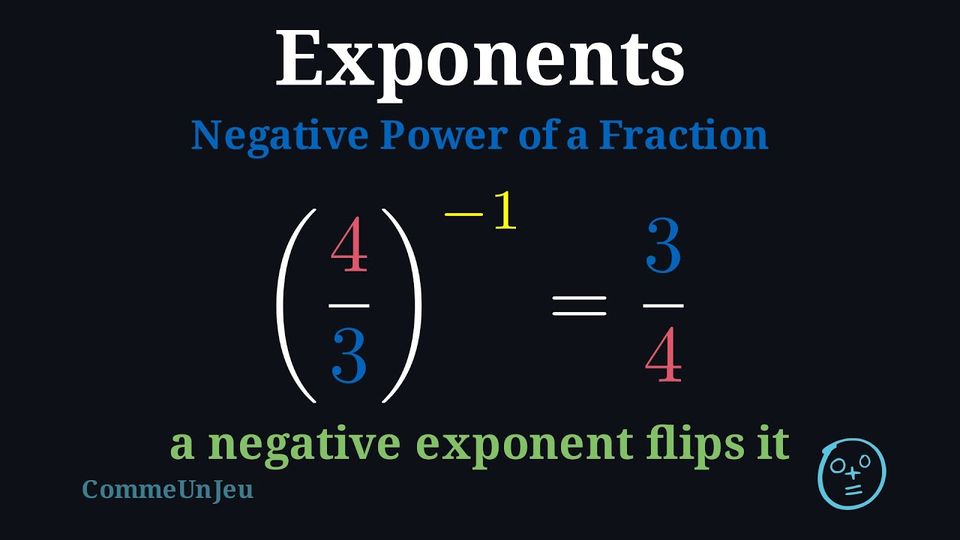
&= \left(\dfrac{\textcolor{colorprop}{3}}{\textcolor{colordef}{5}}\right)^{\textcolor{olive}{2}}\end{aligned}$$ In general, when a quotient \(\dfrac{\textcolor{colordef}{a}}{\textcolor{colorprop}{b}}\) is raised to a negative power \(\textcolor{olive}{-n}\), $$\left(\dfrac{\textcolor{colordef}{a}}{\textcolor{colorprop}{b}}\right)^{\textcolor{olive}{-n}} = \left(\dfrac{\textcolor{colorprop}{b}}{\textcolor{colordef}{a}}\right)^{\textcolor{olive}{n}}.$$ This means that a negative exponent makes the fraction flip: the numerator and denominator swap places.
Proposition — Exponent Law 6
For non-zero numbers \(a\) and \(b\), and any integer \(n\), $$\left(\dfrac{\textcolor{colordef}{a}}{\textcolor{colorprop}{b}}\right)^{\textcolor{olive}{-n}} = \left(\dfrac{\textcolor{colorprop}{b}}{\textcolor{colordef}{a}}\right)^{\textcolor{olive}{n}}$$ and in particular, $$\left(\dfrac{\textcolor{colordef}{a}}{\textcolor{colorprop}{b}}\right)^{\textcolor{olive}{-1}} = \dfrac{\textcolor{colorprop}{b}}{\textcolor{colordef}{a}}.$$ Example
Calculate \(\left(\dfrac{\textcolor{colordef}{2}}{\textcolor{colorprop}{7}}\right)^{-2}\).
$$\begin{aligned}\left(\dfrac{\textcolor{colordef}{2}}{\textcolor{colorprop}{7}}\right)^{-2} &= \left(\dfrac{\textcolor{colorprop}{7}}{\textcolor{colordef}{2}}\right)^{2} \\
&= \dfrac{7^2}{2^2}\\
&= \dfrac{49}{4} \\
\end{aligned}$$
Skills to practice
- Calculating Powers of a Quotient with a Negative Exponent
- Simplifying with Several Laws
II
Writing Numbers in Standard Form
Powers of Ten
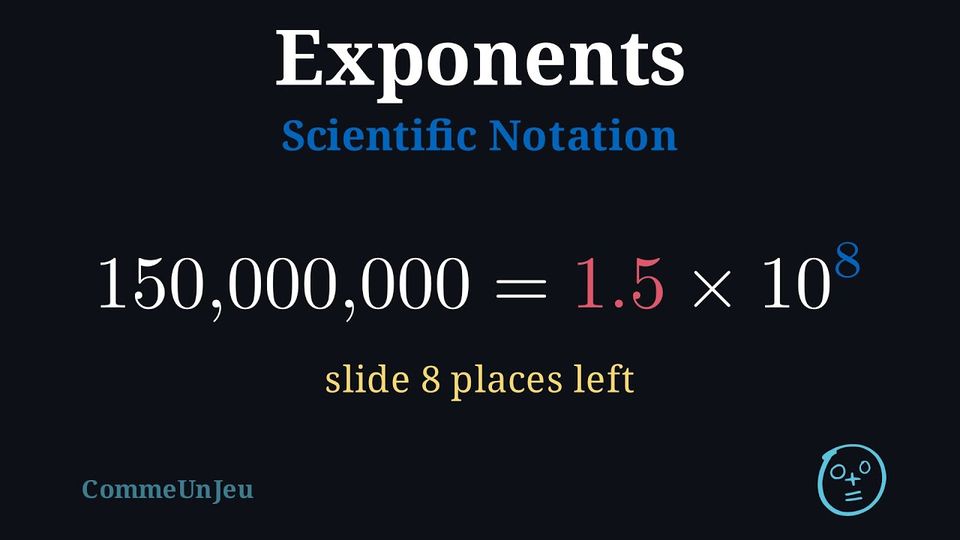
Our number system is base ten, so the powers of ten are the first ones to know. A positive exponent counts the zeros after the \(1\); a negative exponent counts the decimal places, the digit \(1\) being the last one: $$10^3 = 1\,000, \qquad 10^2 = 100, \qquad 10^1 = 10, \qquad 10^0 = 1, \qquad 10^{-1} = \frac{1}{10} = 0.1, \qquad 10^{-2} = \frac{1}{100} = 0.01, \qquad 10^{-3} = \frac{1}{1\,000} = 0.001.$$ In general, for a whole number \(n \geq 1\), \(10^n\) is written \(1\) followed by \(n\) zeros, and \(10^{-n} = \dfrac{1}{10^n}\) is written \(0.0\ldots01\) with \(n\) decimal places. Multiplying a number by \(10^n\) moves its decimal point \(n\) places to the right, and multiplying it by \(10^{-n}\) moves its decimal point \(n\) places to the left: \(2.45 \times 10^{3} = 2\,450\) and \(2.45 \times 10^{-3} = 0.002\,45\).
Example
Write \(10^4\) and \(10^{-3}\) in decimal form, then write \(1\,000\,000\) and \(0.000\,01\) as powers of ten.
\(10^4 = 10\,000\) (\(1\) followed by four zeros) and \(10^{-3} = \dfrac{1}{10^3} = \dfrac{1}{1\,000} = 0.001\) (three decimal places). Conversely, \(1\,000\,000\) is \(1\) followed by six zeros, so \(1\,000\,000 = 10^6\); and \(0.000\,01\) has five decimal places, so \(0.000\,01 = \dfrac{1}{100\,000} = 10^{-5}\).
Working with very large or very small numbers can be awkward. The powers of ten rewrite such numbers in a shorter form that is easier to work with: this way of writing numbers is called scientific notation, and it is especially useful in science.
Definition — Scientific Notation
A non-zero decimal number is expressed in scientific notation when it is written in the form:
Another Name: Standard Form
Scientific notation is also called standard form: \(3.84 \times 10^{5}\) is the standard form of \(384\,000\). This form is unique. A number written \(a \times 10^n\), with \(1 \leq a < 10\), lies between \(10^n\) (included) and \(10^{n+1}\) (excluded); so for a positive number \(x\) there is only one integer \(n\) such that \(10^n \leq x < 10^{n+1}\), and then \(a = x \div 10^n\). A negative number \(-x\) is written \(-a \times 10^n\) with the same \(a\) and \(n\) as \(x\). So \(38.4 \times 10^{4}\) and \(0.384 \times 10^{6}\) are both equal to \(384\,000\), but neither is in standard form, because \(38.4 \geq 10\) and \(0.384 < 1\). In other contexts, the words “standard form” name other agreed ways of writing: the usual writing \(384\,000\) of a number, as opposed to its expanded form, or \(ax^2 + bx + c\) for a quadratic expression. The context tells which one is meant.
Note
When \(n \geq 1\), the number is large: its absolute value is greater than or equal to \(10\). When \(n = 0\), its absolute value is between \(1\) (included) and \(10\) (excluded). When \(n\) is negative, the number is small: its absolute value is less than \(1\), but the number is not \(0\).
Example
Write \(245\) in scientific notation.
$$\begin{aligned}[t]245 &= 2.45 \times 100 \\
&= 2.45 \times 10^2\end{aligned}$$ So \(245\) in scientific notation is \(2.45 \times 10^2\).
Example
Write \(0.002\,45\) in scientific notation.
The coefficient must be between \(1\) and \(10\): the digits \(2\), \(4\), \(5\) give \(a = 2.45\). To go from \(2.45\) to \(0.002\,45\), the decimal point moves \(3\) places to the left, which is a multiplication by \(10^{-3}\): $$0.002\,45 = 2.45 \times 0.001 = 2.45 \times 10^{-3}.$$ A number strictly between \(0\) and \(1\) always has a negative exponent in scientific notation.
Skills to practice
- Writing Numbers as Powers of Ten
- Expressing Numbers in Scientific Notation
- Expressing in Decimal Form
- Comparing Numbers Written with Powers of Ten
- Expressing Real-World Quantities in Scientific Notation
III
Using Prefixes from Nano to Giga
Prefixes from Nano to Giga
In the sciences, the powers of ten are hidden in prefixes placed before a unit. From the smallest to the largest:
So \(1\) kilometre is \(10^3\) metres, \(1\) milligram is \(10^{-3}\) gram and \(1\) nanometre is \(10^{-9}\) metre. The prefix turns a very large or very small measurement into a small number: a distance of \(7\,000\,000\) m is \(7\) Mm, a volume of \(0.000\,003\) L is \(3\) \(\mu\)L.
| prefix | symbol | power of ten |
| nano | n | \(10^{-9}\) |
| micro | \(\mu\) | \(10^{-6}\) |
| milli | m | \(10^{-3}\) |
| kilo | k | \(10^{3}\) |
| mega | M | \(10^{6}\) |
| giga | G | \(10^{9}\) |
Example
Express \(3\) \(\mu\)L in litres and \(7\) MW (megawatts) in watts, in scientific notation. Then write \(5 \times 10^{-3}\) g with a prefix.
The prefix micro means \(10^{-6}\), so \(3\) \(\mu\)L \(= 3 \times 10^{-6}\) L \(= 0.000\,003\) L. The prefix mega means \(10^{6}\), so \(7\) MW \(= 7 \times 10^{6}\) W \(= 7\,000\,000\) W. Conversely, \(10^{-3}\) is the prefix milli: \(5 \times 10^{-3}\) g \(= 5\) mg.
Skills to practice
- Converting with Prefixes from Nano to Giga
IV
Computing in Standard Form
Method — Computing with Scientific Notation
To multiply or divide two numbers written in scientific notation: - Group: multiply (or divide) the coefficients together, and the powers of ten together — with the laws of exponents, \(10^m \times 10^n = 10^{m+n}\) and \(\dfrac{10^m}{10^n} = 10^{m-n}\).
- Put back into scientific notation: if the coefficient obtained, sign apart, is not at least \(1\) and less than \(10\), move its decimal point and adjust the exponent. Moving the point one place to the left adds \(1\) to the exponent: \(15 \times 10^{2} = 1.5 \times 10^{3}\). Moving it one place to the right subtracts \(1\) from the exponent: \(0.5 \times 10^{-3} = 5 \times 10^{-4}\).
Example
Write in scientific notation: \(A = (3 \times 10^{4}) \times (5 \times 10^{-2})\) and \(B = \dfrac{3 \times 10^{2}}{6 \times 10^{5}}\).
$$\begin{aligned}[t] A &= (3 \times 5) \times (10^{4} \times 10^{-2}) \\
&= 15 \times 10^{2} && (10^{4 + (-2)} = 10^{2}) \\
&= 1.5 \times 10^{1} \times 10^{2} && (15 = 1.5 \times 10) \\
&= \textcolor{colordef}{1.5 \times 10^{3}} \end{aligned}$$ The coefficient \(15\) was not between \(1\) and \(10\): the point moves one place to the left, so the exponent goes up by one. $$\begin{aligned}[t] B &= \dfrac{3}{6} \times \dfrac{10^{2}}{10^{5}} && \text{(group)} \\
&= 0.5 \times 10^{-3} && (10^{2 - 5} = 10^{-3}) \\
&= 5 \times 10^{-1} \times 10^{-3} && (0.5 = 5 \times 10^{-1}) \\
&= \textcolor{colordef}{5 \times 10^{-4}} \end{aligned}$$
Scientific Notation on a Calculator
A calculator displays a very large or very small result in scientific notation, in a format of its own: for \(5.2 \times 10^{30}\), the screen may show
5.2E30, 5.2e30 or \(5.2 \times 10^{30}\), depending on the model. -
5.2E30and5.2e30are screen formats, not the scientific notation of mathematics: the result is written \(5.2 \times 10^{30}\), never5.2E30. In the same way, the display3.7E-5is written \(3.7 \times 10^{-5}\). - To key in a number written in scientific notation, the key \(\boxed{\times 10^{x}}\) (named \(\boxed{\text{EXP}}\) or \(\boxed{\text{EE}}\) on some models) enters the power of ten: \(6.02 \times 10^{23}\) is keyed in as \(6.02\ \boxed{\times 10^{x}}\ 23\).
Example
Using a calculator, write in scientific notation \(A = (6.4 \times 10^{5}) \times (3.9 \times 10^{8})\) and \(B = \dfrac{1}{2^{40}}\), the coefficient of \(B\) rounded to two decimal places.
For \(A\), the calculator displays
2.496E14, which is written \(A = 2.496 \times 10^{14}\). The Method gives the same result by hand: $$\begin{aligned}[t] A &= (6.4 \times 3.9) \times (10^{5} \times 10^{8}) && \text{(group)} \\
&= 24.96 \times 10^{13} \\
&= 2.496 \times 10^{14}. \end{aligned}$$ For \(B\), the calculator displays 9.094947018E-13. The coefficient rounded to two decimal places is \(9.09\), so $$B \approx 9.09 \times 10^{-13}.$$ \(0 < B < 1\), so its exponent is negative. Skills to practice
- Computing with Scientific Notation
- Computing with Scientific Notation on a Calculator
V
Going further
Skills to practice
- Problems
- Investigating Patterns in Scientific Notation
- Quiz
Jump to section