International Baccalaureate · MYP 5 Extended
Right-Angled Trigonometry and Bearings
I
Using Exact Values of the Trigonometric Ratios
Proposition — Exact Values of the Trigonometric Ratios
For the angles \(30^\circ\), \(45^\circ\) and \(60^\circ\), the trigonometric ratios have exact values: | \(\theta\) | \(30^\circ\) | \(45^\circ\) | \(60^\circ\) |
| \(\sin\theta\) | \(\dfrac{1}{2}\) | \(\dfrac{\sqrt{2}}{2}\) | \(\dfrac{\sqrt{3}}{2}\) |
| \(\cos\theta\) | \(\dfrac{\sqrt{3}}{2}\) | \(\dfrac{\sqrt{2}}{2}\) | \(\dfrac{1}{2}\) |
| \(\tan\theta\) | \(\dfrac{\sqrt{3}}{3}\) | \(1\) | \(\sqrt{3}\) |
The half-square: \(45^\circ\). Cut a square of side \(1\) along a diagonal: the triangle \(ABC\), right-angled at \(B\), is isosceles, so its two acute angles are equal, and they add up to \(90^\circ\): each measures \(45^\circ\). By Pythagoras' theorem, its hypotenuse measures \(AC = \sqrt{1^2 + 1^2} = \sqrt{2}\). 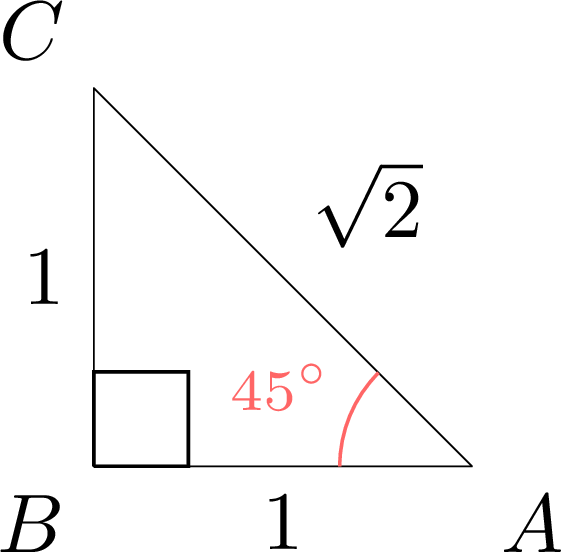
At the angle \(A\), the side \(BC = 1\) is opposite and the side \(AB = 1\) is adjacent: $$\begin{aligned}[t] \sin 45^\circ &= \frac{BC}{AC} = \frac{1}{\sqrt{2}} = \frac{\sqrt{2}}{2}, && \text{(opposite over hypotenuse)}\\
\cos 45^\circ &= \frac{AB}{AC} = \frac{1}{\sqrt{2}} = \frac{\sqrt{2}}{2}, && \text{(adjacent over hypotenuse)}\\
\tan 45^\circ &= \frac{BC}{AB} = \frac{1}{1} = 1. && \text{(opposite over adjacent)} \end{aligned}$$ The half-equilateral triangle: \(30^\circ\) and \(60^\circ\). In an equilateral triangle \(ABC\) of side \(2\), each angle measures \(60^\circ\). The altitude \(\Segment{AH}\) is also a line of symmetry: it cuts the side \(\Segment{BC}\) at its midpoint, so \(BH = 1\), and it cuts the angle at \(A\) into two angles of \(30^\circ\). By Pythagoras' theorem in the triangle \(ABH\), right-angled at \(H\): \(AH = \sqrt{2^2 - 1^2} = \sqrt{3}\). 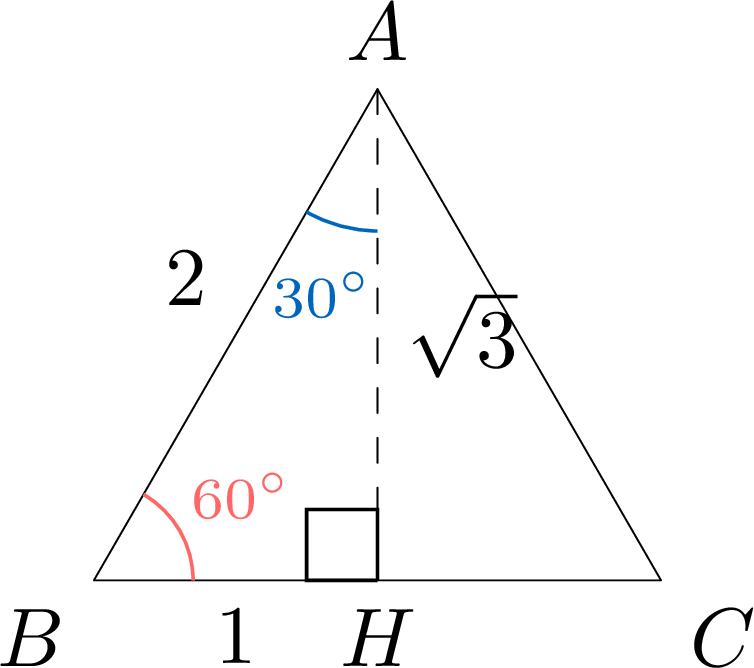
In the triangle \(ABH\), the side \(AH = \sqrt{3}\) is opposite the angle \(B = 60^\circ\) and adjacent to the angle \(\Angle{BAH} = 30^\circ\); the side \(BH = 1\) is the reverse: $$\begin{aligned}[t] \sin 60^\circ &= \frac{AH}{AB} = \frac{\sqrt{3}}{2}, & \cos 60^\circ &= \frac{BH}{AB} = \frac{1}{2}, & \tan 60^\circ &= \frac{AH}{BH} = \sqrt{3},\\
\sin 30^\circ &= \frac{BH}{AB} = \frac{1}{2}, & \cos 30^\circ &= \frac{AH}{AB} = \frac{\sqrt{3}}{2}, & \tan 30^\circ &= \frac{BH}{AH} = \frac{1}{\sqrt{3}} = \frac{\sqrt{3}}{3}. \end{aligned}$$
Example
The triangle \(ABC\) is right-angled at \(B\), with \(AC = 10\) cm and \(\Angle{BAC} = 30^\circ\). Without a calculator, find the exact lengths \(BC\) and \(AB\).
At the angle \(A\), the hypotenuse is \(AC = 10\), the side \(\Segment{BC}\) is opposite and the side \(\Segment{AB}\) is adjacent: $$\begin{aligned}[t] BC &= AC \times \sin 30^\circ && \text{(opposite = hypotenuse} \times \sin\text{)}\\
&= 10 \times \frac{1}{2} = \mathbf{5} \text{ cm},\\
AB &= AC \times \cos 30^\circ && \text{(adjacent = hypotenuse} \times \cos\text{)}\\
&= 10 \times \frac{\sqrt{3}}{2} = \mathbf{5\sqrt{3}} \text{ cm}. \end{aligned}$$ Check: \(5^2 + \left(5\sqrt{3}\right)^2 = 25 + 75 = 100 = 10^2\) (Pythagoras' theorem).
Skills to practice
- Using Exact Values of the Trigonometric Ratios
II
Calculating Lengths in Solids
A closed umbrella is \(75\) cm long. It has to travel in a box shaped like a cuboid, \(60\) cm long, \(20\) cm wide and \(40\) cm high: every edge of the box is shorter than the umbrella. Can the umbrella fit in the box, lying in a straight line? What angle does the longest segment inside the box make with the bottom of the box?
Place the axes along the three edges from a corner \(A\) of the box, the unit being the centimetre: \(x\) along the width, \(y\) along the length, \(z\) along the height. 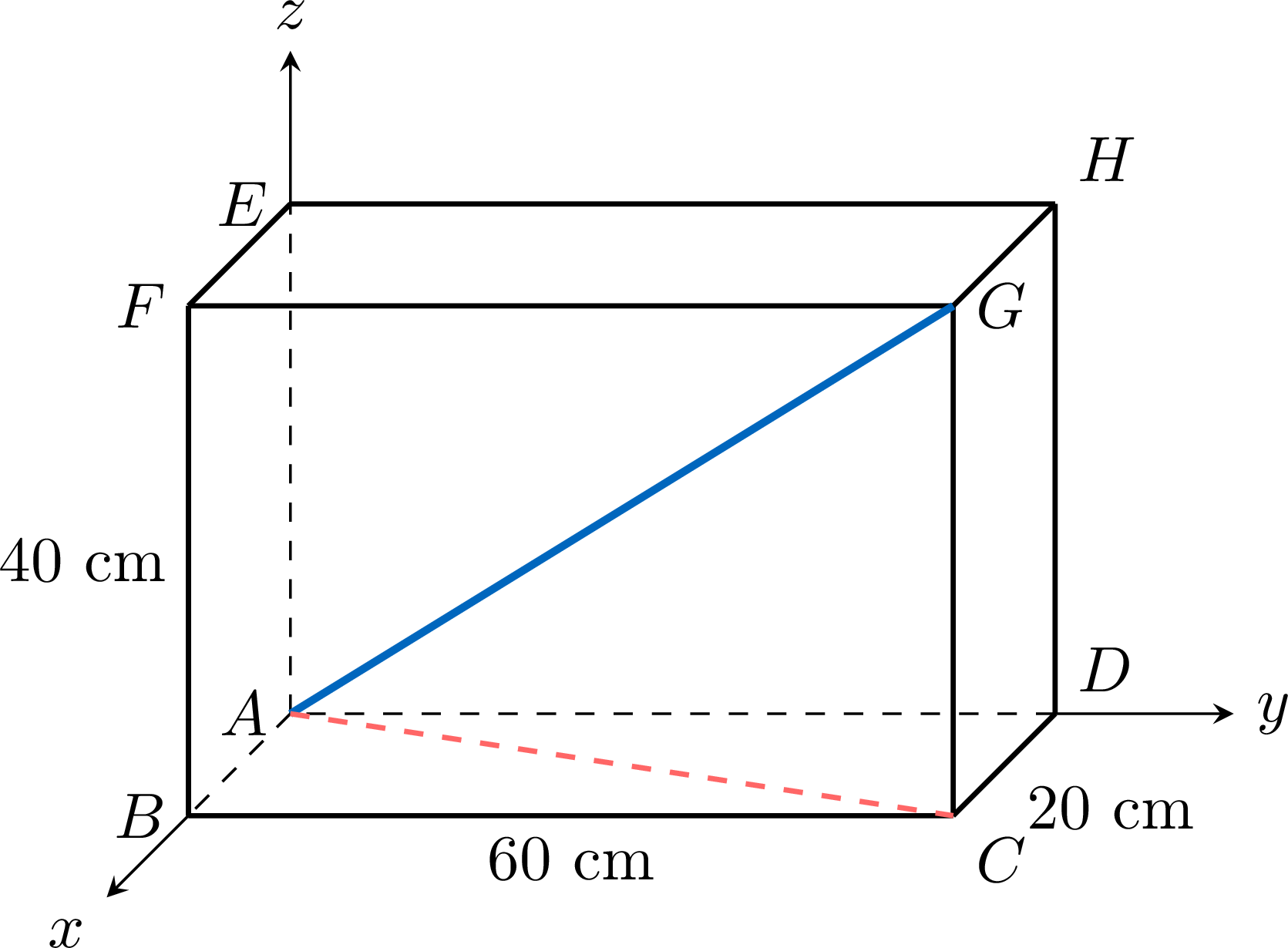
Two points of the box have coordinates that differ by at most \(20\), \(60\) and \(40\) in absolute value, so, by the distance formula, they are at most \(\sqrt{20^2 + 60^2 + 40^2}\) apart: the longest segment inside the box joins \(A\) to the opposite vertex \(G(20, 60, 40)\). $$\begin{aligned}[t] AG &= \sqrt{(20 - 0)^2 + (60 - 0)^2 + (40 - 0)^2} && \text{(distance formula)}\\
&= \sqrt{400 + 3600 + 1600} \\
&= \sqrt{5600} \\
&\approx 74.8 \text{ cm}. \end{aligned}$$ Since \(74.8 < 75\), the umbrella does not fit: about \(2\) mm is missing. The bottom of the box is the face \(ABCD\), in the \(xy\)-plane, and the point of the bottom right below \(G\) is \(C(20, 60, 0)\). The edge \(\Segment{CG}\) is vertical, so the triangle \(ACG\) is right-angled at \(C\), and the angle sought is \(\theta = \Angle{GAC}\), with \(CG = 40\): $$\begin{aligned}[t] AC &= \sqrt{20^2 + 60^2} && \text{(Pythagoras' theorem in the bottom)}\\
&= \sqrt{4000},\\
\tan\theta &= \frac{CG}{AC} && \text{(opposite over adjacent)}\\
&= \frac{40}{\sqrt{4000}}, \end{aligned}$$ so \(\theta = \tan^{-1}\left(\dfrac{40}{\sqrt{4000}}\right) \approx 32.3^\circ\).
Definition — Face Diagonal and Space Diagonal
In a cuboid, a face diagonal joins two opposite vertices of a face, and a space diagonal joins two vertices that lie on no common face. In the cuboid \(ABCDEFGH\), \(\Segment{AC}\) is a diagonal of the face \(ABCD\) and \(\Segment{AG}\) is a space diagonal; the four space diagonals are \(\Segment{AG}\), \(\Segment{BH}\), \(\Segment{CE}\) and \(\Segment{DF}\). 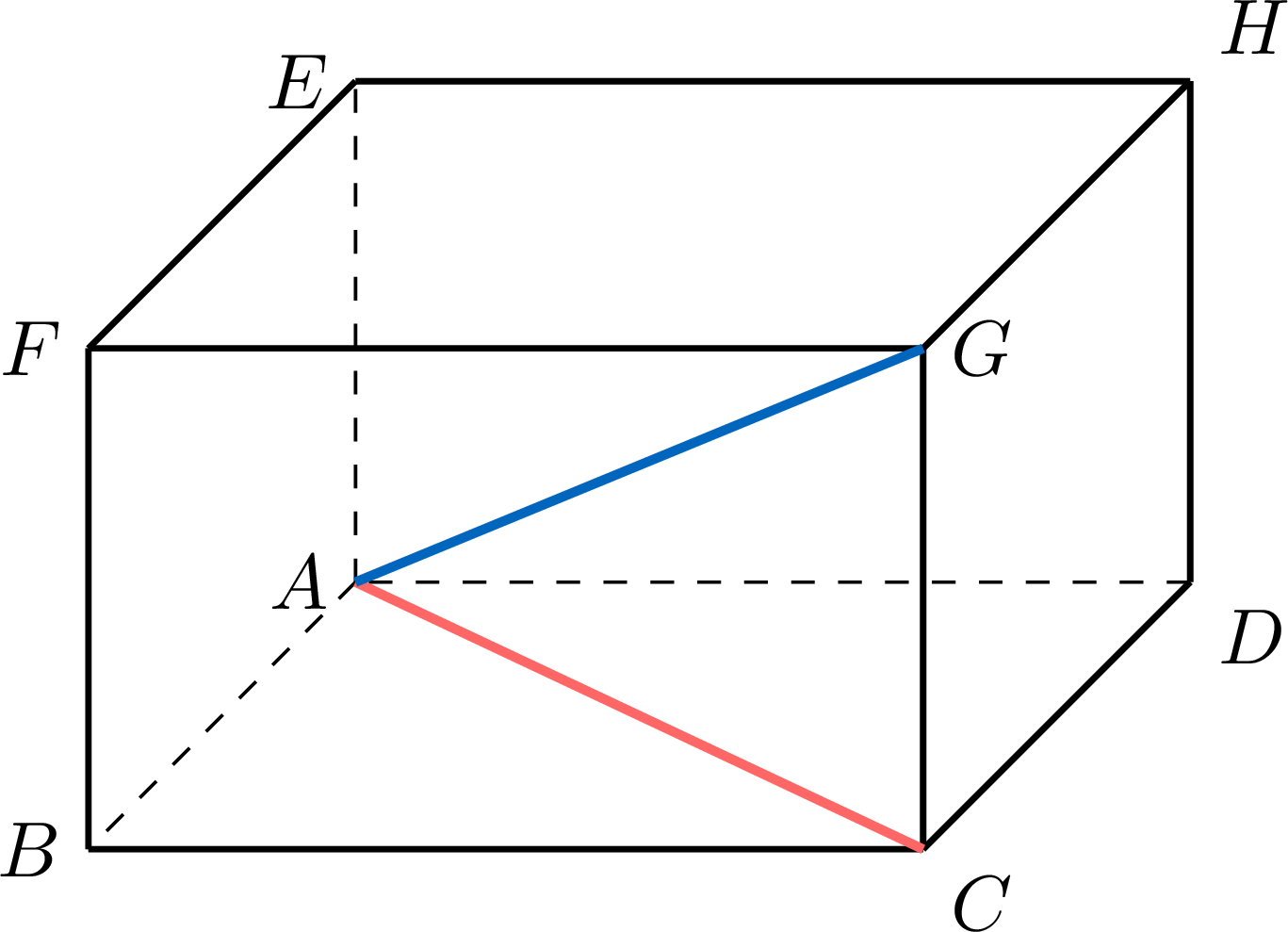
Proposition — Space Diagonals of a Cuboid
In a cuboid whose three edges from one vertex measure \(a\), \(b\) and \(c\), the four space diagonals have the same length $$d = \sqrt{a^2 + b^2 + c^2}$$ and the same midpoint, the centre of the cuboid. In a cube of edge \(a\), the space diagonals measure \(a\sqrt{3}\).
Place the cuboid \(ABCDEFGH\) with \(A\) at the origin and \(\Segment{AB}\), \(\Segment{AD}\), \(\Segment{AE}\) along the axes: \(A(0, 0, 0)\), \(B(a, 0, 0)\), \(C(a, b, 0)\), \(D(0, b, 0)\), \(E(0, 0, c)\), \(F(a, 0, c)\), \(G(a, b, c)\) and \(H(0, b, c)\). 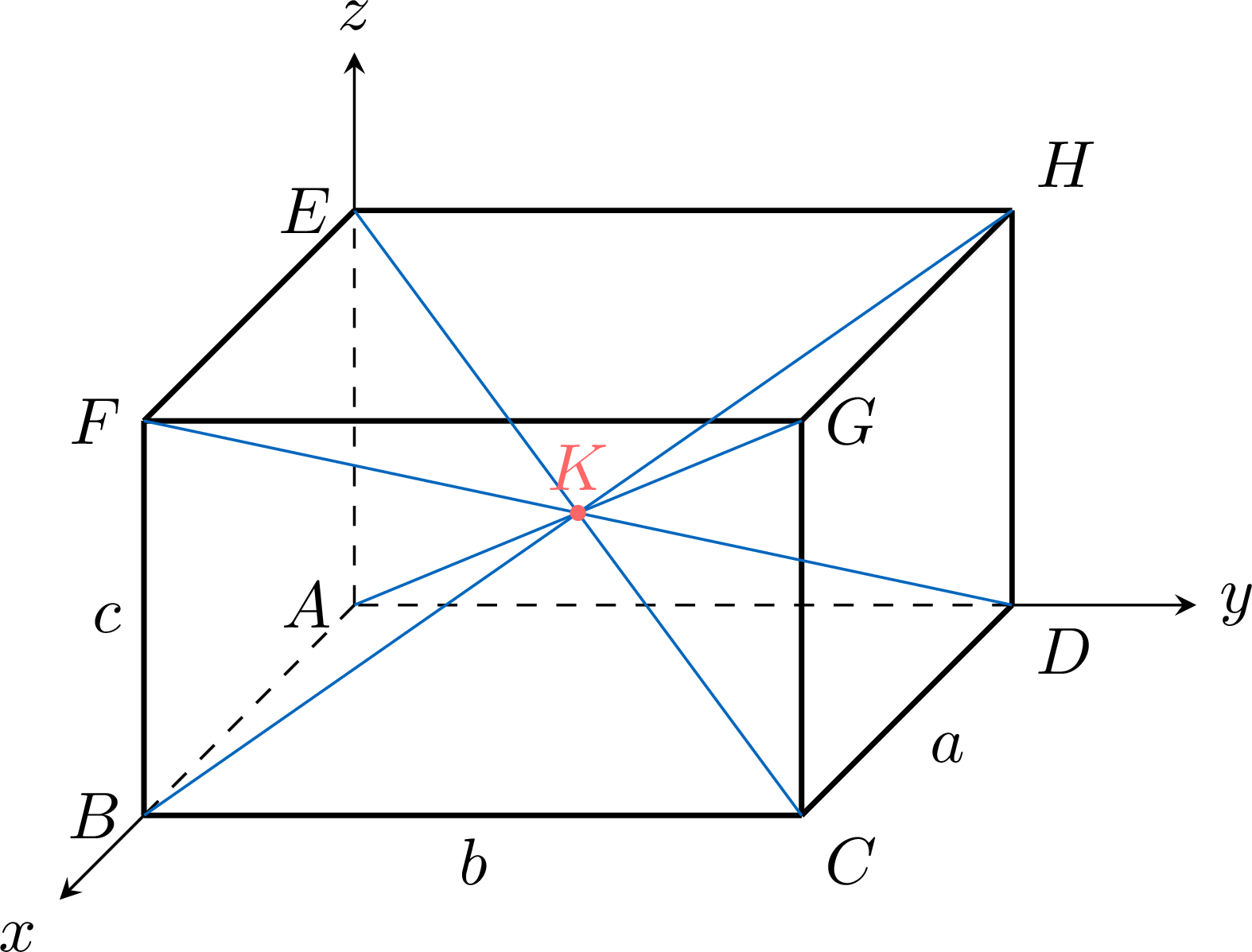
$$\begin{aligned}[t] AG &= \sqrt{(a - 0)^2 + (b - 0)^2 + (c - 0)^2} && \text{(distance formula)}\\
&= \sqrt{a^2 + b^2 + c^2},\\
BH &= \sqrt{(0 - a)^2 + (b - 0)^2 + (c - 0)^2} && \text{(distance formula)}\\
&= \sqrt{a^2 + b^2 + c^2}. && \text{(} (-a)^2 = a^2 \text{)} \end{aligned}$$ The endpoints of \(\Segment{CE}\) and of \(\Segment{DF}\) also differ by \(a\), \(b\) and \(c\) in absolute value — for instance \(C(a, b, 0)\) and \(E(0, 0, c)\) — so \(CE = DF = \sqrt{a^2 + b^2 + c^2}\) as well. By the midpoint formula, the midpoint of \(\Segment{AG}\) is \(\left(\frac{0 + a}{2}, \frac{0 + b}{2}, \frac{0 + c}{2}\right) = \left(\frac{a}{2}, \frac{b}{2}, \frac{c}{2}\right)\), and that of \(\Segment{BH}\) is \(\left(\frac{a + 0}{2}, \frac{0 + b}{2}, \frac{0 + c}{2}\right)\), the same point \(K\); the same holds for \(\Segment{CE}\) and \(\Segment{DF}\). For a cube, \(a = b = c\) and \(d = \sqrt{3a^2} = a\sqrt{3}\).
Skills to practice
- Calculating Lengths with the Space Diagonal
III
Finding Angles in Solids
A vertical mast \(\Segment{FT}\) stands \(6\,\text{m}\) tall; a guy-wire runs from its top \(T\) down to an anchor \(B\) on the ground, \(8\,\text{m}\) from the foot \(F\). What angle does the wire make with the ground? This is no longer an angle of a figure drawn on the ground — it is the angle between a line (the wire) and a plane (the ground). The trick is to find the wire's shadow on the ground, the segment \(\Segment{BF}\): the wire, its shadow, and the mast form a right-angled triangle standing up out of the plane. 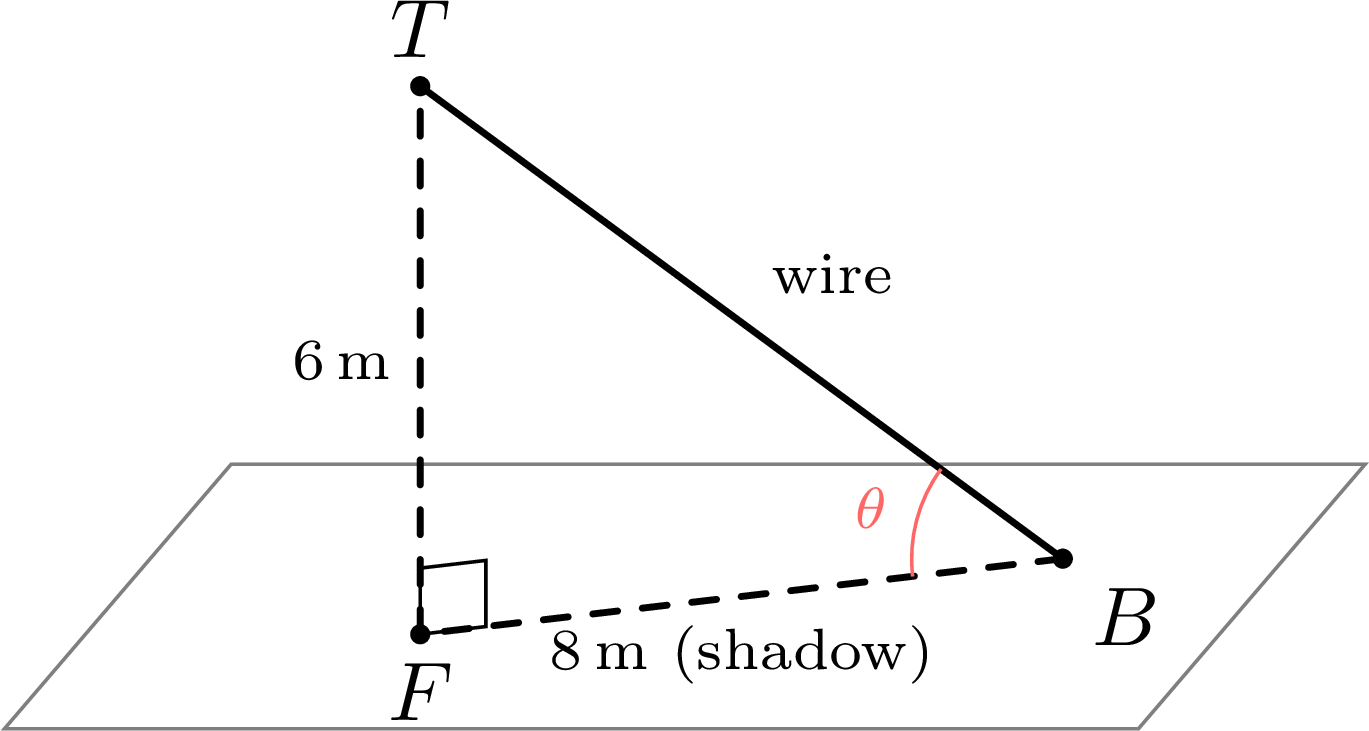
The ratios of the right-angled triangle, used in three dimensions, find the angle between a line and a plane (here \(\tan\theta=\tfrac{6}{8}\)), the key to angles in pyramids, prisms and ramps.
The wire \(\Segment{BT}\), its shadow \(\Segment{BF}\) and the mast \(\Segment{FT}\) form a triangle right-angled at \(F\), since the mast is vertical. Relative to the angle \(\theta\) at \(B\), the mast is the opposite side and the shadow is the adjacent side: $$\begin{aligned}[t] \tan\theta &= \frac{FT}{BF} = \frac{6}{8} && {\scriptstyle(\text{opposite over adjacent})}\\
\theta &= \tan^{-1}\left(\frac{6}{8}\right) \approx 36.9^\circ. \end{aligned}$$ The wire makes an angle of about \(36.9^\circ\) with the ground.
Method — Finding the Angle Between Two Intersecting Lines
Two lines of space that meet at a point \(A\) lie in one plane: the angle between them is an angle of a triangle. To find it: - choose a triangle: take one more point on each line, \(B\) and \(C\); the angle sought is \(\Angle{BAC}\);
- compute the three sides \(AB\), \(AC\) and \(BC\), with the distance formula or with Pythagoras' theorem in a face;
- choose the tool: if the triangle is right-angled — the converse of Pythagoras' theorem decides — use a trigonometric ratio at \(A\); if it is isosceles with apex \(A\), that is if \(AB = AC\), its median from \(A\) is its line of symmetry: it cuts the triangle into two right-angled triangles, so use a trigonometric ratio in one of them, then double the angle obtained; otherwise, the law of cosines, met with non-right-angled triangles, gives the angle.
Example
The cuboid \(ABCDEFGH\) has \(A\) at the origin, \(B(4, 0, 0)\), \(D(0, 3, 0)\) and \(E(0, 0, 2)\). Calculate the angle between the space diagonal \(\Segment{AG}\) and the edge \(\Segment{AE}\), to the nearest tenth of a degree.
The vertex opposite \(A\) is \(G(4, 3, 2)\). The angle sought is \(\theta = \Angle{GAE}\), in the triangle \(AEG\). 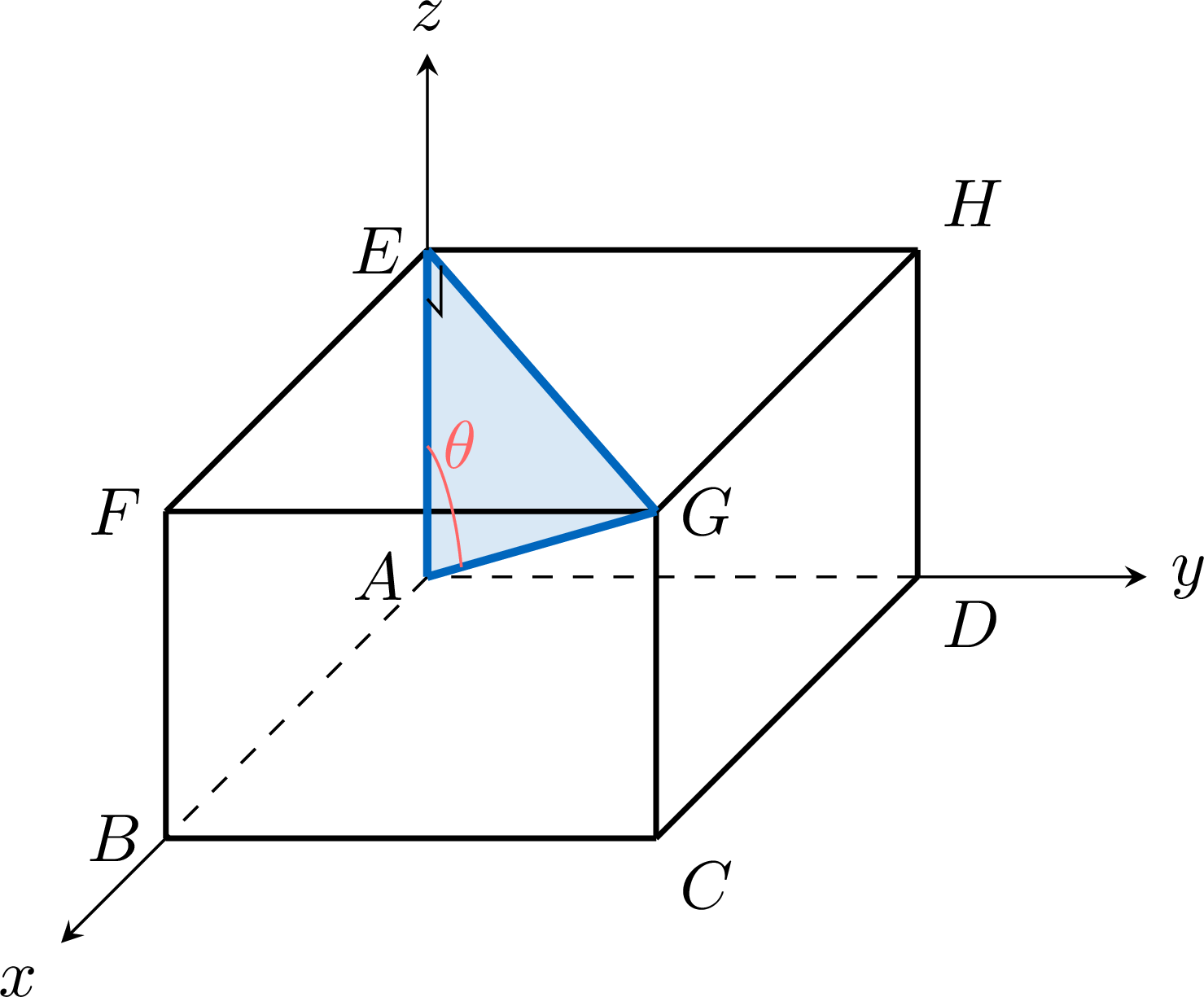
Its sides: \(AE = 2\), \(EG = \sqrt{(4-0)^2 + (3-0)^2 + (2-2)^2} = \sqrt{25} = 5\) and \(AG = \sqrt{4^2 + 3^2 + 2^2} = \sqrt{29}\). Since \(AE^2 + EG^2 = 4 + 25 = 29 = AG^2\), the triangle \(AEG\) is right-angled at \(E\), by the converse of Pythagoras' theorem. The side \(\Segment{AE}\) is adjacent to \(\theta\) and \(\Segment{AG}\) is the hypotenuse: $$\begin{aligned}[t] \cos\theta &= \frac{AE}{AG} && \text{(adjacent over hypotenuse)}\\
&= \frac{2}{\sqrt{29}}, \end{aligned}$$ so \(\theta = \cos^{-1}\left(\dfrac{2}{\sqrt{29}}\right) \approx 68.2^\circ\).
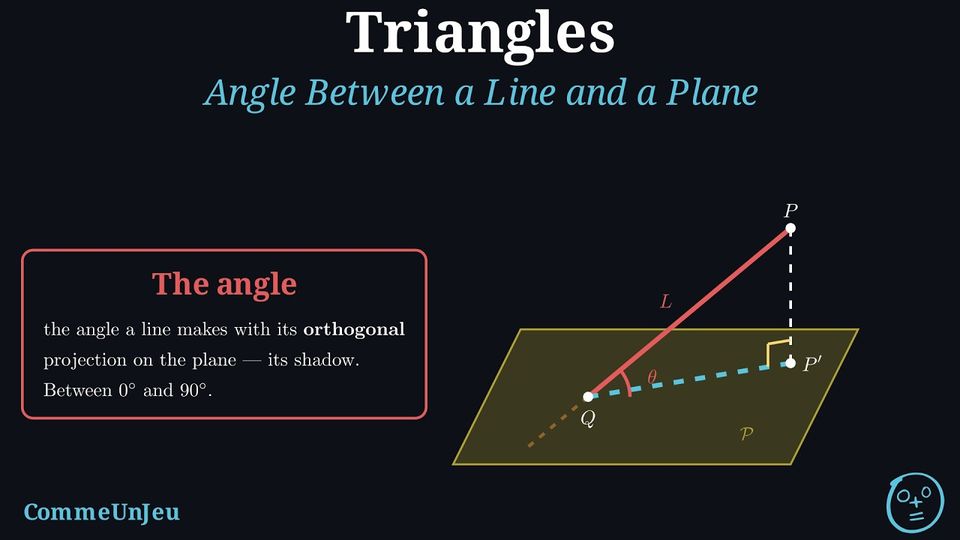
When the sun shines on the gnomon of a sundial, it casts a shadow onto the dial beneath it. If the sun's rays are perpendicular to the dial, the shadow formed is the projection of the gnomon onto the dial. This concept of projection is key when defining the angle between a line and a plane in three dimensions. 
Definition — Angle Between a Line and a Plane
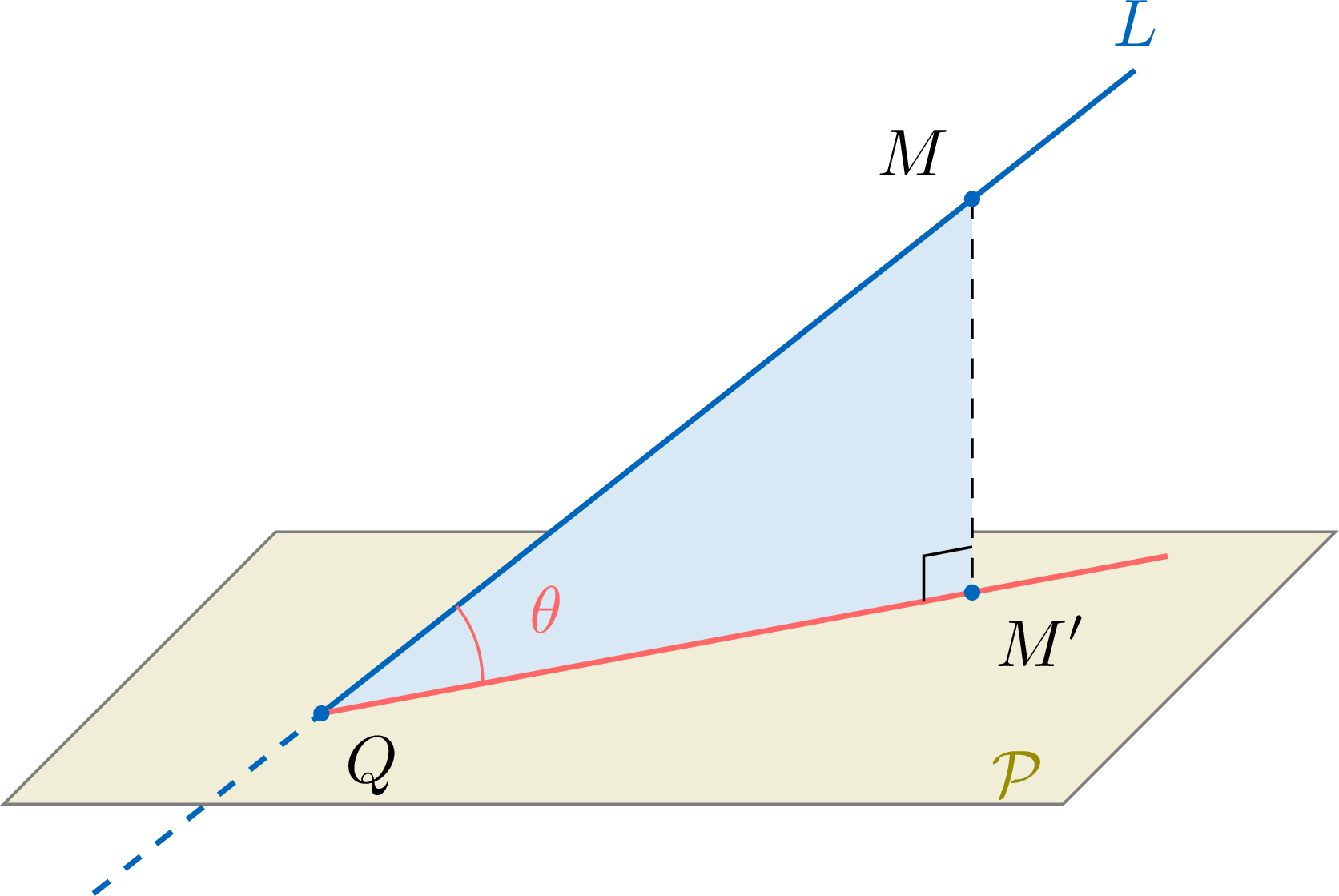
Let \(\mathcal{P}\) be a plane and \(M\) a point outside it. The orthogonal projection of \(M\) on \(\mathcal{P}\) is the point \(M'\) of \(\mathcal{P}\) such that the line \(\Line{MM'}\) is perpendicular to \(\mathcal{P}\): the foot of the perpendicular dropped from \(M\). Let a line \(L\) meet \(\mathcal{P}\) at a point \(Q\), and let \(M'\) be the projection of a point \(M\) of \(L\) outside \(\mathcal{P}\). The angle between the line \(L\) and the plane \(\mathcal{P}\) is the angle \(\theta = \Angle{MQM'}\) between \(L\) and its projection \(\Line{QM'}\). It lies between \(0^\circ\) and \(90^\circ\). When \(L\) is perpendicular to \(\mathcal{P}\), the projection of \(M\) is \(Q\) itself and the angle is taken equal to \(90^\circ\); when \(L\) lies in \(\mathcal{P}\) or is parallel to it, the angle is taken equal to \(0^\circ\). 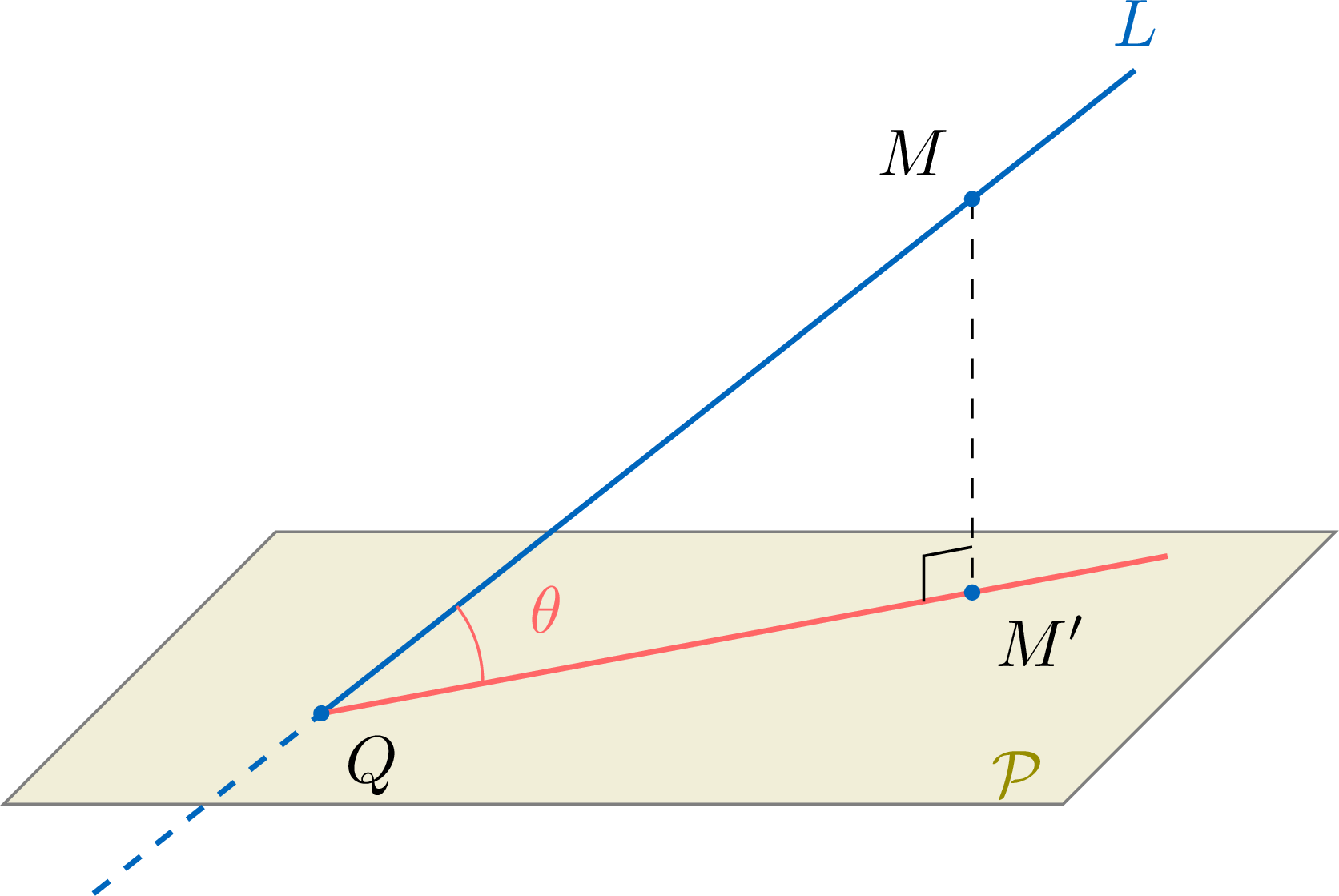
Method — Finding the Angle Between a Line and a Plane
To find the angle \(\theta\) between a line \(\Line{QM}\) and a plane \(\mathcal{P}\) that it meets at \(Q\) — the line being neither perpendicular to the plane, otherwise \(\theta = 90^\circ\), nor contained in it, otherwise \(\theta = 0^\circ\): - project \(M\) on the plane: choose a point \(M\) of the line outside the plane and drop the perpendicular from \(M\) to the plane; its foot \(M'\) is the projection of \(M\), and the line \(\Line{QM'}\) is the projection of the line on the plane. With coordinates, on the \(xy\)-plane, the projection of \(M(x, y, z)\) is \(M'(x, y, 0)\), right below or right above \(M\); on a plane parallel to a coordinate plane — a face of a cuboid placed along the axes, for instance — the coordinate that is constant on the plane takes its value, the other two are kept;
- draw the right-angled triangle \(QM'M\), formed by the segment \(\Segment{QM}\) of the line, its projection \(\Segment{QM'}\) and the perpendicular \(\Segment{MM'}\), right-angled at \(M'\);
- compute two of its sides and use a trigonometric ratio at \(Q\) (SOH-CAH-TOA), for instance \(\tan\theta = \dfrac{MM'}{QM'}\): the result is the acute angle \(\theta\) between the line and its projection.
Example
The pyramid \(SABCD\) has a square base \(ABCD\) in the \(xy\)-plane, with \(A(0, 0, 0)\), \(B(6, 0, 0)\), \(C(6, 6, 0)\) and \(D(0, 6, 0)\), and its apex is \(S(3, 3, 4)\). Calculate the angle between the edge \(\Segment{SC}\) and the base, to the nearest tenth of a degree.
The edge meets the base at \(C\). The projection of \(S(3, 3, 4)\) on the base, the \(xy\)-plane, is \(K(3, 3, 0)\), the centre of the square. The angle sought is \(\theta = \Angle{SCK}\), in the triangle \(CKS\) right-angled at \(K\). 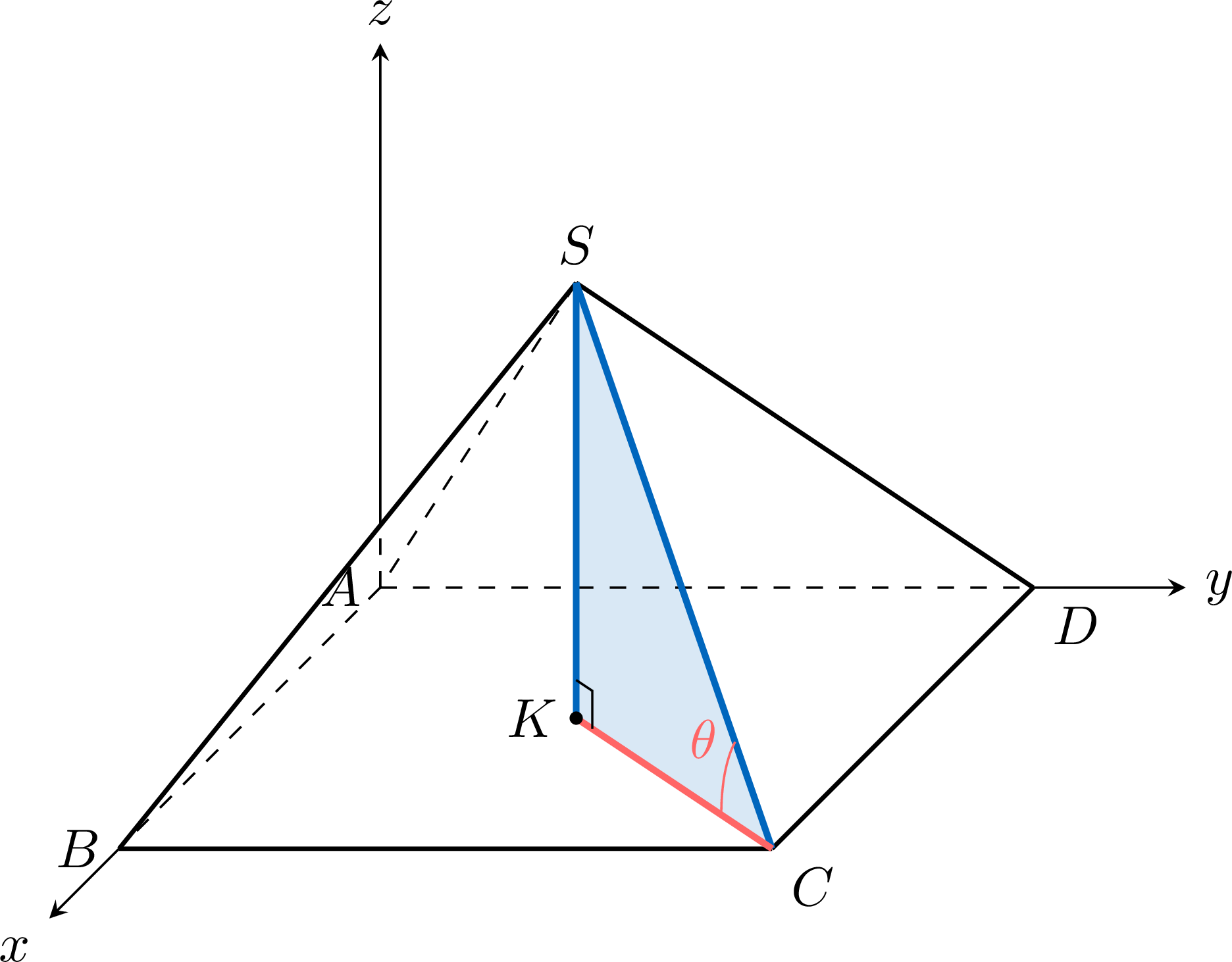
Its sides: \(SK = 4\) and \(CK = \sqrt{(3 - 6)^2 + (3 - 6)^2 + 0^2} = \sqrt{18} = 3\sqrt{2}\). The side \(\Segment{SK}\) is opposite \(\theta\) and \(\Segment{CK}\) adjacent: $$\begin{aligned}[t] \tan\theta &= \frac{SK}{CK} && \text{(opposite over adjacent)}\\
&= \frac{4}{3\sqrt{2}}, \end{aligned}$$ so \(\theta = \tan^{-1}\left(\dfrac{4}{3\sqrt{2}}\right) \approx 43.3^\circ\).
Skills to practice
- Finding the Angle Between Two Lines or Between a Line and a Plane
- Solving Problems in Space
IV
Solving Two-Leg Journeys
Method — Solving a Two-Leg Journey with a Right Angle
A journey in two straight legs goes from a start \(P\) to a turning point \(Q\) on a bearing \(\theta_1\), then from \(Q\) to a finish \(R\) on a bearing \(\theta_2\). When the legs run due North–South and due East–West, or when the traveller turns through \(90^\circ\) at \(Q\), the triangle \(PQR\) is right-angled at \(Q\), and right-angled trigonometry solves it. - Draw the diagram: a North line at \(P\) and at \(Q\), the two legs, and the segment \(\Segment{PR}\) from the start to the finish.
- Check the right angle at \(Q\): at \(Q\) the traveller turns from the bearing \(\theta_1\) to the bearing \(\theta_2\). The angle of this turn and the angle \(\Angle{PQR}\) lie on either side of the extension of \(\Segment{PQ}\) beyond \(Q\), so they add up to \(180^\circ\). A turn of \(90^\circ\) — \(\theta_2 = \theta_1 + 90^\circ\) (a clockwise turn) or \(\theta_2 = \theta_1 - 90^\circ\) (an anticlockwise turn), adding or subtracting \(360^\circ\) when needed — therefore gives \(\Angle{PQR} = 90^\circ\).
- Compute the distance with Pythagoras' theorem: \(PR = \sqrt{PQ^2 + QR^2}\).
- Compute the angle at the start: \(\tan \Angle{QPR} = \dfrac{QR}{PQ}\), the side opposite the angle over the side adjacent to it.
- Give the bearing of \(R\) from \(P\): the finish lies on the side towards which the traveller turned, so this bearing is \(\theta_1 + \Angle{QPR}\) after a clockwise turn and \(\theta_1 - \Angle{QPR}\) after an anticlockwise turn, adding or subtracting \(360^\circ\) to write it with three figures between \(000^\circ\) and \(360^\circ\). The bearing to return from \(R\) to \(P\) is its back bearing, this bearing plus or minus \(180^\circ\).
Example
A yacht sails \(12\) km from a port \(P\) on a bearing of \(050^\circ\) to a buoy \(Q\), then turns onto a bearing of \(140^\circ\) and sails \(5\) km to a point \(R\). - Show that the angle \(\Angle{PQR}\) is a right angle.
- Find the distance \(PR\).
- Find the bearing of \(R\) from \(P\), then the bearing on which the yacht must sail to return straight to \(P\) (to the nearest degree).
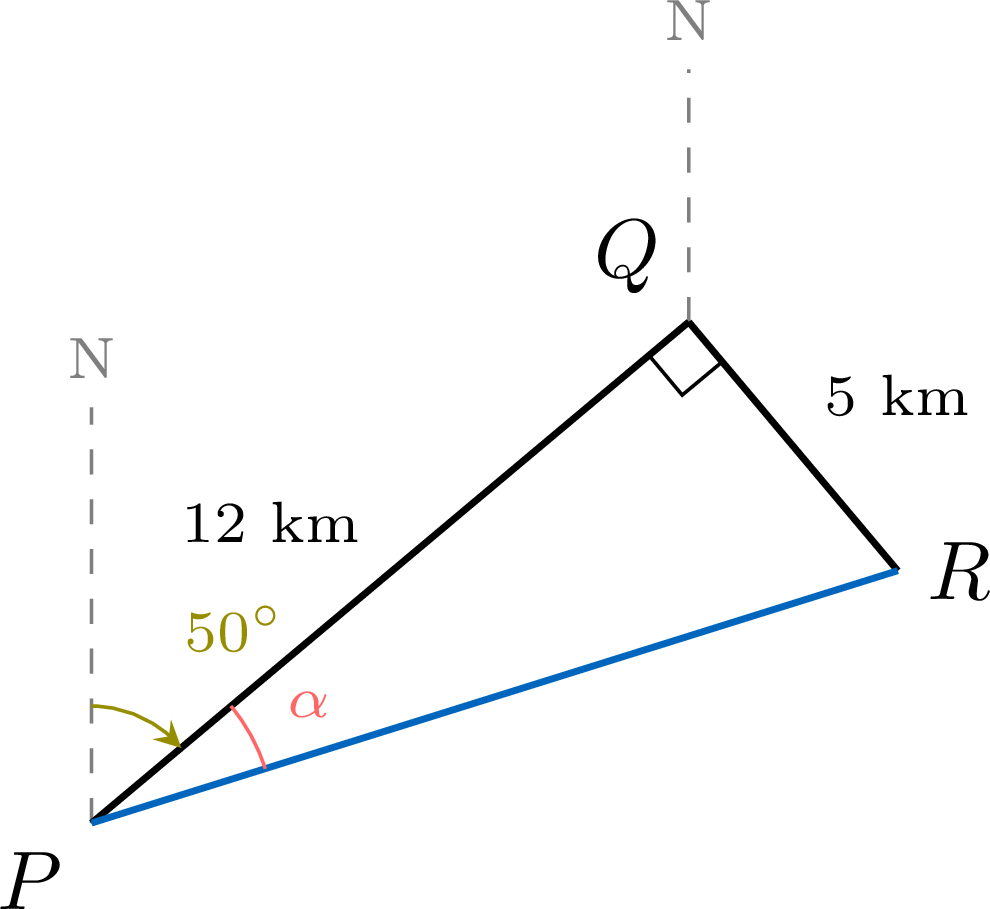
- At \(Q\) the yacht turns from the bearing \(050^\circ\) to the bearing \(140^\circ\): a clockwise turn of \(140^\circ - 50^\circ = 90^\circ\). The turn and the angle \(\Angle{PQR}\) add up to \(180^\circ\) (they lie on either side of the extension of \(\Segment{PQ}\)), so \(\Angle{PQR} = 180^\circ - 90^\circ = 90^\circ\).
- In the triangle \(PQR\), right-angled at \(Q\): $$\begin{aligned}[t] PR^2 &= PQ^2 + QR^2 && {\scriptstyle(\text{Pythagoras' theorem})}\\ &= 12^2 + 5^2 = 169, \end{aligned}$$ so \(PR = \sqrt{169} = \mathbf{13}\) km.
- In the same triangle, \(\Segment{QR}\) is opposite the angle \(\alpha = \Angle{QPR}\) and \(\Segment{PQ}\) is adjacent to it: $$\begin{aligned}[t] \tan\alpha &= \frac{QR}{PQ} = \frac{5}{12} && {\scriptstyle(\text{opposite over adjacent})}\\ \alpha &\approx 22.6^\circ. \end{aligned}$$ The yacht turned clockwise, so seen from \(P\) the point \(R\) lies clockwise from the first leg: the bearing of \(R\) from \(P\) is \(50^\circ + 22.6^\circ = 72.6^\circ\), that is \(\mathbf{073^\circ}\). To return, the yacht follows the back bearing \(72.6^\circ + 180^\circ = 252.6^\circ\), that is \(\mathbf{253^\circ}\).
Skills to practice
- Reading Two-Leg Journeys
- Solving Two-Leg Journeys
- Calculating Bearings from Components
V
Going further
Skills to practice
- Reasoning and Problem-Solving
- Investigating Diagonals and Angles in Cuboids
- Quiz
Jump to section