International Baccalaureate · MYP 3
Pythagoras' Theorem
I
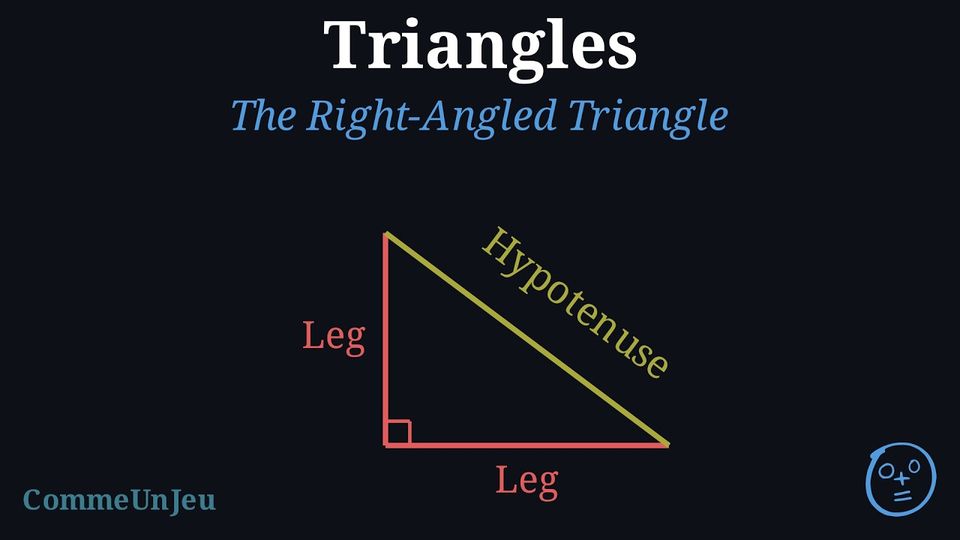
The Right-Angled Triangle
A \(5\,\text{m}\) ladder leans against a wall and reaches \(4\,\text{m}\) up. How far is the foot of the ladder from the wall? You cannot stretch a tape to the foot — it is hidden behind a hedge — yet the answer is fixed. The ladder, the wall and the ground form a right-angled triangle, and in a right-angled triangle the three sides are locked together: knowing two, you can compute the third. 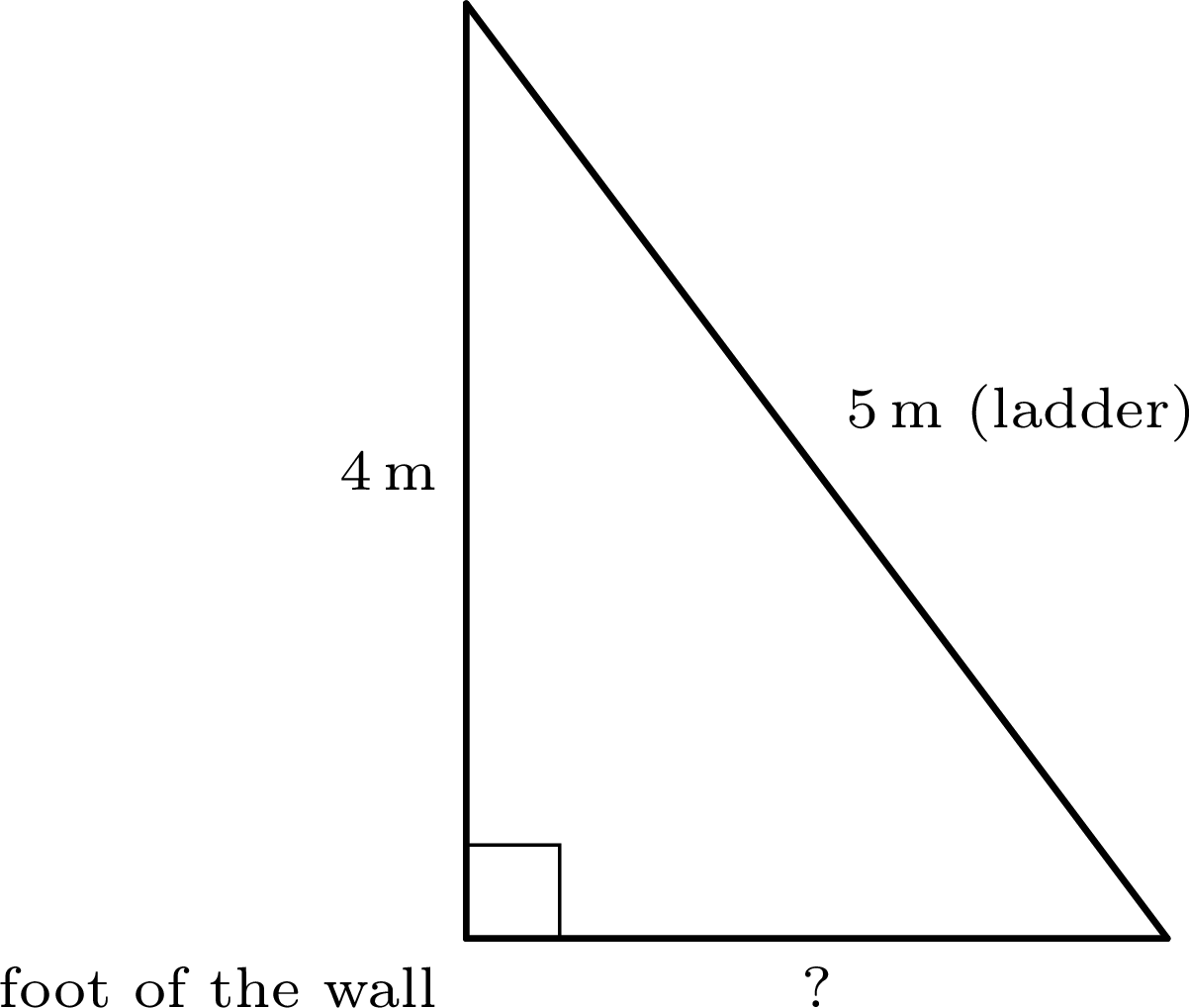
One relation locks the sides of the right-angled triangle — Pythagoras' theorem — and turns “I cannot reach it” into “I can calculate it”.
The ladder, the wall and the ground form a right-angled triangle whose hypotenuse is the ladder (\(5\) m) and one leg is the wall (\(4\) m). Pythagoras' theorem locks the three sides together: $$\begin{aligned}[t] 5^2 &= 4^2 + d^2 && {\scriptstyle(\text{Pythagoras' theorem})} \\
d^2 &= 25 - 16 = 9 \\
d &= 3 \text{ m.} \end{aligned}$$ The foot of the ladder stands \(3\) m from the wall — computed, never measured.
One of the oldest and most famous mathematical concepts is Pythagoras' theorem. Named after the ancient Greek mathematician Pythagoras, this theorem establishes a fundamental relationship between the sides of a right-angled triangle.
Definition — Right-Angled Triangle
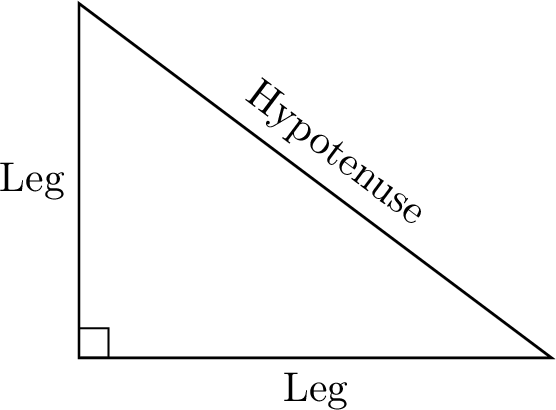
A right-angled triangle is a triangle that has one right angle (90°). - The two sides that form the right angle are called the legs of the triangle.
- The side opposite the right angle, which is also the longest side, is called the hypotenuse.
Skills to practice
- Calculating Squared Side Lengths
II
Pythagoras' Theorem
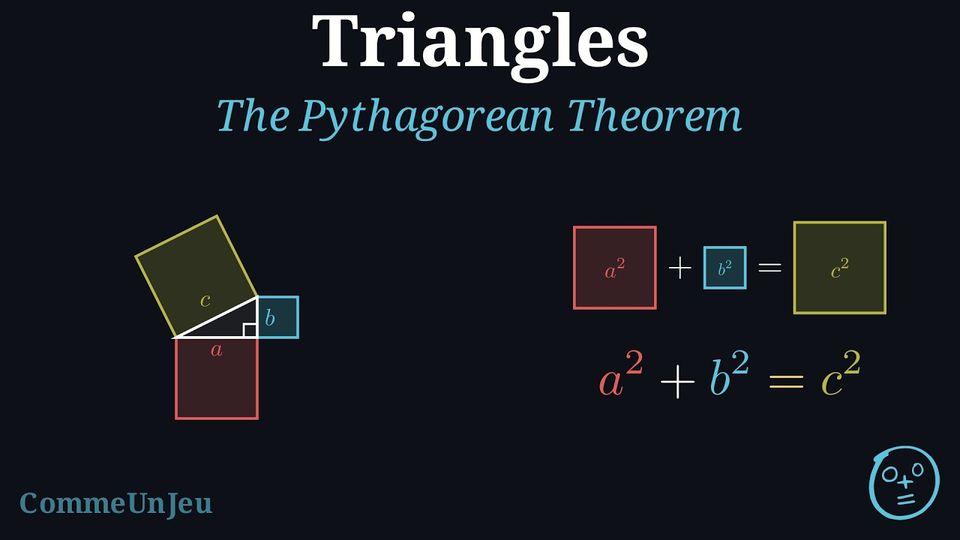
The right-angled triangle itself — vertices, legs, hypotenuse, and the \(180^\circ\) angle sum that forces its two acute angles to be complementary — is already known. Here we add the relation between the lengths of its three sides.
Theorem — Pythagoras' Theorem
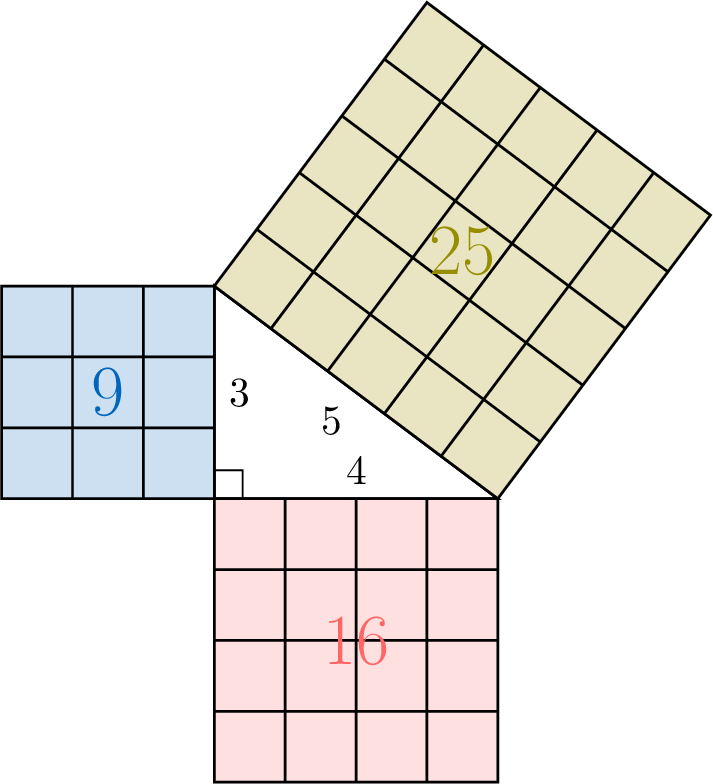
For any right-angled triangle with legs of length \(\textcolor{colordef}{a}\) and \(\textcolor{colorprop}{b}\) and a hypotenuse of length \(\textcolor{olive}{c}\), the square of the hypotenuse is equal to the sum of the squares of the legs: $$ \textcolor{colordef}{a^2} + \textcolor{colorprop}{b^2} = \textcolor{olive}{c^2}. $$ This means the area of the square on the hypotenuse is equal to the sum of the areas of the squares on the other two sides. 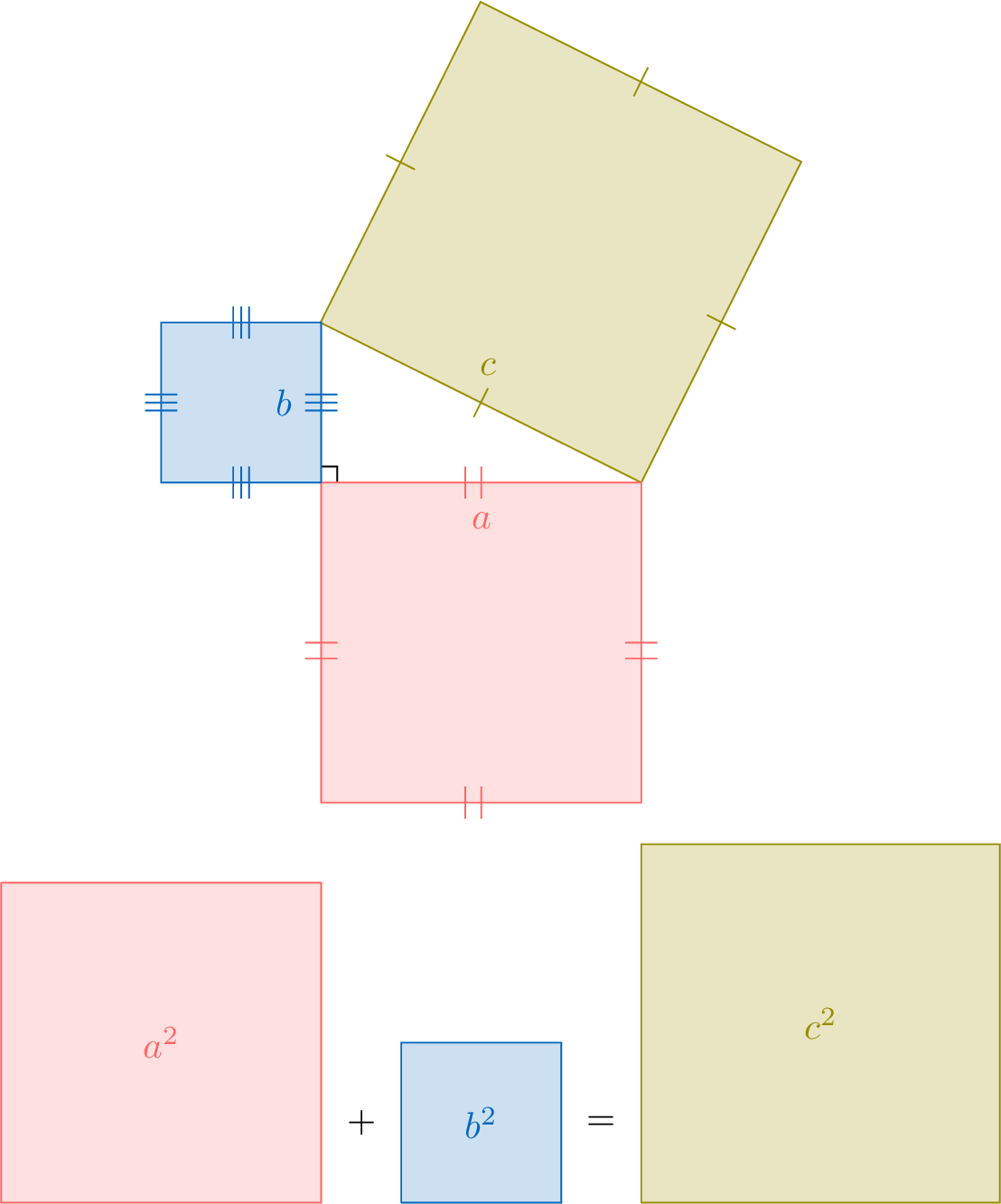
- The geometric proof involves rearranging four identical right-angled triangles within a square of side length \(a + b\).
- In the first arrangement, the four right-angled triangles form a smaller square in the centre of the larger square:
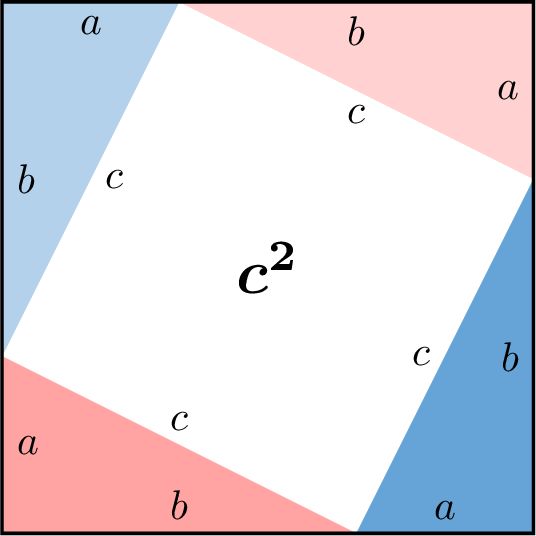
- In the second arrangement, the four right-angled triangles form two smaller squares within the larger square:
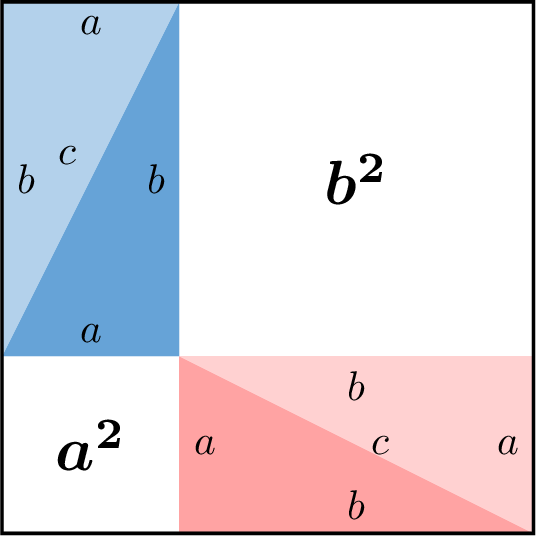
- Since the area not covered by the triangles is equal in both arrangements, we have: $$a^2 + b^2 = c^2.$$
- In the first arrangement, the four right-angled triangles form a smaller square in the centre of the larger square:
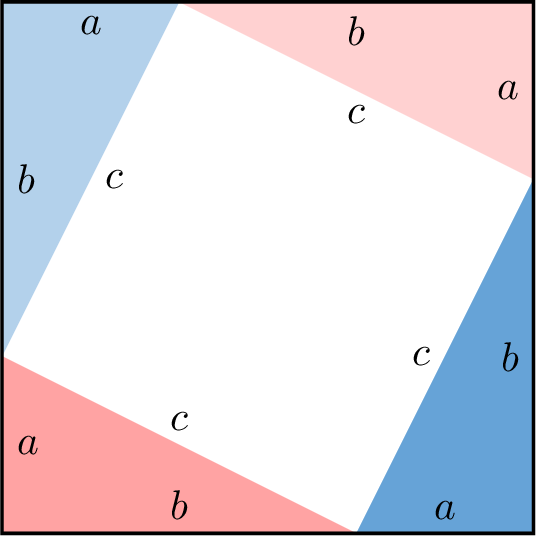
- Algebraic proof: Using four copies of the same triangle arranged symmetrically around a central square with side \(c\), inside a larger square with side \(a + b\):
Example
Find the length of the hypotenuse, \(x\). 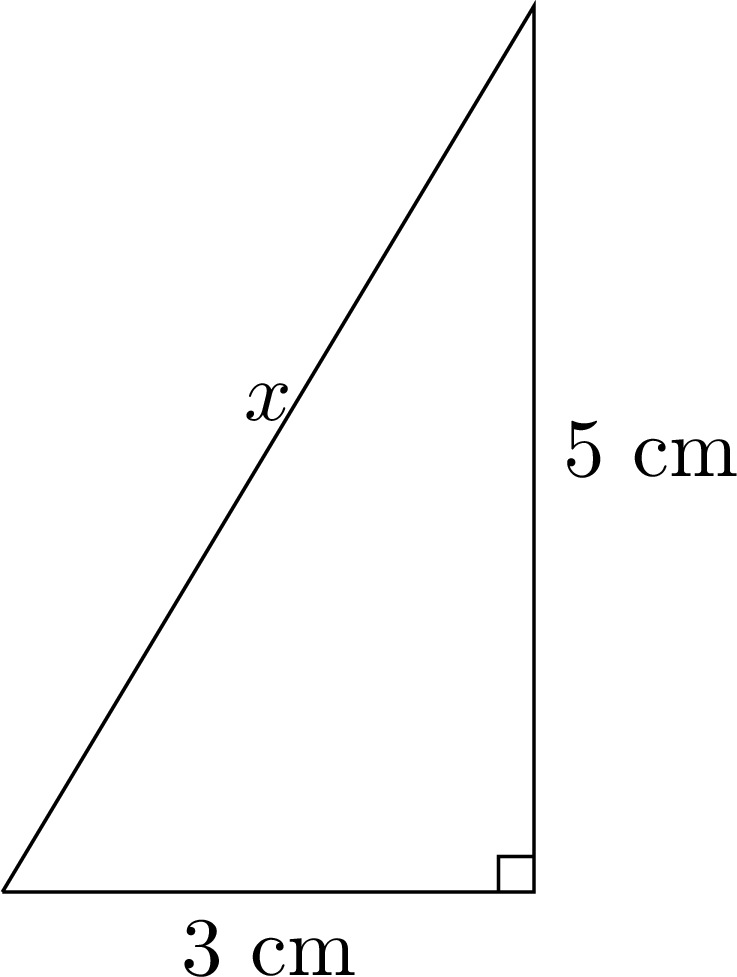
By Pythagoras' theorem: $$ \begin{aligned} a^2 + b^2 &= c^2 \\
3^2 + 5^2 &= x^2 \\
9 + 25 &= x^2 \\
34 &= x^2 \\
x &= \sqrt{34} \, \text{cm} \end{aligned} $$ The hypotenuse has a length of \(\sqrt{34}\) cm (approximately 5.83 cm).
Example
Find the length of the unknown leg, \(y\). 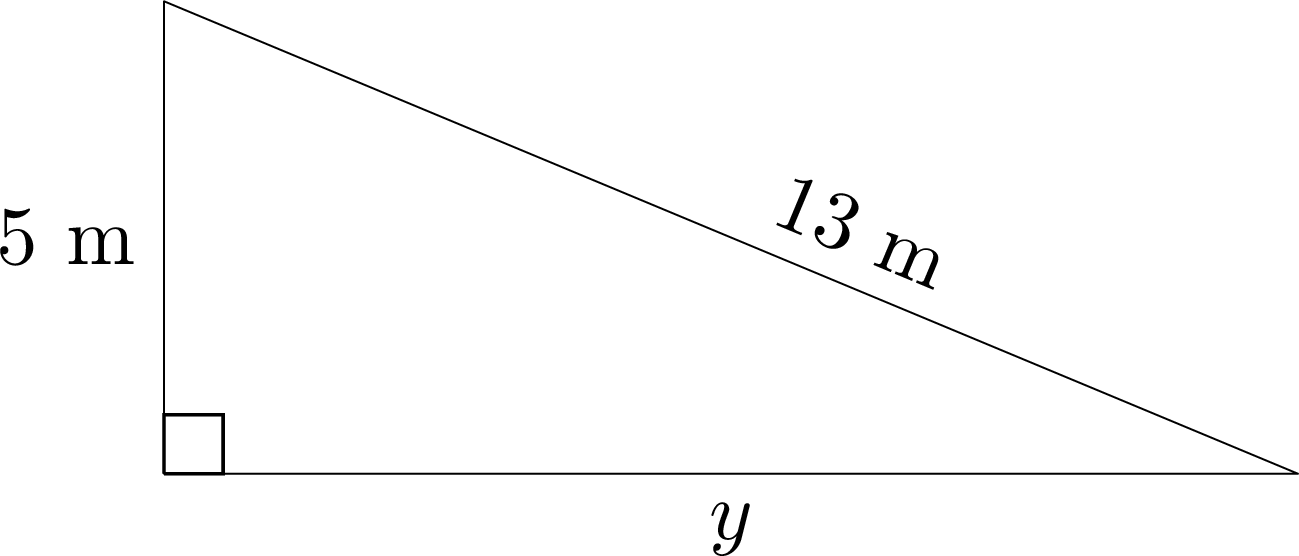
By Pythagoras' theorem, with \(c = 13\) being the hypotenuse: $$ \begin{aligned} a^2 + b^2 &= c^2 \\
y^2 + 5^2 &= 13^2 \\
y^2 + 25 &= 169 \\
y^2 &= 169 - 25 \\
y^2 &= 144 \\
y &= \sqrt{144} = 12 \, \text{m} \end{aligned} $$ The unknown leg has a length of 12 m.
Skills to practice
- Finding the Length of the Hypotenuse
- Finding the Length of a Leg
- Applying Pythagoras' Theorem
III
Checking Whether a Triangle Is Right-Angled
Theorem — Converse of Pythagoras' Theorem
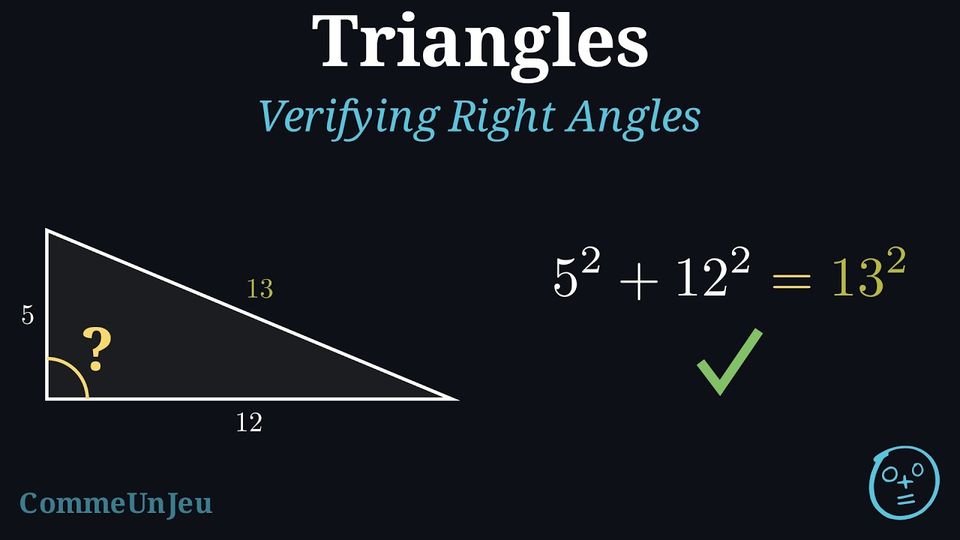
If a triangle has side lengths \(a\), \(b\), and \(c\), where \(c\) is the longest side, and they satisfy \(a^2 + b^2 = c^2\), then the triangle is a right-angled triangle, and the right angle is opposite the longest side, \(c\). Example
Is a triangle with side lengths 5 cm, 12 cm, and 13 cm a right-angled triangle?
We check if the sum of the squares of the two shorter sides equals the square of the longest side. The longest side is 13 cm.
- \( 5^2 + 12^2 = 25 + 144 = 169 \)
- \( 13^2 = 169 \)
Theorem — Contrapositive of Pythagoras' Theorem
If a triangle has side lengths \(a\), \(b\), and \(c\), where \(c\) is the longest side, and the sum of the squares of the two shorter sides is not equal to the square of the longest side (\(a^2 + b^2 \neq c^2\)), then the triangle is not a right-angled triangle.
The contrapositive of a statement “if \(P\), then \(Q\)” is the statement “if not \(Q\), then not \(P\)” — and the two are always true together. Here: 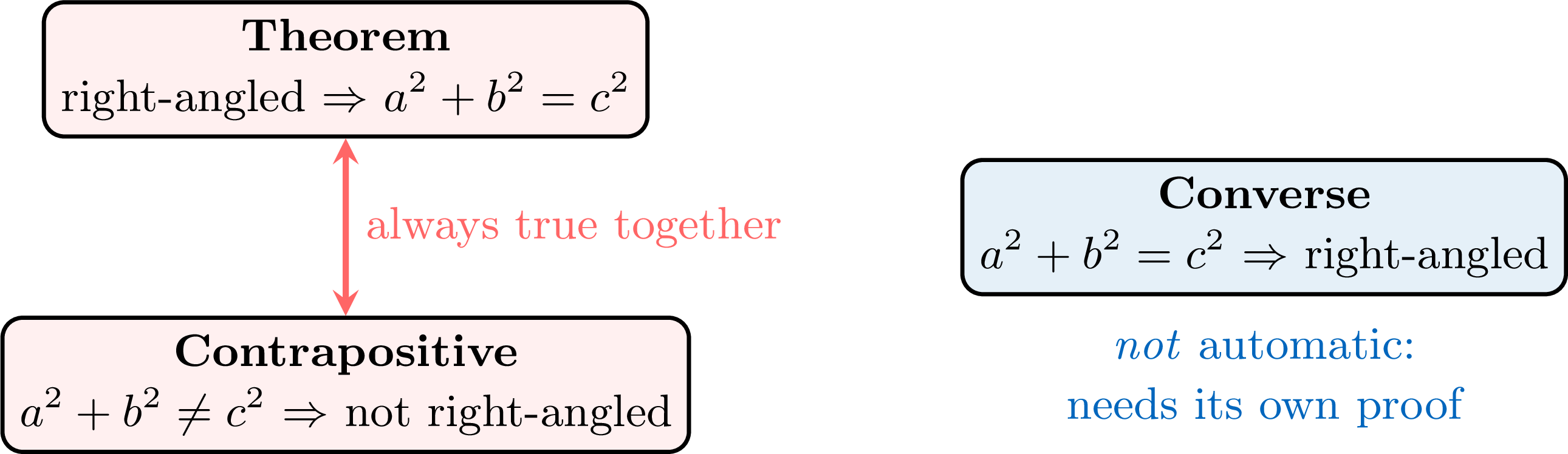
Indeed, if such a triangle were right-angled, Pythagoras' theorem would force \(a^2 + b^2 = c^2\), contradicting the hypothesis. Note the difference with the converse (“if \(a^2+b^2=c^2\), then right-angled”), which is not automatic: it needs a proof of its own.
- Pythagoras' theorem says: if the triangle is right-angled (right angle opposite \(c\)), then \(a^2 + b^2 = c^2\);
- its contrapositive says: if \(a^2 + b^2 \neq c^2\), then the triangle is not right-angled — exactly the statement above.
Example
Is a triangle with sides of lengths 5, 8, and 9 right-angled?
The two shorter sides are 5 and 8, and the longest side is 9.
- \( 5^2 + 8^2 = 25 + 64 = 89 \)
- \( 9^2 = 81 \)
Skills to practice
- Justifying Whether a Triangle Is Right-Angled
IV
Going further
Skills to practice
- Reasoning and Problem-Solving
- Investigating Patterns with Pythagoras' Theorem
- Solving Real-Life Problems with Pythagoras' Theorem
- Quiz
Jump to section