International Baccalaureate · MYP 4
Algebraic Expansion
I
Expanding \((a + b)(c + d)\)
A rectangular garden measures \((x+3)\) metres by \((x+5)\) metres. 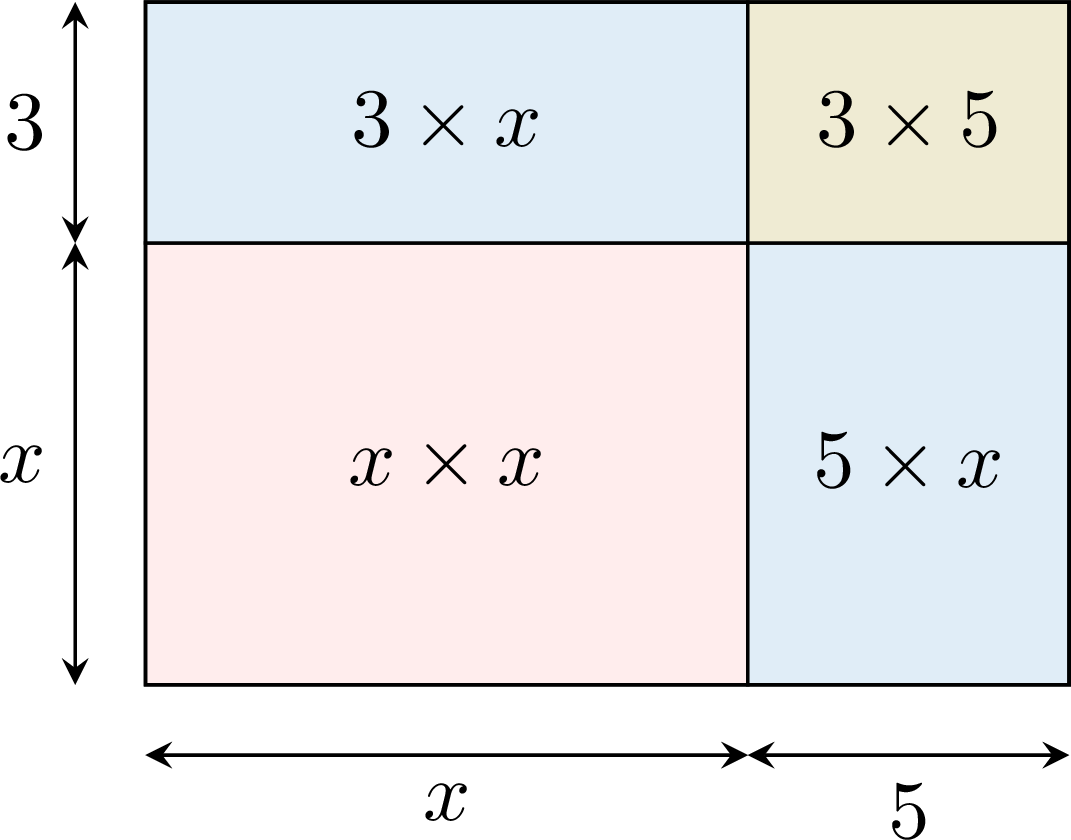
Calculate its area in two ways: by adding the four pieces of the drawing, then by multiplying the two side lengths. What does the comparison give?
By the pieces, the four areas are added: $$\underbrace{x \times x}_{x^2} + \underbrace{5 \times x}_{5x} + \underbrace{3 \times x}_{3x} + \underbrace{3 \times 5}_{15} = x^2 + 8x + 15.$$ By the sides, the two lengths are multiplied: the area is \((x+3)(x+5)\). The same garden is measured twice, so $$(x+3)(x+5) = x^2 + 8x + 15.$$ Each piece of the drawing is one term of the first bracket multiplied by one term of the second — and there are exactly four pieces because each of the two terms on one side meets each of the two on the other. That is the rule this section states in letters.
Proposition — Distributive Law
For any numbers \(a\), \(b\) and \(c\), multiplication is distributive over addition and subtraction: - Addition:
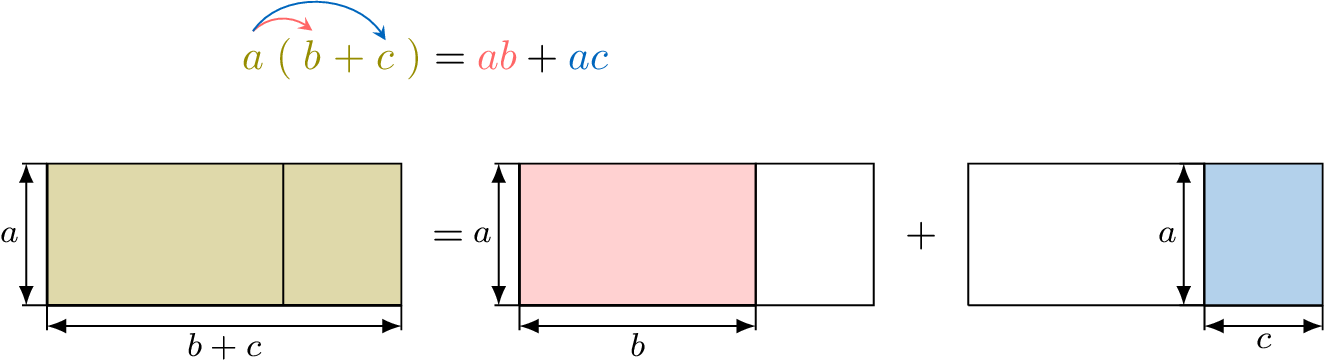
- Subtraction:
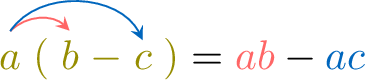
Proposition — Expanding Two Brackets
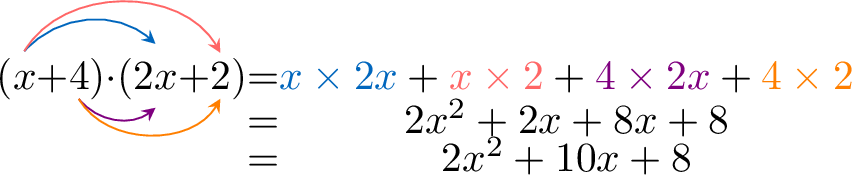
Each term in the first bracket multiplies each term in the second bracket. 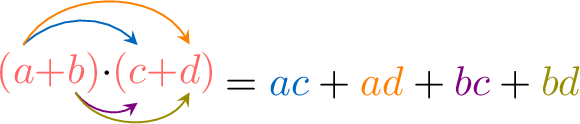

Example
Expand and simplify \((2x+3)(x-5)\).
$$\begin{aligned}[t](2x+3)(x-5) &= 2x \times x + 2x \times (-5) + 3 \times x + 3 \times (-5) && \text{(Each term distributes with its sign)} \\
&= 2x^2 - 10x + 3x - 15 && \text{(Compute each product)} \\
&= 2x^2 - 7x - 15 && \text{(Combine like terms)}\end{aligned}$$
Skills to practice
- Expanding with Addition
- Expanding with Subtraction
II
The Difference of Two Squares
Proposition — Difference of Two Squares
$$(\textcolor{colordef}{a}-\textcolor{colorprop}{b})(\textcolor{colordef}{a}+\textcolor{colorprop}{b}) =\textcolor{colordef}{a}^2-\textcolor{colorprop}{b}^2 $$ This identity is called the difference of two squares.
$$\begin{aligned} (a-b)(a+b) &= a(a+b)-b(a+b) &&\text{(distributive law)} \\
&= a^2+ab-ab-b^2 &&\text{(expanding)} \\
&= a^2+\cancel{ab}-\cancel{ab}-b^2 && \\
&= a^2-b^2. && \end{aligned}$$
Example
Expand and simplify: \((x-3)(x+3)\).
$$\begin{aligned} (\textcolor{colordef}{x}-\textcolor{colorprop}{3})(\textcolor{colordef}{x}+\textcolor{colorprop}{3}) & = \textcolor{colordef}{x}^2-\textcolor{colorprop}{3}^2 \\
& = x^2-9. \end{aligned}$$ So \((x-3)(x+3)=x^2-9\).
Example
Expand and simplify \((3x-5)(3x+5)\).
With \(a = 3x\) and \(b = 5\) in \((a-b)(a+b) = a^2 - b^2\): $$\begin{aligned} (\textcolor{colordef}{3x}-\textcolor{colorprop}{5})(\textcolor{colordef}{3x}+\textcolor{colorprop}{5}) &= (\textcolor{colordef}{3x})^2-\textcolor{colorprop}{5}^2 && \text{(difference of two squares)} \\
&= 3^2x^2-25 && \text{(the whole term \(3x\) is squared)} \\
&= 9x^2-25. \end{aligned}$$ The coefficient is squared too: \((3x)^2 = 9x^2\), not \(3x^2\).
Skills to practice
- Expanding: Level 1
- Expanding: Level 2
III
Perfect Squares
Proposition — Perfect Squares Expansion
The square of a sum and the square of a difference can be written as: $$(a+b)^2=a^2+2ab+b^2 \quad\text{and}\quad (a-b)^2=a^2-2ab+b^2.$$ 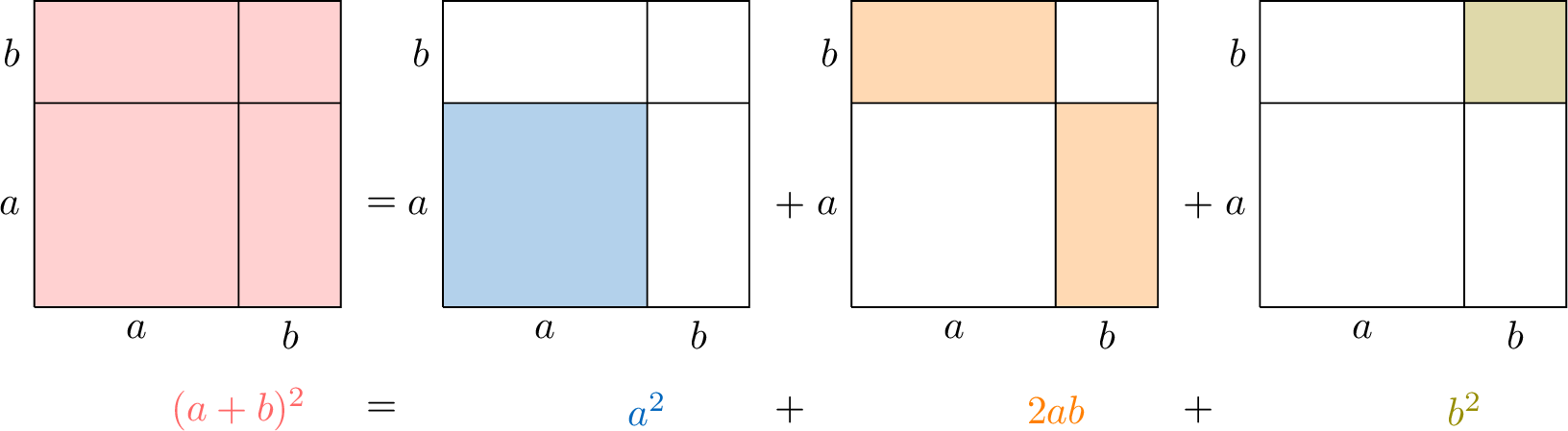
$$\begin{aligned} (a+b)^2 &= (a+b)(a+b) &&\text{(definition of a square)} \\
&= a(a+b)+b(a+b) &&\text{(distributive law)} \\
&= a^2+ab+ab+b^2 &&\text{(expanding)} \\
&= a^2+2ab+b^2 &&\text{(combining like terms)}. \end{aligned}$$ Similarly, $$\begin{aligned} (a-b)^2 &= (a-b)(a-b) &&\text{(definition of a square)} \\
&= a(a-b)-b(a-b) &&\text{(distributive law)} \\
&= a^2-ab-ab+b^2 &&\text{(expanding)} \\
&= a^2-2ab+b^2 &&\text{(combining like terms)}. \end{aligned}$$
Example
Expand and simplify \((x+2)^2\).
Using the formula \((a+b)^2=a^2+2ab+b^2\) with \(a=x\) and \(b=2\): $$\begin{aligned} (\textcolor{colordef}{x}+\textcolor{colorprop}{2})^{2} &=\textcolor{colordef}{x}^{2}+2 \times \textcolor{colordef}{x} \times \textcolor{colorprop}{2}+\textcolor{colorprop}{2}^{2} \\
&=x^{2}+4 x+4. \end{aligned}$$ So \((x+2)^2=x^2+4x+4\).
Example
Expand and simplify \((x-3)^2\).
With \(a = x\) and \(b = 3\) in \((a-b)^2 = a^2 - 2ab + b^2\): $$(x-3)^2 = x^2 - 2 \times x \times 3 + 3^2 = x^2 - 6x + 9.$$ The middle term is subtracted — its coefficient is negative: only the middle term \(2ab\) changes sign; the last term \(b^2\) is a square, never negative.
Example
Expand and simplify \((3x-4)^2\).
With \(a = 3x\) and \(b = 4\) in \((a-b)^2 = a^2 - 2ab + b^2\): $$\begin{aligned} (\textcolor{colordef}{3x}-\textcolor{colorprop}{4})^2 &= (\textcolor{colordef}{3x})^2 - 2 \times \textcolor{colordef}{3x} \times \textcolor{colorprop}{4} + \textcolor{colorprop}{4}^2 && \text{(square of a difference)} \\
&= 9x^2 - 24x + 16. && \text{(compute each term)} \end{aligned}$$ The coefficient \(3\) is squared in the first term and enters the middle term: \(2 \times 3x \times 4 = 24x\). Check with \(x = 1\): \((3-4)^2 = 1\) and \(9 - 24 + 16 = 1\).
The three equalities \((a+b)(a-b) = a^2 - b^2\), \((a+b)^2 = a^2 + 2ab + b^2\) and \((a-b)^2 = a^2 - 2ab + b^2\) are called the special products. Each one is used in both directions: from left to right to expand, from right to left to factorise.
Skills to practice
- Expanding the Square of a Sum
- Expanding the Square of a Difference
IV
Sums and Differences of Products
Method — Taking the Opposite of an Expression
The opposite of an expression is the expression multiplied by \((-1)\). To write it without brackets: - Write the expression in brackets, preceded by a \(-\) sign.
- Change the sign of every term: this is exactly distributing the factor \((-1)\) over the brackets.
- Check with a value: the expression and its opposite must give opposite results.
Example
Expand and simplify \((x+3)^2 - (x+1)(x-4)\).
The expression is a difference of two products. Each product is expanded first and kept in brackets: the minus sign in front of the second product applies to all its terms. $$\begin{aligned} (x+3)^2 - (x+1)(x-4) &= \left(x^2 + 6x + 9\right) - \left(x^2 - 4x + x - 4\right) && \text{(perfect square; two brackets)} \\
&= \left(x^2 + 6x + 9\right) - \left(x^2 - 3x - 4\right) && \text{(collect like terms in the bracket)} \\
&= x^2 + 6x + 9 - x^2 + 3x + 4 && \text{(opposite of an expression)} \\
&= 9x + 13. && \text{(collect like terms)} \end{aligned}$$ Check with \(x = 1\): \((1+3)^2 - (1+1)(1-4) = 16 + 6 = 22\), and \(9 \times 1 + 13 = 22\).
Skills to practice
- Expanding Sums and Differences of Products
V
Going further
Skills to practice
- Reasoning and Problem-Solving
- Investigating and Solving Problems
- Quiz
Jump to section