International Baccalaureate · MYP 5 Extended
Radicals and Surds (Extended)
I
Rationalising with the Conjugate
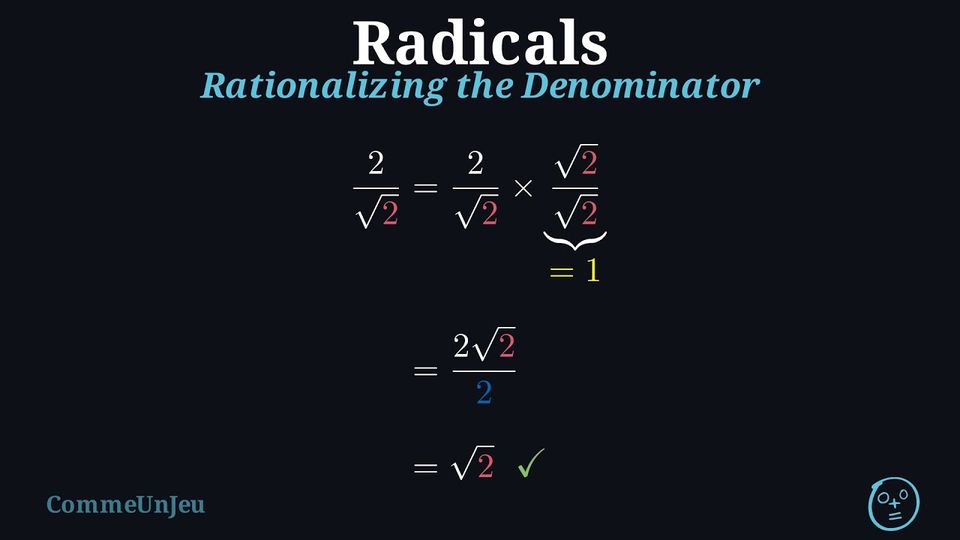
In mathematics, it is standard practice to write expressions without radicals in the denominator. The process of removing a radical from the denominator is called rationalising the denominator. This does not change the value of the expression but converts it to a conventional form which is often easier to work with.
Method — Rationalising a Monomial Denominator
To rationalise a denominator of the form \(\sqrt{b}\) (where \(b>0\)), multiply the numerator and the denominator by \(\sqrt{b}\).$$ \frac{a}{\sqrt{b}} = \frac{a}{\sqrt{b}} \times \frac{\sqrt{b}}{\sqrt{b}} = \frac{a\sqrt{b}}{b} $$ This works because multiplying by \(\frac{\sqrt{b}}{\sqrt{b}}\) is equivalent to multiplying by 1, which does not change the value.
When the denominator is a binomial containing a square root, such as \(a+\sqrt{b}\) with \(a\) and \(b\) rational, we use a special tool called the conjugate to rationalise it.
Definition — Conjugate
The conjugate of a binomial expression \(x+y\) is \(x-y\): it is obtained by changing the sign of the second term. Example
Give the conjugate of \(a+\sqrt{b}\) and of \(a-\sqrt{b}\). - The conjugate of \(a+\sqrt{b}\) is \(\boldsymbol{a-\sqrt{b}}\).
- The conjugate of \(a-\sqrt{b}\) is \(\boldsymbol{a+\sqrt{b}}\).
The power of the conjugate lies in its product, which follows the difference of squares identity: \((x+y)(x-y) = x^2 - y^2\).$$ (a+\sqrt{b})(a-\sqrt{b}) = a^2 - (\sqrt{b})^2 = a^2 - b $$ For rational \(a\) and \(b\), the result \(a^2 - b\) is a rational number, which achieves our goal.
Method — Rationalising a Binomial Denominator
To rationalise a binomial denominator, multiply the numerator and the denominator by the conjugate of the denominator. The method works when the product of the denominator and its conjugate is a non-zero rational number: for \(a + \sqrt{b}\), with \(a\) and \(b\) rational and \(b > 0\) not the square of a rational number, this product is \(a^2 - b \neq 0\). Example
Rationalise the denominator of \(\frac{4}{3+\sqrt{5}}\).
The denominator is \(3+\sqrt{5}\). Its conjugate is \(3-\sqrt{5}\). We multiply the numerator and denominator by this conjugate.$$\begin{aligned}[t]\frac{4}{3+\sqrt{5}} &= \frac{4}{(3+\sqrt{5})} \times \frac{(3-\sqrt{5})}{(3-\sqrt{5})} && \text{(multiply by 1)} \\
&= \frac{4(3 - \sqrt{5})}{3^2 - (\sqrt{5})^2} && \text{(\((x+y)(x-y) = x^2 - y^2\))}\\
&= \frac{4(3 - \sqrt{5})}{9 - 5} && \text{(\(3^2 = 9\) and \((\sqrt{5})^2 = 5\))}\\
&= \frac{4(3 - \sqrt{5})}{4} && \text{(\(9 - 5 = 4\))}\\
&= \boldsymbol{3 - \sqrt{5}}\end{aligned}$$
Example
Rationalise the denominator of \(\frac{2}{\sqrt{5}+\sqrt{3}}\).
The denominator is \(\sqrt{5}+\sqrt{3}\): both of its terms are square roots. Its conjugate is \(\sqrt{5}-\sqrt{3}\). We multiply the numerator and denominator by this conjugate.$$\begin{aligned}[t]\frac{2}{\sqrt{5}+\sqrt{3}} &= \frac{2}{(\sqrt{5}+\sqrt{3})} \times \frac{(\sqrt{5}-\sqrt{3})}{(\sqrt{5}-\sqrt{3})} && \text{(multiply by 1)} \\
&= \frac{2(\sqrt{5} - \sqrt{3})}{(\sqrt{5})^2 - (\sqrt{3})^2} && \text{(\((x+y)(x-y) = x^2 - y^2\))}\\
&= \frac{2(\sqrt{5} - \sqrt{3})}{5 - 3} && \text{(\((\sqrt{5})^2 = 5\) and \((\sqrt{3})^2 = 3\))}\\
&= \frac{2(\sqrt{5} - \sqrt{3})}{2} && \text{(\(5 - 3 = 2\))}\\
&= \boldsymbol{\sqrt{5} - \sqrt{3}}\end{aligned}$$
Example
For \(x \geq 0\) and \(x \neq 4\), rationalise the denominator of \(\frac{1}{2+\sqrt{x}}\).
The denominator is \(2+\sqrt{x}\). Its conjugate is \(2-\sqrt{x}\), which is not \(0\) because \(x \neq 4\) (for \(x = 4\), \(\sqrt{x} = 2\)). We multiply the numerator and denominator by this conjugate.$$\begin{aligned}[t]\frac{1}{2+\sqrt{x}} &= \frac{1}{(2+\sqrt{x})} \times \frac{(2-\sqrt{x})}{(2-\sqrt{x})} && \text{(multiply by 1)} \\
&= \frac{2 - \sqrt{x}}{2^2 - (\sqrt{x})^2} && \text{(difference of two squares)}\\
&= \boldsymbol{\frac{2 - \sqrt{x}}{4 - x}} && \text{(\((\sqrt{x})^2 = x\) for \(x \geq 0\))}\end{aligned}$$ The denominator \(4 - x\) no longer contains a radical.
Skills to practice
- Writing in the Form \(a + b\sqrt{c}\)
- Writing in the Form \(a + b\sqrt{2}\)
- Rationalising Algebraic Denominators
- Applying Several Radical Skills
II
Equating Rational Parts and Coefficients
Proposition — Equality of Surds
Let \(c\) be a positive whole number such that \(\sqrt{c}\) is irrational (for instance \(c = 2\) or \(c = 3\)). For all rational numbers \(a\), \(b\), \(d\) and \(e\): $$a + b\sqrt{c} = d + e\sqrt{c} \iff a = d \ \text{ and } \ b = e.$$ Two numbers written in the form \(a + b\sqrt{c}\), with \(a\) and \(b\) rational, are equal exactly when their rational parts are equal and their coefficients of \(\sqrt{c}\) are equal: one equality between such numbers gives two equalities between rational numbers. This is called equating the rational parts and the coefficients of \(\sqrt{c}\).
If \(a = d\) and \(b = e\), the two numbers are written identically, so they are equal. Conversely, assume that \(a + b\sqrt{c} = d + e\sqrt{c}\). We gather the roots on one side: $$\begin{aligned}[t] a + b\sqrt{c} &= d + e\sqrt{c}\\
b\sqrt{c} - e\sqrt{c} &= d - a && \text{(subtracting \(a\) and \(e\sqrt{c}\) from both sides)}\\
(b - e)\sqrt{c} &= d - a. && \text{(factorising \(\sqrt{c}\))} \end{aligned}$$ Suppose that \(b \neq e\). Dividing both sides by \(b - e \neq 0\) gives $$\sqrt{c} = \frac{d - a}{b - e}.$$ The numbers \(d - a\) and \(b - e\) are rational, so their quotient is rational: \(\sqrt{c}\) would be rational, which contradicts the hypothesis. Therefore \(b = e\). The equality \((b - e)\sqrt{c} = d - a\) then reads \(0 = d - a\), so \(a = d\).
Why Both Hypotheses Matter
The Proposition needs its two hypotheses.
- The root must be irrational. With \(c = 4\), the root \(\sqrt{4} = 2\) is rational, and $$5 + 1 \times \sqrt{4} = 7 + 0 \times \sqrt{4}$$ is true (both sides are equal to \(7\)), although \(5 \neq 7\) and \(1 \neq 0\).
- The coefficients must be rational. The equality $$3 + 1 \times \sqrt{2} = \left(3 - \sqrt{2}\right) + 2\sqrt{2}$$ is true, yet \(3 \neq 3 - \sqrt{2}\) and \(1 \neq 2\): the number \(3 - \sqrt{2}\) is not rational, so the right side is not written with a rational part.
Example
Find the rational numbers \(a\) and \(b\) such that $$\left(a + b\sqrt{3}\right)\left(2 + \sqrt{3}\right) = 11 + 6\sqrt{3}.$$
We expand the left side into the form “rational part \(+\) coefficient \(\times \sqrt{3}\)”: $$\begin{aligned}[t] \left(a + b\sqrt{3}\right)\left(2 + \sqrt{3}\right) &= 2a + a\sqrt{3} + 2b\sqrt{3} + b\sqrt{3}\times\sqrt{3} && \text{(distributive law)}\\
&= 2a + a\sqrt{3} + 2b\sqrt{3} + 3b && \text{(\(\sqrt{3}\times\sqrt{3} = 3\))}\\
&= (2a + 3b) + (a + 2b)\sqrt{3}. && \text{(grouping the terms)} \end{aligned}$$ The numbers \(2a + 3b\) and \(a + 2b\) are rational and \(\sqrt{3}\) is irrational, so the equality of surds gives the system $$\begin{cases} 2a + 3b = 11 \\
a + 2b = 6 \end{cases}$$ From the second equation, \(a = 6 - 2b\). Substituting into the first equation: $$\begin{aligned}[t] 2(6 - 2b) + 3b &= 11\\
12 - b &= 11 && \text{(expanding and collecting)}\\
b &= 1, \end{aligned}$$ then \(a = 6 - 2 \times 1 = 4\). So \(\boldsymbol{a = 4}\) and \(\boldsymbol{b = 1}\). Check: \(\left(4 + \sqrt{3}\right)\left(2 + \sqrt{3}\right) = 8 + 4\sqrt{3} + 2\sqrt{3} + 3 = 11 + 6\sqrt{3}\) \(\checkmark\) Another route gives the same values, by dividing and multiplying by the conjugate \(2 - \sqrt{3}\): $$\begin{aligned}[t] a + b\sqrt{3} &= \frac{11 + 6\sqrt{3}}{2 + \sqrt{3}} = \frac{\left(11 + 6\sqrt{3}\right)\left(2 - \sqrt{3}\right)}{4 - 3}\\
&= 22 - 11\sqrt{3} + 12\sqrt{3} - 18 = 4 + \sqrt{3}. \end{aligned}$$
Example
Find integers \(p\) and \(q\) such that $$\sqrt{7 + 4\sqrt{3}} = p + q\sqrt{3}.$$
If \(\sqrt{7 + 4\sqrt{3}} = p + q\sqrt{3}\), squaring both sides gives $$\begin{aligned}[t] 7 + 4\sqrt{3} &= \left(p + q\sqrt{3}\right)^2\\
&= p^2 + 2pq\sqrt{3} + 3q^2 && \text{(square of a sum)}\\
&= \left(p^2 + 3q^2\right) + 2pq\sqrt{3}. \end{aligned}$$ The numbers \(p^2 + 3q^2\) and \(2pq\) are integers and \(\sqrt{3}\) is irrational, so the equality of surds gives $$p^2 + 3q^2 = 7 \quad \text{and} \quad 2pq = 4, \ \text{that is} \ pq = 2.$$ The pairs of integers whose product is \(2\) are \((1, 2)\), \((2, 1)\), \((-1, -2)\) and \((-2, -1)\); for them \(p^2 + 3q^2\) equals \(13\), \(7\), \(13\) and \(7\). Only \((2, 1)\) and \((-2, -1)\) remain. The number \(7 + 4\sqrt{3}\) is positive, so its square root is positive: \(\sqrt{7 + 4\sqrt{3}} > 0\). Now \(2 + \sqrt{3} > 0\), while \(-2 - \sqrt{3} < 0\). Hence $$\boldsymbol{\sqrt{7 + 4\sqrt{3}} = 2 + \sqrt{3}}.$$ Check: \(\left(2 + \sqrt{3}\right)^2 = 4 + 4\sqrt{3} + 3 = 7 + 4\sqrt{3}\), and \(2 + \sqrt{3} > 0\) \(\checkmark\)
Skills to practice
- Identifying Rational Coefficients
- Using the Equality of Surds
III
Going further
Skills to practice
- Telescoping with Conjugates
- Reasoning with Roots
- Solving Problems with Exact Values
- Quiz
Jump to section