International Baccalaureate · MYP 3
Circles, Perimeter and Area
I
Parts of a Circle
Definition — Circle
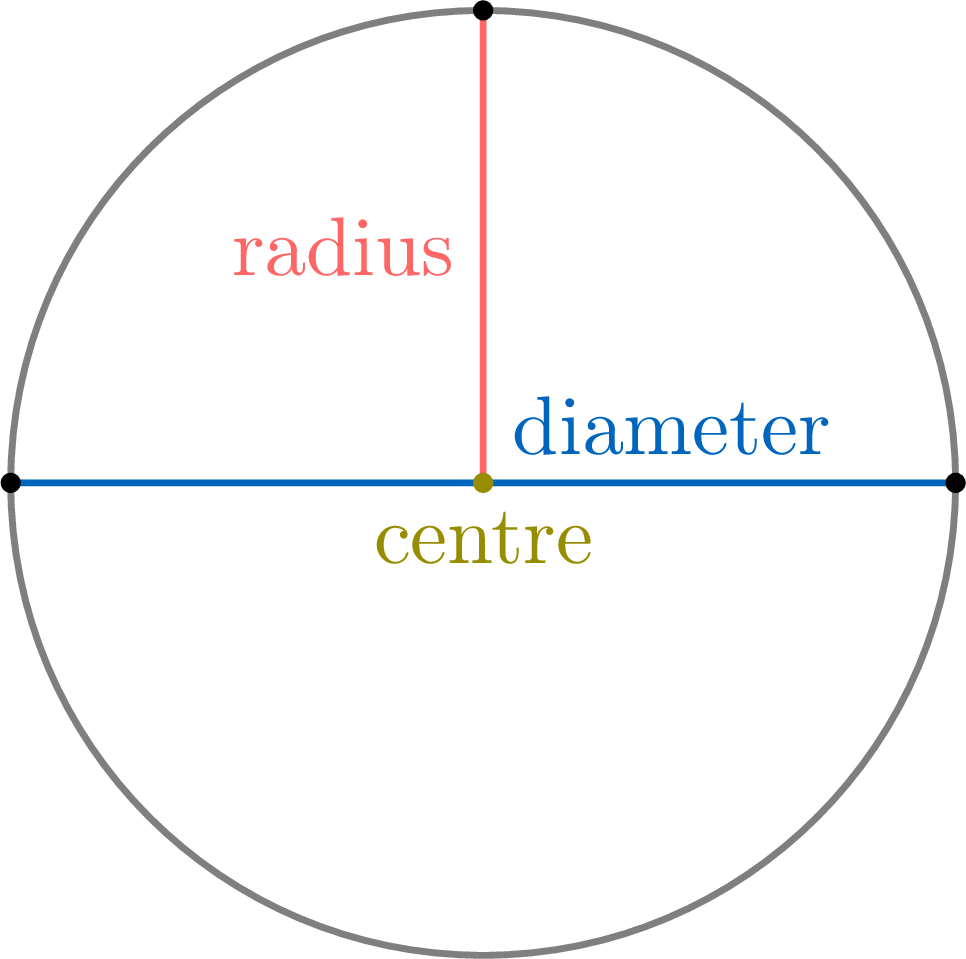
A circle is a closed curved line on a flat surface — only the line, not the inside. Every point on the circle is the same distance from a point called the centre.The radius is a line segment from the centre to a point on the circle. The radius is also the length of this segment.
The diameter is a line segment that goes across the circle through the centre and connects two points on the circle. The diameter is also the length of this segment.
Definition — Disc
A circle is only the curve — the boundary line itself. A disc is the whole flat region the circle encloses: the circle together with every point inside it. 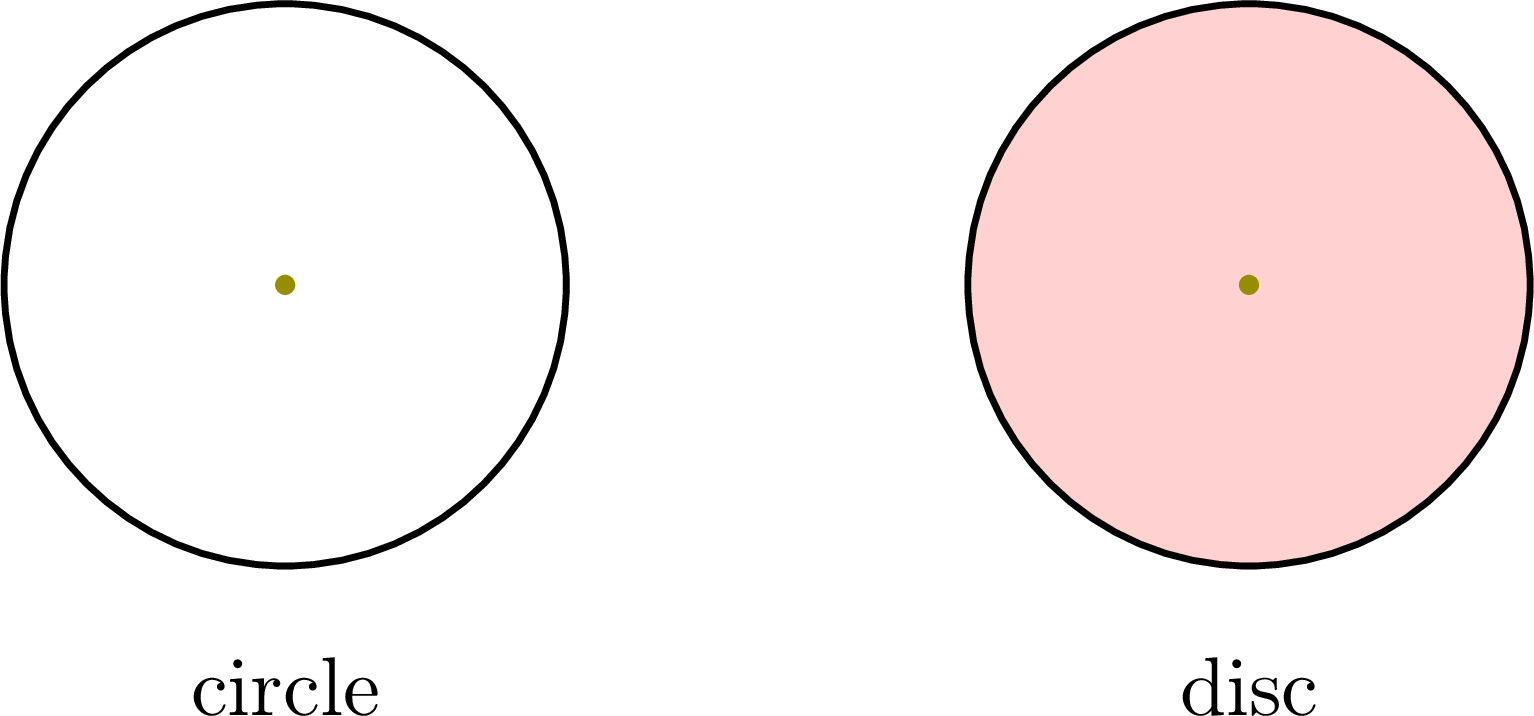
Lea looks down at a round table. She numbers what she sees: \(1\) the edge of the tabletop; \(2\) a string stretched straight between two points of the edge; \(3\) the small part of the tabletop cut off by the string; \(4\) a slice cut from the centre, like a slice of cake; \(5\) a ruler lying against the edge, touching it at a single point. 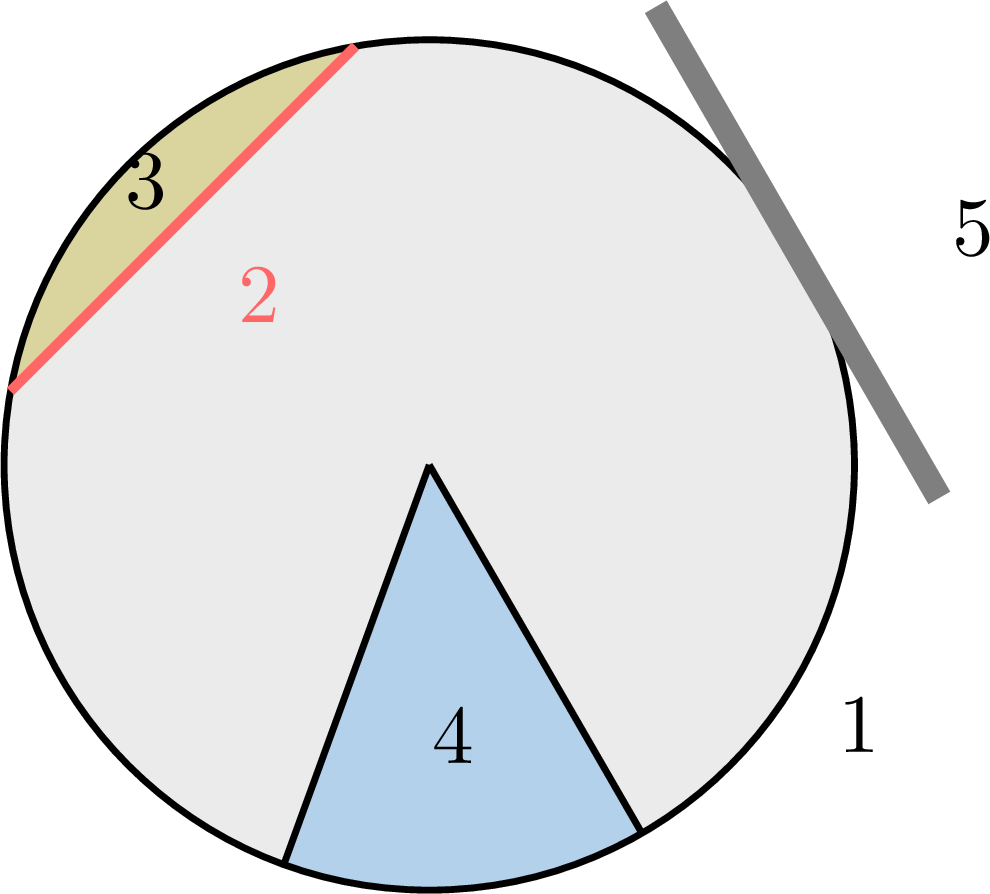
Everyday words — edge, string, piece, slice, ruler — are not precise. Which mathematical word names each of the five elements?
- \(1\): the edge is the circle, a curve; the whole tabletop is the disc.
- \(2\): the string joins two points of the circle: it is a chord.
- \(3\): the part bounded by the chord and the circle is a segment of the disc.
- \(4\): the slice is bounded by two radii and a piece of the circle: it is a sector.
- \(5\): a line that touches the circle at a single point is a tangent.
Definition — Parts of a Circle
The words for the parts of a circle with centre \(O\) fall into four families. 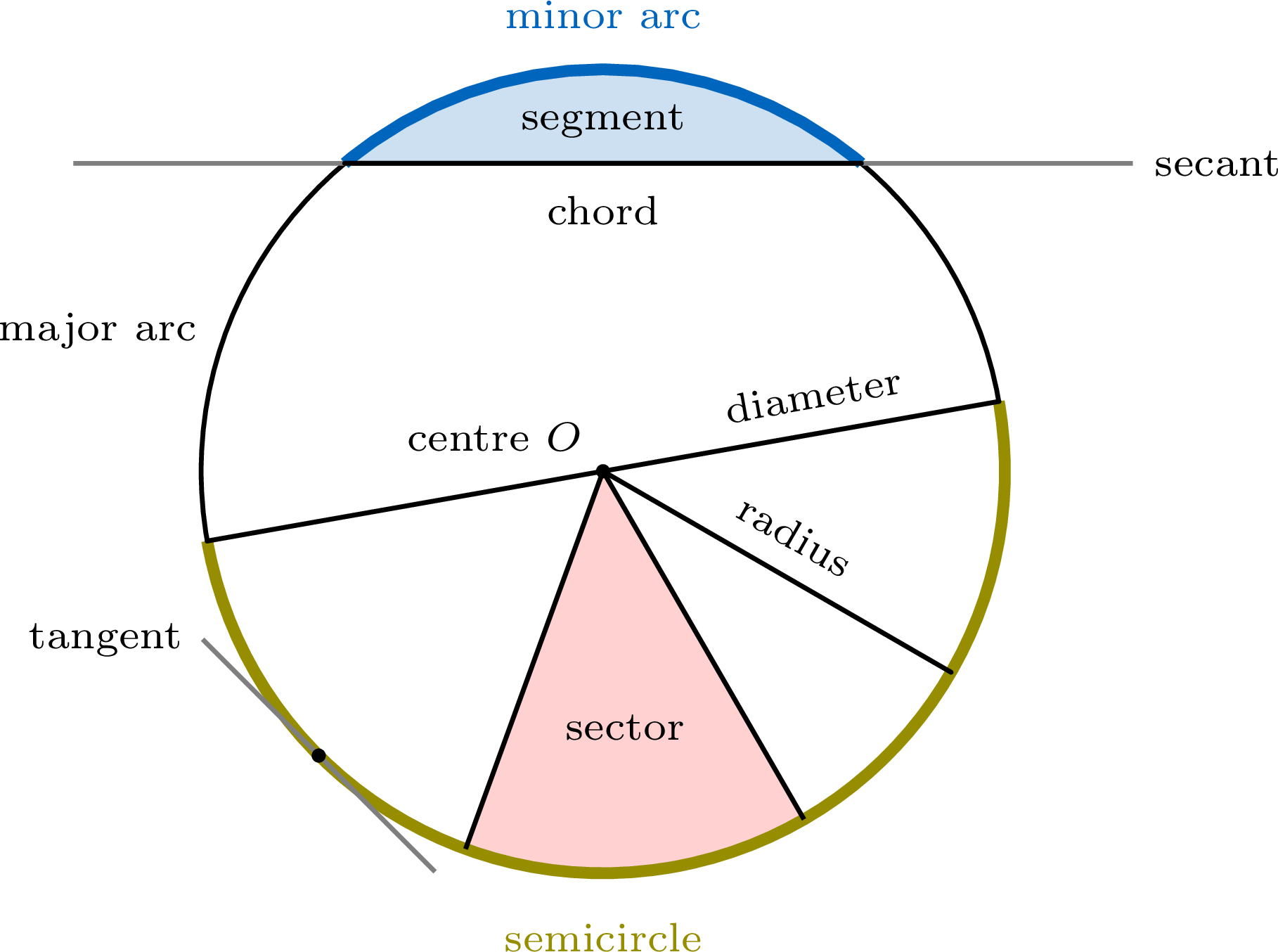
- Segments. A radius joins the centre to a point of the circle; a chord joins two points of the circle; a diameter is a chord that passes through the centre. The words radius and diameter also name their lengths: \(d = 2r\).
- Curves, parts of the circle. Two points \(A\) and \(B\) of the circle cut it into two arcs: the shorter is the minor arc, the longer is the major arc. When \(\Segment{AB}\) is a diameter, the two arcs are semicircles.
- Regions, parts of the disc. A sector is bounded by two radii and an arc: two radii cut the disc into a minor sector, on the side of the minor arc, and a major sector. A segment of the disc is bounded by a chord and an arc: a chord cuts the disc into a minor segment and a major segment. When the two radii, or the chord, form a diameter, the two parts are equal: two half-discs.
- Lines. A tangent has exactly one point in common with the circle, its point of contact; a secant cuts the circle at two points. The part of a secant that lies in the disc is a chord.
Definition — Arc of a Circle
An arc is a part of a circle between two of its points; its central angle \(\theta\) (theta) measures it. 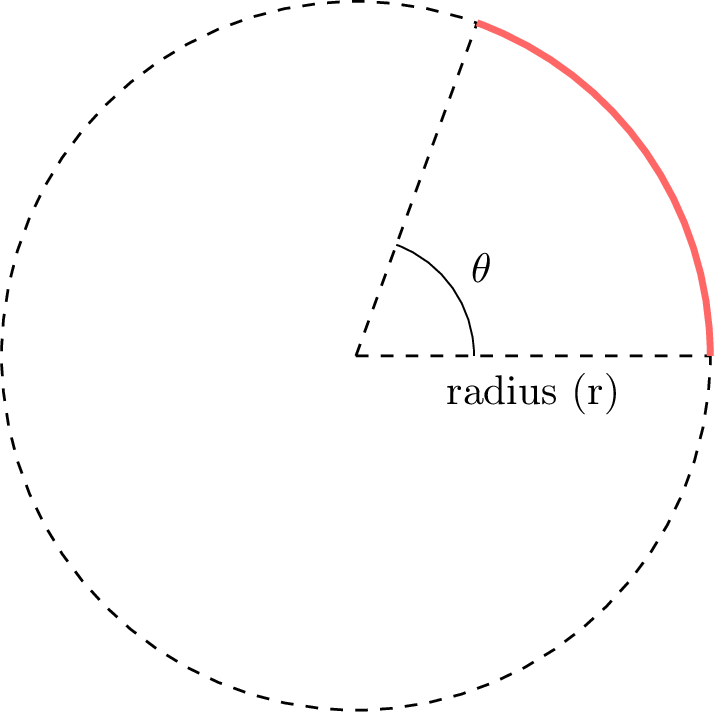
Definition — Semicircle
A diameter \(\Segment{AB}\) cuts a circle into two arcs of the same length: each of them is a semicircle. A semicircle is a part of the circle, so it is a curve: an arc whose central angle is \(180^\circ\). The region bounded by a semicircle and the diameter is a half-disc. A semicircle is to a half-disc what a circle is to a disc (Definition “Disc”). 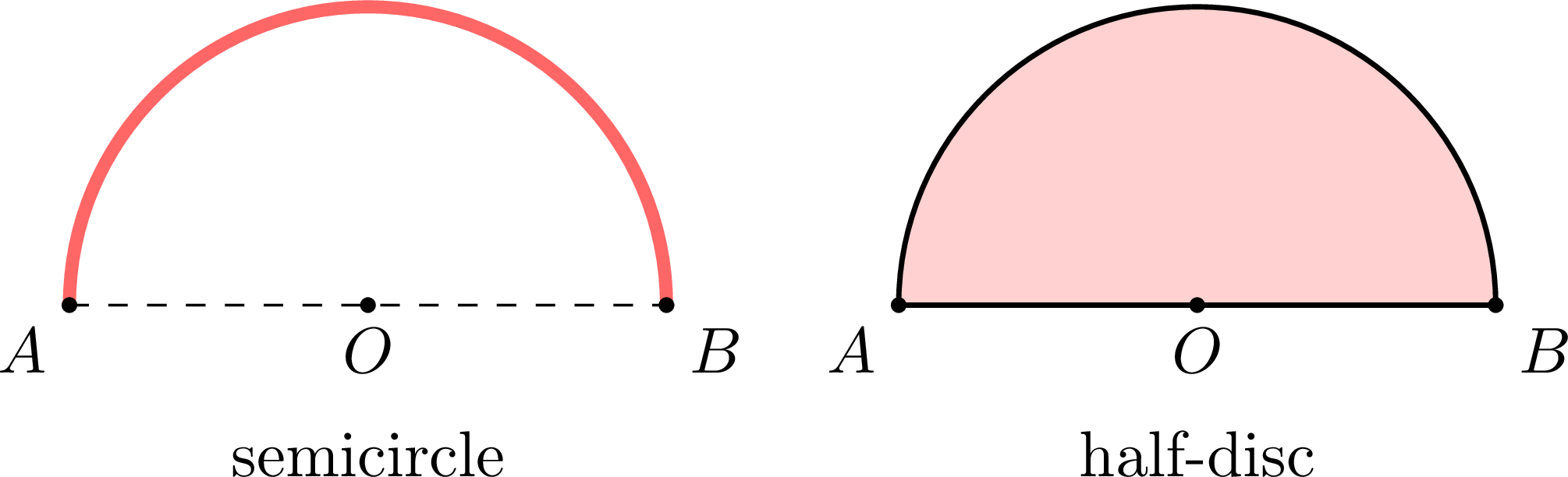
Definition — Sector
Two points \(A\) and \(B\) of a circle with centre \(O\) cut it into two arcs, the minor arc and the major arc (two equal semicircles when \(AB\) is a diameter), and the radii \(OA\) and \(OB\) cut the disc into two parts. Each part, bounded by the two radii and one of the arcs, is a sector; its angle is the central angle that sweeps its arc. When \(\theta = \Angle{AOB}\) is less than \(180^\circ\), the sector of angle \(\theta\) is the minor sector and the other one, of angle \(360^\circ - \theta\), is the major sector. When the two radii are opposite, the two sectors are half-discs, of angle \(180^\circ\). 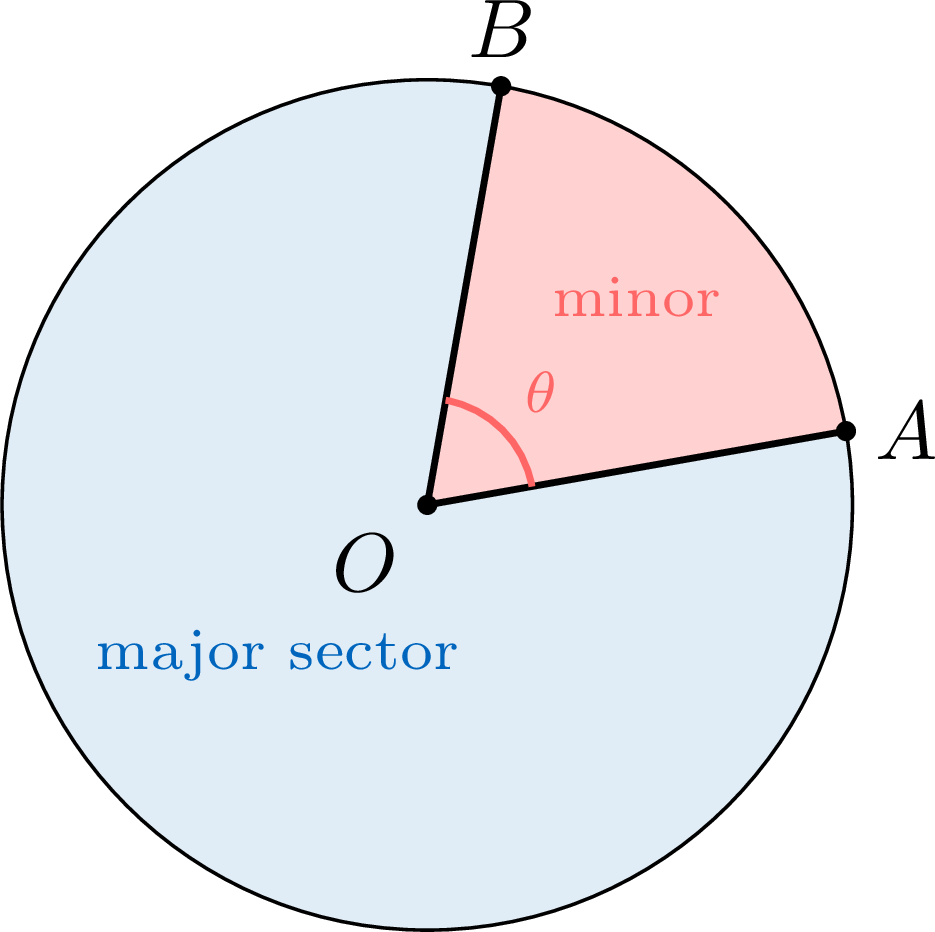
Definition — Segment of a Disc
A chord \(\Segment{AB}\) cuts a disc into two parts, each bounded by the chord and by one of the two arcs \(AB\): they are the two segments of the disc. The minor segment lies on the side of the minor arc, the major segment on the side of the major arc. When the chord is a diameter, the two segments are two equal half-discs: neither is minor nor major. A segment of a disc is not to be confused with the line segment \(\Segment{AB}\), which is its chord. 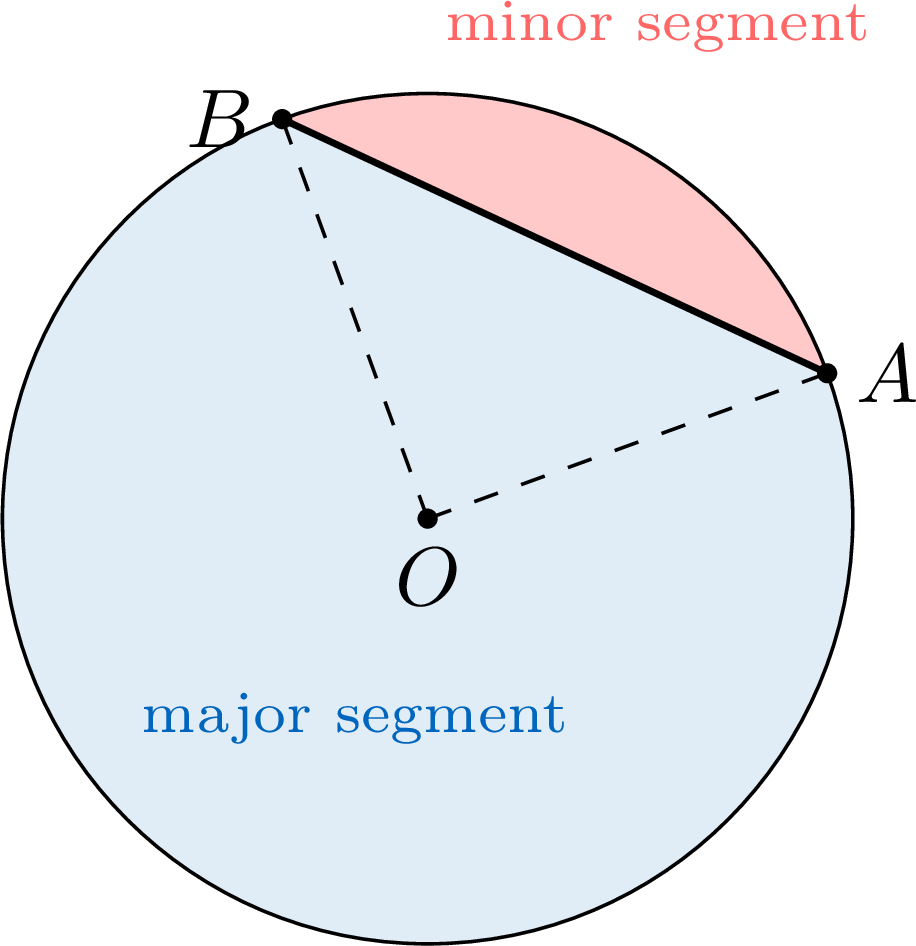
Definition — Tangent Line to a Circle
Let \(\mathcal{C}\) be a circle and \(A\) a point of \(\mathcal{C}\). A line is tangent to \(\mathcal{C}\) at \(A\) when its only common point with \(\mathcal{C}\) is \(A\); the point \(A\) is then the point of contact. A line that meets the circle at two points is a secant line. 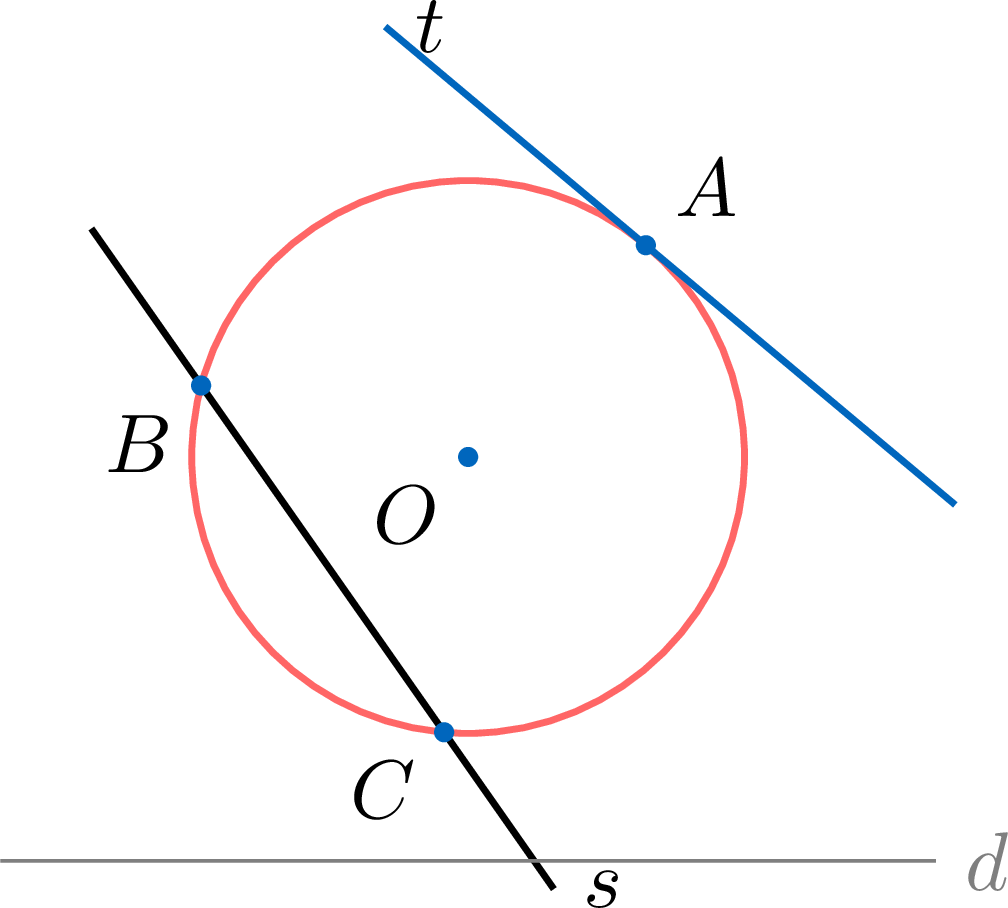
Example
The circle has centre \(O\). The points \(A\), \(B\), \(C\), \(D\) and \(E\) lie on the circle, and \(O\) lies on \(\Segment{AB}\); the line \(t\) touches the circle only at \(E\). 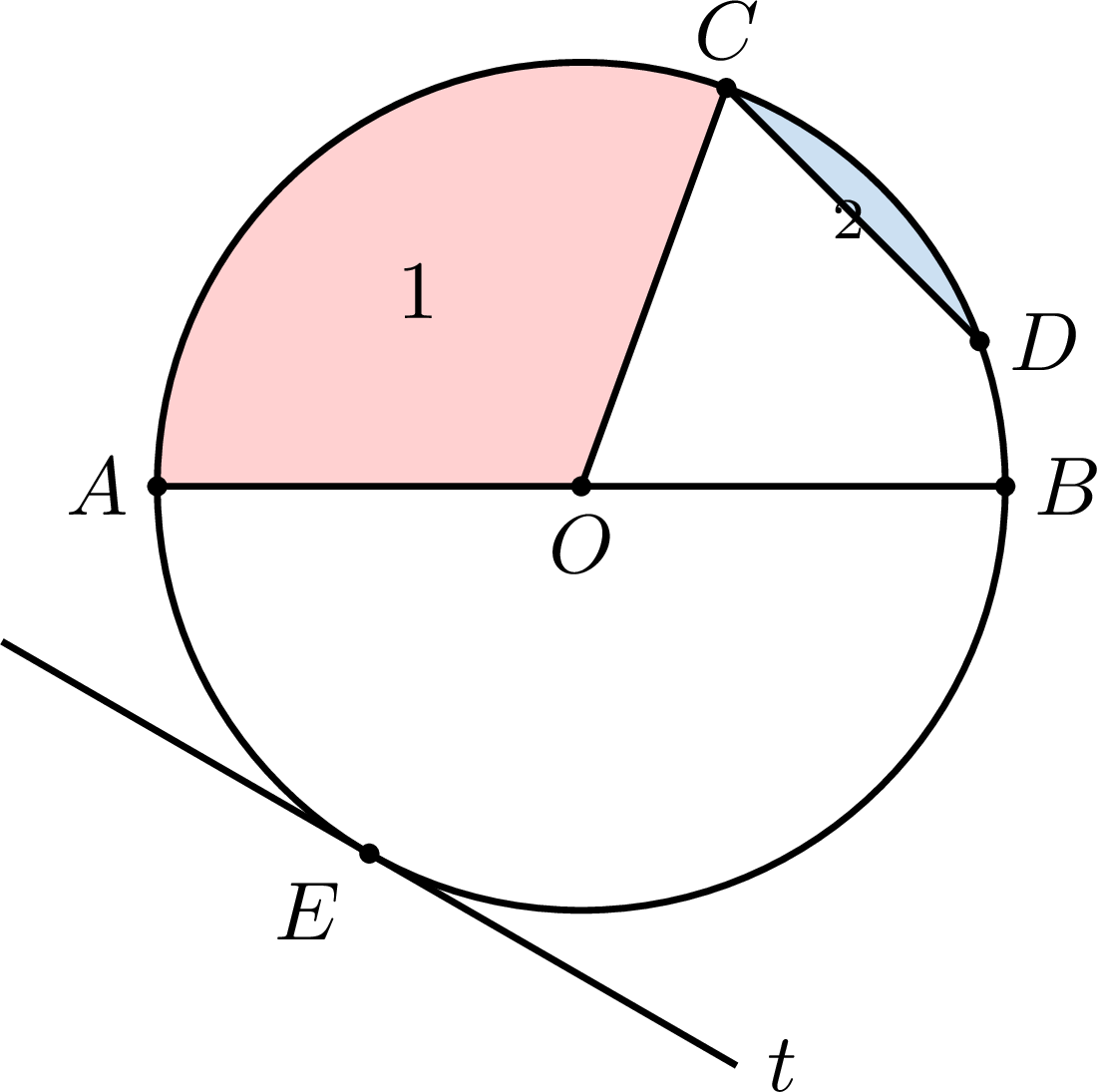
- \(\Segment{AB}\) joins two points of the circle and passes through \(O\): it is a diameter (and also a chord).
- \(\Segment{OC}\) joins the centre to a point of the circle: a radius.
- \(\Segment{CD}\) joins two points of the circle: a chord. It is not a diameter, since it does not pass through \(O\).
- The line \(t\) has exactly one point in common with the circle: a tangent, at \(E\).
- The region \(1\) is bounded by the radii \(\Segment{OA}\) and \(\Segment{OC}\) and the arc from \(A\) to \(C\): a sector.
- The region \(2\) is bounded by the chord \(\Segment{CD}\) and the minor arc \(CD\): a segment of the disc.
Example
A circle has centre \(O\) and radius \(r\). Prove that every chord of the circle measures at most \(2r\), and that the chords of length \(2r\) are the diameters.
Let \(\Segment{AB}\) be a chord: \(OA = OB = r\), since \(A\) and \(B\) lie on the circle. 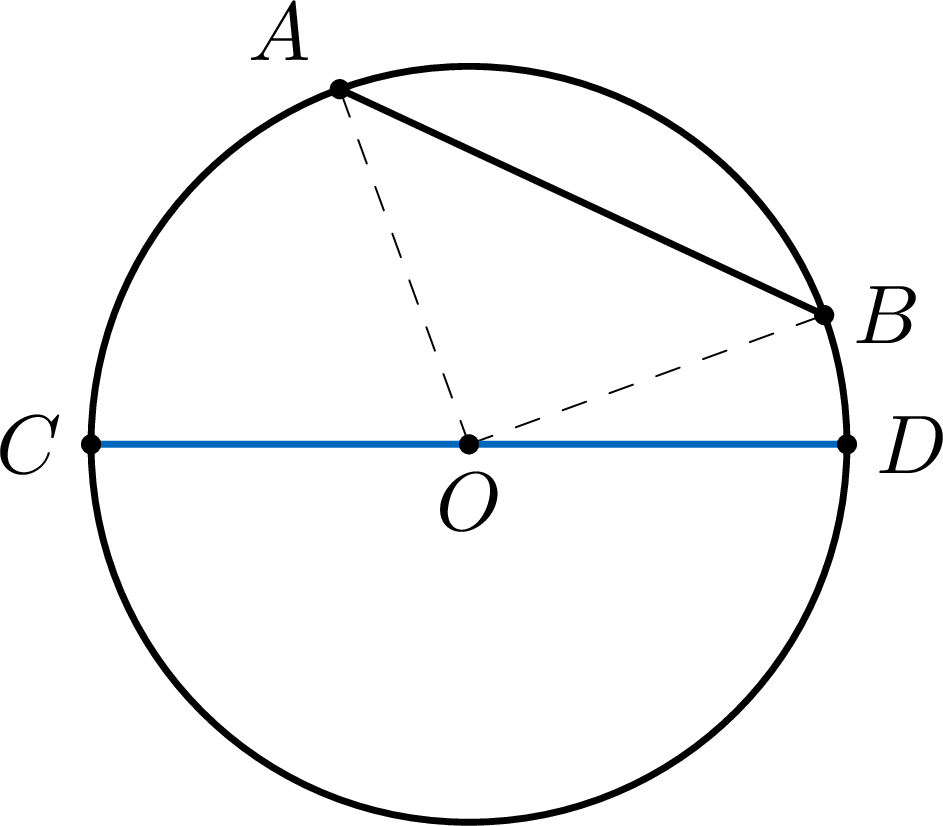
So every chord measures at most \(2r\), and exactly \(2r\) only when it passes through the centre: the longest chords of a circle are its diameters.
- If \(\Segment{AB}\) passes through \(O\), it is a diameter, and \(AB = AO + OB = r + r = 2r\).
- Otherwise, \(A\), \(O\) and \(B\) are the vertices of a triangle, and by the triangle inequality theorem: $$\begin{aligned}[t] AB &< AO + OB && \text{(triangle inequality in } AOB\text{)}\\ &= r + r && \text{(radii)}\\ &= 2r. \end{aligned}$$
Skills to practice
- Naming the Parts of a Circle
- Telling a Sector from a Segment
- Finding Chords, Diameters and Radii
- Drawing the Parts of a Circle
II
The Perimeter of a Circle
Definition — The number \(\pi\)
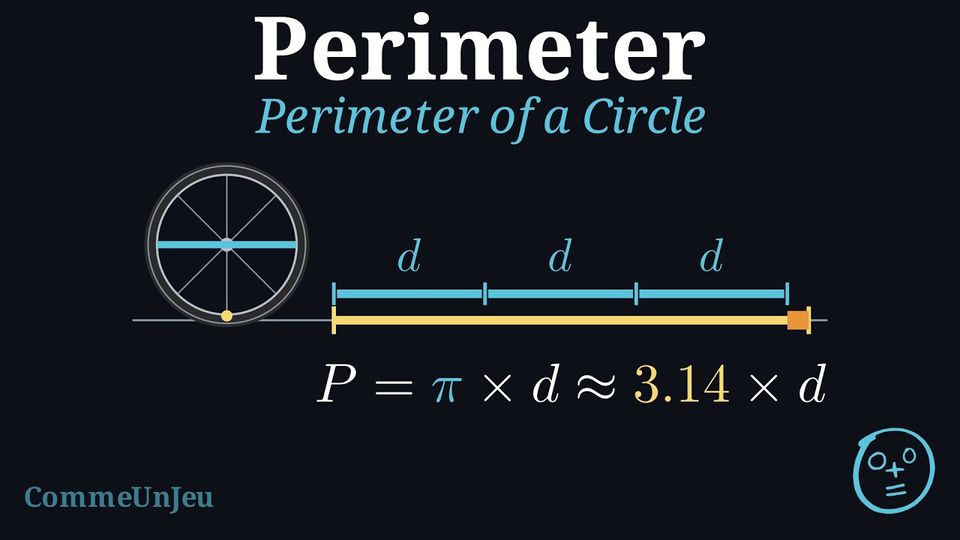
A circle has no straight sides, so its perimeter cannot be found by adding up side lengths. Instead, we compare the perimeter to the diameter. For every circle, the perimeter \(P\) divided by the diameter \(d\) gives the same number. This number is called pi, written \(\pi\): $$\pi = \frac{P}{d} \approx 3.14159.$$ The number \(\pi\) is not a terminating decimal, and it is not the quotient of two whole numbers (accepted without proof): \(3.14\) is only its rounding to the hundredth. 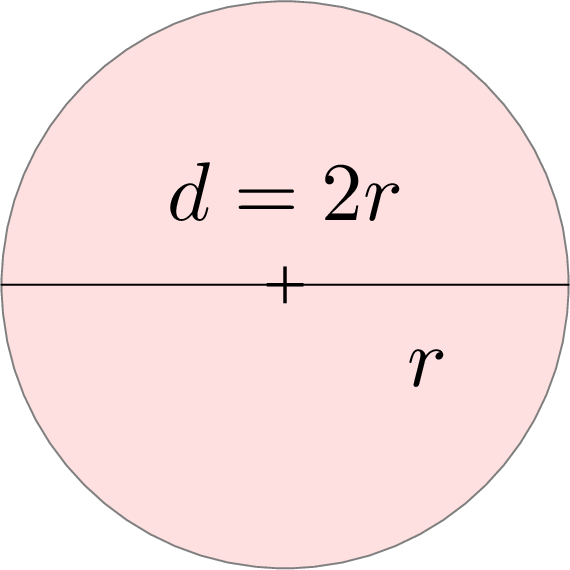

Example
If we measure the circumference \(P\) and the diameter \(d\) of several round objects, the ratio \(P \div d\) is always close to the same value: | Object | \(P\) | \(d\) | \(P \div d\) |
| Coin | \(7.9\) cm | \(2.5\) cm | \(3.16\) |
| Plate | \(69\) cm | \(22\) cm | \(3.14\) |
| Wheel | \(204\) cm | \(65\) cm | \(3.14\) |
Method — Exact Value and Approximate Value of the Perimeter of a Circle
- Write the formula with the element that is given: \(P = \pi \times d\) with the diameter, or \(P = 2 \times \pi \times r\) with the radius.
- Substitute the length for the letter \(d\) or \(r\). Keeping \(\pi\) in the result gives the exact value: for \(d = 9\) cm, \(P = 9 \times \pi\) cm \(= 9\pi\) cm. As \(\pi\) is not a terminating decimal, and it is not the quotient of two whole numbers (accepted without proof), the exact value of the perimeter keeps the letter \(\pi\).
- Replace \(\pi\) by an approximation to get an approximate value: \(3.14\) for a written calculation (\(P \approx 9 \times 3.14 = 28.26\) cm), the \(\pi\) key of the calculator for more digits, or \(3\) for a mental estimate (\(P \approx 27\) cm). Round as asked.
Example
- A circle has a radius of \(3\) cm. Give the exact value of its perimeter, then an approximate value taking \(\pi \approx 3.14\).
- An ant walks once around a circle of diameter \(5\) cm. What distance does it cover, to the nearest hundredth of a centimetre (use the \(\pi\) key of the calculator)?
- \(P = 2 \times \pi \times 3 = 6\pi\) cm (exact value). With \(\pi \approx 3.14\): \(P \approx 6 \times 3.14 = 18.84\) cm.
- The distance is the perimeter of the circle: \(P = \pi \times 5 = 5\pi\) cm \(\approx 15.71\) cm (with the \(\pi\) key: \(5 \times 3.14159\ldots\)).
Method — Finding the Perimeter of a Composite Figure
To find the perimeter of a composite figure: - Identify all the outer sides of the figure. Be careful not to include any lines inside the shape.
- Find the lengths of any unknown sides. The other sides often give them.
- Add the lengths of all the outer sides together (and of the arcs of the outline, if there are any).
Example
A window is made of a rectangle \(6\) m wide and \(4\) m high, topped by a semicircle whose diameter is the \(6\) m upper side. Find the perimeter of the window, taking \(\pi \approx 3.14\). 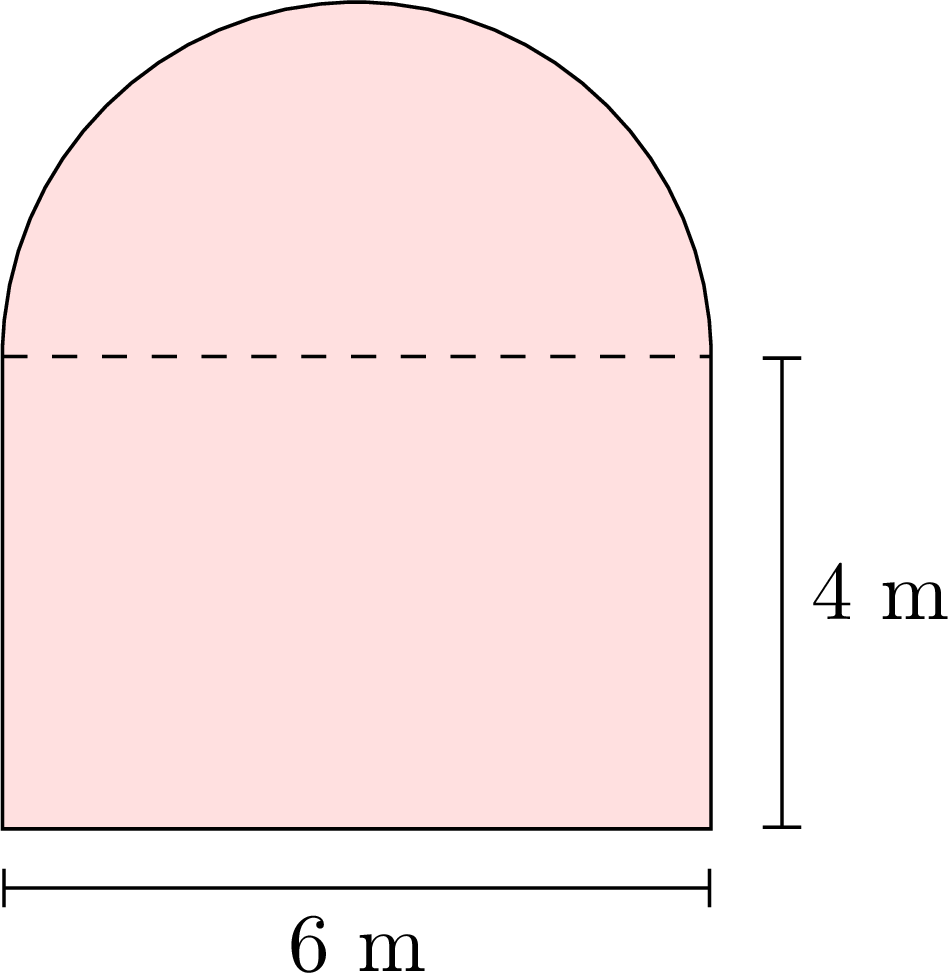
The outline is made of three sides of the rectangle (the dashed side is inside, not on the outline) and of the semicircle. Three sides: \(4 + 6 + 4 = 14\) m. Semicircle of diameter \(6\) m: half of a full circle, \(\pi \times 6 \div 2 \approx 3.14 \times 6 \div 2 = 9.42\) m. Perimeter: \(14 + 9.42 = 23.42\) m.
Skills to practice
- Finding Circumferences
- Giving Exact and Approximate Values
- Finding Perimeters of Composite Figures
III
Converting Area Units
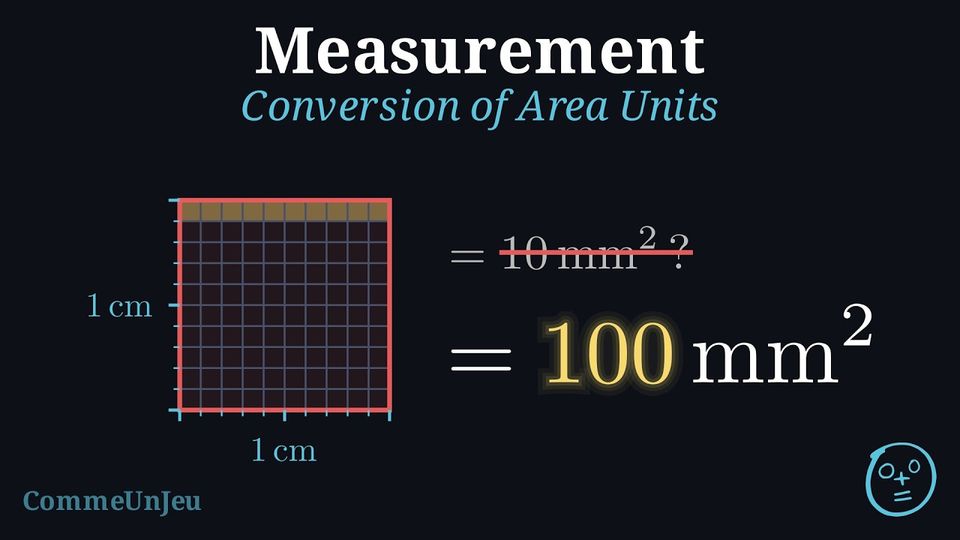
Proposition — Conversion of Area Units
Because we multiply two lengths to get an area, the conversion factors are squared. - \(1 \, \text{cm} = 10 \, \text{mm}\), so \(1 \, \text{cm}^2 = (10 \times 10) \, \text{mm}^2 = \mathbf{100} \, \text{mm}^2\)
- \(1 \, \text{m} = 100 \, \text{cm}\), so \(1 \, \text{m}^2 = (100 \times 100) \, \text{cm}^2 = \mathbf{10\,000} \, \text{cm}^2\)
- \(1 \, \text{km} = 1\,000 \, \text{m}\), so \(1 \, \text{km}^2 = (1\,000 \times 1\,000) \, \text{m}^2 = \mathbf{1\,000\,000} \, \text{m}^2\)
Method — Converting Using the Squared Factor
To convert an area, we start from the factor between the lengths, then square it. 
- Find the area factor between the two units: the length factor, squared.
- Multiply by this factor to go to a smaller unit; divide by it to go to a larger unit.
- Move the decimal point: multiplying by \(100\), \(10\,000\) or \(1\,000\,000\) moves it \(2\), \(4\) or \(6\) places to the right; dividing moves it to the left. Fill any empty places with zeros.
Skills to practice
- Converting Area Units with Decimals
IV
The Area of a Disc
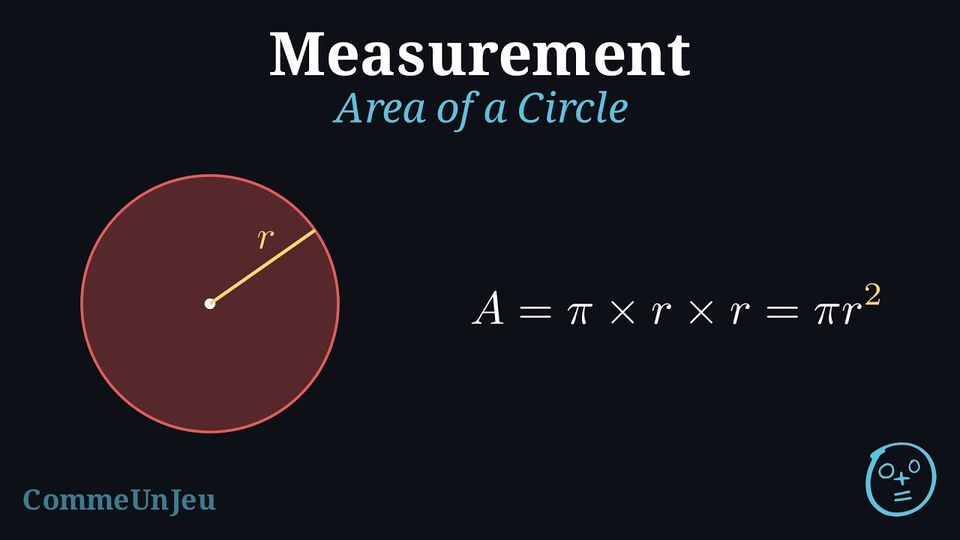
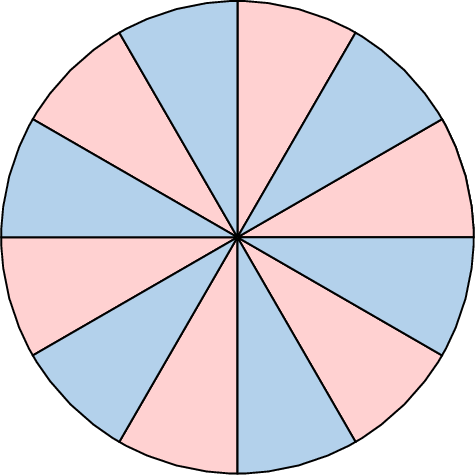
To find the area of a circle, we can divide it into smaller parts and rearrange them to approximate a parallelogram. Here is how it works, step by step:
- Divide the circle into 12 equal parts, like slices of a pie:
- Imagine cutting these 12 parts from the circle.
- Rearrange the parts by alternating them to form a shape that looks like a parallelogram:
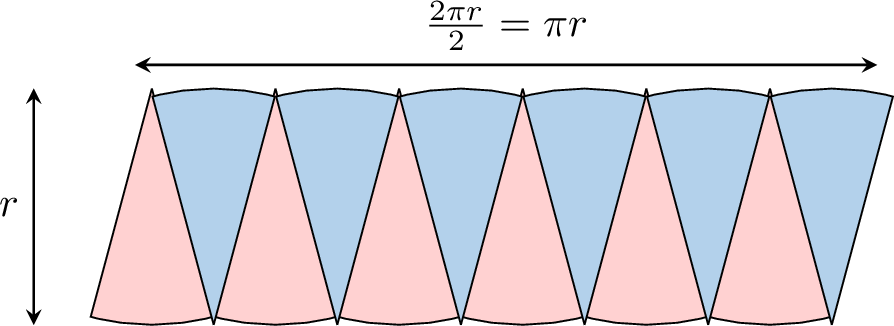
- The base of the parallelogram is approximately half the circumference of the circle (\(\pi r\)), and its height is approximately the radius (\(r\)). So, the area of the circle is the area of the parallelogram: $$ \begin{aligned} A_\text{circle} &= (\pi r) \times r \\ &= \pi \times r \times r \\ &= \pi r^2. \end{aligned} $$ We read this as “pi \(r\) squared”.
Proposition — Area of a Circle
The area of a circle means the area of the disc it encloses. It is found by multiplying \(\pi\) by the radius squared: $$\text{Area of a circle} = \pi \times \text{radius} \times \text{radius} $$ $$A = \pi r \times r = \pi r^2$$ 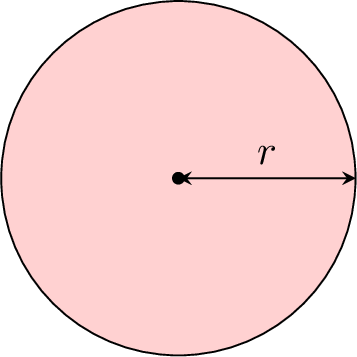
Example
Find the area of the circle: 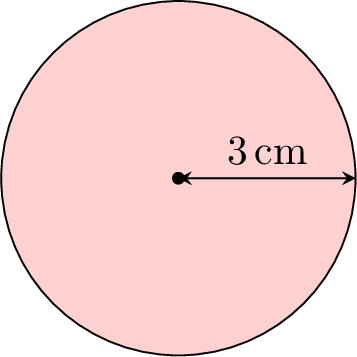
$$\begin{aligned}[t] A &= \pi \times r \times r \\
&= \pi \times 3 \times 3 \\
&= 9\pi \\
&\approx 28.3 \, \text{cm}^2 \end{aligned}$$
Half and Quarter Discs
A half-disc has half the area of the whole disc; a quarter-disc has a quarter of it: $$A_{\text{half-disc}} = \frac{1}{2}\pi r^2, \qquad A_{\text{quarter-disc}} = \frac{1}{4}\pi r^2.$$ 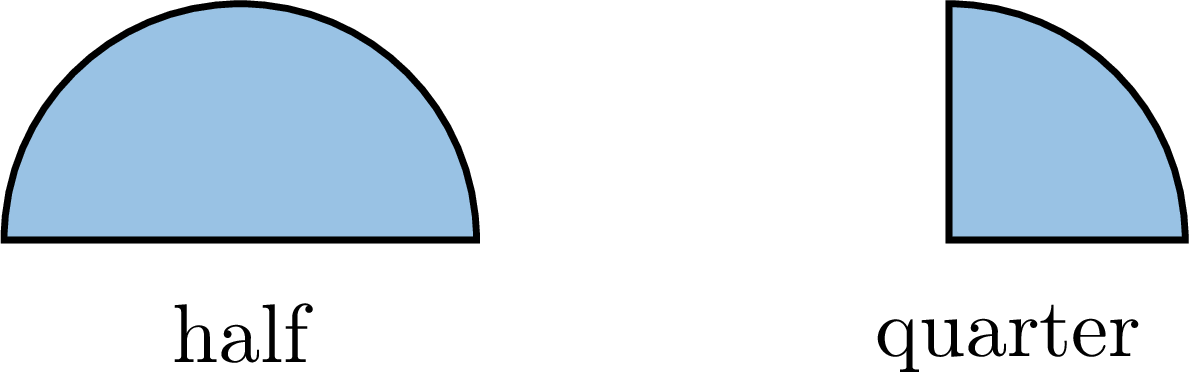
Skills to practice
- Finding Areas of Discs
- Finding Exact Areas and the Radius from an Area
V
Area Formulas
Proposition — Area Formulas
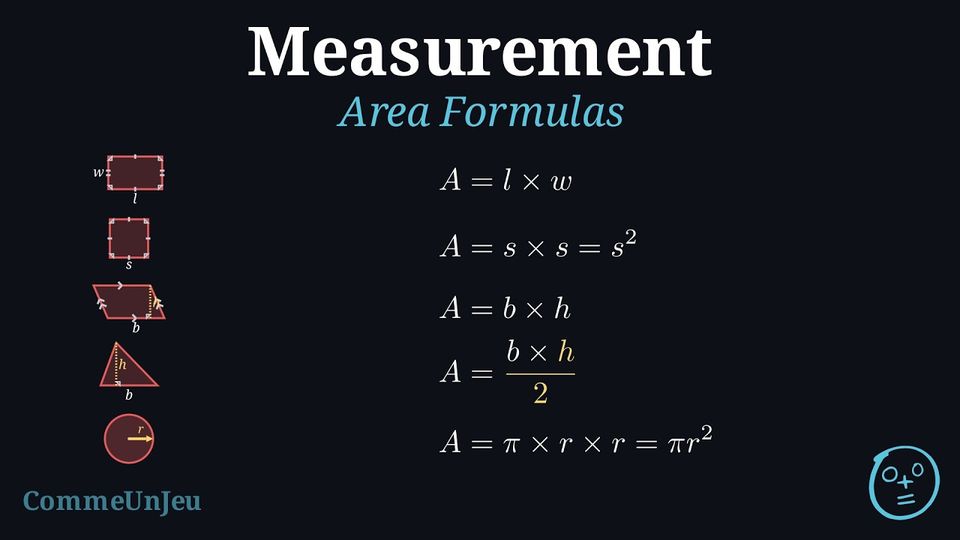
Here are the area formulas for some common shapes. | Name | Shape | Area |
| Rectangle | 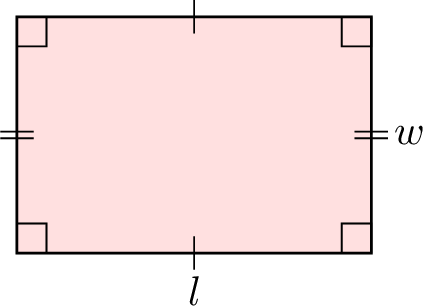 | \(A = l \times w\) |
| Square | 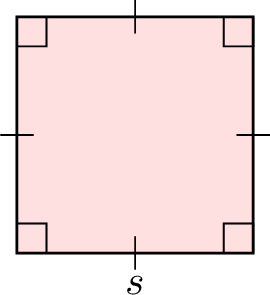 | \(\begin{aligned}A &= s \times s \\&= s^2\end{aligned}\) |
| Parallelogram | 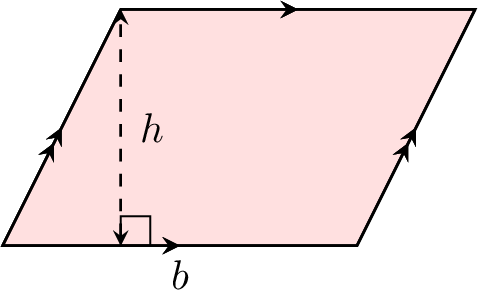 | \(A = b \times h\) |
| Triangle | 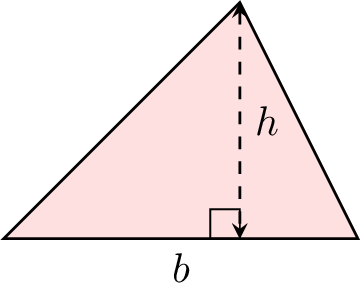 | \(A = \dfrac{b \times h}{2}\) |
| Circle | | \(\begin{aligned}A &= \pi \times r \times r \\&= \pi r^2\end{aligned}\) |
Proposition — Area of a Trapezium
The area of a trapezium whose parallel sides measure \(a\) and \(b\) and whose height is \(h\) is $$\text{Area of a trapezium} = \frac{(\text{sum of the parallel sides}) \times \text{height}}{2}$$ $$A = \frac{(a + b) \times h}{2},$$ also written \(A = \frac{1}{2}(a + b)h\): half the sum of the parallel sides, times the height. The order of \(a\) and \(b\) does not matter. 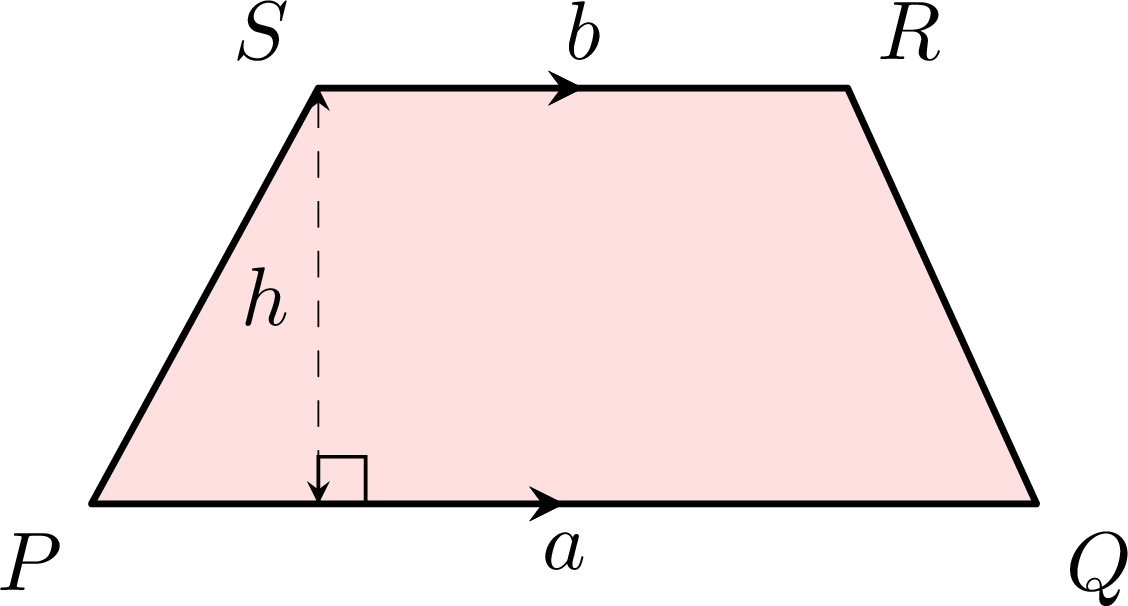
Let \(PQRS\) be a trapezium with \(\Line{PQ} \parallel \Line{SR}\), \(PQ = a\), \(SR = b\) and height \(h\). The diagonal \(\Segment{QS}\) cuts it into two triangles, \(PQS\) and \(QRS\). 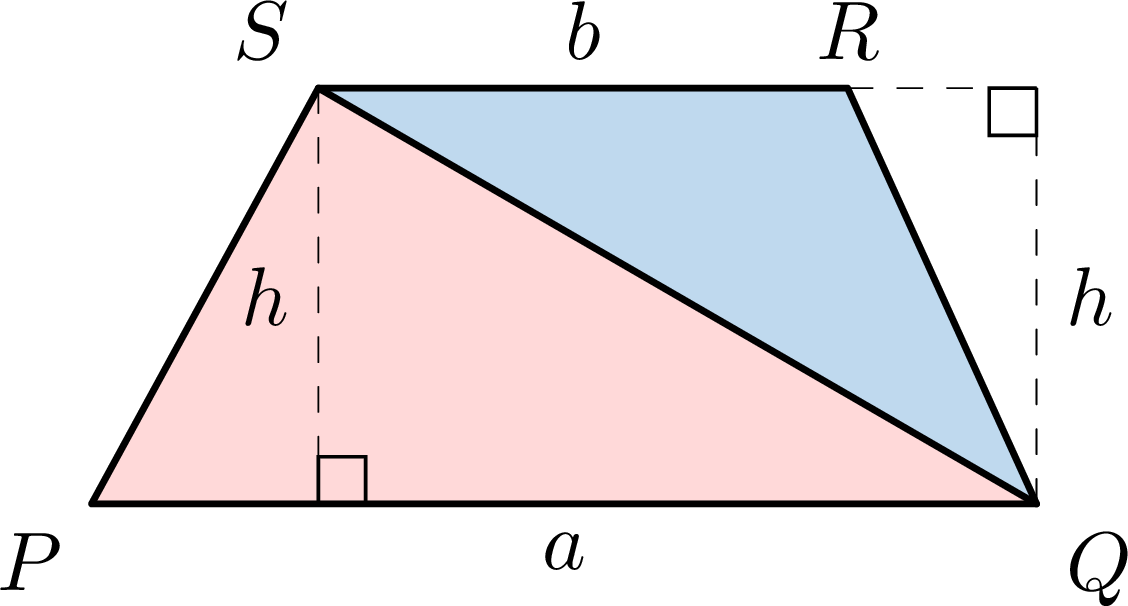
Another way gives the same result: two copies of the trapezium, one turned by a half-turn, make a parallelogram of base \(a + b\) and height \(h\), and the trapezium is half of it.
- In the triangle \(PQS\), take the base \(\Segment{PQ}\): the vertex \(S\) lies on the line \(\Line{SR}\), at the distance \(h\) from \(\Line{PQ}\), so the height relative to \(\Segment{PQ}\) is \(h\).
- In the triangle \(QRS\), take the base \(\Segment{SR}\): the vertex \(Q\) lies on \(\Line{PQ}\), at the distance \(h\) from \(\Line{SR}\), so the height relative to \(\Segment{SR}\) is \(h\) too.
Skills to practice
- Solving Area Problems
VI
The Area of a Kite
Definition — Kite
A kite is a quadrilateral with two pairs of equal adjacent sides: two sides that meet at a vertex have the same length, and the two other sides, which meet at the opposite vertex, have the same length too. 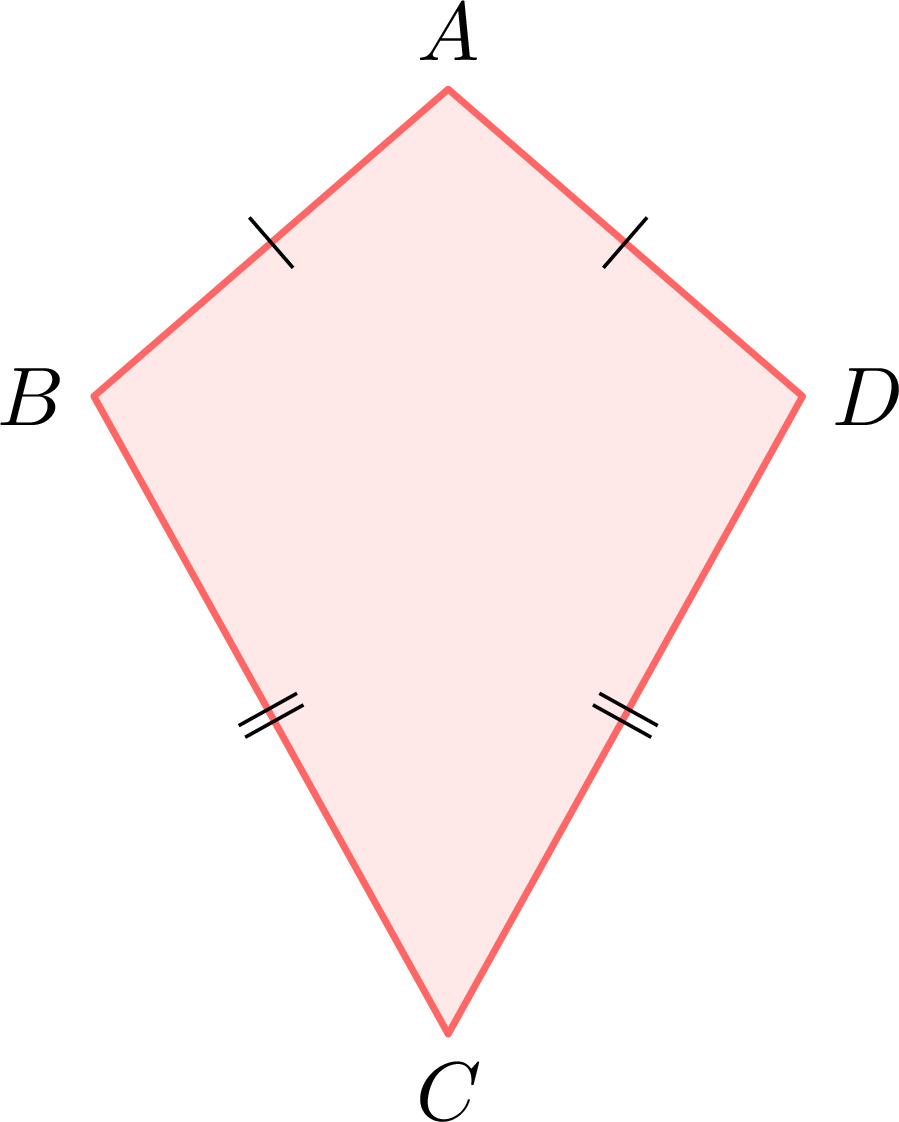
Proposition — Properties of a Kite
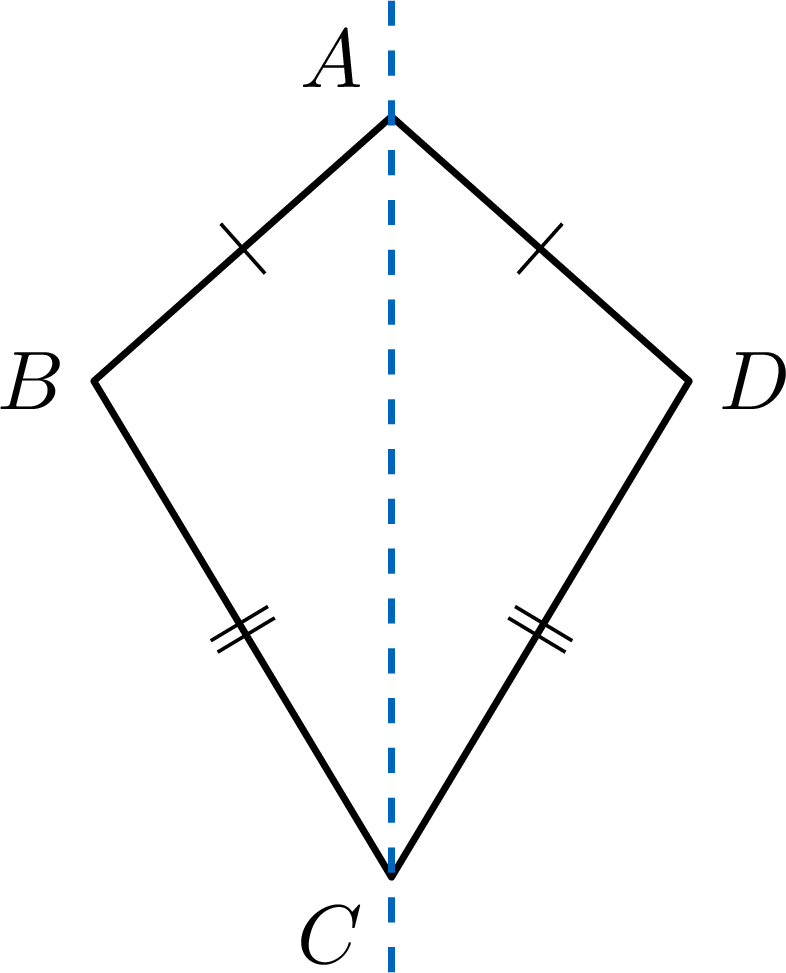
Let \(ABCD\) be a kite with \(AB = AD\) and \(CB = CD\): its equal sides meet at \(A\) and at \(C\). - The line \(\Line{AC}\), through the two vertices where the equal sides meet, is a line of symmetry of the kite. When the kite is not a rhombus, it is its only line of symmetry.
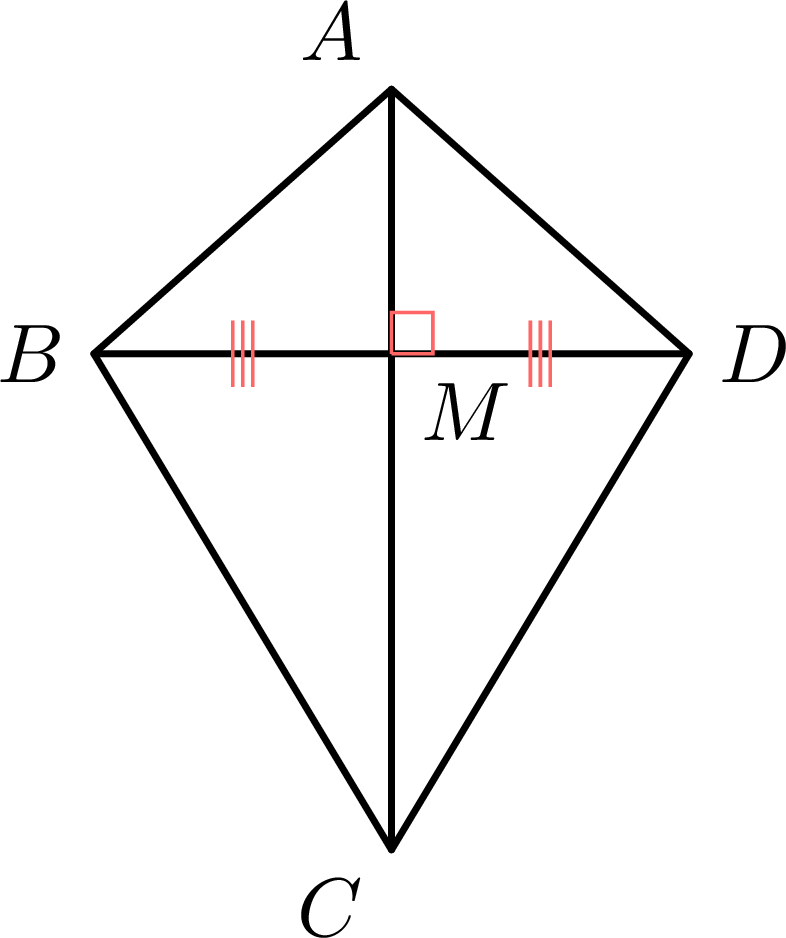
- The lines \(\Line{AC}\) and \(\Line{BD}\) through the diagonals are perpendicular, and \(\Line{AC}\) cuts the diagonal \(\Segment{BD}\) into two equal halves: \(\Line{AC}\) is the perpendicular bisector of \(\Segment{BD}\).
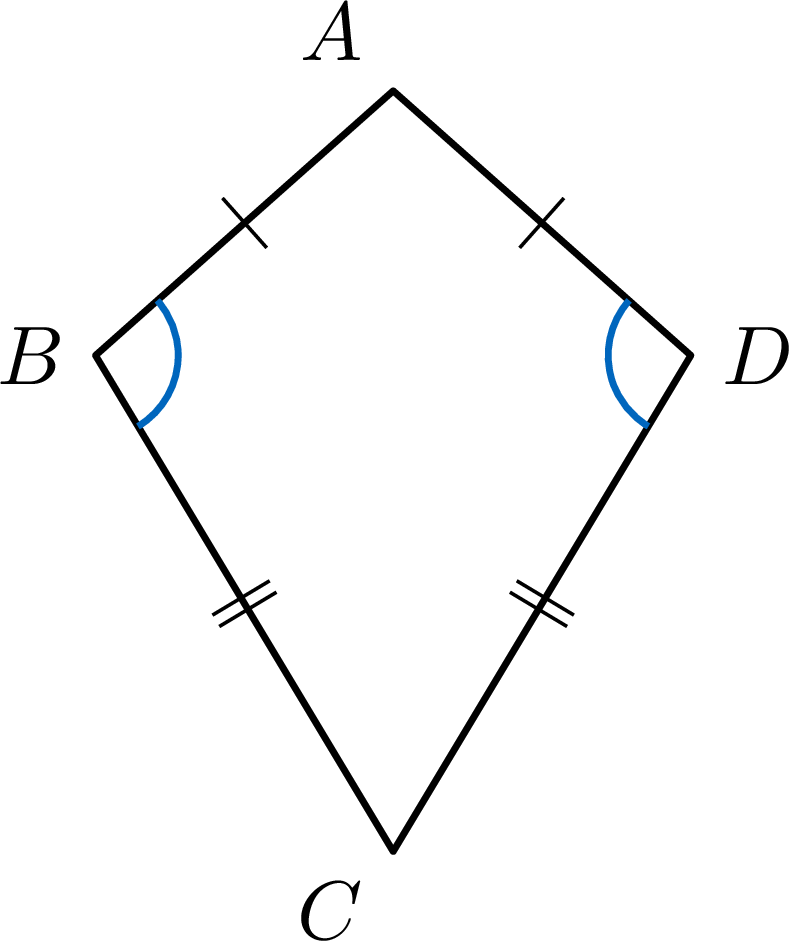
- The angles at \(B\) and at \(D\) are equal: \(\Angle{ABC} = \Angle{ADC}\). When the kite is not a rhombus, they are its two angles between unequal sides.
- The line of symmetry \(\Line{AC}\) bisects the angles at \(A\) and at \(C\): \(\Angle{BAC} = \Angle{DAC}\) and \(\Angle{BCA} = \Angle{DCA}\).
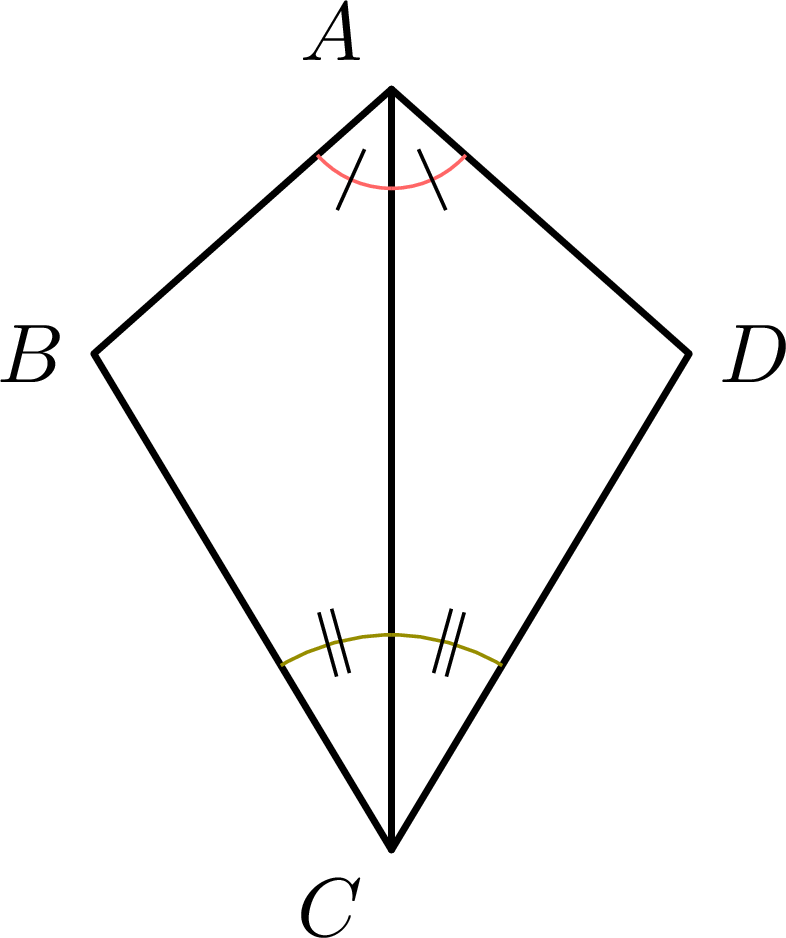
By definition of the kite, \(AB = AD\) and \(CB = CD\). 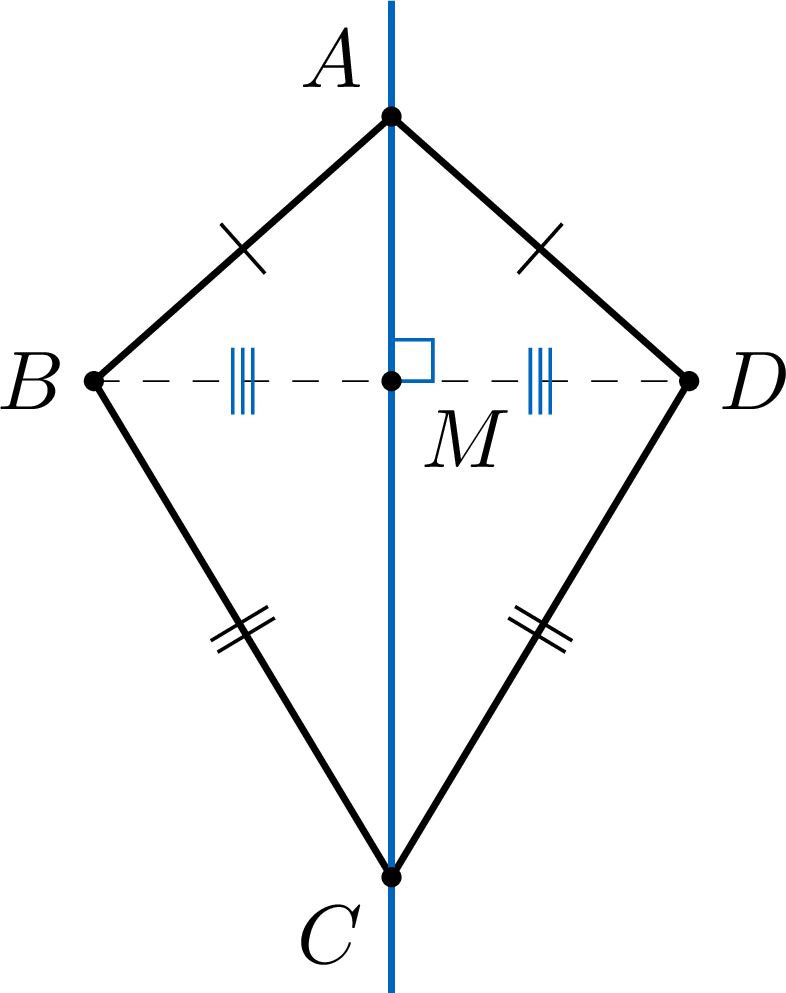
- The perpendicular bisector. The point \(A\) is at the same distance from \(B\) and from \(D\), so \(A\) lies on the perpendicular bisector of \(\Segment{BD}\) (property “Perpendicular bisector and equidistance”). For the same reason, \(C\) lies on it too. The points \(A\) and \(C\) are different, and only one line passes through both: the perpendicular bisector of \(\Segment{BD}\) is the line \(\Line{AC}\). So \(\Line{AC}\) is perpendicular to \(\Line{BD}\) and passes through the midpoint \(M\) of \(\Segment{BD}\).
- The line of symmetry. Since \(\Line{AC}\) is the perpendicular bisector of \(\Segment{BD}\), the reflection in \(\Line{AC}\) maps \(B\) onto \(D\) and \(D\) onto \(B\) (definition “Reflection of a Point”); it leaves \(A\) and \(C\) in place, since they lie on \(\Line{AC}\). It therefore maps the sides \(\Segment{AB}\), \(\Segment{BC}\), \(\Segment{CD}\), \(\Segment{DA}\) onto the sides \(\Segment{AD}\), \(\Segment{DC}\), \(\Segment{CB}\), \(\Segment{BA}\): the kite falls exactly onto itself, and \(\Line{AC}\) is a line of symmetry.
- The angles. A reflection keeps every angle (“Reflection is an isometry”). The reflection in \(\Line{AC}\) maps the angle \(\Angle{ABC}\) onto the angle \(\Angle{ADC}\), the angle \(\Angle{BAC}\) onto \(\Angle{DAC}\), and \(\Angle{BCA}\) onto \(\Angle{DCA}\): these angles are equal in pairs.
- Only one line of symmetry when the kite is not a rhombus. Then \(AB = AD = a\) and \(CB = CD = b\) with \(a \neq b\). A reflection that maps the kite onto itself maps each vertex onto a vertex and each side onto a side of the same length. The vertex \(A\) is the only vertex where two sides of length \(a\) meet, so the reflection leaves \(A\) in place; for the same reason, it leaves \(C\) in place. A reflection leaves in place only the points of its mirror line: that line passes through \(A\) and through \(C\), so it is the line \(\Line{AC}\).
Concave Kites
The definition of the kite also accepts a concave quadrilateral, shaped like an arrowhead (also called a dart): its reflex angle is at a vertex where two equal sides meet. The proof of the properties of a kite applies word for word: \(\Line{AC}\) is still the line of symmetry and the perpendicular bisector of \(\Segment{BD}\), and \(\Angle{ABC} = \Angle{ADC}\). But the diagonal \(\Segment{BD}\) now lies outside the kite, so the two diagonals do not cross each other: it is the lines \(\Line{AC}\) and \(\Line{BD}\) that are perpendicular, at the midpoint \(M\) of \(\Segment{BD}\). 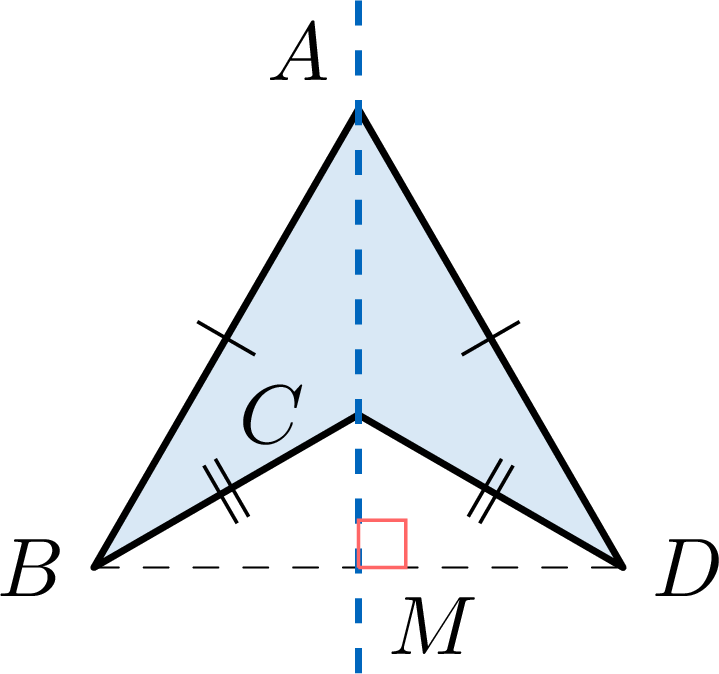
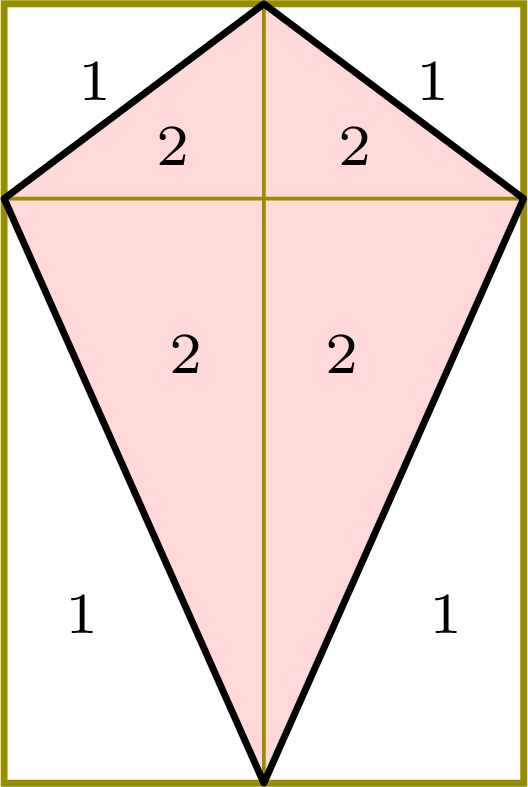
A toy kite is made of two sticks, \(60\) cm and \(40\) cm long, which cross at right angles, the long stick passing through the middle of the short one; the fabric is stretched from the end of one stick to the end of the next. Around the kite, draw the rectangle whose sides pass through the ends of the sticks and are parallel to them. 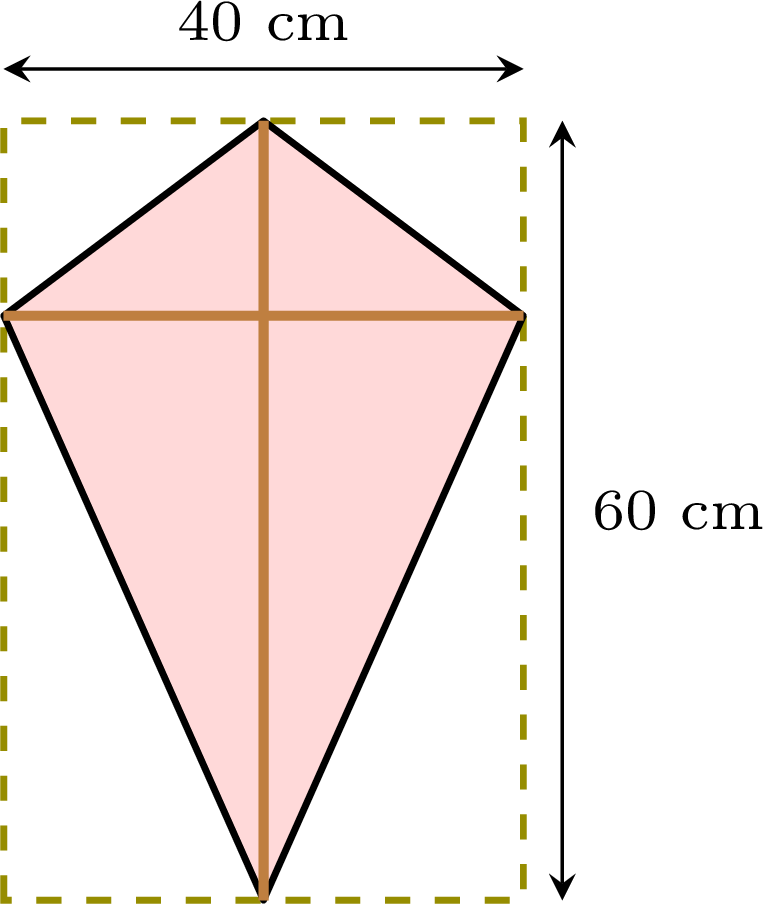
- What is the area of the rectangle?
- The sticks cut the rectangle into four small rectangles. What part of each small rectangle is covered by the fabric?
- Deduce the area of the fabric.
- The rectangle measures \(60\) cm by \(40\) cm: its area is \(60 \times 40 = 2\,400\) cm\(^2\).
- Each small rectangle is cut by a side of the kite along its diagonal, into two equal right-angled triangles: the triangle \(1\) is outside the kite, the triangle \(2\) inside. The fabric covers half of each small rectangle.
- So the fabric covers half of the big rectangle: \(2\,400 \div 2 = 1\,200\) cm\(^2\) — half the product of the lengths of the two sticks, the diagonals of the kite.
Proposition — Area of a Kite
The area of a kite whose diagonals measure \(d_1\) and \(d_2\) is $$\text{Area of a kite} = \frac{\text{diagonal} \times \text{diagonal}}{2}$$ $$A = \frac{d_1 \times d_2}{2}:$$ half the product of the diagonals. A rhombus is a kite, so the same formula gives the area of a rhombus. 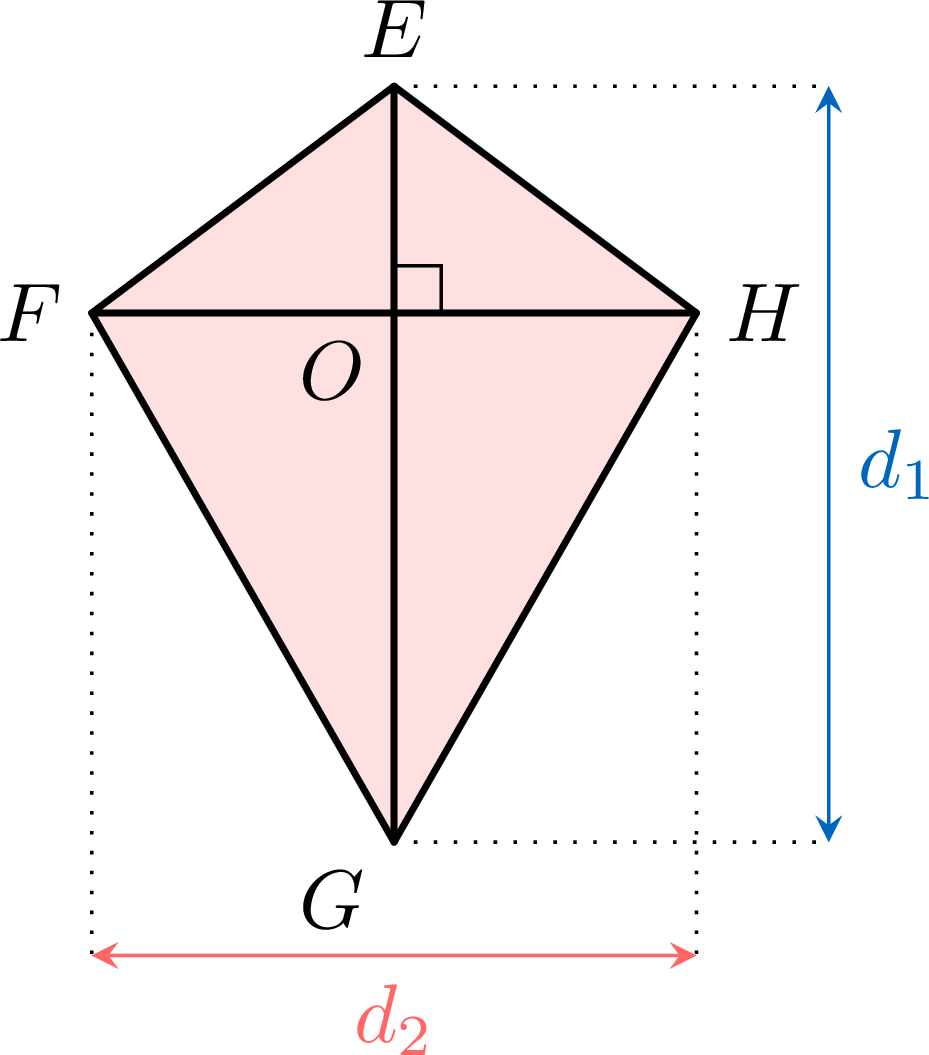
Let \(EFGH\) be a convex kite with \(EF = EH\) and \(GF = GH\), whose diagonals \(\Segment{EG}\) and \(\Segment{FH}\) cross at \(O\), with \(EG = d_1\) and \(FH = d_2\). By the properties of a kite, \(\Line{EG}\) is perpendicular to \(\Line{FH}\) (“Properties of a Kite”). The diagonal \(\Segment{FH}\) cuts the kite into the triangles \(EFH\) and \(GFH\), which share the base \(\Segment{FH}\); their heights relative to this base are \(\Segment{EO}\) and \(\Segment{GO}\). 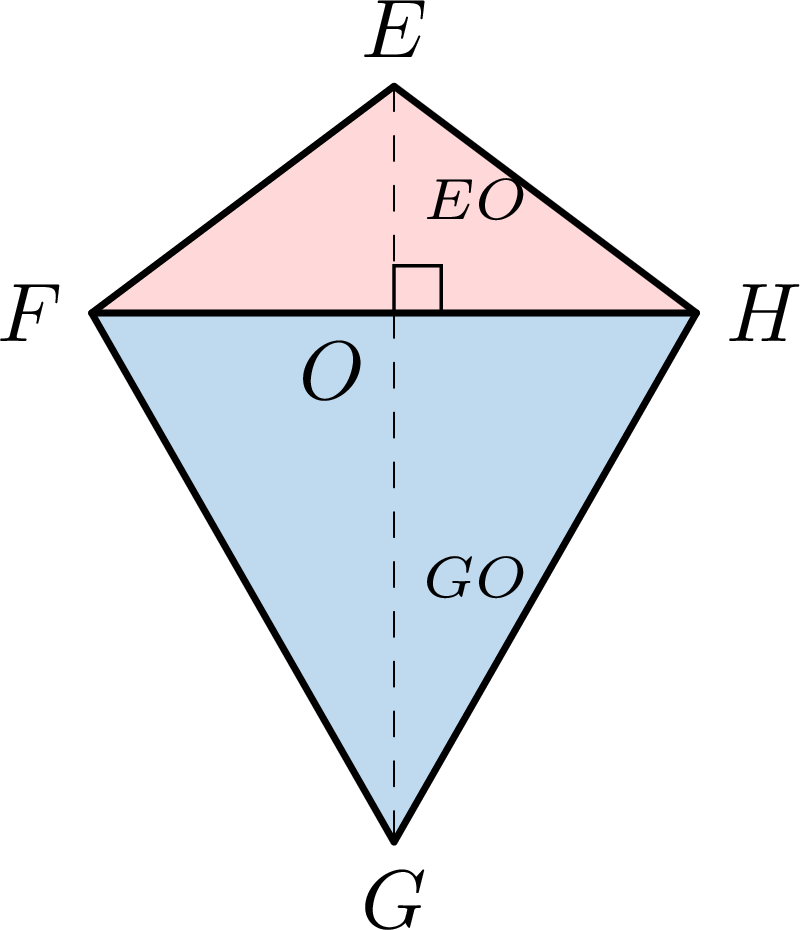
$$\begin{aligned}[t] A &= \text{Area}(EFH) + \text{Area}(GFH) && \text{(the diagonal \(\Segment{FH}\) cuts the kite in two)}\\
&= \frac{FH \times EO}{2} + \frac{FH \times GO}{2} && \text{(area of a triangle)}\\
&= \frac{FH \times (EO + GO)}{2} && \text{(distributivity)}\\
&= \frac{FH \times EG}{2} && \text{(\(O\) lies on \(\Segment{EG}\), between \(E\) and \(G\))}\\
&= \frac{d_1 \times d_2}{2}. \end{aligned}$$ For an arrowhead (a kite that is not convex, Remark “Concave Kites”), the line \(\Line{EG}\) cuts \(\Segment{FH}\) at a point \(O\) that is not between \(E\) and \(G\): the area is then the difference of the areas of the two triangles, and the same formula holds; an exercise on the arrowhead proves it.
Method — Finding the Area of a Kite or a Rhombus
- Find the lengths of the two diagonals \(d_1\) and \(d_2\) — not the sides.
- Check that they are in the same unit.
- Write the formula \(A = \dfrac{d_1 \times d_2}{2}\), replace the letters, compute, and give the area in square units.
Example
Find the area of this kite, whose diagonals measure \(12\) cm and \(7\) cm. 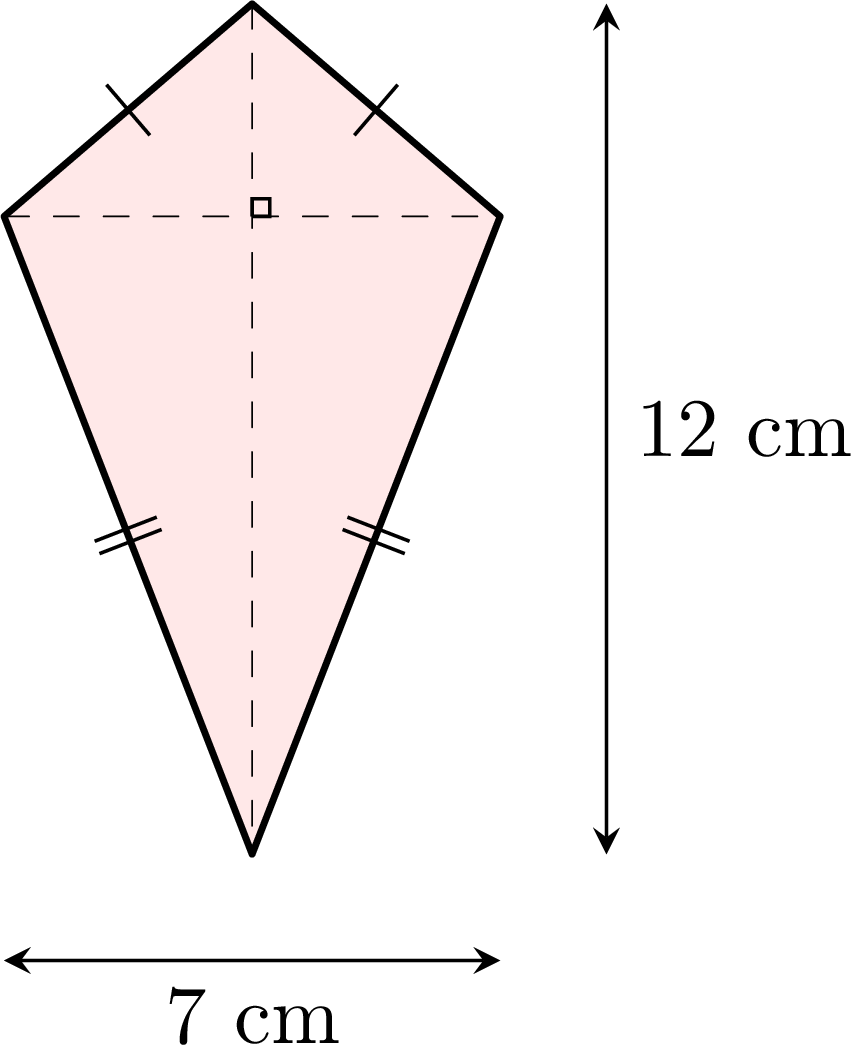
$$\begin{aligned}[t] A &= \frac{d_1 \times d_2}{2} && \text{(area of a kite)}\\
&= \frac{12 \times 7}{2}\\
&= \frac{84}{2} = 42 \text{ cm}^2. \end{aligned}$$
Example
A rhombus-shaped window has diagonals of \(10\) m and \(6\) m. Find its area. 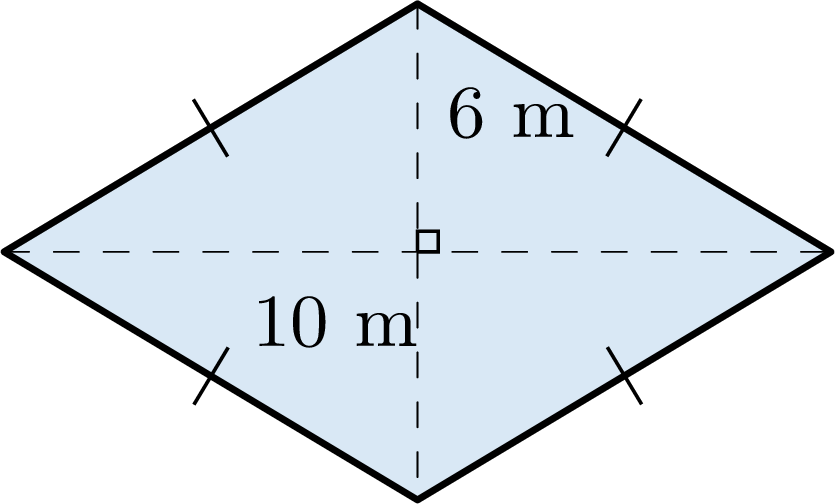
A rhombus is a kite: its area is half the product of its diagonals. $$\begin{aligned}[t] A &= \frac{d_1 \times d_2}{2} && \text{(area of a rhombus)}\\
&= \frac{10 \times 6}{2}\\
&= \frac{60}{2} = 30 \text{ m}^2. \end{aligned}$$
Example
A kite has an area of \(54\) cm\(^2\), and one of its diagonals measures \(12\) cm. Find the length of the other diagonal. 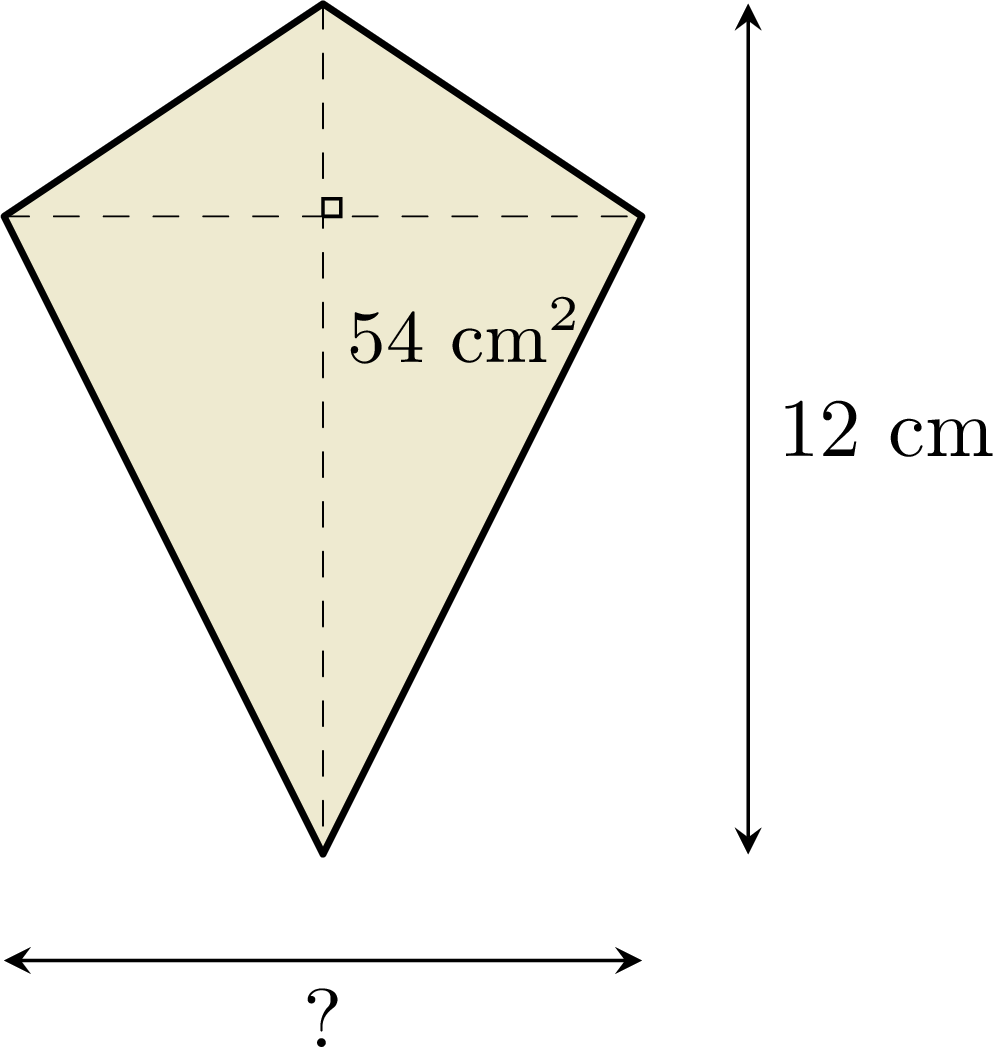
Write \(d_2\) for the unknown diagonal, replace the known values in the formula, then solve: $$\begin{aligned}[t] \frac{12 \times d_2}{2} &= 54 && \text{(area of a kite)}\\
6 \times d_2 &= 54 && \text{(\(12 \div 2 = 6\))}\\
d_2 &= 9. && \text{(dividing both sides by \(6\))} \end{aligned}$$ The other diagonal measures \(9\) cm. Check: \(\dfrac{12 \times 9}{2} = \dfrac{108}{2} = 54\) cm\(^2\).
Skills to practice
- Choosing the Correct Lengths
- Finding the Area of a Kite
- Finding a Missing Diagonal
VII
Going further
Skills to practice
- Finding Areas of Composite Figures
- Solving Circle and Kite Problems in Context
- Investigating Circles and Kites
- Quiz
Jump to section