International Baccalaureate · MYP 3
Exponents
I
Finding the LCM from Prime Factors
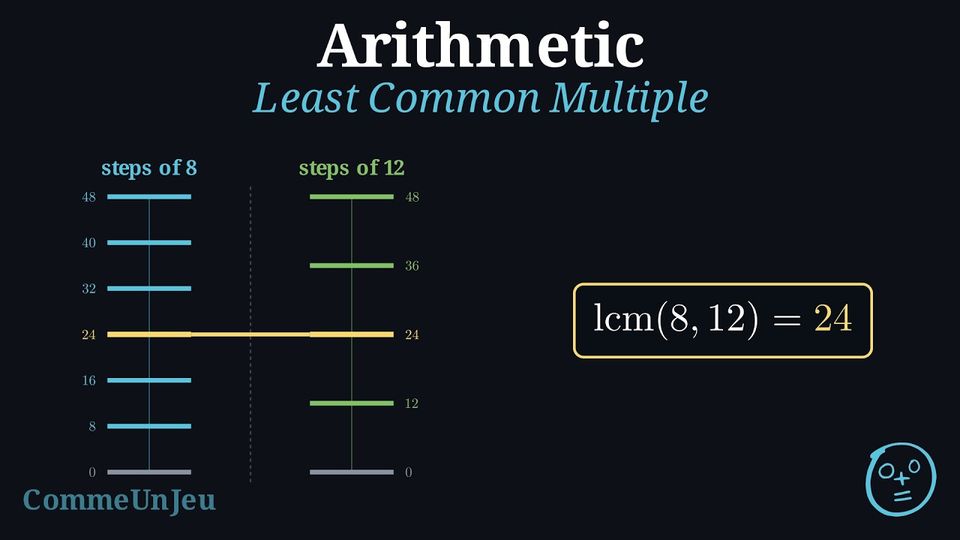
Definition — Lowest Common Multiple (LCM)
The lowest common multiple (LCM) of two (or more) non-zero whole numbers is the smallest positive whole number that is a multiple of each of them. It is also called the least common multiple. We usually write the LCM of \(a\) and \(b\) as \(\operatorname{LCM}(a, b)\).
Method — Prime Factorisation
Prime factorisation of a whole number greater than \(1\) is writing that number as a product of prime numbers only. In other words, it is finding which primes multiply to give the number. Method — Finding the LCM Using Prime Factorisation
- Write the prime factorisation of each number.
- For each prime factor, take the highest power that appears in any of the numbers.
- Multiply these factors together to get the LCM.
Example
Find the LCM of \(8\) and \(12\) using prime factorisation. - \(8 = 2 \times 2 \times 2 = 2^3\)
- \(12 = 2 \times 2 \times 3 = 2^2 \times 3^1\)
- Take the highest powers of each prime: \(2^3\) and \(3^1\).
- So, \(\operatorname{LCM}(8, 12) = 2^3 \times 3^1 = 8 \times 3 = 24\).
Definition — Highest Common Factor (HCF)
The highest common factor (HCF) of two (or more) whole numbers, not all zero, is the largest positive whole number that is a factor of each of them (it divides each of them exactly, with remainder \(0\)). It is also called the greatest common divisor (GCD). We usually write the HCF of \(a\) and \(b\) as \(\operatorname{HCF}(a, b)\).
Proposition — Product Relation between HCF and LCM
For all non-zero whole numbers \(a\) and \(b\): $$\operatorname{HCF}(a, b) \times \operatorname{LCM}(a, b) = a \times b.$$ (Accepted without proof; this relation can be proved with prime factorisations.) In particular, once the HCF is known — for instance from the prime factorisations — the LCM follows by a single division: \(\operatorname{LCM}(a, b) = \dfrac{a \times b}{\operatorname{HCF}(a, b)}\). Example
Using \(\operatorname{HCF}(1071, 462) = 21\), calculate \(\operatorname{LCM}(1071, 462)\).
By the product relation: $$\operatorname{LCM}(1071, 462) = \frac{1071 \times 462}{\operatorname{HCF}(1071, 462)} = \frac{494\,802}{21} = \boxed{23\,562}.$$
Skills to practice
- Finding the LCM from Prime Factorisations
II
Calculating Powers of Negative Numbers
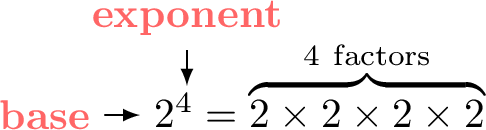
Definition — Powers
A power is a short way to write a repeated multiplication of a number by itself: For a number \(a\) and a positive whole number \(n\), $$ a^n = \overbrace{a \times a \times \dots \times a}^{n\ \text{factors}}. $$
Powers of Negative Numbers
A power with a whole exponent \(n\geq 1\) is a repeated product of \(n\) equal factors, so the sign rule for several factors gives its sign: \(\textcolor{colorprop}{(-2)}^3 = \textcolor{colorprop}{(-2)}\times \textcolor{colorprop}{(-2)}\times \textcolor{colorprop}{(-2)} = \textcolor{colorprop}{-8}\) (three negative factors). Watch out: without brackets, the square applies to the number only, not to the sign: \(-3^2 = -(3\times 3) = -9\), while \(\textcolor{colorprop}{(-3)}^2 = +9\).
Recall that \((-3)^2 = 9\) and \(-3^2 = -(3^2) = -9\): the brackets make \(-3\) the base, whereas without them the square applies to \(3\) only. Without writing out all the factors, is it possible to predict the sign of \((-2)^5\)? Of \((-2)^6\)? What decides the sign of a power?
Proposition — Sign of a Power
For any integer \(n \geq 1\): a power of a negative number is the product of \(n\) negative factors. By the sign rule for a product: - if \(n\) is even, the power is positive;
- if \(n\) is odd, the power is negative.
Example
Give the sign, then the value, of \((-2)^5\) and of \((-10)^4\).
$$\begin{aligned} (-2)^5 &: \text{ the exponent } 5 \text{ is odd, the power is negative};\quad 2^5 = 32, \text{ so } (-2)^5 = \textcolor{colorprop}{-32.}\\
(-10)^4 &: \text{ the exponent } 4 \text{ is even, the power is positive};\quad 10^4 = 10\,000, \text{ so } (-10)^4 = \textcolor{colordef}{+10\,000.} \end{aligned}$$ 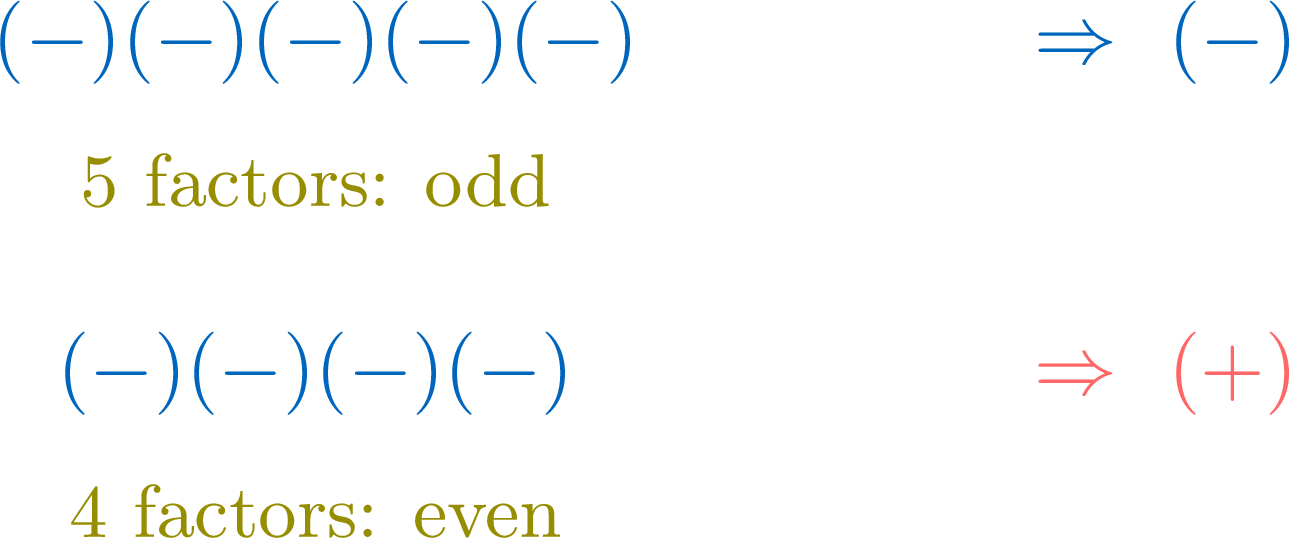
Skills to practice
- Calculating Squares and Cubes of Negative Numbers
- Determining the Sign and Value of a Power
III
Using Zero and Negative Exponents
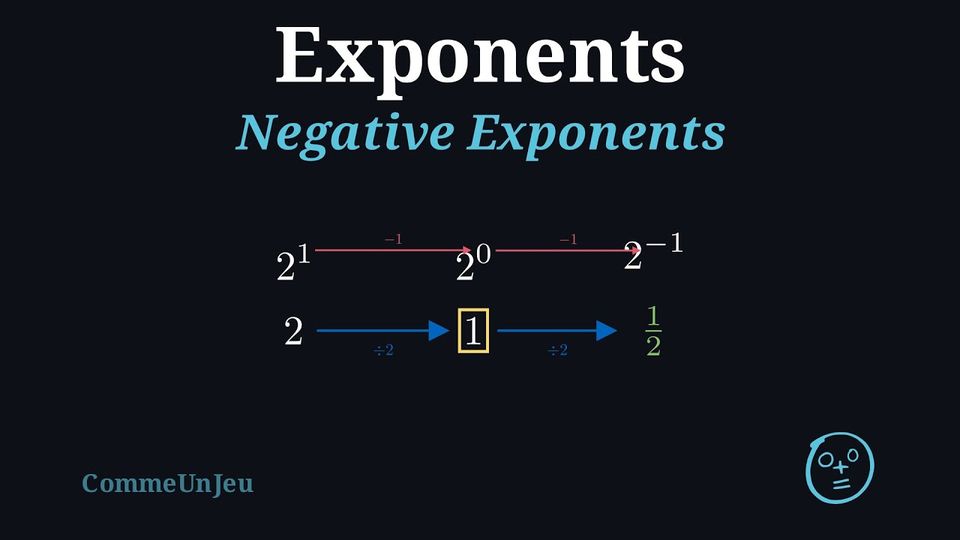
To understand negative exponents, we look at the pattern of multiplying by \(2\): 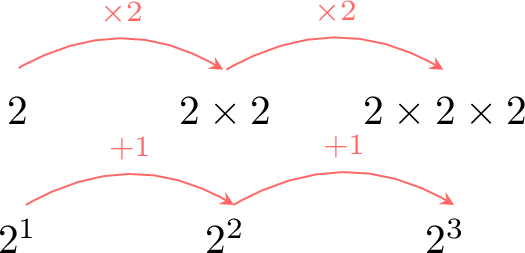
This pattern shows: 
The extended pattern shows:
- \(2^1 = 2\)
- \(2^2 = 2 \times 2\)
- \(2^3 = 2 \times 2 \times 2\)
- \(2^0 = 1\)
- \(2^{-1} = \dfrac{1}{2}\)
- \(2^{-2} = \dfrac{1}{2 \times 2}\)
- \(2^{-3} = \dfrac{1}{2 \times 2 \times 2}\)
Definition — Negative and Zero Exponents
For a non-zero number \(a\) and a positive integer \(n\), we extend exponentiation to negative exponents by: $$\begin{aligned}[t] a^{-n} &= \dfrac{1}{\underbrace{a \times a \times \dots \times a}_{n\ \text{factors}}} \\
&= \dfrac{1}{a^n} \end{aligned} \qquad \text{and} \qquad a^0 = 1 \quad (a \neq 0).$$ In particular, \(a^{-1} = \dfrac{1}{a}\). A negative exponent means we take the reciprocal of the corresponding positive power. Example
Write \(3^{-2}\) as a fraction.
$$\begin{aligned}[t] 3^{-2} &= \dfrac{1}{3 \times 3} \\
&= \dfrac{1}{9} \end{aligned}$$
Skills to practice
- Writing Negative Exponents as Fractions
- Evaluating Powers with a Zero Exponent
- Distinguishing a Negative Base, an Opposite and a Negative Exponent
- Combining Negative Exponents with Arithmetic
IV
Multiplying Powers of the Same Number
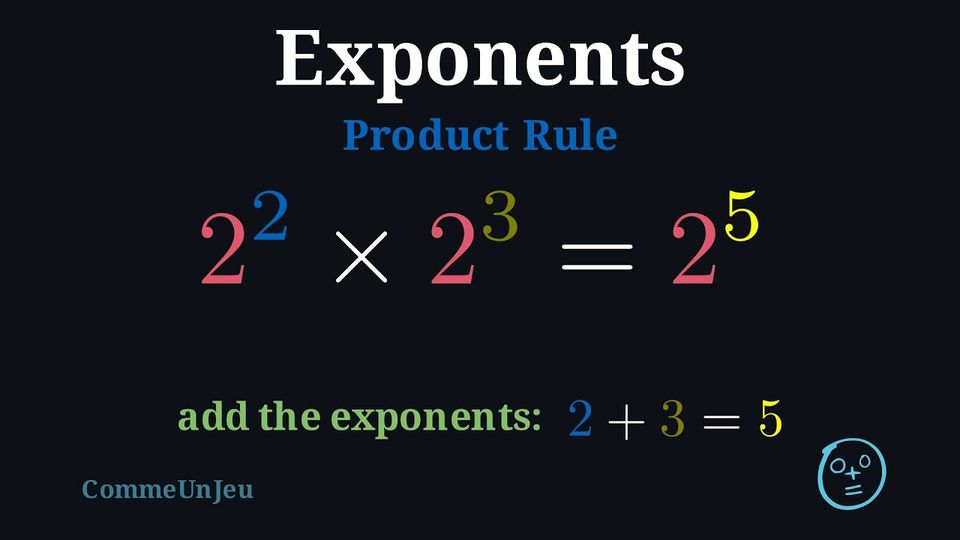
Can \(7^3 \times 7^2\) be written as a single power of \(7\)? We expand: $$\begin{aligned} \textcolor{colordef}{7}^{\textcolor{colorprop}{3}} \times \textcolor{colordef}{7}^{\textcolor{olive}{2}} &= \overbrace{\textcolor{colordef}{7} \times \textcolor{colordef}{7} \times \textcolor{colordef}{7}}^{\textcolor{colorprop}{3}\,\text{factors}} \times \overbrace{\textcolor{colordef}{7} \times \textcolor{colordef}{7}}^{\textcolor{olive}{2}\,\text{factors}} \\
&= \overbrace{\textcolor{colordef}{7} \times \textcolor{colordef}{7} \times \textcolor{colordef}{7} \times \textcolor{colordef}{7} \times \textcolor{colordef}{7}}^{\textcolor{colorprop}{3}+\textcolor{olive}{2}\,\text{factors}} \\
&= \textcolor{colordef}{7}^{\textcolor{colorprop}{3}+\textcolor{olive}{2}} \end{aligned}$$ In general, when a number \(\textcolor{colordef}{a}\) is raised to the power \(\textcolor{colorprop}{m}\) and multiplied by the same number raised to the power \(\textcolor{olive}{n}\), that is $$\textcolor{colordef}{a}^{\textcolor{colorprop}{m}} \times \textcolor{colordef}{a}^{\textcolor{olive}{n}},$$ the result is equal to \(\textcolor{colordef}{a}\) raised to the sum of the exponents: $$\textcolor{colordef}{a}^{\textcolor{colorprop}{m}} \times \textcolor{colordef}{a}^{\textcolor{olive}{n}} = \textcolor{colordef}{a}^{\textcolor{colorprop}{m}+\textcolor{olive}{n}}.$$
Proposition — Exponent Law 1
For \(a\neq 0\) and any integers \(m\) and \(n\), $$\textcolor{colordef}{a}^{\textcolor{colorprop}{m}} \times \textcolor{colordef}{a}^{\textcolor{olive}{n}} = \textcolor{colordef}{a}^{\textcolor{colorprop}{m}+\textcolor{olive}{n}}$$
$$\begin{aligned} \textcolor{colordef}{a}^{\textcolor{colorprop}{m}} \times \textcolor{colordef}{a}^{\textcolor{olive}{n}} &= \overbrace{\textcolor{colordef}{a} \times \cdots \times \textcolor{colordef}{a}}^{\textcolor{colorprop}{m}\ \text{factors}} \times \overbrace{\textcolor{colordef}{a} \times \cdots \times \textcolor{colordef}{a}}^{\textcolor{olive}{n}\ \text{factors}} \\
&= \overbrace{\textcolor{colordef}{a} \times \cdots \times \textcolor{colordef}{a}}^{\textcolor{colorprop}{m}+\textcolor{olive}{n}\ \text{factors}} \\
&= \textcolor{colordef}{a}^{\textcolor{colorprop}{m}+\textcolor{olive}{n}} \end{aligned}$$ Here \(m\) and \(n\) are positive integers; the formula extends to all integers thanks to the definition of negative exponents (accepted without proof).
Example
Simplify \(5^2\times 5^4\).
$$ \begin{aligned} \textcolor{colordef}{5}^{\textcolor{colorprop}{2}} \times \textcolor{colordef}{5}^{\textcolor{olive}{4}} &= \textcolor{colordef}{5}^{\textcolor{colorprop}{2}+\textcolor{olive}{4}} && \text{(same base, add exponents)} \\
&= \textcolor{colordef}{5}^{6}. \end{aligned} $$
Skills to practice
- Identifying Correct Expressions with Powers
- Simplifying Products of Powers of a Signed Number
- Simplifying Products of Algebraic Powers
V
Dividing Powers of the Same Number
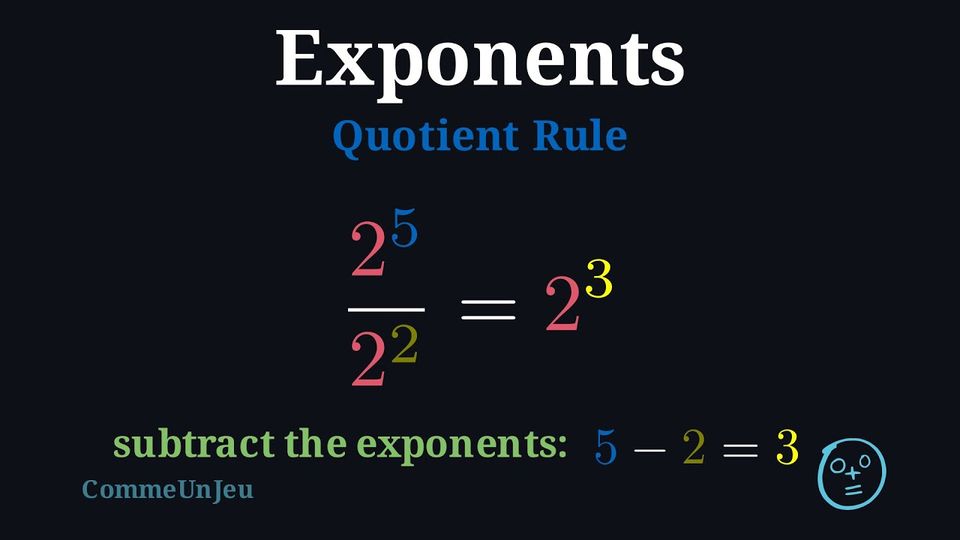
Here is an example: $$\begin{aligned} \dfrac{\textcolor{colordef}{7}^{\textcolor{colorprop}{5}}}{\textcolor{colordef}{7}^{\textcolor{olive}{2}}} &= \dfrac{\overbrace{\cancel{\textcolor{colordef}{7}} \times \cancel{\textcolor{colordef}{7}} \times \textcolor{colordef}{7} \times \textcolor{colordef}{7} \times \textcolor{colordef}{7}}^{\textcolor{colorprop}{5}\,\text{factors}}} {\underbrace{\cancel{\textcolor{colordef}{7}} \times \cancel{\textcolor{colordef}{7}}}_{\textcolor{olive}{2}\,\text{factors}}}\\
&= \overbrace{\textcolor{colordef}{7} \times \textcolor{colordef}{7} \times \textcolor{colordef}{7}}^{\textcolor{colorprop}{5} - \textcolor{olive}{2}\,\text{factors}}\\
&= \textcolor{colordef}{7}^{\textcolor{colorprop}{5} - \textcolor{olive}{2}} \end{aligned}$$ In general, when a number \(\textcolor{colordef}{a}\) is raised to the power \(\textcolor{colorprop}{m}\) and divided by the same number raised to the power \(\textcolor{olive}{n}\), that is $$\dfrac{\textcolor{colordef}{a}^{\textcolor{colorprop}{m}}}{\textcolor{colordef}{a}^{\textcolor{olive}{n}}},$$ the result is \(\textcolor{colordef}{a}\) raised to the difference of the exponents: $$\dfrac{\textcolor{colordef}{a}^{\textcolor{colorprop}{m}}}{\textcolor{colordef}{a}^{\textcolor{olive}{n}}} = \textcolor{colordef}{a}^{\textcolor{colorprop}{m} - \textcolor{olive}{n}}.$$
Proposition — Exponent Law 2
For \(a\neq 0\) and any integers \(m\) and \(n\), $$\dfrac{\textcolor{colordef}{a}^{\textcolor{colorprop}{m}}}{\textcolor{colordef}{a}^{\textcolor{olive}{n}}} = \textcolor{colordef}{a}^{\textcolor{colorprop}{m} - \textcolor{olive}{n}}$$ Example
Simplify \(\dfrac{5^7}{5^3}\).
$$\begin{aligned} \dfrac{\textcolor{colordef}{5}^{\textcolor{colorprop}{7}}}{\textcolor{colordef}{5}^{\textcolor{olive}{3}}} &= \textcolor{colordef}{5}^{\textcolor{colorprop}{7} - \textcolor{olive}{3}} \\
&= \textcolor{colordef}{5}^{4} \end{aligned}$$
Example
Simplify \(\dfrac{7^{3}}{7^{5}}\), then write the result as a fraction.
By Exponent Law 2, $$\dfrac{7^{3}}{7^{5}} = 7^{3-5} = 7^{-2} = \dfrac{1}{7^{2}} = \dfrac{1}{49}.$$ Dividing powers can produce a negative exponent: the law and the definition of negative exponents work together.
Skills to practice
- Simplifying Fractions of Powers
- Simplifying with Negative Exponents
- Simplifying Expressions of Powers
VI
Raising a Power to a Power
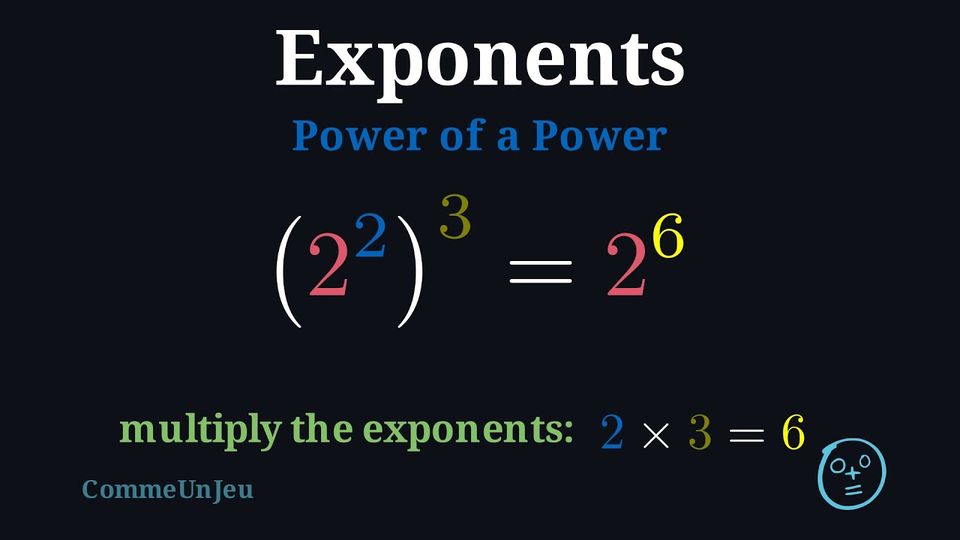
Here is an example: $$\begin{aligned} \left(\textcolor{colordef}{5}^{\textcolor{colorprop}{2}}\right)^{\textcolor{olive}{3}} &= (\overbrace{\textcolor{colordef}{5}\times \textcolor{colordef}{5}}^{\textcolor{colorprop}{2}\,\text{factors}})^{\textcolor{olive}{3}} \\
&= \overbrace{(\overbrace{\textcolor{colordef}{5}\times \textcolor{colordef}{5}}^{\textcolor{colorprop}{2}\,\text{factors}}) \times (\overbrace{\textcolor{colordef}{5}\times \textcolor{colordef}{5}}^{\textcolor{colorprop}{2}\,\text{factors}}) \times (\overbrace{\textcolor{colordef}{5}\times \textcolor{colordef}{5}}^{\textcolor{colorprop}{2}\,\text{factors}})}^{\textcolor{olive}{3}\,\text{factors}} \\
&= \textcolor{colordef}{5}^{\textcolor{colorprop}{2} + \textcolor{colorprop}{2} +\textcolor{colorprop}{2}}\\
&= \textcolor{colordef}{5}^{\textcolor{colorprop}{2} \times \textcolor{olive}{3}} \end{aligned}$$ In general, when a number \(\textcolor{colordef}{a}\) is raised to the power \(\textcolor{colorprop}{m}\), and that result is raised to the power \(\textcolor{olive}{n}\), that is $$\left(\textcolor{colordef}{a}^{\textcolor{colorprop}{m}}\right)^{\textcolor{olive}{n}},$$ the result is \(\textcolor{colordef}{a}\) raised to the product of the exponents: $$\left(\textcolor{colordef}{a}^{\textcolor{colorprop}{m}}\right)^{\textcolor{olive}{n}} = \textcolor{colordef}{a}^{\textcolor{colorprop}{m} \times \textcolor{olive}{n}}.$$
Proposition — Exponent Law 3
For \(a\neq 0\) and any integers \(m\) and \(n\), $$\left(\textcolor{colordef}{a}^{\textcolor{colorprop}{m}}\right)^{\textcolor{olive}{n}} = \textcolor{colordef}{a}^{\textcolor{colorprop}{m} \times \textcolor{olive}{n}}$$ Example
Simplify \(\left(\textcolor{colordef}{5}^{\textcolor{colorprop}{2}}\right)^{\textcolor{olive}{5}}\).
$$\begin{aligned}[t] \left(\textcolor{colordef}{5}^{\textcolor{colorprop}{2}}\right)^{\textcolor{olive}{5}} &= \textcolor{colordef}{5}^{\textcolor{colorprop}{2} \times \textcolor{olive}{5}} \\
&= \textcolor{colordef}{5}^{10} \end{aligned}$$
Skills to practice
- Simplifying Powers of Powers
- Simplifying Powers of Algebraic Powers
VII
Raising a Product to a Power
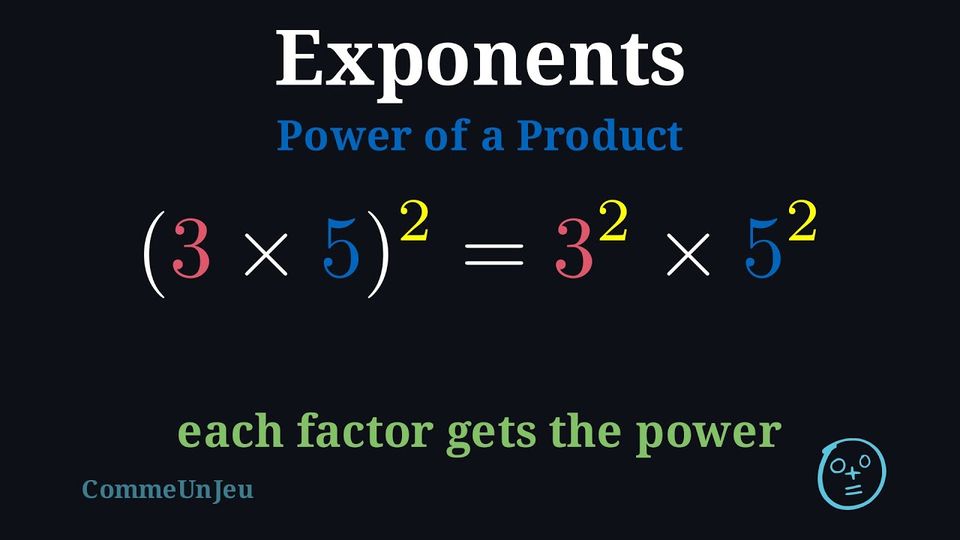
Can \((3 \times 5)^2\) be written using a power of each factor? We expand: $$\begin{aligned} (\textcolor{colordef}{3} \times \textcolor{colorprop}{5})^{\textcolor{olive}{2}} &= (\textcolor{colordef}{3} \times \textcolor{colorprop}{5}) \times (\textcolor{colordef}{3} \times \textcolor{colorprop}{5}) \\
&= \textcolor{colordef}{3} \times \textcolor{colorprop}{5} \times \textcolor{colordef}{3} \times \textcolor{colorprop}{5} \\
&= (\textcolor{colordef}{3} \times \textcolor{colordef}{3}) \times (\textcolor{colorprop}{5} \times \textcolor{colorprop}{5}) \\
&= \textcolor{colordef}{3}^{\textcolor{olive}{2}} \times \textcolor{colorprop}{5}^{\textcolor{olive}{2}} \end{aligned}$$ In general, when two numbers \(\textcolor{colordef}{a}\) and \(\textcolor{colorprop}{b}\) are multiplied and the product is then raised to the power \(\textcolor{olive}{n}\), that is $$(\textcolor{colordef}{a}\textcolor{colorprop}{b})^{\textcolor{olive}{n}},$$ the result is each factor raised to the power \(\textcolor{olive}{n}\): $$(\textcolor{colordef}{a}\textcolor{colorprop}{b})^{\textcolor{olive}{n}} = \textcolor{colordef}{a}^{\textcolor{olive}{n}}\, \textcolor{colorprop}{b}^{\textcolor{olive}{n}}.$$
Proposition — Exponent Law 4
For non-zero numbers \(a\) and \(b\), and any integer \(n\), $$\left(\textcolor{colordef}{a}\textcolor{colorprop}{b}\right)^{\textcolor{olive}{n}} = \textcolor{colordef}{a}^{\textcolor{olive}{n}}\, \textcolor{colorprop}{b}^{\textcolor{olive}{n}}$$ Example
Write \((\textcolor{colordef}{2}\times \textcolor{colorprop}{5})^{\textcolor{olive}{3}}\) using a power of each factor.
$$(\textcolor{colordef}{2}\times \textcolor{colorprop}{5})^{\textcolor{olive}{3}} = \textcolor{colordef}{2}^{\textcolor{olive}{3}} \times \textcolor{colorprop}{5}^{\textcolor{olive}{3}}$$
Skills to practice
- Simplifying Powers of Products
- Writing Products as a Single Power
- Choosing the Correct Law
VIII
Raising a Quotient to a Power
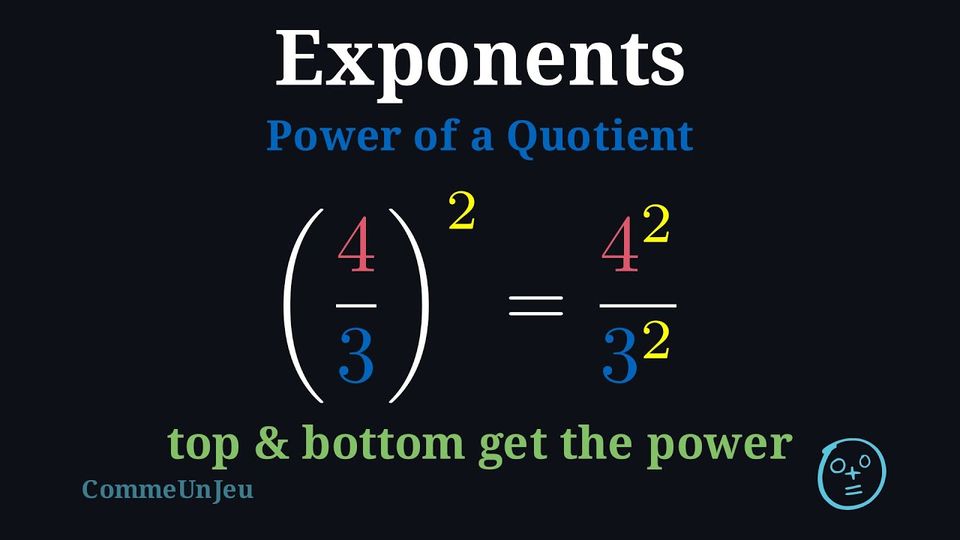
Here is an example: $$\begin{aligned} \left(\dfrac{\textcolor{colordef}{5}}{\textcolor{colorprop}{3}}\right)^{\textcolor{olive}{2}} &= \left(\dfrac{\textcolor{colordef}{5}}{\textcolor{colorprop}{3}}\right) \times \left(\dfrac{\textcolor{colordef}{5}}{\textcolor{colorprop}{3}}\right) \\
&= \dfrac{\textcolor{colordef}{5} \times \textcolor{colordef}{5}}{\textcolor{colorprop}{3} \times \textcolor{colorprop}{3}} \\
&= \dfrac{\textcolor{colordef}{5}^{\textcolor{olive}{2}}}{\textcolor{colorprop}{3}^{\textcolor{olive}{2}}} \end{aligned}$$ In general, when a quotient \(\dfrac{\textcolor{colordef}{a}}{\textcolor{colorprop}{b}}\) is raised to a power \(\textcolor{olive}{n}\), that is $$\left(\dfrac{\textcolor{colordef}{a}}{\textcolor{colorprop}{b}}\right)^{\textcolor{olive}{n}},$$ the result is the numerator raised to that power divided by the denominator raised to that power: $$\left(\dfrac{\textcolor{colordef}{a}}{\textcolor{colorprop}{b}}\right)^{\textcolor{olive}{n}} = \dfrac{\textcolor{colordef}{a}^{\textcolor{olive}{n}}}{\textcolor{colorprop}{b}^{\textcolor{olive}{n}}}.$$
Proposition — Exponent Law 5
For non-zero numbers \(a\) and \(b\), and any integer \(n\), $$\left(\dfrac{\textcolor{colordef}{a}}{\textcolor{colorprop}{b}}\right)^{\textcolor{olive}{n}} = \dfrac{\textcolor{colordef}{a}^{\textcolor{olive}{n}}}{\textcolor{colorprop}{b}^{\textcolor{olive}{n}}}$$ Example
Calculate \(\left(\dfrac{\textcolor{colordef}{5}}{\textcolor{colorprop}{3}}\right)^{\textcolor{olive}{2}}\).
$$\begin{aligned}[t] \left(\dfrac{\textcolor{colordef}{5}}{\textcolor{colorprop}{3}}\right)^{\textcolor{olive}{2}} &= \dfrac{\textcolor{colordef}{5}^{\textcolor{olive}{2}}}{\textcolor{colorprop}{3}^{\textcolor{olive}{2}}} \\
&= \dfrac{25}{9} \end{aligned}$$
Skills to practice
- Simplifying Powers of Fractions
- Simplifying Powers of Algebraic Fractions
IX
Going further
Skills to practice
- Solving Problems with Powers
- Proving the Laws of Exponents
- Investigating Patterns in Powers
- Quiz
Jump to section