International Baccalaureate · MYP 2
Number Properties
I
The Test for 11
Proposition — Divisibility Tests for 3 and 9
- A whole number is divisible by \(3\) exactly when the sum of its digits is divisible by \(3\).
- A whole number is divisible by \(9\) exactly when the sum of its digits is divisible by \(9\).
Why do these two tests work? Because \(10\), \(100\), \(1\,000\) are each one more than a multiple of \(9\): $$10 = 9 + 1, \qquad 100 = 99 + 1, \qquad 1\,000 = 999 + 1.$$ Take \(253 = 2 \times 100 + 5 \times 10 + 3\) and replace \(100\) and \(10\): $$\begin{aligned} 253 &= 2 \times (99 + 1) + 5 \times (9 + 1) + 3 \\
&= \underbrace{2 \times 99 + 5 \times 9}_{\text{multiple of } 9} + \underbrace{(2 + 5 + 3)}_{\text{digit sum}}. \end{aligned}$$ So \(253\) and its digit sum differ by a multiple of \(9\): one is divisible by \(9\) exactly when the other is. The same holds for any whole number, since each of its digits is multiplied by \(10\), \(100\), \(1\,000\), … — all one more than a multiple of \(9\). And since \(99\), \(999\), … are also multiples of \(3\), the very same reasoning gives the test for \(3\).
Proposition — Divisibility Test for 11
Number the places of the digits of a whole number from the right: the units digit is in place \(1\), the tens digit in place \(2\), the hundreds digit in place \(3\), and so on. - Add the digits in the odd places (places \(1\), \(3\), \(5\), …), then, separately, the digits in the even places (places \(2\), \(4\), \(6\), …).
- Subtract the smaller of the two sums from the larger one.
Why the Test for 11 Works
The test rests on two facts: \(10\) is one less than \(11\), and \(100\) is one more than \(99 = 9 \times 11\): $$10 = 11 - 1, \qquad 100 = 99 + 1.$$ Take \(257 = 2 \times 100 + 5 \times 10 + 7\) and replace \(100\) and \(10\): $$\begin{aligned} 257 &= 2 \times (99 + 1) + 5 \times (11 - 1) + 7 \\
&= \underbrace{2 \times 99 + 5 \times 11}_{\text{multiple of } 11} + \underbrace{(2 + 7) - 5}_{\text{difference of the two sums}}. \end{aligned}$$ So \(257\) is a multiple of \(11\) plus the difference \((7 + 2) - 5 = 4\) of the sum of the digits in the odd places and the digit in the even place: \(257 = 11 \times 23 + 4\). One of the two numbers, \(257\) or \(4\), is divisible by \(11\) exactly when the other is: since \(4\) is not, \(257\) is not. The same reasoning holds for every three-digit number, since its hundreds digit is always multiplied by \(99 + 1\) and its tens digit by \(11 - 1\); when the digit in the even place is the larger, the number is a multiple of \(11\) minus the difference, and the conclusion is the same. For longer numbers, the places go on alternating: \(1\,000 = 1\,001 - 1\) with \(1\,001 = 11 \times 91\), and \(10\,000 = 9\,999 + 1\) with \(9\,999 = 11 \times 909\).
Example
Determine whether \(7\,392\) and \(5\,283\) are divisible by \(11\). - For \(7\,392\): the digits in the odd places are \(2\) and \(3\), the digits in the even places are \(9\) and \(7\). $$\begin{aligned}[t] (9 + 7) - (2 + 3) &= 16 - 5 && \text{(sums of the even and of the odd places)}\\ &= 11. \end{aligned}$$ The difference \(11\) is divisible by \(11\), so \(7\,392\) is divisible by \(11\). Check: \(7\,392 = 11 \times 672\).
- For \(5\,283\): the digits in the odd places are \(3\) and \(2\), the digits in the even places are \(8\) and \(5\). $$\begin{aligned}[t] (8 + 5) - (3 + 2) &= 13 - 5 && \text{(sums of the even and of the odd places)}\\ &= 8. \end{aligned}$$ The difference \(8\) is not divisible by \(11\), so \(5\,283\) is not divisible by \(11\). Check: \(5\,283 = 11 \times 480 + 3\).
Example
Is \(90\,816\) divisible by \(11\)? By \(3\)? By \(9\)? - By \(11\). The digits in the odd places are \(6\), \(8\) and \(9\); the digits in the even places are \(1\) and \(0\). $$\begin{aligned}[t] (6 + 8 + 9) - (1 + 0) &= 23 - 1 && \text{(sums of the odd and of the even places)}\\ &= 22. \end{aligned}$$ The difference \(22 = 2 \times 11\) is divisible by \(11\), so \(90\,816\) is divisible by \(11\): \(90\,816 = 11 \times 8\,256\).
- By \(3\) and by \(9\). The sum of the digits is \(9 + 0 + 8 + 1 + 6 = 24\). Since \(24 = 3 \times 8\), the number is divisible by \(3\); since \(24 = 9 \times 2 + 6\), it is not divisible by \(9\).
Skills to practice
- Determining Divisibility by 11
- Finding a Missing Digit
II
Prime Factorization
Definition — Prime Number
A prime number is a whole number greater than \(1\) that has exactly two different divisors: \(1\) and itself.A whole number greater than \(1\) that is not prime is called a composite number.
Method — Prime Factorisation
Prime factorisation of a whole number greater than \(1\) is writing that number as a product of prime numbers only. In other words, it is finding which primes multiply to give the number. Example
Find the prime factorisation of \(12\).
The prime factorisation is \(12 = 2 \times 2 \times 3\).
The order is not important: it can also be written \(12 = 3 \times 2 \times 2\).
The prime factorisation is not \(12 = 2 \times 6\) because \(6\) is a composite number.
The order is not important: it can also be written \(12 = 3 \times 2 \times 2\).
The prime factorisation is not \(12 = 2 \times 6\) because \(6\) is a composite number.
Method — Factor Tree
The factor tree method involves breaking down a composite number into smaller factors, then breaking down those factors further until only prime factors remain. - Place the number at the top of the factor tree.
- Check if the number is prime.
- If the number is prime: Circle it: this branch is finished.
- If the number is composite: Factor it into two smaller factors. Write these two factors as branches below the number. Repeat step 2 for each of these new factors.
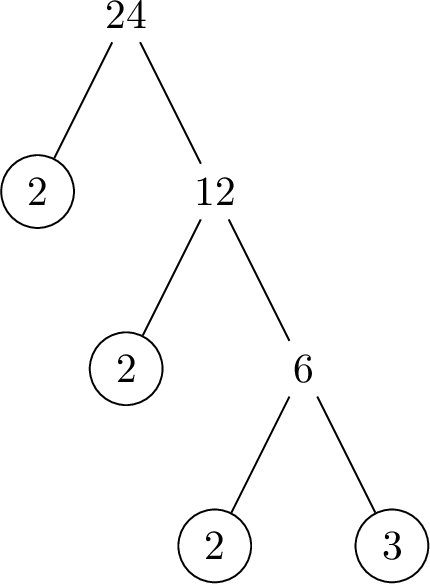
- The prime factorisation is the product of all circled prime numbers on the tree.
Example
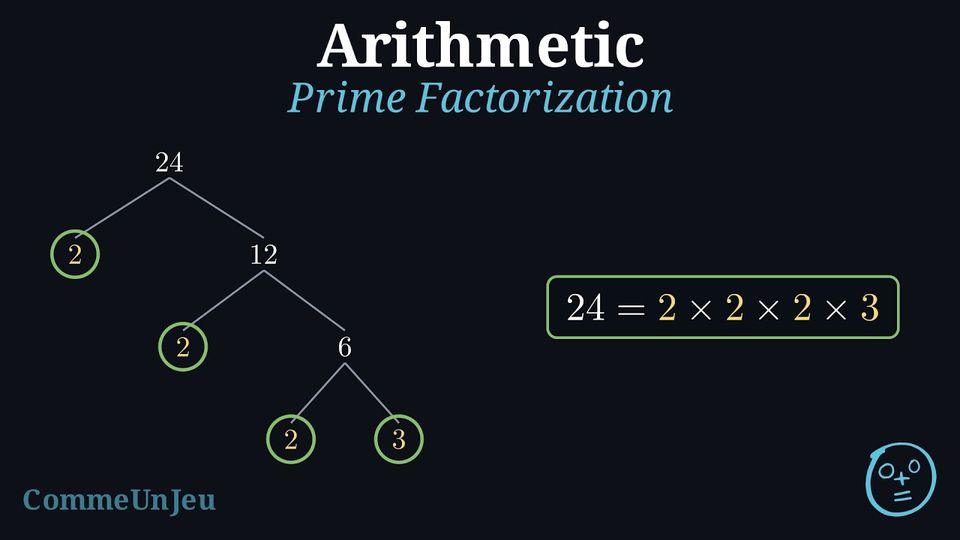
Find a prime factorisation of \(24\). - Step 1:

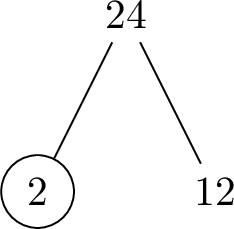
- Step 2: \(24\) is a composite number. \(24 = 2 \times 12\).
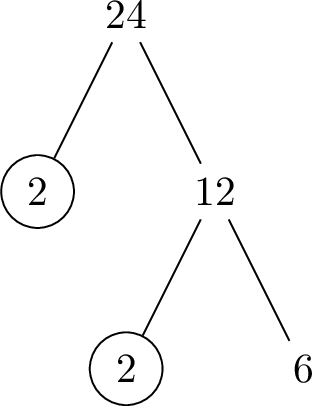
- Step 3: \(12\) is a composite number. \(12 = 2 \times 6\).
- Step 4: \(6\) is a composite number. \(6 = 2 \times 3\).
Proposition — Existence and Uniqueness of the Prime Factorisation
Every whole number greater than \(1\) can be written as a product of prime numbers. This factorisation is unique: whichever method is used (successive divisions, factor tree…), the same prime factors always appear, each the same number of times — only their order can change. (Accepted without proof.) Definition — Powers
A power is a short way to write a repeated multiplication of a number by itself: For a number \(a\) and a positive whole number \(n\), $$ a^n = \overbrace{a \times a \times \dots \times a}^{n\ \text{factors}}. $$
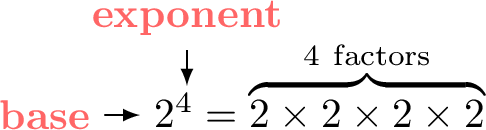
A prime factorisation is usually written in index notation: repeated factors are grouped as powers, each prime appearing exactly once, in increasing order. This canonical form makes decompositions easy to compare.
Example
Write the prime factorisation of \(360\) in index notation.
Dividing successively by primes: $$360 = 2 \times 180 = 2 \times 2 \times 90 = 2 \times 2 \times 2 \times 45 = 2 \times 2 \times 2 \times 3 \times 3 \times 5.$$ Grouping the repeated factors as powers: $$360 = 2^3 \times 3^2 \times 5.$$
Method — Simplifying a Fraction with Prime Factorisations
To write a fraction of two nonzero whole numbers in lowest terms using prime factorisations: - Write the prime factorisation of the numerator and the prime factorisation of the denominator.
- Cross out the factors common to both products, one by one: each factor crossed out on top pairs with a single factor crossed out below (if \(2\) appears three times on top and twice below, only two are crossed out on each side). Dividing the numerator and the denominator by the same number does not change the fraction.
- Multiply the remaining factors on top and on the bottom. No common factor other than \(1\) is left: the fraction obtained is in lowest terms.
Example
Write the fraction \(\dfrac{84}{126}\) in lowest terms.
Dividing successively by primes: $$84 = 2^2 \times 3 \times 7 \qquad \text{and} \qquad 126 = 2 \times 3^2 \times 7.$$ Crossing out the common factors, one \(2\), one \(3\) and one \(7\): $$\dfrac{84}{126} = \dfrac{2 \times \cancel{2} \times \cancel{3} \times \cancel{7}}{\cancel{2} \times 3 \times \cancel{3} \times \cancel{7}} = \dfrac{2}{3}.$$ The remaining factors, \(2\) on top and \(3\) on the bottom, have \(1\) as their only common factor: the fraction \(\dfrac{2}{3}\) is in lowest terms. Check: the crossed-out factors multiply to \(2 \times 3 \times 7 = 42\), and \(2 \times 42 = 84\), \(3 \times 42 = 126\).
Skills to practice
- Writing in Prime Factors: level 1
- Writing in Prime Factors: level 2
- Writing in Prime Factors: level 3
- Simplifying Fractions with Prime Factorizations: level 1
- Simplifying Fractions with Prime Factorizations: level 2
III
The Highest Common Factor from Prime Factorizations
Definition — Highest Common Factor (HCF)
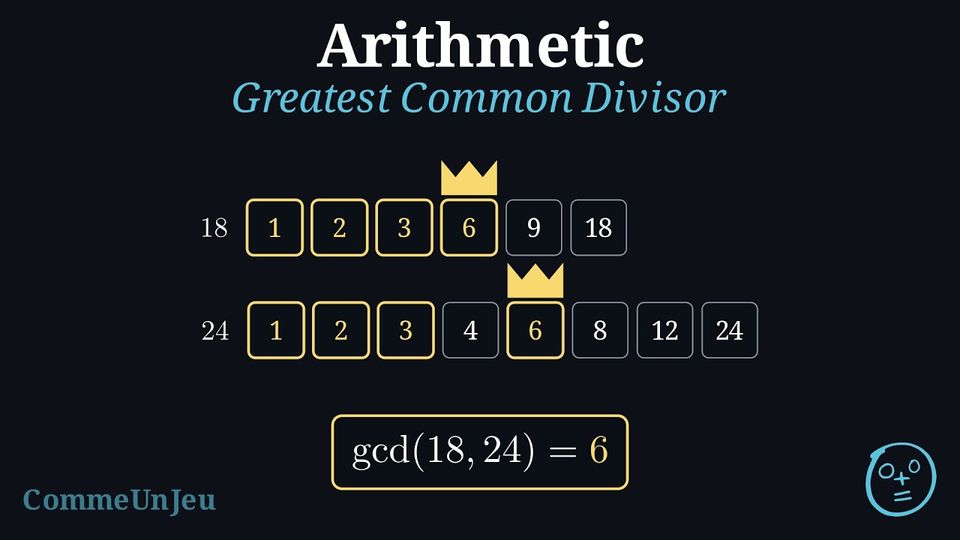
The highest common factor (HCF) of two (or more) whole numbers, not all zero, is the largest positive whole number that is a factor of each of them (it divides each of them exactly, with remainder \(0\)). It is also called the greatest common divisor (GCD). We usually write the HCF of \(a\) and \(b\) as \(\operatorname{HCF}(a, b)\).
Method — Finding the HCF Using Prime Factorisation
- Write the prime factorisation of each number.
- Identify the prime factors that appear in both factorisations, taking each common prime as many times as it appears in both numbers (i.e. with the smallest exponent).
- Multiply these common factors to get the HCF.
Example
Find the HCF of \(18\) and \(24\) using prime factorisation. - \(18 = \boxed{2} \times \boxed{3} \times 3 = 2\times 3^2\)
- \(24 = \boxed{2}\times 2 \times 2 \times \boxed{3} = 2^3\times 3\)
- Common prime factors (with smallest exponents): \(\boxed{2}\) and \(\boxed{3}\).
- So \(\operatorname{HCF}(18, 24) = 2 \times 3 = 6\).
Definition — Coprime Numbers
Two non-zero whole numbers \(a\) and \(b\) are coprime if their only common positive factor is \(1\), that is if \(\operatorname{HCF}(a, b) = 1\).A fraction \(\dfrac{a}{b}\) is in lowest terms exactly when \(a\) and \(b\) are coprime.
Example
Are \(8\) and \(15\) coprime? Are \(8\) and \(20\) coprime?
The factors of \(8\) are \(1, 2, 4, 8\); the factors of \(15\) are \(1, 3, 5, 15\). The only common factor is \(1\), so \(\operatorname{HCF}(8, 15) = 1\): the numbers \(8\) and \(15\) are coprime (and the fraction \(\frac{8}{15}\) is in lowest terms).
The factors of \(20\) are \(1, 2, 4, 5, 10, 20\): the numbers \(8\) and \(20\) share the factors \(1\), \(2\) and \(4\), so \(\operatorname{HCF}(8, 20) = 4 \neq 1\): they are not coprime (and \(\frac{8}{20}\) simplifies to \(\frac{2}{5}\)).
The factors of \(20\) are \(1, 2, 4, 5, 10, 20\): the numbers \(8\) and \(20\) share the factors \(1\), \(2\) and \(4\), so \(\operatorname{HCF}(8, 20) = 4 \neq 1\): they are not coprime (and \(\frac{8}{20}\) simplifies to \(\frac{2}{5}\)).
Skills to practice
- Finding the Highest Common Factor
- Solving Real-Life Problems with the Highest Common Factor
IV
The Lowest Common Multiple
Definition — Lowest Common Multiple (LCM)
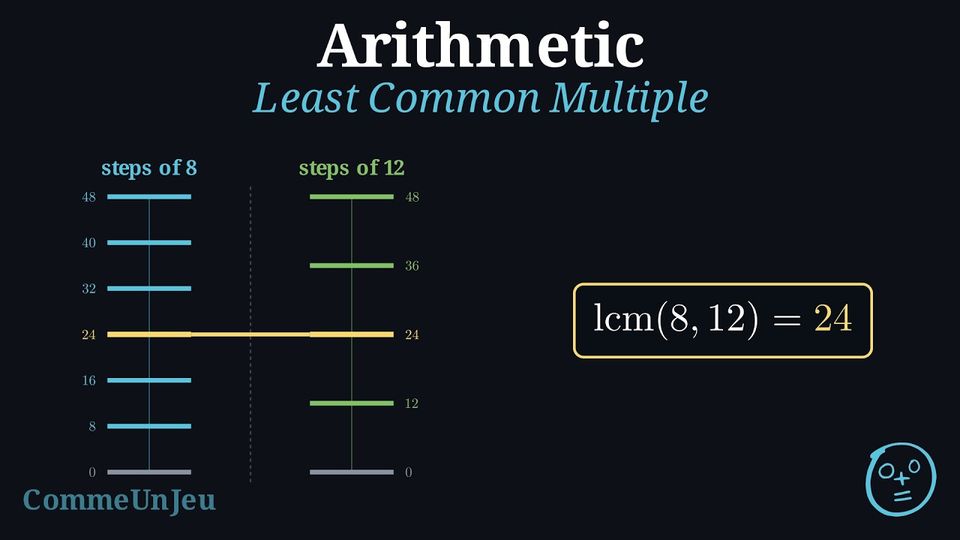
The lowest common multiple (LCM) of two (or more) non-zero whole numbers is the smallest positive whole number that is a multiple of each of them. It is also called the least common multiple. We usually write the LCM of \(a\) and \(b\) as \(\operatorname{LCM}(a, b)\).
Example
Find the LCM of \(8\) and \(12\). - The multiples of \(8\) are: \(8, 16, \textcolor{olive}{24}, 32, 40, \ldots\)
- The multiples of \(12\) are: \(12, \textcolor{olive}{24}, 36, 48, \ldots\)
- The lowest common multiple is \(\textcolor{olive}{24}\), so \(\operatorname{LCM}(8, 12)=24\).
Skills to practice
- Finding the Lowest Common Multiple
- Solving Real-Life Problems with the Lowest Common Multiple
V
Square Roots
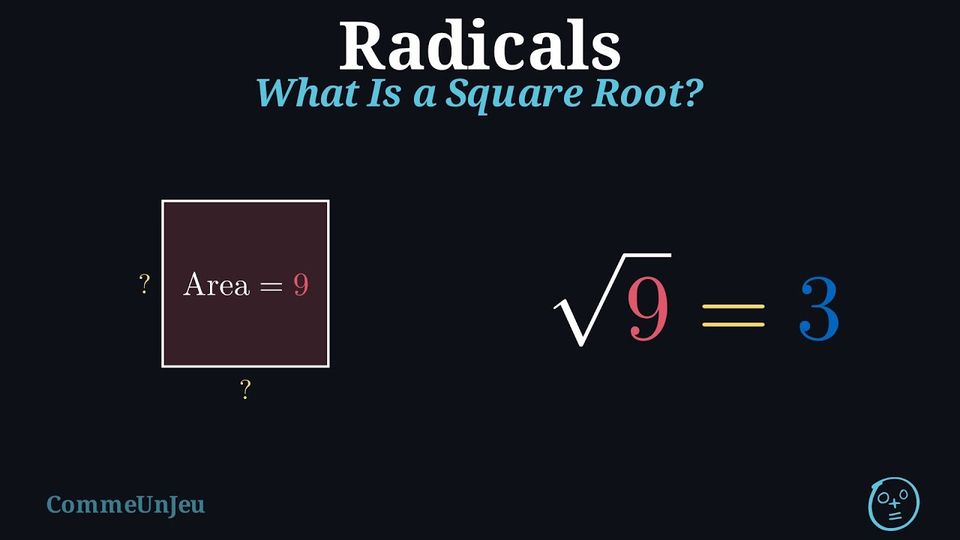
- When we square a number, we multiply it by itself. For example, \(3\) squared is \(3 \times 3\), which we write as \(3^2\).
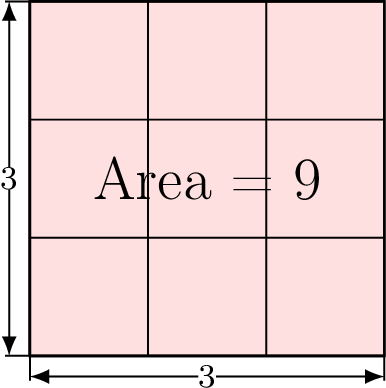
\(3^2 = 9\). The area of a square with side length \(3\) is \(9\) square units. - The square root is the inverse operation: it undoes squaring (for numbers that are positive or zero).
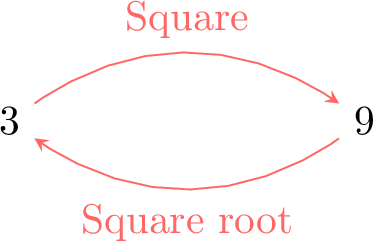
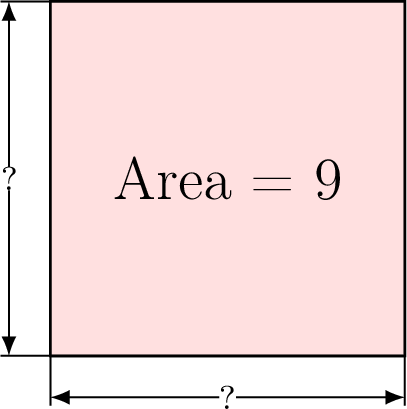
Definition — Square root
The square root of a non-negative number \(a\) (that is, \(a \ge 0\)), written as \(\sqrt{a}\), is the non-negative number that, when multiplied by itself, gives \(a\). $$ \left(\sqrt{a}\right)^2 = a $$ Definition — Perfect Squares
A perfect square is an integer that is the square of an integer. The square root of a perfect square is an integer. Skills to practice
- Finding Square Roots with Prime Factorizations
VI
Cube Roots
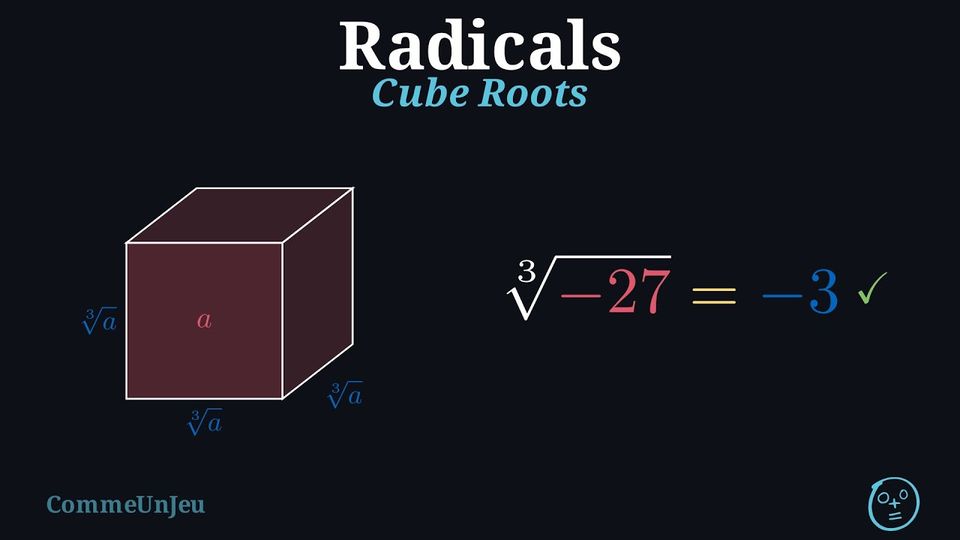
Just as the square root of a number is the side length of a square with a given area, the cube root \(\sqrt[3]{a}\) of a non-negative number \(a\) is the side length of a cube with volume \(a\). 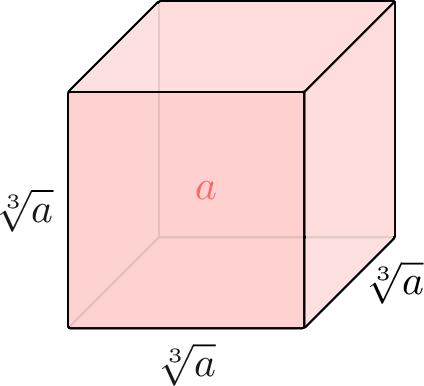
It is the inverse operation of cubing a number (raising it to the power of 3).
Definition — Cube Root
The cube root of a number \(a\), written \(\sqrt[3]{a}\), is the number which, when cubed, gives \(a\): $$\left(\sqrt[3]{a}\right)^3 = a$$ Skills to practice
- Calculating Cube Roots of Perfect Cubes
VII
Going further
Skills to practice
- Investigating Why the Divisibility Tests Work
- Solving Problems with Factors and Multiples
- Quiz
Jump to section