International Baccalaureate · MYP 3
Sets and Venn Diagrams
I
Sets and Elements
I.1
Sets, Elements and Equal Sets
Definition — Set
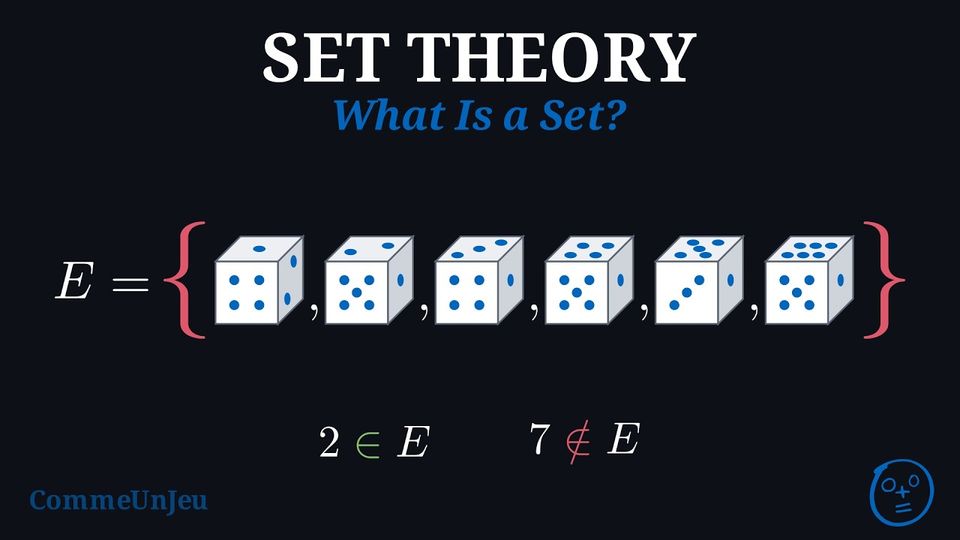
A set is a collection of objects, called elements.Its elements are listed between curly brackets, each element only once and in any order: \(\{3, 8, 9\} = \{9, 3, 8\}\).
Example
List all elements of the set \(E\), which includes all possible results when rolling a standard die 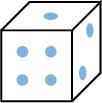 .
\(E=\{1,2,3,4,5,6\}=\{\),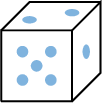 ,
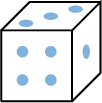 ,
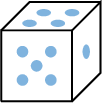 ,
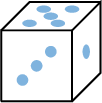 ,
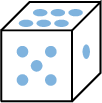 \(\}\).
,,,,,\(\}\). Definition — Element
- An element is an object contained in a set.
- \(\in\) means “is an element of” or “belongs to”.
- \(\notin\) means “is not an element of” or “does not belong to”.
Example
\(2\in \{1,2,3,4,5,6\}\) and \(7\notin \{1,2,3,4,5,6\}\). Definition — Equal sets
Two sets are equal if they have exactly the same elements. Example
Determine if the sets \(\{2,6,4\}\) and \(\{2,4,6\}\) are equal.
Yes, the sets \(\{2,6,4\}\) and \(\{2,4,6\}\) are equal because they contain the same elements: \(2\), \(4\), and \(6\).
Example
Determine if the sets \(\{1,2,3\}\) and \(\{1,2,4\}\) are equal.
No, the sets \(\{1,2,3\}\) and \(\{1,2,4\}\) are not equal because element \(3\) belongs to \(\{1,2,3\}\) but not to \(\{1,2,4\}\).
Definition — Empty Set
The empty set is a set with no elements. It is written as \(\{\}\) or \(\emptyset\). Skills to practice
- Listing the Elements
- Checking Set Equality
- Checking Membership
- Checking Membership in Geometry
I.2
Subsets
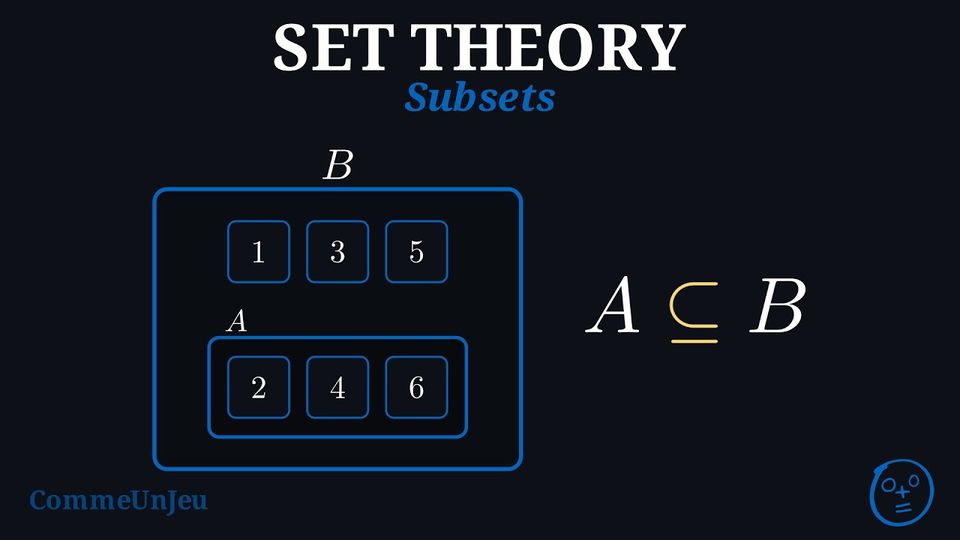
Definition — Subset
A set \(A\) is a subset of a set \(B\) if every element in \(A\) is also in \(B\). This is written \(A \subseteq B\). Some books write \(A \subset B\), as in the nesting of the number sets. - If at least one element of \(A\) is not in \(B\), then \(A\) is not a subset of \(B\), and this is written \(A \not\subseteq B\).
- Every set is a subset of itself: \(A \subseteq A\).
- The empty set is a subset of every set: it has no element outside \(A\), so \(\emptyset \subseteq A\).
Example
Let \(B = \{1, 2, 3, 4, 5, 6\}\), \(A = \{2, 4, 6\}\) and \(C = \{2, 7\}\). Is \(A \subseteq B\)? Is \(C \subseteq B\)?
Check each element: \(2\), \(4\), and \(6\) from \(A\) are all in \(B = \{1, 2, 3, 4, 5, 6\}\). Since every element of \(A\) is in \(B\), \(A \subseteq B\).
In \(C\), the element \(2\) is in \(B\), but the element \(7\) is not. One element outside \(B\) is enough: \(C \not\subseteq B\).
In \(C\), the element \(2\) is in \(B\), but the element \(7\) is not. One element outside \(B\) is enough: \(C \not\subseteq B\).
Skills to practice
- Checking Subsets
I.3
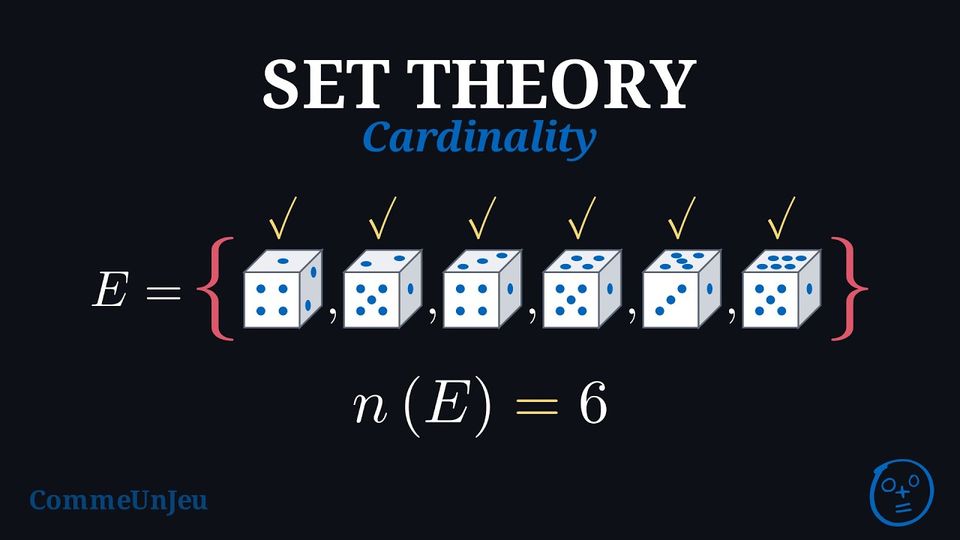
The Number of Elements of a Set
Definition — Cardinality
\(\Card{A}\) denotes the number of elements in the set \(A\). Example
\(\Card{\{1,2,3,4,5,6\}}=6\) 
Skills to practice
- Counting the Elements
- Handling the Empty Set and Repeated Elements
II
Operations on Sets
II.1
Intersection and Union
Definition — Intersection
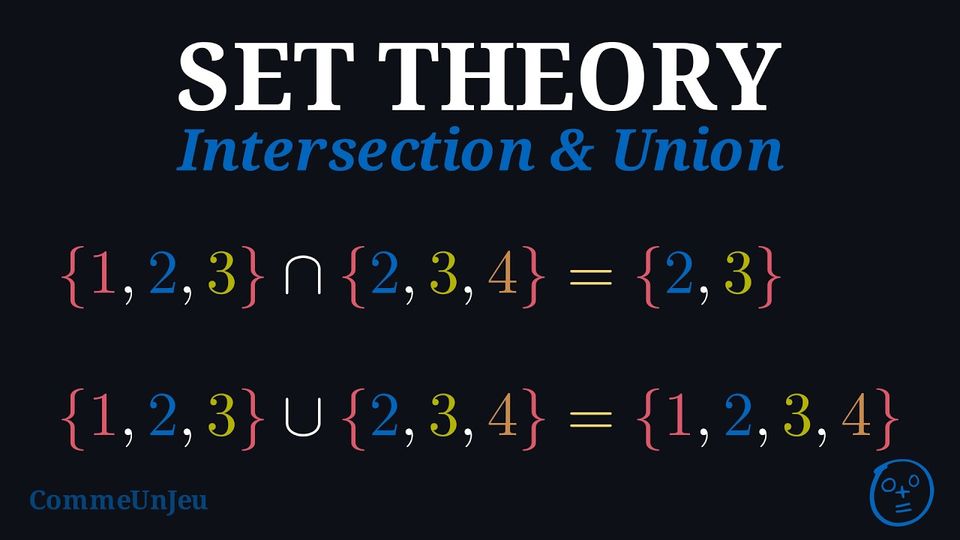
The intersection of two sets \(A\) and \(B\), written \(A \cap B\), is the set of elements that are in both \(A\) and \(B\). Example
What is the intersection \(\{1, 2, 3\} \cap \{2, 3, 4\}\)?
For the intersection \(\cap\), include all common elements: \(\textcolor{colorprop}{2}\) and \(\textcolor{olive}{3}\). So $$\{\textcolor{colordef}{1}, \textcolor{colorprop}{2}, \textcolor{olive}{3}\} \cap \{ \textcolor{colorprop}{2}, \textcolor{olive}{3},\textcolor{brown}{4}\} = \{\textcolor{colorprop}{2},\textcolor{olive}{3}\}$$
Definition — Union
The union of two sets \(A\) and \(B\), written \(A \cup B\), is the set of all elements in \(A\) or \(B\) (or both). Example
What is the union \(\{1, 2, 3\} \cup \{2, 3, 4\}\)?
For the union \(\cup\), include all elements from both sets without repeats: \(\textcolor{colordef}{1}, \textcolor{colorprop}{2}, \textcolor{olive}{3},\textcolor{brown}{4}\). So, $$\{\textcolor{colordef}{1}, \textcolor{colorprop}{2}, \textcolor{olive}{3}\} \cup \{ \textcolor{colorprop}{2}, \textcolor{olive}{3},\textcolor{brown}{4}\} = \{\textcolor{colordef}{1}, \textcolor{colorprop}{2}, \textcolor{olive}{3},\textcolor{brown}{4}\}$$
Skills to practice
- Finding the Intersection and the Union
II.2
The Universal Set and the Complement
Definition — Universal set
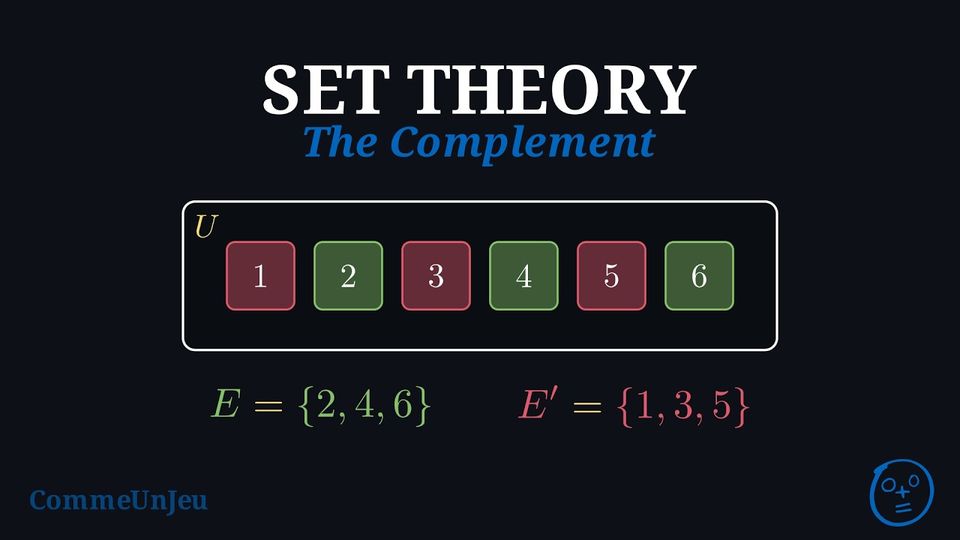
A universal set, written \(U\), is the set of all elements considered. For example, for the possible results of rolling a die, \(U = \{1, 2, 3, 4, 5, 6\}\). Definition — Complement
The complement of a set \(A\), denoted \(A'\) (also written \(\overline{A}\) or \(U \setminus A\)), consists of all the elements of the universal set \(U\) that are not in \(A\). Sets \(A\) and \(A'\) are said to be complementary. Example
Given the universal set \(U = \{1, 2, 3, 4, 5, 6\}\) and the set \(A = \{1, 3, 5\}\), find the complement \(A'\).
Start with the universal set \(U = \{1, 2, 3, 4, 5, 6\}\).
The set \(A = \{1, 3, 5\}\) includes 1, 3, and 5.
The complement \(A'\) is all the elements in \(U\) that are not in \(A\):
$$A' = \{2, 4, 6\}$$
The set \(A = \{1, 3, 5\}\) includes 1, 3, and 5.
The complement \(A'\) is all the elements in \(U\) that are not in \(A\):
$$A' = \{2, 4, 6\}$$
Skills to practice
- Finding the Complement
III
Venn Diagrams
III.1
Reading and Drawing Venn Diagrams
Definition — Venn Diagram
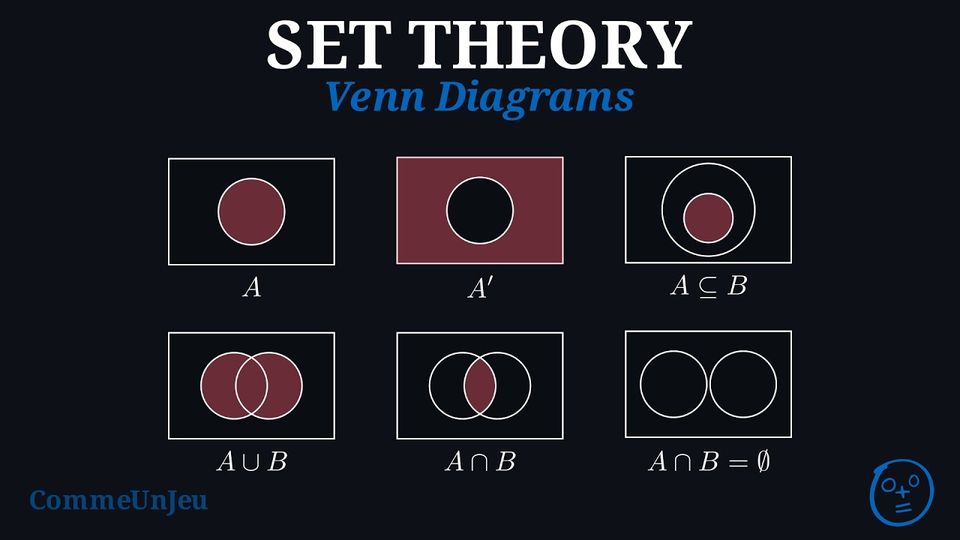
A Venn diagram uses a rectangle to show the universal set \(U\) and circles to represent other sets within it. Example
Here is a Venn diagram for \(U = \{1, 2, 3, 4, 5, 6\}\) and \(A = \{1, 3, 5\}\): 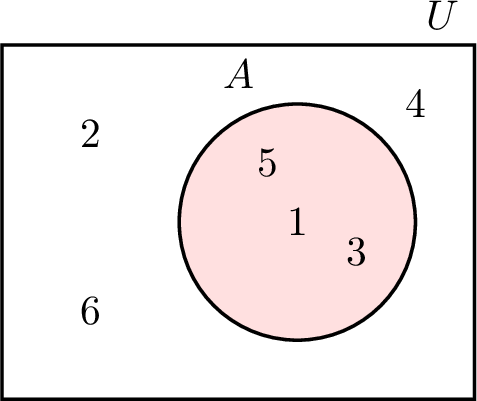
Definition — Key Venn Diagram Concepts
This table shows common set operations and their Venn diagrams: | Notation | Meaning | Venn Diagram |
| \(A\) | Set \(A\) | 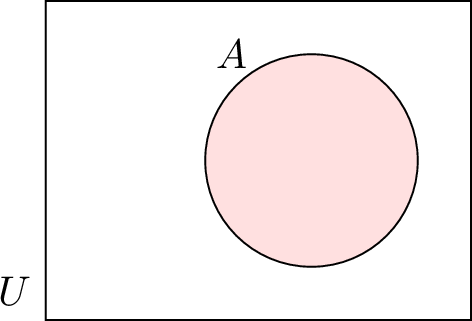 |
| \(A'\) | Complement of \(A\) (everything in \(U\) not in \(A\)) | 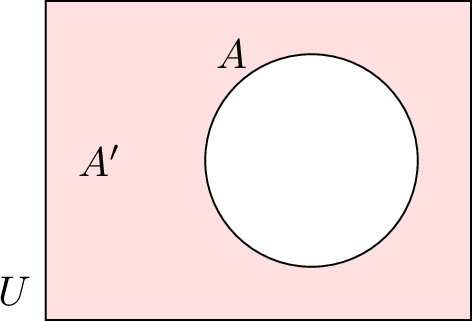 |
| \(A \subseteq B\) | \(A\) is a subset of \(B\) | 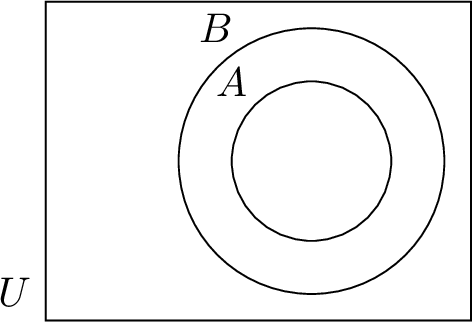 |
| \(A \cup B\) | Union of \(A\) and \(B\) (all elements in \(A\) or \(B\)) | 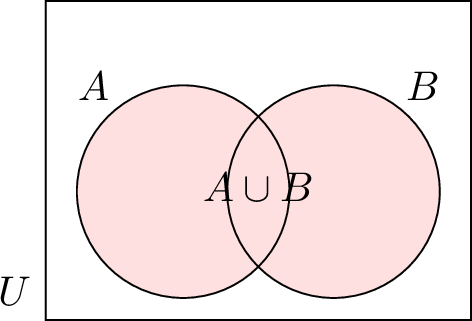 |
| \(A \cap B\) | Intersection of \(A\) and \(B\) (elements in both) | 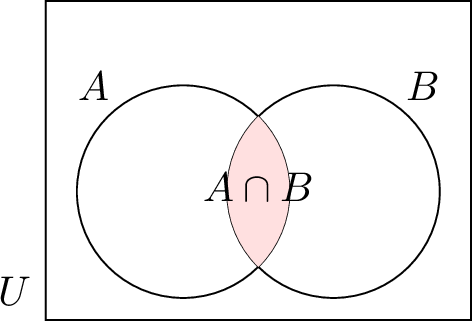 |
| \(A \cap B = \emptyset\) | \(A\) and \(B\) are disjoint (no common elements) | 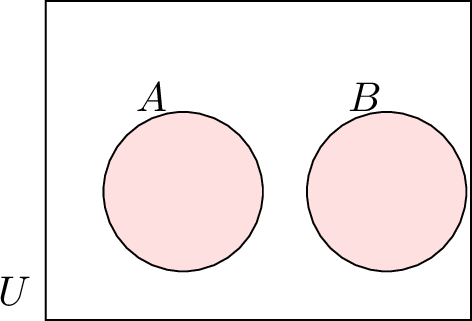 |
Example
Let \(U = \{1, 2, 3, \dots, 10\}\), let \(A\) be the set of the even numbers of \(U\) and \(B\) the set of the multiples of \(3\) in \(U\). List \(A\) and \(B\), then place the ten elements of \(U\) on a Venn diagram.
\(A = \{2, 4, 6, 8, 10\}\) and \(B = \{3, 6, 9\}\). Each element of \(U\) is placed by asking two questions: is it in \(A\)? is it in \(B\)? 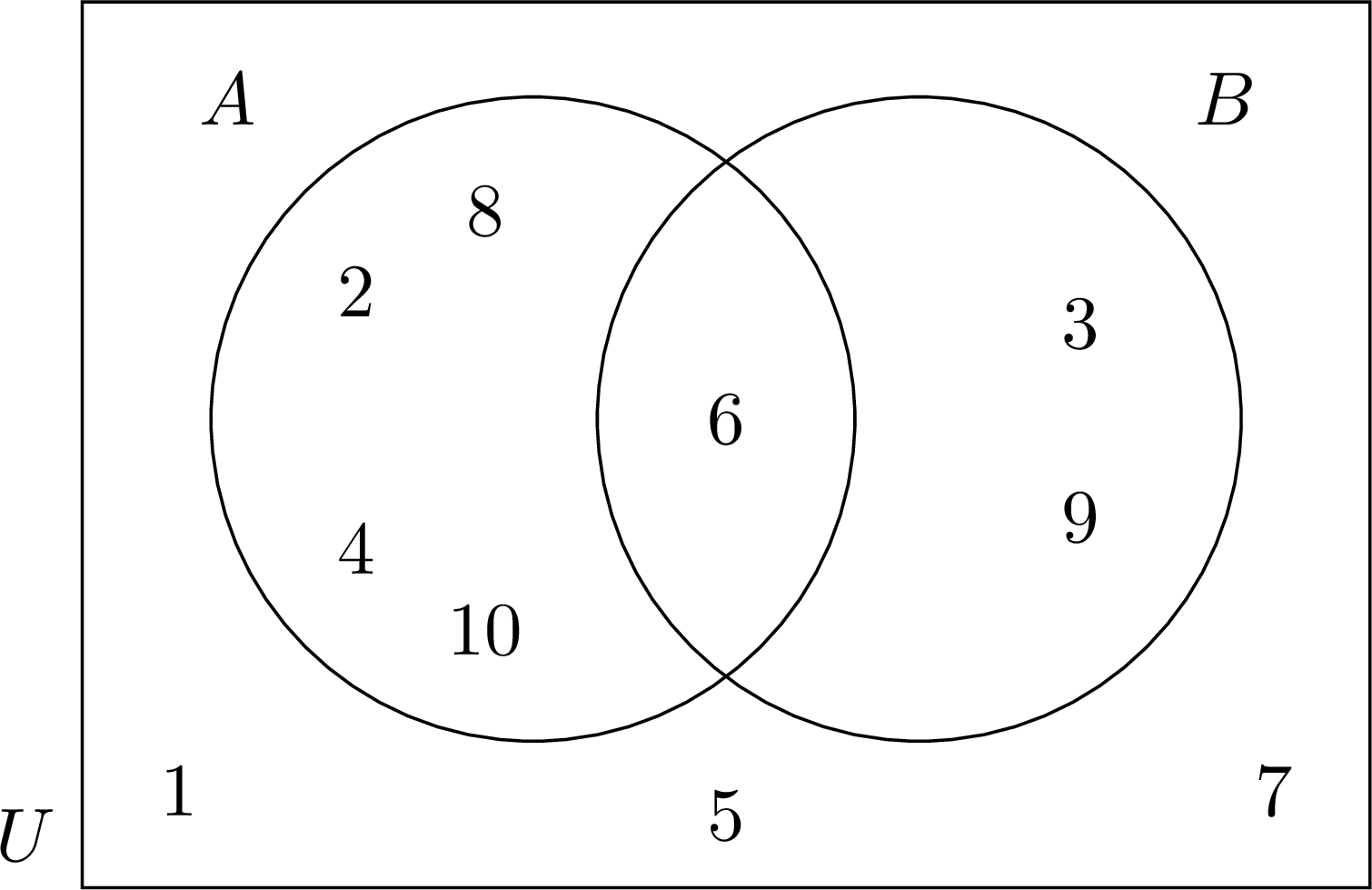
Check: \(4 + 1 + 2 + 3 = 10\) elements.
- \(6\) is in both sets: it goes in the region shared by the two circles, and \(A \cap B = \{6\}\).
- \(2\), \(4\), \(8\) and \(10\) are in \(A\) only; \(3\) and \(9\) are in \(B\) only.
- \(1\), \(5\) and \(7\) are in neither set: they go inside the rectangle, outside the two circles.
Venn diagrams help solve problems by showing the number of elements in each region.
Definition — Counting Elements
In a Venn diagram, a number written in round brackets is the number of elements in its region. Example
Consider this Venn diagram: 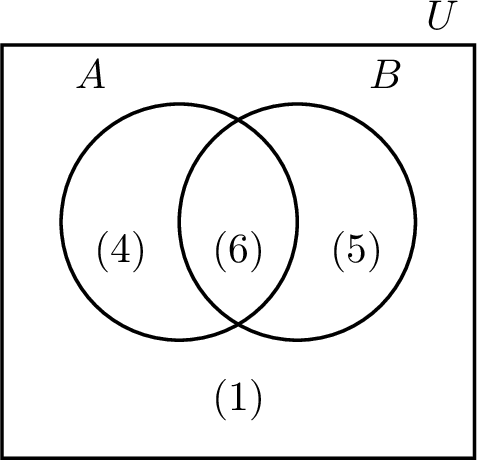
Skills to practice
- Identifying Elements Using Venn Diagrams
III.2
Counting with a Venn Diagram
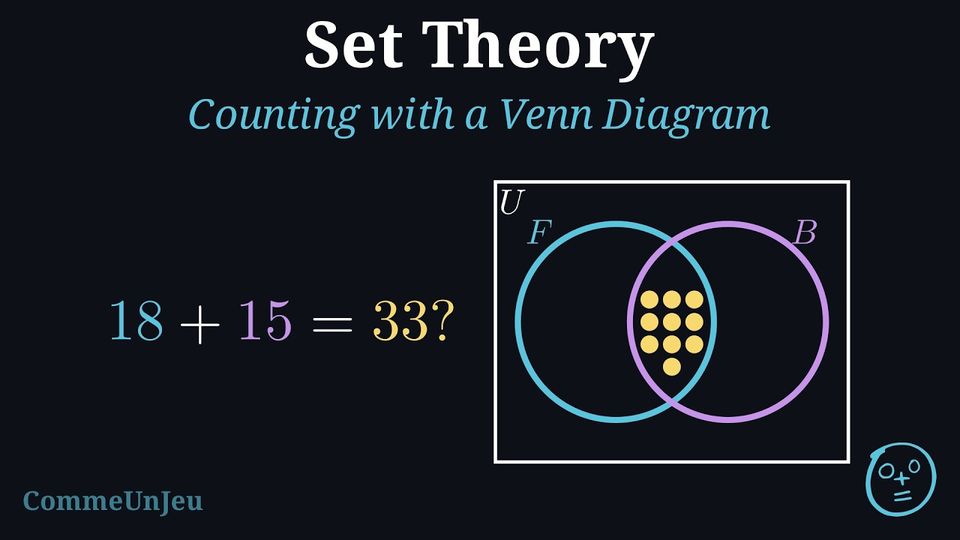
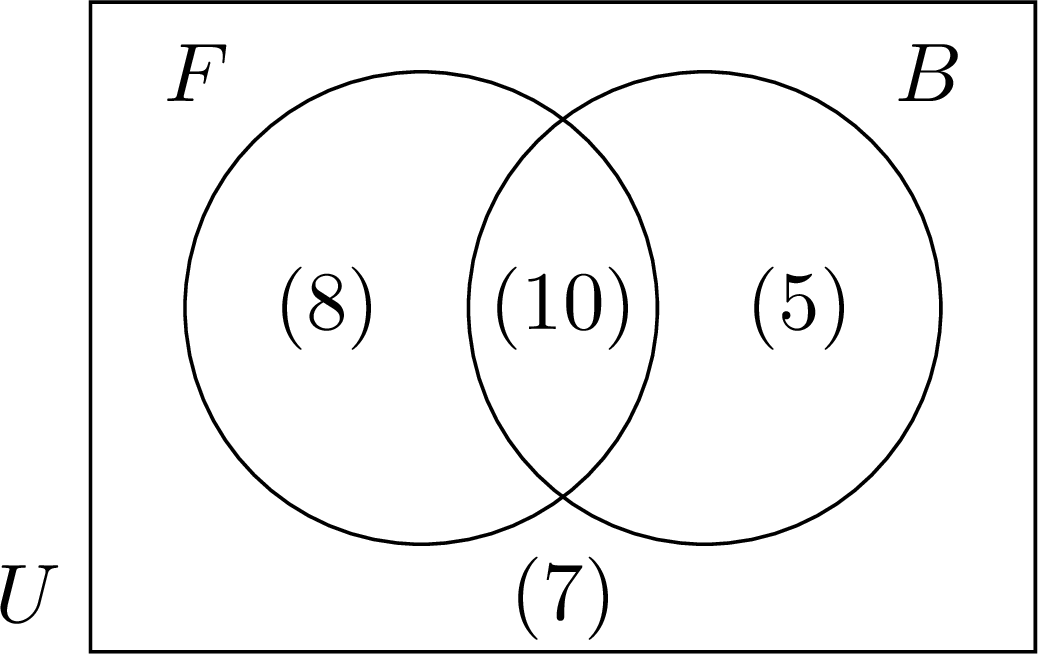
In a class of \(30\) pupils, \(18\) play football, \(15\) play basketball and \(7\) play neither of these two sports.
- Add the number of football players and the number of basketball players. Why is this total larger than the number of pupils who play at least one of the two sports?
- How many pupils play both sports?
- \(18 + 15 = 33\), while only \(30 - 7 = 23\) pupils play at least one of the two sports. A pupil who plays both sports is counted once among the football players and a second time among the basketball players: the sum counts these pupils twice.
- The sum exceeds the number of players by exactly the number of pupils counted twice: \(33 - 23 = 10\) pupils play both sports. The Venn diagram, with \(F\) for football and \(B\) for basketball, shows the four groups of pupils:
Definition — Regions of a Venn Diagram
Two sets \(A\) and \(B\), drawn as two overlapping circles inside the universal set \(U\), divide the diagram into four regions. Every element of \(U\) lies in exactly one of them. 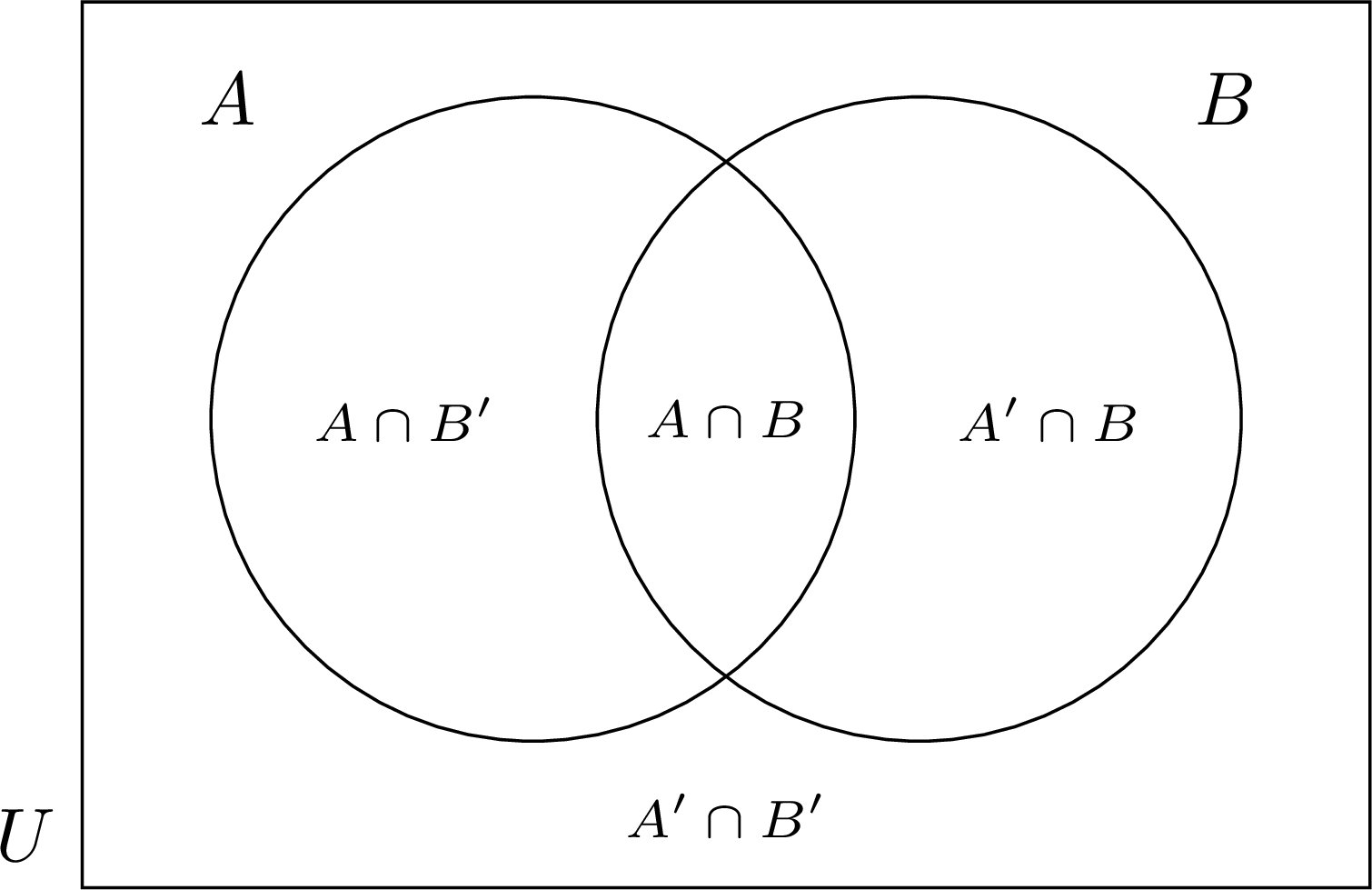
- \(A \cap B'\): the elements of \(A\) that are not in \(B\), “in \(A\) only”.
- \(A \cap B\): the elements of both \(A\) and \(B\).
- \(A' \cap B\): the elements of \(B\) only.
- \(A' \cap B'\): the elements in neither \(A\) nor \(B\).
Proposition — Number of Elements of a Union
For two sets \(A\) and \(B\) of a finite universal set \(U\), $$\textcolor{colorprop}{\Card{A \cup B} = \Card{A} + \Card{B} - \Card{A \cap B}}.$$ Adding \(\Card{A}\) and \(\Card{B}\) counts the elements of \(A \cap B\) twice: subtracting \(\Card{A \cap B}\) counts them once. In particular: - if \(A\) and \(B\) are disjoint (\(A \cap B = \emptyset\)), then \(\Card{A \cup B} = \Card{A} + \Card{B}\);
- for the complement of \(A\) in \(U\), \(\Card{A'} = \Card{U} - \Card{A}\).
Write \(a\), \(b\), \(c\) and \(d\) for the numbers of elements of the four regions: 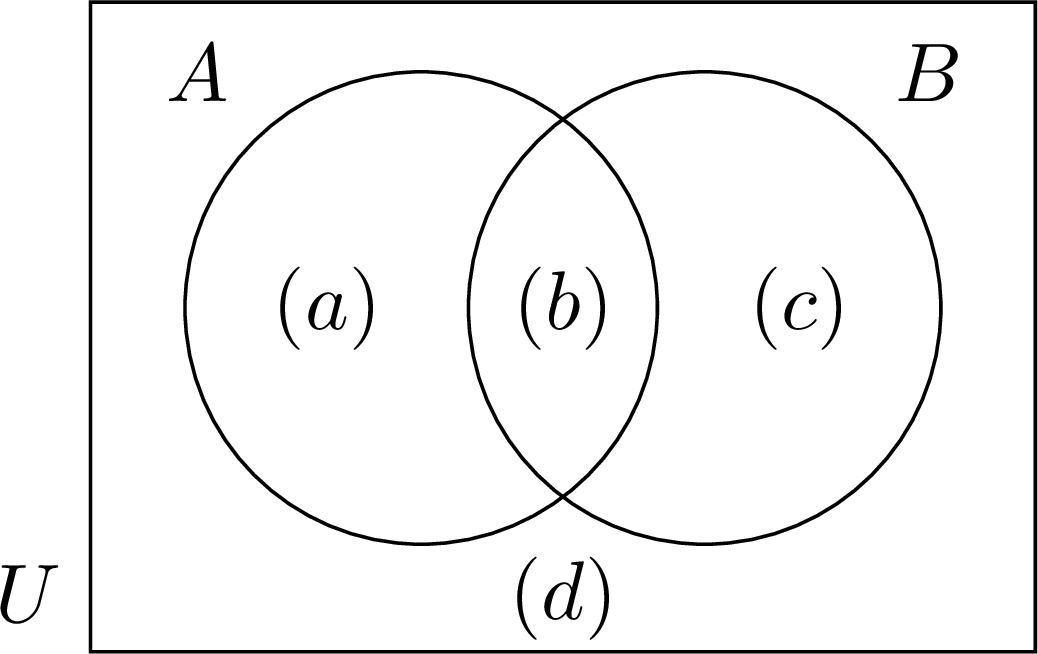
The set \(A\) is made of the regions \(A \cap B'\) and \(A \cap B\), so \(\Card{A} = a + b\); likewise \(\Card{B} = b + c\) and \(\Card{A \cap B} = b\). The union \(A \cup B\) is made of the three regions inside the circles, so \(\Card{A \cup B} = a + b + c\). Then $$\begin{aligned}[t] \Card{A} + \Card{B} - \Card{A \cap B} &= (a + b) + (b + c) - b && \text{(read on the regions)} \\
&= a + b + c && \text{(collect the terms)} \\
&= \Card{A \cup B}. \end{aligned}$$ If \(A \cap B = \emptyset\), then \(b = 0\) and the formula becomes \(\Card{A \cup B} = \Card{A} + \Card{B}\). Finally, \(A\) and \(A'\) have no element in common and together make up \(U\), so \(\Card{A} + \Card{A'} = \Card{U}\).
Example
Given \(\Card{U} = 40\), \(\Card{A} = 21\), \(\Card{B} = 16\) and \(\Card{A \cap B} = 9\), find \(\Card{A \cup B}\), \(\Card{A \cap B'}\) and \(\Card{(A \cup B)'}\).
$$\begin{aligned}[t] \Card{A \cup B} &= \Card{A} + \Card{B} - \Card{A \cap B} && \text{(number of elements of a union)} \\
&= 21 + 16 - 9 \\
&= 28. \end{aligned}$$ The set \(A\) is made of the regions \(A \cap B'\) and \(A \cap B\), so \(\Card{A \cap B'} = \Card{A} - \Card{A \cap B} = 21 - 9 = 12\). $$\begin{aligned}[t] \Card{(A \cup B)'} &= \Card{U} - \Card{A \cup B} && \text{(complement in } U\text{)} \\
&= 40 - 28 \\
&= 12. \end{aligned}$$ The Venn diagram gathers the four numbers (\(B\) only: \(16 - 9 = 7\)): 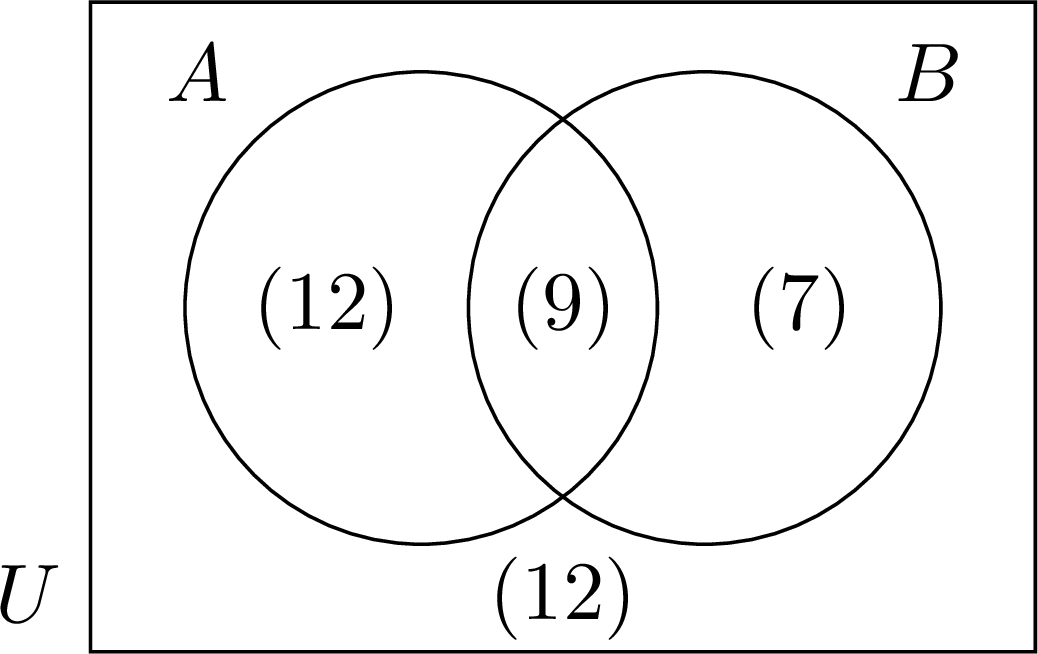
Check: \(12 + 9 + 7 + 12 = 40 = \Card{U}\).
Method — Filling a Venn Diagram from Counts
- Start with the intersection \(A \cap B\), the region shared by the two sets.
- Subtract to obtain the regions “\(A\) only” and “\(B\) only”: \(\Card{A \cap B'} = \Card{A} - \Card{A \cap B}\), and likewise for \(B\).
- The region outside both circles holds what is left: \(\Card{U}\) minus the three numbers inside the circles.
- If the number of a region is unknown, call it \(x\) and write the number of every other region in terms of \(x\). Once every region is known in terms of \(x\), a total given by the statement, usually \(\Card{U}\), gives an equation in \(x\): the four regions add up to it. This requires every other region to be known, the outside one included; if the statement gives only \(\Card{U}\), \(\Card{A}\) and \(\Card{B}\), with the outside unknown, the regions add up to \(\Card{U}\) whatever \(x\) is, and one more piece of information is needed.
- Check that every region holds a whole number of elements, zero or more (or, when the regions hold percentages, a percentage between \(0\) and \(100\)), and that the four regions add up to \(\Card{U}\) (to \(100\pourcent\) when the regions hold percentages).
Example
A hiking club has \(36\) members. \(25\) of them hike in summer, \(19\) hike in winter, and every member hikes in at least one of the two seasons. How many members hike in both seasons?
Let \(S\) and \(W\) be the sets of the members who hike in summer and in winter, and let \(x = \Card{S \cap W}\). Then \(\Card{S \cap W'} = 25 - x\) and \(\Card{S' \cap W} = 19 - x\). The region outside both circles is empty, since every member hikes in at least one season. 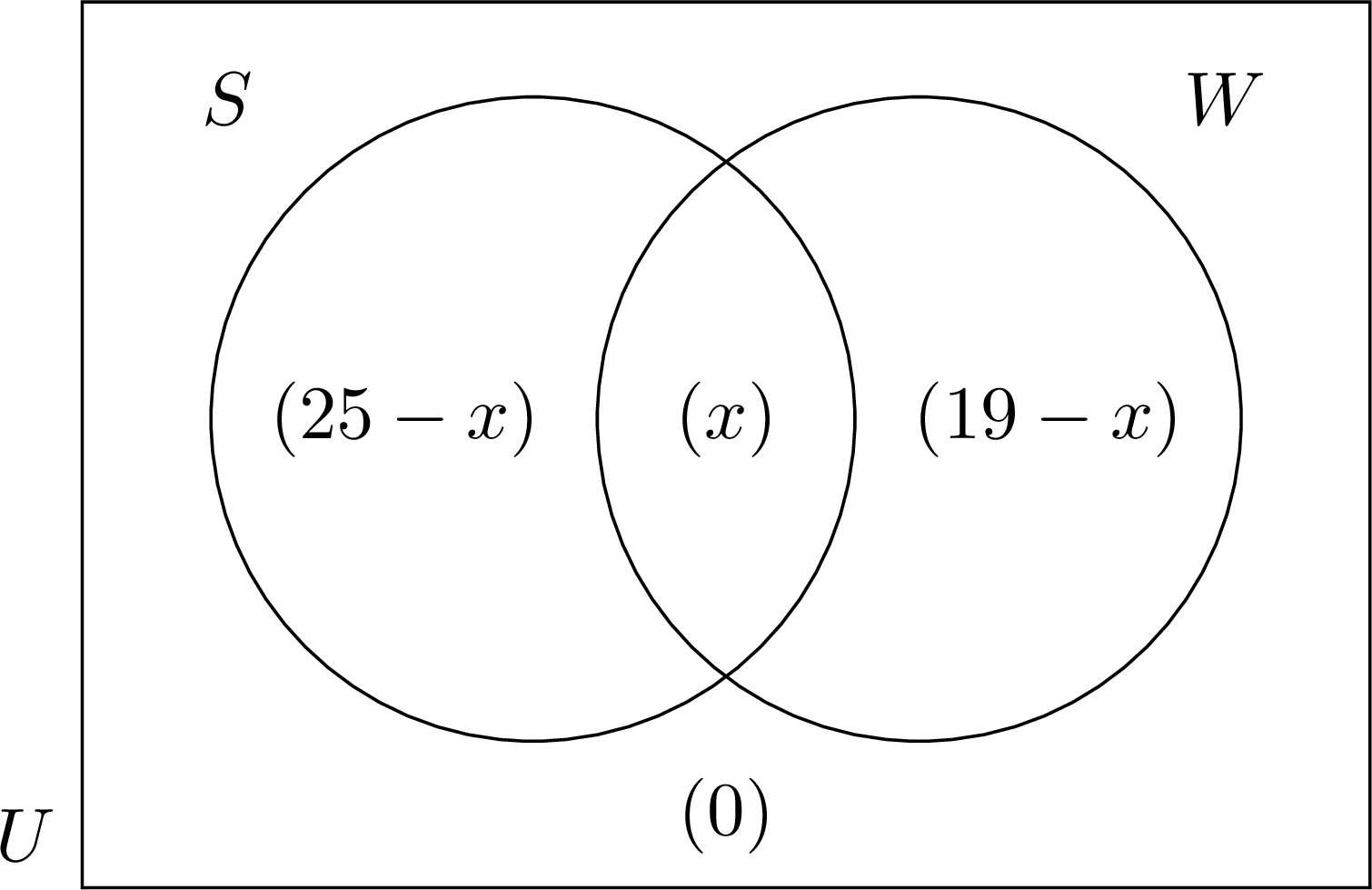
The four regions make up the club: $$\begin{aligned}[t] (25 - x) + x + (19 - x) + 0 &= 36 && \text{(the regions make up } U\text{)} \\
44 - x &= 36 && \text{(collect the terms)} \\
x &= 8 && \text{(subtract } 36 \text{, add } x\text{)} \end{aligned}$$ Check: the regions hold \(25 - 8 = 17\), \(8\) and \(19 - 8 = 11\) members, and \(17 + 8 + 11 = 36\). So \(8\) members hike in both seasons.
Skills to practice
- Naming a Region
- Answering Questions from a Venn Diagram of Counts
- Using the Formula for a Union
- Finding an Unknown Number
- Solving Problems with a Venn Diagram
IV
Going further
Skills to practice
- Solving Survey Problems with Two Sets
- Investigating Patterns in Sets
- Quiz
Jump to section