International Baccalaureate · MYP 2
Whole Numbers, Rounding and Estimation
I
Properties for Mental Calculation
At the shop, Léa buys \(4\) posters at \(\dollar 19.99\) each. Before she can take out her phone, the shopkeeper announces: “\(\dollar 79.96\)!” — in two seconds, without any calculator. How does he do it?
The shopkeeper does not compute \(4 \times 19.99\) digit by digit: he replaces \(19.99\) by \(20 - 0.01\), $$4 \times 19.99 = 4 \times 20 - 4 \times 0.01 = 80 - 0.04 = 79.96.$$ He is allowed to spread the \(4\) over the difference — that right and the right to reorder sums and products first are two properties of the operations, stated below.
Proposition — Commutativity and Associativity
In a sum, the terms can be swapped and grouped in any order. In a product, the factors can be swapped and grouped in any order. Choosing pairs that make simple numbers — a whole number, \(1\), \(10\), \(100\) — speeds up mental calculation. $$\begin{aligned} 1.2+27.9+0.8&=(1.2+0.8)+27.9 &&\text{(swap and group the terms that make a whole number)}\\
&=2+27.9\\
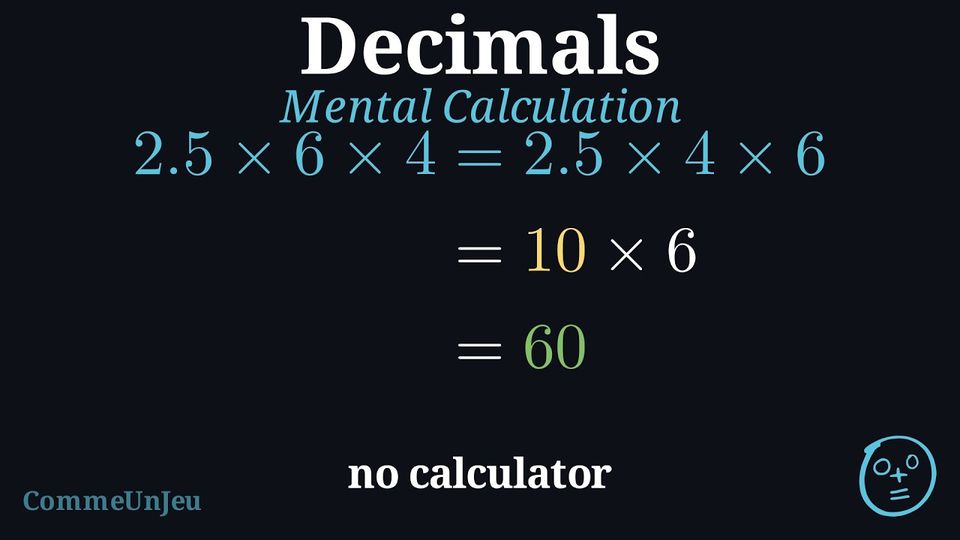
&=29.9 \end{aligned}$$ $$\begin{aligned} 2.5\times 6.7\times 4&=(2.5\times 4)\times 6.7 &&\text{(swap and group the factors that make a simple number)}\\
&=10\times 6.7\\
&=67 \end{aligned}$$ These properties hold for addition and multiplication; they do not hold for subtraction or division. Proposition — Distributivity
Multiplication distributes over addition and subtraction — here the letters \(k\), \(a\) and \(b\) simply stand for any numbers: $$k\times(a+b)=k\times a+k\times b \qquad\qquad k\times(a-b)=k\times a-k\times b$$ A factor close to a simple number can be replaced by a sum or a difference: $$\begin{aligned} 25\times 0.99&=25\times(1-0.01) &&\text{(since } 0.99=1-0.01\text{)}\\
&=25\times 1-25\times 0.01 &&\text{(distributivity)}\\
&=25-0.25\\
&=24.75 \end{aligned}$$ Example
Compute mentally, stating the property used. - \(4.8 + 13.5 + 5.2\)
- \(2 \times 8.3 \times 0.5\)
- \(12 \times 1.01\)
- Group the terms that make a whole number: $$\begin{aligned} 4.8 + 13.5 + 5.2&=(4.8+5.2)+13.5 &&\text{(commutativity and associativity)}\\ &=10+13.5\\ &=23.5 \end{aligned}$$
- Group the factors that make \(1\): $$\begin{aligned} 2 \times 8.3 \times 0.5&=(2\times 0.5)\times 8.3 &&\text{(commutativity and associativity)}\\ &=1\times 8.3\\ &=8.3 \end{aligned}$$
- Replace \(1.01\) with the sum \(1+0.01\): $$\begin{aligned} 12 \times 1.01&=12\times(1+0.01) &&\text{(since } 1.01=1+0.01\text{)}\\ &=12+0.12 &&\text{(distributivity)}\\ &=12.12 \end{aligned}$$
Example
Compute cleverly: \(7 \times 2.5 + 3 \times 2.5\).
Both products share the factor \(2.5\): the distributivity identity can also be read from right to left, to collect instead of spreading: $$7 \times 2.5 + 3 \times 2.5 = (7 + 3) \times 2.5 = 10 \times 2.5 = 25.$$
Example
Calculate \(6 \times (10 + 3)\) in two ways, then \(6 \times 10 + 3\). Why do the brackets matter?
Following the order of operations, the parentheses first: $$\begin{aligned} 6 \times (10 + 3) &= 6 \times 13 &&\text{(parentheses first)}\\
&= 78 \end{aligned}$$ With distributivity: $$\begin{aligned} 6 \times (10 + 3) &= 6 \times 10 + 6 \times 3 &&\text{(distributivity)}\\
&= 60 + 18 &&\text{(the multiplications first)}\\
&= 78 \end{aligned}$$ The same result — and the second expression needs no parentheses: its multiplications come first anyway. But \(6 \times 10 + 3 = 60 + 3 = 63\): without parentheses, the \(6\) multiplies only the \(10\). Distributivity turns a product whose factor is in parentheses into a sum of products, which needs none.
Skills to practice
- Reordering Sums and Products
- Using Distributivity with Whole Numbers
- Using Distributivity
- Solving Real-World Problems
II
Significant Figures
The final of a football cup was watched by \(48\,736\) spectators in the stadium. The next day, a radio station announced “about \(49\,000\) spectators”, a newspaper wrote “nearly \(50\,000\) spectators”, and the website of the club “\(48\,700\) fans”.
How many digits of \(48\,736\) did each of them keep? Why did none of them simply write \(49\)?
How many digits of \(48\,736\) did each of them keep? Why did none of them simply write \(49\)?
Each of them rounded \(48\,736\), keeping its first digits and replacing the others by zeros.
- The radio kept two digits: \(48\,736\) is closer to \(49\) thousands than to \(48\) thousands, since the next digit is \(7\).
- The newspaper kept one digit: \(4\) ten-thousands became \(5\) ten-thousands, since the next digit is \(8\).
- The website kept three digits: \(487\) hundreds, since the next digit is \(3\).
Definition — Significant Figures
The significant figures of a number are the digits that give its precision, counted from the first non-zero digit, reading from left to right, by the rules below; the other zeros only put the digits in their places and keep the size of the number. - Every non-zero digit is significant.
- A zero between two non-zero digits is significant: \(307\) and \(4.05\) each have \(3\) significant figures.
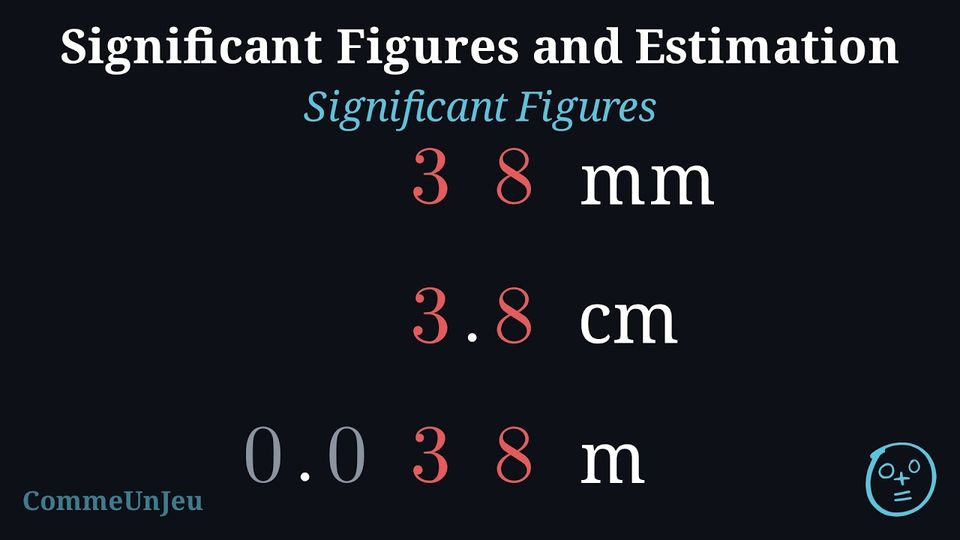
- The zeros before the first non-zero digit are place holders, never significant: \(0.0038\) has \(2\) significant figures, \(3\) and \(8\).
- A zero at the end of the decimal part is significant: \(2.50\) has \(3\) significant figures — its last zero shows that the value is given to the hundredth.
- The zeros at the end of a whole number, as in \(5\,300\), are read as place holders: \(5\,300\) has \(2\) significant figures, unless it is stated otherwise — “\(5\,300\), to \(3\) significant figures” makes its first zero significant.
Example
Give the number of significant figures of each number. - \(4\,072\)
- \(0.0306\)
- \(5.20\)
- \(250\,000\)
The significant figures are counted from the first non-zero digit; they are coloured below.
- \(\textcolor{colordef}{4\,072}\) has \(4\) significant figures: the zero lies between the non-zero digits \(4\) and \(7\).
- \(0.0\textcolor{colordef}{306}\) has \(3\) significant figures: the first non-zero digit is \(3\); the two zeros before it are place holders, and the zero between \(3\) and \(6\) is significant.
- \(\textcolor{colordef}{5.20}\) has \(3\) significant figures: the final zero of the decimal part is significant.
- \(\textcolor{colordef}{25}0\,000\) has \(2\) significant figures: nothing states otherwise, so the zeros at the end of the whole number are read as place holders.
Skills to practice
- Deciding Whether a Zero Is Significant
- Counting Significant Figures
III
Rounding to Significant Figures
Method — Rounding to a Number of Significant Figures
To round a number to \(n\) significant figures: - Find the first significant figure: the first non-zero digit from the left.
- Count \(n\) figures from it and underline the \(n\)-th one: it is the last figure kept.
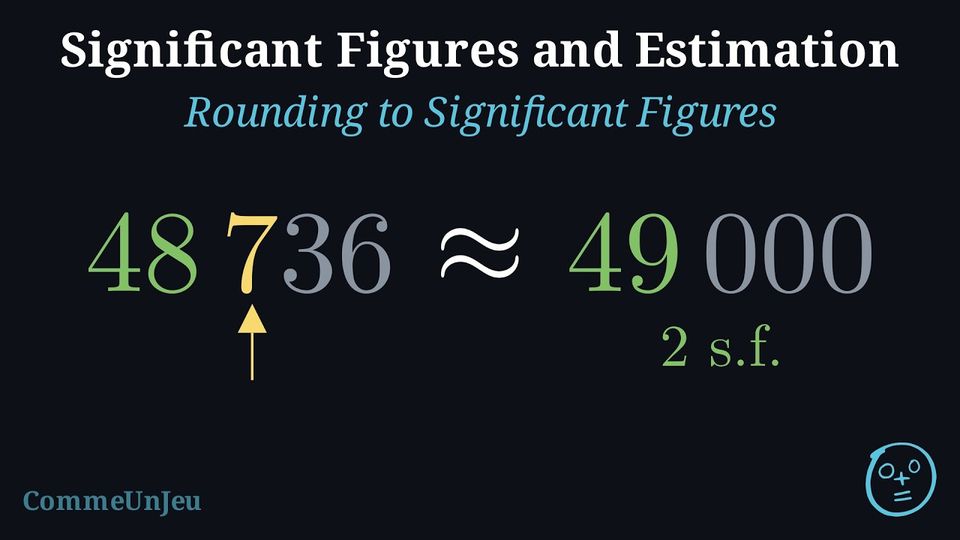
- Look at the next digit. If it is \(0\), \(1\), \(2\), \(3\) or \(4\), the underlined figure stays the same; if it is \(5\), \(6\), \(7\), \(8\) or \(9\), the underlined figure increases by \(1\) — a \(9\) then becomes \(0\) and carries \(1\) to the digit on its left.
- Keep the size of the number: before the decimal point, replace each dropped digit by a zero; after the decimal point, drop the digits. A zero that is one of the \(n\) figures is written, as in \(3.997 \approx 4.00\) to \(3\) s.f.
Example
Round \(48\,736\) to \(1\), to \(2\) and to \(3\) significant figures.
The first significant figure is the \(4\) of the ten-thousands.
- To \(1\) s.f.: in \(\underline{4}8\,736\) the next digit is \(8\), so the \(4\) becomes \(5\), and the four dropped digits become zeros: \(48\,736 \approx 50\,000\).
- To \(2\) s.f.: in \(4\underline{8}\,736\) the next digit is \(7\), so the \(8\) becomes \(9\): \(48\,736 \approx 49\,000\).
- To \(3\) s.f.: in \(48\,\underline{7}36\) the next digit is \(3\), so the \(7\) stays: \(48\,736 \approx 48\,700\).
Example
Round each number as indicated. - \(0.004567\) to \(2\) significant figures
- \(2.3961\) to \(3\) significant figures
- \(0.0997\) to \(2\) significant figures
- The first significant figure is \(4\), in the thousandths. In \(0.004\underline{5}67\) the next digit is \(6\), so the \(5\) becomes \(6\): \(0.004567 \approx 0.0046\). The zeros after the decimal point stay: they place the \(4\) and the \(6\).
- The figures kept are \(2\), \(3\) and \(9\). In \(2.3\underline{9}61\) the next digit is \(6\), so the \(9\) becomes \(0\) and carries \(1\) to the \(3\), which becomes \(4\): \(2.3961 \approx 2.40\). The final \(0\) is the third significant figure: it is written.
- The first significant figure is the \(9\) of the hundredths. In \(0.09\underline{9}7\) the next digit is \(7\): the underlined \(9\) becomes \(0\) and carries \(1\), the other \(9\) becomes \(0\) and carries \(1\) to the tenths: \(0.0997 \approx 0.10\). The carry has moved the first significant figure: the two figures are now the \(1\) of the tenths and the \(0\) of the hundredths.
Example
Round \(3\,846.2\) and \(0.00483\) to \(2\) decimal places, then to \(2\) significant figures. Which of the two kinds of rounding keeps useful information about \(0.00483\)? - To \(2\) decimal places, two digits are kept after the decimal point: \(3\,846.2\) has only one decimal place, so it is written \(3\,846.20\) with no rounding; \(0.00483 \approx 0.00\), since the digit after the hundredths is \(4\).
- To \(2\) significant figures, two digits are kept from the first non-zero digit: \(3\,846.2 \approx 3\,800\) (next digit \(4\)) and \(0.00483 \approx 0.0048\) (next digit \(3\)).
Rounding Keeps the Size of the Number
The most frequent error is to forget the place holders. Rounded to \(2\) significant figures, \(48\,736\) is \(49\,000\), not \(49\), which is a thousand times smaller; and \(0.004567\) is \(0.0046\), not \(46\). A rounded value is always close to the number it replaces: comparing their sizes, as with an order of magnitude, catches the error at once.
Skills to practice
- Checking a Rounding
- Rounding Whole Numbers
- Rounding Decimals and Carrying
IV
Orders of Magnitude
Definition — Order of Magnitude
An order of magnitude of a number is a simple number close to it: a whole number, or a multiple of \(10\), of \(100\), of \(1\,000\), …- \(20\) is an order of magnitude of \(19.8\).
- \(500\) is an order of magnitude of \(487.25\).
- \(3\) is an order of magnitude of \(2.95\).
Method — Estimating with Orders of Magnitude
- Step 1: Round each number to a simple nearby number — often the nearest whole number; for a number smaller than \(1\), keep its first non-zero digit: \(0.29 \approx 0.3\) and \(0.048 \approx 0.05\).
- Step 2: Compute mentally with the rounded numbers.
- Step 3: Conclude. The result obtained is an order of magnitude: the exact result is close to it.
Example
Give an order of magnitude of each result. - \(503.7 + 98.2\)
- \(41.6 \times 1.9\)
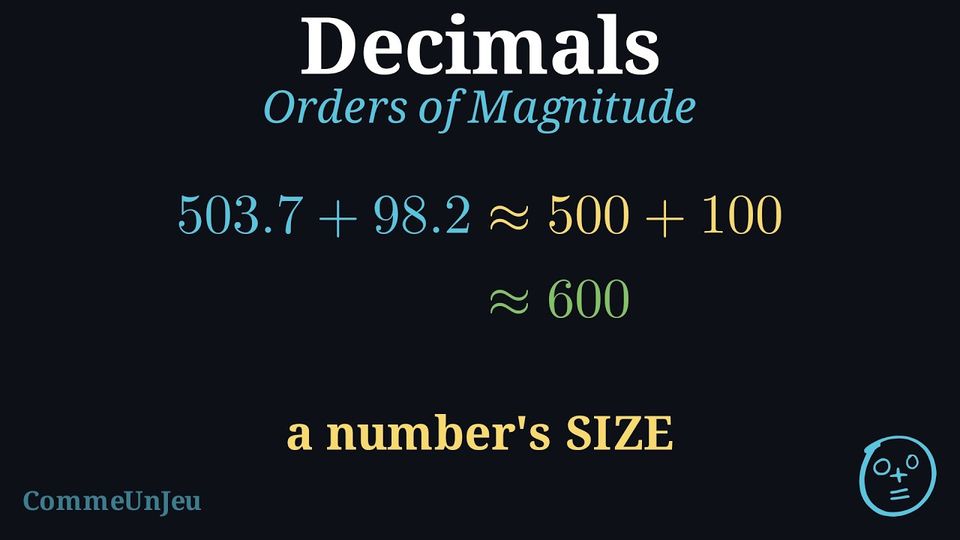
- For the sum: $$\begin{aligned} 503.7 + 98.2 &\approx 500 + 100 &&\text{(orders of magnitude of each number)}\\ &= 600 &&\text{(mental addition)} \end{aligned}$$ The exact sum, \(601.9\), is indeed close to \(600\).
- For the product: $$\begin{aligned} 41.6 \times 1.9 &\approx 40 \times 2 &&\text{(orders of magnitude of each number)}\\ &= 80 &&\text{(mental multiplication)} \end{aligned}$$ The exact product, \(79.04\), is indeed close to \(80\).
Skills to practice
- Placing the Decimal Point
V
One-Figure Estimates
Method — Making a One-Figure Estimate
A one-figure estimate of a calculation gives its size quickly, without a calculator. - Round every number to \(1\) significant figure: \(7\,235 \approx 7\,000\), \(0.48 \approx 0.5\), \(0.032 \approx 0.03\).
- Compute mentally with the rounded numbers.
- Write the result after the sign \(\approx\): it is an estimate, and in most calculations the exact result has the same size.
- Check a calculator result against the estimate: the two must have the same size. A result about \(10\) or \(100\) times too large or too small reveals a keying error — often a misplaced decimal point: redo the calculation.
Example
Make a one-figure estimate of each calculation. - \(7\,235 \times 591\)
- \(38.7 \times 0.52\)
- \(\dfrac{812}{0.39}\)
- $$\begin{aligned}[t] 7\,235 \times 591 &\approx 7\,000 \times 600 && \text{(each number to 1 s.f.)}\\ &= 4\,200\,000. \end{aligned}$$ The exact product, \(4\,275\,885\), is indeed about four million.
- $$\begin{aligned}[t] 38.7 \times 0.52 &\approx 40 \times 0.5 && \text{(each number to 1 s.f.)}\\ &= 20. \end{aligned}$$ The exact product is \(20.124\).
- $$\begin{aligned}[t] \frac{812}{0.39} &\approx \frac{800}{0.4} && \text{(each number to 1 s.f.)}\\ &= \frac{8\,000}{4} && \text{(both multiplied by 10: the quotient does not change)}\\ &= 2\,000. \end{aligned}$$ The exact quotient is \(2\,082.05\ldots\) Dividing by a number smaller than \(1\) gives a result larger than the number divided.
Example
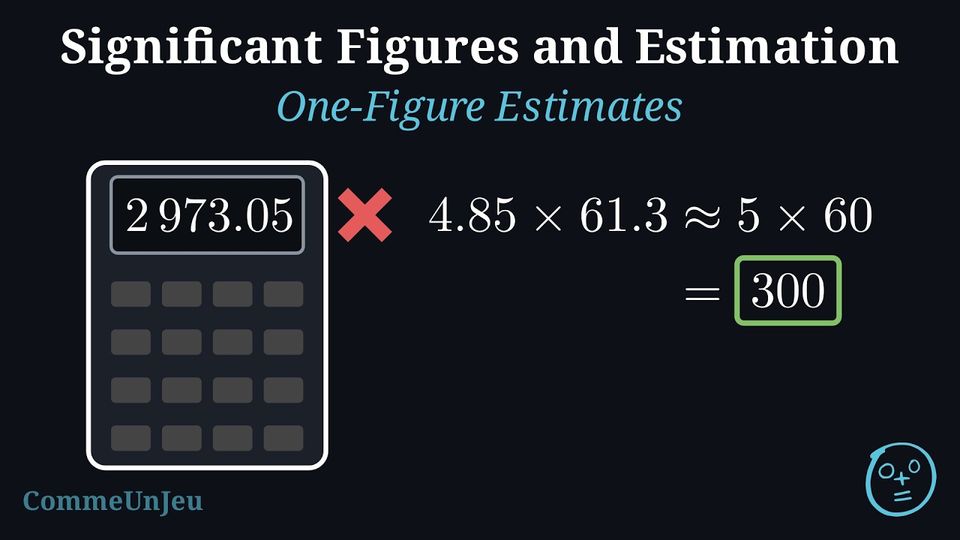
Tom computed \(4.85 \times 61.3\) with a calculator and read \(2\,973.05\).Check his result with a one-figure estimate.
$$\begin{aligned}[t] 4.85 \times 61.3 &\approx 5 \times 60 && \text{(each number to 1 s.f.)}\\
&= 300. \end{aligned}$$ The result \(2\,973.05\) is about ten times too large: it cannot be correct. Tom probably typed \(48.5\) instead of \(4.85\), since \(48.5 \times 61.3 = 2\,973.05\). Done again, the calculation gives \(4.85 \times 61.3 = 297.305\), which has the size of the estimate \(300\).
Skills to practice
- Choosing the Correct Size
- Making One-Figure Estimates
VI
Giving an Answer to Three Significant Figures
When to Give an Answer to Three Significant Figures
When a calculation gives a short exact value, such as \(15\) or \(2.75\), the answer is written in full. When the result goes on — a division that does not end, such as \(20 \div 7 = 2.857142\ldots\) — and the question does not say how to round, a common convention is to give the answer to \(3\) significant figures: \(20 \div 7 \approx 2.86\). Three figures are enough for most uses; for a result computed from measurements, more figures would even claim a precision that the measurements do not have. Two rules go with this convention:
- keep the full calculator value during the calculation, and round only the final answer;
- give an amount of money to the cent, that is to \(2\) decimal places, rather than to \(3\) significant figures.
Example
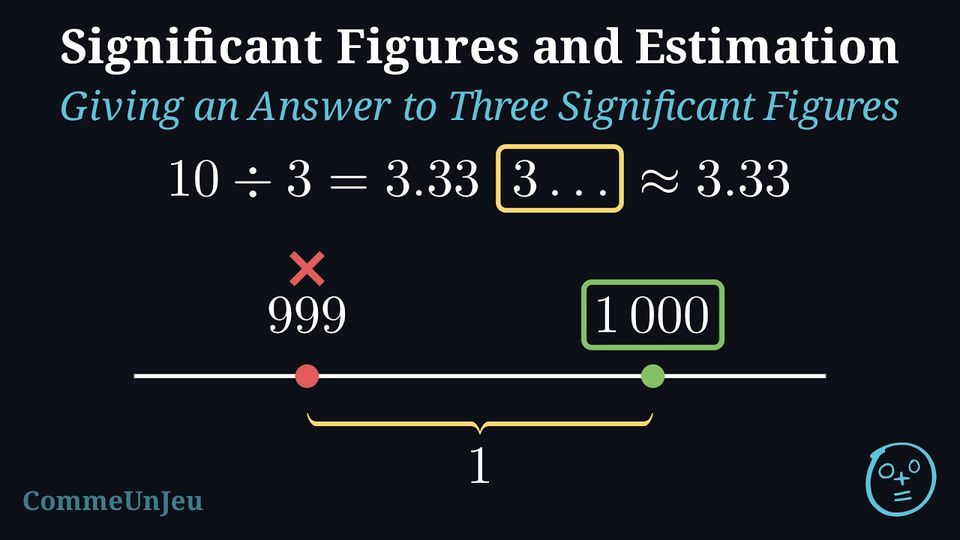
Compute \(10 \div 3 \times 300\) in two ways. - Round \(10 \div 3\) to \(3\) significant figures first, then multiply by \(300\).
- Keep the exact value of \(10 \div 3\) until the end.
- \(10 \div 3 = 3.333\ldots \approx 3.33\), then \(3.33 \times 300 = 999\).
- $$\begin{aligned}[t] 10 \div 3 \times 300 &= \frac{10}{3} \times 300\\ &= \frac{3\,000}{3} && \text{(multiply the numerator by 300)}\\ &= 1\,000. \end{aligned}$$
Skills to practice
- Deciding How to Round an Answer
- Rounding a Final Answer
VII
Going further
Skills to practice
- Solving Problems with Rounding and Estimation
- Investigating Rounding
- Quiz
Jump to section