International Baccalaureate · MYP 2
Integers and Signed Numbers
I
The Sign of a Product of Several Factors
Definition — Multiplication
The product of two signed integers is obtained by: - multiplying their distances to zero;
- then deciding the sign using the following rules:
- \(\textcolor{colordef}{(+)}\times \textcolor{colordef}{(+)} = \textcolor{colordef}{(+)}\): a positive times a positive gives a positive.
- \(\textcolor{colordef}{(+)}\times \textcolor{colorprop}{(-)} = \textcolor{colorprop}{(-)}\): a positive times a negative gives a negative.
- \(\textcolor{colorprop}{(-)} \times \textcolor{colordef}{(+)} = \textcolor{colorprop}{(-)}\): a negative times a positive gives a negative.
- \(\textcolor{colorprop}{(-)} \times \textcolor{colorprop}{(-)} = \textcolor{colordef}{(+)}\): a negative times a negative gives a positive.
- If one factor is \(0\), the product is \(0\).
Proposition — Sign of a Product of Several Factors
The sign of a product of several signed numbers (all factors nonzero) depends only on the number of negative factors: - an even number of negative factors gives a positive product;
- an odd number of negative factors gives a negative product.
Example
Calculate \(\textcolor{colorprop}{(-1)}\times \textcolor{colorprop}{(-2)}\times \textcolor{colorprop}{(-3)}\) and \(\textcolor{colordef}{(+4)}\times \textcolor{colorprop}{(-1)}\times \textcolor{colorprop}{(-5)}\times \textcolor{colorprop}{(-2)}\). - Three negative factors (odd), so the product is negative: \(1\times 2\times 3 = 6\), hence \(\textcolor{colorprop}{(-1)}\times \textcolor{colorprop}{(-2)}\times \textcolor{colorprop}{(-3)} = \textcolor{colorprop}{-6}\).
- Three negative factors (odd) and one positive factor, so the product is negative: \(4\times 1\times 5\times 2 = 40\), hence \(\textcolor{colordef}{(+4)}\times \textcolor{colorprop}{(-1)}\times \textcolor{colorprop}{(-5)}\times \textcolor{colorprop}{(-2)} = \textcolor{colorprop}{-40}\).
Skills to practice
- Multiplying Several Integers
II
Signed Decimals
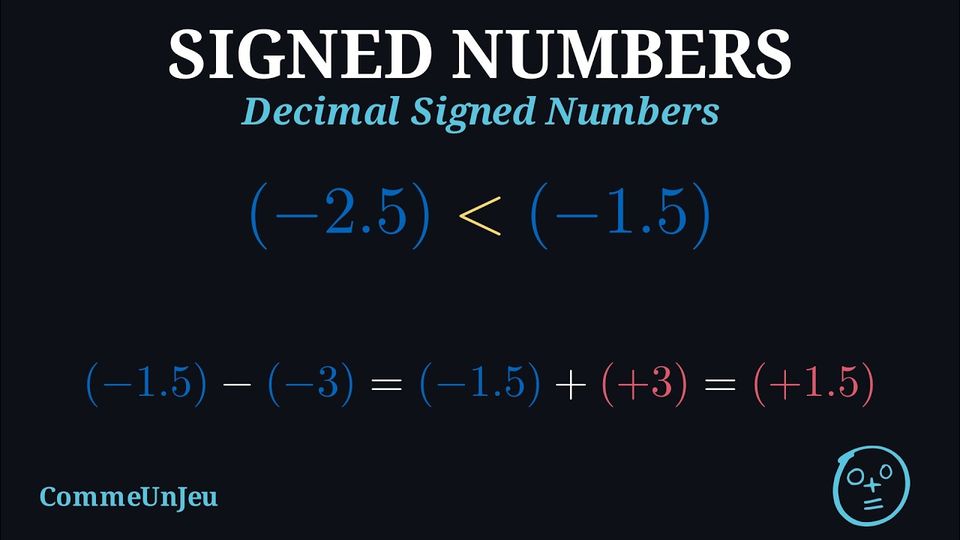
For three days in a row, the temperature drops by \(1.5\,^\circ\)C each day. What is the total change? It is a repeated addition, that is, a product: $$3\times \textcolor{colorprop}{(-1.5)} = \textcolor{colorprop}{(-1.5)} + \textcolor{colorprop}{(-1.5)} + \textcolor{colorprop}{(-1.5)} = \textcolor{colorprop}{-4.5}\,^\circ\text{C}.$$ The sign rules of multiplication work for decimal signed numbers exactly as for integers.
Naming the families of numbers. The natural numbers are the numbers used for counting: \(0, \textcolor{colordef}{1}, \textcolor{colordef}{2}, \textcolor{colordef}{3}, \ldots\) They are also called the whole numbers; some books start the natural numbers at \(1\) and keep the name “whole numbers” for \(0, 1, 2, 3, \ldots\) The integers are the natural numbers and their opposites: \(\ldots, \textcolor{colorprop}{-3}, \textcolor{colorprop}{-2}, \textcolor{colorprop}{-1}, 0, \textcolor{colordef}{1}, \textcolor{colordef}{2}, \textcolor{colordef}{3}, \ldots\)
- Every natural number is an integer: \(\textcolor{colordef}{7}\) is both.
- An integer is not always a natural number: \(\textcolor{colorprop}{-5}\) is an integer, but not a natural number.
- A number such as \(2.5\) or \(\textcolor{colorprop}{-0.5}\) is neither: it lies between two consecutive integers.
Definition — Signed Numbers
Any number — integer, decimal or in fraction notation (like \(-\frac{1}{2}\)), positive, negative or zero — is a signed number. Everything built for signed integers applies unchanged to all these numbers: opposite, distance to zero, comparison, addition and subtraction — and the sign rules of this chapter: multiply (or divide) the distances to zero, then apply the sign rule of the operation.To divide by a decimal, first make the divisor whole (multiply both numbers by \(10\), \(100\), …): \(15\div 2.5 = 150\div 25 = 6\).
Method — Rules of Addition
- To add two positive numbers, add their distances to zero. The sum is also a positive number: $$\textcolor{colordef}{(+2)}+\textcolor{colordef}{(+4)}=\textcolor{colordef}{+6} \quad \text{as }2+4=6.$$

- To add two negative numbers, add their distances to zero. The sum is also a negative number: $$\textcolor{colorprop}{(-5)}+\textcolor{colorprop}{(-3)}=\textcolor{colorprop}{-8} \quad \text{as }5+3=8.$$

- To add a positive number and a negative number, subtract the smaller distance to zero from the larger one and use the sign of the number with the larger distance to zero. When the two distances to zero are equal, the sum is \(0\) (the two numbers are opposites).
\(\textcolor{colorprop}{(-2)}+\textcolor{colordef}{(+5)}=\textcolor{colordef}{+3} \quad \text{as }5-2=3\)

\(\textcolor{colordef}{(+2)}+\textcolor{colorprop}{(-6)}=\textcolor{colorprop}{-4} \quad \text{as }6-2=4\)

Example
Compare \(-2.4\) and \(-2.15\).
Both numbers are negative: the one with the larger distance to zero is the smaller number. Here \(-2.4\) is \(2.4\) from zero and \(-2.15\) is \(2.15\) from zero, and \(2.4 > 2.15\), so: $$-2.4 < -2.15.$$ Watch out: \(2.4 > 2.15\) for positive numbers, but the order reverses for the negatives.
Example
Compute \((-3.5) - (-1.2)\).
Subtracting is adding the opposite: $$(-3.5) - (-1.2) = (-3.5) + (+1.2) = -2.3.$$
Example
Calculate \(\textcolor{colorprop}{(-2.5)}\times \textcolor{colorprop}{(-1.2)}\).
$$\textcolor{colorprop}{(-2.5)}\times \textcolor{colorprop}{(-1.2)}= \textcolor{colordef}{+3}\quad (2.5\times 1.2 = 3 \text{ and } \textcolor{colorprop}{(-)}\times \textcolor{colorprop}{(-)} = \textcolor{colordef}{(+)}) $$
Example
Calculate \(\textcolor{colorprop}{(-8.4)}\div \textcolor{colorprop}{(-0.4)}\).
$$\textcolor{colorprop}{(-8.4)}\div \textcolor{colorprop}{(-0.4)}= \textcolor{colordef}{+21}\quad (8.4\div 0.4 = 84\div 4 = 21 \text{ and } \textcolor{colorprop}{(-)}\div \textcolor{colorprop}{(-)} = \textcolor{colordef}{(+)}) $$
Example
Calculate \(\textcolor{colorprop}{(-3)}\div \textcolor{colordef}{(+2)}\), then \(\textcolor{colordef}{(+1)}\div \textcolor{colorprop}{(-3)}\). - \(3\div 2 = 1.5\) and \(\textcolor{colorprop}{(-)}\div \textcolor{colordef}{(+)} = \textcolor{colorprop}{(-)}\), so \(\textcolor{colorprop}{(-3)}\div \textcolor{colordef}{(+2)} = \textcolor{colorprop}{-1.5}\): the quotient is not a whole number, but it is a decimal one.
- \(1\div 3\) is not a decimal number: its exact value is written as a fraction, \(\textcolor{colordef}{(+1)}\div \textcolor{colorprop}{(-3)} = \textcolor{colorprop}{-\frac{1}{3}}\). A calculator shows \(-0.333\dots\), and \(-0.33\) is only an approximation rounded to the hundredth.
Skills to practice
- Ordering Decimal Signed Numbers
- Finding Decimal Numbers on the Number Line
- Comparing Negative Decimals
- Adding Signed Decimal Numbers
- Subtracting Signed Decimal Numbers
- Multiplying Signed Decimal Numbers
- Dividing Signed Decimal Numbers
III
Chaining Additions and Subtractions
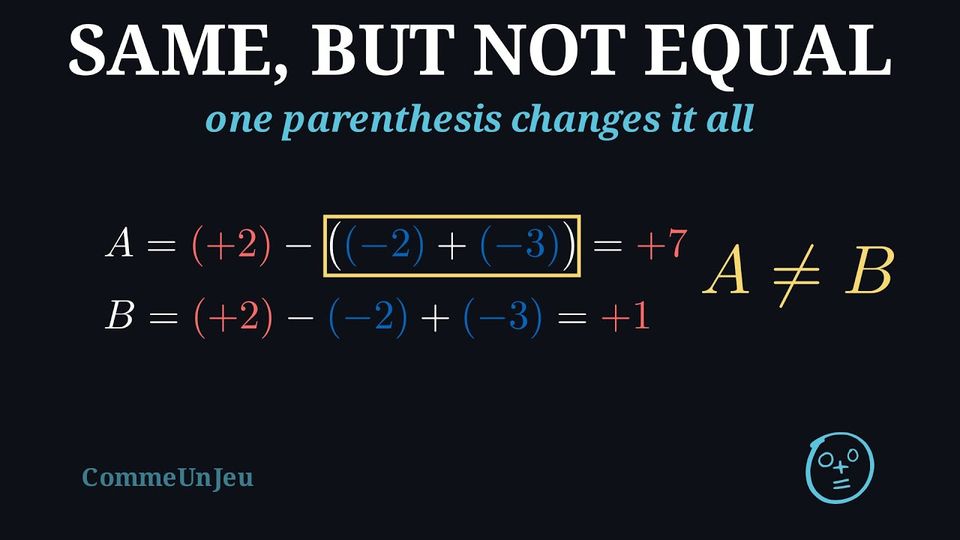
An expression can mix additions and subtractions, or use brackets. We then follow a fixed order so that everyone finds the same result.
Method — Chaining Additions and Subtractions
To evaluate a chain of additions and subtractions: - first compute what is inside the innermost brackets;
- rewrite each subtraction as adding the opposite;
- then add from left to right (two opposite numbers may be grouped, since their sum is \(0\)).
Proposition — Regrouping by Sign
In a sum of signed numbers, the order of the terms may be changed. One often regroups all the positives together, then all the negatives: $$(+16) + (-11) + (+4) + (-9) = (16 + 4) + (-11 - 9) = (+20) + (-20) = 0.$$ Example
Calculate \(A=\textcolor{colordef}{(+8)}-\big(\textcolor{colorprop}{(-3)}+\textcolor{colordef}{(+5)}\big)\).
$$\begin{aligned}[t] A&=\textcolor{colordef}{(+8)}-\big(\textcolor{colorprop}{(-3)}+\textcolor{colordef}{(+5)}\big)&&\text{(innermost brackets first)}\\
&=\textcolor{colordef}{(+8)}-\textcolor{colordef}{(+2)}&&\text{(}\textcolor{colorprop}{(-3)}+\textcolor{colordef}{(+5)}=\textcolor{colordef}{+2}\text{)}\\
&=\textcolor{colordef}{(+8)}+\textcolor{colorprop}{(-2)}&&\text{(add the opposite)}\\
&=\textcolor{colordef}{+6}&&\text{(opposite signs)} \end{aligned}$$
Example
Calculate \(B=\textcolor{colorprop}{(-4)}+\textcolor{colordef}{(+9)}-\textcolor{colorprop}{(-3)}+\textcolor{colorprop}{(-6)}\).
$$\begin{aligned}[t] B&=\textcolor{colorprop}{(-4)}+\textcolor{colordef}{(+9)}+\textcolor{colordef}{(+3)}+\textcolor{colorprop}{(-6)}&&\text{(add the opposite)}\\
&=\textcolor{colordef}{(+5)}+\textcolor{colordef}{(+3)}+\textcolor{colorprop}{(-6)}&&\text{(left to right)}\\
&=\textcolor{colordef}{(+8)}+\textcolor{colorprop}{(-6)}&&\text{(left to right)}\\
&=\textcolor{colordef}{+2}&&\text{(opposite signs)} \end{aligned}$$
Skills to practice
- Computing Chains without Brackets
- Computing Chains with Brackets
- Computing Chains with Brackets Step by Step
- Analysing the Impact of Brackets
IV
Priorities with Signed Numbers
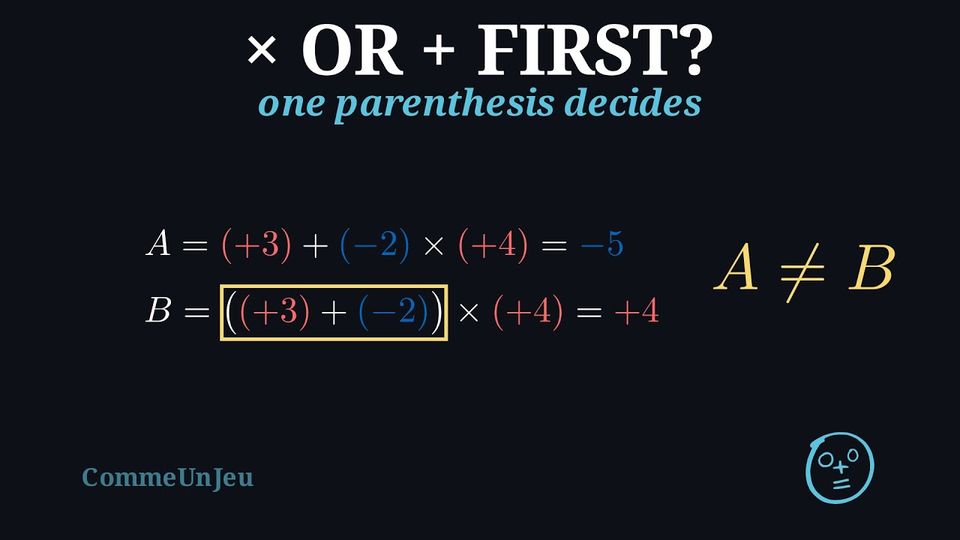
When an expression combines several operations, we follow a fixed order of priority so that everyone finds the same result.
Method — Order of Operations
To evaluate an expression: - first compute what is inside the innermost brackets;
- then the powers;
- then the multiplications and divisions, from left to right;
- finally the additions and subtractions, from left to right.
Example
Calculate \(A=\textcolor{colordef}{(+3)}+\textcolor{colorprop}{(-2)}\times\textcolor{colordef}{(+4)}\).
$$\begin{aligned}[t] A&=\textcolor{colordef}{(+3)}+\textcolor{colorprop}{(-2)}\times\textcolor{colordef}{(+4)}&&\text{(given)}\\
&=\textcolor{colordef}{(+3)}+\textcolor{colorprop}{(-8)}&&\text{(multiply first)}\\
&=\textcolor{colorprop}{-5}&&\text{(opposite signs)} \end{aligned}$$
Example
Calculate \(B=\big(\textcolor{colordef}{(+3)}+\textcolor{colorprop}{(-2)}\big)\times\textcolor{colordef}{(+4)}\), and compare with \(A\).
$$\begin{aligned}[t] B&=\big(\textcolor{colordef}{(+3)}+\textcolor{colorprop}{(-2)}\big)\times\textcolor{colordef}{(+4)}&&\text{(given)}\\
&=\textcolor{colordef}{(+1)}\times\textcolor{colordef}{(+4)}&&\text{(innermost brackets first)}\\
&=\textcolor{colordef}{+4}&&\text{(same signs)} \end{aligned}$$ The brackets force the addition before the multiplication, so \(B\neq A\).
Example
Calculate \(\textcolor{colordef}{(+12)}\div \textcolor{colorprop}{(-3)}\times \textcolor{colordef}{(+2)}\).
Division and multiplication have the same priority: compute from left to right. $$\begin{aligned}[t] \textcolor{colordef}{(+12)}\div \textcolor{colorprop}{(-3)}\times \textcolor{colordef}{(+2)} &= \textcolor{colorprop}{(-4)}\times \textcolor{colordef}{(+2)} && \text{(division first, left to right)}\\
&= \textcolor{colorprop}{-8}. \end{aligned}$$
Example
Calculate \(C=\textcolor{colordef}{(+18)}\div\textcolor{colorprop}{(-3)}+\textcolor{colordef}{(+2)}\times\textcolor{colorprop}{(-4)}\).
$$\begin{aligned}[t] C&=\textcolor{colordef}{(+18)}\div\textcolor{colorprop}{(-3)}+\textcolor{colordef}{(+2)}\times\textcolor{colorprop}{(-4)}&&\text{(given)}\\
&=\textcolor{colorprop}{(-6)}+\textcolor{colorprop}{(-8)}&&\text{(divide and multiply first)}\\
&=\textcolor{colorprop}{-14}&&\text{(same sign)} \end{aligned}$$
Skills to practice
- Applying Priority without Brackets
- Applying Priority with Brackets
- Applying Priority with Brackets Step by Step
- Computing with Decimal Numbers
V
Naming an Expression and Calculation Programs
Method — Using the Vocabulary of Operations
An expression built from a chain of operations is named after the last operation performed — the one the priority rules keep for the end. For $$A = (-3)\times(+4)+(+2),$$ the product \((-3)\times(+4)\) is computed first and the addition comes last: \(A\) is a sum — the sum of the product of \((-3)\) and \((+4)\) and the number \((+2)\). The same naming covers the four operations: a difference if the subtraction comes last, a product if the multiplication does, a quotient if the division does.This vocabulary translates calculation programs in both directions: the program “choose \((-3)\); multiply by \((+4)\); add \((+2)\)” builds exactly \(A\) — and, the other way round, reading \(A\) as a sum whose first term is a product dictates the program.
Example
- Write the expression produced by the program “choose \((-5)\); multiply by \((+3)\); add \((+12)\)”, name it, then compute it.
- Conversely, write a program that computes \(B = \big((+6)-(-4)\big)\div(+5)\), and name \(B\).
- Each step wraps the previous result: $$A = (-5)\times(+3)+(+12).$$ The multiplication is done first, the addition last: \(A\) is a sum — the sum of the product \((-5)\times(+3)\) and the number \((+12)\). Its value: \(A = (-15)+(+12) = \textcolor{colorprop}{-3}\).

- Program: “choose \((+6)\); subtract \((-4)\); divide by \((+5)\)”. The division comes last: \(B\) is a quotient — the difference \((+6)-(-4)\) divided by \((+5)\). Its value: \(B = (+10)\div(+5) = \textcolor{colordef}{+2}\).
Skills to practice
- Describing an Expression with the Vocabulary
- Translating a Calculation Program into an Expression
VI
Using a Calculator with Signed Numbers
Method — Using a Calculator with Signed Numbers
Most scientific calculators have two different keys that show a minus sign: the subtraction key \(\boxed{-}\), placed between two numbers, and the sign key \(\boxed{(-)}\), placed in front of a number to make it negative. - Type each negative number with the sign key, before the number: \(-4.8\) is typed \(\boxed{(-)}\;4.8\). On some calculators this key is marked \(\boxed{+/-}\) and is pressed after the number.
- Type each subtraction with the subtraction key, between the two numbers.
- Type the brackets that group a calculation, such as \((-4.2 + 1.8)\), and put brackets around a numerator or a denominator that is a calculation: the calculator then applies the order of operations by itself. The brackets around a single negative number, as in \((-6.3)\), are not needed: the sign key already makes the number negative.
- Check the result: its sign with the sign rules, its size with an estimate.
Example
Compute \((-4.8) \times 2.5 - (-6.3) \div (-0.9)\) with a calculator. Write the keys pressed, then check the result.
The keys are $$\boxed{(-)}\;4.8\;\boxed{\times}\;2.5\;\boxed{-}\;\boxed{(-)}\;6.3\;\boxed{\div}\;\boxed{(-)}\;0.9\;\boxed{=}$$ and the calculator shows \(-19\). Only the second minus sign, between \(2.5\) and \(6.3\), is a subtraction; the three others are signs, typed with the sign key, and the brackets around the negative numbers are not typed.
Size: \((-5) \times 2.5\) is about \(-12\) and \((-6) \div (-1) = 6\), so the result is about \(-12 - 6 = -18\): \(-19\) has a sensible size.
Check: the multiplication and the division come first, and the sign rules give $$\begin{aligned}[t] (-4.8) \times 2.5 - (-6.3) \div (-0.9) &= (-12) - (+7) && \text{(} \times \text{ and } \div \text{ first; sign rules)}\\ &= -19. && \text{(subtracting is adding the opposite)} \end{aligned}$$ The calculator result is correct.
Skills to practice
- Using a Calculator with Signed Numbers
VII
Going further
Skills to practice
- Solving Magic Squares with Integers
- Solving Word Problems with Signed Numbers
- Quiz
Jump to section