International Baccalaureate · MYP 1
Decimals
I
Decimal Numbers and Place Value
I.1
What a Decimal Number Is
In our number system, the position of a digit tells us its value. Consider the number 235. \(235=\) 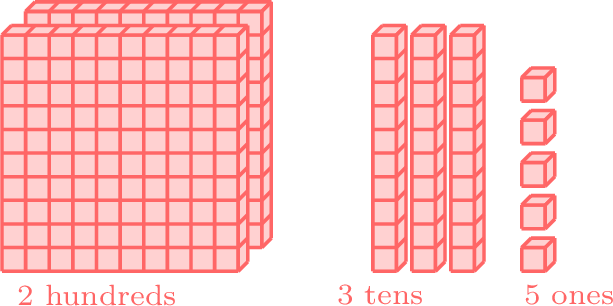
It is made of three parts:
We get a piece called a tenth. A tenth is a fraction, written as \(\dfrac{1}{10}\).
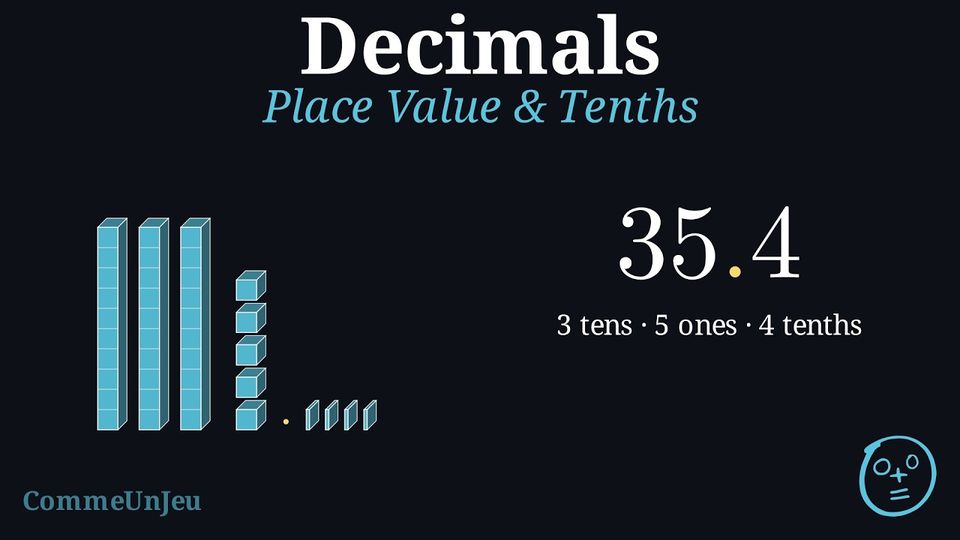
To write numbers that include these smaller pieces, we use a decimal point to separate the whole part from the fractional part. \(35.4\) = 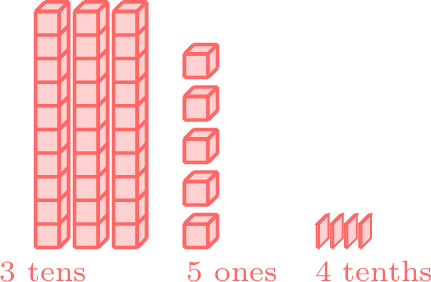
This number means 3 tens, 5 ones, and 4 tenths.
- The 5 is in the Ones place, meaning 5 ones (\(5\)).
- The 3 is in the Tens place, meaning 3 tens (\(30\)).
- The 2 is in the Hundreds place, meaning 2 hundreds (\(200\)).
- When we move left \(\leftarrow\), each place is 10 times bigger. (10 ones make a ten, 10 tens make a hundred).
- When we move right \(\rightarrow\), each place is 10 times smaller. (A hundred divided by 10 is a ten, a ten divided by 10 is a one).
We get a piece called a tenth. A tenth is a fraction, written as \(\dfrac{1}{10}\).
To write numbers that include these smaller pieces, we use a decimal point to separate the whole part from the fractional part.
Definition — Decimal Number
A decimal number is a number that can be written with a whole part and a fractional part separated by a decimal point, with a finite number of digits after the decimal point. The place-value pattern continues to the right of the hundredths: one hundredth divided by 10 gives one thousandth, written \(\dfrac{1}{1000}\). We can represent a decimal number in different ways: - Decimal Form:
\(35.487\) - Expanded Form$$\begin{aligned} 3\text{ tens} &+& 5\text{ ones} &+& 4\text{ tenths} &+& 8\text{ hundredths} &+& 7\text{ thousandths} \\ 30 &+& 5 &+& \frac{4}{10} &+& \frac{8}{100} &+& \frac{7}{1000}\\ 3\times 10 &+& 5\times 1 &+& 4\times \frac{1}{10} &+& 8\times \frac{1}{100} &+& 7\times \frac{1}{1000}\\ \end{aligned}$$
- Place Value Table:
Tens Ones . Tenths Hundredths Thousandths 3 5 . 4 8 7 - Decimal Fraction:
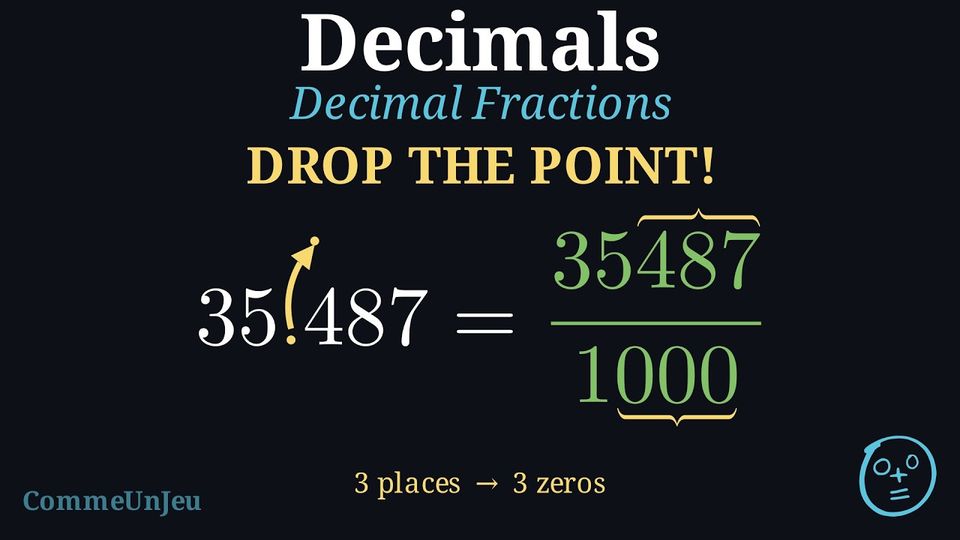
\(35.487=\dfrac{35\,487}{1000}\) The smallest place used is the thousandth, so the number counts \(35\,487\) thousandths.
Definition — The Thousandth
The pattern continues past the hundredths: each place is still 10 times smaller than the place on its left. - A hundredth divided by 10 is a new, smaller piece called a thousandth. A thousandth is written \(\dfrac{1}{1\,000}\) as a fraction, or \(0.001\) as a decimal.
- 10 thousandths make 1 hundredth: \(\dfrac{10}{1\,000} = \dfrac{1}{100}\).
- \(1\,000\) thousandths make 1 one: \(\dfrac{1\,000}{1\,000} = 1\).
| Ones | . | Tenths | Hundredths | Thousandths |
| \(2\) | . | \(6\) | \(4\) | \(7\) |
Example
Consider the number \(53.276\). - Write \(53.276\) in expanded form.
- Write \(53.276\) as a single decimal fraction.
- Decompose \(53.276\) as a whole number plus a fraction smaller than \(1\).
The place value table of \(53.276\) is:
| Tens | Ones | . | Tenths | Hundredths | Thousandths |
| 5 | 3 | . | 2 | 7 | 6 |
- Expanded form: $$53.276=5\times 10+3\times 1+2\times \frac{1}{10}+7\times \frac{1}{100}+6\times \frac{1}{1000}$$
- As a single decimal fraction: $$\begin{aligned} 53.276&=\frac{53\,276}{1000} &&\text{(the last digit, 6, is in the thousandths place)} \end{aligned}$$
- As a whole number plus a fraction smaller than \(1\): $$\begin{aligned} 53.276&=53+0.276 &&\text{(whole part and decimal part)}\\ &=53+\frac{276}{1000} &&\text{(276 thousandths)} \end{aligned}$$
Skills to practice
- Identifying Thousandths
I.2
Decimal Fractions, Digits and Units
Definition — Decimal Number: Definition by Decimal Fractions
A decimal number is a number that can be written with a decimal point and a finite number of digits after it; in other words, a number that can be written as a decimal fraction: a fraction whose numerator is a whole number and whose denominator is \(1\), \(10\), \(100\), \(1\,000\), …- \(3.74 = \dfrac{374}{100}\) and \(0.5 = \dfrac{5}{10}\) are decimal numbers.
- Every whole number is a decimal number: \(2 = \dfrac{20}{10} = \dfrac{2}{1} = 2.0\).
- Some quotients are not decimal numbers: no decimal fraction equals \(10 \div 3\), whose writing \(3.333\ldots\) never stops.
Method — Digit of a Place and Number of a Unit
In \(1.27\), the digit of the hundredths is \(7\), but the number of hundredths is \(127\): the number \(1.27\) as a whole is made of \(127\) hundredths. The digit is what is written at one place; the number counts how many of that unit the entire number contains. - The digit of a place: read the single digit written at that place. In \(84.375\), the digit of the hundredths is \(\textcolor{colordef}{7}\).
- The number of a unit: read everything written up to that place, ignoring the decimal point. In \(84.375\), the number of hundredths is \(\textcolor{colorprop}{8\,437}\): the number contains \(8\,437\) hundredths, and \(5\) thousandths remain. If the place is not written, complete with zeros first: \(1.2 = 1.20\) contains \(120\) hundredths.
Example
In the number \(324.071\), give the digit of the tens, the number of tens, the digit of the thousandths and the number of tenths. - Digit of the tens: \(\textcolor{colordef}{2}\) (the digit written at the tens place).
- Number of tens: \(\textcolor{colorprop}{32}\), because \(324.071 = 32\) tens and \(4.071\) more.
- Digit of the thousandths: \(\textcolor{colordef}{1}\).
- Number of tenths: \(\textcolor{colorprop}{3\,240}\), because \(324.071 = 3\,240\) tenths and \(71\) thousandths more.
Skills to practice
- Finding the Digit of a Place and the Number of a Unit
II
Decimals on a Number Line
II.1
Placing Decimals on a Number Line
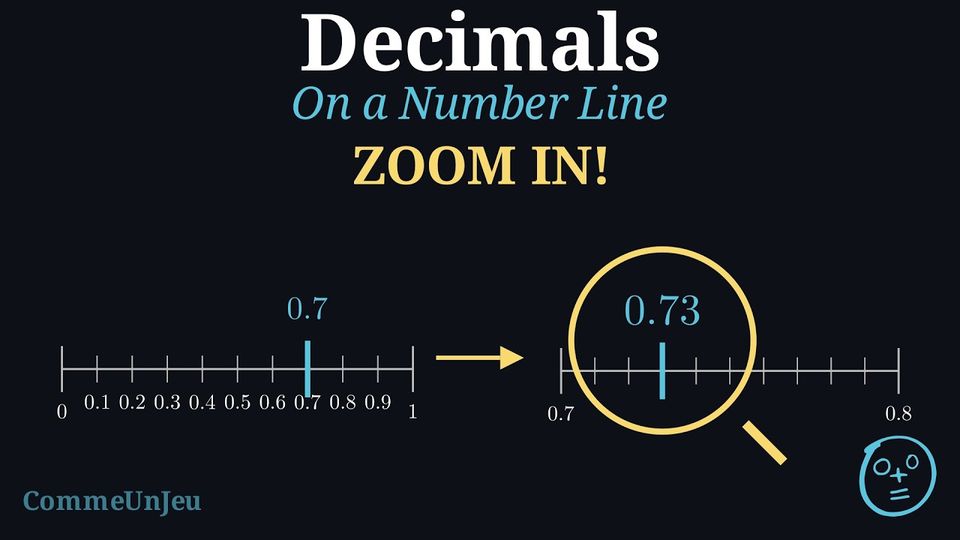
Every decimal number has an exact position on the number line.
- Finding Tenths
If we take the space between two whole numbers, like 0 and 1, and divide it into 10 equal parts, each part is one tenth (0.1).
- Finding Hundredths
If we magnify a small section, such as the one between 0 and 0.1, and divide it into 10 equal parts, each new part is one hundredth (0.01).
Method — Placing a Decimal on a Number Line
To place a decimal like 2.27 on a number line: - Find the start and end points. The number 2.27 is between \(2.2 = 2.20\) and \(2.3 = 2.30\).
- Draw the line and divide it into 10 equal parts. Each part will represent a hundredth.
- Count up from the start. The marks will be 2.21, 2.22, 2.23, and so on. Find the 7th mark to place 2.27.

Definition — Graduated Half-Line, Origin, Unit and Abscissa
A graduated half-line is a half-line on which we have chosen an origin — the point \(O\), of abscissa \(0\) —, a direction, shown by the arrow, and a unit of length, marked off regularly from \(O\). Every point of the half-line then corresponds to one number, its abscissa: the number of units between the origin and the point. We write \(A(2.5)\) to say that the point \(A\) has abscissa \(2.5\). 
Example
Give the abscissa of the points \(B\) and \(C\). 
The segment from \(5.4\) to \(5.5\) is one tenth long and is shared into \(10\) equal parts, so each part is one hundredth. \(B\) is \(2\) parts after \(5.4\): \(B(5.42)\). \(C\) is \(7\) parts after \(5.4\): \(C(5.47)\).
Skills to practice
- Identifying Decimal Numbers on a Number Line
- Reading the Abscissa of a Point
- Placing Points on a Graduated Half-Line
III
Comparing and Rounding Decimals
III.1
Comparing and Ordering Decimals
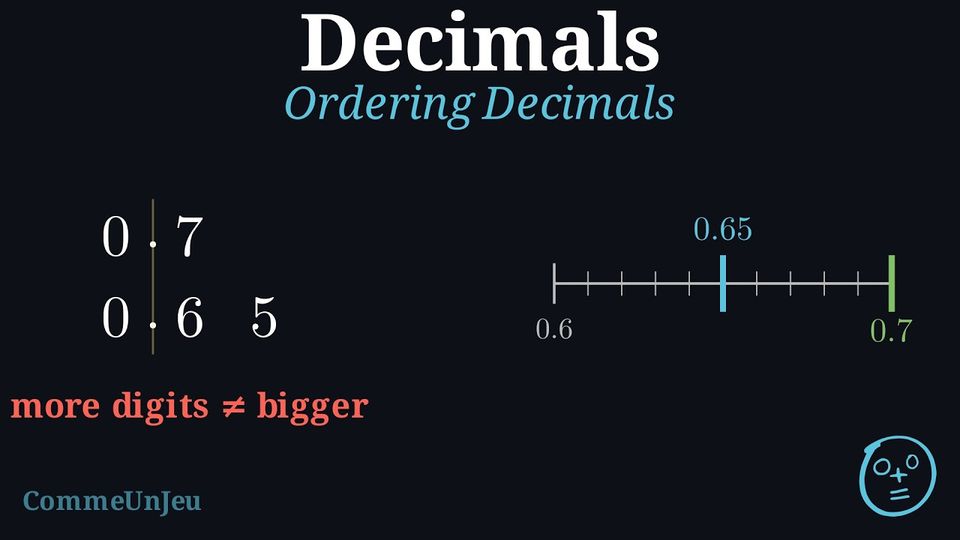
Method — Comparing Decimals Step-by-Step
To find out which decimal number is bigger, follow these steps: - Line them up: Place the numbers one above the other, making sure the decimal points are perfectly aligned.
- Make them the same length: Add zeros to the end of the shorter number until both have the same number of decimal places. This doesn't change their value.
- Compare from left to right: Starting from the left, compare the digits in each place value column. The first number with a larger digit is the larger number. If one whole part has more digits than the other, that number is the larger one.
Example
Compare 6.22 and 6.3. - Line them up:
\(6.22\)
\(6.3\) - Make them the same length: We add a zero to 6.3 to make it 6.30.
\(6.22\)
\(6.30\) - Compare:
- Ones place: Both have a 6.
- Tenths place: The top number has a 2, the bottom has a 3.
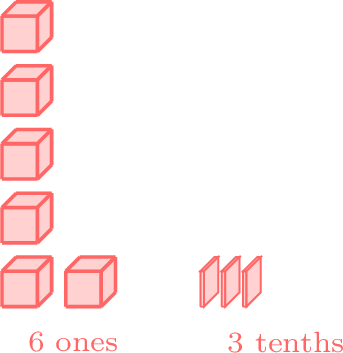
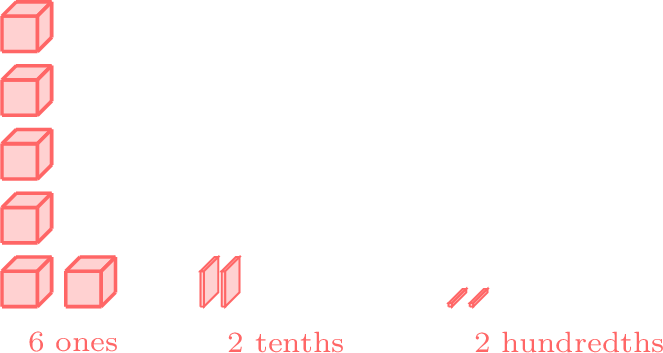 \(\lt\)
Method — Framing and Inserting Decimals
- To frame a decimal between two consecutive whole numbers: the whole part gives the lower bound, and the next whole number gives the upper bound. For \(6.815\): $$6\leq 6.815<7$$
- To frame a decimal between two consecutive tenths: keep the digits up to the tenths place for the lower bound, then add one tenth for the upper bound. For \(6.815\): $$6.8\leq 6.815<6.9$$
- To frame a decimal between two consecutive hundredths: keep the digits up to the hundredths place for the lower bound, then add one hundredth for the upper bound. For \(6.815\): $$6.81\leq 6.815<6.82$$ The sign \(\leq\) reads “is less than or equal to”: the number can be equal to its lower bound (\(6\leq 6<7\) and \(6.1\leq 6.1<6.2\)), never to its upper bound.
- To insert a decimal between two given numbers: first write both numbers with the same number of decimal places, then with one more; the new graduations appear between them. Between \(5.7=5.70\) and \(5.8=5.80\), we can insert \(5.71\), \(5.72\), …, \(5.79\). Between two different decimal numbers, there is always another decimal number.
Example
- Frame \(7.062\) between two consecutive whole numbers.
- Frame \(7.062\) between two consecutive tenths.
- Frame \(7.062\) between two consecutive hundredths.
- Find three decimal numbers between \(9.61\) and \(9.62\).
- The whole part of \(7.062\) is \(7\), so: $$7\leq 7.062<8$$
- The digits up to the tenths place give \(7.0\); adding one tenth gives \(7.1\), so: $$7.0\leq 7.062<7.1$$
- The digits up to the hundredths place give \(7.06\); adding one hundredth gives \(7.07\), so: $$7.06\leq 7.062<7.07$$
- We write both numbers with one more decimal place: \(9.61=9.610\) and \(9.62=9.620\). The new graduations \(9.611\), \(9.612\), …, \(9.619\) all lie between them. For example: $$9.61<9.612<9.615<9.618<9.62$$

Definition — Wide Inequalities
The sign \(\leq\) has already been used to bound a number, as in \(6 \leq 6.815 < 7\); together with its mirror image \(\geq\), it completes \(<\) and \(>\). - \(a \leq b\) reads “\(a\) is less than or equal to \(b\)”: \(a\) is smaller than \(b\), or equal to it.
- \(a \geq b\) reads “\(a\) is greater than or equal to \(b\)”: \(a\) is greater than \(b\), or equal to it.
Skills to practice
- Deciding True or False with Wide Inequalities
- Comparing Numbers
III.2
Rounding Decimals
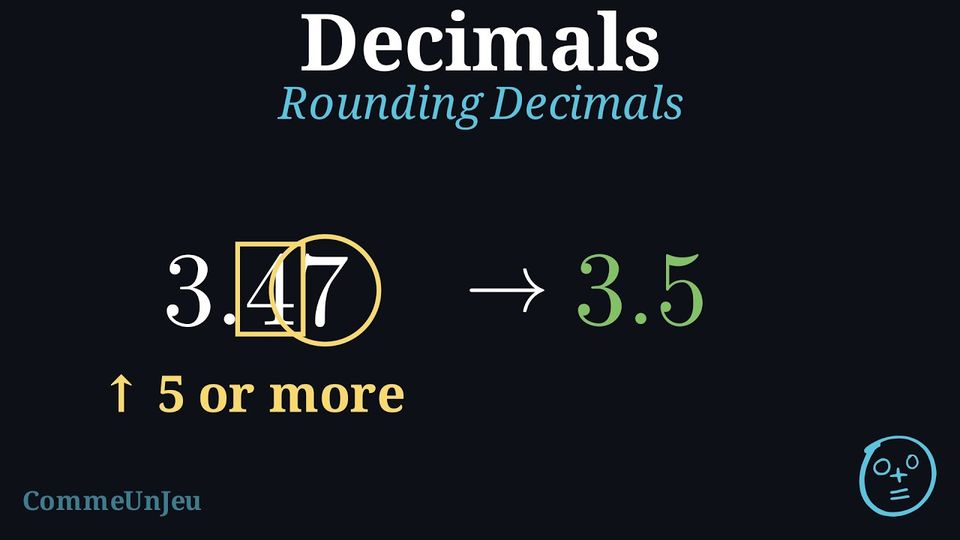
Method — The Four-Step Rounding Rule
- Underline the target digit: Find and underline the digit in the place you are rounding to.
- Look at the next digit: Look at the digit immediately to the right of your underlined digit.
- Decide to round up or down:
- If the next digit is 5 or more, add one to your underlined digit (round up). If the underlined digit is \(9\), it becomes \(10\): write \(0\) and add \(1\) to the digit on its left (so \(0.\underline{9}5\) rounds to \(1.0\)); if that digit is a \(9\) too, it becomes \(0\) in turn and the carry moves on to the left (so \(9.\underline{9}5\) rounds to \(10.0\)).
- If the next digit is 4 or less, your underlined digit stays the same.
- Drop the rest: the digits to the right of your underlined digit are dropped when they are after the decimal point; in the whole part, they are replaced by zeros (\(365 \approx 400\) to the nearest hundred).
Example
Round the number \(6.72\) to the nearest whole number.
Let's follow the steps:
- Underline the digit (the ones place): \(\underline{6}.72\)
- Look at the next digit: the digit to the right (the tenths) is 7.
- Decide: since 7 is “5 or more”, round up: the 6 becomes 7.
- Drop the rest: the 7 and the 2 are dropped.
Example
Round the number \(12.346\) to the nearest tenth.
Let's follow the steps: 
- Underline the digit (the tenths place): \(12.\underline{3}46\)
- Look at the next digit: the digit to the right is \(4\).
- Decide: since \(4\) is “4 or less”, the underlined digit \(3\) stays the same.
- Drop the rest: the \(4\) and the \(6\) are dropped.
Skills to practice
- Rounding to the Nearest Tenth
IV
Calculating with Decimals
IV.1
Dividing a Decimal by a Whole Number
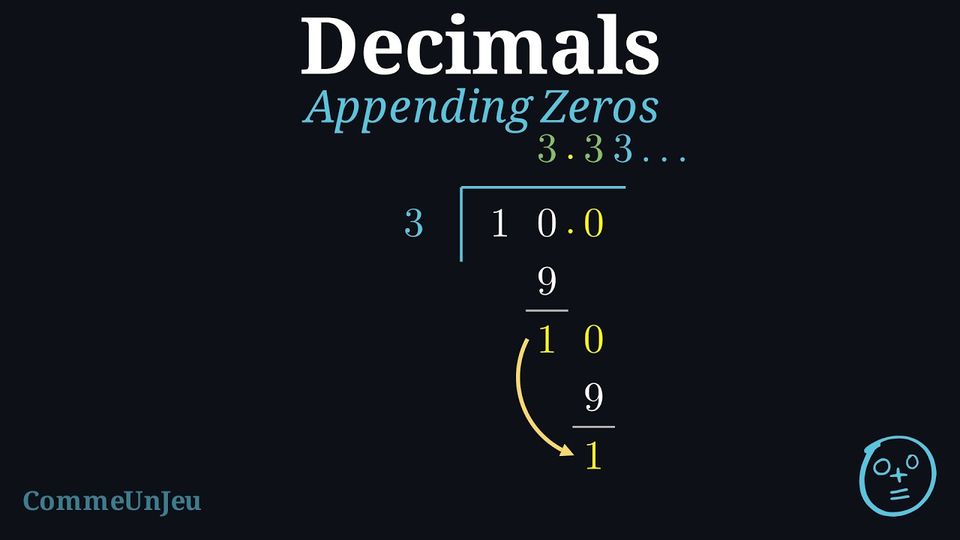
Method — Long Division by a Whole Number
- Step 1: Set up the division. Write the problem in the long division format.
- Step 2: Place the decimal point. Write the decimal point in the answer space, directly above the decimal point in the number being divided.
- Step 3: Divide from left to right. Divide as you would with whole numbers, ignoring the decimal point now.
Example
Calculate \(34.4 \div 4\). - Set up and place the decimal point.
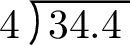
- Divide.
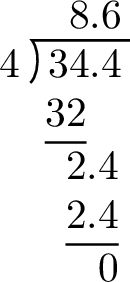
- How many 4s in 34? 8. (\(8 \times 4 = 32\))
- Subtract: \(34 - 32 = 2\).
- Bring down the 4 to make 24.
- How many 4s in 24? 6. (\(6 \times 4 = 24\))
- Subtract: \(24 - 24 = 0\). The division is complete.
Method — Continuing a Division by Appending Zeros
When the digits of the dividend are used up, the Euclidean division stops there: a whole-number quotient and a remainder. For a decimal quotient, the division is continued, because appending zeros after the decimal point does not change the value of a number: \(10 = 10.0 = 10.00\). - Step 1: Use up the digits. Divide as usual. If the remainder is not zero after the last digit of the dividend, continue.
- Step 2: Write the decimal point and append a zero. Write the decimal point in the quotient (if it is not there already). Append a zero to the dividend (\(10\) becomes \(10.0\)) and bring this zero down.
- Step 3: Keep dividing. Continue the division. Append another zero each time the digits run out, until the remainder is zero or the quotient reaches the requested number of decimal places.
Example
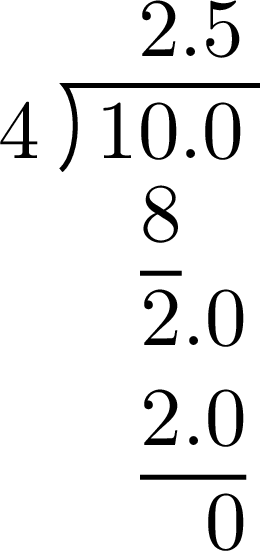
Calculate \(10 \div 4\). - Use up the digits.
- How many 4s in 10? 2. (\(2 \times 4 = 8\))
- Subtract: \(10 - 8 = 2\). The digits of the dividend are used up: the Euclidean division stops there, quotient 2 and remainder 2. For a decimal quotient, the division is continued.
- Write the decimal point and append a zero. Since \(10 = 10.0\), write the decimal point in the quotient and bring down the appended zero: the new number is 20 (twenty tenths).
- Keep dividing.
- How many 4s in 20? 5. (\(5 \times 4 = 20\))
- Subtract: \(20 - 20 = 0\). The division is complete.
Skills to practice
- Dividing by Whole Numbers
V
Decimals and Fractions
V.1
Converting Between Fractions and Decimals
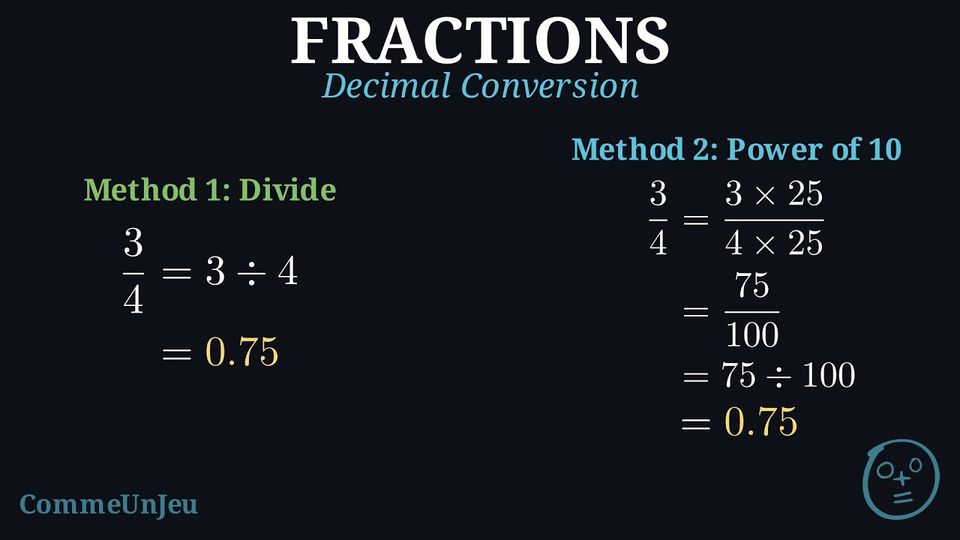
Fractions and decimals are two different notations for writing numbers, and many numbers can be written in both ways. Both can describe values that lie between integers. The ability to convert between these two forms is a fundamental mathematical skill. For example, the number “one half” can be written as either a fraction or a decimal:$$ \frac{1}{2} = 0.5 $$
Method — Converting a Fraction to a Decimal Number
There are two primary methods for converting a fraction to a decimal number, when this is possible. - Method 1: Direct Division
Since a fraction \(\frac{a}{b}\) is equal to the quotient \(a \div b\), perform the division of the numerator by the denominator. When the division stops, it gives the decimal writing of the fraction; otherwise, the fraction is not equal to any decimal number. - Method 2: Denominator as a Power of 10 (equal fractions)
Find an equivalent fraction where the denominator is a power of 10 (e.g., 10, 100, 1000). This new fraction is then written as a decimal number: \(\dfrac{75}{100} = 0.75\). This method only works when the denominator can be turned into a power of \(10\) (for example \(2\), \(4\), \(5\), \(25\)). For a denominator such as \(3\), no power of \(10\) works, so use Method 1: \(\frac{1}{3} = 1 \div 3 = 0.333\ldots\) (the decimal expansion never ends).
Example
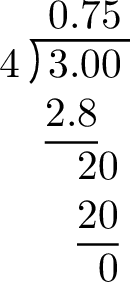
Convert \(\dfrac{3}{4}\) to a decimal number. - Applying Method 1 (Direct Division): $$ \frac{3}{4} = 3 \div 4 = 0.75 $$
- Applying Method 2 (Power of 10): We seek a number to multiply the denominator (4) by to get a power of 10. We know \(4 \times 25 = 100\). $$ \frac{3}{4} = \frac{3 \textcolor{olive}{\times 25}}{4 \textcolor{olive}{\times 25}} = \frac{75}{100} $$ The fraction “seventy-five hundredths” is written as the decimal \(0.75\).
Method — Converting a Decimal to a Fraction
The procedure for converting a terminating decimal to a fraction is as follows: - Write the decimal as the numerator of a fraction without the decimal point.
- The denominator is 1 followed by as many zeros as there are decimal places in the original number.
- Simplify the fraction to its lowest terms, if necessary.
Example
Convert \(1.3\) to a fraction. - The number \(1.3\) has one decimal place.
- Write the number without the decimal point as the numerator: 13.
- The denominator will be 1 followed by one zero: 10.
Skills to practice
- Converting Fractions to Decimals
- Converting Decimals to Fractions
V.2
Whole Number, Decimal Number or Neither
Proposition — Whole Number, Decimal Number or Neither
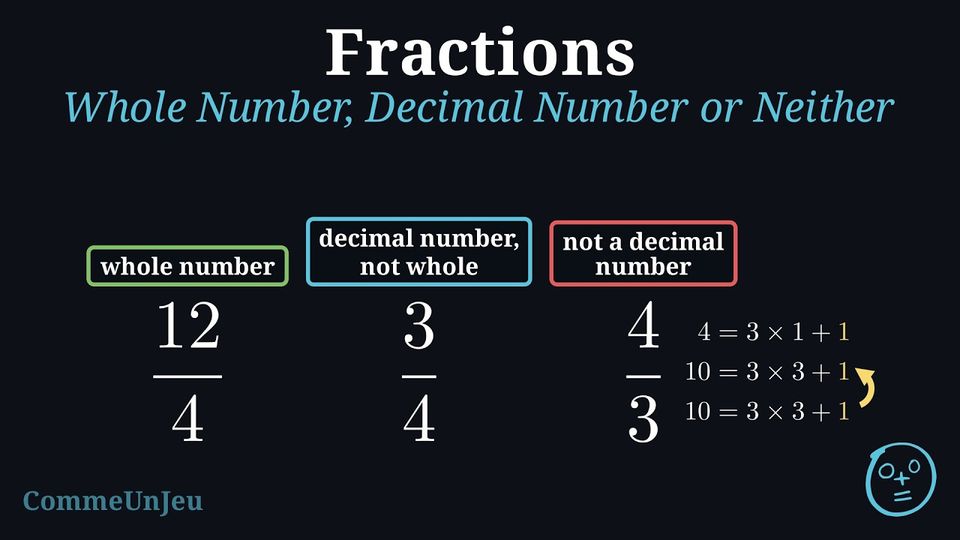
A fraction \(\dfrac{a}{b}\) is the exact result of the division \(a \div b\). Three cases can happen: - the division gives a whole number: \(\dfrac{12}{4} = 12 \div 4 = 3\);
- the division stops after some decimal places: the fraction is a decimal number that is not whole: \(\dfrac{3}{4} = 3 \div 4 = 0.75\);
- the division never stops: the fraction is not a decimal number: \(\dfrac{4}{3} = 4 \div 3 = 1.333\ldots\) — \(1.33\) is only its value rounded to the hundredth, and no finite writing with a decimal point is exact: a fraction (\(\dfrac{4}{3}\), or a fraction equal to it) writes this number exactly.
Example
For each fraction, say whether it is a whole number, a decimal number that is not whole, or not a decimal number: \(\dfrac{15}{5}\), \(\dfrac{7}{4}\), \(\dfrac{5}{3}\), \(\dfrac{9}{10}\). - \(\dfrac{15}{5} = 15 \div 5 = 3\): a whole number.
- \(\dfrac{7}{4} = 7 \div 4 = 1.75\): the division stops, a decimal number that is not whole.
- \(\dfrac{5}{3} = 5 \div 3 = 1.666\ldots\): the remainder \(2\) comes back at every step, the division never stops: not a decimal number.
- \(\dfrac{9}{10} = 0.9\): a decimal number (a decimal fraction is always one).
Skills to practice
- Recognising Whole and Decimal Numbers among Fractions
VI
Going further
Skills to practice
- Solving Problems on Numeration and Writing Numbers
- Solving Problems by Comparing, Bounding and Rounding
- Quiz
Jump to section