International Baccalaureate · MYP 1
Positive and Negative Numbers
I
Adding and Subtracting
I.1
Zero Pairs
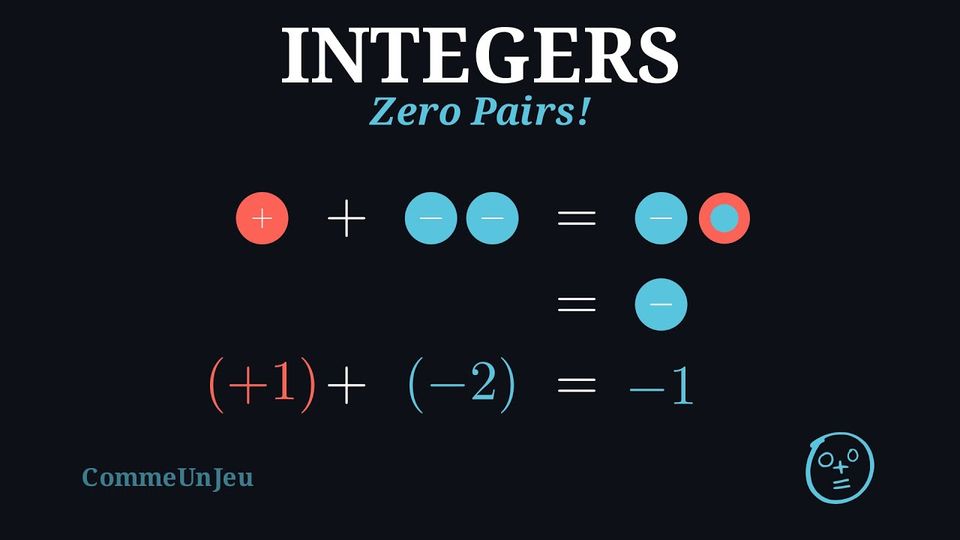
Imagine a world with two types of particles: positives (+) and negatives (-). They interact in specific ways.
- When particles of the same type meet, they join forces.


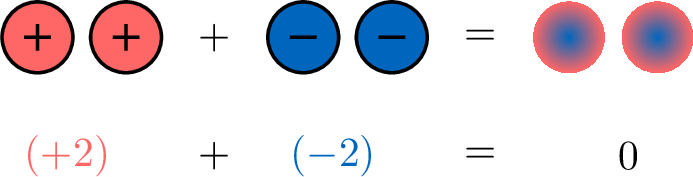
- When a positive and a negative particle meet, they cancel each other out, leaving nothing. This is called a zero pair.

- When 2 positives meet 1 negative, one zero pair is formed, leaving 1 positive.
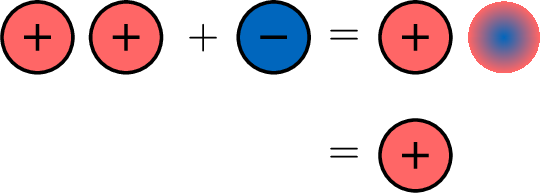
- To show which type of particle we have, we put a sign in front of the number:
- The + sign for a group of positives.
- The - sign for a group of negatives.

- The + sign for a group of positives.
- When 3 positives meet 1 negative:
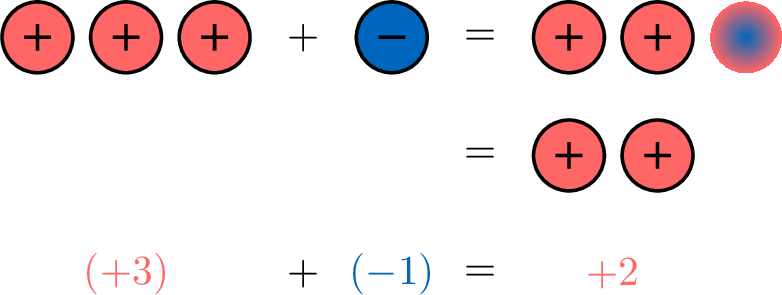
- When 2 positives meet 2 negatives:
Definition — Integers
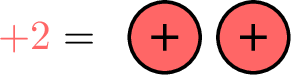
The integers are the whole numbers (\(0, 1, 2, 3, \dots\)) and their opposites (\(0, -1, -2, -3, \dots\)). - Positive numbers (\(\textcolor{colordef}{+1}, \textcolor{colordef}{+2},\dots\)) are written with a positive sign \((+)\). This sign is often omitted (\(\textcolor{colordef}{+2}=\textcolor{colordef}{2}\)).
\(\textcolor{colordef}{+2}=\) 
- Negative numbers (\(\textcolor{colorprop}{-1}, \textcolor{colorprop}{-2},\dots\)) are written with a negative sign \((-)\).
\(\textcolor{colorprop}{-3}=\) 
- Zero (\(0\)) is neither positive nor negative.
- Two integers are opposites if they have the same number of units with opposite signs; zero is its own opposite. The figure below shows that placing \((+2)\) and \((-2)\) together leaves no unit.
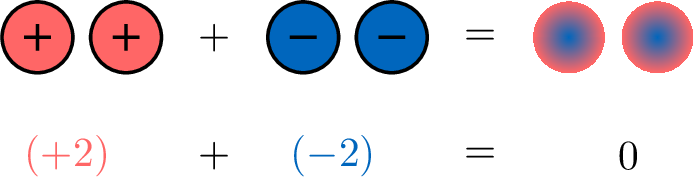
\(\textcolor{colorprop}{-2}\) is the opposite of \(\textcolor{colordef}{+2}\). - To avoid confusion between a number's sign and an operation sign, we often use brackets ( ) (also called parentheses). For example, \(\textcolor{colordef}{+1}+\textcolor{colorprop}{-2}\) can be written as \(\textcolor{colordef}{(+1)}+\textcolor{colorprop}{(-2)}\).

Skills to practice
- Adding Small Integers
I.2
Adding Integers
Example
Calculate \(\textcolor{colordef}{(+1)}+\textcolor{colorprop}{(-2)}\). -
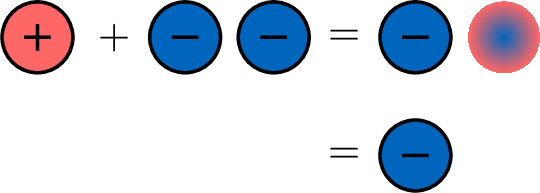
- So, \(\textcolor{colordef}{(+1)}+\textcolor{colorprop}{(-2)}=\textcolor{colorprop}{-1}\).
Definition — Distance to Zero
The distance to zero of a number is the distance between its point and the point \(0\) on the number line. It does not depend on the sign: \(\textcolor{colordef}{+3}\) and \(\textcolor{colorprop}{-3}\) have the same distance to zero, which is \(3\). This distance is also called the absolute value of the number: for a number \(n\), it is written \(|n|\), and we write \(|+3| = |-3| = 3\). Method — Rules of Addition
- To add two positive numbers, add their distances to zero. The sum is also a positive number: $$\textcolor{colordef}{(+2)}+\textcolor{colordef}{(+4)}=\textcolor{colordef}{+6} \quad \text{as }2+4=6.$$

- To add two negative numbers, add their distances to zero. The sum is also a negative number: $$\textcolor{colorprop}{(-5)}+\textcolor{colorprop}{(-3)}=\textcolor{colorprop}{-8} \quad \text{as }5+3=8.$$

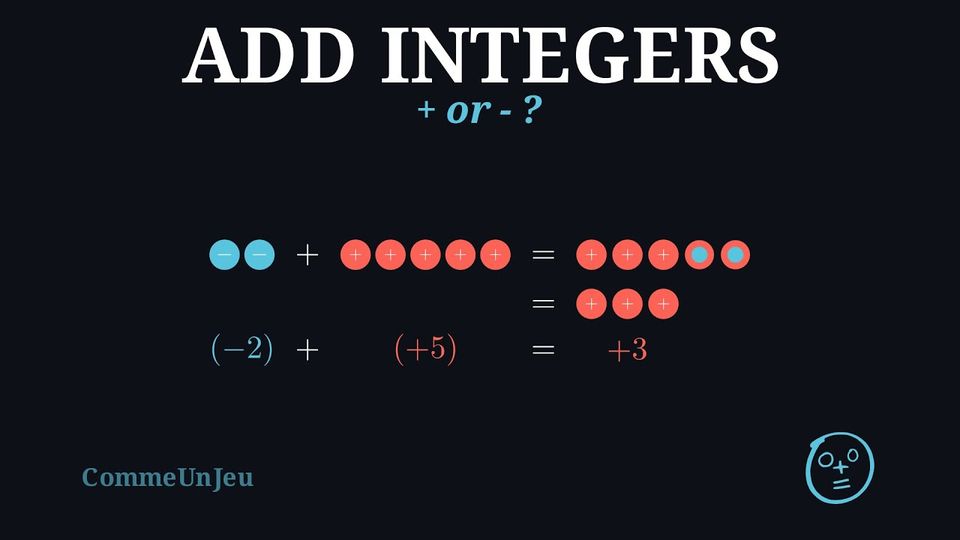
- To add a positive number and a negative number, subtract the smaller distance to zero from the larger one and use the sign of the number with the larger distance to zero. When the two distances to zero are equal, the sum is \(0\) (the two numbers are opposites).
\(\textcolor{colorprop}{(-2)}+\textcolor{colordef}{(+5)}=\textcolor{colordef}{+3} \quad \text{as }5-2=3\)

\(\textcolor{colordef}{(+2)}+\textcolor{colorprop}{(-6)}=\textcolor{colorprop}{-4} \quad \text{as }6-2=4\)

Example
Calculate \(\textcolor{colorprop}{(-10)}+\textcolor{colordef}{(+3)}\). - \(\textcolor{colorprop}{(-10)}+\textcolor{colordef}{(+3)}=\textcolor{colorprop}{-7} \quad \text{as }10-3=7.\)
-

Simplified writing. In a sum, the brackets and the leading \(+\) signs may be dropped; when a \(+\) operation sign meets a \(-\) number sign, only the \(-\) remains: $$(+3) + (-5) = 3 + (-5) = 3 - 5 \qquad\qquad -5 + 8 \text{ reads } (-5) + (+8).$$ Both writings mean the same computation; the simplified one is the everyday one. Two signs never stand side by side: \(3 + -5\) is not written; we write \(3 + (-5)\), where the brackets are essential, or simply \(3 - 5\).
Skills to practice
- Adding Integers
- Adding Integers without Explicit Signs
- Adding Several Integers
- Adding Integers in Real-World Problems
I.3
Subtracting Integers
-
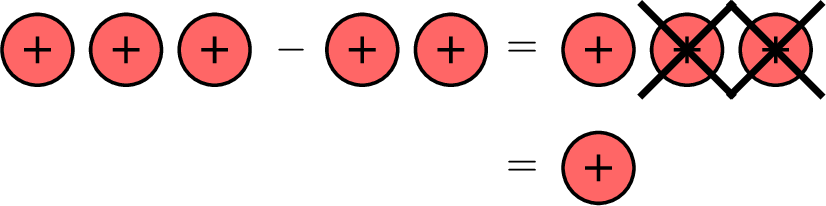
- For the subtraction, \(\textcolor{colordef}{(+3)}-\textcolor{colordef}{(+2)}\):
- For the addition, \(\textcolor{colordef}{(+3)}+\textcolor{colorprop}{(-2)}\):
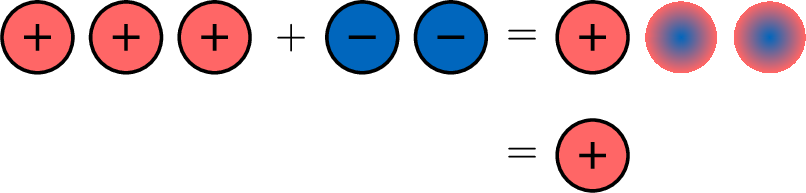
- Therefore, these two operations are equivalent:
\(\textcolor{colordef}{(+3)}-\textcolor{colordef}{(+2)}=\textcolor{colordef}{(+3)}+\textcolor{colorprop}{(-2)}\) 
- For the subtraction, \(\textcolor{colordef}{(+3)}-\textcolor{colordef}{(+2)}\):
-
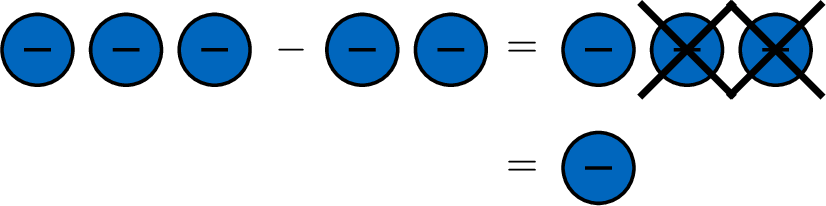
- For the subtraction, \(\textcolor{colorprop}{(-3)}-\textcolor{colorprop}{(-2)}\):
- For the addition, \(\textcolor{colorprop}{(-3)}+\textcolor{colordef}{(+2)}\):
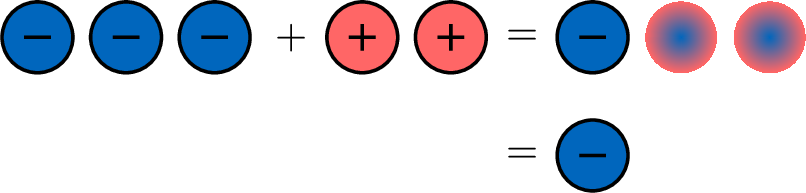
- Therefore, these two operations are equivalent:
\(\textcolor{colorprop}{(-3)}-\textcolor{colorprop}{(-2)}=\textcolor{colorprop}{(-3)}+\textcolor{colordef}{(+2)}\) 
- For the subtraction, \(\textcolor{colorprop}{(-3)}-\textcolor{colorprop}{(-2)}\):
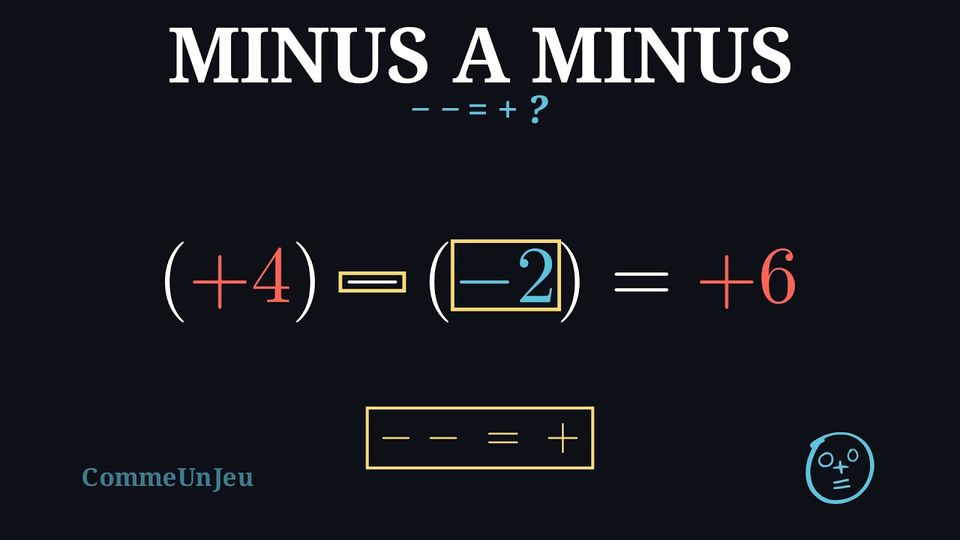
- In conclusion, these examples show a fundamental rule in arithmetic: subtracting any number is equivalent to adding the number with its opposite sign.
Definition — Subtraction
Subtracting a number means adding its opposite. Example
Calculate \(\textcolor{colordef}{(+4)}-\textcolor{colorprop}{(-2)}\).
$$\begin{aligned}[t] \textcolor{colordef}{(+4)}-\textcolor{colorprop}{(-2)}&=\textcolor{colordef}{(+4)}+\textcolor{colordef}{(+2)}&&\text{(add the opposite)}\\
&=\textcolor{colordef}{+6}&&\text{(same sign: add the distances to zero)} \end{aligned}$$ 
Adding can make smaller. With numbers without a sign, adding always made the result bigger. With signed numbers, it is the sign of the number added that decides, not the operation: $$\textcolor{colordef}{(+5)}+\textcolor{colorprop}{(-3)}=\textcolor{colordef}{+2} \quad\text{is smaller than}\quad \textcolor{colordef}{+5}.$$ The same reading holds the other way: subtracting a negative number makes the result bigger, since \(\textcolor{colordef}{(+5)}-\textcolor{colorprop}{(-3)}=\textcolor{colordef}{+8}\). So one never decides from the operation alone; one reads the sign of the number that is added or subtracted.
Example
This morning the temperature was \(-2\,^\circ\)C; this afternoon it is \(+3\,^\circ\)C. What is the change in temperature?
The change is the final value minus the initial value: $$(+3) - (-2) = (+3) + (+2) = +5.$$ The temperature rose by \(5\,^\circ\)C — a positive change is a rise, a negative one a drop.
Method — Distance Between Two Points
To find the distance between two points on a number line: - Spot the larger number and the smaller one — on the line, the larger is the one on the right.
- Subtract the smaller from the larger: the distance is that difference.
- Check the sign: a distance is never negative.
Example
On a number line, determine the distance between the points at \(\textcolor{colorprop}{-5}\) and \(\textcolor{colordef}{+2}\), then between the points at \(\textcolor{colorprop}{-6}\) and \(\textcolor{colorprop}{-2}\). - The larger is \(\textcolor{colordef}{+2}\), the smaller is \(\textcolor{colorprop}{-5}\): $$\textcolor{colordef}{(+2)}-\textcolor{colorprop}{(-5)}=\textcolor{colordef}{(+2)}+\textcolor{colordef}{(+5)}=\textcolor{colordef}{+7},$$ so the distance is \(7\).
- The larger is \(\textcolor{colorprop}{-2}\), the smaller is \(\textcolor{colorprop}{-6}\): $$\textcolor{colorprop}{(-2)}-\textcolor{colorprop}{(-6)}=\textcolor{colorprop}{(-2)}+\textcolor{colordef}{(+6)}=\textcolor{colordef}{+4},$$ so the distance is \(4\).

Skills to practice
- Converting a Subtraction into an Addition
- Subtracting Integers Step by Step
- Subtracting Integers
- Subtracting Integers without Explicit Signs
- Adding and Subtracting Several Integers
- Subtracting Integers in Real-World Problems
- Calculating the Distance Between Two Points by Subtraction
II
Multiplying and Dividing
II.1
Multiplying Integers
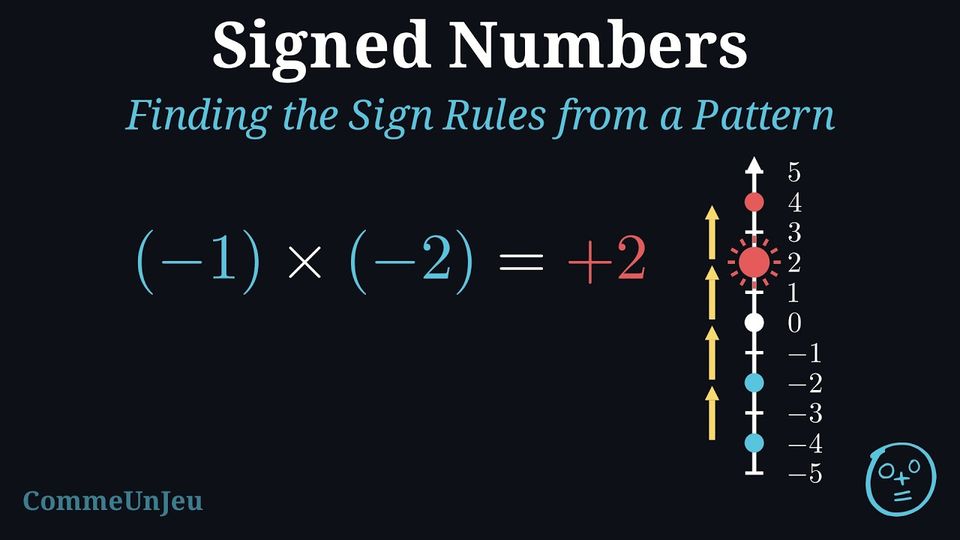
A product such as \(3\times \textcolor{colorprop}{(-2)}\) can be read as a repeated addition: \(\textcolor{colorprop}{(-2)}+\textcolor{colorprop}{(-2)}+\textcolor{colorprop}{(-2)}\). A product such as \(\textcolor{colorprop}{(-3)}\times \textcolor{colorprop}{(-2)}\) cannot: “\(-3\) times” is not a number of repetitions. A pattern suggests what such a product should be.
- \(\textcolor{colordef}{(+)}\times \textcolor{colorprop}{(-)}\): the first factor stays \(3\) and the second factor goes down by \(1\) at each line. $$ \begin{aligned}[t] 3\times \textcolor{colordef}{2} &= \textcolor{colordef}{6}\\ 3\times \textcolor{colordef}{1} &= \textcolor{colordef}{3} && (\text{down by } 3)\\ 3\times 0 &= 0 && (\text{down by } 3)\\ 3\times \textcolor{colorprop}{(-1)} &= \textcolor{colorprop}{-3} && (\text{down by } 3)\\ 3\times \textcolor{colorprop}{(-2)} &= \textcolor{colorprop}{-6} && (\text{down by } 3) \end{aligned} $$ Each time the second factor goes down by \(1\), the product goes down by \(3\). Continuing the pattern below \(0\) gives \(3\times \textcolor{colorprop}{(-1)}=\textcolor{colorprop}{-3}\) and \(3\times \textcolor{colorprop}{(-2)}=\textcolor{colorprop}{-6}\), as the repeated addition \(\textcolor{colorprop}{(-2)}+\textcolor{colorprop}{(-2)}+\textcolor{colorprop}{(-2)}=\textcolor{colorprop}{-6}\) confirms. So, a positive times a negative gives a negative. Keeping the rule known for whole numbers, that the order of the factors does not change a product, a negative times a positive also gives a negative: \(\textcolor{colorprop}{(-2)}\times 3=\textcolor{colorprop}{-6}\).
- \(\textcolor{colorprop}{(-)}\times \textcolor{colorprop}{(-)}\): now the second factor stays \(\textcolor{colorprop}{(-2)}\) and the first factor goes down by \(1\) at each line. $$ \begin{aligned}[t] \textcolor{colordef}{2}\times \textcolor{colorprop}{(-2)} &= \textcolor{colorprop}{-4}\\ \textcolor{colordef}{1}\times \textcolor{colorprop}{(-2)} &= \textcolor{colorprop}{-2} && (\text{up by } 2)\\ 0\times \textcolor{colorprop}{(-2)} &= 0 && (\text{up by } 2)\\ \textcolor{colorprop}{(-1)}\times \textcolor{colorprop}{(-2)} &= \textcolor{colordef}{+2} && (\text{up by } 2)\\ \textcolor{colorprop}{(-2)}\times \textcolor{colorprop}{(-2)} &= \textcolor{colordef}{+4} && (\text{up by } 2) \end{aligned} $$ Each time the first factor goes down by \(1\), the product goes up by \(2\). Continuing the pattern below \(0\) gives \(\textcolor{colorprop}{(-1)}\times \textcolor{colorprop}{(-2)}=\textcolor{colordef}{+2}\) and \(\textcolor{colorprop}{(-2)}\times \textcolor{colorprop}{(-2)}=\textcolor{colordef}{+4}\). So, a negative times a negative gives a positive.
Definition — Multiplication
The product of two signed integers is obtained by: - multiplying their distances to zero;
- then deciding the sign using the following rules:
- \(\textcolor{colordef}{(+)}\times \textcolor{colordef}{(+)} = \textcolor{colordef}{(+)}\): a positive times a positive gives a positive.
- \(\textcolor{colordef}{(+)}\times \textcolor{colorprop}{(-)} = \textcolor{colorprop}{(-)}\): a positive times a negative gives a negative.
- \(\textcolor{colorprop}{(-)} \times \textcolor{colordef}{(+)} = \textcolor{colorprop}{(-)}\): a negative times a positive gives a negative.
- \(\textcolor{colorprop}{(-)} \times \textcolor{colorprop}{(-)} = \textcolor{colordef}{(+)}\): a negative times a negative gives a positive.
- If one factor is \(0\), the product is \(0\).
Example
Calculate \(\textcolor{colordef}{(+2)}\times \textcolor{colorprop}{(-5)}\).
$$\textcolor{colordef}{(+2)}\times \textcolor{colorprop}{(-5)}= \textcolor{colorprop}{-10}\quad (2\times 5 = 10 \text{ and } \textcolor{colordef}{(+)}\times \textcolor{colorprop}{(-)} = \textcolor{colorprop}{(-)}) $$
Example
Calculate \(\textcolor{colorprop}{(-7)}\times \textcolor{colorprop}{(-4)}\).
$$\textcolor{colorprop}{(-7)}\times \textcolor{colorprop}{(-4)}= \textcolor{colordef}{+28}\quad (7\times 4 = 28 \text{ and } \textcolor{colorprop}{(-)}\times \textcolor{colorprop}{(-)} = \textcolor{colordef}{(+)}) $$
Skills to practice
- Writing a Repeated Sum as a Product
- Multiplying Small Integers
- Multiplying Integers without Explicit Signs
- Multiplying Integers in Real-World Problems
II.2
Dividing Integers
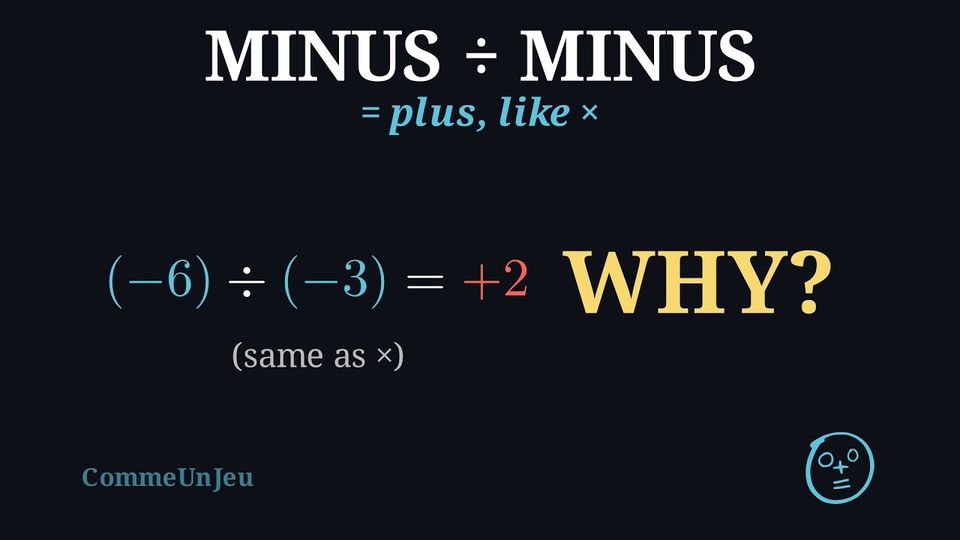
Multiplication and division are inverse operations: $$\textcolor{black}{3}\times \textcolor{black}{2}=\textcolor{black}{6}, \text{ so }\textcolor{black}{6}\div \textcolor{black}{3}=\textcolor{black}{2}.$$ (Here we only divide by non-zero numbers.)
We now extend this to division with negative numbers:
We now extend this to division with negative numbers:
- \(\textcolor{colordef}{(+)} \div \textcolor{colordef}{(+)}\): $$ \textcolor{colordef}{(+3)} \times \textcolor{colordef}{(+2)}=\textcolor{colordef}{+6}, \text{ so }\textcolor{colordef}{(+6)} \div \textcolor{colordef}{(+3)}=\textcolor{colordef}{(+2)}. $$ So, a positive divided by a positive gives a positive.
- \(\textcolor{colordef}{(+)} \div \textcolor{colorprop}{(-)}\): $$ \textcolor{colorprop}{(-3)} \times \textcolor{colorprop}{(-2)}=\textcolor{colordef}{+6}, \text{ so }\textcolor{colordef}{(+6)} \div \textcolor{colorprop}{(-3)}=\textcolor{colorprop}{(-2)}. $$ So, a positive divided by a negative gives a negative.
- \(\textcolor{colorprop}{(-)} \div \textcolor{colordef}{(+)}\): $$ \textcolor{colordef}{(+3)} \times \textcolor{colorprop}{(-2)}=\textcolor{colorprop}{-6}, \text{ so }\textcolor{colorprop}{(-6)} \div \textcolor{colordef}{(+3)}=\textcolor{colorprop}{(-2)}. $$ So, a negative divided by a positive gives a negative.
- \(\textcolor{colorprop}{(-)} \div \textcolor{colorprop}{(-)}\): $$ \textcolor{colorprop}{(-3)} \times \textcolor{colordef}{(+2)}=\textcolor{colorprop}{-6}, \text{ so }\textcolor{colorprop}{(-6)} \div \textcolor{colorprop}{(-3)}=\textcolor{colordef}{(+2)}. $$ So, a negative divided by a negative gives a positive.
Definition — Division
The quotient of two signed integers (with a non-zero divisor) is obtained by: - dividing their distances to zero;
- then deciding the sign using the following rules:
- \(\textcolor{colordef}{(+)}\div \textcolor{colordef}{(+)} = \textcolor{colordef}{(+)}\): a positive divided by a positive gives a positive.
- \(\textcolor{colordef}{(+)}\div \textcolor{colorprop}{(-)} = \textcolor{colorprop}{(-)}\): a positive divided by a negative gives a negative.
- \(\textcolor{colorprop}{(-)} \div \textcolor{colordef}{(+)} = \textcolor{colorprop}{(-)}\): a negative divided by a positive gives a negative.
- \(\textcolor{colorprop}{(-)} \div \textcolor{colorprop}{(-)} = \textcolor{colordef}{(+)}\): a negative divided by a negative gives a positive.
- If the dividend is \(0\), the quotient is \(0\) (the divisor is never \(0\)).
Example
Calculate \(\textcolor{colordef}{(+10)}\div \textcolor{colorprop}{(-5)}\).
$$\textcolor{colordef}{(+10)}\div \textcolor{colorprop}{(-5)}= \textcolor{colorprop}{-2} \quad (10\div 5 = 2 \text{ and } \textcolor{colordef}{(+)}\div \textcolor{colorprop}{(-)} = \textcolor{colorprop}{(-)})$$
Example
Calculate \(\textcolor{colorprop}{(-35)}\div \textcolor{colorprop}{(-5)}\).
$$\textcolor{colorprop}{(-35)}\div \textcolor{colorprop}{(-5)}= \textcolor{colordef}{+7}\quad (35\div 5 = 7 \text{ and } \textcolor{colorprop}{(-)}\div \textcolor{colorprop}{(-)} = \textcolor{colordef}{(+)}) $$
Skills to practice
- Completing Multiplications with a Missing Factor
- Dividing Small Integers
- Dividing Integers without Explicit Signs
III
Going further
Skills to practice
- Investigating Sign Patterns
- Solving Problems with Signed Numbers
- Quiz
Jump to section