International Baccalaureate · PYP 5
Length and Perimeter
I
Decimals and Units of Measure
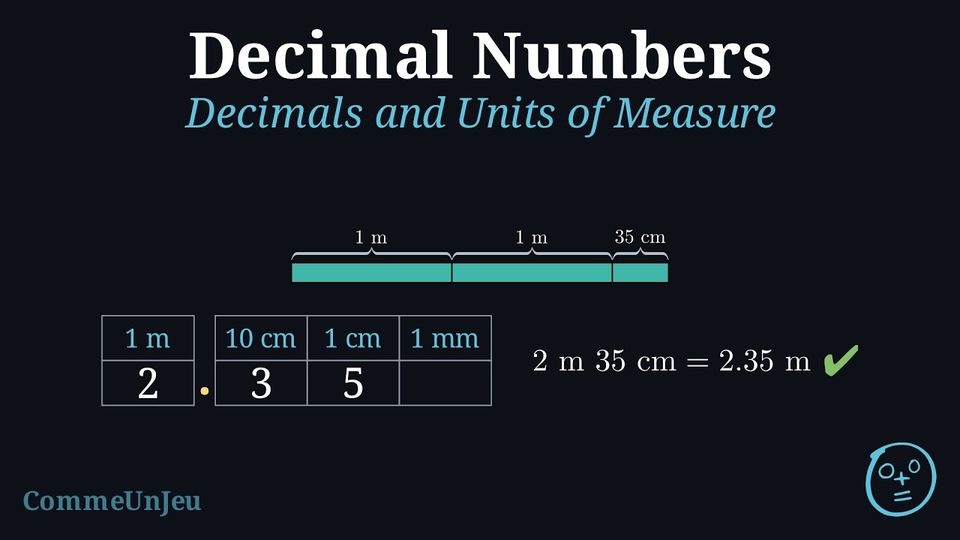
Method — Converting a Decimal Length with Tenths and Hundredths
A length such as \(4.6~\mathrm{m}\) is a whole number of metres and a part of a metre: \(4\) metres and \(6\) tenths of a metre. Since \(1~\mathrm{m}=100~\mathrm{cm}\): - a tenth of a metre is \(10~\mathrm{cm}\): the \(100~\mathrm{cm}\) of one metre are cut into \(10\) equal parts;
- a hundredth of a metre is \(1~\mathrm{cm}\): the \(100~\mathrm{cm}\) are cut into \(100\) equal parts.
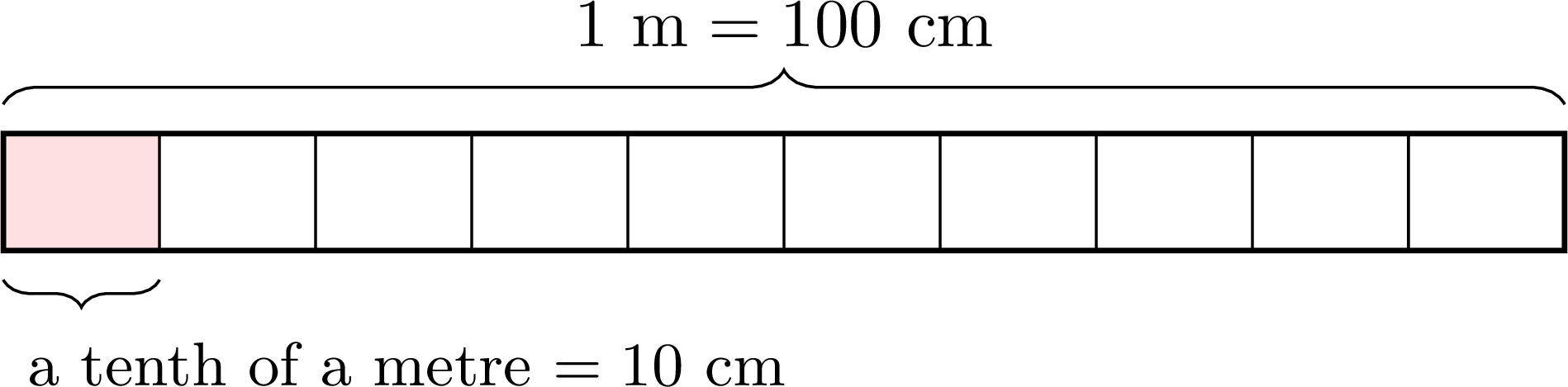
- Towards the smaller unit: split the length into its whole units and its tenths (or hundredths), then change each part. $$\begin{aligned}[t] 4.6~\mathrm{m} &= 4~\mathrm{m} + 6 \text{ tenths of a metre} &&\text{(4 units and 6 tenths)}\\ &= 400~\mathrm{cm} + 6 \times 10~\mathrm{cm} &&\text{(1 m = 100 cm; a tenth = 10 cm)}\\ &= 400~\mathrm{cm} + 60~\mathrm{cm} &&\text{(multiplication)}\\ &= 460~\mathrm{cm} \end{aligned}$$ $$\begin{aligned}[t] 3.75~\mathrm{m} &= 3~\mathrm{m} + 75 \text{ hundredths of a metre} &&\text{(3 units and 75 hundredths)}\\ &= 300~\mathrm{cm} + 75 \times 1~\mathrm{cm} &&\text{(a hundredth = 1 cm)}\\ &= 375~\mathrm{cm} \end{aligned}$$
- Towards the bigger unit: group the whole units first, then write what is left as tenths (or hundredths). $$\begin{aligned}[t] 280~\mathrm{cm} &= 200~\mathrm{cm} + 80~\mathrm{cm} &&\text{(the hundreds first)}\\ &= 2~\mathrm{m} + 8 \text{ tenths of a metre} &&\text{(100 cm = 1 m; 80 cm is 8 tenths)}\\ &= 2.8~\mathrm{m} \end{aligned}$$ $$\begin{aligned}[t] 275~\mathrm{cm} &= 200~\mathrm{cm} + 75~\mathrm{cm} &&\text{(the hundreds first)}\\ &= 2~\mathrm{m} + 75 \text{ hundredths of a metre} &&\text{(100 cm = 1 m; 75 cm is 75 hundredths)}\\ &= 2.75~\mathrm{m} \end{aligned}$$ Here the part left is always a whole number of tenths or hundredths of the bigger unit.
- The same with the other units: \(1~\mathrm{km}=1\,000~\mathrm{m}\), so a tenth of a kilometre is \(100~\mathrm{m}\) and a hundredth is \(10~\mathrm{m}\): \(3.4~\mathrm{km} = 3\,000~\mathrm{m} + 400~\mathrm{m} = 3\,400~\mathrm{m}\). And \(1~\mathrm{cm}=10~\mathrm{mm}\), so a tenth of a centimetre is \(1~\mathrm{mm}\): \(6.8~\mathrm{cm} = 60~\mathrm{mm} + 8~\mathrm{mm} = 68~\mathrm{mm}\).
- Check: \(4.6~\mathrm{m}\) lies between \(4~\mathrm{m}\) and \(5~\mathrm{m}\), so the answer lies between \(400~\mathrm{cm}\) and \(500~\mathrm{cm}\).
Example
A ribbon measures \(2\) metres and \(35\) centimetres. Write this length as a decimal number of metres.
$$\begin{aligned}[t] 1 \text{ cm} &= 0.01 \text{ m} && \text{(a centimetre is a hundredth of a metre)} \\
35 \text{ cm} &= 0.35 \text{ m} && \text{(35 hundredths)} \\
2 \text{ m } 35 \text{ cm} &= 2.35 \text{ m} && \end{aligned}$$
Skills to practice
- Converting Units of Measurement
II
Finding Perimeters with Decimal Lengths
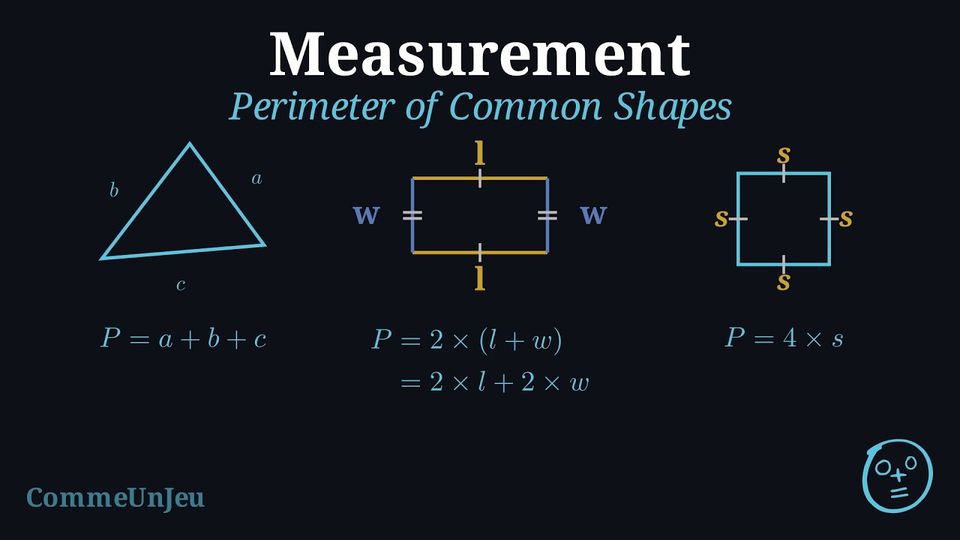
Proposition — Perimeter Formulas
| Shape | Diagram | Perimeter formula |
| Triangle |  | \(P = a + b + c\) |
| Rectangle |  | \(\begin{aligned}[t] P &= l + w + l + w\\ &= 2 \times l + 2 \times w \\ &= 2 \times (l + w) \end{aligned}\) |
| Square |  | \(P = s + s + s + s = 4 \times s\) |
Example
Find the perimeter of the rectangle: 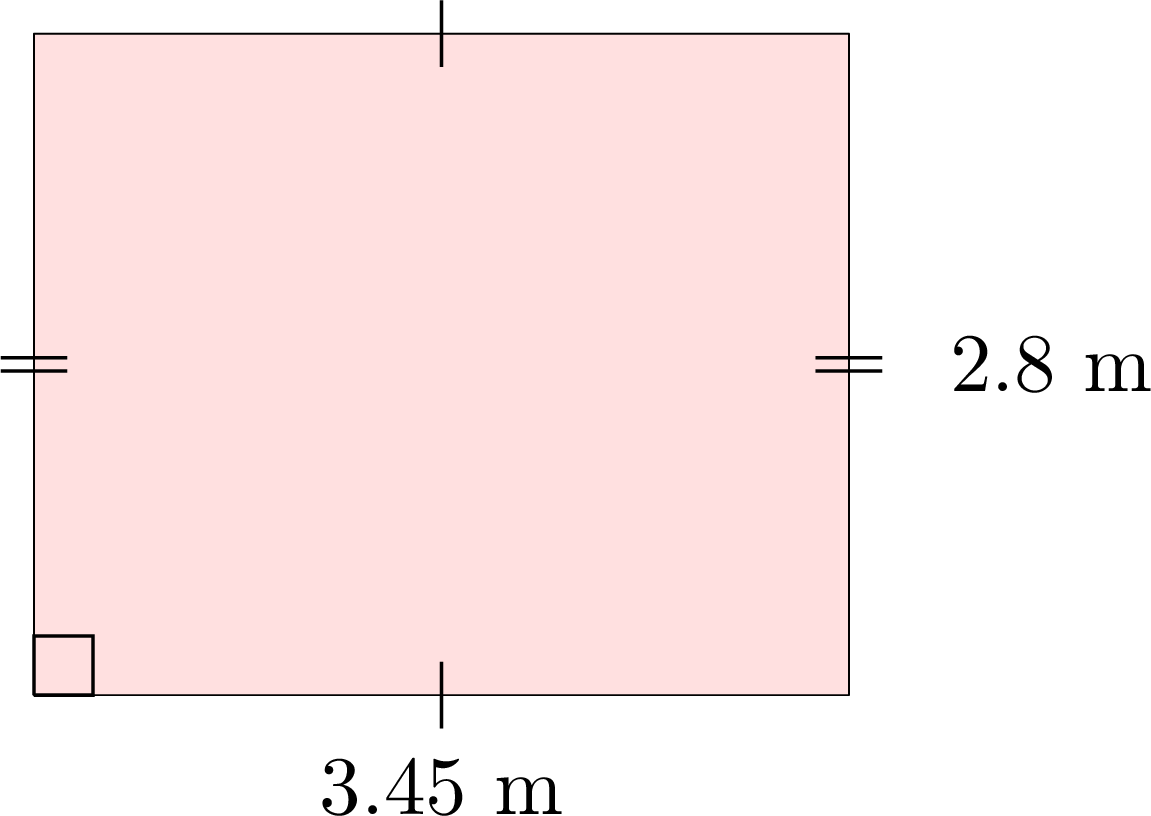
The rectangle has a length \(l = 3.45\) m and a width \(w = 2.8\) m. We add the length and the width, lining up the decimal points (\(2.8 = 2.80\)), then we multiply by \(2\): $$\begin{aligned}[t] P &= 2 \times (l + w) \\
&= 2 \times (3.45 + 2.80) \\
&= 2 \times 6.25 \\
&= 12.5 \,\mathrm{m} \end{aligned}$$ The perimeter of the rectangle is \(12.5\) m. The other formula gives the same result: \(2 \times 3.45 + 2 \times 2.8 = 6.9 + 5.6 = 12.5\) m.
Skills to practice
- Finding Perimeters with Decimal Lengths
III
Perimeter of Composite Figures
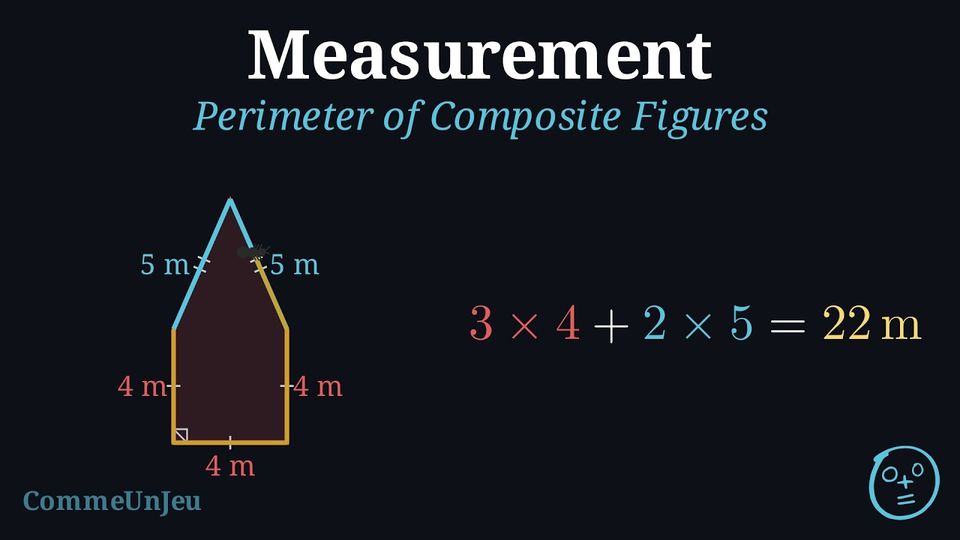
Definition — Composite Figure
A composite figure is a shape made by joining two or more simple shapes (like rectangles, squares, and triangles). Method — Finding the Perimeter of a Composite Figure
To find the perimeter of a composite figure: - Identify all the outer sides of the figure. Be careful not to include any lines inside the shape.
- Find the lengths of any unknown sides. The other sides often give them.
- Add the lengths of all the outer sides together (and of the arcs of the outline, if there are any).
Example
Find the perimeter of this composite figure, which is made of a square and a triangle. 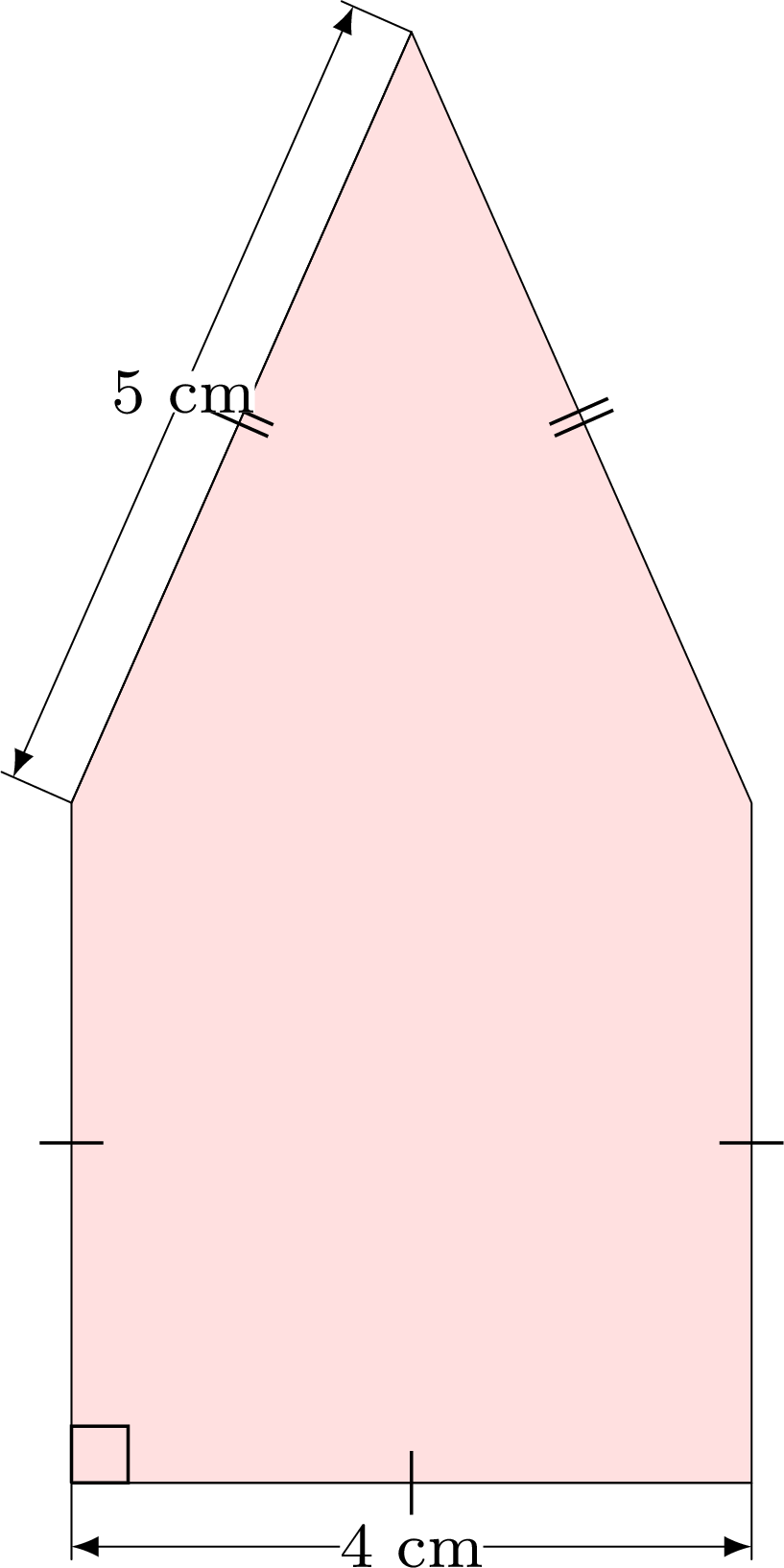
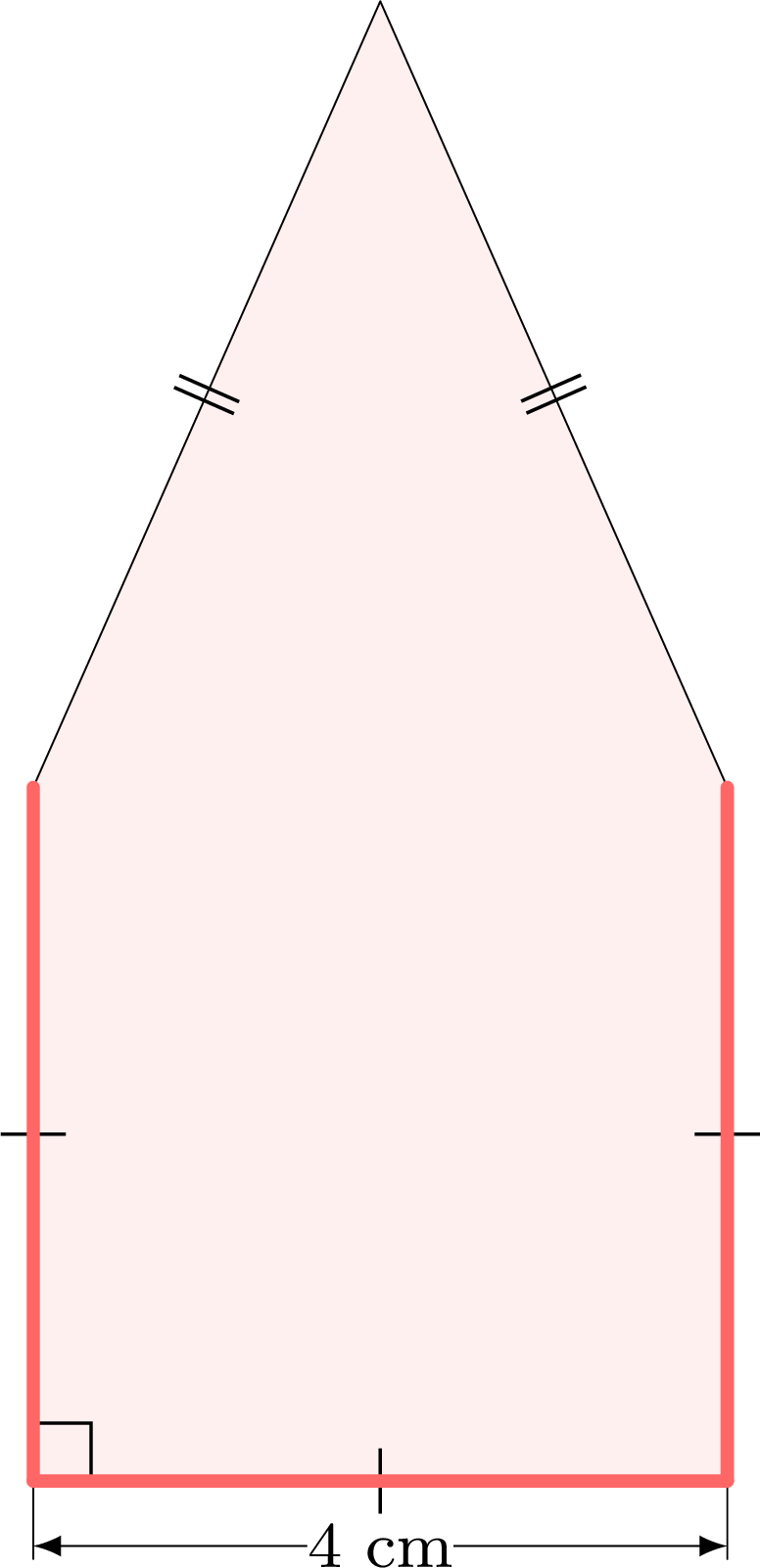 \(+\)
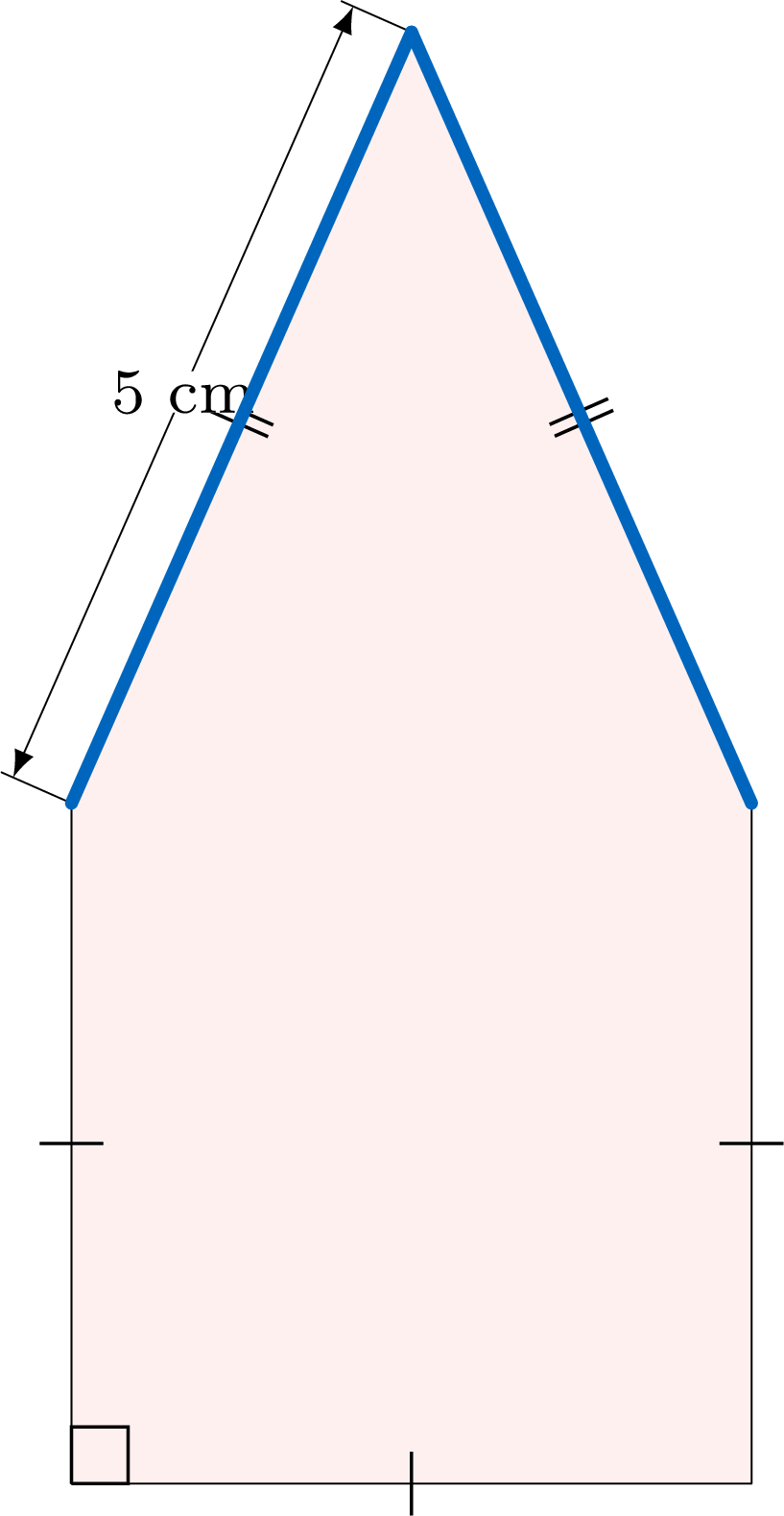
Skills to practice
- Finding the Perimeter of Composite Figures
IV
Going further
Skills to practice
- Problems: Decimals in Measures
- Quiz
Jump to section