International Baccalaureate · MYP 1
Time
I
Using the Calendar
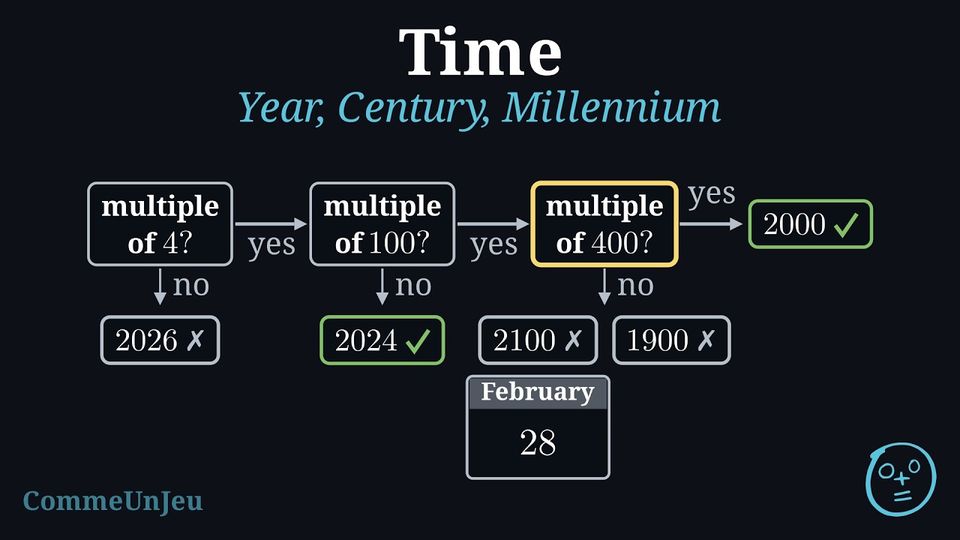
Definition — Year, Century, Millennium
- Year: \(365\) days, or \(366\) days in a leap year. A year is a leap year when its number is a multiple of \(4\), except the multiples of \(100\) that are not multiples of \(400\): \(2024\) and \(2000\) are leap years, \(1900\) and \(2100\) are not.
- Century: \(100\) years.
- Millennium: \(1\,000\) years, that is \(10\) centuries.
Example
- How many hours are there in a leap year?
- How many centuries are there in \(2\,700\) years? In \(4\,000\) years, how many centuries and how many millennia?
- A leap year has \(366\) days of \(24\) hours: \(366 \times 24 = 8\,784\) h.
- \(2\,700 = 27 \times 100\): \(27\) centuries. \(4\,000 = 40 \times 100 = 4 \times 1\,000\): \(40\) centuries, that is \(4\) millennia.
Definition — Days in Each Month
Not all months have the same number of days. Some are longer than others. - 31 days: January, March, May, July, August, October, December.
- 30 days: April, June, September, November.
- 28 or 29 days: February is a special case. It is the shortest month with 28 days. However, in general every four years, we have a leap year, and February gets an extra day, giving it 29 days.
Method — Counting the Days Between Two Dates
To find how many days pass from one date to a later date: - Same month of the same year: subtract the two day numbers. From 5 October to 26 October, \(26 - 5 = 21\) days pass.
- Days left in the first month: the number of days of that month minus the day number of the start date.
- Whole months in between: add their numbers of days, \(31\) or \(30\), and \(28\) for February — \(29\) in a leap year.
- Days in the last month: add the day number of the end date.
Example
- A summer camp runs from 4 July to 1 September. How many days pass from the first date to the second?
- A seed is sown on 20 January 2028 and the plant flowers on 6 March 2028. How many days does it take to flower?
- July has \(31\) days: \(31 - 4 = 27\) days are left after 4 July. Then comes the whole of August, then \(1\) day in September. $$\begin{aligned}[t] \text{number of days} &= (31 - 4) + 31 + 1 &&\text{(rest of July, August, September)}\\ &= 27 + 31 + 1\\ &= 59. \end{aligned}$$ From 4 July to 1 September, \(59\) days pass.
- \(2028\) is a multiple of \(4\) and not a multiple of \(100\): it is a leap year, and February 2028 has \(29\) days. $$\begin{aligned}[t] \text{number of days} &= (31 - 20) + 29 + 6 &&\text{(rest of January, February, March)}\\ &= 11 + 29 + 6\\ &= 46. \end{aligned}$$ The plant takes \(46\) days to flower.
Skills to practice
- Recognising Leap Years
- Counting Days in the Calendar
II
Converting into Hours, Minutes and Seconds
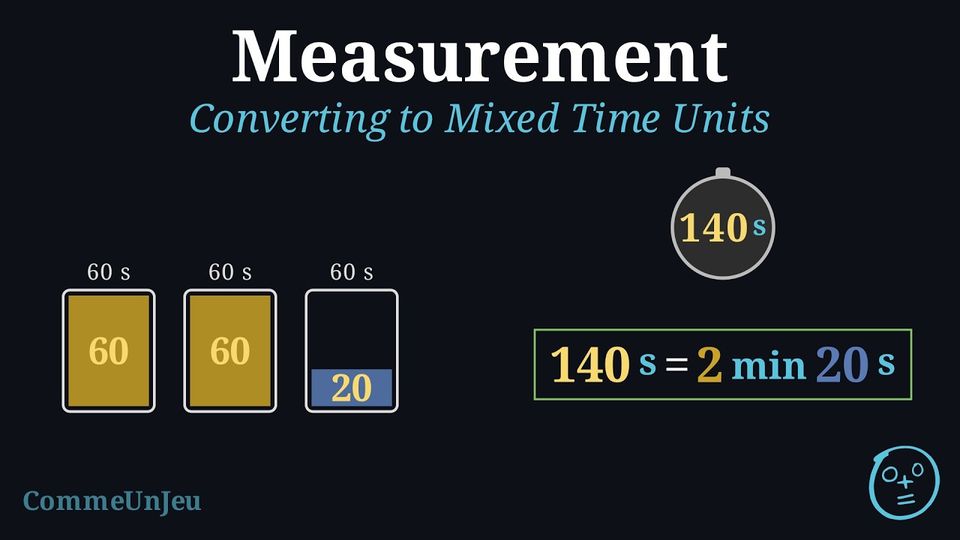
Method — Converting Seconds into Minutes and Seconds
To write a time given in seconds as minutes and seconds, we find how many full groups of \(60\) seconds (minutes) it contains: it is a division by \(60\), done by counting in sixties. - Find how many 60s fit. Since there are \(60\) seconds in \(1\) minute, count in sixties, \(60\), \(120\), \(180\), \(240\), and stop at the last one that is not more than the number of seconds.
- The quotient is the minutes. The number of sixties (the quotient) is the number of full minutes.
- The remainder is the seconds. Subtract that last number from the number of seconds: what is left (the remainder, less than \(60\)) is the number of seconds left over.
Example
A video lasts \(8\,000\) seconds. Express this duration in hours, minutes and seconds.
The unit is changed twice: seconds to minutes, then minutes to hours. Each time, the quotient is the bigger unit and the remainder stays in the smaller one.
- First division, by \(60\) — \(8\,000 = 60 \times 133 + 20\): the video lasts \(133\) min \(20\) s.
- Second division, by \(60\) — the \(133\) minutes are converted in turn: \(133 = 60 \times 2 + 13\), that is \(2\) h \(13\) min.
- The \(20\) seconds of the first remainder are kept: $$8\,000\ \text{s} = 2\ \text{h}\ 13\ \text{min}\ 20\ \text{s}.$$
Skills to practice
- Converting by Successive Divisions
III
Converting Durations in Decimal Hours
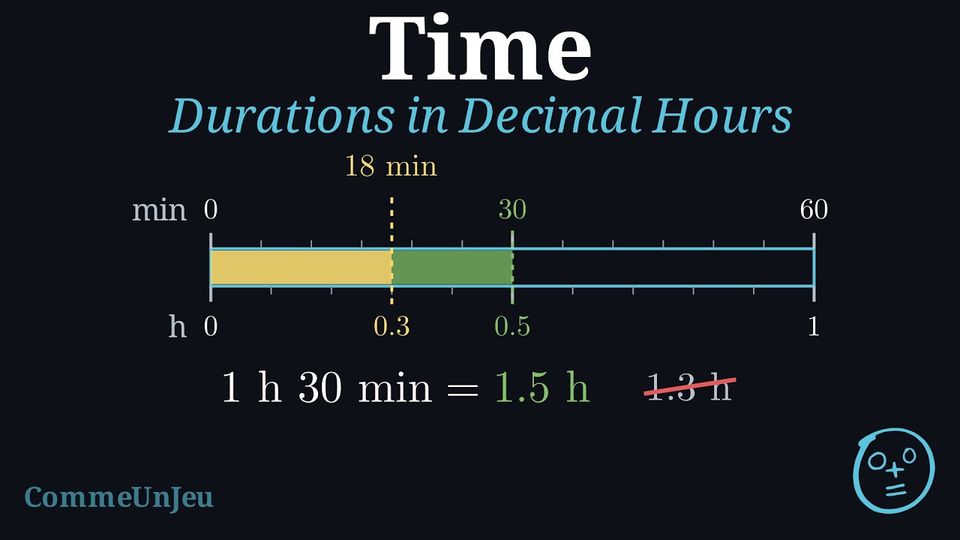
A route planner announces \(1.5\) h for a journey. Zoé reads: “one hour and fifty minutes”. Hugo objects: “no, one hour and a half, so one hour and thirty minutes”. Who is correct?
Hugo is correct. In \(1.5\), the digit \(5\) after the point means \(5\) tenths of an hour, not \(50\) minutes: half an hour is \(30\) minutes. Hours, minutes and seconds are not counted in tens but in sixties: \(1\) h \(30\) min means one hour and \(30\) sixtieths of an hour. To go from one way of writing to the other, the fraction of an hour has to be converted.
Hugo is correct. In \(1.5\), the digit \(5\) after the point means \(5\) tenths of an hour, not \(50\) minutes: half an hour is \(30\) minutes. Hours, minutes and seconds are not counted in tens but in sixties: \(1\) h \(30\) min means one hour and \(30\) sixtieths of an hour. To go from one way of writing to the other, the fraction of an hour has to be converted.
Definition — The Sexagesimal System
Durations written in hours, minutes and seconds use the sexagesimal system: each unit is worth \(60\) of the next smaller one (\(1\) h \(= 60\) min, \(1\) min \(= 60\) s). It comes from the Babylonians, who counted in sixties four thousand years ago. Numbers such as \(1.5\) or \(2.75\) are written in the decimal system: each unit is worth \(10\) of the next smaller one. The digits after the point are tenths and hundredths of an hour, not minutes: \(2.75\) h is \(2\) hours and \(75\) hundredths of an hour.
Method — From a Decimal Duration to Hours, Minutes and Seconds
- Keep the whole part: it is the number of hours (or of minutes, if the duration is in minutes).
- Multiply the decimal part by \(60\): it gives the minutes (or the seconds).
- For a duration in hours, if the minutes obtained still have a decimal part, multiply that part by \(60\) again: it gives the seconds.
Careful: \(2.3\) h \(= 2\) h \(18\) min, and not \(2\) h \(30\) min.
Example
Write \(5.7\) h in hours and minutes, then \(6.25\) min in minutes and seconds. - Whole part \(5\) h; decimal part \(0.7 \times 60 = 42\) min: \(5.7\) h \(= 5\) h \(42\) min.
- Whole part \(6\) min; \(0.25 \times 60 = 15\) s: \(6.25\) min \(= 6\) min \(15\) s.
Method — From Minutes to a Decimal Duration
The minutes are a fraction of an hour: divide them by \(60\). A proportionality table helps: \(60\) min \(\leftrightarrow 1\) h, so \(6\) min \(\leftrightarrow 0.1\) h and \(3\) min \(\leftrightarrow 0.05\) h. | minutes | \(60\) | \(30\) | \(15\) | \(45\) | \(6\) | \(18\) |
| hours | \(1\) | \(0.5\) | \(0.25\) | \(0.75\) | \(0.1\) | \(0.3\) |
Some numbers of minutes do not give a short decimal: \(20\) min \(= \dfrac{1}{3}\) h. In that case, the fraction is kept.
Example
Write \(2\) h \(54\) min in decimal form.
\(54\) min \(= \dfrac{54}{60}\) h \(= 0.9\) h, so \(2\) h \(54\) min \(= 2.9\) h.
Method — Fractions of an Hour and of a Day
To find a fraction of an hour, divide \(60\) minutes: \(\dfrac{1}{3}\) h \(= 60 \div 3 = 20\) min, \(\dfrac{2}{3}\) h \(= 40\) min, \(\dfrac{1}{5}\) h \(= 12\) min, \(\dfrac{7}{12}\) h \(= 7 \times 5 = 35\) min. To find a fraction of a day, divide \(24\) hours: \(\dfrac{1}{8}\) of a day \(= 3\) h, \(\dfrac{2}{3}\) of a day \(= 16\) h.
A fraction of a year is counted in months, the year being cut into \(12\) months of equal rank (not of equal length): \(\dfrac{1}{4}\) of a year \(= 3\) months (a quarter), \(\dfrac{1}{2}\) year \(= 6\) months (a half-year), \(\dfrac{1}{12}\) year \(= 1\) month.
Example
How many minutes are there in \(\dfrac{5}{6}\) of an hour?
\(\dfrac{1}{6}\) h \(= 60 \div 6 = 10\) min, so \(\dfrac{5}{6}\) h \(= 5 \times 10 = 50\) min.
Skills to practice
- Recognising Equal Durations
- Converting a Decimal Duration into Hours, Minutes and Seconds
- Converting Minutes and Fractions of an Hour or a Day
IV
Going further
Skills to practice
- Reasoning and Problem-Solving
- Solving Problems with Rates and Calendars
- Investigating Calendar Patterns
- Quiz
Jump to section