International Baccalaureate · MYP 1
Length and Perimeter
I
Length
I.1
Converting Length Units
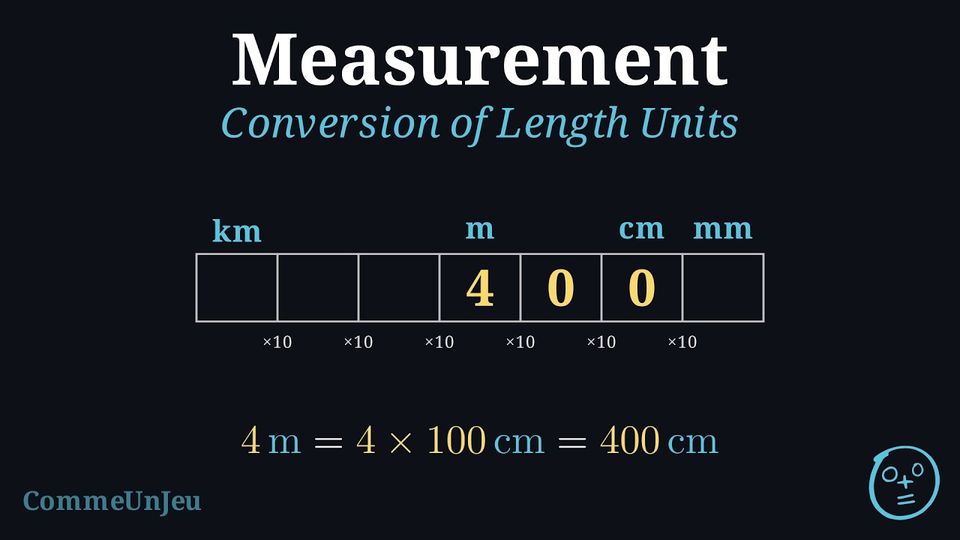
Method — Converting a Decimal Length with Tenths and Hundredths
A length such as \(4.6~\mathrm{m}\) is a whole number of metres and a part of a metre: \(4\) metres and \(6\) tenths of a metre. Since \(1~\mathrm{m}=100~\mathrm{cm}\): - a tenth of a metre is \(10~\mathrm{cm}\): the \(100~\mathrm{cm}\) of one metre are cut into \(10\) equal parts;
- a hundredth of a metre is \(1~\mathrm{cm}\): the \(100~\mathrm{cm}\) are cut into \(100\) equal parts.
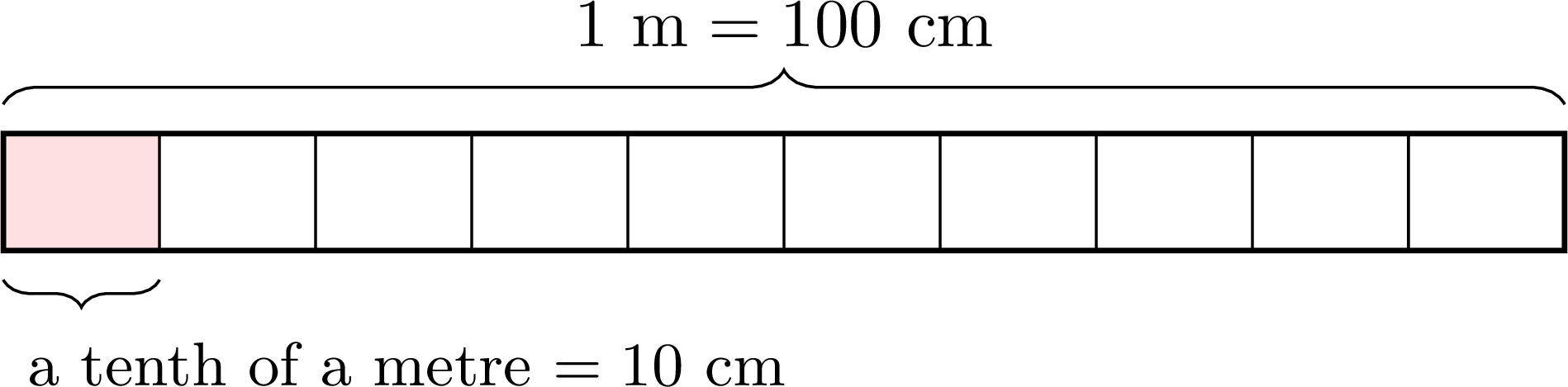
- Towards the smaller unit: split the length into its whole units and its tenths (or hundredths), then change each part. $$\begin{aligned}[t] 4.6~\mathrm{m} &= 4~\mathrm{m} + 6 \text{ tenths of a metre} &&\text{(4 units and 6 tenths)}\\ &= 400~\mathrm{cm} + 6 \times 10~\mathrm{cm} &&\text{(1 m = 100 cm; a tenth = 10 cm)}\\ &= 400~\mathrm{cm} + 60~\mathrm{cm} &&\text{(multiplication)}\\ &= 460~\mathrm{cm} \end{aligned}$$ $$\begin{aligned}[t] 3.75~\mathrm{m} &= 3~\mathrm{m} + 75 \text{ hundredths of a metre} &&\text{(3 units and 75 hundredths)}\\ &= 300~\mathrm{cm} + 75 \times 1~\mathrm{cm} &&\text{(a hundredth = 1 cm)}\\ &= 375~\mathrm{cm} \end{aligned}$$
- Towards the bigger unit: group the whole units first, then write what is left as tenths (or hundredths). $$\begin{aligned}[t] 280~\mathrm{cm} &= 200~\mathrm{cm} + 80~\mathrm{cm} &&\text{(the hundreds first)}\\ &= 2~\mathrm{m} + 8 \text{ tenths of a metre} &&\text{(100 cm = 1 m; 80 cm is 8 tenths)}\\ &= 2.8~\mathrm{m} \end{aligned}$$ $$\begin{aligned}[t] 275~\mathrm{cm} &= 200~\mathrm{cm} + 75~\mathrm{cm} &&\text{(the hundreds first)}\\ &= 2~\mathrm{m} + 75 \text{ hundredths of a metre} &&\text{(100 cm = 1 m; 75 cm is 75 hundredths)}\\ &= 2.75~\mathrm{m} \end{aligned}$$ Here the part left is always a whole number of tenths or hundredths of the bigger unit.
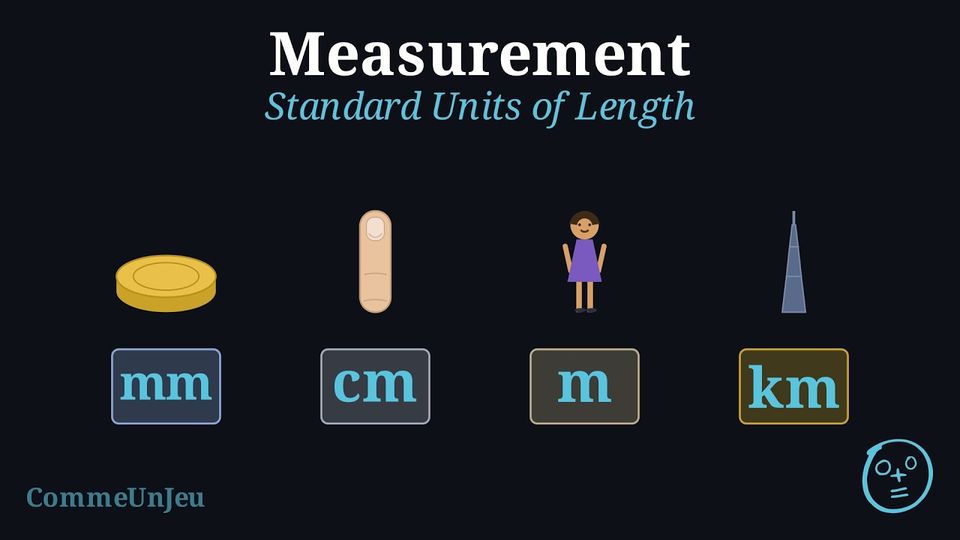
- The same with the other units: \(1~\mathrm{km}=1\,000~\mathrm{m}\), so a tenth of a kilometre is \(100~\mathrm{m}\) and a hundredth is \(10~\mathrm{m}\): \(3.4~\mathrm{km} = 3\,000~\mathrm{m} + 400~\mathrm{m} = 3\,400~\mathrm{m}\). And \(1~\mathrm{cm}=10~\mathrm{mm}\), so a tenth of a centimetre is \(1~\mathrm{mm}\): \(6.8~\mathrm{cm} = 60~\mathrm{mm} + 8~\mathrm{mm} = 68~\mathrm{mm}\).
- Check: \(4.6~\mathrm{m}\) lies between \(4~\mathrm{m}\) and \(5~\mathrm{m}\), so the answer lies between \(400~\mathrm{cm}\) and \(500~\mathrm{cm}\).
Skills to practice
- Converting Units of Length with Decimal Numbers
- Converting to and from Metres
I.2
Choosing Units and Calculating with Lengths
Skills to practice
- Choosing the Unit
- Comparing and Calculating with Lengths in Different Units
- Checking and Explaining Conversions
II
Perimeter
II.1
Solving Perimeter Problems
Proposition — Perimeter Formulas
| Shape | Diagram | Perimeter formula |
| Triangle |  | \(P = a + b + c\) |
| Rectangle |  | \(\begin{aligned}[t] P &= l + w + l + w\\ &= 2 \times l + 2 \times w \\ &= 2 \times (l + w) \end{aligned}\) |
| Square |  | \(P = s + s + s + s = 4 \times s\) |
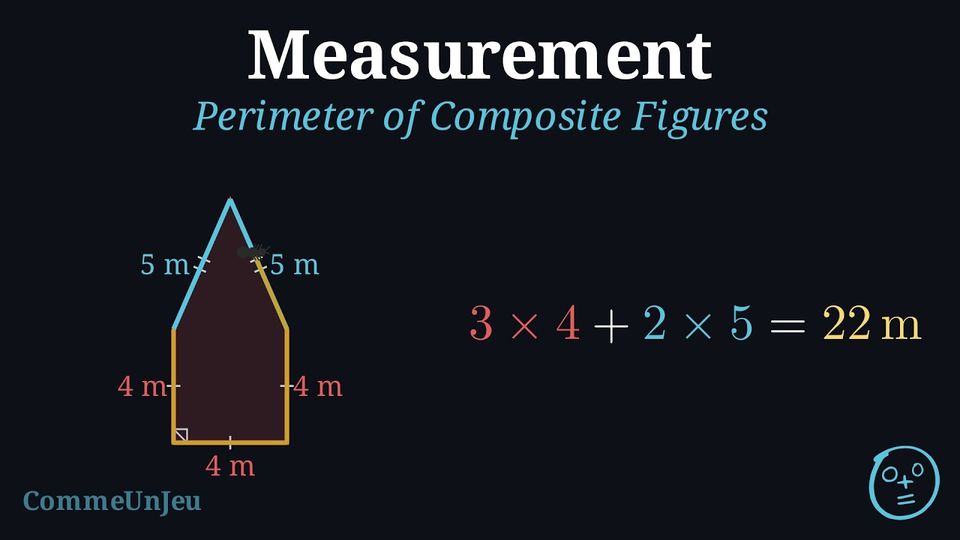
Method — Finding the Perimeter of a Composite Figure
To find the perimeter of a composite figure: - Identify all the outer sides of the figure. Be careful not to include any lines inside the shape.
- Find the lengths of any unknown sides. The other sides often give them.
- Add the lengths of all the outer sides together (and of the arcs of the outline, if there are any).
Skills to practice
- Using Perimeters to Solve Problems
III
Scale Diagrams
III.1
Using a Scale
The plan of a classroom is drawn at the scale \(1/100\): \(1\)~cm on the plan represents \(100\)~cm in reality, that is \(1\)~m. On the plan, the board is \(4\)~cm long and the room is \(9\)~cm long. How long are the real board and the real room? The teacher's desk is \(1.50\)~m long: how long is it on the plan?
Each centimetre of the plan is one metre of reality, so the real lengths are proportional to the drawn lengths.
- The board: \(4\)~cm on the plan is \(4\) times \(1\)~cm, so \(4\) times \(1\)~m: the real board is \(\textbf{4 m}\) long.
- The room: \(9\)~cm on the plan, so the real room is \(\textbf{9 m}\) long.
- The desk: \(1.50\)~m of reality is \(1.5\) times \(1\)~m, so \(1.5\) times \(1\)~cm on the plan: the desk is \(\textbf{1.5 cm}\) long on the plan.
Definition — The Scale of a Plan
A plan (or a map) is a drawing of a real object in which every length represented has been reduced in the same way: the real lengths are proportional to the lengths on the plan.The scale of the plan says what one unit of the plan represents in reality. It is given by a sentence or by a fraction:
- “\(1\)~cm for \(2\)~m”: one centimetre on the plan represents two metres in reality;
- “scale \(1/100\)”: one centimetre on the plan represents \(100\)~centimetres in reality, that is \(1\)~m. More generally, one unit on the plan represents \(100\) of the same unit in reality: \(1\)~mm represents \(100\)~mm.
Method — From the Plan to Reality, and Back
Since the real lengths are proportional to the plan lengths, a scale problem is a proportionality problem. Start the table with the column of the unit: what \(1\)~cm of the plan represents. | \textcolor{colordef}{On the plan (cm)} | \(\textcolor{colordef}{1}\) | \(\textcolor{colordef}{3}\) | \(?\) |
| \textcolor{colorprop}{In reality (m)} | \(\textcolor{colorprop}{2}\) | \(?\) | \(\textcolor{colorprop}{9}\) |
- From the plan to reality: \(3\)~cm is \(3\) times \(1\)~cm, so \(3\) times \(2\)~m: \(\textbf{6 m}\).
- From reality to the plan: \(9\)~m is \(4.5\) times \(2\)~m (\(9 \div 2 = 4.5\)), so \(4.5\) times \(1\)~cm: \(\textbf{4.5 cm}\).
Example
The plan of a bedroom is drawn at the scale \(1/50\). - On the plan, the bed is \(4\)~cm long. Find its real length.
- The wardrobe is \(1.20\)~m wide in reality. Find its width on the plan.
Scale \(1/50\): \(1\)~cm on the plan represents \(50\)~cm in reality.
- \(4\)~cm on the plan is \(4\) times \(1\)~cm, so \(4\) times \(50\)~cm: the real bed is \(200\)~cm, that is \(\textbf{2 m}\) long.
- \(1.20\)~m is \(120\)~cm. \(120\)~cm is \(2.4\) times \(50\)~cm (\(120 \div 50 = 2.4\)), so \(2.4\) times \(1\)~cm on the plan: the wardrobe is \(\textbf{2.4 cm}\) wide on the plan.
The Same Unit on Both Sides
A scale written as a fraction, like \(1/50\) or \(1/100\,000\), compares two lengths in the same unit: \(1\)~cm for \(50\)~cm, \(1\)~cm for \(100\,000\)~cm. Before using it, convert the real length into that unit — \(1.20\)~m \(= 120\)~cm — or convert what \(1\)~cm represents into a convenient unit: at \(1/100\,000\), \(1\)~cm represents \(100\,000\)~cm \(= 1\,000\)~m \(= 1\)~km, which is how a road map is read.
Skills to practice
- Converting between the Plan and Reality
III.2
Scale Drawings and the Scale Factor
When designing a house, an architect creates a drawing that is much smaller than the actual building. To do this, every measurement of the real house is proportionally reduced. This proportional relationship is called the scale.
For house plans, a common scale is \(1{:}100\). This means every length on the drawing is 100 times smaller than the actual length in reality. These types of drawings are called scale drawings. \includegraphics[width=0.5\textwidth]{\imagepath floorplan2.png}
For house plans, a common scale is \(1{:}100\). This means every length on the drawing is 100 times smaller than the actual length in reality. These types of drawings are called scale drawings.
Definition — Scale Drawing and Scale Factor
A scale drawing represents a real object with all its lengths reduced (or enlarged) in the same proportion. The scale is the ratio of a drawn length to the matching real length, written in the same unit and simplified so the drawn term is~\(1\): $$\text{scale} = (\text{drawn length}):(\text{real length}) = \textcolor{colorprop}{1}:\textcolor{colordef}{N}.$$ The second term~\(\textcolor{colordef}{N}\) is the scale factor: for a reduction — the usual case, with \(N > 1\) — it tells how many times larger reality is than the drawing.Example. If \(\textcolor{colorprop}{4}\,\mathrm{cm}\) on the plan represents \(\textcolor{colordef}{8}\,\mathrm{m}\) in reality, write both in the same unit and simplify the ratio: $$\textcolor{colorprop}{4}\,\mathrm{cm}:\textcolor{colordef}{8}\,\mathrm{m} = \textcolor{colorprop}{4}:\textcolor{colordef}{800} = \textcolor{colorprop}{1}:\textcolor{colordef}{200}.$$ So the scale is \(1{:}200\) (scale factor \(200\)).
Skills to practice
- Finding the Scale
III.3
The Scale Formulae
Proposition — Formulae
Because the scale is \(\textcolor{colorprop}{1}:\textcolor{colordef}{N}\), a drawn length and its real length are always in that ratio: \((\text{drawn}):(\text{real}) = 1:N\). Finding a missing length means scaling this ratio up or down, which gives three useful formulae: $$\begin{aligned}\text{Actual Length} &= \text{Drawn Length} \times \text{Scale Factor}\\
\text{Drawn Length} &= \frac{\text{Actual Length}}{\text{Scale Factor}}\\
\text{Scale Factor} &= \frac{\text{Actual Length}}{\text{Drawn Length}}\end{aligned}$$ Note: To calculate the scale factor, both lengths must be in the same unit. 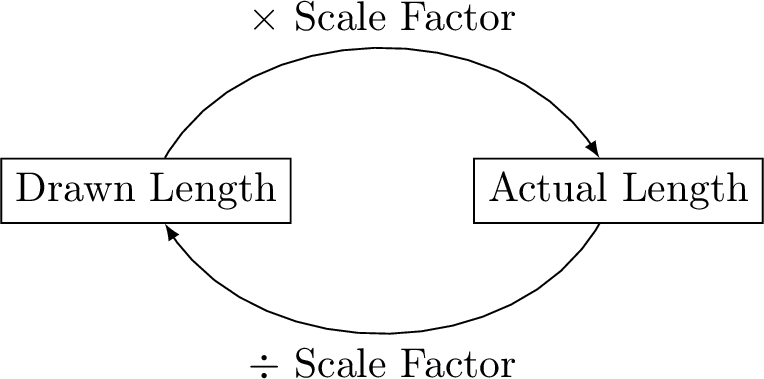
Example
Calculate the actual width of this house. 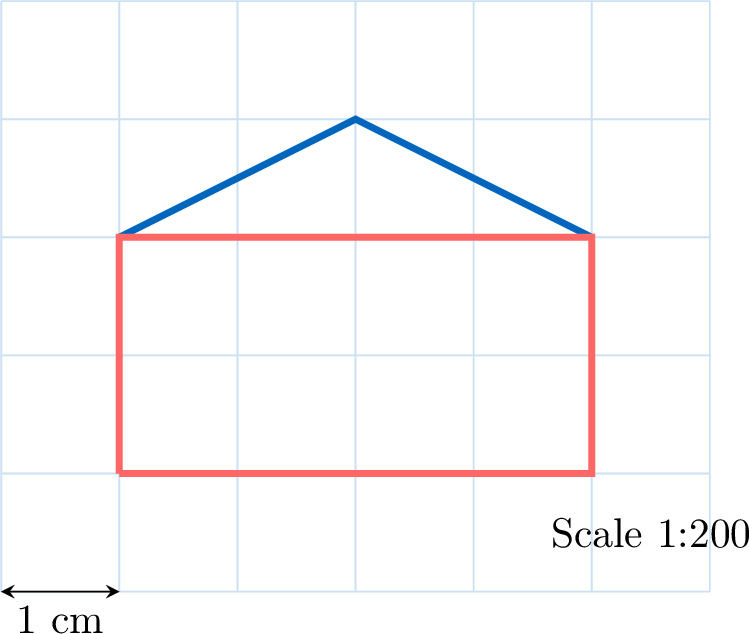
The drawn width of the house is \(4\,\mathrm{cm}\). The scale \(1{:}200\) means the scale factor is \(200\). $$\begin{aligned}\text{Actual width} &= \text{Drawn width} \times \text{Scale factor}\\
&= 4\,\mathrm{cm} \times 200 \\
&= 800\,\mathrm{cm} \\
&= 8\,\mathrm{m}\end{aligned}$$ The actual width of the house is \(8\) metres.
Example
For a scale of \(1{:}200\), find the drawn length corresponding to an actual length of \(6\,\mathrm{m}\).
The scale factor is \(200\). $$\begin{aligned}\text{Drawn length} &= \frac{\text{Actual length}}{\text{Scale factor}}\\
&= \frac{6\,\mathrm{m}}{200}\\
&= \frac{600\,\mathrm{cm}}{200} &&(\text{unit conversion})\\
&= 3\,\mathrm{cm}\end{aligned}$$ A \(6\,\mathrm{m}\) actual length is represented by a \(3\,\mathrm{cm}\) drawn length.
Example
A drawn length of \(2\,\mathrm{cm}\) represents an actual length of \(5\,\mathrm{m}\). Find the scale factor and the scale.
Write the scale as the ratio (drawn length : real length) in the same unit, then simplify it to the form \(1:N\): $$\textcolor{colorprop}{2}\,\mathrm{cm} : \textcolor{colordef}{5}\,\mathrm{m} = \textcolor{colorprop}{2}\,\mathrm{cm} : \textcolor{colordef}{500}\,\mathrm{cm} = \textcolor{colorprop}{2}:\textcolor{colordef}{500} = \textcolor{colorprop}{1}:\textcolor{colordef}{250}.$$ The scale is \(1{:}250\), so the scale factor is \(250\).
Skills to practice
- Reading and Choosing a Scale
- Finding Lengths Using the Formulae
- Finding the Actual Lengths in Scale Drawings
- Solving Problems with Plans
IV
Going further
Skills to practice
- Converting Lengths with a Scale
- Finding a Scale
- Investigating Perimeter Patterns
- Quiz
Jump to section