How to Teach Ratios
This guide is for teachers who use CommeUnJeu with a class, from the first ratio in PYP 2 to direct and inverse proportion in MYP 4. One idea carries it. A ratio compares two quantities, named, in an order: \(2\) red apples for \(4\) apples, \(4\) tickets for \(\dollar 28\). And one gesture transforms it: multiply, or divide, both terms by the same number. Why the same number? Because a ratio describes a group that can be repeated. \(4\) tickets for \(\dollar 28\) is one group; two groups are \(8\) tickets for \(\dollar 56\); half a group is \(2\) tickets for \(\dollar 14\). A pupil who sees the group knows why the gesture works, and does not need a new rule in each chapter. The same gesture then serves in four situations:
The guide gives the meaning first, the way pupils can understand it and say it in their own words. Then it follows the chapters year by year, with the figures and videos of the lessons, and says where the gesture stops.
In each chapter you will find:
| Situation | The gesture |
| Proportionality, through the unit | \(4:28 = 1:7 = 6:42\), so \(6\) tickets cost \(\dollar 42\) |
| A fraction of a quantity | \(2:3 = 6:9\), so two thirds of \(9\) apples are \(6\) apples |
| A percentage, a ratio to \(100\) | \(5:25 = 20:100\), so \(5\) out of \(25\) is \(20\pourcent\) |
| A scale | \(1:100 = 3:300\), so \(3\) cm on the plan are \(300\) cm, that is \(3\) m |
In each chapter you will find:
- most sections open with a short video, in English and in French (this guide shows them too, at the head of the passages they belong to);
- the lesson: definitions, methods and worked examples, to project on the board;
- under each section, the skills to practise: groups of exercises corrected at once, each answer followed by a worked correction;
- at the end, a Going further section with harder exercises;
- some exercises are written on paper or on the slate: the pupil draws the groups or the bars, writes the ratios, and sends a photo of the page to have it corrected.
Where the Curriculum Places Ratio
The PYP scope and sequence for mathematics describes the phases of learning as “not always linear or age related”, and its continuums are not prescriptive: teachers interpret them according to the needs of their pupils. Ratio appears there through scale, used to enlarge and reduce shapes. The MYP guide places proportional reasoning with ratios and percentages among the topics of numerical and abstract reasoning, together with the idea that a ratio links two quantities that vary together.
CommeUnJeu teaches ratio every year from PYP 2 to MYP 1: a Ratios chapter of its own in PYP 2, PYP 3, PYP 4 and MYP 1, and in PYP 5 a chapter shared with percentages, “Percentages and Ratios”. From PYP 2 to PYP 4, the Ratios chapter comes right after the Fractions chapter of the year; in MYP 1, Decimals comes in between. Meeting the ratio and the fraction in the same weeks, so that they can be compared, is a suggestion for the class, not a rule. Each year adds one step: what a ratio is and how to simplify it (PYP 2); a part of a whole (PYP 3); part-part and part-whole ratios (PYP 4); equivalent ratios, proportions and percentages (PYP 5); the unitary method and cross-multiplication (MYP 1). MYP 2 then shares a quantity in a ratio and works with rates, MYP 3 with speed and quotient quantities, and MYP 4 meets inverse proportion, where the gesture stops.
CommeUnJeu teaches ratio every year from PYP 2 to MYP 1: a Ratios chapter of its own in PYP 2, PYP 3, PYP 4 and MYP 1, and in PYP 5 a chapter shared with percentages, “Percentages and Ratios”. From PYP 2 to PYP 4, the Ratios chapter comes right after the Fractions chapter of the year; in MYP 1, Decimals comes in between. Meeting the ratio and the fraction in the same weeks, so that they can be compared, is a suggestion for the class, not a rule. Each year adds one step: what a ratio is and how to simplify it (PYP 2); a part of a whole (PYP 3); part-part and part-whole ratios (PYP 4); equivalent ratios, proportions and percentages (PYP 5); the unitary method and cross-multiplication (MYP 1). MYP 2 then shares a quantity in a ratio and works with rates, MYP 3 with speed and quotient quantities, and MYP 4 meets inverse proportion, where the gesture stops.
Why Start with the Ratio
Three things change for the pupils when the ratio comes first.
Two quantities stay in sight. “The tickets cost \(\dollar 42\)” keeps one number and hides the other; the ratio \(6:42\), tickets to dollars, keeps both, each with its name. The pupil sees what is compared with what, and in which order: \(2:3\) is not \(3:2\). Saying the names aloud, “red apples to all the apples”, is the first habit to build, and it stays useful until the last year.
One gesture, with a reason. The lessons draw the reason. Four apples, two of them red, are packed in boxes of two: one red box out of two boxes. \(2:4\) counts apples, \(1:2\) counts boxes; both describe the same apples. 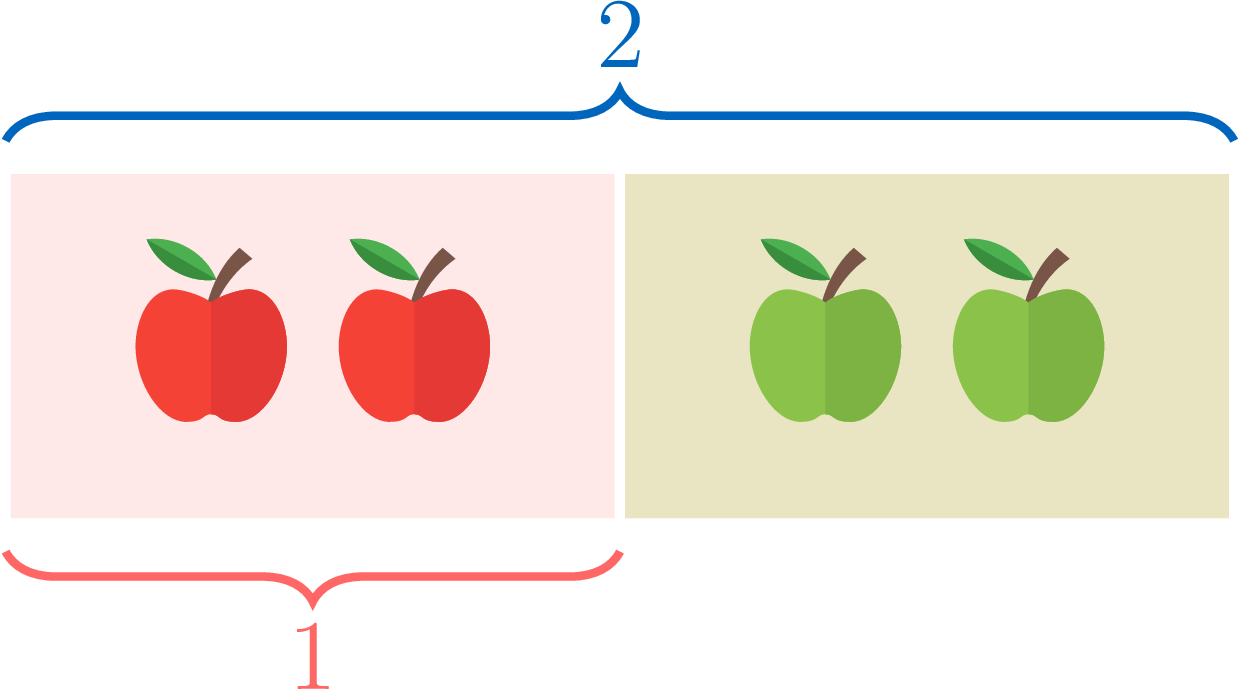
Dividing both terms by \(2\) counts in boxes of \(2\) instead of in apples, and multiplying by \(2\) goes back to apples: the number changes the unit of counting for the whole picture, so it acts on both terms. The same apples can also be sorted into mixed sets, each holding \(1\) red apple among \(2\) apples: then \(2:4\) is the set \(1:2\) taken twice, and the multiplier counts the sets. Equivalent ratios are the same set, taken more or fewer times. In both readings, name the group first, a box of \(2\) apples or one mixed set, \(1:2\), then read the number. The lessons then draw the gesture as two arrows, one above for the first terms, one below for the second terms, with the same multiplier on both: Since 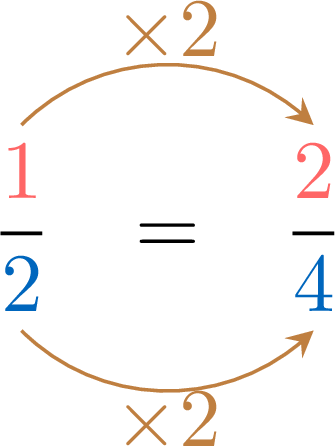 , the ratios are equivalent: \(\textcolor{colordef}{1}:\textcolor{colorprop}{2}=\textcolor{colordef}{2}:\textcolor{colorprop}{4}\)
The same gesture, again and again. The four situations of the table above are not four rules: they are four uses of these arrows. Proportionality goes through the group of one unit; a fraction of a quantity takes \(2\) for every \(3\); a percentage rewrites the ratio with a whole of \(100\); a scale rewrites it with a first term of \(1\).
This guide does not claim that pupils taught this way succeed better: no study has measured it on these lessons. It claims something smaller and more useful in class: one gesture, with a reason the pupils can say, serves in four places, and each new chapter starts from something they already do.
Two quantities stay in sight. “The tickets cost \(\dollar 42\)” keeps one number and hides the other; the ratio \(6:42\), tickets to dollars, keeps both, each with its name. The pupil sees what is compared with what, and in which order: \(2:3\) is not \(3:2\). Saying the names aloud, “red apples to all the apples”, is the first habit to build, and it stays useful until the last year.
One gesture, with a reason. The lessons draw the reason. Four apples, two of them red, are packed in boxes of two: one red box out of two boxes. \(2:4\) counts apples, \(1:2\) counts boxes; both describe the same apples.
, the ratios are equivalent: \(\textcolor{colordef}{1}:\textcolor{colorprop}{2}=\textcolor{colordef}{2}:\textcolor{colorprop}{4}\)This guide does not claim that pupils taught this way succeed better: no study has measured it on these lessons. It claims something smaller and more useful in class: one gesture, with a reason the pupils can say, serves in four places, and each new chapter starts from something they already do.
The Path, Year by Year
Each chapter takes up the gesture where the year before left it, then goes one step further. The table gives the step and the link to the chapter.
| Year | Chapter | What is new |
| PYP 2 | Ratios | a ratio compares two quantities, \(2:3\); simplifying, with boxes |
| PYP 3 | Ratios | the same, then a part of a whole: half of \(4\) apples |
| PYP 4 | Ratios | part-part and part-whole ratios, drawn as bars; always ask what is compared to what |
| PYP 4 | Position, Grids and Scale | a plan, its scale, a scale bar |
| PYP 5 | Operations with fractions | “half of” is a multiplication by \(\frac12\); two thirds of \(12\) apples |
| PYP 5 | Percentages and Ratios | a percentage, \(42\) out of \(100\); equivalent ratios; a proportion, an equation of two ratios |
| MYP 1 | Ratios | the unitary method; the better buy; cross-multiplication, last |
| MYP 1 | Percentage | from a ratio to a percentage; comparing with percentages; the part and the whole |
| MYP 1 | Length and Perimeter | the scale of a plan; scale drawings and the scale factor |
| MYP 2 | Ratios, Rates and Percentages | sharing a quantity in a ratio; the unit rate; rates; percentages of a quantity, increase and decrease |
| MYP 3 | Ratio, Rates and Speed | three numbers in a ratio; the fourth proportional by cross products; quotient quantities and speed |
| MYP 3 | Percentages and Money | percentage change and the multiplier |
| MYP 4 | Direct and Inverse Proportion | direct, inverse and power proportion: where the gesture stops |
Year by Year, with the Figures of the Lessons
What a Ratio Is: Two Named Quantities, in an Order (PYP 2 to PYP 4)
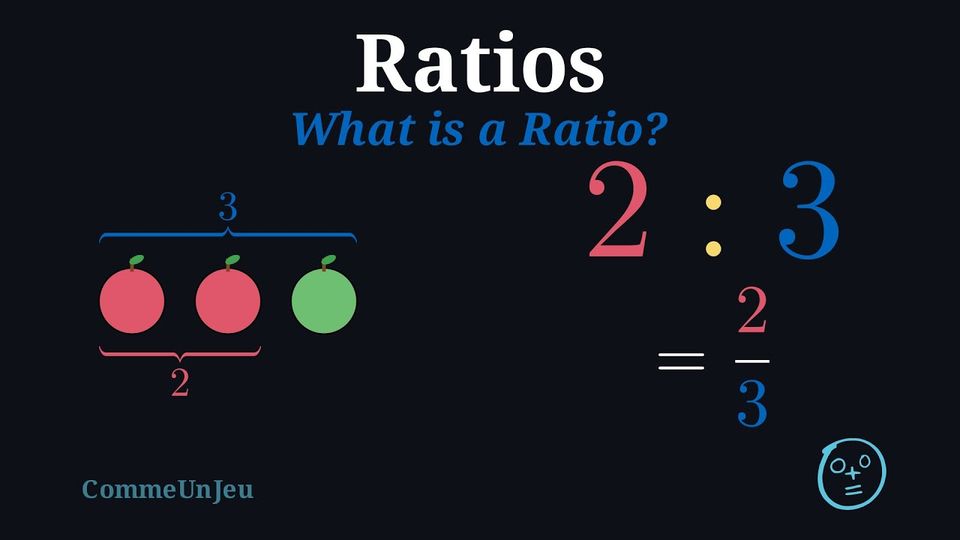
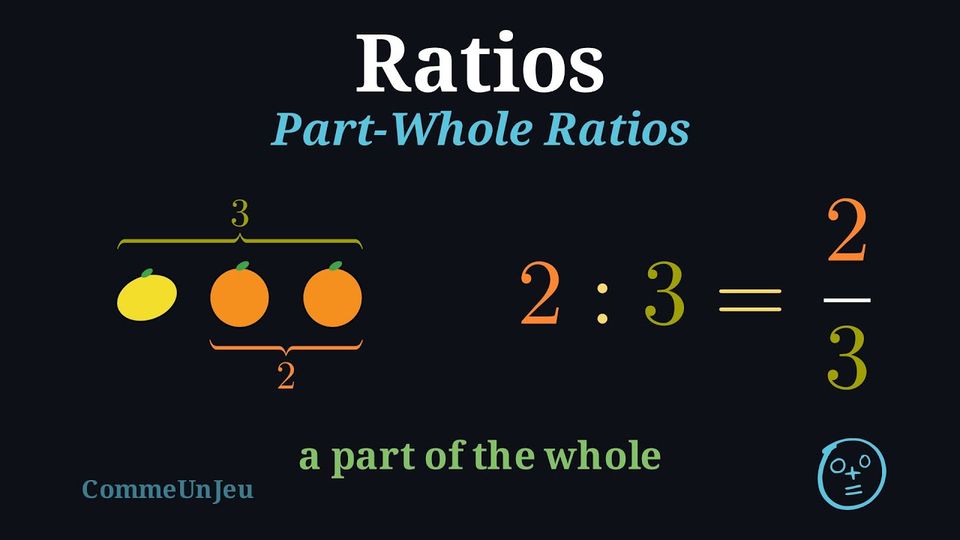
In the lesson. PYP 2 opens with the definition that stays until MYP 1: “A ratio is a comparison of two quantities. The ratio of \(2\) to \(3\) is written \(2:3\) (read `\(2\) to \(3\)').” The first example counts apples, the part below, the whole above. 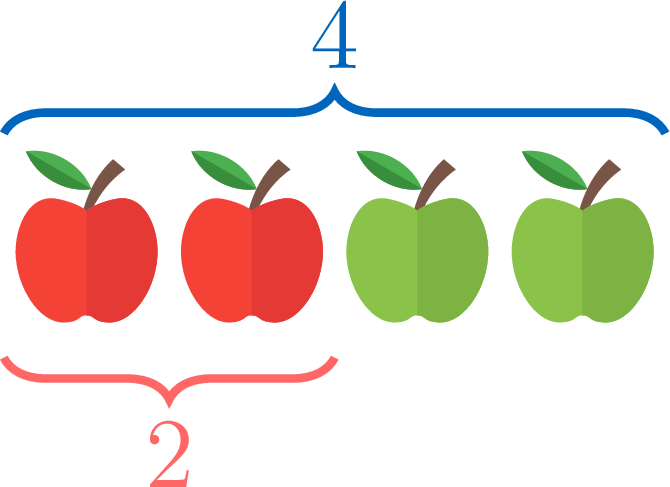
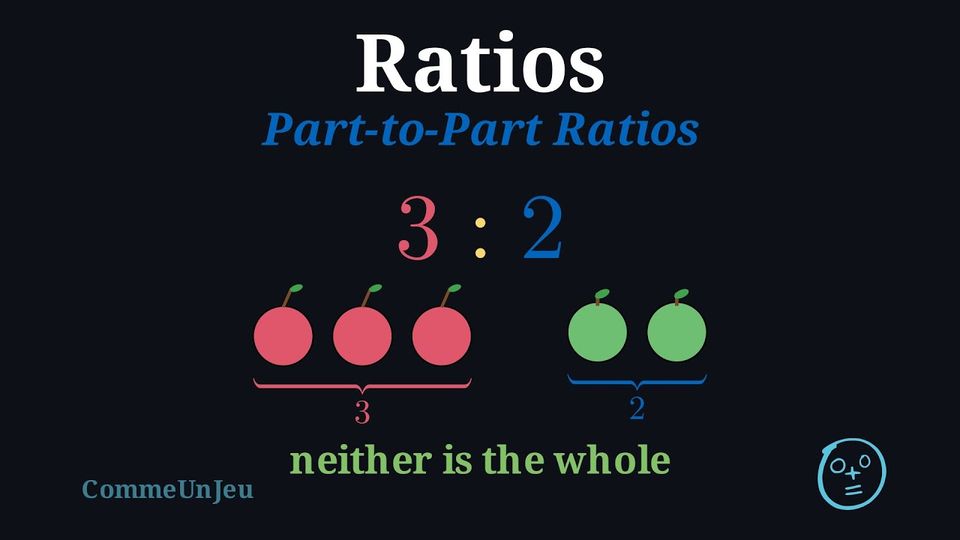
PYP 4 separates the two kinds of comparison and draws them. A part-part ratio compares two distinct parts of a whole: two separate bars. A part-whole ratio compares one part with the whole: the bar of the whole above the bars of its parts. 
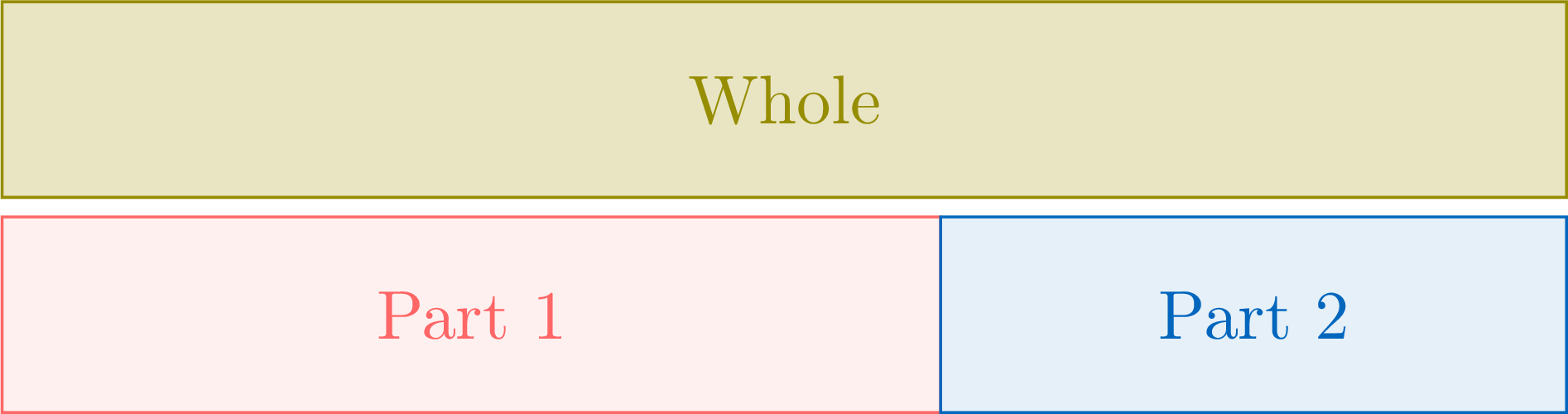
A remark of the same chapter gives the sentence to repeat: the same notation \(a:b\) can mean two different things, so always ask what is compared to what. In the part-part ratio cherries to apples, \(3:2\), the fraction \(\dfrac32\) compares the cherries with the apples, and the cherries are \(\dfrac{3}{3+2}=\dfrac35\) of the fruit. In the part-whole ratio oranges to all the fruit, \(2:3\), the fraction \(\dfrac23\) is the part of the whole.
The meaning for the pupils. A ratio is a sentence with two names: “\(3\) cherries for \(2\) apples”. Ask for the sentence before the numbers, and write the names above the numbers for the first weeks: cherries : apples \(= 3:2\). The order of the names gives the order of the numbers; changing the order changes the ratio.
The exercises. Find a ratio in a picture, then the other ratios of the same picture: each part to the other, each part to the whole. The PYP 3 written exercises already go the other way, from a ratio to a picture: draw \(6\) stars and colour some so that yellow stars to all the stars is \(1:3\).
Watch for a part-part ratio read as a part of the whole: cherries to apples \(3:2\) does not say that the cherries are \(\dfrac32\) of the fruit. The bars answer it: the whole is the two bars put end to end, \(3+2=5\).
Equal Ratios: the Same Number for Both Terms (PYP 2 and PYP 5)
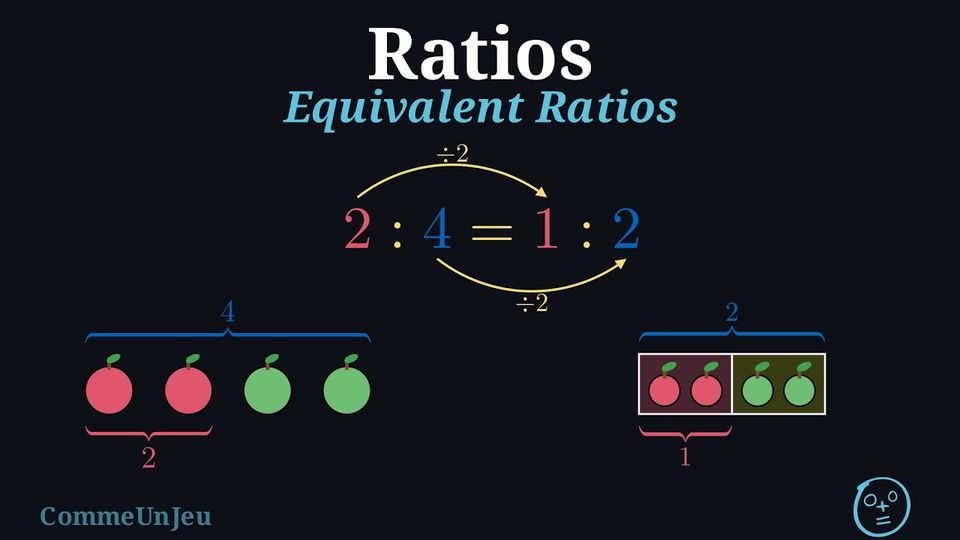
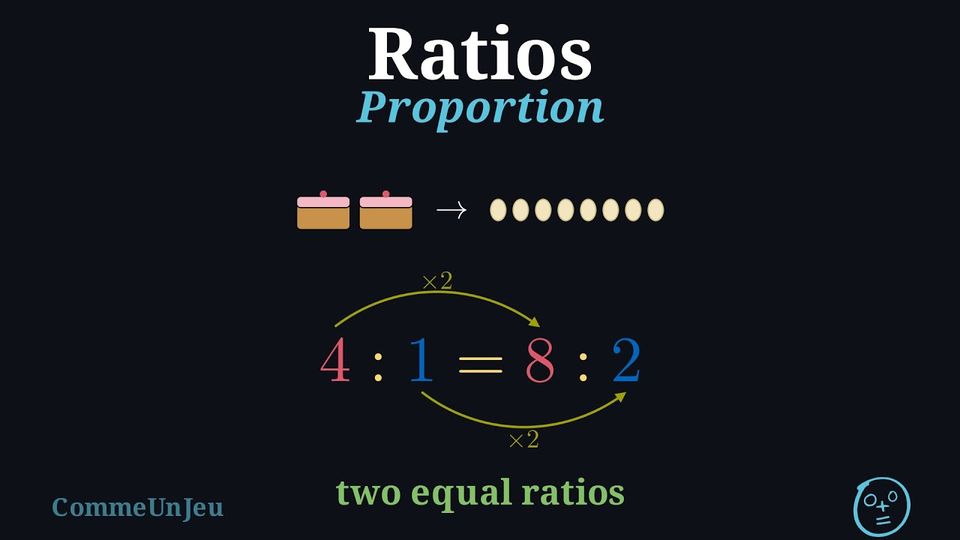
In the lesson. PYP 2 simplifies at once: the ratio of red apples to all the apples, \(2:4\), becomes \(1:2\) by dividing both terms by the same number, and the four apples are packed in boxes of two, one red box out of two boxes — the boxes drawn in the section “Why Start with the Ratio”. PYP 5 states the operative definition: “Two ratios are equivalent when one is obtained from the other by multiplying (or dividing) both parts of the ratio by the same nonzero number.” A method checks it on fractions, with the two arrows. The same chapter calls proportion an equation stating that two ratios are equivalent; its opening problem doubles a juice recipe, \(1\) lemon for \(2\) oranges, then \(2\) lemons for \(4\) oranges, \(1:2=2:4\).
The meaning for the pupils. The boxes give the reason for the rule (section “Why Start with the Ratio”): both terms are counted with the same box of \(2\), so both are divided by \(2\); in mixed sets, the divisor is the number of sets. Ask “boxes of how many?” or “how many sets?” before “by how much?”.
The exercises. Simplify; find the missing term (\(3:5=9:\ldots\)); recognise a proportion. A written exercise of PYP 4 asks the question of the drinks: Léa mixes \(2\) cups of syrup with \(3\) cups of water, Tom \(3\) cups of syrup with \(5\) cups of water; whose drink tastes more of syrup? Rewritten with the same water, \(2:3=10:15\) and \(3:5=9:15\), the two drinks are drawn as bars with water bars of the same length, and the answer is read on the drawing: Léa's.
Watch for the same number added to both terms: \(2:3\) becomes \(4:5\) by adding \(2\). It keeps the difference, not the ratio. The sets answer it: \(2:3\) taken twice is \(4:6\), and no number of \(2:3\) sets makes \(4:5\).
First Use: Proportionality, Through the Unit (MYP 1 and MYP 2)
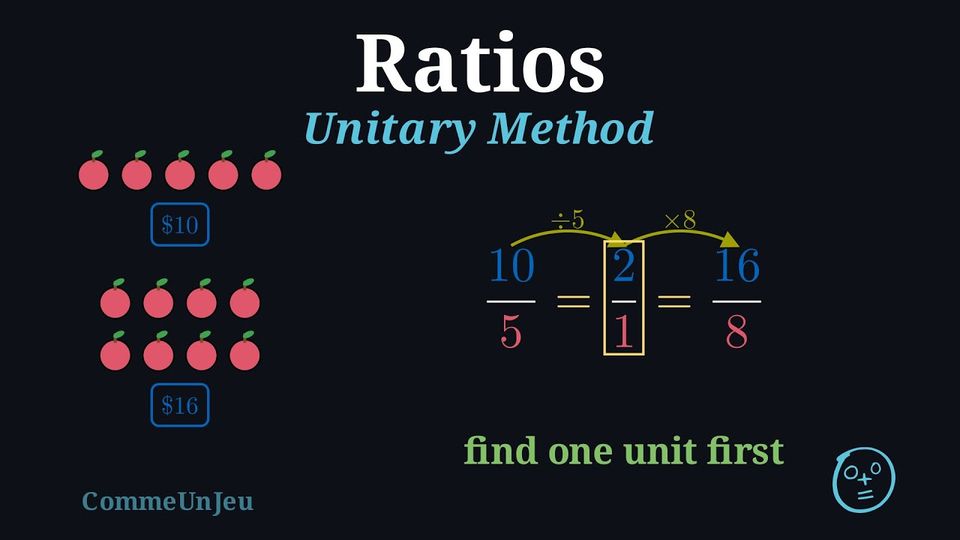
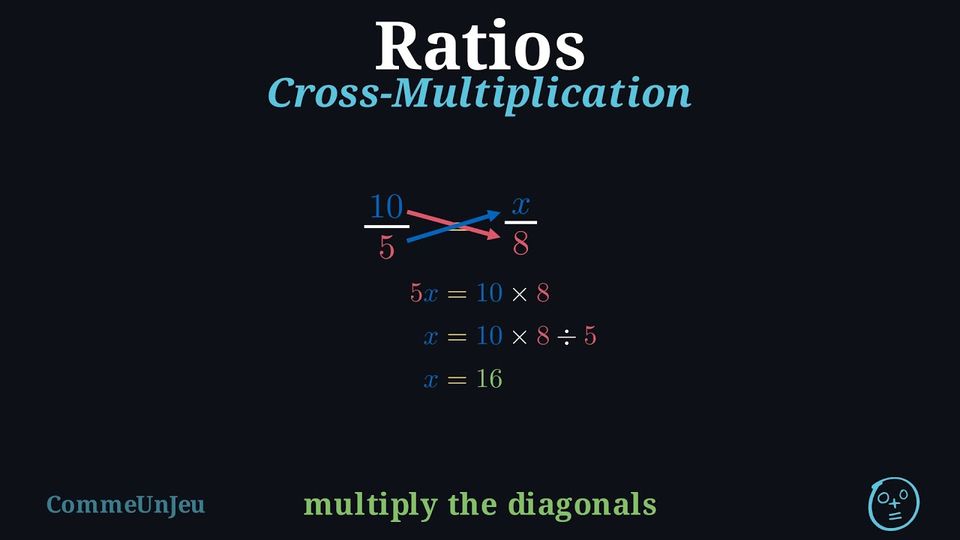
In the lesson. MYP 1 Ratios teaches the unitary method first. “If \(5\) apples cost \(\dollar 10\), how much do \(8\) apples cost?” Step 1 finds the cost of one apple, the unit cost, by dividing both numbers by \(5\); step 2 multiplies both by \(8\). The lesson then writes the two steps as one chain of equal ratios, cost over apples: 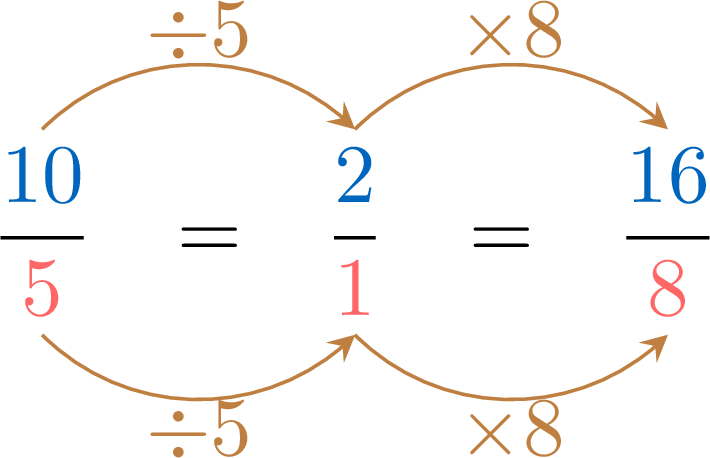
These are the arrows of PYP 5, unchanged. The same section compares two packs by their unit cost (which is the better buy?). Cross-multiplication comes last, in a section of its own: write the proportion with the unknown, \(\dfrac{10}{5}=\dfrac{x}{8}\), then \(5\times x=10\times 8\). In MYP 2, the unit rate is named, and the rate becomes a quotient of two quantities of different kinds, read “per”.
The meaning for the pupils. The unit is the reference chosen: one apple, one ticket, one kilogram. “How much for one?” is a question pupils already ask in a shop. Once the value for one unit is known, any number of units is one multiplication. The order of the terms is free, as long as both pairs use the same order and the names are written: in this lesson, cost over apples, so the fraction \(\dfrac21\) is the cost of one apple, \(\dollar 2\) per apple.
Cross-multiplication, last. It gives the answer without the group, and that is its weakness: a pupil can apply it to a situation that is not proportional, and nothing in the calculation warns. Keep it for numbers that hide the group. The MYP 3 lesson says it plainly: “The cross products must not become automatic: when a coefficient or a multiple is visible, the simpler procedures remain the best path.”
The exercises. Compare prices by their unit cost; bring to the unit and back; find a quantity by cross-multiplication; in the Going further section, written problems where the pupil chooses the path and explains it.
Watch for the two pairs written in different orders: \(5\) apples for \(\dollar 10\) written \(\dfrac{10}{5}\), then \(8\) apples for \(x\) dollars written \(\dfrac{8}{x}\). Ask for the names above the numbers; the arrows only work between two pairs written the same way.
Second Use: a Fraction of a Quantity, 2 for 3 (PYP 3 to PYP 5)
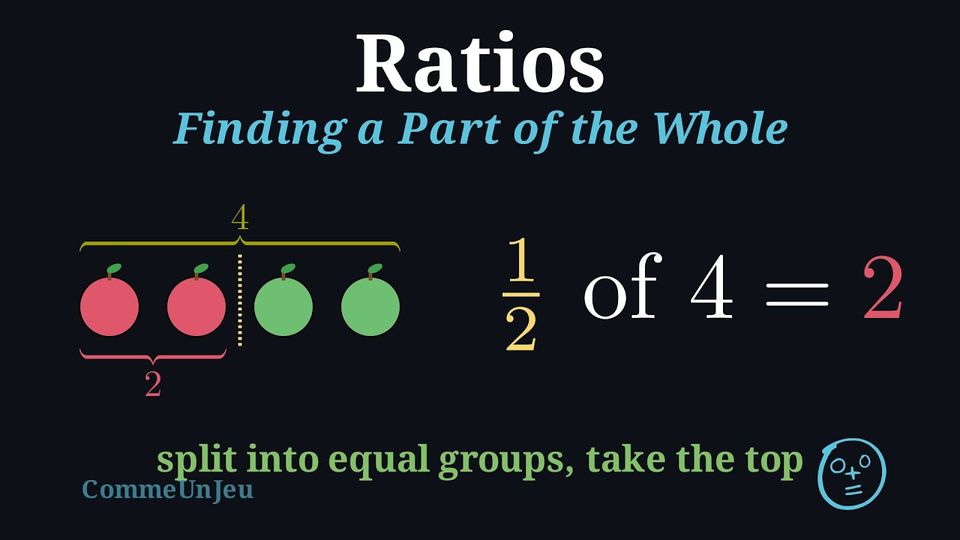
In the lesson. PYP 3 takes half of \(4\) apples with the hands: divide the whole into \(2\) equal parts (the denominator), select \(1\) part (the numerator), count. 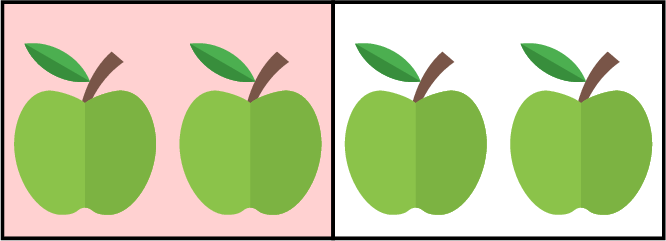
PYP 5 (Operations with fractions) gives two readings of the same calculation, as a sharing (\(4\div 2=2\)) and as a multiplication (\(\dfrac12\times 4=2\)): “The sharing reading is the one that computes; the multiplication reading is the one that writes.” Then two thirds of \(12\) apples: two thirds are two parts of one third each; share the \(12\) apples into \(3\) equal parts, take \(2\) of them. 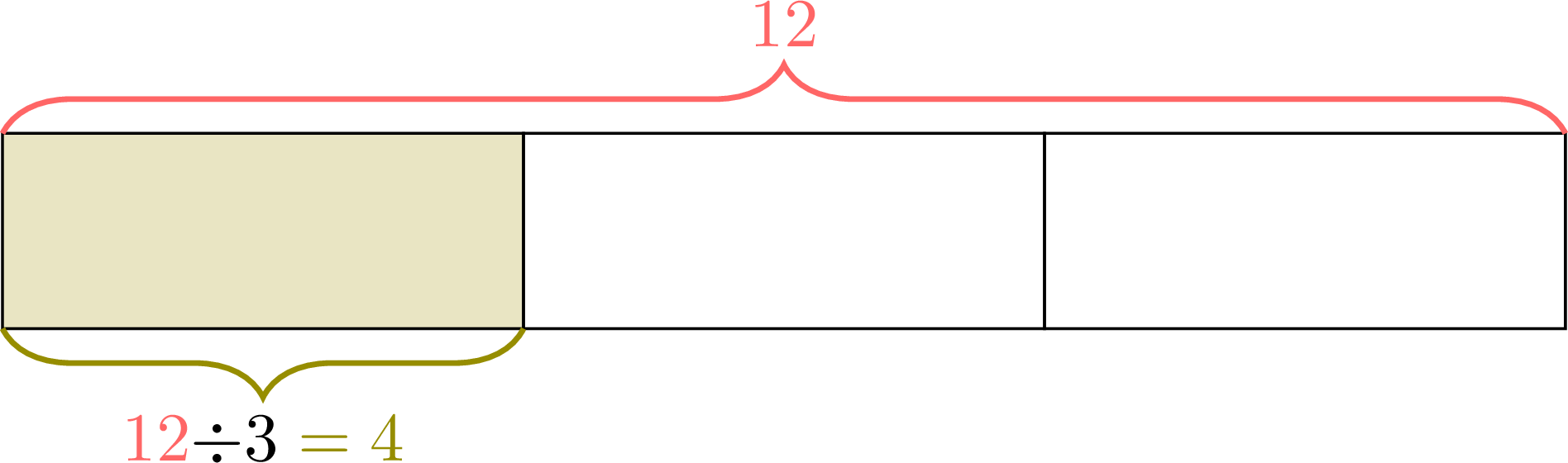
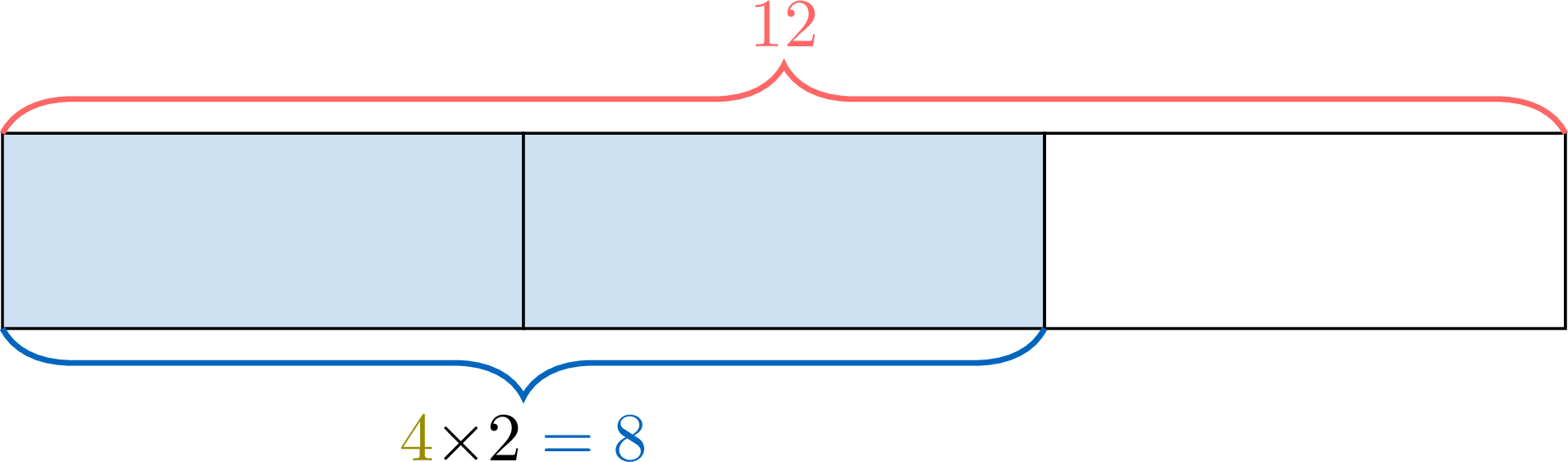
\((12\div 3)\times 2=8\), written \(\dfrac23\times 12=8\), and checked: the part not taken, \(4\) apples, completes \(12\).
The meaning, and the reading “2 for 3”. A ratio gives a third reading, which the lessons do not develop yet and which is offered here for the classroom: two thirds of \(12\) is “\(2\) for every \(3\)”. Make sets of \(3\) apples, and take \(2\) apples in each set. Four sets, so \(8\) apples: \(2:3=8:12\). 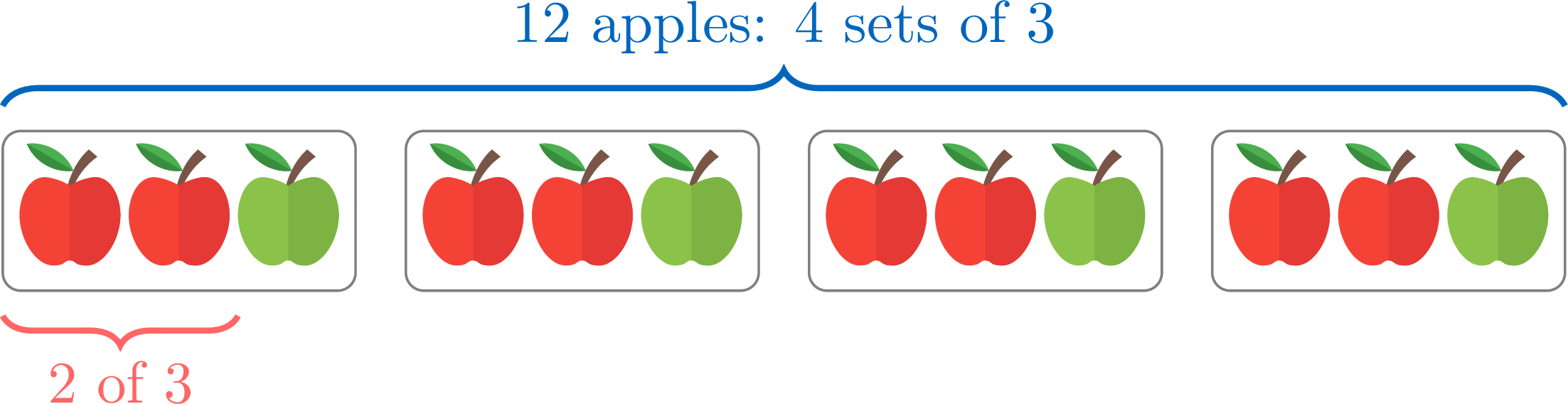
The PYP 3 Ratios chapter already asks it, in a written exercise: draw \(6\) stars and colour some yellow so that yellow stars to all the stars is \(1:3\). Its correction reads the ratio this way: “The ratio \(1:3\) means \(1\) yellow star out of every \(3\). With \(6\) stars, that is \(2\) yellow stars, because \(2:6=1:3\).” Two numbers must be kept apart: \(\times 4\) counts the sets, \(\times\dfrac23\) is the multiplication that takes the part. With \(9\) apples, \(2:3=6:9\): three sets of three, two taken from each, \(6\) apples.
The exercises. Find a part in a part-whole relationship; write a part as a multiplication, then justify it.
Watch for the numerator taken for the number of parts: two thirds of \(12\) computed as \(12\div 2\times 3=18\), more than the whole. The figure answers: the denominator says into how many equal parts the whole is shared, and a part of a whole is never more than the whole.
The meaning, and the reading “2 for 3”. A ratio gives a third reading, which the lessons do not develop yet and which is offered here for the classroom: two thirds of \(12\) is “\(2\) for every \(3\)”. Make sets of \(3\) apples, and take \(2\) apples in each set. Four sets, so \(8\) apples: \(2:3=8:12\).
The exercises. Find a part in a part-whole relationship; write a part as a multiplication, then justify it.
Watch for the numerator taken for the number of parts: two thirds of \(12\) computed as \(12\div 2\times 3=18\), more than the whole. The figure answers: the denominator says into how many equal parts the whole is shared, and a part of a whole is never more than the whole.
Sharing in a Ratio (MYP 2 and MYP 3)
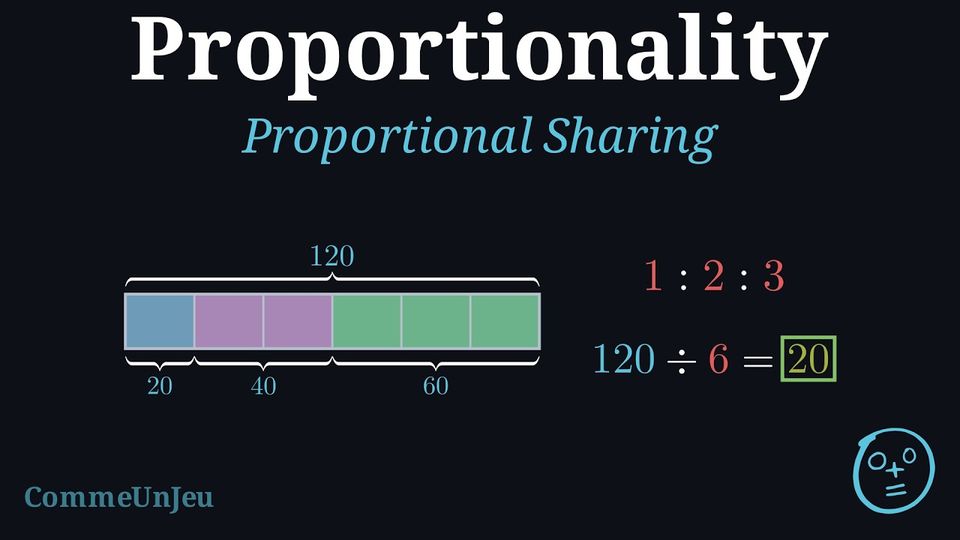
In the lesson. “To share an amount proportionally to given numbers: count the parts, find the value of one part, then multiply.” Share \(\dollar 100\) between two people proportionally to their ages, \(20\) and \(30\): \(20+30=50\) parts, one part is \(100\div 50=\dollar 2\), the shares are \(\dollar 40\) and \(\dollar 60\), “in the ratio \(20:30=2:3\)”.
The meaning for the pupils. Sharing is the unit again. Draw the ratio \(2:3\) as \(5\) equal boxes, \(2\) for the first person and \(3\) for the second, the bars of PYP 4: the whole amount fills the \(5\) boxes, one box is the value of one part, and each share is a number of boxes.
Watch for the amount divided by the terms instead of by their sum (\(100\div 2\) and \(100\div 3\)), and the shares read as part-part fractions: the first person receives \(\dfrac25\) of the amount, not \(\dfrac23\). Ask: how many boxes in all?
The Percentage, a Ratio to 100 (PYP 5 to MYP 3)
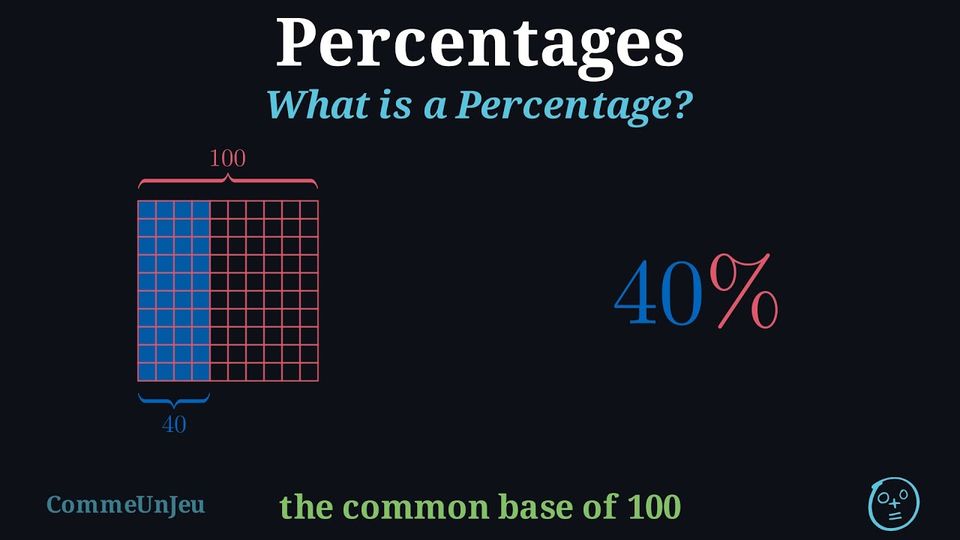
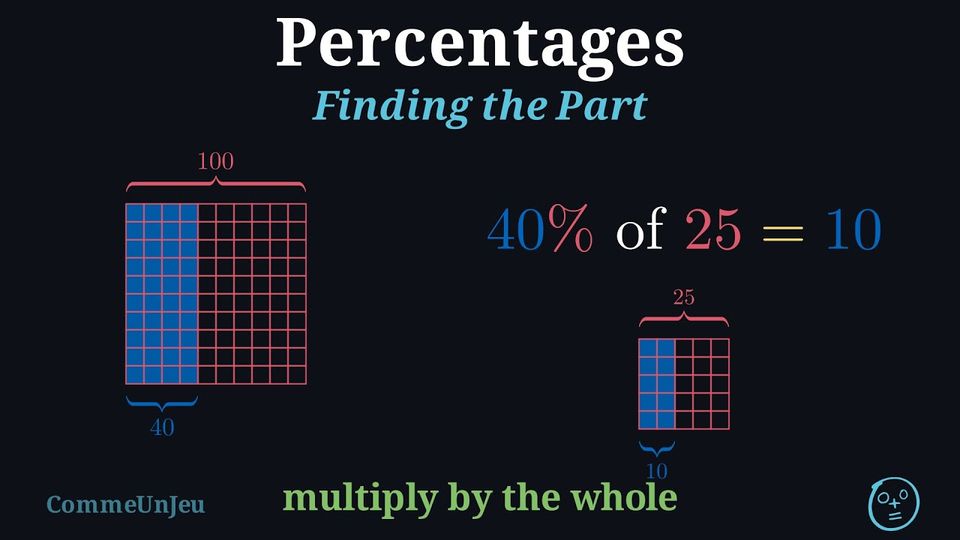
In the lesson. PYP 5 defines the percentage: “A percentage is a way of writing a fraction with denominator \(100\): \(42\pourcent\) is \(\dfrac{42}{100}\), that is \(42\) out of \(100\).” The symbol comes from per centum, “out of one hundred”. The example that follows in the lesson takes another percentage, on a grid of \(100\) squares: \(23\) squares coloured out of \(100\), that is \(23\pourcent\) of the grid. 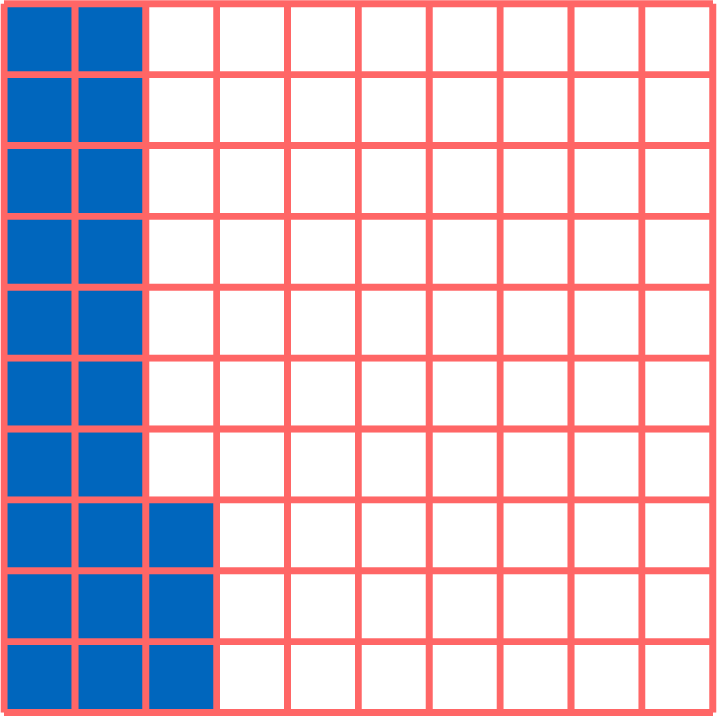
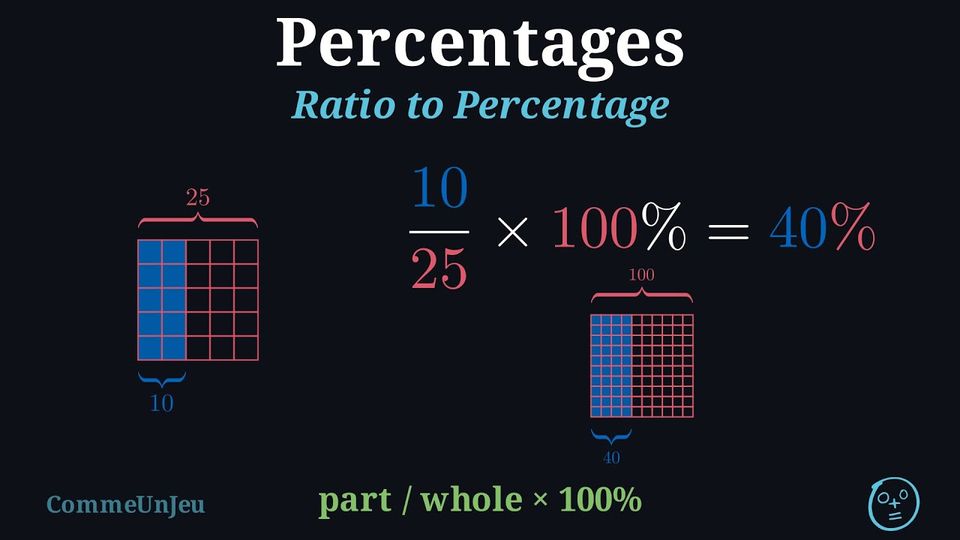
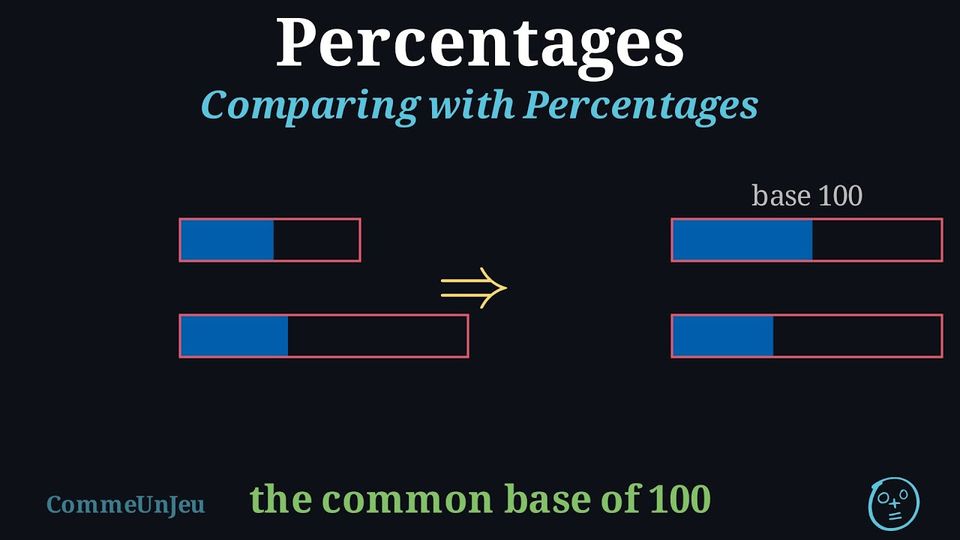
The meaning for the pupils: a ratio to \(100\). “\(42\) out of \(100\)” is a part-whole ratio whose whole is \(100\): \(42:100\). The fraction \(\dfrac{42}{100}\) of the lesson and the ratio \(42:100\) say the same thing; the ratio says it with the words the pupils use, “\(42\) for every \(100\)”. Everything else is the gesture: to write a part-whole ratio as a percentage, rewrite it with a whole of \(100\). MYP 1 Percentage does exactly that in its section “Expressing a Part as a Percentage”, with the method “Ratio to Percentage”. A class of \(20\) students has \(12\) girls: \(\dfrac{12}{20}=\dfrac{12\times 5}{20\times 5}=\dfrac{60}{100}\), so \(60\pourcent\) of the class are girls, “for every \(100\) students, \(60\) would be girls”. The method draws the gesture on two grids: 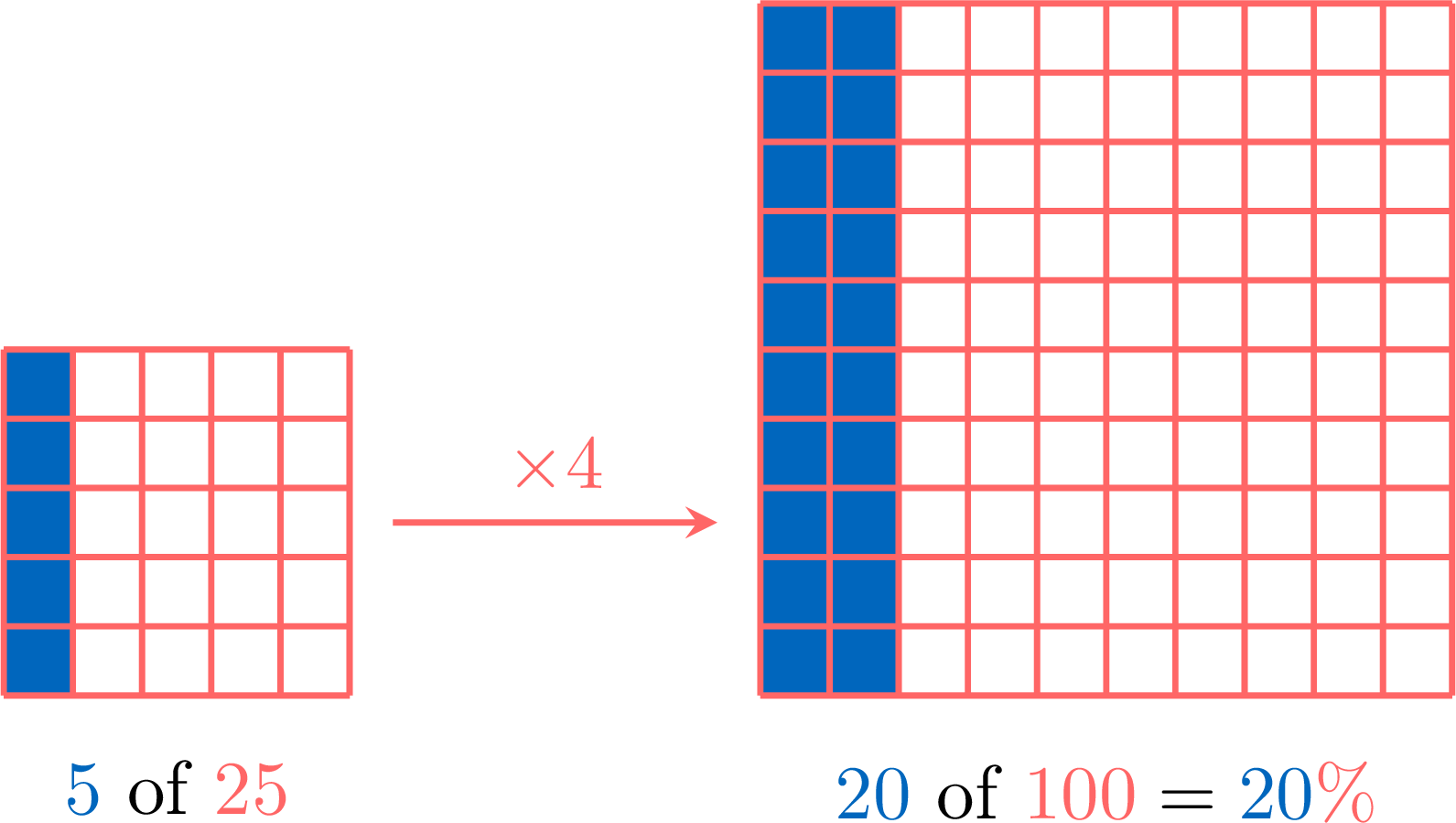
\(5\) girls out of \(25\) scale up (\(\times 4\)) to \(20\) out of \(100\): \(5:25=20:100\). When the whole does not go into \(100\) (say \(7\) out of \(30\)), the same gesture needs the multiplier \(\dfrac{100}{30}\), and the formula of the lesson, \(\dfrac{\text{part}}{\text{whole}}\times 100\pourcent\), is that gesture done in one step.
Why \(100\)? To compare. The opening problem of the next section: in Parliament A, \(26\) women out of \(50\) members; in Parliament B, \(60\) out of \(200\). Hugo says: “Since there are more women in Parliament B, women have better representation there.” With a whole of \(100\) for both, \(26:50=52:100\) and \(60:200=30:100\): \(52\pourcent\) against \(30\pourcent\), and Hugo is wrong. A percentage is a common whole, chosen once for all.
The part from a percentage. “In a school with \(200\) students, \(60\pourcent\) are girls.” The correction gives two methods: the formula, \(0.60\times 200=120\); and “for \(100\)”: \(60\) girls for every \(100\) pupils, \(200=2\times 100\), so \(120\) girls. The second is the ratio \(60:100=120:200\), in a table. Show both, the second first. The lesson adds that a part-whole ratio never exceeds \(1\), nor \(100\pourcent\); it calls that ratio a proportion, in a different sense from PYP 5, where a proportion is an equation of two ratios.
Later: increases and decreases. An increase of \(20\pourcent\) takes \(100\) to \(120\): new to old is \(120:100\), and on the unit \(1.2:1\). That is the multiplier \(1.2\) of MYP 2 and MYP 3, read on a ratio.
The exercises. Convert between the forms; turn a ratio into a percentage; compare with percentages; find the part, then the whole.
Watch for a percentage without its whole: “\(20\pourcent\) more, then \(20\pourcent\) less” does not come back to the start, because the second whole is not the first. Ask “a percentage of what?” every time. The MYP 1 remark “Compare like with like” adds that the two quantities must be of the same kind and in the same unit before dividing.
A Scale, a Ratio of Lengths (PYP 4 and MYP 1)
In the lesson. PYP 4 meets the plan and its scale bar: “\(1\) cm stands for \(5\) m”. MYP 1 says why a plan works — “the real lengths are proportional to the lengths on the plan” — and writes the scale as a sentence (“\(1\) cm for \(2\) m”) or as a fraction (“scale \(1/100\)”). The same chapter then defines the scale as “the ratio of a drawn length to the matching real length, written in the same unit and simplified so the drawn term is \(1\)”: \(4\) cm for \(8\) m is \(4:800=1:200\).
The meaning for the pupils. A scale is the ratio plan to reality, with a first term of \(1\): the group of one centimetre. The gesture does the rest: at \(1:200\), \(3\) cm on the plan are \(1:200=3:600\), \(600\) cm, that is \(6\) m.
Watch for the units: “\(1\) cm for \(2\) m” is \(1:200\), not \(1:2\). Write both lengths in the same unit before writing the ratio.
Where the Gesture Stops (MYP 4)
In the lesson. The arrows work only when a group can be repeated: when doubling one quantity doubles the other. MYP 4 Direct and Inverse Proportion says where that stops. Two quantities are inversely proportional when their product is constant; a remark, “Decreasing Is Not Enough”, closes a common shortcut: a \(50\) L tank empties at \(5\) L per minute, \(y=50-5x\); \(y\) goes down when \(x\) goes up, but \(2\times 40=80\) and \(4\times 30=120\), and doubling \(x\) from \(2\) to \(4\) takes \(y\) from \(40\) to \(30\), not to \(20\). A third law, proportion to a power, multiplies \(y\) by \(4\) when \(x\) is doubled, if \(y\propto x^2\). On a graph, a direct proportion shows points aligned with the origin: both conditions are needed.
The meaning for the pupils. Before using the arrows, try them: if one quantity is doubled, is the other doubled? One failure is enough to rule proportionality out. One success does not prove it: in the table \(1\) for \(2\), \(2\) for \(4\), \(3\) for \(7\), doubling \(1\) does double \(2\), yet \(3:7\) is not \(1:2\); the test only sees the pairs it doubles. Check the ratio on every pair of the data, and say why the situation should be proportional: the same price for every ticket. A taxi fare with a fixed charge, the area of a square and its side, the ages of two people: in each, the arrows give a wrong answer, and the pupils can say why.
The meaning for the pupils. Before using the arrows, try them: if one quantity is doubled, is the other doubled? One failure is enough to rule proportionality out. One success does not prove it: in the table \(1\) for \(2\), \(2\) for \(4\), \(3\) for \(7\), doubling \(1\) does double \(2\), yet \(3:7\) is not \(1:2\); the test only sees the pairs it doubles. Check the ratio on every pair of the data, and say why the situation should be proportional: the same price for every ticket. A taxi fare with a fixed charge, the area of a square and its side, the ages of two people: in each, the arrows give a wrong answer, and the pupils can say why.
One Task Taken Apart: the Fourth Proportional
“All tickets cost the same. \(4\) tickets cost \(\dollar 28\). How much do \(6\) tickets cost?” One task, five paths. Ask the pupils for theirs before showing any. 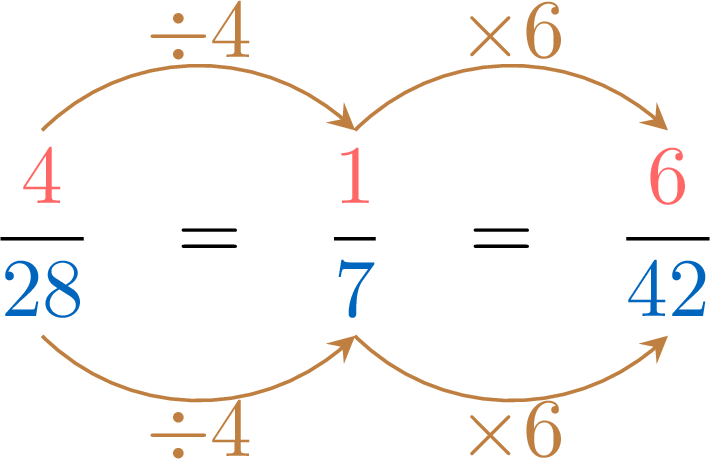
The answers to expect. “\(6\) is \(4+2\), so \(28+2=30\)”: the additive answer, the best documented in research on proportional reasoning. One term multiplied, \(6:28\). The two pairs written in different orders, \(\dfrac{4}{28}=\dfrac{x}{6}\). And, once cross-multiplication is known, the same calculation applied to a taxi fare with a fixed charge. Each has its answer in the earlier sections: the group, the names above the numbers, the doubling test and the check on every pair.
- Through the unit. Tickets to dollars, \(4:28=1:7=6:42\): one ticket costs \(\dollar 7\), the value for one unit, and \(6\) tickets cost \(\dollar 42\). This is the unitary method of MYP 1, written with ratios.
- Through a smaller group. \(4:28=2:14=6:42\) (divide by \(2\), then multiply by \(3\)): two tickets for \(\dollar 14\), three times.
- By the unit rate. \(28\div 4=7\) dollars per ticket, then \(7\times 6=42\): the unit rate of MYP 2.
- In one step. \(6=4\times\dfrac32\), so \(28\times\dfrac32=42\). Correct; this path asks the pupil to see the factor \(\dfrac32\).
- By cross-multiplication. \(\dfrac{28}{4}=\dfrac{x}{6}\), so \(4\times x=28\times 6\) and \(x=42\). Correct, and blind: nothing in it says that the price is proportional to the number of tickets.
The answers to expect. “\(6\) is \(4+2\), so \(28+2=30\)”: the additive answer, the best documented in research on proportional reasoning. One term multiplied, \(6:28\). The two pairs written in different orders, \(\dfrac{4}{28}=\dfrac{x}{6}\). And, once cross-multiplication is known, the same calculation applied to a taxi fare with a fixed charge. Each has its answer in the earlier sections: the group, the names above the numbers, the doubling test and the check on every pair.
Errors to Watch For, and the Figure That Answers Each
The same number added to both terms. \(2:3\) becomes \(4:5\), or “\(6\) tickets cost \(\dollar 30\)” from \(4\) for \(\dollar 28\). The sets and the arrows answer it: adding the same number to both terms does not, in general, keep the ratio; equal ratios are the same set taken more or fewer times. What may be added, term by term, are two pairs of the same proportional situation: \(4\) tickets for \(\dollar 28\) and \(2\) tickets for \(\dollar 14\) make \(6\) tickets for \(\dollar 42\). One term only multiplied. \(2:3=4:3\). Two lots of \(2:3\) are \(4:6\): taking the lot twice doubles both terms. Two pairs written in different orders. The arrows then join a price to a number of tickets. Write the names above the numbers until it becomes a habit. A part-part ratio read as a part of the whole. Cherries to apples \(3:2\) read as “the cherries are \(\dfrac32\) of the fruit”. The two bars: the whole is \(3+2=5\), and the cherries are \(\dfrac35\). The numerator taken for the number of parts. Two thirds of \(12\) computed as \(18\). The figure of the shared apples: the denominator says into how many equal parts the whole is cut; a part is never more than the whole. The shares divided by the terms. \(\dollar 100\) shared in the ratio \(2:3\) computed as \(100\div 2\) and \(100\div 3\). Five boxes, not two or three. The unit rate confused with the quotient of the ratio. \(5\) apples for \(\dollar 10\), apples to dollars: \(5:10=1:2\), so one apple costs \(\dollar 2\), the second term of \(1:2\), not \(\dollar\dfrac12\); \(\dfrac12\) is the number of apples per dollar. Read the rate on the pair for one unit, with its names. A percentage without its whole. \(20\pourcent\) more, then \(20\pourcent\) less, read as a return to the start. Ask “a percentage of what?”. A scale with two units. “\(1\) cm for \(2\) m” written \(1:2\). Same unit first: \(1:200\). The arrows where they do not work. A taxi fare, the area of a square, a tank that empties. The doubling test to rule them out, the check on every pair to keep them; in MYP 4, “Decreasing Is Not Enough”.
The additive answer is the best documented of these errors; the others come from reading the lessons and their exercises, and are given as things to watch, not as measured frequencies.
The additive answer is the best documented of these errors; the others come from reading the lessons and their exercises, and are given as things to watch, not as measured frequencies.
In Class
- Start with a group the pupils can hold. A glass of juice, \(1\) lemon for \(2\) oranges; a pack of \(4\) tickets; a bag of apples sorted into boxes. Ask for the sentence with its two names before any number.
- Draw before writing. Boxes, bars, then arrows. The arrows come last, once the pupils can say what each number counts.
- Name the group, then count the groups. First say what one group holds, one set: \(1\) lemon and \(2\) oranges; then ask “how many sets?” before “by how much?”. Saying both keeps the gesture meaningful.
- Compare two drinks. \(2\) cups of syrup with \(3\) of water against \(3\) with \(5\): rewrite with the same water, draw the bars, read the answer on the drawing.
- Make sets with objects. Twelve counters in sets of three, two taken from each set: two thirds of \(12\), “\(2\) for \(3\)”. Then nine counters.
- Use a grid of \(100\). “For every \(100\)” before the formula; then a whole of \(25\), of \(20\), of \(200\).
- Test the arrows. Before each new situation, double one quantity and ask whether the other doubles. A no ends the question; a yes is only a first guess: check the ratio on every pair, and find the reason in the situation.
Frequently Asked Questions
Ratio or Fraction: What Is the Difference?
A fraction is one number. A ratio keeps two quantities, each with its name, in an order. A part-whole ratio gives a fraction of the whole at once: oranges to all the fruit \(2:3\), the oranges are \(\dfrac23\) of the fruit. A part-part ratio does not: cherries to apples \(3:2\), and the cherries are \(\dfrac35\) of the fruit, not \(\dfrac32\). The fraction \(\dfrac{a}{b}\) of a ratio \(a:b\) compares the first quantity with the second; it is a part of a whole only when the second quantity is the whole.
Why One Notation for Both Kinds of Ratio?
The lessons write \(a:b\) for a part-part ratio and for a part-whole ratio alike. One writing is learnt once; the question “what is compared to what?” decides the meaning, and the names written with the numbers answer it. Two notations would hide that question instead of asking it.
Which Order: Quantity to Price, or Price to Quantity?
Either, provided both pairs are written in the same order and the names are written. The MYP 1 unitary method writes the cost over the number of apples: then the fraction \(\dfrac{2}{1}\) is the cost of one apple. Written quantity to price, the pair of one unit is \(1:k\), and the value for one unit is its second term. Choose one order with the class, and keep it for a whole chapter.
Should Cross-Multiplication Be Taught?
Yes, and last. It is the right tool when the numbers hide the group, and the lessons teach it after the unitary method in MYP 1 and as a property of equal fractions in MYP 3. It is also blind: it works only between two pairs of a proportional situation written in the same order, and nothing in the calculation checks either condition. Hence the sentence of the MYP 3 lesson: the cross products “must not become automatic”.
How Do You Explain Two Thirds of 9?
Three ways, which give the same number. As a sharing: \(9\div 3=3\), one third is \(3\) apples, two thirds are \(6\). As a ratio, “\(2\) for \(3\)”: sets of \(3\) apples, \(2\) taken from each set, \(2:3=6:9\). As a multiplication: \(\dfrac23\times 9=6\). With \(9\) apples the two arrangements look alike, three groups of three; the difference is that the sharing takes two whole groups, the ratio two apples from each group. With \(12\) apples the difference is visible: three groups of four, or four sets of three.
Is It Not Too Early?
In PYP 2, a ratio is first a sentence: “\(2\) red apples for \(4\) apples”, then one box out of two. The calculation stays within the times tables of the year, and each year adds one step. The PYP continuums are not tied to age; the order of the chapters is CommeUnJeu's choice, and teachers keep the freedom the PYP gives them.
Going Further
The guide How to Teach Fractions follows the fraction as a number, then as a tool: its second part meets the ratio, the percentage and the scale from the side of the fraction. The chapters of this guide are listed in the section “The Path, Year by Year”.