International Baccalaureate · PYP 4
Symmetry and Transformations
I
Types of Transformations
Definition — Types of Transformations
In geometry, we often use three transformations; each one moves a shape without changing its shape or its size: - Translation (a slide): Moves every point of the shape the same distance in the same direction. The shape keeps the same shape, size, and orientation.

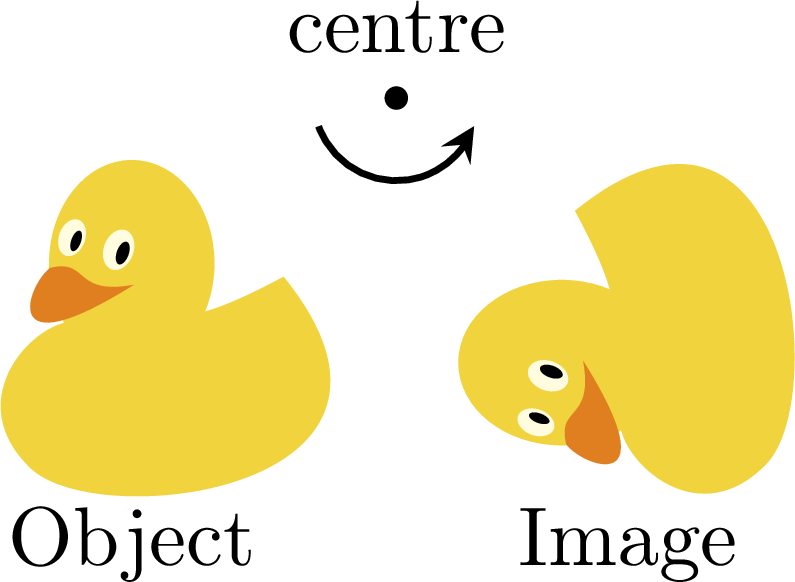
- Rotation (a turn): Turns the shape around a fixed point (called the centre of rotation). The shape keeps the same shape and size.
- Reflection (a flip): Flips the shape across a line (called the line of reflection) to make a mirror image.

Skills to practice
- Identifying Types of Transformations
- Describing a Transformation Exactly
II
The Line of Symmetry
Definition — Line of Symmetry
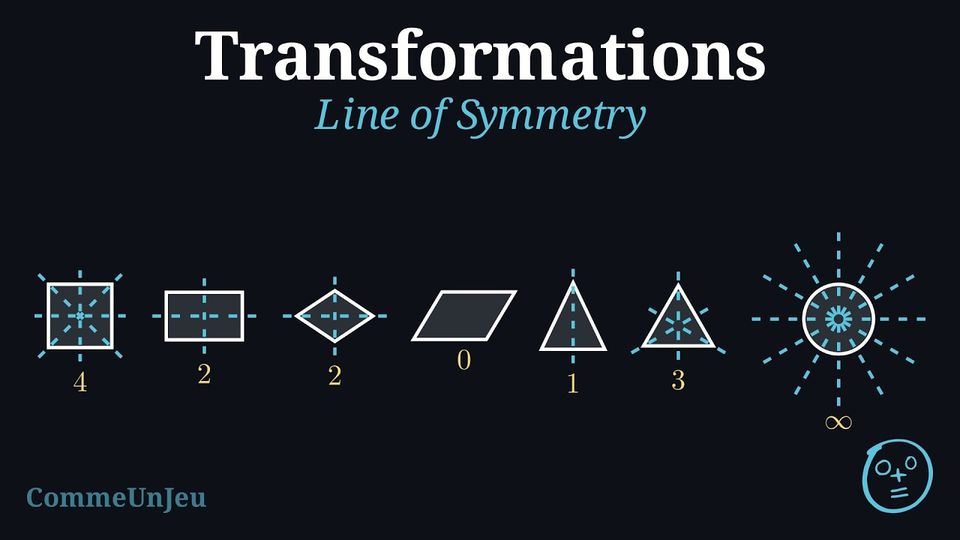
A line is a line of symmetry of an object (also called an axis of symmetry) when the reflection of the object in this line fits exactly onto the object. 
Skills to practice
- Counting Lines of Symmetry
III
Patterns
Definition — Pattern
A pattern is a design made by repeating the same move of a shape again and again: a slide, a flip or a turn (also called a translation, a reflection or a rotation). Skills to practice
- Drawing Patterns
IV
Tessellations
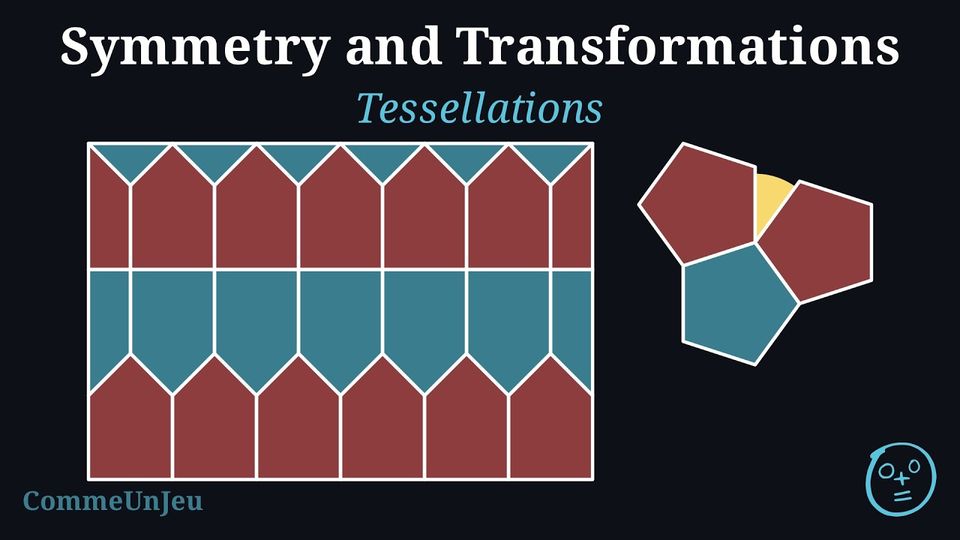
Noah covers a wall with square tiles. Léa wants to cover the wall next to it with tiles shaped like a regular pentagon, all the same size. Noah's tiles fit together perfectly; Léa's tiles leave gaps, however she places them. 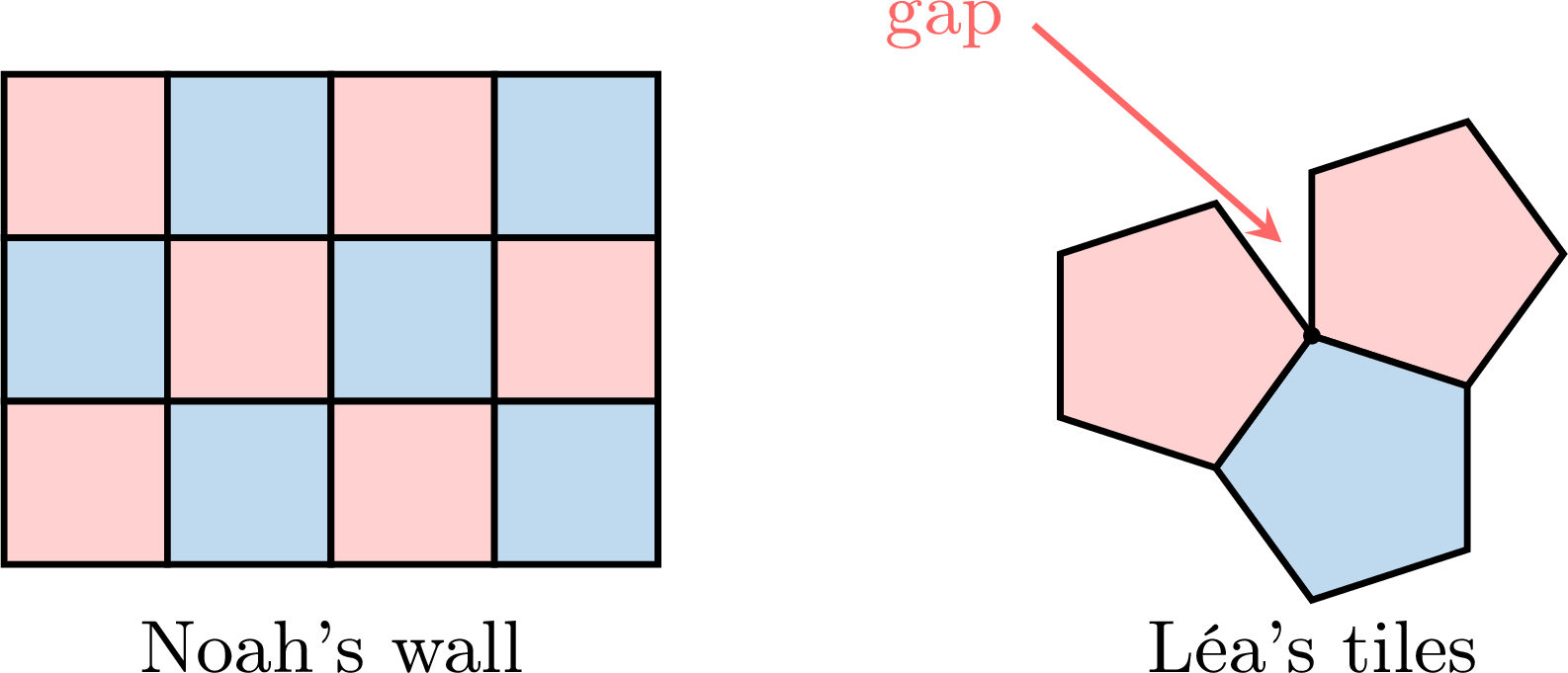
Why do some shapes cover a wall perfectly, and others do not?
Noah's square tiles fit together with no gaps and no overlaps: at each corner of the grid, four square corners fill the whole turn around the point. Around a point, three corners of Léa's pentagons do not fill the whole turn: a gap is left, and a fourth pentagon does not fit in it — it would overlap the others. Whether a shape can cover a surface depends on its corners: around every point where tiles meet, the tiles must fill the whole turn exactly, with no gap and no overlap.
Definition — Tessellation
A tessellation is a pattern of shapes, called tiles, that covers a flat surface with no gaps and no overlaps. A shape tessellates when copies of it, slid, turned or flipped, can make a tessellation. At the edge of a surface, such as a wall, tiles may be cut. 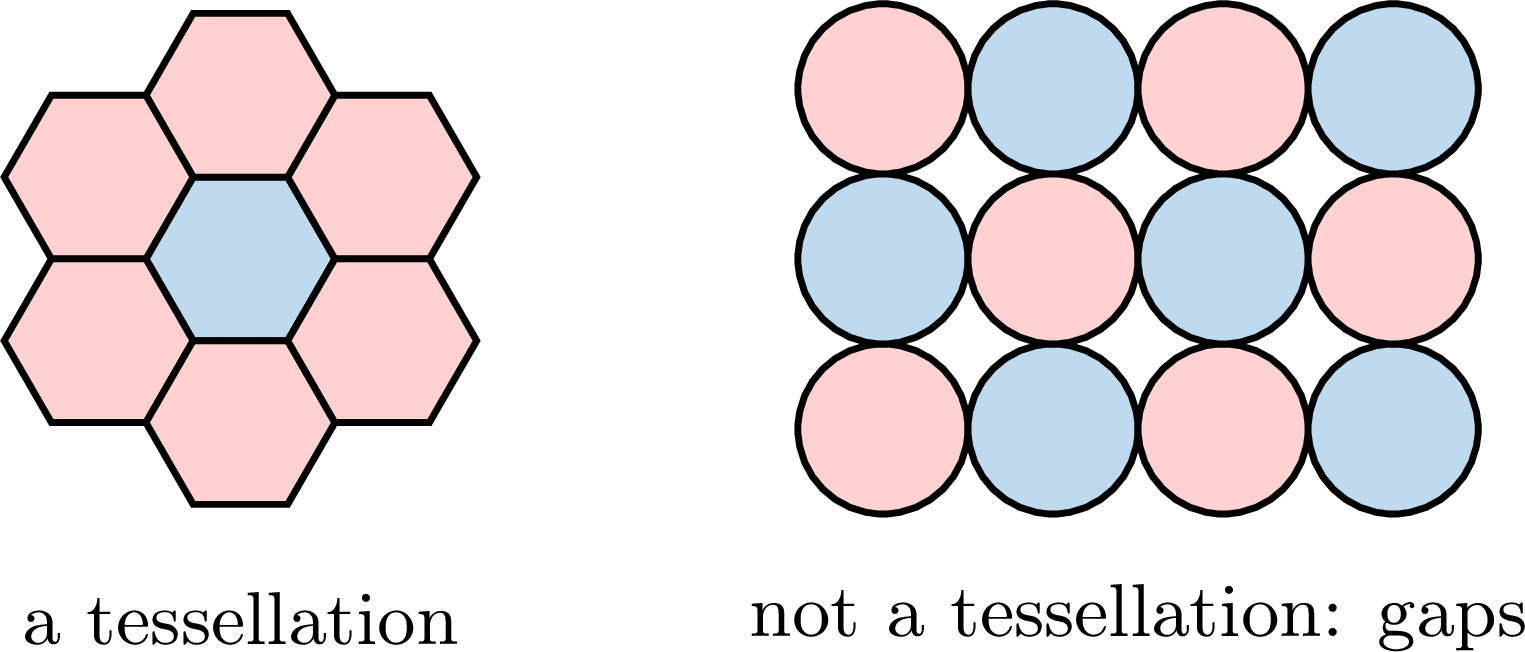
Method — Checking Whether a Shape Tessellates
Look at a point where corners of tiles meet. - Place copies of the shape around the point, each one touching the next along a side (cut-out copies or tracing paper help).
- The corners around the point must fill the whole turn exactly: no gap and no overlap.
- If a gap is left, or a copy has to overlap another one, the shape does not tessellate this way. If the corners fill the whole turn, carry on around the next points.
Example
Here are five regular shapes: all their sides have the same length and all their corners are the same. Which of them tessellate by themselves, with copies of one shape only? 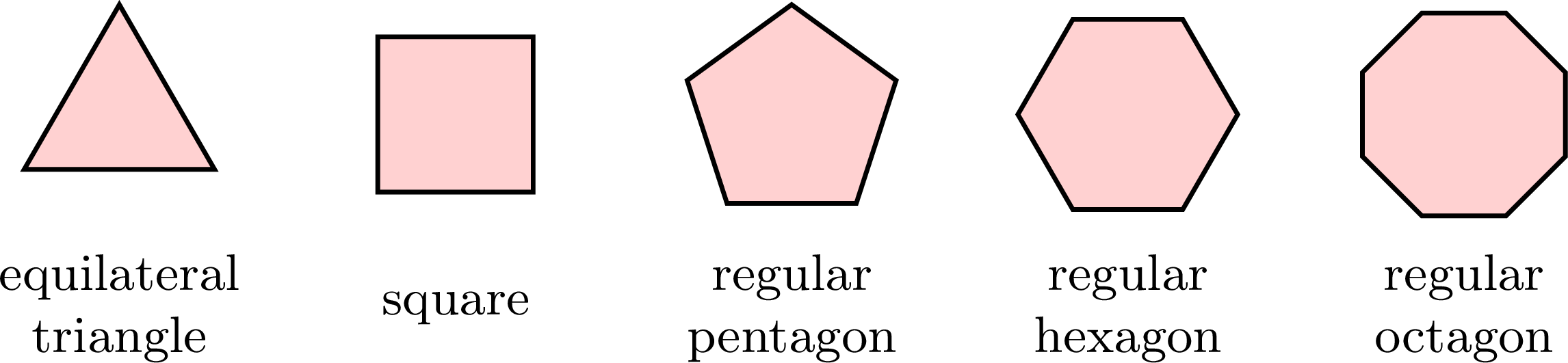
Place copies around a point. 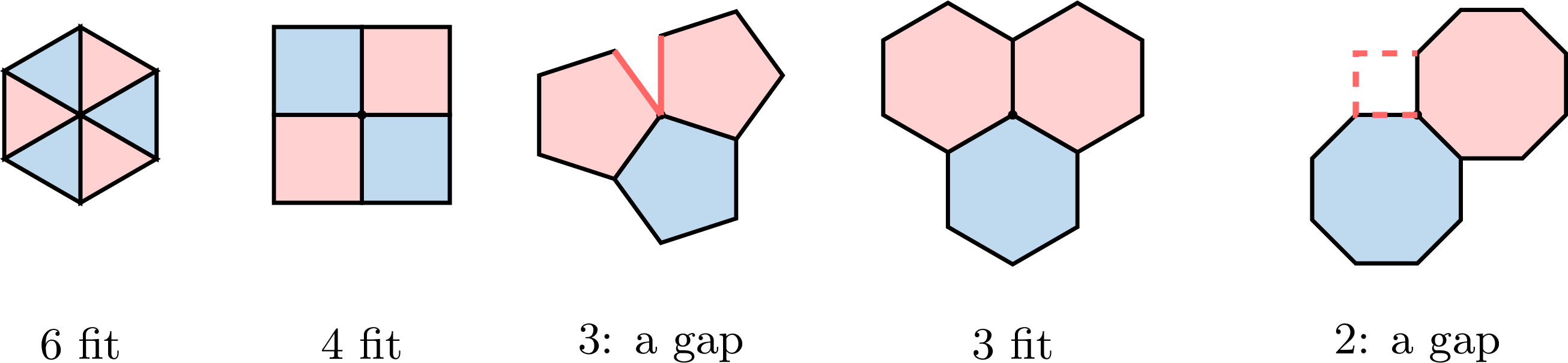
- Equilateral triangle: \(6\) corners fill the whole turn. It tessellates.
- Square: \(4\) corners fill the whole turn — four right angles, and \(4 \times 90^\circ = 360^\circ\). It tessellates.
- Regular pentagon: \(3\) corners leave a gap, and a fourth copy would overlap. It does not tessellate.
- Regular hexagon: \(3\) corners fill the whole turn, as in a honeycomb. It tessellates.
- Regular octagon: \(2\) corners leave a gap (a square would fit in it), and a third copy would overlap. It does not tessellate by itself.
Method — Making a Tessellation with One Tile
- Draw the tile on squared paper, or cut several copies out of card.
- Slide a copy until it touches the tiles already placed, with no gap; repeat to make a row.
- If a copy does not fit, turn it (often a half turn) or flip it, then try again.
- Slide copies of the whole row upwards — and sideways if needed — to cover the surface, row after row; a row of turned tiles may be needed in between.
- Check every point where corners meet: no gap, no overlap.
Example
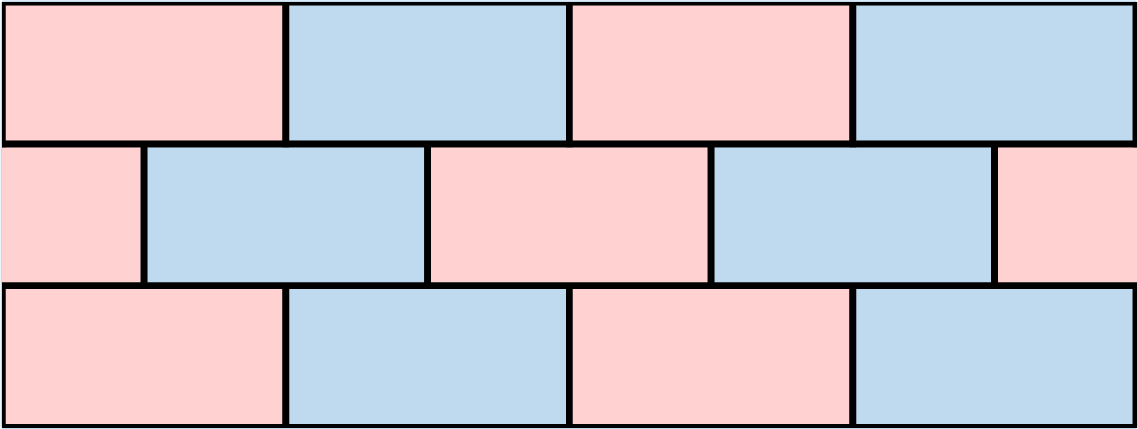
A wall is built with bricks shaped like a rectangle \(2\) squares long and \(1\) square high. Show how to cover the wall with this brick, using slides only. 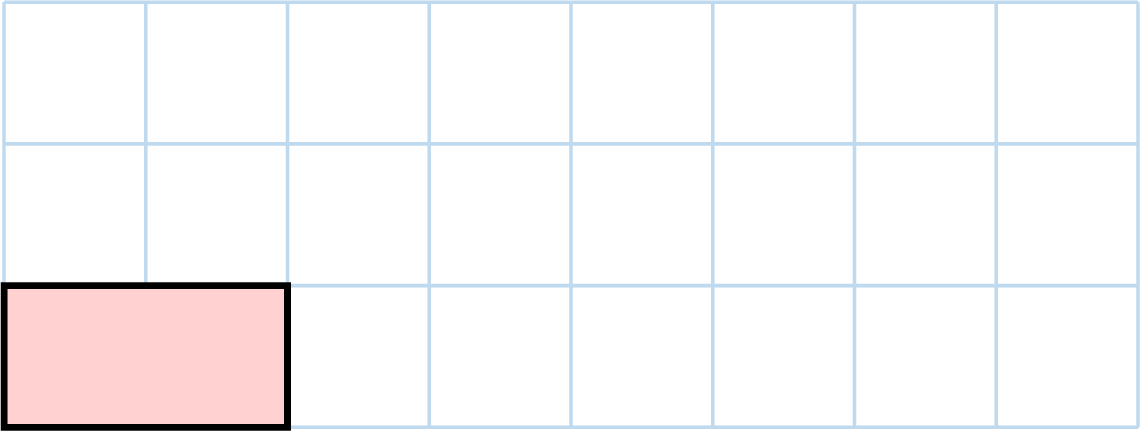
Example
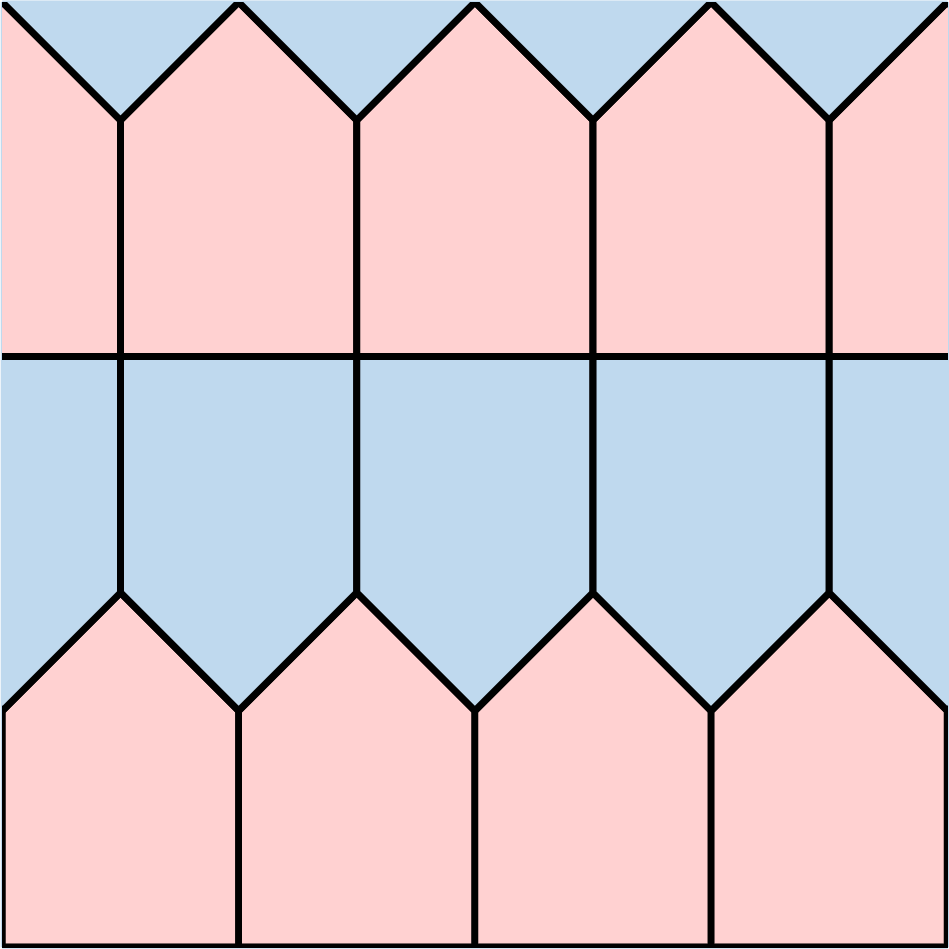
This tile looks like a house: it has five sides. Show that it tessellates, using slides and half turns. 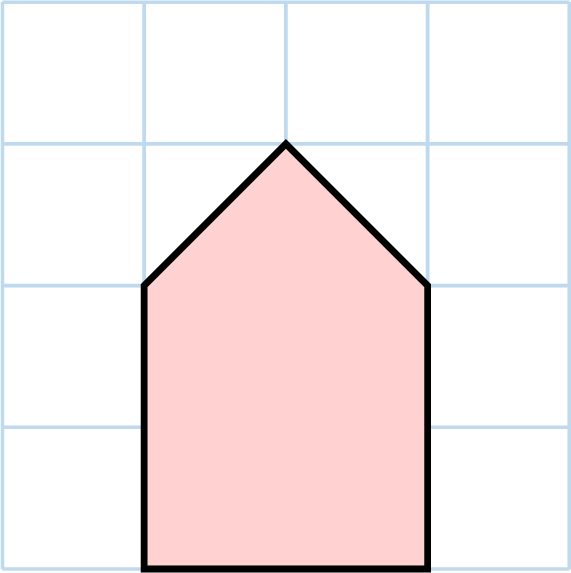
Skills to practice
- Deciding Whether Shapes Tessellate
- Continuing a Tessellation
V
Going further
Skills to practice
- Problems
- Quiz
Jump to section