International Baccalaureate · PYP 5
Lines and Angles
I
Perpendicular Lines
Definition — Perpendicular Lines
Two lines are perpendicular when they cross forming a right angle — the angle of the right-angle corner of a set square, the same angle as the corner of a rectangular sheet of paper. On a figure, the right angle is shown by a small square drawn in the corner: 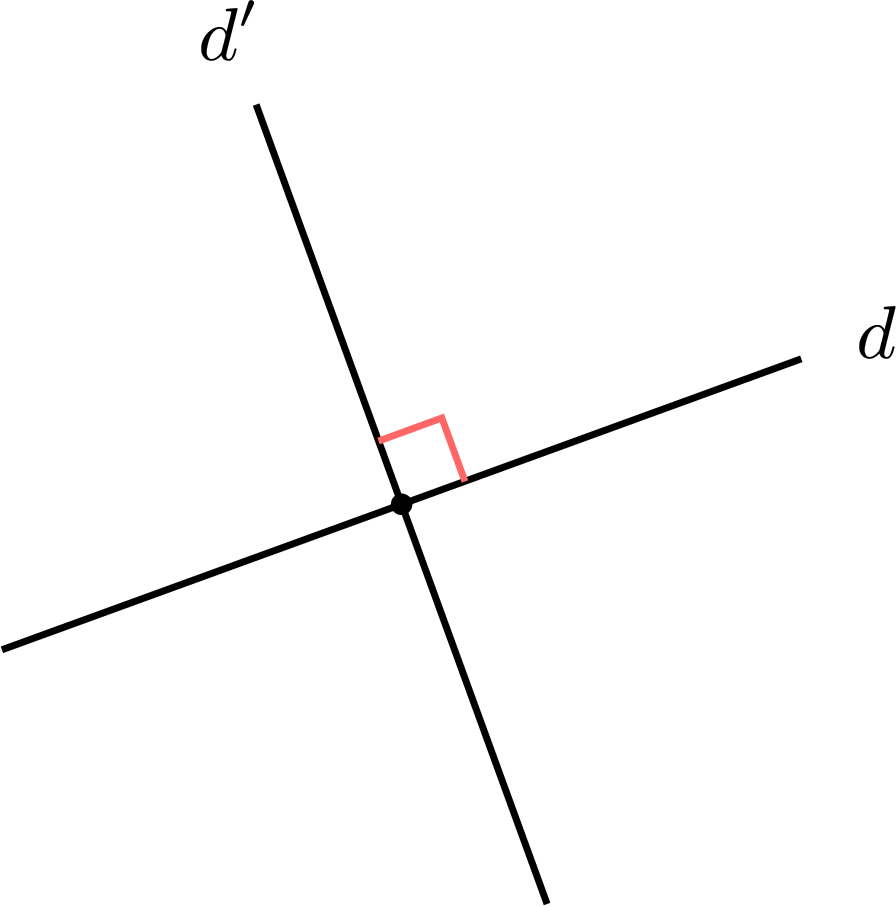
Method — Checking and Drawing with the Set Square
A set square has one right-angle corner; the two edges that meet at that corner form the right angle. Those are the ones we use — never the third side, the long one opposite the right-angle corner. - To check: place the right-angle corner on the crossing point, one of its two edges along the first line. If the second line follows the other edge exactly, the lines are perpendicular; if it moves away from that edge, they are not.
- To draw the perpendicular to a line through a point: keep one edge of the right angle pressed along the line and slide it until the other edge passes through the point, then draw along that other edge. The right-angle corner ends up on the line, at the point where the new line meets it: that point is called the foot of the perpendicular.
Example
Léa has placed her set square (in grey) to check the lines \(d\) and \(d'\): the right-angle corner is on the crossing point and one edge lies along \(d\). Are the two lines perpendicular? 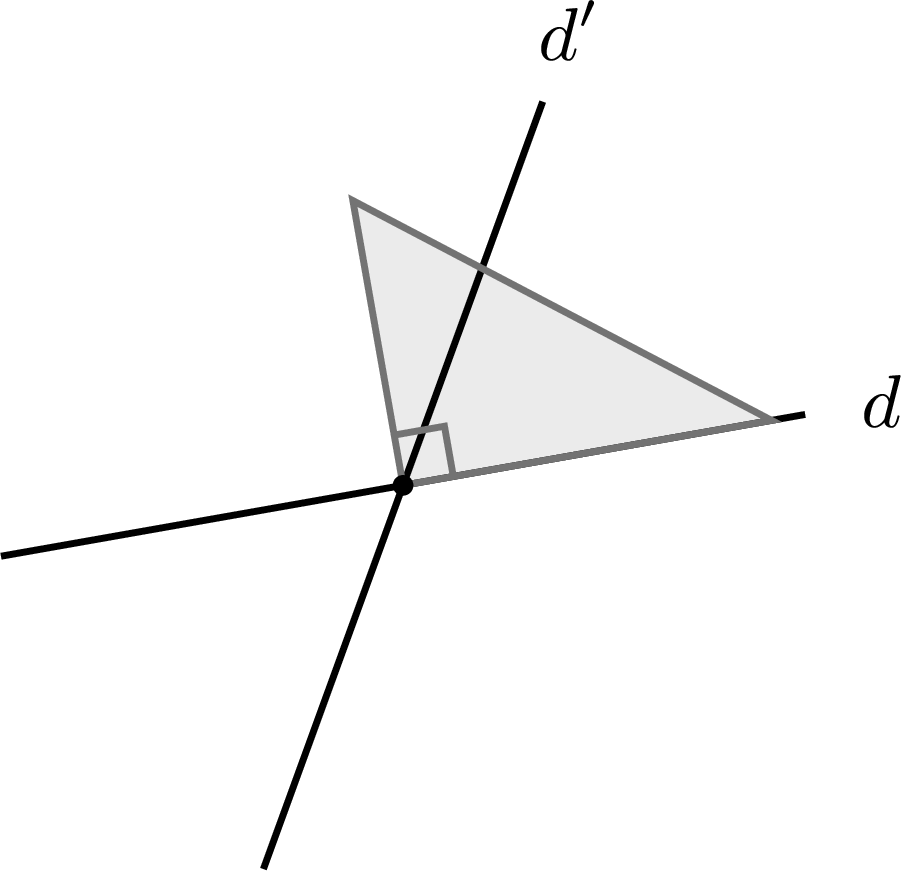
No. The line \(d'\) does not follow the second edge of the right angle: it moves away from it. The lines \(d\) and \(d'\) cross, but not at a right angle — they are not perpendicular. Had \(d'\) followed that edge exactly, they would have been perpendicular and we would mark the small square.
Example
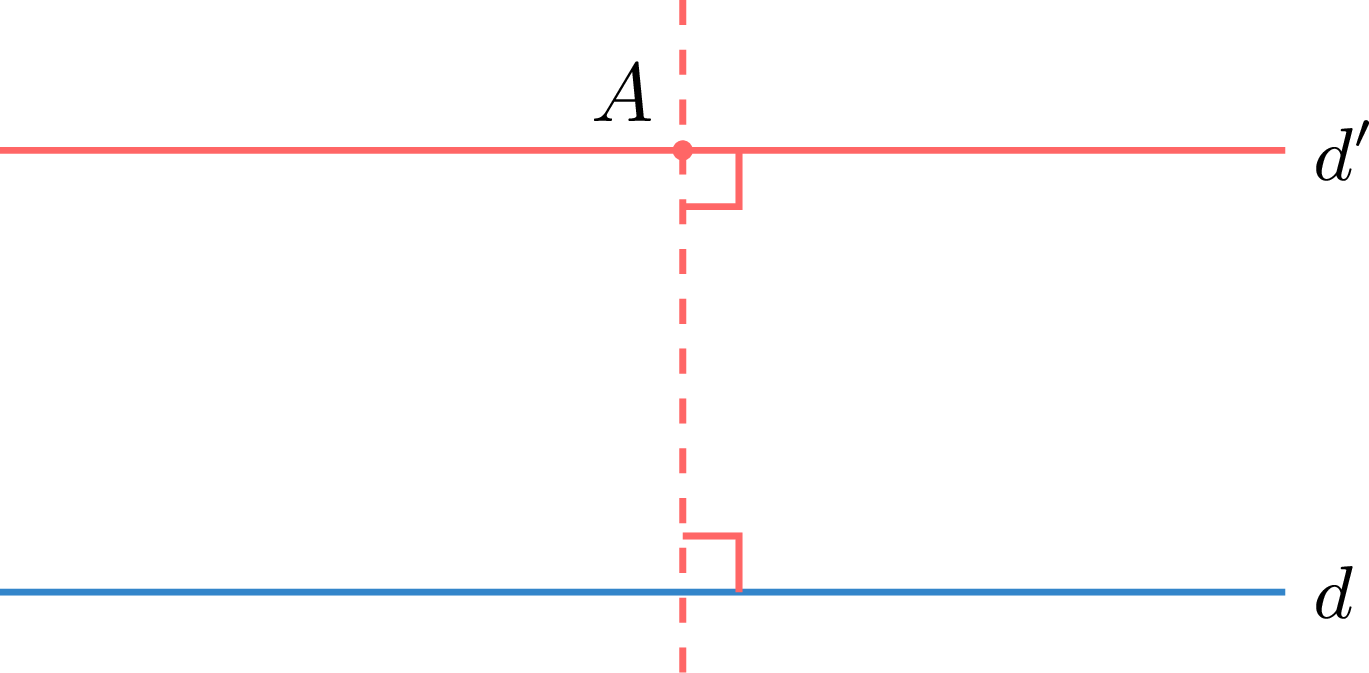
Draw the line perpendicular to \(d\) passing through the point \(A\). 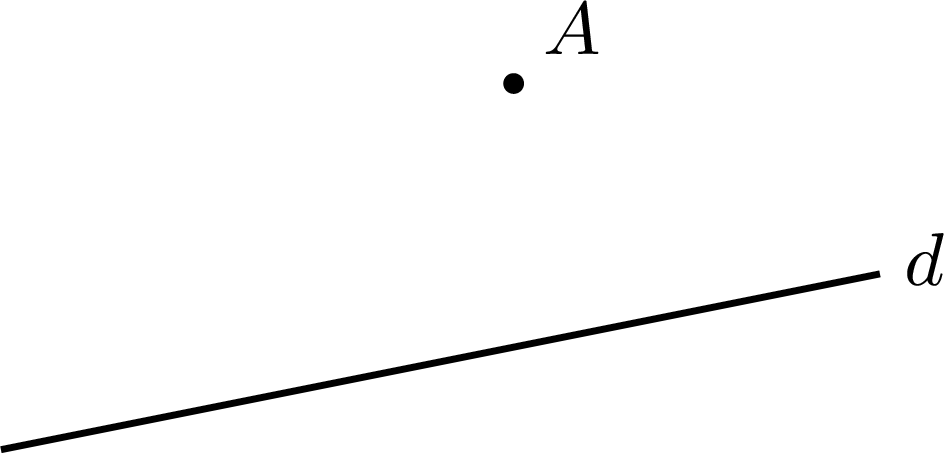
Keep one edge of the right angle along \(d\) and slide the set square until the other edge passes through \(A\), then draw along that other edge. The new line crosses \(d\) at a right angle, marked with a small square; the crossing point is the foot of the perpendicular: 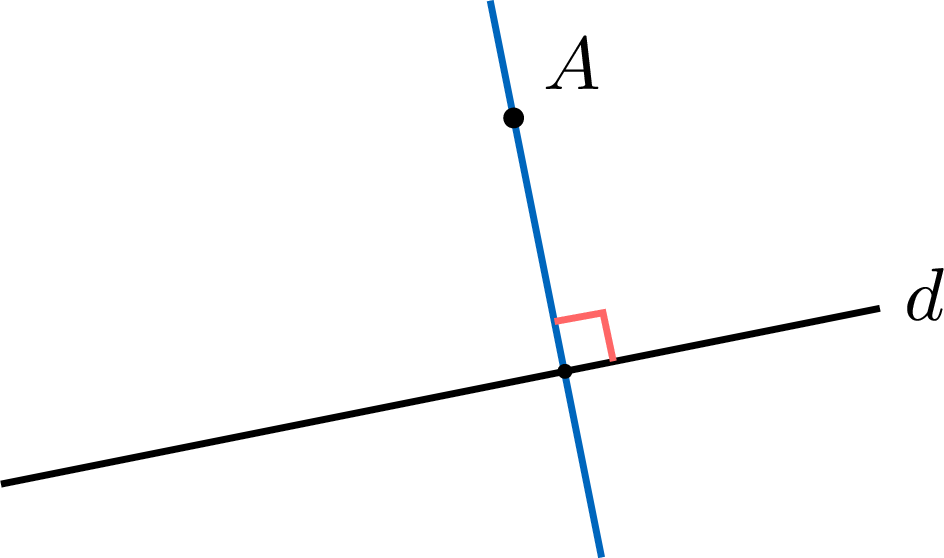
Skills to practice
- Recognising Perpendicular Lines
- Drawing a Perpendicular Line
- Using the Set Square
II
Parallel Lines
Definition — Parallel Lines
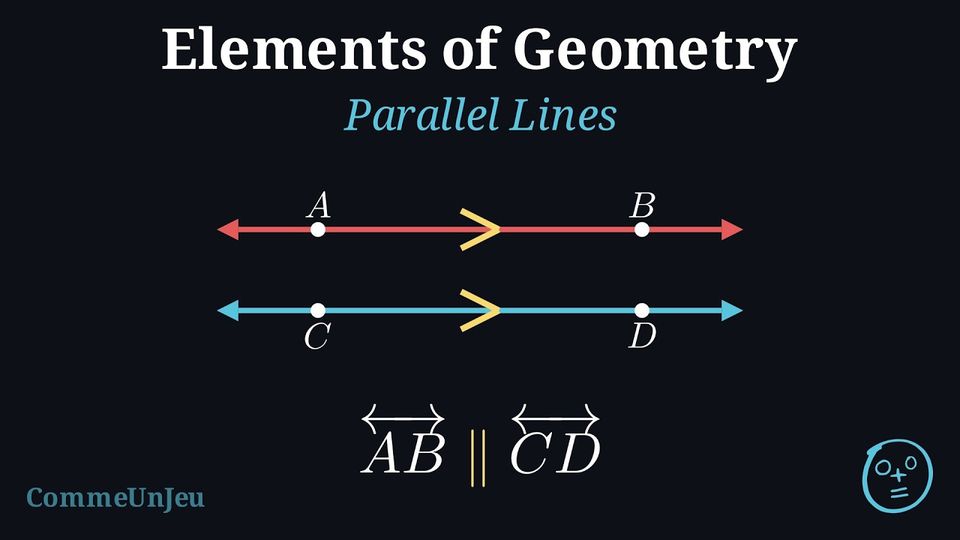
Two parallel lines are two lines that never meet, even when extended — or else the same line drawn twice: they are then said to be coincident, and they count as parallel too. Two distinct parallel lines stay the same distance apart, a distance measured perpendicularly. 
Definition — Parallel Line Notation
We write \(\Line{AB} \parallel \Line{CD}\) to show that line \(\Line{AB}\) is parallel to line \(\Line{CD}\). On a diagram, parallel lines are also shown using matching little arrows on each line. 
Proposition — Two Perpendiculars to the Same Line
If two distinct lines are both perpendicular to the same third line, then they are parallel: however far you extend them, they keep the same distance apart and never meet. 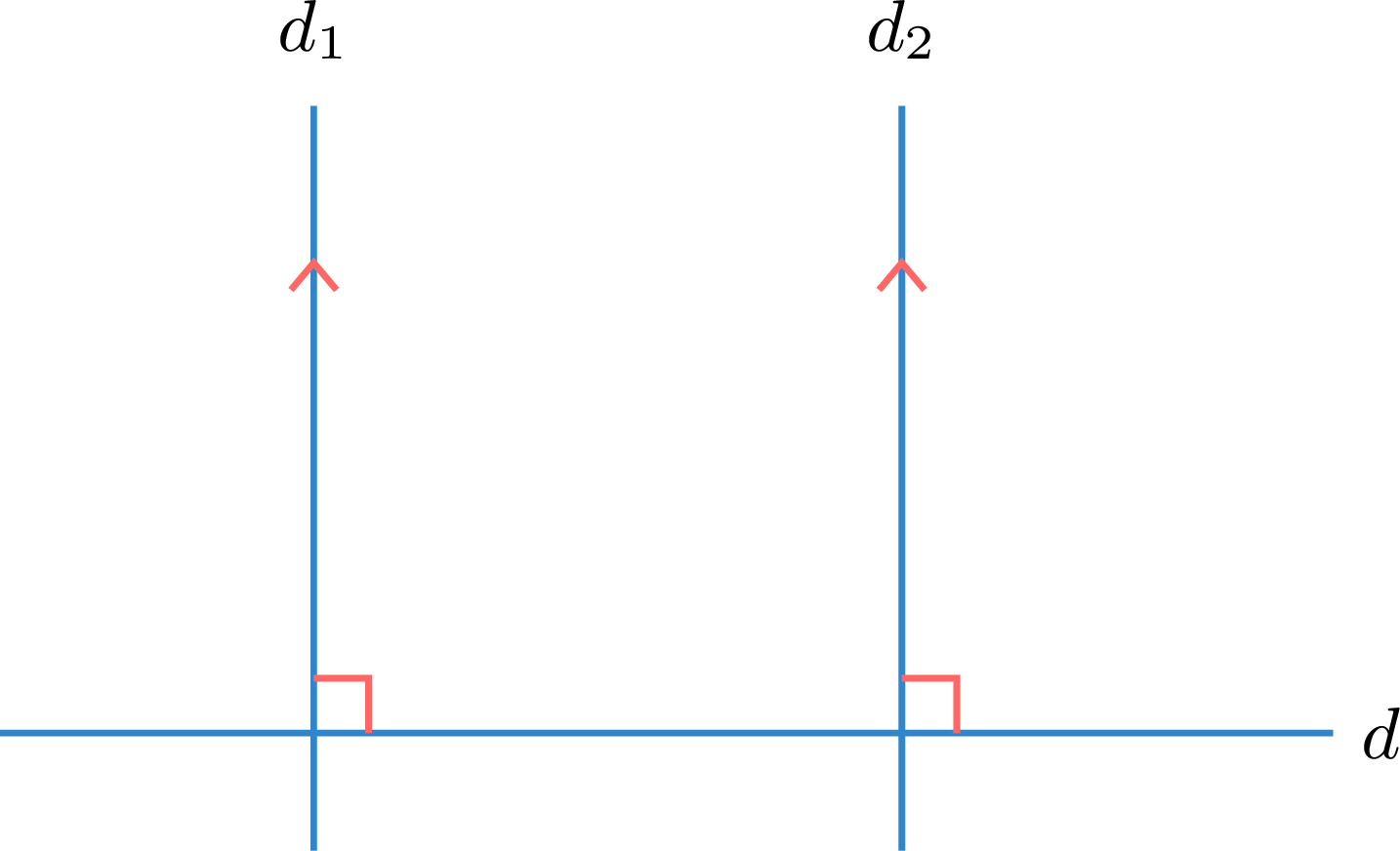
Method — Checking and Drawing Parallels with the Set Square
- To check that two lines \(d\) and \(d'\) are parallel: with the set square, draw the perpendicular to \(d\) and carry it on until it cuts \(d'\). Then check with the set square the angle it makes with \(d'\). If that angle is right, the two lines are parallel; if it is not, they are not.
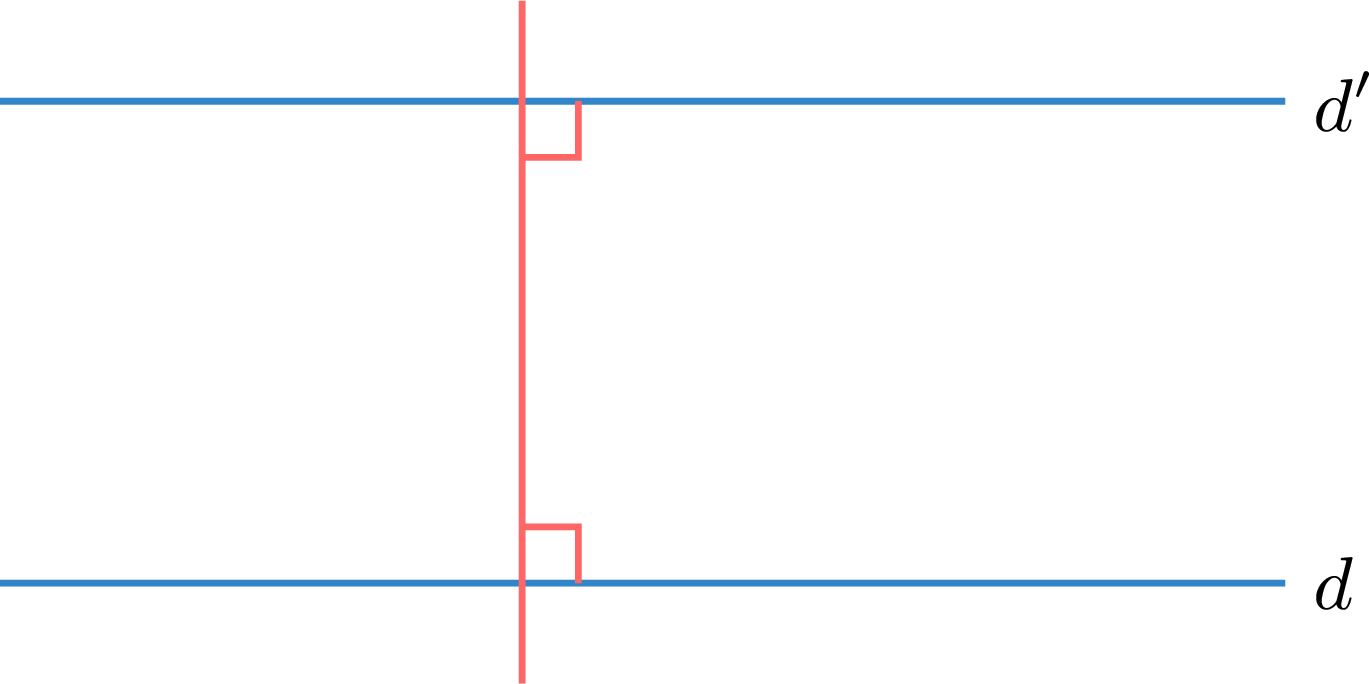
- To draw the parallel to \(d\) through a point \(A\): first draw the perpendicular to \(d\) through \(A\). Then draw the perpendicular to that line, again through \(A\). Two right angles, so the line you get is parallel to \(d\).
Example
These two lines do not meet anywhere on the sheet, and they look parallel. Are they? 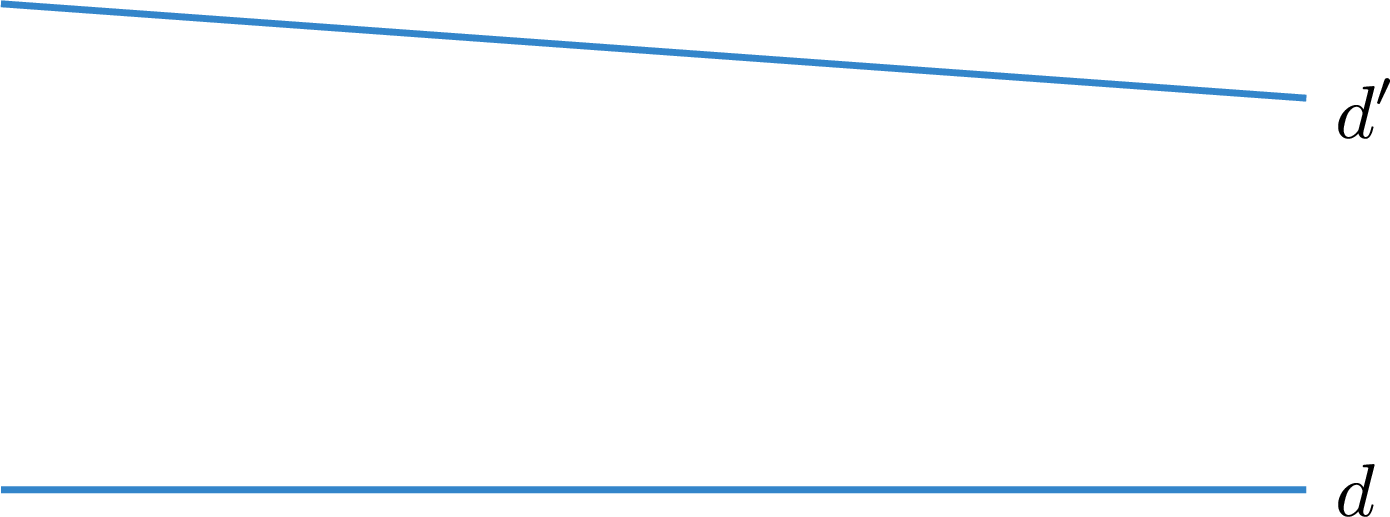
No. Draw the perpendicular to \(d\) and carry it up to \(d'\): the set square shows that the second angle is not a right angle. So \(d\) and \(d'\) are not parallel — they come closer as they go right, and they would meet well beyond the sheet. Not meeting on the sheet proves nothing. 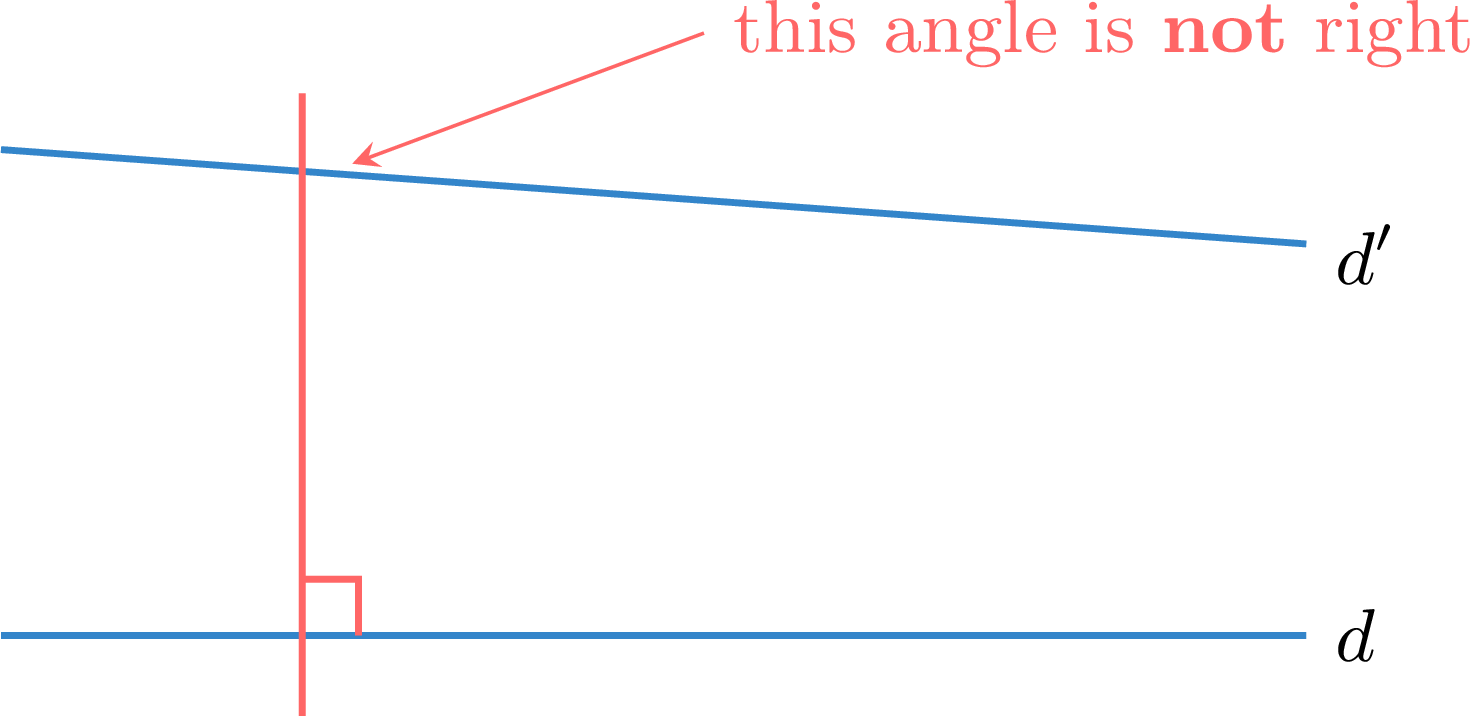
Example
Here is a line \(d\) and a point \(A\) that is not on it. How do we draw the line through \(A\) that is parallel to \(d\)?
In two strokes, both with the set square. First: draw the perpendicular to \(d\) through \(A\) (shown dashed). Then: draw the perpendicular to that dashed line, through \(A\) again. The new line is perpendicular to the same line as \(d\) is, so by the proposition above it is parallel to \(d\) — and it passes through \(A\), as asked.
Skills to practice
- Identifying Parallel Lines
- Drawing a Parallel Line
- Using Parallel Lines
III
Measuring and Drawing Angles with a Protractor
Definition — Protractor
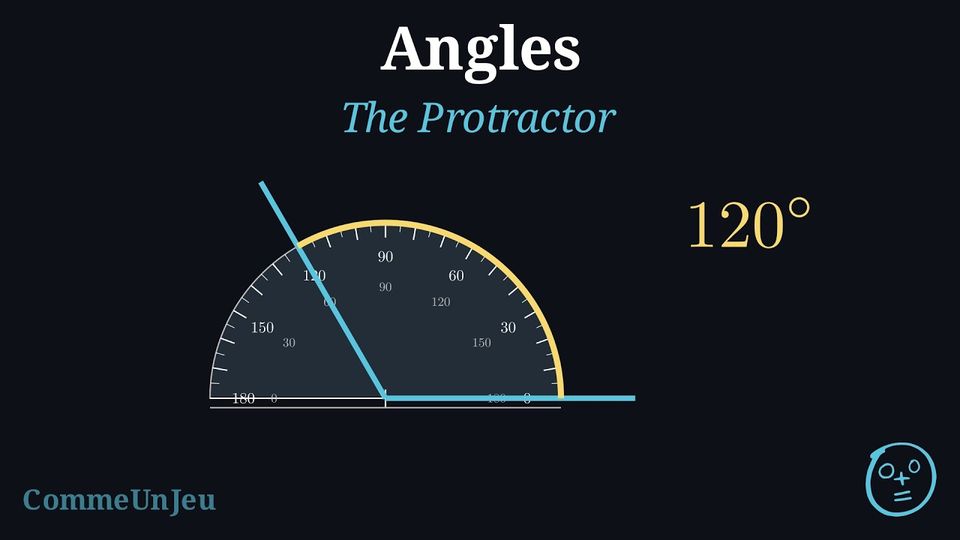
A protractor is a tool used to measure and draw angles in degrees. It is typically a semi-circular tool with a scale marked from \(0^\circ\) to \(180^\circ\). 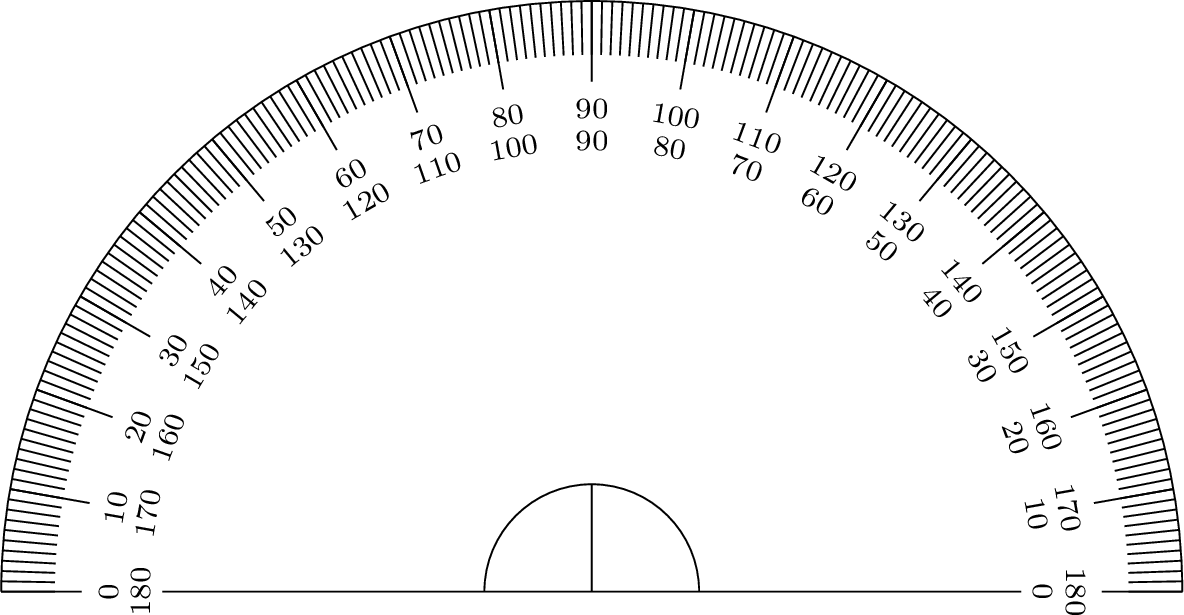
Method — Measuring an Angle with a Protractor
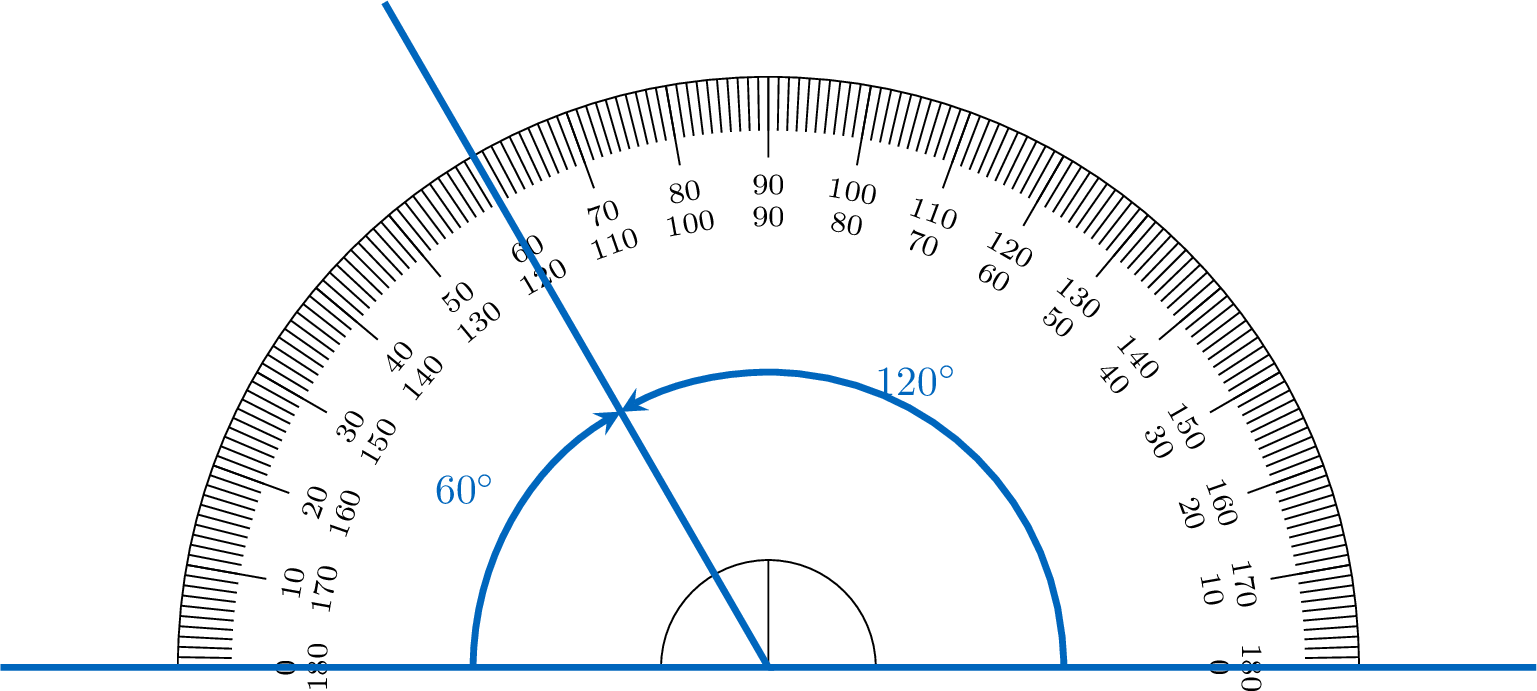
- Place the protractor’s origin (centre point) over the vertex of the angle.
- Align one ray of the angle with the protractor’s baseline (the \(0^\circ\) mark).
- Observe where the other ray intersects the protractor’s scale.
- Read the angle measure in degrees from the correct scale (the one that starts at \(0^\circ\) on your first ray).
Method — Estimating an Angle with Benchmark Angles
Without a protractor, an angle is estimated by comparing it with a few angles we know well, the benchmark angles: - the right angle, \(90^\circ\) — the corner of the set square;
- half a right angle, \(45^\circ\) — the corner of the set square cut into two equal openings;
- the straight angle, \(180^\circ\) — two right angles side by side, the two arms in a straight line.
Example
Measure the following angle. 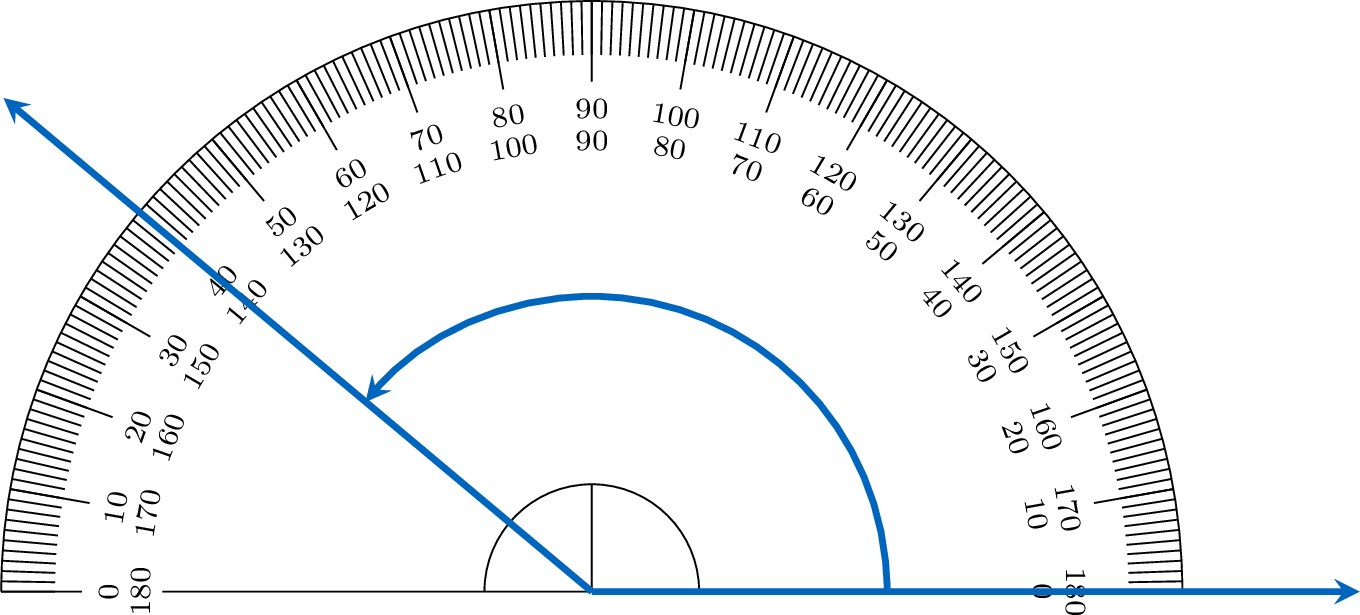
The second ray points to \(140^\circ\) on the protractor, so the angle measures \(140^\circ\).
Method — Drawing an Angle with a Protractor
- Draw a ray starting from a point (the vertex).
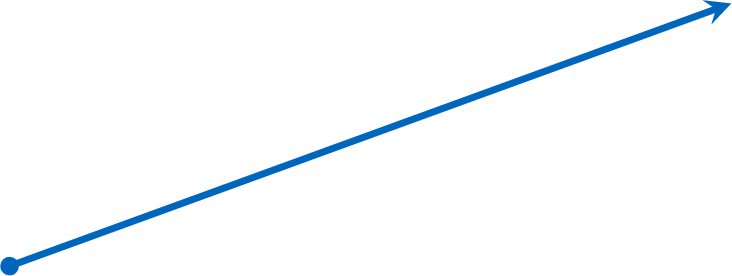
- Place the protractor’s origin over the vertex and align the baseline with the ray.
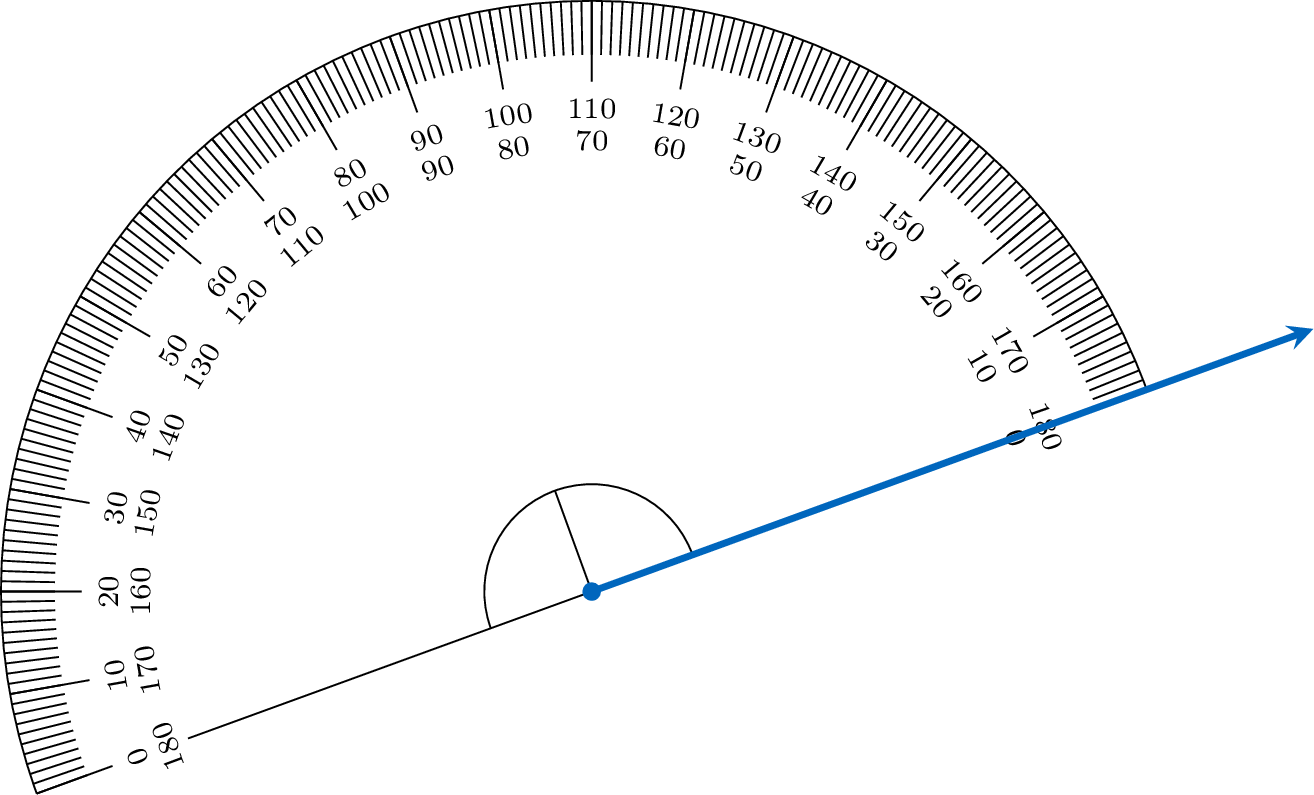
- Locate the desired angle measure on the protractor’s scale and mark the point.
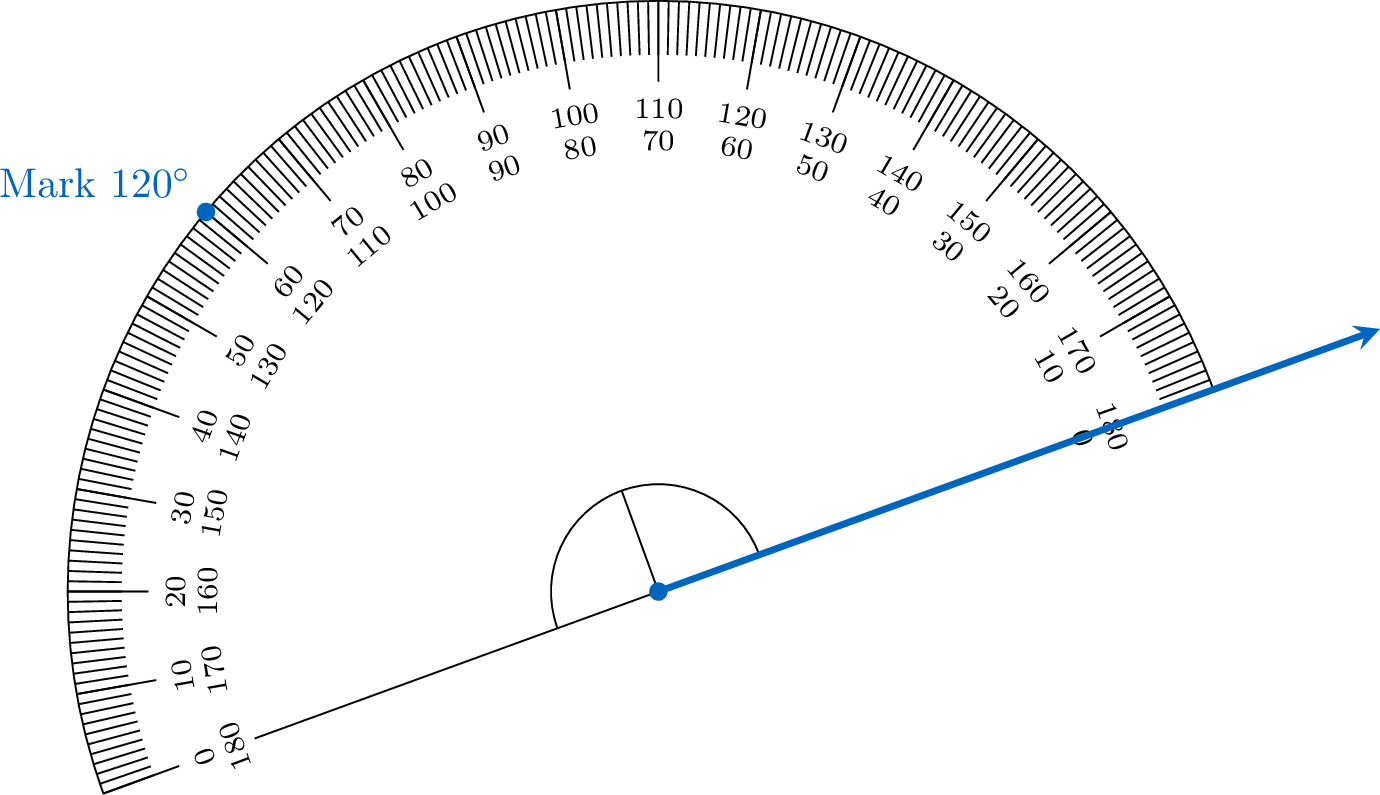
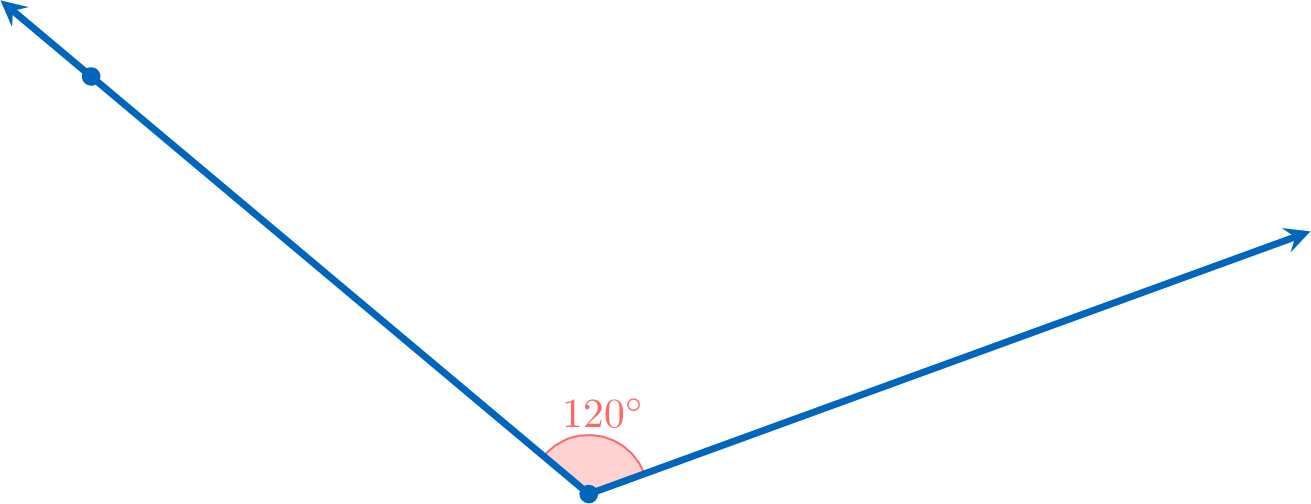
- Draw a second ray from the vertex through the marked point to form the angle.
Skills to practice
- Estimating, then Choosing the Measure
- Reading the Protractor
- Constructing Angles
IV
Sums, Multiples and Halves of Angles
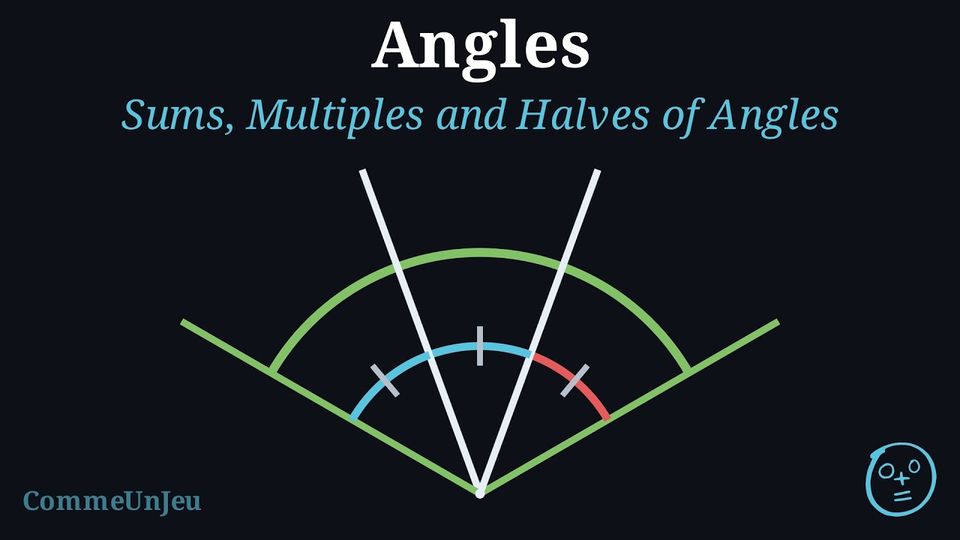
Without any measuring instrument, how can you build an angle exactly twice as big as a given angle? With tracing paper: copy the angle, then place the copy edge to edge against the original — same vertex, one arm shared. The two angles together make one bigger angle: the double. 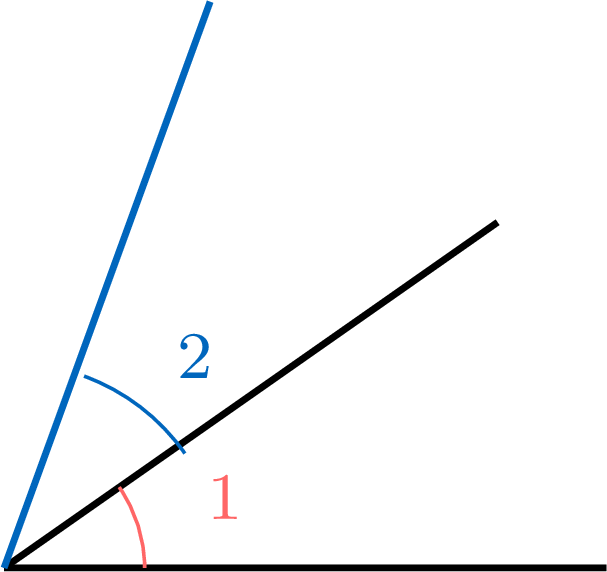
Method — Constructing a Sum or a Multiple of Angles
To construct the sum of two angles, without measuring: - Copy the first angle with tracing paper.
- Place the second angle edge to edge against it: same vertex, one arm shared, the two angles side by side without overlap.
- The whole angle obtained is the sum of the two.
Method — Folding the Half of an Angle
To construct half of an angle, without measuring: - Copy the angle on tracing paper.
- Fold the paper through the vertex, so that one arm lands exactly on the other.
- The fold line splits the angle into two equal halves.
Example
The first angle below measures \(60^\circ\) (one-sixth of a full turn) and the second \(30^\circ\). Predict the measure of their sum, construct it edge to edge with tracing paper, then say how to check the result without a protractor. 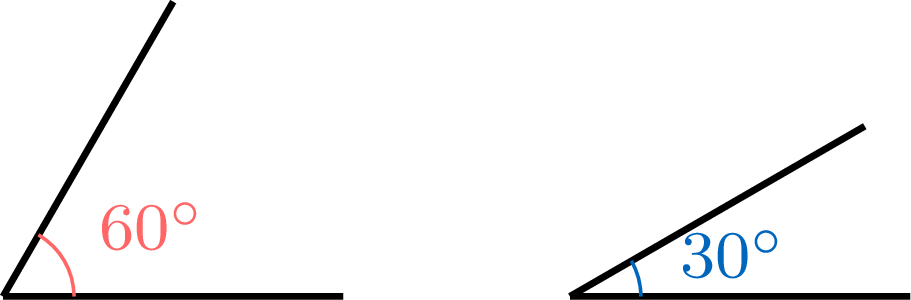
Skills to practice
- Predicting Sums in Degrees
- Constructing Sums and Multiples
- Folding the Half
- Solving Problems with Sums of Angles
V
Zero, Full and Reflex Angles
Definition — Classification of Angles
| Name | Fraction of a Full Turn | Angle Measure | Figure |
| Acute Angle | Less than \(\dfrac{1}{4}\) of a full turn | More than \(0^{\circ}\), less than \(90^{\circ}\) | 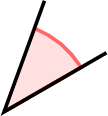 |
| Right Angle | \(\dfrac{1}{4}\) of a full turn | Exactly \(90^{\circ}\) | 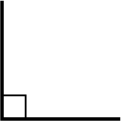 |
| Obtuse Angle | Between \(\dfrac{1}{4}\) and \(\dfrac{1}{2}\) of a full turn | More than \(90^{\circ}\), less than \(180^{\circ}\) | 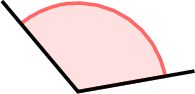 |
| Straight Angle | \(\dfrac{1}{2}\) of a full turn | Exactly \(180^{\circ}\) | 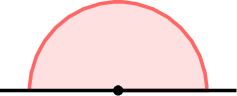 |
Definition — Zero Angle and Full Angle
Two more angles complete the classification, the two extremes. - A zero angle measures \(0^\circ\): its two arms lie on top of each other, the turn is not started.
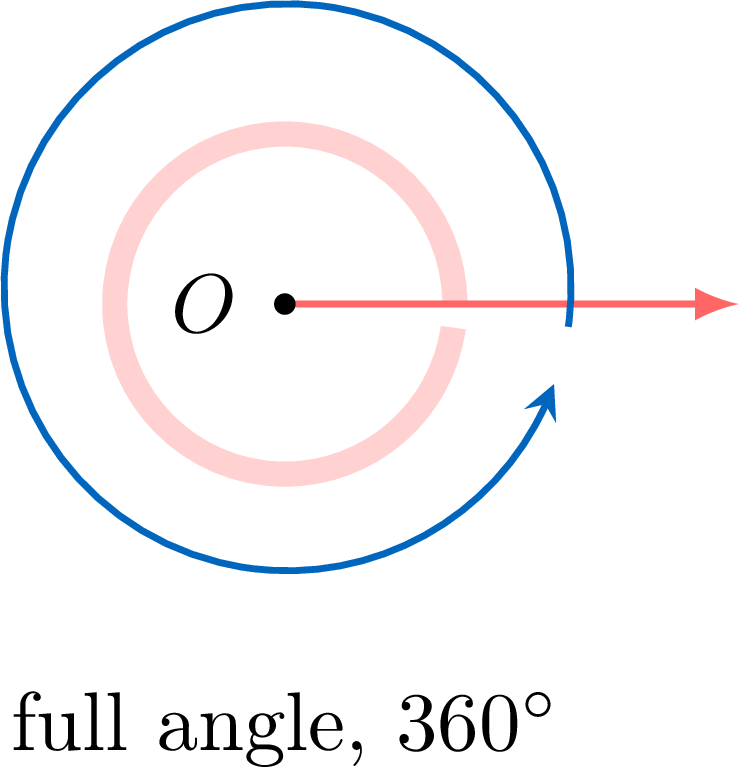
- A full angle measures \(360^\circ\): its two arms lie on top of each other again, after one complete turn.
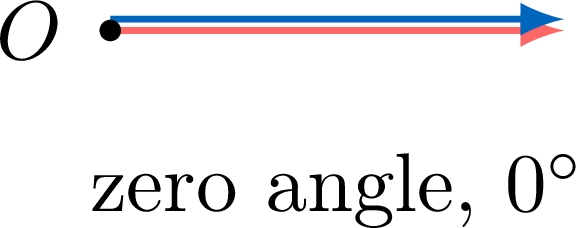
Definition — Reflex Angle
An angle whose measure is greater than \(180^\circ\) and less than \(360^\circ\) is a reflex angle. It is the “large” opening, turning the long way round. 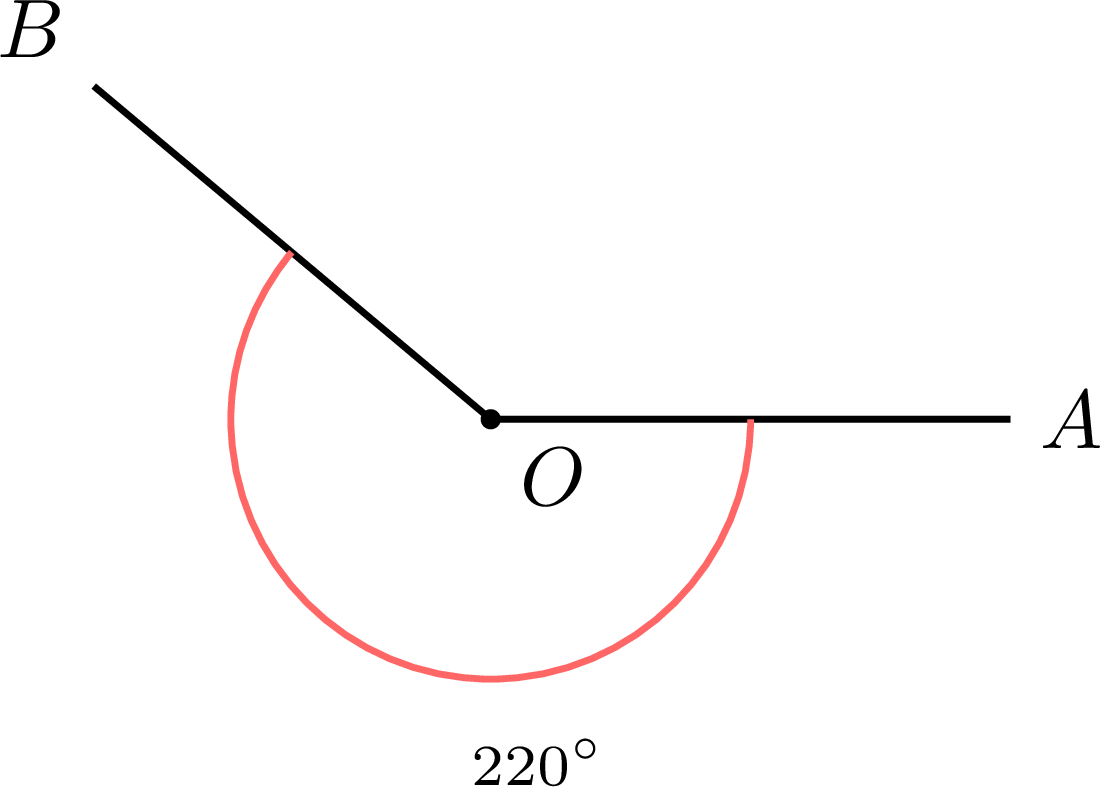
Method — Measuring a Reflex Angle
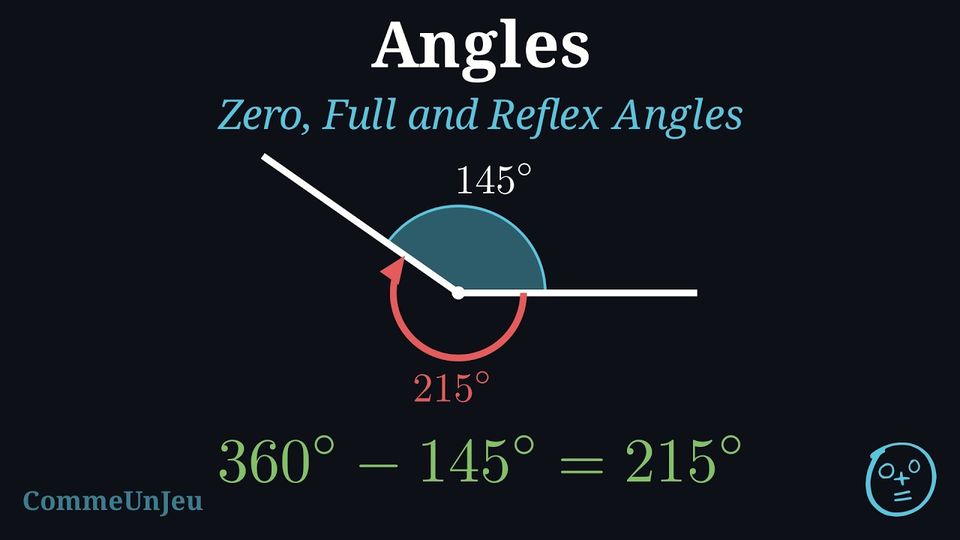
A protractor reads angles up to \(180^\circ\) only: it cannot read a reflex angle directly. To measure a reflex angle: - Measure the other angle formed by the two arms, the one smaller than a half turn, with the protractor.
- The two angles together go once round the vertex: they make a full turn, \(360^\circ\).
- Subtract the measure found from \(360^\circ\): reflex angle \(= 360^\circ -\) other angle.
Example
The arc marks a reflex angle. Measure it with a protractor. 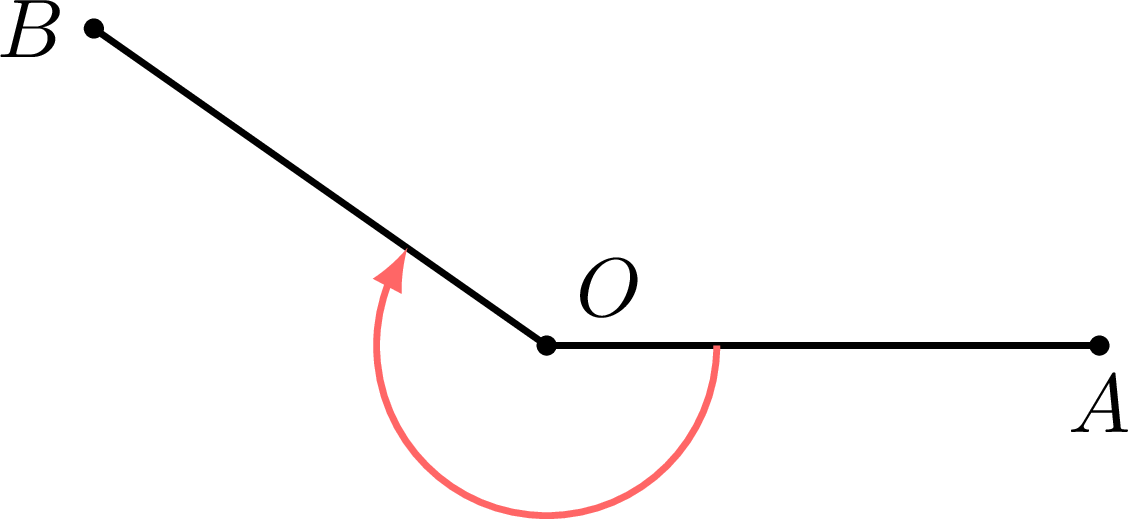
The protractor cannot read the reflex angle, so we measure the other angle: centre on \(O\), \(0^\circ\) on \(\Ray{OA}\); the ray \(\Ray{OB}\) points to \(145^\circ\) on the inner scale. 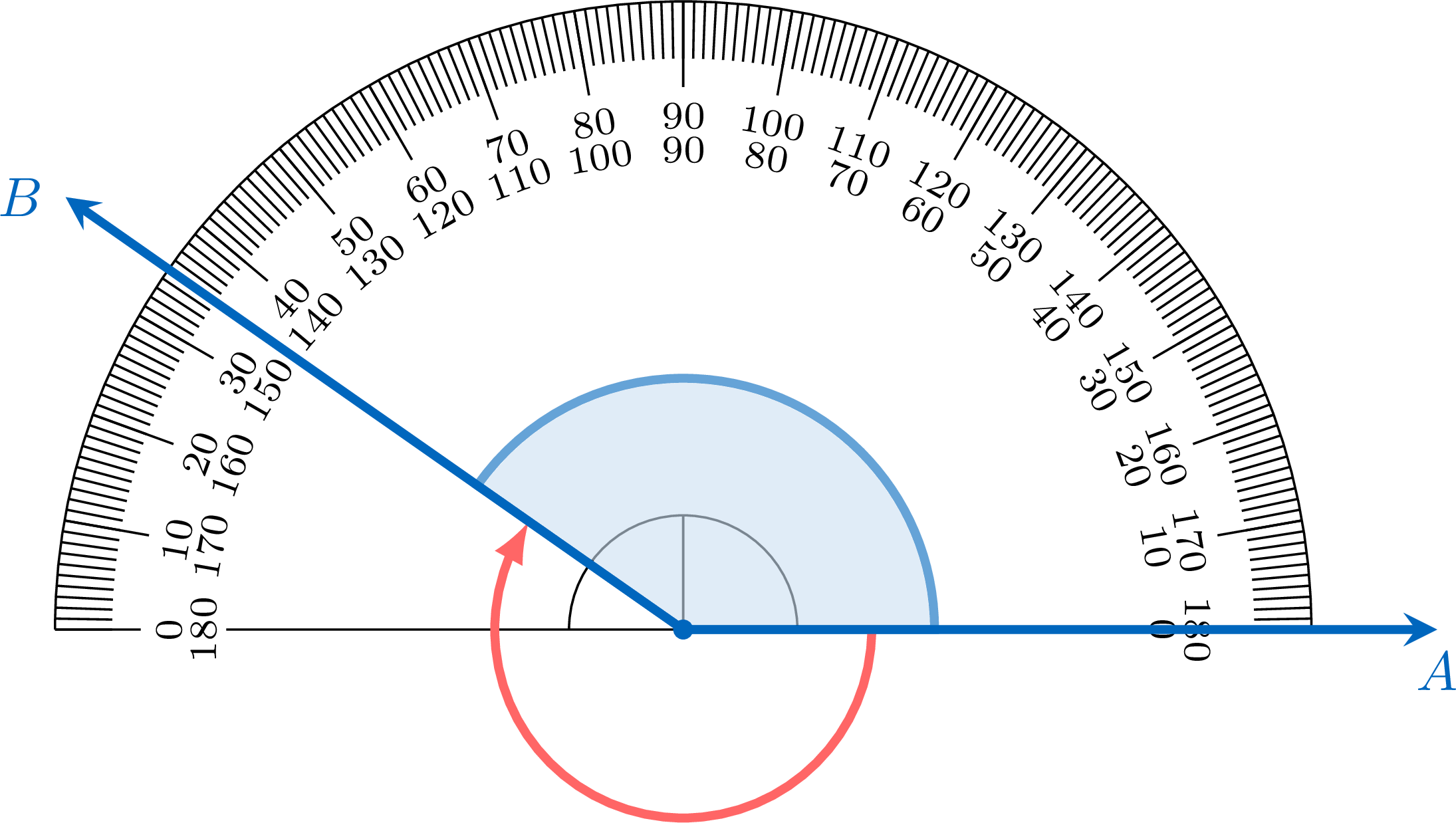
The two angles make a full turn: $$\begin{aligned}[t] \text{reflex angle} &= 360^\circ - 145^\circ\\
&\qquad{\scriptstyle\text{(the two angles fill a full turn)}}\\
&= 215^\circ \end{aligned}$$ Check: \(180^\circ < 215^\circ < 360^\circ\), it is indeed a reflex angle.
Skills to practice
- Recognising Zero, Full and Reflex Angles
VI
Going further
Skills to practice
- Reasoning about Angles
- Quiz
Jump to section