International Baccalaureate · PYP 4
Probability
I
Outcomes and Events
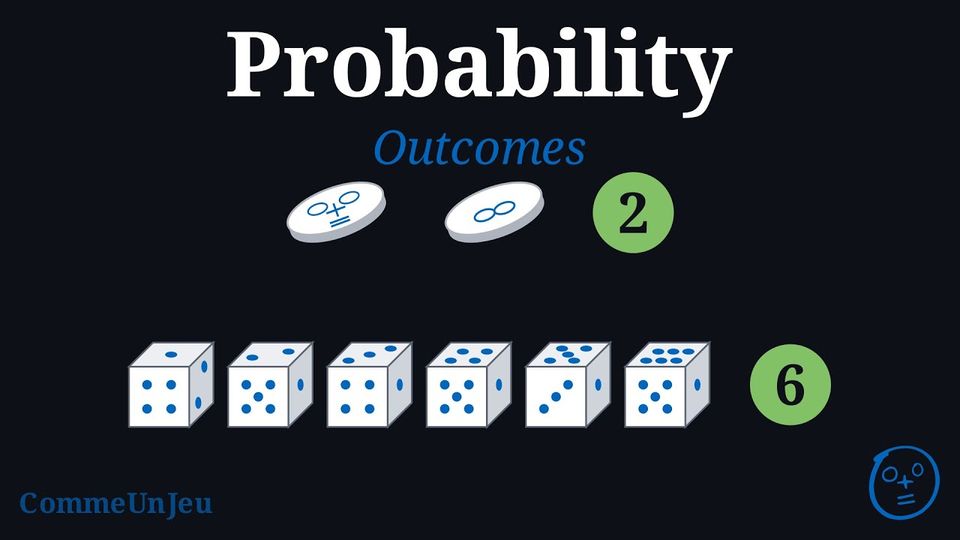
Some actions have a result we cannot predict — flipping a coin, rolling a die, or playing a game. We call such an action a random experiment: it can be repeated under the same conditions, all its possible results are known in advance, but nobody can tell with certainty which one will happen. Probability is a mathematical way to measure how likely an event of the experiment is, such as “rolling a 6” when a die is rolled.
Definition — Outcome
An outcome is one possible result of a random experiment. Definition — All Possible Outcomes
All possible outcomes are the complete list of all the outcomes that can happen in a random experiment. Example
What are all the possible outcomes when you flip a coin? 
All possible outcomes are Heads (H)= and Tails (T)=
 .
and Tails (T)=. Example
What are all the possible outcomes when you roll a six-sided die?
All possible outcomes are 1= , 2=
 , 3=
 , 4=
 , 5=
 , and 6=
 .
, 2=, 3=, 4=, 5=, and 6=. 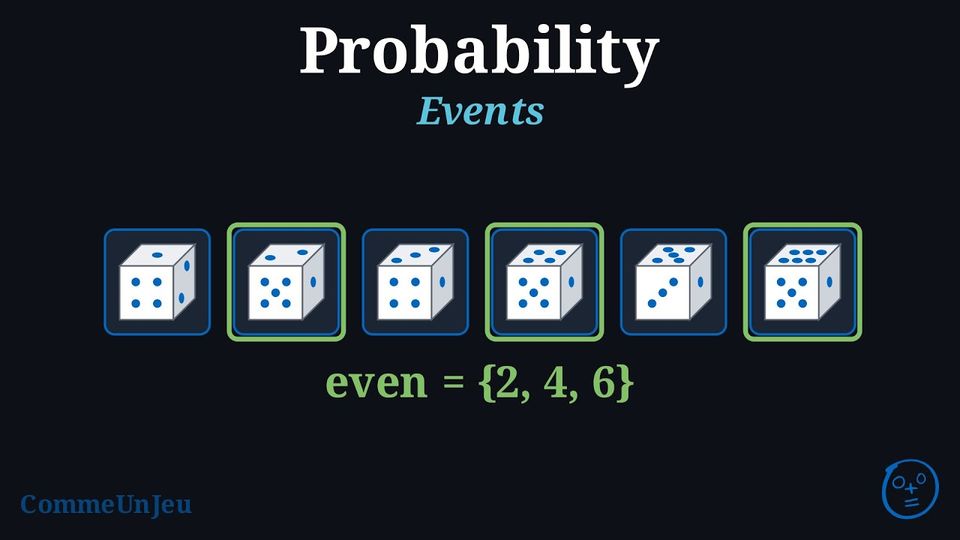
Definition — Event
An event is a set of outcomes from the set of all possible outcomes. Example
In the experiment of rolling a die, find the outcomes that correspond to rolling an even number.
The outcomes for “rolling an even number” are 2=, 4=, and 6=.
, 4=, and 6=. Skills to practice
- Identifying Outcomes for Die-Rolling Events
II
Calculating and Comparing Probabilities
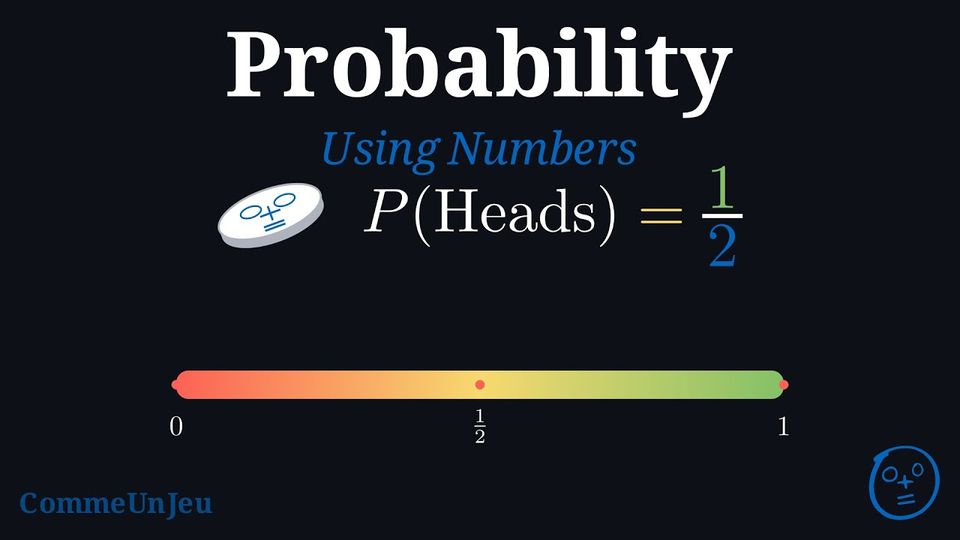
When you flip a fair coin, there are two possible outcomes: heads or tails. The chance of getting heads is 1 out of 2. We can write this as a fraction: 
Definition — Probability
The probability of an event, written \(P(\text{event})\), is a number from 0 (impossible) to 1 (certain). 
Equally Likely Outcomes
A probability can be found by counting when all the outcomes have the same chance — we say they are equally likely: a fair die, a fair coin, a fair spinner cut into equal parts, or marbles that are alike, mixed in a bag and drawn without looking (each marble is an outcome). When exactly one of the \(n\) equally likely outcomes makes the event happen, there is one chance in \(n\): \(P(\text{event}) = \frac{1}{n}\). With a fair die, \(P(\text{rolling a } 5) = \frac{1}{6}\).
When the outcomes are equally likely and several of them make the event happen, we count them: $$P(\text{event}) = \frac{\text{number of outcomes that make the event happen}}{\text{number of outcomes}}$$ Both spinners below spin fairly: the pointer has the same chance of stopping in two parts of the circle of the same size. Spinner A has \(6\) equal parts, numbered from \(1\) to \(6\): they are the \(6\) outcomes, and the event “red” is the set of parts \(1\) and \(2\). So \(P(\text{red}) = \frac{2}{6}\), two chances in six.
When the outcomes do not have the same chance, we cannot count this way. Spinner B has three colours, but \(P(\text{red})\) is not \(\frac{1}{3}\): red covers half of the spinner, so on each spin red is more likely than blue or green, and \(P(\text{red}) = \frac{1}{2}\). 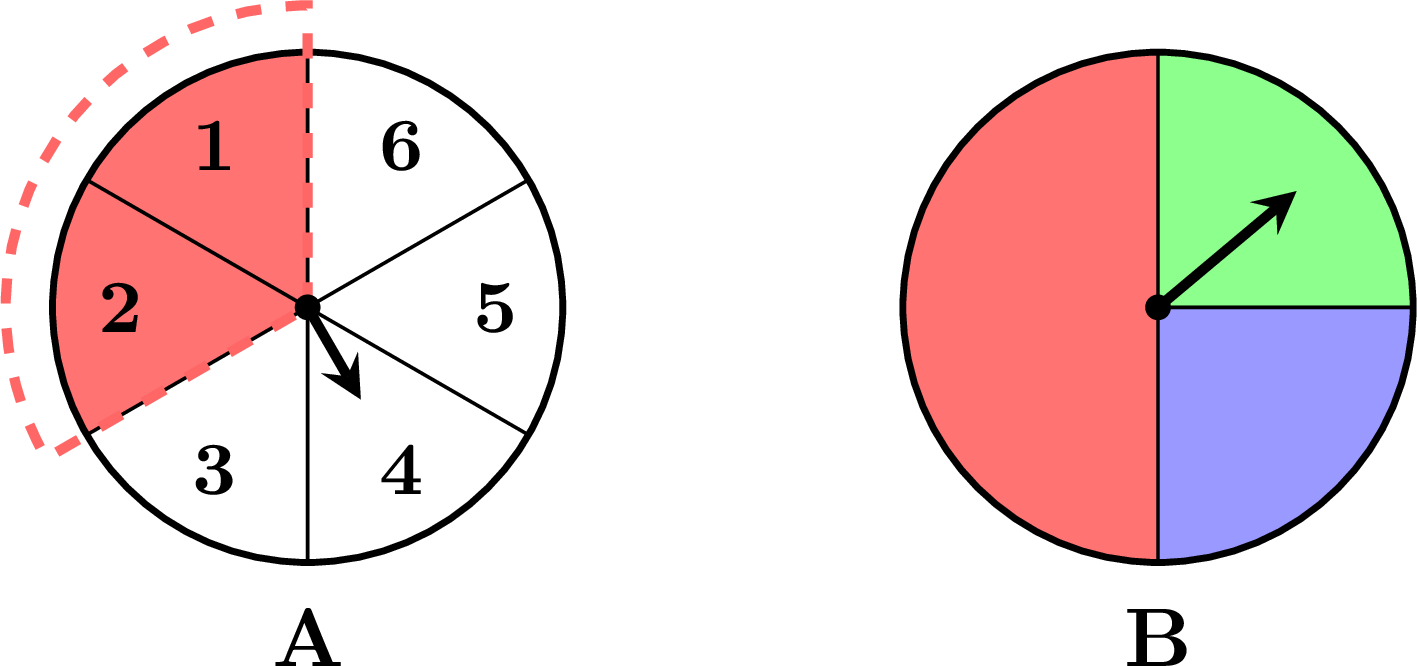
When the outcomes are equally likely and several of them make the event happen, we count them: $$P(\text{event}) = \frac{\text{number of outcomes that make the event happen}}{\text{number of outcomes}}$$ Both spinners below spin fairly: the pointer has the same chance of stopping in two parts of the circle of the same size. Spinner A has \(6\) equal parts, numbered from \(1\) to \(6\): they are the \(6\) outcomes, and the event “red” is the set of parts \(1\) and \(2\). So \(P(\text{red}) = \frac{2}{6}\), two chances in six.
When the outcomes do not have the same chance, we cannot count this way. Spinner B has three colours, but \(P(\text{red})\) is not \(\frac{1}{3}\): red covers half of the spinner, so on each spin red is more likely than blue or green, and \(P(\text{red}) = \frac{1}{2}\).
Definition — Calculating Probability with Equally Likely Outcomes
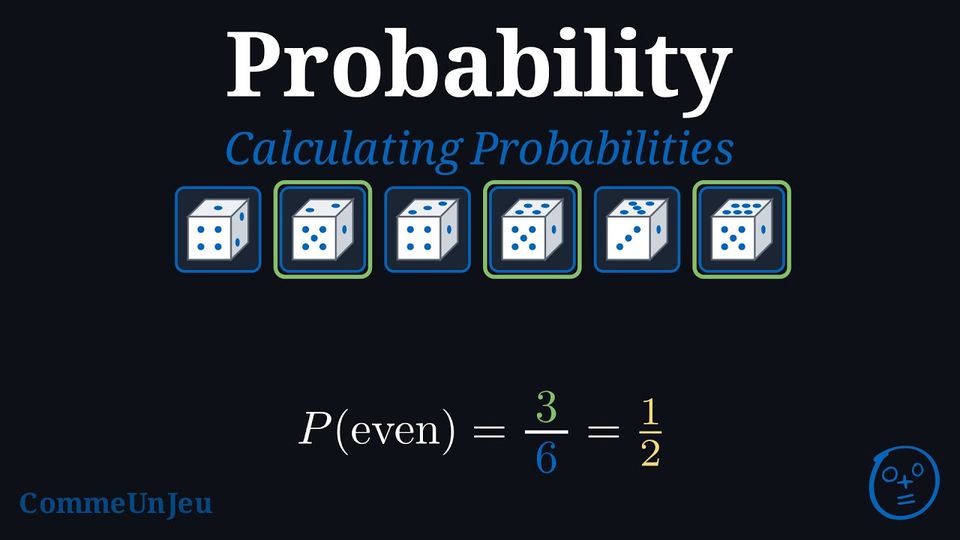
When all outcomes of an experiment are equally likely, we can calculate the probability of an event using a simple formula: $$P(\text{event}) = \frac{\text{Number of favourable outcomes}}{\text{Total number of possible outcomes}}$$ “Favourable outcomes” are the outcomes that match the event we are interested in. Example
A fair six-sided die is rolled. Calculate the probability of rolling an even number. - Total number of possible outcomes: A die has 6 faces, so there are 6 possible outcomes: \(1\), \(2\), \(3\), \(4\), \(5\) and \(6\).
- Number of favourable outcomes: The event is “rolling an even number”. The outcomes that are even are \(2\), \(4\) and \(6\). There are 3 favourable outcomes.
- Calculate the probability: $$\begin{aligned} P(\text{rolling an even number}) &= \frac{\text{Number of favourable outcomes}}{\text{Total number of possible outcomes}} \\ &= \frac{3}{6} \\ &= \frac{1}{2} \end{aligned}$$
Method — Comparing Two Events
Two events of the same experiment share the same total number of possible outcomes. When the outcomes are equally likely, the two probabilities are therefore written with the same denominator, and comparing them does not require computing them. - Check that the outcomes are equally likely — a fair die, a balanced spinner with equal sectors, marbles alike apart from their colour and drawn without looking.
- Count the favourable outcomes of each event.
- Compare these two numbers. The event with more favourable outcomes is the more likely; with as many on both sides, the two events have the same probability.
Example
This spinner is balanced and its eight sectors are equal. Which event is the more likely: “red” or “blue”? 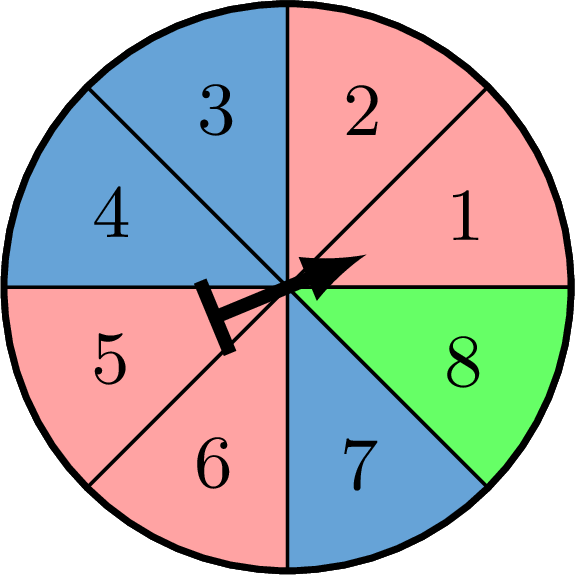
The spinner is balanced and its sectors are equal, so the eight outcomes are equally likely and the method applies.
- Favourable outcomes for “red”: sectors \(1\), \(2\), \(5\) and \(6\) — that is \(4\) outcomes.
- Favourable outcomes for “blue”: sectors \(3\), \(4\) and \(7\) — that is \(3\) outcomes.
Skills to practice
- Calculating Probabilities
- Calculating Probabilities on a Spinner
III
Fair and Unfair Games
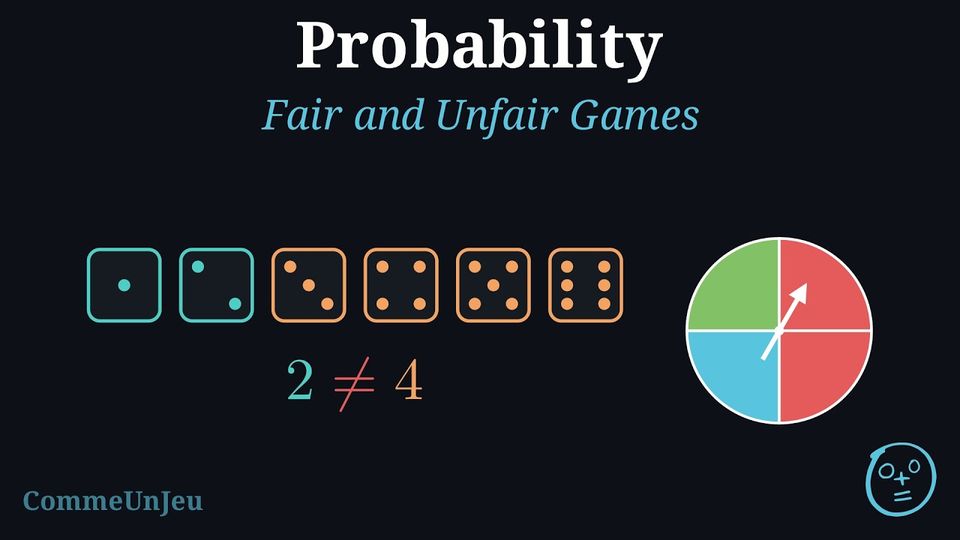
Sam and Mia play a game with a fair die. At each round the die is rolled once: Sam wins the round when it shows \(1\) or \(2\); Mia wins the round when it shows \(3\), \(4\), \(5\) or \(6\). They take turns to roll the die. Mia says: “The game is fair: we each roll the die the same number of times.” Is she correct?
No. The six faces of a fair die are equally likely. Sam wins a round with 2 outcomes (\(1\) and \(2\)); Mia wins it with 4 outcomes (\(3\), \(4\), \(5\) and \(6\)). Taking turns changes nothing: at every round, Mia has more chances to win than Sam.
To make the game fair, each player needs the same number of winning outcomes: for example, Sam wins with \(1\), \(2\), \(3\) and Mia with \(4\), \(5\), \(6\).
To make the game fair, each player needs the same number of winning outcomes: for example, Sam wins with \(1\), \(2\), \(3\) and Mia with \(4\), \(5\), \(6\).
Definition — Fair Game
A game of chance is fair when every player has the same chance of winning. When one player has more chances of winning than another, the game is unfair. Method — Deciding Whether a Game Is Fair
In one round, the events “player A wins” and “player B wins” belong to the same experiment: we compare them by counting, as for any two events. - Make the outcomes equally likely: a fair die, a fair coin, counters alike drawn without looking, a spinner cut into equal parts. A part twice as big counts as two equal parts.
- Count the winning outcomes of each player.
- Compare: the same number for every player, the game is fair; different numbers, the game is unfair, and the player with more winning outcomes is favoured.
- To make an unfair game fair, change the rules, the spinner or the counters in the bag so that every player has the same number of winning outcomes.
Example
Léa and Tom play with this spinner. Léa wins when it stops on red; Tom wins when it stops on blue or on green. Is the game fair? 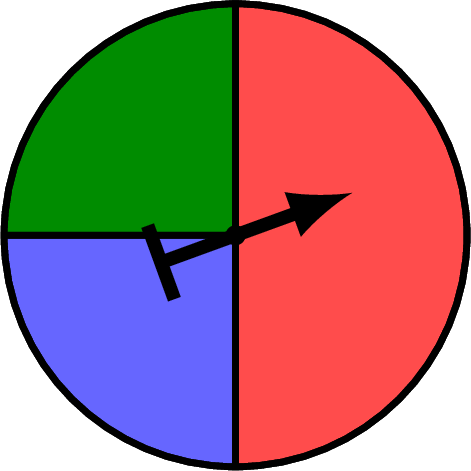
The parts are not equal: the red part is half of the spinner, twice as big as the blue part or the green part. We cut the red half into two quarters, so the spinner has 4 equal parts: \(2\) red, \(1\) blue, \(1\) green. 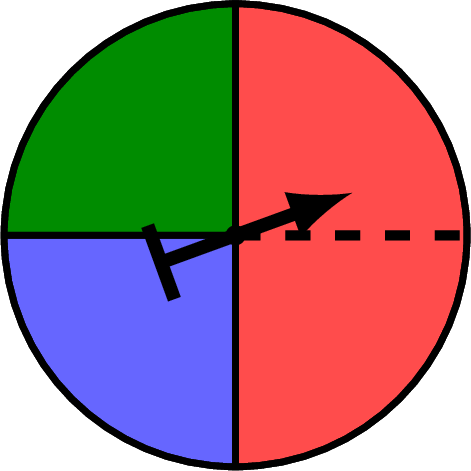
Léa wins with the \(\mathbf{2}\) red parts; Tom wins with \(\mathbf{2}\) parts (\(1\) blue and \(1\) green). \(2\) and \(2\) are equal: the game is fair.
Counting colours instead of equal parts (Léa \(1\) colour, Tom \(2\) colours) would wrongly call the game unfair.
Counting colours instead of equal parts (Léa \(1\) colour, Tom \(2\) colours) would wrongly call the game unfair.
Skills to practice
- Deciding Whether a Game Is Fair
- Making a Game Fair
IV
Chance Experiments
Definition — Trial and Prediction
When we carry out a random experiment several times, each time is a trial: one toss of a coin, one roll of a die, one spin of a spinner, one draw from a bag. Before the trials, we make a prediction: using the outcomes and their chances, we say what we think the results will be. The results are the numbers of times each outcome came up. Method — Carrying Out a Chance Experiment
- List the outcomes and prepare a tally chart with one row for each outcome.
- Predict. Outcomes with the same chance should come up about the same number of times. An outcome with more chances (a bigger part of the spinner, more counters of that colour in the bag) should come up more often.
- Do the trials. After each trial, draw one tally mark in the row of the outcome. When drawing from a bag, put the counter back before the next draw.
- Count. Write the total of each row. The totals together make the number of trials.
- Compare with the prediction. Are the results close to it? They are often a little different from it, and another series of trials usually gives other results: that is chance.
Example
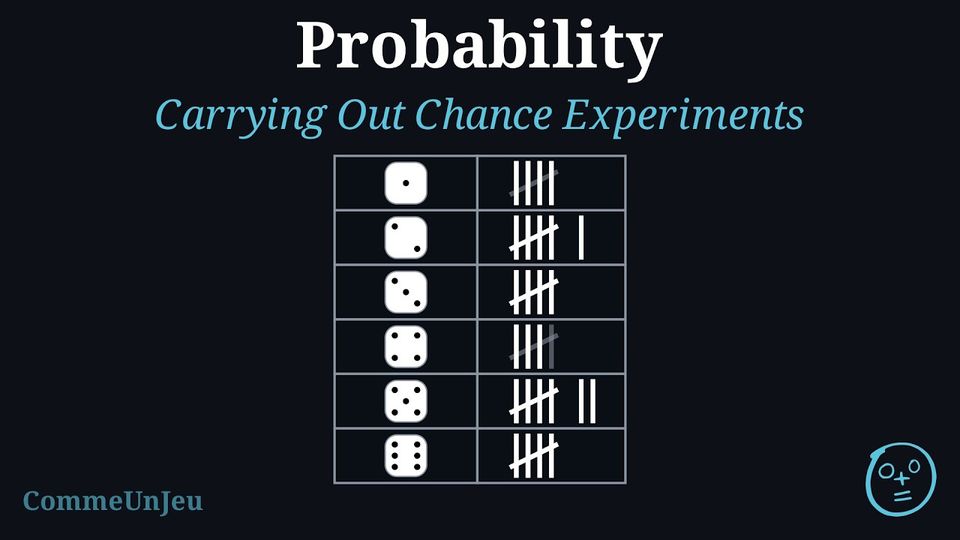
Mia rolls a fair die \(30\) times. What can she predict? Here are her results: compare them with the prediction. | Face | Tally Marks | Total |
| \(1\) |  | 4 |
| \(2\) |  | 6 |
| \(3\) |  | 5 |
| \(4\) |  | 3 |
| \(5\) |  | 7 |
| \(6\) | | 5 |
The six faces of a fair die have the same chance. \(30\) rolls shared equally among \(6\) faces give \(5\) rolls each, because \(6 \times 5 = 30\): Mia can predict about 5 for each face.
Her totals: \(4 + 6 + 5 + 3 + 7 + 5 = 30\), so every roll is counted once. Each total lies between \(3\) and \(7\), close to \(5\), and only two faces came up exactly \(5\) times. The results are close to the prediction without being equal to it, as expected with chance.
Her totals: \(4 + 6 + 5 + 3 + 7 + 5 = 30\), so every roll is counted once. Each total lies between \(3\) and \(7\), close to \(5\), and only two faces came up exactly \(5\) times. The results are close to the prediction without being equal to it, as expected with chance.
Skills to practice
- Comparing Results with the Probability
V
Going further
Skills to practice
- Solving Probability Problems
- Quiz
Jump to section