International Baccalaureate · PYP 3
Symmetry and Transformations
I
Checking a Line of Symmetry: Folding or Tracing Paper
Tom draws a rectangle and its diagonal. He says: “This line cuts the rectangle into two halves that have exactly the same shape, so it is an axis of symmetry.” Is he correct? 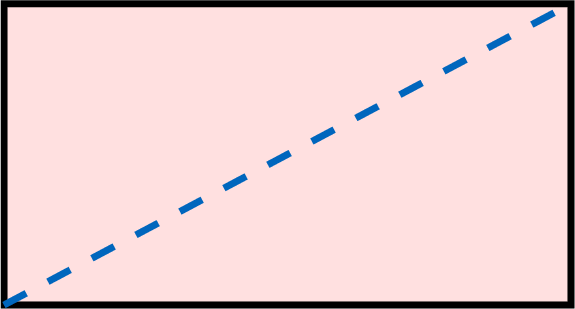
Tom is wrong, and the fold says why. Cut out the rectangle and fold it along the diagonal: the two halves do not land on each other — one sticks out on each side. They do have the same shape, but you would have to turn one to place it on the other, not flip it. An axis of symmetry asks for the flip. (Careful: in a square, which is a rectangle too, the diagonals are axes.)
Method — Checking a Line of Symmetry: Folding or Tracing Paper
A drawn line is an axis of symmetry of a figure if the two parts land exactly on each other when the figure is flipped over that line. Two ways of checking it, with your hands: - Folding. Fold the sheet along the line. If the two parts of the figure cover each other exactly — no corner sticking out, no gap — the line is an axis. If something sticks out, it is not.
- Tracing paper. Trace the figure and the line, with two marks on the line. Turn the tracing paper over. Put the traced line back on the line, the two marks on the two marks. If the traced figure lands exactly on the figure, the line is an axis.
The trap: a line that cuts a figure into two parts of the same shape is not always an axis. The diagonal of a rectangle that is not a square cuts it into two identical triangles, yet the fold does not make them meet.
Example — Folding a Heart and a Kite
Does this heart have an axis of symmetry? And this kite? 
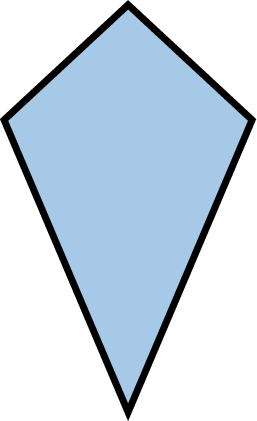
The heart: fold it down the middle, from the point at the bottom to the dip at the top — the two lobes land on each other. It has one axis, the vertical one. The kite: fold it along its long diagonal, from the top point to the bottom point — the two sides meet. One axis too. Neither has a horizontal one. For the kite, look carefully: folding across the middle does bring the top point onto the bottom point — but the two side corners, both at the same height, land below themselves and meet nothing. One pair matching is not enough: everything must match.
Skills to practice
- Checking Symmetry
- Finding the Axes of Everyday Objects
- Drawing and Explaining Axes
II
Lines of Symmetry of Common Shapes
Proposition — Lines of Symmetry of Common Shapes
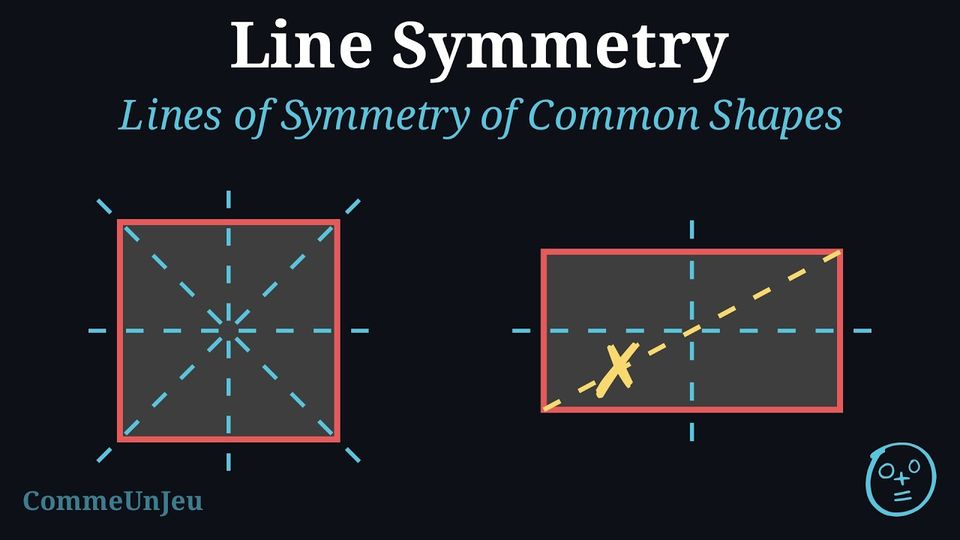
A figure can have one line of symmetry (also called an axis of symmetry), several, or none at all. Counting them is another way of telling the usual figures apart. - A square has 4 lines of symmetry.
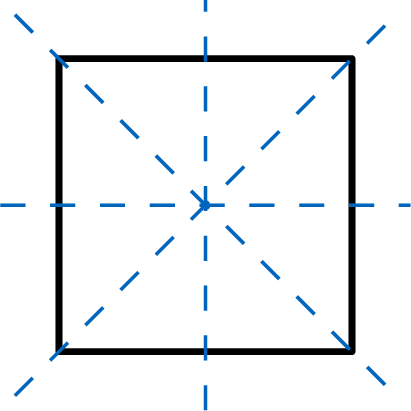
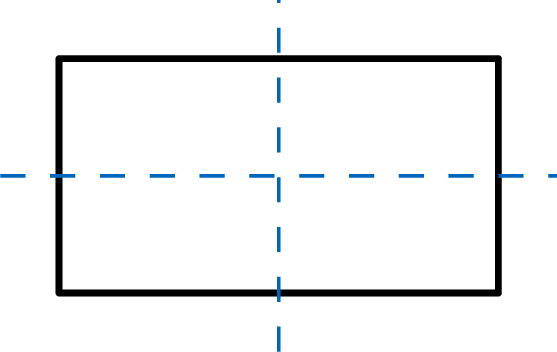
- A rectangle that is not a square has 2 lines of symmetry — its diagonals are not lines of symmetry.
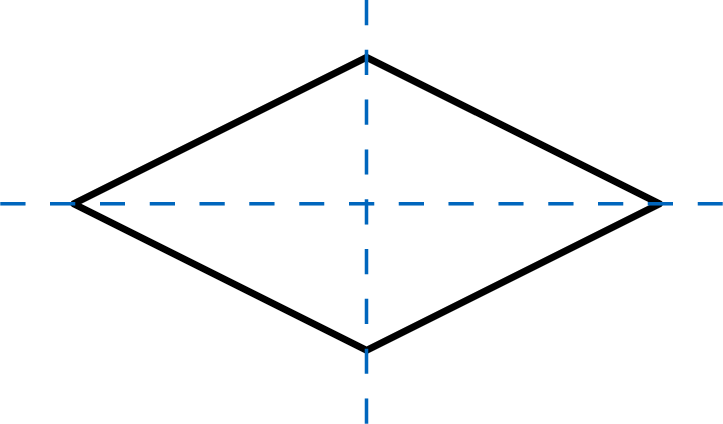
- A rhombus that is not a square has 2 lines of symmetry — its two diagonals.
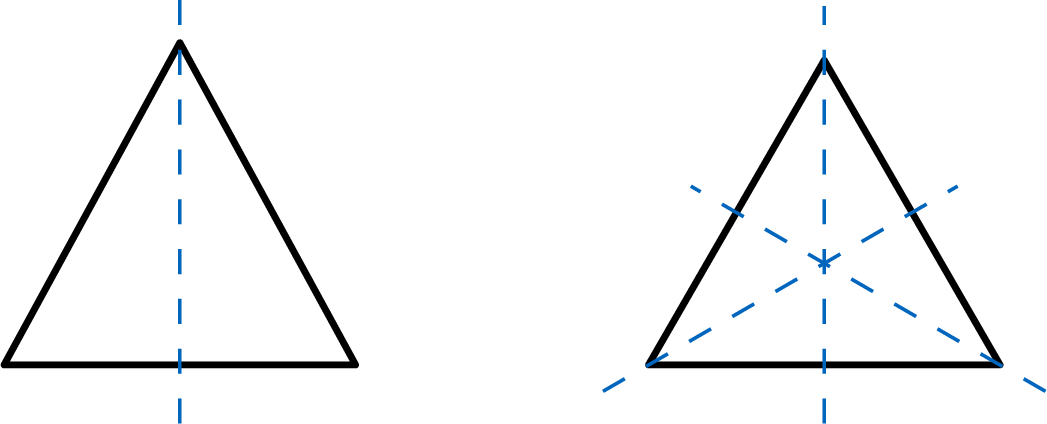
- A triangle with two sides of the same length (an isosceles triangle) has 1 line of symmetry, unless all three sides are equal (an equilateral triangle): it then has 3.
- A circle has an infinite number of lines of symmetry: every line through its centre is one.
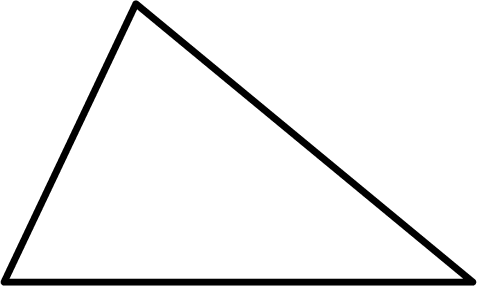
- A triangle whose three sides have different lengths has no line of symmetry at all: whichever way it is folded, the two halves never match.
Skills to practice
- Drawing All the Lines of Symmetry
III
Completing a Figure to Make it Symmetrical
Folding to Complete a Figure
The fold does not only check: it also builds. To complete a figure so that it becomes symmetrical about a given line, fold the sheet along that line and hold it up to the light: the part already drawn shows through on the empty side. Trace what you see, unfold, and the figure is complete.
On squared paper the fold can be counted instead of made: a point three squares to the left of the axis has its mirror three squares to the right, on the same line.
On squared paper the fold can be counted instead of made: a point three squares to the left of the axis has its mirror three squares to the right, on the same line.
Method — Completing a Figure to Make it Symmetrical
The figure is drawn on squared paper, the axis is horizontal or vertical, and only half of the outline is there: it starts and stops on the axis. Completing it means adding the missing half so that the whole figure becomes symmetrical. - Look at the vertices already drawn. Those that sit on the axis do not move: they are their own mirror, and it is there that the two halves join.
- Mirror the others. For each one, count the squares to the axis, then place its mirror the same number of squares on the other side — without leaving its row if the axis is vertical, without leaving its column if it is horizontal.
- Join the new points in the same order as the ones already drawn, and close the figure on the vertices that sit on the axis.
Example
Complete the figure so that it becomes symmetrical about the axis. The two vertices marked with a dot are on the axis. 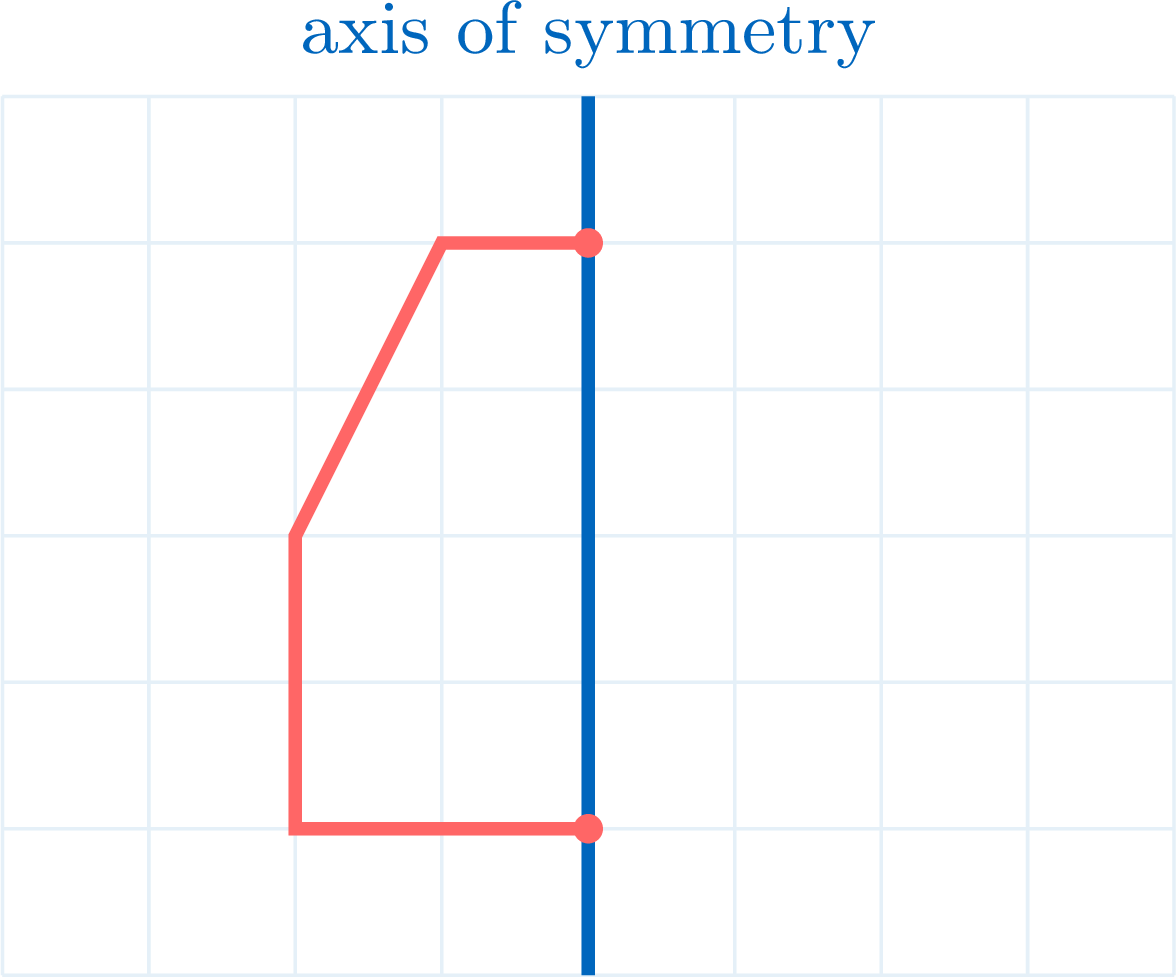
The two marked vertices stay put. The others are at \(2\), \(2\) and \(1\) squares from the axis, so their mirrors go \(2\), \(2\) and \(1\) squares on the other side. Joining them in the same order closes the figure: 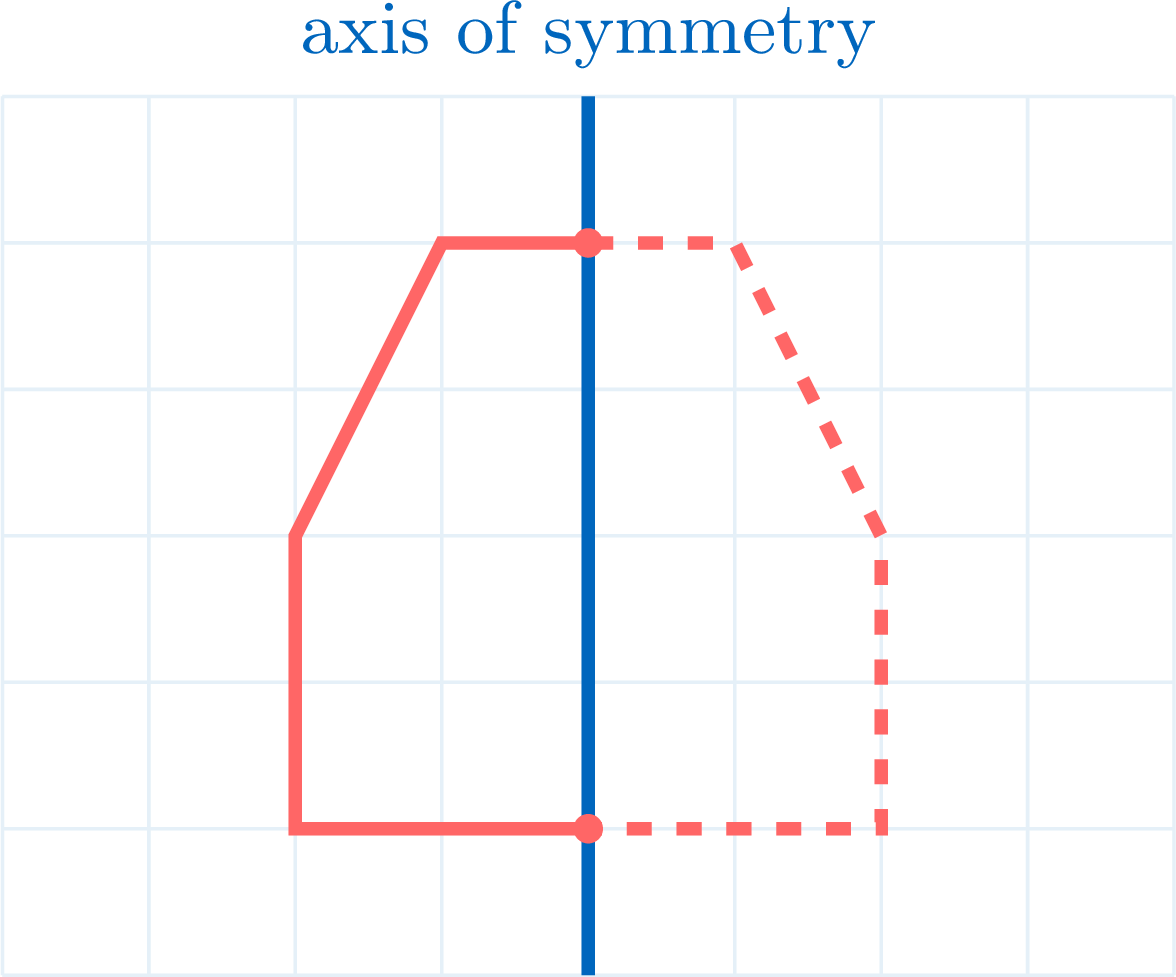
Example
Complete the figure so that it becomes symmetrical. Here the axis is horizontal. 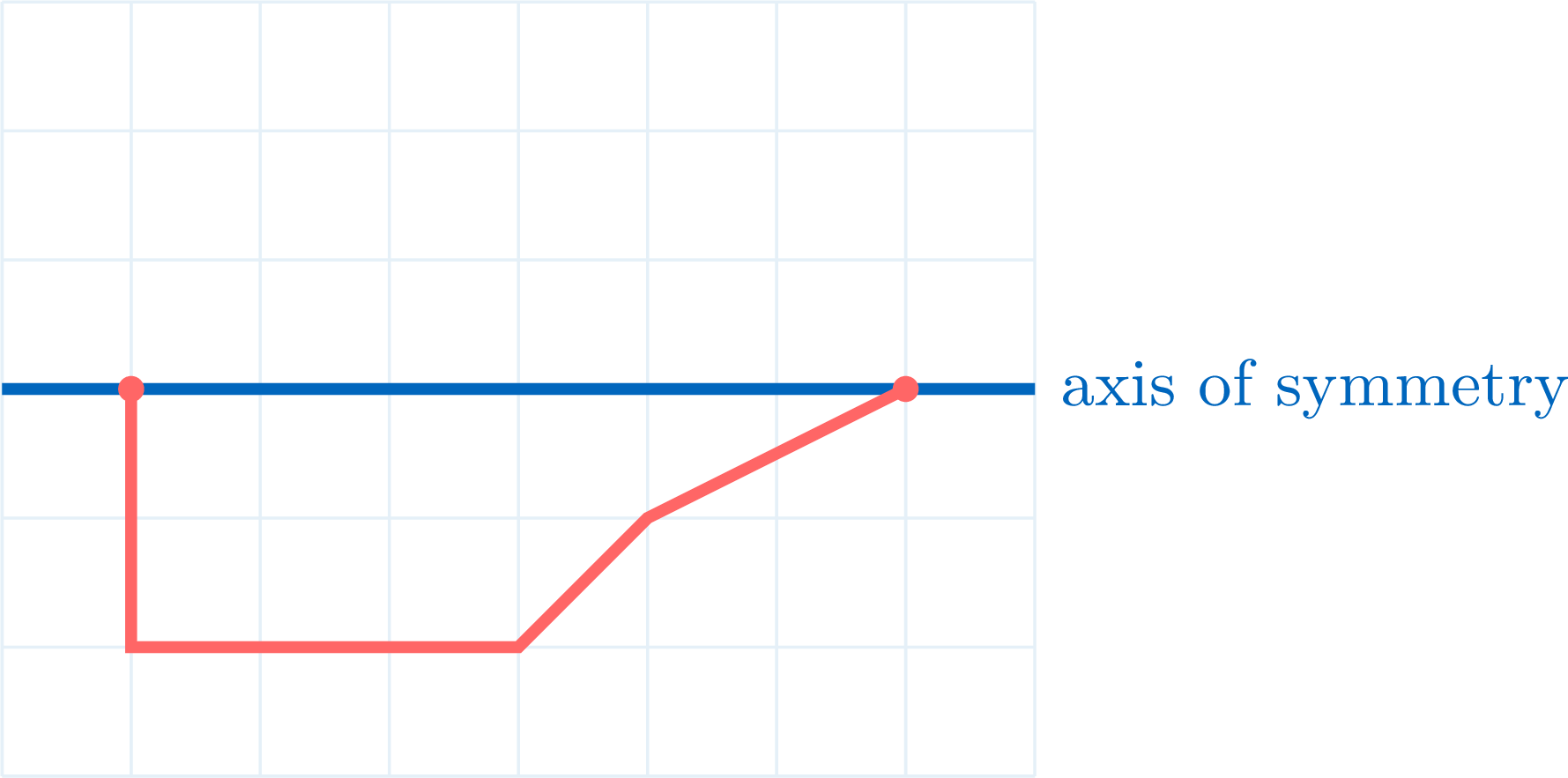
Nothing changes in the method: the two vertices on the axis stay, and the others are mirrored by counting squares — upwards this time instead of sideways. 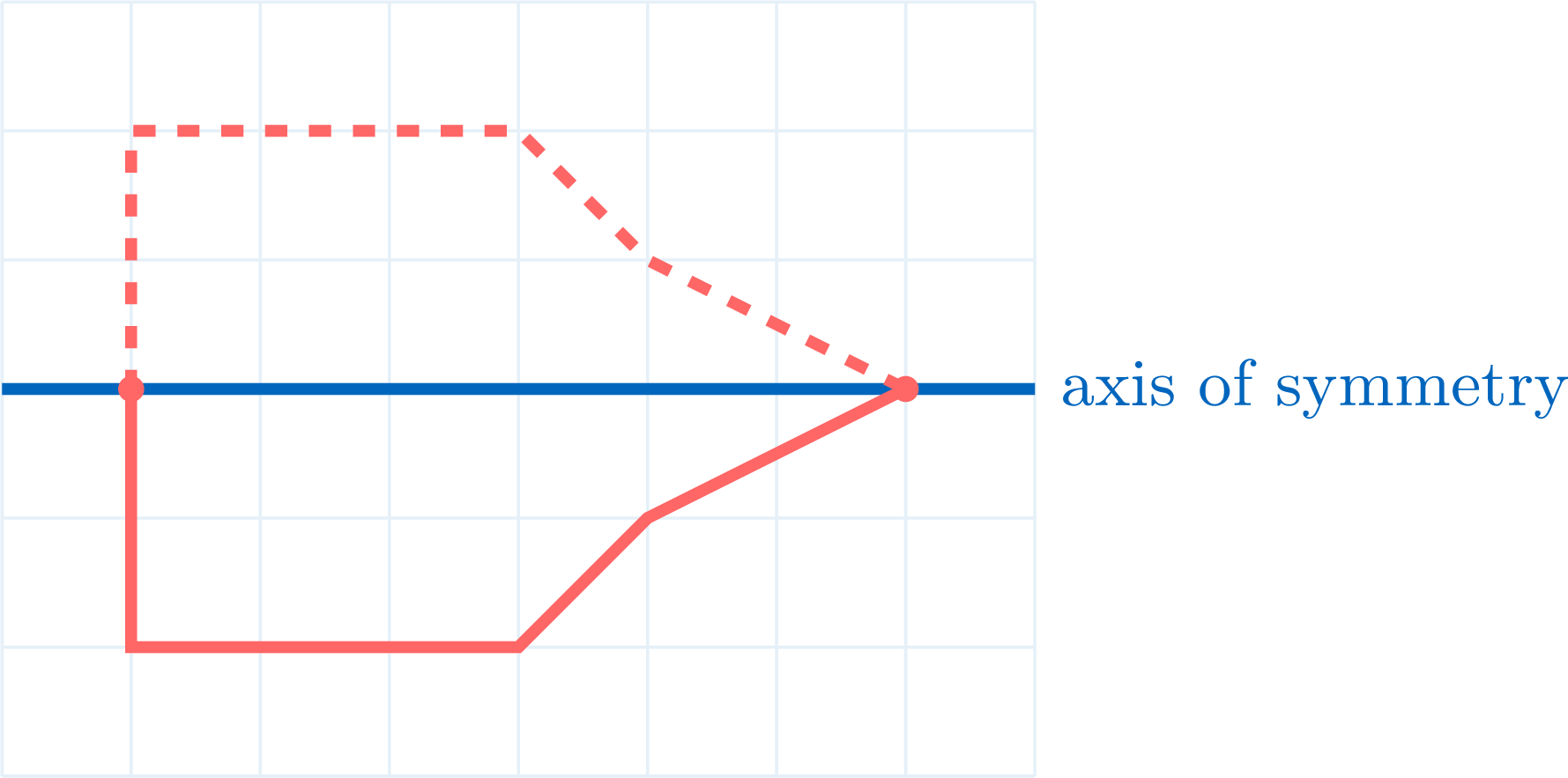
Skills to practice
- Completing on Squared Paper
- Checking a Completed Figure
IV
Describing a Move Exactly
Definition — Object and Image
When we move a shape (we slide it, flip it or turn it), the shape we start with is called the object. The new shape, after the move, is called the image. Only the image of a flip is a mirror image. Method — Describing a Move Exactly
To describe a move so that anyone can repeat it, give all its details: - a slide: how many squares to the right or to the left, then how many squares up or down — “slide \(3\) squares to the right and \(1\) square up”;
- a flip: the line it is flipped over — “flip over the line \(d\)”;
- a turn: how far (a quarter turn or a half turn), which way (clockwise or anticlockwise) and about which point — “a quarter turn clockwise about the point \(O\)”. For a half turn, the way does not matter: both ways end in the same place.
Example
Describe exactly the move that takes flag \(A\) to flag \(B\) in (a), to flag \(C\) in (b), and to flag \(D\) in (c). 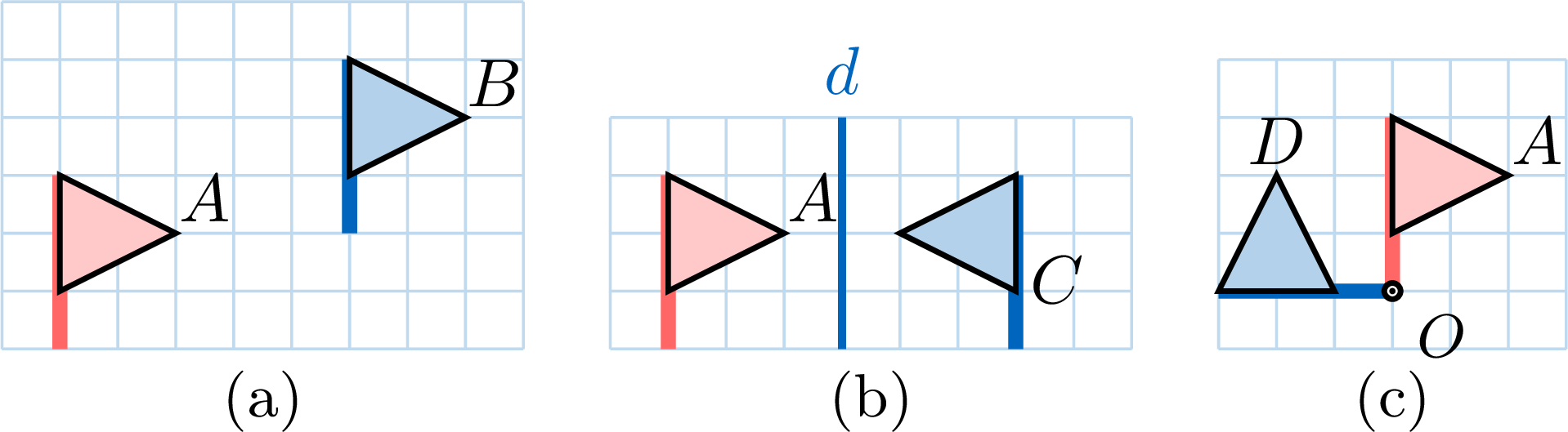
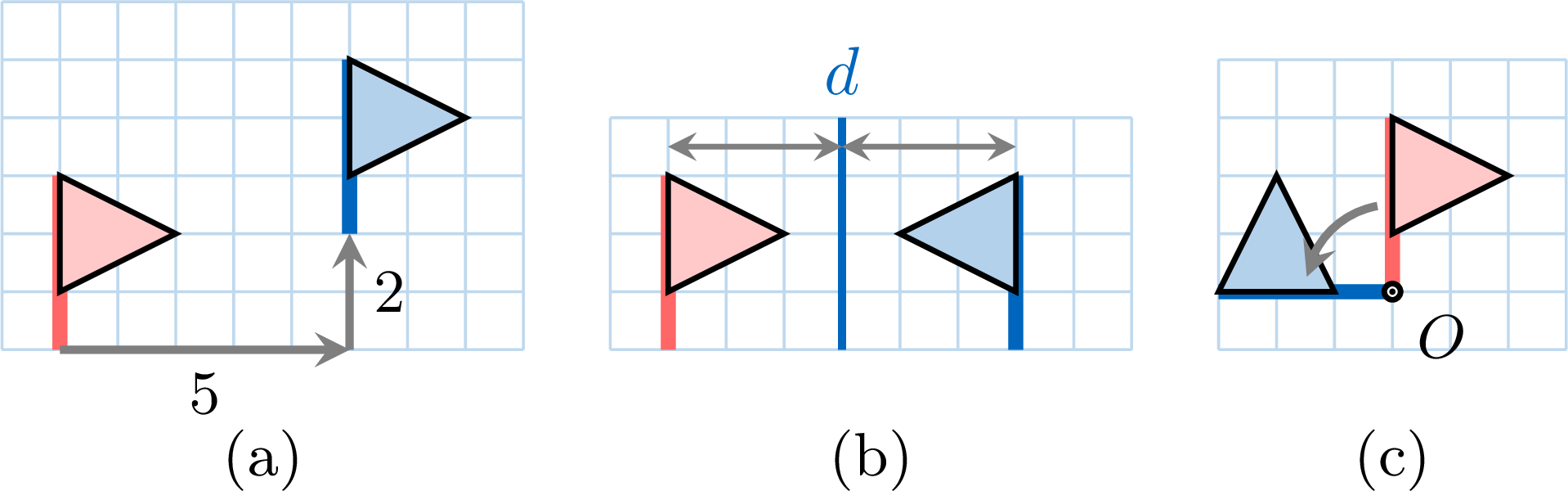
- [(a)] \(B\) points the same way as \(A\): a slide. Follow the foot of the pole: \(5\) squares to the right, then \(2\) squares up. The move is “slide \(5\) squares to the right and \(2\) squares up”.
- [(b)] \(C\) is the mirror image of \(A\): “flip over the line \(d\)”. Check: the pole of \(A\) is \(3\) squares to the left of \(d\), the pole of \(C\) is \(3\) squares to the right of it.
- [(c)] The foot of the pole stays on \(O\); the pole pointed up and now points to the left: “a quarter turn anticlockwise about the point \(O\)”.
Example
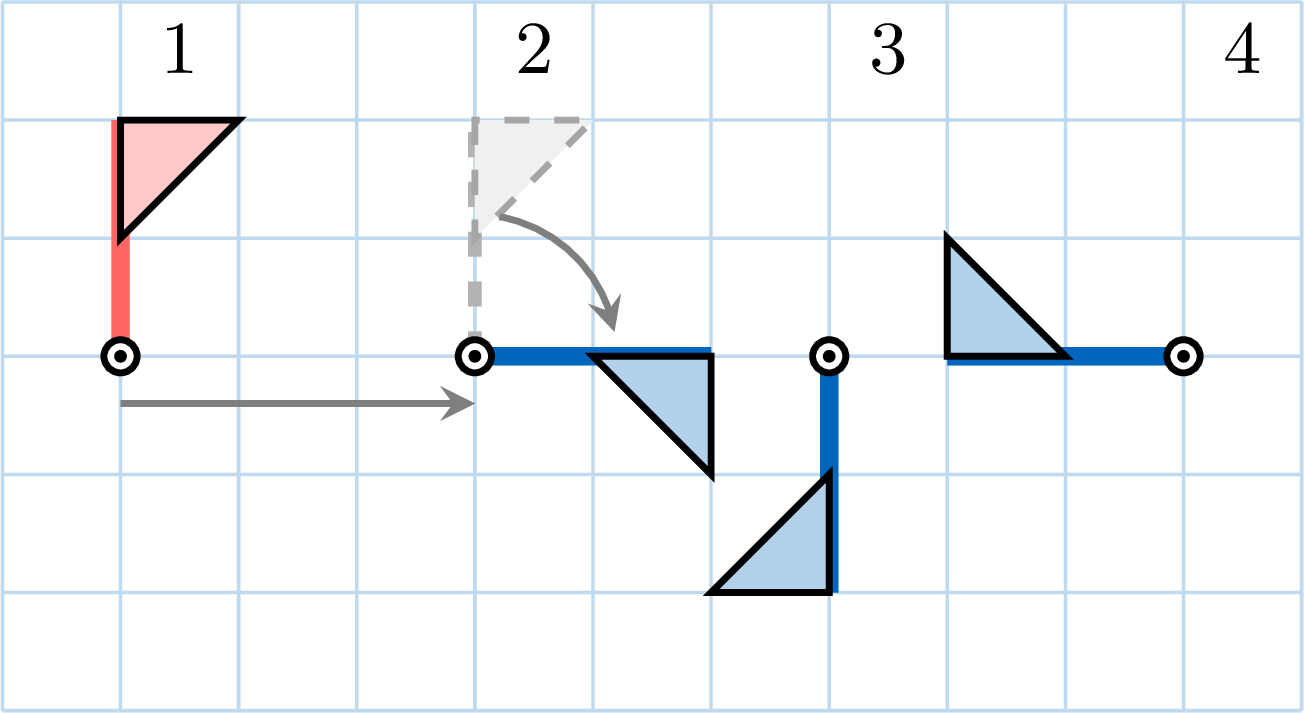
A pattern is made with a rule of two moves: “slide \(3\) squares to the right, then make a quarter turn clockwise about the foot of the pole”. Starting from flag \(1\), apply the rule three times to draw flags \(2\), \(3\) and \(4\). 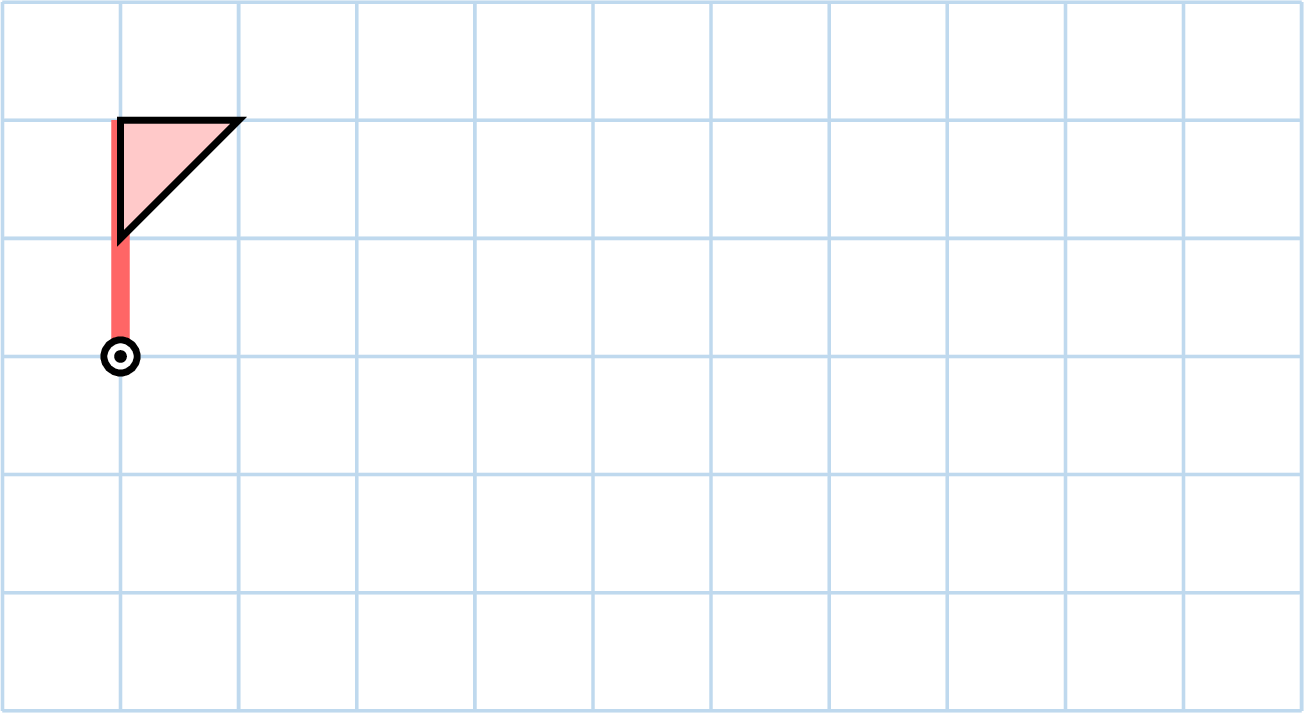
Skills to practice
- Measuring Slides
- Following a Rule of Two Moves
- Describing the Move Exactly
V
Going further
Skills to practice
- Measuring Mirrors and Finding Axes
- Problems
- Quiz
Jump to section