International Baccalaureate · PYP 2
2D Shapes
I
Drawing Shapes on Squared Paper
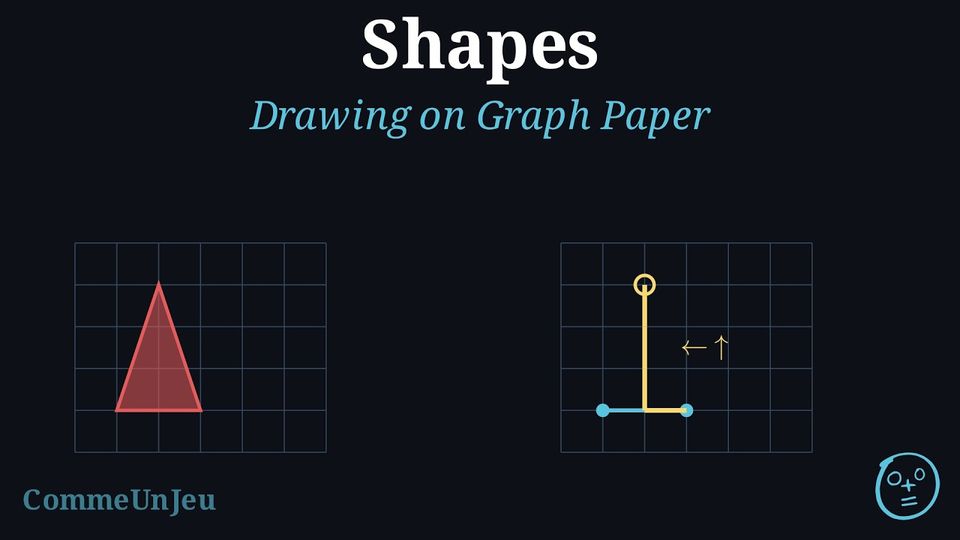
Sami has drawn a flag on squared paper and wants to copy it exactly onto a second sheet, with no tracing. Drawing it again by eye, he gets a flag that looks close but is not the same: one side does not lean the same way, and the tip lands in the wrong place. 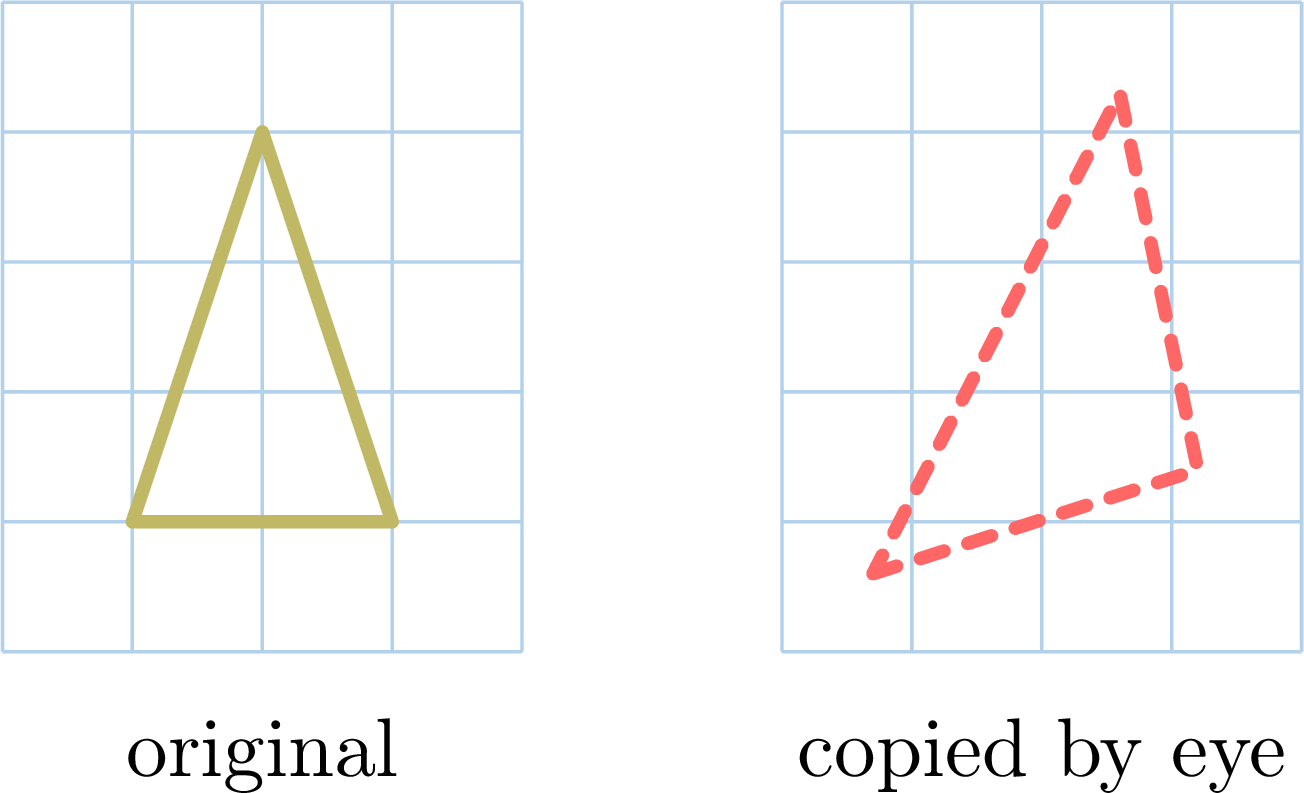
The squares give Sami a more reliable method. Rather than judging the figure by how it looks, he reads where each vertex is on the grid, counted in squares. From one vertex he counts the squares to the right or left, and up or down, to reach the next one, then repeats those exact moves on the second sheet. The two flags then match, because the same counts give the same figure.
Method — Reproducing a Shape on Squared Paper
To reproduce this shape on squared paper: 
- Place the vertices: Choose one vertex of the original shape as a starting point. Draw this vertex on the grid in the same place. Then count the grid squares to the right/left and up/down to place the other vertices, keeping the same moves as on the original shape.

- Draw the sides: Use a ruler to join the vertices with straight lines, in the same order as on the original shape.

Skills to practice
- Placing the Vertices of a Copy
- Drawing Simple and Composite Shapes
II
The Midpoint of a Segment
Definition — Segment and Midpoint
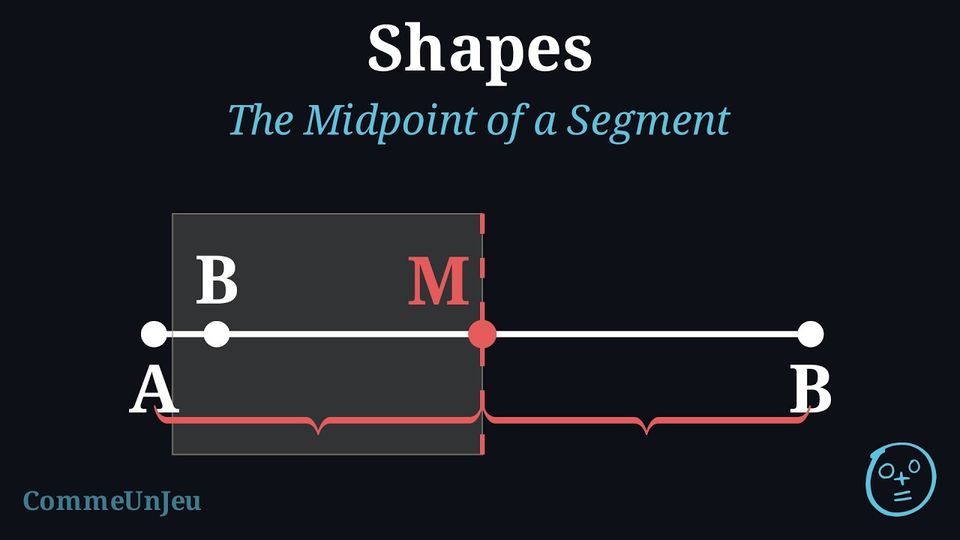
A segment is the straight line drawn between two points, from one to the other. The midpoint of a segment is the point that cuts it into two parts of the same length. 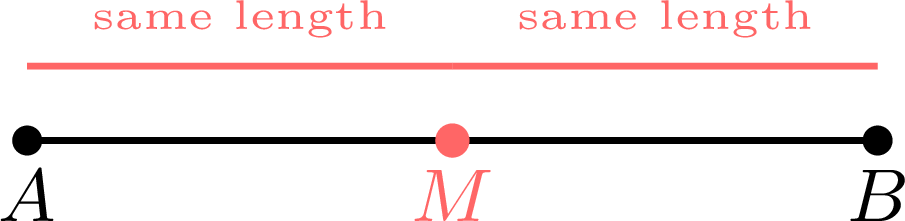
Method — Finding the Midpoint by Folding
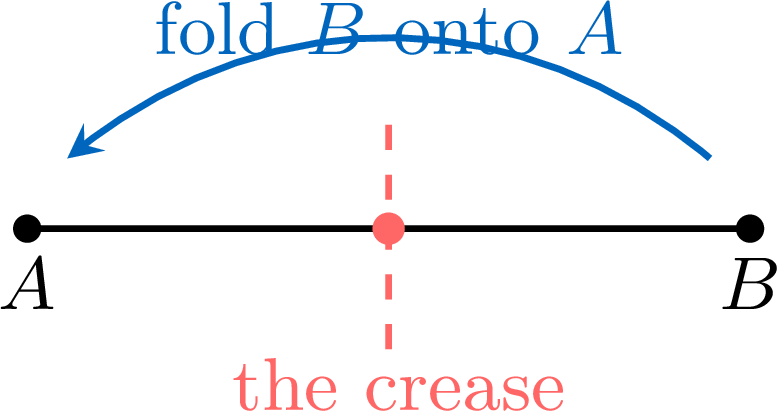
On a sheet of paper, the midpoint of a segment is found without measuring: - Fold the sheet so that the end \(B\) falls exactly on the end \(A\).
- Flatten the fold with the fingernail, then unfold.
- The crease crosses the segment at one point: that point is the midpoint, because the two parts have been laid one on the other.
Example
Sami folds his sheet so that \(B\) falls on \(A\). Where is the midpoint of the segment, and how can he be sure?
The midpoint is where the crease crosses the segment. Sami can be sure of it: by folding, the part from the midpoint to \(B\) has been laid exactly on the part from the midpoint to \(A\) — the two parts have the same length.
Skills to practice
- Recognising a Midpoint
- Placing the Midpoint on the Grid
- Finding the Midpoint by Folding
III
The Circle and the Compass
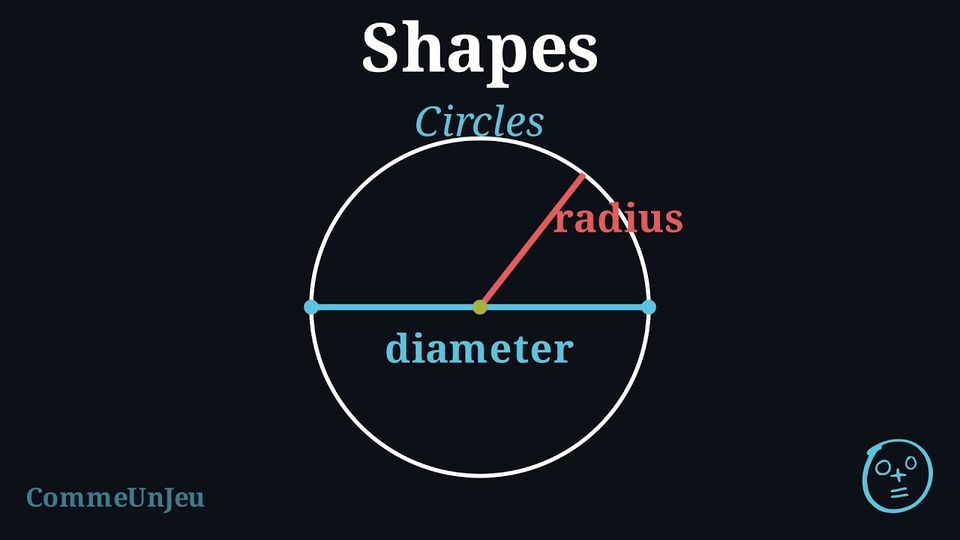
In the playground, Sami plants a stake and ties a rope to it. Léa ties a piece of chalk to the other end of the rope, stretches it, and walks all around, the chalk on the ground. What shape does the chalk draw? 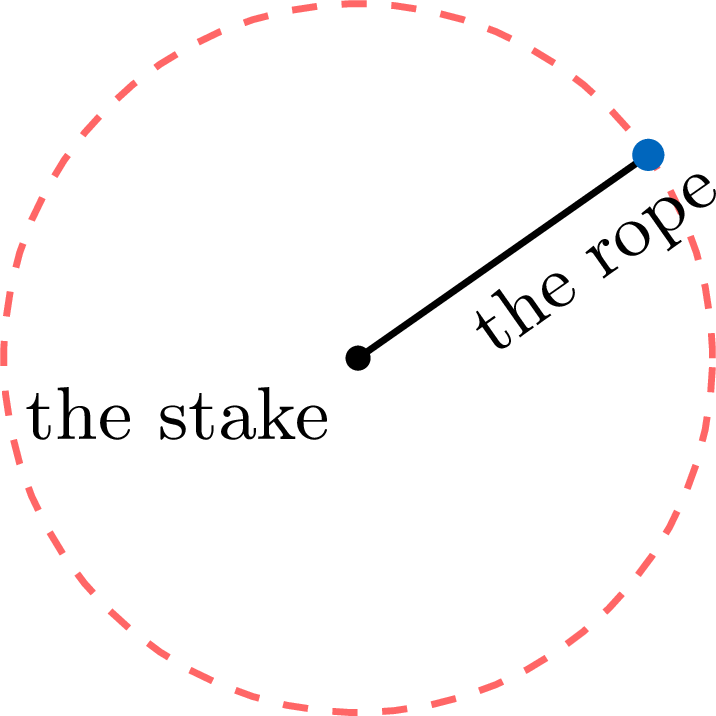
The rope keeps the same length, so the chalk always stays at the same distance from the stake. It draws a circle, and the stake is its centre.
Definition — Circle and Centre
A circle is the curve drawn by all the points that are at the same distance from one point. That point is the centre of the circle. The flat shape inside it is the disc; in everyday words people also call it a circle. 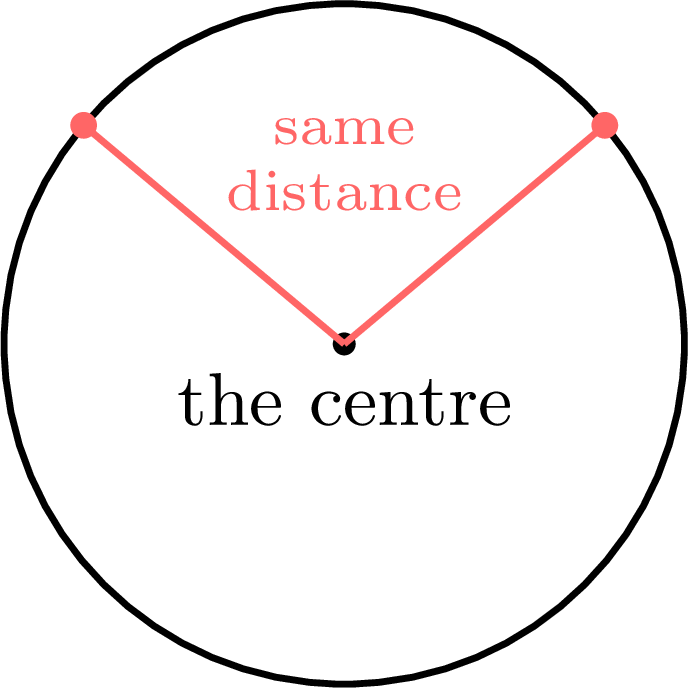
Method — Drawing a Circle with a Compass
A compass (the drawing tool) keeps a distance while turning. To draw the circle with centre \(O\) passing through the point \(A\): - Open the compass: put its point on \(O\) and its pencil exactly on \(A\).
- Keep the opening: do not touch the compass any more — the opening is the distance from \(O\) to \(A\).
- Turn: press the point on \(O\) and turn the pencil all the way round, in one go.
Example
Draw the circle with centre \(O\) passing through \(A\). 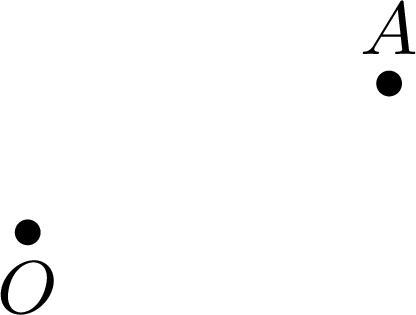
Point of the compass on \(O\), pencil on \(A\): the opening is set. Turning without changing it, the pencil draws the circle, and it comes back exactly on \(A\). 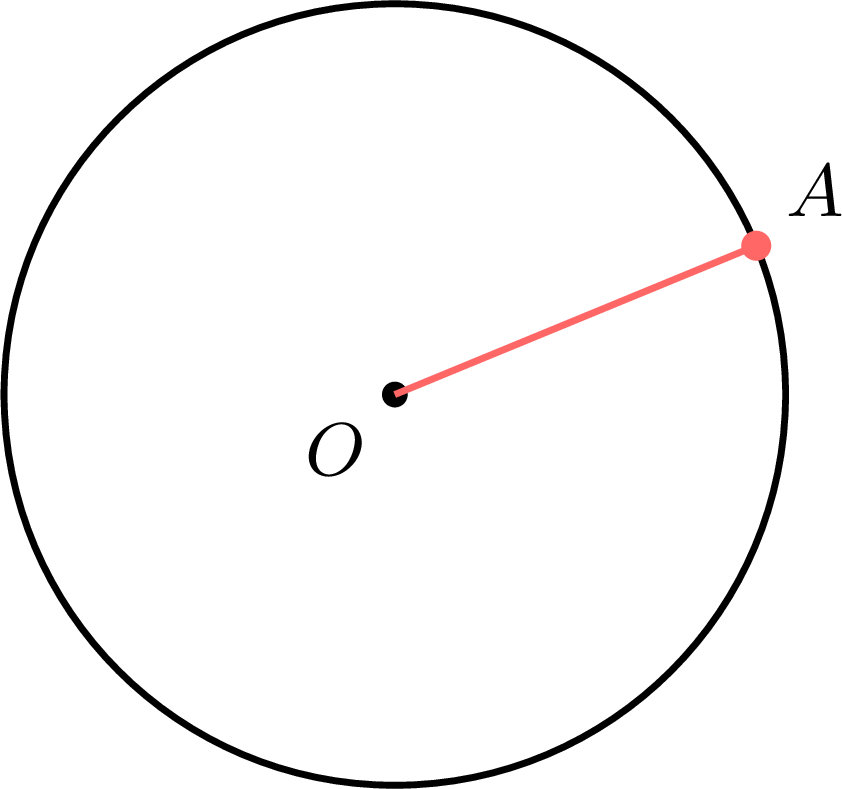
Skills to practice
- Understanding the Compass
- Drawing a Circle with a Compass
IV
Going further
Skills to practice
- Counting Squares to Draw Shapes
- Quiz
Jump to section