International Baccalaureate · PYP 5
2D Shapes
I
Constructing a Circle
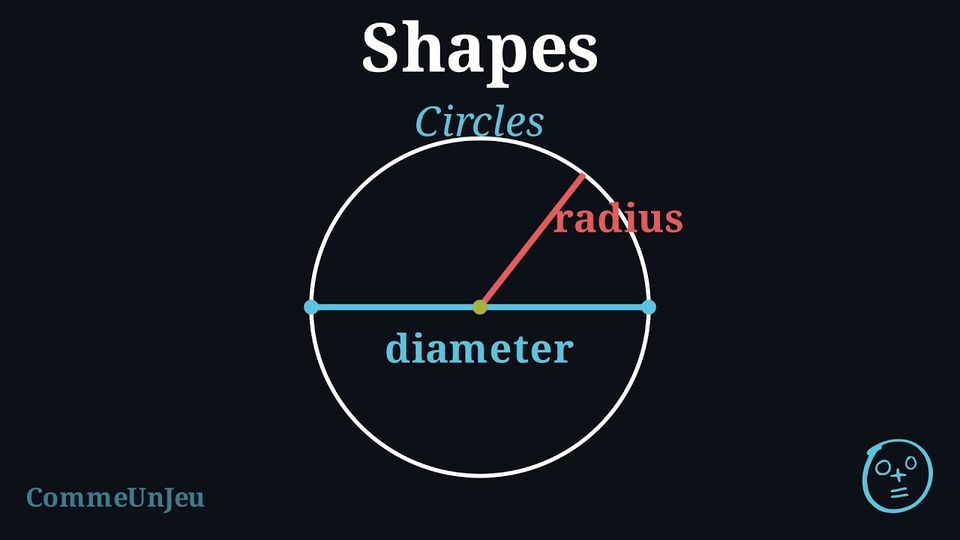
Definition — Circle
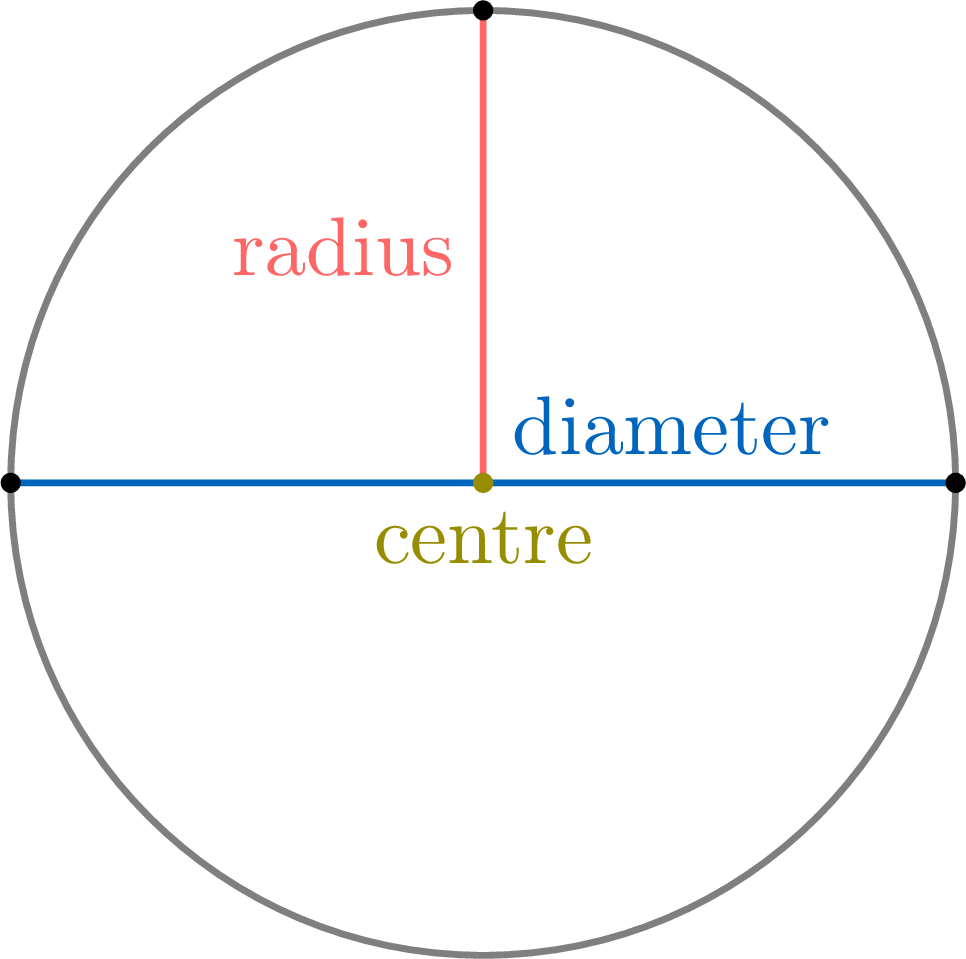
A circle is a closed curved line on a flat surface — only the line, not the inside. Every point on the circle is the same distance from a point called the centre.The radius is a line segment from the centre to a point on the circle. The radius is also the length of this segment.
The diameter is a line segment that goes across the circle through the centre and connects two points on the circle. The diameter is also the length of this segment.
Proposition — Diameter-Radius Rule
- The diameter is twice as long as the radius.
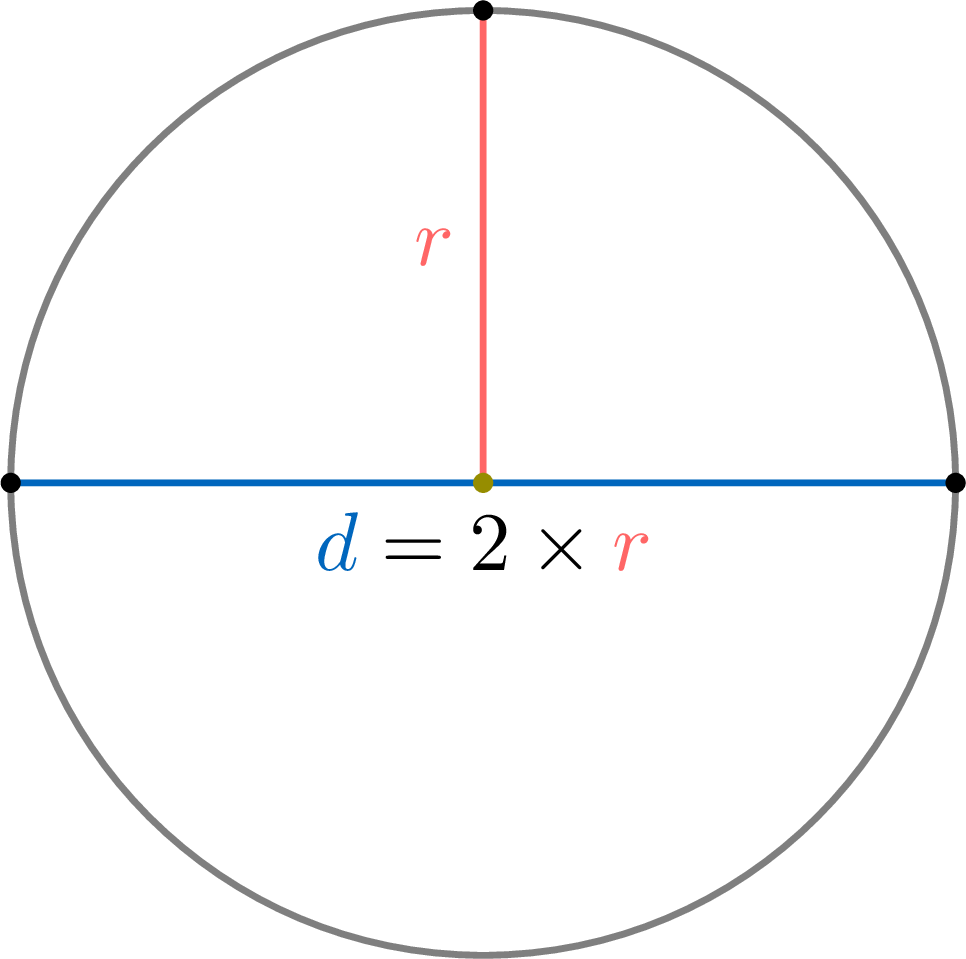
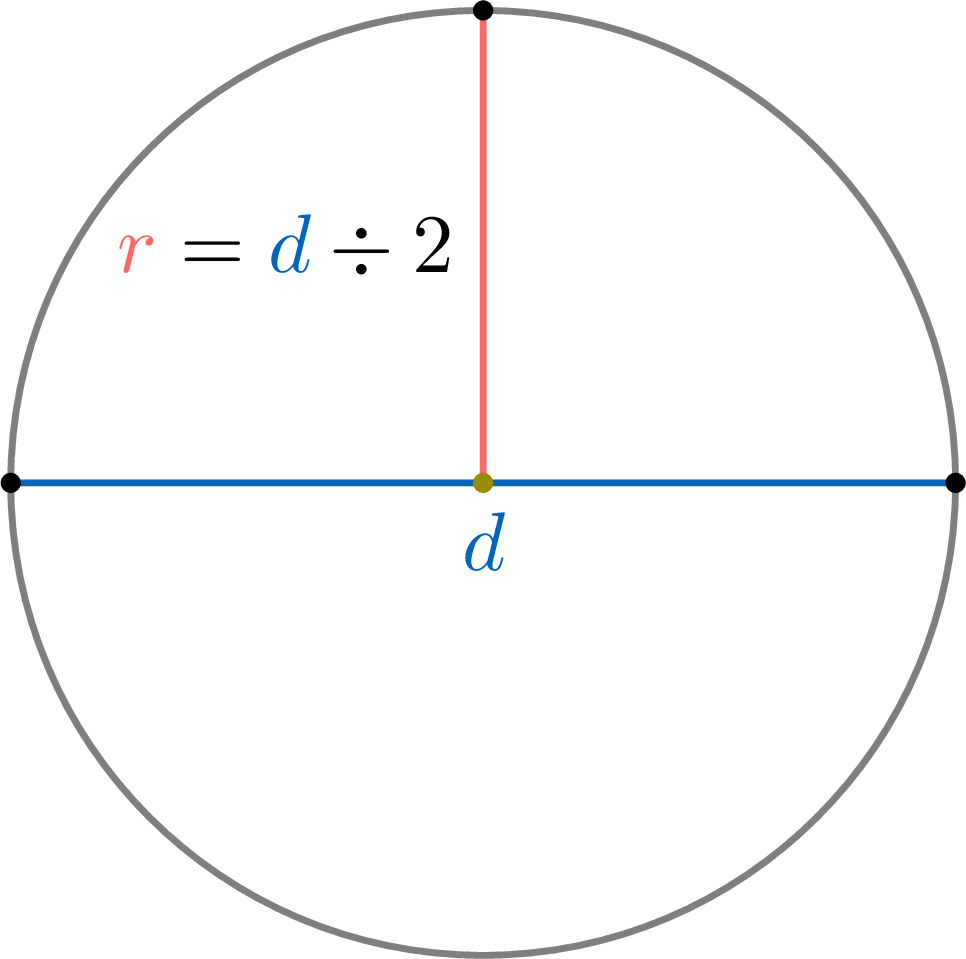
- The radius is half of the diameter.
Method — Constructing a Circle
To construct the circle with centre \(O\) and radius 3 cm: - Set the compass to a radius of 3 cm. To do this, open the compass so that the distance between the pencil tip and the needle is 3 cm. This distance is measured with the ruler.

- Place the needle of the compass on the point \(O\). Hold the compass steady and rotate the pencil around \(O\) to draw the full circle.

Skills to practice
- Constructing and Using Circles
II
Triangles
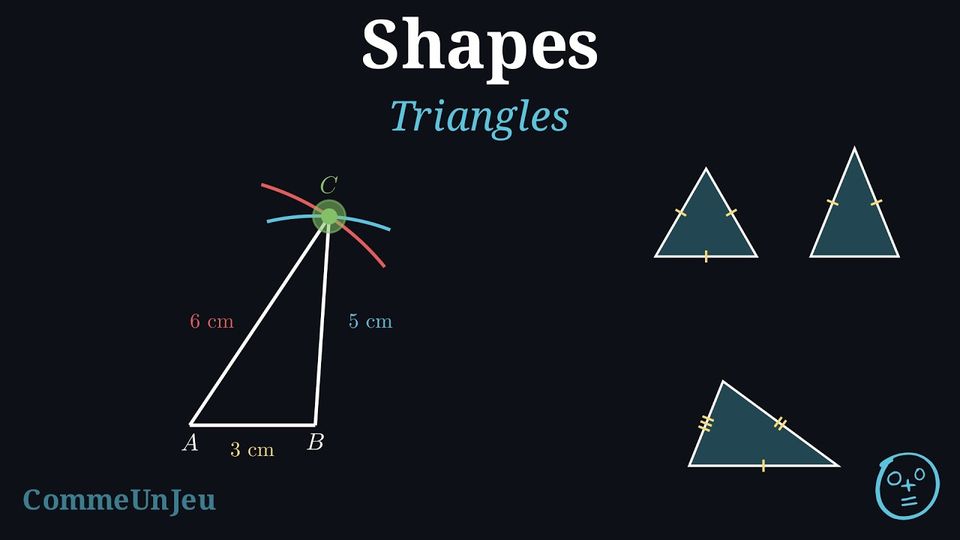
A workshop must cut two identical triangular brackets. The first was drawn freehand, and the second, copied by eye, came out a different shape, so the two parts do not match. The only reliable record kept is the three side lengths: \(AB = 3\) cm, \(BC = 5\) cm, \(AC = 6\) cm. 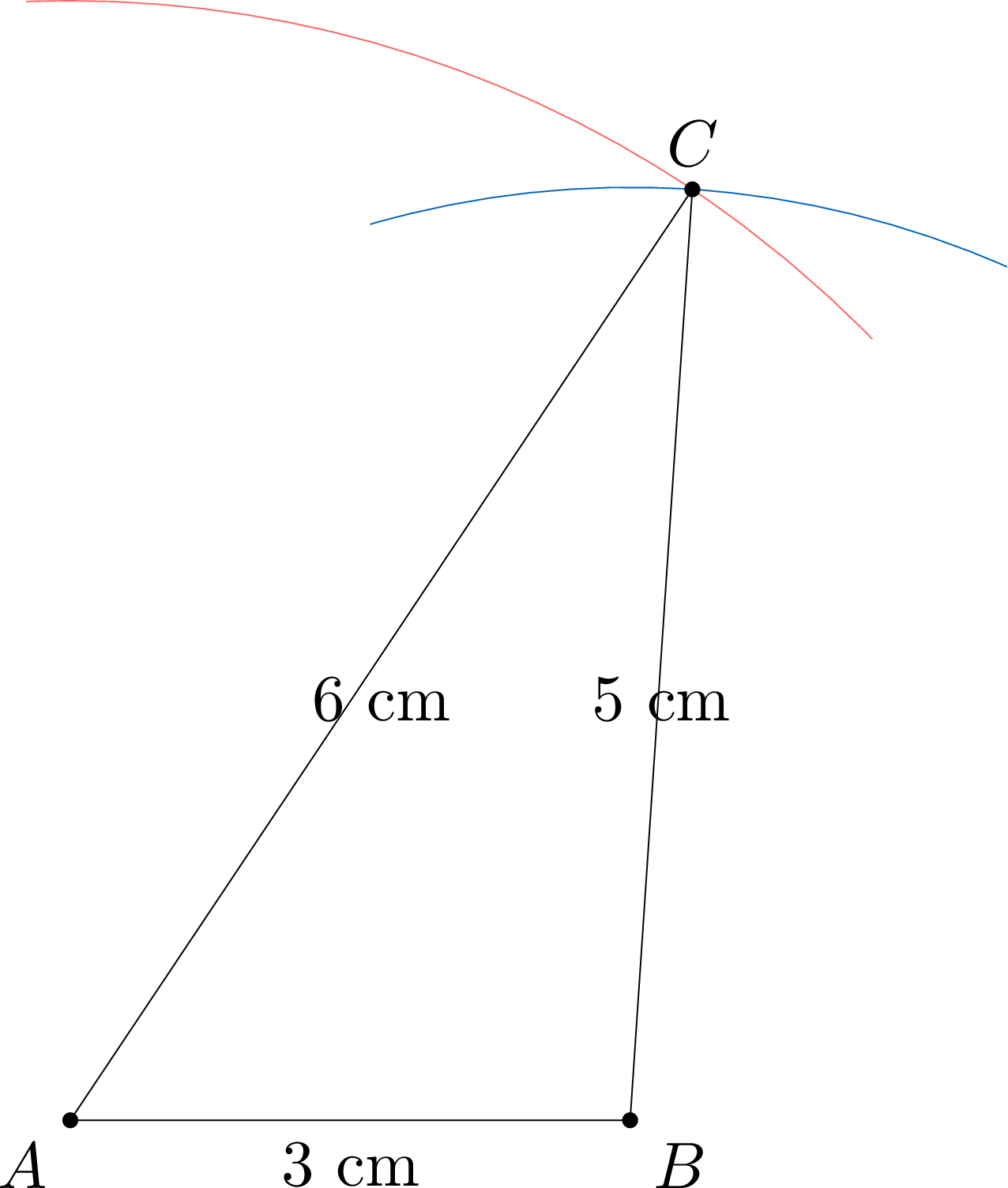
These three lengths are enough, because they are a property that fixes the triangle completely. With a ruler the side \(\Segment{AB}\) is drawn first; a compass opened to \(6\) cm draws an arc centred on \(A\), and one opened to \(5\) cm an arc centred on \(B\). Drawn all the way round, the two arcs cross at two points, one on each side of \(\Segment{AB}\) (the figure shows the one above); either one can be taken as \(C\), and the two triangles obtained are mirror images of each other — the same triangle turned over. So the triangle is determined, and the same lengths reproduce it identically every time. Once built, a triangle is named by which of its sides are equal, and a quadrilateral by which of its sides and angles are equal: the family comes from the properties, not from the appearance.
Definition — Triangle
A triangle is a polygon with three sides (and therefore three vertices and three angles). 
We can classify triangles by looking at how many of their sides are equal in length.
Definition — Isosceles triangle
An isosceles triangle is a triangle in which at least two sides are equal in length. When exactly two of them are equal, the third side is called the base, and the vertex opposite the base is called the apex. An equilateral triangle, whose three sides are equal, is therefore isosceles as well. 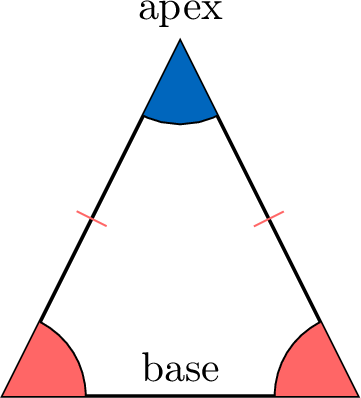
Definition — Equilateral triangle
An equilateral triangle is a triangle in which all three sides are equal in length. It is a special case of an isosceles triangle. 
Definition — Scalene triangle
A scalene triangle is a triangle in which all three sides have different lengths (no sides are equal). 
Definition — Right-angled triangle
A right-angled triangle is a triangle with one right angle (an angle of \(90^\circ\)). 
Method — Constructing a triangle with a ruler and compass
To construct a triangle \(ABC\) with \(AB = 3\) cm, \(AC = 6\) cm, and \(BC = 5\) cm: - Draw the segment \(\Segment{AB}\) of length 3 cm with the ruler.

- With the compass, draw an arc with centre \(A\) and radius 6 cm.

- With the compass again, draw an arc with centre \(B\) and radius 5 cm.

- The two arcs cross at two points, one on each side of \(\Line{AB}\). Mark either of them as \(C\) — the two choices give the same triangle, each the mirror image of the other. Then draw the segments \(\Segment{AC}\) and \(\Segment{BC}\) with the ruler.

Skills to practice
- Classifying Triangles by Side Lengths
- Constructing Triangles with a Ruler and Compass
III
Special Quadrilaterals
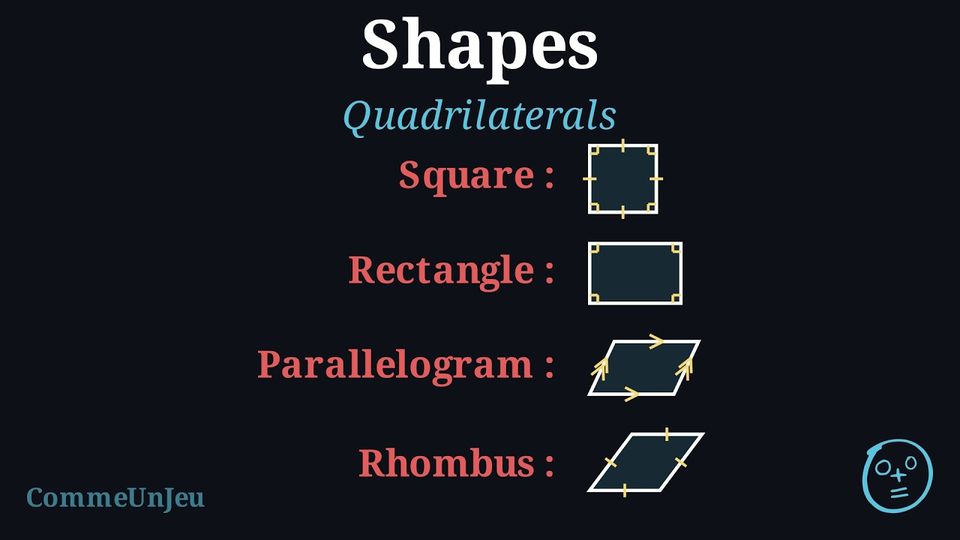
Some quadrilaterals have special names, based on their side lengths, their angles, and whether opposite sides are parallel.
Definition — Parallelogram
A parallelogram is a quadrilateral in which both pairs of opposite sides are parallel. 
Proposition — Property of a parallelogram
In a parallelogram, the opposite sides are equal in length. 
Definition — Square
A square is a quadrilateral with four right angles and four equal sides. 
Definition — Rectangle
A rectangle is a quadrilateral with four right angles (each angle is \(90^\circ\)). 
Proposition — Properties of a rectangle
In a rectangle, the opposite sides are equal in length and parallel. 

Definition — Rhombus
A rhombus is a quadrilateral with four equal sides. 
Proposition — Property of a rhombus
In a rhombus, the opposite sides are parallel. 
Definition — Trapezium
A trapezium is a quadrilateral with at least one pair of opposite sides parallel: these two sides are called the bases. The two other sides are not necessarily parallel. 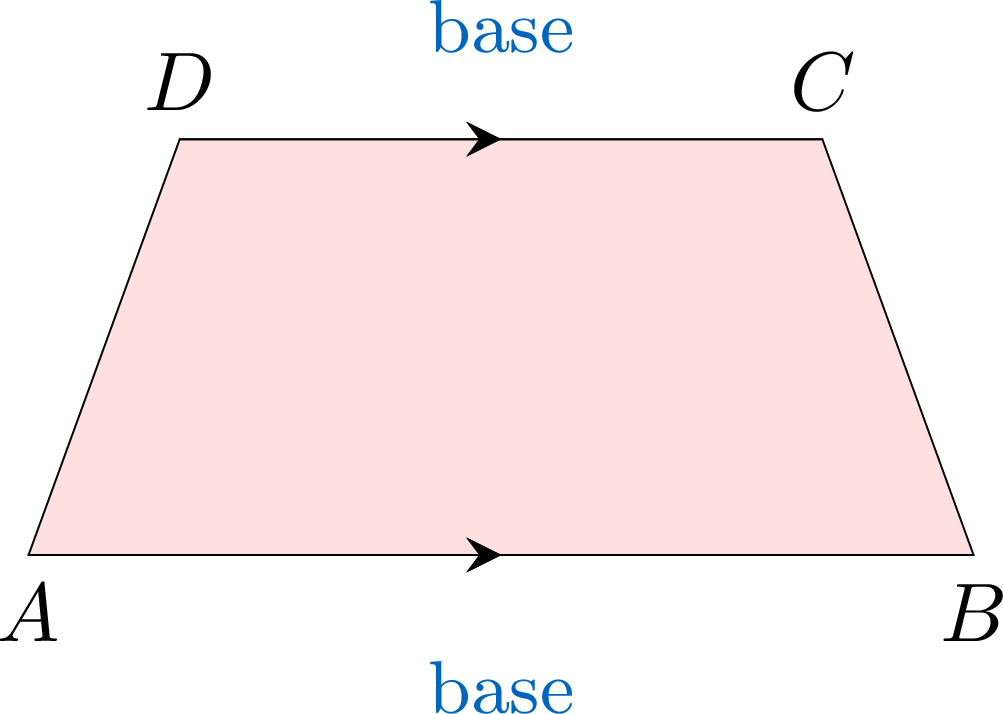
Definition — Right-angled Trapezium
A right-angled trapezium is a trapezium with at least two right angles: one of its sides is perpendicular to both bases. 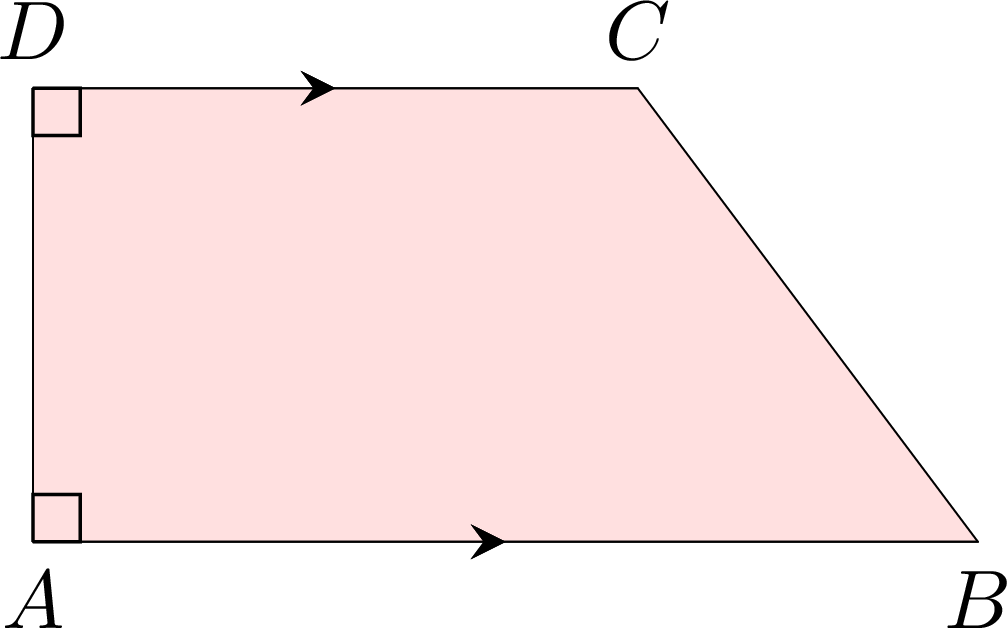
Proposition — Properties of a trapezium
- In a trapezium, the two bases are parallel. To check with the set square: draw a line perpendicular to one base; if it is also perpendicular to the other base, the bases are parallel.
- In a right-angled trapezium, the side perpendicular to the bases forms two right angles — checked with the set square. If the two bases had the same length, the figure would be a rectangle.
- A rectangle is a trapezium with four right angles; a square, a rectangle and a rhombus all have two pairs of parallel sides.
Example
Which of these quadrilaterals are trapeziums? Which one is a right-angled trapezium? Explain with the codes on the figures. (On figure (2), a check with the set square shows that no side is parallel to another.) 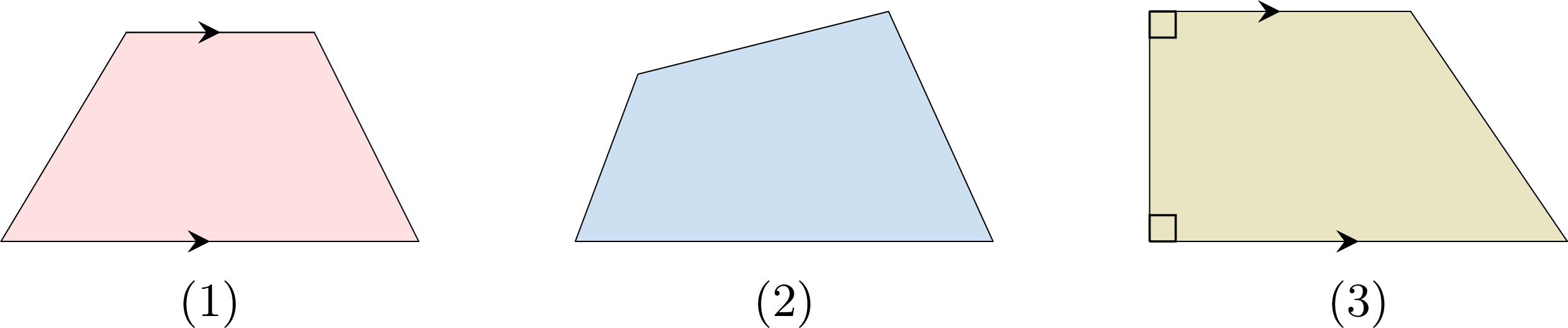
Skills to practice
- Determining Properties of Quadrilaterals
- Identifying a Figure from its Properties
- Recognising Trapeziums
- Constructing and Identifying Quadrilaterals
IV
Construction Programs
Definition — Diagonal
A diagonal of a polygon is a line segment that joins two vertices which are not next to each other — two corners not already joined by a side. A quadrilateral has two diagonals. 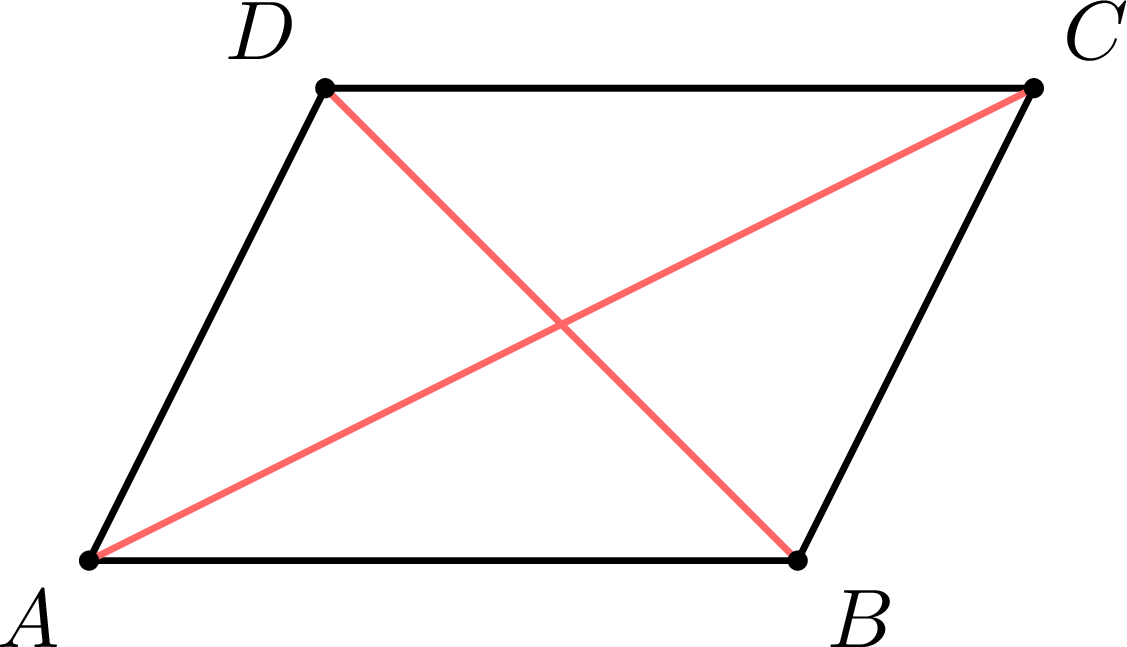
Definition — Construction Program
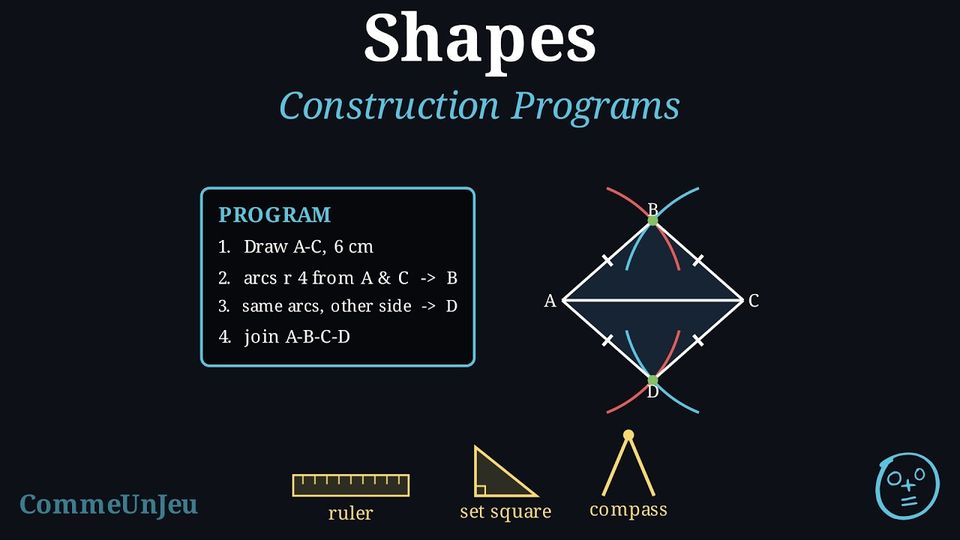
A construction program is an ordered list of instructions that explains, step by step, how to draw a figure. Each instruction must say exactly what to draw, leaving no choice that changes the figure. Where on the sheet it ends up, and which way round it is turned, do not matter: two people who follow the same program carefully obtain the same figure — same shape, same lengths — even if one drew it higher up, or the other way round. The steps you used to construct a circle and a triangle were already construction programs. Method — Writing a Construction Program
To write a construction program for a figure: - Name the points of the figure (for example \(A\), \(B\), \(C\), \(D\)).
- Give the steps in order, starting from a first segment and ending with the finished figure.
- Make each instruction precise — state every length, every right angle, and which tool to use (ruler, set square, compass) — so the reader can follow it without ever seeing the figure.
Example
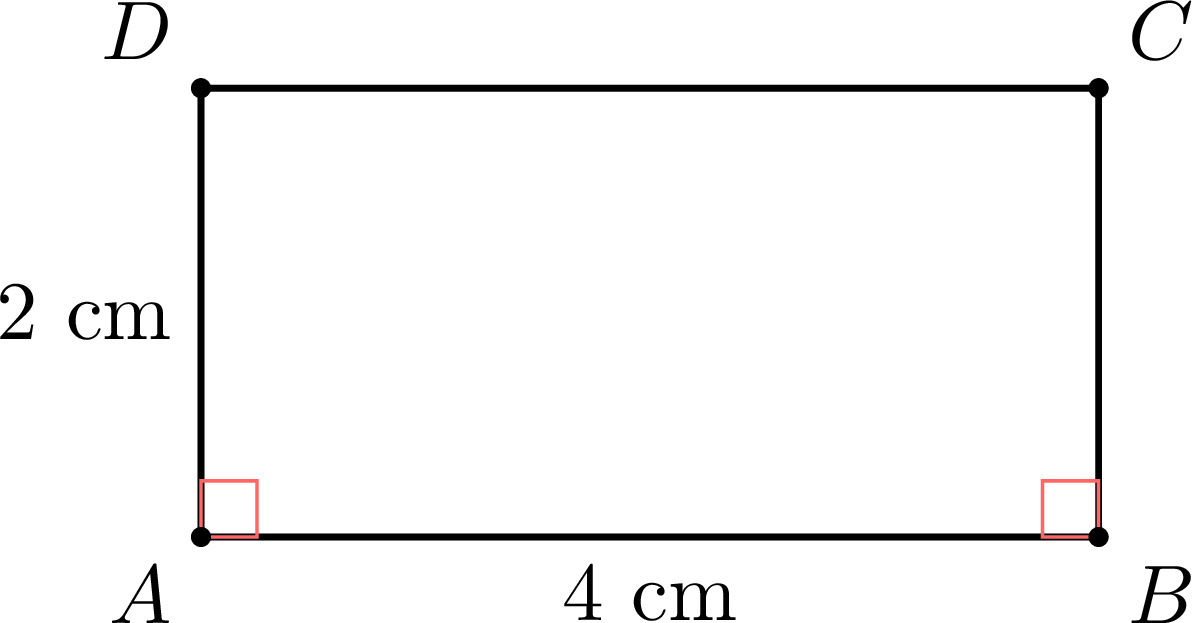
Here is a construction program for a rectangle \(ABCD\) with \(AB = 4\) cm and \(BC = 2\) cm. - Draw the segment \(\Segment{AB}\) of length \(4\) cm.
- At \(A\), with the set square, draw the line perpendicular to \(\Segment{AB}\); on it mark the point \(D\) with \(AD = 2\) cm.
- At \(B\), with the set square, draw the line perpendicular to \(\Segment{AB}\); on it, on the same side of \(\Line{AB}\) as \(D\), mark the point \(C\) with \(BC = 2\) cm.
- Draw the segment \(\Segment{DC}\). The quadrilateral \(ABCD\) is the required rectangle.
Example
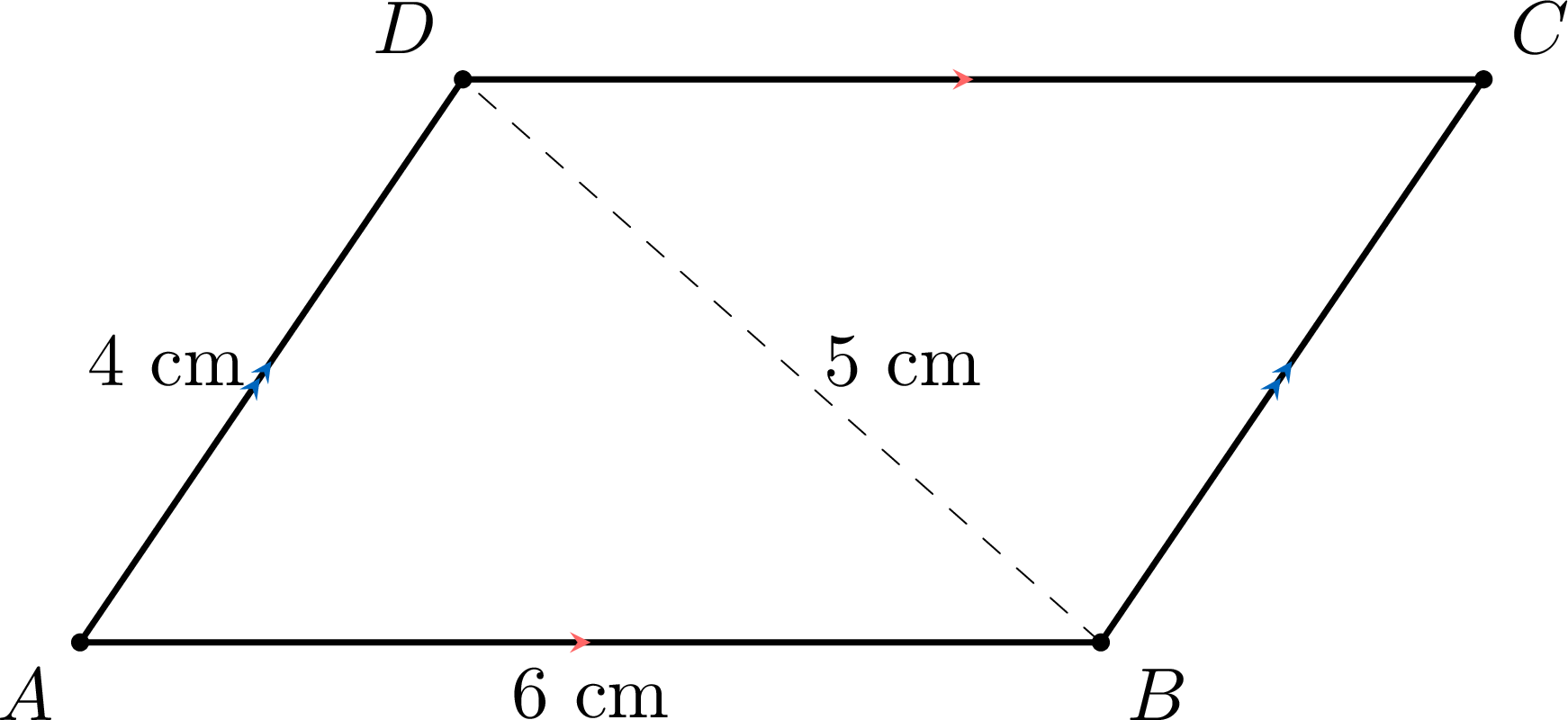
Here is a construction program for a parallelogram \(ABCD\) with \(AB = 6\) cm, \(AD = 4\) cm and diagonal \(BD = 5\) cm. Two consecutive sides and a diagonal fix the parallelogram completely. - Draw the segment \(\Segment{AB}\) of length \(6\) cm.
- With the compass, draw the arc of radius \(4\) cm centred on \(A\) and the arc of radius \(5\) cm centred on \(B\); mark \(D\) where they cross. Draw \(\Segment{AD}\).
- With the compass, draw the arc of radius \(6\) cm centred on \(D\) and the arc of radius \(4\) cm centred on \(B\); mark \(C\) where they cross, on the other side of \(\Line{BD}\) from \(A\).
- Draw \(\Segment{DC}\) and \(\Segment{BC}\). The quadrilateral \(ABCD\) is the required parallelogram.
Example
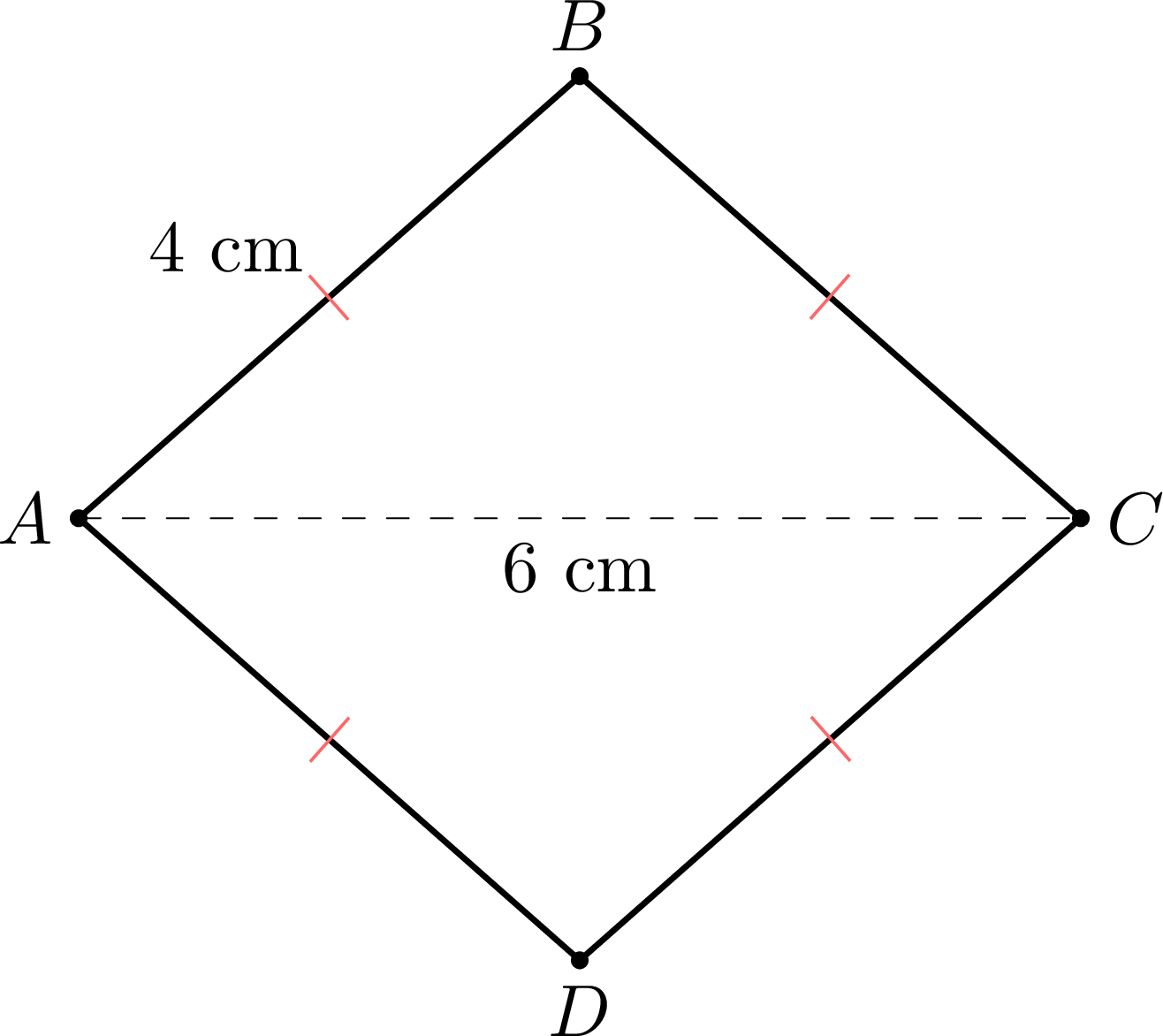
Here is a construction program for a rhombus \(ABCD\) with side \(4\) cm and diagonal \(AC = 6\) cm. Because every side of a rhombus is equal, a side length and a diagonal are enough. - Draw the segment \(\Segment{AC}\) of length \(6\) cm (this will be a diagonal).
- With the compass, draw the arc of radius \(4\) cm centred on \(A\) and the arc of radius \(4\) cm centred on \(C\), above \(\Segment{AC}\); mark \(B\) where they cross.
- Draw the two arcs again below \(\Segment{AC}\); mark \(D\) where they cross.
- Draw \(\Segment{AB}\), \(\Segment{BC}\), \(\Segment{CD}\) and \(\Segment{DA}\). The quadrilateral \(ABCD\) is the required rhombus.
Skills to practice
- Following a Construction Program
- Writing a Construction Program
V
Going further
Skills to practice
- Solving Harder Plane-Figure Problems
- Quiz
Jump to section