International Baccalaureate · PYP 1
Position and Direction
I
On, Under and In
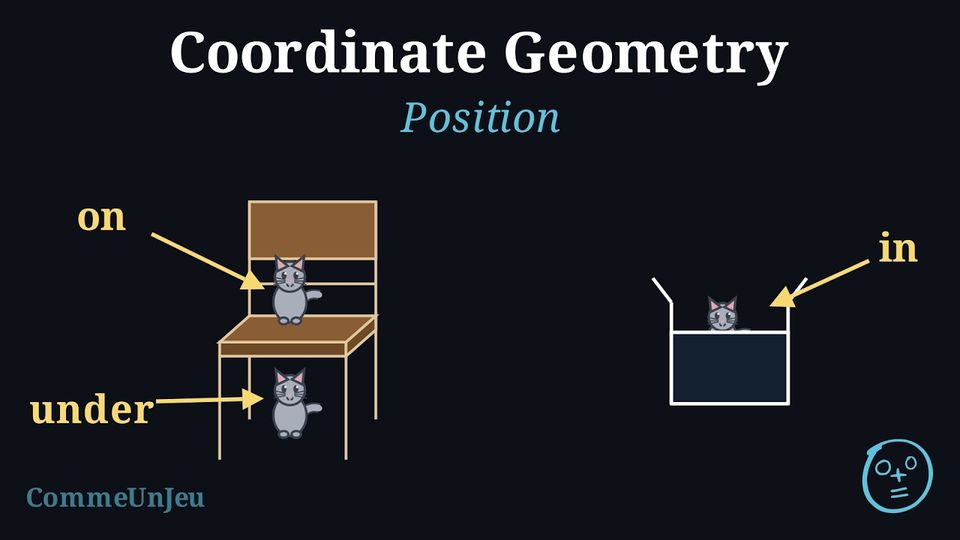
Tom's cat is hiding under the chair. Aya only tells him: “It is near the chair.” Tom looks all around the chair and does not find it. Which word would have told him at once where to look?
The word under: “The cat is under the chair.” 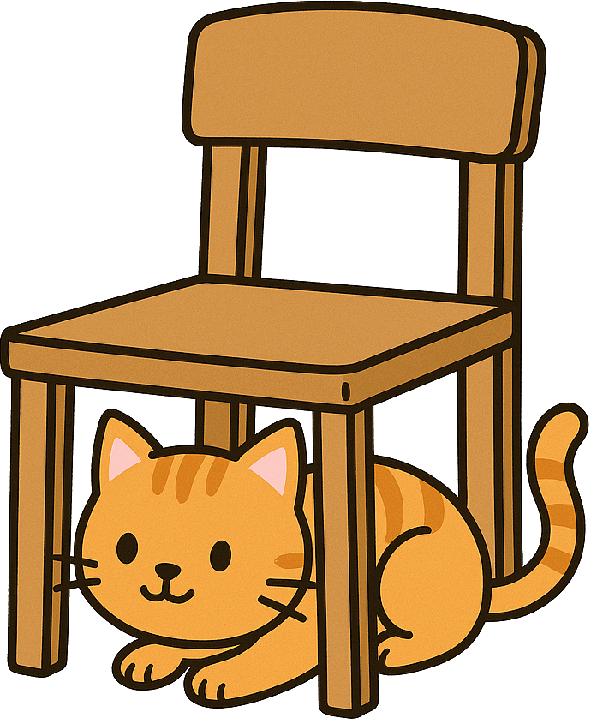
“Near” only says that it is not far; under says where to look. There are other words like this one to say where a thing is.
Definition — Positional Words
These words tell us where something is. -
The cat is on the chair. It is sitting on top.

-
The cat is under the chair. It is hiding underneath.

-
The cat is in the box. It is inside.

Skills to practice
- Finding Positions
II
Where Is It?
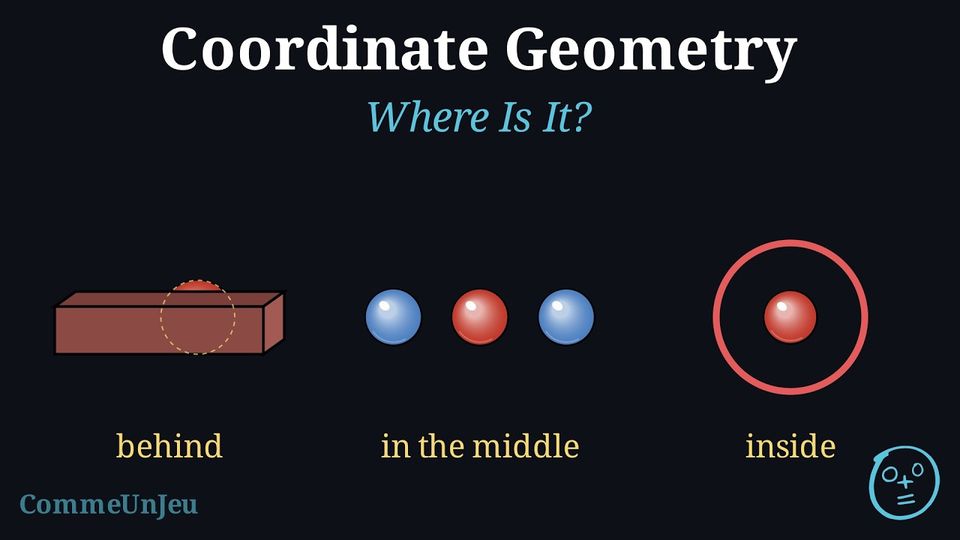
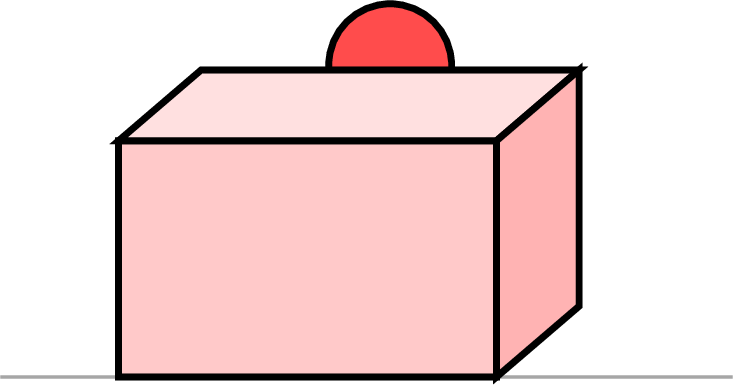
Definition — In Front and Behind
The marble can hide on either side of the box. 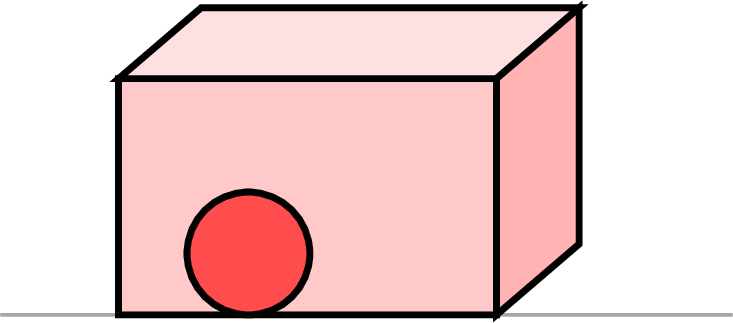
Definition — Between and in the Middle
The red marble is between the two blue marbles. Here, it is even right in the middle: at the same distance from both. 
Example
The ball, the box and the star are on a shelf. 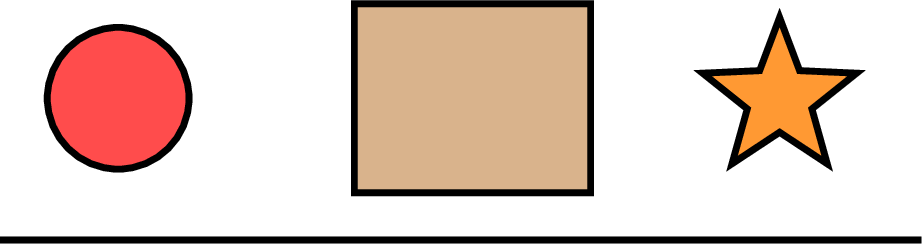
The box is between the ball and the star.
Skills to practice
- Choosing In Front, Behind or Between
III
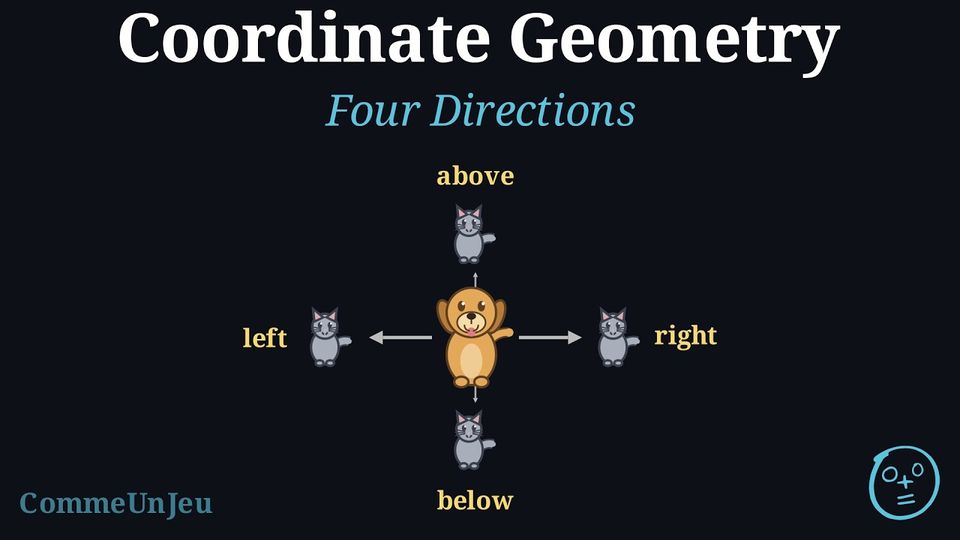
Four Directions
Definition — My Left and My Right
You always carry your left and your right with you: one hand is your left hand, the other is your right hand. When you turn around, they turn with you. A trick to remember them: wear a little bracelet on your left wrist for a few days — your hands will teach you. 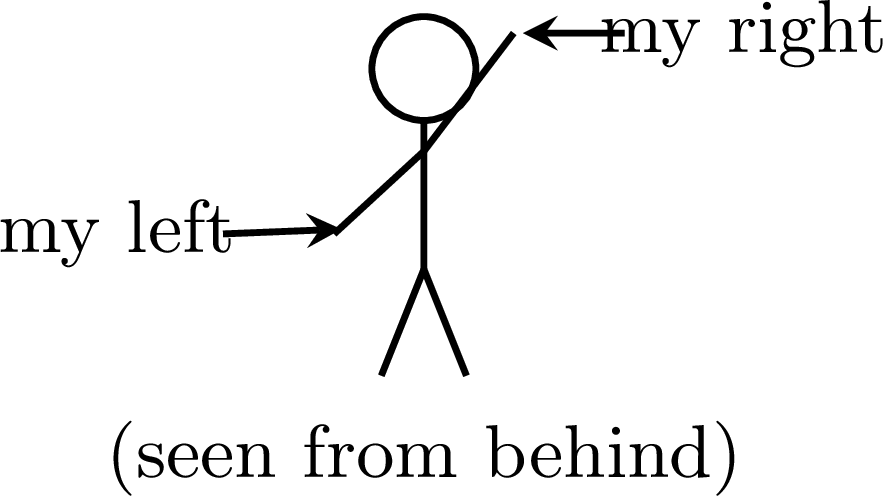
Aya says to Tom: “Take the ball beside the box!” Tom looks…and hesitates. 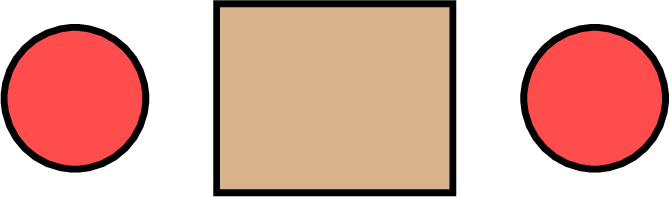
Why can Tom not know which ball it is?
Because there are two balls beside the box: one on each side of it. “Beside” is not enough. Aya must say which side: “the ball to the right of the box”. Only one ball matches. It is the same when a thing is higher or lower: we must say which side too.
Definition — Four Directions
These words tell us where one object is compared to another. -
The cat is above the dog. It is higher up.

-
The cat is below the dog. It is lower down.

-
The cat is to the right of the dog. It is on the right side.

-
The cat is to the left of the dog. It is on the left side.

Two Ways of Saying Right
Careful, “to the right” is not said in the same way for a person and for a picture. 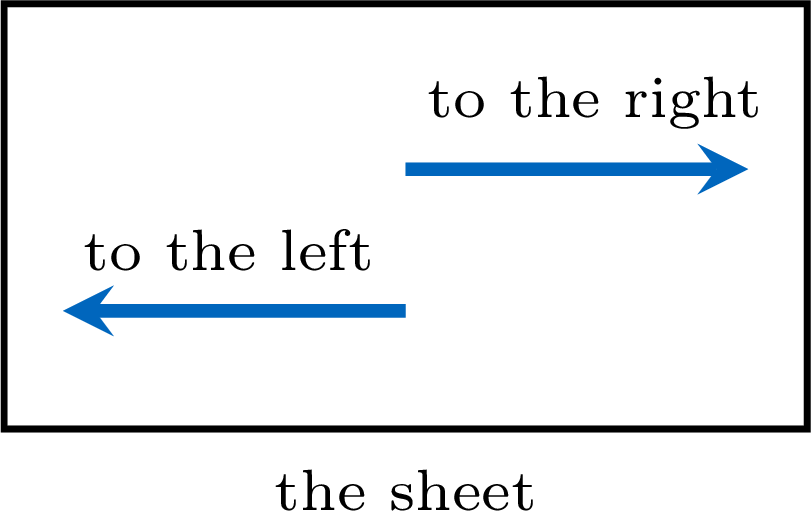
- When your friend is facing you, their right hand is on the side of your left hand — it is the other way round.
- When we say “the cat is to the right of the dog”, we are talking about the picture: to the right means towards the right edge of the sheet, wherever you are.
Example
The star and the ball are around the box. 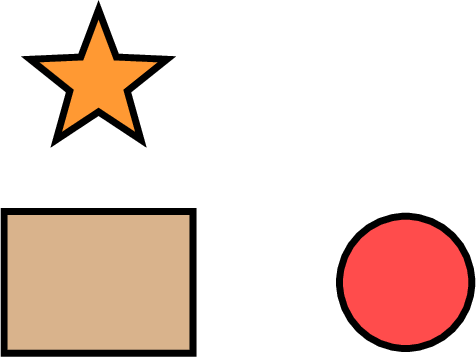
The star is above the box. The ball is to the right of the box.
Skills to practice
- Finding Directions in the Bedroom
- Finding Directions in the Classroom
IV
Four Movements
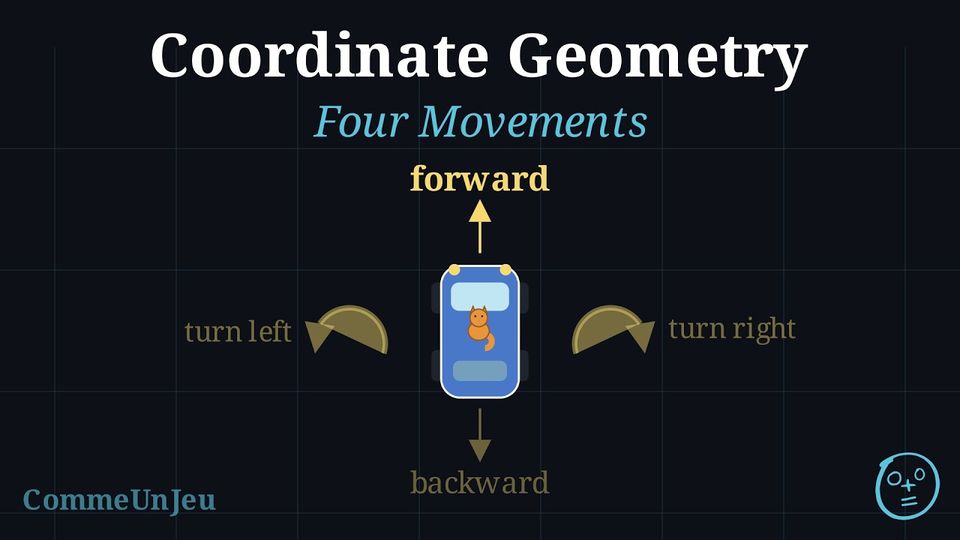
Sam has a remote-controlled car. It is in the garage, and it must go out and then reach the star. Sam wants to explain to Aya what his car does. 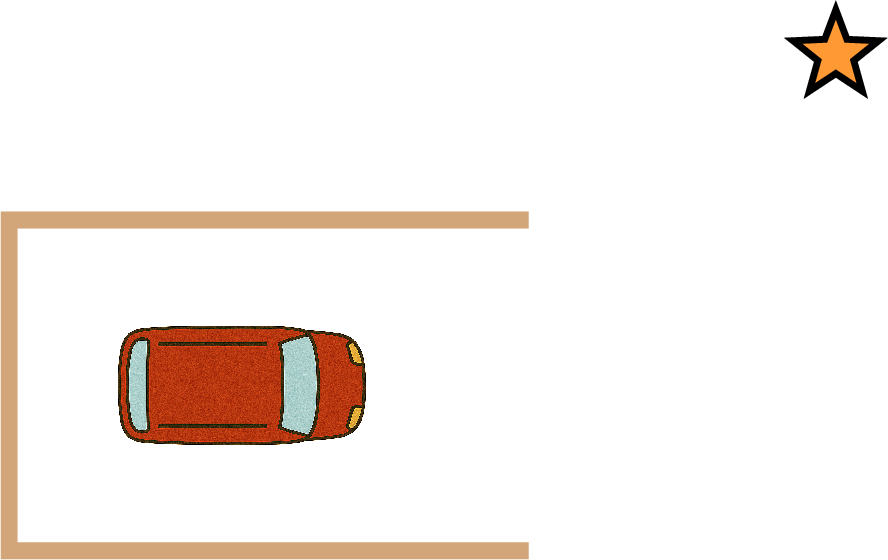
Which words does Sam need?
The car must first move forward until it is just below the star. Then it turns left — turning does not move it, it only changes the way it looks — and it moves forward again up to the star. With a few words like these ones, Sam can tell his whole trip.
Definition — Four Movements
These words tell us what the car does: two of them move it, two of them turn it on the spot. -
The car moves forward. It goes straight ahead.

-
The car moves backward. It goes back.

-
The car turns right. It changes direction towards its own right: the right of the one driving it.
 \(\quad\)

-
The car turns left. It changes direction towards its own left: the left of the one driving it.
\(\quad\) 
Example
The car moves forward on the grid. 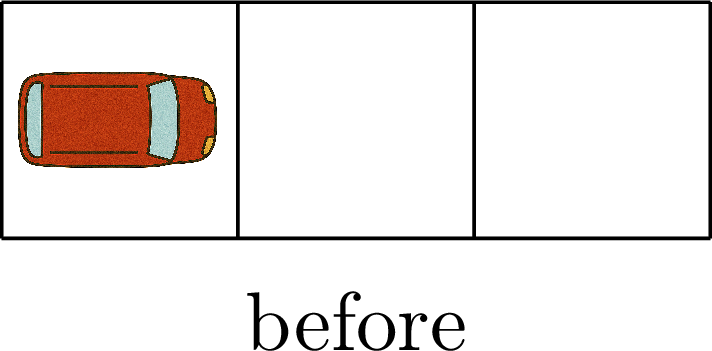 \(\qquad\)
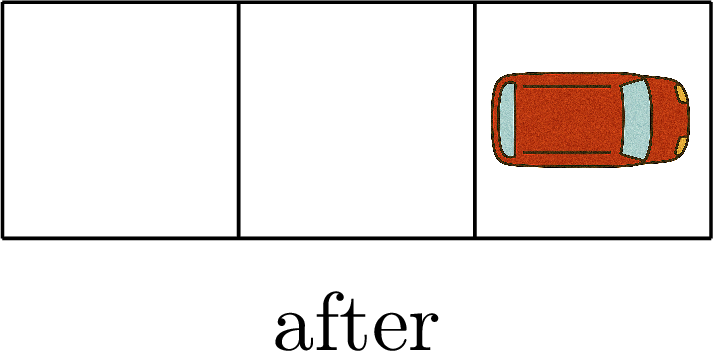
The car looks towards the right, and it did go that way: from its square it took two steps. It moves forward two squares.
Method — Turning Like the Robot
When the instructions are given in words to the robot car, we put ourselves in the robot's place. - Look at its nose: we see which way the robot is looking.
- Turn its nose: we turn the sheet (or our head) to look the same way as the robot, then we turn its nose a quarter turn towards the side we are told.
- Without changing square: when it turns, the robot stays on its square. It only changes square when it goes forward or backward.
Example
The robot is looking towards the right of the sheet. It gets one instruction: turn right. 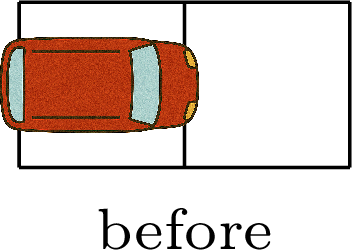
We put ourselves in its place: it is looking to the right, so its right is towards the bottom of the sheet. It turns its nose that way and stays on its square: now it is looking downwards. 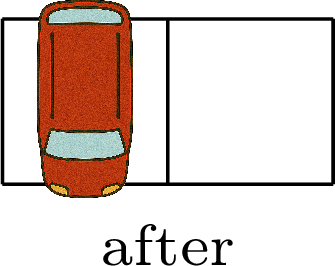
Skills to practice
- Moving a Car Forward or Backward on a Grid
- Turning a Car on a Grid
V
The Classroom Plan
Definition — The Plan
A plan shows a room seen from above. The bed becomes a big rectangle, the little table a small square, the cat and the dog become dots. On the plan, we can point at where everything is. 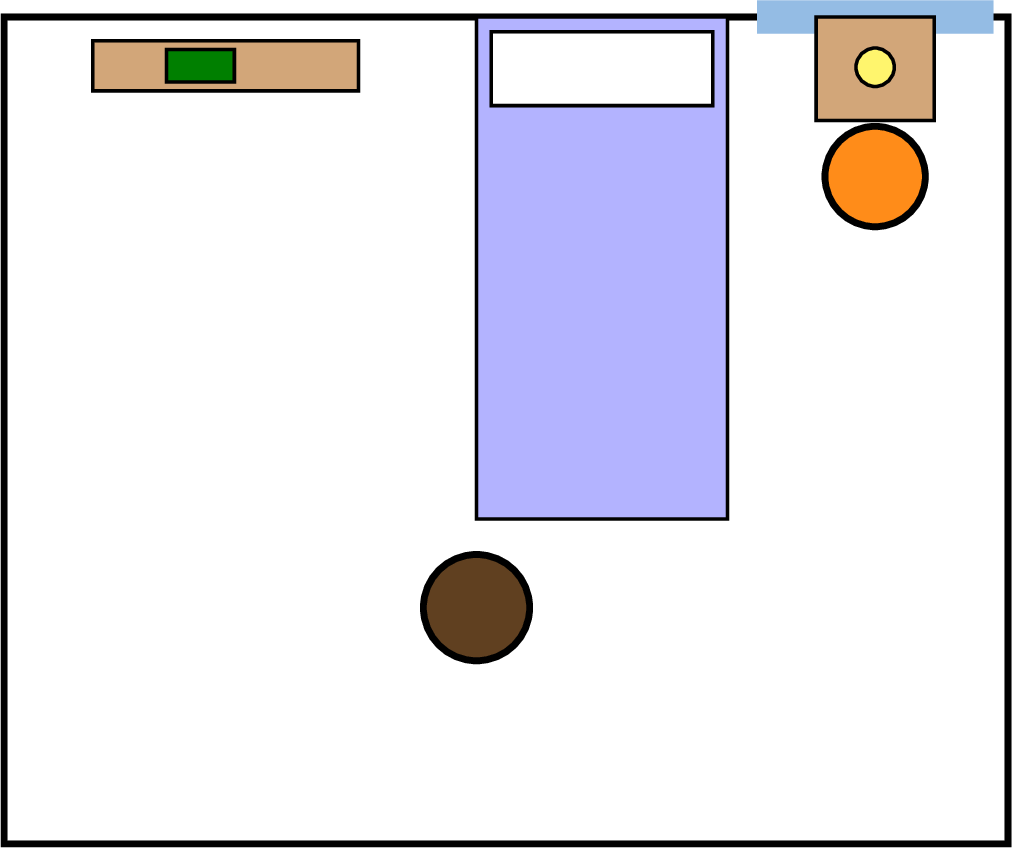
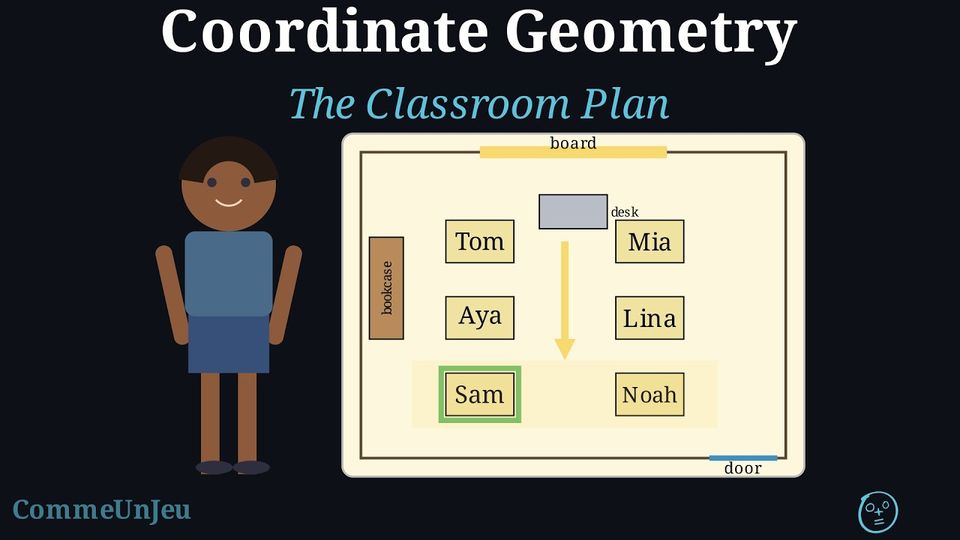
It is the first day of school. The teacher sent out the plan of the classroom. Sam is happy: he says he is at the back of the classroom, next to his friend Tom. 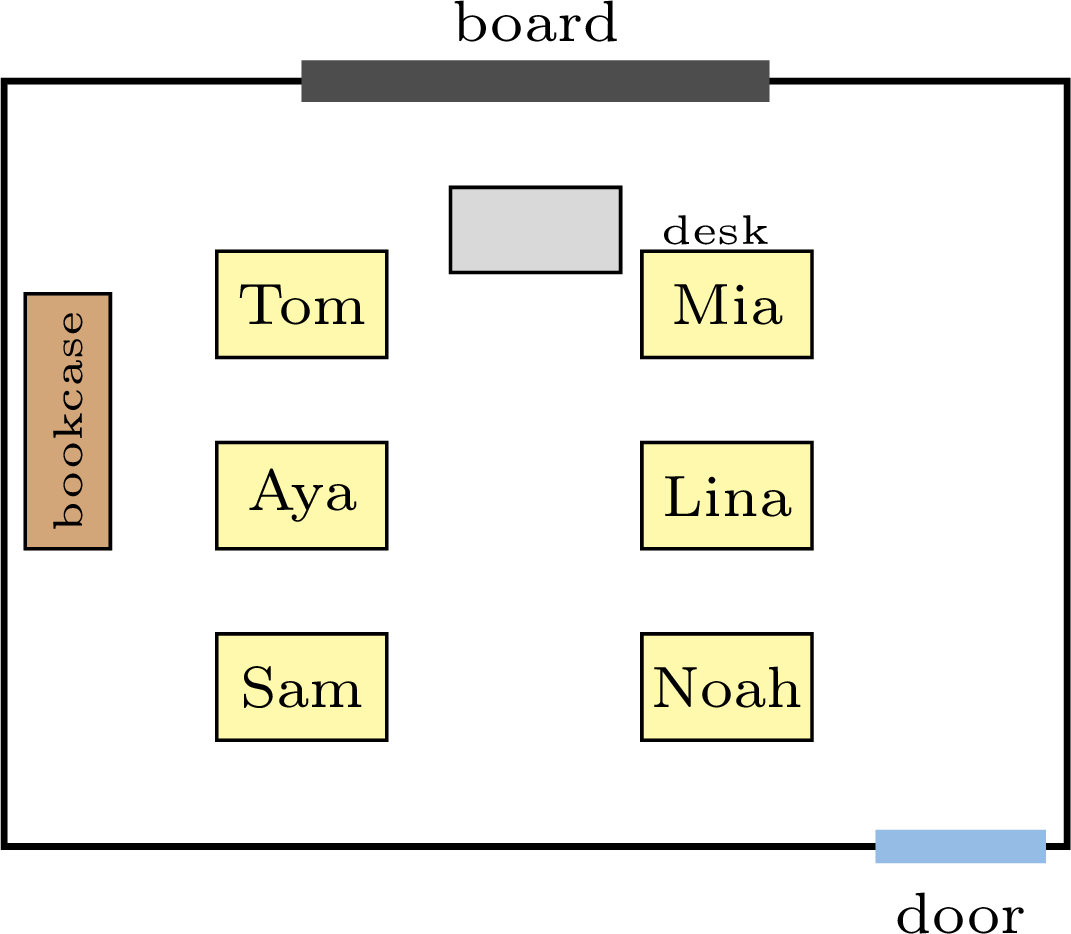
Sam says two things. Are they both true?
We read the plan. The board is at the top: the back of the classroom is the row furthest from the board — Sam's table is there. True, Sam is at the back. In that back row, beside Sam, there is Noah's table (Aya's table is above Sam's, in the row in front); Tom's table is close to the board. False, Sam is not next to Tom — his neighbour is Noah. 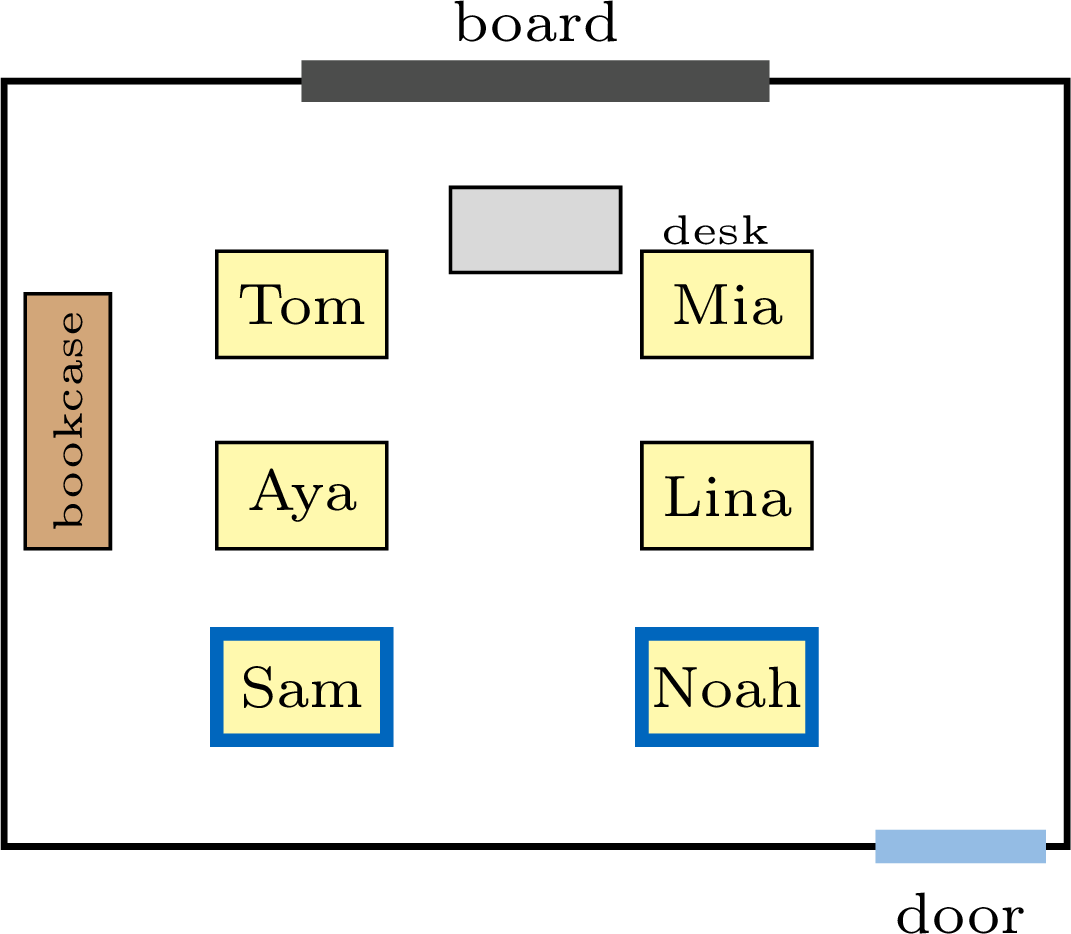
Definition — The Classroom Plan
The plan of the classroom is the drawing of the classroom seen from above, like the plan of the bedroom. Each table, the board, the door are drawn at their place. On the plan, we can mark a place to show it to someone without pointing. Method — Reading the Classroom Plan
- Find the fixed landmarks: we spot the board, the door, the bookshelf — they never move.
- Turn the plan: hold it so the board on the plan is on the same side as the real board.
- Walk with your eyes: start from a landmark and move from table to table up to the place you are looking for.
Example
The star is put on a table. On whose table is it? 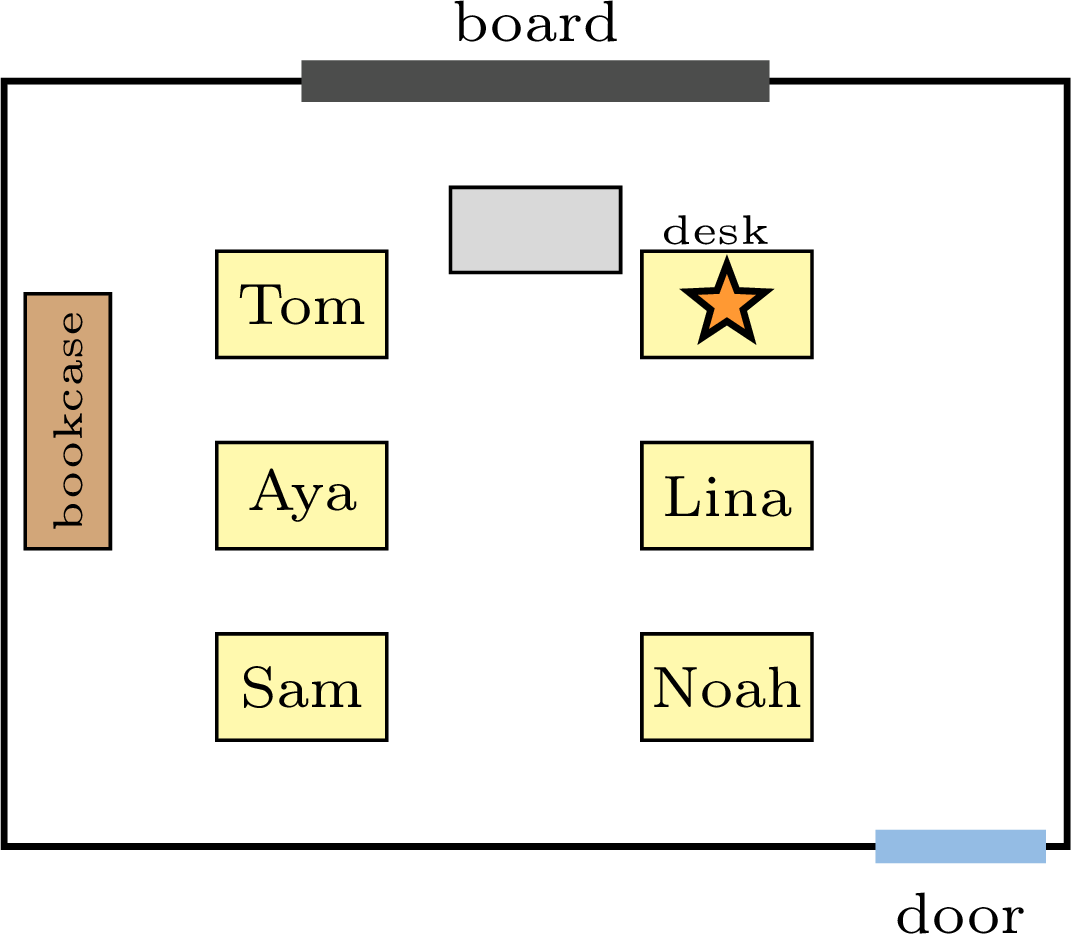
The table with the star has no name written: we use the landmarks. It is the pupil table at the top right, next to Tom's table and above Lina's table. It is Mia's table.
Skills to practice
- Reading the Classroom Plan
- Drawing the Path on the Plan
VI
Coding Moves
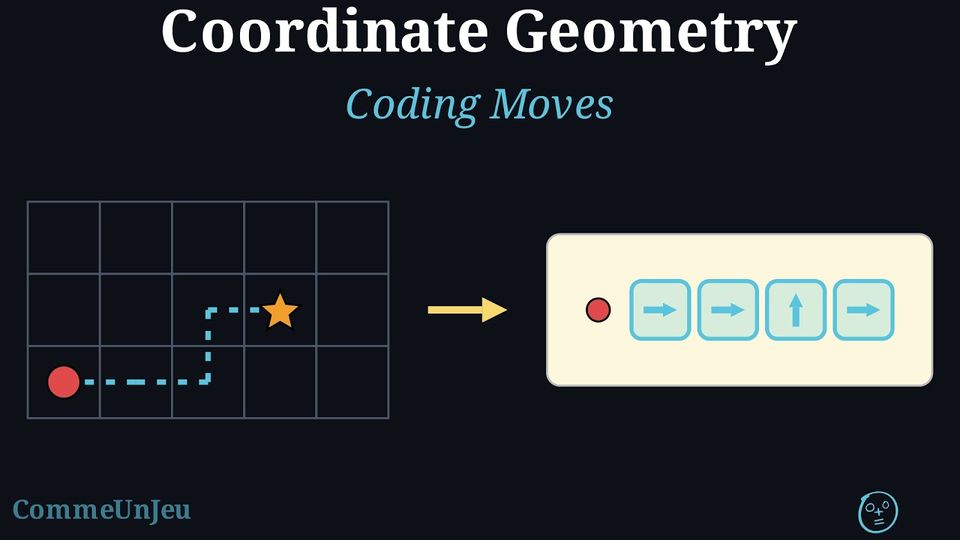
Definition — One Arrow per Step
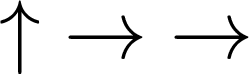
To code a path, we use four arrows: \(\uparrow\;\rightarrow\;\downarrow\;\leftarrow\). Each arrow means: take one step to the next square in that direction. 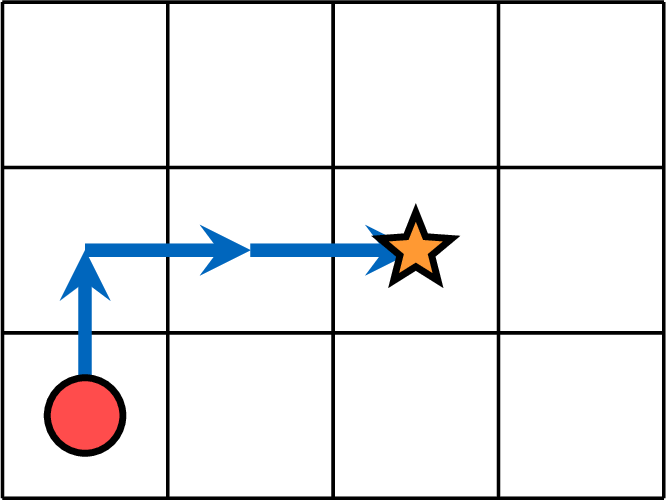
Aya found a secret hiding spot in the playground: the star. She walked the path drawn on the tiles. Now she wants to give the path to Tom on a piece of paper, without a single mistake. 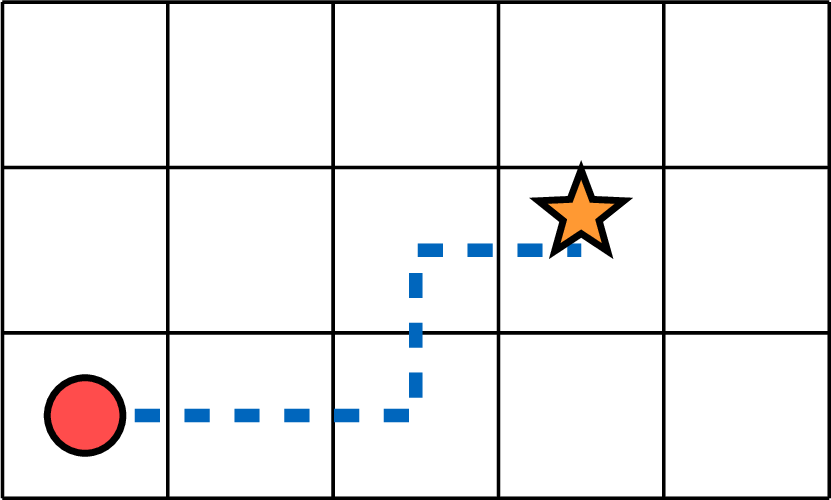
How can she write the path?
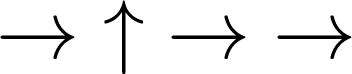
She writes the code: one arrow for each step of the path, in order — \(\rightarrow\;\rightarrow\;\uparrow\;\rightarrow\). Then she checks: finger on the start, she reads her arrows again and must land exactly on the hiding spot. Tom can now follow the path without Aya. 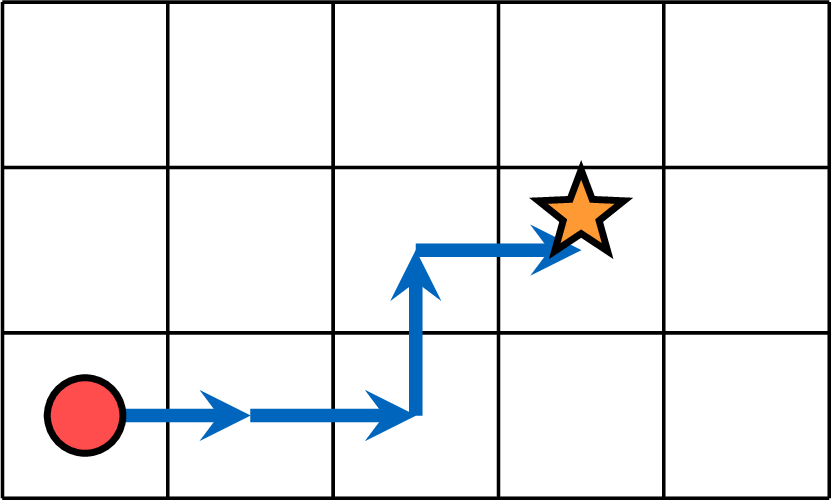
Definition — The Code
The code of a move is the row of arrows written in order: the first arrow is the first step, the last arrow is the last step. We read it from left to right, like a story of the path, square after square. 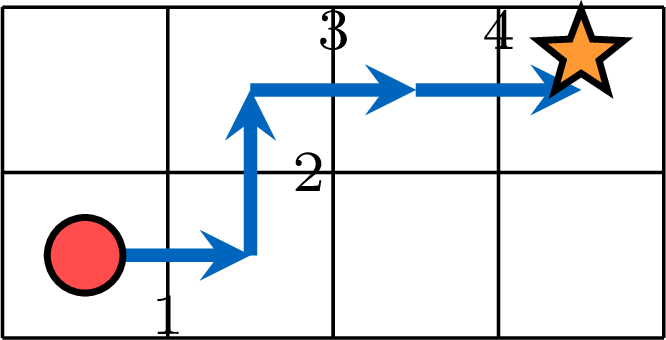
Method — Reading a Code
- Start: put your finger on the starting square.
- One arrow, one step: read the arrows one by one, in order; at each arrow, move to the next square in its direction.
- Arrival: the square where the finger stops is the arrival.
Method — Coding a Path
- Start: put your finger on the starting square.
- Step by step: follow the path one square at a time; at each step, write the arrow of its direction.
- Check: read your code again from the start, finger on the grid — you must land exactly on the arrival.
Example
Here is a path drawn from the marble to the star. 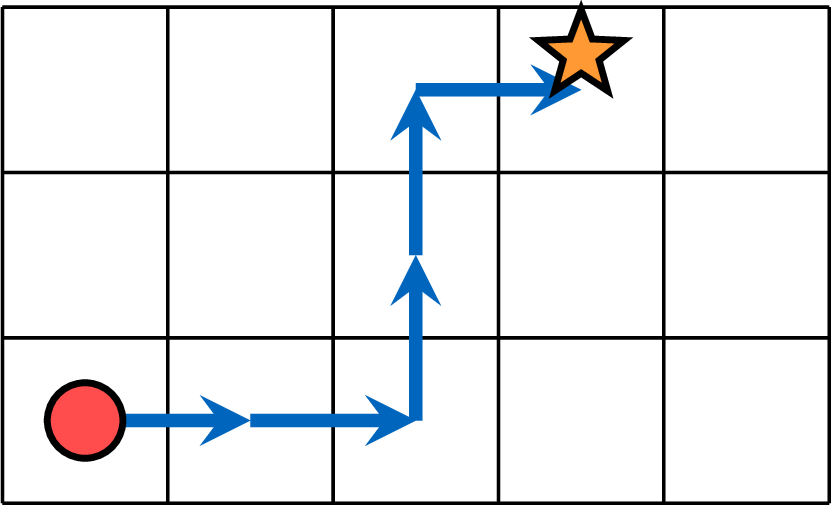
We follow the path one square at a time and write one arrow per step: \(\rightarrow\;\rightarrow\;\uparrow\;\uparrow\;\rightarrow\) Check: finger on the start, we read the code again — right, right, up, up, right — and we land on the star.
Saying Moves with Words
In the classroom, we can also say a move with words: move forward two steps, turn right, move back one step. Careful: with words, right is the right of the walker. On the grid, the arrows follow the sheet: \(\rightarrow\) always means towards the right edge of the sheet.
Skills to practice
- Following the Code and the Instructions
- Writing the Code
- Giving Instructions to the Robot
VII
Going further
Skills to practice
- Counting Moves on a Strip
- Programming the Robot
- Problems
- Quiz
Jump to section