International Baccalaureate · MYP 5 Extended
Further Functions
I
The Square Root Function
Proposition — Properties
- For any real number \(x\), \(x^2 \geq 0\).
- The square function is strictly decreasing on \((-\infty, 0]\) and strictly increasing on \([0, +\infty)\).

- The square function is even: its graph is symmetric with respect to the \(y\)-axis (\(f(-x) = f(x)\)).
Definition — Square Root Function
The square root function is defined on \([0, +\infty)\) by \(f(x) = \sqrt{x}\). For any non-negative \(x\), \(\sqrt{x}\) is the unique non-negative number whose square is \(x\). 
- Domain: \([0, +\infty)\) (non-negative real numbers).
- Shape: A curve starting at the origin \((0,0)\) and increasing.
Proposition — Properties
The square root function is strictly increasing on \([0, +\infty)\). 
Let \(f(x) = \sqrt{x}\). Let \(a\) and \(b\) be two real numbers such that \(0 \leq a < b\).$$\begin{aligned}[t]f(b) - f(a) &= \sqrt{b} - \sqrt{a} \\
&= \frac{(\sqrt{b} - \sqrt{a})(\sqrt{b} + \sqrt{a})}{\sqrt{b} + \sqrt{a}} \\
&= \frac{(\sqrt{b})^2 - (\sqrt{a})^2}{\sqrt{b} + \sqrt{a}}\\
&= \frac{b - a}{\sqrt{b} + \sqrt{a}}\end{aligned}$$ Since \(b > a\), the numerator \((b - a)\) is positive. The denominator is a sum of square roots of two non-negative numbers (not both zero), so it is positive.
Thus, \(f(b) - f(a) > 0\), so \(f(a) < f(b)\).
Thus, \(f(b) - f(a) > 0\), so \(f(a) < f(b)\).
Skills to practice
- Calculating Images
- Solving \(\sqrt{x} \equal k\)
- Comparing Square Roots
II
The Cube Function
Definition — Cube Function
The cube function is defined on \(\mathbb{R}\) by \(f(x) = x^3\). 
Proposition — Properties
- The cube function is strictly increasing on \(\mathbb{R}\).

- The cube function is odd: its graph is symmetric with respect to the origin \((0,0)\).
Parity: \(f(-x) = (-x)^3 = (-x) \times (-x) \times (-x) = -x^3 = -f(x)\).Thus, \(f\) is odd.
Variations: the strict growth of the cube function on \(\R\) is accepted without proof.
Variations: the strict growth of the cube function on \(\R\) is accepted without proof.
Example
The volume of a cube with side length \(x\) is \(V(x) = x^3\). What is the volume of a cube with side length \(6\) cm? \(V(6) = 6^3 = 216\): the volume is \(216\) cm\(^3\). Proposition — Comparing the Curves
For \(x \geq 0\), the curves of equations \(y=x\), \(y=x^2\) and \(y=x^3\) all pass through the points \(O(0, 0)\) and \(A(1, 1)\), and: - if \(0 \leq x \leq 1\), then \(x^3 \leq x^2 \leq x\): the curve of \(y=x^3\) is below the curve of \(y=x^2\), which is below the line \(y=x\);
- if \(x \geq 1\), then \(x \leq x^2 \leq x^3\): the order is reversed.
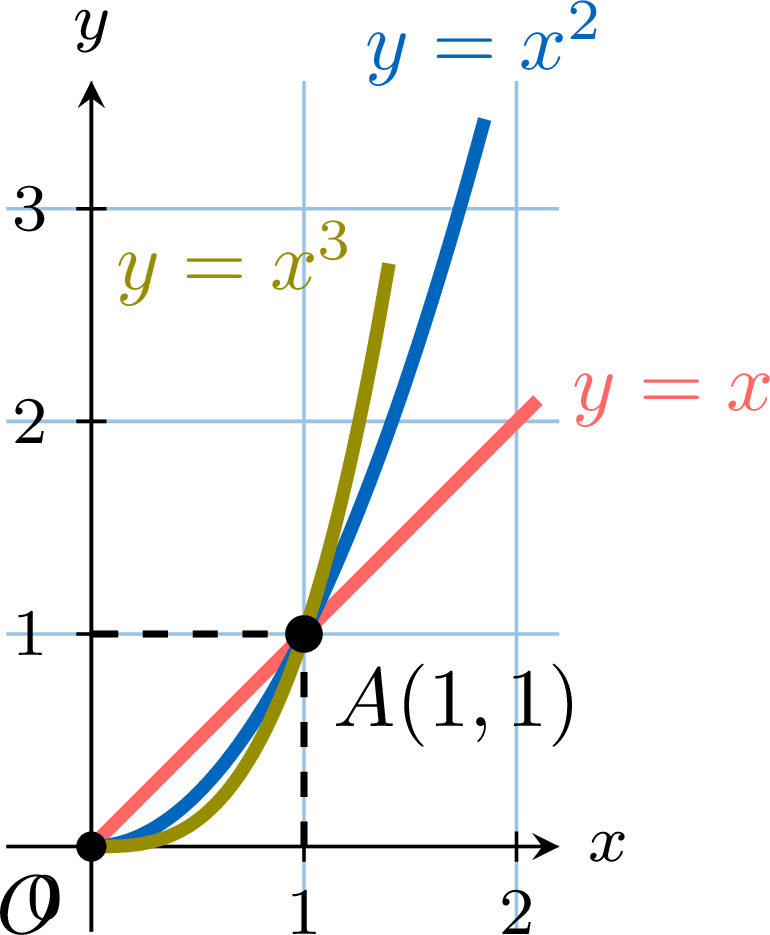
Let \(x\) be a real number with \(x \geq 0\). We compare the numbers in pairs by studying the sign of their difference.
Comparing \(x^2\) and \(x\). We factorise the difference: $$x^2 - x = x(x-1)$$
Moreover \(x(x-1) = 0\) and \(x^2(x-1) = 0\) hold exactly when \(x = 0\) or \(x = 1\): these are the only values where the three curves meet.
Comparing \(x^2\) and \(x\). We factorise the difference: $$x^2 - x = x(x-1)$$
- If \(0 \leq x \leq 1\): \(x \geq 0\) and \(x - 1 \leq 0\), so the product \(x(x-1) \leq 0\), hence \(x^2 \leq x\).
- If \(x \geq 1\): \(x \geq 0\) and \(x - 1 \geq 0\), so the product \(x(x-1) \geq 0\), hence \(x^2 \geq x\).
- if \(0 \leq x \leq 1\), then \(x^3 - x^2 \leq 0\), hence \(x^3 \leq x^2\);
- if \(x \geq 1\), then \(x^3 - x^2 \geq 0\), hence \(x^3 \geq x^2\).
Moreover \(x(x-1) = 0\) and \(x^2(x-1) = 0\) hold exactly when \(x = 0\) or \(x = 1\): these are the only values where the three curves meet.
Example
Without any calculation, order the numbers \(0.8\), \(0.8^2\), \(0.8^3\), then the numbers \(1.2\), \(1.2^2\), \(1.2^3\), in increasing order.
Since \(0 \lt 0.8 \lt 1\), the proposition gives: $$0.8^3 \lt 0.8^2 \lt 0.8$$ Since \(1.2 \gt 1\), the order is reversed: $$1.2 \lt 1.2^2 \lt 1.2^3$$ Check: \(0.8^2 = 0.64\) and \(0.8^3 = 0.512\); \(1.2^2 = 1.44\) and \(1.2^3 = 1.728\).
Skills to practice
- Ordering a Number and Its Powers
- Calculating Images
III
The Reciprocal Function
Definition — Reciprocal Function
The reciprocal function is defined on \(\mathbb{R} \setminus \{0\}\) (all real numbers except \(0\)) by \(f(x) = \frac{1}{x}\). 
- Domain: \(\mathbb{R} \setminus \{0\}\), also written \((-\infty, 0) \cup (0, +\infty)\).
- Shape: A curve called a hyperbola.
Proposition — Properties
- The reciprocal function is strictly decreasing on \((-\infty, 0)\) and strictly decreasing on \((0, +\infty)\).

- The reciprocal function is odd (symmetric about the origin).
Let \(a\) and \(b\) be two real numbers such that \(0 < a < b\).$$f(b) - f(a) = \frac{1}{b} - \frac{1}{a} = \frac{a - b}{ab}$$ Since \(a < b\), then \((a - b) < 0\). Since \(a\) and \(b\) are positive, \(ab > 0\).
The quotient is strictly negative, so \(f(b) < f(a)\). The order is reversed; \(f\) is strictly decreasing on \((0, +\infty)\).
For \(a < b < 0\), the same computation applies: \(ab > 0\) (product of two negatives) and \(a - b < 0\), so again \(f(b) < f(a)\): \(f\) is strictly decreasing on \((-\infty, 0)\) as well.
Parity: for every \(x \neq 0\), \(f(-x) = \frac{1}{-x} = -\frac{1}{x} = -f(x)\): \(f\) is odd.
Skills to practice
- Comparing Values of the Reciprocal Function
IV
The Absolute Value Function
Definition — Absolute Value Function
The absolute value function is defined on \(\mathbb{R}\) by \(f(x) = |x|\), the absolute value of \(x\): $$f(x) = |x| = \begin{cases} x & \text{if } x \geq 0 \\
-x & \text{if } x < 0 \end{cases}$$ 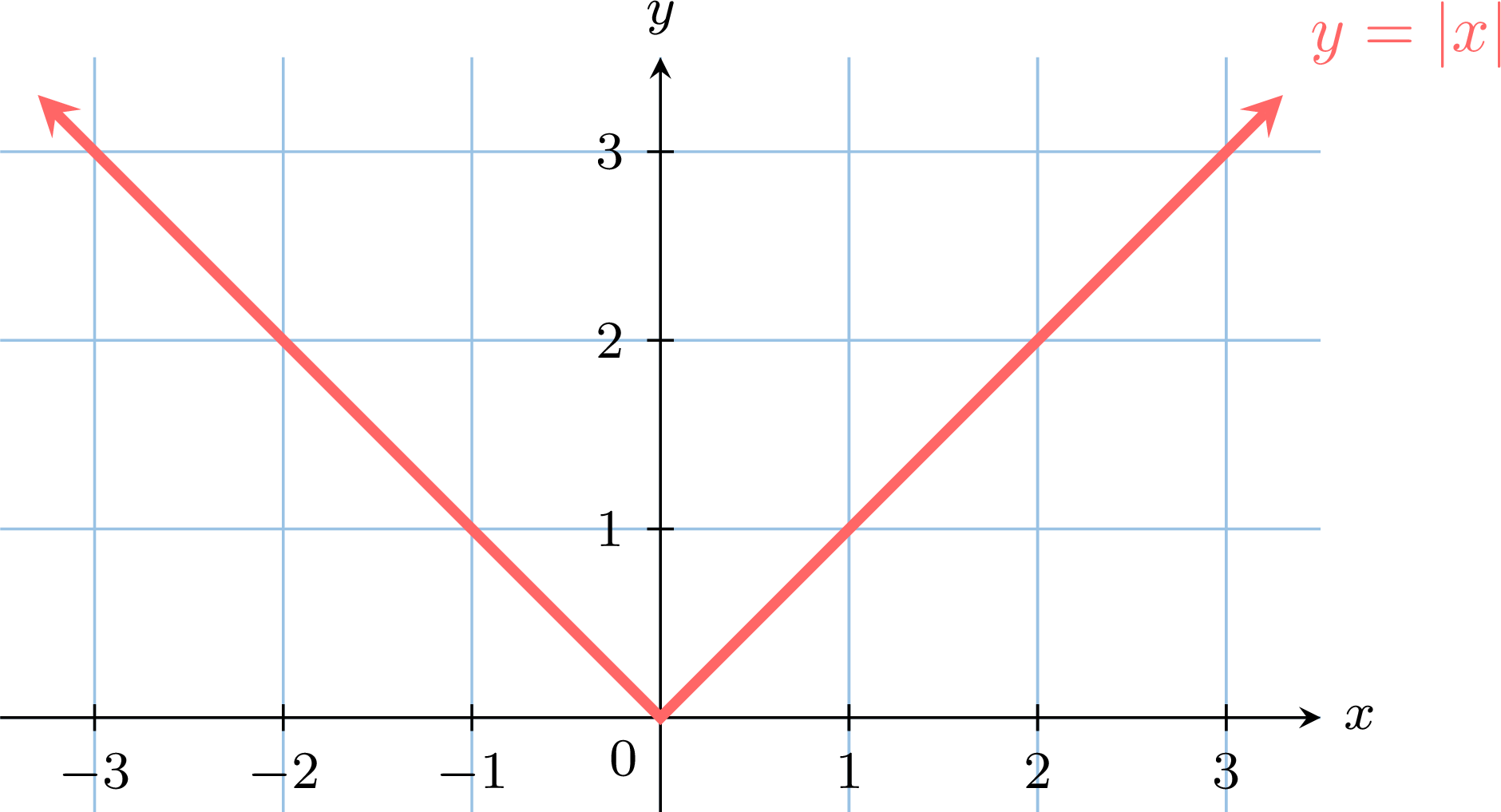
- Domain: all real numbers (\(\mathbb{R}\)).
- Shape: two rays starting from the origin, the line \(y = x\) for \(x \geq 0\) and the line \(y = -x\) for \(x < 0\), which form a “V” with its vertex at \(O\).
- Symmetry: since \(|-x| = |x|\) for every real \(x\), the curve is symmetric with respect to the \(y\)-axis.
Proposition — Properties
- For any real number \(x\), \(|x| \geq 0\), and \(|x| = 0\) only for \(x = 0\).
- The absolute value function is strictly decreasing on \((-\infty, 0]\) and strictly increasing on \([0, +\infty)\); its minimum is \(0\), reached at \(x = 0\).
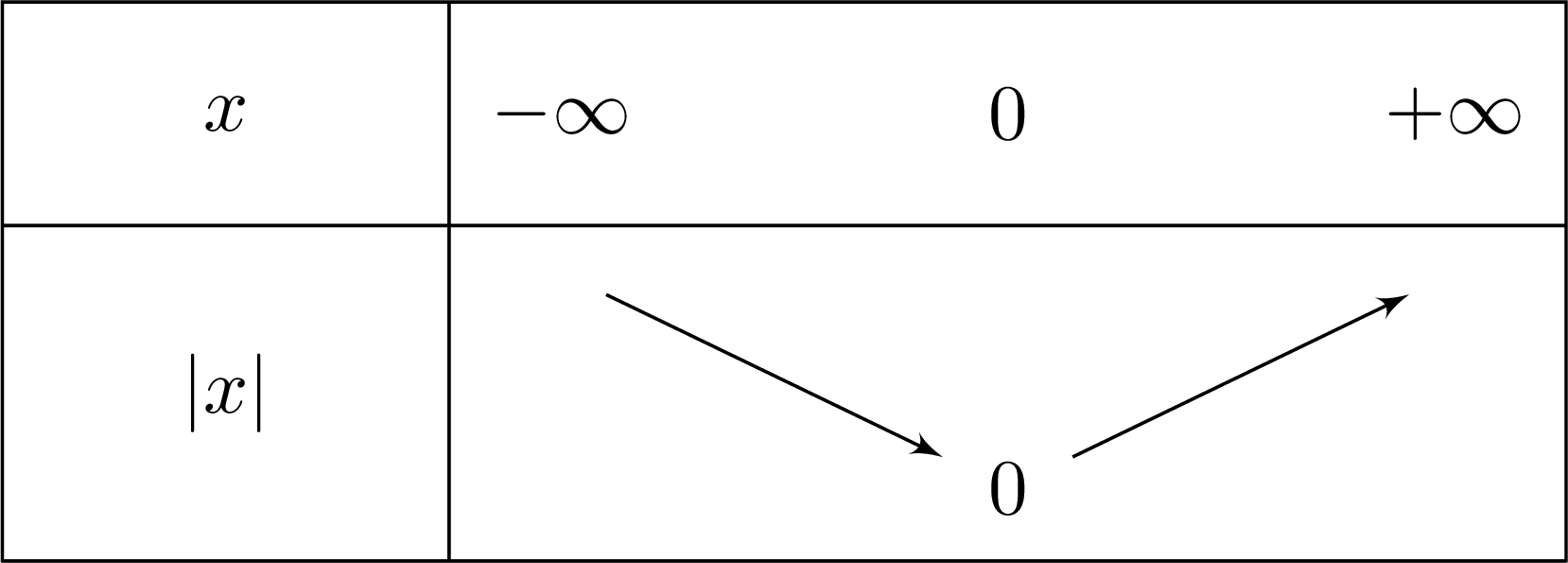
Let \(f(x) = |x|\).
- Sign: if \(x \geq 0\), then \(|x| = x \geq 0\); if \(x < 0\), then \(|x| = -x > 0\). In both cases \(|x| \geq 0\), and \(|x| = 0\) happens only in the first case with \(x = 0\).
- Variations:
- Let \(a\) and \(b\) be two real numbers such that \(0 \leq a < b\). Then \(f(a) = a\) and \(f(b) = b\), so \(f(b) - f(a) = b - a > 0\): \(f(a) < f(b)\). The function is strictly increasing on \([0, +\infty)\).
- Let \(a\) and \(b\) be two real numbers such that \(a < b \leq 0\). Then \(f(a) = -a\) and \(f(b) = -b\) (for \(b = 0\), \(-b = 0 = |0|\) as well), so \(f(b) - f(a) = -b + a = a - b < 0\): \(f(a) > f(b)\). The function is strictly decreasing on \((-\infty, 0]\).
Method — Solving \(|x| \equal k\) and \(|x| \lt k\)
Let \(k\) be a real number. Graphically, the solutions of \(|x| = k\) are the \(x\)-coordinates of the points of the “V” at height \(k\), and the solutions of \(|x| < k\) are the \(x\)-coordinates of the points of the “V” below the horizontal line \(y = k\). Algebraically, \(|x|\) is the distance from \(x\) to \(0\): - if \(k > 0\): \(|x| = k\) has the two solutions \(x = -k\) and \(x = k\); \(|x| < k\) has the solutions \(-k < x < k\), the interval \((-k, k)\); \(|x| > k\) has the solutions \(x < -k\) or \(x > k\);
- if \(k = 0\): \(|x| = 0\) has the single solution \(x = 0\); \(|x| < 0\) has no solution; \(|x| > 0\) is true for every real \(x \neq 0\);
- if \(k < 0\): \(|x| = k\) and \(|x| < k\) have no solution, since \(|x| \geq 0\); \(|x| > k\) is true for every real \(x\).
Method — Comparing \(|a|\) and \(|b|\)
To compare \(|a|\) and \(|b|\) for two real numbers \(a\) and \(b\): - if \(a\) and \(b\) are on the same side of \(0\), use the variations: on \([0, +\infty)\) the function keeps the order (\(0 \leq a < b\) gives \(|a| < |b|\)), on \((-\infty, 0]\) it reverses it (\(a < b \leq 0\) gives \(|a| > |b|\));
- if \(a\) and \(b\) have opposite signs, the order of \(a\) and \(b\) says nothing: compare the distances to \(0\), that is the numbers \(|a|\) and \(|b|\) themselves — graphically, the higher of the two points of the “V” at \(x = a\) and \(x = b\).
Example
Solve graphically, then algebraically: \(|x| = 3\), \(|x| \leq 3\) and \(|x| > 3\). 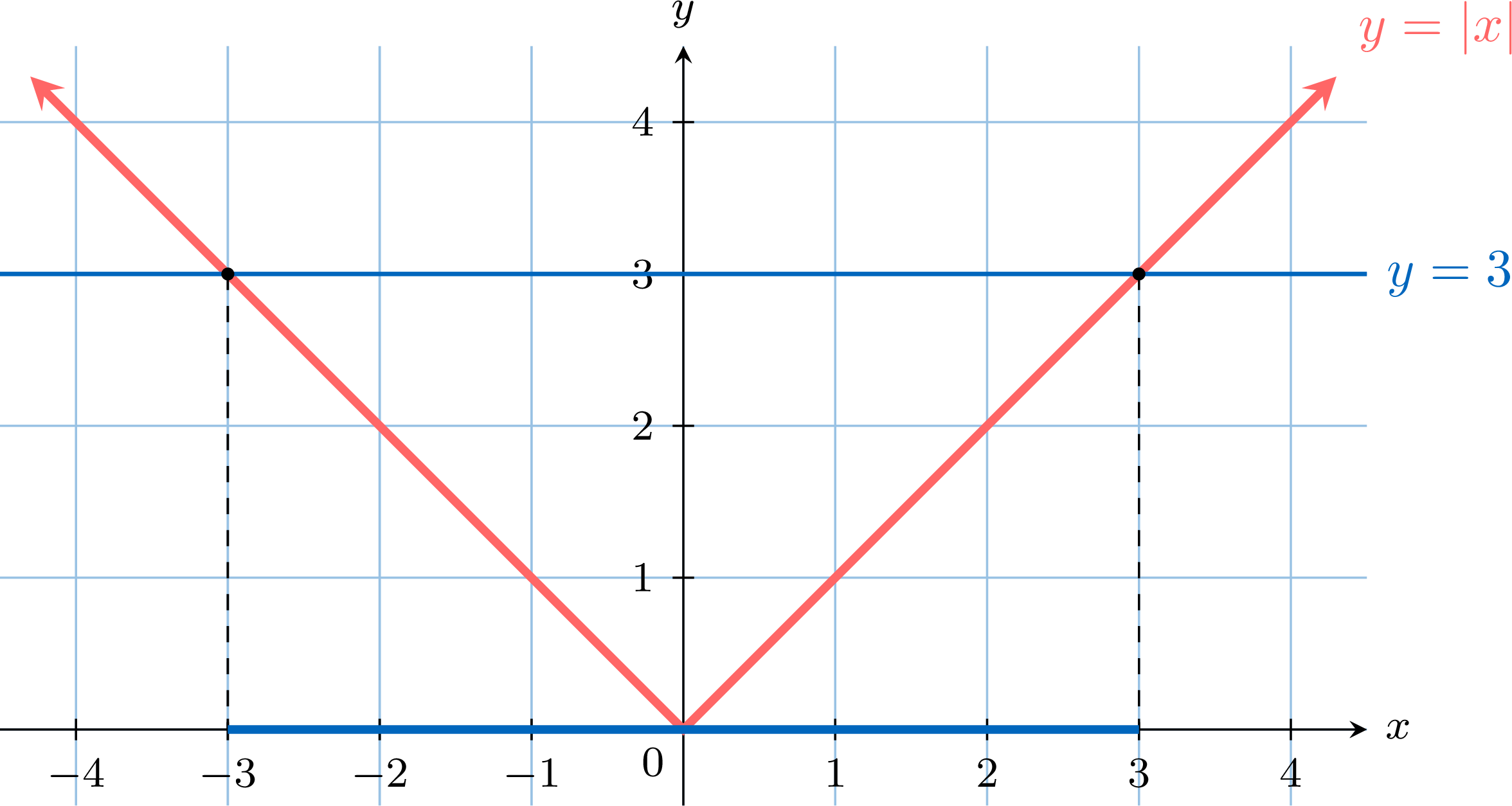
- \(|x| = 3\): the line \(y = 3\) cuts the “V” at two points, of \(x\)-coordinates \(-3\) and \(3\). Algebraically, the numbers at distance \(3\) from \(0\) are \(-3\) and \(3\). The solutions are \(x = -3\) and \(x = 3\).
- \(|x| \leq 3\): the points of the “V” on or below the line \(y = 3\) have their \(x\)-coordinates between \(-3\) and \(3\) — the thick segment drawn on the \(x\)-axis. Algebraically, the numbers at distance at most \(3\) from \(0\) form the interval \([-3, 3]\).
- \(|x| > 3\): the points of the “V” strictly above the line have \(x < -3\) or \(x > 3\), outside the thick segment. Algebraically, the numbers at distance more than \(3\) from \(0\) are those below \(-3\) or above \(3\). The solutions form \((-\infty, -3) \cup (3, +\infty)\).
Skills to practice
- Reading the Absolute Value
- Finding Images and Solving \(|x| \equal k\)
- Comparing Absolute Values
- Bounding \(|x|\)
V
Sums, Differences and Products of Functions
Let \(\textcolor{colordef}{f(x)=2x+1}\) and \(\textcolor{colorprop}{g(x)=x^2}\).
\(\textcolor{olive}{(f+g)(x)}\) means that, for any input \(x\) that belongs to the domains of both functions, \(\textcolor{colordef}{f(x)}\) and \(\textcolor{colorprop}{g(x)}\) are calculated separately, then the results are added. In other words, \((f+g)\) is a new function defined by \((f+g)(x)=f(x)+g(x)\).
This is illustrated by the function machine below: 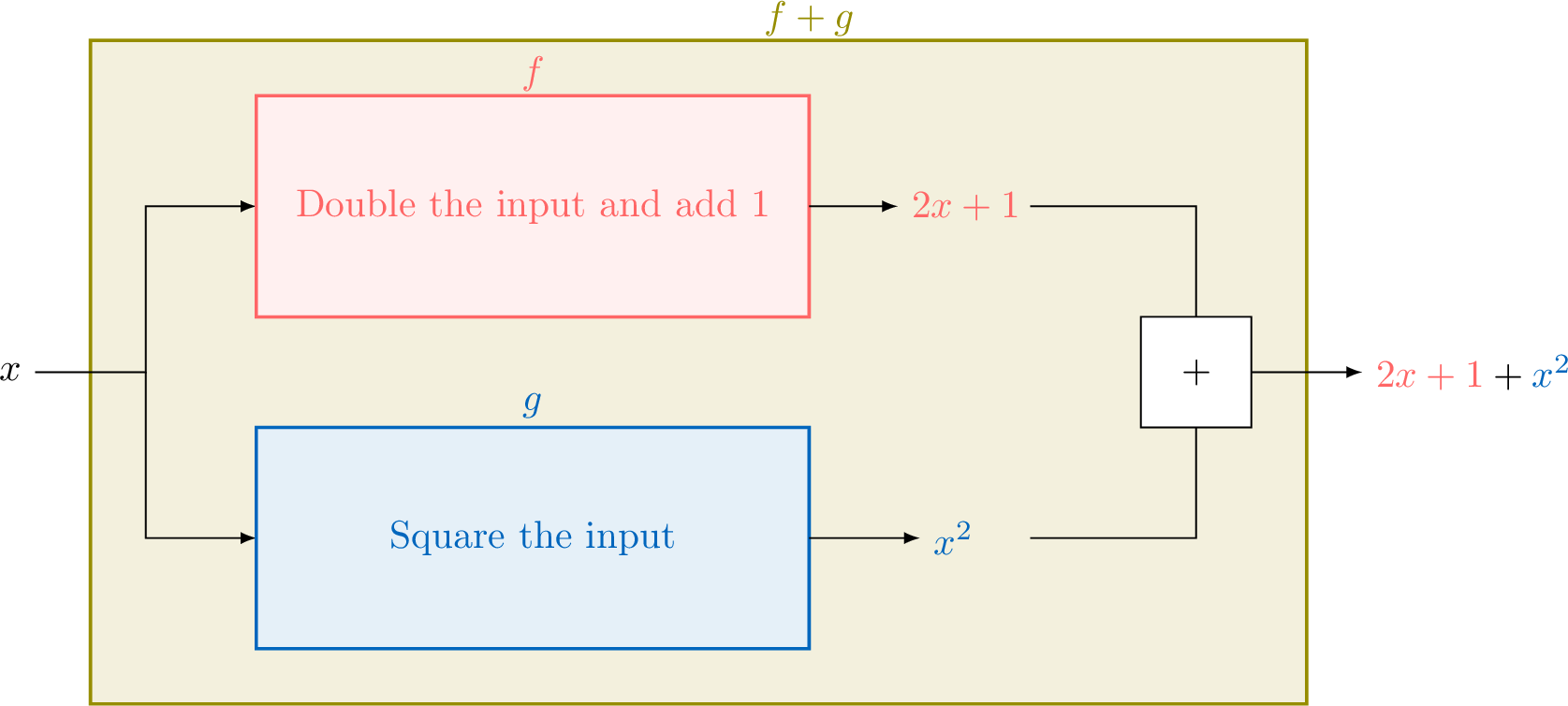
So, $$\begin{aligned}[t]\textcolor{olive}{(f+g)(x)} &= \textcolor{colordef}{f(x)} + \textcolor{colorprop}{g(x)} \\
&= \textcolor{colordef}{2x+1} + \textcolor{colorprop}{x^2}.\end{aligned}$$
\(\textcolor{olive}{(f+g)(x)}\) means that, for any input \(x\) that belongs to the domains of both functions, \(\textcolor{colordef}{f(x)}\) and \(\textcolor{colorprop}{g(x)}\) are calculated separately, then the results are added. In other words, \((f+g)\) is a new function defined by \((f+g)(x)=f(x)+g(x)\).
This is illustrated by the function machine below:
Definition — Operations on Functions
Given two functions \(f\) and \(g\), we can define new functions by performing arithmetic operations on their outputs, for each \(x\) where both are defined: - Sum: \((f+g)(x) = f(x) + g(x)\)
- Difference: \((f-g)(x) = f(x) - g(x)\)
- Product: \((fg)(x) = f(x) \times g(x)\)
- Quotient: \(\displaystyle\left(\frac{f}{g}\right)(x) = \frac{f(x)}{g(x)}\), provided that \(g(x) \neq 0\).
For the quotient, the domain is the intersection of the domains of \(f\) and \(g\), excluding any \(x\) such that \(g(x)=0\).
Example
Let \(f(x)=2x+1\) and \(g(x)=x^4-1\). Find \((f+g)(x)\).
\(\begin{aligned} (f+g)(x) &= f(x) + g(x) \\ &= (2x+1) + (x^4-1) \\ &= x^4 + 2x. \end{aligned}\)
Since both \(f\) and \(g\) are polynomials, \((f+g)(x)\) is defined for all real numbers \(x\).
Since both \(f\) and \(g\) are polynomials, \((f+g)(x)\) is defined for all real numbers \(x\).
Skills to practice
- Decomposing Expressions into Functions
- Adding, Subtracting and Multiplying Functions
VI
Composite Functions
Let \(\textcolor{colordef}{f(x)=x^2}\) and \(\textcolor{colorprop}{g(x)=2x+1}\).
The composition \(\textcolor{olive}{(f \circ g)(x)}\) means that \(g\) is applied to \(x\) first, and then \(f\) is applied to the result. In other words, \(x\) goes through machine \(g\) (becoming \(2x+1\)), and that output then goes through machine \(f\). 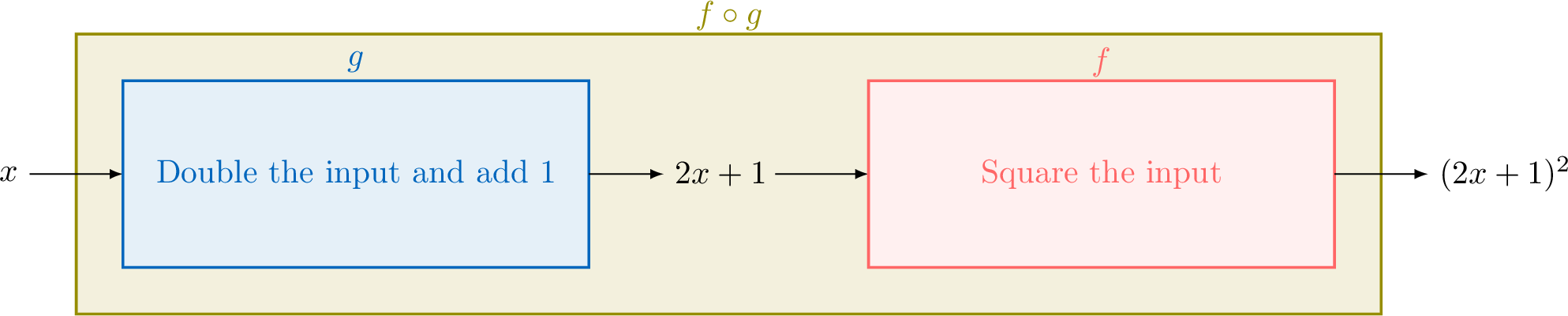
Algebraically, we write this as: $$\begin{aligned}[t](f \circ g)(x) &= \textcolor{colordef}{f}(\textcolor{colorprop}{g(x)}) \\
&= \textcolor{colordef}{f}(2x+1) \\
&= (2x+1)^2.\end{aligned}$$
The composition \(\textcolor{olive}{(f \circ g)(x)}\) means that \(g\) is applied to \(x\) first, and then \(f\) is applied to the result. In other words, \(x\) goes through machine \(g\) (becoming \(2x+1\)), and that output then goes through machine \(f\).
Definition — Composition of Functions
Given two functions \(f\) and \(g\), the composite function, denoted \(\boldsymbol{f \circ g}\) (read “\(f\) composed with \(g\)”), is defined by: $$\boldsymbol{(f \circ g)(x) = f(g(x))}$$ for every \(x\) that belongs to the domain of \(g\) and for which \(g(x)\) belongs to the domain of \(f\). We first apply the function \(g\) to \(x\), and then apply the function \(f\) to the result \(g(x)\).
Example
Let \(f(x)=x^2\) and \(g(x)=2x+1\). - Find \((f \circ g)(x)\).
- Find \((g \circ f)(x)\).
- Is composition commutative? (i.e., is \((f \circ g)(x) = (g \circ f)(x)\)?)
- \(\begin{aligned}[t] (f \circ g)(x) &= f(g(x)) \\ &= f(2x+1) \\ &= (2x+1)^2 \\ &= 4x^2 + 4x + 1. \end{aligned}\)
- \(\begin{aligned}[t] (g \circ f)(x) &= g(f(x)) \\ &= g(x^2) \\ &= 2(x^2) + 1 \\ &= 2x^2 + 1. \end{aligned}\)
- No. Since \(4x^2 + 4x + 1 \neq 2x^2 + 1\), the two composite functions are different, so function composition is not commutative in general.
Skills to practice
- Evaluating Composite Functions
- Using Composite Functions
VII
Inverse Functions
In arithmetic, we are familiar with inverse operations. For example, subtraction is the inverse of addition because it “undoes” the addition. Starting with 5, adding 3 gives 8, and subtracting 3 then returns to 5: $$(5+3) - 3 = 5.$$ Similarly, division is the inverse of multiplication: $$(5\times 3) \div 3 = 5.$$ The concept of an inverse function follows the same idea. An inverse function, denoted \(\boldsymbol{f^{-1}}\), is a function that “undoes” or reverses the action of another function, \(f\).
If a function \(f\) takes an input \(x\) to an output \(y\), the inverse function \(f^{-1}\) takes that output \(y\) back to the original input \(x\). This creates a perfect loop: 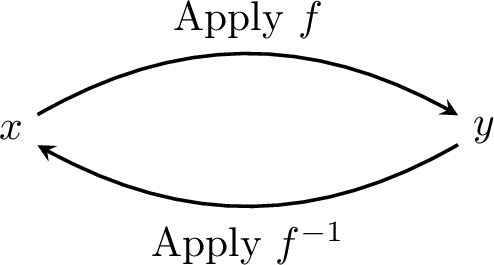
However, not every function has an inverse function. For an inverse to exist, each output \(y\) must come from exactly one input \(x\) (the function must never take the same value twice on its domain).
If a function \(f\) takes an input \(x\) to an output \(y\), the inverse function \(f^{-1}\) takes that output \(y\) back to the original input \(x\). This creates a perfect loop:
Definition — Inverse Function
Let \(f\) be a function with domain \(D\) and range \(R\). A function \(f^{-1}\) with domain \(R\) and range \(D\) is the inverse function of \(f\) if it “undoes” the action of \(f\). This means that if \(f\) maps an input \(x\) to an output \(y\), then \(f^{-1}\) maps \(y\) back to \(x\): $$ \text{If } f(x) = y, \text{ then } f^{-1}(y) = x. $$ This relationship must hold for every \(x\) in the domain \(D\) (and every \(y\) in the range \(R\)). In terms of composition, this means: $$f^{-1}(f(x)) = x \quad \text{for all } x \in D,$$ and $$f(f^{-1}(x)) = x \quad \text{for all } x \in R.$$ In particular, for an inverse function to exist, each output \(y\) in the range of \(f\) must correspond to exactly one input \(x\). Method — Finding the Inverse Function
To find the inverse of a function \(f\) (when it exists): - Set \(y = f(x)\).
- Solve the equation for \(x\) in terms of \(y\). This gives an expression of the form \(x = f^{-1}(y)\).
- Swap the variables \(x\) and \(y\) to write the inverse in terms of \(x\). The result is \(y = f^{-1}(x)\).
Example
Find the inverse of \(f(x) = 4x - 8\).
Set \(y = 4x - 8\) and solve for \(x\): $$\begin{aligned} y &= 4x - 8 \\
y + 8 &= 4x \\
x &= \dfrac{y + 8}{4}. \end{aligned}$$ Now, swap the variables \(x\) and \(y\): $$y = \dfrac{x + 8}{4}.$$ So, the inverse function is \(\boldsymbol{f^{-1}(x) = \dfrac{x + 8}{4}}\).
Check: $$\begin{aligned} f\bigl(f^{-1}(x)\bigr) &= 4\left(\dfrac{x+8}{4}\right) - 8 = x+8-8 = x,\\ f^{-1}(f(x)) &= \dfrac{(4x-8)+8}{4} = \dfrac{4x}{4} = x, \end{aligned}$$ so \(f^{-1}\) really is the inverse of \(f\).
Check: $$\begin{aligned} f\bigl(f^{-1}(x)\bigr) &= 4\left(\dfrac{x+8}{4}\right) - 8 = x+8-8 = x,\\ f^{-1}(f(x)) &= \dfrac{(4x-8)+8}{4} = \dfrac{4x}{4} = x, \end{aligned}$$ so \(f^{-1}\) really is the inverse of \(f\).
Proposition — Symmetry of Inverse Functions
The graphs of a function \(f\) and its inverse \(f^{-1}\) are reflections of each other in the line \(\boldsymbol{y = x}\). Equivalently, if a point \((a, b)\) lies on the graph of \(y=f(x)\), then the point \((b, a)\) lies on the graph of \(y=f^{-1}(x)\). 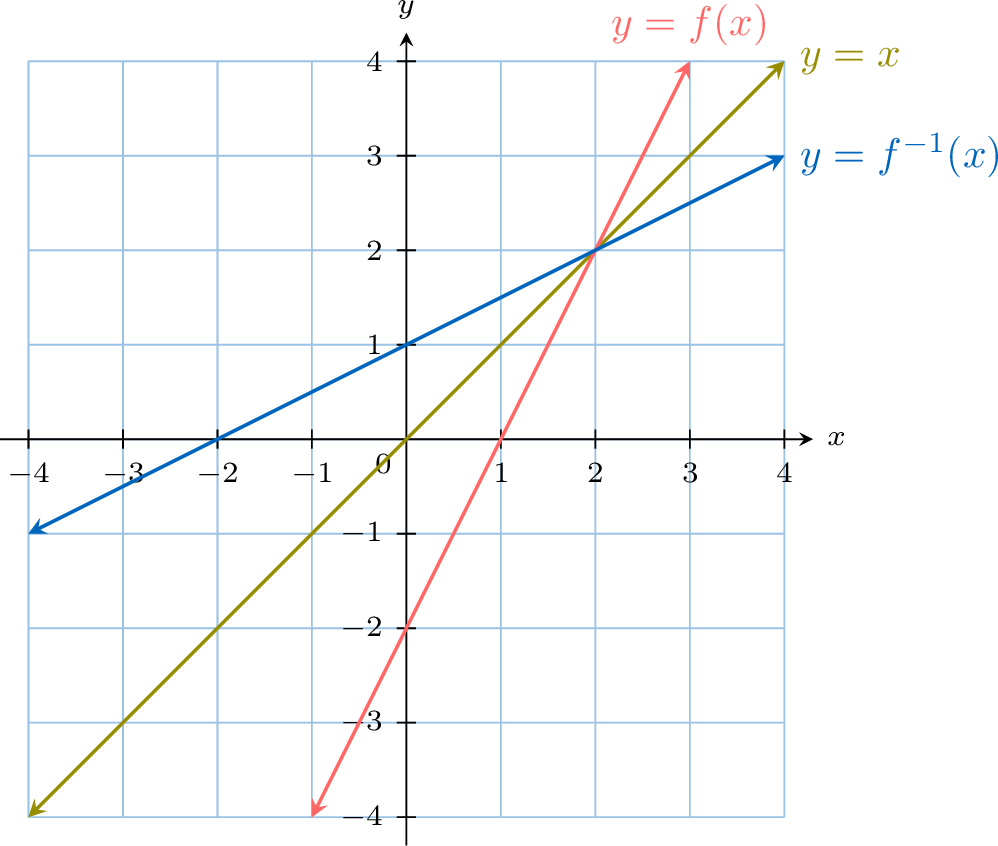
Let \(f\) be a function that has an inverse function \(f^{-1}\).
- The points of the two graphs correspond by swapping the coordinates. A point \((a, b)\) lies on the graph of \(y = f(x)\) exactly when \(b = f(a)\). By the definition of the inverse function, \(f(a) = b\) means \(f^{-1}(b) = a\), which says that the point \((b, a)\) lies on the graph of \(y = f^{-1}(x)\). Conversely, if \((b, a)\) lies on the graph of \(f^{-1}\), then \(f^{-1}(b) = a\), so \(f(a) = f\big(f^{-1}(b)\big) = b\) and \((a, b)\) lies on the graph of \(f\). So the graph of \(f^{-1}\) is made of the points \((b, a)\), where \((a, b)\) runs through the graph of \(f\).
- Swapping the coordinates is the reflection in the line \(y = x\). If \(a = b\), the point \((a, a)\) lies on the line \(y = x\) and is its own image. If \(a \neq b\), the segment joining \(P(a, b)\) and \(P'(b, a)\) has midpoint \(\left(\dfrac{a + b}{2}, \dfrac{a + b}{2}\right)\), which lies on the line \(y = x\), and gradient \(\dfrac{a - b}{b - a} = -1\). The line \(y = x\) has gradient \(1\), and \(1 \times (-1) = -1\): the segment is perpendicular to the line. So the line \(y = x\) is the perpendicular bisector of \([PP']\), and \(P'\) is the reflection of \(P\) in it.
Example
Restricting the domain to obtain an inverse function. - Explain why the function \(f(x) = x^2\), defined for every real number \(x\), has no inverse function.
- Let \(g(x) = x^2\) for \(x \ge 0\). Find \(g^{-1}(x)\), and give the domain and the range of \(g^{-1}\).
- Let \(h(x) = (x - 3)^2 + 1\) for \(x \ge 3\). Explain why \(h\) has an inverse function, then find \(h^{-1}(x)\) and its domain.
- \(f(-2) = 4\) and \(f(2) = 4\): the output \(4\) comes from two inputs. An inverse function would have to send \(4\) back to \(-2\) and to \(2\) at the same time, which a function cannot do. So \(f\), on all the real numbers, has no inverse function.
- On the domain \(x \ge 0\), each output \(y \ge 0\) comes from exactly one input, the non-negative square root of \(y\). Set \(y = x^2\) with \(x \ge 0\) and solve for \(x\): $$\begin{aligned} y &= x^2, \quad x \ge 0\\
x &= \sqrt{y} &&\color{gray}\text{(the non-negative square root, since \(x \ge 0\))}. \end{aligned}$$ Swap \(x\) and \(y\): \(\boldsymbol{g^{-1}(x) = \sqrt{x}}\). The domain of \(g^{-1}\) is the range of \(g\), \(x \ge 0\); its range is the domain of \(g\), \(y \ge 0\).
Check: for \(x \ge 0\), \(g^{-1}\big(g(x)\big) = \sqrt{x^2} = x\) and \(g\big(g^{-1}(x)\big) = (\sqrt{x})^2 = x\). The graphs of \(y = x^2\) (\(x \ge 0\)) and \(y = \sqrt{x}\) are reflections of each other in the line \(y = x\):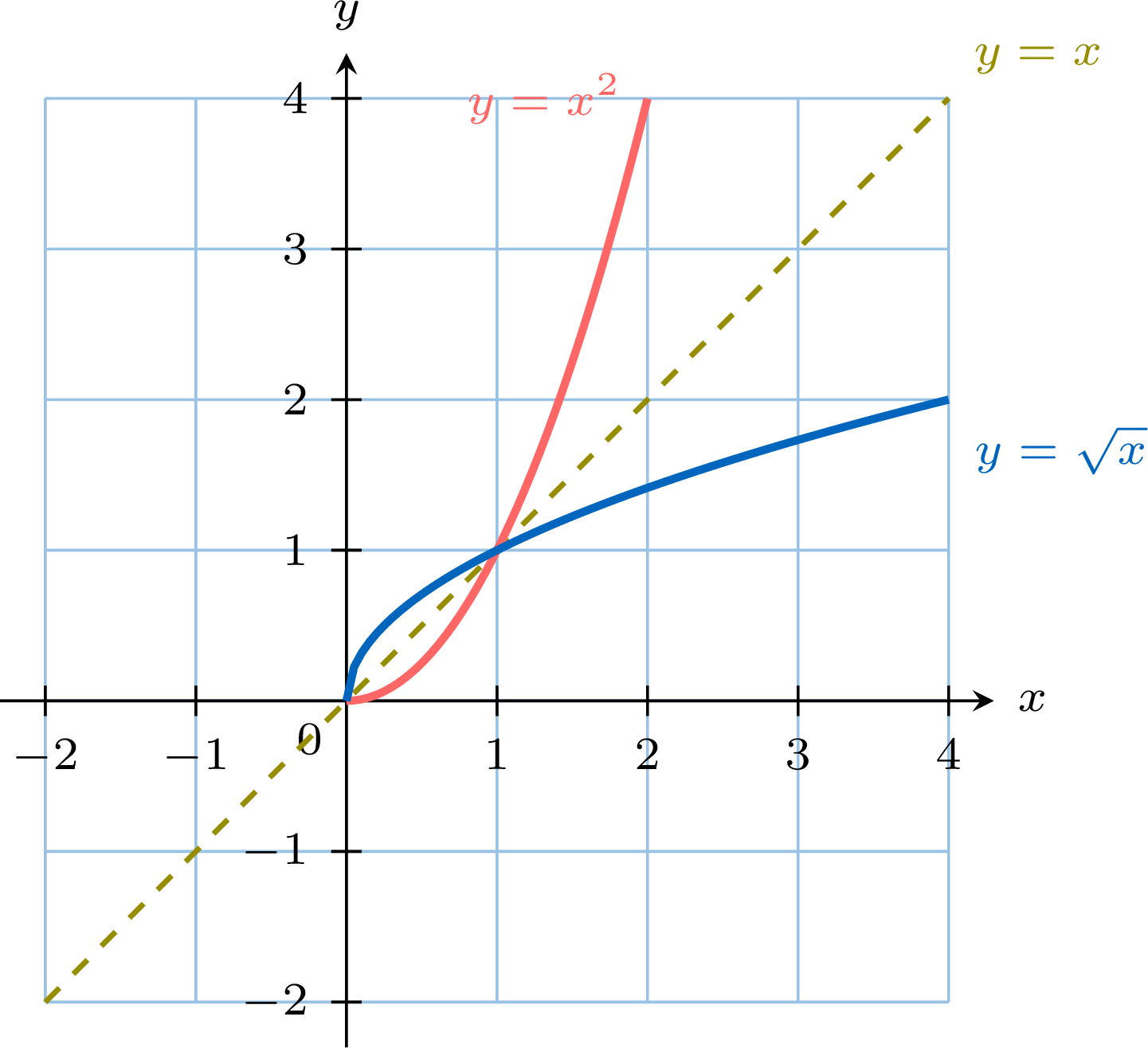
- \(h\) is written in vertex form: its graph is a parabola with vertex \((3, 1)\) and axis of symmetry \(x = 3\). Two different inputs with the same output are symmetric about \(x = 3\), so they lie on either side of the axis: on the domain \(x \ge 3\), each output comes from exactly one input, and \(h\) has an inverse function. Its range is \(y \ge 1\). Set \(y = (x - 3)^2 + 1\) with \(x \ge 3\): $$\begin{aligned} (x - 3)^2 &= y - 1\\ x - 3 &= \sqrt{y - 1} &&\color{gray}\text{(since \(x - 3 \ge 0\))}\\ x &= 3 + \sqrt{y - 1}. \end{aligned}$$ Swap \(x\) and \(y\): \(\boldsymbol{h^{-1}(x) = 3 + \sqrt{x - 1}}\), with domain \(x \ge 1\) (the range of \(h\)). Check: \(h\big(h^{-1}(x)\big) = \big(\sqrt{x - 1}\big)^2 + 1 = x\) for \(x \ge 1\).
Skills to practice
- Deciding Whether a Function Has an Inverse
- Finding, Graphing and Using Inverse Functions
VIII
Going further
Skills to practice
- Reasoning about Functions
- Solving Problems with Functions
- Investigating Composite and Inverse Functions
- Quiz
Jump to section