International Baccalaureate · MYP 4
Financial Mathematics
I
Mark-up and Discount
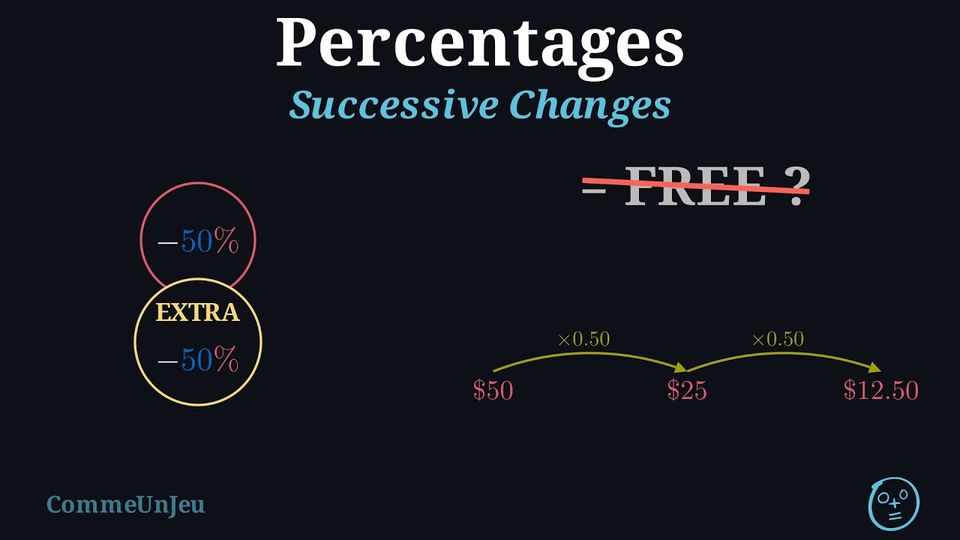
A clothes shop buys a jacket from the maker for \(\dollar 80\). It adds a mark-up of \(50\pourcent\) to set the price on the label. In the sales, the label price is reduced by \(30\pourcent\). The manager says: “\(50 - 30 = 20\): we still make a profit of \(20\pourcent\).” Is the manager correct?
The two prices are computed one after the other, each change applying to the price at that moment: $$\begin{aligned}[t] \text{label price} &= 80 \times 1.50 && \text{(mark-up of } 50\pourcent)\\
&= 120,\\
\text{sale price} &= 120 \times 0.70 && \text{(reduction of } 30\pourcent)\\
&= 84. \end{aligned}$$ The profit is \(84 - 80 = \dollar 4\), that is \(\frac{4}{80} = 5\pourcent\) of the cost price, not \(20\pourcent\): the reduction of \(30\pourcent\) applies to \(\dollar 120\), not to \(\dollar 80\). In one step, the cost price was multiplied by \(1.50 \times 0.70 = 1.05\).
Definition — Percentage Profit and Percentage Loss
A trader buys an item at its cost price and sells it at its selling price. As for a business, the profit is the income minus the expenses: here the two prices give a profit when the selling price is greater and a loss when it is smaller: $$\text{profit} = \text{selling price} - \text{cost price}, \qquad \text{loss} = \text{cost price} - \text{selling price}.$$ The percentage profit is the profit expressed as a percentage of the cost price, and the percentage loss is the loss expressed as a percentage of the cost price: $$\text{percentage profit} = \frac{\text{profit}}{\text{cost price}} \times 100, \qquad \text{percentage loss} = \frac{\text{loss}}{\text{cost price}} \times 100.$$ Definition — Mark-up and Discount
A trader sets the marked price of an item, the price on its label, by adding a mark-up to the cost price. A mark-up is usually given as a percentage of the cost price: with a mark-up \(m\) (as a decimal), $$\text{marked price} = \text{cost price} \times (1 + m).$$ A discount is a reduction of the marked price, usually given as a percentage of the marked price: with a discount \(d\) (as a decimal), the sale price is $$\text{sale price} = \text{marked price} \times (1 - d).$$ Definition — Multiplier
- Increasing a quantity by \(t\pourcent\) means multiplying it by \(1 + \dfrac{t}{100}\).
- Decreasing a quantity by \(t\pourcent\) means multiplying it by \(1 - \dfrac{t}{100}\).
A sign can also be given to the percentage change: a rise of \(15\pourcent\) is a change of \(+15\pourcent\), a drop of \(15\pourcent\) a change of \(-15\pourcent\). The two formulas then become one: with the signed number \(t\), the multiplier (written \(M\)) is always \(M = 1 + \dfrac{t}{100}\), for instance \(1 + \dfrac{-15}{100} = 1 - \dfrac{15}{100} = 0.85\). Beware of mixing the two writings: with a signed \(t = -15\), writing \(1 - \dfrac{t}{100}\) would give \(1.15\), a rise.
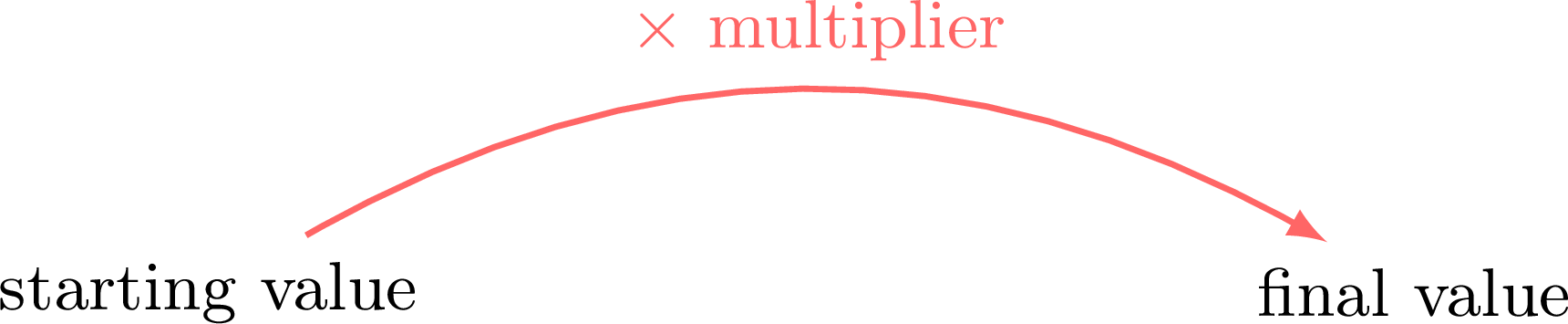
Proposition — Global Multiplier
When a quantity undergoes two successive changes, the global multiplier is the product of the two multipliers: 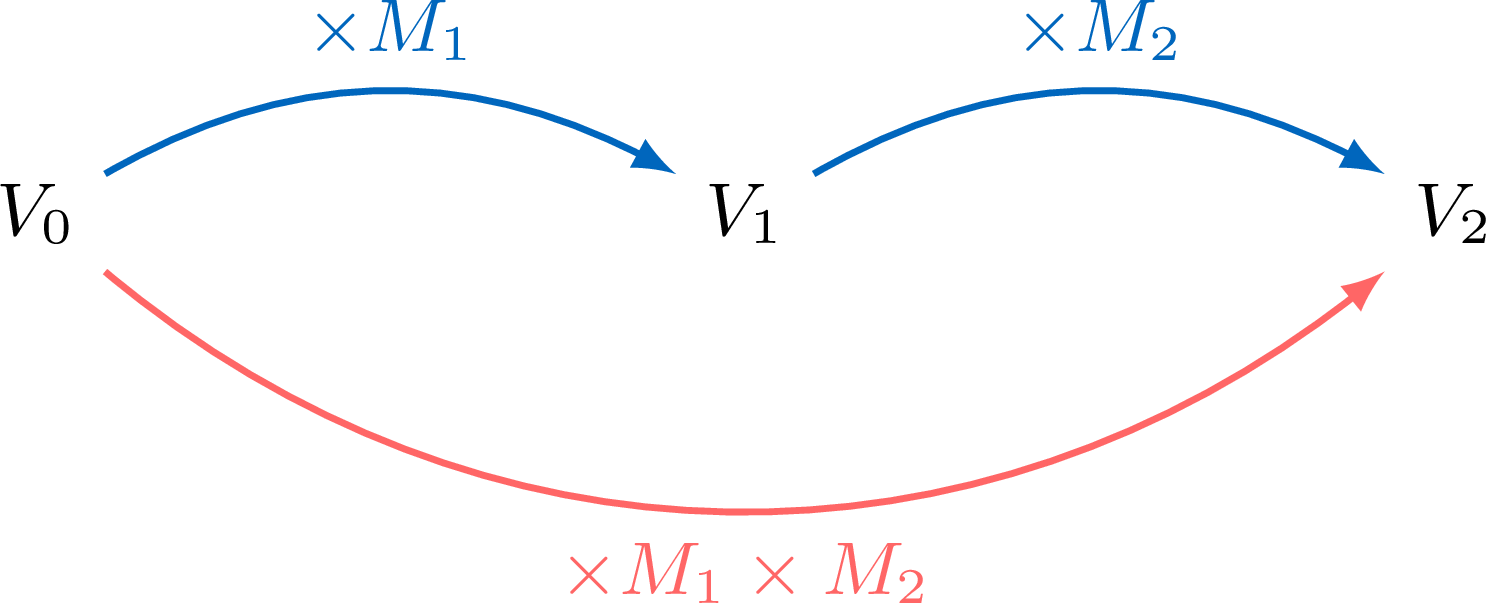
The global percentage change is then read off that single multiplier, exactly as for one change: a multiplier larger than \(1\) is a rise, smaller than \(1\) a drop.
Method — Chains of Price Changes
When a price undergoes several percentage changes in turn — a mark-up, a discount, a sales tax — each change multiplies the current price by its own multiplier. By the global multiplier, the final price is the starting price times the product \(k\) of the multipliers, for example $$\text{price paid} = \text{cost price} \times \underbrace{(1 + m) \times (1 - d) \times (1 + r)}_{k}.$$ The product \(k\) gives the overall change: if \(k > 1\), the price has increased by \((k - 1) \times 100\) percent; if \(k < 1\), it has decreased by \((1 - k) \times 100\) percent. To go back from the final price to the starting price, divide by \(k\). Percentages applied in turn are not added: each one applies to a price the previous ones have already changed. Example
A shop marks up its goods by \(60\pourcent\) of the cost price, then offers a discount of \(25\pourcent\) on every marked price. - Find the overall percentage profit on the cost price.
- A lamp costs the shop \(\dollar 45\). Find its marked price and its sale price.
- The mark-up multiplies by \(1.60\) and the discount by \(1 - 0.25 = 0.75\): $$\begin{aligned}[t] k &= 1.60 \times 0.75 && \text{(product of the multipliers)}\\ &= 1.20. \end{aligned}$$ Since \(k = 1.20 > 1\), the sale price is \(20\pourcent\) above the cost price: an overall profit of \(20\pourcent\) — not \(60 - 25 = 35\pourcent\).
- The marked price is \(45 \times 1.60 = \dollar 72\) and the sale price \(72 \times 0.75 = \dollar 54\). Check with the overall multiplier: \(45 \times 1.20 = 54\).
Definition — Sales Tax
In most countries a sales tax is added to the price of goods and services. It is a percentage of the price before tax, fixed by law: the tax rate. Depending on the country it is called value added tax (VAT) or goods and services tax (GST). The price the customer pays is the price including tax: $$\text{price including tax} = \text{price before tax} + \text{tax}.$$ Some countries display prices including tax, others add the tax at the till: a statement always says which price it gives. Method — Adding the Tax
For a tax rate \(r\) written as a decimal (for example \(15\pourcent = 0.15\)): $$\text{tax} = r \times \text{price before tax}, \qquad \text{price including tax} = \text{price before tax} \times (1 + r).$$ Adding the tax is an increase of the price before tax by the tax rate: the price is multiplied by the multiplier \(1 + r\), since \(\text{price} + r \times \text{price} = \text{price} \times (1 + r)\). Example
A deli buys a jar of honey for \(\dollar 36\) before tax. It adds a mark-up of \(50\pourcent\) of the cost price, then a GST of \(10\pourcent\). Find the price paid by the customer, GST included.
The mark-up multiplies by \(1.50\), then the GST by \(1.10\): $$\begin{aligned}[t] \text{price paid} &= 36 \times 1.50 \times 1.10 && \text{(chain of multipliers)}\\
&= 54 \times 1.10\\
&= 59.40. \end{aligned}$$ The customer pays \(\dollar 59.40\): \(\dollar 54\) for the shop and \(\dollar 5.40\) of GST, which the shop collects for the State.
Example
In a sale, every marked price is reduced by \(15\pourcent\). A coat has a sale price of \(\dollar 102\). The shop's mark-up was \(50\pourcent\) of the cost price. Find the marked price, the cost price, and the percentage profit the shop still makes.
Working backwards, each multiplication is undone by a division: $$\begin{aligned}[t] \text{marked price} &= \frac{102}{0.85} && \text{(undoing the discount)}\\
&= 120,\\
\text{cost price} &= \frac{120}{1.50} && \text{(undoing the mark-up)}\\
&= 80. \end{aligned}$$ The profit is \(102 - 80 = \dollar 22\), that is \(\frac{22}{80} \times 100 = 27.5\pourcent\) of the cost price. Check with the overall multiplier: \(80 \times 1.50 \times 0.85 = 80 \times 1.275 = 102\).
Skills to practice
- Recognising the Effect of a Chain of Changes
- Calculating Prices after Several Changes
- Working Backwards to the Cost Price
II
Simple Interest
Definition — Principal
The principal is the original amount of money that is either invested or loaned. Definition — Interest
Interest is the cost paid for borrowing money or the amount earned from lending or investing money.
A sum of \(\dollar 100\) is borrowed at an interest rate of \(10\pourcent\) per year. With simple interest, the interest is calculated only on the initial amount each year.
- \( \begin{aligned}[t] \text{Total interest after 1 year} &= 100 \times 10\pourcent \\ &= 100 \times \frac{10}{100} \\ &= 10~\text{dollars} \end{aligned} \)
- \( \begin{aligned}[t] \text{Total interest after 2 years} &= 100 \times 10\pourcent \times 2 \\ &= 100 \times \frac{10}{100} \times 2 \\ &= 20~\text{dollars} \end{aligned} \)
- \( \begin{aligned}[t] \text{Total interest after 3 years} &= 100 \times 10\pourcent \times 3 \\ &= 100 \times \frac{10}{100} \times 3 \\ &= 30~\text{dollars} \end{aligned} \)
Definition — Simple Interest
The simple interest is calculated each year as a fixed percentage of the principal (original amount) borrowed or invested. With simple interest, the same amount of interest is added every year. Proposition — Simple Interest Formula
The simple interest, denoted by \(I\), is calculated as: $$ I = P \times r \times t $$ where: - \(P\) is the principal (original amount)
- \(r\) is the interest rate per year (expressed as a decimal, e.g. \(3\pourcent = 0{.}03\))
- \(t\) is the time (in years)
Example
Find the simple interest on a principal of \(\dollar 500\) at a rate of \(3\pourcent\) per year over \(5\) years. Then find the final amount.
Write the rate as a decimal: \(3\pourcent = 0.03\). $$ \begin{aligned}[t] I&= P \times r \times t\\
&= 500 \times 0.03 \times 5 \\
&= 15 \times 5 \\
&= 75~\text{dollars} \end{aligned} $$ The final amount is: $$ \begin{aligned}[t] A &= P + I\\
&= 500 + 75\\
&= 575~\text{dollars} \end{aligned} $$
Skills to practice
- Understanding Interest
- Finding the Simple Interest
- Finding the Total Amount
- Finding the Rate or the Time
III
Compound Interest
When money is left in a bank account for a period of time, the interest earned is added to the account. Once added, this interest also earns interest in the next time period. This process is called compound interest.
Example of compound interest:
\(\dollar 1\,000\) is deposited in an account that earns \(10\pourcent\) interest per annum (p.a.), and the interest is allowed to compound over three years. This means the account is earning \(10\pourcent\) p.a. in compound interest.
The table follows the account year by year:
After 3 years, the account holds a total of \(\dollar 1\,331\): the compound interest earned is \(\dollar 331\).
The final amount can also be calculated in another way:
Example of compound interest:
\(\dollar 1\,000\) is deposited in an account that earns \(10\pourcent\) interest per annum (p.a.), and the interest is allowed to compound over three years. This means the account is earning \(10\pourcent\) p.a. in compound interest.
The table follows the account year by year:
| Year | Interest for the year | Amount at the end of the year |
| 1 | \(10\pourcent\) of \(\dollar 1\,000 = \dollar 100\) | \(\dollar 1\,000 + \dollar 100 = \dollar 1\,100\) |
| 2 | \(10\pourcent\) of \(\dollar 1\,100 = \dollar 110\) | \(\dollar 1\,100 + \dollar 110 = \dollar 1\,210\) |
| 3 | \(10\pourcent\) of \(\dollar 1\,210 = \dollar 121\) | \(\dollar 1\,210 + \dollar 121 = \dollar 1\,331\) |
The final amount can also be calculated in another way:
- \(\begin{aligned}[t] \text{Amount after 1 year} &= \text{Initial amount} + \text{Interest on the initial amount} \\ &= \text{Initial amount} + \text{Interest Rate} \times \text{Initial amount} \\ &= 1\,000 + 0.1 \times 1\,000 \\ &= 1\,000 \times (1 + 0.1) \\ &= 1\,000 \times 1.1 \end{aligned}\)
- \(\begin{aligned}[t] \text{Amount after 2 years} &= \text{Amount after 1 year} + \text{Interest on the amount after 1 year} \\ &= \text{Amount after 1 year} + \text{Interest Rate} \times \text{Amount after 1 year} \\ &= 1\,000 \times 1.1 + 0.1 \times 1\,000 \times 1.1 \\ &= 1\,000 \times 1.1 \times (1 + 0.1) \\ &= 1\,000 \times 1.1^2 \end{aligned}\)
- \(\begin{aligned}[t] \text{Amount after 3 years} &= \text{Amount after 2 years} + \text{Interest on the amount after 2 years} \\ &= \text{Amount after 2 years} + \text{Interest Rate} \times \text{Amount after 2 years} \\ &= 1\,000 \times 1.1^2 + 0.1 \times 1\,000 \times 1.1^2 \\ &= 1\,000 \times 1.1^2 \times (1 + 0.1) \\ &= 1\,000 \times 1.1^3 \end{aligned}\)
Definition — Compound Interest
Compound interest is interest that accumulates on both the principal (initial amount) and the previously accumulated interest. Proposition — Annual Compound Interest Formula
The final amount \(A\) of an investment with interest compounded annually is: $$A = P (1 + r)^t$$ where: - \(P\) is the principal (initial amount),
- \(r\) is the annual interest rate (as a decimal),
- \(t\) is the time (in years).
Example
Find the final amount for compound interest on a principal of \(\dollar 500\) at a rate of \(3\pourcent\) per year over \(5\) years.
$$ \begin{aligned}[t] A &= P (1 + r)^t \\
&= 500 \times (1 + 0.03)^5 \\
&= 500 \times 1.03^5 \\
&\approx 579.64 \end{aligned} $$ The final amount is approximately \(\dollar 579.64\).
Skills to practice
- Understanding Compound Interest
- Finding the Total Amount with a Table or the Formula
IV
Appreciation and Depreciation
A delivery company buys a van for \(\dollar 40\,000\). Its accountant assumes that the van loses \(20\pourcent\) of its value every year. Complete the table below. Does the van lose \(\dollar 8\,000\) every year? Can its value be found after \(n\) years without building the whole table?
| Year | Value lost during the year | Value at the end of the year |
| \(1\) | \(20\pourcent\) of \(40\,000 = 8\,000\) | \(40\,000 - 8\,000 = 32\,000\) |
| \(2\) | \(?\) | \(?\) |
| \(3\) | \(?\) | \(?\) |
Each year the loss is \(20\pourcent\) of the value at the start of that year:
The van does not lose \(\dollar 8\,000\) every year: the loss shrinks because it is taken of a smaller value each year. Keeping \(80\pourcent\) of the value multiplies it by \(0.80\), so after three years the value is \(40\,000 \times 0.80 \times 0.80 \times 0.80 = 40\,000 \times 0.80^3 = 20\,480\), and after \(n\) years \(40\,000 \times 0.80^n\).
| Year | Value lost during the year | Value at the end of the year |
| \(1\) | \(20\pourcent\) of \(40\,000 = 8\,000\) | \(40\,000 - 8\,000 = 32\,000\) |
| \(2\) | \(20\pourcent\) of \(32\,000 = 6\,400\) | \(32\,000 - 6\,400 = 25\,600\) |
| \(3\) | \(20\pourcent\) of \(25\,600 = 5\,120\) | \(25\,600 - 5\,120 = 20\,480\) |
Definition — Appreciation and Depreciation
An item appreciates when its value increases over time (a house, a rare stamp) and depreciates when its value decreases (a car, a computer). The amount by which the value has decreased is the depreciation. When the value changes by the same percentage of the current value each year, the item appreciates or depreciates at a constant rate, called the rate of appreciation or the rate of depreciation. Proposition — Value after n Years at a Constant Rate
Let \(V_0\) be the initial value of an item and \(r\) a rate written as a decimal. After \(n\) whole years: - if the item appreciates at the constant rate \(r\) per year, its value is \(V = V_0 (1 + r)^n\);
- if the item depreciates at the constant rate \(r\) per year, its value is \(V = V_0 (1 - r)^n\).
An increase of \(r\) multiplies the value by the multiplier \(1 + r\), a decrease of \(r\) by \(1 - r\). Each year applies the same change to the value at the start of that year, so \(n\) years apply \(n\) successive changes. By the global multiplier, the value is multiplied by the product of the \(n\) multipliers: $$\underbrace{(1 + r) \times (1 + r) \times \cdots \times (1 + r)}_{n \text{ factors}} = (1 + r)^n,$$ hence \(V = V_0 (1 + r)^n\); in the same way \(V = V_0 (1 - r)^n\) for a depreciation. Dividing both sides by \((1 + r)^n\), which is not zero, gives \(V_0\); the same holds with \((1 - r)^n\), not zero for a rate \(r\) smaller than \(1\).
Compound Interest and Straight-Line Depreciation
Money placed at compound interest appreciates at the interest rate: \(V = V_0 (1 + r)^n\) is the annual compound interest formula \(A = P(1 + r)^t\). Some accountants use another model of depreciation, straight-line depreciation: the value drops by the same amount every year, as simple interest adds the same amount every year. A machine bought for \(\dollar 12\,000\) and depreciated by \(\dollar 1\,500\) a year is worth \(12\,000 - 4 \times 1\,500 = \dollar 6\,000\) after \(4\) years, and nothing after \(8\) years. Depreciated at the constant rate of \(12.5\pourcent\) a year instead — the same \(\dollar 1\,500\) the first year — it is worth \(12\,000 \times 0.875^4 \approx \dollar 7\,034.18\) after \(4\) years, and its value never reaches \(0\).
Example
A car bought for \(\dollar 24\,000\) depreciates at \(15\pourcent\) per year. Find its value after \(4\) years, rounded to the nearest cent, and the total depreciation.
The rate of depreciation is \(r = 0.15\), so each year multiplies the value by \(1 - 0.15 = 0.85\): $$\begin{aligned}[t] V &= V_0 (1 - r)^n && \text{(value after } n \text{ years)}\\
&= 24\,000 \times 0.85^4\\
&\approx 12\,528.15. \end{aligned}$$ The car is worth about \(\dollar 12\,528.15\) after \(4\) years; the depreciation is \(24\,000 - 12\,528.15 = \dollar 11\,471.85\). The power is computed with the calculator key for powers, and the result is rounded only at the end.
Example
An apartment was worth \(\dollar 250\,000\). Over three years its value rose by \(6\pourcent\), then rose by \(4\pourcent\), then fell by \(3\pourcent\). Find its value after the three years and the overall percentage change.
The rate changes from year to year, so the three multipliers are different; their product gives the overall change: $$\begin{aligned}[t] k &= 1.06 \times 1.04 \times 0.97 && \text{(global multiplier)}\\
&= 1.069328,\\
V &= 250\,000 \times 1.069328\\
&= 267\,332. \end{aligned}$$ The apartment is worth \(\dollar 267\,332\): an overall increase of about \(6.93\pourcent\), not \(6 + 4 - 3 = 7\pourcent\).
Example
A rare coin appreciates at \(8\pourcent\) per year. Five years after it was bought, it is worth \(\dollar 2\,938.66\). Find the price paid for it, rounded to the nearest dollar.
The value after \(5\) years is \(V = V_0 \times 1.08^5\); the initial value is found by dividing: $$\begin{aligned}[t] V_0 &= \frac{V}{(1 + r)^n} && \text{(initial value)}\\
&= \frac{2\,938.66}{1.08^5}\\
&\approx 2\,000. \end{aligned}$$ The coin was bought for about \(\dollar 2\,000\). Check: \(2\,000 \times 1.08^5 \approx 2\,938.66\).
Skills to practice
- Recognising Appreciation and Depreciation
- Calculating a Value after Several Years
- Finding the Depreciation or the Initial Value
V
Loans and Repayments
Noah needs \(\dollar 4\,800\) to buy a used car. A finance company offers him a loan at a flat rate of \(7.5\pourcent\) per year for \(2\) years: the interest is simple interest on the \(\dollar 4\,800\) for the \(2\) years, and everything is repaid in \(24\) equal monthly repayments. How much interest will Noah pay? How much is each repayment?
By the simple interest formula, with \(P = 4\,800\), \(r = 0.075\) and \(t = 2\): $$\begin{aligned}[t] I &= P \times r \times t && \text{(simple interest formula)}\\
&= 4\,800 \times 0.075 \times 2\\
&= 720. \end{aligned}$$ Noah repays \(4\,800 + 720 = \dollar 5\,520\) in \(24\) equal parts: \(5\,520 \div 24 = \dollar 230\) per month. He pays \(\dollar 720\) of interest although, month after month, he owes less and less.
Definition — Flat-Rate Loan
In a flat-rate loan, the interest is simple interest on the whole amount borrowed for the whole term of the loan, even though the debt shrinks as it is repaid. For a principal \(P\) borrowed at a flat rate \(r\) per year (as a decimal) for \(t\) years: $$I = P \times r \times t, \qquad \text{total to repay} = P + I.$$ The total is repaid in equal instalments, usually every month. Method — Calculating the Repayments of a Flat-Rate Loan
- Compute the interest with the simple interest formula \(I = P \times r \times t\), the term \(t\) in years.
- Add it to the principal: the total to repay is \(P + I\).
- Divide the total by the number of repayments — for monthly repayments over \(t\) years, \(12t\): $$\text{repayment} = \frac{P + I}{\text{number of repayments}}.$$
- Round the repayment to the nearest cent at the end only; the last repayment is then adjusted by the few cents needed for the repayments to add up to \(P + I\).
Example
Aisha borrows \(\dollar 15\,000\) at a flat rate of \(6\pourcent\) per year over \(4\) years, with monthly repayments. Find the interest, the total to repay and the monthly repayment.
$$\begin{aligned}[t] I &= P \times r \times t && \text{(simple interest formula)}\\
&= 15\,000 \times 0.06 \times 4\\
&= 3\,600. \end{aligned}$$ The total to repay is \(15\,000 + 3\,600 = \dollar 18\,600\). Over \(4\) years there are \(4 \times 12 = 48\) monthly repayments: $$\begin{aligned}[t] \text{repayment} &= \frac{18\,600}{48}\\
&= 387.50. \end{aligned}$$ Aisha pays \(\dollar 387.50\) a month, of which \(3\,600 \div 48 = \dollar 75\) is interest.
Definition — Buying on Terms
An item is bought on terms when the buyer pays the price in regular instalments, possibly after paying part of it at once, the deposit. The total paid on terms is the deposit, if any, plus all the instalments; the cost of the credit is what is paid beyond the cash price: $$\text{cost of the credit} = \text{deposit} + \text{sum of the instalments} - \text{cash price}.$$ Example
A sofa costs \(\dollar 2\,500\) cash. On terms, the buyer pays a deposit of \(20\pourcent\), then \(24\) monthly instalments of \(\dollar 95\). - Find the total paid on terms and the cost of the credit.
- Find the flat rate per year that this cost corresponds to, the amount borrowed being the cash price minus the deposit.
- The deposit is \(0.20 \times 2\,500 = \dollar 500\) and the instalments add up to \(24 \times 95 = \dollar 2\,280\): $$\begin{aligned}[t] \text{total on terms} &= 500 + 2\,280\\ &= 2\,780,\\ \text{cost of the credit} &= 2\,780 - 2\,500\\ &= 280. \end{aligned}$$ Buying on terms costs \(\dollar 280\) more than paying cash.
- The amount borrowed is \(P = 2\,500 - 500 = 2\,000\) for \(t = 2\) years, and the interest is \(I = 280\). From \(I = P \times r \times t\): $$\begin{aligned}[t] r &= \frac{I}{P \times t}\\ &= \frac{280}{2\,000 \times 2}\\ &= 0.07. \end{aligned}$$ The credit corresponds to a flat rate of \(7\pourcent\) per year.
Comparing Loans
Two loans with the same stated rate can cost very different amounts.
- In a flat-rate loan, interest is charged on the whole principal for the whole term, although each instalment gives part of it back: by the end, the borrower pays interest on money already repaid. A loan whose interest is charged only on the amount still owed, called a reducing-balance loan, costs less at the same stated rate, for the same principal, term and number of instalments, and without fees. The flat rate therefore understates the effective rate of the loan.
- When a debt is left unpaid and its interest is added to it every year, the lender charges compound interest, by the annual compound interest formula: the interest itself bears interest. At the same rate and over more than one year, it costs more than simple interest. For a debt of \(\dollar 3\,000\) at \(8\pourcent\) per year repaid in one payment after \(3\) years: \(3\,000 \times (1 + 0.08 \times 3) = \dollar 3\,720\) with simple interest, and \(3\,000 \times 1.08^3 \approx \dollar 3\,779.14\) with compound interest.
Skills to practice
- Reading a Flat-Rate Loan
- Calculating Flat-Rate Repayments
- Calculating the Cost of Buying on Terms
VI
Going further
Skills to practice
- Diagnosing and Correcting
- Solving Interest Problems
- Solving Problems in Context
- Investigating Patterns in Financial Changes
- Quiz
Jump to section