International Baccalaureate · MYP 4
Similarity and Congruence
I
Solving Equations from Similar Triangles
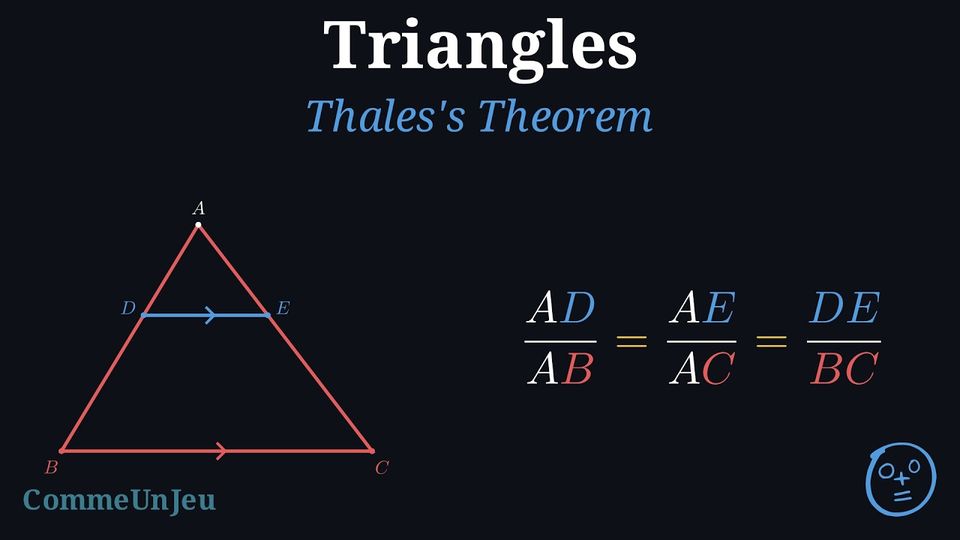
Theorem — The Intercept Theorem (Thales's Theorem)
Let \(\textcolor{colordef}{\triangle ABC}\) be a triangle, with a point \(\textcolor{colorprop}{D}\) on the line \(\Line{A\textcolor{colordef}{B}}\) and a point \(\textcolor{colorprop}{E}\) on the line \(\Line{A\textcolor{colordef}{C}}\), both distinct from \(A\).If the line \(\textcolor{colorprop}{\Line{DE}}\) is parallel to the line \(\textcolor{colordef}{\Line{BC}}\), then the triangles \(\textcolor{colordef}{\triangle ABC}\) and \(\textcolor{colorprop}{\triangle ADE}\) are similar: $$\dfrac{A\textcolor{colorprop}{D}}{A\textcolor{colordef}{B}} = \dfrac{A\textcolor{colorprop}{E}}{A\textcolor{colordef}{C}} = \dfrac{\textcolor{colorprop}{DE}}{\textcolor{colordef}{BC}}$$
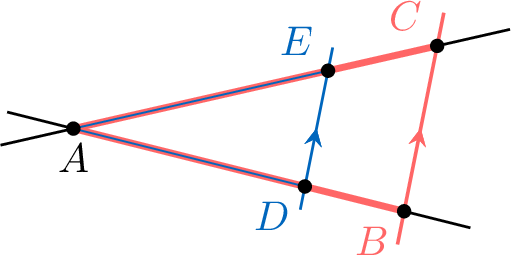
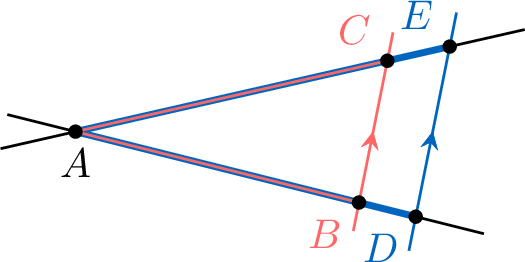
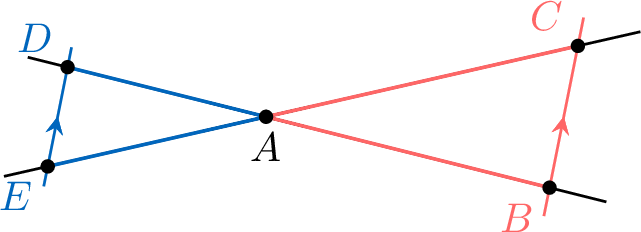
Each blue triangle is similar to the red triangle.
Proposition — Angle-Angle Similarity for Triangles
If two angles of one triangle are equal to two angles of another triangle, then the two triangles are similar. Example
In each figure, find the length \(x\), in cm. - In triangle \(ABC\), the point \(D\) lies on the segment \(\Segment{AB}\) and the point \(E\) on the segment \(\Segment{AC}\), with \(\Line{DE} \parallel \Line{BC}\), \(AD = x\), \(DB = 3\), \(DE = 8\) and \(BC = 10\).
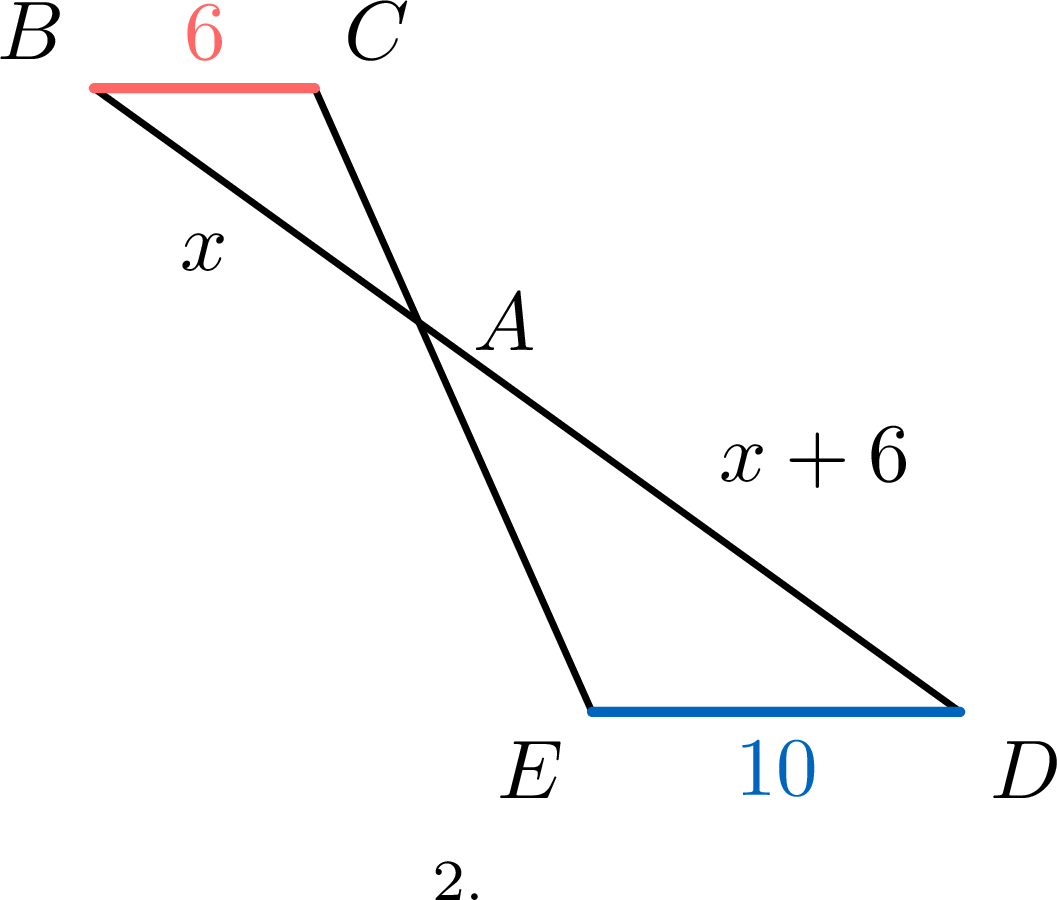
- The lines \(\Line{BD}\) and \(\Line{CE}\) cross at \(A\), with \(\Line{BC} \parallel \Line{DE}\), \(AB = x\), \(AD = x + 6\), \(BC = 6\) and \(DE = 10\).
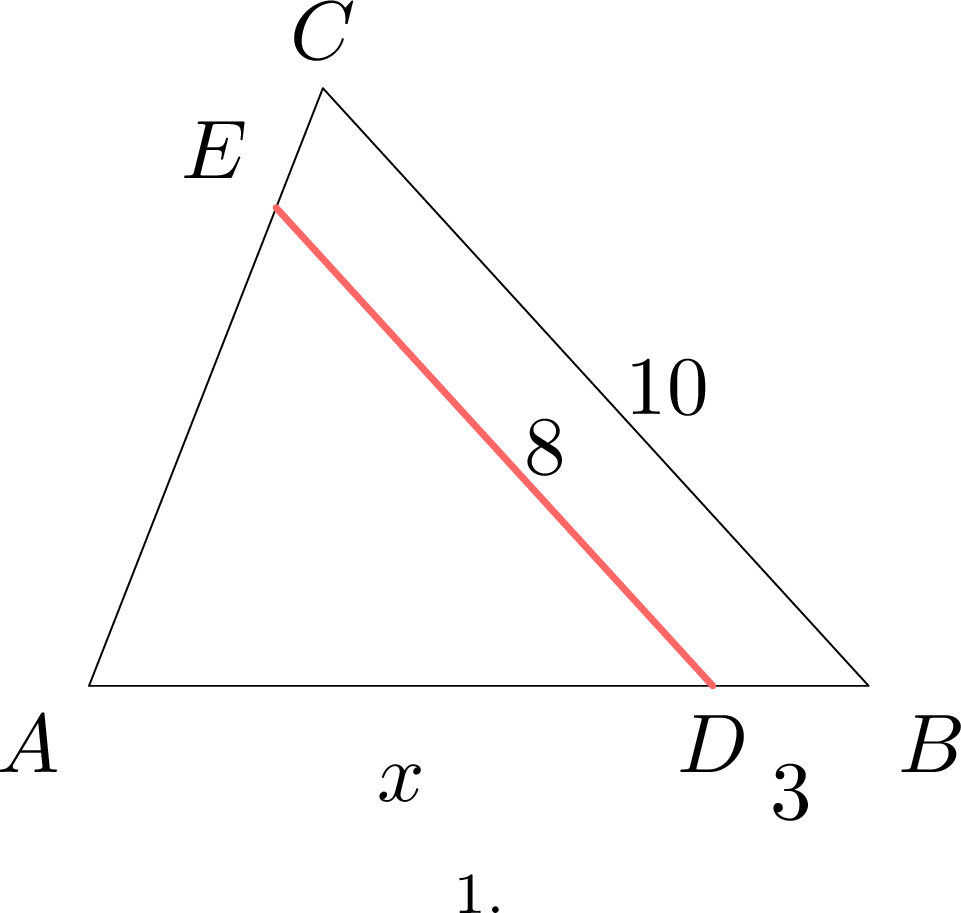
- The lines \(\Line{DB}\) and \(\Line{EC}\) cross at \(A\) and \(\Line{DE} \parallel \Line{BC}\): by Thales's theorem, \(\dfrac{AD}{AB} = \dfrac{DE}{BC}\). The length \(AB\) is not given: \(AB = AD + DB = x + 3\), so the unknown appears in two lengths, \(AD\) and \(AB\). The equation of ratios becomes an equation in \(x\): $$\begin{aligned}[t] \dfrac{x}{x + 3} &= \dfrac{8}{10} \\ 10x &= 8(x + 3) && \text{(cross multiplication)} \\ 10x &= 8x + 24 && \text{(expand)} \\ 2x &= 24 && \text{(subtract } 8x\text{)} \\ x &= 12. \end{aligned}$$ Check: \(AD = 12\) and \(AB = 15\), both positive, and \(\dfrac{12}{15} = \dfrac{4}{5} = \dfrac{8}{10}\). So \(x = 12\) cm.
- The lines \(\Line{BD}\) and \(\Line{CE}\) cross at \(A\) and \(\Line{BC} \parallel \Line{DE}\): by Thales's theorem, \(\dfrac{AB}{AD} = \dfrac{BC}{DE}\), and here both \(AB\) and \(AD\) contain \(x\): $$\begin{aligned}[t] \dfrac{x}{x + 6} &= \dfrac{6}{10} \\ 10x &= 6(x + 6) && \text{(cross multiplication)} \\ 10x &= 6x + 36 && \text{(expand)} \\ 4x &= 36 && \text{(subtract } 6x\text{)} \\ x &= 9. \end{aligned}$$ Check: \(AB = 9\) and \(AD = 15\), both positive, and \(\dfrac{9}{15} = \dfrac{3}{5} = \dfrac{6}{10}\). So \(x = 9\) cm.
Skills to practice
- Finding an Unknown That Appears in Two Lengths
- Setting Up and Solving an Equation
II
Proving That Lines Are Parallel
Theorem — Converse of Thales's Theorem
Let \(\triangle ABC\) be a triangle, \(D\) a point of the ray \(\Ray{AB}\) and \(E\) a point of the ray \(\Ray{AC}\), both distinct from \(A\) — or, in the butterfly position, \(D\) and \(B\) on either side of \(A\), and likewise \(E\) and \(C\).If $$\dfrac{AD}{AB} = \dfrac{AE}{AC},$$ then the line \(\Line{DE}\) is parallel to the line \(\Line{BC}\).
Draw the line through \(D\) parallel to \(\Line{BC}\): it meets the ray \(\Ray{AC}\) at a point \(E'\). By Thales's theorem,$$\dfrac{AD}{AB} = \dfrac{AE'}{AC}.$$ Comparing with the hypothesis \(\dfrac{AD}{AB} = \dfrac{AE}{AC}\) gives \(AE' = AE\). The points \(E\) and \(E'\) lie on the same ray \(\Ray{AC}\) at the same distance from \(A\), so \(E' = E\). Hence \(\Line{DE} = \Line{DE'}\) is parallel to \(\Line{BC}\). The proof above treats the rays \(\Ray{AB}\) and \(\Ray{AC}\); the butterfly position reduces to it and is accepted without proof.
Example
In triangle \(ABC\), the point \(D\) lies on segment \(\Segment{AB}\) and the point \(E\) on segment \(\Segment{AC}\), with \(AD = 2\) cm, \(AB = 5\) cm, \(AE = 2.4\) cm and \(AC = 6\) cm. Are the lines \(\Line{DE}\) and \(\Line{BC}\) parallel?
$$\begin{aligned}[t] \dfrac{AD}{AB} &= \dfrac{2}{5} = 0.4 \\
\dfrac{AE}{AC} &= \dfrac{2.4}{6} = 0.4 \end{aligned}$$ The two ratios are equal, and \(D\), \(E\) lie on the rays \(\Ray{AB}\), \(\Ray{AC}\): by the converse of Thales's theorem, \(\Line{DE} \parallel \Line{BC}\).
Proposition — Contrapositive of Thales's Theorem
The contrapositive turns “if P then Q” into “if not Q then not P” — the statement reversed and negated (reading it backwards alone would give the converse), which is why it is always as true as the theorem itself. For Thales's theorem, with \(D\) on the line \(\Line{AB}\) and \(E\) on the line \(\Line{AC}\) as in the theorem: if $$\dfrac{AD}{AB} \neq \dfrac{AE}{AC},$$ then the lines \(\Line{DE}\) and \(\Line{BC}\) are not parallel. It is the tool to prove that two lines are not parallel: compute the two ratios separately, and conclude from their difference. Example
In triangle \(ABC\), the point \(D\) is on the segment \(\Segment{AB}\) and the point \(E\) on the segment \(\Segment{AC}\), with \(AD = 3\) cm, \(AB = 8\) cm, \(AE = 2.4\) cm and \(AC = 6\) cm. Are the lines \(\Line{DE}\) and \(\Line{BC}\) parallel? 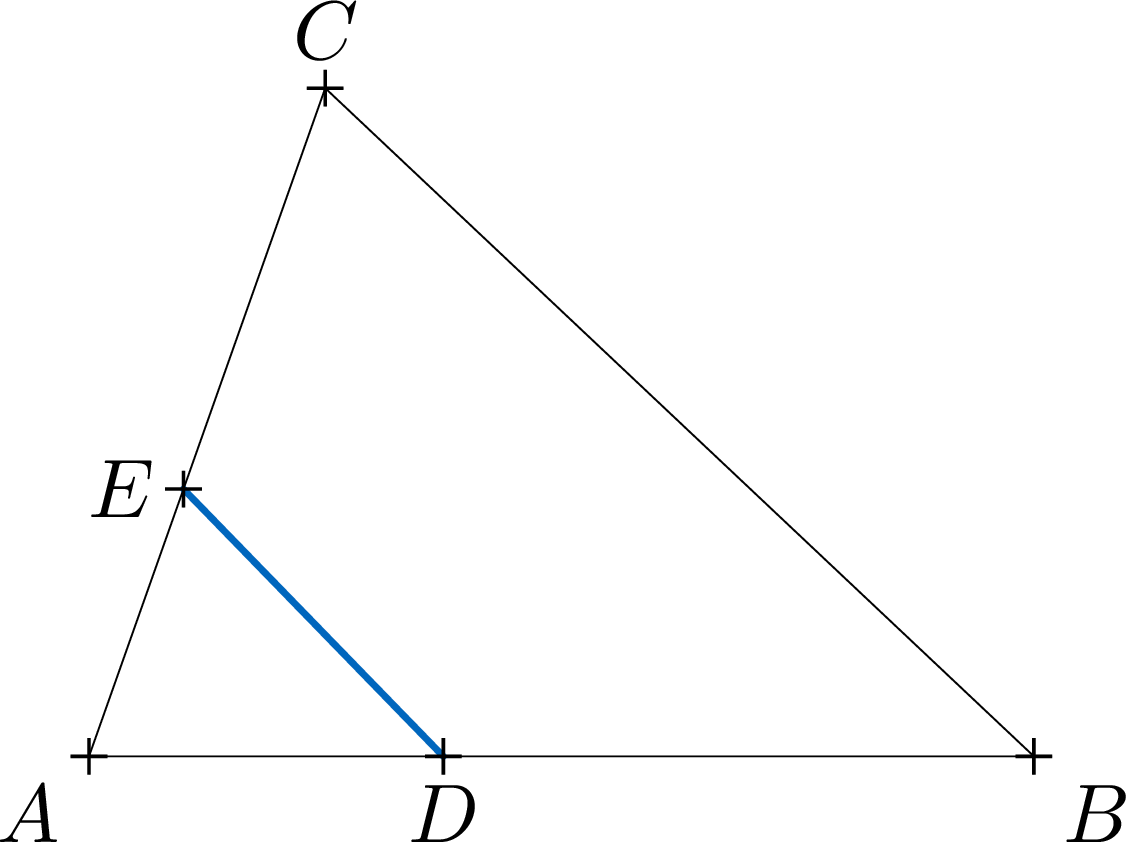
$$\begin{aligned}[t] \dfrac{AD}{AB} &= \dfrac{3}{8} = 0.375 \\
\dfrac{AE}{AC} &= \dfrac{2.4}{6} = 0.4 \end{aligned}$$ The two ratios are different: by the contrapositive of Thales's theorem, the lines \(\Line{DE}\) and \(\Line{BC}\) are not parallel. (If they were, Thales's theorem would force \(0.375 = 0.4\) — impossible.)
On the figure the two lines look parallel: the eye cannot tell \(0.375\) from \(0.4\). Only the calculation decides — a drawing is never a proof.
On the figure the two lines look parallel: the eye cannot tell \(0.375\) from \(0.4\). Only the calculation decides — a drawing is never a proof.
Skills to practice
- Using the Converse
- Showing That Lines Are Not Parallel
III
Using Areas and Volumes of Similar Figures
Definition — Similar Figures
Two figures are similar if one can be obtained from the other by a similarity (an enlargement or a reduction, possibly combined with an isometry, or an isometry alone).
In both Thales configurations, the small triangle is a reduction of the large one (and the large one, an enlargement of the small one): every length is multiplied by the same positive number \(k\), the scale factor — an enlargement when \(k > 1\), a reduction when \(0 < k < 1\) (and an identical copy when \(k = 1\)).
Proposition — Effects of an Enlargement or a Reduction
In an enlargement or a reduction with scale factor \(k\): - every length is multiplied by \(k\);
- every area is multiplied by \(k^2\);
- every volume is multiplied by \(k^3\).
Why \(k^2\) and \(k^3\)?
A square whose side is multiplied by \(k = 3\) contains \(3 \times 3 = 9\) squares identical to the starting square: its area is multiplied by \(3^2 = 9\). A cube whose edge is multiplied by \(3\) contains \(3 \times 3 \times 3 = 27\) cubes identical to the starting cube: its volume is multiplied by \(3^3 = 27\). 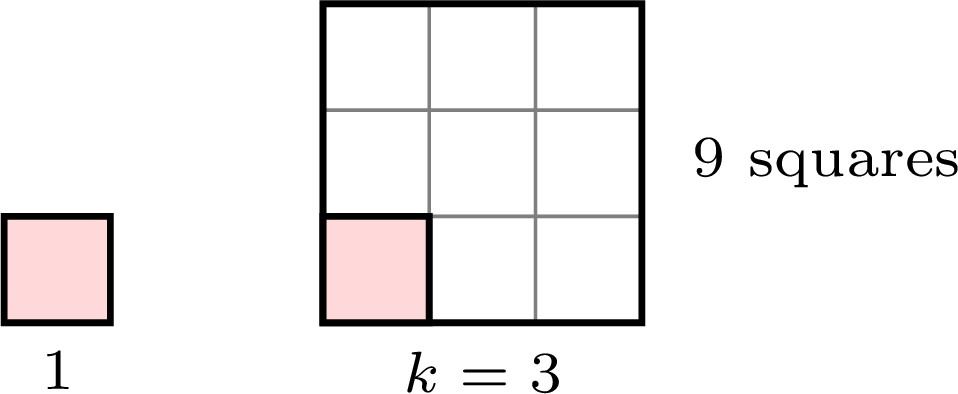
Any figure can be covered by small squares, and any solid by small cubes, as closely as we like, and the scale factor \(k\) need not be a whole number: the idea stays the same — a length counts \(k\) times, an area \(k \times k\) times, a volume \(k \times k \times k\) times. This is the idea behind the rule, which is accepted here without proof for every figure and every solid.
Example
A triangle has a perimeter of \(12\) cm and an area of \(6\) cm\(^2\). It is enlarged with scale factor \(k = 5\). Give the perimeter and the area of the enlarged triangle.
The perimeter is a length: it is multiplied by \(k = 5\), giving \(12 \times 5 = 60\) cm. The area is multiplied by \(k^2 = 25\), giving \(6 \times 25 = 150\) cm\(^2\) — not by \(5\) (see the remark: it is \(k^2\), not \(k\)).
Proposition — Cutting Parallel to the Base
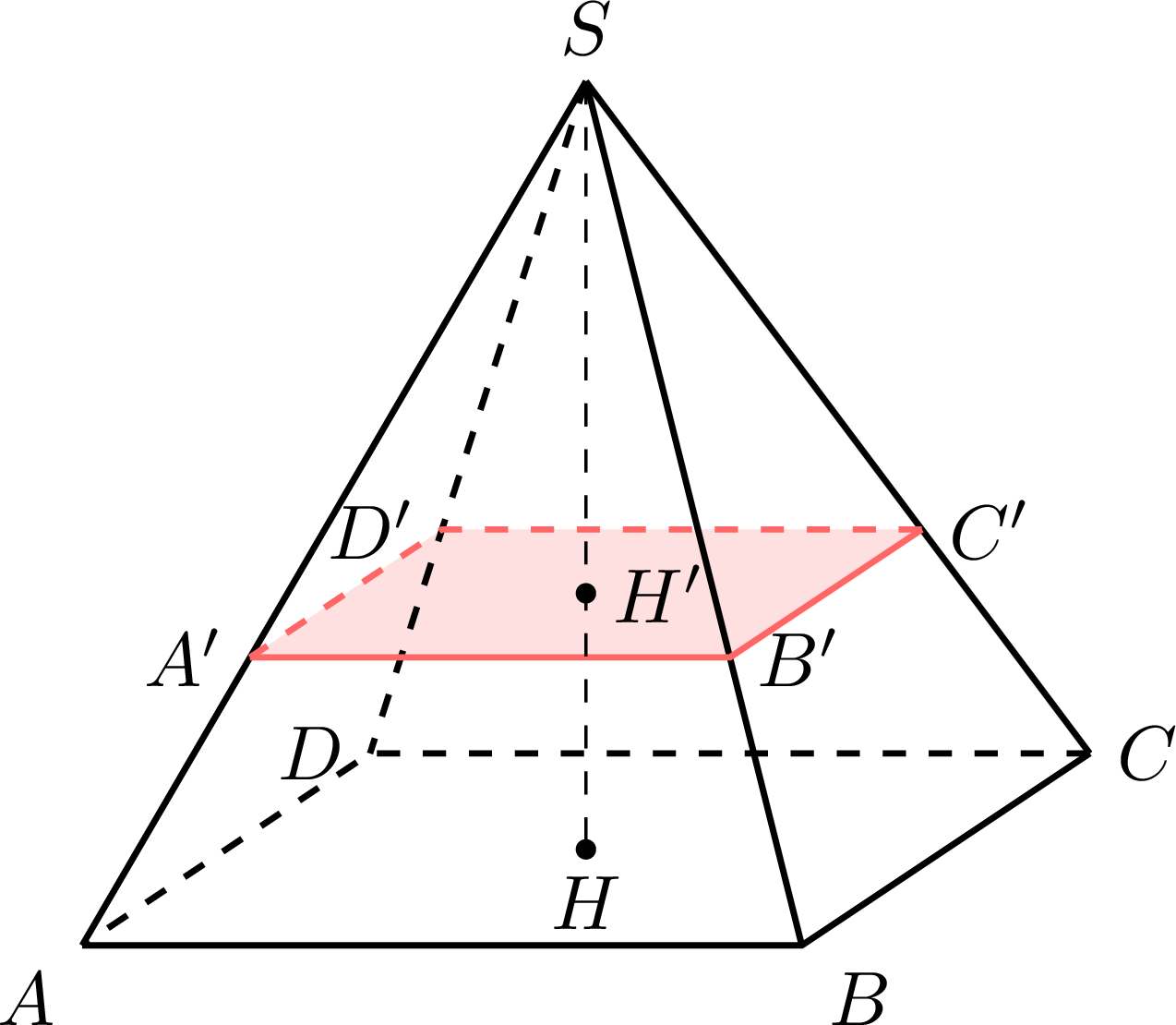
Let \(S\) be the apex of a pyramid or of a cone, \(H\) the foot of its height on the base. A plane parallel to the base, between the apex and the base, cuts the height at \(H'\), and let \(k = \dfrac{SH'}{SH}\). Then: - the section is a reduction of the base, with scale factor \(k\) (a polygon of the same shape for a pyramid, a disc for a cone);
- the small pyramid or cone cut off at the top is a reduction of the large one, with scale factor \(k\): lengths multiplied by \(k\), areas by \(k^2\), volume by \(k^3\).
Example
The pyramid \(SABCD\) of the Proposition “Cutting Parallel to the Base” has a square base of side \(6\) cm and a height \(SH = 9\) cm. It is cut by a plane parallel to its base, at \(6\) cm from the apex. Give the nature and the dimensions of the section, then the volume of the small pyramid. Recall: the volume of a pyramid is \(\dfrac{1}{3} \times\) base area \(\times\) height.
The scale factor of the reduction is \(k = \dfrac{SH'}{SH} = \dfrac{6}{9} = \dfrac{2}{3}\).
- The section is a reduction of the square base: a square, of side \(6 \times \dfrac{2}{3} = 4\) cm.
- Volume of the large pyramid: \(\dfrac{1}{3} \times 6^2 \times 9 = 108\) cm\(^3\). The small pyramid is a reduction with scale factor \(\dfrac{2}{3}\): $$V = 108 \times \left(\dfrac{2}{3}\right)^3 = 108 \times \dfrac{8}{27} = 32 \text{ cm}^3.$$ Check: \(\dfrac{1}{3} \times 4^2 \times 6 = 32\) cm\(^3\).
Congruent and Similar Figures
- A similarity multiplies every length by its scale factor \(k\). With \(k = 1\), it keeps every length: congruent figures are similar figures with scale factor \(1\). Two congruent figures are always similar; two similar figures are congruent only when the scale factor is \(1\) — an enlargement keeps the shape, not the size.
- Two congruent triangles can be laid exactly on one another after moving one of them and possibly turning it over: moving is a translation or a rotation, turning over is a reflection.
Skills to practice
- Recognising the Effects of a Scale Factor
- Using the Rules for Lengths, Areas and Volumes
- Working with Sections Parallel to the Base
IV
Going further
Skills to practice
- Reasoning with Thales's Theorem and Its Converse
- Investigating Areas and Volumes of Similar Figures
- Solving Real-Life Problems with Similar Figures
Jump to section