International Baccalaureate · MYP 3
Angles and Polygons
I
Complementary and Supplementary Angles
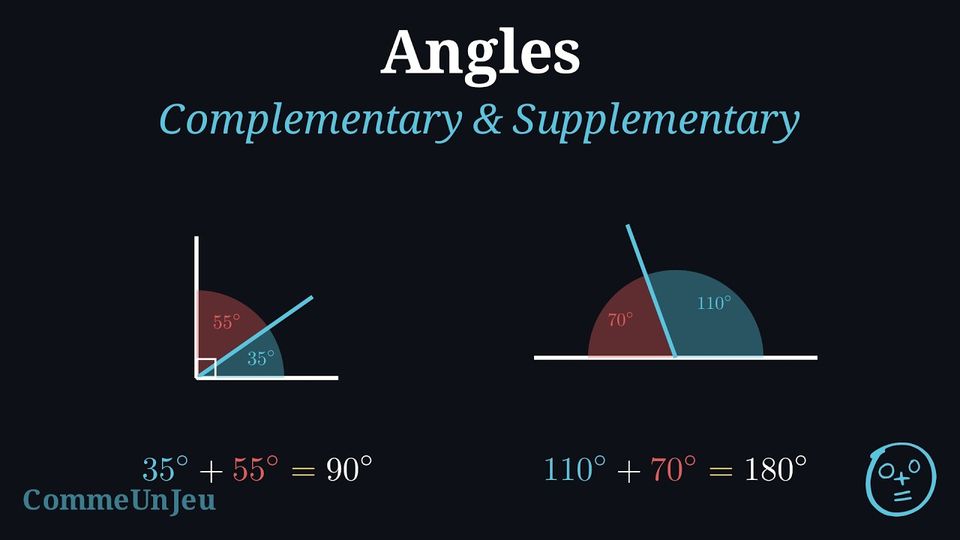
Proposition — Angle Properties
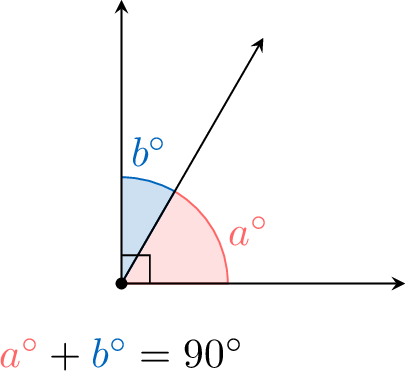
- Right Angle: If two adjacent angles form a right angle, the sum of their measures is \(90^\circ\) (two angles whose measures add up to \(90^\circ\) are called complementary, whether or not they are side by side).
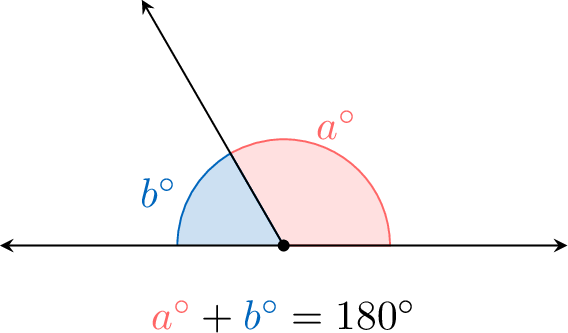
- Straight Angle: If two adjacent angles form a straight angle, the sum of their measures is \(180^\circ\) (two angles whose measures add up to \(180^\circ\) are called supplementary, whether or not they are side by side).
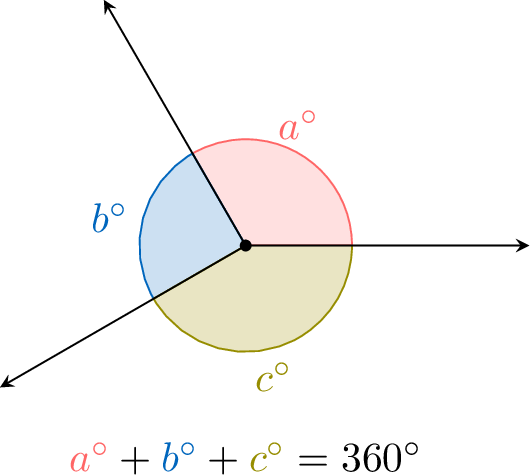
- Full Angle: If several angles meet at a point and form one full turn around that point, the sum of their measures is \(360^\circ\).
To wedge the shelf bracket into the corner, the carpenter saws a strip into two pieces: placed side by side, they must fill a right angle exactly. The first piece is cut at \(35^\circ\). What must the second one measure — and what would it be if they had to fill a straight edge instead? 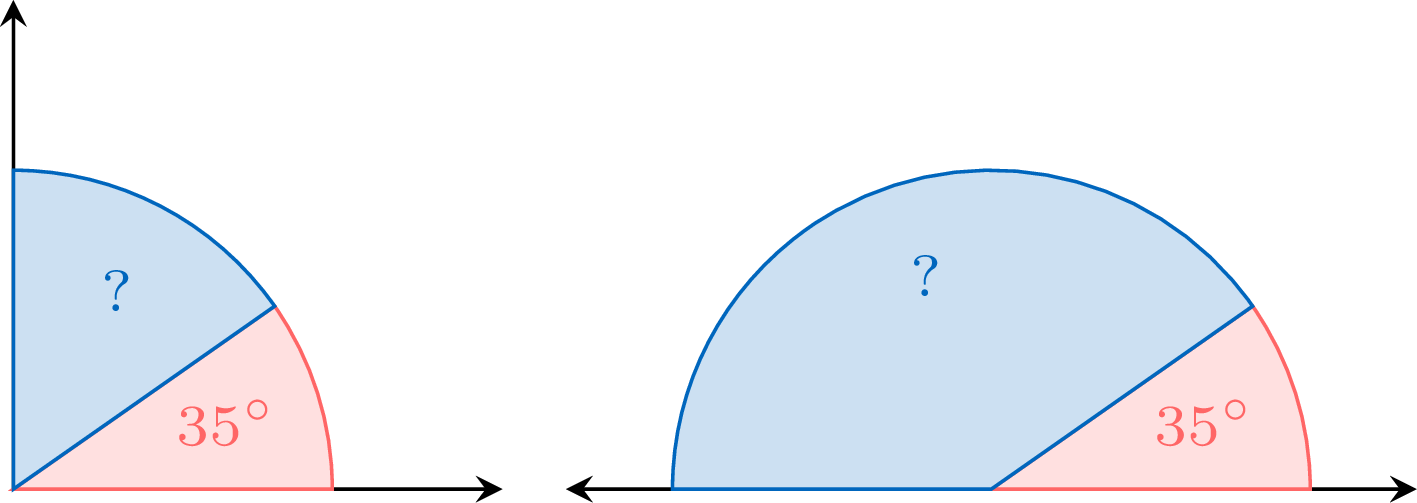
Placed side by side, the two pieces must add up to the whole corner.
- For the right angle: \(35^\circ + {?} = 90^\circ\), so the second piece measures \(90^\circ - 35^\circ = \boldsymbol{55^\circ}\) — the two angles are complementary.
- For the straight edge: \(35^\circ + {?} = 180^\circ\), so it would take \(180^\circ - 35^\circ = \boldsymbol{145^\circ}\) — the two angles are supplementary.
Definition — Complementary
Two angles are complementary if the sum of their measures is \(90^\circ\). Placed side by side, complementary angles form a right angle, like the corner of a square. Example
Calculate the measure of the unknown angle \(x^\circ\) if it is complementary to a \(28^\circ\) angle. 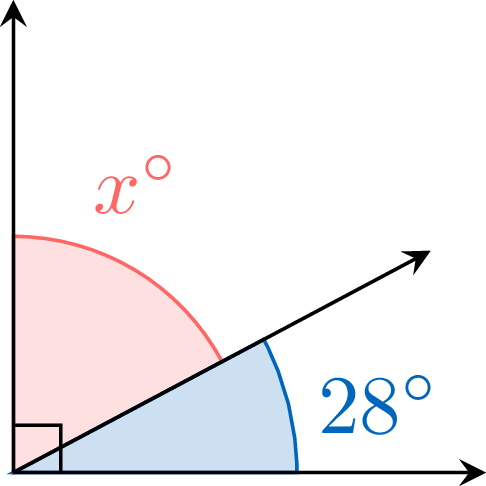
Definition — Supplementary
Two angles are supplementary if the sum of their measures is \(180^\circ\). Placed side by side, supplementary angles form a straight angle (a straight line). Example
Calculate the measure of the unknown angle \(x^\circ\) if it is supplementary to a \(110^\circ\) angle. 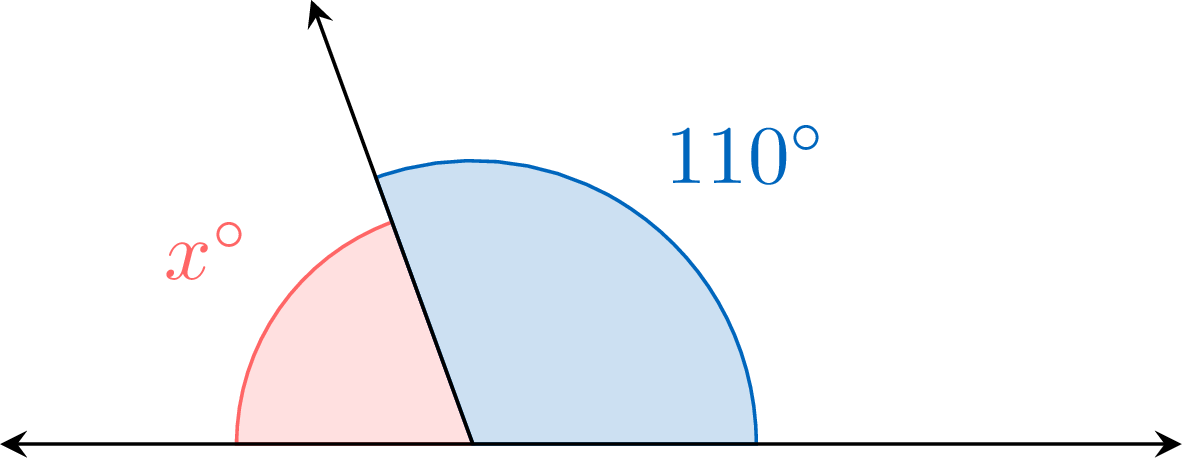
Skills to practice
- Verifying Complementary Angles
- Verifying Supplementary Angles
- Calculating Complementary Angles
- Calculating Supplementary Angles
- Finding Angles with Algebra
II
The Angle Sum of a Polygon
Proposition — Sum of the angles of a triangle
In any triangle, the sum of the three interior angles is \(180^\circ\). 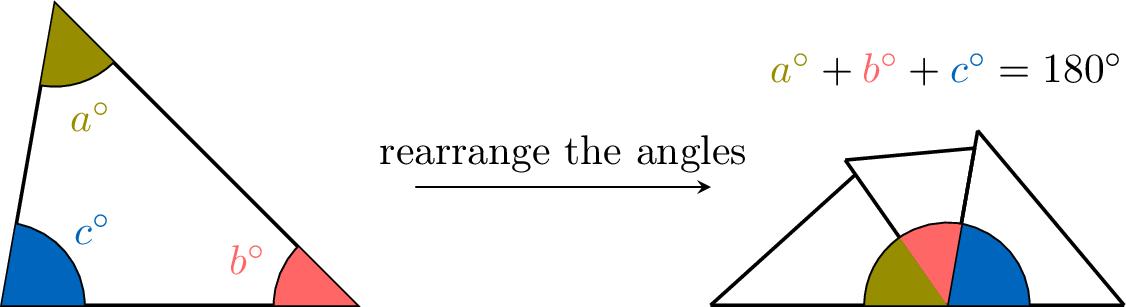
The cut-and-rearrange activity suggests the result; here we prove it. Through the vertex \(C\), draw the line parallel to the opposite side \(\Line{AB}\), meeting it nowhere. The two sides \(\Segment{CA}\) and \(\Segment{CB}\) are then transversals cutting a pair of parallel lines. 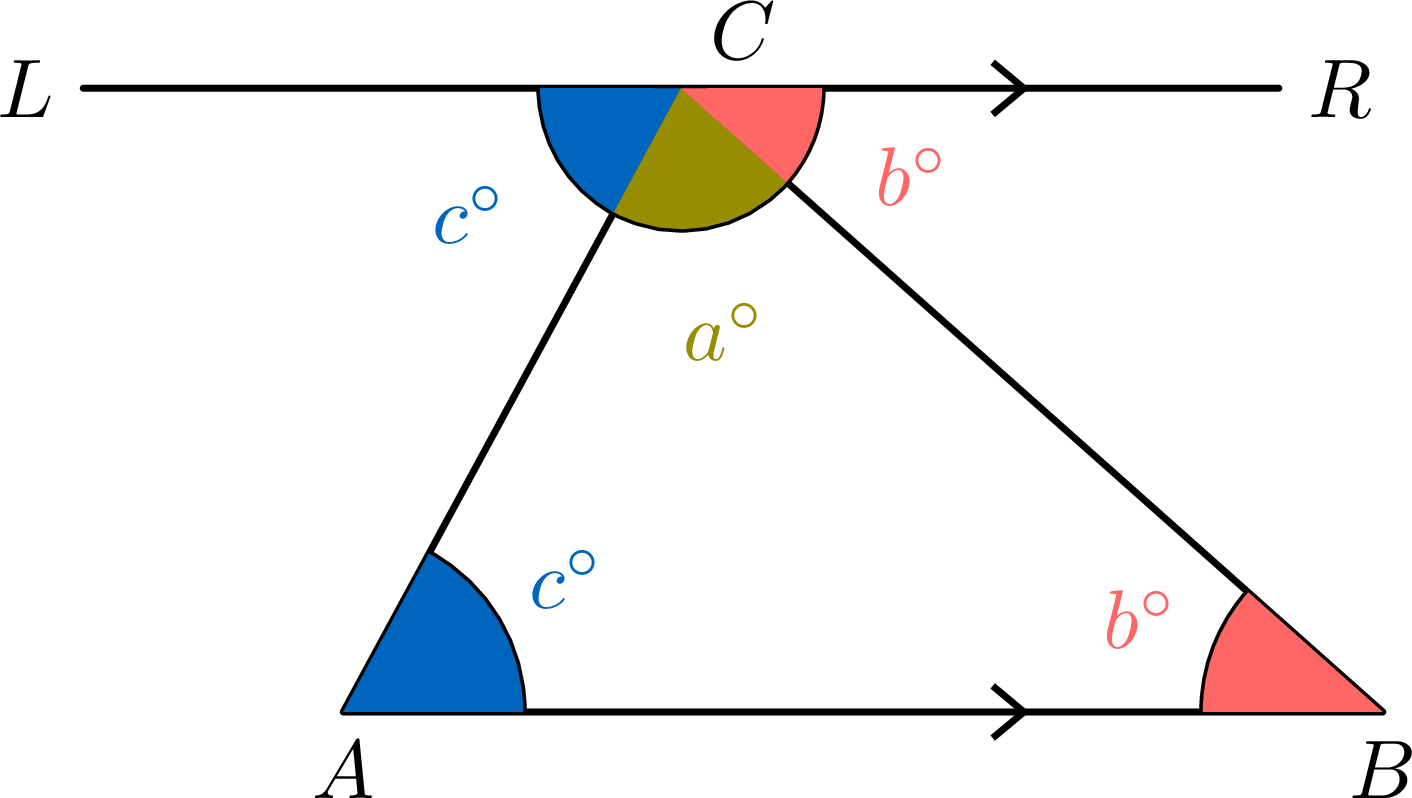
Each base angle reappears at \(C\) as an alternate angle: the transversal \(\Segment{CA}\) gives \(\Angle{LCA}=c^\circ\), and the transversal \(\Segment{CB}\) gives \(\Angle{BCR}=b^\circ\). The three angles at \(C\) lie along the straight line \(\Line{LR}\), so they form a straight angle: $$\begin{aligned}[t] \Angle{LCA}+\Angle{ACB}+\Angle{BCR} &= 180^\circ && \text{(angles on a straight line)}\\
c^\circ + a^\circ + b^\circ &= 180^\circ. && \text{(alternate angles, parallel lines)} \end{aligned}$$ Hence the three interior angles satisfy \(a^\circ+b^\circ+c^\circ=180^\circ\).
Definition — Convex Polygon
A non-crossed polygon is convex when each of its interior angles is less than \(180^\circ\). A non-crossed polygon with at least one interior angle greater than \(180^\circ\) — a reflex angle — is concave, or non-convex. 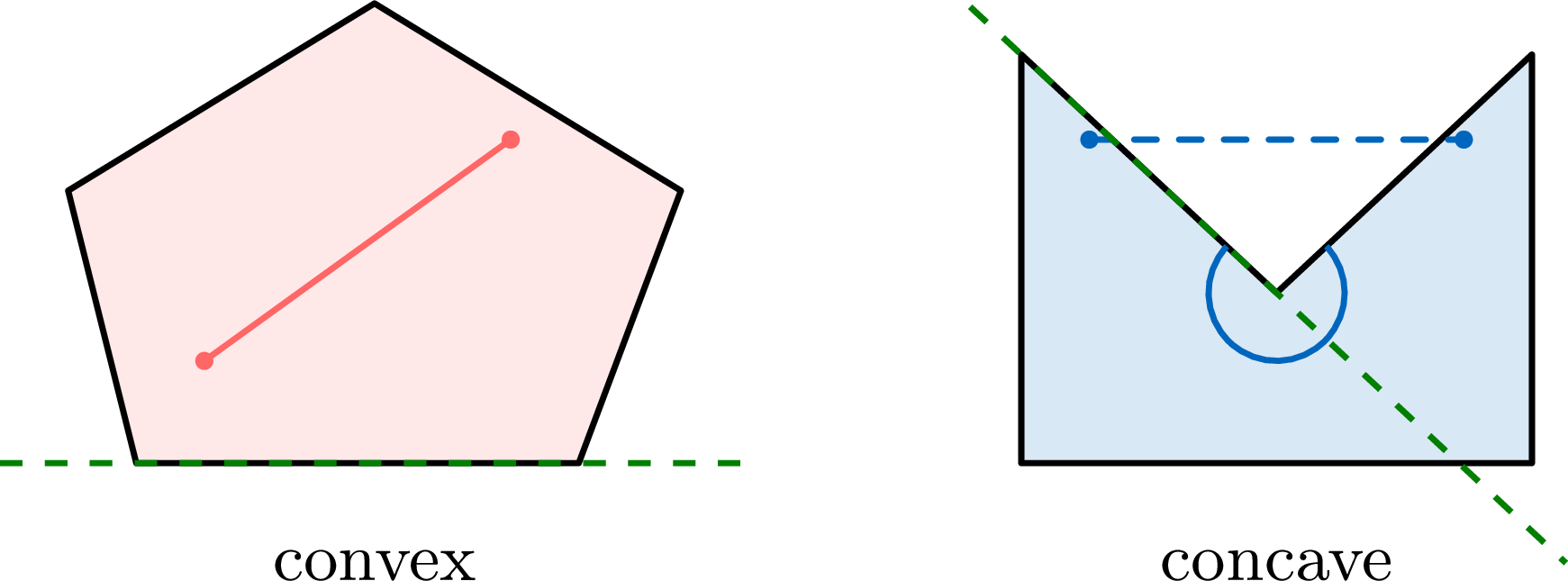
- the segment joining any two points inside the polygon stays inside the polygon;
- the line through any one of its sides leaves the whole polygon on the same side of it (green dashes).
Proposition — Sum of the Angles of a Quadrilateral
The sum of the interior angles of a non-crossed quadrilateral is \(360^\circ\). 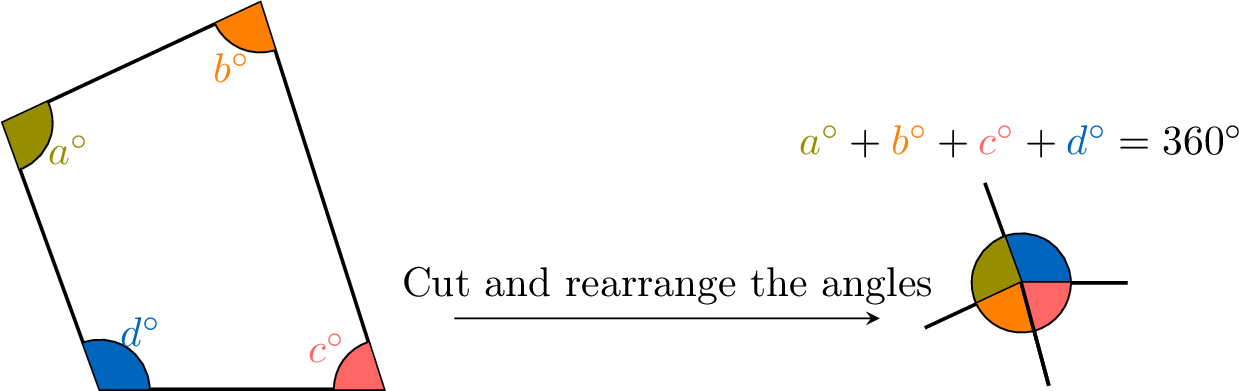
We cut the quadrilateral \(ABCD\) into two triangles, \(ABC\) and \(ACD\), along the diagonal \(\Segment{AC}\), which lies inside it (for a concave quadrilateral, the diagonal to choose is given in the Remark “Angle Sum of a Concave Polygon”). 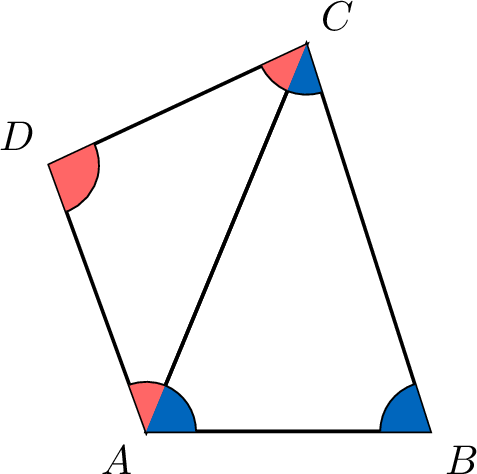
$$\begin{aligned} \text{Sum of the interior angles of quadrilateral } ABCD &= \text{Sum of the interior angles of } \triangle ABC \\
&\quad + \text{Sum of the interior angles of } \triangle ACD \\
&= 180^\circ + 180^\circ \\
&= 360^\circ \end{aligned}$$
The angles of a triangle add up to \(180^\circ\) and those of a quadrilateral to \(360^\circ\). What about a pentagon, a hexagon, or a polygon with \(10\) sides? In each polygon below, the diagonals drawn from the vertex \(A\) cut the polygon into triangles. 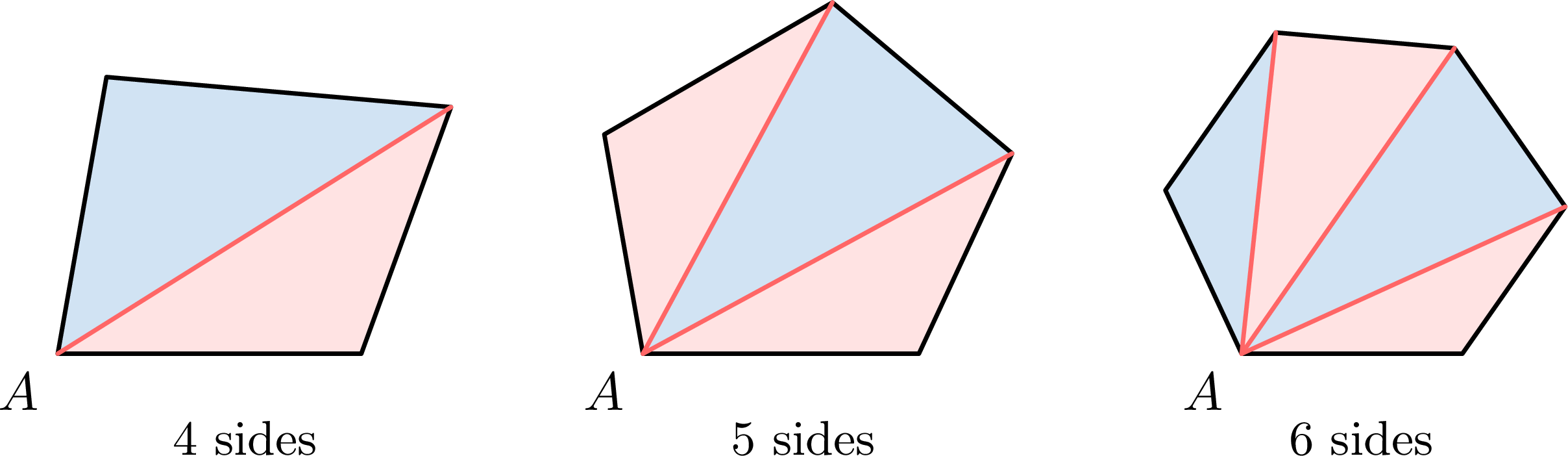
- Count the triangles in each polygon.
- Deduce the sum of the angles of the pentagon and of the hexagon.
- Predict the sum of the angles of a convex polygon with \(10\) sides.
- The quadrilateral is cut into \(2\) triangles, the pentagon into \(3\) and the hexagon into \(4\): always \(2\) triangles fewer than sides. The diagonals start from \(A\) and go to every vertex except \(A\) and its two neighbours.
- The angles of the triangles fill the angles of the polygon exactly, and each triangle brings \(180^\circ\): $$\begin{aligned}[t] \text{pentagon: } 3 \times 180^\circ &= 540^\circ,\\ \text{hexagon: } 4 \times 180^\circ &= 720^\circ. \end{aligned}$$
- The diagonals from one vertex of a convex polygon with \(10\) sides lie inside it and cut it into \(10 - 2 = 8\) triangles, so the sum of its angles is \(8 \times 180^\circ = 1440^\circ\).
Definition — Polygons and Their Angles
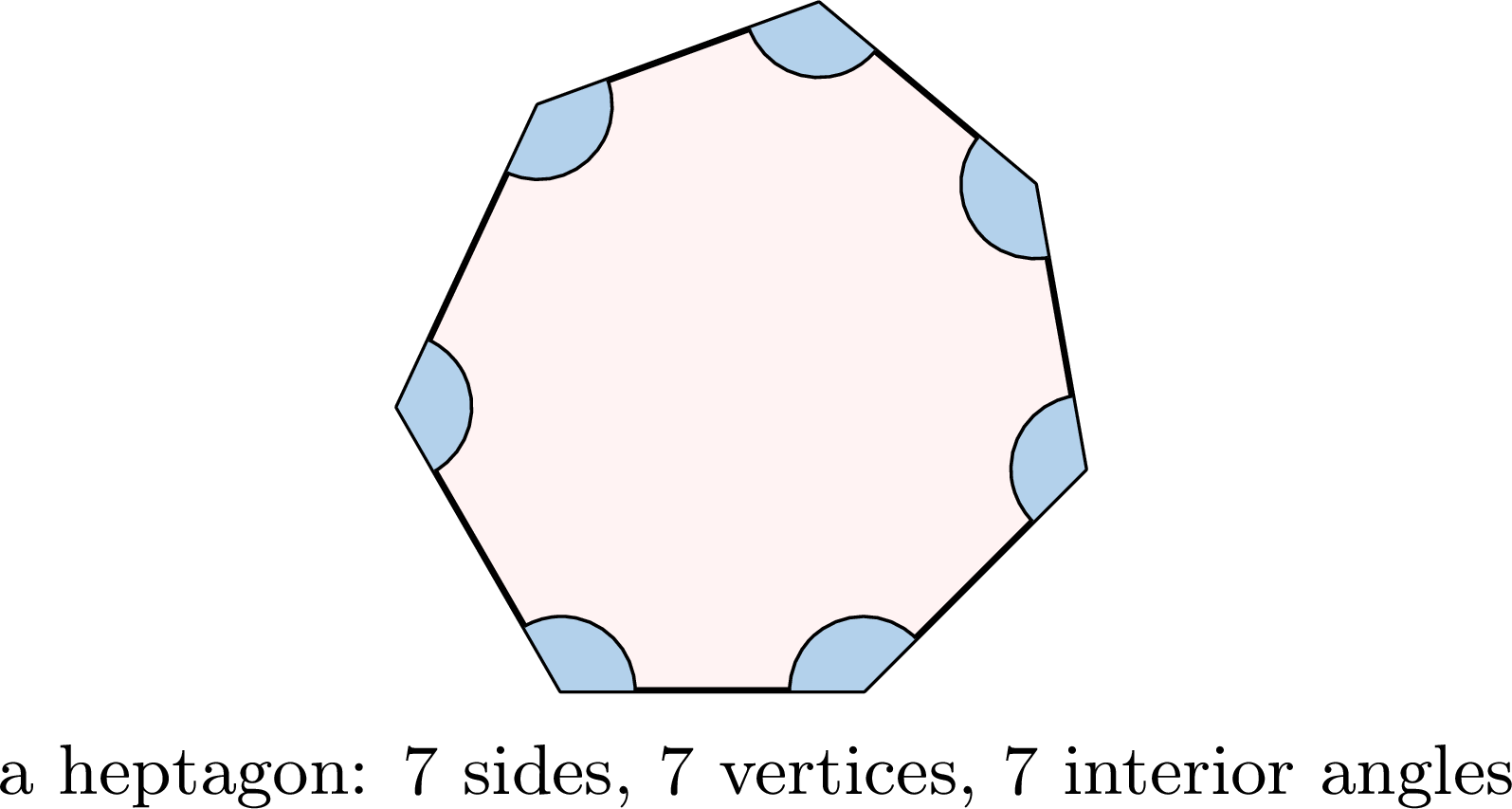
A polygon with \(n\) sides (\(n \geq 3\)) has \(n\) vertices and \(n\) angles. The angle of the polygon at a vertex, measured inside the polygon, is an interior angle. Beyond the triangle, the quadrilateral, the pentagon and the hexagon, some polygons have a name of their own: | Number of sides | \(7\) | \(8\) | \(9\) | \(10\) | \(12\) |
| Name | heptagon | octagon | nonagon | decagon | dodecagon |
Proposition — Angle Sum of a Polygon
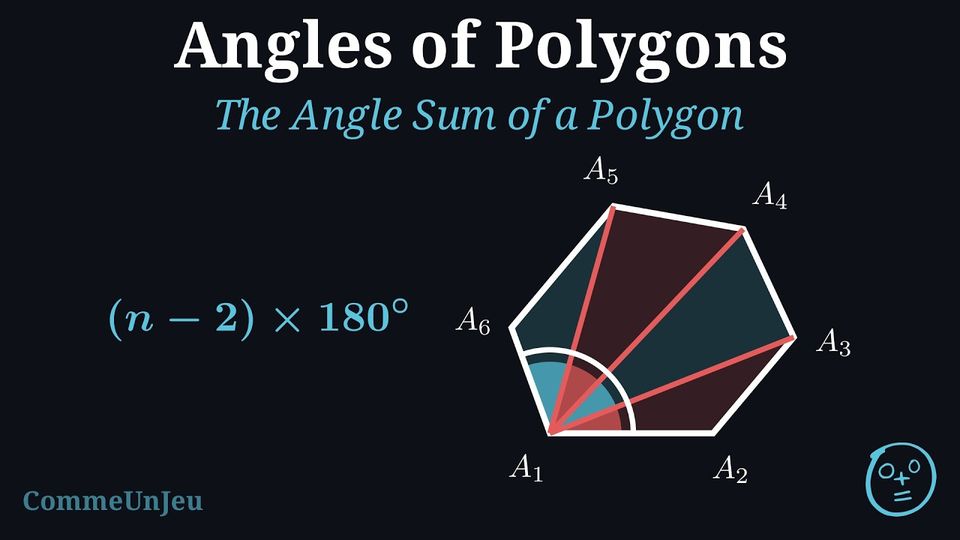
The interior angles of a polygon with \(n\) sides add up to \((n - 2) \times 180^\circ\).For example, the angles of a pentagon add up to \((5 - 2) \times 180^\circ = 540^\circ\), and those of a hexagon to \((6 - 2) \times 180^\circ = 720^\circ\).
We prove it for a convex polygon \(A_1A_2 \ldots A_n\); the Remark below deals with a concave one. From the vertex \(A_1\), draw the diagonals to every vertex except \(A_1\) and its two neighbours \(A_2\) and \(A_n\): there are \(n - 3\) of them. As the polygon is convex, they lie inside it and cut it into the \(n - 2\) triangles \(A_1A_2A_3\), \(A_1A_3A_4\), …, \(A_1A_{n-1}A_n\) — one triangle more than diagonals. Here is the hexagon: \(3\) diagonals, \(4\) triangles. 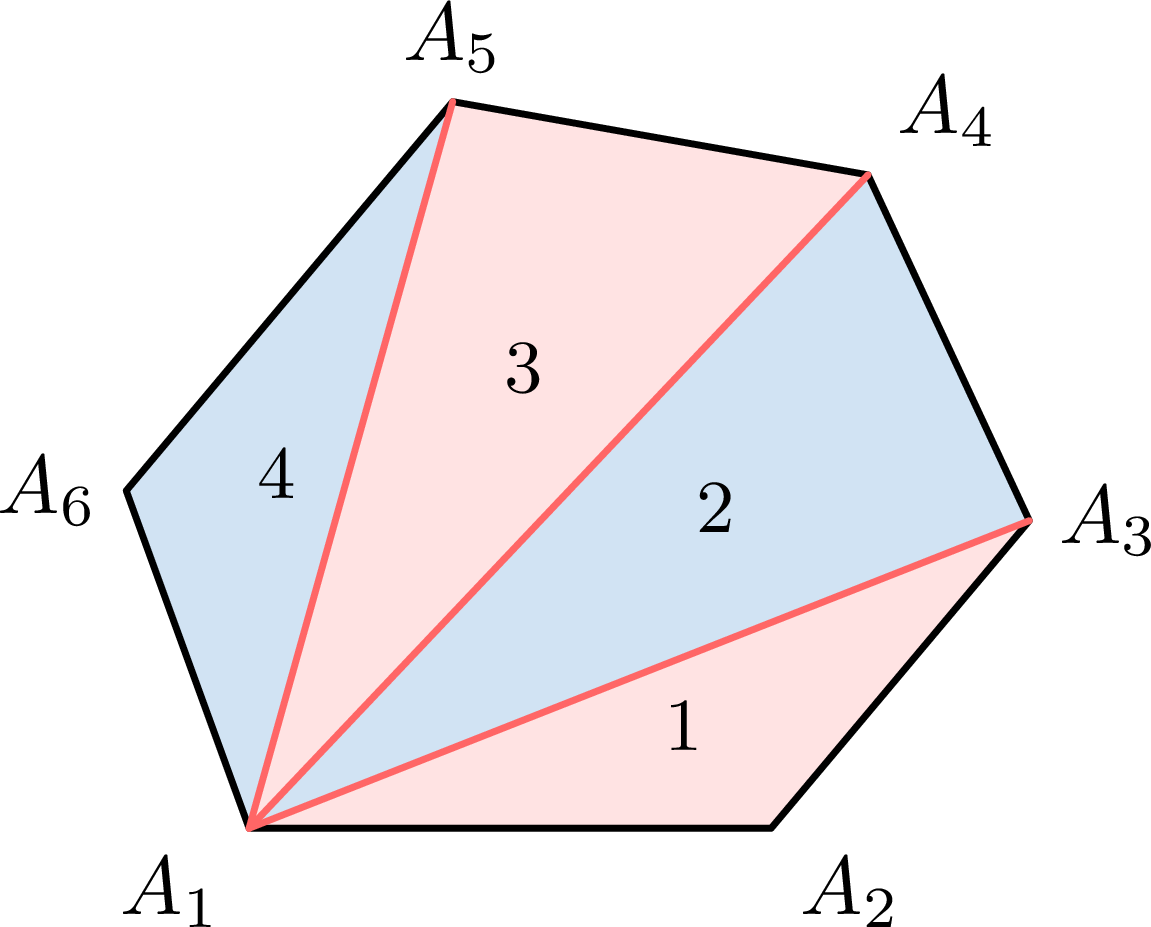
The angles of these triangles fill the interior angles of the polygon exactly: at \(A_1\), the angles of all the triangles together make the angle of the polygon, and at every other vertex, one or two triangles fill it. Each triangle has an angle sum of \(180^\circ\) (Proposition “Sum of the angles of a triangle”), so $$\begin{aligned}[t] \text{sum of the angles of the polygon} &= \text{sum of the angles of the } n - 2 \text{ triangles} && \text{(the triangles fill the angles)}\\
&= (n - 2) \times 180^\circ. \end{aligned}$$
Angle Sum of a Concave Polygon
The sum of the angles of a non-crossed quadrilateral is \(360^\circ\) even when the quadrilateral is concave. The proof cuts the quadrilateral into two triangles along a diagonal; for a concave quadrilateral, choose the diagonal that starts at the vertex of the reflex angle: it lies inside the quadrilateral, while the other diagonal lies outside. In the arrowhead \(ABCD\) below, \(60^\circ + 30^\circ + 240^\circ + 30^\circ = 360^\circ\). 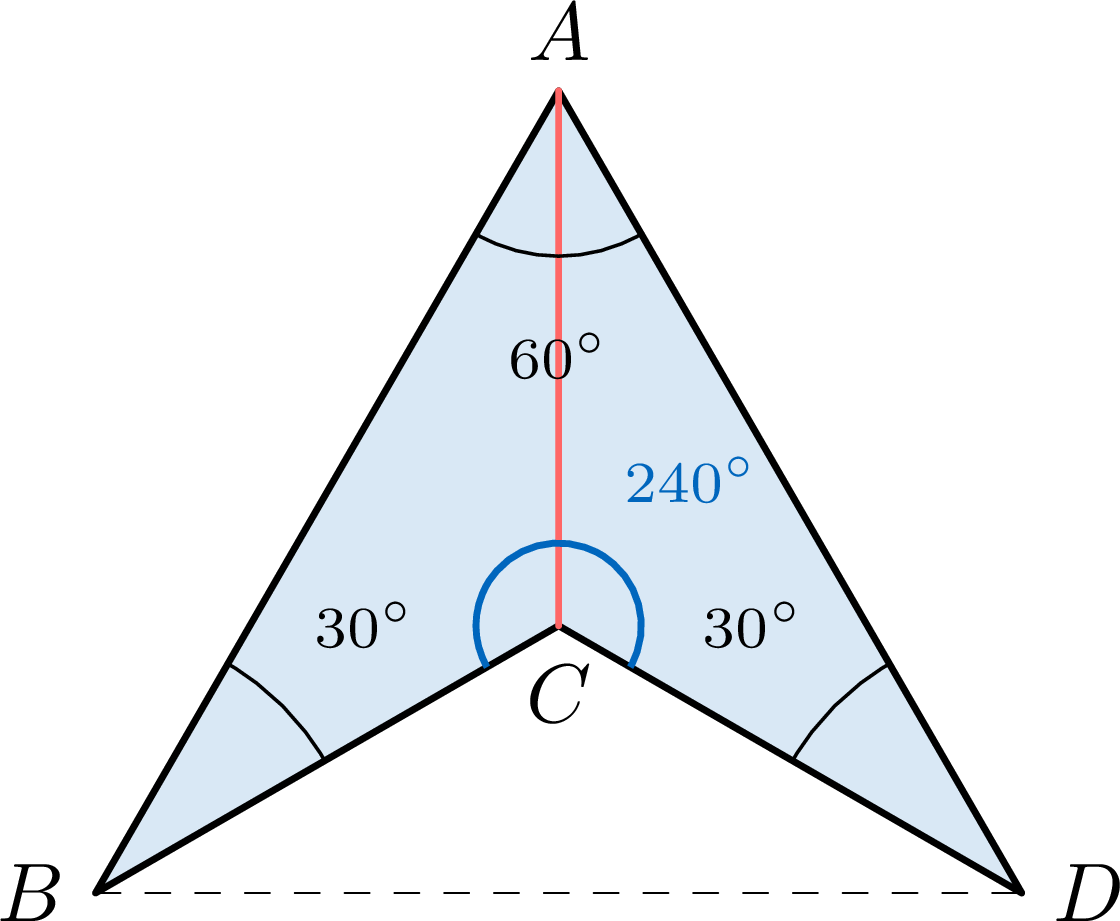
More generally, a non-crossed polygon with \(n\) sides, convex or concave, can always be cut into \(n - 2\) triangles by diagonals lying inside it, so the sum of its interior angles is \((n - 2) \times 180^\circ\): for \(n = 4\), \(2 \times 180^\circ = 360^\circ\).
Concave Polygons
In a concave polygon, a diagonal drawn from a vertex may pass outside the polygon, and the proof above does not apply as it stands. The formula \((n - 2) \times 180^\circ\) still holds for a polygon whose sides do not cross, convex or concave (Remark “Angle Sum of a Concave Polygon”); it is accepted here without proof. In the concave pentagon below, the two diagonals from the vertex \(D\) of the reflex angle lie inside and cut it into \(3\) triangles: its angles add up to \(3 \times 180^\circ = 540^\circ\). 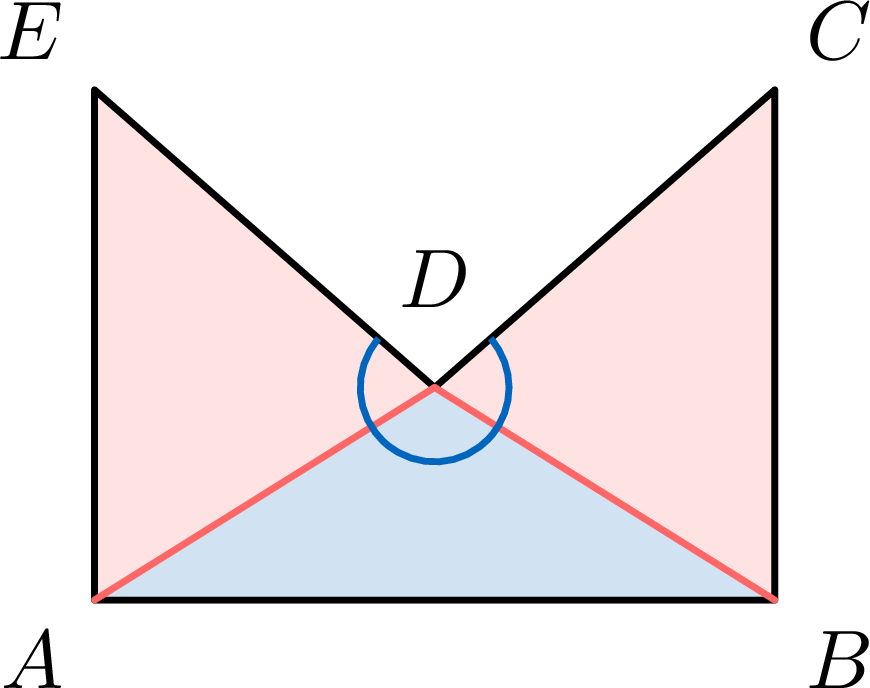
Method — Finding an Unknown Angle of a Polygon
- Count the sides: \(n\).
- Compute the angle sum: \((n - 2) \times 180^\circ\).
- Write the equation: the given angles and the unknown ones add up to the angle sum.
- Solve it, then check that the angles found add up to the angle sum.
Example
Find the value of \(x\) in the pentagon \(ABCDE\). 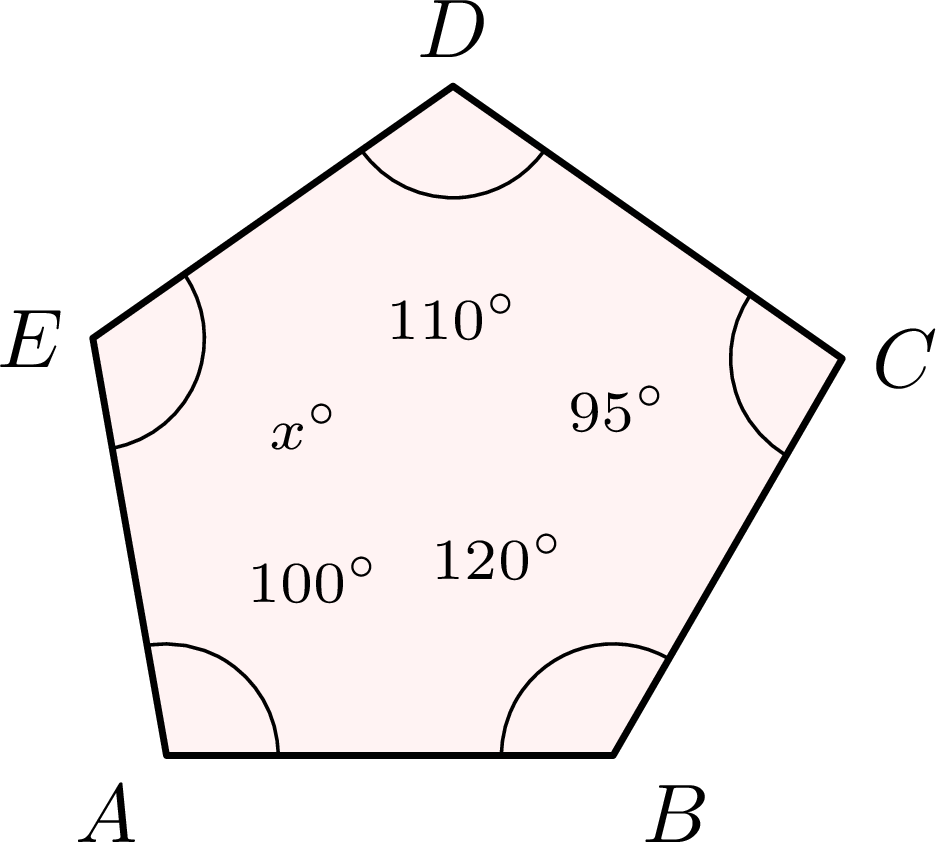
The pentagon has \(n = 5\) sides, so its angles add up to \((5 - 2) \times 180^\circ = 540^\circ\): $$\begin{aligned}[t] x + 100 + 120 + 95 + 110 &= 540 && \text{(angle sum of a pentagon)}\\
x + 425 &= 540\\
x &= 540 - 425 && \text{(subtract } 425\text{)}\\
x &= 115. \end{aligned}$$ Check: \(115 + 100 + 120 + 95 + 110 = 540\).
Example
Find the value of \(x\), then the six angles of the hexagon. 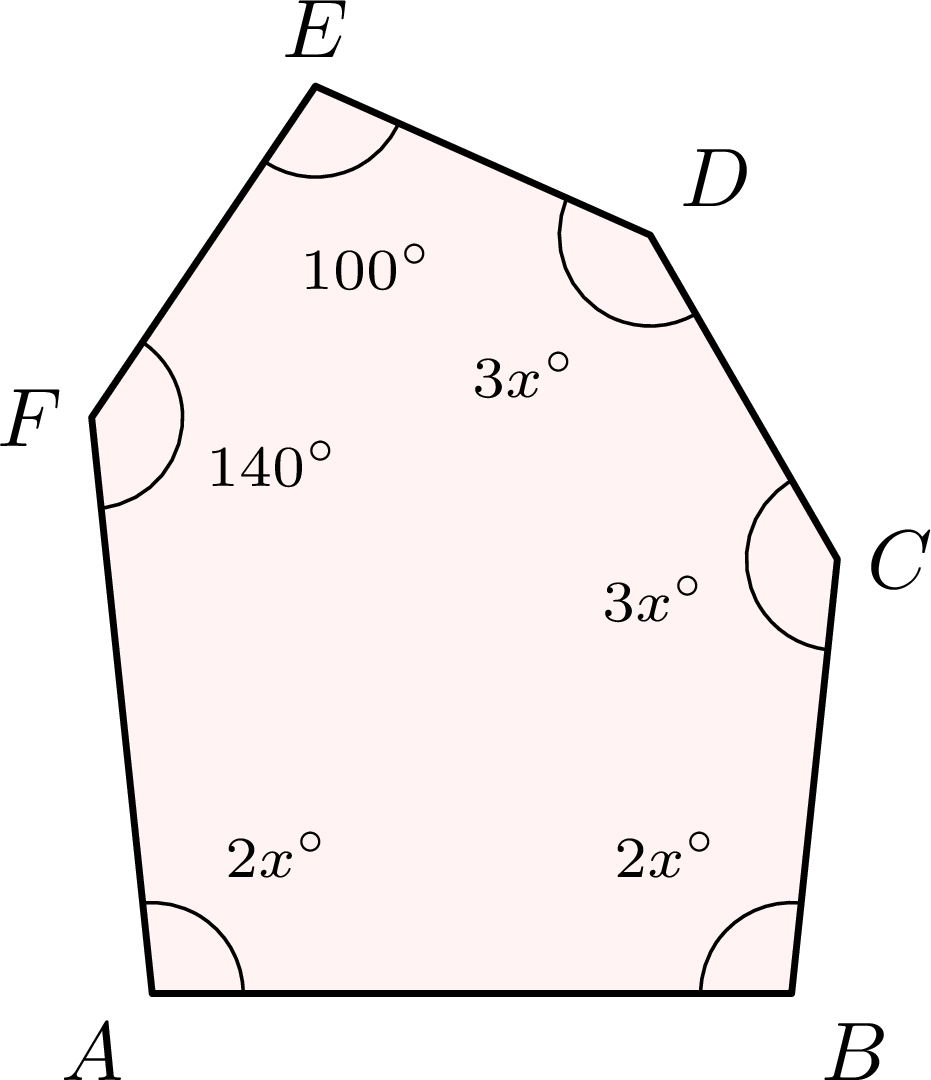
The hexagon has \(n = 6\) sides, so its angles add up to \((6 - 2) \times 180^\circ = 720^\circ\): $$\begin{aligned}[t] 2x + 2x + 3x + 3x + 100 + 140 &= 720 && \text{(angle sum of a hexagon)}\\
10x + 240 &= 720 && \text{(collect like terms)}\\
10x &= 480 && \text{(subtract } 240\text{)}\\
x &= 48 && \text{(divide by } 10\text{)}. \end{aligned}$$ The angles are \(2 \times 48^\circ = 96^\circ\) (twice), \(3 \times 48^\circ = 144^\circ\) (twice), \(100^\circ\) and \(140^\circ\). Check: \(96 + 96 + 144 + 144 + 100 + 140 = 720\).
Example
- The interior angles of a polygon add up to \(1980^\circ\). How many sides has the polygon?
- Can the interior angles of a polygon add up to \(2500^\circ\)?
- Let \(n\) be the number of sides: $$\begin{aligned}[t] (n - 2) \times 180 &= 1980 && \text{(angle sum of a polygon)}\\ n - 2 &= 1980 \div 180 = 11 && \text{(divide by } 180\text{)}\\ n &= 13. \end{aligned}$$ The polygon has \(13\) sides.
- An angle sum is \((n - 2) \times 180^\circ\), a whole number of times \(180^\circ\). But \(2500 \div 180 = 13.88\ldots\) is not a whole number: no polygon has an angle sum of \(2500^\circ\).
Skills to practice
- Recognising Angle Sums
- Calculating Angle Sums
- Finding an Unknown Angle in a Polygon
- Finding the Number of Sides from the Angle Sum
- Justifying Angle Sums
III
Exterior Angles
A robot walks once around a pentagon-shaped path, anticlockwise. It starts at the corner \(S\), facing along the first side. At each of the four other corners, it stops and turns left through the angle shown, then walks along the next side. Back at \(S\), it turns left through the angle shown at \(S\) and faces exactly the direction it started in. Through what total angle has it turned? 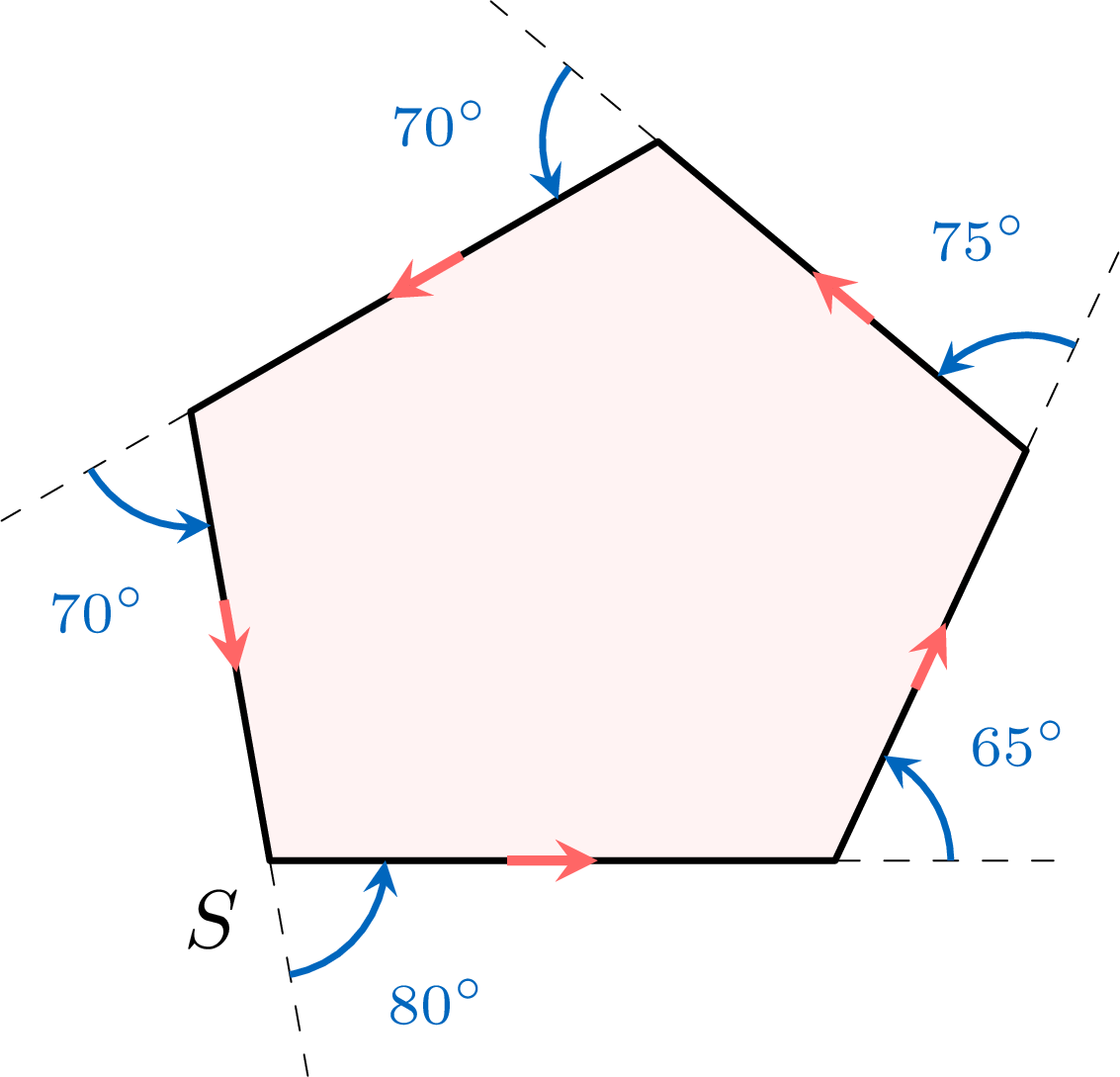
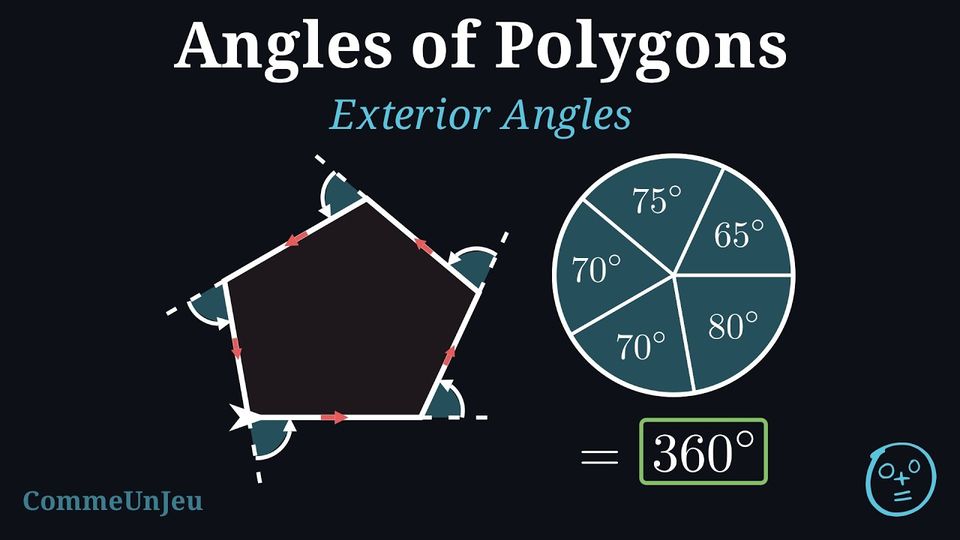
The five turns add up to $$80^\circ + 65^\circ + 75^\circ + 70^\circ + 70^\circ = 360^\circ,$$ one full turn. This is no coincidence: walking once around the path, the robot turns all the way round once and faces its first direction again. At each corner, it turns from the extension of the side it has just walked (dashed) to the next side: these turning angles are the exterior angles of the pentagon.
Definition — Exterior Angle of a Polygon
At a vertex of a convex polygon, extend either of the two sides beyond the vertex. The angle between this extension and the other side at that vertex is an exterior angle of the polygon. 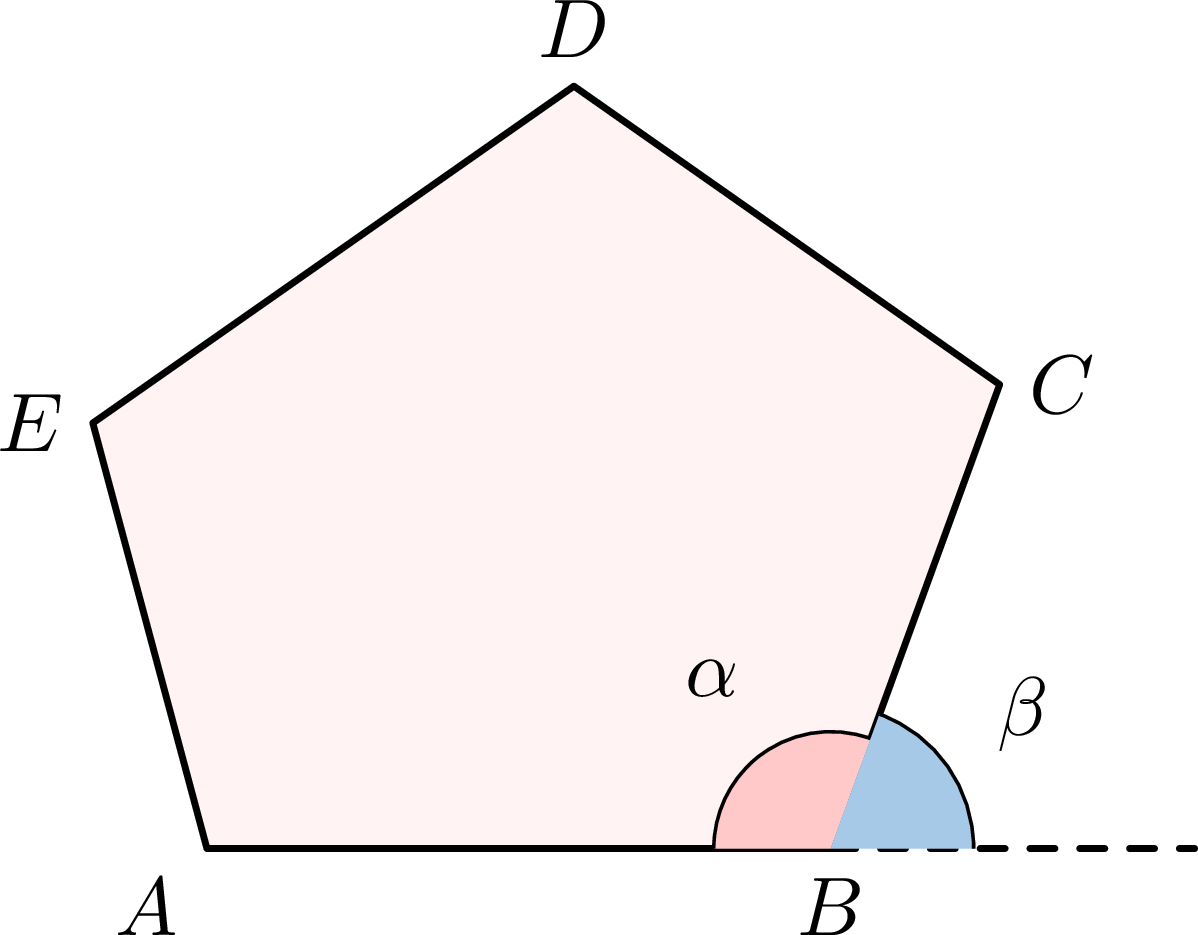
Proposition — Sum of the Exterior Angles
In a convex polygon, the exterior angles, one at each vertex, add up to \(360^\circ\), whatever the number of sides.
Let the convex polygon have \(n\) sides. At each of its \(n\) vertices, the interior angle and the exterior angle add up to \(180^\circ\), so all the interior and exterior angles together make \(n \times 180^\circ\). The interior angles alone make \((n - 2) \times 180^\circ\) (Proposition “Angle Sum of a Polygon”). Hence $$\begin{aligned}[t] \text{sum of the exterior angles} &= n \times 180^\circ - (n - 2) \times 180^\circ && \text{(all the angles minus the interior angles)}\\
&= n \times 180^\circ - n \times 180^\circ + 2 \times 180^\circ && \text{(distributive law)}\\
&= 360^\circ. \end{aligned}$$
Example
The exterior angles of the pentagon \(ABCDE\) are marked. Find the value of \(x\), then the five interior angles. 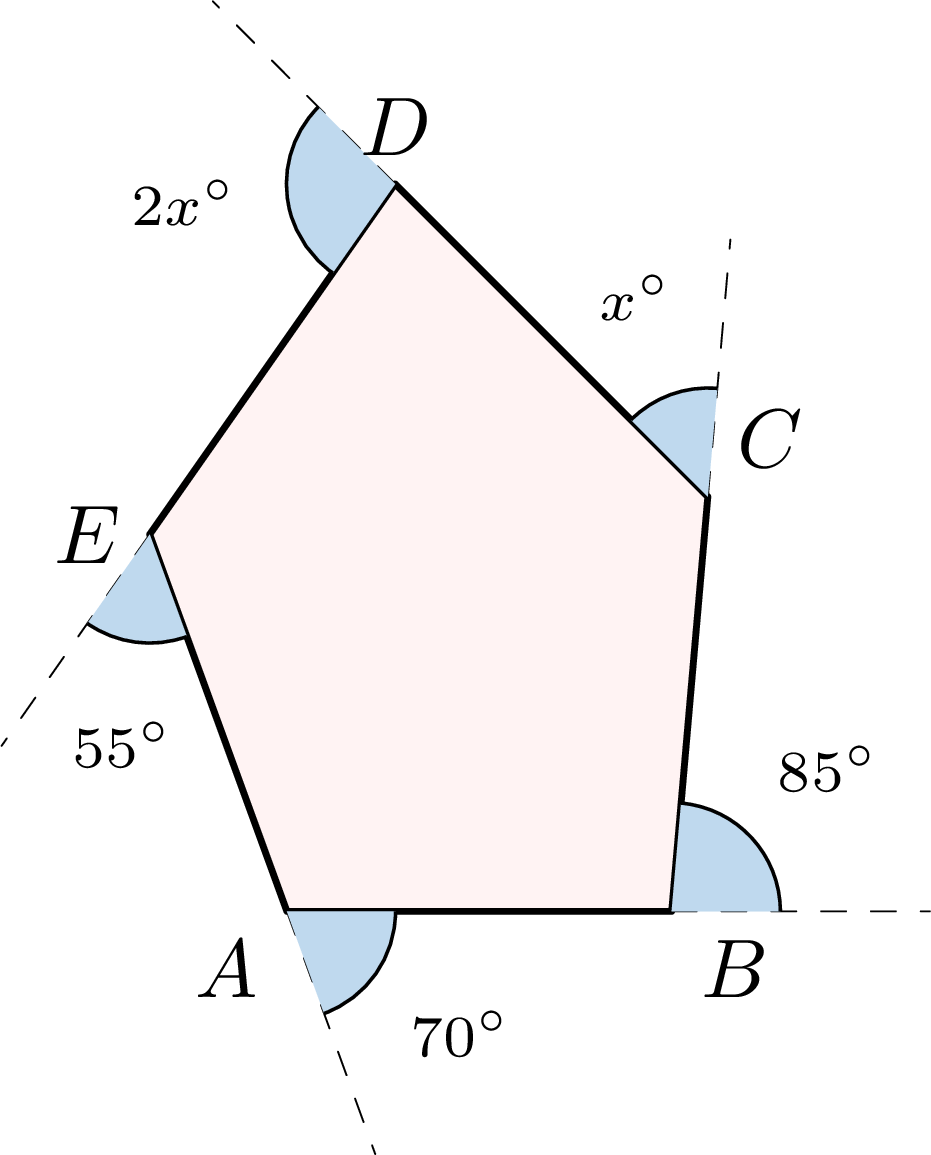
$$\begin{aligned}[t] 70 + 85 + x + 2x + 55 &= 360 && \text{(sum of the exterior angles)}\\
3x + 210 &= 360 && \text{(collect like terms)}\\
3x &= 150 && \text{(subtract } 210\text{)}\\
x &= 50 && \text{(divide by } 3\text{)}. \end{aligned}$$ The exterior angles are \(70^\circ\), \(85^\circ\), \(50^\circ\), \(100^\circ\) and \(55^\circ\). Each interior angle is \(180^\circ\) minus the exterior angle at its vertex: \(110^\circ\), \(95^\circ\), \(130^\circ\), \(80^\circ\) and \(125^\circ\). Check: \(110 + 95 + 130 + 80 + 125 = 540 = (5 - 2) \times 180\).
Skills to practice
- Recognising Exterior Angles
- Finding Exterior Angles
IV
Angles of a Regular Polygon
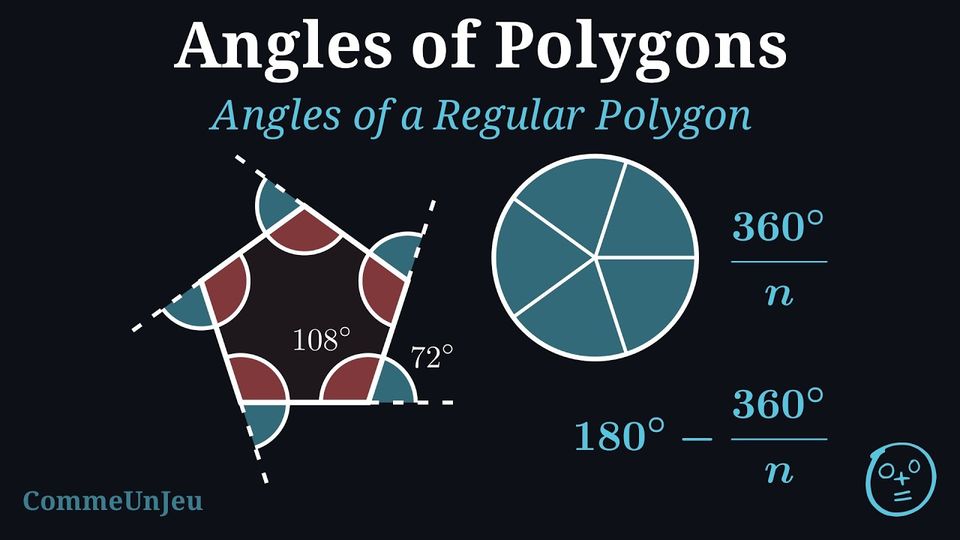
Definition — Regular Polygon
A regular polygon has all sides the same length and all its angles equal.  \(\quad\)
 \(\quad\)

Identical tiles in the shape of a regular hexagon cover a floor with no gap and no overlap: three tiles meet at each corner, as around the point \(O\) in the figure. 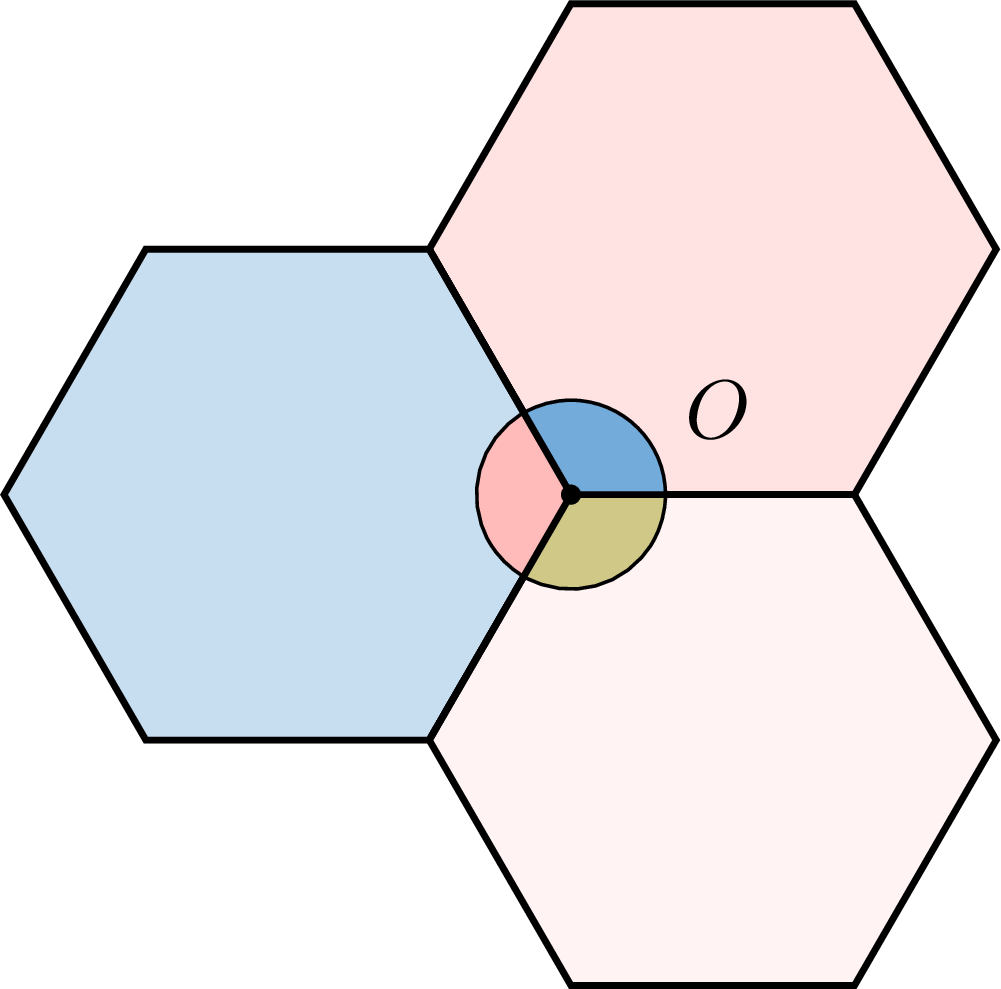
- What is the sum of the three angles marked at \(O\)?
- Deduce the measure of each interior angle of a regular hexagon.
- Check this measure with the angle sum of a hexagon, shared equally among its six angles.
- The three angles fill the whole turn around \(O\), with no gap and no overlap: their sum is \(360^\circ\).
- The three tiles are identical regular hexagons, and all the angles of a regular hexagon are equal (Definition “Regular Polygon”). So the three angles at \(O\) are equal, and each of them measures $$360^\circ \div 3 = 120^\circ.$$
- A hexagon has \(6\) sides, so its angles add up to \((6 - 2) \times 180^\circ = 720^\circ\) (Proposition “Angle Sum of a Polygon”). Its six angles are equal, so each of them measures \(720^\circ \div 6 = 120^\circ\). The two methods agree: \(3 \times 120^\circ = 360^\circ\).
Proposition — Angles of a Regular Polygon
In a regular polygon with \(n\) sides, all the interior angles are equal and all the exterior angles are equal: - each exterior angle measures \(\dfrac{360^\circ}{n}\);
- each interior angle measures \(\dfrac{(n - 2) \times 180^\circ}{n} = 180^\circ - \dfrac{360^\circ}{n}\).
A regular polygon has all its angles equal (Definition “Regular Polygon”). Its \(n\) equal interior angles add up to \((n - 2) \times 180^\circ\), so each of them measures \(\dfrac{(n - 2) \times 180^\circ}{n}\); each is less than \(180^\circ\), so the polygon is convex. At each vertex, the exterior angle is \(180^\circ\) minus the interior angle, so the \(n\) exterior angles are equal too; they add up to \(360^\circ\) (Proposition “Sum of the Exterior Angles”), so each of them measures \(\dfrac{360^\circ}{n}\). Finally, the two forms of the interior angle agree: $$\begin{aligned}[t] \frac{(n - 2) \times 180^\circ}{n} &= \frac{n \times 180^\circ - 360^\circ}{n} && \text{(distributive law)}\\
&= 180^\circ - \frac{360^\circ}{n}. \end{aligned}$$
Example
Complete the table of the angles of regular polygons. | Regular polygon | triangle | square | pentagon | hexagon | octagon | decagon |
| \(n\) | \(3\) | \(4\) | \(5\) | \(6\) | \(8\) | \(10\) |
| Exterior angle | \(?\) | \(?\) | \(?\) | \(?\) | \(?\) | \(?\) |
| Interior angle | \(?\) | \(?\) | \(?\) | \(?\) | \(?\) | \(?\) |
For each polygon, the exterior angle is \(360^\circ \div n\) and the interior angle is \(180^\circ\) minus the exterior angle. For the regular pentagon: $$\begin{aligned}[t] \text{exterior angle} &= \frac{360^\circ}{5} = 72^\circ,\\
\text{interior angle} &= 180^\circ - 72^\circ = 108^\circ. \end{aligned}$$
The regular triangle is the equilateral triangle, whose angles measure \(60^\circ\), and the regular quadrilateral is the square.
| Regular polygon | triangle | square | pentagon | hexagon | octagon | decagon |
| \(n\) | \(3\) | \(4\) | \(5\) | \(6\) | \(8\) | \(10\) |
| Exterior angle | \(120^\circ\) | \(90^\circ\) | \(72^\circ\) | \(60^\circ\) | \(45^\circ\) | \(36^\circ\) |
| Interior angle | \(60^\circ\) | \(90^\circ\) | \(108^\circ\) | \(120^\circ\) | \(135^\circ\) | \(144^\circ\) |
Method — Finding the Number of Sides of a Regular Polygon
- From the interior angle, compute the exterior angle: \(180^\circ - \text{interior angle}\).
- Divide: \(n = \dfrac{360^\circ}{\text{exterior angle}}\).
- If \(n\) is a whole number greater than or equal to \(3\), the regular polygon exists and has \(n\) sides; otherwise no regular polygon has this angle.
Example
- Each interior angle of a regular polygon measures \(150^\circ\). How many sides has it?
- Is there a regular polygon whose interior angles measure \(158^\circ\)?
- The exterior angle is \(180^\circ - 150^\circ = 30^\circ\), so $$n = \frac{360^\circ}{30^\circ} = 12.$$ It is a regular dodecagon: \(12\) sides.
- The exterior angle would be \(180^\circ - 158^\circ = 22^\circ\), and $$\frac{360^\circ}{22^\circ} = 16.36\ldots$$ is not a whole number: no regular polygon has interior angles of \(158^\circ\).
Skills to practice
- Calculating the Angles of a Regular Polygon
- Finding the Number of Sides of a Regular Polygon
- Deciding Whether a Regular Polygon Exists
V
Going further
Skills to practice
- Investigating Patterns in the Angles of Polygons
- Solving Real-Life Problems with Polygons
- Quiz
Jump to section