International Baccalaureate · MYP 4
Linear Equations, Inequalities and Formulae
I
Equations
I.1
Quotient Equations and Forbidden Values
Proposition — Null Quotient Law
A quotient \(\dfrac{A(x)}{B(x)}\) is defined only when \(B(x) \neq 0\): the values of \(x\) for which \(B(x) = 0\) are the forbidden values (also called excluded values). For every allowed \(x\): $$\frac{A(x)}{B(x)} = 0 \iff A(x) = 0 \ \text{ and } \ B(x) \neq 0.$$ A fraction is zero exactly when its numerator is zero — provided the denominator is not. Example
Solve \(\dfrac{x-2}{x+3} = 0\). - Forbidden value: \(x + 3 = 0\) for \(x = -3\), so \(-3\) is forbidden.
- Numerator: \(x - 2 = 0\) for \(x = 2\).
- \(2\) is not a forbidden value, so \(S = \{2\}\).
Proposition — Golden Rules of Solving Equations
To create an equivalent equation, apply the same operation to both sides, using the golden rules below: - Addition/Subtraction Property: Adding or subtracting the same number from both sides produces an equivalent equation. $$A=B \quad \Longleftrightarrow \quad A+c = B+c$$ (and similarly \(A-c = B-c\))
- Multiplication/Division Property: Multiplying or dividing both sides by the same non-zero number produces an equivalent equation. $$A=B \quad \Longleftrightarrow \quad cA = cB \quad (c \neq 0)$$ $$A=B \quad \Longleftrightarrow \quad \frac{A}{c} = \frac{B}{c} \quad (c \neq 0)$$
Proposition — Quotient Equation
Let \(A(x)\) and \(B(x)\) be two polynomial expressions (defined for every real number \(x\)) and \(k\) a real number. The equation $$\frac{A(x)}{B(x)} = k$$ is defined only for the values of \(x\) such that \(B(x) \neq 0\): the values of \(x\) for which \(B(x) = 0\) are its forbidden values, and the other values form its domain. For every \(x\) in the domain, $$\textcolor{colorprop}{\frac{A(x)}{B(x)} = k \iff A(x) = k \cdot B(x)}.$$ To solve a quotient equation: - Find the forbidden values: solve \(B(x) = 0\).
- Multiply both sides by \(B(x)\): the equation becomes \(A(x) = k \cdot B(x)\), which is solved without a denominator.
- Discard any solution that is a forbidden value: the solution set contains only allowed values.
Let \(x\) be a value of the domain, so that \(B(x) \neq 0\). If \(\dfrac{A(x)}{B(x)} = k\), multiplying both sides by the non-zero number \(B(x)\) gives \(A(x) = k \cdot B(x)\). Conversely, if \(A(x) = k \cdot B(x)\), dividing both sides by \(B(x) \neq 0\) gives \(\dfrac{A(x)}{B(x)} = k\). The two equations have the same solutions in the domain — and outside the domain the quotient is not defined, so a value of \(x\) with \(B(x) = 0\) is never a solution, even if it satisfies \(A(x) = k \cdot B(x)\).
Example
Solve each equation. - \(\dfrac{x + 4}{x - 1} = 3\)
- \(\dfrac{2x + 1}{x - 3} = 2\)
- \(\dfrac{3x - 6}{x - 2} = 3\)
- Forbidden value: \(x - 1 = 0\), that is \(x = 1\). For \(x \neq 1\): $$\begin{aligned} \frac{x + 4}{x - 1} = 3 &\iff x + 4 = 3(x - 1) && \text{(multiply by \(x - 1 \neq 0\))} \\ &\iff x + 4 = 3x - 3 && \text{(expand)} \\ &\iff 7 = 2x && \text{(gather)} \\ &\iff x = \dfrac{7}{2}. && \text{(divide by \(2\))} \end{aligned}$$ Since \(\dfrac{7}{2} \neq 1\), the value is allowed: \(S = \left\{\dfrac{7}{2}\right\}\).
- Forbidden value: \(x = 3\). For \(x \neq 3\): \(2x + 1 = 2(x - 3) = 2x - 6\), that is \(1 = -6\), which is false for every \(x\). The equation has no solution: \(S = \varnothing\).
- Forbidden value: \(x = 2\). For \(x \neq 2\): \(3x - 6 = 3(x - 2) = 3x - 6\), which is true for every \(x\). Every allowed value is a solution: \(S = \mathbb{R} \setminus \{2\}\) — the forbidden value \(2\) satisfies \(A(x) = k \cdot B(x)\) but is not a solution, since the quotient is not defined there.
Skills to practice
- Deciding the Solution Set of a Quotient Equation
- Solving Quotient Equations
- Justifying with the Forbidden Values
I.2
Equations with Fractions: Cross Multiplication
When two fractions are equal, their numerators and denominators are linked by a very useful identity called the cross product rule. It is the standard tool for solving an equation that contains a single fraction equal to another.
Proposition — Cross Multiplication
For all algebraic expressions \(A\), \(B\), \(C\), \(D\) with \(B \neq 0\) and \(D \neq 0\): $$\dfrac{A}{B} = \dfrac{C}{D} \quad \Longleftrightarrow \quad A \times D = B \times C.$$ Example
Solve for \(x\): $$\dfrac{12}{4} = \dfrac{x}{6}.$$
Apply cross multiplication, then isolate \(x\): $$ \begin{aligned} \dfrac{12}{4} &= \dfrac{x}{6} \\
12 \times 6 &= 4 \times x && \text{(cross multiplication)} \\
72 &= 4x \\
x &= \dfrac{72}{4} && \text{(dividing both sides by 4)} \\
x &= 18. \end{aligned} $$
Example
Solve for \(x\): $$\dfrac{3}{x-1} = \dfrac{2}{x+1}.$$
The unknown is in the denominators, which must not be zero: \(x - 1 = 0\) for \(x = 1\), and \(x + 1 = 0\) for \(x = -1\). The forbidden values are \(1\) and \(-1\). For \(x \neq 1\) and \(x \neq -1\), both denominators are non-zero, and cross multiplication applies: $$ \begin{aligned} \dfrac{3}{x-1} &= \dfrac{2}{x+1} \\
3(x+1) &= 2(x-1) && \text{(cross multiplication)} \\
3x + 3 &= 2x - 2 && \text{(expanding)} \\
3x - 2x &= -2 - 3 && \text{(subtracting \(2x\) and \(3\) from both sides)} \\
x &= -5. \end{aligned} $$ The value \(-5\) is not a forbidden value. Check: \(\dfrac{3}{-5-1} = \dfrac{3}{-6} = -\dfrac{1}{2}\) and \(\dfrac{2}{-5+1} = \dfrac{2}{-4} = -\dfrac{1}{2}\). The solution is \(x = -5\).
Skills to practice
- Solving Proportions by Cross Multiplication
II
Inequalities
II.1
Solving an Inequality
Method — Rules for Solving Inequalities
Solving inequalities is almost identical to solving equations. The same operation can be performed on both sides to isolate the unknown, but with one critical exception. - Adding any number to both sides, or subtracting it from both sides, preserves the inequality.
- Multiplying or dividing both sides by a positive number preserves the inequality.
- Multiplying or dividing both sides by a negative number reverses the direction of the inequality symbol. For example, \(<\) becomes \(>\).
Why does the direction reverse? \(2 < 3\), yet multiplying both by \(-1\): \(-2 > -3\). On the number line, multiplying by \(-1\) is the reflection in \(0\): each number goes to its opposite, and the number that was further to the right lands further to the left — the reflection in \(0\) reverses the order. Multiplying by any negative number amounts to multiplying by a positive number, then by \(-1\): the order is reversed too.
Method — Representing the Solutions
On a number line: - Mark the boundary with a full circle \(\bullet\) if it is a solution (signs \(\leq\) or \(\geq\)), with a hollow circle \(\circ\) if it is not (signs \(<\) or \(>\)).
- Colour the ray of the solutions, with an arrow showing that it goes on forever.
Example
Solve the inequality \(3x + 4 \leq 19\) and represent the solutions on a number line.
$$\begin{aligned}[t]3x + 4 &\leq 19 \\
3x &\leq 15 && \text{(Subtract \(4\) from both sides: the direction is preserved)} \\
x &\leq 5 && \text{(Divide both sides by \(3\), positive: the direction is preserved)}\end{aligned}$$ The solutions are \(5\) and all the numbers less than \(5\). 
Check: for \(x = 5\): \(3 \times 5 + 4 = 19 \leq 19\); for \(x = 0\): \(4 \leq 19\). Both work.
Example
Solve the inequality \(7 - 2x < 1\) and represent the solutions on a number line.
$$\begin{aligned}[t]7 - 2x &< 1 \\
-2x &< -6 && \text{(Subtract \(7\) from both sides: the direction is preserved)} \\
x &> 3 && \text{(Divide both sides by \(-2\), negative: the direction is reversed)}\end{aligned}$$ The solutions are all the numbers greater than \(3\); the boundary \(3\) is not a solution. 
Check: for \(x = 4\): \(7 - 8 = -1 < 1\) — it works; for \(x = 0\): \(7 < 1\) is false — and indeed \(0\) is not in the coloured part.
Example
At the cinema, a ticket costs \(\dollar 9\). A loyalty card costs \(\dollar 25\), and with it each ticket only costs \(\dollar 4\). For \(n\) films, the card is the cheaper option when \(25 + 4n < 9n\). Solve this inequality: from how many films onwards is the card the cheaper option?
Gathering the terms in \(n\) on the right avoids dividing by a negative number: $$\begin{aligned}[t]25 + 4n &< 9n \\
25 &< 9n - 4n && \text{(Subtract \(4n\) from both sides: direction preserved)} \\
25 &< 5n && \text{(Combine like terms)} \\
5 &< n && \text{(Divide both sides by \(5\), positive: direction preserved)}\end{aligned}$$ The card is the cheaper option for all the numbers greater than \(5\). Counting whole films: from \(6\) films onwards. Check: for \(6\) films, \(25 + 4 \times 6 = 49\) and \(9 \times 6 = 54\), and \(49 < 54\); for \(5\) films, \(25 + 20 = 45\) and \(9 \times 5 = 45\): the two costs are equal.
Skills to practice
- Solving: Level 1
- Solving: Level 2
II.2
Solving Graphically
The two sides of an inequality such as \(2x - 1 \leq x + 2\) can be pictured: the values of \(2x - 1\) are read on the line of equation \(y = 2x - 1\), the values of \(x + 2\) on the line of equation \(y = x + 2\). Comparing the two sides then becomes comparing the heights of two given lines.
Method — Solving Graphically
On the given lines: - Locate their intersection point (when the two lines intersect): its \(x\)-coordinate is the boundary.
- Read for which \(x\) the line of the left side is below the other one (for \(<\) or \(\leq\)) or above it (for \(>\) or \(\geq\)); for the non-strict signs \(\leq\) and \(\geq\), the boundary itself is also a solution.
- Conclude, and check one value by calculation.
Example
The lines of equations \(y = 2x - 1\) and \(y = x + 2\) are drawn below. Solve graphically the inequality \(2x - 1 \leq x + 2\). 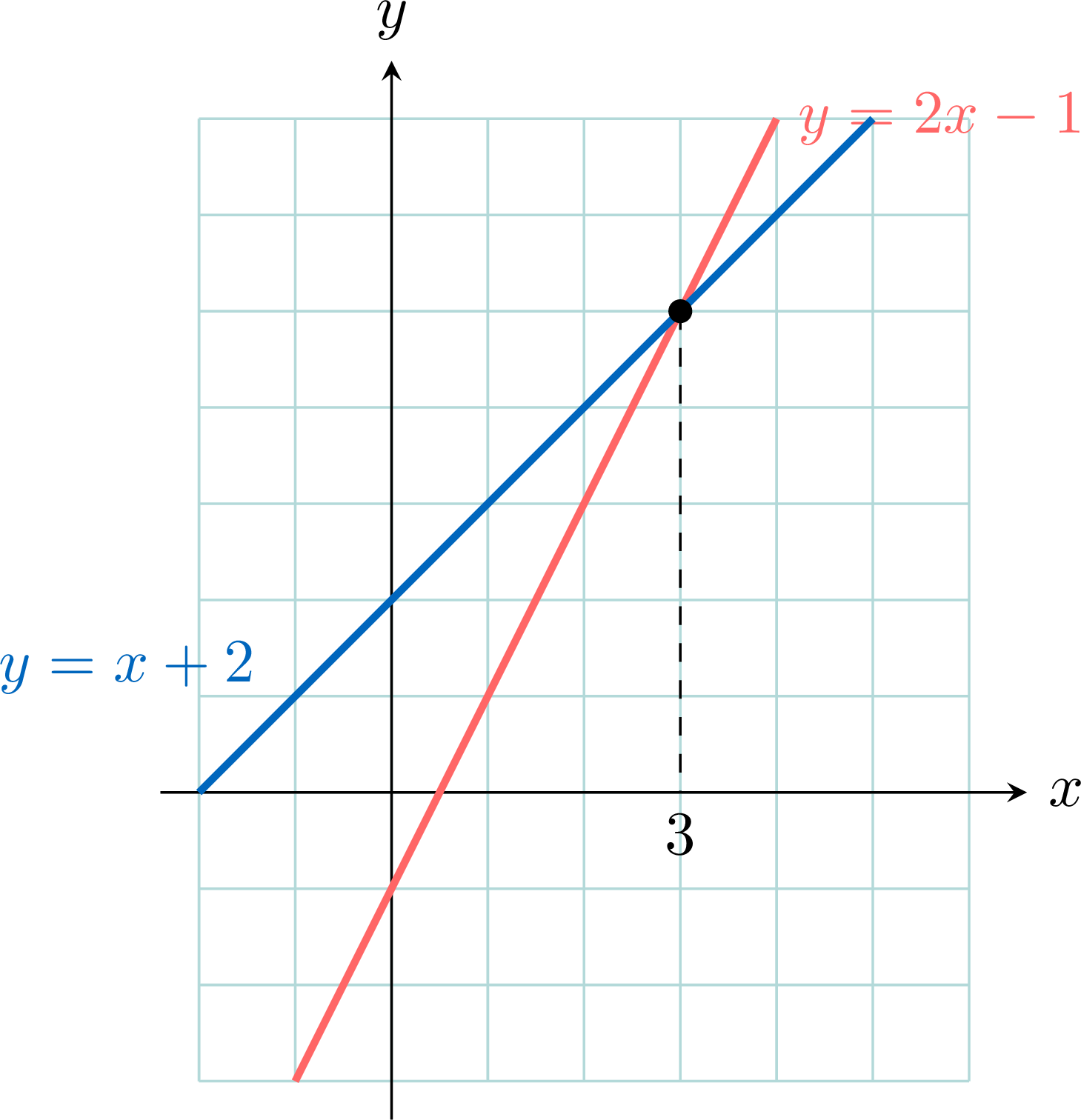
- The two lines intersect at the point of \(x\)-coordinate \(3\): the boundary is \(3\).
- To the left of \(3\), the line \(y = 2x - 1\) is below the line \(y = x + 2\); at \(x = 3\) the two sides are equal.
- The solutions of \(2x - 1 \leq x + 2\) are \(3\) and all the numbers less than \(3\): \(x \leq 3\).
Skills to practice
- Reading Solutions on a Graph
III
Formulae
III.1
Changing the Subject of a Formula
Definition — Formula
A formula is an equality that expresses one quantity in terms of others; its letters are variables. The single variable that stands alone on one side of the equality is called the subject of the formula. Method — Changing the Subject
We can rearrange a formula to make a different variable the subject. This is also known as “solving for a variable”. The process uses the same rules as solving equations: apply inverse operations to both sides of the formula to isolate the desired variable. Example
The formula for the area of a square is \(A = s^2\). Rearrange the formula to make the side length, \(s\), the subject.
To isolate \(s\), we undo the squaring by taking the square root of both sides. A side length is positive: \(s > 0\), so \(\sqrt{s^2} = s\). $$\begin{aligned} A &= s^2 \\
\sqrt{A} &= \sqrt{s^2} && \text{(square root of both sides)} \\
\sqrt{A} &= s && \text{(\(s > 0\), so \(\sqrt{s^2} = s\))} \end{aligned}$$ The rearranged formula is \(s = \sqrt{A}\).
Example
The formula \(v = u + at\) gives the speed \(v\) of a moving object after a time \(t\), where \(u\) is its starting speed and \(a\) its acceleration, with \(a \neq 0\). Make \(t\) the subject of the formula.
\(t\) appears once, multiplied by \(a\), and then \(u\) is added. We undo these operations in reverse order: first the addition of \(u\), then the multiplication by \(a\). $$\begin{aligned} v &= u + at \\
v - u &= at && \text{(subtracting \(u\) from both sides)} \\
t &= \dfrac{v - u}{a} && \text{(dividing both sides by \(a\), allowed since \(a \neq 0\))} \end{aligned}$$ The rearranged formula is \(t = \dfrac{v - u}{a}\), for \(a \neq 0\). Check with \(u = 2\), \(a = 3\) and \(t = 4\): \(v = 2 + 3 \times 4 = 14\), and the new formula gives back \(t = \dfrac{14 - 2}{3} = 4\).
Example
Make \(y\) the subject of \(2x - 3y = 6\).
\(y\) appears once, in the term \(-3y\). We subtract the other term from both sides, then divide both sides by the coefficient of \(y\). $$\begin{aligned} 2x - 3y &= 6 \\
-3y &= 6 - 2x && \text{(subtracting \(2x\) from both sides)} \\
y &= \dfrac{6 - 2x}{-3} && \text{(dividing both sides by \(-3\))} \\
y &= \dfrac{2x - 6}{3} && \text{(multiplying the numerator and the denominator by \(-1\))} \end{aligned}$$ Dividing each term of the numerator by \(3\), the formula can also be written \(y = \dfrac{2}{3}x - 2\). Check with \(x = 6\): \(y = \dfrac{12 - 6}{3} = 2\), and \(2 \times 6 - 3 \times 2 = 12 - 6 = 6\).
Skills to practice
- Rearranging Geometry and Physics Formulae
- Rearranging Linear Equations
- Rearranging Equalities of Quotients
IV
Going further
Skills to practice
- Reasoning and Problem-Solving
- Solving Problems in Context
- Solving Mixture Problems
- Constructing and Rearranging Formulae
- Quiz
Jump to section