International Baccalaureate · MYP 3
Expansion and Factorisation
I
Expanding
I.1
The Distributive Law
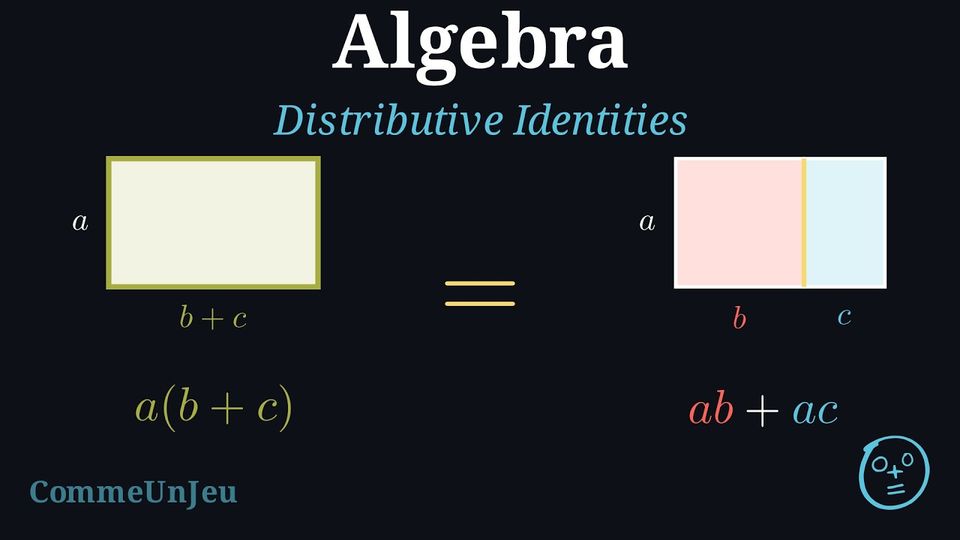
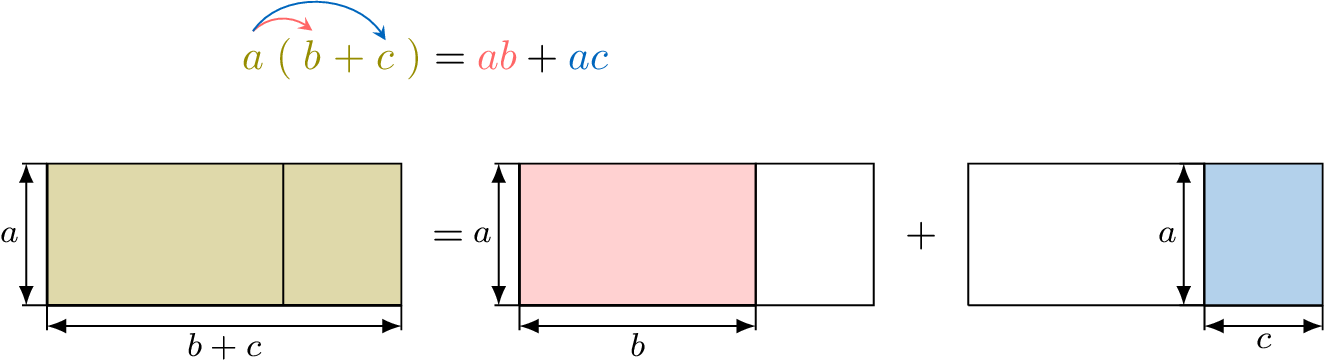
The large rectangle below is split into two smaller rectangles. Find the total area of the large rectangle in two different ways. 

- Method 1: Sum of the parts
The total area is the sum of the areas of the two smaller rectangles. $$\text{Total Area} = \textcolor{colordef}{\text{Area 1}} + \textcolor{colorprop}{\text{Area 2}} = \textcolor{colordef}{ab} + \textcolor{colorprop}{ac}$$
- Method 2: Area of the whole
The total length of the base is \(b+c\) and the height is \(a\). $$\text{Total Area} = \textcolor{olive}{a(b+c)}$$
Proposition — Distributive Law
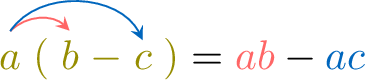
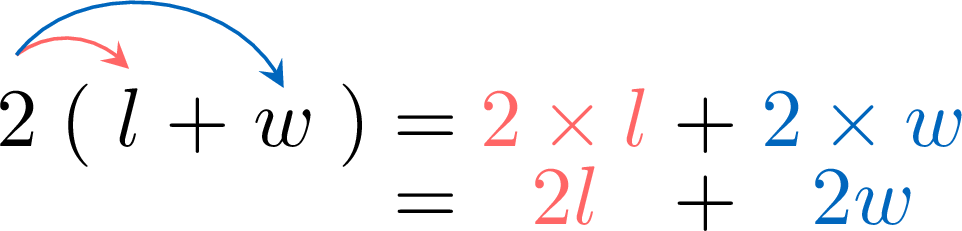
For any numbers \(a\), \(b\) and \(c\), multiplication is distributive over addition and subtraction: - Addition:
- Subtraction:
Method — Sum or Product?
The distributive identities convert between two shapes of expression. To decide which shape an expression has, look at its last operation — the one performed last when computing: - in \(3(x+2)\), one computes the bracket, then multiplies: the last operation is a multiplication — the expression is a product;
- in \(3x+2\), one computes \(3x\), then adds \(2\): the last operation is an addition — the expression is a sum.
Example
Sum or product? Decide for each expression: $$5(x+1), \qquad 5x+1, \qquad 2(x+3)+1$$ - \(5(x+1)\): compute the bracket, then multiply by \(5\) — a product.
- \(5x+1\): compute \(5x\), then add \(1\) — a sum.
- \(2(x+3)+1\): compute the bracket, multiply by \(2\), then add \(1\) — the brackets suggest a product, but the last operation is the addition of \(1\): a sum.
Definition — Expanding
Expanding is the process of using the distributive law to write a product with brackets as a sum (or difference) of terms. 
Example
Expand and simplify: \(x(2x+3)\).
$$\begin{aligned}[t] x(2x + 3) &= x \times 2x + x \times 3 && {\scriptstyle\text{(distributivity)}}\\
&= \textcolor{colordef}{2x^2 + 3x} && {\scriptstyle(x \times 2x = 2x^2)} \end{aligned}$$
Skills to practice
- Recognising a Sum or a Product
- Expanding with Addition: Level 1
- Expanding with Addition: Level 2
- Expanding with Addition: Level 3
- Expanding with Subtraction: Level 1
- Expanding with Subtraction: Level 2
- Expanding with Subtraction: Level 3
I.2
The Opposite of an Expression
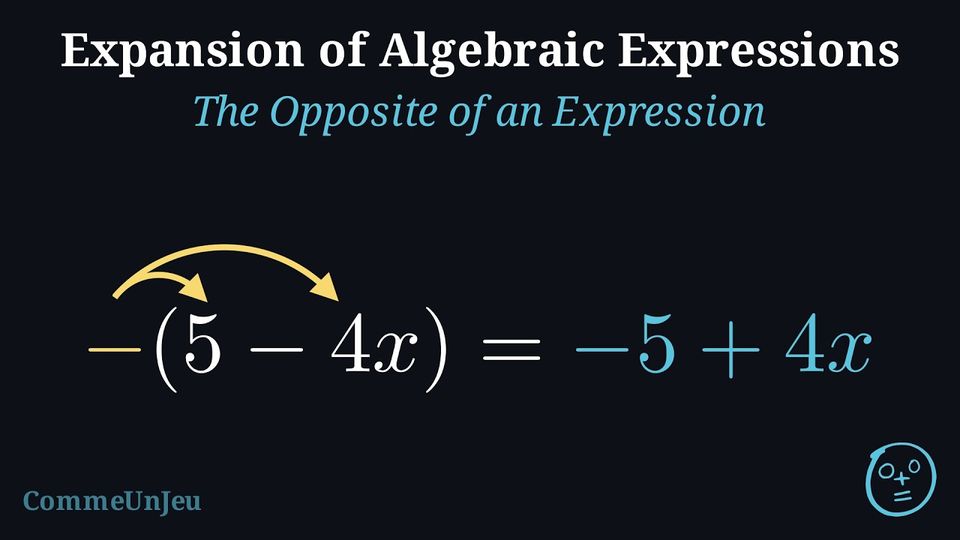
Method — Taking the Opposite of an Expression
The opposite of an expression is the expression multiplied by \((-1)\). To write it without brackets: - Write the expression in brackets, preceded by a \(-\) sign.
- Change the sign of every term: this is exactly distributing the factor \((-1)\) over the brackets.
- Check with a value: the expression and its opposite must give opposite results.
Example
Write the opposite of \(5 - 4x\) without brackets.
$$\begin{aligned}[t]-(5 - 4x) &= (-1) \times 5 + (-1) \times (-4x) && \text{(Distribute the factor \(-1\))} \\
&= -5 + 4x && \text{(Each term changes sign)}\end{aligned}$$ Check with \(x = 1\): the expression gives \(5 - 4 = 1\), and \(-5 + 4 = -1\) — opposite results.
Example
Expand and simplify \(-3(x+2)\), then \(6-2(x-4)\).
Taking the opposite is the case \(-1\); any other negative factor is distributed in the same way — the factor carries its sign onto every term of the bracket. $$\begin{aligned}[t]-3(x+2) &= (-3) \times x + (-3) \times 2 && \text{(Distribute the factor \(-3\))} \\
&= \textcolor{colorprop}{-3x-6} && \text{(Each term is multiplied by \(-3\))}\end{aligned}$$ $$\begin{aligned}[t]6-2(x-4) &= 6 + (-2) \times x + (-2) \times (-4) && \text{(Distribute the factor \(-2\))} \\
&= 6 - 2x + 8 && \text{(A negative times a negative is positive)} \\
&= \textcolor{colorprop}{14 - 2x} && \text{(Combine like terms)}\end{aligned}$$ Checking with \(x = 1\): \(-3 \times 3 = -9\) and \(-3-6 = -9\); \(6 - 2 \times (-3) = 12\) and \(14 - 2 = 12\).
Skills to practice
- Taking the Opposite: Level 1
- Taking the Opposite: Level 2
II
Factorising
II.1
Factorising with a Common Factor
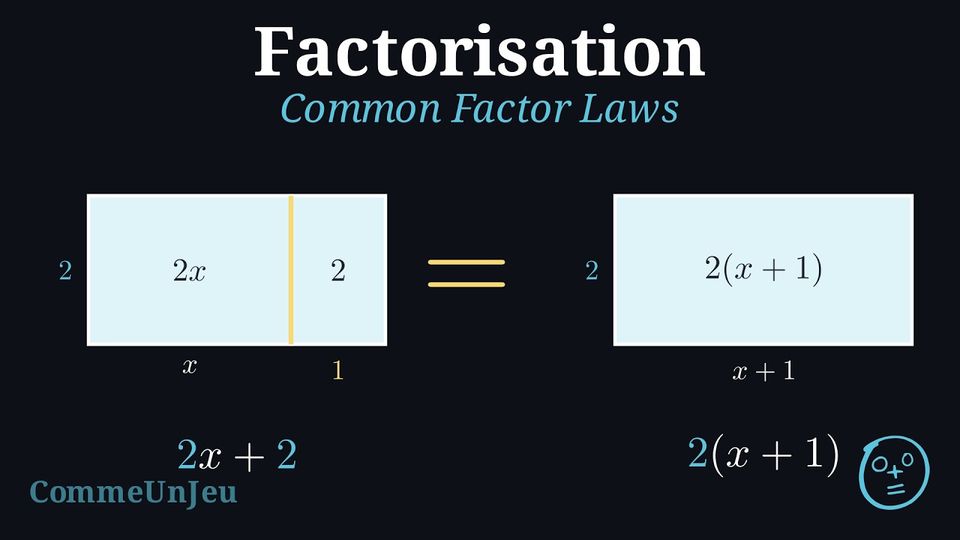
The common factor laws are the reverse of the distributive laws: instead of expanding brackets, we look for a common factor to “take out” and introduce brackets.
Proposition — Common Factor Laws
For any numbers \(a\), \(b\) and \(c\): Example
Factorise \(2x+2\).
$$\begin{aligned} 2x+2&=\textcolor{colorprop}{2}\times x +\textcolor{colorprop}{2}\times 1\\
&=\textcolor{colorprop}{2}(x+1). \end{aligned}$$
Example
Factorise: \(x^2 + 6x\).
$$\begin{aligned}[t] x^2 + 6x &= \textcolor{colorprop}{x} \times x + \textcolor{colorprop}{x} \times 6 && {\scriptstyle\text{(the common factor is } \textcolor{colorprop}{x})}\\
&= \textcolor{colorprop}{x}(x + 6) \end{aligned}$$
Method — Factorising with a Common Bracket
A common factor is not always a number or a letter: it can be a whole bracket appearing in every term. - Spot the bracket that appears in each term.
- Write this bracket in front, and collect in a second bracket what multiplies it in each term.
- Simplify the second bracket.
A term made of the common bracket alone is multiplied by \(1\): in \((x+3)(2x-1) + (x+3)\), the second term is \((x+3) \times 1\), so the second bracket is \((2x-1) + 1\).
Example
Factorise \((x+2)(3x-1) + (x+2)(x+5)\).
The bracket \(\textcolor{colorprop}{(x+2)}\) appears in both terms: it is the common factor. $$\begin{aligned}[t] &(x+2)(3x-1) + (x+2)(x+5) \\
&= \textcolor{colorprop}{(x+2)}\left[(3x-1) + (x+5)\right] && {\scriptstyle\text{(common bracket)}} \\
&= \textcolor{colorprop}{(x+2)}(3x-1+x+5) \\
&= \textcolor{colorprop}{(x+2)}(4x+4). \end{aligned}$$ The second bracket still holds the common factor \(4\), so the complete factorisation is \(4(x+2)(x+1)\).
Skills to practice
- Factorising with a Common Factor: Level 1
- Factorising with a Common Factor: Level 2
- Factorising with a Common Bracket
III
Proving with Algebra
III.1
Proving by Expanding and Factorising
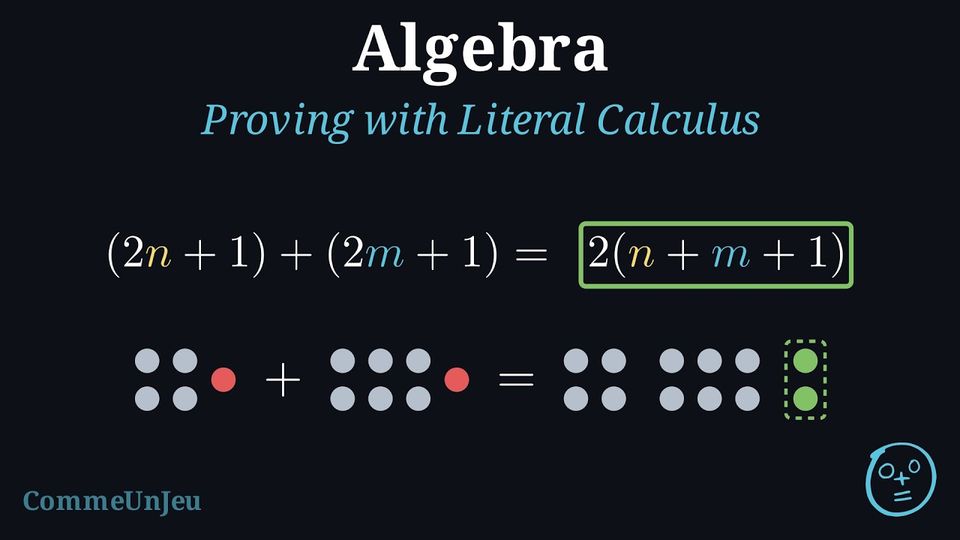
Zoe claims: “The sum of two odd numbers is always even.”
Check her claim with \(3 + 5\), with \(7 + 13\), and with \(9 + 21\). These three checks agree with Zoe — but can you be sure the claim is true for all odd numbers, without testing them all?
Check her claim with \(3 + 5\), with \(7 + 13\), and with \(9 + 21\). These three checks agree with Zoe — but can you be sure the claim is true for all odd numbers, without testing them all?
Definition — Even and Odd Numbers in Algebraic Form
For any whole number \(n\): - the number \(2n\) is even — it is twice \(n\); every even number can be written in this form;
- the number \(2n + 1\) is odd — it is an even number plus one; every odd number can be written in this form.
Method — Proving by Expanding and Factorising
Testing examples can only make a claim plausible; to prove it for all numbers: - Write the numbers in algebraic form: \(2n\) for an even number, \(2n+1\) for an odd number, \(n\) and \(n+1\) for consecutive numbers… Use different letters, such as \(n\) and \(m\), for numbers chosen independently.
- Compute with the letters (expand, simplify, factorise).
- Read the form of the result — \(2(\ldots)\) is twice a whole number, \(3(\ldots)\) a multiple of \(3\)… — and connect it to the claim: this form proves the property for every whole number.
Example
Prove Zoe's claim: the sum of two odd numbers is always even.
Let \(2n + 1\) and \(2m + 1\) be two odd numbers (\(n\) and \(m\) whole numbers — two different letters, because the two odd numbers are chosen independently). $$\begin{aligned}[t] (2n + 1) + (2m + 1) &= 2n + 2m + 2 && {\scriptstyle\text{(remove the brackets and reorder)}}\\
&= 2(n + m + 1) && {\scriptstyle\text{(common factor } 2)} \end{aligned}$$ The sum is twice the whole number \(n + m + 1\): it is even, for every choice of the two odd numbers. Zoe is correct. 
Disproving with a Counter-Example
To prove that a general claim is false, one single counter-example is enough. For instance, “every odd number is prime” is false, because \(9\) is odd and \(9 = 3 \times 3\) is not prime. No amount of successful tests can prove a claim about infinitely many numbers — but one counter-example disproves it.
Skills to practice
- Proving Properties of Even and Odd Numbers
- Proving with Factorisation
IV
Going further
Skills to practice
- Reasoning and Problem-Solving
- Solving Problems in Context
- Solving Problems with Algebra
- Quiz
Jump to section