International Baccalaureate · MYP 3
Surface Area and Volume
I
Volume
I.1
Volume of a Cylinder
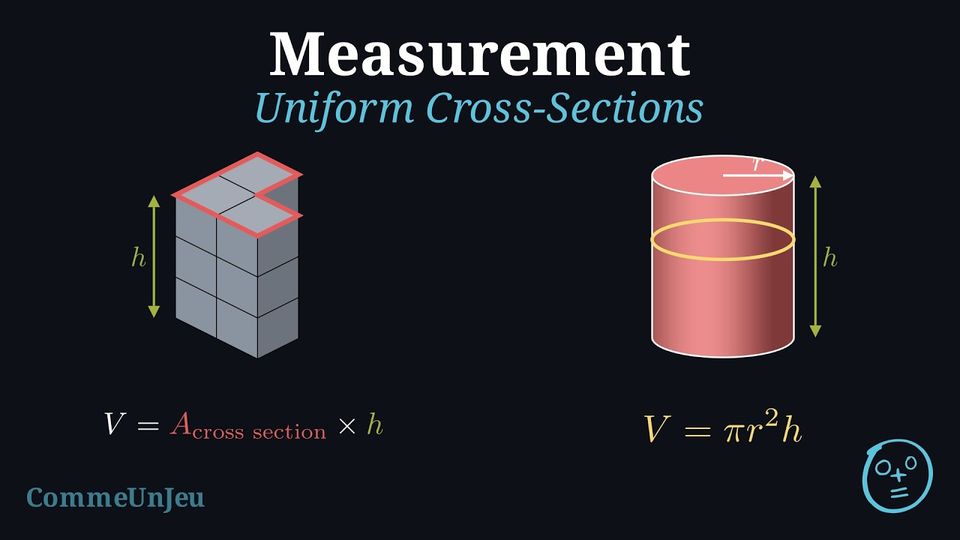
Proposition — Volume of a Solid of Uniform Cross-Section
$$\text{Volume} = \textcolor{colordef}{\text{area of the cross-section}} \times \textcolor{olive}{\text{length}}$$ The length is the distance between the two ends, measured perpendicular to them; for a solid standing on an end, it is its height.
A coin is a thin disc. Piled up flat, identical coins make a stack shaped like a cylinder. 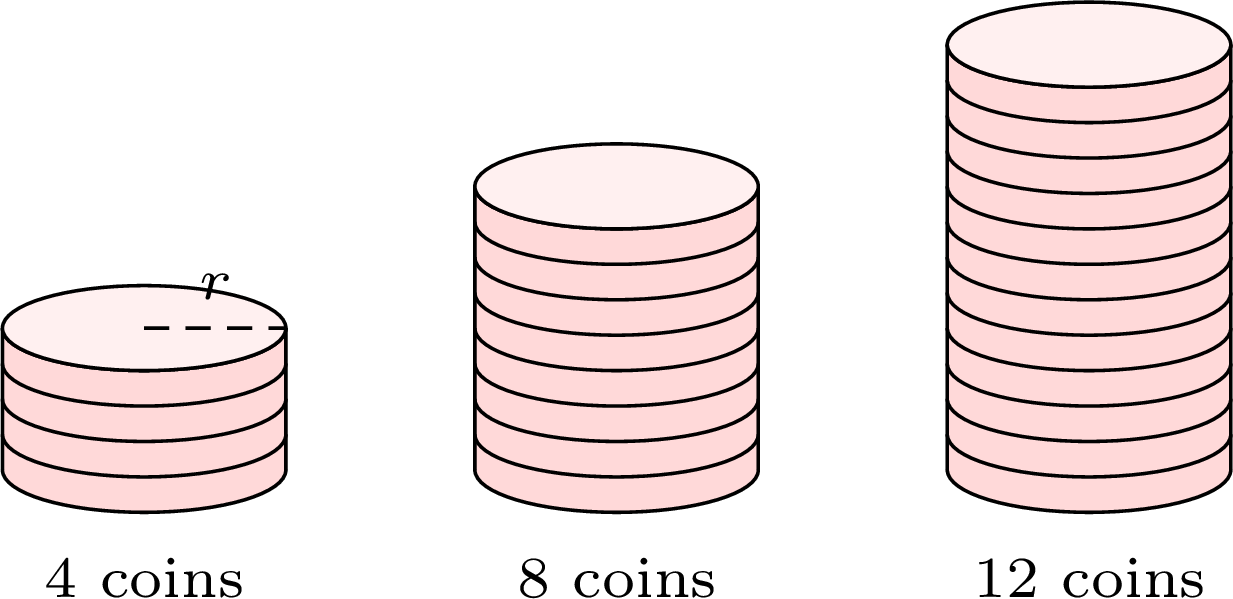
Each coin is a layer of the stack, and every layer has the same base: a disc of radius \(r\). The stack is a solid of uniform cross-section, like a prism, but its cross-section is a disc.
- The number of coins doubles. What happens to the height of the stack, and to its volume?
- Using the volume of a solid of uniform cross-section, write a formula for the volume \(V\) of a cylinder whose base is a disc of radius \(r\) and whose height is \(h\).
Proposition — Volume of a Cylinder
$$\begin{aligned}V &= \pi r^2 h\end{aligned}$$ 
A cylinder has a uniform cross-section.
- Area of base = Area of
 = Area of a disc = \(\pi r^2\)
- height = \(h\)
- $$ \begin{aligned}[t] V &= \text{area of base} \times \text{height} \\ &= \pi r^2 \times h \end{aligned} $$
Example — From Cubic Centimetres to Litres
Leo has a cube-shaped box. Measured on the inside, it is \(10~\mathrm{cm}\) long, \(10~\mathrm{cm}\) wide and \(10~\mathrm{cm}\) high. 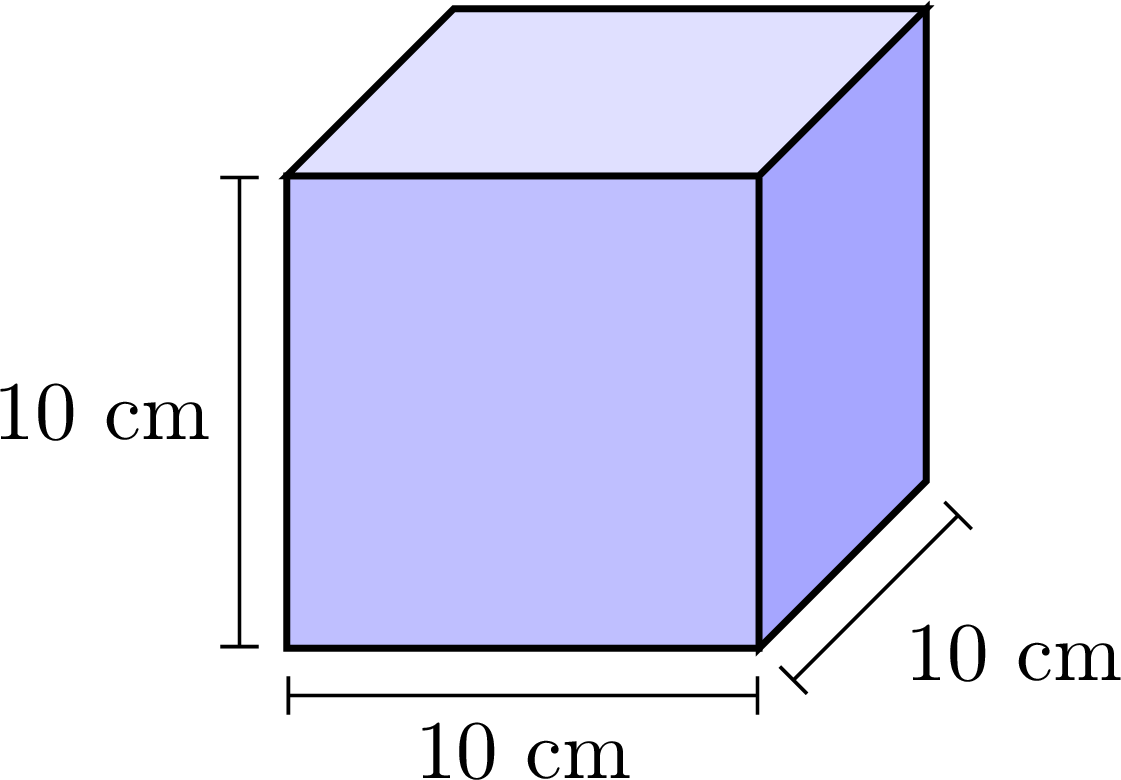
- Find the volume of the box in cubic centimetres.
- Leo fills the box to the top with water. How much water does it hold, in millilitres, then in litres?
- A water tank has a volume of \(1~\mathrm{m}^3\). How many litres of water does it hold?
- Inside, the box is a rectangular prism whose three edges measure \(10~\mathrm{cm}\): $$\begin{aligned} V &= \text{length} \times \text{width} \times \text{height} &&\text{(volume of a rectangular prism)}\\ &= 10~\mathrm{cm} \times 10~\mathrm{cm} \times 10~\mathrm{cm}\\ &= 100 \times 10~\mathrm{cm}^3\\ &= \textcolor{colorprop}{1\,000~\mathrm{cm}^3} \end{aligned}$$
- One millilitre of water fills exactly one cubic centimetre, so each of the \(1\,000\) cubic centimetres of the box holds \(1~\mathrm{mL}\): $$\begin{aligned} 1\,000~\mathrm{cm}^3 &= 1\,000~\mathrm{mL} &&\text{(}1~\mathrm{cm}^3 = 1~\mathrm{mL}\text{)}\\ &= (1\,000 \div 1\,000)~\mathrm{L} &&\text{(}1\,000~\mathrm{mL} = 1~\mathrm{L}\text{)}\\ &= \textcolor{colorprop}{1~\mathrm{L}} \end{aligned}$$ The box holds \(1\,000~\mathrm{mL}\), that is \(1~\mathrm{L}\). Its edges measure \(10~\mathrm{cm} = 1~\mathrm{dm}\): it is the cubic decimetre. So one litre is one cubic decimetre: $$1~\mathrm{L} = 1~\mathrm{dm}^3 = 1\,000~\mathrm{cm}^3.$$
- A cubic metre is a cube of edge \(1~\mathrm{m}\), that is \(100~\mathrm{cm}\), and each of its cubic centimetres holds one millilitre: $$\begin{aligned} 1~\mathrm{m}^3 &= (100 \times 100 \times 100)~\mathrm{cm}^3 &&\text{(}1~\mathrm{m} = 100~\mathrm{cm}\text{)}\\ &= 1\,000\,000~\mathrm{cm}^3 &&\text{(conversion of volume units)}\\ &= 1\,000\,000~\mathrm{mL} &&\text{(}1~\mathrm{cm}^3 = 1~\mathrm{mL}\text{)}\\ &= (1\,000\,000 \div 1\,000)~\mathrm{L} &&\text{(}1\,000~\mathrm{mL} = 1~\mathrm{L}\text{)}\\ &= \textcolor{colorprop}{1\,000~\mathrm{L}} \end{aligned}$$ The tank holds \(1\,000~\mathrm{L}\) of water: \(1~\mathrm{m}^3 = 1\,000~\mathrm{L}\).
Skills to practice
- Finding Volumes of Cylinders
I.2
Pyramids, Cones and Spheres
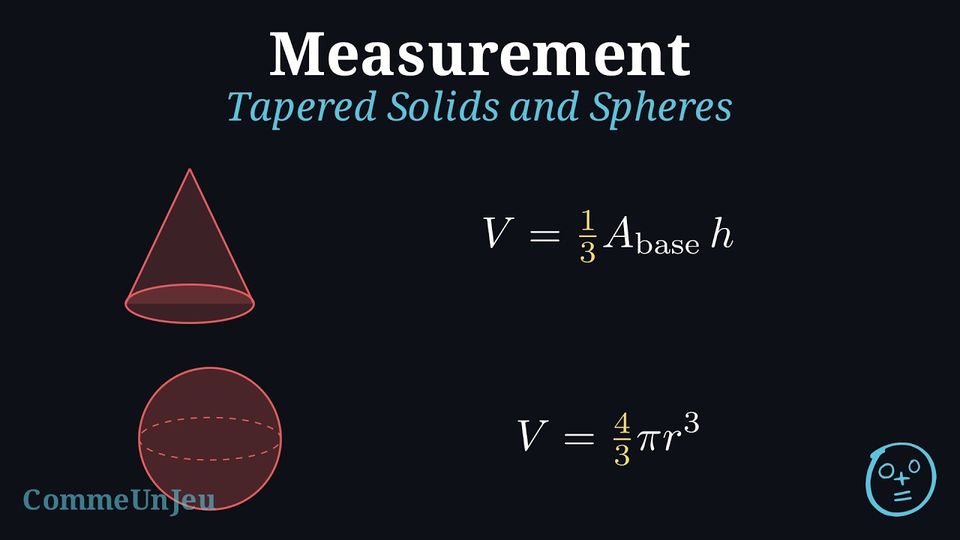
Proposition — Volume of a Pyramid or Cone
The volume of a pyramid or a cone (a solid that tapers from its base to a single point, its apex) is one-third of the area of its base multiplied by its perpendicular height.$$ V = \frac{1}{3} \times A_{\text{base}} \times h $$ 

Example
Find the volume of the cone. 
- Find the area of the circular base: $$ \begin{aligned} A_{\text{base}} &= \pi r^2 \\ &= \pi (3)^2 \\ &= 9\pi \, \text{cm}^2 \end{aligned} $$
- Calculate the volume of the cone: $$ \begin{aligned} V &= \frac{1}{3} \times A_{\text{base}} \times h \\ &= \frac{1}{3} \times 9\pi \times 7 \\ &= 21\pi \, \text{cm}^3 \\ &\approx 65.97 \, \text{cm}^3 \end{aligned} $$
Proposition — Volume of a Sphere
The volume of a sphere with radius \(r\) is given by the formula:$$ V = \frac{4}{3} \pi r^3 $$ 
Example
Find the volume of the sphere. 
$$ \begin{aligned} V &= \frac{4}{3} \pi r^3 \\
&= \frac{4}{3} \pi (4)^3 \\
&= \frac{4}{3} \pi (64) \\
&= \frac{256}{3}\pi \, \text{m}^3 \\
&\approx 268.08 \, \text{m}^3 \end{aligned} $$
Proposition — Volume of a Hemisphere
A plane through the centre of a sphere cuts it into two identical halves, each called a hemisphere. The volume of a hemisphere of radius \(r\) is half the volume of the sphere: $$V = \frac{2}{3}\pi r^3.$$ 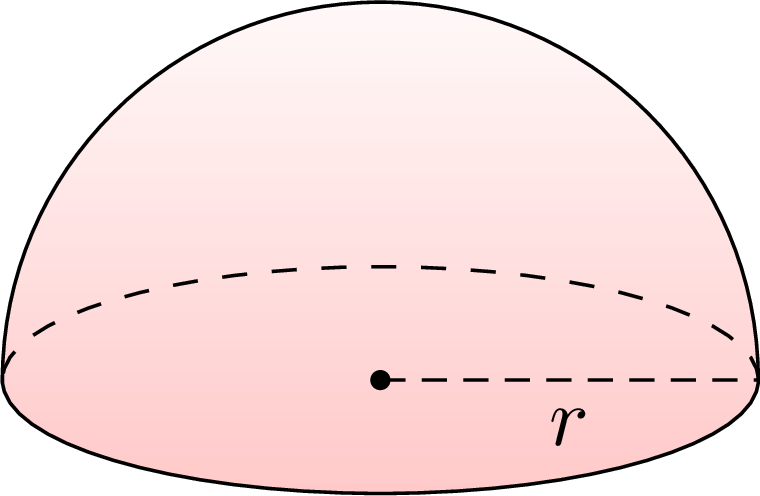
The two halves are identical, so each one has half the volume of the sphere of radius \(r\): $$\begin{aligned}[t]V &= \frac{1}{2} \times \frac{4}{3}\pi r^3 && \text{(half the volume of a sphere)}\\
&= \frac{2}{3}\pi r^3.\end{aligned}$$
Skills to practice
- Finding Volumes of Pyramids and Cones
- Finding Volumes of Spheres
I.3
Volume of a Composite Solid
Method — Finding the Volume of a Composite Solid
A composite solid is made of several solids whose volume formulas are known: prisms, cylinders, pyramids, cones, spheres, hemispheres. To find its volume: - Split the solid into these parts, and read the dimensions of each part on the figure: a radius shared by two parts is the same length.
- Write the volume of each part with its formula, keeping exact values (in terms of \(\pi\)).
- Add the volumes of the parts; subtract the volume of a part that has been removed, such as a hole.
- Round only once, at the end.
Example
A spinning top is made of a hemisphere of radius \(3\) cm and a cone with the same base and a height of \(4\) cm, glued base to base. Find the volume of the top, exactly and to \(0.1\) cm\(^3\). 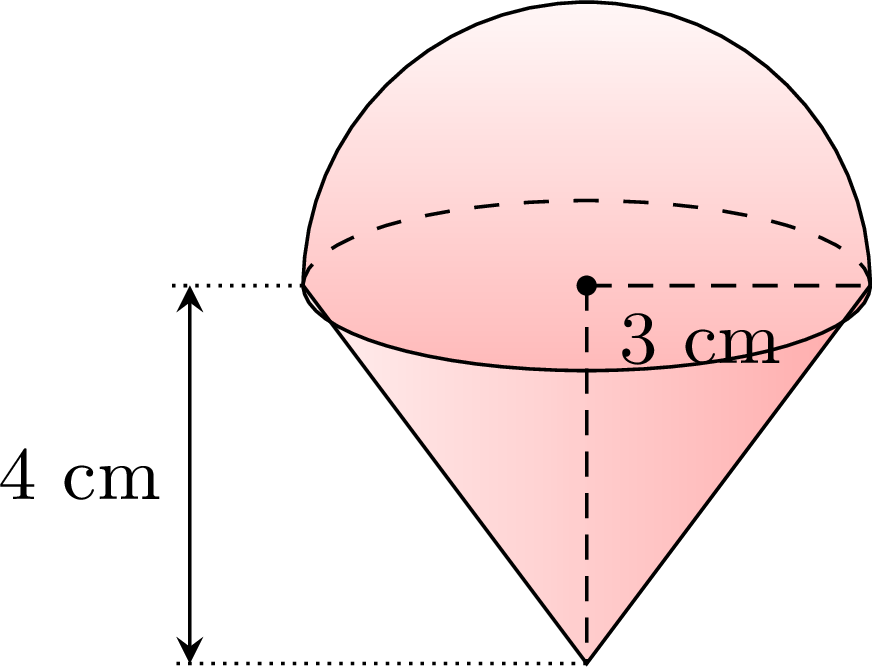
The top is made of two parts, a cone of height \(h = 4\) cm and a hemisphere, which share the radius \(r = 3\) cm: $$\begin{aligned}[t]V &= V_{\text{cone}} + V_{\text{hemisphere}} && \text{(sum of the two parts)}\\
&= \frac{1}{3}\pi r^2 h + \frac{2}{3}\pi r^3 && \text{(volume of a cone, of a hemisphere)}\\
&= \frac{1}{3}\pi \times 3^2 \times 4 + \frac{2}{3}\pi \times 3^3\\
&= 12\pi + 18\pi\\
&= \textcolor{colorprop}{30\pi} \approx \textcolor{colorprop}{94.2} \text{ cm}^3.\end{aligned}$$
Skills to practice
- Finding Volumes of Composite Solids
II
Surface Area
II.1
Surface Area of Polyhedra
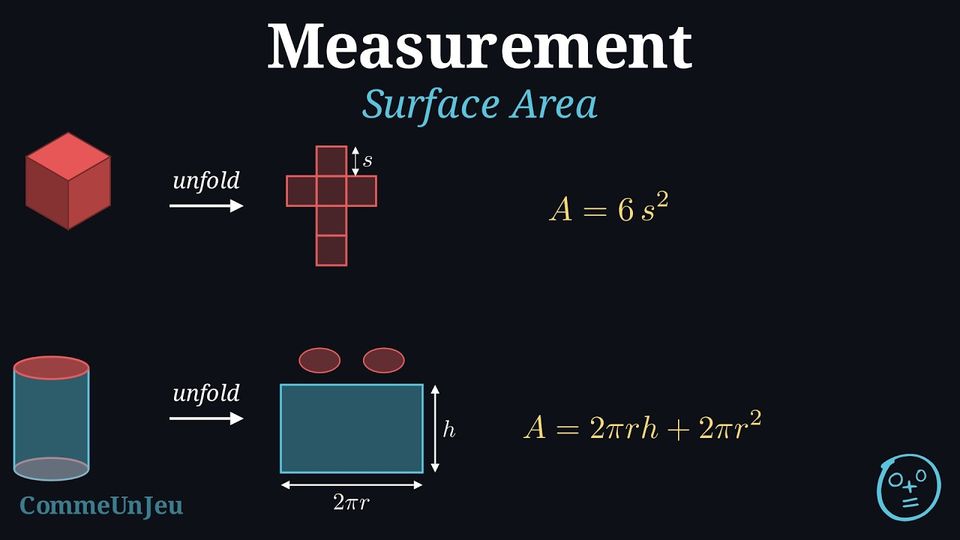
Definition — Surface Area
The surface area of a 3D shape is the total area of all its faces. It is measured in square units (cm\(^2\), m\(^2\), \(\dots\)). Proposition — Surface Area of Polyhedra
The surface area of a three-dimensional figure with plane faces is the sum of the areas of the faces. Proposition — Net of a Pyramid or Cone
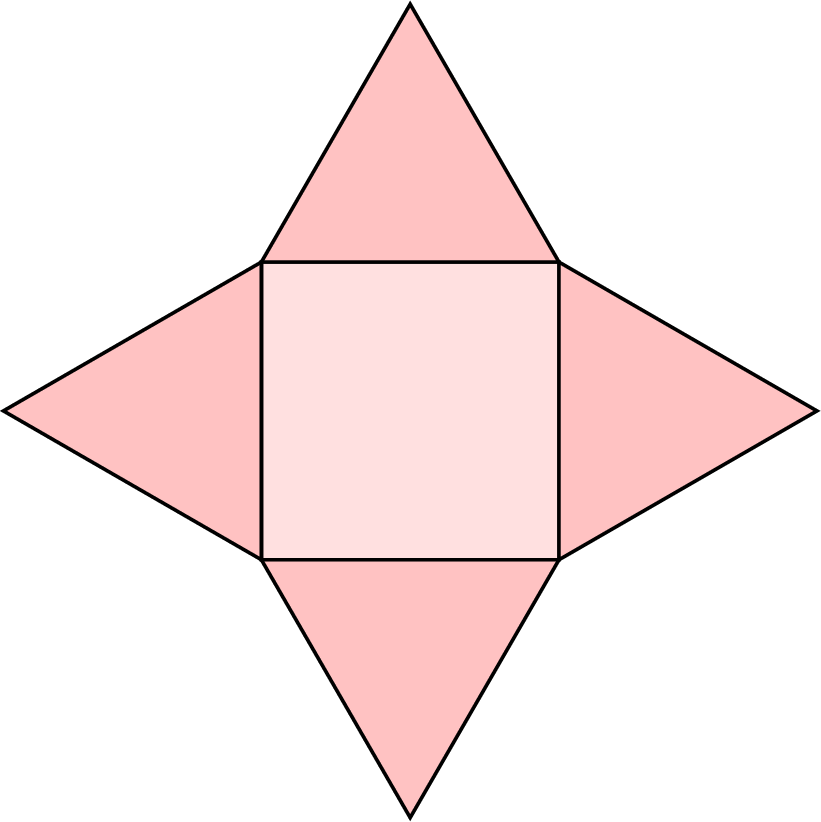
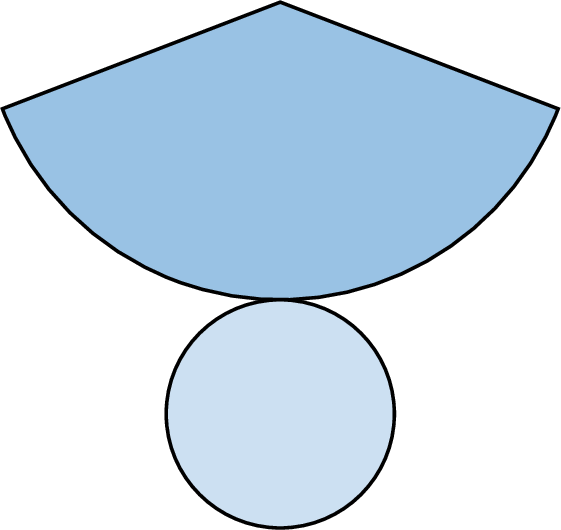
Unfolding a solid flat (after cutting along some edges — for a cone, along a segment from the apex to the base circle) gives its net, as for prisms. - The net of a pyramid is made of its polygon base and its triangular lateral faces — most often drawn attached to the sides of the base.
- The lateral surface of a cone is curved, yet it unrolls flat: its net is made of a disc (the base) and a portion of a disc called a circular sector (the lateral surface). When the net is rolled up, the curved edge of the sector wraps exactly around the base: the arc of the sector has the same length as the circle bounding the base disc.
 \(\quad\)
Method — Collapse the 3D Figure into Its Net
If we collapse the figure into its net, the surface area is the area of the net. 
Example
Find the surface area of the cube: 
A cube has 6 identical square faces. The area of one face is the side length squared (\(a^2\)). 
$$ \begin{aligned} \text{Surface Area} &= 6 \times (\text{Area of one square}) \\
&= 6 \times a^2 \\
&= 6 \times 5^2 \\
&= 6 \times 25 \\
&= 150 \, \text{cm}^2 \end{aligned} $$
Skills to practice
- Finding Surface Areas of Prisms and Pyramids
II.2
Cylinders, Cones and Spheres
Proposition — Surface Area of Solids with Curved Surfaces
| Name | Solid | Surface area |
| Right cylinder |  | \(\begin{aligned} A=& \text { curved surface } +2 \text { circular ends } \\=&2 \pi r h+2 \pi r^{2} \end{aligned}\) |
| Cone |  | \(\begin{aligned} A &=\text { curved surface } +\text { circular base } \\&= \pi r s+\pi r^{2} \end{aligned}\) |
| Sphere |  | \(A=4\pi r^2\) |
- Curved surface area of the cylinder.
If we unroll the cylinder, its lateral surface becomes a rectangle of height \(h\) and length equal to the circumference of the base, \(2\pi r\):

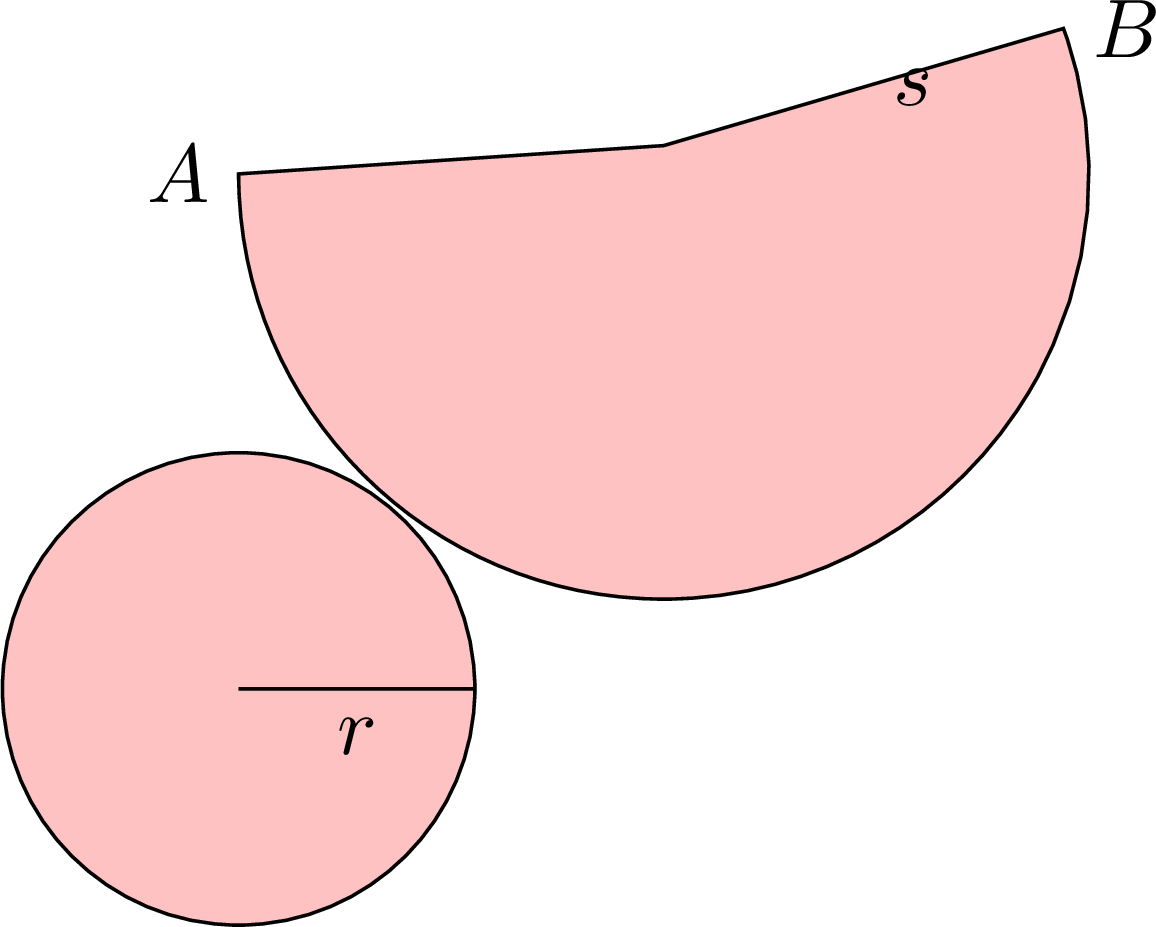
- Curved surface area of the cone.
If we unroll the cone’s lateral surface, we obtain a sector of the disc of radius \(s\) (the slant height):
Example
Find the surface area of the cylinder: 
$$ \begin{aligned} A &= 2\pi r h + 2\pi r^2 \\
&= 2\pi(2)(5) + 2\pi(2)^2 \\
&= 20\pi + 8\pi \\
&= 28\pi \, \text{m}^2 \end{aligned} $$
Skills to practice
- Using the Curved Surface Formulas
II.3
Hemispheres and Composite Solids
Proposition — Surface Area of a Hemisphere
The curved surface of a hemisphere of radius \(r\) is half the sphere: its area is \(2\pi r^2\). A solid hemisphere is also bounded by a flat disc of radius \(r\), so its total surface area is $$A = 2\pi r^2 + \pi r^2 = 3\pi r^2.$$ 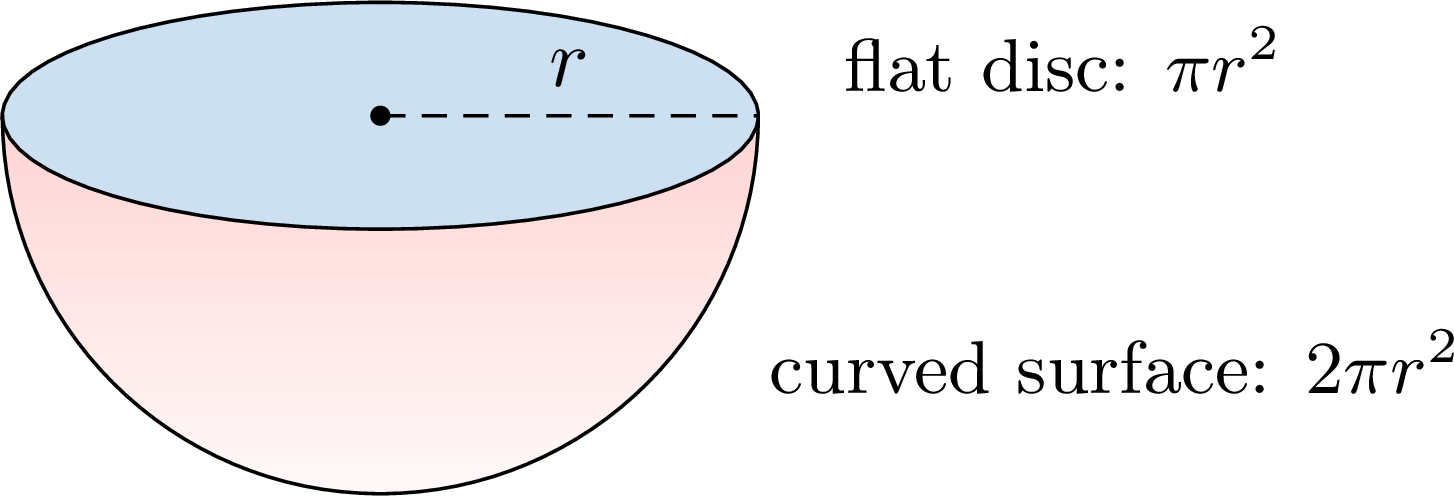
The plane through the centre cuts the sphere into two identical halves, so the curved surface has half the area of the sphere; the flat face is a disc of radius \(r\): $$\begin{aligned}[t]A &= \frac{1}{2} \times 4\pi r^2 + \pi r^2 && \text{(half a sphere, plus a disc)}\\
&= 2\pi r^2 + \pi r^2\\
&= 3\pi r^2.\end{aligned}$$
Method — Finding the Surface Area of a Composite or Hollow Solid
- List the surfaces that are really on the outside of the solid; for a hollow object with a thin wall, such as a bowl or a pipe, it is usually this outer surface that is asked, and the inner surface counts only when the question says so. Where two parts are glued together, the joining face is inside the solid and is not counted; an open (hollow) end has no surface.
- Find the area of each outside surface with its formula: the curved surface of a cylinder \(2\pi r h\), of a cone \(\pi r s\), where \(s\) is the slant height (given, or found from the height with Pythagoras' theorem), of a hemisphere \(2\pi r^2\), and the flat faces as plane figures.
- Add these areas, and round only once, at the end.
Example
A bowl is an open hemisphere of radius \(9\) cm, with a wall thin enough to be ignored: it has no lid. Find the area of its outer surface, exactly and to \(0.1\) cm\(^2\), and compare it with the surface area of a solid hemisphere of the same radius. 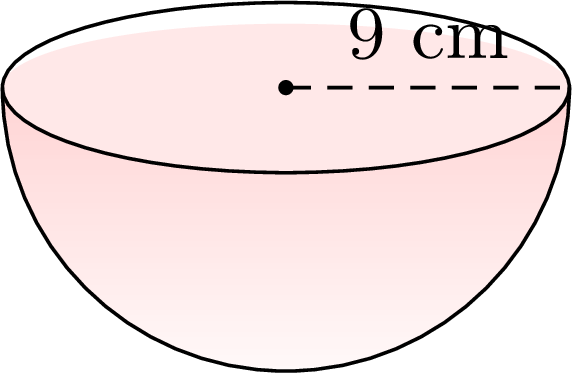
The bowl is open: its outer surface is the curved surface alone, with \(r = 9\) cm: $$\begin{aligned}[t]A_{\text{bowl}} &= 2\pi r^2 && \text{(curved surface of a hemisphere)}\\
&= 2\pi \times 9^2\\
&= \textcolor{colorprop}{162\pi} \approx \textcolor{colorprop}{508.9} \text{ cm}^2.\end{aligned}$$ A solid hemisphere of the same radius also has its flat disc: \(A = 3\pi r^2 = 243\pi \approx 763.4\) cm\(^2\). The difference, \(81\pi \approx 254.5\) cm\(^2\), is exactly the area \(\pi \times 9^2\) of the missing disc.
Skills to practice
- Finding Surface Areas of Composite Solids
III
Going further
Skills to practice
- Solving Surface Area and Volume Problems
- Investigating Surface Areas and Volumes
- Quiz
Jump to section