International Baccalaureate · MYP 1
Sequences
I
Generating a Sequence from a Rule
Definition — Numerical Sequence
A numerical sequence is a list of numbers that follows a specific rule. - The first number is called the 1\(^{\text{st}}\) term.
- The second number is called the 2\(^{\text{nd}}\) term.
- The third number is called the 3\(^{\text{rd}}\) term.
- And so on.
Definition — A Sequence Given by Its First Term and Its Rule
A sequence can be given by two pieces of information: - its first term (the starting point);
- the rule from one term to the next (also called a recursive rule), which tells how to get each new term from the term just before it.
Example
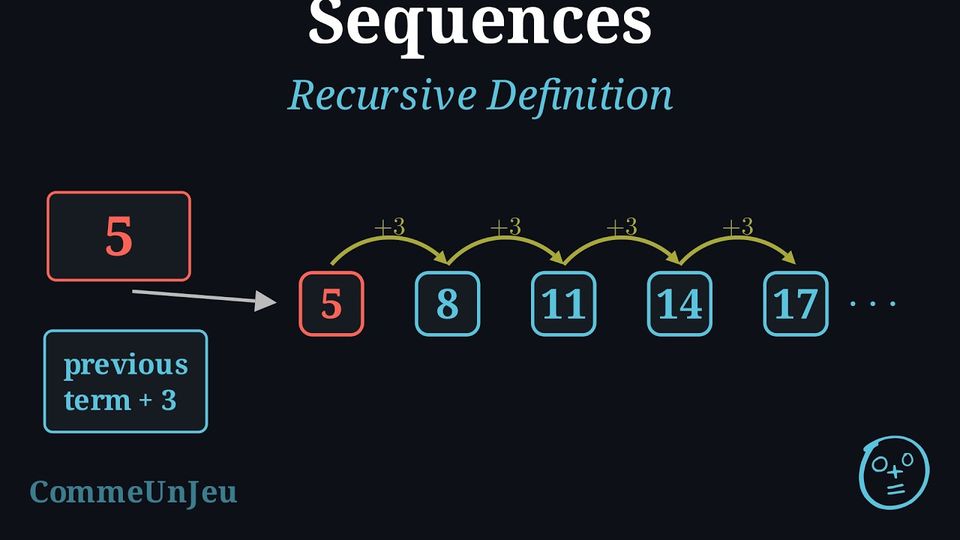
A sequence is given by its first term and its rule from one term to the next: - The first term is 5.
- The rule is: “add 3 to the previous term to get the next term”.
The sequence is built step by step: $$5 \textcolor{olive}{\xrightarrow{\;+3\;}} 8 \textcolor{olive}{\xrightarrow{\;+3\;}} 11 \textcolor{olive}{\xrightarrow{\;+3\;}} 14 \textcolor{olive}{\xrightarrow{\;+3\;}} 17$$ The first five terms are: \(5, 8, 11, 14, 17\).
- 1\(^{\text{st}}\) term: The starting point is 5.
- 2\(^{\text{nd}}\) term: Take the previous term (5) and add 3. \(\rightarrow 5 + 3 = \textbf{8}\)
- 3\(^{\text{rd}}\) term: Take the previous term (8) and add 3. \(\rightarrow 8 + 3 = \textbf{11}\)
- 4\(^{\text{th}}\) term: Take the previous term (11) and add 3. \(\rightarrow 11 + 3 = \textbf{14}\)
- 5\(^{\text{th}}\) term: Take the previous term (14) and add 3. \(\rightarrow 14 + 3 = \textbf{17}\)
Skills to practice
- Continuing a Sequence from Its Table
- Calculating the First Terms
II
Recognising Arithmetic and Geometric Sequences
Definition — The Step of a Pattern
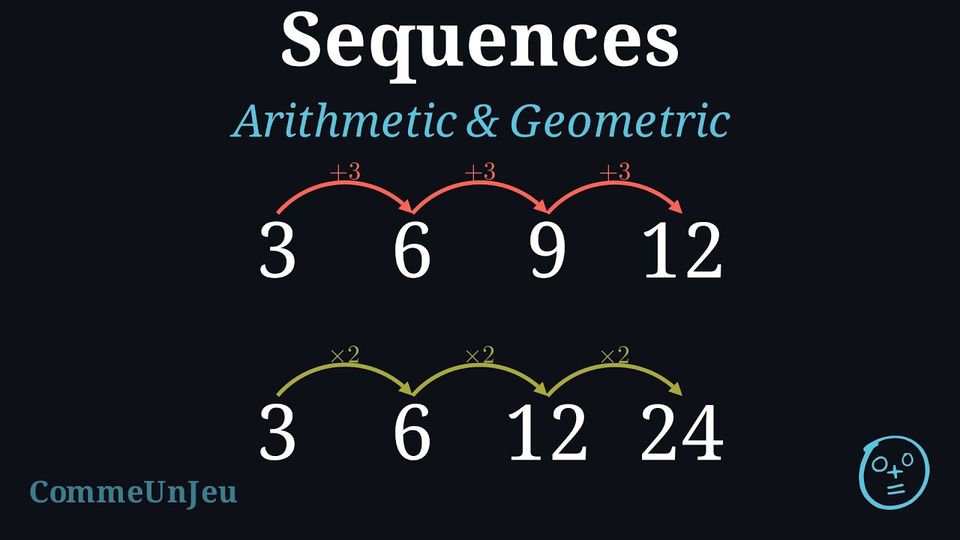
In some patterns the same number is added each time, or the same number is subtracted each time: that number is the step. It is the difference between two terms that are next to each other in the pattern.Such a pattern is also called an arithmetic sequence, and its step the common difference.
Definition — Geometric Sequence
A geometric sequence is a list of numbers where each term is the previous term multiplied by the same number, the common ratio.Dividing by \(2\) is multiplying by \(\frac{1}{2}\): in \(64, 32, 16, \dots\) each term is the previous term multiplied by \(\frac{1}{2}\), so the common ratio is \(\frac{1}{2}\).
Example
What is the 5\(^{\text{th}}\) term of this sequence? | position | 1 | 2 | 3 | 4 | 5 |
| term | 2 | 4 | 8 | 16 | ? |
The 5\(^{\text{th}}\) term is \(32\), because each term is multiplied by \(2\). 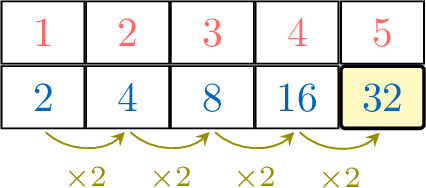
Skills to practice
- Identifying the Rule
- Deciding Whether a Sequence Is Arithmetic or Geometric
- Solving Problems with Arithmetic and Geometric Sequences
III
Going further
Skills to practice
- Reasoning and Problem-Solving
- Solving Problems in Context
- Quiz
Jump to section