International Baccalaureate · MYP 3
Congruence
I
Congruent Figures
I.1
Congruent Figures
A tile maker stamps the shape \(P\) on a squared sheet, then four more shapes \(A\), \(B\), \(C\) and \(D\). 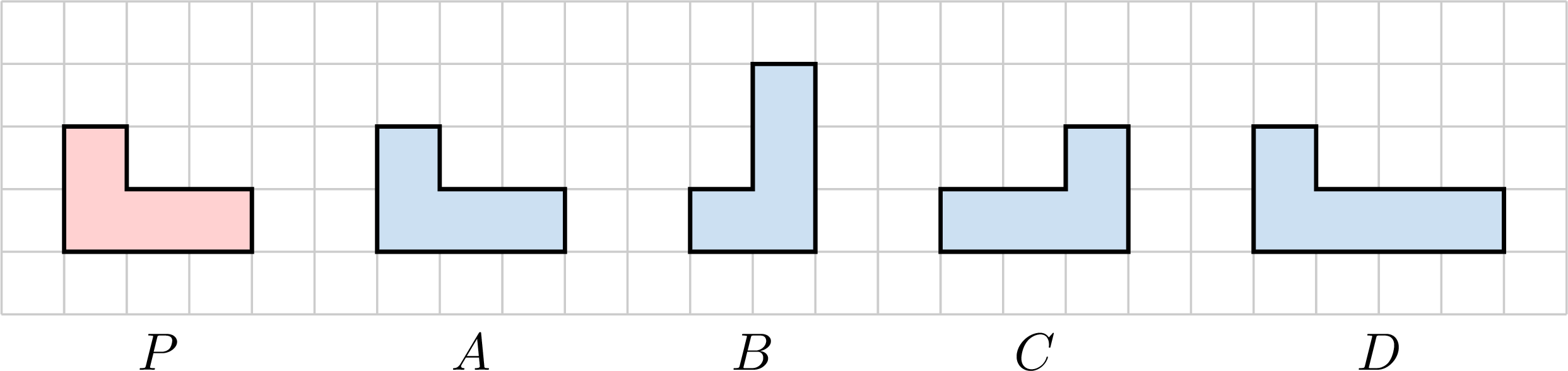
Which shapes are exact copies of \(P\)? For each copy, how can \(P\) be moved to cover it exactly?
Count the squares. \(P\) has a long arm of \(3\) squares and a short arm of \(2\) squares.
- \(A\) is \(P\) slid \(5\) squares to the right: a translation.
- \(B\) is \(P\) turned a quarter turn: a rotation of \(90^\circ\). Its long arm now points up.
- \(C\) is \(P\) turned over, as in a mirror: a reflection in a vertical line. No slide and no turn can do it: \(P\) must be flipped.
- \(D\) is not a copy: its long arm has \(4\) squares instead of \(3\). It has the same kind of shape, but not the same size.
Definition — Isometry
A transformation is an isometry when it keeps every length and every angle unchanged. The object and its image are then congruent: one can be placed exactly on top of the other. Definition — Congruent Figures
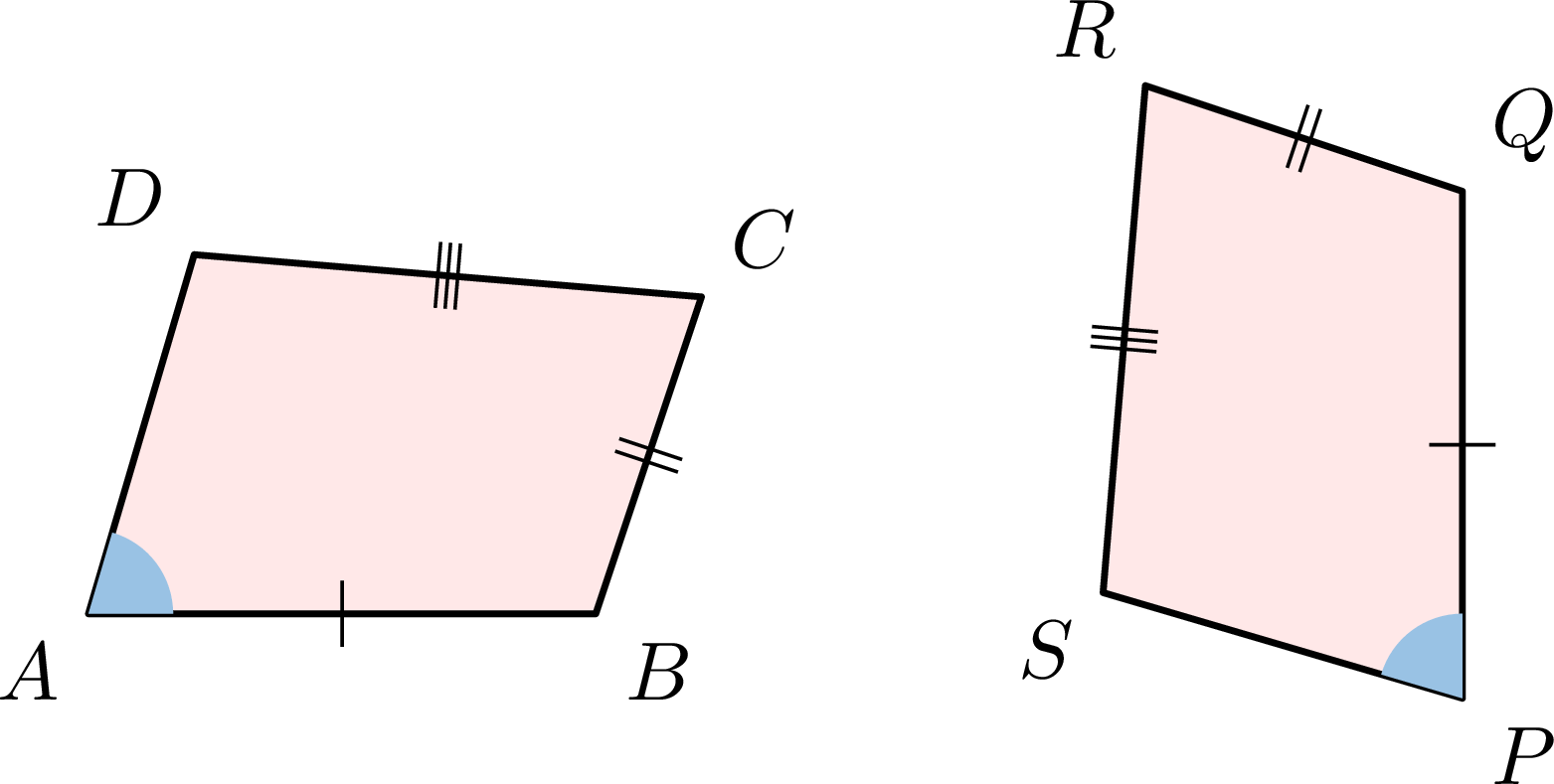
Two figures are congruent when an isometry — a translation, a rotation, a reflection, or several of them one after the other — maps one of them exactly onto the other. Congruent figures have the same shape and the same size: their corresponding sides are equal and their corresponding angles are equal.We write \(ABCD \cong PQRS\), listing the vertices in corresponding order: \(A\) corresponds to \(P\), \(B\) to \(Q\), \(C\) to \(R\) and \(D\) to \(S\).
Congruent and Similar Figures
- A similarity multiplies every length by its scale factor \(k\). With \(k = 1\), it keeps every length: congruent figures are similar figures with scale factor \(1\). Two congruent figures are always similar; two similar figures are congruent only when the scale factor is \(1\) — an enlargement keeps the shape, not the size.
- Two congruent triangles can be laid exactly on one another after moving one of them and possibly turning it over: moving is a translation or a rotation, turning over is a reflection.
Example
On the squared grid, the triangle \(PQR\) is the image of the triangle \(ABC\) by an isometry. 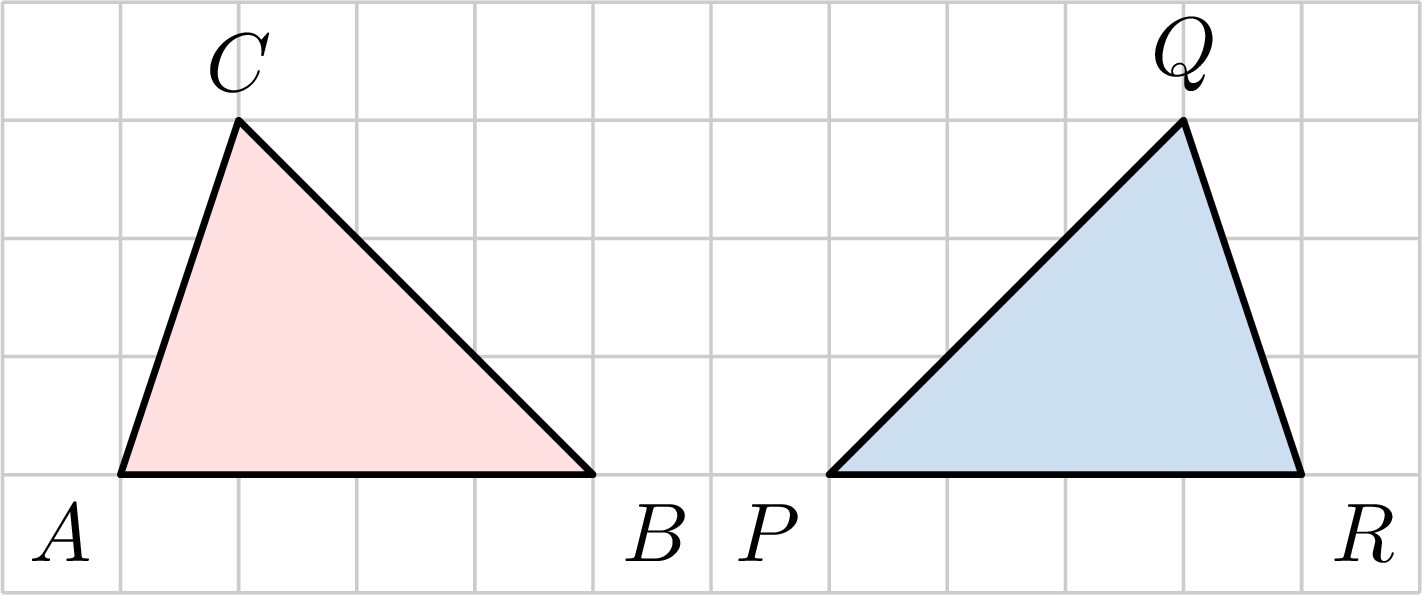
Read the grid, counting squares from the vertical grid line \(d\) drawn below, halfway between the two triangles: \(B\) and \(P\) are \(1\) square on either side of \(d\), \(C\) and \(Q\) are \(4\) squares, \(A\) and \(R\) are \(5\) squares. Each vertex of \(ABC\) and its image are at the same distance from \(d\), on opposite sides: \(PQR\) is the image of \(ABC\) by the reflection in the line \(d\). 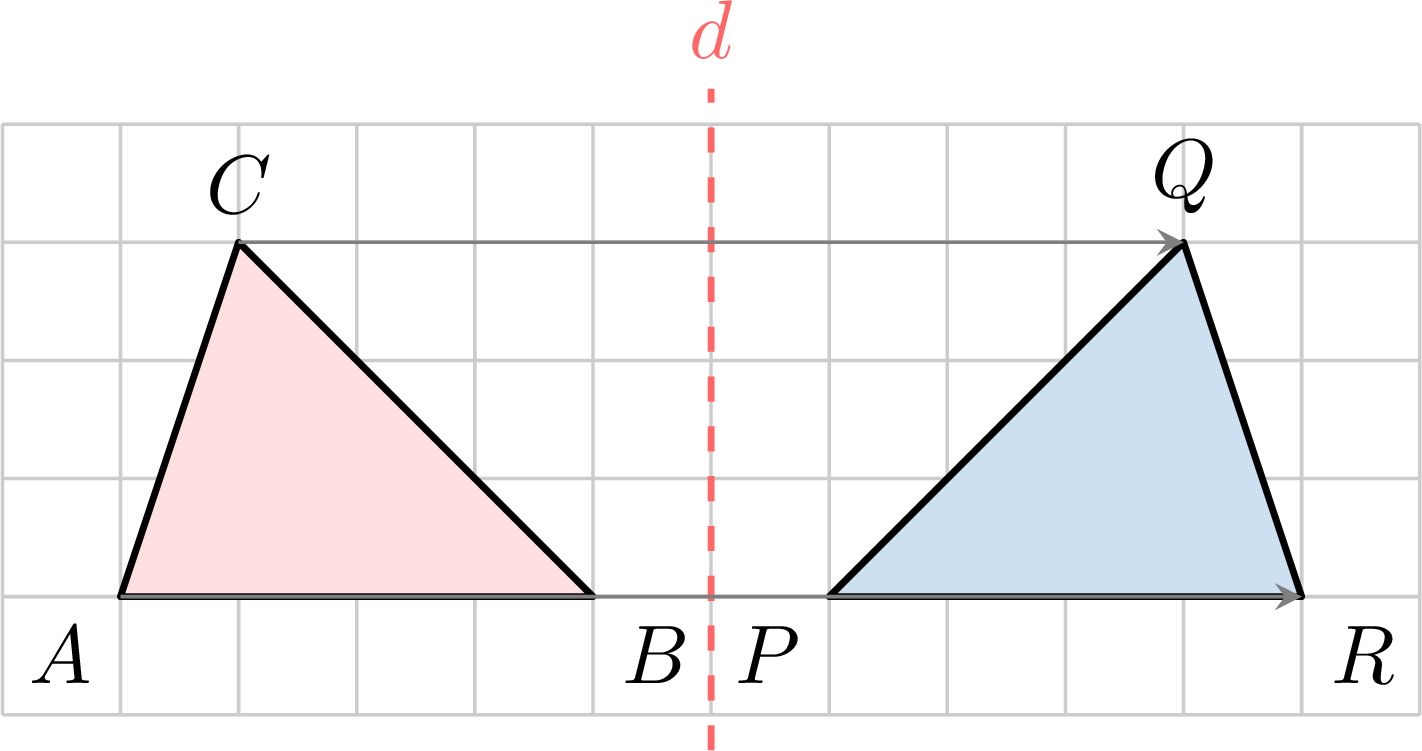
The reflection maps \(A\) to \(R\), \(B\) to \(P\) and \(C\) to \(Q\). In corresponding order: $$\triangle ABC \cong \triangle RPQ.$$ The equal sides are \(AB = RP\), \(BC = PQ\), \(CA = QR\); the equal angles are \(\Angle{A} = \Angle{R}\), \(\Angle{B} = \Angle{P}\), \(\Angle{C} = \Angle{Q}\). Writing \(\triangle ABC \cong \triangle PQR\) would be wrong: it would claim \(AB = PQ\), and \(AB = 4\) while \(PQ\) is the slanted side.
Example
The quadrilaterals \(ABCD\) and \(KLMN\) are congruent: \(ABCD \cong KLMN\). In \(ABCD\), \(AB = 6\) cm, \(BC = 4\) cm, \(DA = 5\) cm, \(\Angle{A} = 65^\circ\) and \(\Angle{B} = 80^\circ\). 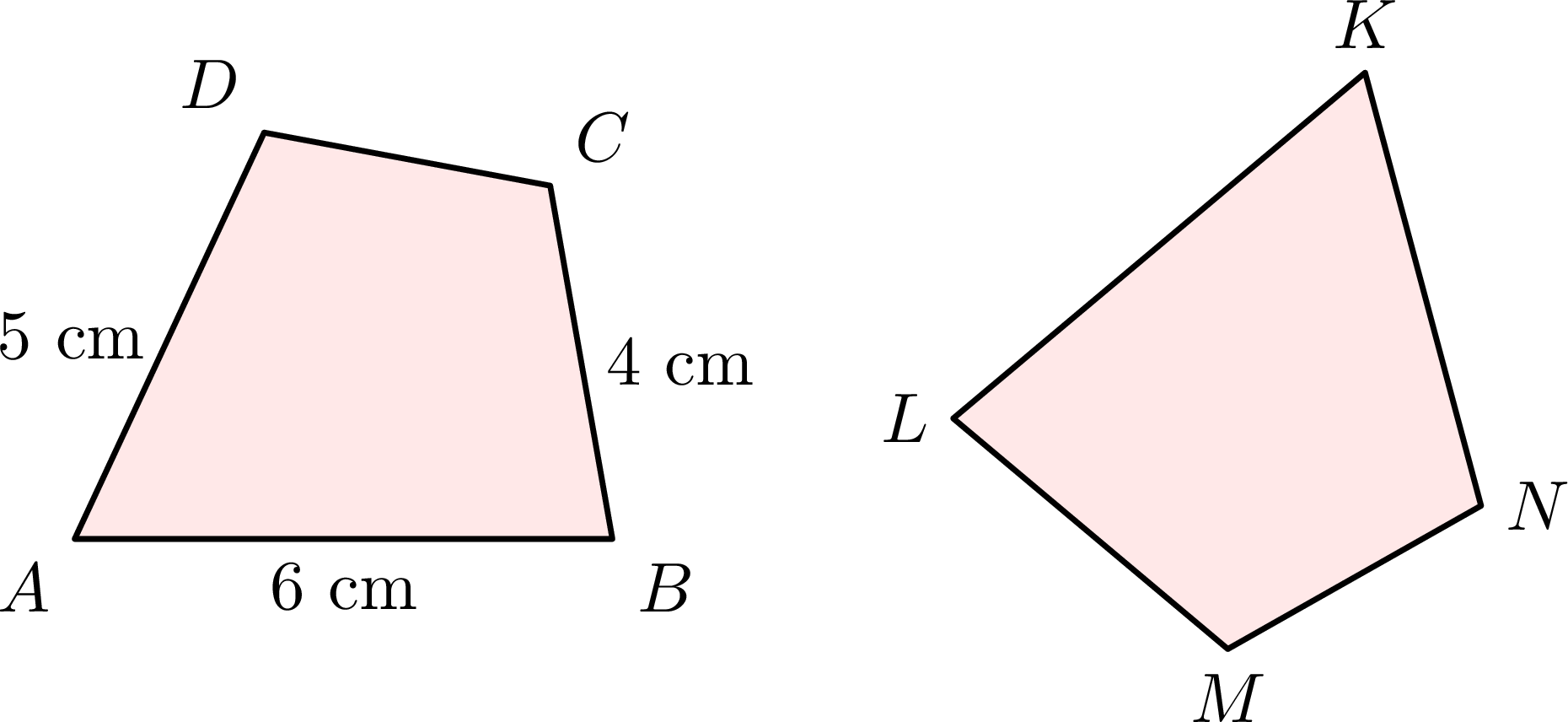
The order of the letters in \(ABCD \cong KLMN\) gives the correspondence: \(A \leftrightarrow K\), \(B \leftrightarrow L\), \(C \leftrightarrow M\), \(D \leftrightarrow N\). A side corresponds to the side joining the corresponding vertices, and an angle to the angle at the corresponding vertex:
- \(KL = AB = 6\) cm, \(LM = BC = 4\) cm, \(NK = DA = 5\) cm;
- \(\Angle{K} = \Angle{A} = 65^\circ\) and \(\Angle{L} = \Angle{B} = 80^\circ\).
Skills to practice
- Recognising Congruent Figures
- Naming Corresponding Sides and Angles
- Identifying the Isometry
II
Congruent Triangles
II.1
The Three Congruence Cases
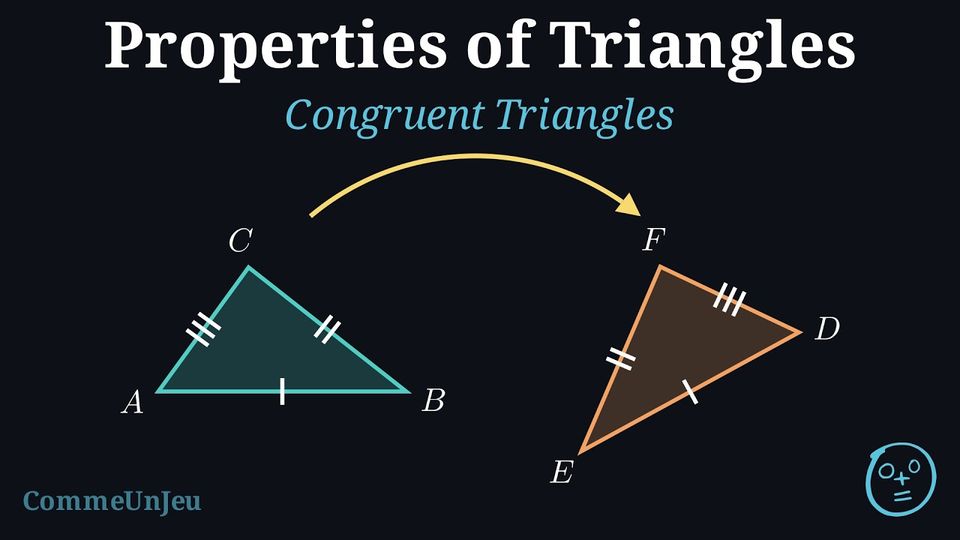
Method — Constructing a Triangle from Three Pieces of Data
Three well-chosen pieces of data are enough to construct a triangle — three angles, for instance, are not, since they say nothing about its size. Here are the three usual cases; the construction itself shows whether the triangle exists. - Three lengths (side, side, side): draw one side; from each of its ends, draw an arc whose radius is the wanted length; the third vertex is where the two arcs meet. If the arcs do not meet, the triangle does not exist; if they only touch at one point, the three points are collinear and the triangle is flat — the triangle inequality, with its case of equality, is what decides.
- Two lengths and the angle between them (side, angle, side): draw one side; at one of its ends, mark the angle with the protractor, which gives a ray; on that ray, place the point at the second length; join.
- One side and its two adjacent angles (angle, side, angle): draw the side; mark each angle at its own end, both rays on the same side of the segment; the third vertex is where they meet. The two angles must add up to less than \(180^\circ\).
Hugo and Lea have each cut out a paper triangle. The sides of Hugo's triangle measure \(5\) cm, \(6\) cm and \(7\) cm; Lea measured hers and found \(7\) cm, \(5\) cm and \(6\) cm. Without measuring any angle, can we be sure that one triangle can be laid exactly on the other?
Yes. Three lengths leave the compass no choice (Method “Constructing a Triangle from Three Pieces of Data”): a triangle with sides \(5\) cm, \(6\) cm and \(7\) cm can be drawn in only one way, up to its position. Lea's triangle is therefore Hugo's triangle, moved and perhaps turned over: laid on it, it covers it exactly — and its angles are equal to those of Hugo's triangle, although nobody measured them.
Definition — Congruent Triangles
Two triangles are congruent when one can be laid exactly on the other, after moving it and possibly turning it over. Their sides are then equal in pairs, and so are their angles. The sides and the angles that match are called corresponding. 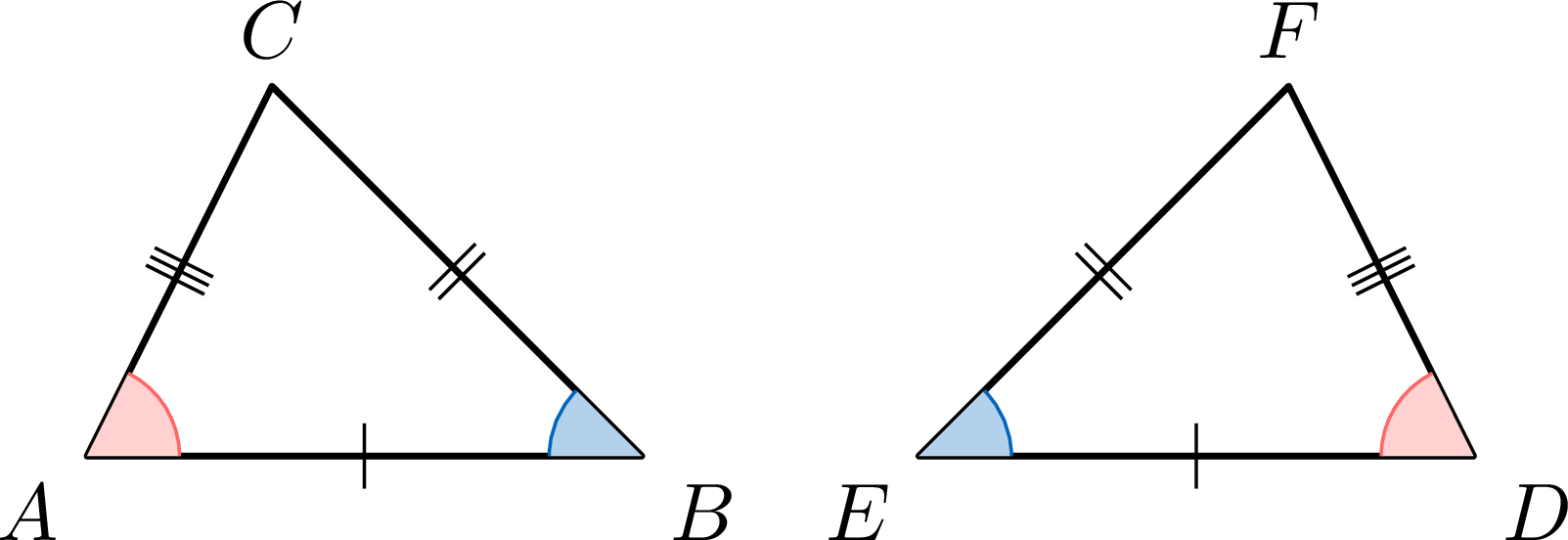
Proposition — The Three Congruence Cases
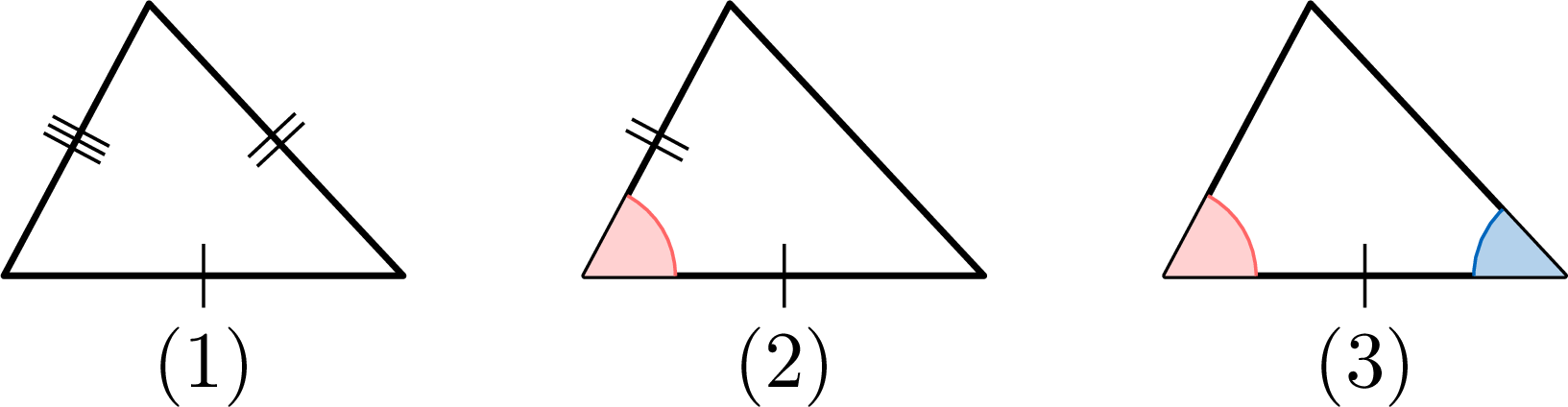
Two triangles are congruent as soon as one of the following conditions holds: - three sides (SSS): their three sides are equal in pairs;
- two sides and the included angle (SAS): two sides are equal in pairs, and so is the angle between these two sides;
- one side and the two adjacent angles (ASA): one side has the same length in both triangles, and the two angles at its ends are equal in pairs.
Method — Proving That Two Triangles Are Congruent
- Name the two triangles, pairing their vertices in the order in which they correspond.
- Find three pieces of data equal in pairs, each one justified: a given of the problem, a common side, vertically opposite angles, a property of a known figure…
- Name the case — SSS (three sides), SAS (two sides and the included angle), ASA (one side and the two adjacent angles) and, once they are known, AAS (two angles and a corresponding side) or, for two right-angled triangles, RHS (the hypotenuse and a leg) — and conclude that the triangles are congruent.
- Deduce the other equalities: the remaining corresponding sides and angles are equal.
Example
\(ABC\) is an isosceles triangle with apex \(A\), and \(I\) is the midpoint of \(\Segment{BC}\). Prove that the triangles \(ABI\) and \(ACI\) are congruent, then deduce that the angles \(\Angle{ABC}\) and \(\Angle{ACB}\) are equal. 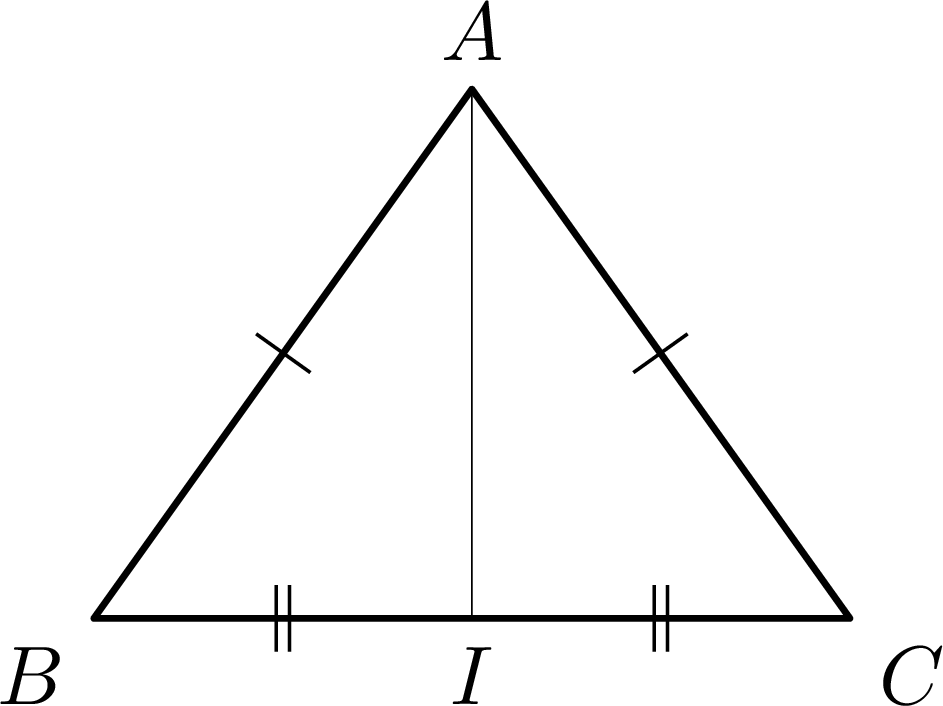
In the triangles \(ABI\) and \(ACI\), the vertices are paired \(A \leftrightarrow A\), \(B \leftrightarrow C\), \(I \leftrightarrow I\):
- \(AB = AC\), since \(ABC\) is isosceles with apex \(A\);
- \(BI = CI\), since \(I\) is the midpoint of \(\Segment{BC}\);
- \(AI = AI\): the side \(\Segment{AI}\) is common to both triangles.
Example
The segments \(\Segment{AB}\) and \(\Segment{CD}\) cross at their common midpoint \(O\). Prove that \(AC = BD\). 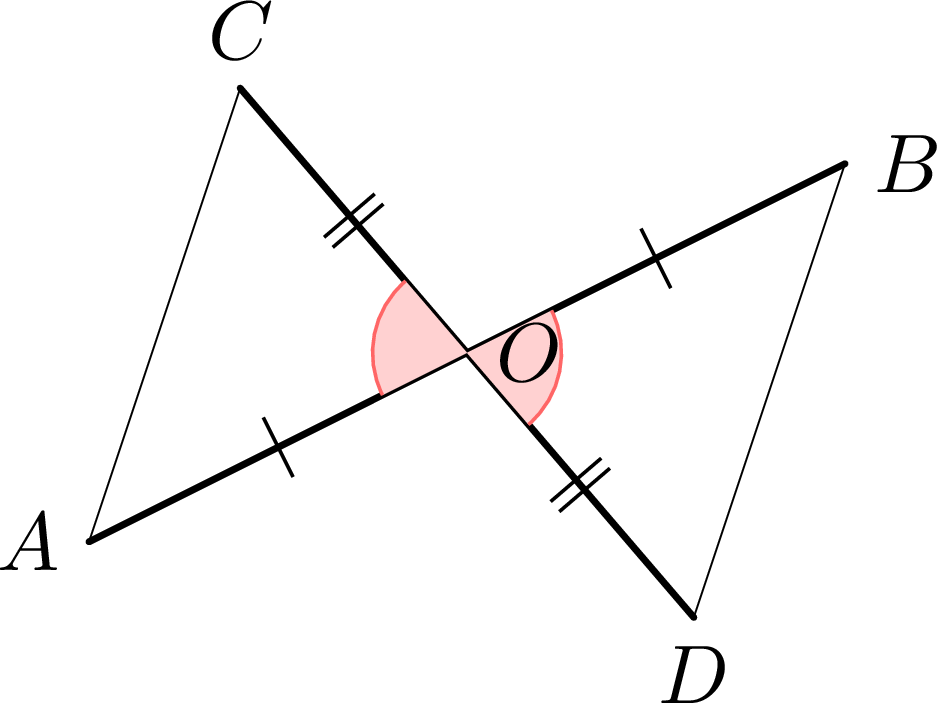
\(AC\) and \(BD\) are sides of the triangles \(AOC\) and \(BOD\), paired \(O \leftrightarrow O\), \(A \leftrightarrow B\), \(C \leftrightarrow D\):
- \(OA = OB\), since \(O\) is the midpoint of \(\Segment{AB}\);
- \(OC = OD\), since \(O\) is the midpoint of \(\Segment{CD}\);
- \(\Angle{AOC} = \Angle{BOD}\), since they are vertically opposite angles.
Example
\(ABCD\) is a parallelogram: its opposite sides are parallel. Prove that the triangles \(ABC\) and \(CDA\) are congruent, then deduce that the opposite sides of the parallelogram have the same length. 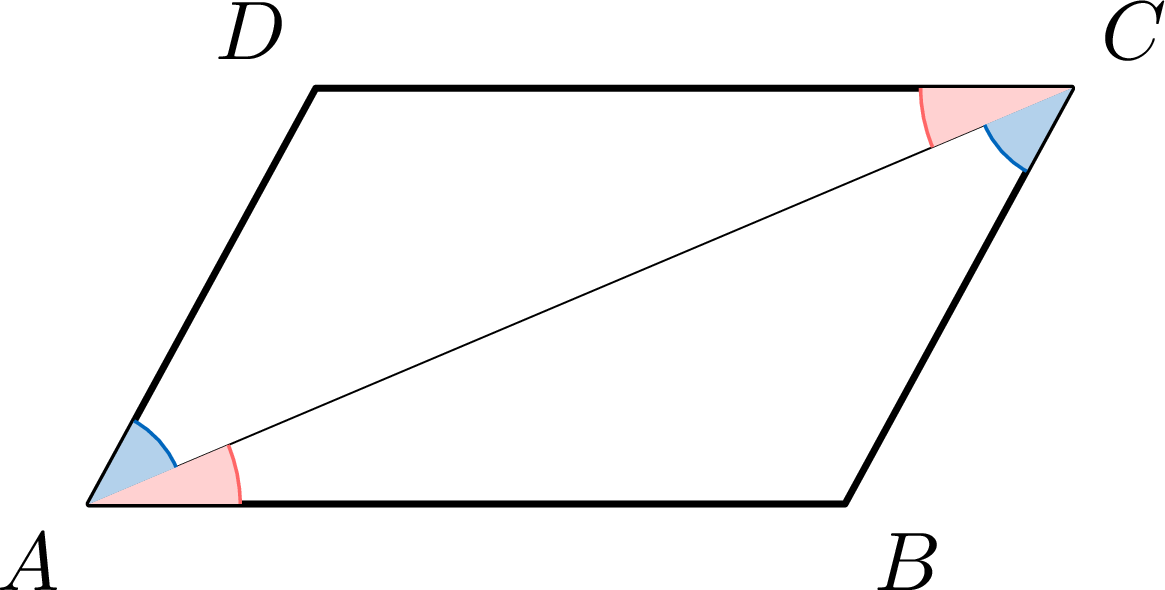
In the triangles \(ABC\) and \(CDA\), the vertices correspond as follows: \(A \leftrightarrow C\), \(B \leftrightarrow D\), \(C \leftrightarrow A\).
- The side \(\Segment{AC}\) is common to the two triangles.
- The lines \(\Line{AB}\) and \(\Line{CD}\) are parallel, cut by the transversal \(\Line{AC}\): the angles \(\Angle{BAC}\) and \(\Angle{DCA}\) are alternate angles, so \(\Angle{BAC} = \Angle{DCA}\).
- The lines \(\Line{BC}\) and \(\Line{AD}\) are parallel, cut by \(\Line{AC}\): the angles \(\Angle{BCA}\) and \(\Angle{DAC}\) are alternate angles, so \(\Angle{BCA} = \Angle{DAC}\).
Three Pieces of Data That Are Not Enough
- Three equal angles are not enough: an enlargement keeps the angles and changes the lengths.
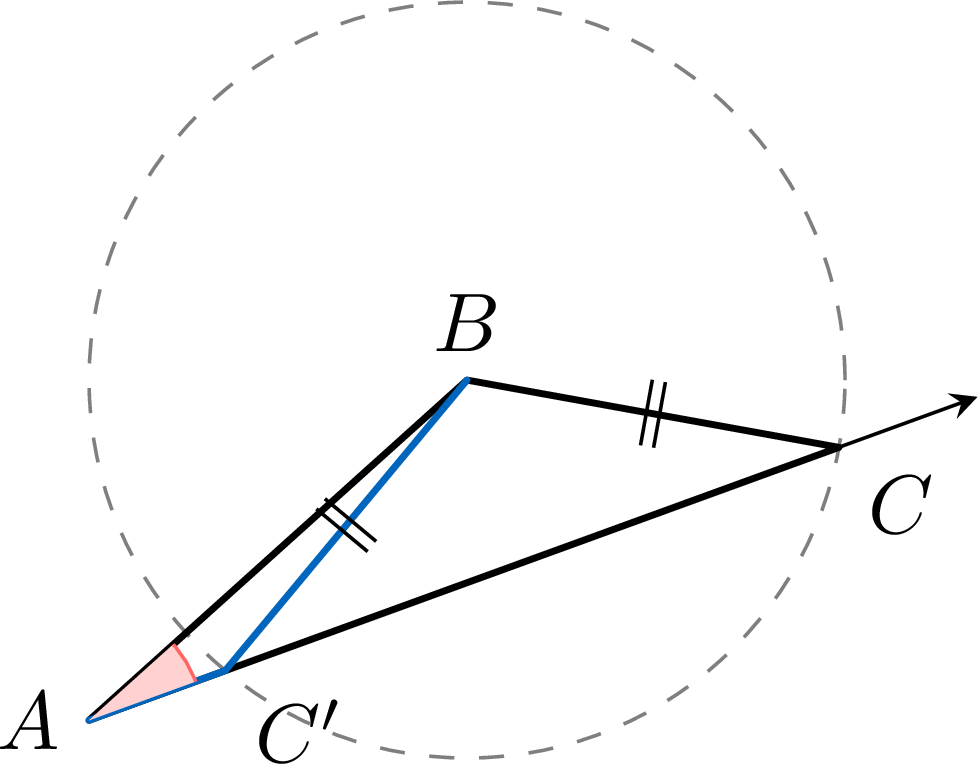
- Two sides and an angle that is not between them are not enough in general. Below, the side \(\Segment{AB}\) and the angle at \(A\) are the same for both triangles, and \(BC = BC'\); yet \(ABC\) and \(ABC'\) are not congruent.
Skills to practice
- Recognising the Case
- Proving That Two Triangles Are Congruent
II.2
Two Angles and a Side (AAS)
Proposition — Two Angles and a Corresponding Side
If two angles of a triangle are equal to two angles of another triangle, and a side of the first triangle is equal to the corresponding side of the second — the side opposite the same equal angle — then the two triangles are congruent. This test is written AAS (angle, angle, side). 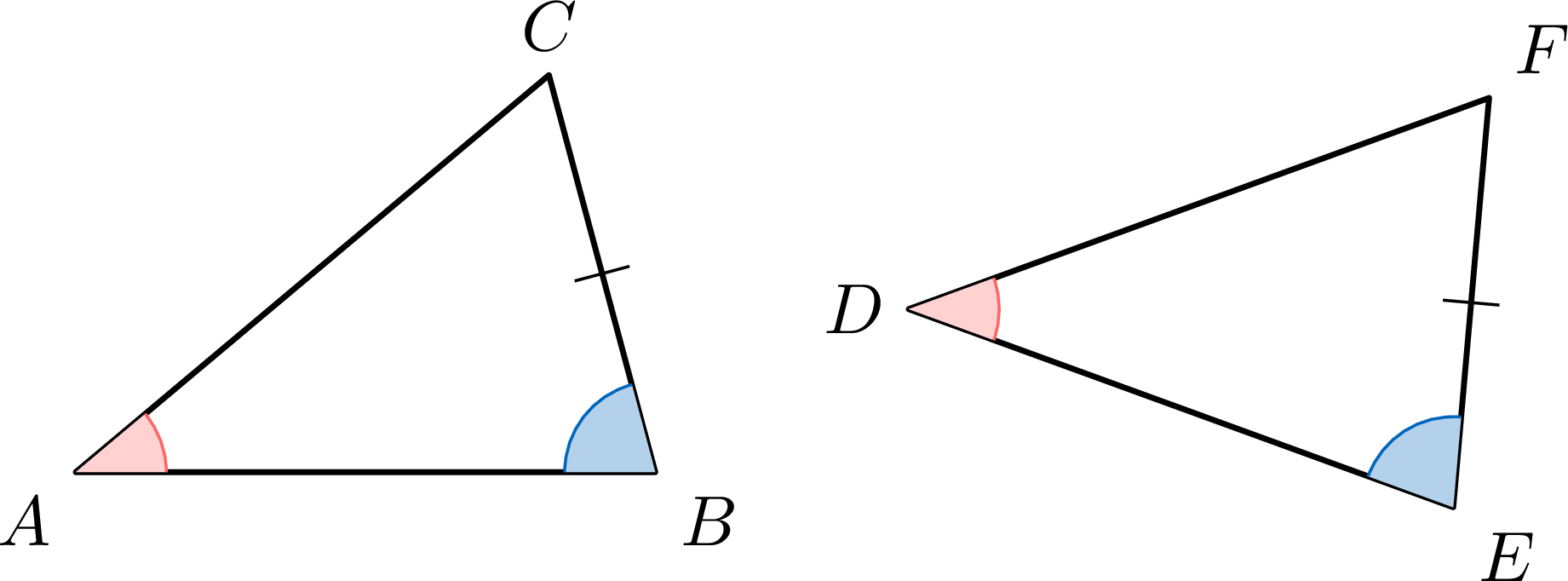
Let \(ABC\) and \(DEF\) be two triangles with \(\Angle{A} = \Angle{D}\), \(\Angle{B} = \Angle{E}\), and one side of \(ABC\) equal to the corresponding side of \(DEF\). First, the third angles are equal: $$\begin{aligned}[t] \Angle{C} &= 180^\circ - \Angle{A} - \Angle{B} && \text{(sum of the angles of a triangle)}\\
&= 180^\circ - \Angle{D} - \Angle{E} && \text{(the two given pairs of equal angles)}\\
&= \Angle{F}. && \text{(sum of the angles of a triangle)} \end{aligned}$$ So the three angles of \(ABC\) are equal to the three angles of \(DEF\), in the correspondence \(A \leftrightarrow D\), \(B \leftrightarrow E\), \(C \leftrightarrow F\). The equal side joins two vertices of \(ABC\), and its corresponding side joins the corresponding vertices of \(DEF\): the two angles at the ends of the first are equal to the two angles at the ends of the second. One side and the two adjacent angles are equal in pairs: by ASA, the case “one side and the two adjacent angles” (Proposition “The Three Congruence Cases”), the triangles \(ABC\) and \(DEF\) are congruent.
Which Side Must Be Equal
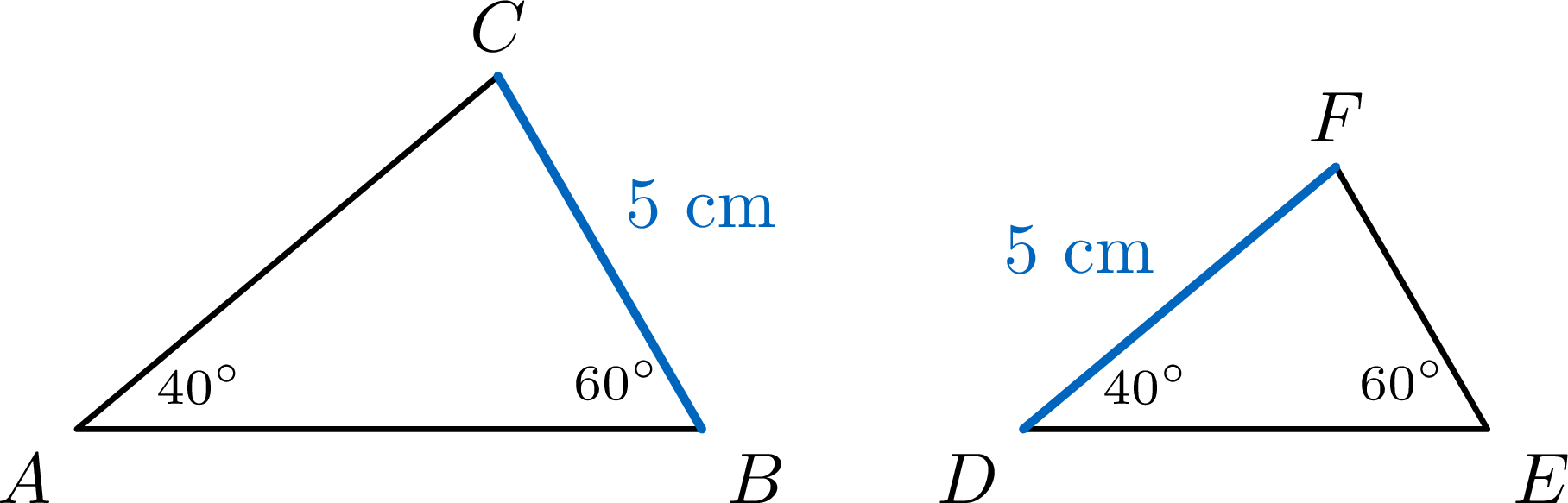
- The equal side must be a corresponding side. Below, both triangles have angles of \(40^\circ\), \(60^\circ\) and \(80^\circ\) and a side of \(5\) cm; but this side is opposite the \(40^\circ\) angle in \(ABC\) and opposite the \(60^\circ\) angle in \(DEF\). Corresponding sides are opposite equal angles, so these two sides of \(5\) cm do not correspond: AAS does not apply, and the figure shows two triangles of different sizes. Before using AAS, name the angle opposite the equal side in each triangle: these two angles must be equal.
- The equal side may lie between the two equal angles (the case “one side and the two adjacent angles”, written ASA) or not (AAS): once two angles are equal in pairs, any pair of corresponding sides is enough.
Example
The ray \(\Ray{Oz}\) is the bisector of the angle \(\Angle{xOy}\). \(M\) is a point of \(\Ray{Oz}\), and \(H\) and \(K\) are the feet of the perpendiculars from \(M\) to \(\Ray{Ox}\) and to \(\Ray{Oy}\). 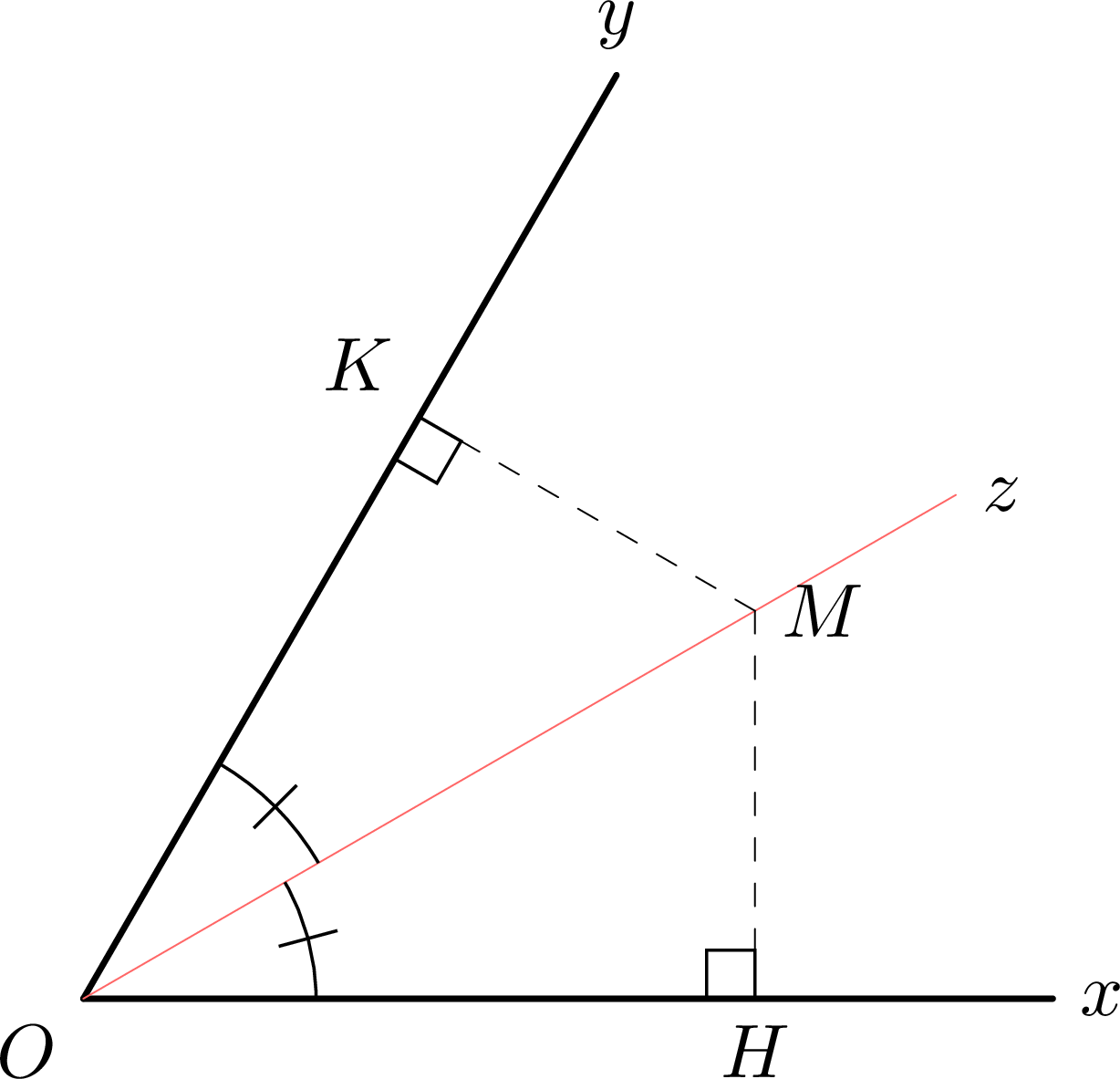
\(MH\) and \(MK\) are sides of the triangles \(OHM\) and \(OKM\), with the correspondence \(O \leftrightarrow O\), \(H \leftrightarrow K\), \(M \leftrightarrow M\):
- \(\Angle{HOM} = \Angle{KOM}\), since \(\Ray{Oz}\) is the bisector of \(\Angle{xOy}\);
- \(\Angle{OHM} = \Angle{OKM} = 90^\circ\), since \(H\) and \(K\) are the feet of the perpendiculars from \(M\);
- \(OM = OM\): the side \(\Segment{OM}\) is common. It is opposite the right angle in both triangles, so it is a corresponding side.
Skills to practice
- Deciding Whether Two Angles and a Side Are Enough
II.3
Right-Angled Triangles (RHS)
Why SSA Fails Except Here
Two sides and an angle that is not between them are not enough in general (Remark “Three Pieces of Data That Are Not Enough”): the circle that places the third vertex can cut the line at two points, far apart, and give two different triangles. With a right angle, the data are the right angle at \(C\), the leg \(\Segment{AC}\) and the hypotenuse \(\Segment{AB}\). To construct the triangle, draw \(\Segment{AC}\), the perpendicular to \(\Line{AC}\) at \(C\), and the circle with centre \(A\) and radius \(AB\): it cuts the perpendicular at two points \(B\) and \(B'\), symmetric about \(\Line{AC}\). 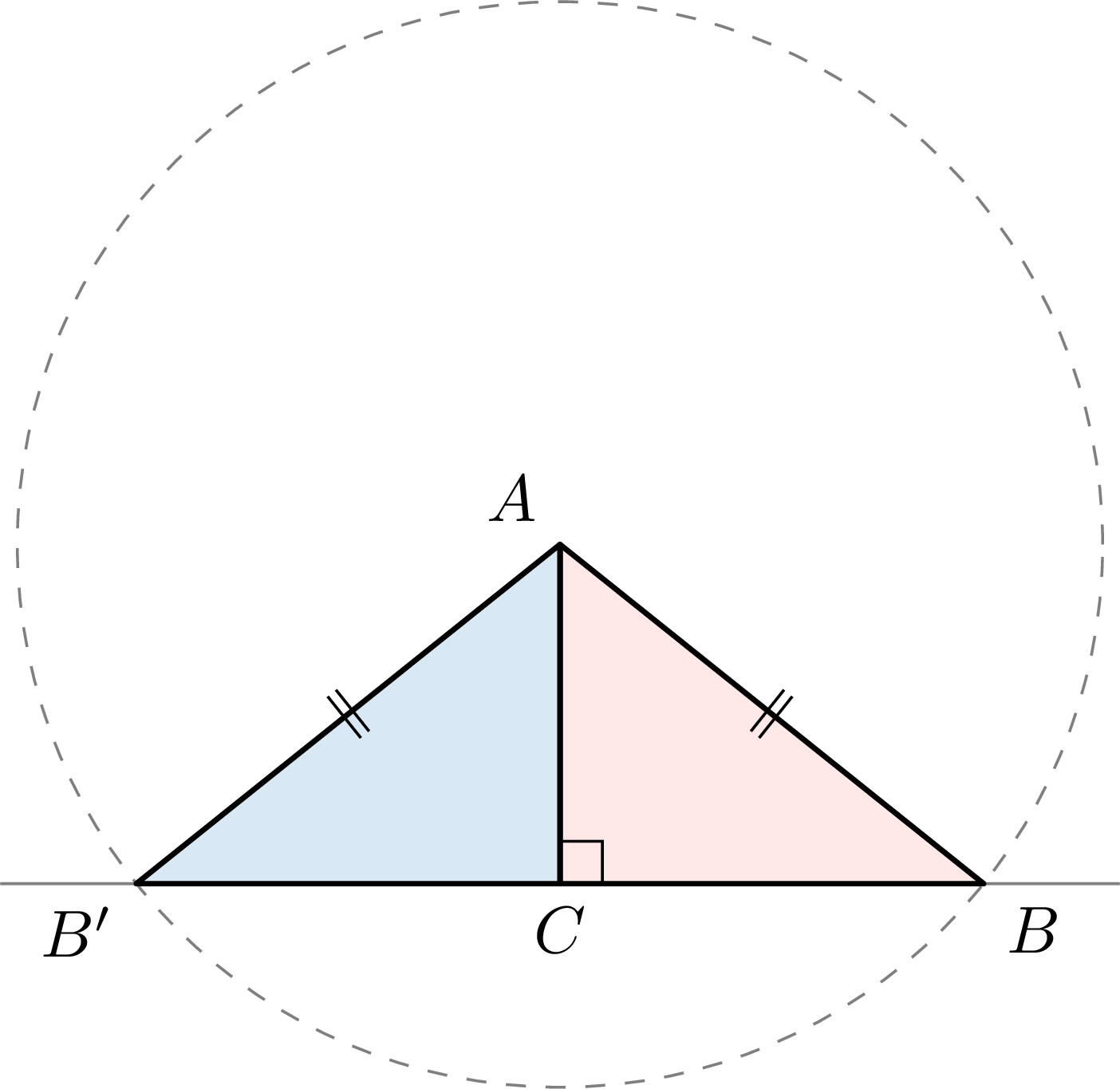
The triangles \(ACB\) and \(ACB'\) are images of each other by the reflection in \(\Line{AC}\): they are congruent, so the data fix the triangle. The right angle makes the difference: it is opposite the longest side, the hypotenuse.
Proposition — Hypotenuse and a Leg
If two right-angled triangles have equal hypotenuses and one leg equal to one leg — a leg is a side of the right angle —, then the two triangles are congruent. This test is written RHS (right angle, hypotenuse, side). 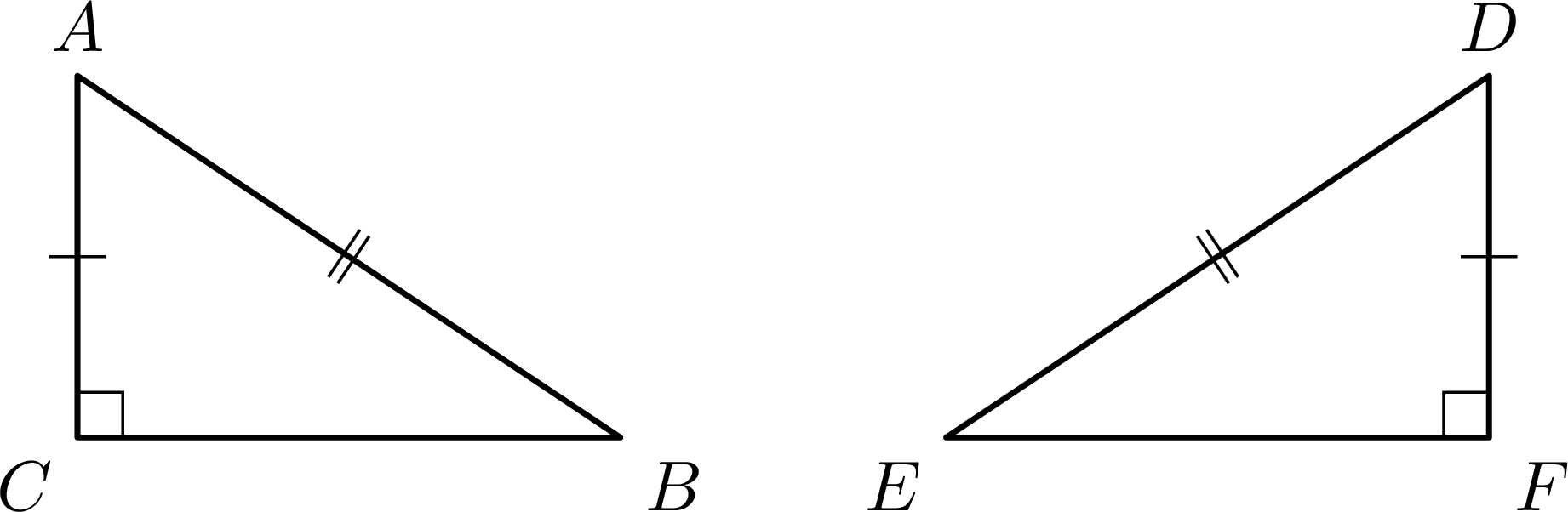
Let \(ABC\) be right-angled at \(C\) and \(DEF\) right-angled at \(F\), with \(AB = DE\) and \(AC = DF\). We show that the third sides are equal too. Pythagoras' theorem in each triangle gives \(AB^2 = AC^2 + BC^2\) and \(DE^2 = DF^2 + EF^2\), so: $$\begin{aligned}[t] BC^2 &= AB^2 - AC^2 && \text{(Pythagoras' theorem in } ABC\text{)}\\
&= DE^2 - DF^2 && (AB = DE\text{ and }AC = DF)\\
&= EF^2. && \text{(Pythagoras' theorem in } DEF\text{)} \end{aligned}$$ \(BC\) and \(EF\) are lengths, so they are positive numbers with the same square: \(BC = EF\). The three sides are equal in pairs: \(AB = DE\), \(AC = DF\), \(BC = EF\). By SSS, the case “three sides” (Proposition “The Three Congruence Cases”), the triangles \(ABC\) and \(DEF\) are congruent.
A second proof, without Pythagoras' theorem. Move the triangle \(DEF\) so that its leg \(\Segment{DF}\) covers \(\Segment{AC}\), with \(D\) on \(A\) and \(F\) on \(C\), and \(E\) on the other side of \(\Line{AC}\) from \(B\). 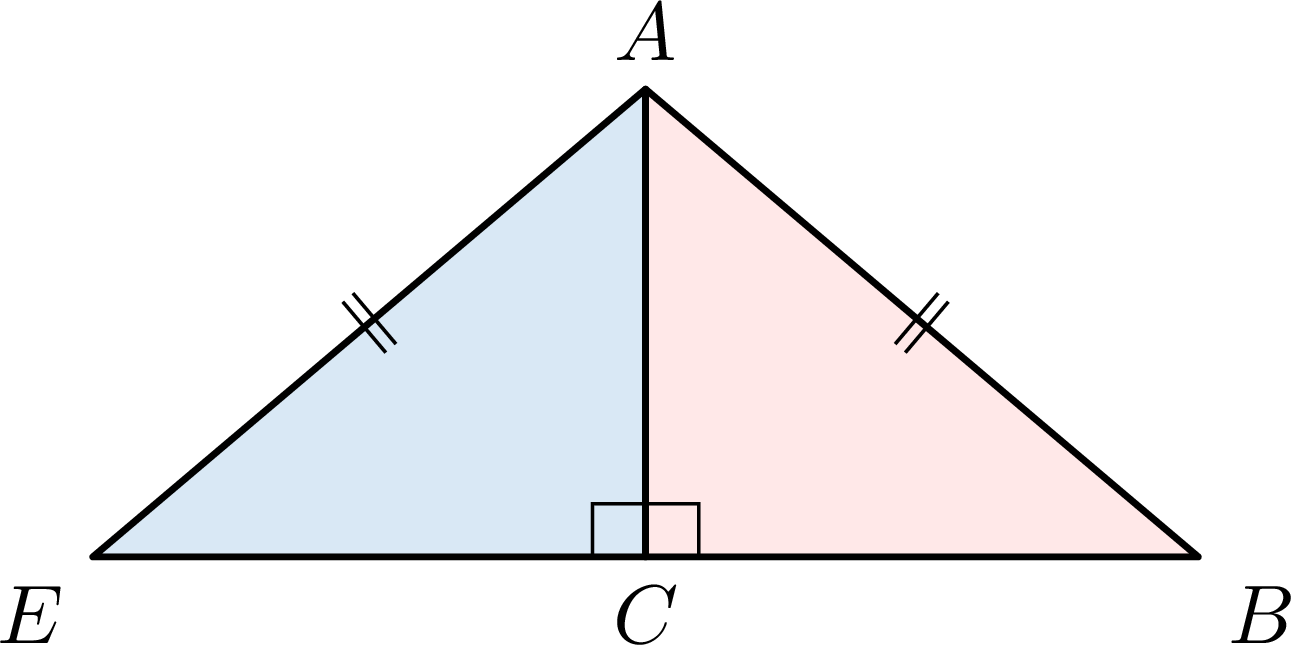
The angles \(\Angle{ACB}\) and \(\Angle{ACE}\) are right angles: together they make \(180^\circ\), so \(B\), \(C\) and \(E\) are collinear. In the triangle \(ABE\), \(AE = DE = AB\): it is isosceles with apex \(A\), so its base angles are equal, \(\Angle{ABC} = \Angle{AEC}\) (Proposition “Angles in an isosceles triangle”). The triangles \(ABC\) and \(AEC\) then have two angles equal in pairs — the right angles at \(C\) and the base angles at \(B\) and \(E\) — and the common side \(\Segment{AC}\), opposite the equal angles at \(B\) and \(E\): they are congruent (AAS). Since \(AEC\) is the triangle \(DEF\) moved, \(\triangle ABC \cong \triangle DEF\).
Example
\(ABC\) is a triangle, and \(H\) is the foot of the altitude from \(A\): the point of \(\Line{BC}\) such that \(\Line{AH} \perp \Line{BC}\). 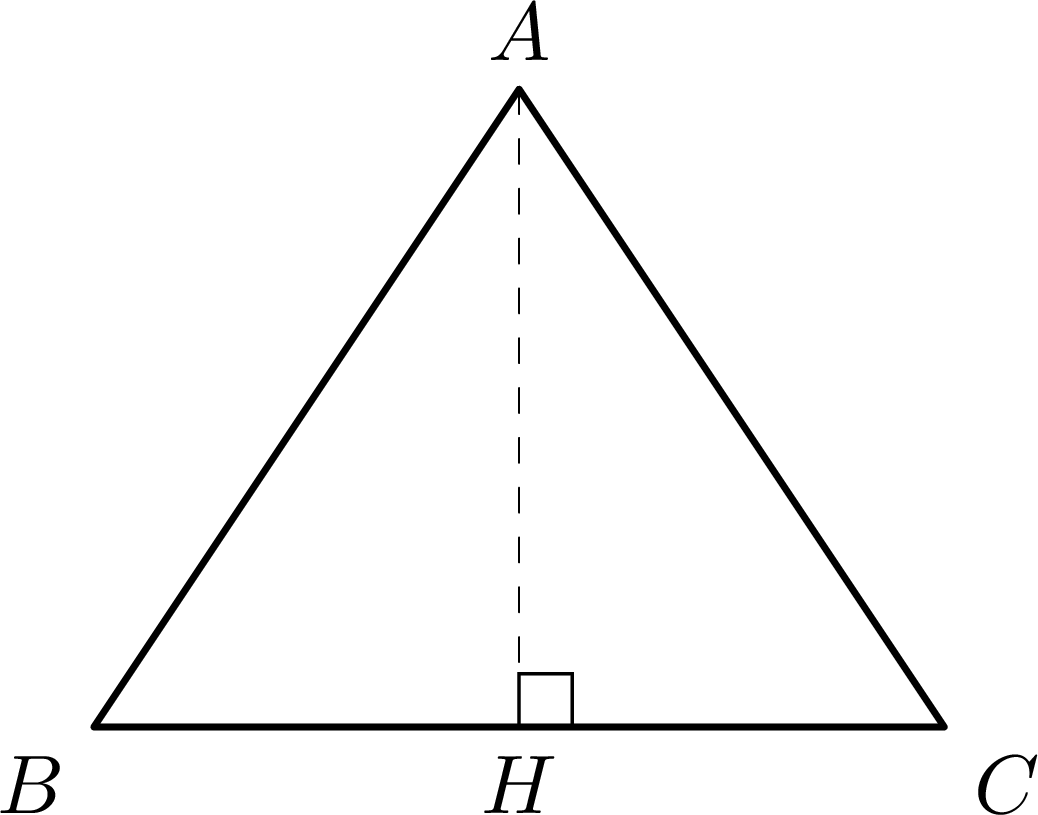
- Suppose that \(AB = AC\). Prove that \(H\) is the midpoint of \(\Segment{BC}\) and that \(\Line{AH}\) bisects the angle \(\Angle{BAC}\).
- Conversely, suppose that \(\Angle{ABC} = \Angle{ACB}\). Prove that \(AB = AC\).
- In the triangles \(AHB\) and \(AHC\) (\(A \leftrightarrow A\), \(H \leftrightarrow H\), \(B \leftrightarrow C\)):
- \(\Angle{AHB} = \Angle{AHC} = 90^\circ\), since \(\Line{AH} \perp \Line{BC}\);
- \(AB = AC\) (given): these are the hypotenuses;
- \(AH = AH\): the leg \(\Segment{AH}\) is common.
- The angles at \(B\) and \(C\) are equal and add up to less than \(180^\circ\): each one is acute. So \(H\) lies strictly between \(B\) and \(C\): \(H\) is neither \(B\) nor \(C\), since the angles at \(B\) and \(C\) are not right angles; and if \(H\) were on \(\Line{BC}\) beyond \(C\), the angle \(\Angle{ACB}\) would be the supplement of the acute angle at \(C\) of the right-angled triangle \(AHC\), hence obtuse (and beyond \(B\), \(\Angle{ABC}\) would be obtuse). In the triangles \(AHB\) and \(AHC\):
- \(\Angle{AHB} = \Angle{AHC} = 90^\circ\);
- \(\Angle{ABH} = \Angle{ACH}\), since \(H\) lies on \(\Segment{BC}\) and \(\Angle{ABC} = \Angle{ACB}\) (given);
- \(AH = AH\): the common side, opposite the equal angles at \(B\) and \(C\).
Example
A circle has centre \(O\). The segment \(\Segment{AB}\) is a chord of the circle that is not a diameter, and \(H\) is the foot of the perpendicular from \(O\) to \(\Line{AB}\). 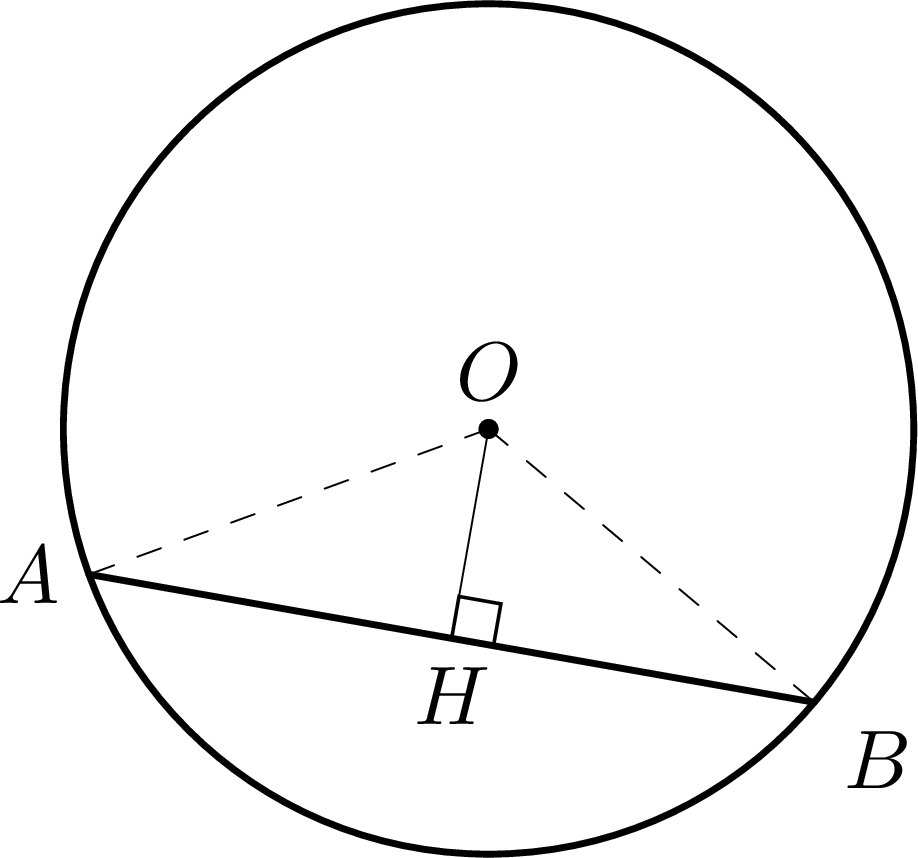
In the triangles \(OHA\) and \(OHB\) (\(O \leftrightarrow O\), \(H \leftrightarrow H\), \(A \leftrightarrow B\)):
- \(\Angle{OHA} = \Angle{OHB} = 90^\circ\), since \(\Line{OH} \perp \Line{AB}\);
- \(OA = OB\): they are radii of the same circle, and they are the hypotenuses;
- \(OH = OH\): the leg \(\Segment{OH}\) is common.
Skills to practice
- Using RHS to Find Lengths and Angles
II.4
Writing a Congruence Proof
The Names of the Tests
Each congruence test is named by the equal elements it needs, read around the triangle: S for a side, A for an angle, R for a right angle, H for the hypotenuse.
AAS is also written AAcorS: two angles and a corresponding side. The order of the letters says where the elements are: in SAS the angle lies between the two sides, in ASA the side lies between the two angles. SSA and AAA are not tests in general (Remark “Three Pieces of Data That Are Not Enough”): two sides and a non-included angle are enough when the angle faces the longer of the two sides (as in RHS) or when these two sides are equal; otherwise, in general, they are not.
| Name | Equal elements |
| SSS | three sides |
| SAS | two sides and the included angle |
| ASA | a side and its two adjacent angles |
| AAS | two angles and a corresponding side |
| RHS | right angle, hypotenuse and a leg |
Congruence in English and in French
The same ideas are named differently in French:
The symbol \(\cong\) is read “is congruent to”. French texts usually name each test by its words rather than by its letters.
| English | French |
| congruent figures | “figures isométriques” or “superposables” |
| congruent triangles | “triangles égaux” |
| \(\triangle ABC \cong \triangle DEF\) | “\(ABC\) et \(DEF\) sont égaux” |
| the congruence tests | “les cas d'égalité des triangles” |
Laying Out a Congruence Proof
A congruence proof follows the Method “Proving That Two Triangles Are Congruent” and is laid out in the same order every time:
- the two triangles, with their vertices in corresponding order;
- three equalities, one per line, each followed by its reason: (given), (common side), (vertically opposite angles), (radii of the same circle), (alternate angles)…;
- the test, named, and the congruence: \(\triangle ABC \cong \triangle DEF\) (SAS);
- the deduction: the other corresponding sides and angles are equal.
Example
In the triangle \(ABC\), \(BC = a\), \(CA = b\) and \(AB = c\), with \(a^2 + b^2 = c^2\). 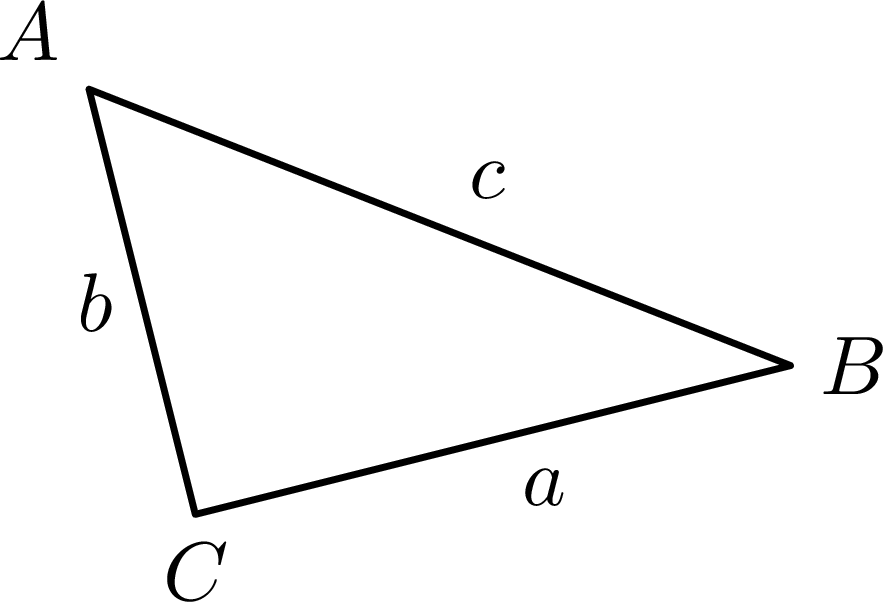
We compare \(ABC\) with a triangle known to be right-angled. Construct a triangle \(DEF\) right-angled at \(F\), with \(FE = a\) and \(FD = b\). 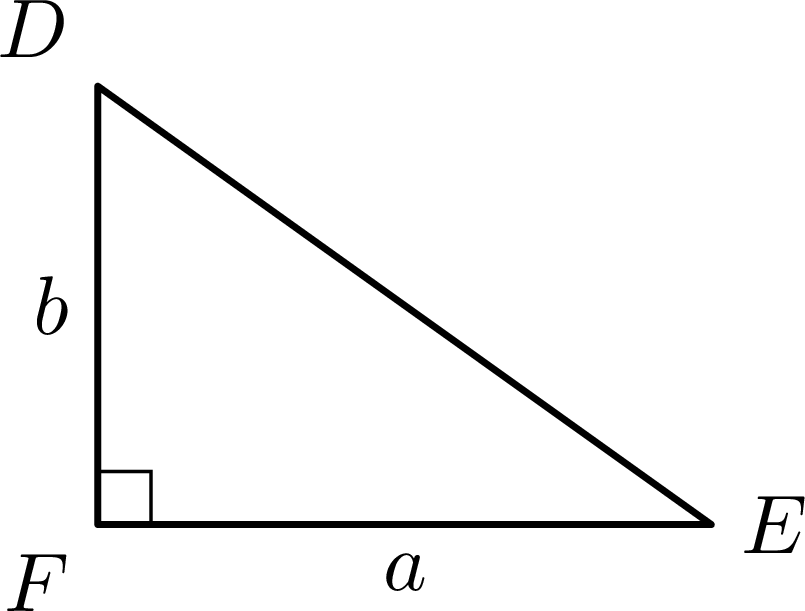
Its hypotenuse is \(\Segment{DE}\): $$\begin{aligned}[t] DE^2 &= FE^2 + FD^2 && \text{(Pythagoras' theorem in } DEF\text{, right-angled at } F\text{)}\\
&= a^2 + b^2 && \text{(construction)}\\
&= c^2. && \text{(hypothesis)} \end{aligned}$$ \(DE\) and \(c\) are positive, so \(DE = c\). In the triangles \(ABC\) and \(DEF\) (\(A \leftrightarrow D\), \(B \leftrightarrow E\), \(C \leftrightarrow F\)):
- \(BC = EF\) (both equal \(a\): construction);
- \(CA = FD\) (both equal \(b\): construction);
- \(AB = DE\) (both equal \(c\): just shown).
Skills to practice
- Choosing the Test
- Completing a Proof
- Finding Lengths and Angles by Congruence
- Proving with AAS and RHS
III
Going further
Skills to practice
- Proving with Congruent Triangles
- Solving Problems with Congruent Triangles
- Investigating Which Data Fix a Triangle
- Measuring with Congruent Triangles
- Quiz
Jump to section