International Baccalaureate · MYP 3
Similarity
I
Similar Figures
I.1
Similarity and Scale Factor
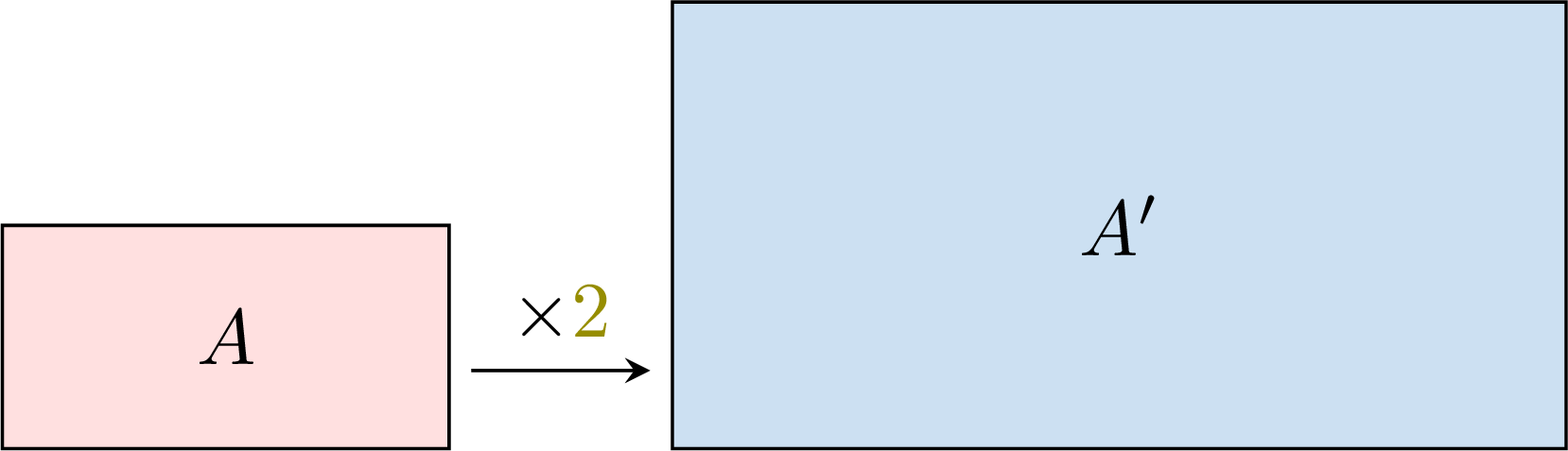
Examine the rectangles shown below. Although their sizes differ, they have the same shape because the proportions of their side lengths are identical. 
When \(\textcolor{colordef}{A}\) is enlarged to form \(\textcolor{colorprop}{A'}\), the side lengths are doubled. The scale factor is \(\textcolor{olive}{2}\).
Definition — Similarity and Enlargement/Reduction
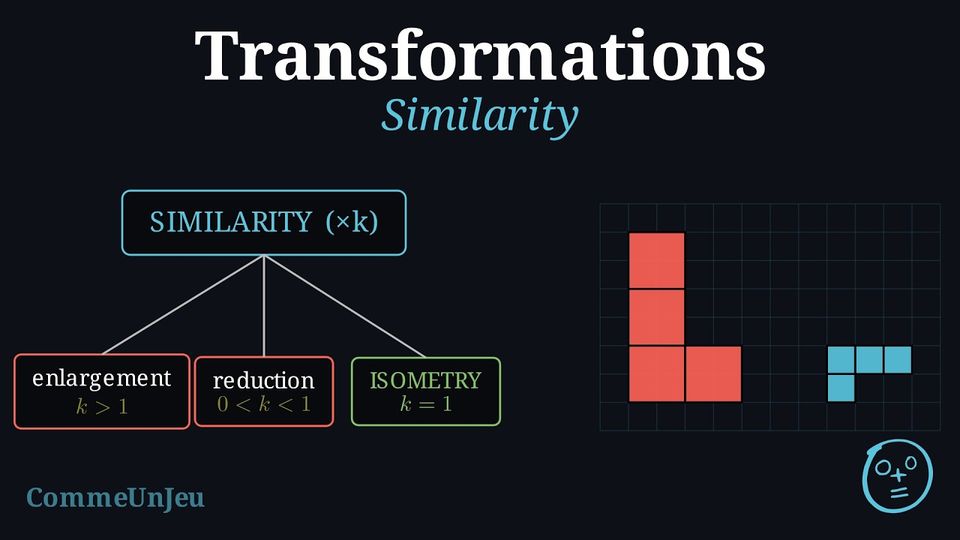
A similarity with scale factor \(k>0\) is a transformation that multiplies all distances by the same number \(k\). - If \(k>1\), the similarity enlarges the figure: an enlargement, possibly followed by a turn or a flip.
- If \(0 < k < 1\), the similarity reduces the figure: a reduction, possibly followed by a turn or a flip.

- If \(k=1\), the similarity preserves all distances (it is an isometry), so the figure has the same size and shape.
Skills to practice
- Finding the Image of a Vertex
- Finding the Scale Factor
I.2
Similar Figures and Their Properties
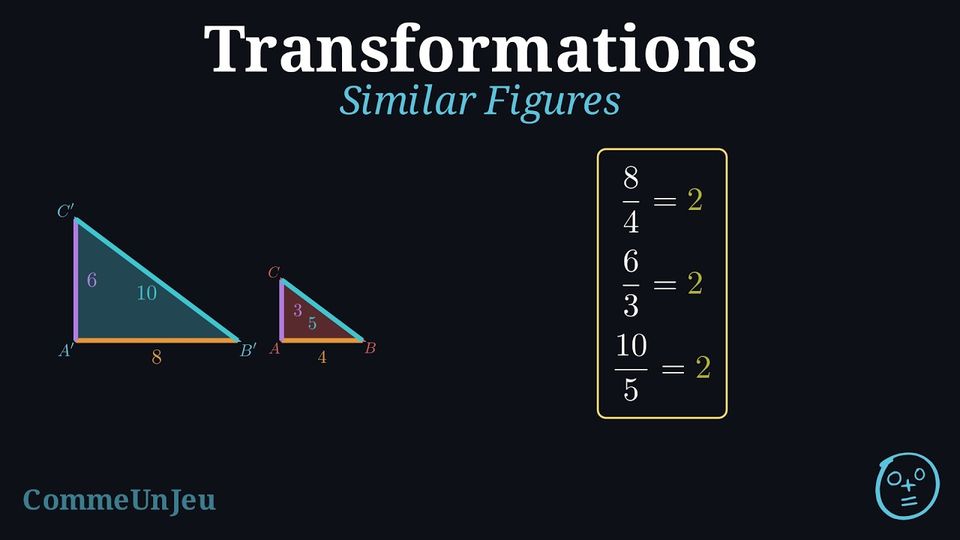
The figure \(F'\) is an enlargement of the figure \(F\) by a scale factor of \(2\). 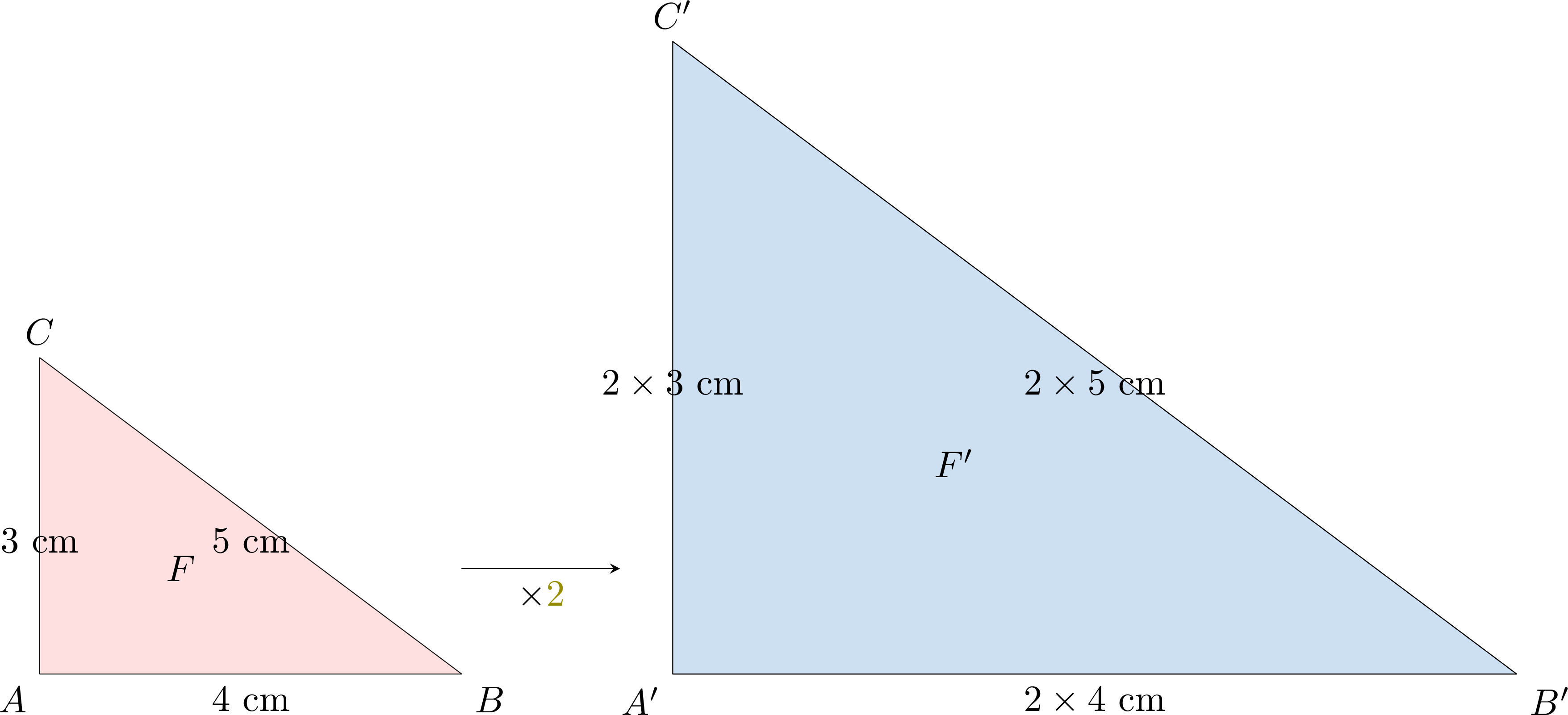
The ratios of the corresponding sides are:
- \(\dfrac{\textcolor{colorprop}{A'B'}}{\textcolor{colordef}{AB}} = \dfrac{2 \times 4~\text{cm}}{4~\text{cm}} = \textcolor{olive}{2}\)
- \(\dfrac{\textcolor{colorprop}{A'C'}}{\textcolor{colordef}{AC}} = \dfrac{2 \times 3~\text{cm}}{3~\text{cm}} = \textcolor{olive}{2}\)
- \(\dfrac{\textcolor{colorprop}{B'C'}}{\textcolor{colordef}{BC}} = \dfrac{2 \times 5~\text{cm}}{5~\text{cm}} = \textcolor{olive}{2}\)
Definition — Similar Figures
Two figures are similar if one can be obtained from the other by a similarity (an enlargement or a reduction, possibly combined with an isometry, or an isometry alone). Proposition — Properties of Similar Figures
For similar figures: - The ratios of the lengths of corresponding sides are all equal to the same scale factor (or similarity ratio).
- The corresponding angles are equal.
Example
The figures \(\textcolor{colordef}{F}\) and \(\textcolor{colorprop}{F'}\) are similar. Find \(x\). 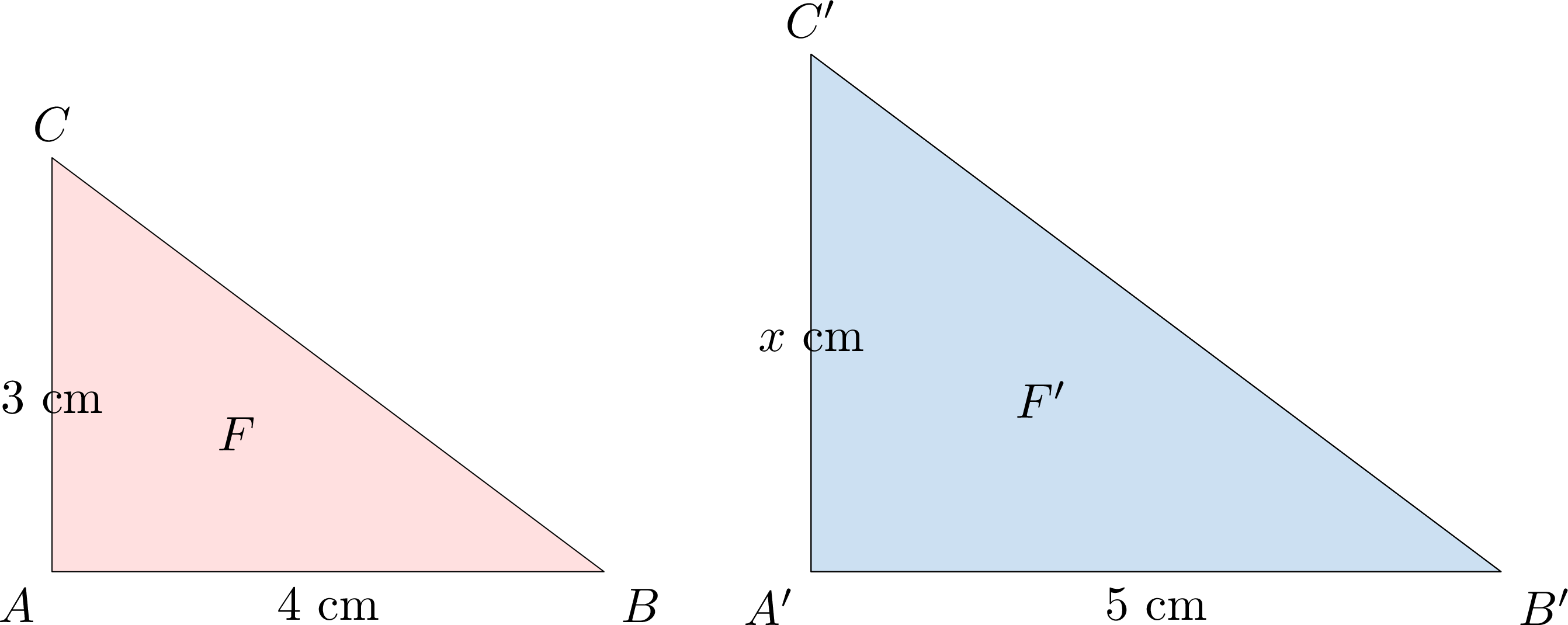
The ratios of the corresponding sides are equal:$$\begin{aligned}\dfrac{\textcolor{colorprop}{A'C'}}{\textcolor{colordef}{AC}} &= \dfrac{\textcolor{colorprop}{A'B'}}{\textcolor{colordef}{AB}} \\
\dfrac{x}{3} &= \dfrac{5}{4} \\
x &= 3 \times \dfrac{5}{4} \\
x &= 3.75~\text{cm}\end{aligned}$$
Skills to practice
- Deciding Whether Shapes Are Always Similar
- Finding an Unknown Length
II
Similar Triangles
II.1
The Similarity Criteria
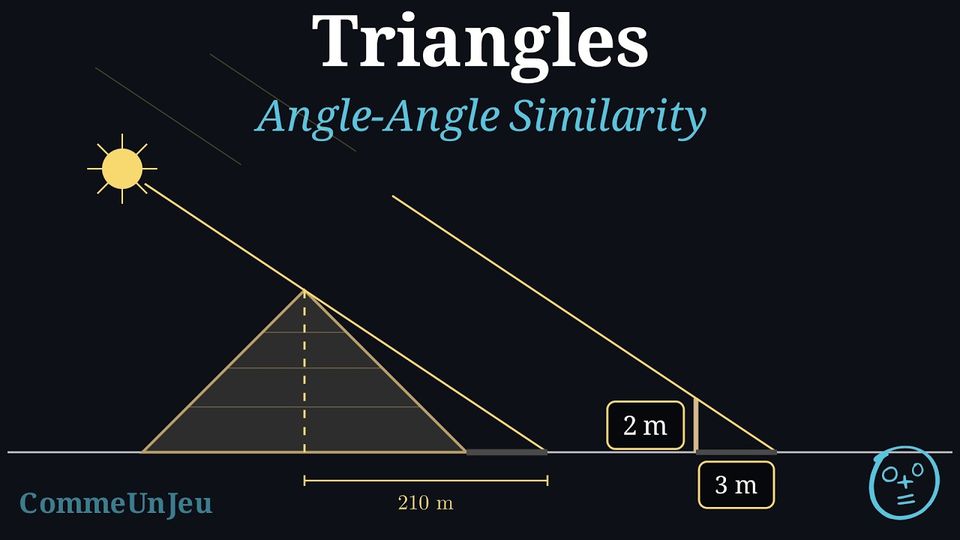
Thales, an ancient Greek mathematician, used shadows to measure the height of the Great Pyramid. He measured the pyramid's shadow and, at the same time, the shadow of a staff of a known height. 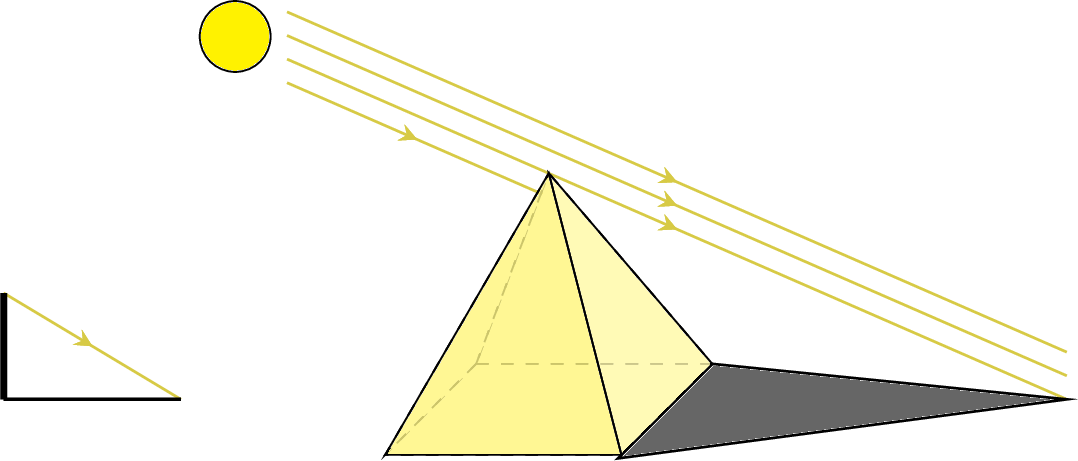
- The tip of the pyramid's shadow was 210 metres from the centre of its base (Thales added half the base to the shadow he measured).
- A staff 2 metres tall, placed vertically, cast a shadow 3 metres long.
At the same moment, the sun's rays are parallel: the staff and the pyramid are both vertical, so the two right-angled triangles (the staff and its shadow; the height of the pyramid and the \(210\) m from the centre of its base to the tip of its shadow) have the same angles, and their sides are proportional: $$\dfrac{h}{2} = \dfrac{210}{3}, \qquad h = \dfrac{2 \times 210}{3} = 140 \text{ m.}$$ The Great Pyramid is about \(140\) m tall — measured with a staff and a shadow. The tools behind this stroke of genius are worth building.
Proposition — Angle-Angle Similarity for Triangles
If two angles of one triangle are equal to two angles of another triangle, then the two triangles are similar.
This criterion is proved as a consequence of Thales's theorem — whose own proof uses nothing but areas; the guided proof is a problem of the section Going further.
Definition — Scale Factor
When two triangles are similar, the ratios of corresponding sides are all equal to one number \(k\), called the scale factor:$$k = \dfrac{A'B'}{AB} = \dfrac{A'C'}{AC} = \dfrac{B'C'}{BC}.$$ Every length of the second triangle is \(k\) times the matching length of the first. If \(k > 1\) the triangle is enlarged; if \(k < 1\) it is reduced; if \(k = 1\) the two triangles are congruent. Example
Two similar triangles have corresponding sides \(AB = 4\) cm and \(A'B' = 10\) cm. What is the scale factor from \(\triangle ABC\) to \(\triangle A'B'C'\)? If \(BC = 6\) cm, how long is \(B'C'\)?
$$\begin{aligned}[t] k &= \dfrac{A'B'}{AB} = \dfrac{10}{4} = 2.5 && \text{(ratio of corresponding sides)} \\
B'C' &= k \times BC = 2.5 \times 6 = 15 \text{ cm.} && \text{(every length is multiplied by } k\text{)} \end{aligned}$$
Proposition — SAS Similarity
If an angle of one triangle equals an angle of another triangle, and the sides forming these two angles are proportional, then the two triangles are similar. Example
In \(\triangle ABC\): \(AB = 4\), \(AC = 6\) and \(\angle A = 50^\circ\). In \(\triangle DEF\): \(DE = 6\), \(DF = 9\) and \(\angle D = 50^\circ\). Are the triangles similar?
$$\begin{aligned}[t] \dfrac{DE}{AB} &= \dfrac{6}{4} = 1.5 \\
\dfrac{DF}{AC} &= \dfrac{9}{6} = 1.5 \end{aligned}$$ The sides forming the equal angles (\(\angle A = \angle D = 50^\circ\)) are proportional, so by SAS similarity the triangles are similar, with scale factor \(1.5\).
Proposition — SSS Similarity
If the three sides of one triangle are proportional to the three sides of another triangle, then the two triangles are similar. Example
A triangle has sides \(3\), \(5\), \(7\); another has sides \(4.5\), \(7.5\), \(10.5\). Are they similar?
$$\dfrac{4.5}{3} = 1.5, \qquad \dfrac{7.5}{5} = 1.5, \qquad \dfrac{10.5}{7} = 1.5.$$ The three ratios are equal: by SSS similarity the triangles are similar, with scale factor \(1.5\).
The AA criterion is the one proved (in the section Going further) and the one that powers the rest of the chapter; SAS and SSS, accepted without proof, are its companions for the situations where not all angles are known.
Skills to practice
- Deciding Whether Two Triangles Are Similar
- Proving That Triangles Are Similar
II.2
The Intercept Theorem
How high is the bell tower, without climbing it? Lucie lies on the ground, her eye at \(O\). Her friend holds a \(1.5\) m stick upright, \(2\) m from her eye, and moves it until its top \(S\) lines up exactly with the top \(T\) of the tower. The foot \(K\) of the tower is \(40\) m from \(O\). 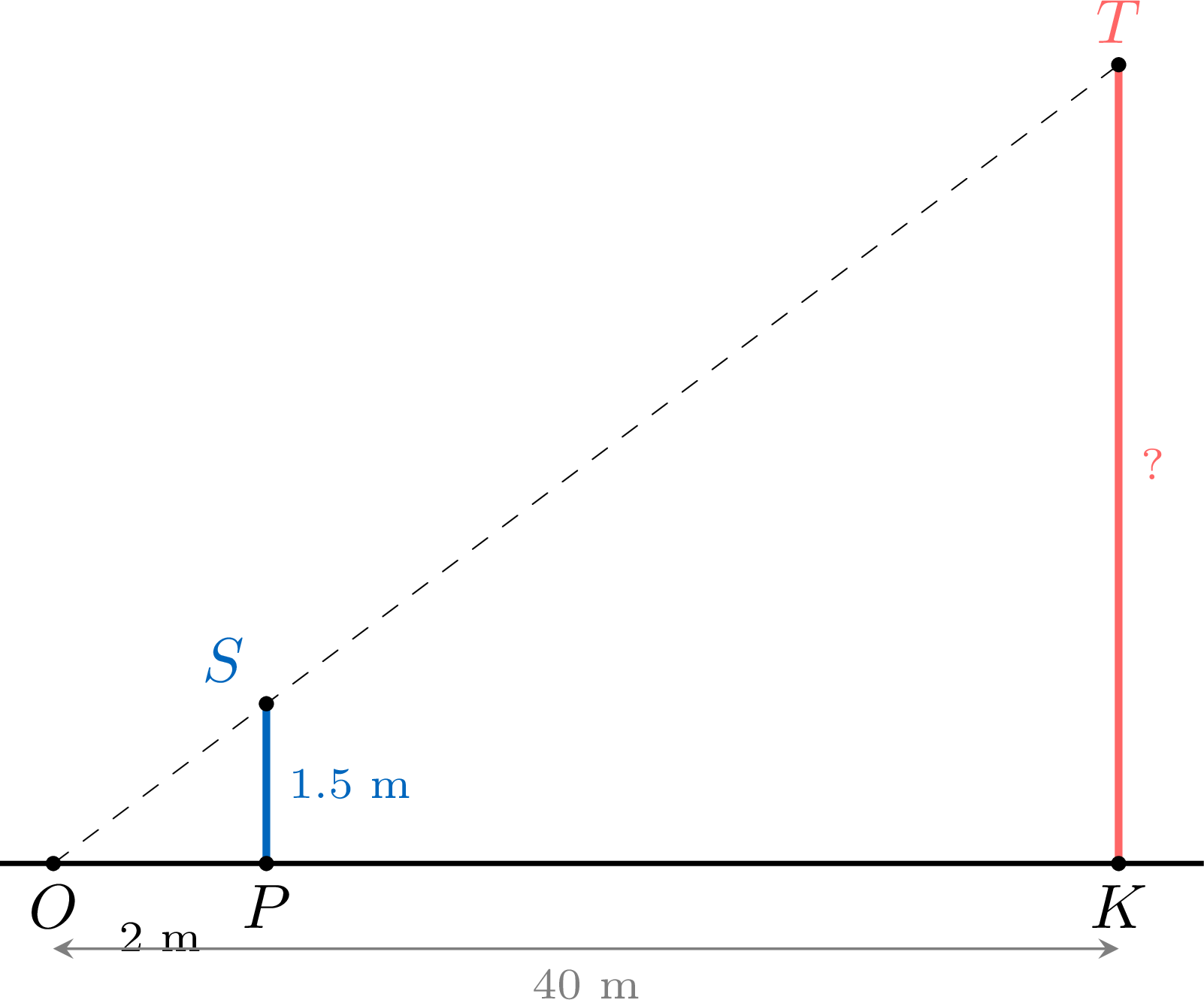
The stick and the tower are both vertical, so \(\Line{PS} \parallel \Line{KT}\); the points \(O\), \(S\), \(T\) are collinear, on the line of sight, and \(O\), \(P\), \(K\) on the ground. Why does this make the lengths proportional — and how high is the tower?
The small triangle \(OPS\) and the large triangle \(OKT\) share the vertex \(O\); \(P\) lies on \(\Segment{OK}\), \(S\) on \(\Segment{OT}\), and \(\Line{PS} \parallel \Line{KT}\): the two triangles are nested. This is exactly the situation described by Thales's theorem, which this chapter is about to state: the lengths of the small triangle are proportional to those of the large one, $$\dfrac{PS}{KT} = \dfrac{OP}{OK}, \qquad \text{so} \qquad KT = \dfrac{1.5 \times 40}{2} = 30 \text{ m.}$$ The bell tower is \(30\) m high — measured lying on the ground, with a stick.
Theorem — The Intercept Theorem (Thales's Theorem)
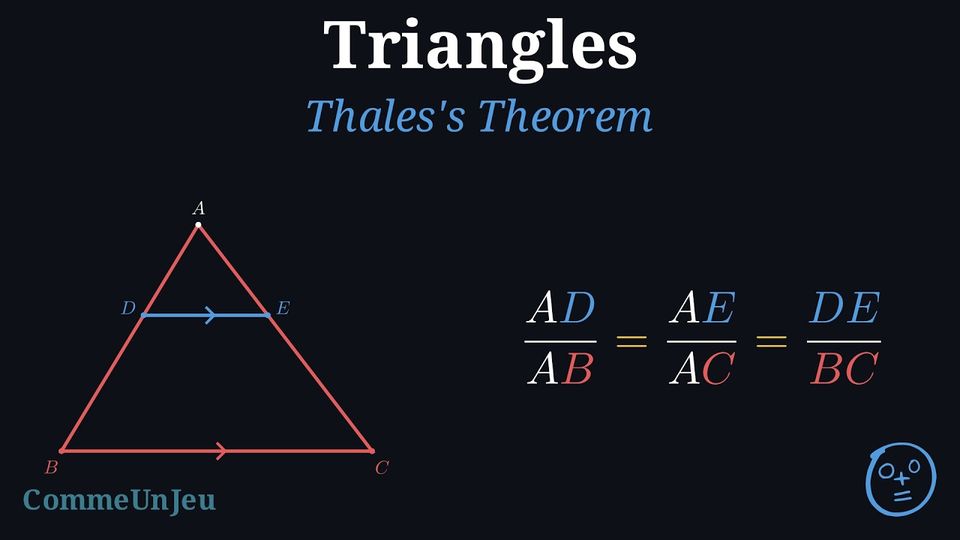
Let \(\textcolor{colordef}{\triangle ABC}\) be a triangle, with a point \(\textcolor{colorprop}{D}\) on the line \(\Line{A\textcolor{colordef}{B}}\) and a point \(\textcolor{colorprop}{E}\) on the line \(\Line{A\textcolor{colordef}{C}}\), both distinct from \(A\).If the line \(\textcolor{colorprop}{\Line{DE}}\) is parallel to the line \(\textcolor{colordef}{\Line{BC}}\), then the triangles \(\textcolor{colordef}{\triangle ABC}\) and \(\textcolor{colorprop}{\triangle ADE}\) are similar: $$\dfrac{A\textcolor{colorprop}{D}}{A\textcolor{colordef}{B}} = \dfrac{A\textcolor{colorprop}{E}}{A\textcolor{colordef}{C}} = \dfrac{\textcolor{colorprop}{DE}}{\textcolor{colordef}{BC}}$$
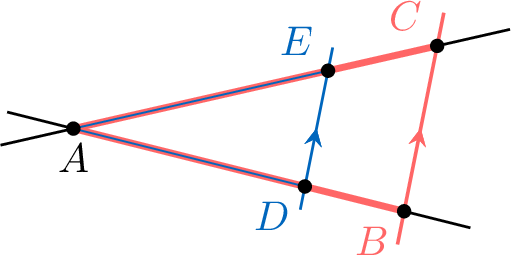
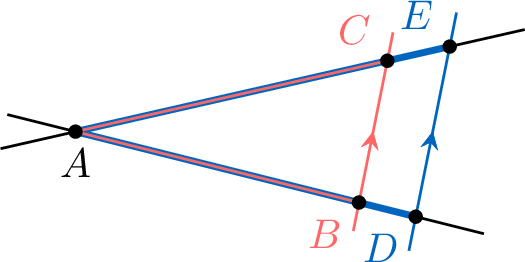
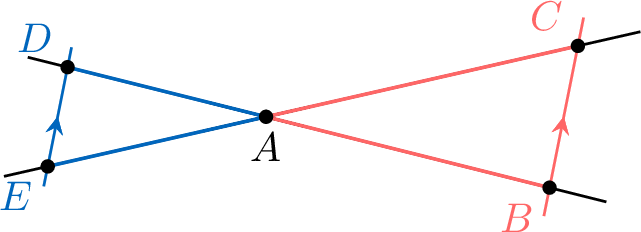
Each blue triangle is similar to the red triangle.
We first prove \(\dfrac{A\textcolor{colorprop}{D}}{A\textcolor{colordef}{B}} = \dfrac{A\textcolor{colorprop}{E}}{A\textcolor{colordef}{C}}\) using areas.
Join \(\textcolor{colordef}{B}\) to \(\textcolor{colorprop}{E}\) and \(\textcolor{colordef}{C}\) to \(\textcolor{colorprop}{D}\). The triangles \(\triangle B\textcolor{colorprop}{DE}\) and \(\triangle C\textcolor{colorprop}{DE}\) have the same base \(\Segment{DE}\) and the same height — the distance between the parallel lines \(\textcolor{colorprop}{\Line{DE}}\) and \(\textcolor{colordef}{\Line{BC}}\) — so they have the same area. Adding the area of \(\triangle A\textcolor{colorprop}{DE}\) to each, we get$$\text{area}(\triangle A\textcolor{colordef}{B}\textcolor{colorprop}{E}) = \text{area}(\triangle A\textcolor{colordef}{C}\textcolor{colorprop}{D}).$$ 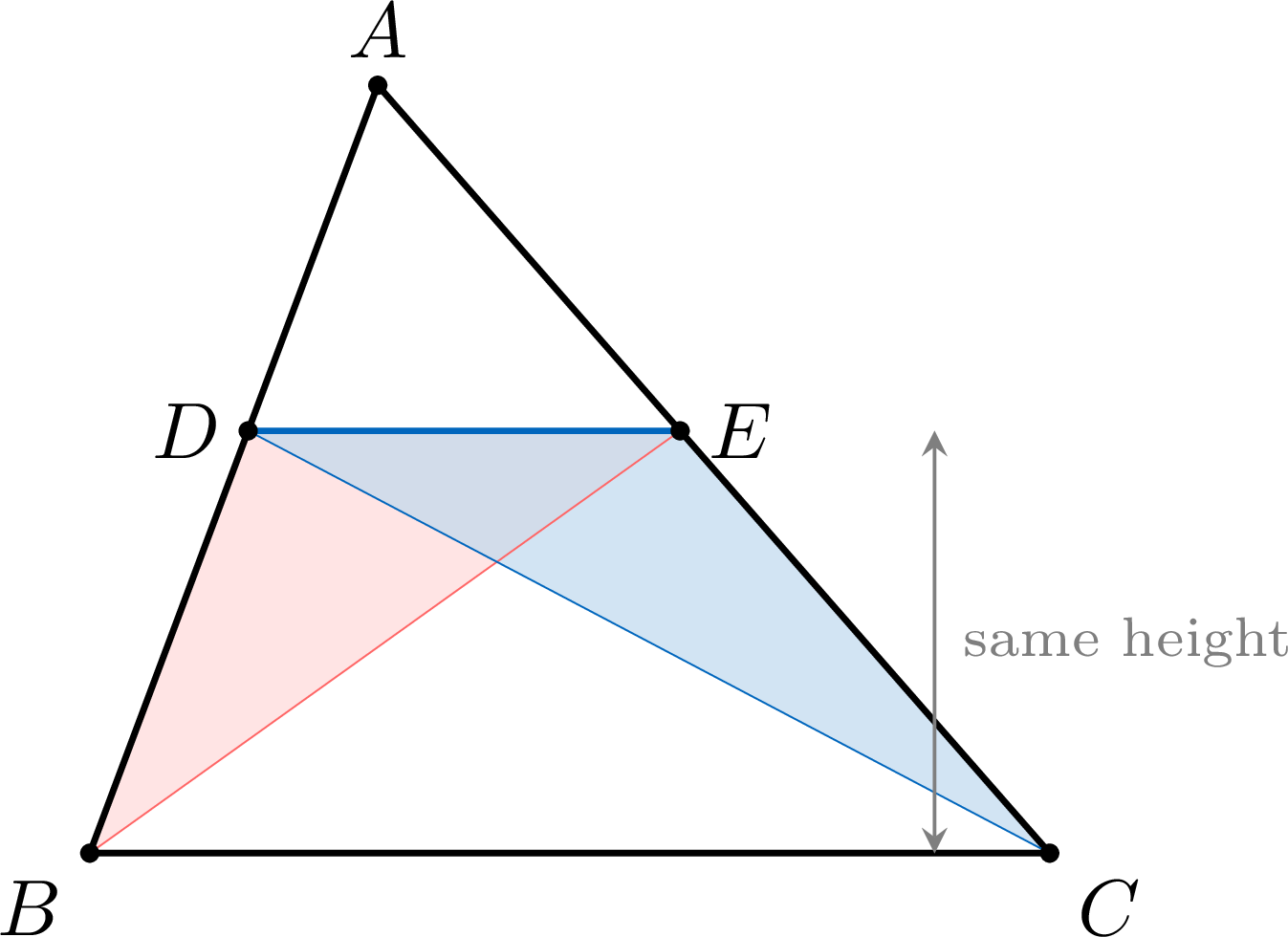
Now \(\triangle A\textcolor{colorprop}{DE}\) and \(\triangle A\textcolor{colordef}{B}\textcolor{colorprop}{E}\) have the same apex \(\textcolor{colorprop}{E}\) and their bases \(A\textcolor{colorprop}{D}\), \(A\textcolor{colordef}{B}\) lie on the same line, so their areas are in the ratio of their bases; the same holds for \(\triangle A\textcolor{colorprop}{DE}\) and \(\triangle A\textcolor{colordef}{C}\textcolor{colorprop}{D}\) with bases \(A\textcolor{colorprop}{E}\), \(A\textcolor{colordef}{C}\). Therefore$$\dfrac{A\textcolor{colorprop}{D}}{A\textcolor{colordef}{B}} = \dfrac{\text{area}(\triangle A\textcolor{colorprop}{DE})}{\text{area}(\triangle A\textcolor{colordef}{B}\textcolor{colorprop}{E})} = \dfrac{\text{area}(\triangle A\textcolor{colorprop}{DE})}{\text{area}(\triangle A\textcolor{colordef}{C}\textcolor{colorprop}{D})} = \dfrac{A\textcolor{colorprop}{E}}{A\textcolor{colordef}{C}}.$$ For the third ratio, draw the line through \(\textcolor{colorprop}{E}\) parallel to \(\Line{A\textcolor{colordef}{B}}\); it meets \(\textcolor{colordef}{\Line{BC}}\) at a point \(F\). The quadrilateral \(\textcolor{colorprop}{D}\textcolor{colordef}{B}F\textcolor{colorprop}{E}\) has two pairs of parallel sides, so it is a parallelogram and \(\textcolor{colordef}{B}F = \textcolor{colorprop}{DE}\). 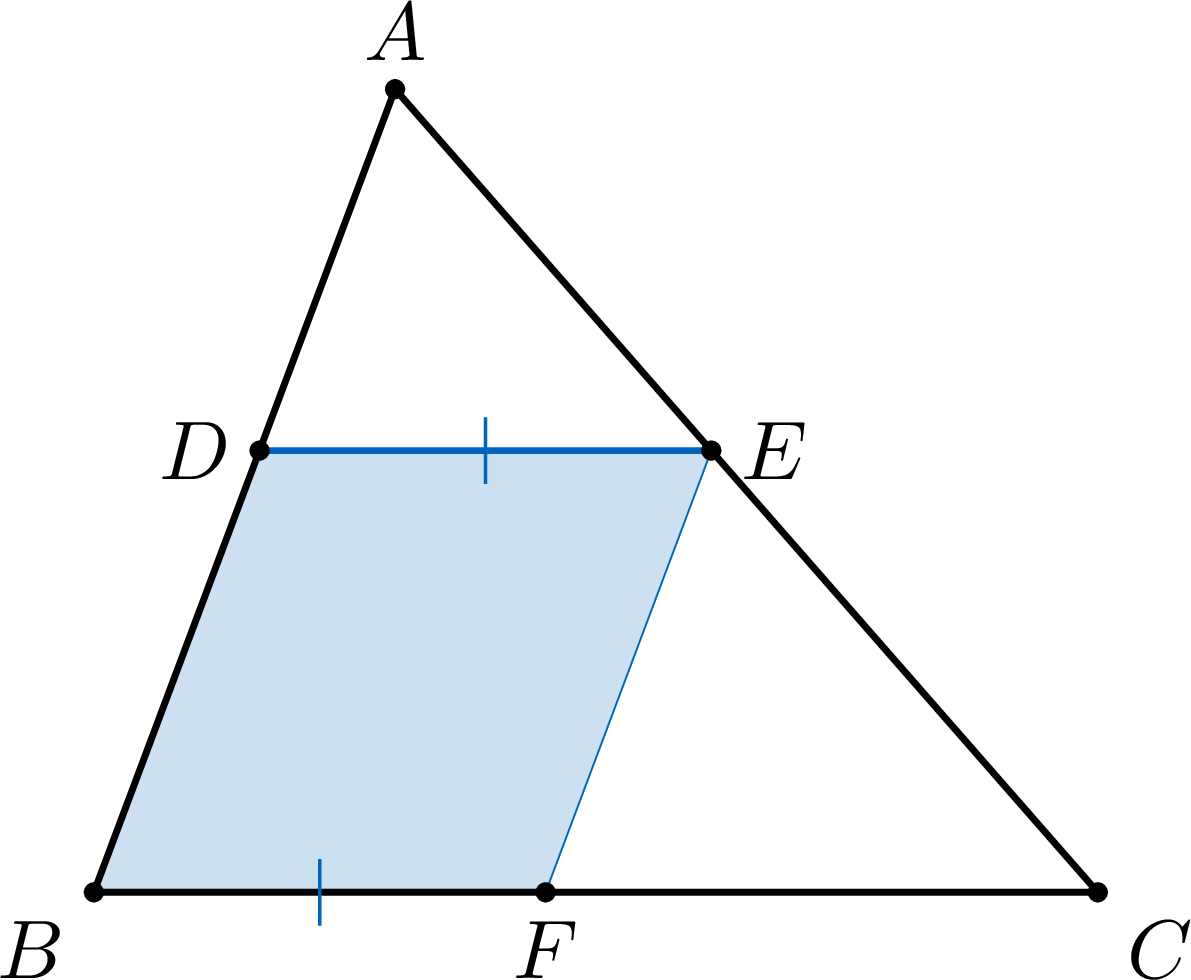
Applying the first result in the triangle read from \(\textcolor{colordef}{C}\) (with the parallel \(\Line{\textcolor{colorprop}{E}F} \parallel \Line{A\textcolor{colordef}{B}}\)):$$\dfrac{\textcolor{colordef}{C}F}{\textcolor{colordef}{CB}} = \dfrac{\textcolor{colordef}{C}\textcolor{colorprop}{E}}{\textcolor{colordef}{C}A} , \quad\text{hence, since } BF = BC - CF \text{ and } AE = AC - CE,\quad \dfrac{\textcolor{colordef}{B}F}{\textcolor{colordef}{BC}} = \dfrac{A\textcolor{colorprop}{E}}{A\textcolor{colordef}{C}} \quad\text{and so}\quad \dfrac{\textcolor{colorprop}{DE}}{\textcolor{colordef}{BC}} = \dfrac{A\textcolor{colorprop}{E}}{A\textcolor{colordef}{C}} = \dfrac{A\textcolor{colorprop}{D}}{A\textcolor{colordef}{B}}.$$ Finally, since \(\textcolor{colorprop}{\Line{DE}} \parallel \textcolor{colordef}{\Line{BC}}\), the corresponding angles are equal (\(\angle A\textcolor{colorprop}{DE} = \angle A\textcolor{colordef}{BC}\) and \(\angle A\textcolor{colorprop}{ED} = \angle A\textcolor{colordef}{CB}\)) and \(\angle A\) is common: the triangles \(\textcolor{colordef}{\triangle ABC}\) and \(\textcolor{colorprop}{\triangle ADE}\) have equal angles and proportional sides — they are said to be similar:$$\dfrac{A\textcolor{colorprop}{D}}{A\textcolor{colordef}{B}} = \dfrac{A\textcolor{colorprop}{E}}{A\textcolor{colordef}{C}} = \dfrac{\textcolor{colorprop}{DE}}{\textcolor{colordef}{BC}}$$ This proof treats the case where \(D\) lies on the segment \(\Segment{AB}\); the other positions (\(D\) beyond \(B\), or \(D\) and \(E\) on the other side of \(A\) from \(B\) and \(C\) — the “butterfly” configuration presented below) reduce to it and are accepted without proof.
Join \(\textcolor{colordef}{B}\) to \(\textcolor{colorprop}{E}\) and \(\textcolor{colordef}{C}\) to \(\textcolor{colorprop}{D}\). The triangles \(\triangle B\textcolor{colorprop}{DE}\) and \(\triangle C\textcolor{colorprop}{DE}\) have the same base \(\Segment{DE}\) and the same height — the distance between the parallel lines \(\textcolor{colorprop}{\Line{DE}}\) and \(\textcolor{colordef}{\Line{BC}}\) — so they have the same area. Adding the area of \(\triangle A\textcolor{colorprop}{DE}\) to each, we get$$\text{area}(\triangle A\textcolor{colordef}{B}\textcolor{colorprop}{E}) = \text{area}(\triangle A\textcolor{colordef}{C}\textcolor{colorprop}{D}).$$
Example
In triangle \(ABC\), the point \(D\) lies on the segment \(\Segment{AB}\) and the point \(E\) on the segment \(\Segment{AC}\), with \(\Line{DE} \parallel \Line{BC}\), \(AD = 3\) cm, \(AB = 7.5\) cm and \(AC = 10\) cm. Compute \(AE\).
The lines \(\Line{DB}\) and \(\Line{EC}\) cross at \(A\), and \(\Line{DE} \parallel \Line{BC}\): by Thales's theorem, $$\begin{aligned}[t]\dfrac{AD}{AB} &= \dfrac{AE}{AC} \\
\dfrac{3}{7.5} &= \dfrac{AE}{10} \\
AE &= \dfrac{3 \times 10}{7.5} = 4 \text{ cm.}\end{aligned}$$
Thales's theorem also applies when the two triangles sit on either side of the intersection point: the lines \(\Line{BD}\) and \(\Line{CE}\) cross at \(A\), with \(\Line{BC} \parallel \Line{DE}\). This is the butterfly configuration, the theorem's other key figure — the equal ratios are read from \(A\) exactly as before: $$\dfrac{AB}{AD} = \dfrac{AC}{AE} = \dfrac{BC}{DE}.$$ 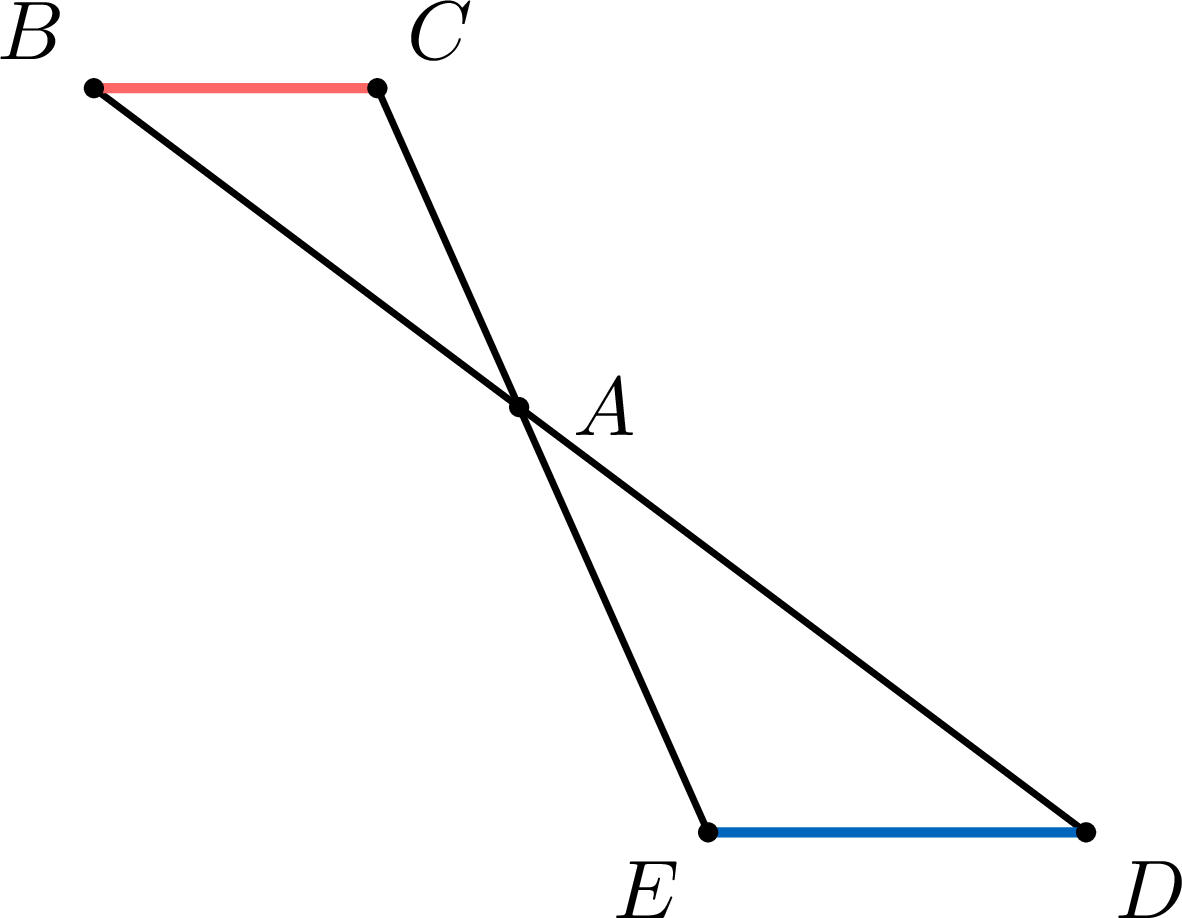
Example
The lines \(\Line{BD}\) and \(\Line{CE}\) cross at \(A\), and \(\Line{BC} \parallel \Line{DE}\), with \(AB = 3\) cm, \(AD = 4\) cm and \(DE = 6\) cm. Compute \(BC\). 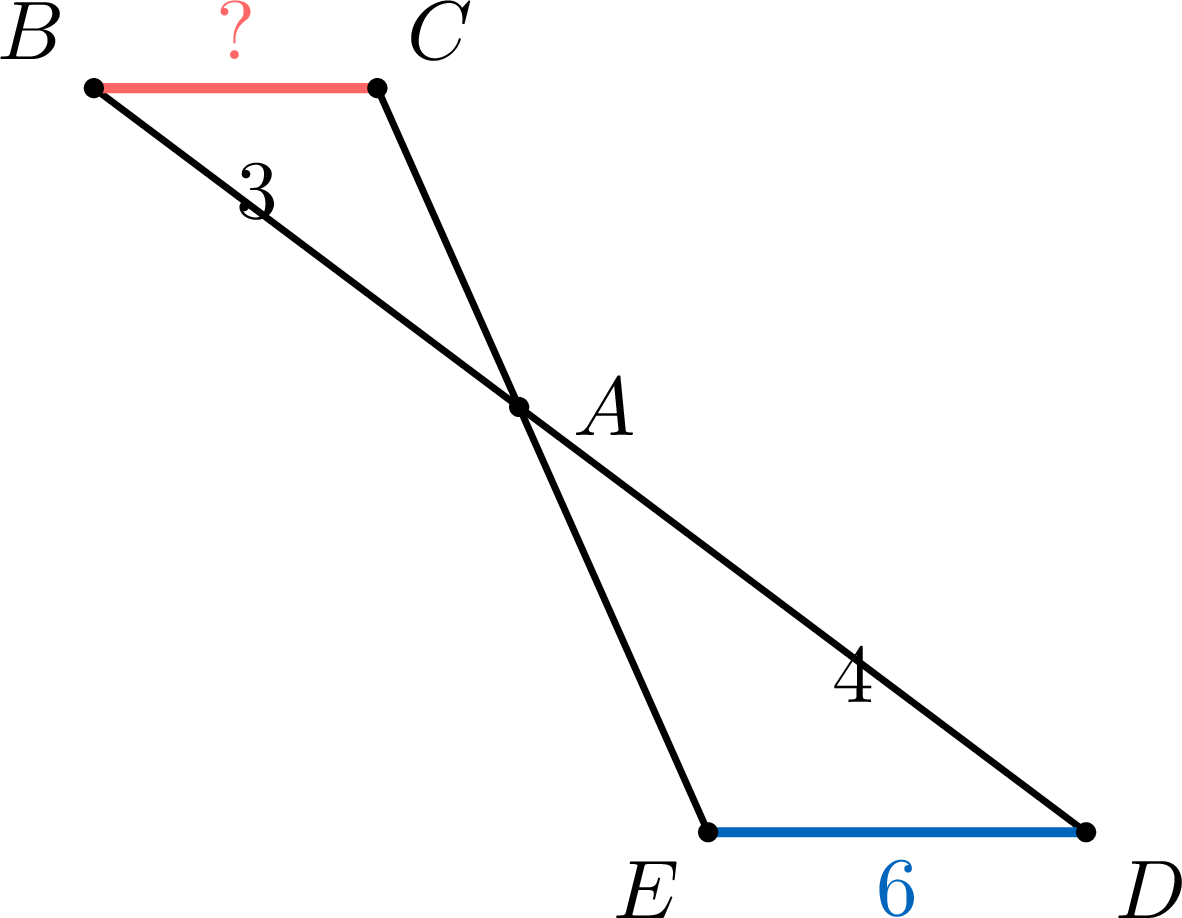
The lines \(\Line{BD}\) and \(\Line{CE}\) cross at \(A\) and \(\Line{BC} \parallel \Line{DE}\): by Thales's theorem, $$\dfrac{AB}{AD} = \dfrac{BC}{DE}, \quad\text{that is}\quad \dfrac{3}{4} = \dfrac{BC}{6}.$$ $$BC = \dfrac{3 \times 6}{4} = \dfrac{18}{4} = 4.5 \text{ cm.}$$ The butterfly changes the picture, not the ratios.
The Angle-Angle criterion and Thales's theorem can be deduced from one another.
Skills to practice
- Computing Lengths with Thales's Theorem
- Applying Thales's Theorem with Justification
- Applying Thales's Theorem in the Butterfly Configuration
III
Going further
Skills to practice
- Solving Real-Life Problems with Similar Triangles
- Investigating Patterns in Similar Figures
- Reasoning and Solving Problems with Similar Figures
- Quiz
Jump to section