International Baccalaureate · MYP 2
Transformations and Symmetry
I
Parallelogram and Properties of a Translation
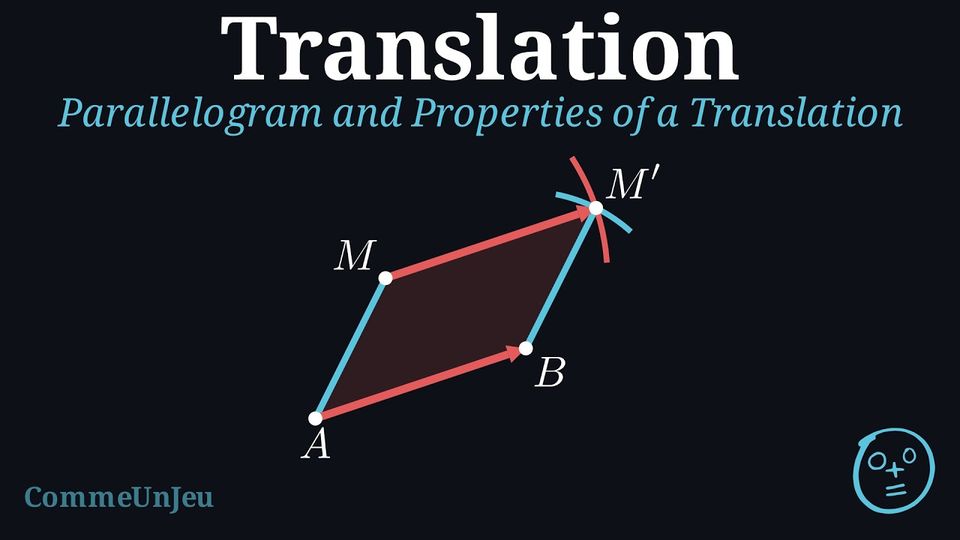
Definition — Translation that Maps A to B
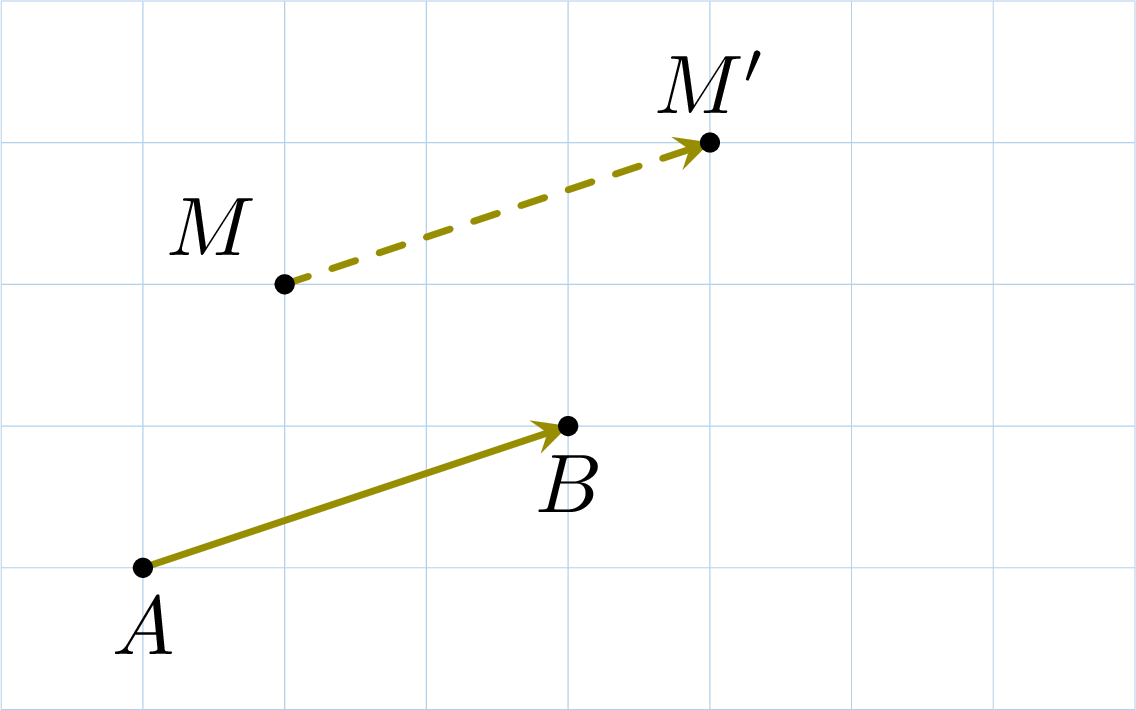
Given two distinct points \(A\) and \(B\), the translation that maps \(A\) to \(B\) is the slide that takes \(A\) onto \(B\).The image \(M'\) of a point \(M\) is obtained by moving \(M\)
- in the direction of the line \(\Line{AB}\),
- the way from \(A\) towards \(B\),
- by the length \(AB\).
Proposition — Translation and Parallelogram
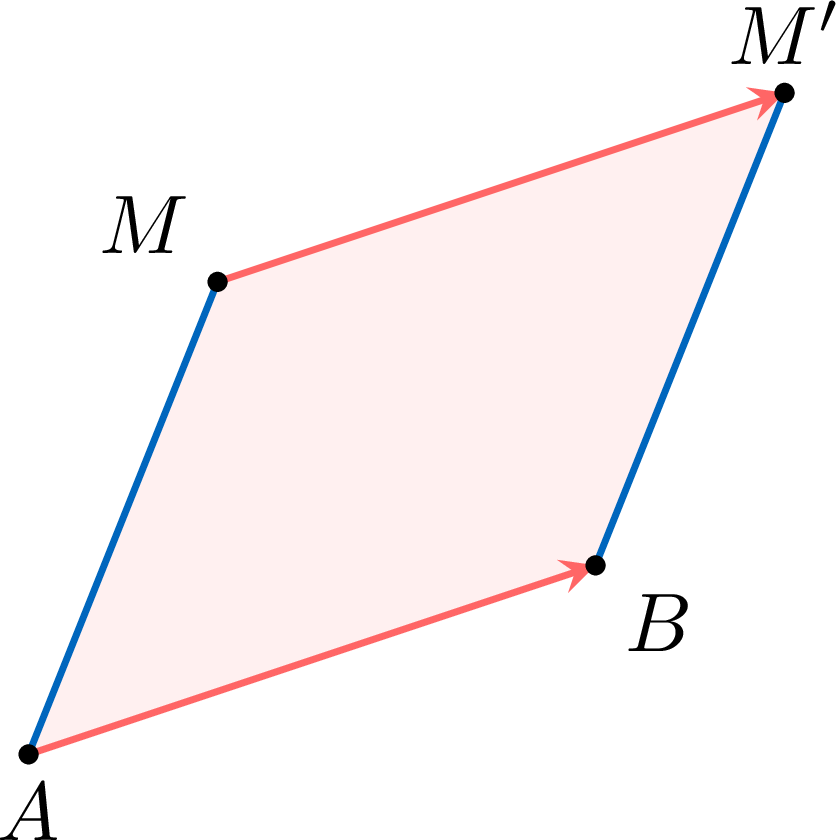
If \(M'\) is the image of \(M\) under the translation that maps \(A\) to \(B\), and \(M\) is not on the line \(\Line{AB}\), then $$\textcolor{colorprop}{ABM'M \text{ is a parallelogram.}}$$ Indeed, the segments \(\Segment{AB}\) and \(\Segment{MM'}\) are parallel and have the same length — by the parallelogram criterion: two opposite sides that are both parallel and of the same length (and \(ABM'M\) is not crossed: \(M\) and \(M'\) follow each other in the same direction as \(A\) and \(B\)).(If \(M\) is on the line \(\Line{AB}\), the four points are aligned: the parallelogram is flattened.)
Method — Constructing an Image with a Compass
To construct the image \(M'\) of a point \(M\) not on the line \(\Line{AB}\), under the translation that maps \(A\) to \(B\) (without a grid), use the parallelogram \(ABM'M\): - Draw an arc with centre \(M\) and radius \(AB\).
- Draw an arc with centre \(B\) and radius \(AM\).
- The point \(M'\) is the intersection of the two arcs on the other side of the line \(\Line{MB}\) from \(A\) — so that \(ABM'M\) is not crossed.
Example
\(A\), \(B\) and \(M\) are three points, with no grid. Construct the image \(M'\) of \(M\) under the translation that maps \(A\) to \(B\), and explain the construction. 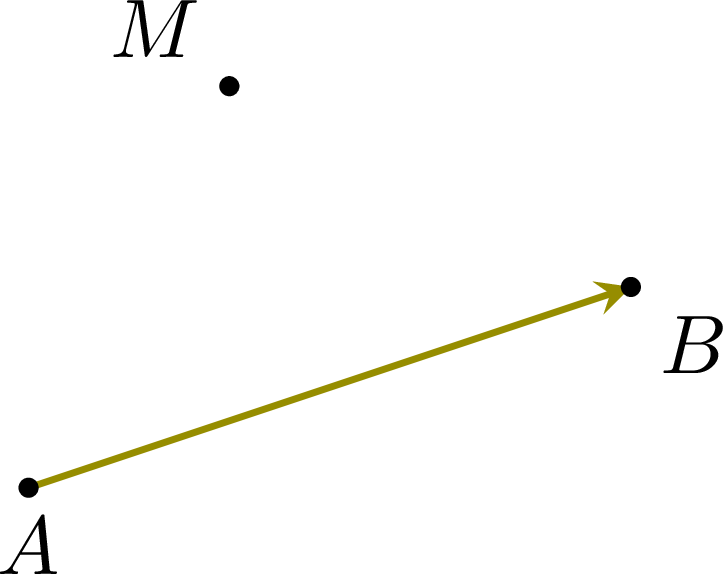
\(ABM'M\) must be a parallelogram, so \(MM' = AB\) and \(BM' = AM\): 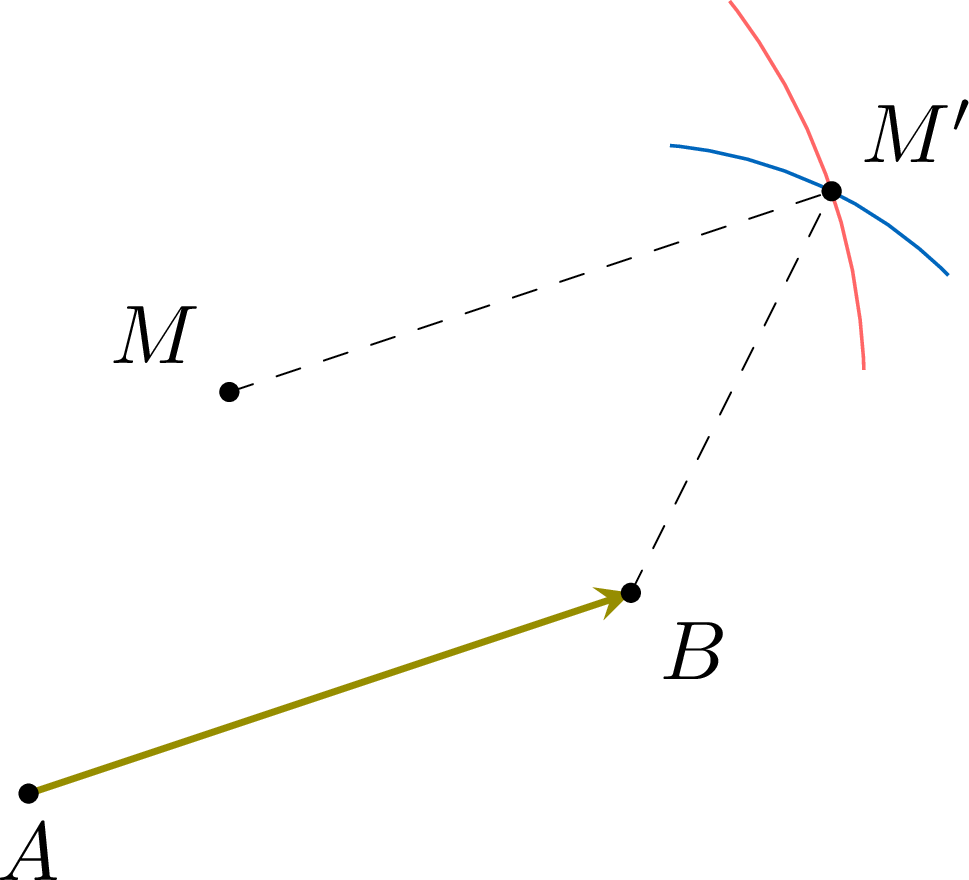
- the arc with centre \(M\) and radius \(AB\) contains the points at distance \(AB\) from \(M\);
- the arc with centre \(B\) and radius \(AM\) contains the points at distance \(AM\) from \(B\);
- their intersection, chosen so that \(ABM'M\) is not crossed, is \(M'\): the opposite sides are then equal in pairs — the parallelogram criterion.
Proposition — Conservation Properties
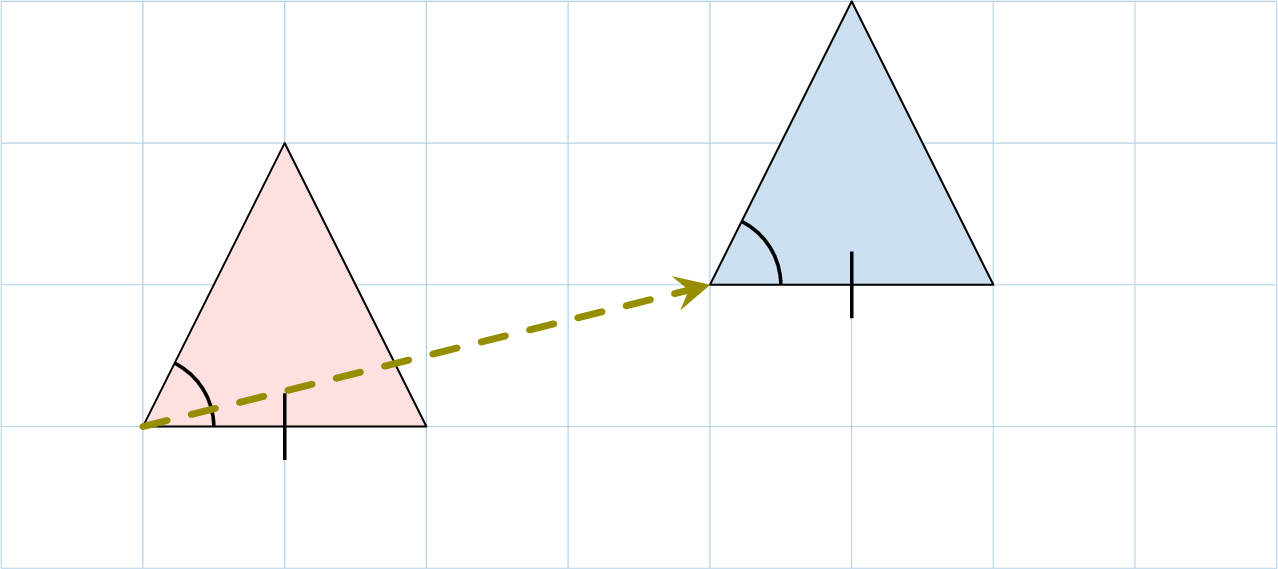
A translation preserves lengths, angle measures, perimeters and areas: the image of a figure is an identical copy of the figure, slid without turning. In particular: - the image of a segment is a segment of the same length;
- the image of a line is a line parallel to it (or the line itself);
- the image of a circle is a circle with the same radius;
- if points are aligned, their images are aligned too.
Example
The triangle \(A'B'C'\) is the image of the triangle \(ABC\) under a translation. In the triangle \(ABC\): \(AB = 4\) cm, \(BC = 6\) cm and \(\Angle{ABC} = 35^\circ\).Without measuring anything, give \(A'B'\), \(B'C'\) and \(\Angle{A'B'C'}\).
A translation preserves lengths and angle measures, so $$A'B' = AB = {4} \text{ cm}, \quad B'C' = BC = {6} \text{ cm}, \quad \Angle{A'B'C'} = \Angle{ABC} = {35^\circ}$$
Skills to practice
- Using the Conservation Properties
- Constructing Images
II
Constructing a Reflection on Plain Paper
Definition — Reflection of a Point
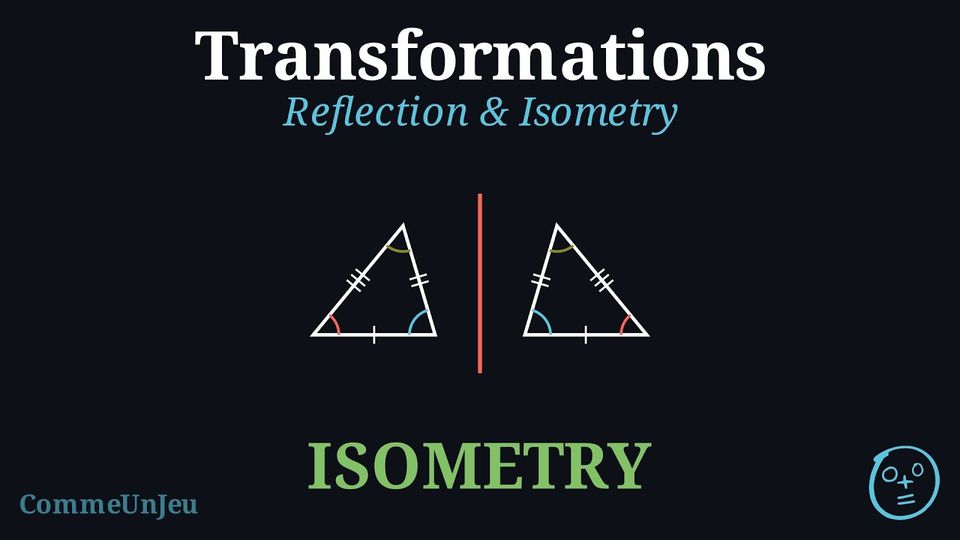
The reflection of point \(M\) over line \(l\) is the point \(M'\) such that line \(l\) is the perpendicular bisector of the segment \(\Segment{MM'}\). (If \(M\) is on \(l\), its image is \(M\) itself.) 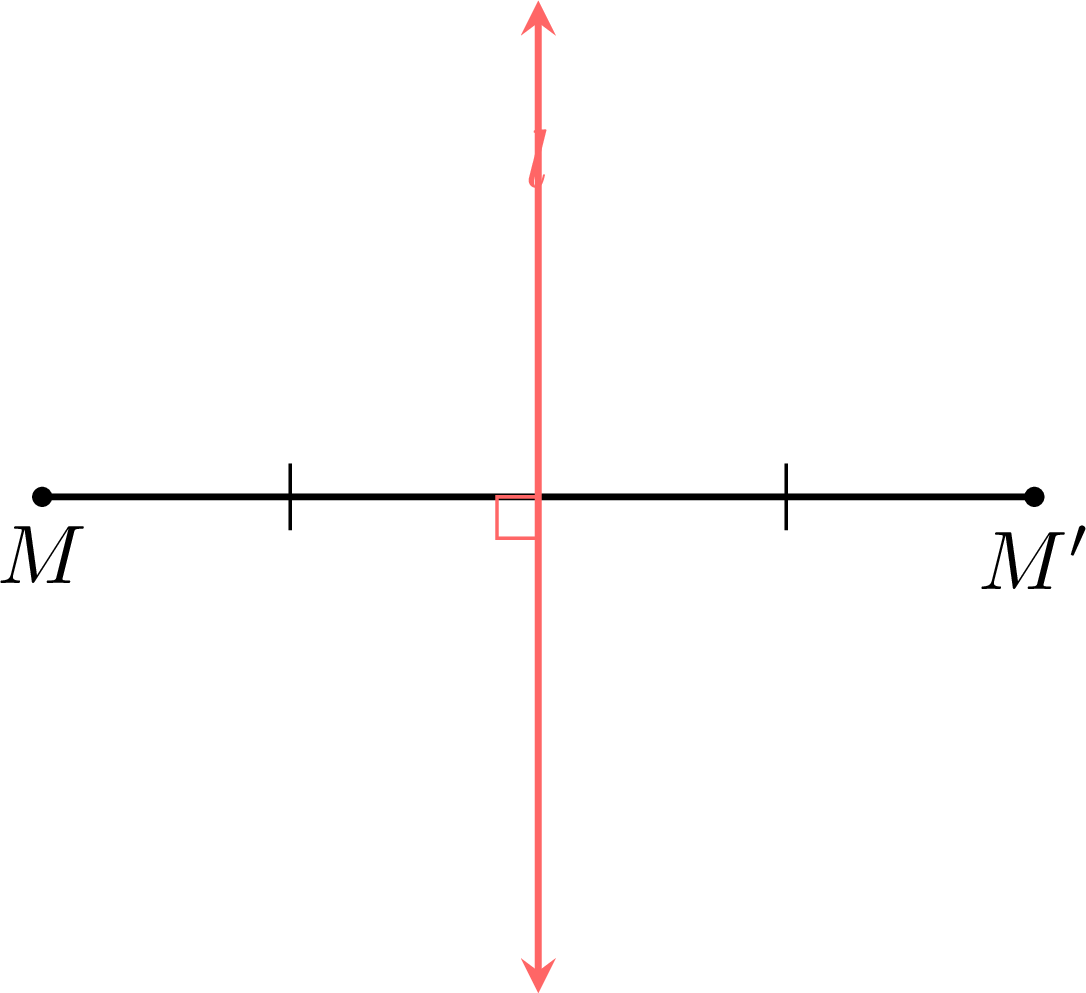
Consider a point \(M\) that is not on the line \(l\), and its image \(M'\). The line \(l\) is the perpendicular bisector of \(\Segment{MM'}\). By the equidistance property of the perpendicular bisector (a point lies on it exactly when it is at the same distance from both ends of the segment), \(l\) is exactly the set of points at the same distance from \(M\) and from \(M'\). Folding the plane along \(l\) sends \(M\) onto \(M'\) and \(M'\) onto \(M\): each point and its image are mirror images across the line. A point on \(l\) is its own image: the points of \(l\) do not move.
Method — Constructing the Reflection of a Point with the Compass
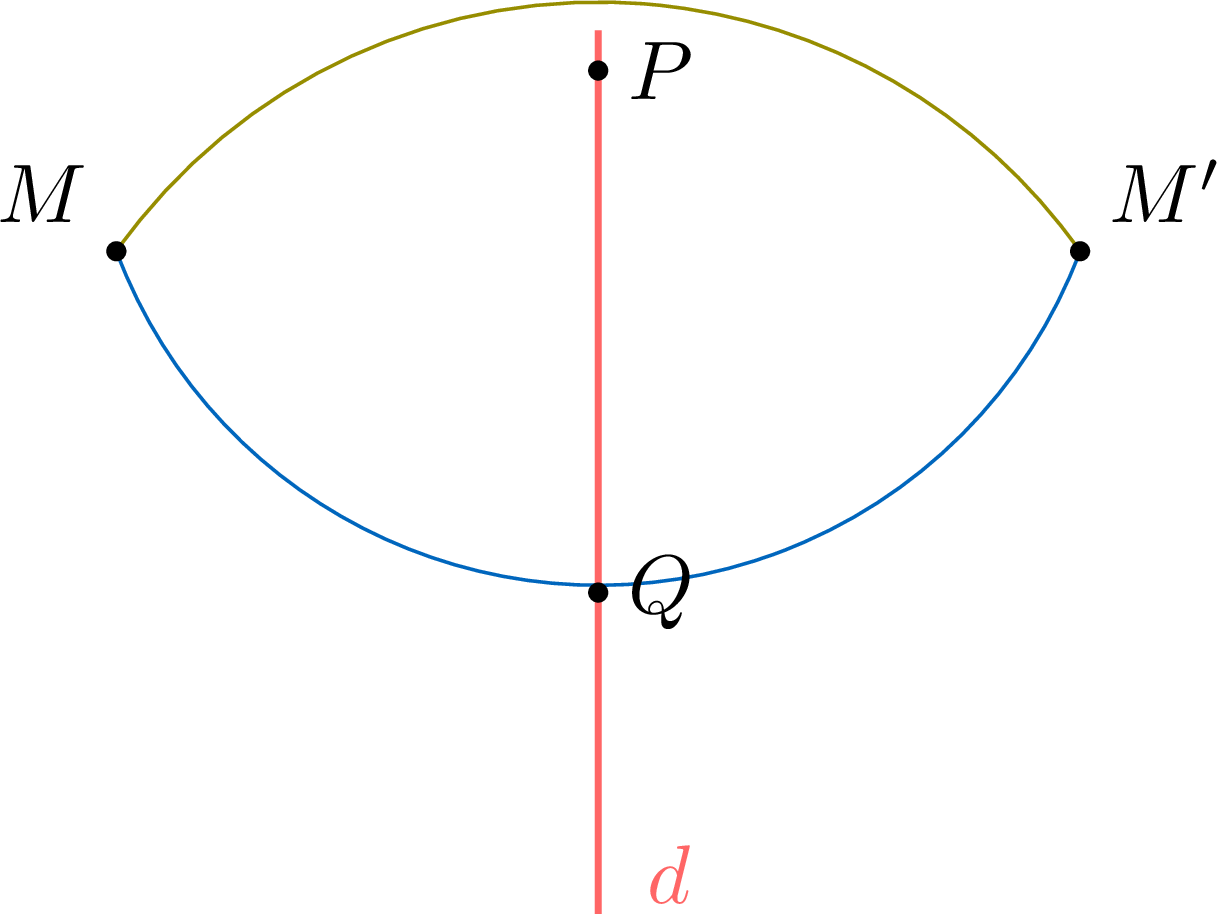
The compass uses the equidistance property of the mirror line: every point of the line \(d\) is at the same distance from \(M\) and from its image \(M'\). With the compass - Put the needle on a point \(P\) of the line \(d\) and draw an arc through \(M\).
- Put the needle on another point \(Q\) of the line \(d\) and draw a second arc through \(M\).
- The two arcs cross again on the other side of \(d\): that second crossing point is \(M'\). (If \(M\) is on \(d\), the two arcs do not cross anywhere else: \(M' = M\).)
Skills to practice
- Constructing on Plain Paper
III
Point Reflection
Léa puts the ace of diamonds upside down on the table — and the card still looks exactly the same. Tom tries with the seven of hearts: upside down, his card looks wrong. Léa says: my card made a half-turn and nothing changed. What does a half-turn do, exactly — to a card, to a letter, to each point of a figure? 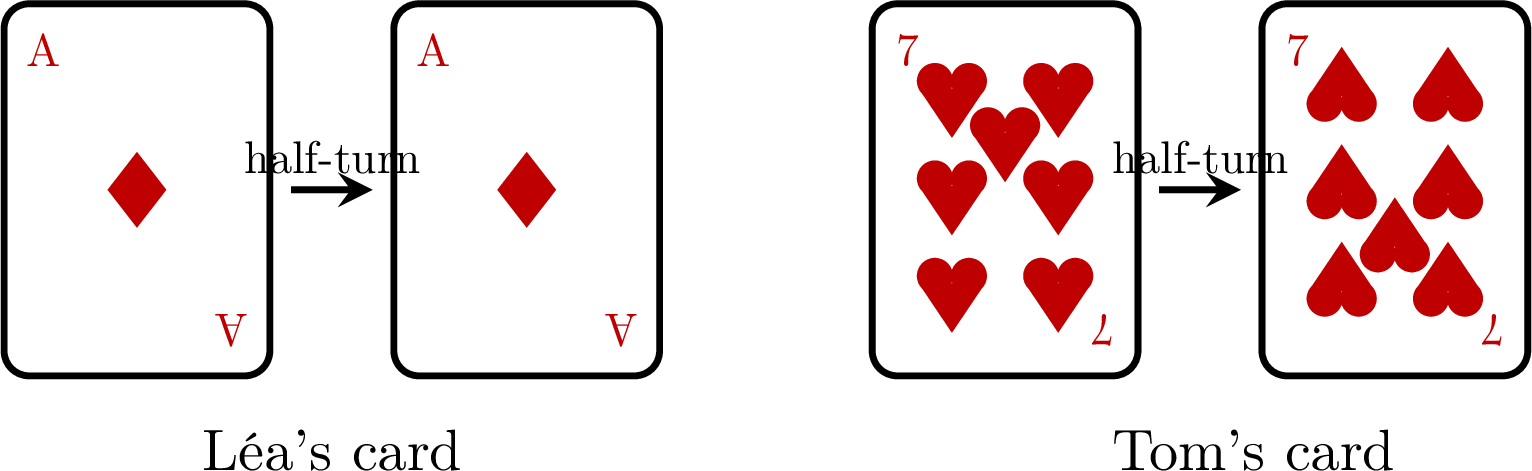
Definition — Point Reflection of a Point
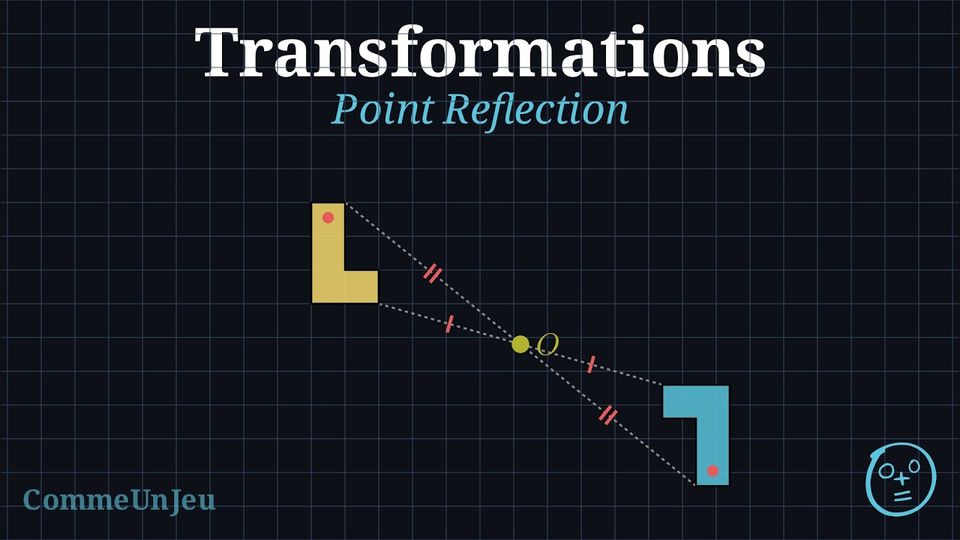
The point reflection of a point \(M\) in a point \(O\) (its image under the half-turn about \(O\)) is the point \(M'\) such that \(O\) is the midpoint of the segment \(\Segment{MM'}\). In other words, \(OM = OM'\) and the three points \(M\), \(O\) and \(M'\) lie on the same straight line, with \(M\) and \(M'\) on either side of \(O\). (If \(M = O\), its image is \(O\) itself.) 
Definition — Point Reflection
The point reflection of an object in a point \(O\) is obtained by constructing the image of each of its points in the point reflection in \(O\). The image has the same size and shape as the object, but it is turned \(180^\circ\) around \(O\). 
Proposition — Conservation Properties
A point reflection preserves lengths, angle measures, perimeters and areas: the image of a figure is an identical copy of the figure, turned by a half-turn. In particular: - the image of a segment is a segment of the same length;
- the image of a line is a line parallel to it (or the line itself);
- the image of a circle is a circle with the same radius;
- if points are aligned, their images are aligned too.
Example
On the grid below, construct the image \(\Segment{A'B'}\) of the segment \(\Segment{AB}\) under the point reflection in \(O\). What can be said about the lengths \(AB\) and \(A'B'\), and about the lines \(\Line{AB}\) and \(\Line{A'B'}\)? 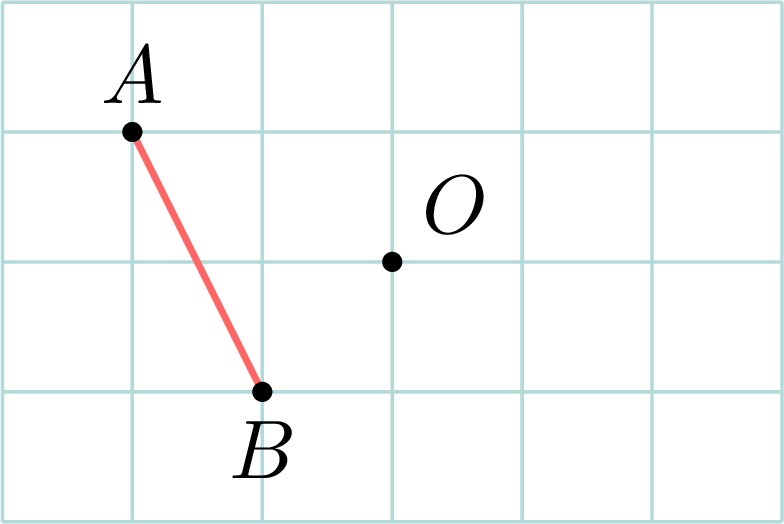
For each point, go through \(O\) and just as far beyond, so that \(O\) is the midpoint: 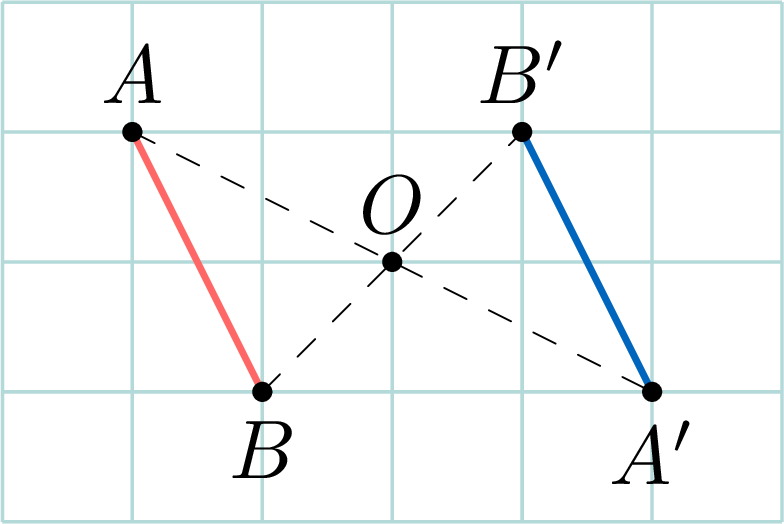
Counting the squares: \(A'B'\) covers the same number of squares as \(AB\), so \(AB = A'B'\) — and \(\Line{AB}\) and \(\Line{A'B'}\) are parallel: the half-turn reversed the direction of travel from \(A\) to \(B\), but not the direction of the line. A half-turn moves the segment but does not deform it.
- from \(A\) to \(O\): \(2\) squares right, \(1\) square down — so from \(O\), again \(2\) squares right and \(1\) down: \(A'\);
- from \(B\) to \(O\): \(1\) square right, \(1\) square up — so from \(O\), again \(1\) square right and \(1\) up: \(B'\).
Method — Constructing an Image on Plain Paper
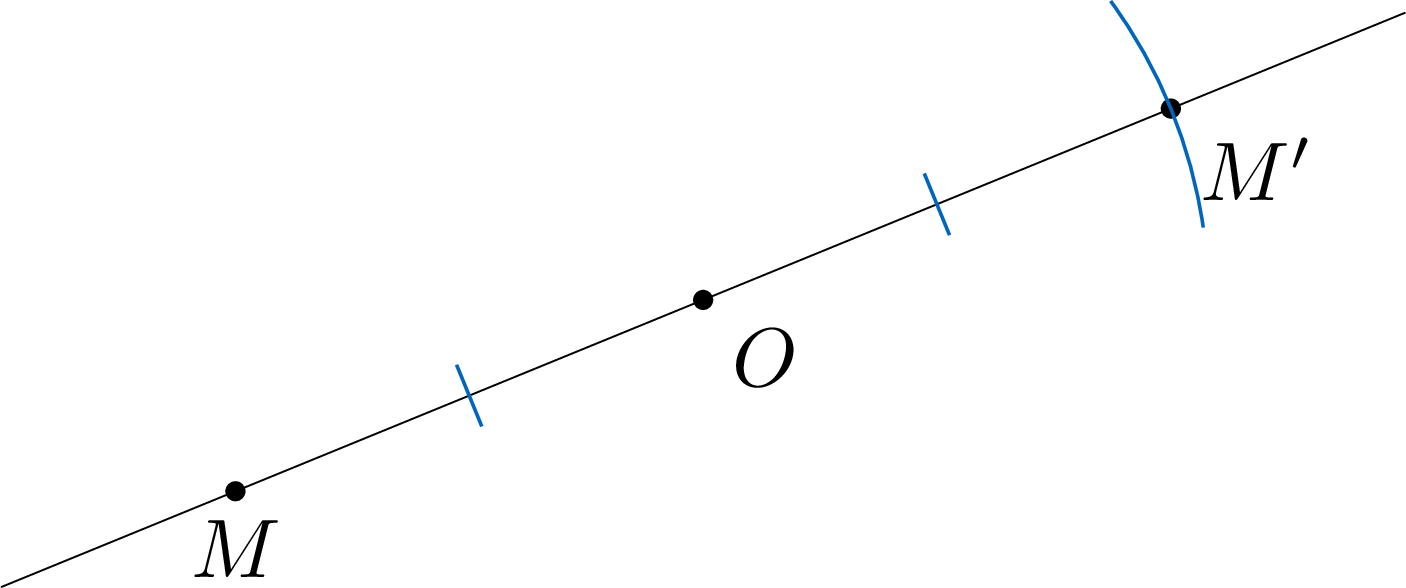
To construct the image \(M'\) of a point \(M\) under the point reflection in \(O\), without a grid (if \(M = O\), its image is \(O\) itself): - Draw the line \(\Line{MO}\) with the ruler, carrying the stroke on beyond \(O\).
- With the graduated ruler: measure \(OM\), then measure the same length on the line, on the other side of \(O\).
- With the compass: open it to \(OM\) (point on \(O\), pencil on \(M\)), then, keeping this opening, draw an arc centred at \(O\) on the other side: it cuts the line at \(M'\).
Skills to practice
- Recognising Point Reflections of Figures
- Using the Conservation Properties of a Point Reflection
- Finding Images of Points
- Constructing a Point Reflection on Plain Paper
IV
Centre of Symmetry
Proposition — Lines of Symmetry of the Usual Figures
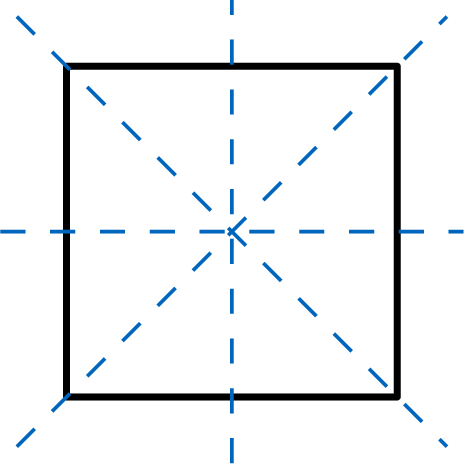
The usual figures have different numbers of lines of symmetry — this is another property that tells them apart. - A square has 4 lines of symmetry.
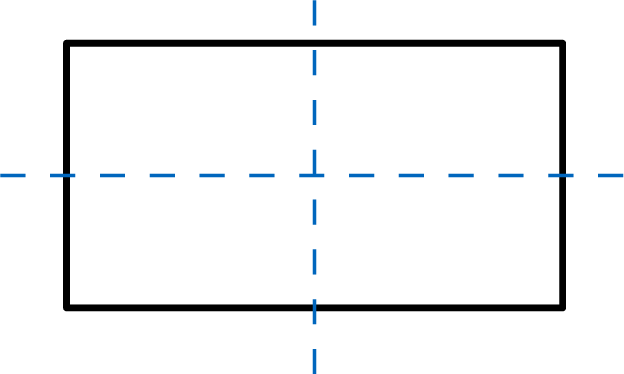
- A rectangle that is not a square has 2 lines of symmetry (the diagonals are not lines of symmetry).
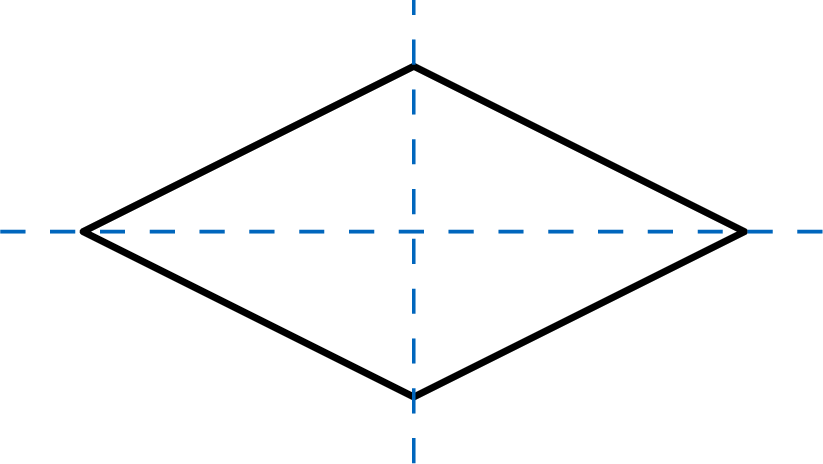
- A rhombus that is not a square has 2 lines of symmetry (its two diagonals).
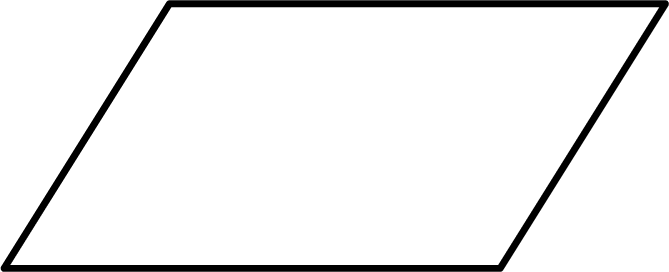
- A parallelogram that is neither a rectangle nor a rhombus has 0 lines of symmetry.
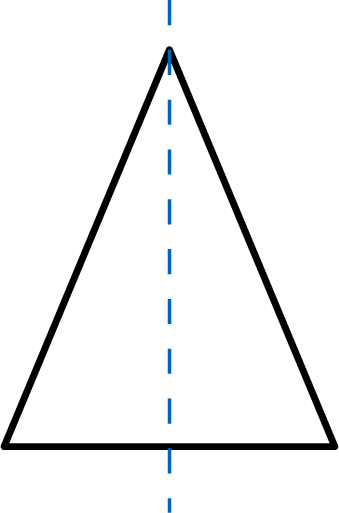
- An isosceles triangle that is not equilateral has 1 line of symmetry (through the apex).
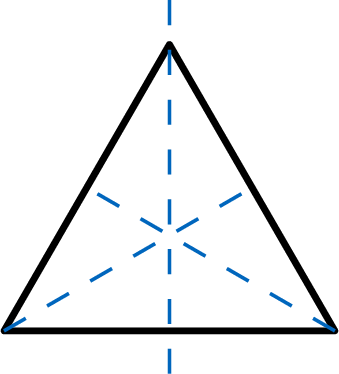
- An equilateral triangle has 3 lines of symmetry (one through each vertex).
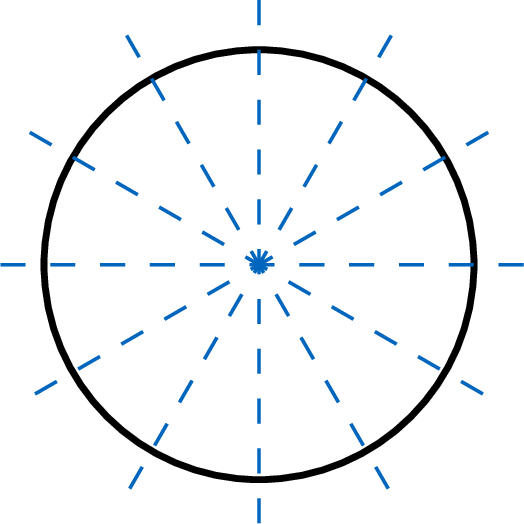
- A circle has infinitely many lines of symmetry (every line through the centre).
Definition — Centre of Symmetry
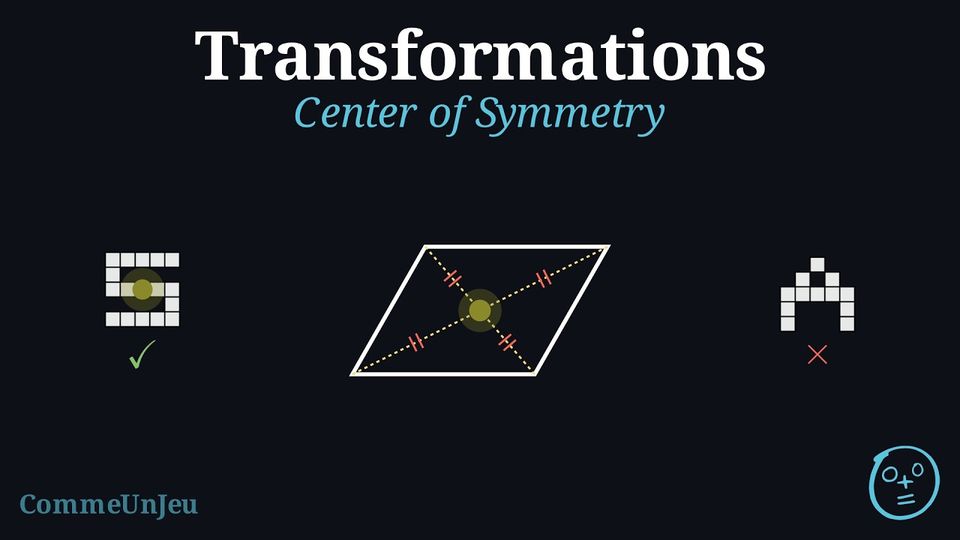
A point is a centre of symmetry of an object if the image of the object under the point reflection in this point coincides exactly with the object. In other words, the object does not change when it is reflected in this point. 
Example
Back to the two cards. Give the ace of diamonds a half-turn about its centre: the diamond lands on itself and the two corner marks swap places — the card lands exactly on itself. Its centre is a centre of symmetry: that is the name of what Léa observed. Now turn the seven of hearts: the odd heart ends up upside down, in the wrong half of the card, so the card does not land on itself — it has no centre of symmetry. That is why Tom's card looked wrong. 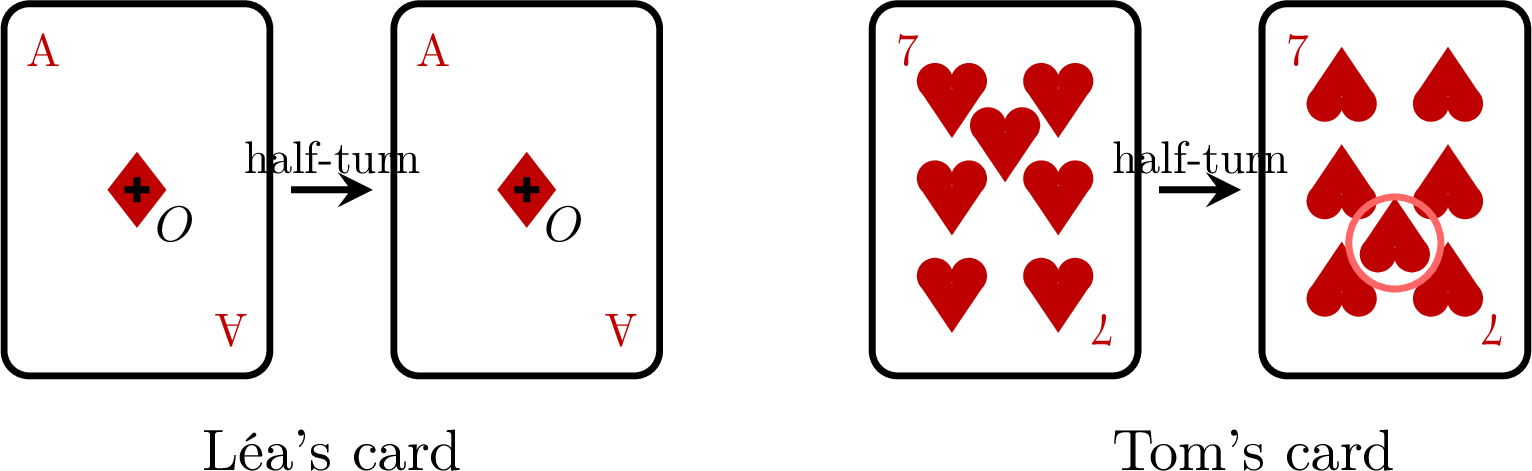
Proposition — Centre of Symmetry of a Parallelogram
The point \(O\) where the two diagonals of a parallelogram cross is its centre of symmetry: the half-turn about \(O\) maps the parallelogram exactly onto itself, sending each vertex to the opposite one (\(A\) onto \(C\), and \(B\) onto \(D\)). 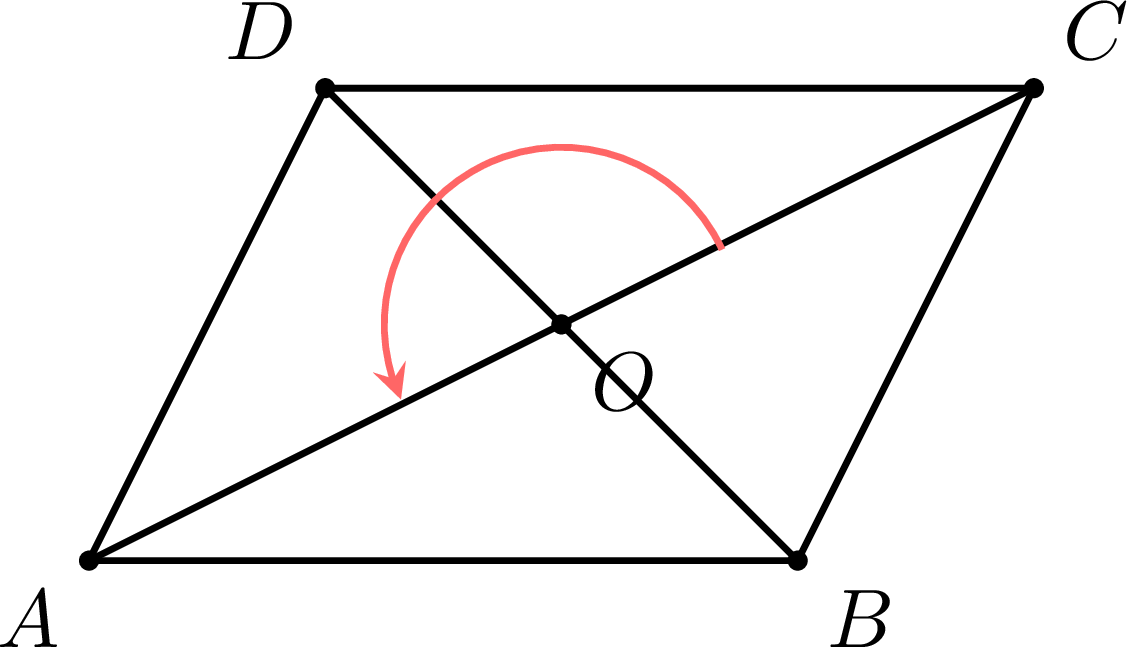
Call \(O\) the midpoint of the diagonal \(\Segment{AC}\): the half-turn about \(O\) sends \(A\) to \(C\) and \(C\) to \(A\). By the conservation properties of a point reflection, the image of the line \(\Line{AB}\) is a line parallel to \(\Line{AB}\) through the image \(C\) of \(A\): it is the line \(\Line{CD}\), since \(ABCD\) is a parallelogram. In the same way, the image of the line \(\Line{CB}\) is the parallel to \(\Line{CB}\) through \(A\): it is \(\Line{AD}\). The point \(B\) lies on both \(\Line{AB}\) and \(\Line{CB}\), so its image lies on both \(\Line{CD}\) and \(\Line{AD}\): it is \(D\).
The half-turn about \(O\) therefore sends \(A\) to \(C\) and \(B\) to \(D\): the parallelogram falls back exactly onto itself, \(O\) is a centre of symmetry, and the properties follow at once:
The half-turn about \(O\) therefore sends \(A\) to \(C\) and \(B\) to \(D\): the parallelogram falls back exactly onto itself, \(O\) is a centre of symmetry, and the properties follow at once:
- the half-turn maps side \(\Segment{AB}\) onto side \(\Segment{CD}\), and side \(\Segment{AD}\) onto side \(\Segment{CB}\), so the opposite sides are equal and the opposite angles are equal;
- the half-turn sends \(B\) onto \(D\) while leaving \(O\) fixed, so \(O\) is also the midpoint of \(\Segment{BD}\): the diagonals cross at \(O\) and bisect each other.
Skills to practice
- Counting Centres of Symmetry of Common Shapes
V
Order and Angle of Rotational Symmetry
Definition — Rotation of a Point
A rotation of point \(M\) through an angle \(a^{\circ}\) about centre \(O\), in a given direction, gives the point \(M'\) with \(OM'=OM\) such that turning the segment \(\Segment{OM}\) about \(O\) through \(a^{\circ}\) in that direction brings it onto the segment \(\Segment{OM'}\). The centre \(O\) is its own image.The direction is always given: clockwise \(\curvearrowright\) or anticlockwise \(\curvearrowleft\).

Definition — Rotational Symmetry of a Figure
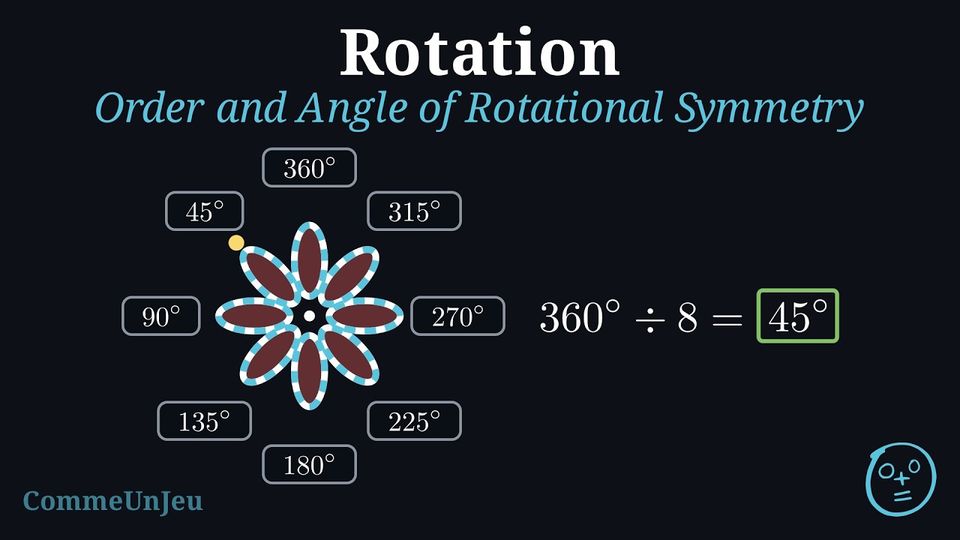
A figure has rotational symmetry about a point \(O\) when a rotation about \(O\) through an angle \(a^\circ\), with \(0 < a < 360\), maps the figure onto itself.When there are finitely many angles \(a^\circ\), with \(0 < a \le 360\), such that the rotation about \(O\) through \(a^\circ\), always turning the same way, maps the figure onto itself, their number is the order of rotational symmetry of the figure; the full turn, \(360^\circ\), is counted. A figure mapped onto itself by infinitely many rotations about \(O\), like a circle, has no order. A figure of order \(1\) is mapped onto itself only by the full turn: it has no rotational symmetry.
Proposition — Order and Angle
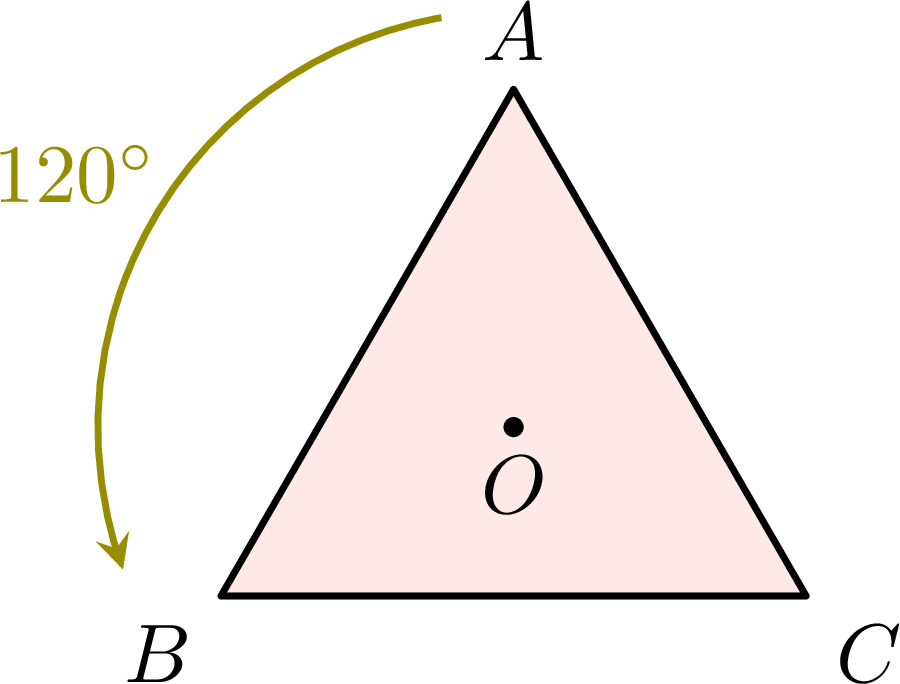
If a figure has rotational symmetry of order \(n\) about \(O\), the rotations about \(O\) that map it onto itself are exactly the rotations through $$\frac{360^\circ}{n},\quad 2\times\frac{360^\circ}{n},\quad 3\times\frac{360^\circ}{n},\quad \dots,\quad n\times\frac{360^\circ}{n} = 360^\circ.$$ In particular, the smallest angle of a rotation that maps the figure onto itself is \(\dfrac{360^\circ}{n}\), and every angle that works is a multiple of it.
Two rotations about the same centre \(O\), one after the other, make one rotation about \(O\): the angles add when both turn the same way, and they subtract when the second one turns back. Let \(a^\circ\) be the smallest angle, with \(0 < a \le 360\), whose rotation about \(O\) maps the figure onto itself (such angles exist, since the full turn works, and there are only \(n\) of them).
- Every multiple of \(a\) works. The rotation through \(a^\circ\) maps the figure onto itself; applying it again maps the result, which is the figure, onto itself again: the rotation through \(2a^\circ\) works, then \(3a^\circ\), and so on.
- No other angle works. Suppose that the rotation through \(b^\circ\), with \(0 < b \le 360\), maps the figure onto itself, and that \(b\) is not a multiple of \(a\). Then \(b\) lies between two consecutive multiples of \(a\): \(k \times a < b < (k+1) \times a\) for a whole number \(k\). Turn the figure through \(b^\circ\), then turn it back through \(k \times a^\circ\): each move maps the figure onto itself, so the two together do too, and together they make the rotation through \((b - k\times a)^\circ\). But \(0 < b - k \times a < a\): this rotation would work with an angle smaller than \(a\), which is impossible, since \(a\) is the smallest.
- Counting the angles. The full turn works, so \(360\) is a multiple of \(a\): \(360 = m \times a\) for a whole number \(m\). The angles that work, between \(0\) and \(360\), are then \(a, 2a, \dots, m \times a = 360\): there are \(m\) of them. The order is the number of these angles, so \(m = n\) and \(a = \dfrac{360}{n}\).
Proposition — Point Symmetry and Rotational Symmetry
A point \(O\) is a centre of symmetry of a figure exactly when the rotation about \(O\) through \(180^\circ\) maps the figure onto itself (this rotation is the half-turn about \(O\), also called the point reflection in \(O\)).If a figure has rotational symmetry of order \(n\) about \(O\), then \(O\) is a centre of symmetry of the figure exactly when \(n\) is even. In particular, a figure of order \(2\) has a centre of symmetry, and the only rotations that map it onto itself are the half-turn and the full turn.
The first sentence is the definition of a centre of symmetry, since the point reflection in \(O\) is the half-turn about \(O\), the rotation about \(O\) through \(180^\circ\).
By the Proposition “Order and Angle”, the rotations about \(O\) that map the figure onto itself are those through the multiples of \(\dfrac{360^\circ}{n}\). So the half-turn works exactly when there is a whole number \(k\) such that $$\begin{aligned}[t] 180 &= k \times \frac{360}{n}\\ 180 \times n &= 360 \times k && \text{(both sides multiplied by } n\text{)}\\ n &= 2 \times k. && \text{(both sides divided by } 180\text{)} \end{aligned}$$ Each of these three equalities says the same thing as the others. A whole number \(k\) with \(n = 2 \times k\) exists exactly when \(n\) is even. Hence \(O\) is a centre of symmetry exactly when \(n\) is even.
By the Proposition “Order and Angle”, the rotations about \(O\) that map the figure onto itself are those through the multiples of \(\dfrac{360^\circ}{n}\). So the half-turn works exactly when there is a whole number \(k\) such that $$\begin{aligned}[t] 180 &= k \times \frac{360}{n}\\ 180 \times n &= 360 \times k && \text{(both sides multiplied by } n\text{)}\\ n &= 2 \times k. && \text{(both sides divided by } 180\text{)} \end{aligned}$$ Each of these three equalities says the same thing as the others. A whole number \(k\) with \(n = 2 \times k\) exists exactly when \(n\) is even. Hence \(O\) is a centre of symmetry exactly when \(n\) is even.
The case of the circle. A circle is mapped onto itself by every rotation about its centre, whatever the angle: it has infinitely many rotational symmetries, so it has no order. The Proposition “Order and Angle” and the part of the second Proposition that speaks of the order \(n\) do not apply to it. The first sentence of the second Proposition does apply: the rotation through \(180^\circ\) is one of these rotations, so the centre of the circle is a centre of symmetry. 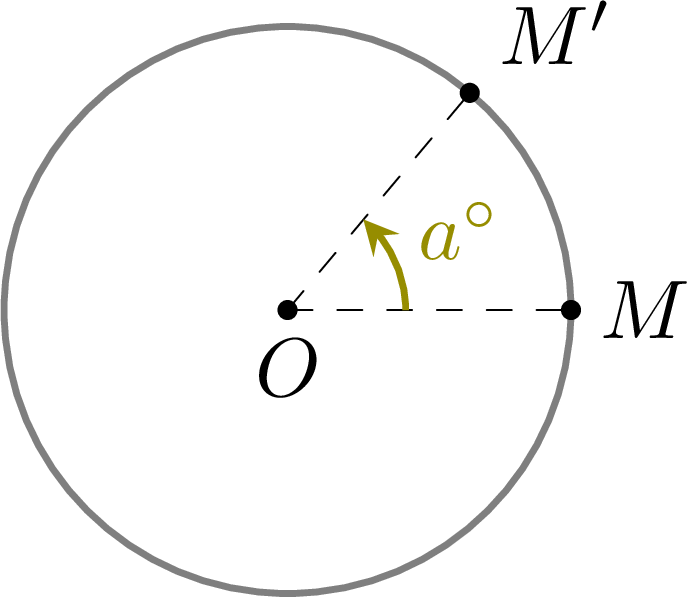
Whatever the angle \(a^\circ\), the image \(M'\) of a point \(M\) of the circle is at the same distance from \(O\), so it is on the circle. Conversely, every point of the circle is the image of a point of the circle: turn it back through \(a^\circ\) to find that point. So the image of the circle is the whole circle.
Example
For each regular polygon, with centre \(O\), give the order of rotational symmetry, the smallest angle of a rotation about \(O\) that maps it onto itself, and say whether \(O\) is a centre of symmetry. 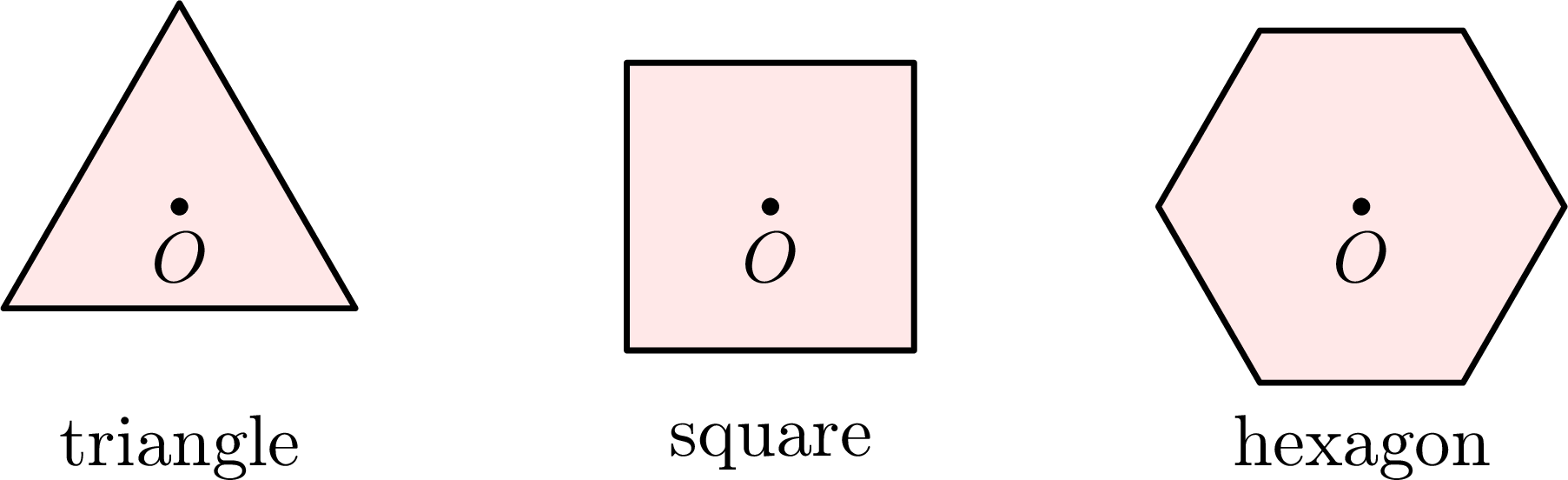
A rotation that maps a polygon onto itself sends each vertex to a vertex, since a corner can only land on a corner. For a regular polygon with \(n\) sides, the vertex \(A\) can therefore go to \(n\) places only, and each of them works: the rotation about \(O\) that sends each vertex to the next one, and its multiples, map the polygon onto itself. Its order is \(n\). By the Proposition “Order and Angle”, the smallest angle is \(\dfrac{360^\circ}{n}\), and by the Proposition “Point Symmetry and Rotational Symmetry”, \(O\) is a centre of symmetry exactly when \(n\) is even.
For the square, the half-turn is two quarter turns: \(180^\circ = 2 \times 90^\circ\). For the triangle, the half-turn sends the vertex at the top to a point at the bottom, where there is a side and no vertex: the dashed image below does not coincide with the triangle. 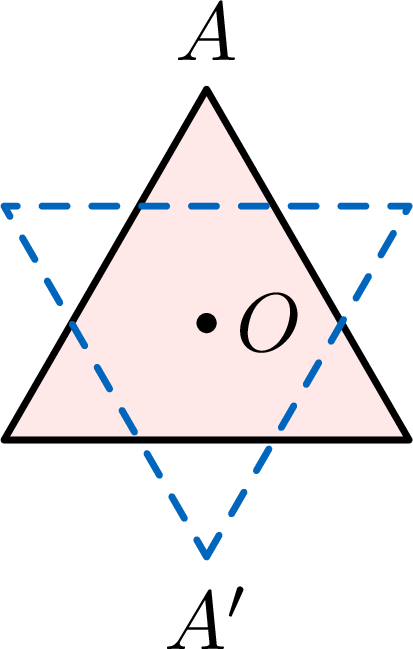
| polygon | order \(n\) | smallest angle | centre of symmetry |
| equilateral triangle | \(3\) | \(360^\circ \div 3 = 120^\circ\) | no (\(3\) is odd) |
| square | \(4\) | \(360^\circ \div 4 = 90^\circ\) | yes (\(4\) is even) |
| regular hexagon | \(6\) | \(360^\circ \div 6 = 60^\circ\) | yes (\(6\) is even) |
Example
This regular five-pointed star, with centre \(O\), is mapped onto itself by the rotation about \(O\) through \(72^\circ\), and by no rotation through a smaller angle. What is its order of rotational symmetry? Is \(O\) a centre of symmetry of the star? 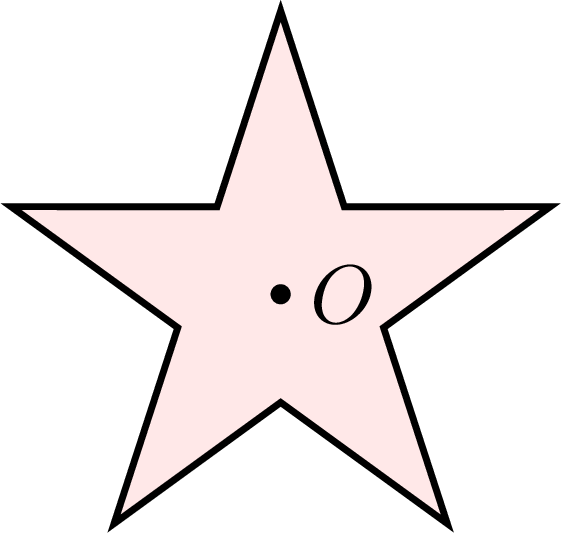
The smallest angle is \(72^\circ\) and, by the Proposition “Order and Angle”, it equals \(\dfrac{360^\circ}{n}\): $$\begin{aligned}[t] n &= \frac{360}{72} && \text{(smallest angle } = 360^\circ \div n\text{)}\\
&= 5. \end{aligned}$$ The star has rotational symmetry of order \(5\): the angles that work are \(72^\circ\), \(144^\circ\), \(216^\circ\), \(288^\circ\) and \(360^\circ\). The order \(5\) is odd, so by the Proposition “Point Symmetry and Rotational Symmetry”, \(O\) is not a centre of symmetry: \(180^\circ\) is not in the list, since \(180 \div 72 = 2.5\) is not a whole number. On the figure, the half-turn sends the top point to the bottom, where the star has a hollow between two points: the dashed image does not coincide with the star. 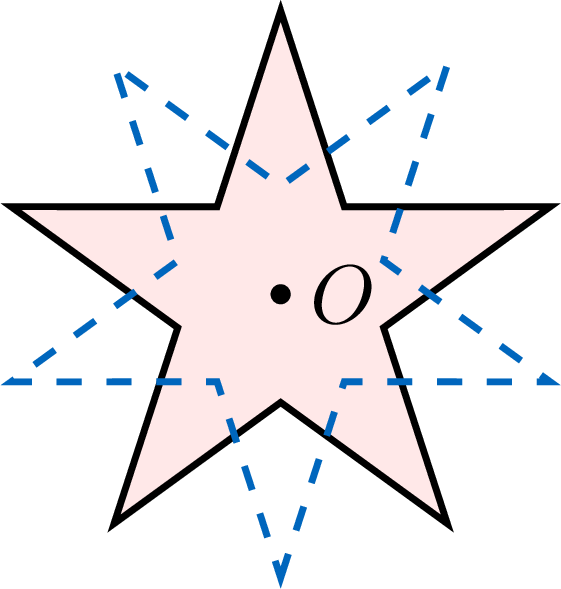
Skills to practice
- Linking Order and Angle
- Computing the Order or the Angle
- Justifying Point Symmetry with the Order
VI
Going further
Skills to practice
- Reasoning with Transformations
- Reasoning with Point Reflections
- Solving Problems with Designs
- Investigating Patterns in Rotational Symmetry
- Quiz
Jump to section