International Baccalaureate · MYP 4
Deductive Geometry and Circle Theorems
I
Deductive Proof
I.1
Writing a Deductive Geometric Proof
The Names of the Tests
Each congruence test is named by the equal elements it needs, read around the triangle: S for a side, A for an angle, R for a right angle, H for the hypotenuse.
AAS is also written AAcorS: two angles and a corresponding side. The order of the letters says where the elements are: in SAS the angle lies between the two sides, in ASA the side lies between the two angles. SSA and AAA are not tests in general (Remark “Three Pieces of Data That Are Not Enough”): two sides and a non-included angle are enough when the angle faces the longer of the two sides (as in RHS) or when these two sides are equal; otherwise, in general, they are not.
| Name | Equal elements |
| SSS | three sides |
| SAS | two sides and the included angle |
| ASA | a side and its two adjacent angles |
| AAS | two angles and a corresponding side |
| RHS | right angle, hypotenuse and a leg |
Method — Proving That Two Triangles Are Congruent
- Name the two triangles, pairing their vertices in the order in which they correspond.
- Find three pieces of data equal in pairs, each one justified: a given of the problem, a common side, vertically opposite angles, a property of a known figure…
- Name the case — SSS (three sides), SAS (two sides and the included angle), ASA (one side and the two adjacent angles) and, once they are known, AAS (two angles and a corresponding side) or, for two right-angled triangles, RHS (the hypotenuse and a leg) — and conclude that the triangles are congruent.
- Deduce the other equalities: the remaining corresponding sides and angles are equal.
Method — Writing a Deductive Geometric Proof
- Draw a clear figure and mark the data on it: equal lengths, right angles, known angles.
- Write what is given and what is to be proved, with the names of the figure.
- Chain the facts, one per line, each followed by its reason: a datum of the problem, a definition, or a theorem called by its name (“radii”, “tangent and radius”, “RHS”…). A measurement on the figure, or “it looks like it”, is never a reason.
- Conclude with a sentence that restates the claim.
Skills to practice
- Writing a Deductive Geometric Proof
II
The Midpoint Theorem
II.1
The Midpoint Theorem
Tom wants to know the width \(BC\) of a pond, but he cannot measure through the water. He plants a stake at a point \(A\) away from the pond, marks the midpoint \(M\) of \(\Segment{AB}\) and the midpoint \(N\) of \(\Segment{AC}\), and measures on dry land: $$MN = 27 \text{ m}$$ 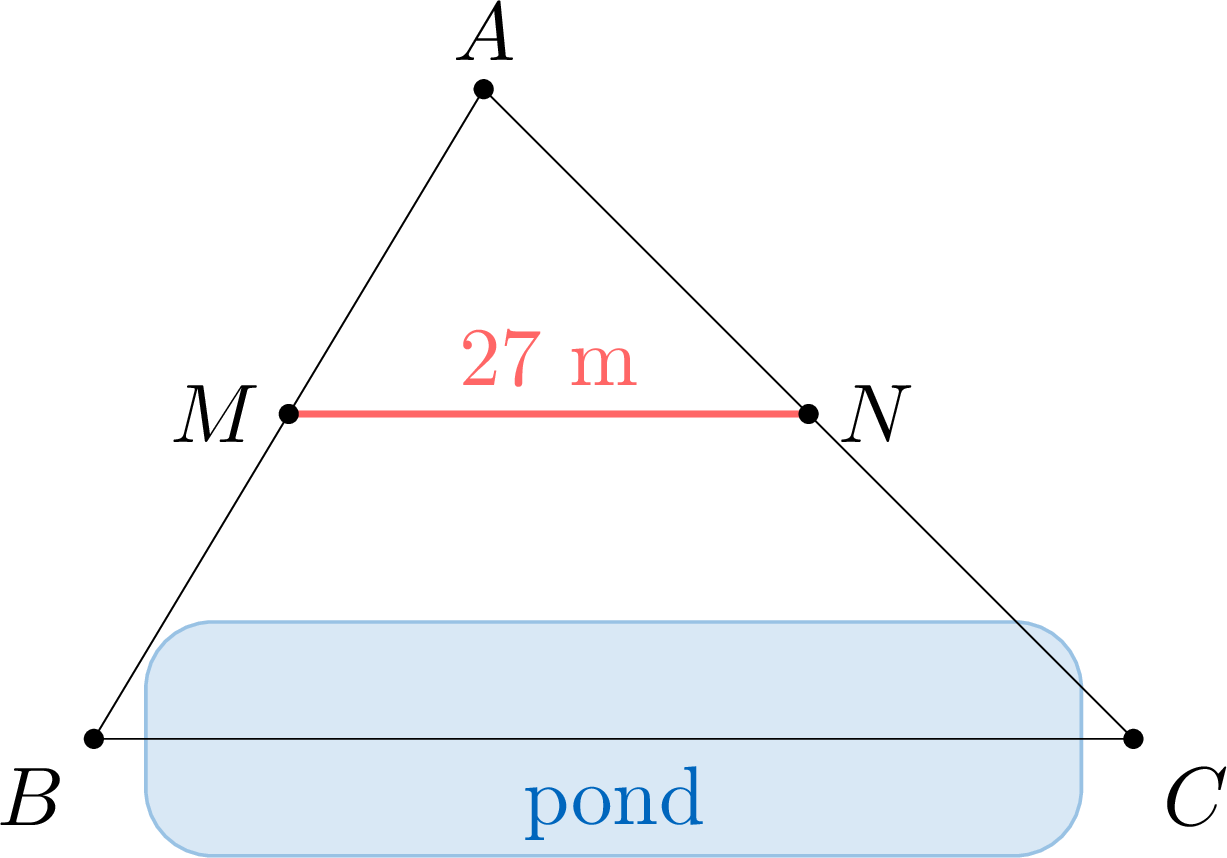
Can Tom deduce the width \(BC\) without crossing the pond?
Yes. The segment \(\Segment{MN}\) joins the midpoints of two sides of the triangle \(ABC\): the theorem below states that \(BC\) is exactly twice \(MN\): $$BC = 2 \times MN = 2 \times 27 = \textcolor{colorprop}{54} \text{ m}$$ Tom measured \(27\) m on dry land and learned the width of the pond.
Theorem — Midpoint Theorem
In a triangle \(ABC\), let \(M\) be the midpoint of \(\Segment{AB}\) and \(N\) the midpoint of \(\Segment{AC}\). Then: - the line \(\Line{MN}\) is parallel to the line \(\Line{BC}\);
- the segment \(\Segment{MN}\) is half as long as \(\Segment{BC}\): $$MN = \dfrac{BC}{2}$$
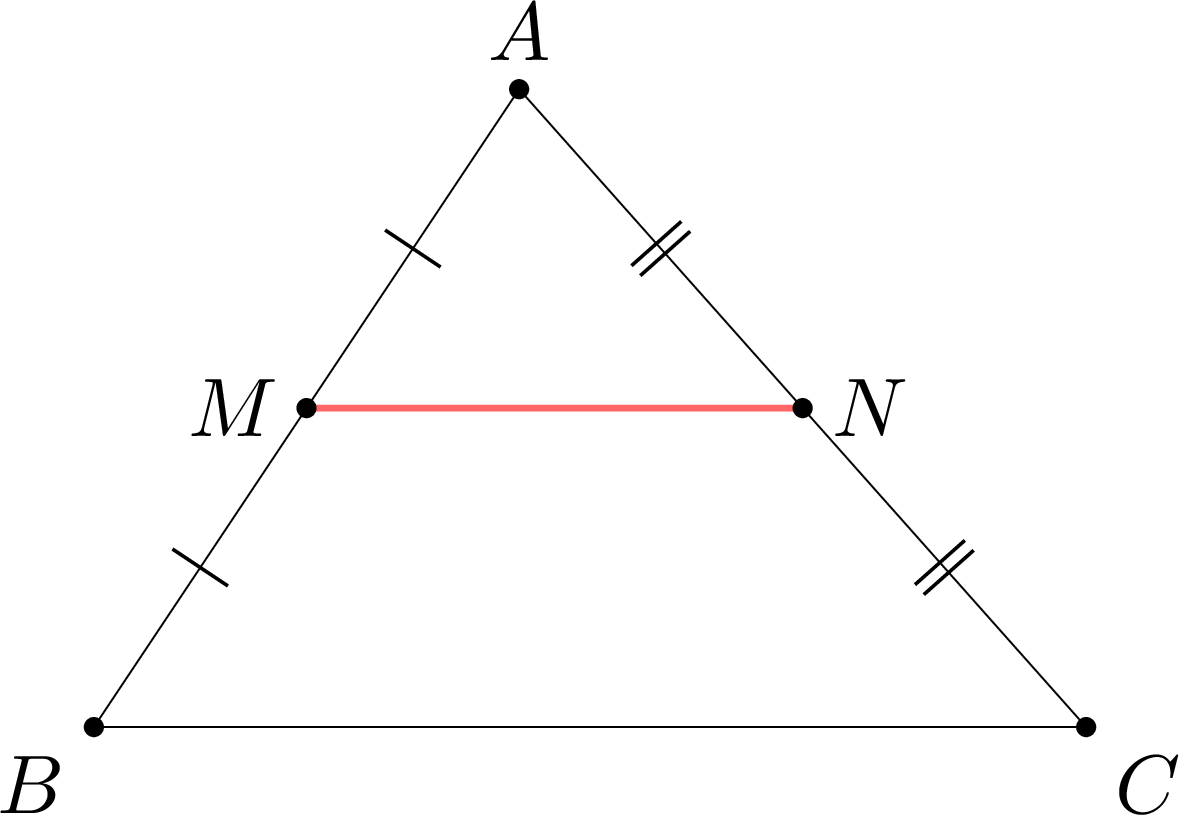
Let \(P\) be the image of \(M\) under the point reflection in \(N\) (so \(N\) is the midpoint of \(\Segment{MP}\)). 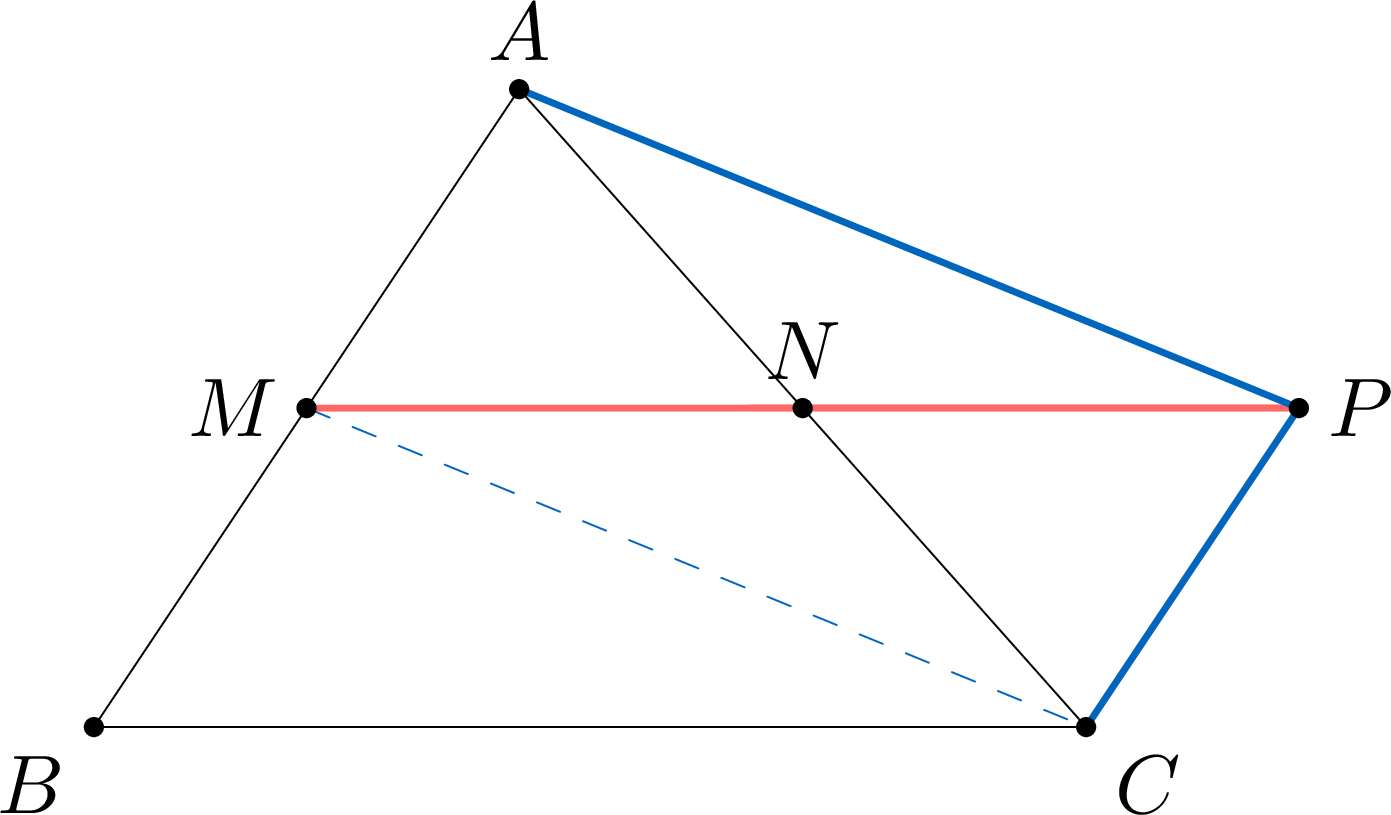
- In the quadrilateral \(AMCP\), the diagonals \(\Segment{AC}\) and \(\Segment{MP}\) have the same midpoint \(N\): by the parallelogram criterion, \(AMCP\) is a parallelogram. So \(\Segment{CP}\) is parallel to \(\Segment{AM}\) and \(CP = AM\).
- Since \(M\) is the midpoint of \(\Segment{AB}\): \(AM = MB\). So \(CP = MB\), and \(\Segment{CP}\) is parallel to \(\Segment{MB}\) (same line \(\Line{AB}\)). A non-crossed quadrilateral with two opposite sides parallel and of the same length is a parallelogram: \(MBCP\) — which is not crossed, see the figure — is a parallelogram.
- Therefore \(\Line{MP} \parallel \Line{BC}\) — that is, \(\Line{MN} \parallel \Line{BC}\) — and \(MP = BC\). Since \(N\) is the midpoint of \(\Segment{MP}\): $$MN = \dfrac{MP}{2} = \dfrac{BC}{2}$$
Example
In the triangle \(ABC\): \(M\) is the midpoint of \(\Segment{AB}\), \(N\) is the midpoint of \(\Segment{AC}\), \(BC = 10\) cm and \(AB = 8\) cm. - Compute \(MN\). Justify.
- Compute \(AM\).
- What can you say about the lines \(\Line{MN}\) and \(\Line{BC}\)?
- \(M\) and \(N\) are the midpoints of two sides of the triangle \(ABC\), so by the midpoint theorem: $$MN = \dfrac{BC}{2} = \dfrac{10}{2} = \textcolor{colorprop}{5} \text{ cm}$$
- \(M\) is the midpoint of \(\Segment{AB}\), so $$AM = \dfrac{AB}{2} = \dfrac{8}{2} = \textcolor{colorprop}{4} \text{ cm}$$
- By the same midpoint theorem, the line \(\Line{MN}\) is parallel to the line \(\Line{BC}\).
Skills to practice
- Recognising When the Theorem Applies
- Calculating Lengths with the Midpoint Theorem
II.2
The Converse of the Midpoint Theorem
Theorem — Converse of the Midpoint Theorem
In a triangle \(ABC\), let \(M\) be the midpoint of \(\Segment{AB}\). The line through \(M\) parallel to \(\Line{BC}\) crosses the side \(\Segment{AC}\) at its midpoint. 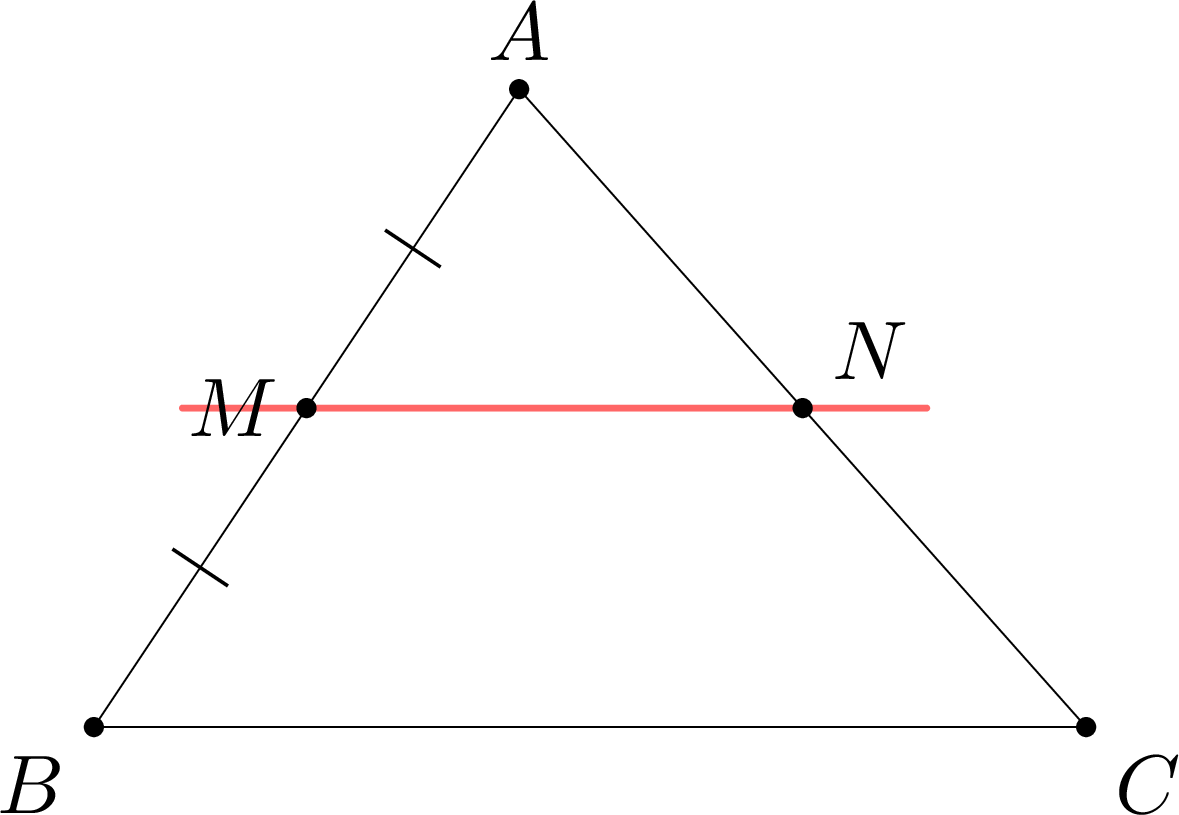
Let \(N\) be the midpoint of \(\Segment{AC}\). By the midpoint theorem, the line \(\Line{MN}\) is parallel to \(\Line{BC}\).
Through the point \(M\), there is only one line parallel to \(\Line{BC}\). So the parallel to \(\Line{BC}\) through \(M\) is exactly the line \(\Line{MN}\): it crosses \(\Segment{AC}\) at \(N\), the midpoint of \(\Segment{AC}\).
Through the point \(M\), there is only one line parallel to \(\Line{BC}\). So the parallel to \(\Line{BC}\) through \(M\) is exactly the line \(\Line{MN}\): it crosses \(\Segment{AC}\) at \(N\), the midpoint of \(\Segment{AC}\).
Example
In the triangle \(ABC\): \(M\) is the midpoint of \(\Segment{AB}\), the line through \(M\) parallel to \(\Line{BC}\) crosses \(\Segment{AC}\) at \(N\), and \(AC = 9\) cm.Compute \(AN\). Justify.
\(M\) is the midpoint of \(\Segment{AB}\) and the line \(\Line{MN}\) is parallel to \(\Line{BC}\): by the converse of the midpoint theorem, \(N\) is the midpoint of \(\Segment{AC}\). So $$AN = \dfrac{AC}{2} = \dfrac{9}{2} = \textcolor{colorprop}{4{.}5} \text{ cm}$$
Three statements must be told apart:
- midpoints of two sides \(\Rightarrow\) the line is parallel to the third side;
- midpoints of two sides \(\Rightarrow\) the segment is half the third side;
- converse: midpoint of one side \(+\) parallel to another side \(\Rightarrow\) midpoint of the third side.
Skills to practice
- Recognising the Converse
- Using the Converse
- Justifying with the Theorems
III
Circle Theorems
III.1
Angle in a Semicircle
On a building site, Tom must draw a right angle on the ground, but he has no set square — only string and stakes. He plants two stakes \(B\) and \(C\), draws the circle with diameter \(\Segment{BC}\) (string attached to the midpoint \(O\)), and plants a third stake at any point \(A\) of the circle (other than \(B\) and \(C\)). 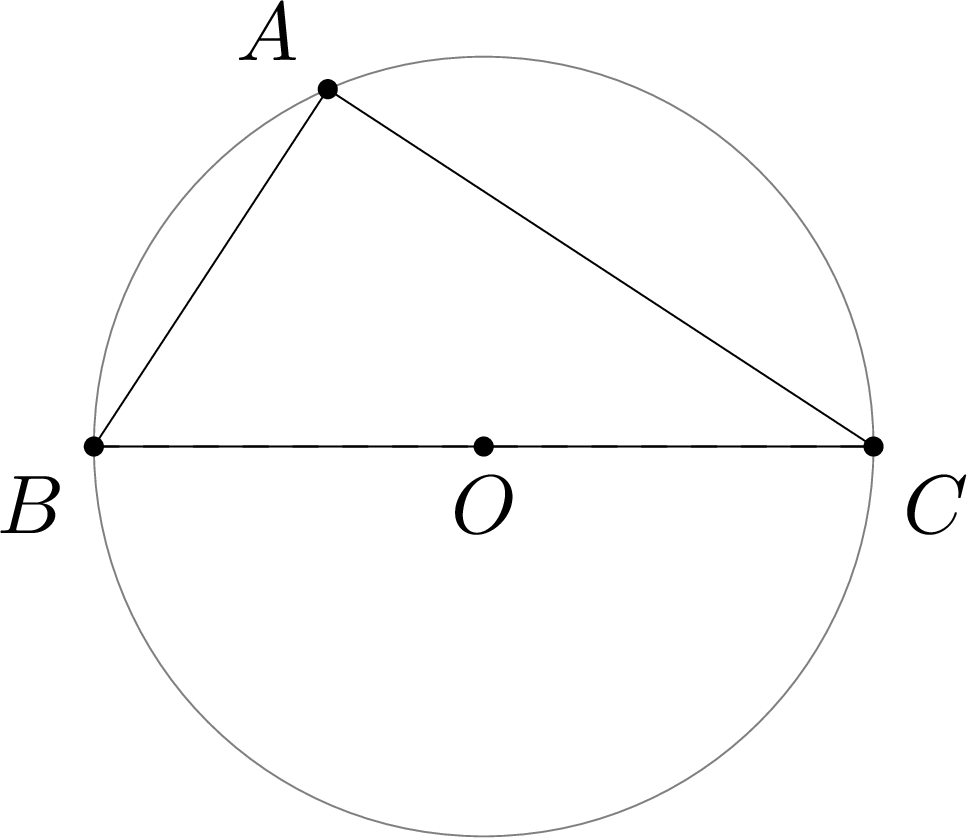
Tom claims the angle at \(A\) is right, wherever \(A\) is on the circle. Is he correct?
Yes: this is the theorem below — any triangle inscribed in a circle with one side as a diameter is right-angled, at the vertex opposite the diameter. Tom's string and stakes draw perfect right angles. This result is often accepted without proof — here it is proved.
Theorem — Angle in a Semicircle
If a triangle is inscribed in a circle and one of its sides is a diameter of the circle, then the triangle is right-angled at the vertex opposite that diameter: the angle in a semicircle is a right angle. This theorem is also called Thales's theorem. 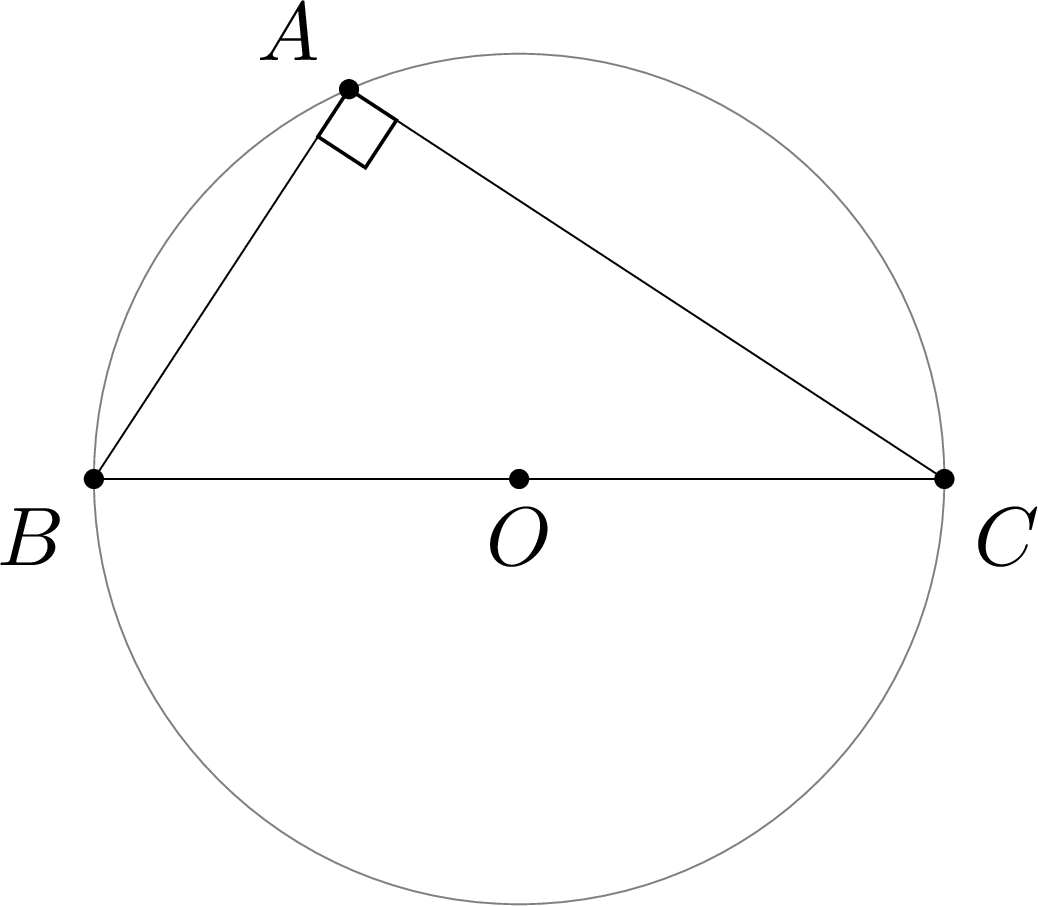
Let \(O\) be the centre of the circle (the midpoint of the diameter \(\Segment{BC}\)). The segments \(\Segment{OA}\), \(\Segment{OB}\) and \(\Segment{OC}\) are all radii: \(OA = OB = OC\). 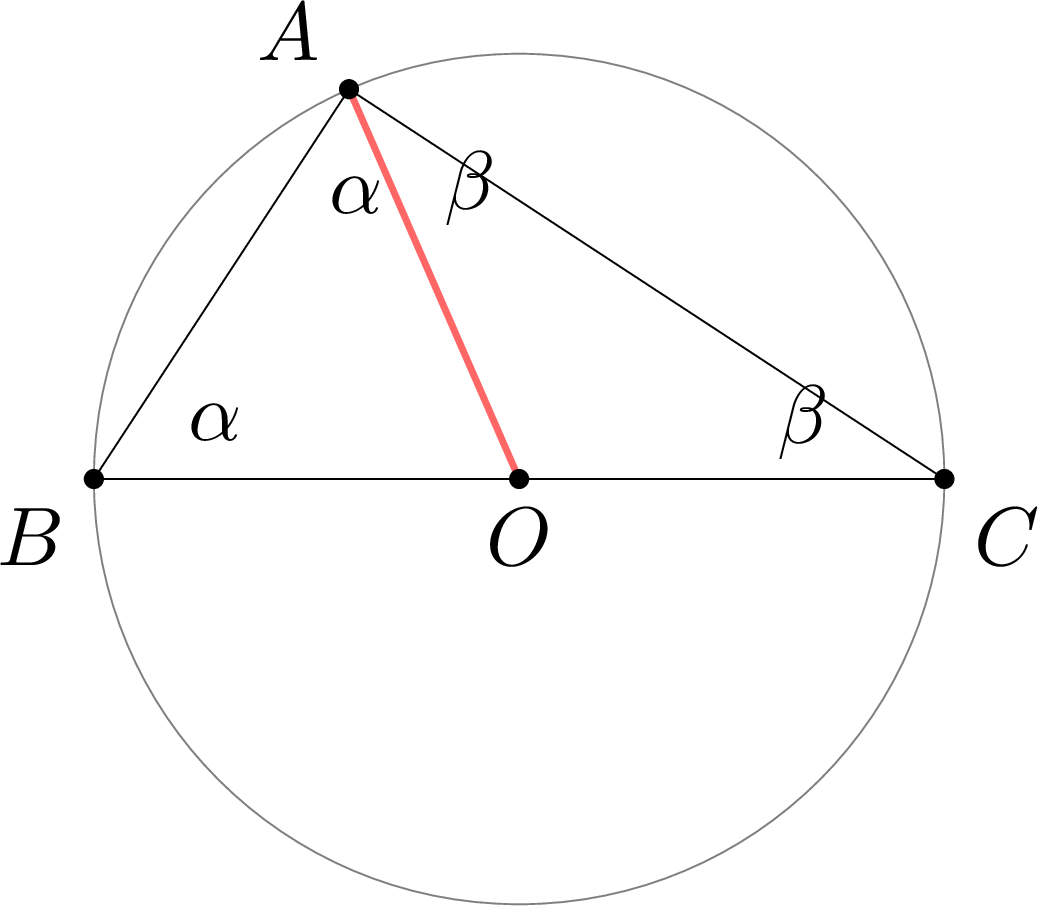
- The triangle \(OAB\) is isosceles at \(O\), so its base angles are equal: \(\Angle{BAO} = \Angle{ABO} = \alpha\).
- The triangle \(OAC\) is isosceles at \(O\), so its base angles are equal: \(\Angle{OAC} = \Angle{OCA} = \beta\).
Proposition — Circumscribed circle of a triangle
Let \(ABC\) be a triangle. The perpendicular bisectors of its three sides pass through a single point \(O\), which is at equal distance from the three vertices: \(OA = OB = OC\). The circle with centre \(O\) passing through \(A\), \(B\) and \(C\) is called the circumscribed circle of the triangle. 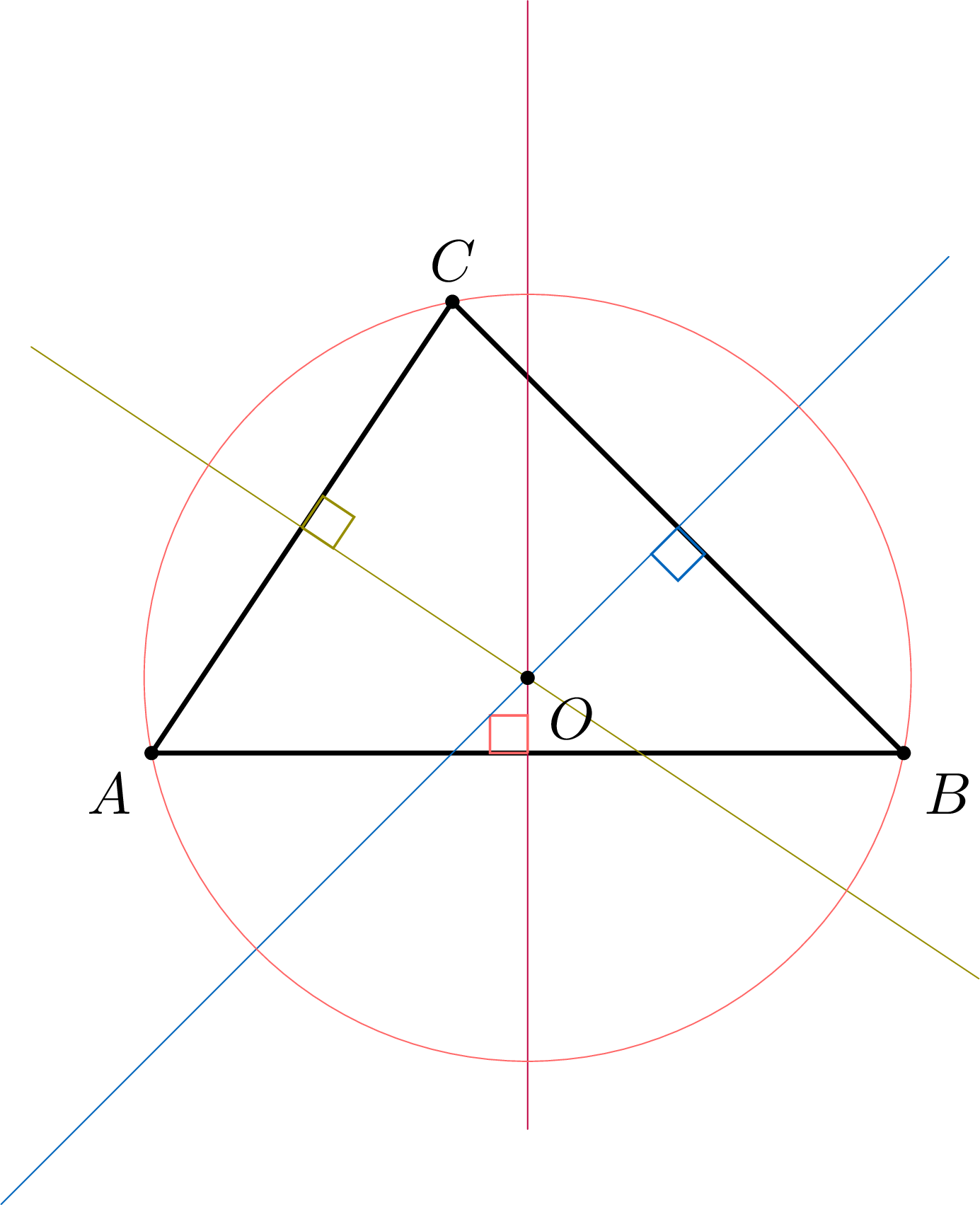
Call \(O\) the point where the perpendicular bisectors of \(\Segment{AB}\) and \(\Segment{BC}\) cross.
- \(O\) is on the perpendicular bisector of \(\Segment{AB}\), so \(OA = OB\).
- \(O\) is on the perpendicular bisector of \(\Segment{BC}\), so \(OB = OC\).
Theorem — Circumscribed Circle of a Right-Angled Triangle
If a triangle is right-angled, then the centre of its circumscribed circle is the midpoint of its hypotenuse (the hypotenuse is a diameter).In particular, the median from the right angle measures half the hypotenuse.
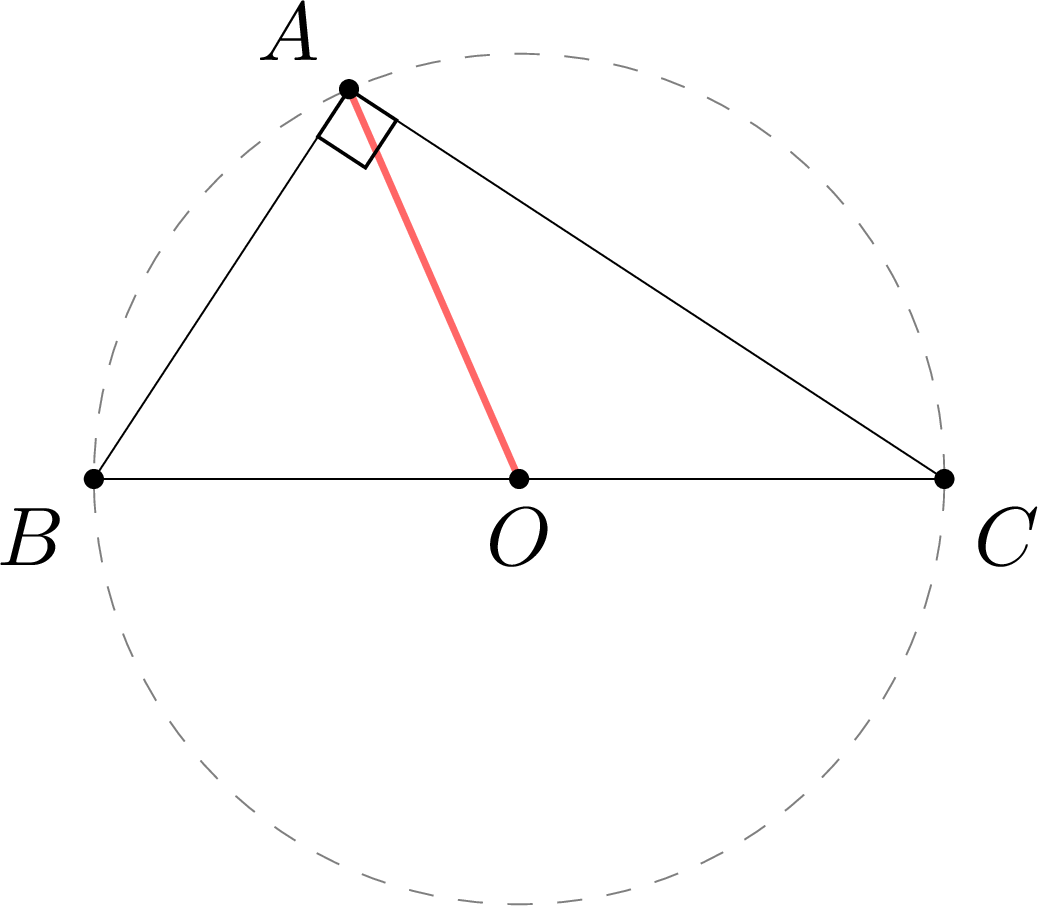
Let \(ABC\) be right-angled at \(A\), and let \(O\) be the midpoint of the hypotenuse \(\Segment{BC}\). Let \(D\) be the image of \(A\) under the half-turn about \(O\) (point reflection). 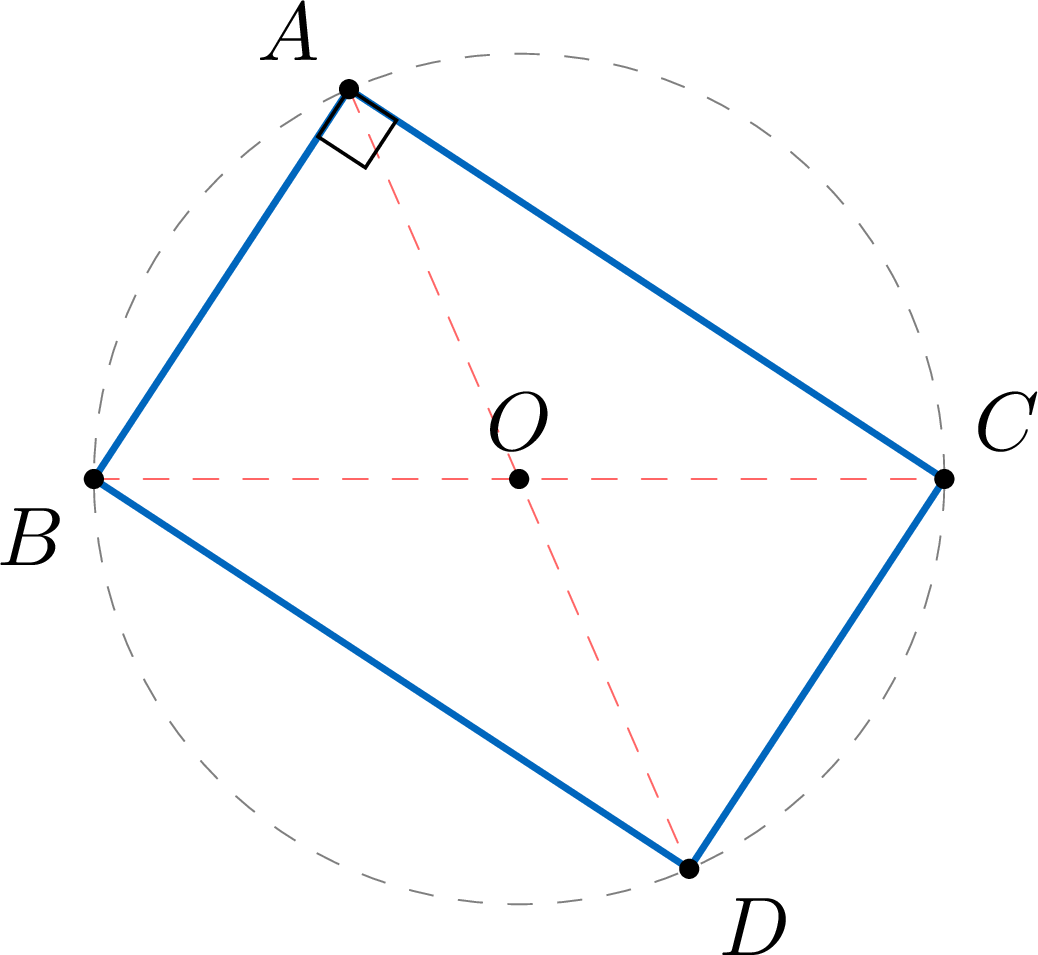
- The diagonals \(\Segment{AD}\) and \(\Segment{BC}\) of the quadrilateral \(ABDC\) have the same midpoint \(O\): \(ABDC\) is a parallelogram.
- This parallelogram has a right angle (at \(A\)): it is a rectangle.
- The diagonals of a rectangle have the same length and cut each other at their midpoints: so \(OA = OB = OC = OD\).
Example
The point \(C\) is on the circle with diameter \(\Segment{AB}\), with \(AB = 13\) cm and \(AC = 5\) cm. - Explain why the triangle \(ABC\) is right-angled at \(C\).
- Compute \(BC\).
- \(O\) is the midpoint of \(\Segment{AB}\). Compute the median \(CO\).
- The triangle \(ABC\) is inscribed in the circle and \(\Segment{AB}\) is a diameter: by the angle in a semicircle theorem, \(ABC\) is right-angled at \(C\), the vertex opposite the diameter.
- In the right-angled triangle, by Pythagoras' theorem: $$\begin{aligned} AB^2 &= AC^2 + BC^2 \\ 13^2 &= 5^2 + BC^2 \\ BC^2 &= 169 - 25 = 144 \\ BC &= \textcolor{colorprop}{12} \text{ cm} \end{aligned}$$
- The median from the right angle measures half the hypotenuse: $$CO = \dfrac{AB}{2} = \dfrac{13}{2} = \textcolor{colorprop}{6.5} \text{ cm}$$
Example
The segment \(\Segment{AB}\) is a diameter of the circle of centre \(O\), and \(C\) is a point of the circle with \(\Angle{CAB} = 28^\circ\). 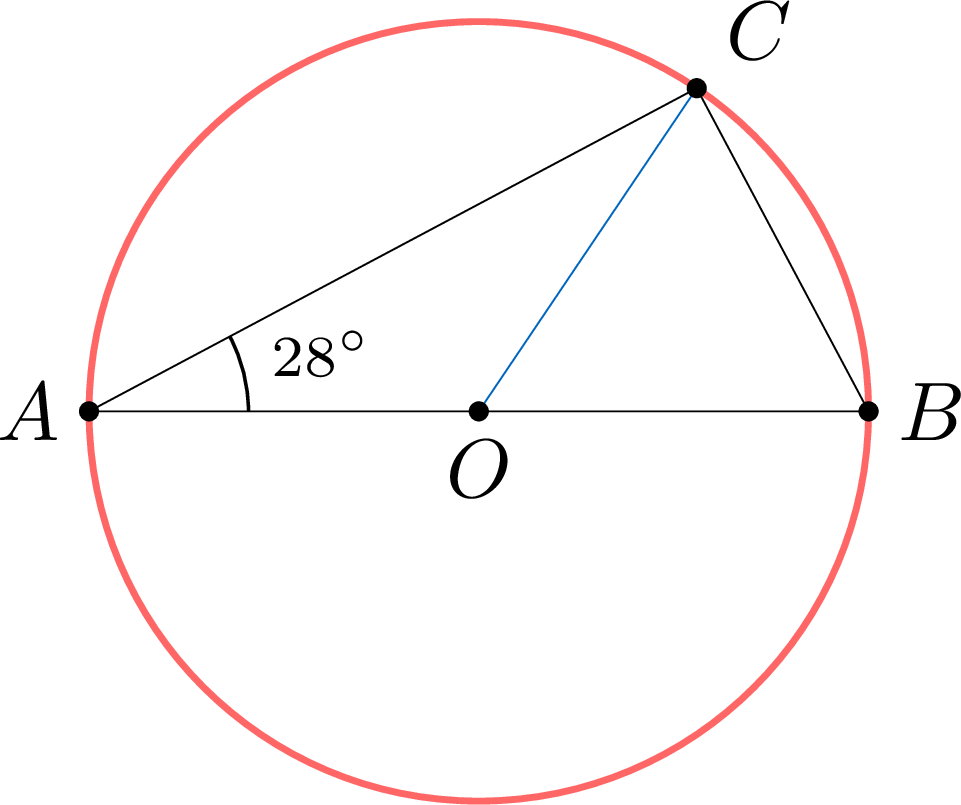
$$\begin{aligned}[t] \Angle{ACB} &= 90^\circ && \text{(angle in a semicircle: } \Segment{AB} \text{ is a diameter)}\\
\Angle{ABC} &= 180^\circ - 90^\circ - 28^\circ && \text{(angle sum of the triangle } ABC\text{)}\\
&= 62^\circ\\
\Angle{OCA} &= \Angle{OAC} && \text{(}OA = OC\text{, radii: the triangle } OAC \text{ is isosceles)}\\
&= 28^\circ && \text{(}O \text{ lies on } \Segment{AB}\text{, so } \Angle{OAC} = \Angle{CAB}\text{)}\\
\Angle{BOC} &= \Angle{OAC} + \Angle{OCA} && \text{(exterior angle of the triangle } OAC\text{)}\\
&= 28^\circ + 28^\circ\\
&= 56^\circ. \end{aligned}$$
Skills to practice
- Recognising Right-Angled Triangles in Circles
- Finding Lengths in a Semicircle
- Finding Angles in a Semicircle
- Proving with the Angle in a Semicircle
III.2
Chords
Proposition — Perpendicular bisector and equidistance
The perpendicular bisector of a segment \(\Segment{AB}\) is the set of all the points at the same distance from \(A\) and from \(B\). In other words, a point \(M\) lies on the perpendicular bisector of \(\Segment{AB}\) if and only if \(MA = MB\). 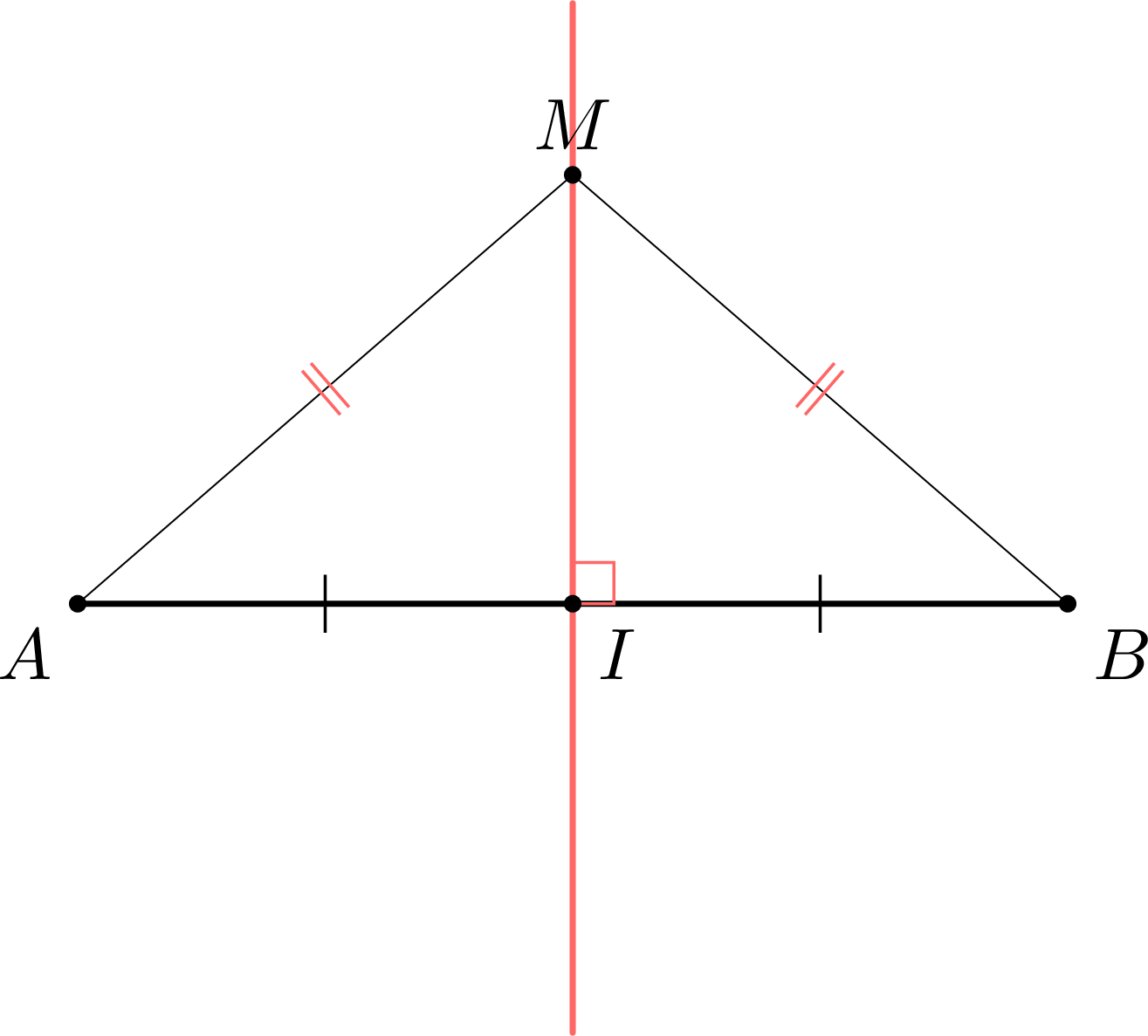
A round pond has a fountain at its centre \(O\). A straight footbridge \(\Segment{AB}\), \(12\) m long, crosses the pond from one edge to the other, and the point of the footbridge closest to the fountain is \(2.5\) m from it. 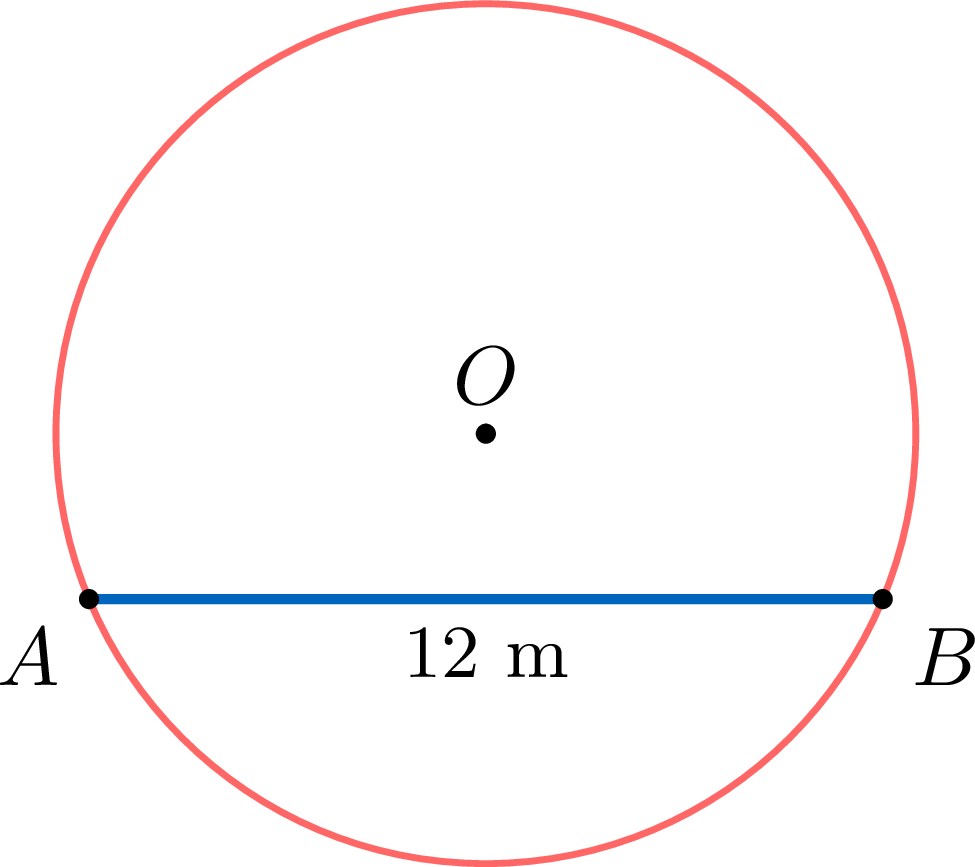
Where on the footbridge is the point closest to the fountain? How wide is the pond?
The point of the footbridge closest to \(O\) is the foot \(M\) of the perpendicular from \(O\) to \(\Segment{AB}\). It is exactly the middle of the footbridge: the perpendicular from the centre of a circle to a chord cuts the chord into two equal halves (the Proposition “Perpendicular from the Centre to a Chord”). So \(AM = 6\) m, and the triangle \(OMA\) is right-angled at \(M\), with hypotenuse the radius \(r = OA\): 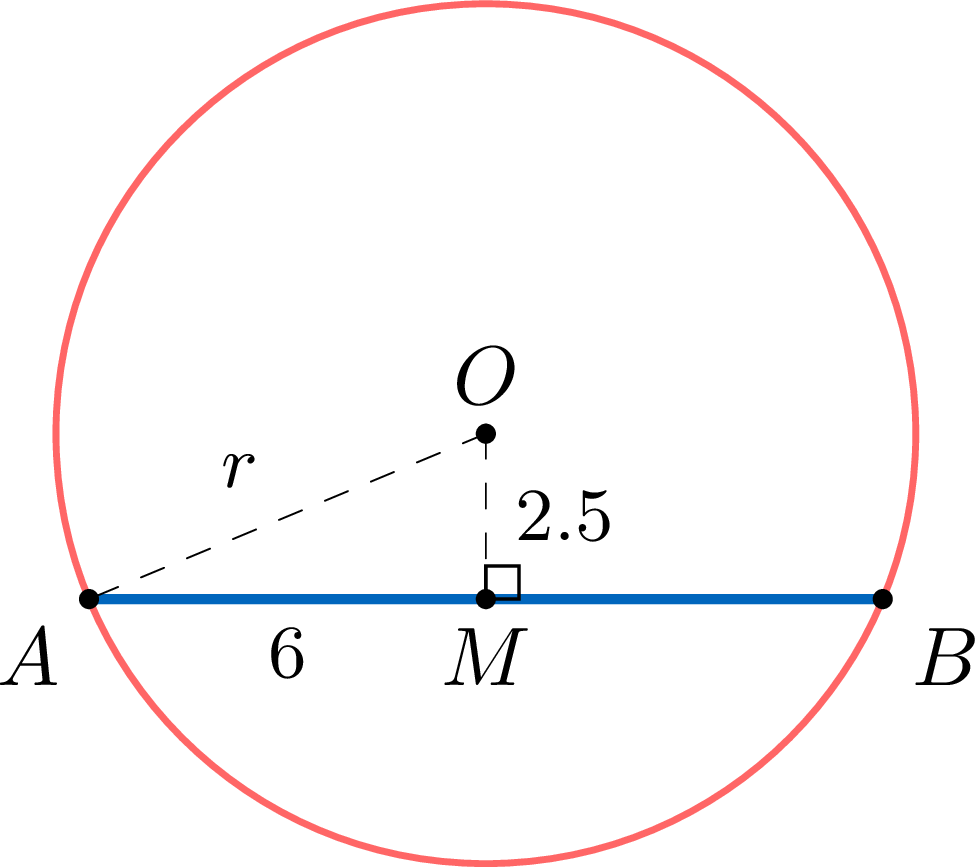
$$\begin{aligned}[t] r^2 &= OM^2 + AM^2 && \text{(Pythagoras' theorem in } OMA\text{)}\\
&= 2.5^2 + 6^2\\
&= 6.25 + 36\\
&= 42.25, \end{aligned}$$ so \(r = \sqrt{42.25} = 6.5\) m, and the pond is \(2 \times 6.5 = 13\) m wide, along a diameter.
Proposition — Perpendicular from the Centre to a Chord
Let \(\Segment{AB}\) be a chord of a circle of centre \(O\), and \(M\) the foot of the perpendicular from \(O\) to \(\Line{AB}\). Then \(M\) is the midpoint of \(\Segment{AB}\): the perpendicular from the centre to a chord bisects the chord. 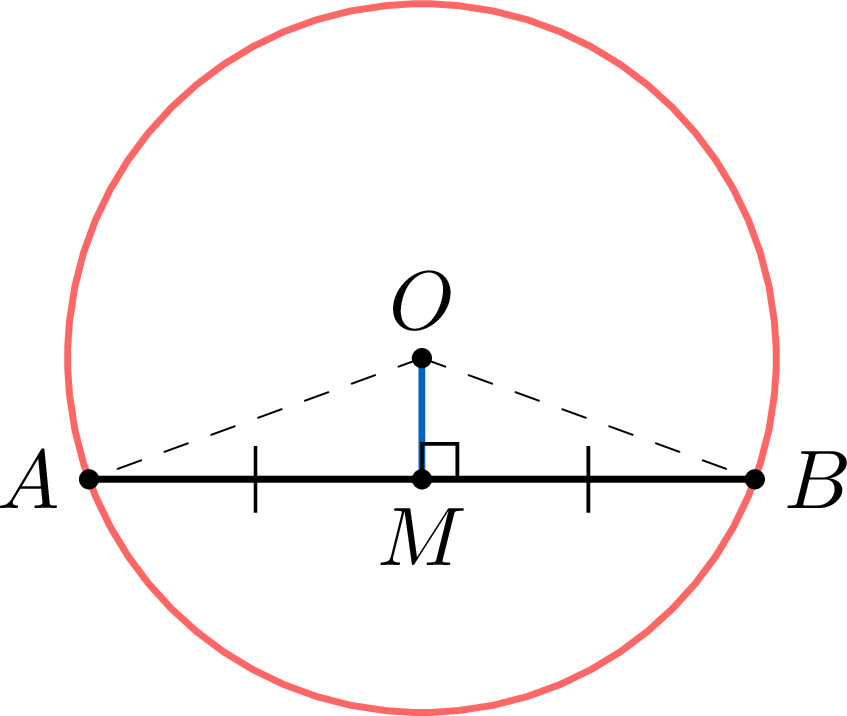
If \(\Segment{AB}\) is a diameter, then \(O\) lies on \(\Line{AB}\), so \(M = O\), the midpoint of \(\Segment{AB}\). Otherwise, consider the triangles \(OMA\) and \(OMB\). The point \(M\) is neither \(A\) nor \(B\): if \(M\) were \(A\), the triangle \(OAB\) would be right-angled at \(A\), and Pythagoras' theorem would give \(OB^2 = OA^2 + AB^2 \gt OA^2\), whereas \(OA = OB\); likewise for \(B\). 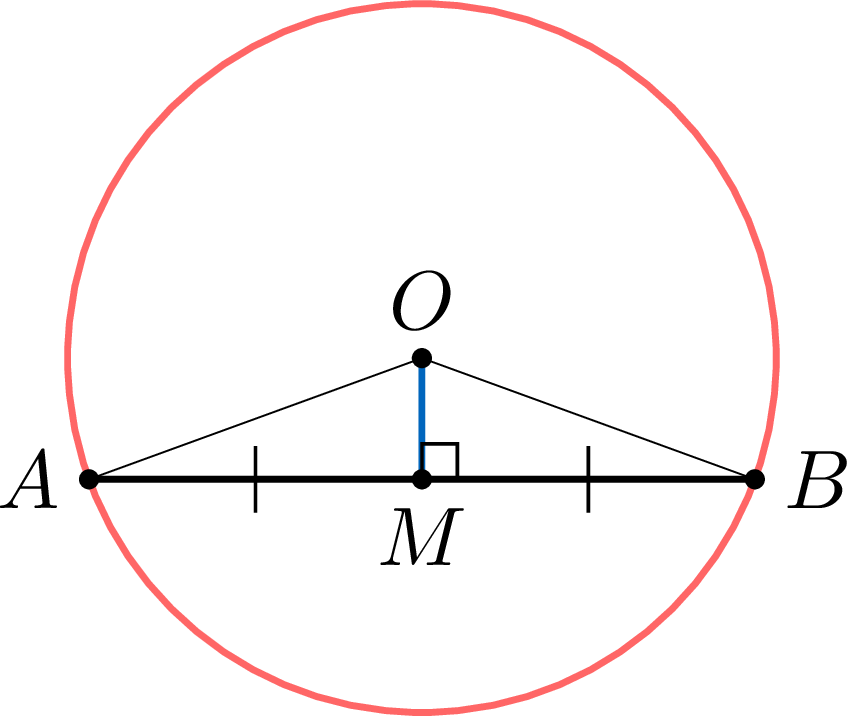
$$\begin{aligned}[t] \Angle{OMA} &= \Angle{OMB} = 90^\circ && \text{(}M \text{ is the foot of the perpendicular)}\\
OA &= OB && \text{(radii)}\\
OM &= OM && \text{(common side)} \end{aligned}$$ The two triangles are right-angled, with equal hypotenuses \(\Segment{OA}\) and \(\Segment{OB}\) and a common side \(\Segment{OM}\): they are congruent (RHS). Their corresponding sides \(\Segment{MA}\) and \(\Segment{MB}\) are equal: \(MA = MB\). The point \(M\) lies on the line \(\Line{AB}\) at the same distance from \(A\) and from \(B\), with \(A \neq B\): it is the midpoint of \(\Segment{AB}\).
Proposition — Perpendicular Bisector of a Chord
The perpendicular bisector of a chord of a circle passes through the centre of the circle. Consequently, the line joining the centre to the midpoint of a chord that is not a diameter is perpendicular to the chord. 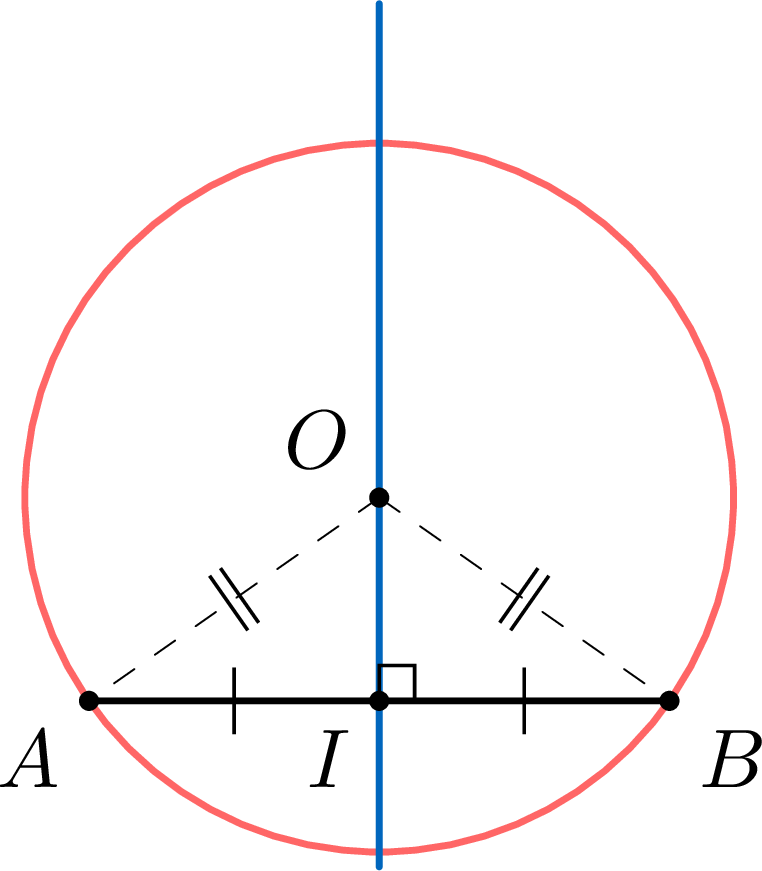
Let \(\Segment{AB}\) be a chord of the circle of centre \(O\), and \(I\) its midpoint. The points \(A\) and \(B\) are on the circle, so \(OA = OB\) (radii): the centre \(O\) is at the same distance from \(A\) and from \(B\), so it lies on the perpendicular bisector of \(\Segment{AB}\) (perpendicular bisector and equidistance). If \(\Segment{AB}\) is not a diameter, \(O\) does not lie on \(\Segment{AB}\), so \(O \neq I\). The perpendicular bisector of \(\Segment{AB}\) passes through \(I\), by definition, and through \(O\): it is the line \(\Line{OI}\). Hence \(\Line{OI} \perp \Line{AB}\).
Method — Finding the Centre of a Circle
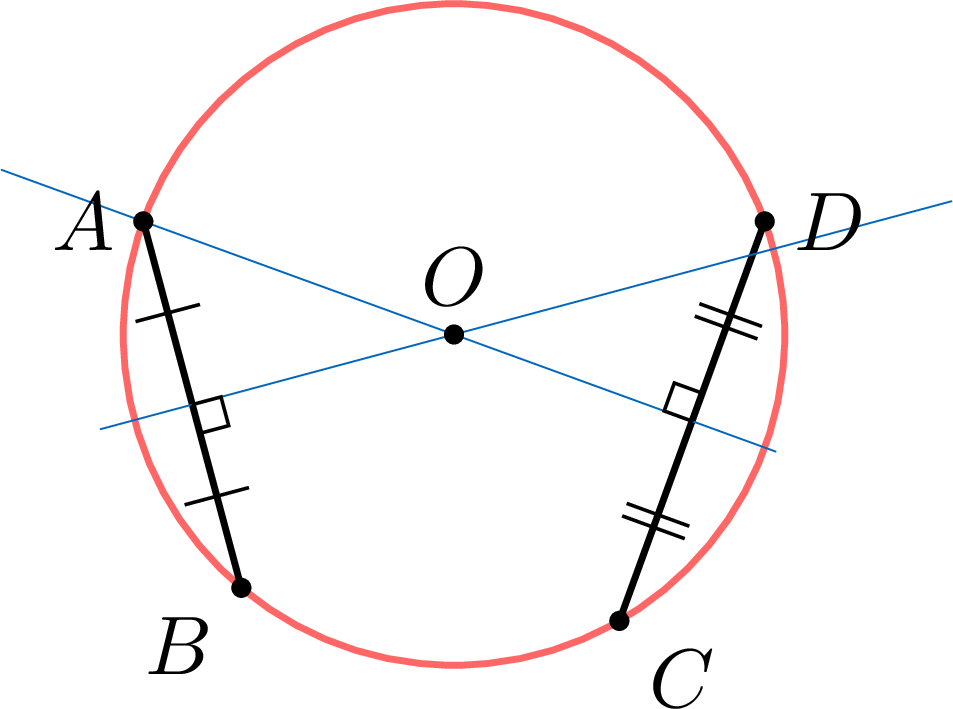
To find the centre of a circle that is drawn but whose centre is lost: - draw two chords that are not parallel;
- construct the perpendicular bisector of each chord, with the compass;
- the centre is the intersection point of the two perpendicular bisectors, since each of them passes through the centre.
Proposition — Equal Chords
In a circle, two chords of the same length are at the same distance from the centre. Conversely, two chords at the same distance from the centre have the same length. 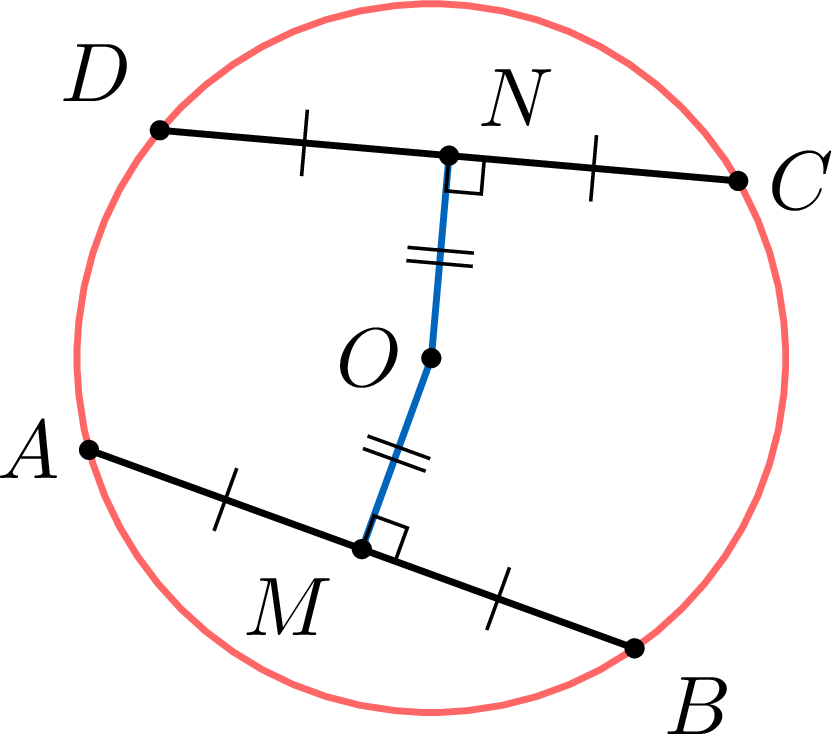
Let \(\Segment{AB}\) be a chord of a circle of centre \(O\) and radius \(r\), \(M\) the foot of the perpendicular from \(O\) to \(\Line{AB}\), and \(d = OM\) the distance from the centre to the chord. By the Proposition “Perpendicular from the Centre to a Chord”, \(M\) is the midpoint of \(\Segment{AB}\), so \(AM = \dfrac{AB}{2}\).
- If \(M \neq O\), the triangle \(OMA\) is right-angled at \(M\), and \(OA^2 = OM^2 + AM^2\) (Pythagoras' theorem).
- If \(M = O\) (the chord is a diameter), then \(d = 0\) and \(AM = OA\): the same equality holds.
Method — Calculating with a Chord
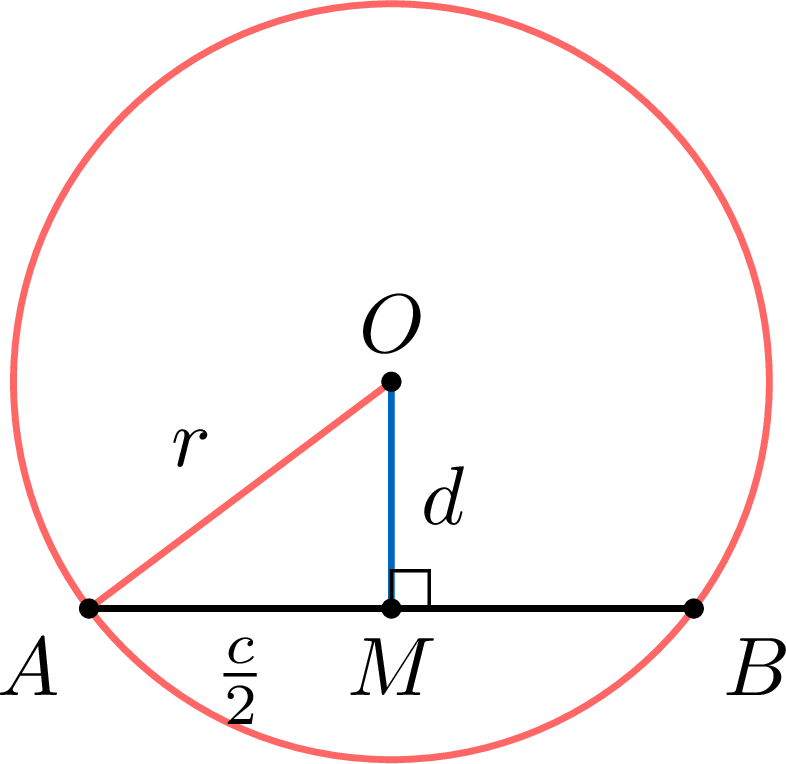
In a circle of centre \(O\) and radius \(r\), let \(c\) be the length of a chord \(\Segment{AB}\) and \(d\) its distance from the centre. To calculate one of the three lengths \(r\), \(c\), \(d\) from the other two: - draw the perpendicular \(\Segment{OM}\) from the centre to the chord and the radius \(\Segment{OA}\) to one end of the chord;
- \(M\) is the midpoint of the chord (perpendicular from the centre to a chord), so \(AM = \dfrac{c}{2}\);
- the triangle \(OMA\) is right-angled at \(M\): write Pythagoras' theorem \(r^2 = d^2 + \left(\dfrac{c}{2}\right)^2\), then substitute the two known lengths (for a diameter, \(M = O\), \(d = 0\) and \(c = 2r\): the relation still holds).
Example
A circle has centre \(O\) and radius \(13\) cm, and its chord \(\Segment{AB}\) measures \(24\) cm. 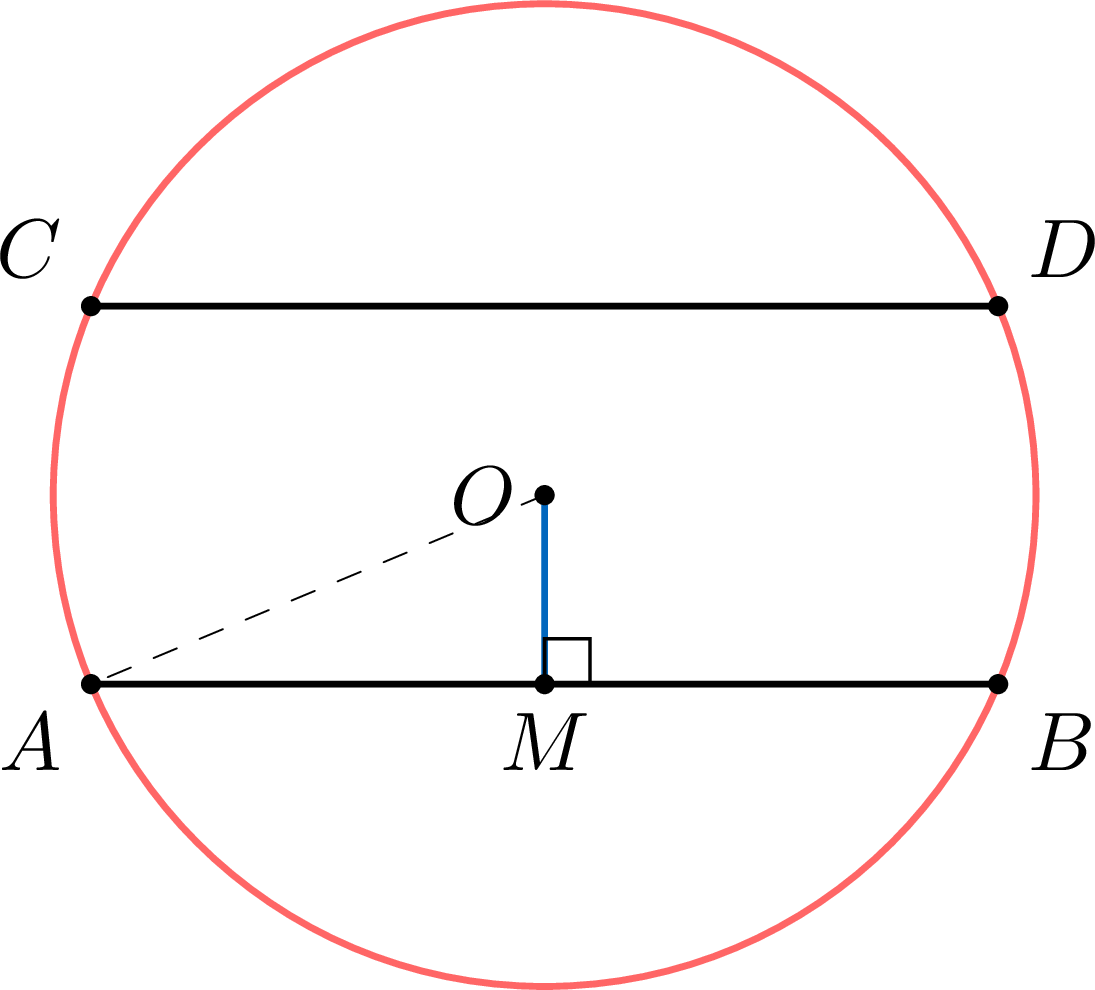
- Calculate the distance from \(O\) to the chord \(\Segment{AB}\).
- A second chord \(\Segment{CD}\) of the circle is \(5\) cm from \(O\). Find its length.
- Let \(M\) be the foot of the perpendicular from \(O\) to \(\Line{AB}\). It is the midpoint of \(\Segment{AB}\) (perpendicular from the centre to a chord), so \(AM = \dfrac{24}{2} = 12\) cm, and the triangle \(OMA\) is right-angled at \(M\): $$\begin{aligned}[t] OA^2 &= OM^2 + AM^2 && \text{(Pythagoras' theorem in } OMA\text{)}\\ 13^2 &= OM^2 + 12^2\\ OM^2 &= 169 - 144\\ &= 25, \end{aligned}$$ so \(OM = 5\) cm: the chord \(\Segment{AB}\) is \(5\) cm from the centre.
- The chord \(\Segment{CD}\) is \(5\) cm from \(O\), like \(\Segment{AB}\): the two chords are at the same distance from the centre, so they have the same length (equal chords). Hence \(CD = AB = 24\) cm, with no further calculation.
Example
Two circles have the same centre \(O\). A line cuts the larger circle at \(A\) and \(D\), and the smaller circle at \(B\) and \(C\), in the order \(A\), \(B\), \(C\), \(D\). 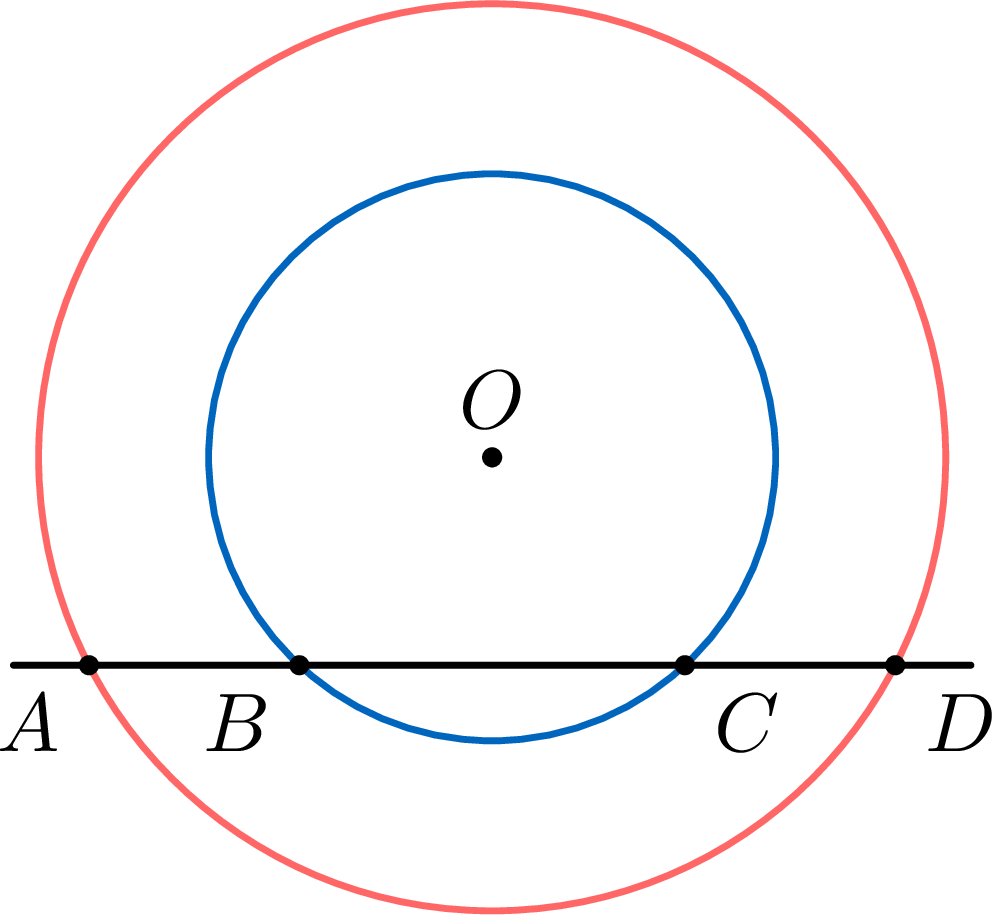
Figure. Let \(M\) be the foot of the perpendicular from \(O\) to the line \(\Line{AD}\) (\(M = O\) if the line passes through \(O\)). 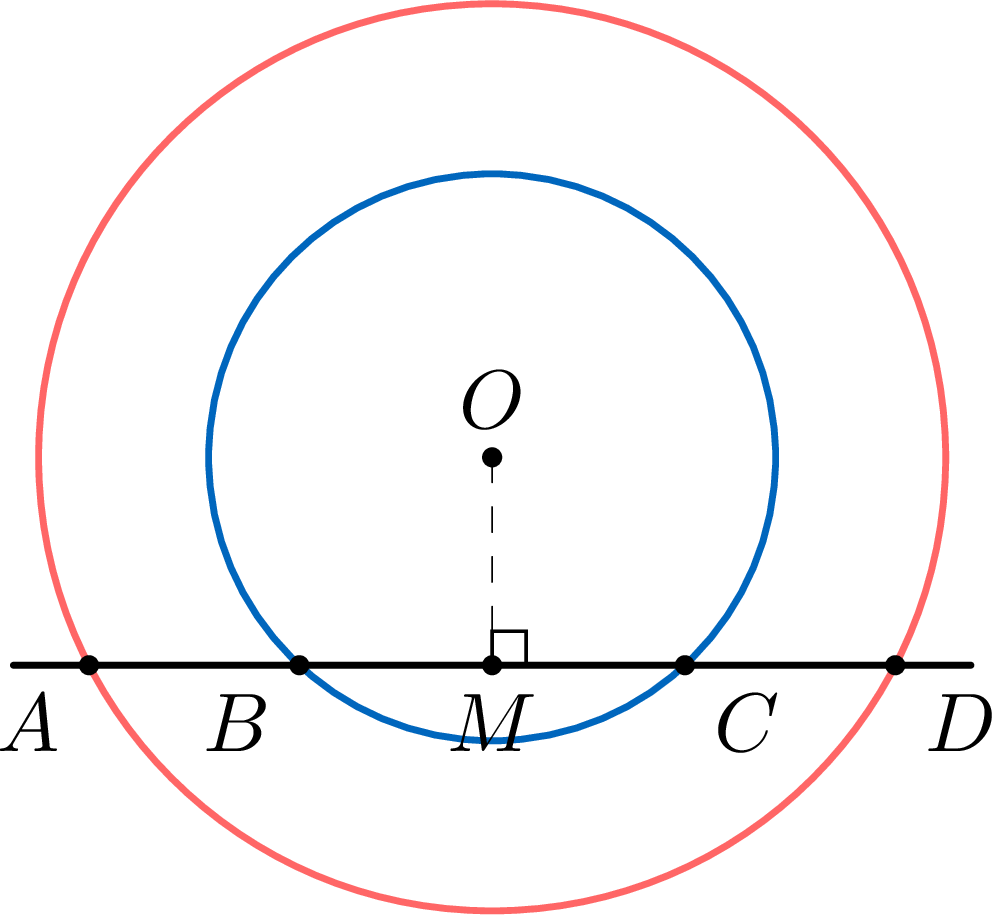
Given: \(A\) and \(D\) are on the larger circle, \(B\) and \(C\) on the smaller one, both of centre \(O\), collinear in the order \(A\), \(B\), \(C\), \(D\). To prove: \(AB = CD\). Facts and reasons. The segment \(\Segment{AD}\) is a chord of the larger circle and \(\Segment{BC}\) a chord of the smaller one, both on the line \(\Line{AD}\), and \(M\) is the foot of the perpendicular from the common centre \(O\) to this line. $$\begin{aligned}[t] MA &= MD && \text{(perpendicular from the centre to the chord } \Segment{AD}\text{)}\\
MB &= MC && \text{(perpendicular from the centre to the chord } \Segment{BC}\text{)} \end{aligned}$$ So \(M\) is the midpoint of \(\Segment{BC}\), and the order on the line is \(A\), \(B\), \(M\), \(C\), \(D\). Hence $$\begin{aligned}[t] AB &= MA - MB && \text{(}B \text{ lies between } A \text{ and } M\text{)}\\
&= MD - MC && \text{(the two equalities above)}\\
&= CD && \text{(}C \text{ lies between } M \text{ and } D\text{)}. \end{aligned}$$ Conclusion. The segments \(\Segment{AB}\) and \(\Segment{CD}\) have the same length: \(AB = CD\).
Skills to practice
- Calculating with Chords
- Proving Chord Properties
III.3
Radius and Tangent
A tram wheel, seen from the side, is a circle of centre \(O\) and radius \(40\) cm; it rests on a straight rail. 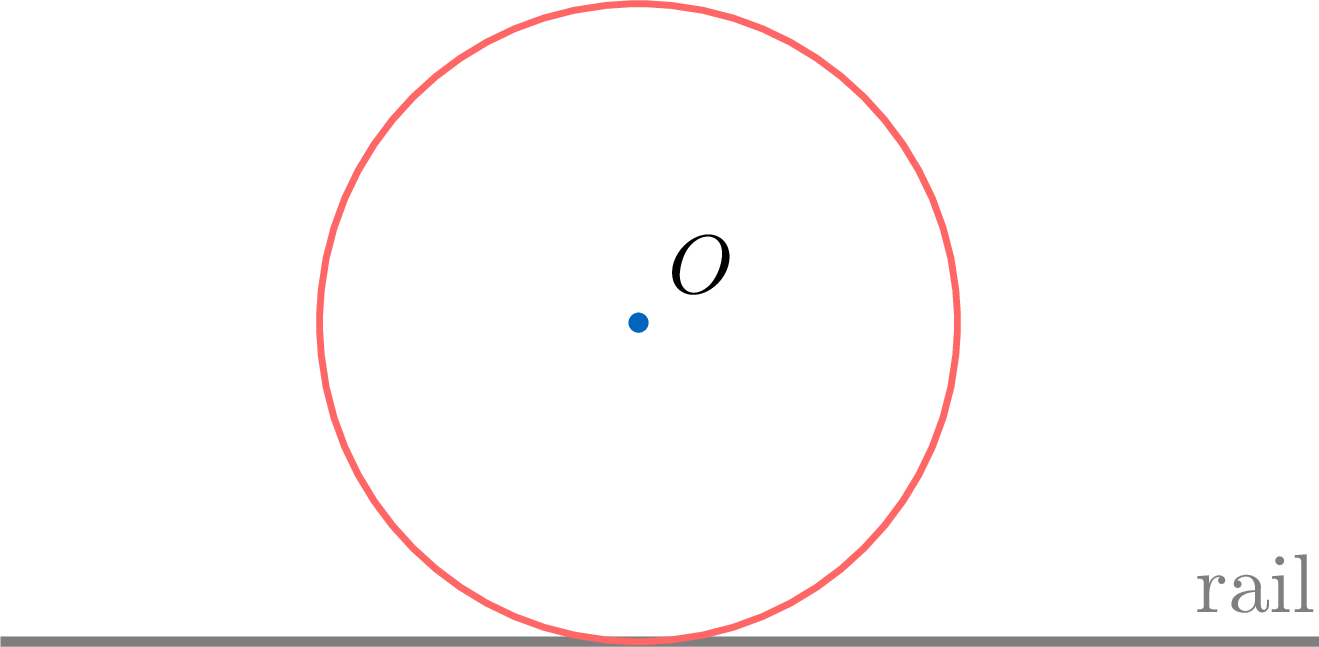
How many points do the wheel and the rail have in common? Where is the centre \(O\) relative to the common point(s), and how far is it from the rail?
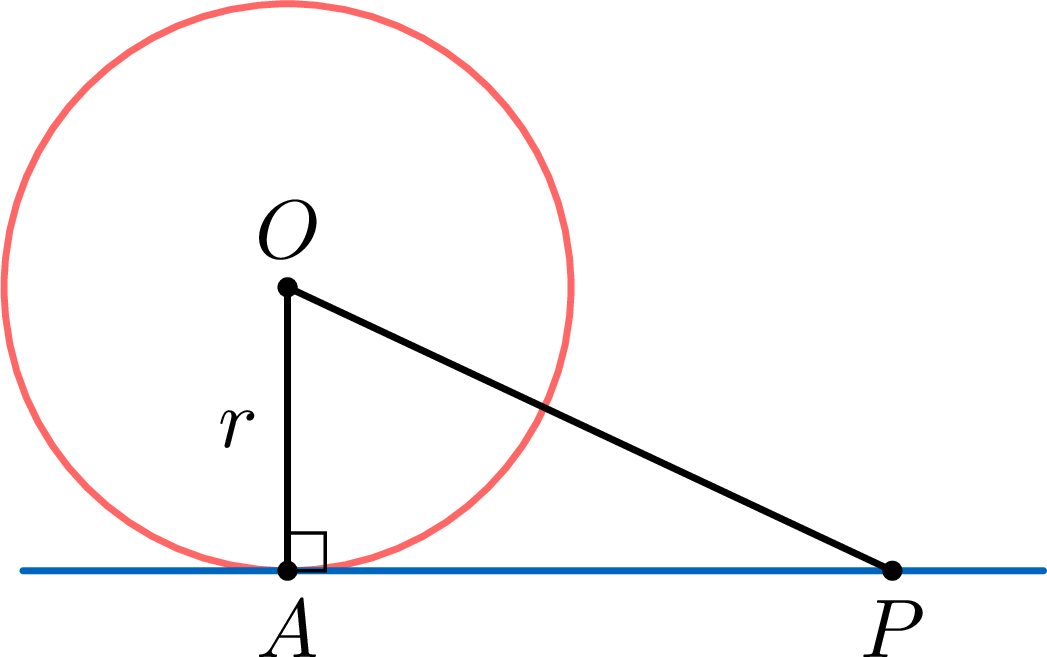
One point only: the rail touches the wheel without cutting it. This point \(A\) is the lowest point of the wheel, and the centre \(O\) is right above it: the radius \(\Segment{OA}\) is vertical, so it is perpendicular to the rail, and \(O\) is \(40\) cm from the rail — exactly the radius. 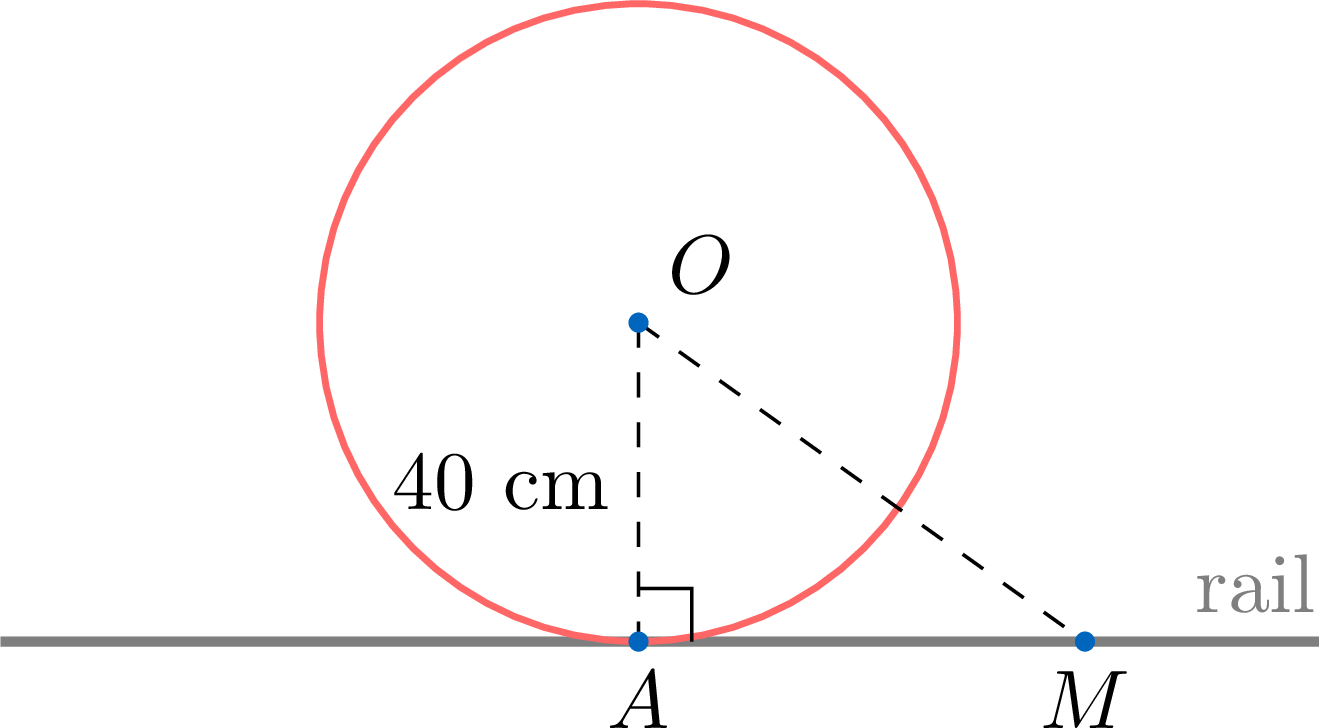
Any other point \(M\) of the rail is farther from \(O\): in the triangle \(OAM\), right-angled at \(A\), the hypotenuse \(\Segment{OM}\) is longer than the side \(\Segment{OA}\), so \(OM \gt 40\) cm and \(M\) is outside the wheel. A line that meets a circle at a single point is a tangent line; the radius to that point is always perpendicular to it.
Proposition — Tangent and Radius
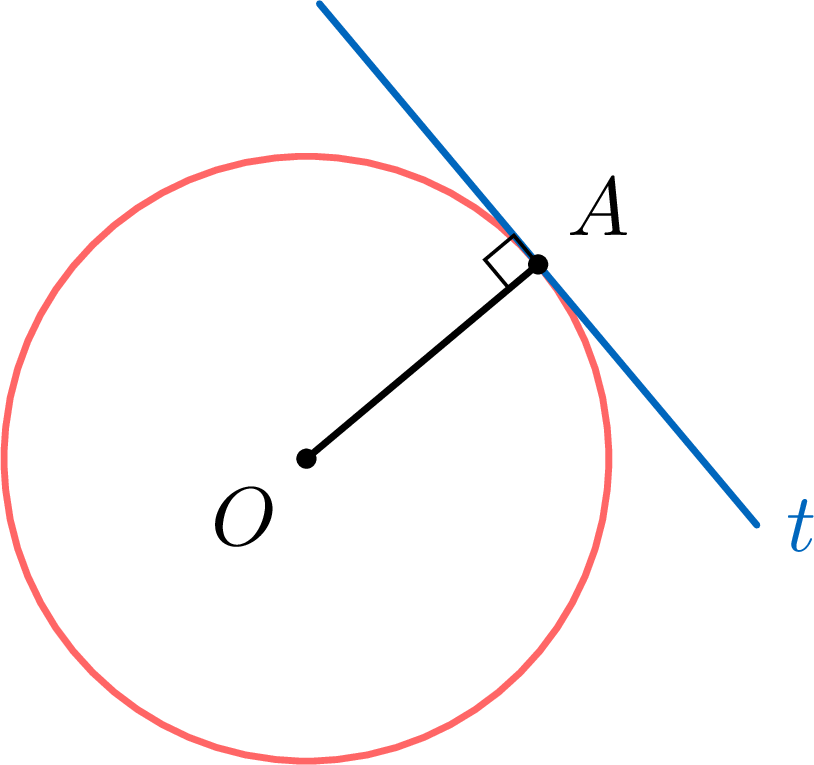
Let \(\mathcal{C}\) be the circle of centre \(O\) and radius \(r\), and \(A\) a point of \(\mathcal{C}\). Recall that a line is tangent to \(\mathcal{C}\) at \(A\) when \(A\) is its only common point with \(\mathcal{C}\). - If a line is tangent to \(\mathcal{C}\) at \(A\), then it is perpendicular to the radius \(\Segment{OA}\).
- Conversely, the line through \(A\) perpendicular to the radius \(\Segment{OA}\) is tangent to \(\mathcal{C}\) at \(A\).
The perpendicular is tangent. Let \(d\) be the line through \(A\) perpendicular to \(\Line{OA}\), and \(M\) a point of \(d\) other than \(A\) (left figure). The triangle \(OAM\) is right-angled at \(A\): $$\begin{aligned}[t] OM^2 &= OA^2 + AM^2 && \text{(Pythagoras' theorem in } OAM\text{)}\\
&= r^2 + AM^2\\
&\gt r^2. \end{aligned}$$ So \(OM \gt r\): the point \(M\) is outside \(\mathcal{C}\). Hence \(A\) is the only common point of \(d\) and \(\mathcal{C}\), and \(d\) is tangent to \(\mathcal{C}\) at \(A\). 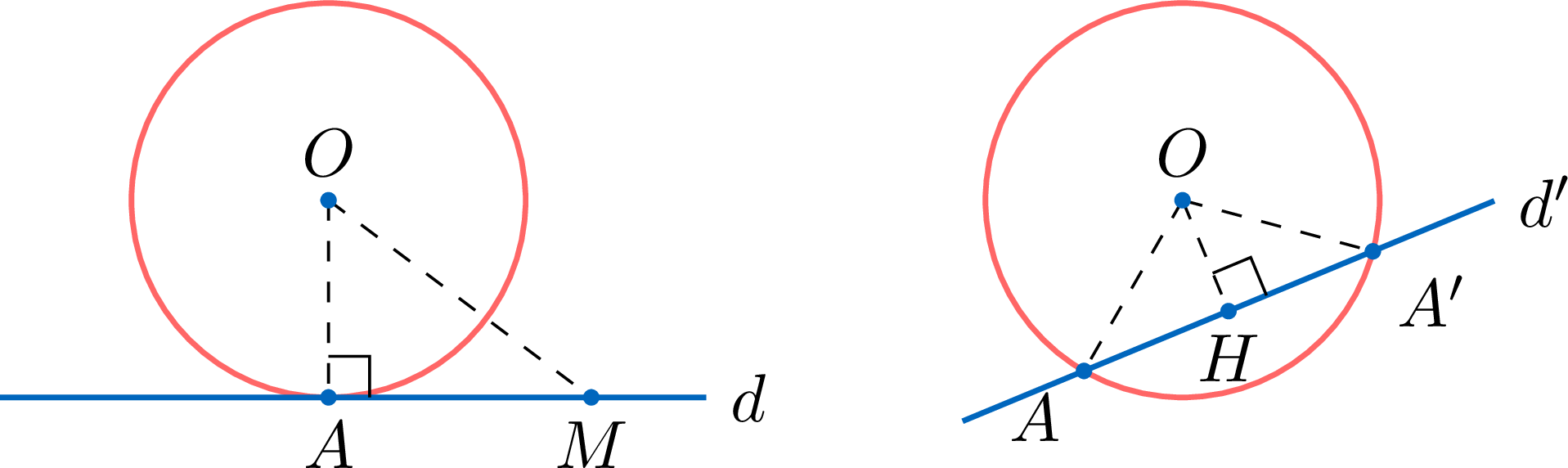
A tangent is perpendicular to the radius. Let \(t\) be a line tangent to \(\mathcal{C}\) at \(A\). Suppose, for contradiction, that \(t\) is not perpendicular to \(\Line{OA}\) (right figure, where \(t\) is the line \(d'\)). If \(t\) passes through \(O\), it meets \(\mathcal{C}\) again at the point diametrically opposite \(A\): contradiction. Otherwise, let \(H\) be the foot of the perpendicular from \(O\) to \(t\); then \(H \neq A\), since \(t\) is not perpendicular to \(\Line{OA}\). Let \(A'\) be the point of \(t\) such that \(H\) is the midpoint of \(\Segment{AA'}\): then \(A' \neq A\). The line \(\Line{OH}\) is perpendicular to \(\Segment{AA'}\) at its midpoint: it is its perpendicular bisector, so \(OA' = OA = r\) (perpendicular bisector and equidistance). The point \(A'\) lies on \(\mathcal{C}\), so the line \(t\) has two common points with \(\mathcal{C}\): it is not tangent. This is a contradiction. Hence the assumption is false, and \(t \perp \Line{OA}\).
Method — Drawing the Tangent Line at a Point
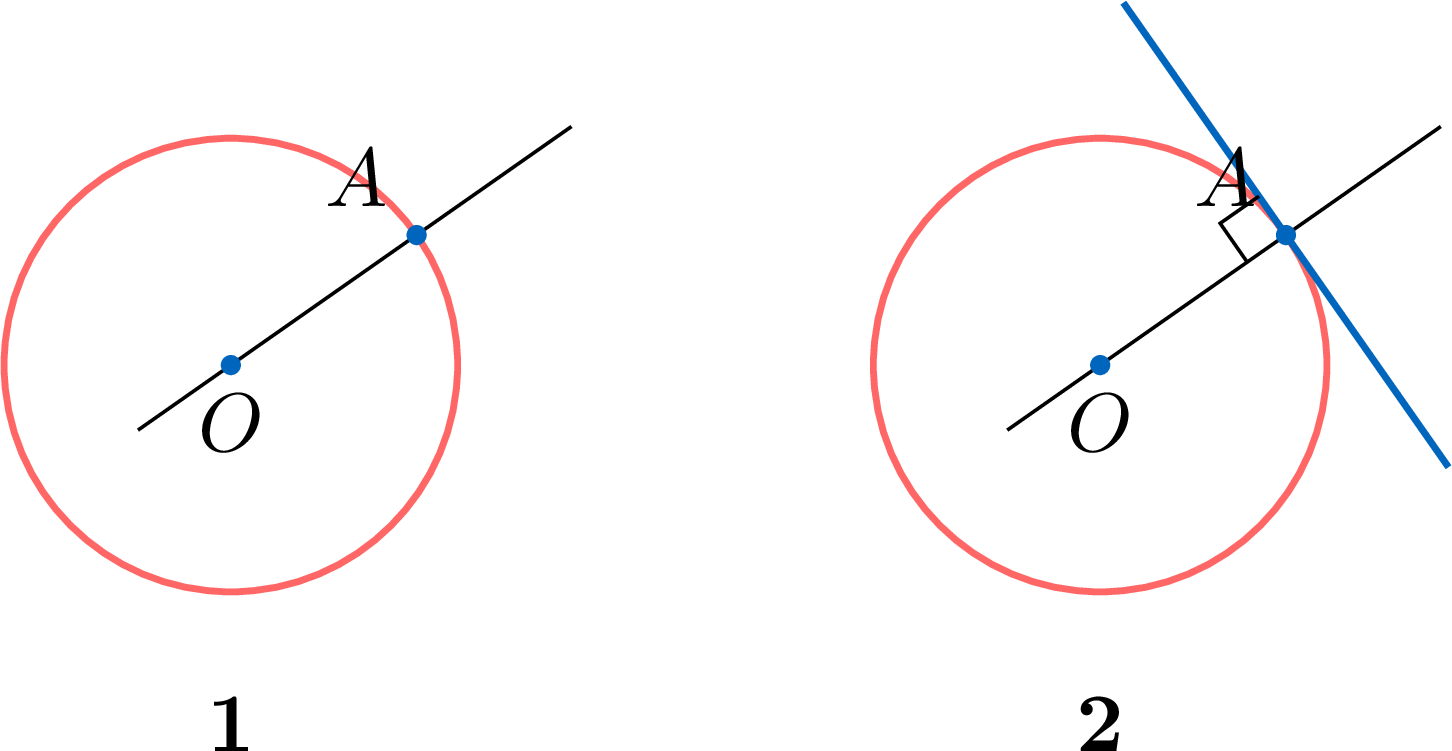
To draw the tangent line to the circle of centre \(O\) at its point \(A\): - draw the line \(\Line{OA}\);
- draw the perpendicular to \(\Line{OA}\) through \(A\), with a set square.
Method — Calculating with a Tangent
When a line is tangent at \(A\) to a circle of centre \(O\) and radius \(r\): - draw the radius \(\Segment{OA}\) and mark the right angle between the radius and the tangent;
- for a point \(P\) of the tangent other than \(A\), the triangle \(OAP\) is right-angled at \(A\), with hypotenuse \(\Segment{OP}\): use Pythagoras' theorem \(OP^2 = r^2 + PA^2\) for a length, and the angle sum \(\Angle{AOP} + \Angle{APO} = 90^\circ\) for an angle;
- write the reason “tangent and radius” on the line where the right angle is used.
Example
The circle of centre \(O\) has radius \(9\) cm. The line \(\Line{AP}\) is tangent to the circle at \(A\), with \(OP = 15\) cm, and \(\Segment{AB}\) is a chord such that \(\Angle{OAB} = 34^\circ\), the points \(B\) and \(P\) lying on the same side of the line \(\Line{OA}\). 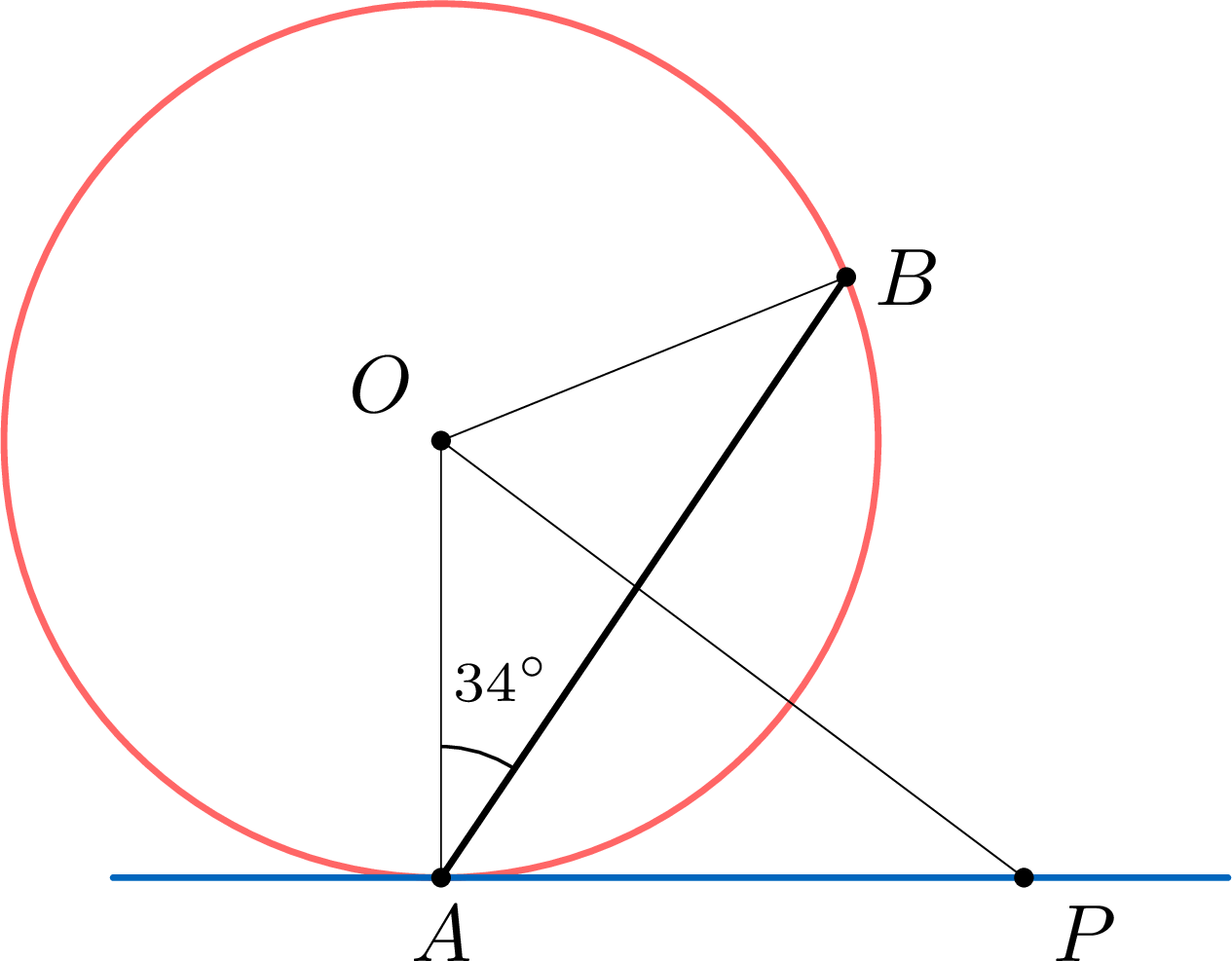
- Calculate the length \(PA\).
- Find the angles \(\Angle{PAB}\) and \(\Angle{AOB}\), giving a reason for each step.
- The line \(\Line{AP}\) is tangent at \(A\), so \(\Line{AP} \perp \Line{OA}\) (tangent and radius): the triangle \(OAP\) is right-angled at \(A\), with hypotenuse \(\Segment{OP}\). $$\begin{aligned}[t] OP^2 &= OA^2 + PA^2 && \text{(Pythagoras' theorem in } OAP\text{)}\\ 15^2 &= 9^2 + PA^2\\ PA^2 &= 225 - 81\\ &= 144, \end{aligned}$$ so \(PA = 12\) cm.
- $$\begin{aligned}[t] \Angle{OAP} &= 90^\circ && \text{(tangent and radius)}\\ \Angle{PAB} &= \Angle{OAP} - \Angle{OAB} && \text{(}B \text{ and } P \text{ on the same side of } \Line{OA}\text{)}\\ &= 90^\circ - 34^\circ\\ &= 56^\circ\\ \Angle{OBA} &= \Angle{OAB} = 34^\circ && \text{(}OA = OB\text{, radii: the triangle } OAB \text{ is isosceles)}\\ \Angle{AOB} &= 180^\circ - 34^\circ - 34^\circ && \text{(angle sum of the triangle } OAB\text{)}\\ &= 112^\circ. \end{aligned}$$
Proposition — Distance from the Centre to a Line
Let \(\mathcal{C}\) be the circle of centre \(O\) and radius \(r\), \(d\) a line, \(H\) the foot of the perpendicular from \(O\) to \(d\), and \(h = OH\) the distance from \(O\) to \(d\). - If \(h \gt r\), the line \(d\) and the circle \(\mathcal{C}\) have no common point.
- If \(h = r\), the line \(d\) is tangent to \(\mathcal{C}\) at \(H\).
- If \(h \lt r\), the line \(d\) intersects \(\mathcal{C}\) at two points.
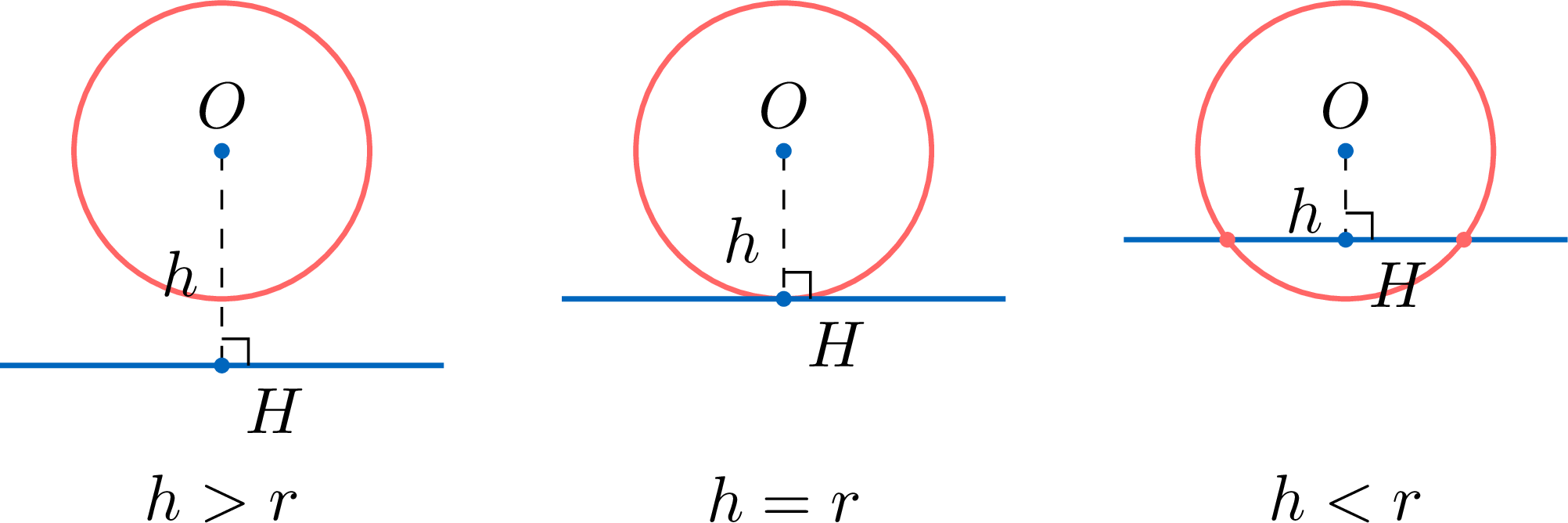
For every point \(M\) of \(d\) other than \(H\), the triangle \(OHM\) is right-angled at \(H\), so \(OM^2 = OH^2 + HM^2 = h^2 + HM^2\) (Pythagoras' theorem); this also holds for \(M = H\), and when \(O\) lies on \(d\), since then \(H = O\), \(h = 0\) and \(OM = HM\).
- If \(h \gt r\): \(OM^2 \geq h^2 \gt r^2\), so every point of \(d\) is outside \(\mathcal{C}\).
- If \(h = r\): the point \(H\) is on \(\mathcal{C}\), and \(\Line{OH} \perp d\), so \(d\) is the tangent line to \(\mathcal{C}\) at \(H\) (tangent line and radius).
- If \(h \lt r\): the two points \(M\) of \(d\) with \(HM = \sqrt{r^2 - h^2}\), one on each side of \(H\), satisfy \(OM^2 = h^2 + (r^2 - h^2) = r^2\): they are on \(\mathcal{C}\).
Skills to practice
- Deciding the Position of a Line and a Circle
- Finding Angles and Lengths with a Tangent
- Proving with Tangents
III.4
Tangents from an External Point
Proposition — Tangents from an External Point
Let \(\mathcal{C}\) be the circle of centre \(O\) and radius \(r\), and \(P\) a point outside \(\mathcal{C}\). Exactly two tangent lines to \(\mathcal{C}\) pass through \(P\), and their points of contact \(A\) and \(B\) lie on the circle of diameter \(\Segment{OP}\). Moreover: - the two tangent segments have the same length: \(PA = PB = \sqrt{OP^2 - r^2}\);
- the line \(\Line{OP}\) bisects the angle \(\Angle{APB}\) between the tangents and the angle \(\Angle{AOB}\) between the radii.
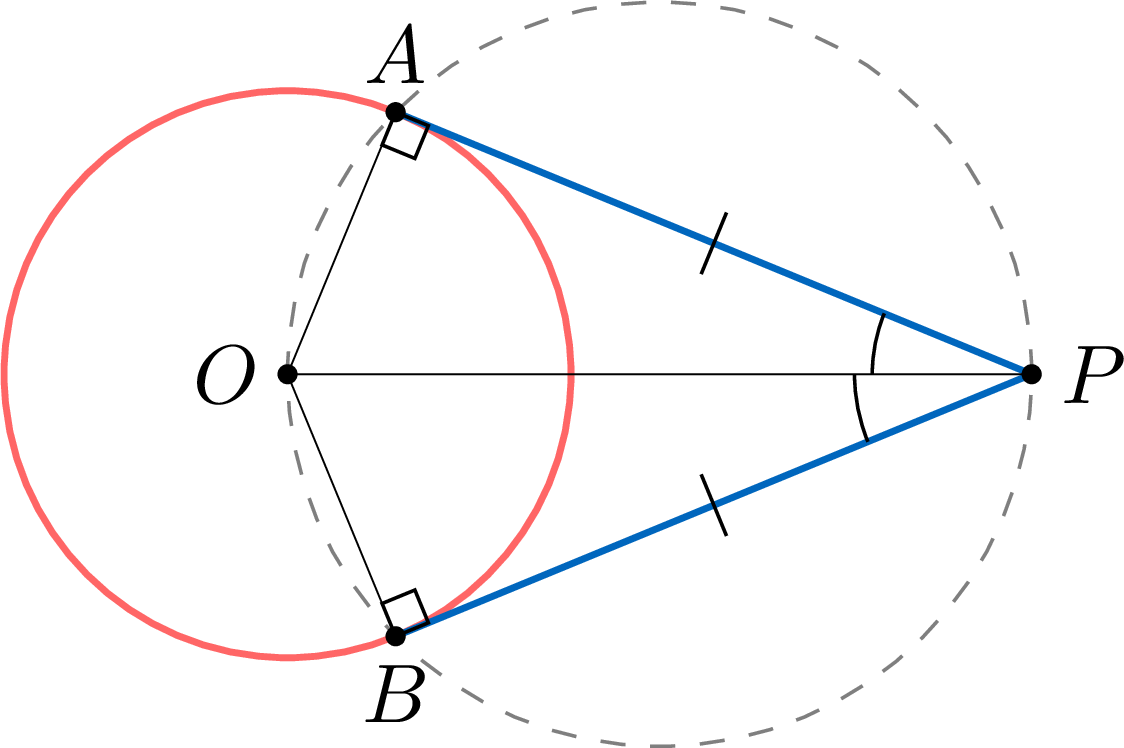
Equal tangents and bisected angles. Let two tangent lines through \(P\) touch \(\mathcal{C}\) at \(A\) and \(B\). $$\begin{aligned}[t] \Angle{OAP} &= \Angle{OBP} = 90^\circ && \text{(tangent and radius)}\\
OA &= OB && \text{(radii)}\\
OP &= OP && \text{(common hypotenuse)} \end{aligned}$$ The right-angled triangles \(OAP\) and \(OBP\) have a common hypotenuse and the equal sides \(\Segment{OA}\) and \(\Segment{OB}\): they are congruent (RHS). Their corresponding sides and angles are equal: \(PA = PB\), \(\Angle{APO} = \Angle{BPO}\) and \(\Angle{AOP} = \Angle{BOP}\), so \(\Line{OP}\) bisects \(\Angle{APB}\) and \(\Angle{AOB}\). Finally, in the triangle \(OAP\) right-angled at \(A\): $$\begin{aligned}[t] PA^2 &= OP^2 - OA^2 && \text{(Pythagoras' theorem in } OAP\text{)}\\
&= OP^2 - r^2. \end{aligned}$$ Where the points of contact are, and how many. A point \(A\) of \(\mathcal{C}\) is the point of contact of a tangent line through \(P\) exactly when \(\Line{PA} \perp \Line{OA}\) (tangent and radius, both directions), that is, when the triangle \(OAP\) is right-angled at \(A\). This happens exactly when \(A\) lies on the circle \(\Gamma\) of diameter \(\Segment{OP}\) (angle in a semicircle, and its converse: the circumscribed circle of a right-angled triangle). So the points of contact are the common points of \(\mathcal{C}\) and \(\Gamma\). The circle \(\Gamma\) passes through \(O\), inside \(\mathcal{C}\), and through \(P\), outside \(\mathcal{C}\): it crosses \(\mathcal{C}\) (a fact accepted here without proof: a circle through a point inside another circle and a point outside it meets that circle). Both circles have their centres on \(\Line{OP}\), so the reflection in \(\Line{OP}\) maps each of them onto itself; and the only points of \(\Gamma\) on \(\Line{OP}\) are \(O\) and \(P\), which are not on \(\mathcal{C}\). The common points therefore come in pairs of distinct points symmetric about \(\Line{OP}\); since two distinct circles have at most two common points (a fact also accepted without proof), there are exactly two of them, \(A\) and \(B\): exactly two tangent lines pass through \(P\).
Example
From a point \(P\) outside the circle of centre \(O\), the two tangent lines touch the circle at \(A\) and \(B\), and \(\Angle{APB} = 48^\circ\). 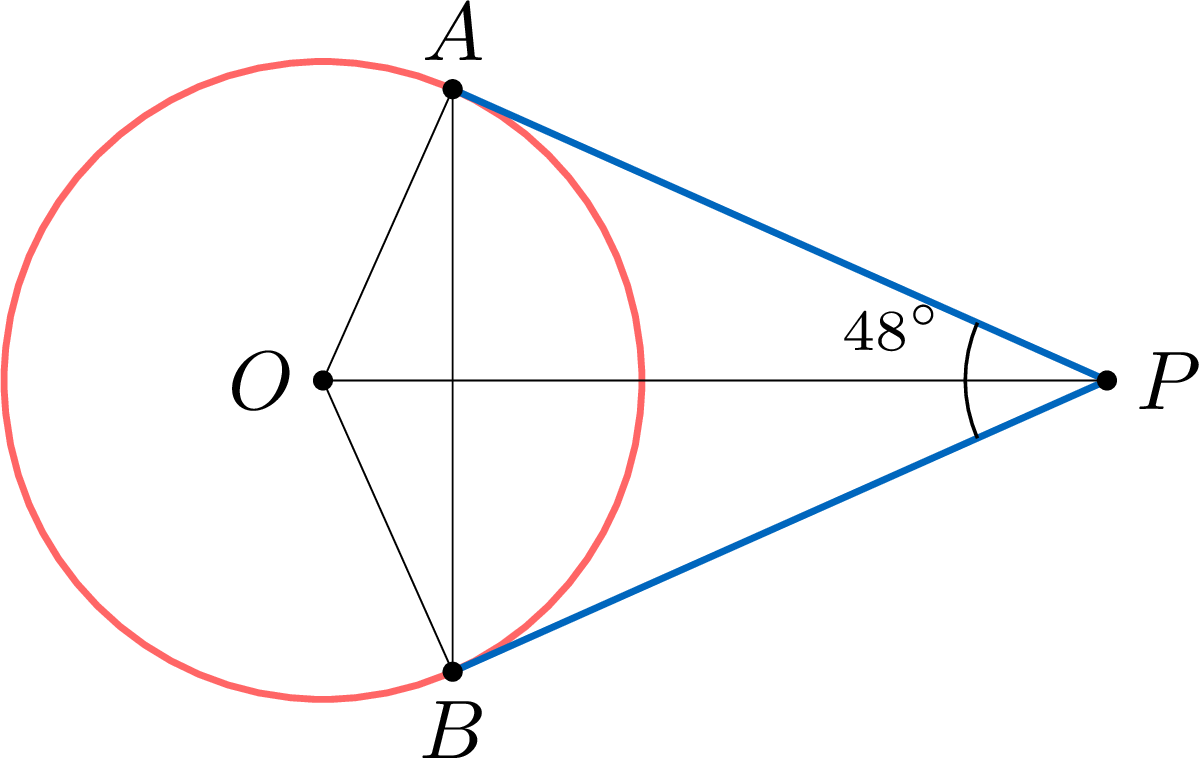
$$\begin{aligned}[t] \Angle{OAP} &= 90^\circ && \text{(tangent and radius)}\\
\Angle{APO} &= \frac{48^\circ}{2} = 24^\circ && \text{(}\Line{OP} \text{ bisects } \Angle{APB}\text{: tangents from an external point)}\\
\Angle{AOP} &= 180^\circ - 90^\circ - 24^\circ && \text{(angle sum of the triangle } OAP\text{)}\\
&= 66^\circ\\
\Angle{AOB} &= 2 \times 66^\circ = 132^\circ && \text{(}\Line{OP} \text{ bisects } \Angle{AOB}\text{)}\\
\Angle{PAB} &= \frac{180^\circ - 48^\circ}{2} && \text{(}PA = PB\text{: the triangle } PAB \text{ is isosceles)}\\
&= 66^\circ. \end{aligned}$$
Method — Constructing the Tangent Lines from a Point
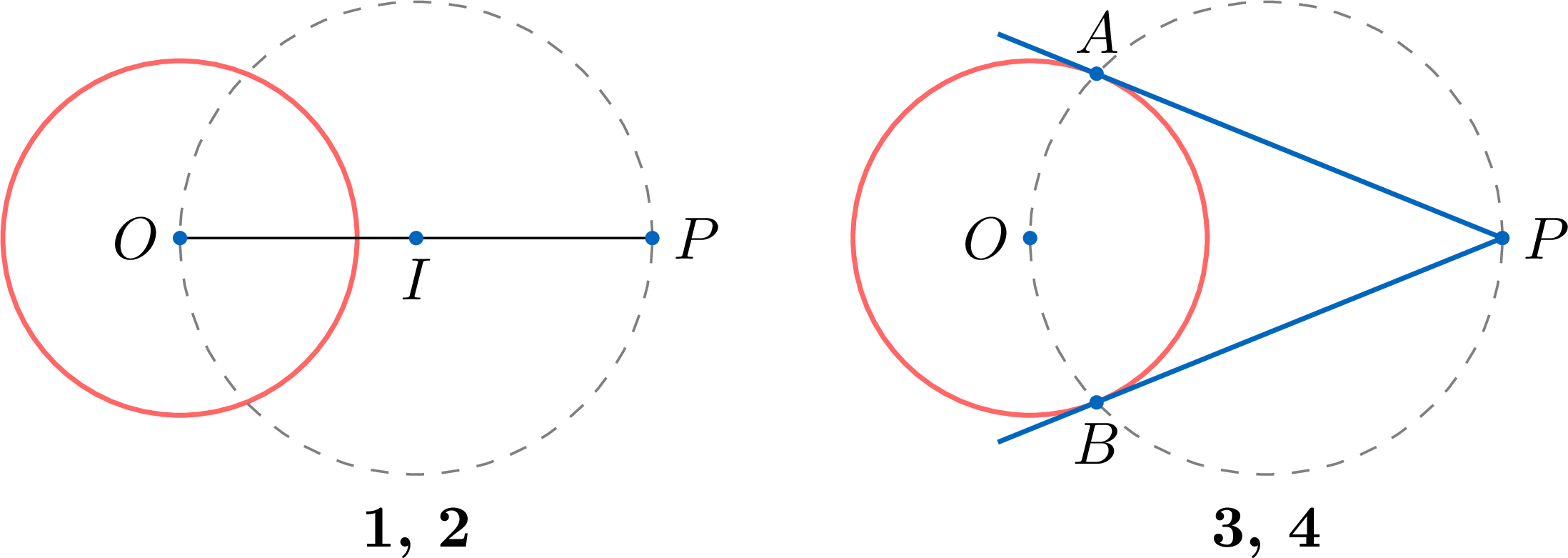
To construct the tangent lines to the circle \(\mathcal{C}\) of centre \(O\) through a point \(P\) outside it: - place the midpoint \(I\) of \(\Segment{OP}\);
- draw the circle of centre \(I\) through \(O\) — its diameter is \(\Segment{OP}\);
- this circle cuts \(\mathcal{C}\) at the points of contact \(A\) and \(B\);
- draw the lines \(\Line{PA}\) and \(\Line{PB}\).
Example
A logo shows an ice-cream cone: the scoop is a disc of centre \(O\) and radius \(3\) cm, and the two straight sides of the cone are the tangent lines to its circle through the tip \(P\), with \(OP = 5\) cm. 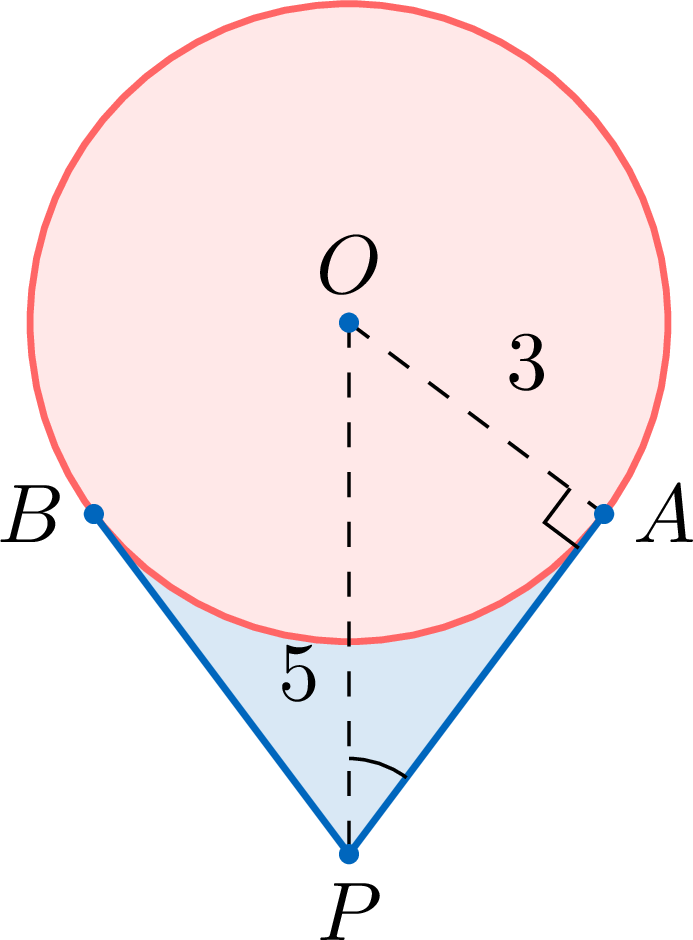
The side \(\Line{PA}\) is tangent at \(A\), so the triangle \(OAP\) is right-angled at \(A\) (tangent line and radius): $$\begin{aligned}[t] PA &= \sqrt{OP^2 - OA^2} && \text{(Pythagoras' theorem in }OAP\text{)}\\
&= \sqrt{5^2 - 3^2}\\
&= \sqrt{16}\\
&= 4 \text{ cm}. \end{aligned}$$ In the same triangle, \(\sin \Angle{APO} = \dfrac{OA}{OP} = \dfrac{3}{5}\), so \(\Angle{APO} \approx 36.87^\circ\). The line \(\Line{OP}\) bisects the angle at the tip: $$\begin{aligned}[t] \Angle{APB} &= 2 \times \Angle{APO} && \text{(line of symmetry }\Line{OP}\text{)}\\
&= 2 \times 36.87^\circ\\
&= 73.74^\circ\\
&\approx 74^\circ \end{aligned}$$
Skills to practice
- Choosing the Reason
- Finding Angles and Lengths with Two Tangents
- Proving with Two Tangents
- Constructing with the Circle Theorems
IV
Going further
Skills to practice
- Solving Problems with Midpoints
- Solving Problems with Circle Theorems
- Investigating Patterns
- Solving Problems in Context
- Quiz
Jump to section