International Baccalaureate · MYP 1
Geometric Shapes
I
The Kite and the Family of Quadrilaterals
Definition — Diagonal
A diagonal of a polygon is a line segment that joins two vertices which are not next to each other — two corners not already joined by a side. A quadrilateral has two diagonals. 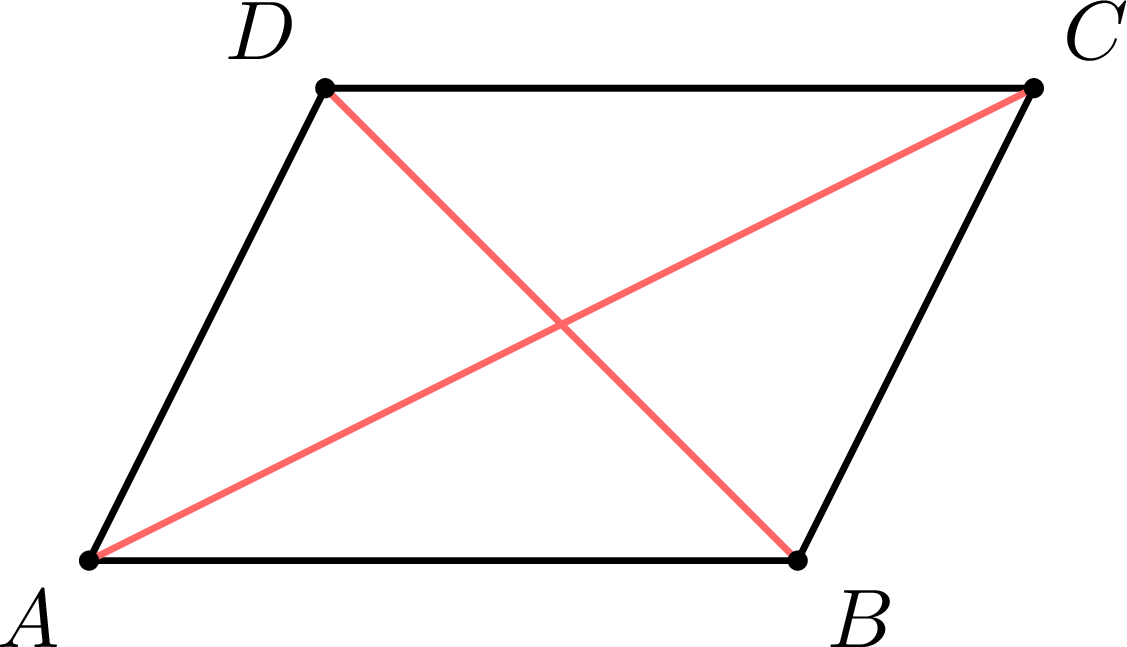
One Definition of the Trapezium
The definition of the trapezium asks for at least one pair of parallel sides. A parallelogram has two pairs of parallel sides, so every parallelogram is also a trapezium — and so are the rectangle, the rhombus and the square.
Some textbooks define the trapezium with exactly one pair of parallel sides; with that other definition, a parallelogram is not a trapezium. Only one definition is used here, in the lessons and in the exercises: a trapezium is a quadrilateral with at least one pair of parallel sides. (In some countries, a trapezium is called a trapezoid.)
Some textbooks define the trapezium with exactly one pair of parallel sides; with that other definition, a parallelogram is not a trapezium. Only one definition is used here, in the lessons and in the exercises: a trapezium is a quadrilateral with at least one pair of parallel sides. (In some countries, a trapezium is called a trapezoid.)
Definition — Kite
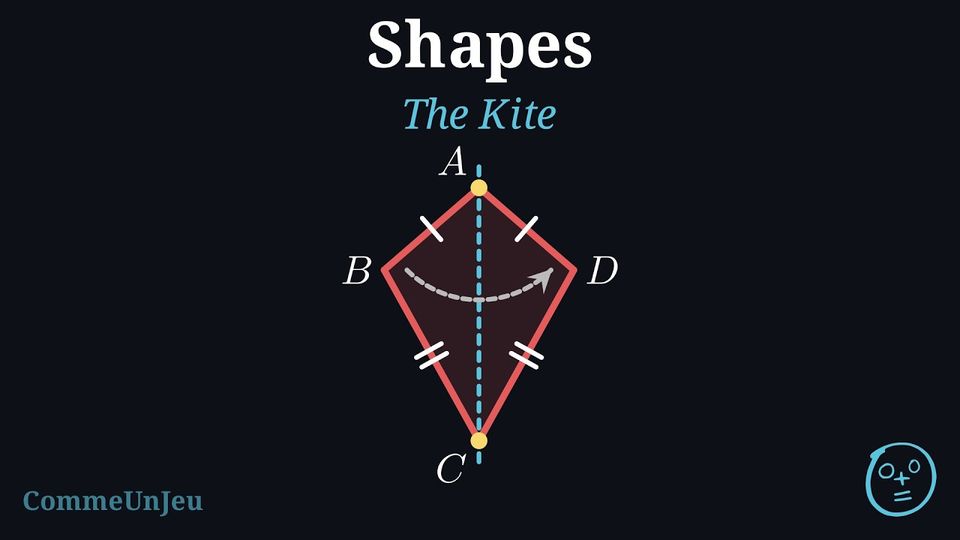
A kite is a quadrilateral with two pairs of equal adjacent sides: two sides that meet at a vertex have the same length, and the two other sides, which meet at the opposite vertex, have the same length too. 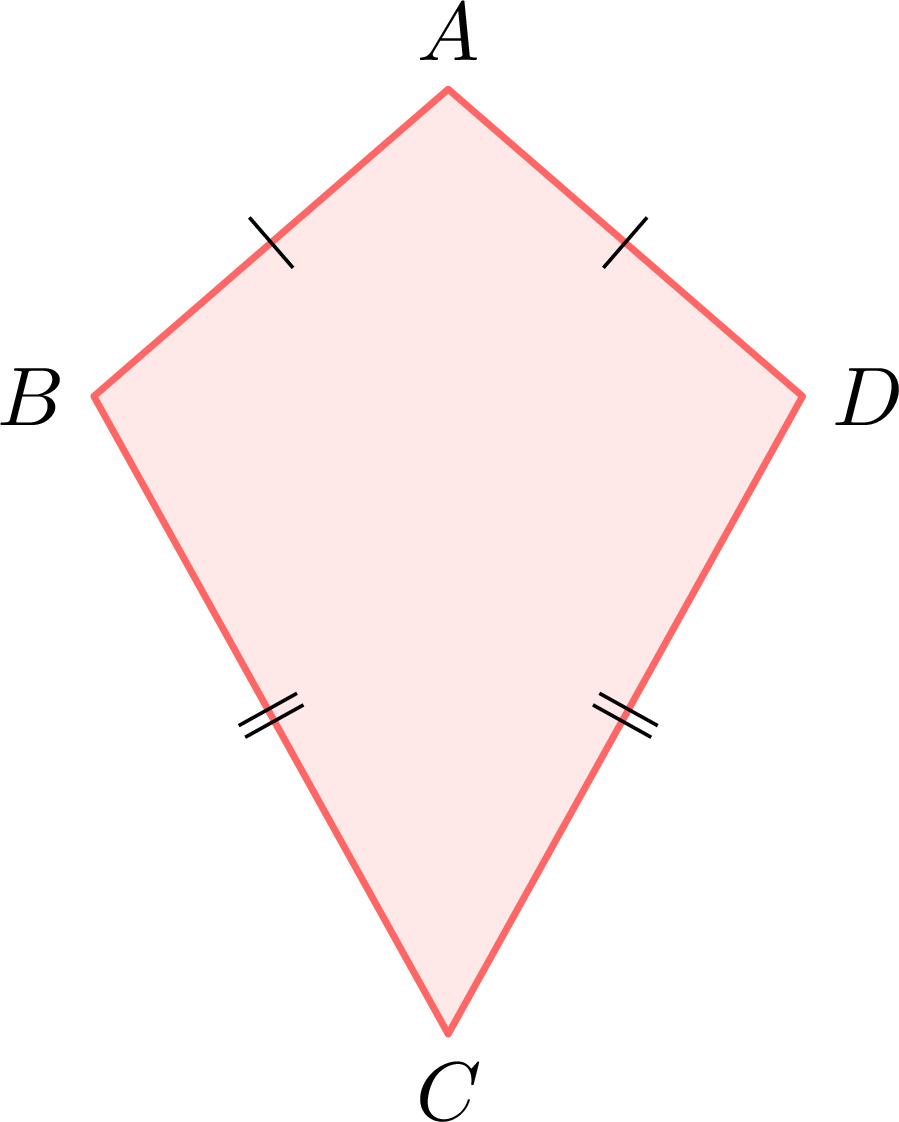
Proposition — Property of a kite
In a kite \(ABCD\) with \(AB = AD\) and \(CB = CD\), the line through \(A\) and \(C\), which contains the diagonal \(\Segment{AC}\) — it joins the vertex where the equal sides \(AB\) and \(AD\) meet to the vertex where the equal sides \(CB\) and \(CD\) meet — is an axis of symmetry: folding the kite along this line, one half falls exactly onto the other. (In a rhombus, the lines containing both diagonals are axes of symmetry.) 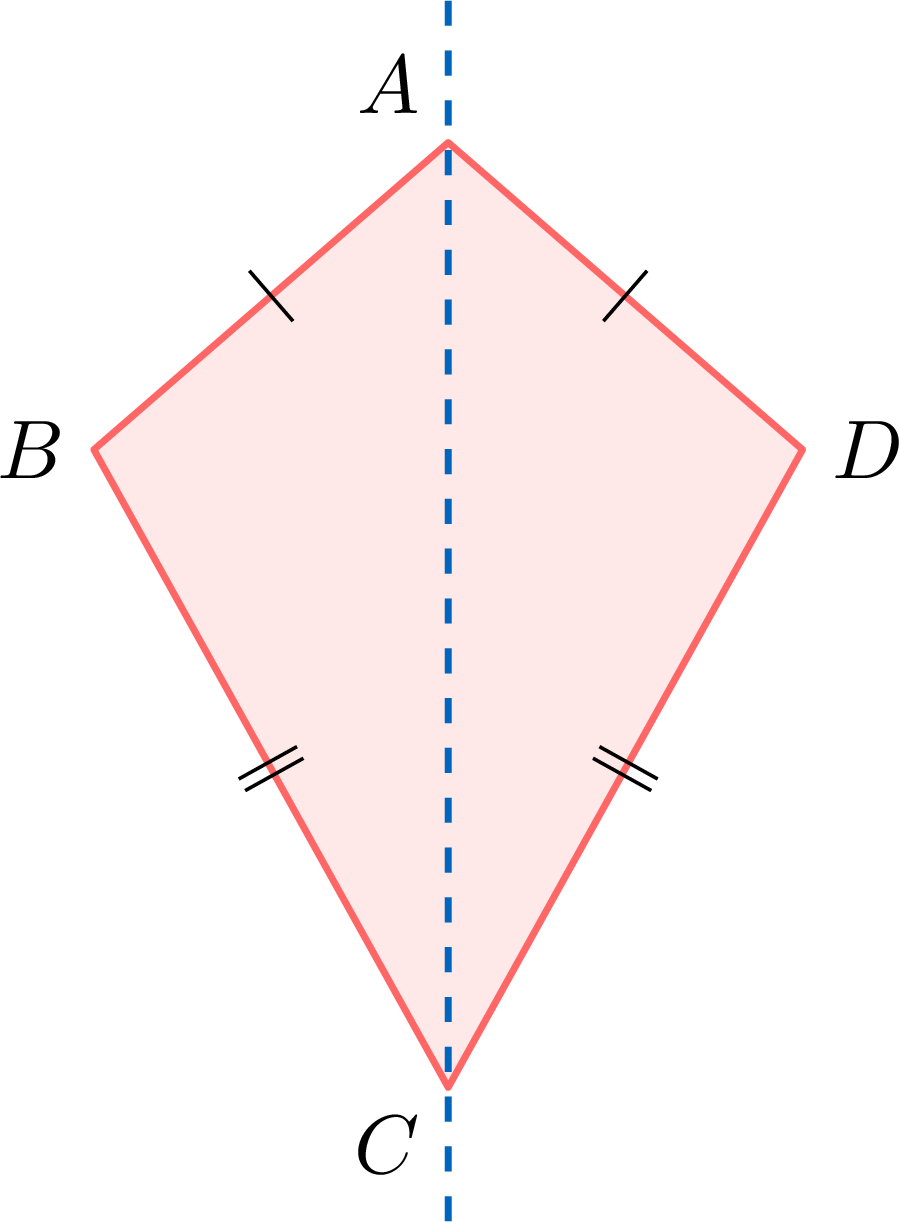
The Kite in the Family of Quadrilaterals
A rhombus has four equal sides, so each of its sides is equal to the two sides next to it: every rhombus is a kite, and so is every square. But a kite is not always a rhombus: in the kite \(ABCD\) drawn with the definition “Kite”, \(AB\) is shorter than \(CB\).
A kite whose four sides are not all equal has no pair of parallel sides. Indeed, if two opposite sides were parallel, folding along the line of symmetry would send them onto the two other opposite sides, which would then be parallel too: the kite would be a parallelogram. Its opposite sides would be equal, and with its two pairs of equal adjacent sides, its four sides would all be equal. So such a kite is neither a parallelogram nor a trapezium. In the tree below, an arrow goes from a family to a special case of it. 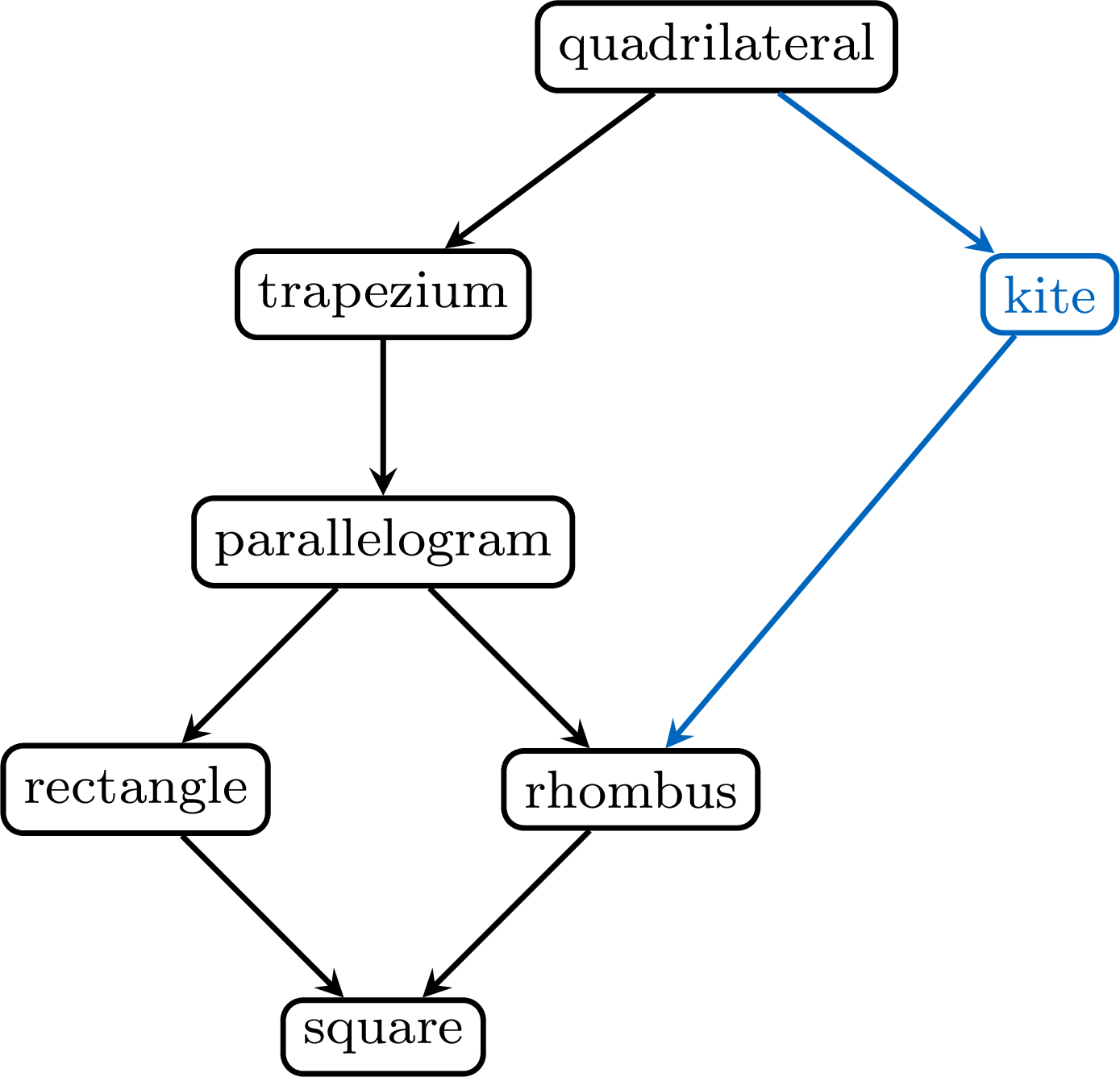
Reading the arrows: a square is a special rectangle and a special rhombus; a rhombus is a special parallelogram and a special kite.
A kite whose four sides are not all equal has no pair of parallel sides. Indeed, if two opposite sides were parallel, folding along the line of symmetry would send them onto the two other opposite sides, which would then be parallel too: the kite would be a parallelogram. Its opposite sides would be equal, and with its two pairs of equal adjacent sides, its four sides would all be equal. So such a kite is neither a parallelogram nor a trapezium. In the tree below, an arrow goes from a family to a special case of it.
Example
Which of these quadrilaterals are kites? Explain with the codes on the figures (the same number of strokes means the same length; sides without strokes have different lengths). 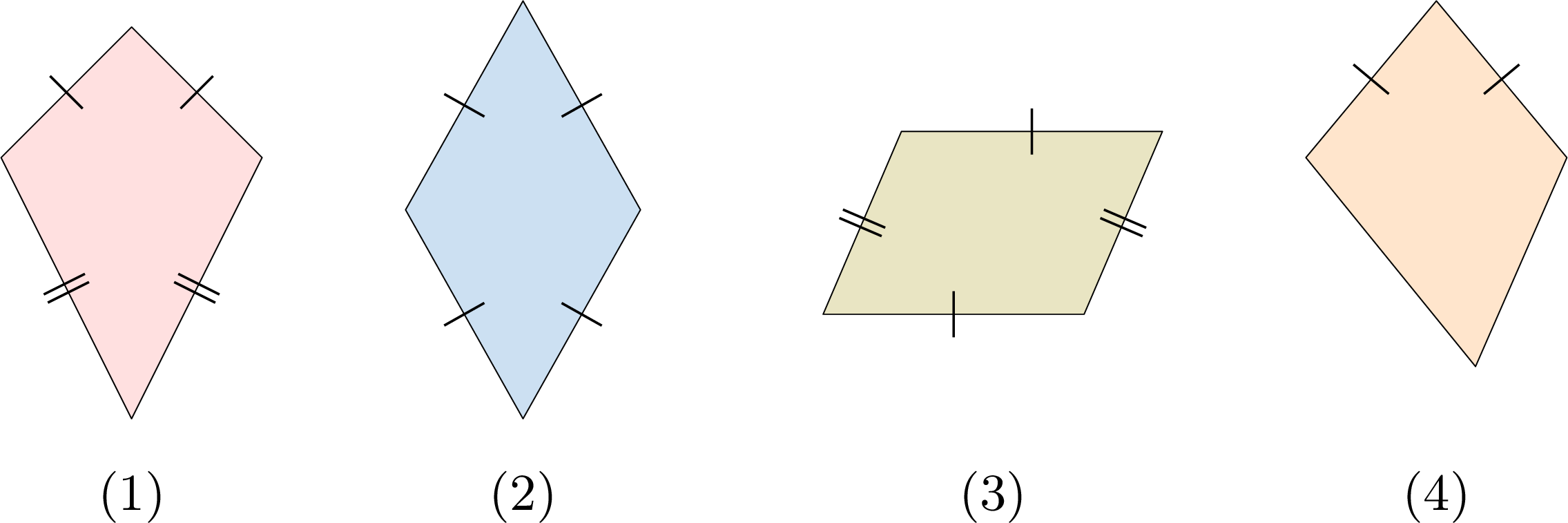
Skills to practice
- Recognising Kites
- Placing a Quadrilateral in Its Family
- Drawing Kites
II
Polyhedra
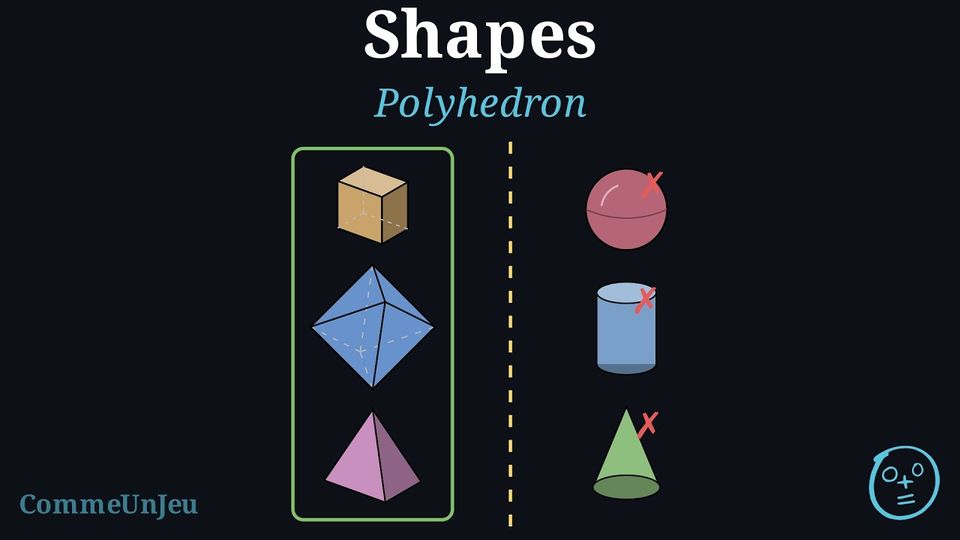
Definition — Polyhedron
A polyhedron is a three-dimensional solid with flat faces that are polygons. 
Skills to practice
- Identifying Polyhedra
III
Cross-Sections and Prisms
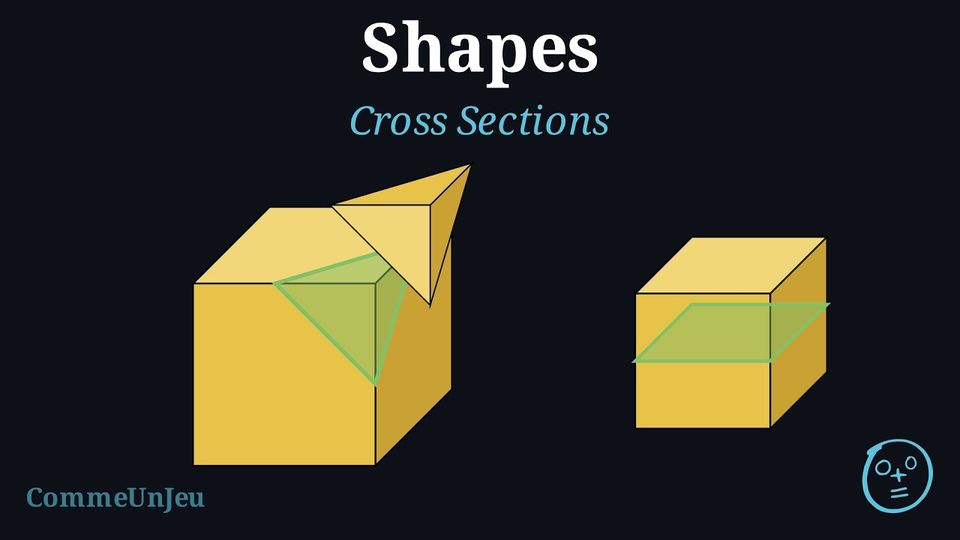
Sofia slices a block of cheese with one straight cut and looks at the fresh flat face the knife leaves behind. She wonders what decides its shape. Cutting a cube-shaped block straight across gives a square; but the same block cut on a slant gives a different flat shape entirely, even though the block has not changed. 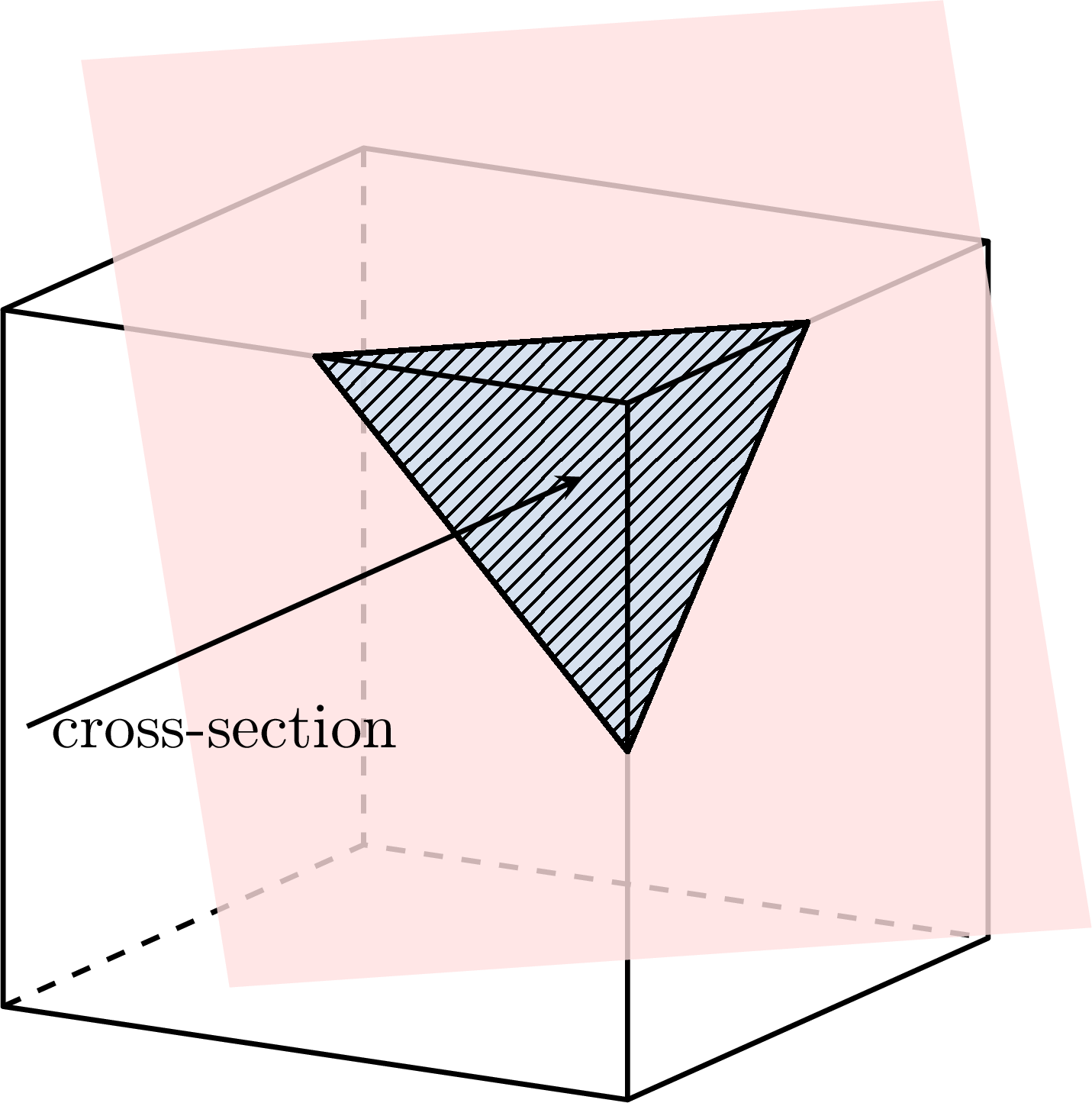
Instead of trusting how the cut looks, Sofia describes the block as a polyhedron — a solid whose faces are flat polygons — and asks how the cutting plane meets those faces. The flat shape revealed by the cut is the cross-section; its sides come from where the plane crosses each face. The same solid yields different cross-sections depending on the direction of the cut.
Definition — Cross-Section
A cross-section of a solid is the two-dimensional (flat) shape made when a plane cuts through the solid. 
Definition — Uniform Cross-Section
A uniform cross-section means that, when the solid is sliced in the same direction, the cross-section has the same size and shape at every point along its length. Definition — Axis of a Cylinder
The axis of a cylinder is the line joining the centres of its two circular bases. A cutting plane can be parallel to this axis, perpendicular to it, or neither. 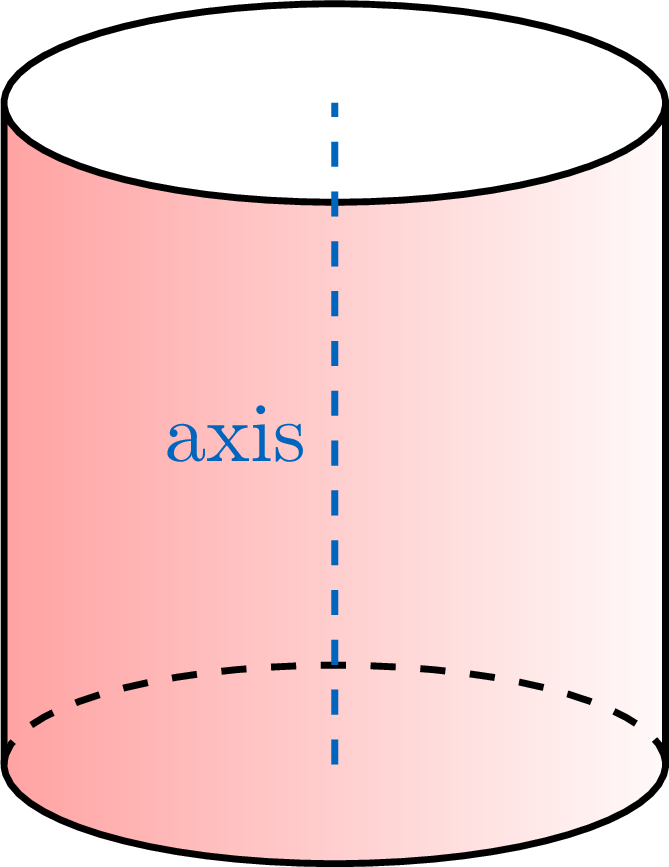
Proposition — Naming a Cross-Section
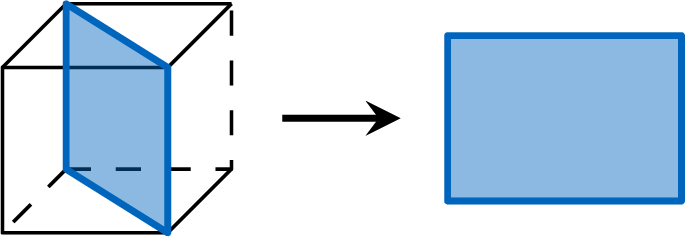
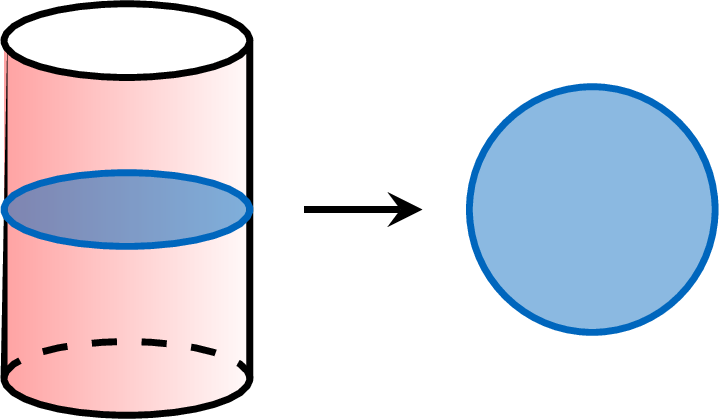
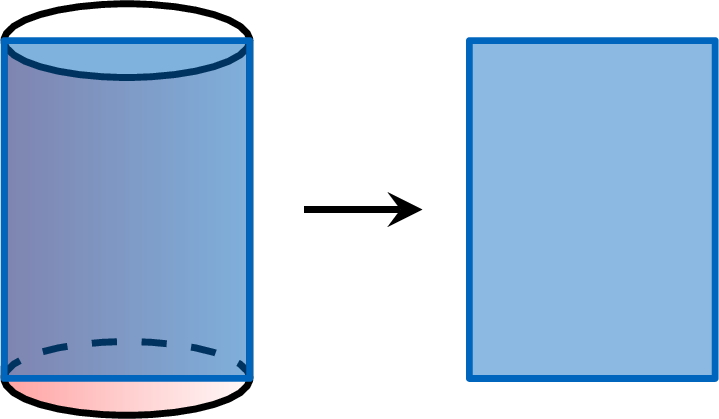
The cross-section depends on the solid, on the direction of the cutting plane and on its position. The most common cases: a cube cut parallel to a face gives a square; cut by a vertical plane through a diagonal of its base, a rectangle; a cylinder cut perpendicular to its axis gives a disc, cut along its axis a rectangle. 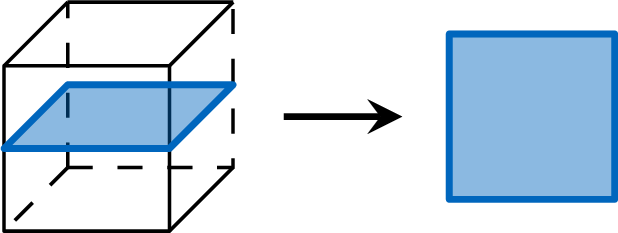 \(\quad\)
 \(\quad\)
Example
Does this solid have a uniform cross-section? 
Yes. When sliced perpendicular to its length, each cross-section is a triangle of the same size and shape. So it has a uniform cross-section. The solid is a triangular prism. 
Sections of a Rectangular Prism and a Cylinder
The rule for the cube extends to any rectangular prism: cut parallel to a face, the section is a rectangle identical to that face — whatever the height of the cut. 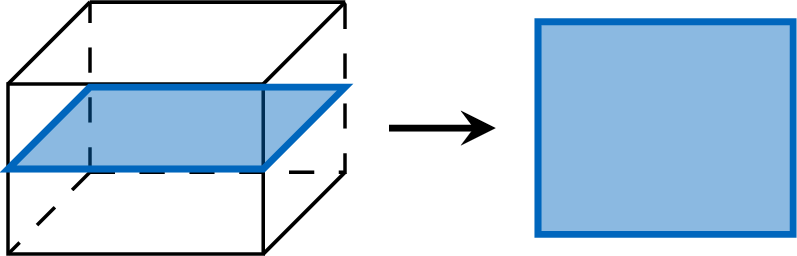
For a cylinder of radius \(r\) and height \(h\): the section along its axis is a rectangle of width the diameter (\(2r\)) and length the height (\(h\)) of the cylinder — not the radius. 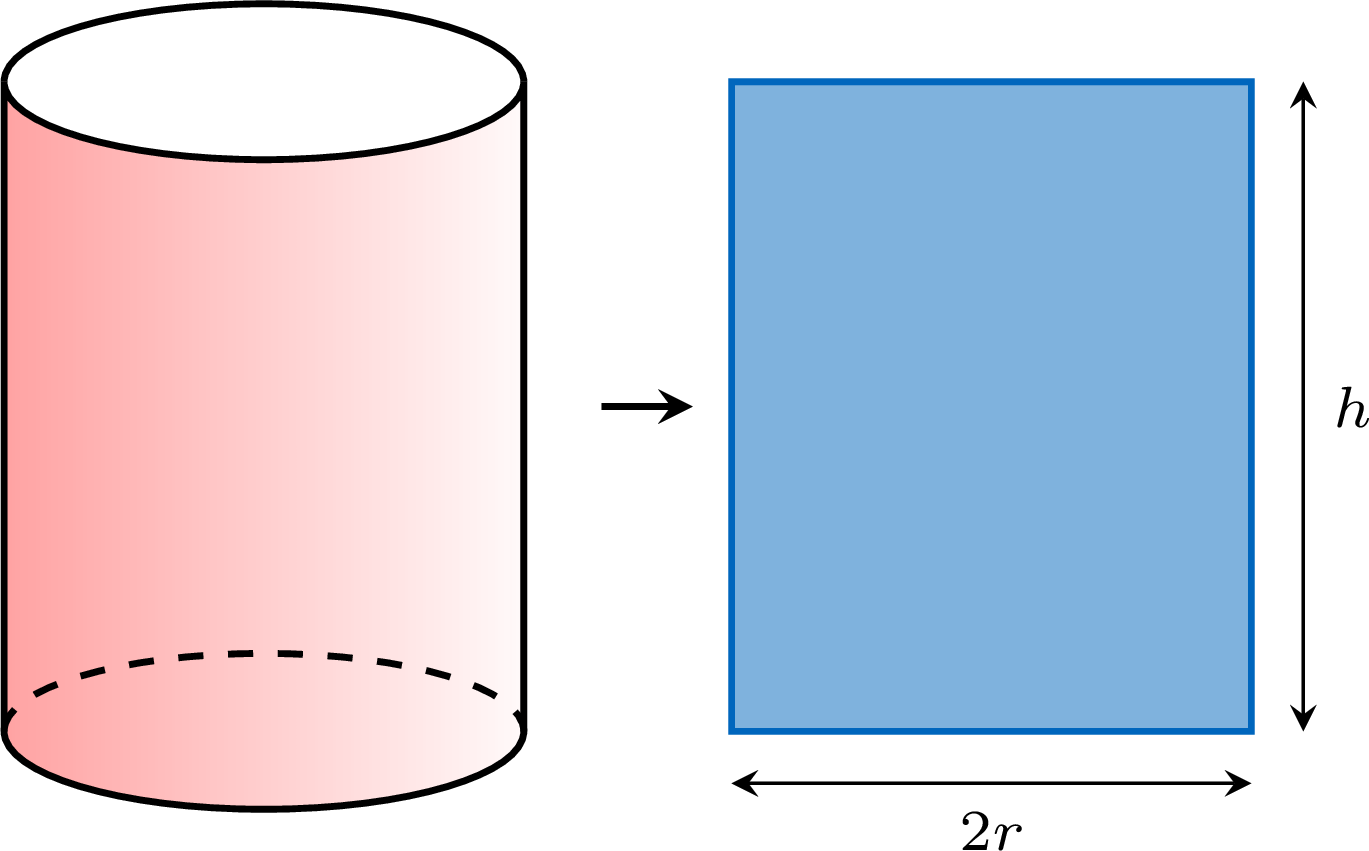
Section of a Cone
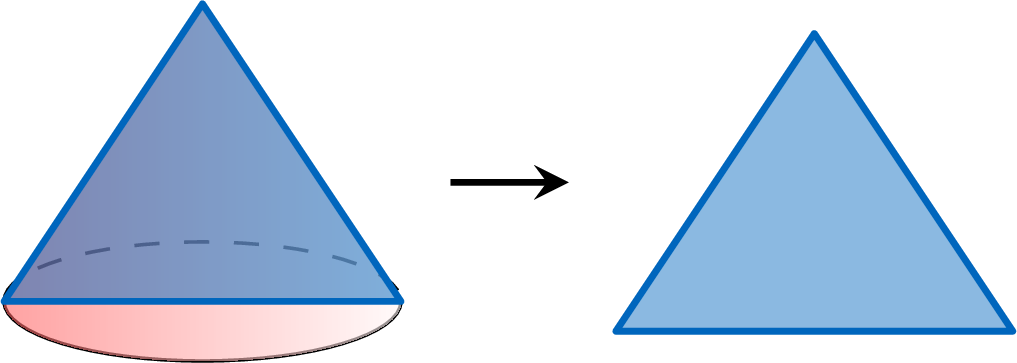
A cone cut parallel to its base gives a disc, cut straight down through its apex a triangle. 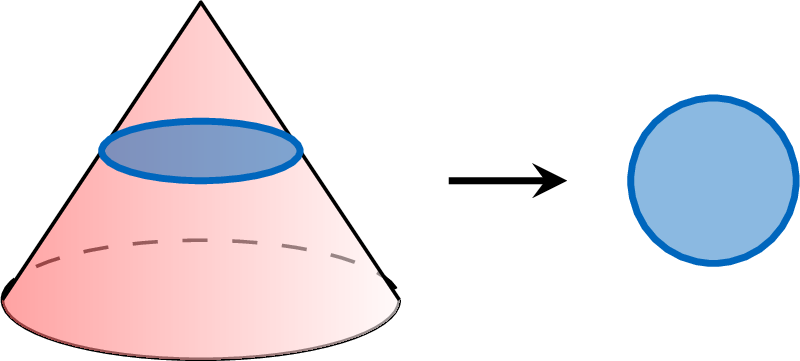 \(\quad\)
\(\quad\) Definition — Right Prism
A right prism is a polyhedron that has a uniform cross-section which is a polygon. It has two identical, parallel faces called bases, and all the other faces are rectangles. Prisms are named according to the shape of their base. | Name | Figure | Cross-Section |
| Triangular prism |  |  |
| Rectangular prism (also called a cuboid) |  |  |
Skills to practice
- Identifying Uniform Cross-Sections
- Slicing Solids
- Describing Cross-Sections
IV
Classifying Solids and Euler's Relation
Definition — Classification
We can classify 3D shapes by the number of faces, edges, and vertices they have. | Name | Shape | Faces | Edges | Vertices |
| Cube | 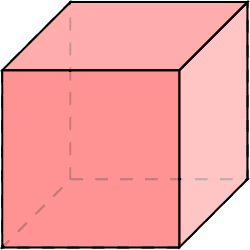 | 6 (flat faces) | 12 | 8 |
| Rectangular Prism | 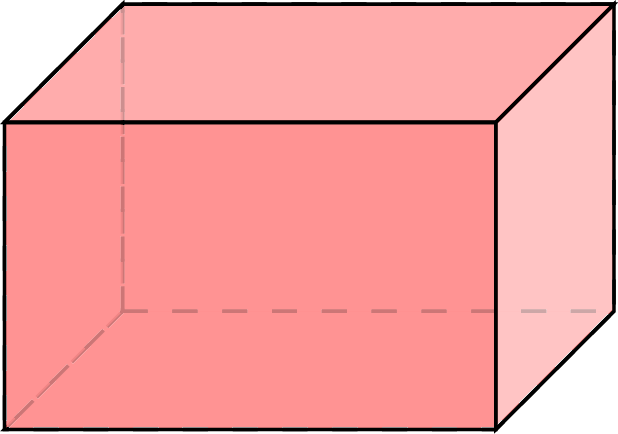 | 6 (flat faces) | 12 | 8 |
| Sphere | 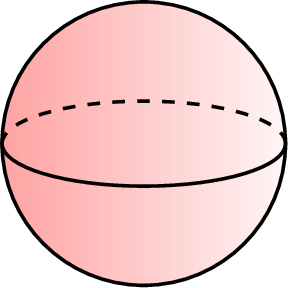 | 0 flat faces (1 curved surface) | 0 | 0 |
| Square Pyramid | 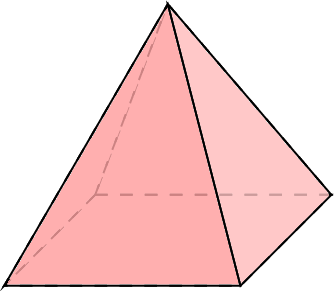 | 5 (flat faces) | 8 | 5 |
| Cylinder | 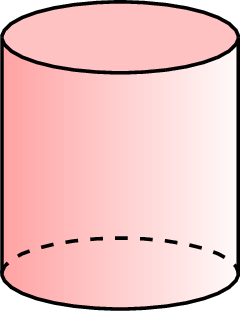 | 2 flat faces (1 curved surface) | 0 | 0 |
| Cone |  | 1 flat face (1 curved surface) | 0 | 0 |
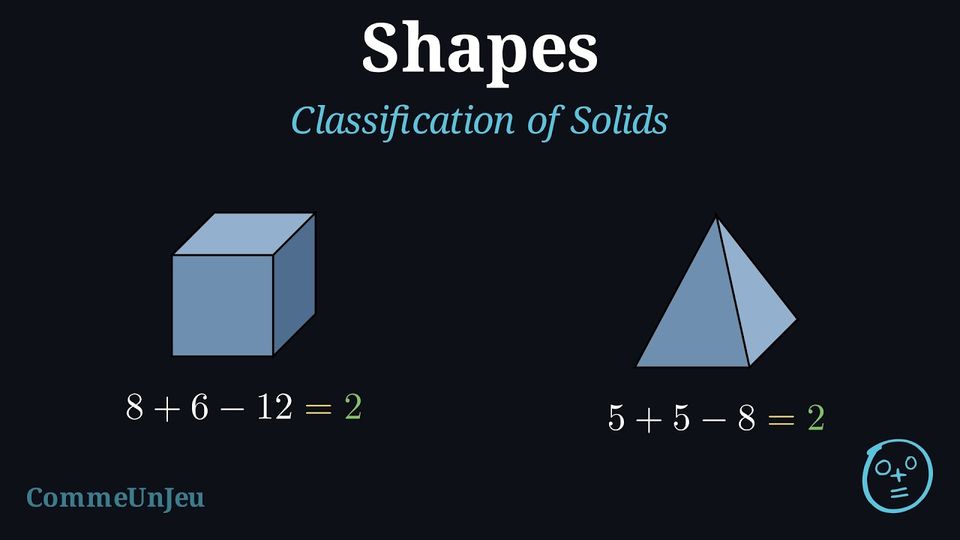
Look back at the table. For each polyhedron of the table (a solid with only flat faces), add the number of vertices to the number of faces, then subtract the number of edges. The cube gives \(8+6-12=2\); the square pyramid gives \(5+5-8=2\): each polyhedron of the table gives \(2\). This rule is Euler's relation. It does not apply to the sphere, cylinder, or cone, because they are not polyhedra (each of them has a curved surface).
Proposition — Euler's Relation
For every convex polyhedron — a polyhedron with no dent and no hole, in which the segment joining any two of its points stays inside it, like a cube, a rectangular prism or a pyramid with a square base — Euler's relation holds: $$\text{Vertices} - \text{Edges} + \text{Faces} = 2,$$ also written \(F + V = E + 2\) (\(F\) faces, \(V\) vertices, \(E\) edges).
A Polyhedron with a Tunnel
Euler's relation also holds for many polyhedra that are not convex, but not for all of them. A polyhedron with a tunnel through it can break it. This square picture frame has four trapezium-shaped faces on top, four below, four rectangular faces outside and four inside. The trapeziums slope slightly: a flat top would be a single face with a hole, which is not a polygon. The frame has \(8 + 8 = 16\) vertices, \(12 + 12 + 8 = 32\) edges (on top, below and upright) and \(4 + 4 + 4 + 4 = 16\) faces: $$16 - 32 + 16 = 0.$$ 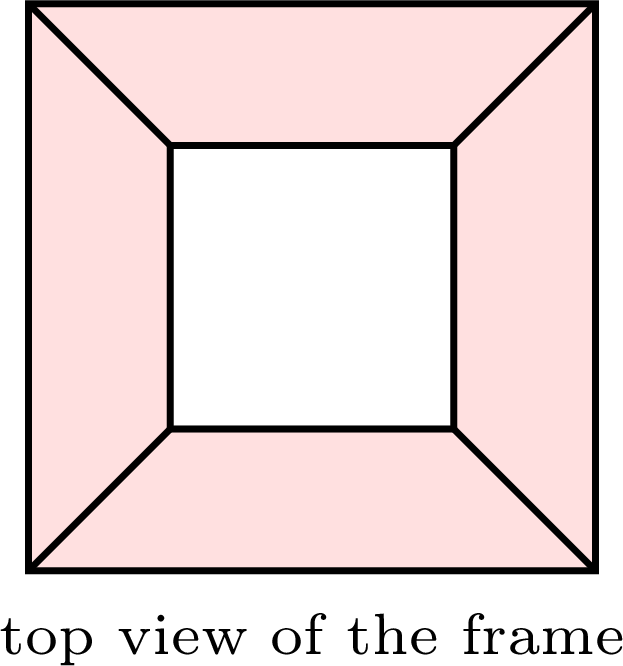
Skills to practice
- Classifying 3D Shapes
- Applying Euler's Relation
V
Drawing Solids: Hidden Edges and Cavalier Perspective
Method — Visible and Hidden Edges
When we draw a 3D (three-dimensional) shape on paper, we see it from one viewpoint only: some of its edges are behind the shape and cannot be seen. These are called hidden edges. To show that an edge is hidden but still part of the shape, we draw it with dashed lines. Solid lines show the edges we can see. 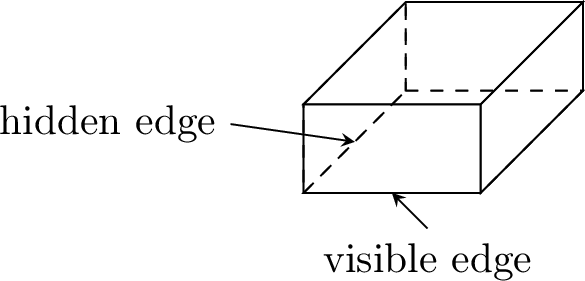
A solid has three dimensions, but a sheet of paper has only two. To show a solid on paper we use a code: a way of drawing that keeps the information we need and flattens the rest. The main code is a perspective drawing: a drawing that gives an impression of depth, with the hidden edges dashed. A net shows the solid unfolded flat, and views from the front, the side and the top show it from one direction at a time. Each code keeps some information and gives up some; read together, they let us recognise a solid and build it.
Definition — Cavalier Perspective
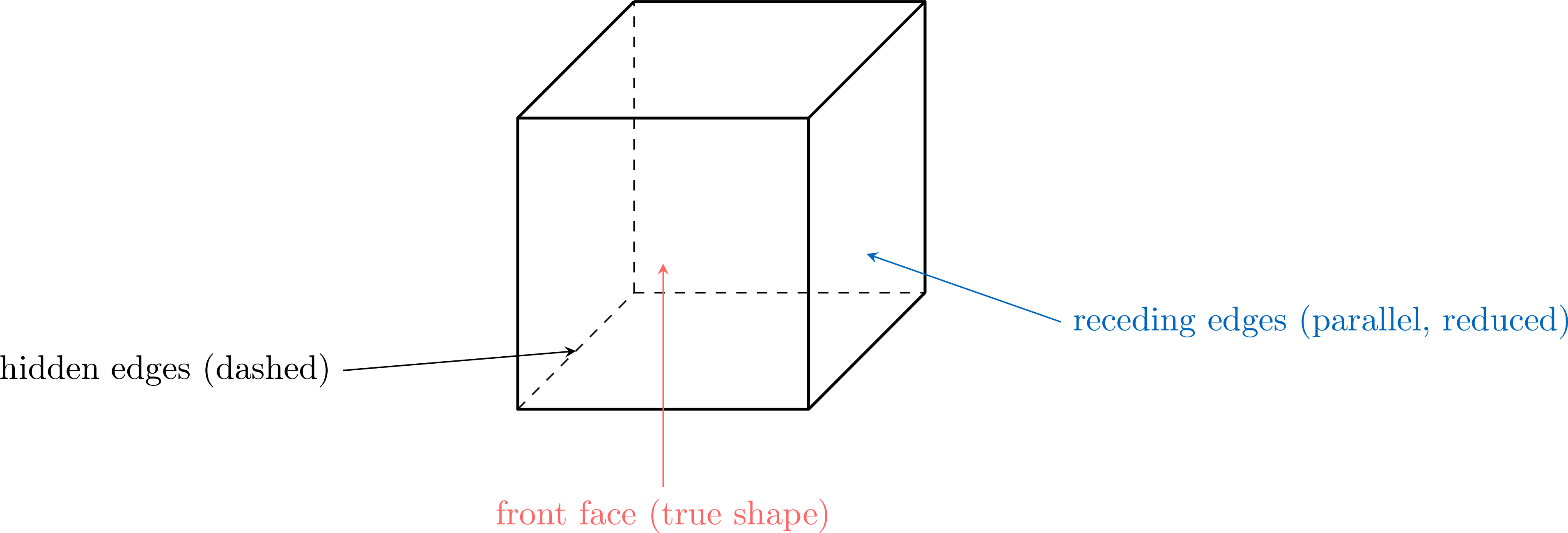
The drawings of solids use cavalier perspective (also called an oblique drawing). Its rules are: - the front face, parallel to the paper, is drawn in its true shape — real lengths and real angles;
- the edges that go away from the reader (the receding edges) are all drawn parallel, at the same fixed angle, and shortened by the same factor;
- edges that are parallel on the solid stay parallel in the drawing;
- edges hidden behind the solid are drawn dashed.
Skills to practice
- Counting Visible and Hidden Edges
- Drawing in Cavalier Perspective
VI
Nets of Prisms and Cylinders
Definition — Net
A net of a solid is a flat figure that can be folded up, or rolled up, to make that solid. When the solid has only flat faces and no curved surface — a cube, a rectangular prism (a box), a pyramid, a prism — the net is folded along the edges: the folds are the lines inside the net. A cylinder and a cone have a net too, but their curved surface has to be rolled rather than folded. A ball has no net at all: no flat sheet can be wrapped around it without creasing. 
Example
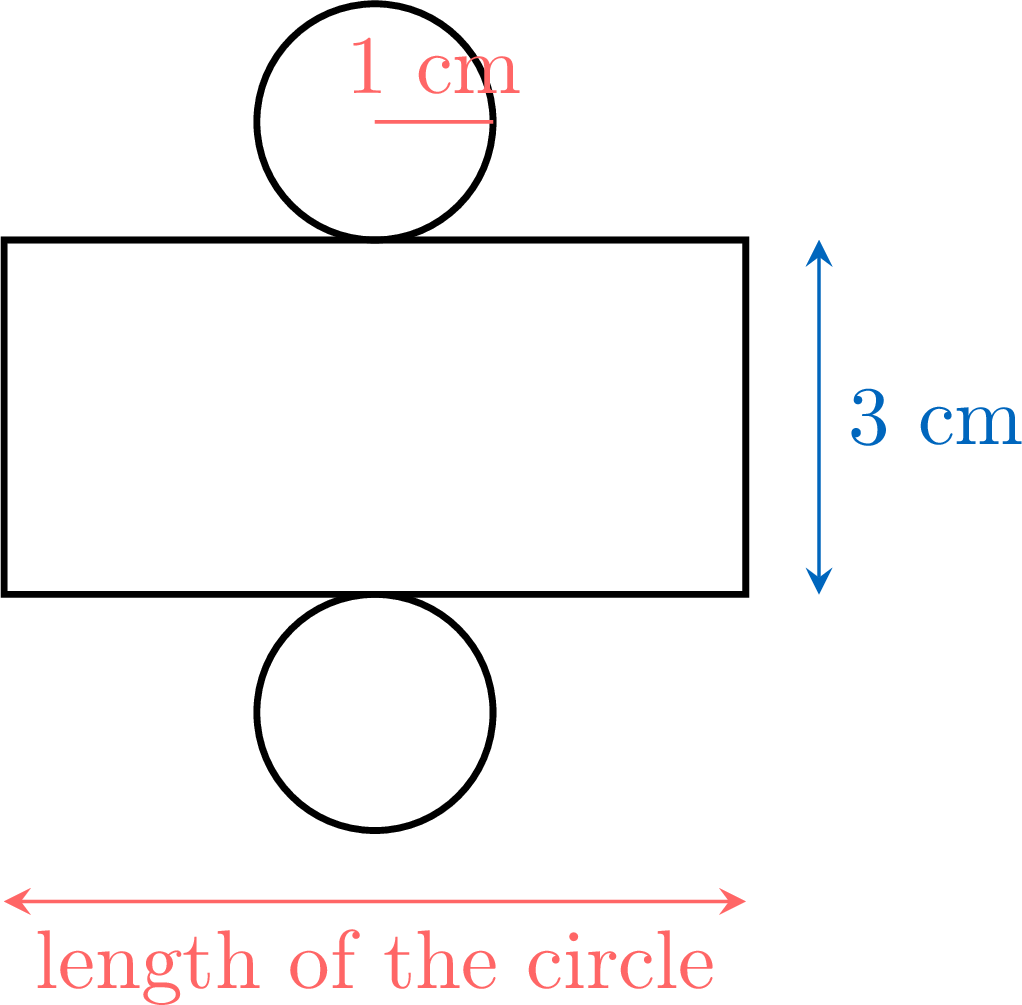
What does the net of a right prism with triangular bases look like? And the net of a cylinder whose base has radius \(1\) cm and whose height is \(3\) cm? 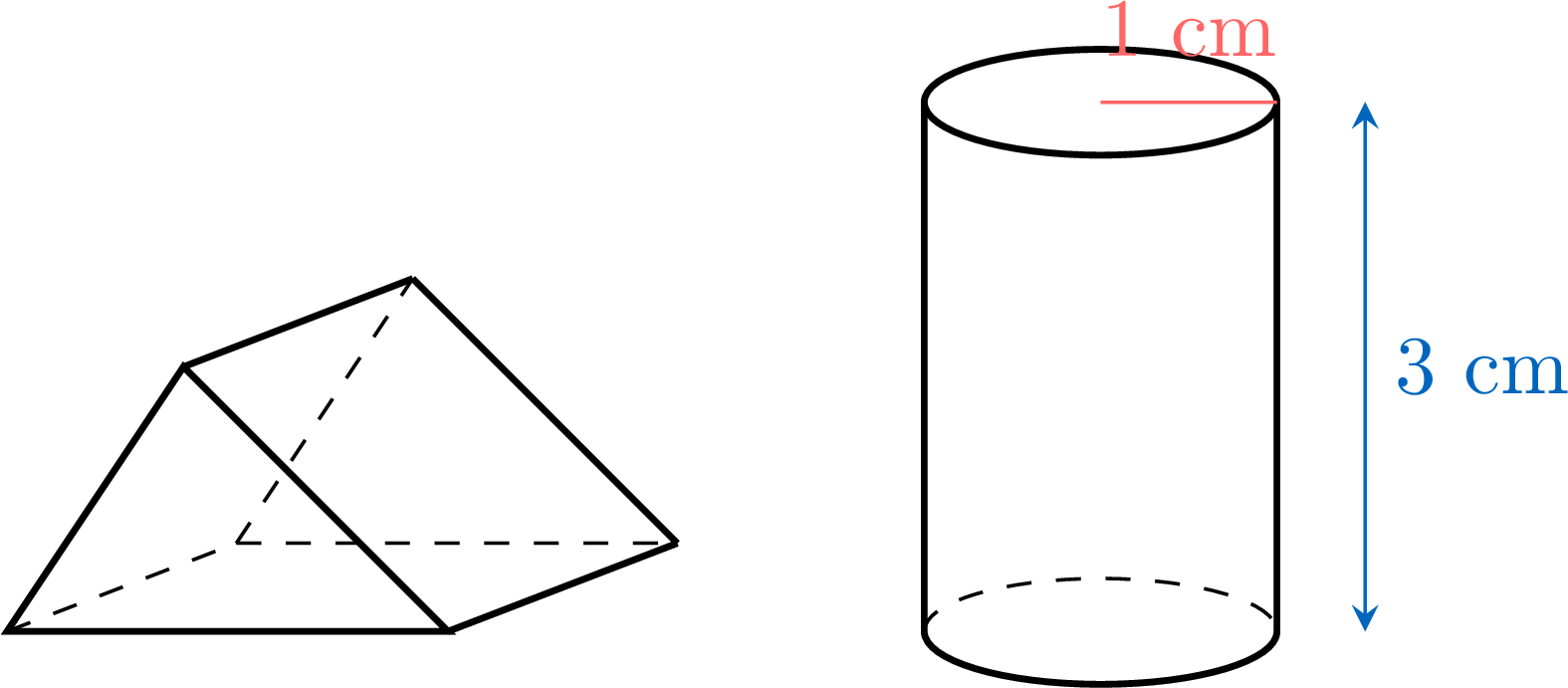
The net of the prism has the two triangular bases and one rectangle per side of the triangle — three rectangles in a strip, all with the height of the prism. Each rectangle has the width of the side it folds onto: 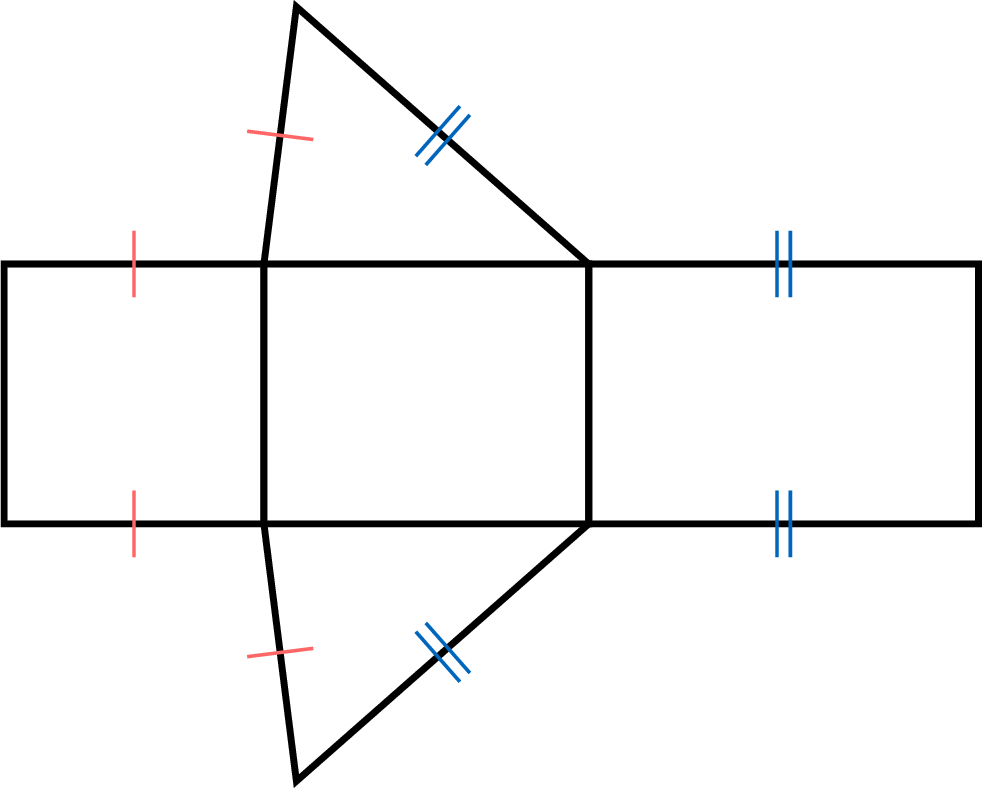
Skills to practice
- Identifying Nets of Prisms and Cylinders
- Drawing and Completing Nets
VII
Going further
Skills to practice
- Investigating Faces, Edges and Vertices
- Solving Real-Life Problems with Solids
- Quiz
Jump to section