International Baccalaureate · MYP 2
Lines, Angles and Constructions
I
Constructions with a Compass
I.1
The Perpendicular Bisector and Equidistance
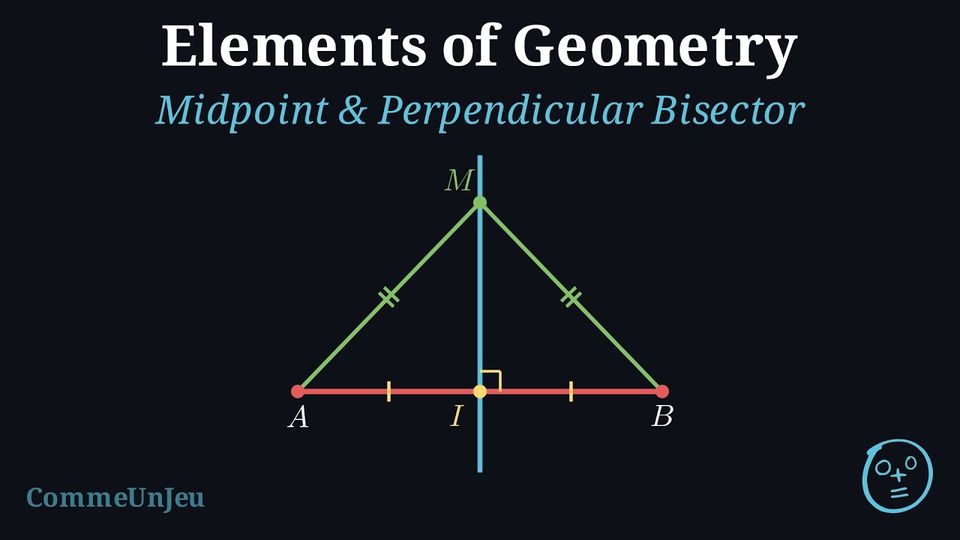
Definition — Midpoint of a Line Segment
The midpoint of a line segment is a point that lies on the segment and divides it into two segments of equal length. For example, if \(I\) is the midpoint of segment \(\Segment{AB}\), then \(I\) is on the segment \(\Segment{AB}\) and \(AI = IB\). 
Definition — Perpendicular bisector
The perpendicular bisector of a line segment is the line that passes through the midpoint of the segment and is perpendicular to the segment. 
Proposition — Midpoint Length Property
If point \(I\) is the midpoint of segment \(\Segment{AB}\), then \(AB = 2 \times AI\) and \(AI = \frac{AB}{2}\).
$$\begin{aligned} AB &= AI + IB &&(I \text{ is the midpoint of } \Segment{AB})\\
&= AI + AI\\
&= 2 \times AI \end{aligned}$$ Thus, \(AB = 2 \times AI\). To find \(AI\) in terms of \(AB\), we rearrange the equation: $$AI = \frac{AB}{2}.$$
Proposition — Perpendicular bisector and equidistance
The perpendicular bisector of a segment \(\Segment{AB}\) is the set of all the points at the same distance from \(A\) and from \(B\). In other words, a point \(M\) lies on the perpendicular bisector of \(\Segment{AB}\) if and only if \(MA = MB\). 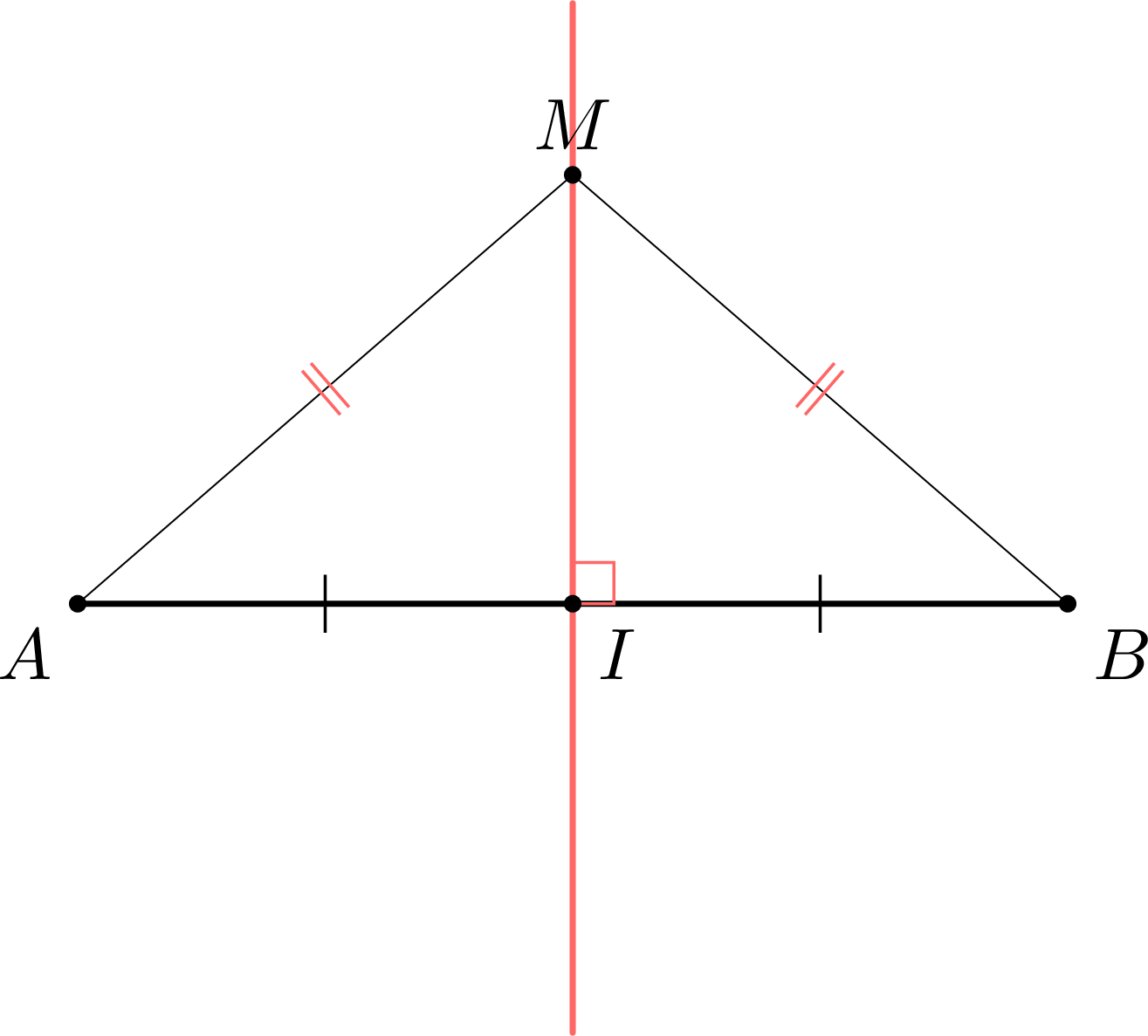
The perpendicular bisector passes through the midpoint \(I\) of \(\Segment{AB}\) (so \(IA = IB\)) and is perpendicular to \(\Segment{AB}\). Folding the figure along this line therefore brings \(A\) exactly onto \(B\).
- If \(M\) is on the line, the fold leaves \(M\) in place and carries \(\Segment{MA}\) onto \(\Segment{MB}\), so \(MA = MB\).
- If \(M\) is not on the line, it lies on \(A\)'s side or on \(B\)'s side, and it is then closer to the point on its own side: \(MA \neq MB\). This second point, the converse, is accepted without proof here — folding sends \(M\) to another point \(M'\), but that is not enough to compare \(MA\) and \(MB\); its proof goes through the triangle inequality.
Method — Constructing the Perpendicular Bisector of \(\Segment{AB}\)
- Using a compass, construct two arcs with the same radius — greater than half of \(\Segment{AB}\), so the arcs meet — and with centres at \(A\) and \(B\).

- The arcs intersect at points \(E\) and \(F\).

- The perpendicular bisector of \(\Segment{AB}\) is the line \(\Line{EF}\).

This is exactly why the compass construction works. The two arcs are drawn with the same radius \(r\), so each meeting point is at distance \(r\) from both centres: \(EA = EB = r\) and \(FA = FB = r\). So \(E\) and \(F\) are each at equal distance from \(A\) and \(B\), and by the property above they both lie on the perpendicular bisector of \(\Segment{AB}\). Two points are enough to draw a line, so \(\Line{EF}\) is that perpendicular bisector.
Example
The point \(P\) lies on the line \(\Line{d}\). Construct, with a ruler and a compass only, the line perpendicular to \(\Line{d}\) that passes through \(P\): this constructs a right angle at \(P\) without a set square. - Put the needle of the compass on \(P\) and draw an arc that cuts \(\Line{d}\) at two points \(M\) and \(N\). Then \(PM = PN\): \(P\) is the midpoint of \(\Segment{MN}\).
- Open the compass wider than \(PM\). With the needle on \(M\), draw an arc on one side of \(\Line{d}\); with the same opening and the needle on \(N\), draw a second arc that cuts the first one at \(W\).
- Draw the line \(\Line{PW}\): it is perpendicular to \(\Line{d}\) at \(P\).
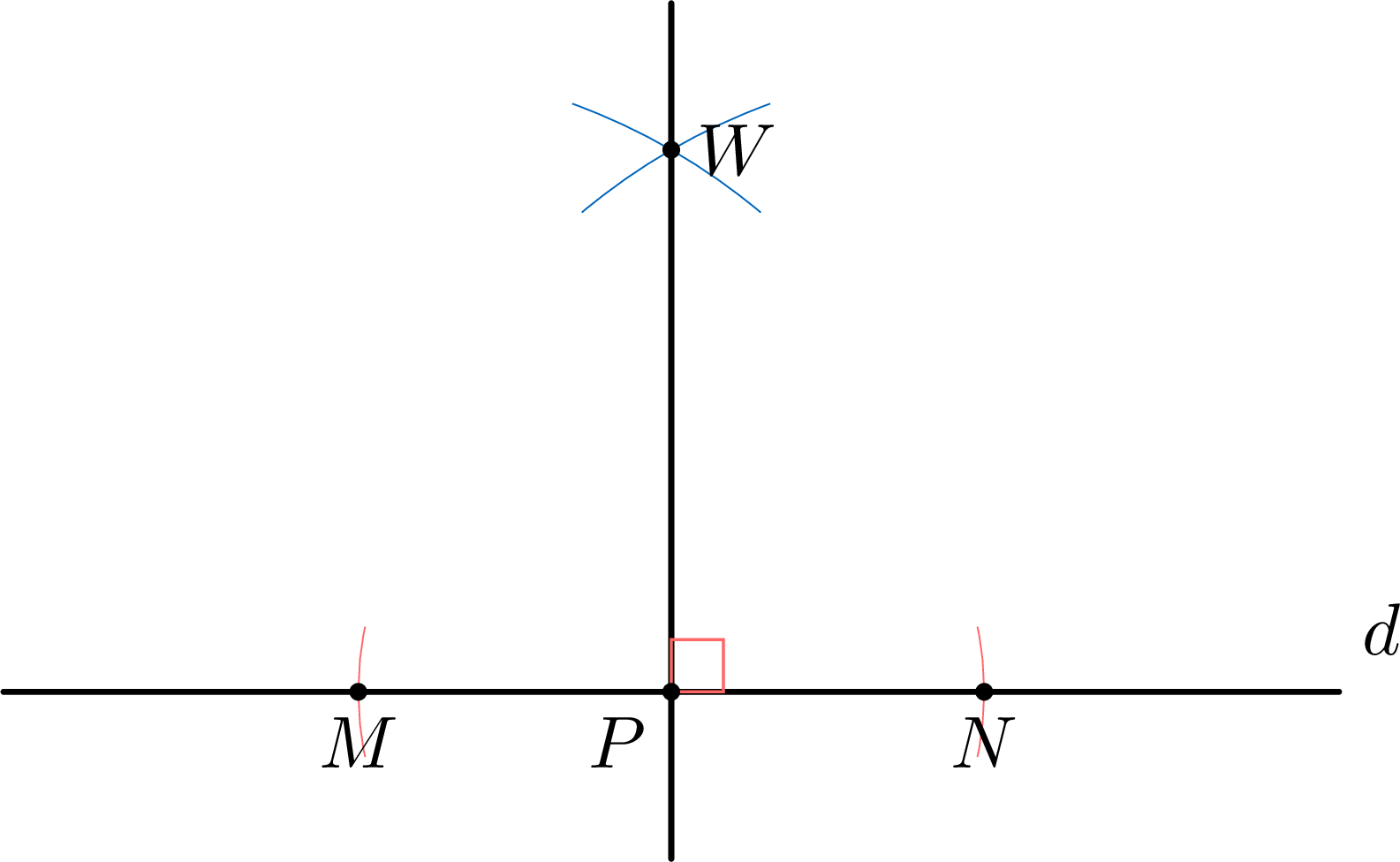
When \(P\) is at an end of a segment, extend the segment beyond \(P\) first, so that the first arc cuts it twice.
Skills to practice
- Identifying Midpoints and Perpendicular Bisectors
- Using the Perpendicular Bisector
- Constructing Right Angles with a Compass
I.2
Concurrent Lines and the Circumscribed Circle
Proposition — Circumscribed circle of a triangle
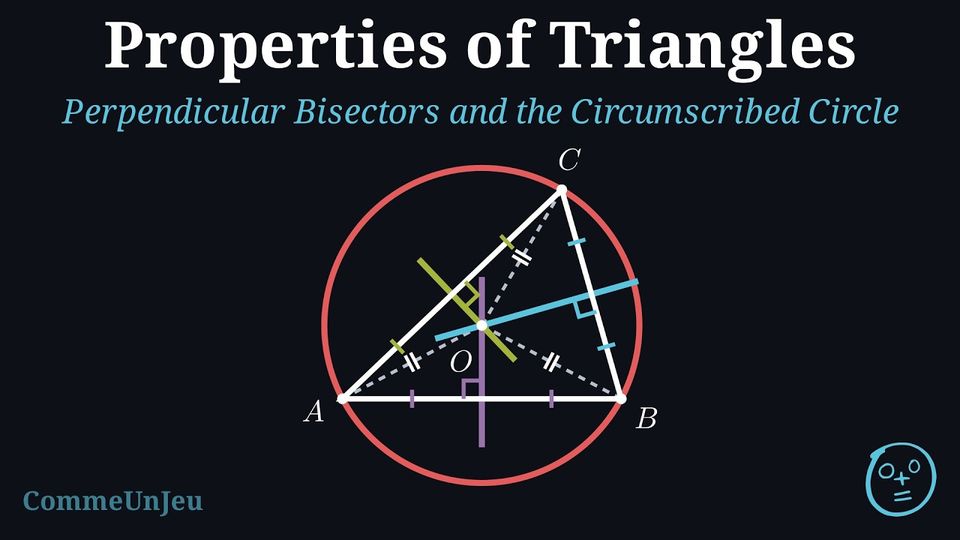
Let \(ABC\) be a triangle. The perpendicular bisectors of its three sides pass through a single point \(O\), which is at equal distance from the three vertices: \(OA = OB = OC\). The circle with centre \(O\) passing through \(A\), \(B\) and \(C\) is called the circumscribed circle of the triangle. 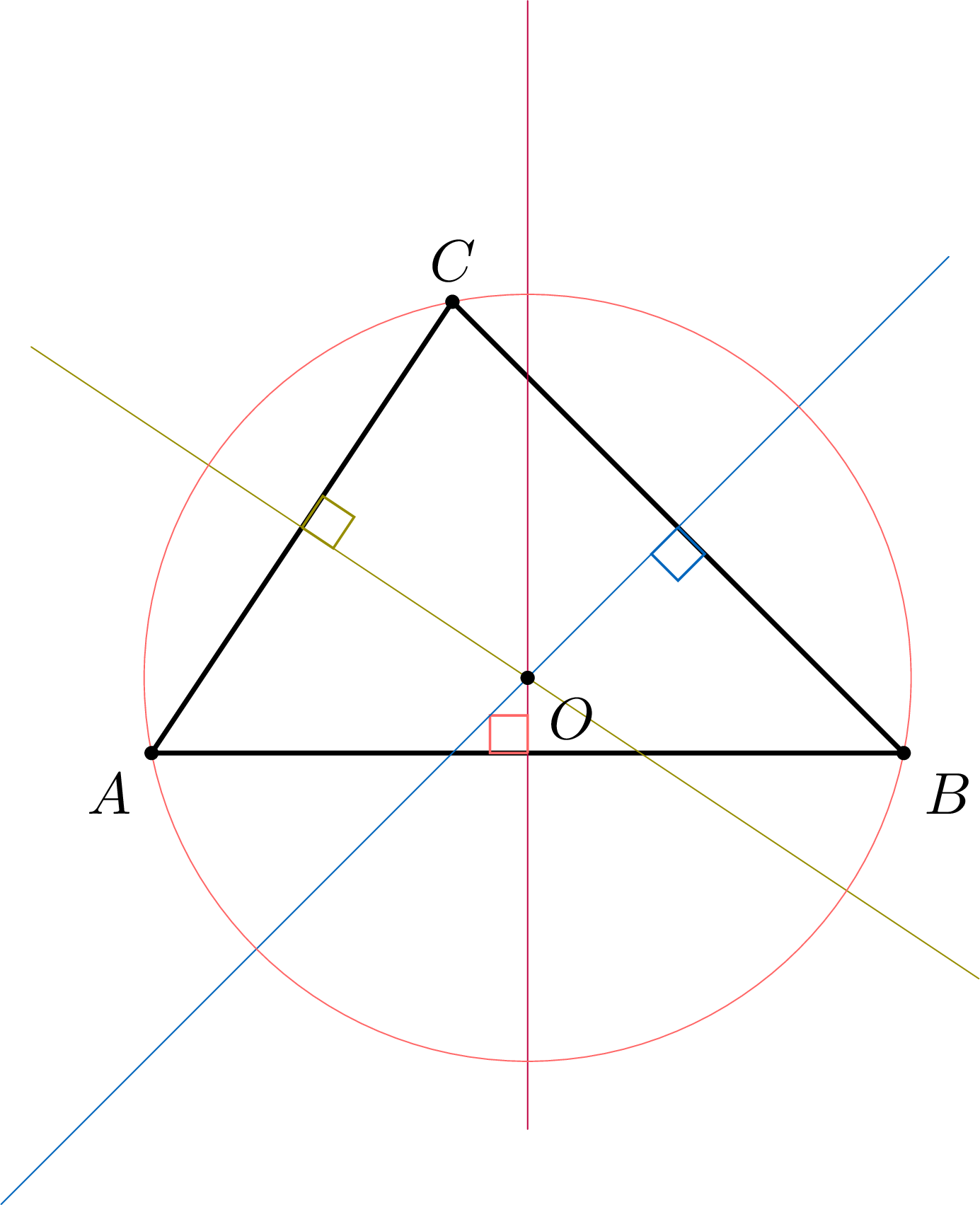
Call \(O\) the point where the perpendicular bisectors of \(\Segment{AB}\) and \(\Segment{BC}\) cross.
- \(O\) is on the perpendicular bisector of \(\Segment{AB}\), so \(OA = OB\).
- \(O\) is on the perpendicular bisector of \(\Segment{BC}\), so \(OB = OC\).
Concurrent Lines
Three lines or more that all pass through one same point are called concurrent; that point is their point of concurrency. Two lines that are not parallel always meet at one point, but three lines usually cross in pairs at three different points, forming a small triangle: saying that three lines are concurrent says something about them.
The three perpendicular bisectors of a triangle are concurrent: their point of concurrency is the centre \(O\) of the circumscribed circle. 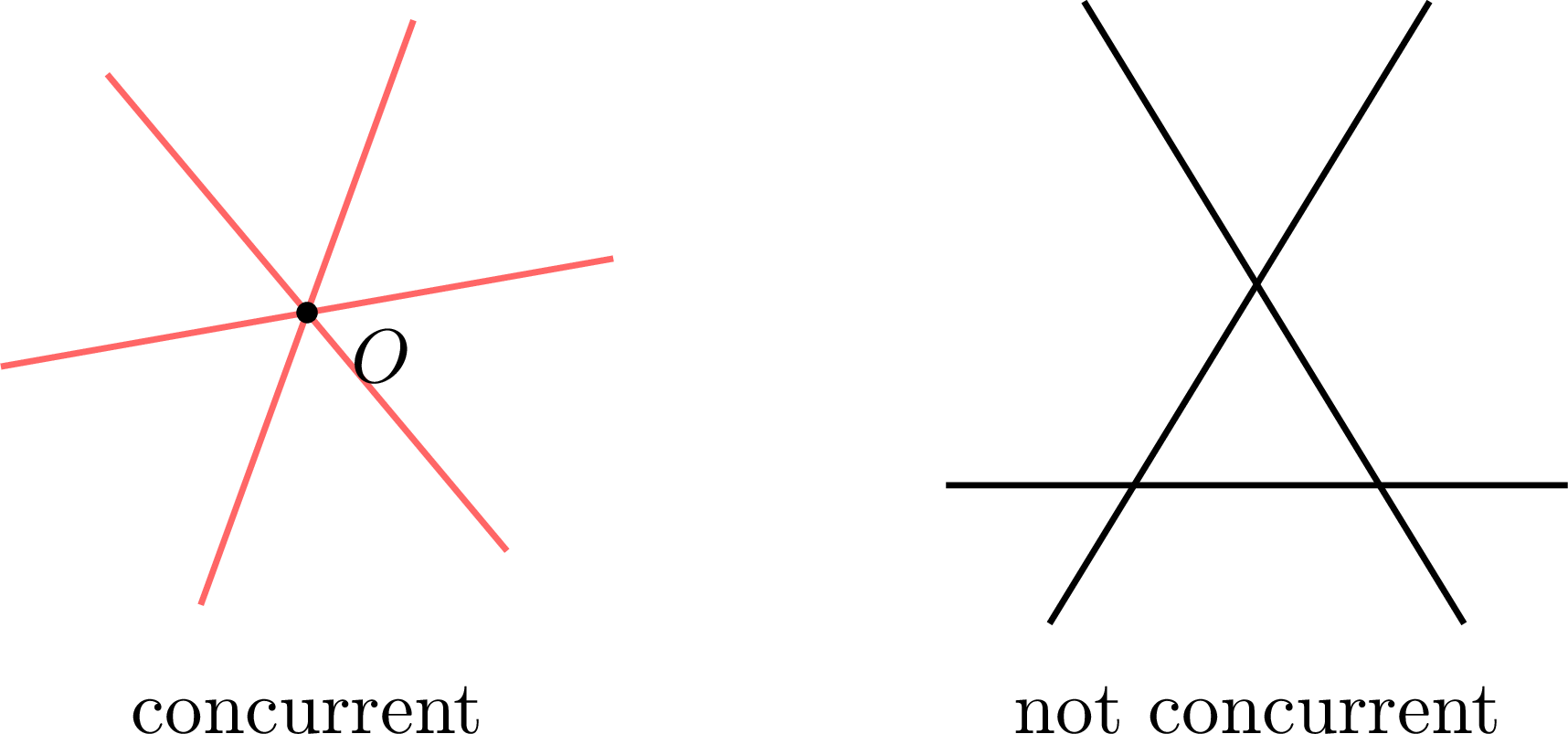
The three perpendicular bisectors of a triangle are concurrent: their point of concurrency is the centre \(O\) of the circumscribed circle.
Proposition — Right-Angled Triangle in its Circumscribed Circle
A right-angled triangle is inscribed in the circle whose diameter is its hypotenuse (the side opposite the right angle): the centre of the circumscribed circle is the midpoint of the hypotenuse. 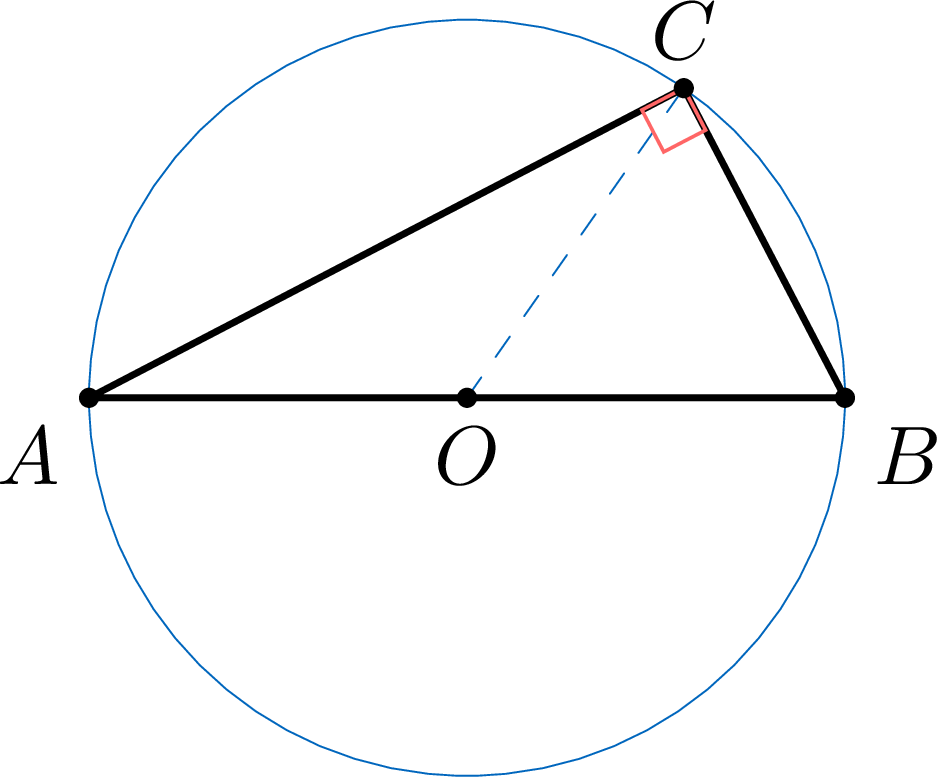
Skills to practice
- Constructing Circumscribed Circles
I.3
The Angle Bisector
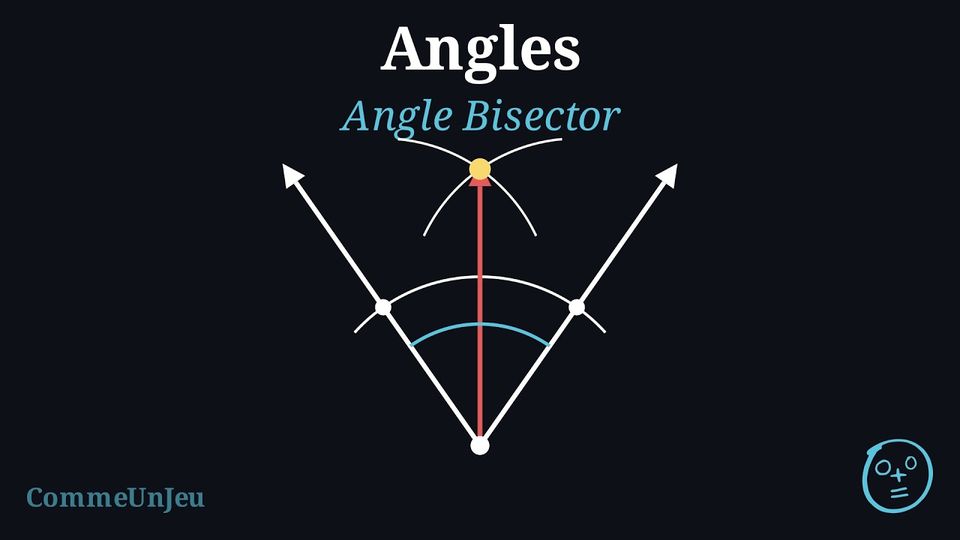
Placing the same angle twice, edge to edge, gives its double. The reverse, splitting it into two equal halves, is done by folding. The ray along the fold has a name, and it can be drawn exactly with a compass — no protractor needed.
Definition — Angle Bisector
The angles considered here are convex: they measure less than \(180^\circ\). The bisector of such an angle is the ray, drawn from its vertex, that divides the angle into two equal angles. It lies on the line of symmetry of the angle: folding along the bisector lays one arm exactly on the other. 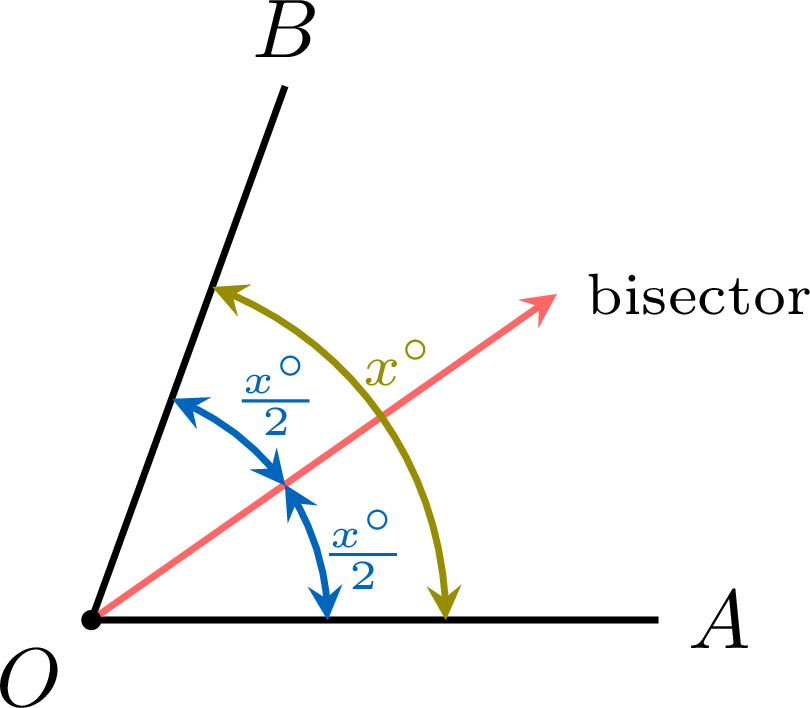
Method — Constructing the Bisector with a Compass
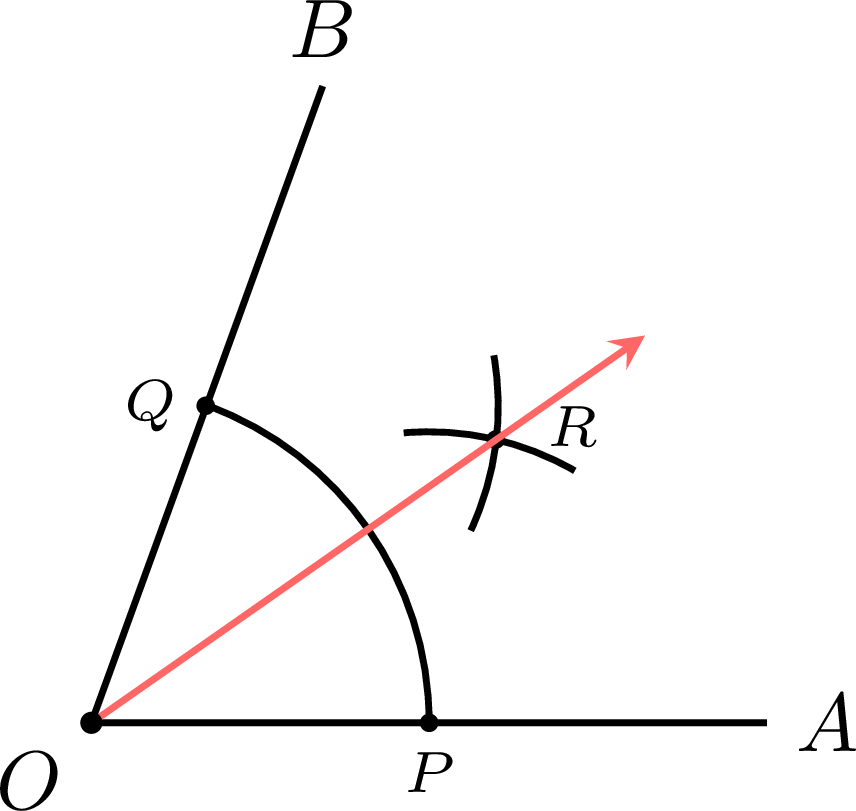
- Place the compass point on the vertex \(O\) and draw an arc that crosses both arms of the angle, at \(P\) and \(Q\).
- Place the compass point on \(P\) and, with a wide enough opening, draw an arc inside the angle. Without changing the opening, place it on \(Q\) and draw a second arc crossing the first, at \(R\).
- Draw the ray from \(O\) through \(R\). This ray is the bisector: it splits the angle into two equal angles.
Example
The bisector of an angle of \(70^\circ\) is drawn. What is the measure of each of the two angles it creates?
The bisector splits the angle into two equal halves, so each measures half of \(70^\circ\): $$\begin{aligned}[t] 70^\circ \div 2 &= 35^\circ. && \text{(half of the angle)} \end{aligned}$$
Skills to practice
- Calculating Half-Angles
- Constructing Bisectors
II
Parallel Lines and Angles
II.1
Properties of Parallel Lines
Definition — Perpendicular Lines
Two perpendicular lines are lines that intersect at a right angle (90 degrees). We write \(\Line{AB} \perp \Line{CD}\) to show that line \(\Line{AB}\) is perpendicular to line \(\Line{CD}\). 
Proposition — Properties of Parallel Lines
These properties help us decide when two lines are parallel or perpendicular. - If line \(l_1\) is parallel to line \(l_2\) and line \(l_2\) is parallel to line \(l_3\), then line \(l_1\) is parallel to line \(l_3\).
If 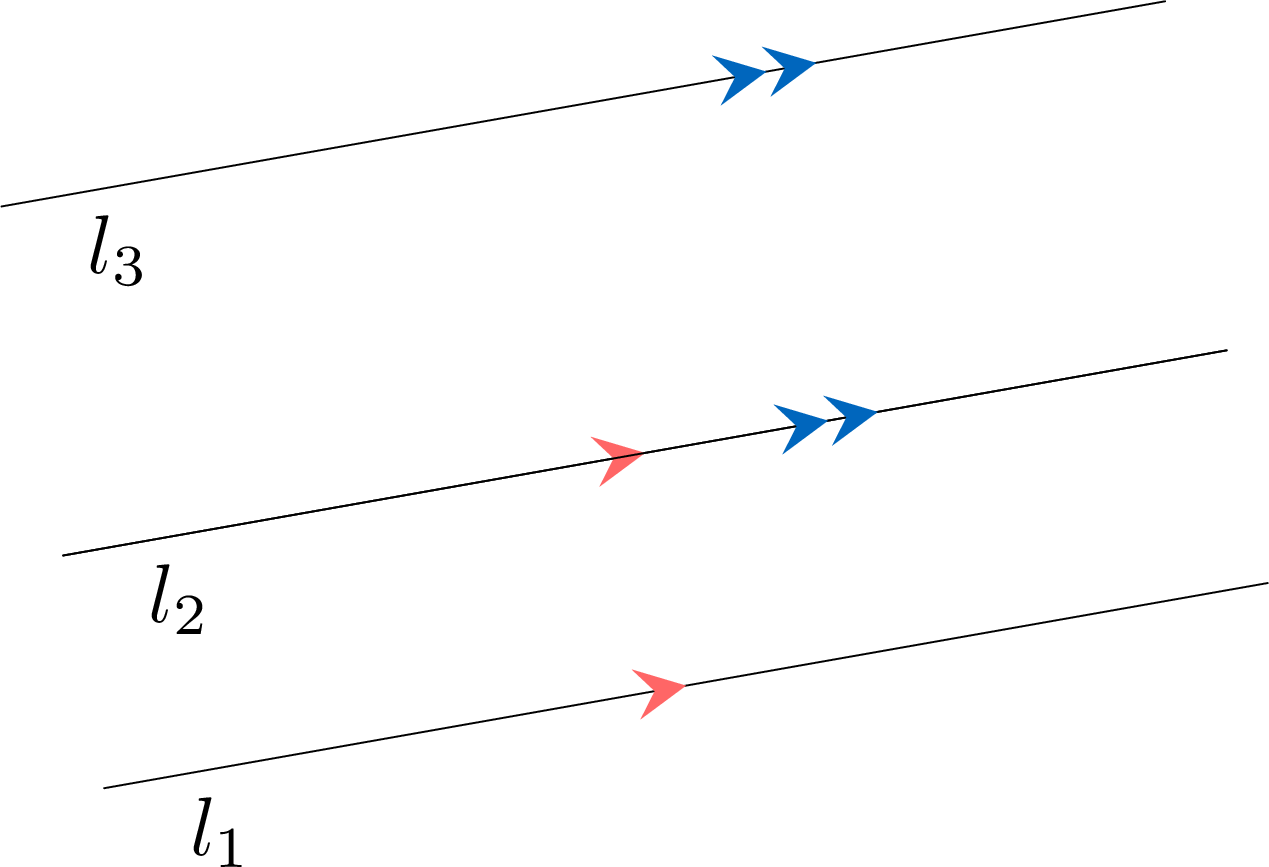 , then
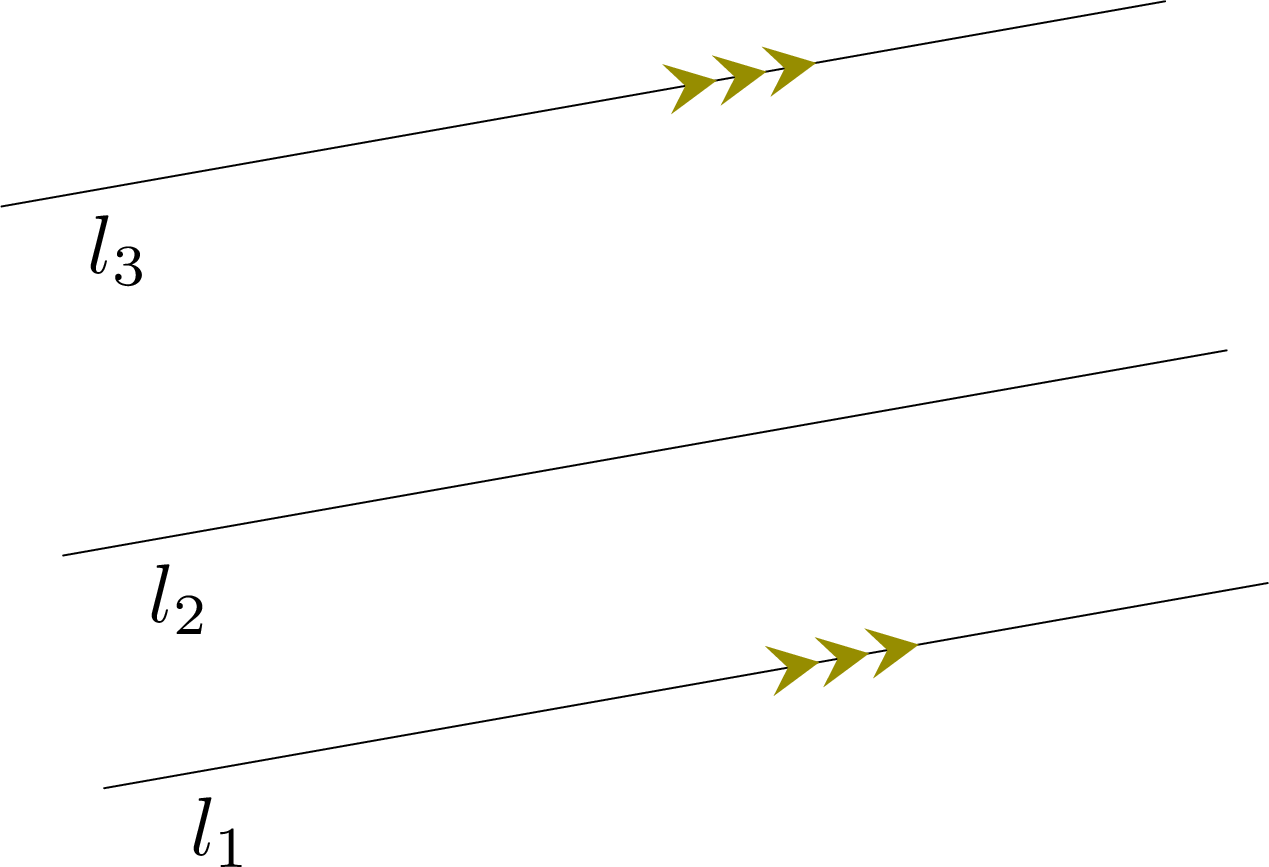 .
- If line \(l_1\) is perpendicular to line \(l_3\) and line \(l_2\) is perpendicular to line \(l_3\), then line \(l_1\) is parallel to line \(l_2\).
If 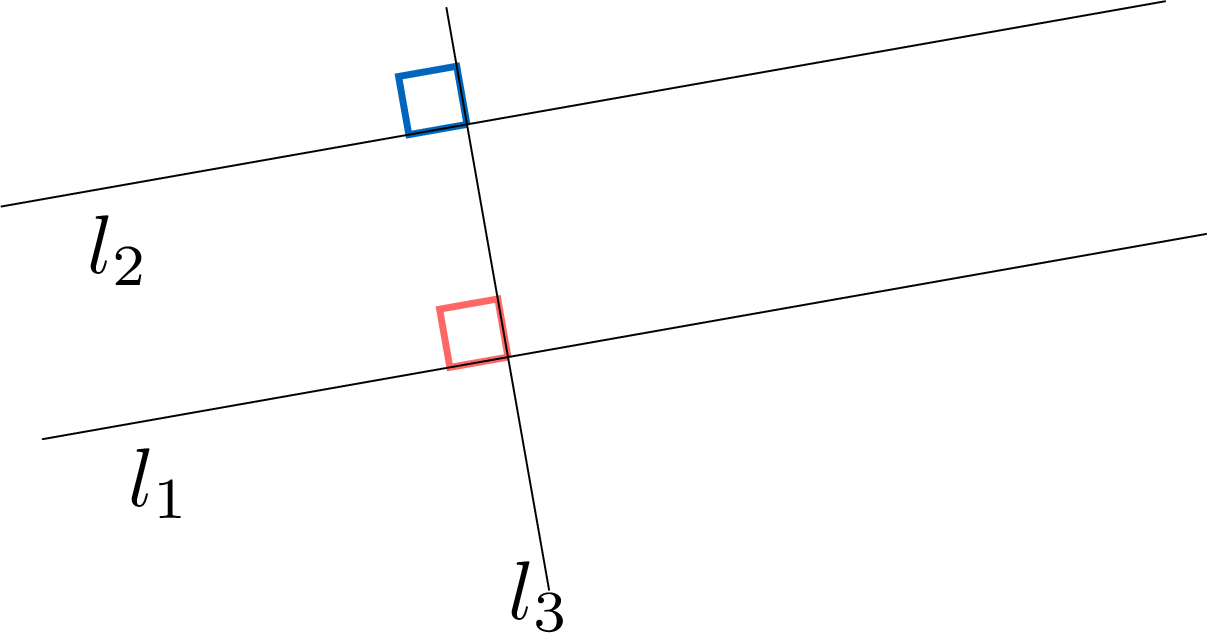 , then
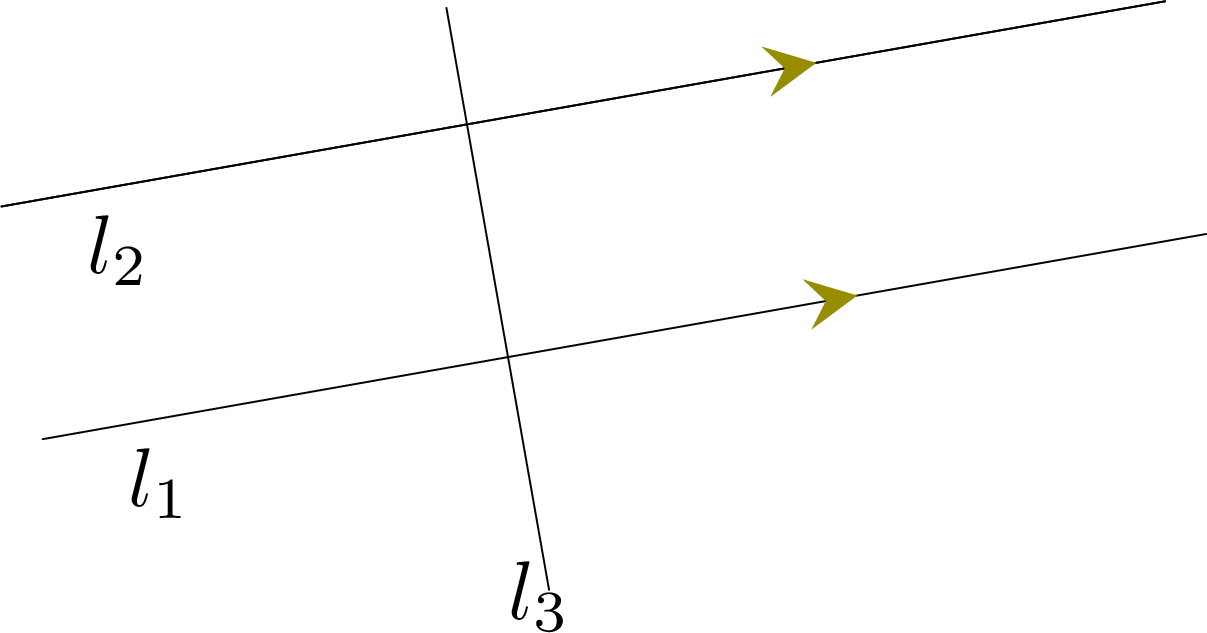 .
- If line \(l_1\) is parallel to line \(l_2\) and line \(l_1\) is perpendicular to line \(l_3\), then line \(l_2\) is perpendicular to line \(l_3\).
If 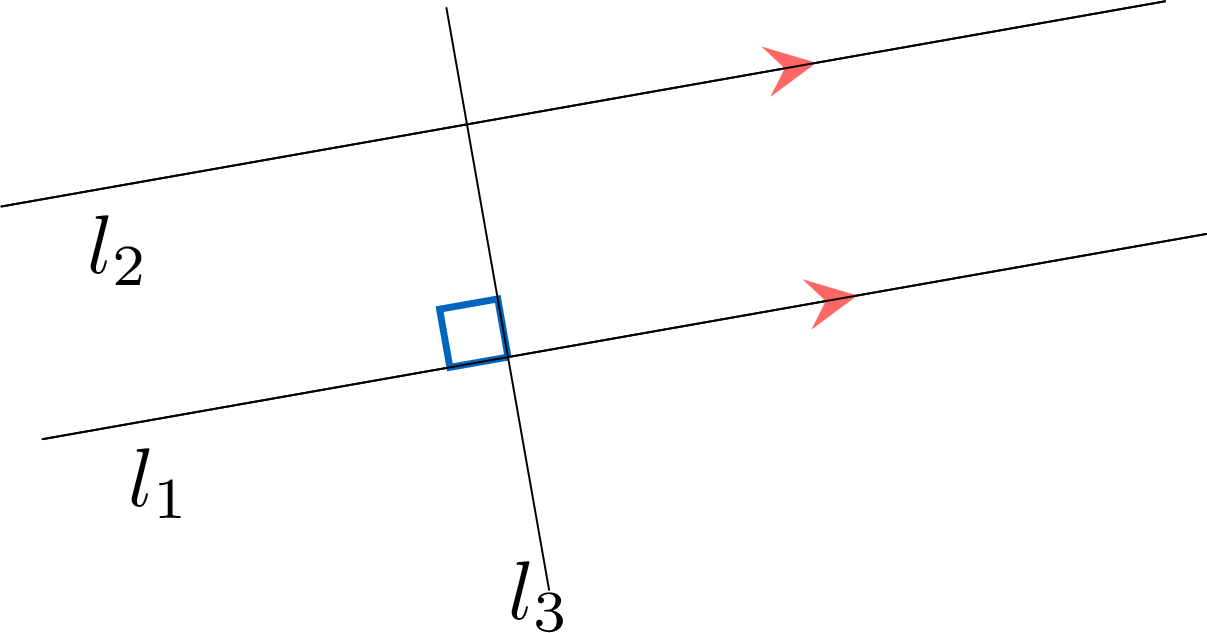 , then
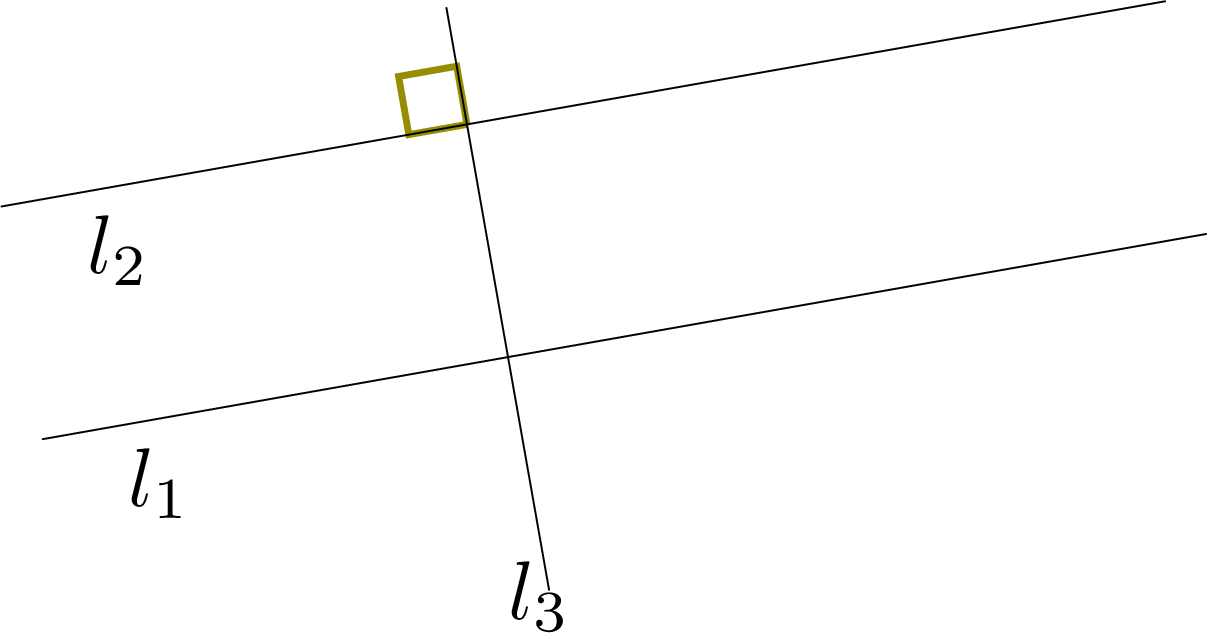 .
We accept two facts: through a given point there is exactly one line perpendicular to a given line, and exactly one line parallel to it. The three properties are deduced from these two facts.
- Two lines perpendicular to the same line are parallel. Suppose \(l_1 \perp l_3\) and \(l_2 \perp l_3\), and suppose, to reach a contradiction, that \(l_1\) and \(l_2\) are not parallel. Then they meet at a point \(Q\). Both \(l_1\) and \(l_2\) pass through \(Q\) and are perpendicular to \(l_3\). But through a point there is only one perpendicular to a line, so \(l_1\) and \(l_2\) would be the same line — hence parallel (a line is parallel to itself), contradicting our supposition that they are not. Therefore \(l_1\) and \(l_2\) are parallel.
- A perpendicular to one of two parallel lines is perpendicular to the other. Suppose \(l_1\) is parallel to \(l_2\) and \(l_1 \perp l_3\). The line \(l_3\) crosses \(l_1\), so it also crosses \(l_2\), which runs parallel to \(l_1\); call this crossing point \(P\). Through \(P\), draw the line \(t\) perpendicular to \(l_3\). Then \(t \perp l_3\) and \(l_1 \perp l_3\), so by the property just proved, \(t\) is parallel to \(l_1\). Now \(t\) and \(l_2\) both pass through \(P\) and are both parallel to \(l_1\); since there is only one parallel to \(l_1\) through \(P\), they are the same line: \(t = l_2\). As \(t \perp l_3\), we conclude \(l_2 \perp l_3\).
- If two lines are parallel to the same line, they are parallel to each other. Suppose \(l_1\) is parallel to \(l_2\) and \(l_2\) is parallel to \(l_3\). Draw a line \(d\) perpendicular to \(l_2\). Since \(l_1\) is parallel to \(l_2\), the previous property gives \(d \perp l_1\); since \(l_3\) is parallel to \(l_2\), it gives \(d \perp l_3\). So \(l_1\) and \(l_3\) are both perpendicular to \(d\), and by the first property they are parallel.
Skills to practice
- Investigating Line Relationships
II.2
Corresponding, Alternate and Co-interior Angles
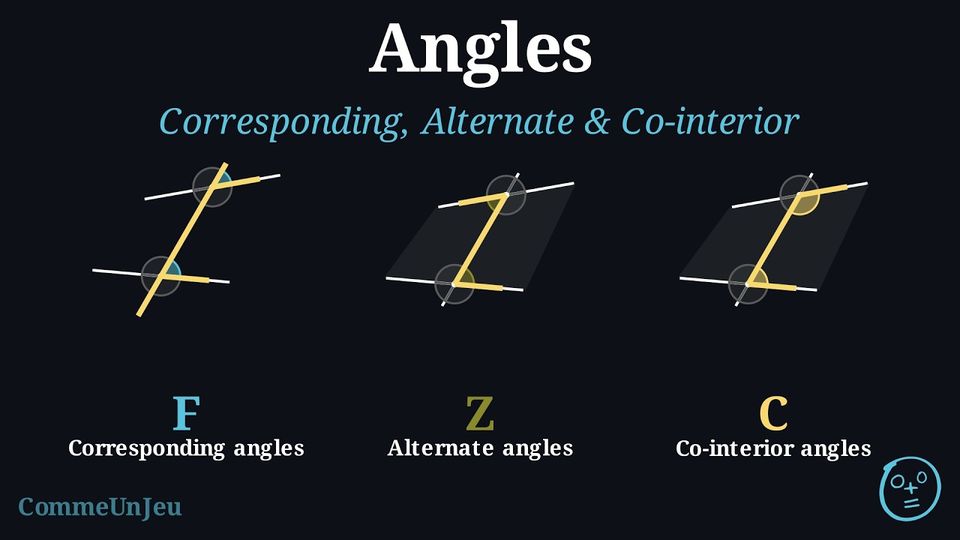
Definition — Corresponding, Alternate, and Co-interior Angles
- Corresponding angles are on the same side of a transversal that intersects two lines and are in matching corners relative to the intersected lines, like the top-right corners of each intersection.
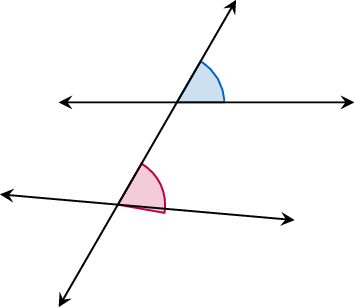
- Alternate angles are on opposite sides of a transversal and lie between the two intersected lines, forming a “Z” shape.
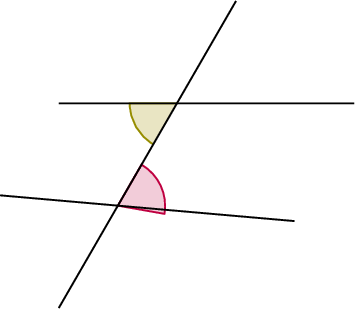
- Co-interior angles (also called consecutive interior angles) are on the same side of a transversal and between the two intersected lines, forming a “C” shape.
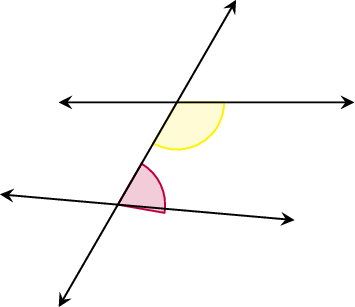
Example
Identify the following for the given diagram: - The corresponding angles.
- The alternate angles.
- The co-interior angles.
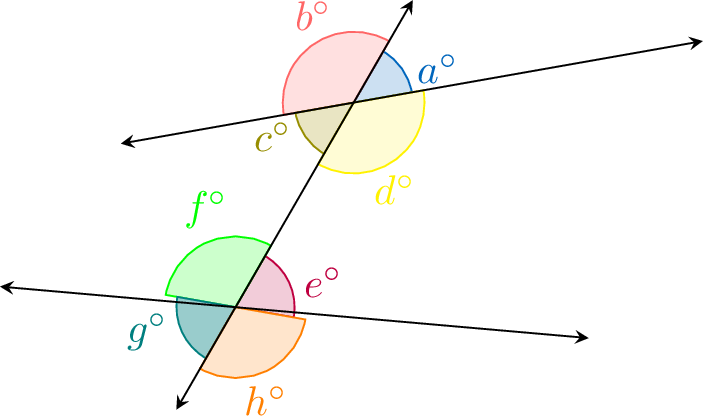
- Corresponding angles: \(\textcolor{colorprop}{a^\circ}\) and \(\textcolor{purple}{e^\circ}\), \(\textcolor{colordef}{b^\circ}\) and \(\textcolor{green}{f^\circ}\), \(\textcolor{olive}{c^\circ}\) and \(\textcolor{teal}{g^\circ}\), \(\textcolor{yellow}{d^\circ}\) and \(\textcolor{orange}{h^\circ}\).
- Alternate angles: \(\textcolor{olive}{c^\circ}\) and \(\textcolor{purple}{e^\circ}\), \(\textcolor{yellow}{d^\circ}\) and \(\textcolor{green}{f^\circ}\).
- Co-interior angles: \(\textcolor{olive}{c^\circ}\) and \(\textcolor{green}{f^\circ}\), \(\textcolor{yellow}{d^\circ}\) and \(\textcolor{purple}{e^\circ}\).
Definition — Alternate and Corresponding Angles
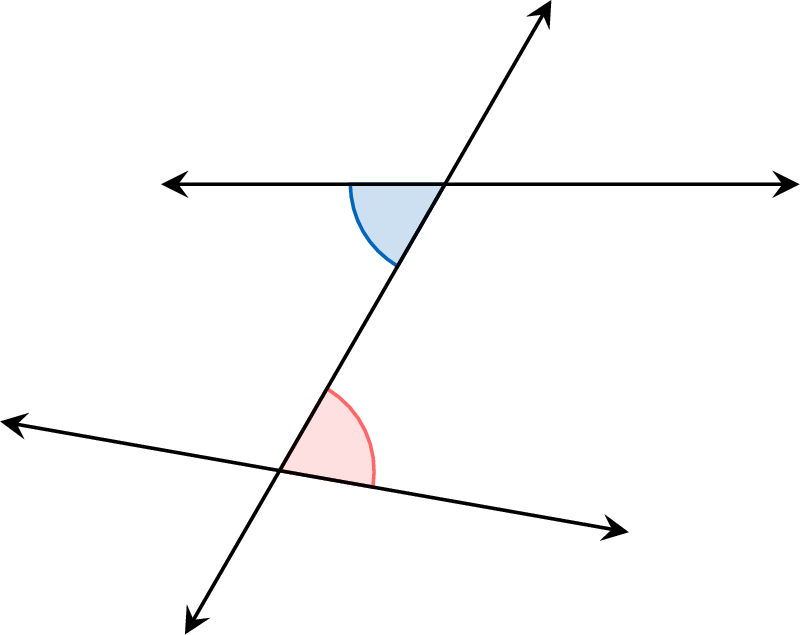
Two lines cut, at two distinct points, by a third line — a transversal — form eight angles, in two clusters of four. Among them: - two angles are alternate angles (also called alternate interior angles) when: they do not share a vertex; they both lie between the two lines; they are on opposite sides of the transversal;
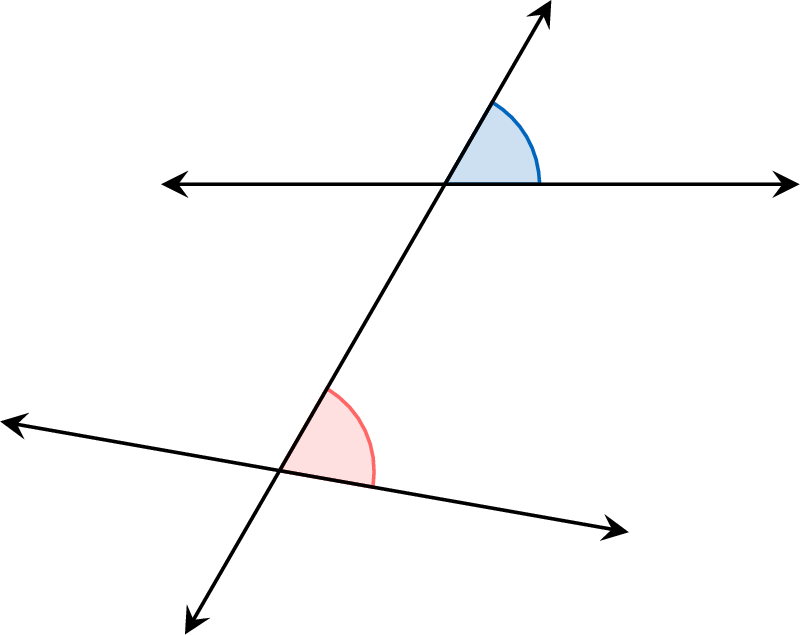
- two angles are corresponding angles when: they do not share a vertex; only one of them lies between the two lines; they are on the same side of the transversal.
Example
On the figure, the lines \(d\) and \(d'\) are cut by the transversal \(t\). Among the four marked angles, name a pair of alternate angles and a pair of corresponding angles, and check the three criteria each time. 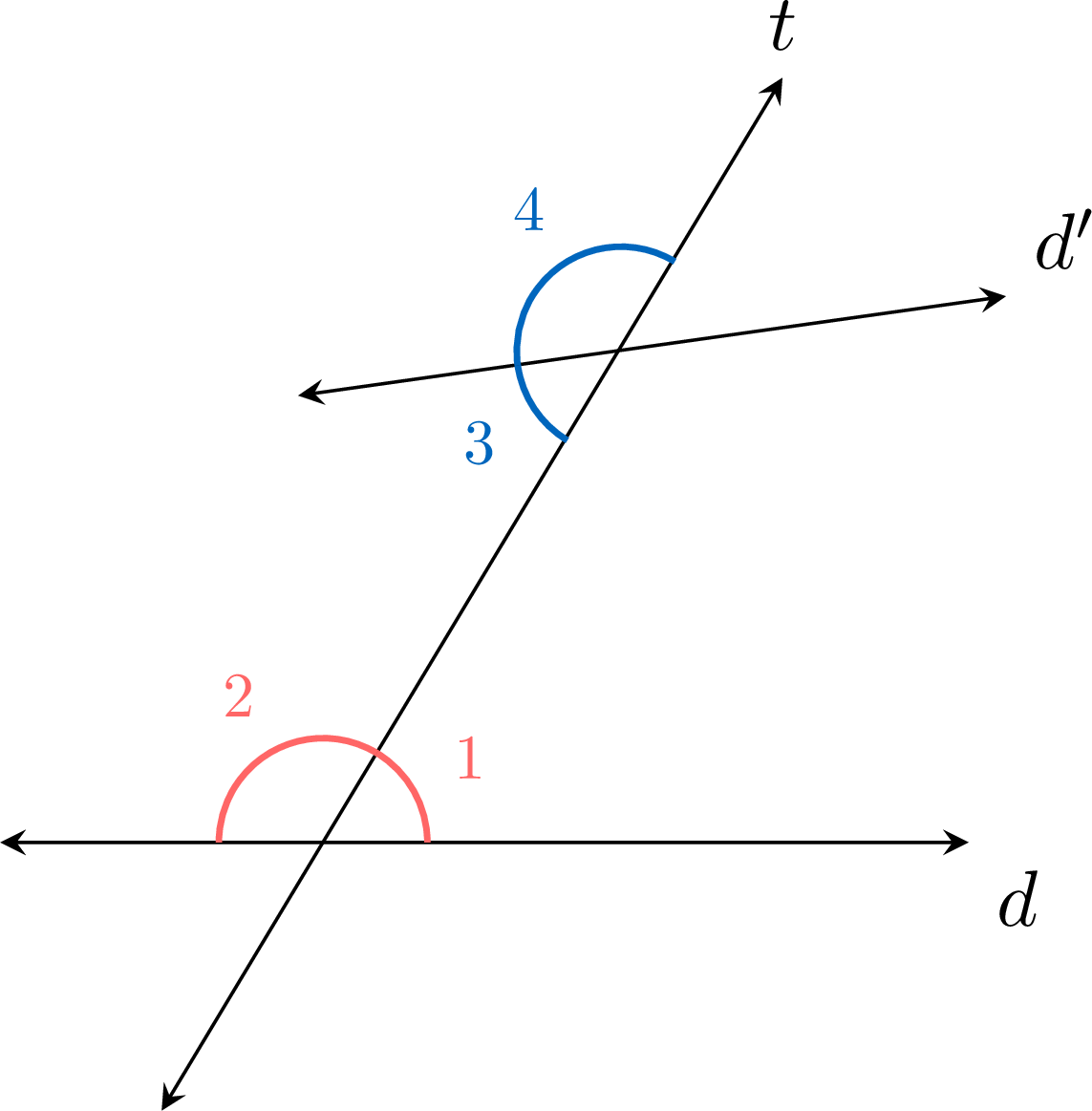
- Angles \(1\) and \(3\) are alternate angles: different vertices; both lie between \(d\) and \(d'\); angle \(1\) is to the right of \(t\) and angle \(3\) to the left of it — opposite sides.
- Angles \(2\) and \(4\) are corresponding angles: different vertices; angle \(2\) lies between the lines and angle \(4\) does not — only one is between; both are on the left side of \(t\) — the same side.
Skills to practice
- Identifying Angles
II.3
Angle Properties of Parallel Lines
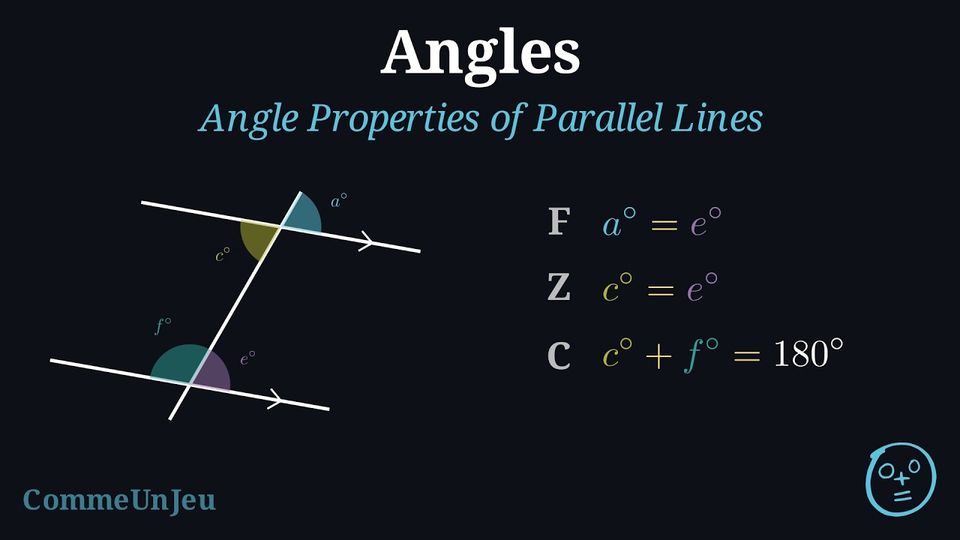
Two parallel lines are crossed by a third line. One angle is marked \(70^\circ\); three other angles are marked ?. No protractor is needed: knowing one angle is enough to find all the others — this is angle-chasing. Starting from that \(70^\circ\), what are all the other angles? 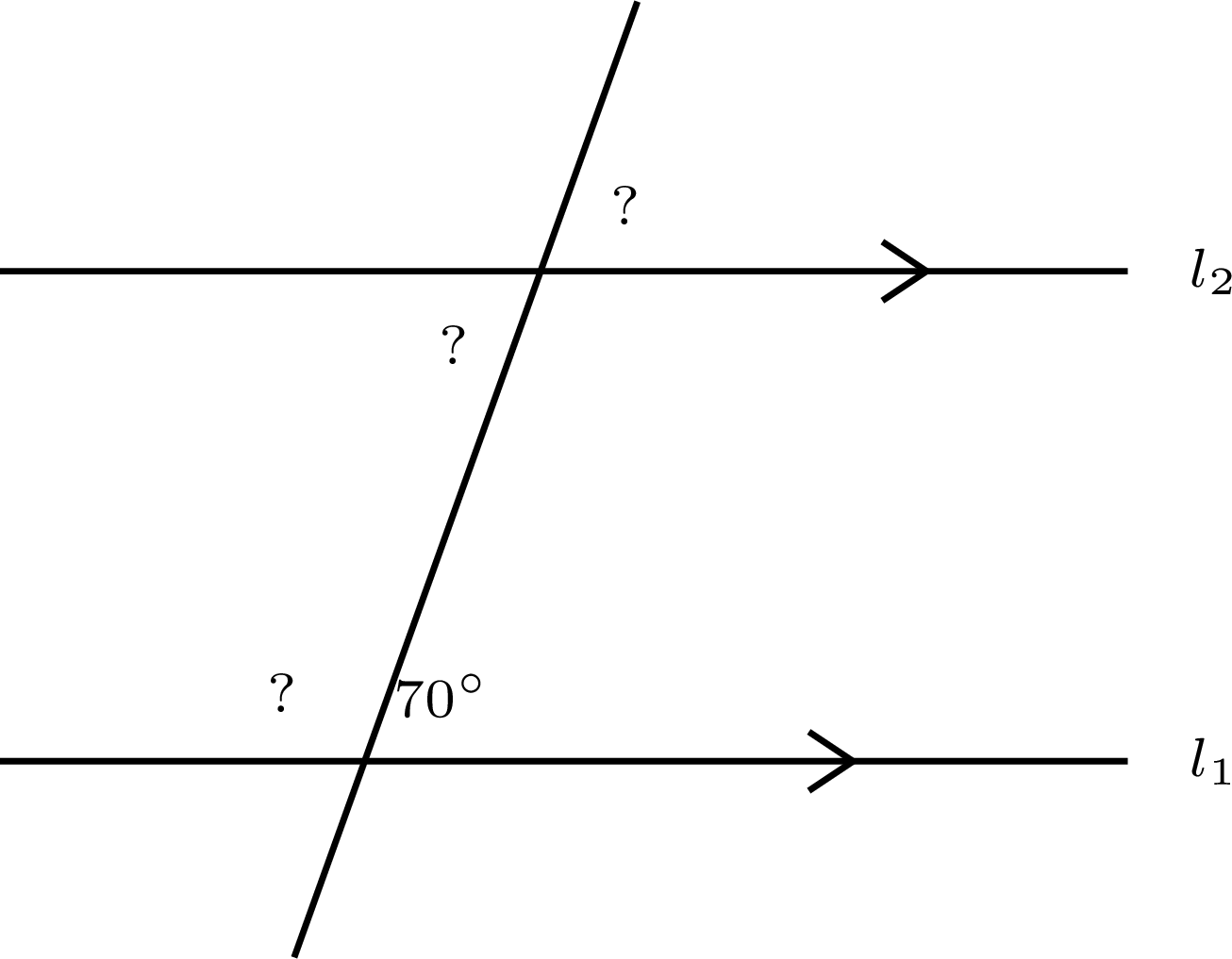
A transversal crossing two parallel lines creates angle relationships: corresponding, alternate, and co-interior angles. The properties of parallel lines say how parallelism carries from one line to the next and meets perpendicularity. Here the lines are given as parallel; we read off what their angles must be.
Proposition — Corresponding Angles on Parallel Lines
When a transversal crosses two parallel lines, the corresponding angles are equal. We take this as our starting point — a postulate — and from it the other two properties are proved, not merely stated. 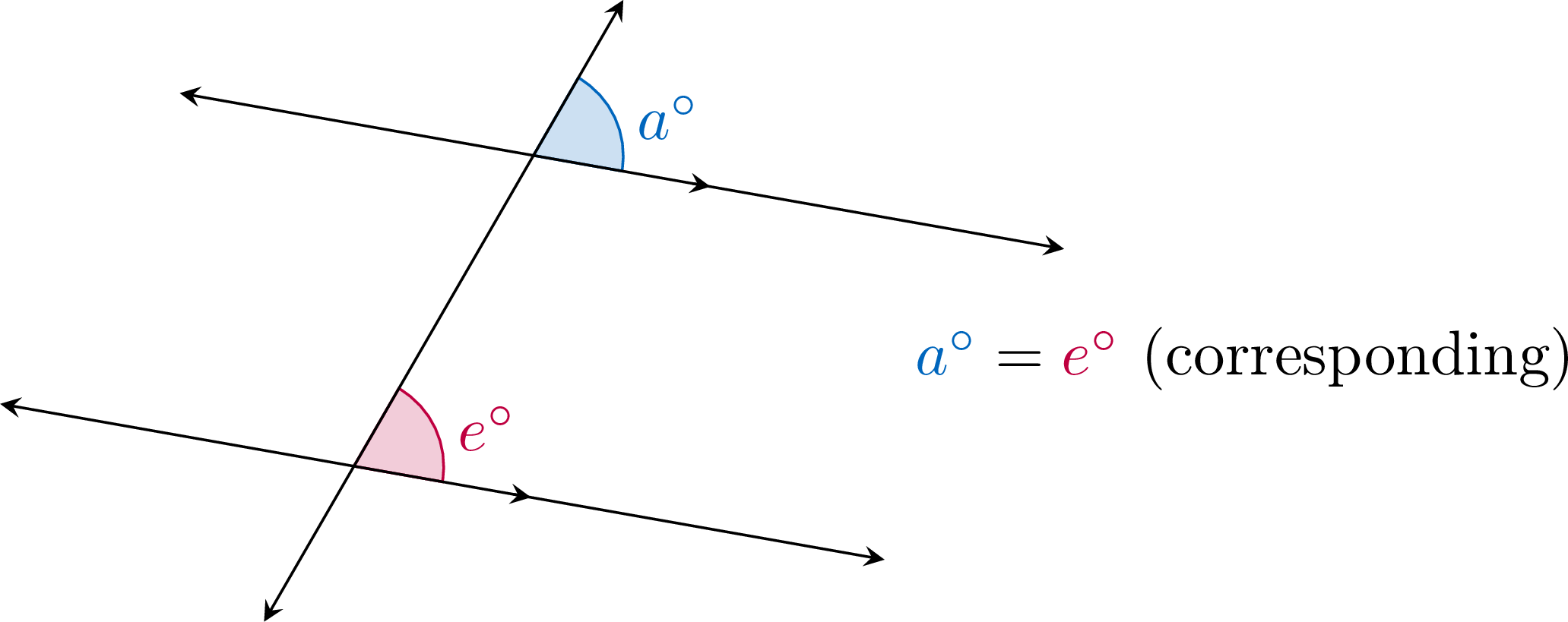
Proposition — Vertically Opposite Angles Are Equal
Vertically opposite angles are equal. 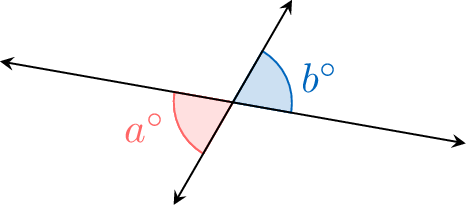
\(\textcolor{colordef}{a^\circ} = \textcolor{colorprop}{b^\circ}\)
Consider two lines intersecting at a point, forming opposite angles \(a^\circ\) and \(b^\circ\), and an adjacent angle \(c^\circ\). 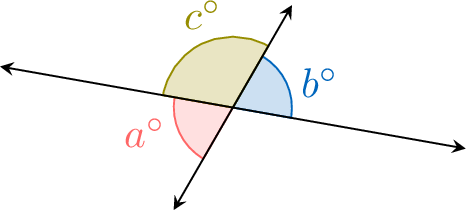
Since \(a^\circ\) and \(c^\circ\) form a straight angle: $$\textcolor{colordef}{a^\circ} + \textcolor{olive}{c^\circ} = 180^\circ \quad (\text{straight angle})$$ Similarly, \(b^\circ\) and \(c^\circ\) form a straight angle: $$\textcolor{colorprop}{b^\circ} + \textcolor{olive}{c^\circ} = 180^\circ \quad (\text{straight angle})$$ Thus, \(\textcolor{colordef}{a^\circ} + \textcolor{olive}{c^\circ} = \textcolor{colorprop}{b^\circ} + \textcolor{olive}{c^\circ}\). Subtracting \(\textcolor{olive}{c^\circ}\) from both sides gives: $$\textcolor{colordef}{a^\circ} = \textcolor{colorprop}{b^\circ}$$
Proposition — Alternate Angles are Equal
When a transversal crosses two parallel lines, the alternate angles are equal. 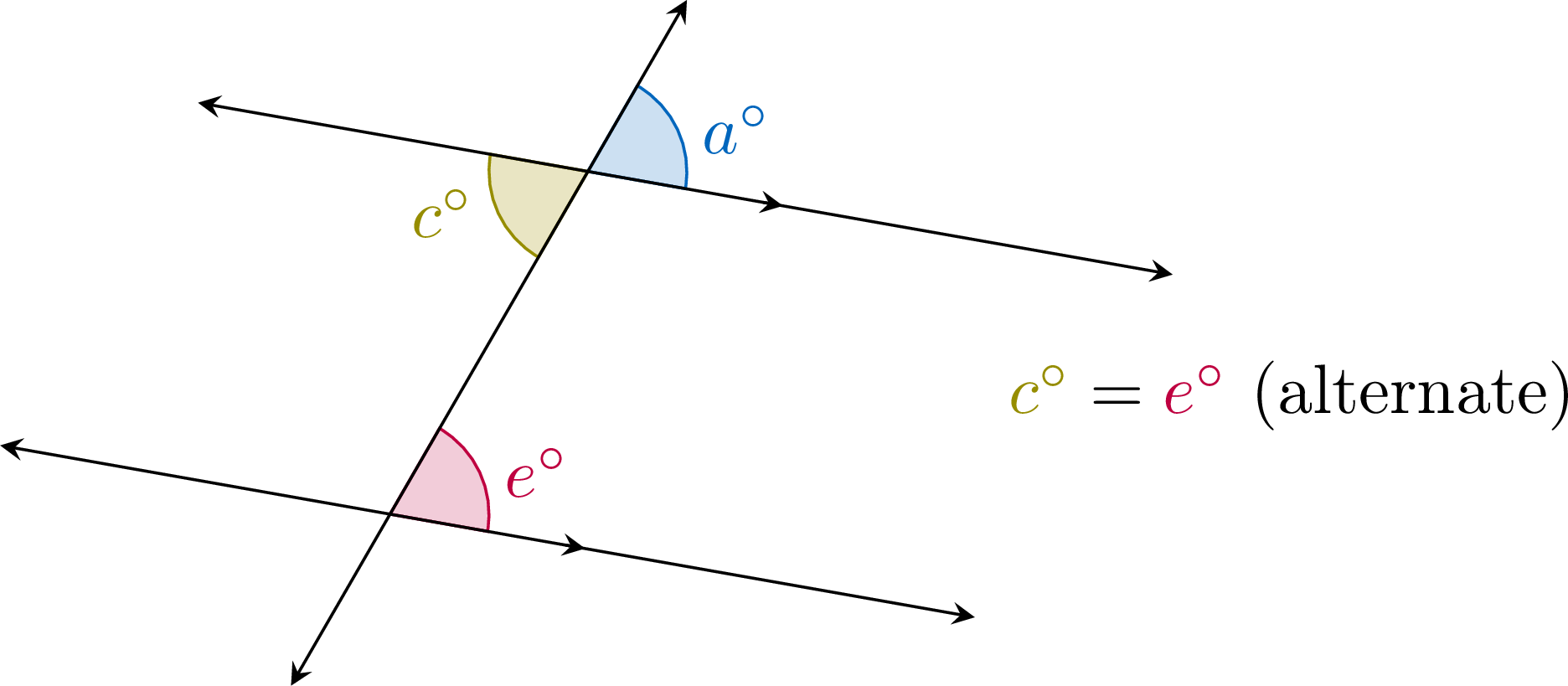
At the upper vertex, \(\textcolor{olive}{c^\circ}\) and \(\textcolor{colorprop}{a^\circ}\) are vertically opposite angles, so they are equal. And \(\textcolor{colorprop}{a^\circ}\) and \(\textcolor{purple}{e^\circ}\) are corresponding angles, equal by the postulate. Therefore: $$\begin{aligned}[t] \textcolor{olive}{c^\circ} &= \textcolor{colorprop}{a^\circ} && \text{(vertically opposite angles)}\\
&= \textcolor{purple}{e^\circ}. && \text{(corresponding angles, postulate)} \end{aligned}$$ So \(\textcolor{olive}{c^\circ}=\textcolor{purple}{e^\circ}\): the alternate angles are equal.
Proposition — Co-interior Angles are Supplementary
When a transversal crosses two parallel lines, the co-interior angles are supplementary: their measures sum to \(180^\circ\). 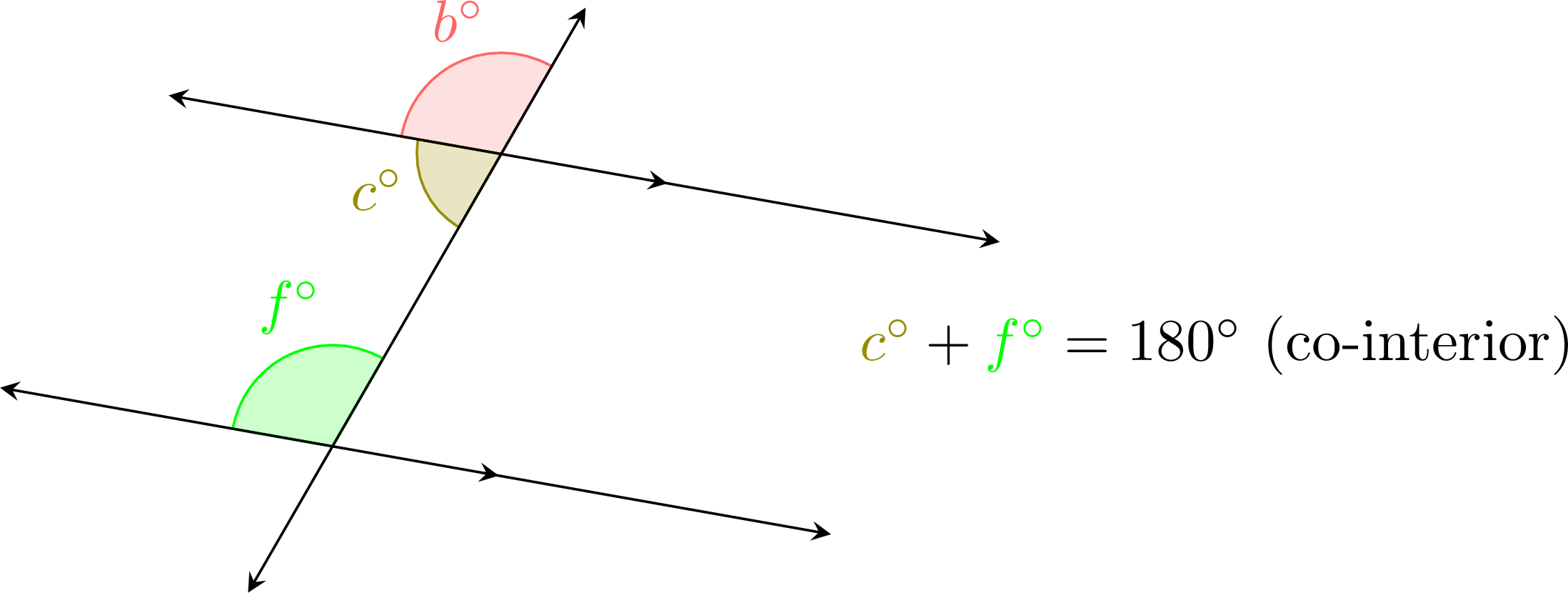
At the upper vertex, \(\textcolor{colordef}{b^\circ}\) and \(\textcolor{olive}{c^\circ}\) are angles on a straight line, so \(\textcolor{colordef}{b^\circ}+\textcolor{olive}{c^\circ}=180^\circ\). And \(\textcolor{colordef}{b^\circ}\) and \(\textcolor{green}{f^\circ}\) are corresponding angles, equal by the postulate. Substituting \(\textcolor{green}{f^\circ}\) for \(\textcolor{colordef}{b^\circ}\): $$\begin{aligned}[t] \textcolor{olive}{c^\circ}+\textcolor{green}{f^\circ} &= \textcolor{olive}{c^\circ}+\textcolor{colordef}{b^\circ} && \text{(corresponding: } \textcolor{green}{f^\circ}=\textcolor{colordef}{b^\circ}\text{)}\\
&= 180^\circ. && \text{(angles on a straight line)} \end{aligned}$$ So \(\textcolor{olive}{c^\circ}+\textcolor{green}{f^\circ}=180^\circ\): the co-interior angles are supplementary.
Example
Calculate the measure of the unknown angle \(x^\circ\), given that the lines are parallel. 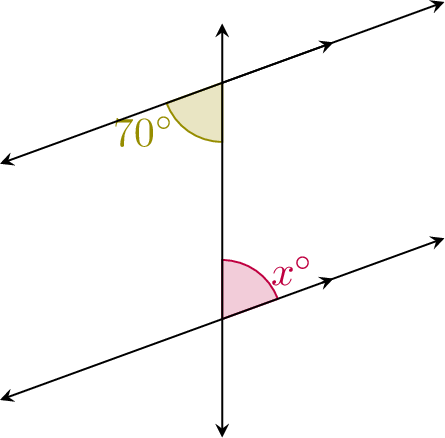
Since the angles are alternate and the lines are parallel, they are equal. $$\begin{aligned} x^\circ &= 70^\circ \quad (\text{alternate angles are equal}) \end{aligned}$$
Proposition — Parallel Lines from Equal Angles
If two corresponding angles or two alternate angles formed by the same transversal are equal, then the lines are parallel. 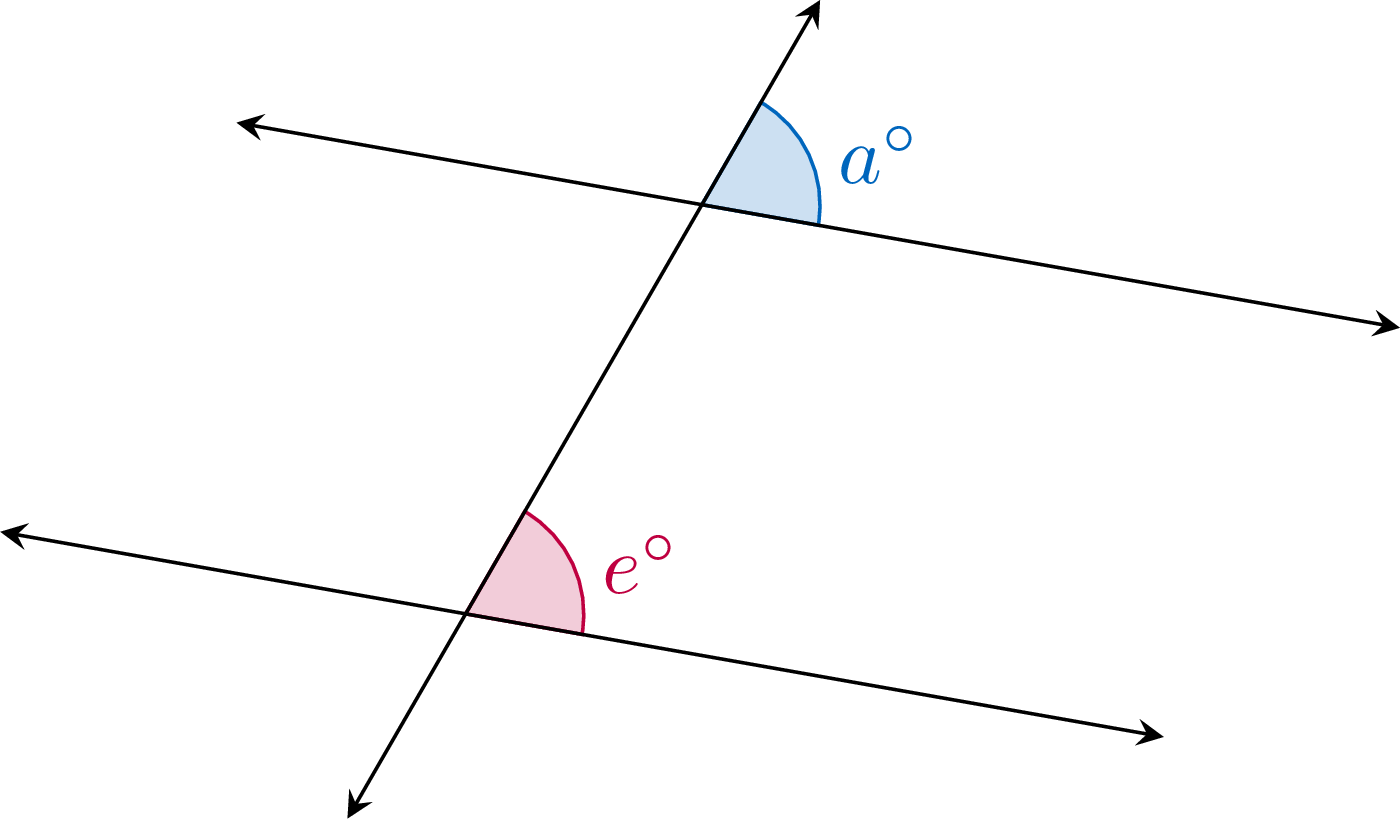
Suppose the corresponding angles \(\textcolor{colorprop}{a^\circ}\) and \(\textcolor{purple}{e^\circ}\) are equal, and suppose — to reach a contradiction — that the two lines are not parallel. Through the upper vertex there is exactly one line parallel to the lower line. By the postulate, that parallel makes a corresponding angle with the transversal equal to \(\textcolor{purple}{e^\circ}\) — hence equal to \(\textcolor{colorprop}{a^\circ}\). But from the vertex, on a given side of the transversal, there is only one ray making the given angle with it, so that parallel coincides with the upper line. The upper line is therefore parallel to the lower line, contradicting our supposition. Hence the two lines are parallel. If instead two alternate angles are equal, the angle vertically opposite one of them is corresponding to the other and has the same measure (vertically opposite angles are equal): the case reduces to the previous one.
Example
Show that the lines are parallel, given the angle measures. 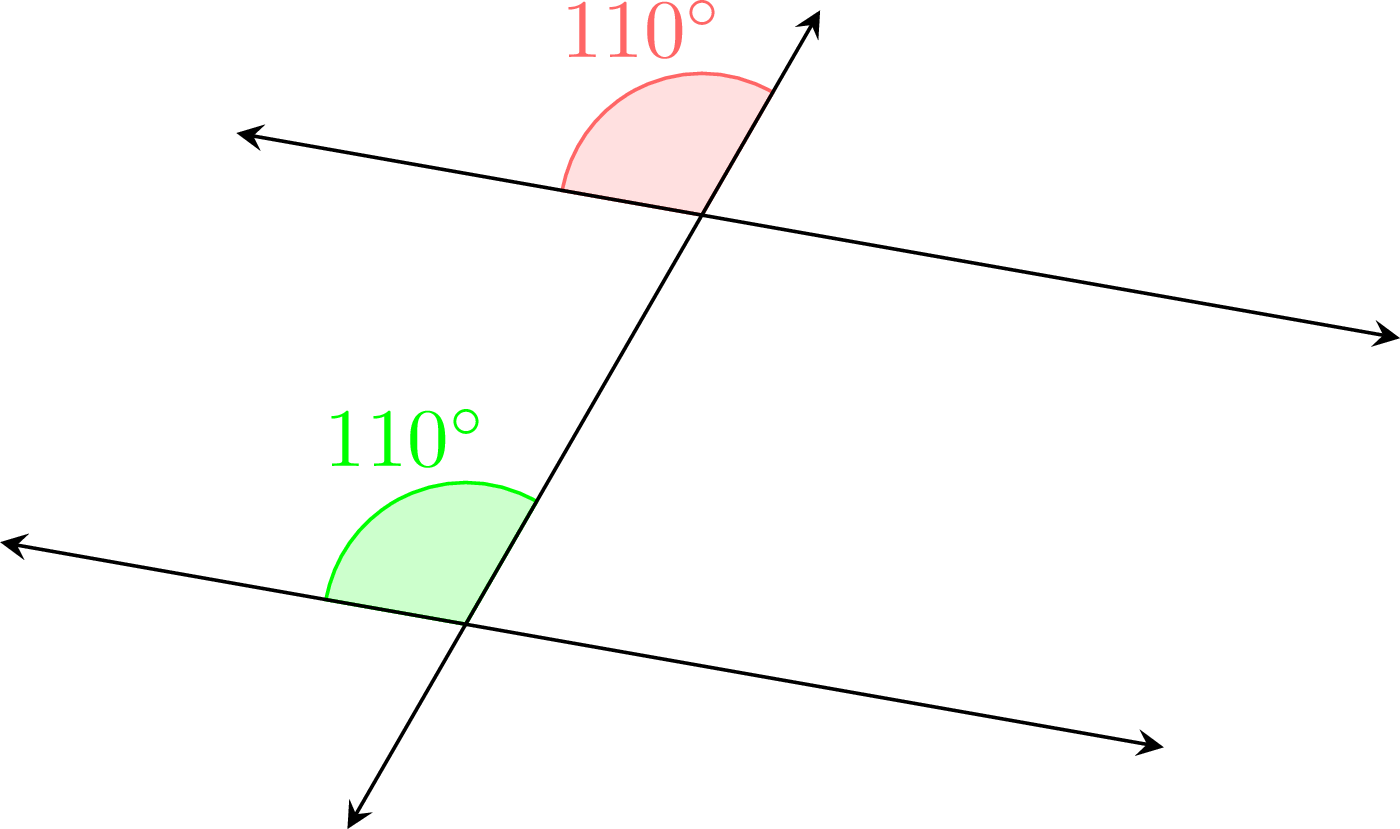
Since the corresponding angles are equal (\(110^\circ = 110^\circ\)), the lines are parallel.
Skills to practice
- Calculating Unknown Angles: Level 1
- Calculating Unknown Angles: Level 2
- Chasing Angles and Justifying Each Step
III
Going further
Skills to practice
- Proving the Properties of Parallel Lines
- Solving Problems with Lines and Constructions
- Investigating Patterns with Parallel Lines
- Quiz
Jump to section