International Baccalaureate · MYP 1
Transformations
I
Translations
I.1
The Translation that Maps A to B
Definition — Types of Transformations
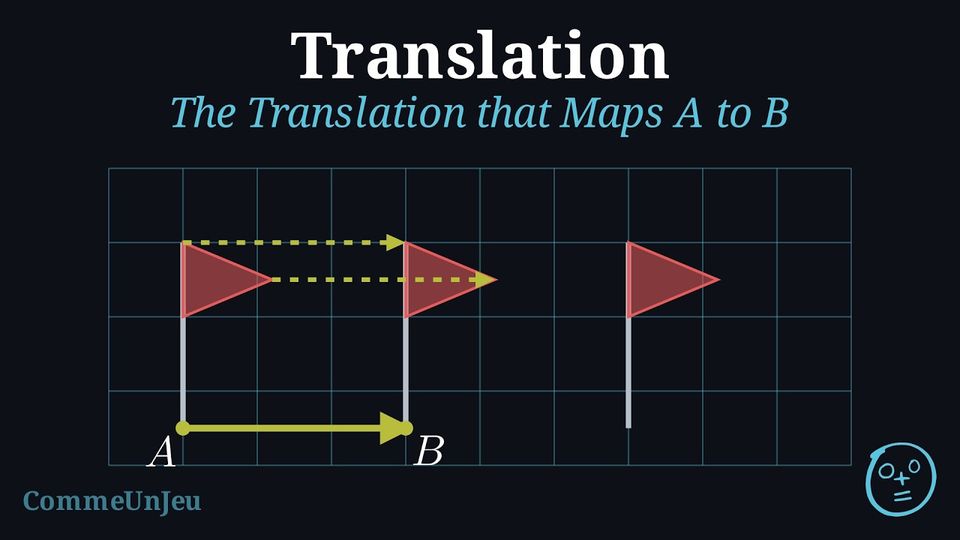
In geometry, we often use three transformations; each one moves a shape without changing its shape or its size: - Translation (a slide): Moves every point of the shape the same distance in the same direction. The shape keeps the same shape, size, and orientation.

- Rotation (a turn): Turns the shape around a fixed point (called the centre of rotation). The shape keeps the same shape and size.
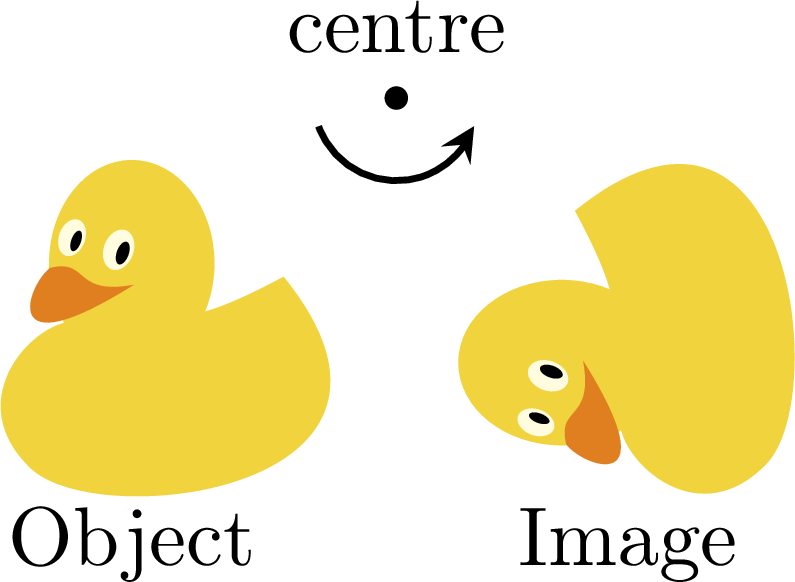
- Reflection (a flip): Flips the shape across a line (called the line of reflection) to make a mirror image.

On this frieze, the same flag is repeated: each flag is obtained by sliding the previous one, without turning it and without flipping it over. 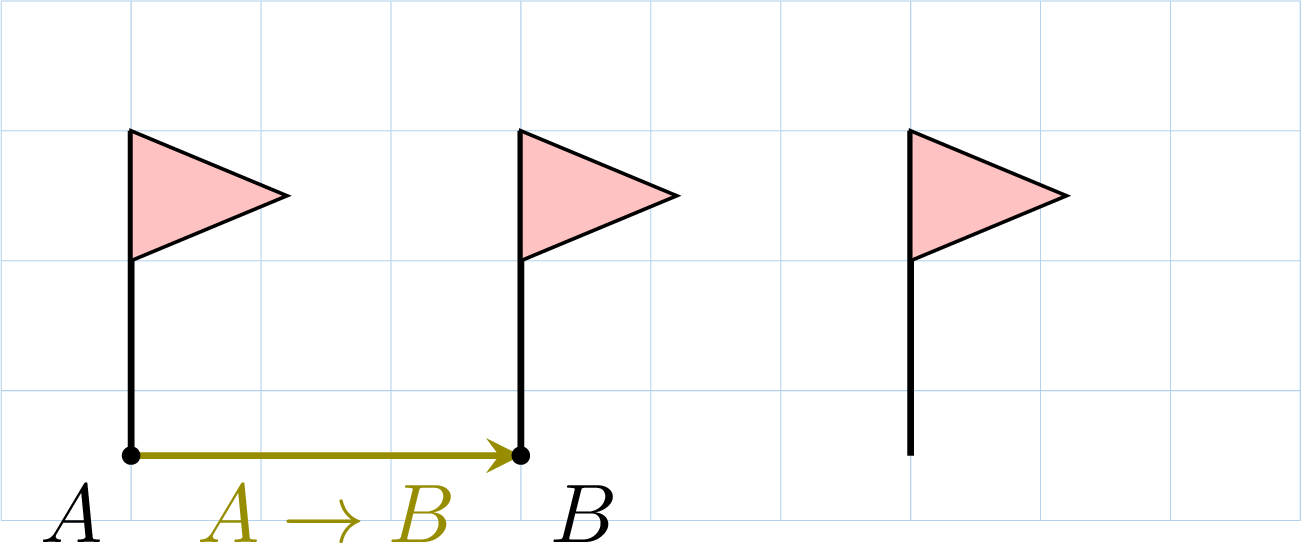
How can this slide be described precisely, so that anyone could place the next flag exactly?
It is enough to give one point \(A\) and its image \(B\): the slide is then completely known. Every point of the flag moves
- in the direction of the line \(\Line{AB}\),
- the way from \(A\) towards \(B\),
- by the length \(AB\) (here \(3\) squares to the right).
Definition — Translation that Maps A to B
Given two distinct points \(A\) and \(B\), the translation that maps \(A\) to \(B\) is the slide that takes \(A\) onto \(B\).The image \(M'\) of a point \(M\) is obtained by moving \(M\)
- in the direction of the line \(\Line{AB}\),
- the way from \(A\) towards \(B\),
- by the length \(AB\).
Example
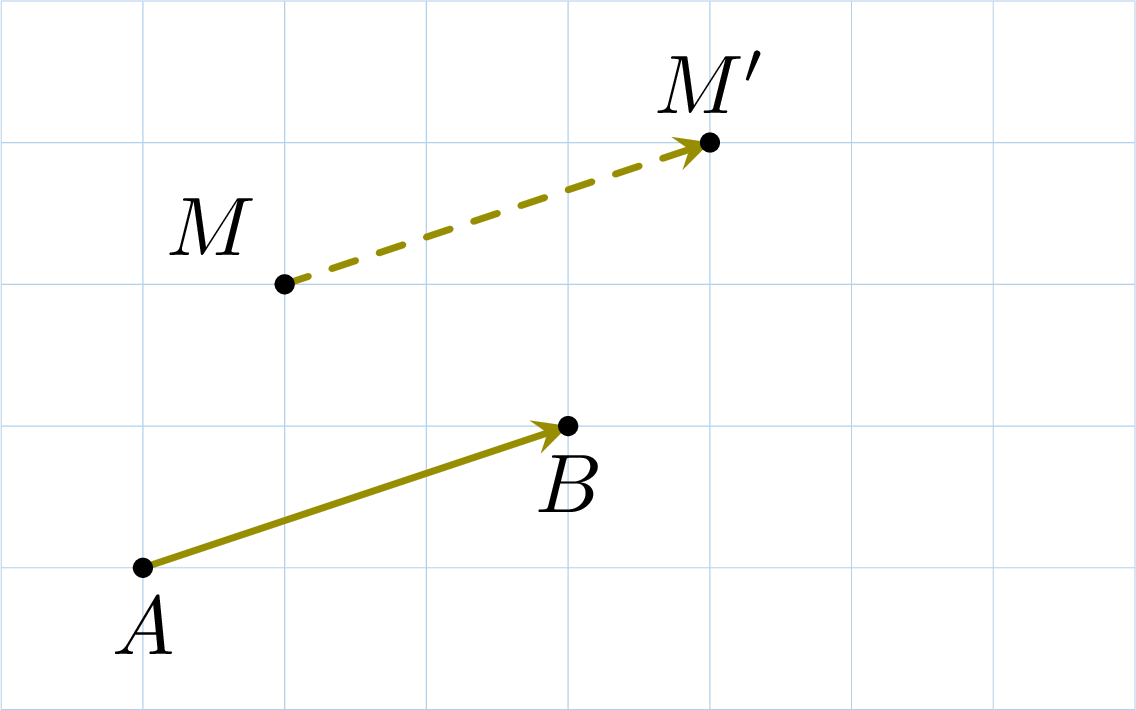
On the grid, place the image \(M'\) of the point \(M\) under the translation that maps \(A\) to \(B\), then give its coordinates. 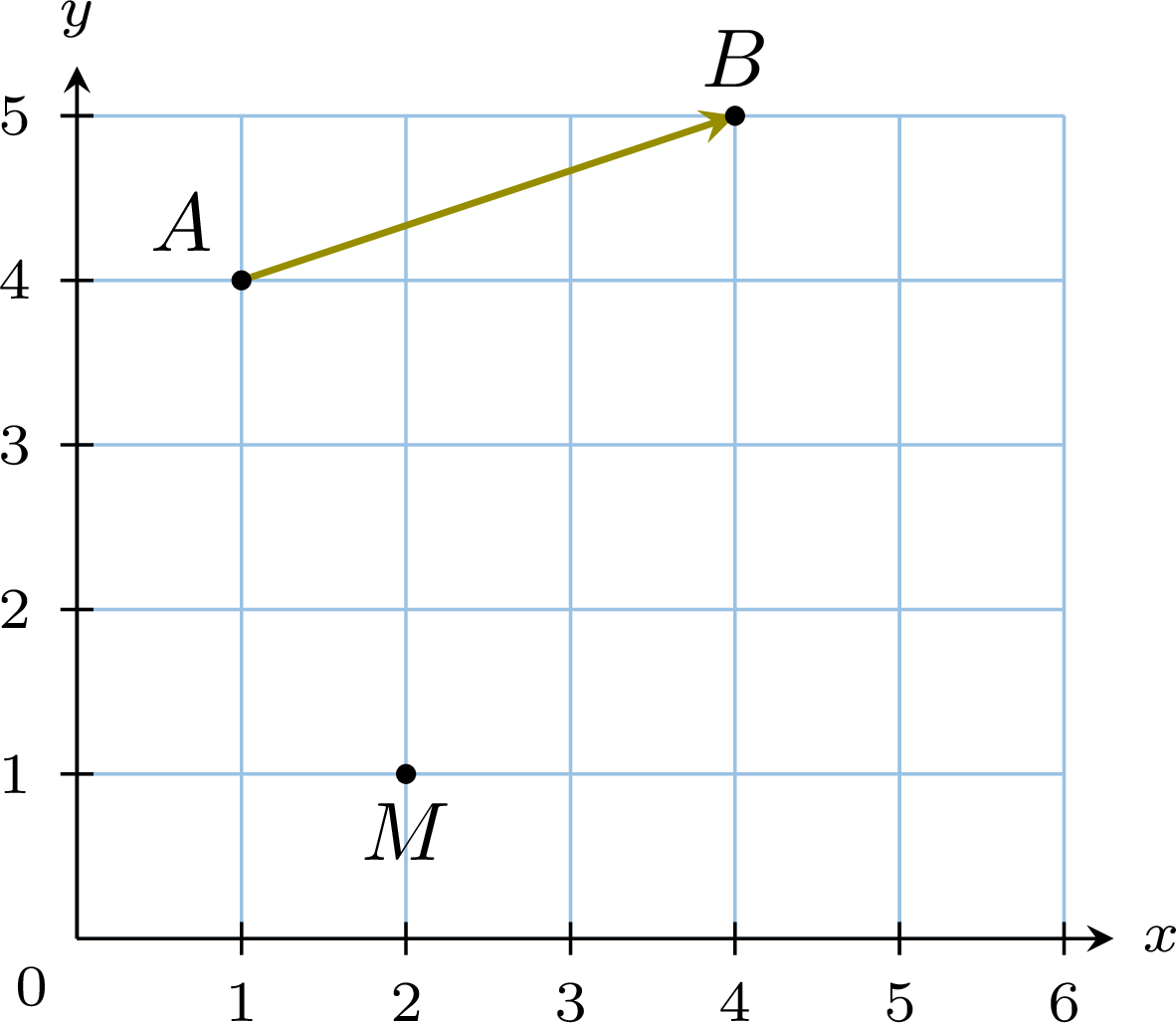
To go from \(A\) to \(B\): \(\textcolor{colordef}{3}\) squares to the right and \(\textcolor{colorprop}{1}\) square up. The point \(M\) must make exactly the same moves: 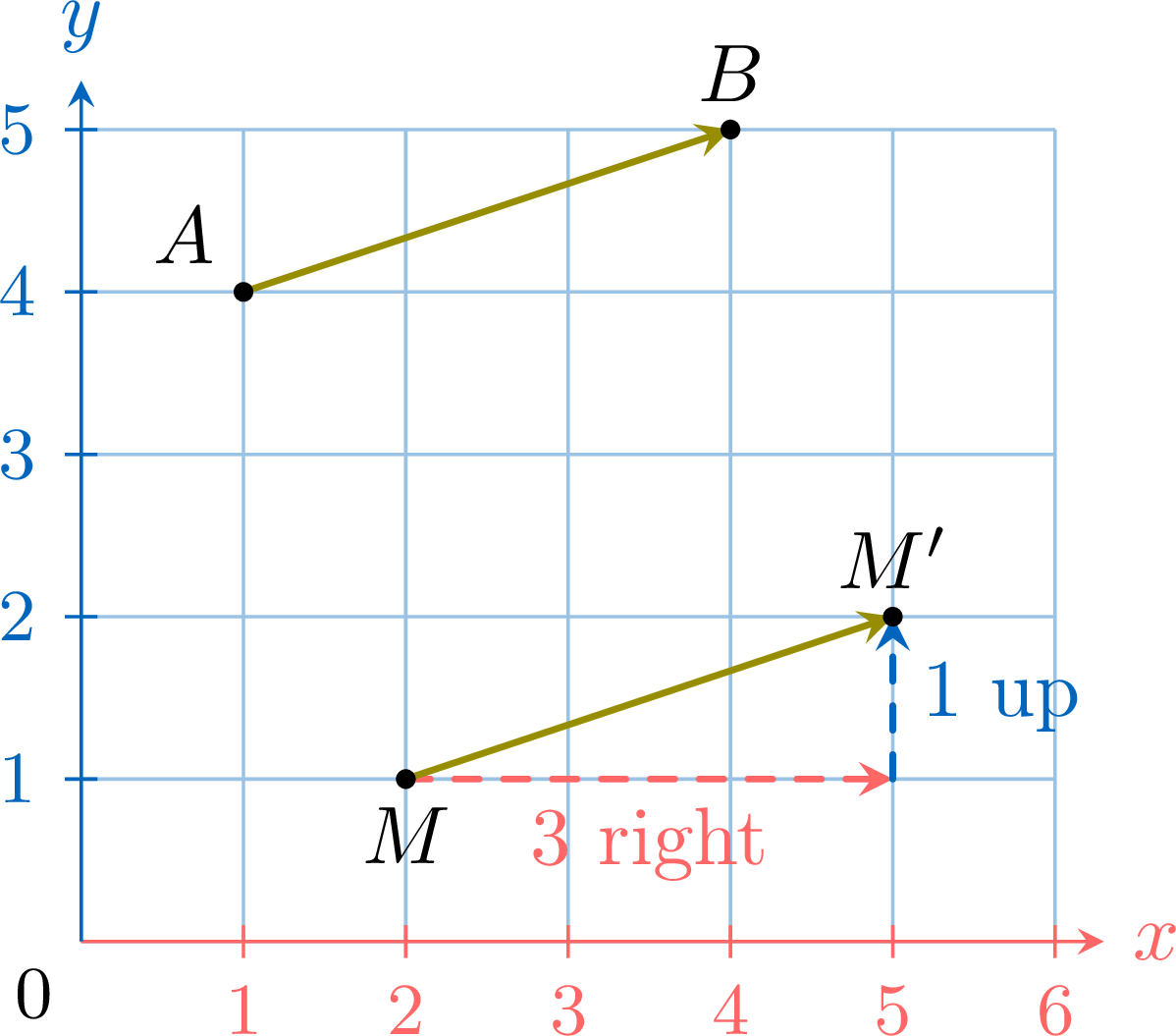
$$M'(\textcolor{colordef}{5}, \textcolor{colorprop}{2})$$
Skills to practice
- Recognising Translations
- Finding the Coordinates of Images
II
Reflections
II.1
The Reflection of a Point and of a Figure
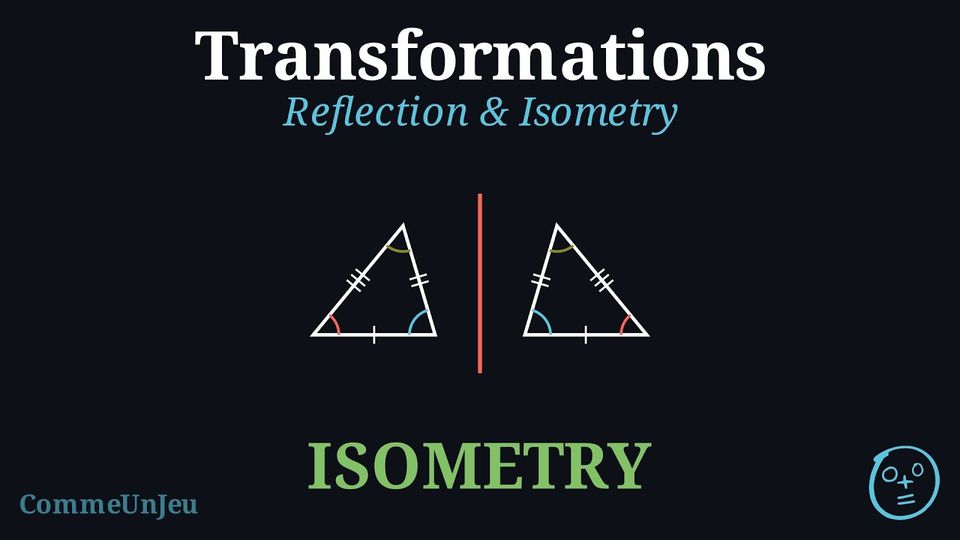
Imagine folding a piece of paper along the mirror line: the shape on one side of the fold lands exactly on its image on the other side.
Definition — Midpoint of a Line Segment
The midpoint of a line segment is a point that lies on the segment and divides it into two segments of equal length. For example, if \(I\) is the midpoint of segment \(\Segment{AB}\), then \(I\) is on the segment \(\Segment{AB}\) and \(AI = IB\). 
Definition — Perpendicular bisector
The perpendicular bisector of a line segment is the line that passes through the midpoint of the segment and is perpendicular to the segment. 
Definition — Reflection of a Point
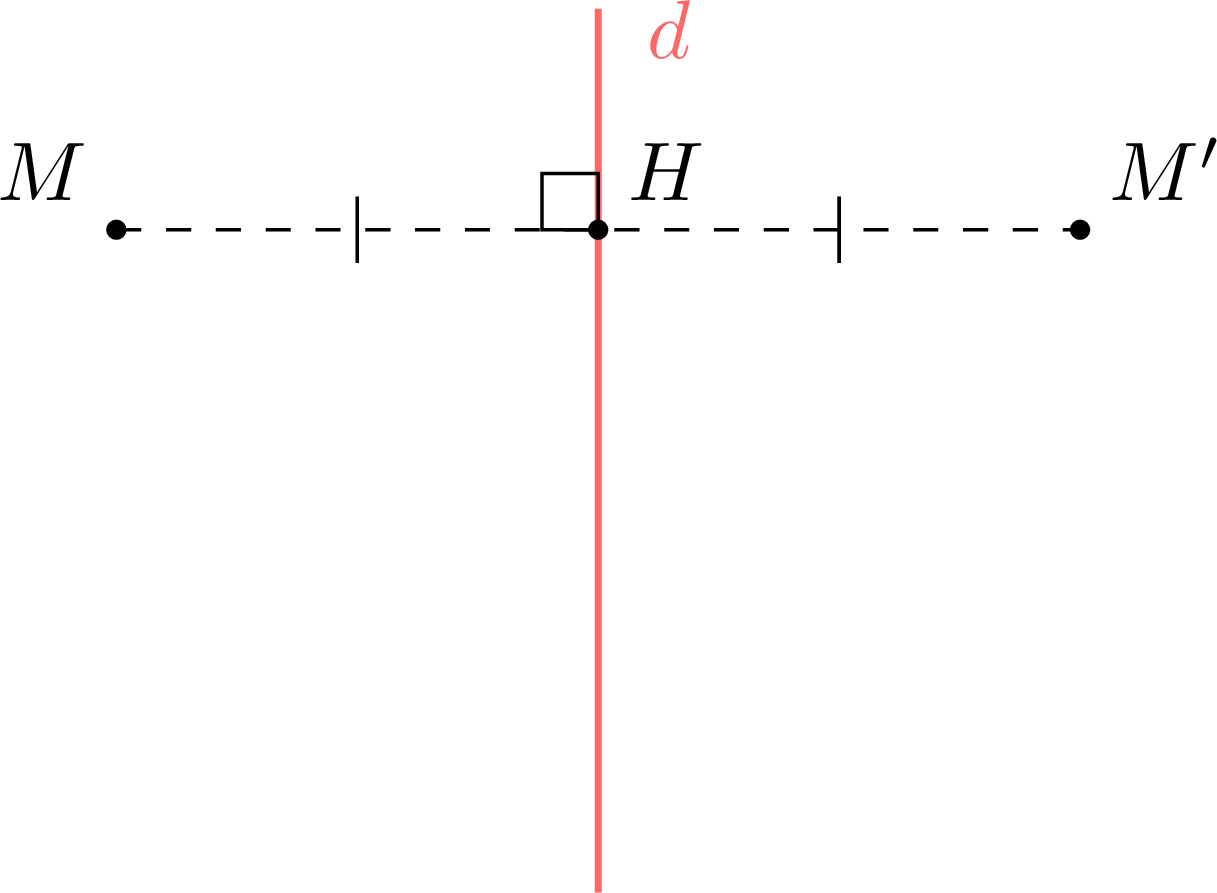
The reflection of point \(M\) over line \(l\) is the point \(M'\) such that line \(l\) is the perpendicular bisector of the segment \(\Segment{MM'}\). (If \(M\) is on \(l\), its image is \(M\) itself.) 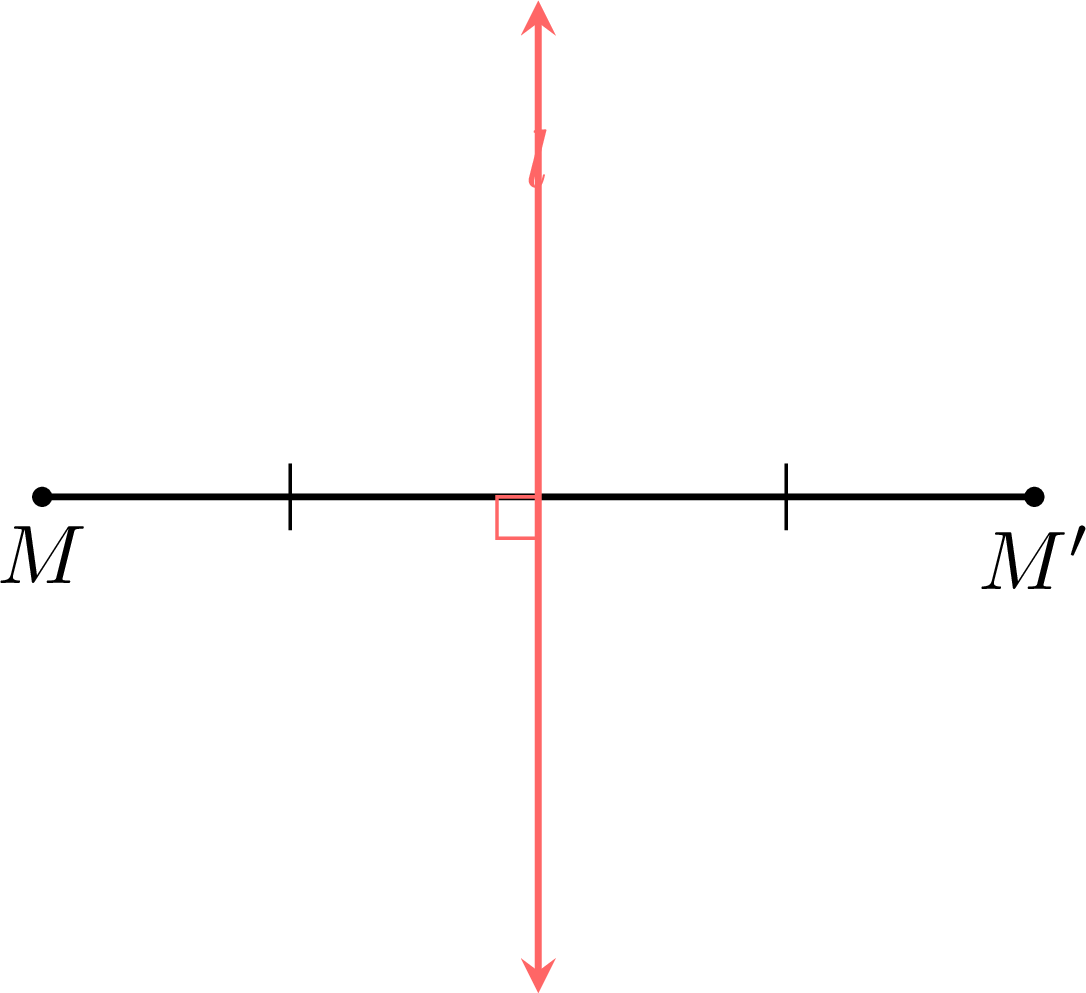
Definition — Reflection
The reflection of an object over line \(l\) flips all its points, creating a mirror image of the object. 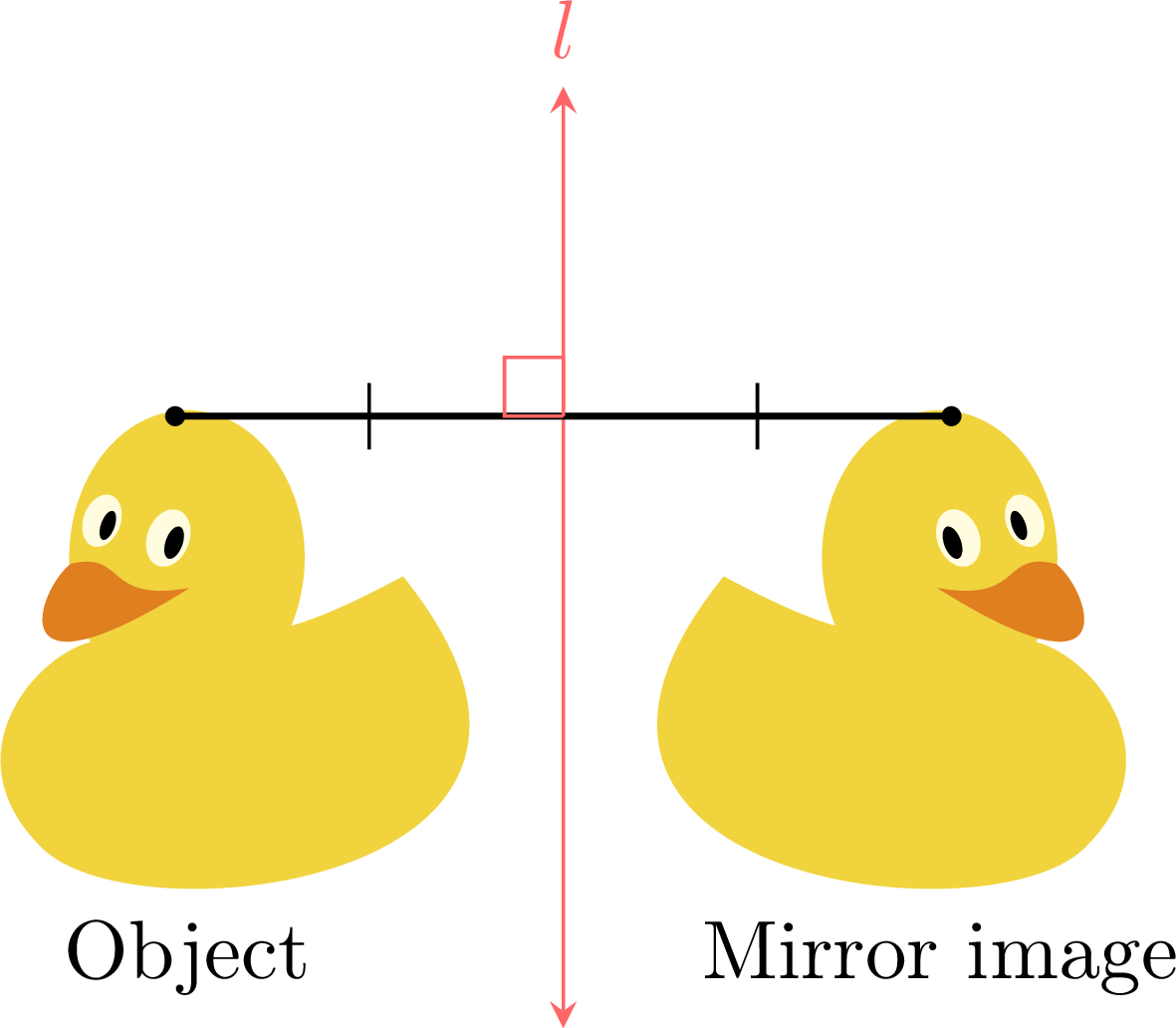
Method — Constructing the Reflection of a Point
On squared paper the squares are counted. On plain paper there is nothing to count, so the two properties of the mirror line are used instead: it is perpendicular to \(\Segment{MM'}\) and it cuts it at its middle. With the set square and the ruler - Place one edge of the set square along the mirror line \(d\) and slide it until the other edge passes through \(M\); draw that perpendicular. It cuts \(d\) at a point \(H\).
- Measure \(MH\) with the ruler.
- Carry the same length beyond \(H\), on the perpendicular: the point obtained is \(M'\). (If \(M\) is on \(d\), then \(H = M\) and \(M' = M\).)
Skills to practice
- Identifying Reflections
- Finding the Image of a Point
- Finding the Line
- Reflecting a Shape in an Axis of the Coordinate Plane
II.2
What a Reflection Keeps
Definition — Isometry
A transformation is an isometry when it keeps every length and every angle unchanged. The object and its image are then congruent: one can be placed exactly on top of the other. Proposition — Reflection is an isometry
A reflection preserves all lengths and all angles: it is an isometry. The image figure has the same side lengths and the same angles as the object; it is flipped over the axis. 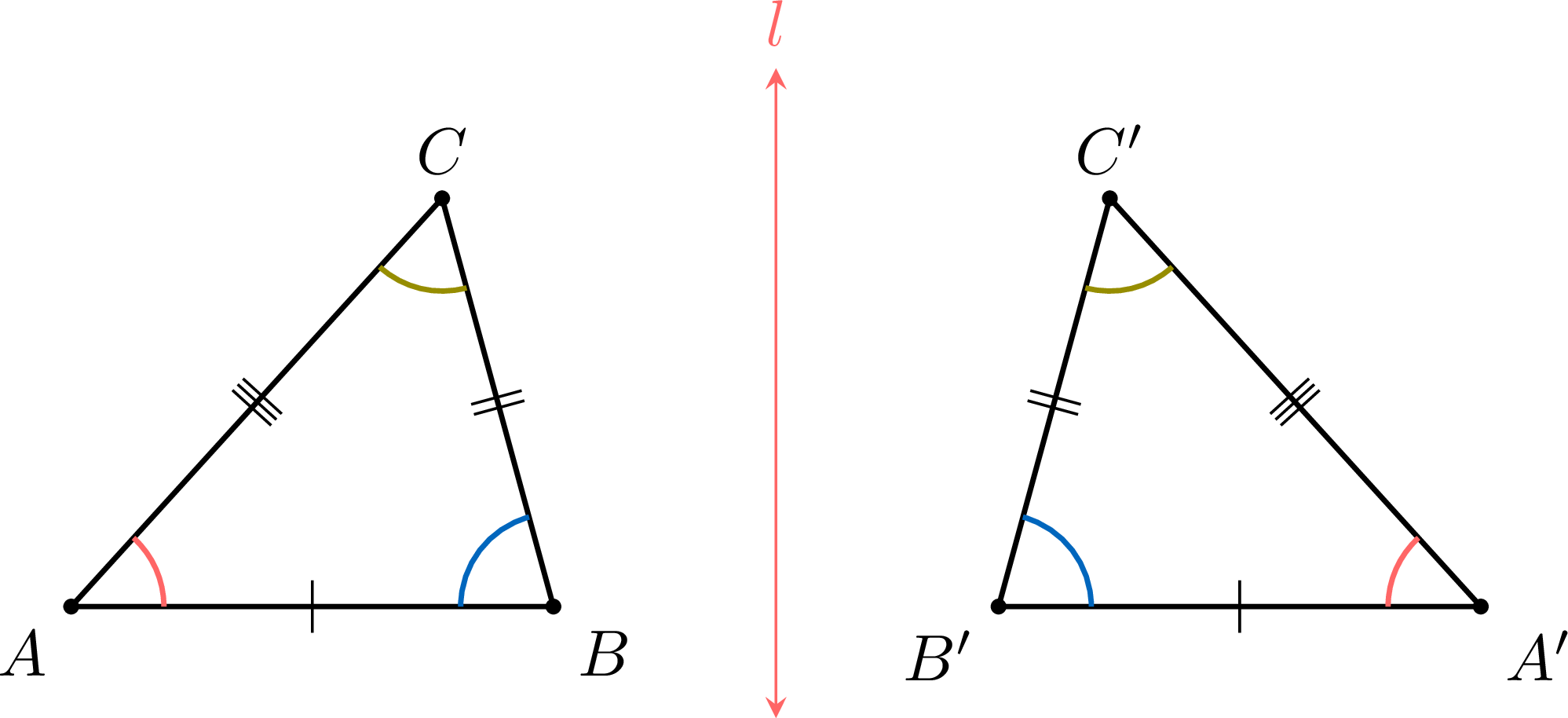
Proposition — Properties of a Reflection
Under the reflection in the line \(l\): - the image of a segment is a segment of the same length;
- the image of a line is a line, that of a ray a ray;
- the image of an angle is an angle of the same measure;
- the image of a circle is a circle of the same radius, whose centre is the image of the centre;
- points on a line have their images on a line.
Example
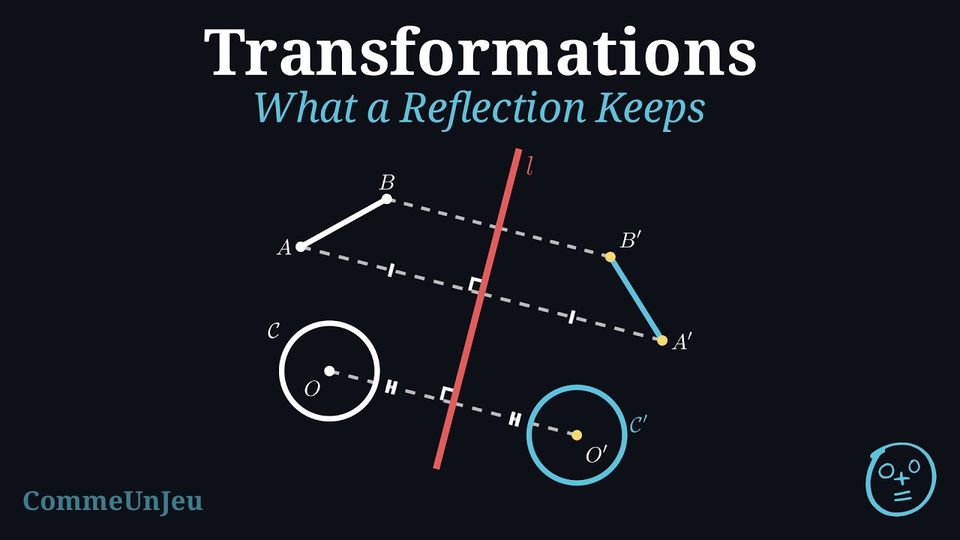
On plain paper, construct the image of the segment \(\Segment{AB}\) and the image of the circle \(\mathcal{C}\) with centre \(O\) and radius \(1\) cm under the reflection in the line \(l\). Which points have to be constructed? 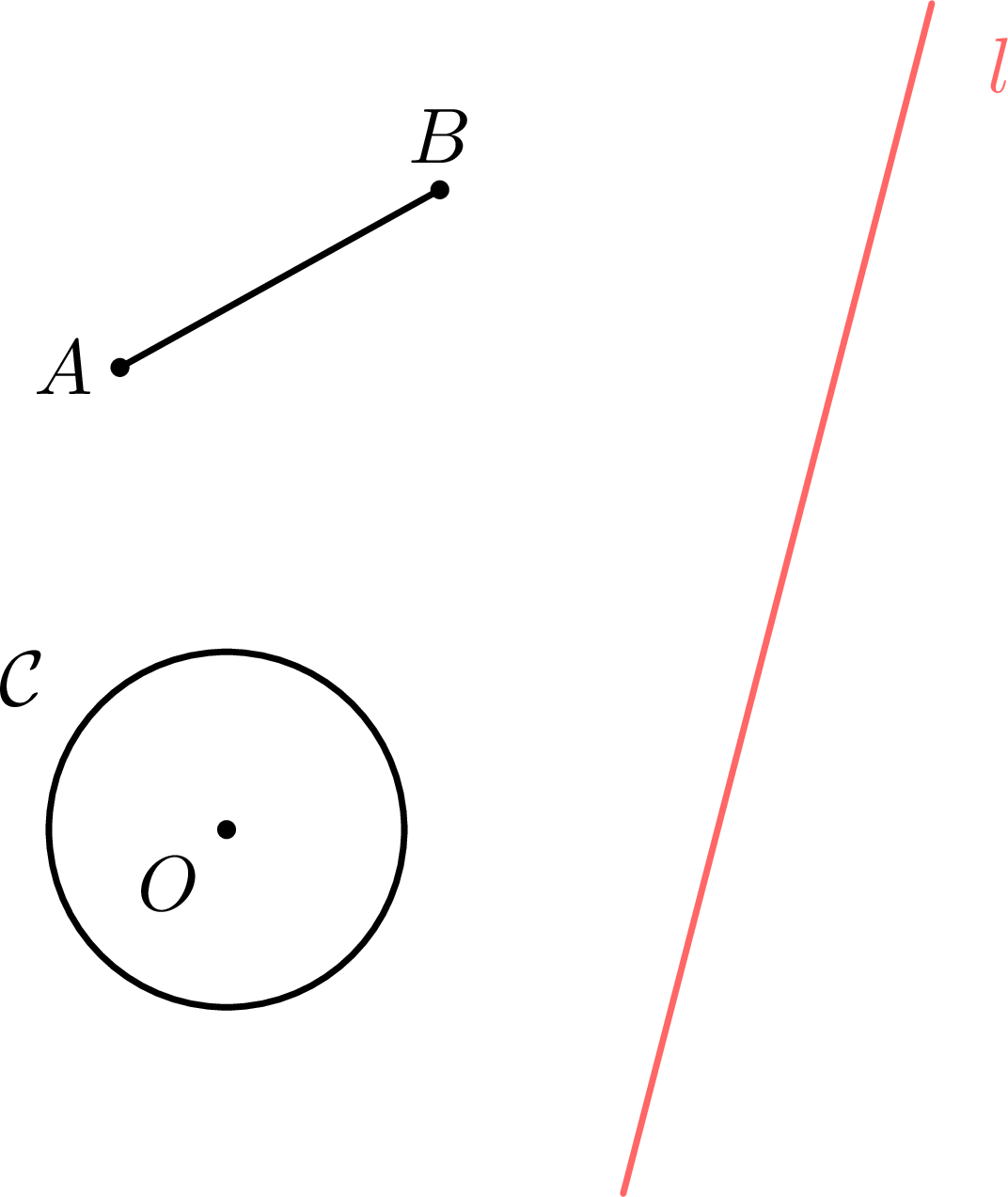
Only three points have to be constructed: the images of \(A\), \(B\) and \(O\). 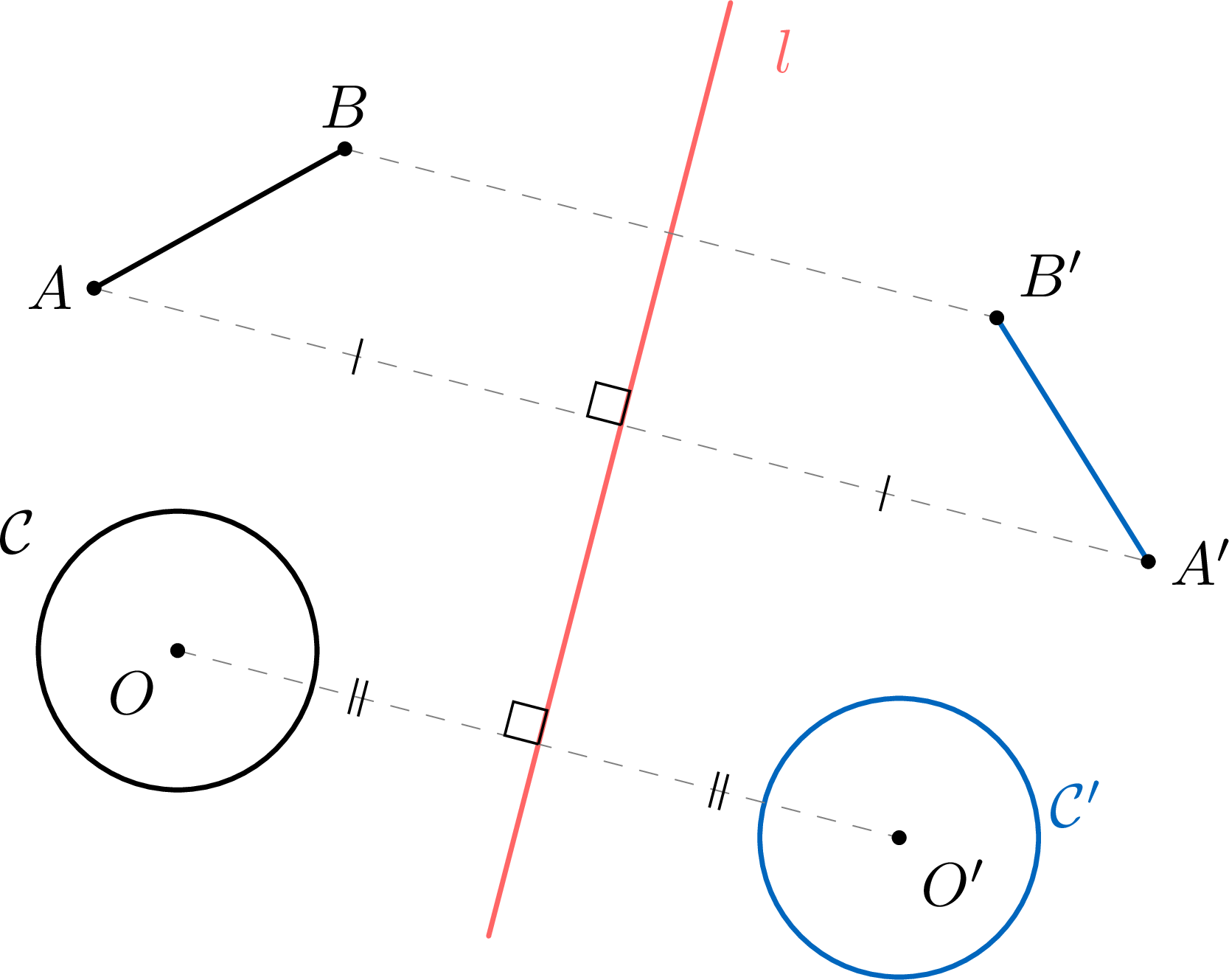
Nothing else needs to be constructed: the properties of the reflection finish the figure.
- The images \(A'\), \(B'\) and \(O'\) of \(A\), \(B\) and \(O\) are constructed one by one, with the set square and the ruler (or with the compass).
- The image of a segment is a segment of the same length: the image of \(\Segment{AB}\) is the segment \(\Segment{A'B'}\), drawn with the ruler. Then \(A'B' = AB\).
- The image of a circle is a circle of the same radius, whose centre is the image of the centre: the compass is opened to \(1\) cm, its point is set on \(O'\), and the circle \(\mathcal{C}'\) is drawn.
Skills to practice
- Using the Properties of a Reflection
III
Rotations
III.1
Rotations of 90° and 180°
Juliette is on a swing. As she swings back and forth, she always stays the same distance from the attachment point. Her seat moves along part of a circle. 
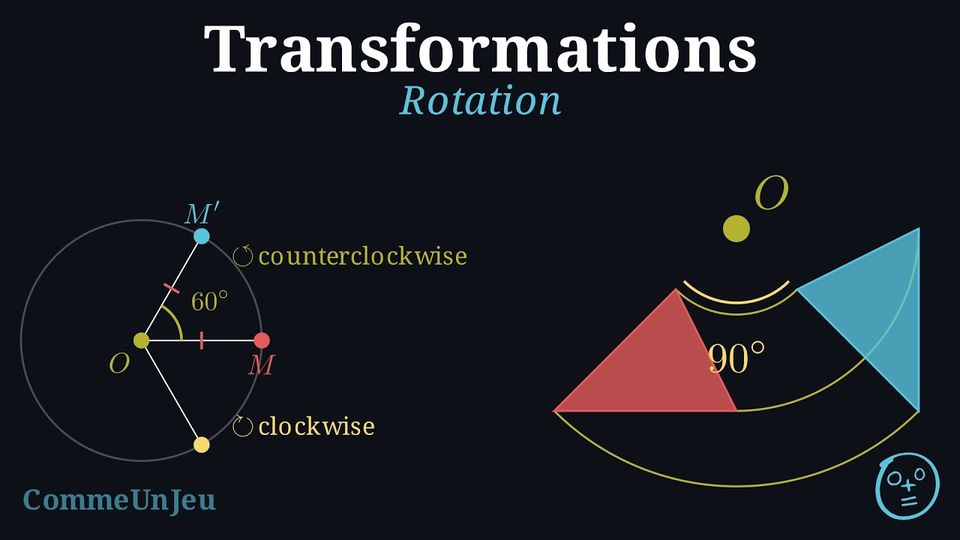
We say that Juliette is rotating about the attachment point, which is the centre of the rotation.
Definition — Rotation of a Point
A rotation of point \(M\) through an angle \(a^{\circ}\) about centre \(O\), in a given direction, gives the point \(M'\) with \(OM'=OM\) such that turning the segment \(\Segment{OM}\) about \(O\) through \(a^{\circ}\) in that direction brings it onto the segment \(\Segment{OM'}\). The centre \(O\) is its own image.The direction is always given: clockwise \(\curvearrowright\) or anticlockwise \(\curvearrowleft\).

Definition — Rotation
A rotation of an object through an angle \(a^{\circ}\) about centre \(O\) is the rotation of all its points through the same angle around \(O\). The object keeps the same size and shape; only its position changes. 
Proposition — Properties of a Rotation
A rotation preserves lengths, angles and areas: a figure and its image are congruent (they have the same shape and the same size, only their position changes). The image of a segment is a segment of the same length, the image of a line is a line, the image of a circle is a circle of the same radius.A transformation that preserves lengths is called an isometry: rotations, reflections, half-turns (point reflections) and translations are isometries.
Skills to practice
- Finding the Image of a Point under a 90° Rotation
- Finding the Image of a Point under a 180° Rotation
- Drawing Images of Figures
IV
Combining Transformations
IV.1
Applying One Transformation after Another
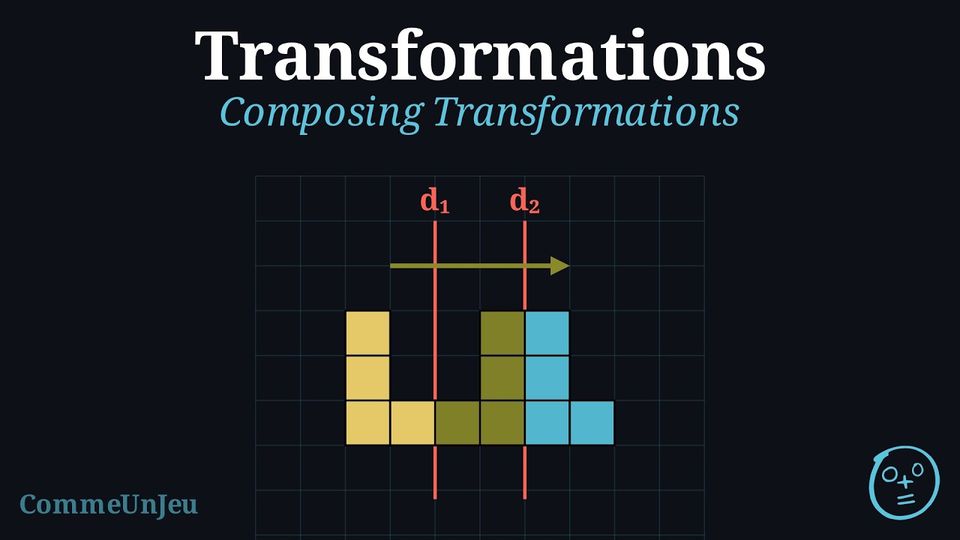
Applying one transformation and then another is called composing them. The result is often a single, simpler transformation.
Proposition — Composing Two Reflections
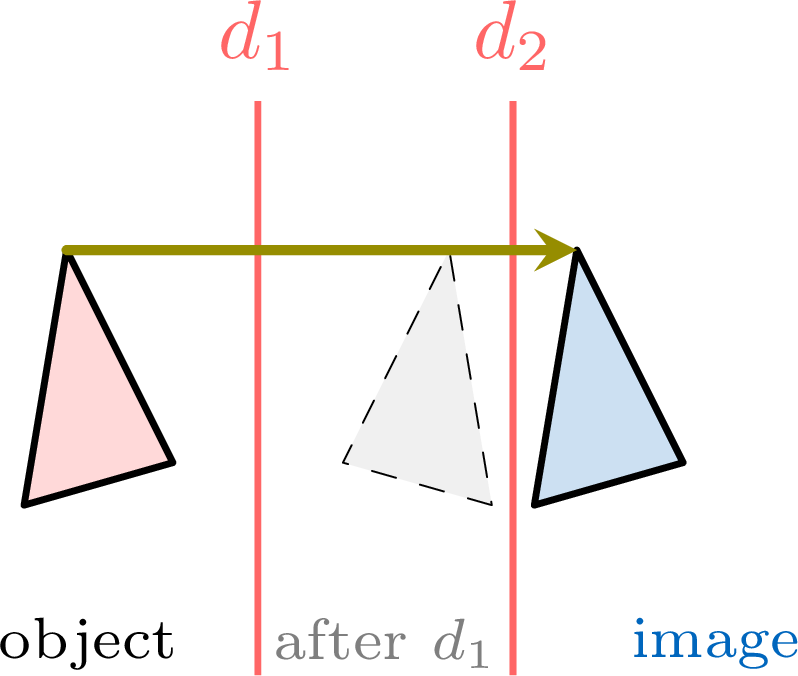
Reflecting a figure over one line and then over a second line gives an isometry of a familiar kind: - if the two lines are parallel, the result is a translation: its direction is perpendicular to the two lines, it goes from \(d_1\) towards \(d_2\), and its length is twice the distance between them;
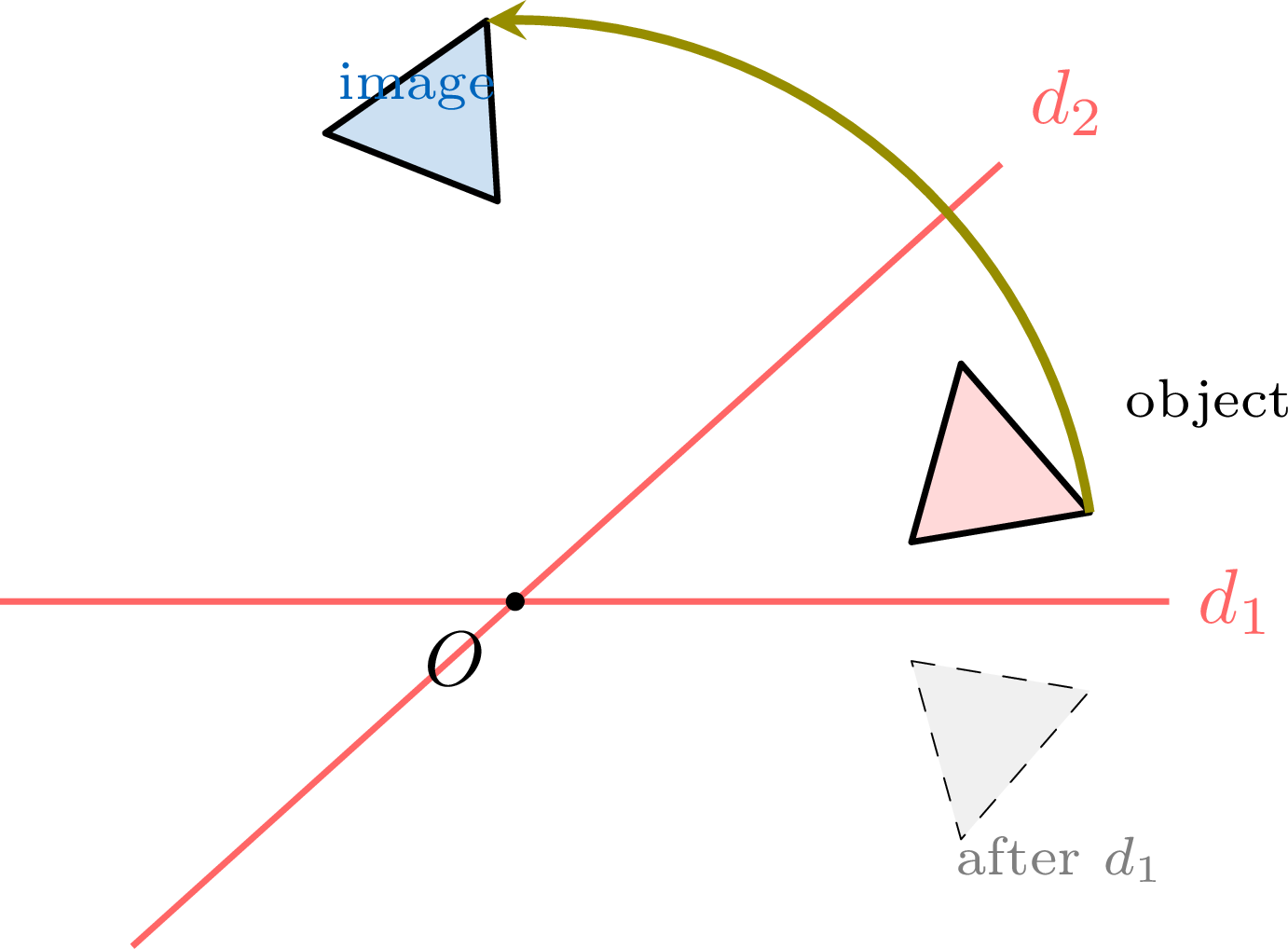
- if the two lines intersect, the result is a rotation about their crossing point \(O\).
Example
The lines \(d_1\) and \(d_2\) are parallel to the \(y\)-axis. Find the coordinates of the images \(A'\) and \(B'\) of the points \(A\) and \(B\) under the reflection in \(d_1\) followed by the reflection in \(d_2\). 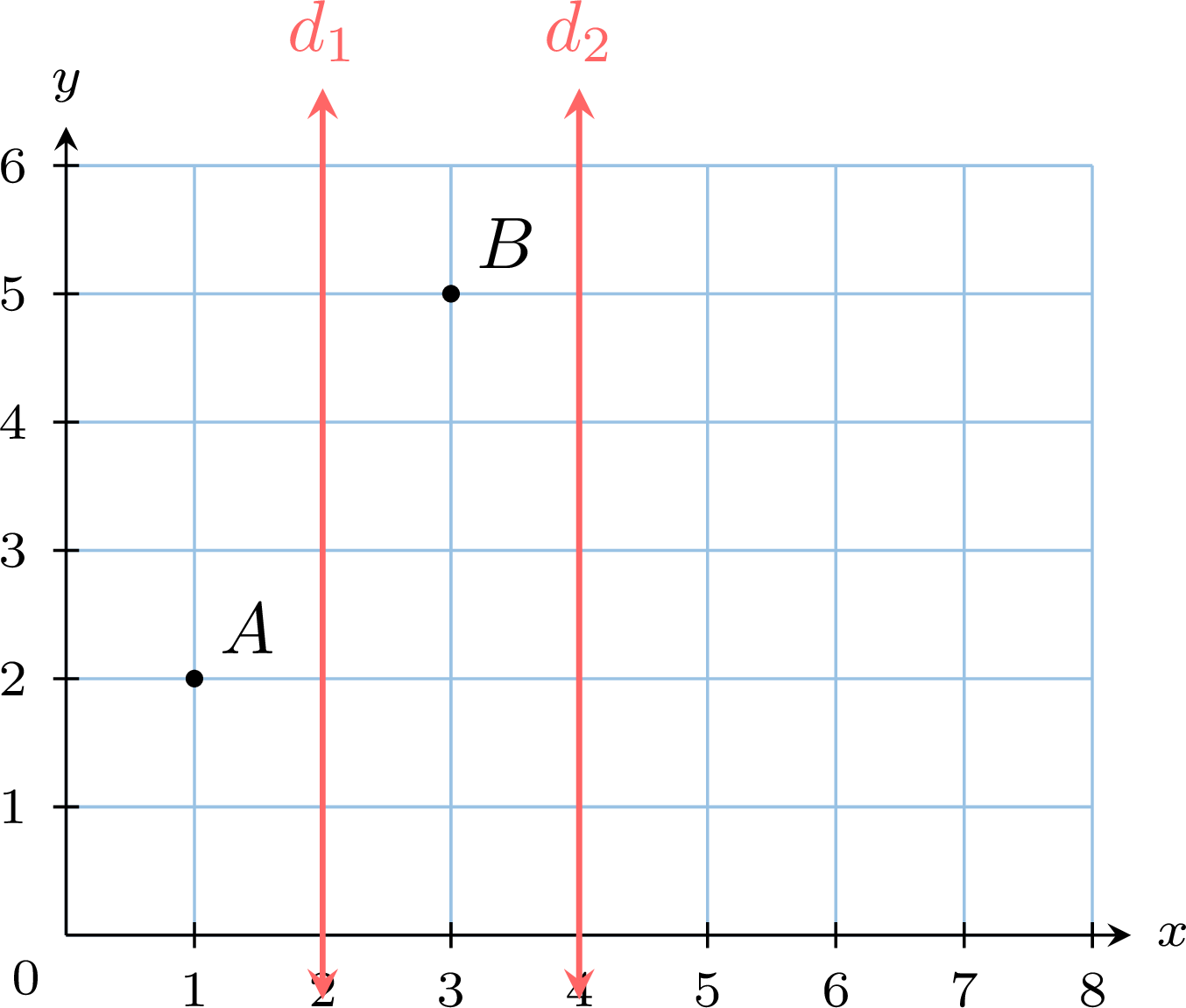
A reflection in a line parallel to the \(y\)-axis keeps the \(y\)-coordinate and puts the image on the other side of the line, at the same distance. Each point is treated one step at a time. The point \(A\). \(A(1,2)\) is \(1\) unit to the left of \(d_1\), so its image is \(1\) unit to the right of \(d_1\): \(A_1(3,2)\). Then \(A_1\) is \(1\) unit to the left of \(d_2\), so its image is \(1\) unit to the right of \(d_2\): \(A'(5,2)\). The point \(B\). \(B(3,5)\) is \(1\) unit to the right of \(d_1\), so \(B_1(1,5)\). Then \(B_1\) is \(3\) units to the left of \(d_2\), so \(B'(7,5)\). 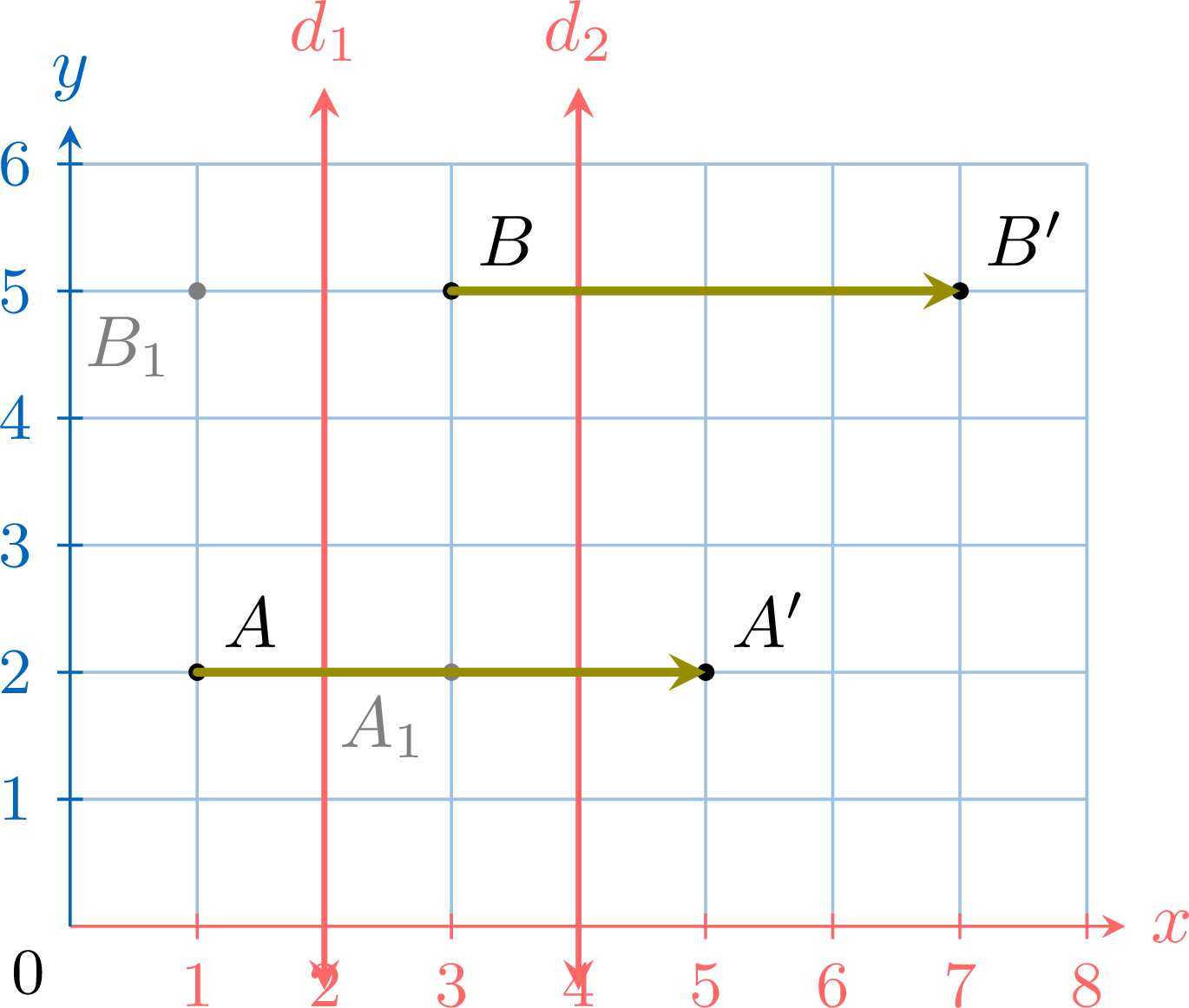
Both points have moved \(4\) units to the right: the composition is the translation announced by the proposition. Its length agrees with the proposition too, since \(d_1\) and \(d_2\) are \(2\) units apart and \(2 \times 2 = 4\).
Skills to practice
- Recognising the Resulting Transformation
- Combining Transformations on a Grid
- Finding the Image of a Point after Two Reflections
V
Going further
Skills to practice
- Solving Problems with Transformations
- Chaining Two Transformations
- Quiz
Jump to section