International Baccalaureate · MYP 1
Number Properties
I
Zero and One
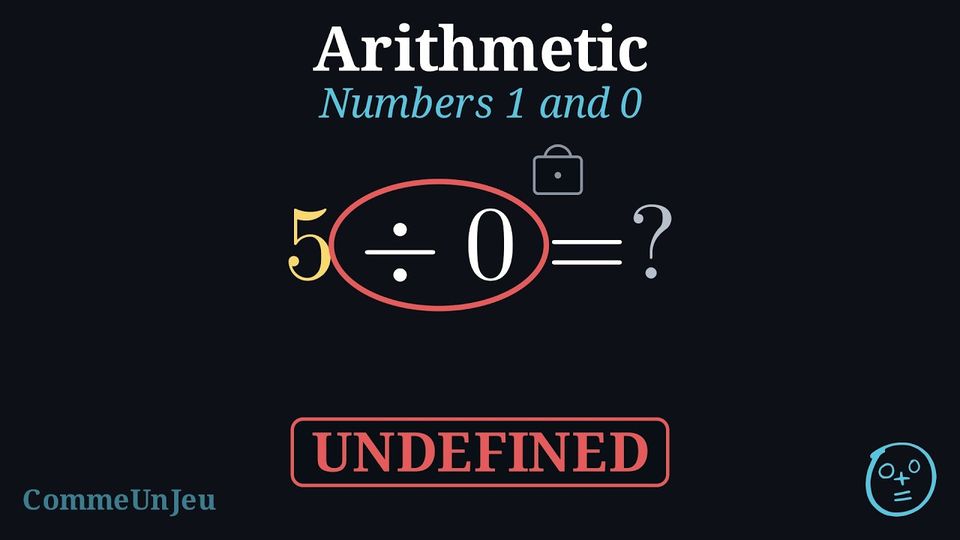
Zero \((0)\) and one \((1)\) are numbers with specific properties.
Proposition — Additive Identity Property
Adding \(0\) to any number results in the number itself.For any number \(a\), $$0 + a = a \quad \text{and} \quad a + 0 = a.$$
Example
\(7 + 0 = 7\) Proposition — Multiplicative Identity Property
Multiplying any number by \(1\) results in the number itself.For any number \(a\), $$1 \times a = a \quad \text{and} \quad a \times 1 = a.$$
Example
\(1 \times 7 = 7\) - Multiplying by \(0\):
- Any number multiplied by \(0\) always results in \(0\).
- For example, \(5 \times 0 = 0 + 0 + 0 + 0 + 0 = 0\).
- Dividing by \(0\):
- Dividing a non-zero number by \(0\) leads to a contradiction.
- For example, if we assume \(a = 5 \div 0\), then \(a \times 0 = 5\). But this is impossible because \(a \times 0\) is always \(0\), not \(5\).
- The case \(0 \div 0\) is different: there is no contradiction, since \(a \times 0 = 0\) holds for every number \(a\) — but then no number stands out, there is no unique quotient. Either way, dividing by \(0\) makes no sense.
Proposition — Multiplying by \(0\)
For any number \(a\), $$a \times 0 = 0 \quad \text{and} \quad 0 \times a = 0.$$ Proposition — Dividing by \(0\)
For any number \(a\), the division \(a \div 0\) is undefined. Skills to practice
- Applying the Properties of 0 and 1
II
The Tests for 4 and 6
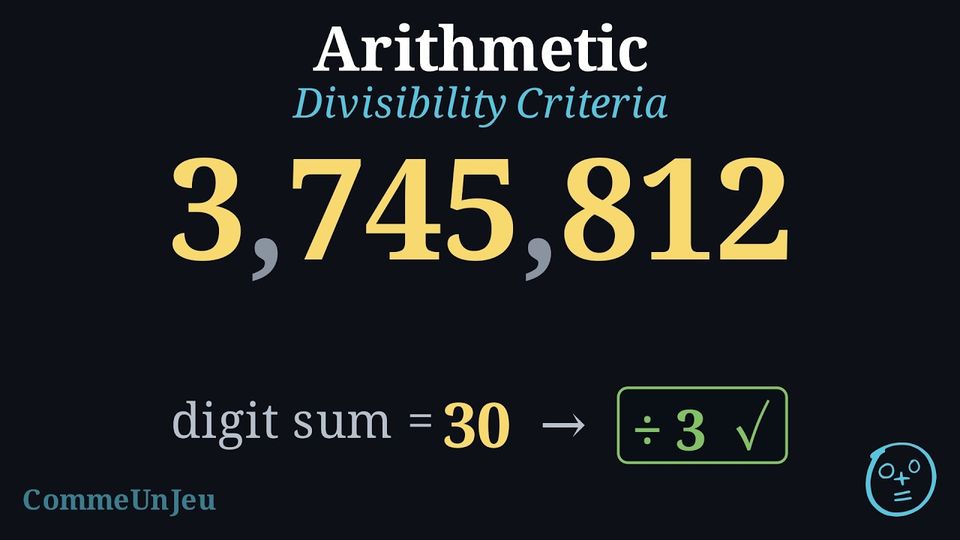
Proposition — Divisibility Tests for 3 and 9
- A whole number is divisible by \(3\) exactly when the sum of its digits is divisible by \(3\).
- A whole number is divisible by \(9\) exactly when the sum of its digits is divisible by \(9\).
Proposition — Divisibility Criterion for 4
A whole number is divisible by \(4\) exactly when the number formed by its last two digits is divisible by \(4\) (for a number with a single digit, this is the number itself). Example
Determine whether \(917\) is divisible by \(4\), then whether \(1\,316\) is.
\(917\) is not divisible by \(4\) because the number formed by its last two digits, \(17\), is not divisible by \(4\) (\(17 = 4 \times 4 + 1\)). \(1\,316\) is divisible by \(4\) because the number formed by its last two digits, \(16\), is divisible by \(4\) (\(16 = 4 \times 4\)). Check: \(1\,316 = 4 \times 329\).
Proposition — Divisibility Criterion for 6
A whole number is divisible by \(6\) exactly when it is divisible both by \(2\) and by \(3\). Indeed \(6 = 2 \times 3\): every multiple of \(6\) is even and a multiple of \(3\). The converse is accepted without proof: a number that is both even and a multiple of \(3\) is always a multiple of \(6\). Example
Determine whether \(8\,514\) is divisible by \(6\).
Both conditions must be checked.
- By \(2\): the last digit is \(4\), which is even — so \(8\,514\) is divisible by \(2\).
- By \(3\): the sum of the digits is \(8 + 5 + 1 + 4 = 18\), a multiple of \(3\) — so \(8\,514\) is divisible by \(3\).
Example
Determine whether \(2\,346\) is divisible by \(6\), then whether \(2\,344\) is.
For \(2\,346\): the last digit \(6\) is even, and \(2 + 3 + 4 + 6 = 15\) is a multiple of \(3\). Both conditions hold, so \(2\,346\) is divisible by \(6\) (\(2\,346 = 6 \times 391\)). For \(2\,344\): the last digit \(4\) is even, but \(2 + 3 + 4 + 4 = 13\) is not a multiple of \(3\). One condition failing is enough: \(2\,344\) is not divisible by \(6\).
Skills to practice
- Determining Divisibility by 4
- Determining Divisibility by 6
- Applying the Tests for 4 and 6
III
Factors and Factor Pairs
Definition — Divisibility Relationships
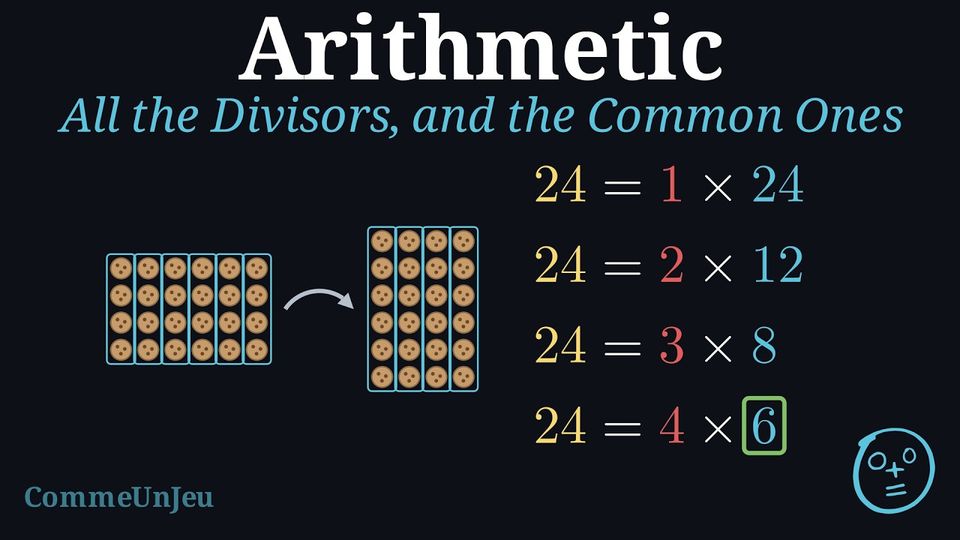
We say that a non-zero natural number \(b\) divides a natural number \(a\) if \(a\) can be obtained by multiplying \(b\) by a natural number \(k\): $$ a = k \times b $$ In other words, the number \(a\) appears in the multiplication table of \(b\).We can also use the following formulations:
- \(b\) is a divisor of \(a\)
- \(b\) is a factor of \(a\)
- \(a\) is divisible by \(b\)
- \(a\) is a multiple of \(b\)
The numbers \(0\) and \(1\) play special roles in divisibility:
- \(1\) divides every whole number: \(n = n \times 1\);
- every non-zero whole number divides \(0\): \(0 = n \times 0\);
- this is why the definition requires \(b \neq 0\): dividing by \(0\) is never allowed.
Method — Finding All the Factors by Pairs
- Look for factors in pairs: for a non-zero whole number \(n\), each factor \(d\) comes with its partner \(n \div d\).
- Start from \(1\) and test \(2, 3, 4, \dots\) in order, writing each pair found.
- Stop when the pairs cross: once the candidate \(d\) satisfies \(d \times d > n\), every positive factor has been found — beyond that point, each factor has already turned up as the partner of a smaller one. If a pair has two equal members (\(d \times d = n\)), that factor counts only once.
Example
Find all the factors of \(60\).
Test the candidates in order, in pairs: $$1 \times 60 \qquad 2 \times 30 \qquad 3 \times 20 \qquad 4 \times 15 \qquad 5 \times 12 \qquad 6 \times 10$$ The candidate \(7\) does not divide \(60\) (\(60 = 7 \times 8 + 4\)). The next candidate is \(8\), and \(8 \times 8 = 64 > 60\): stop, the pairs have crossed. $$\text{Factors of } 60: \; 1, 2, 3, 4, 5, 6, 10, 12, 15, 20, 30, 60 \quad (\text{12 factors}).$$
Skills to practice
- Recognising All the Factors of a Number
- Listing All the Factors by Pairs
IV
Testing Whether a Number Is Prime
Definition — Prime Number
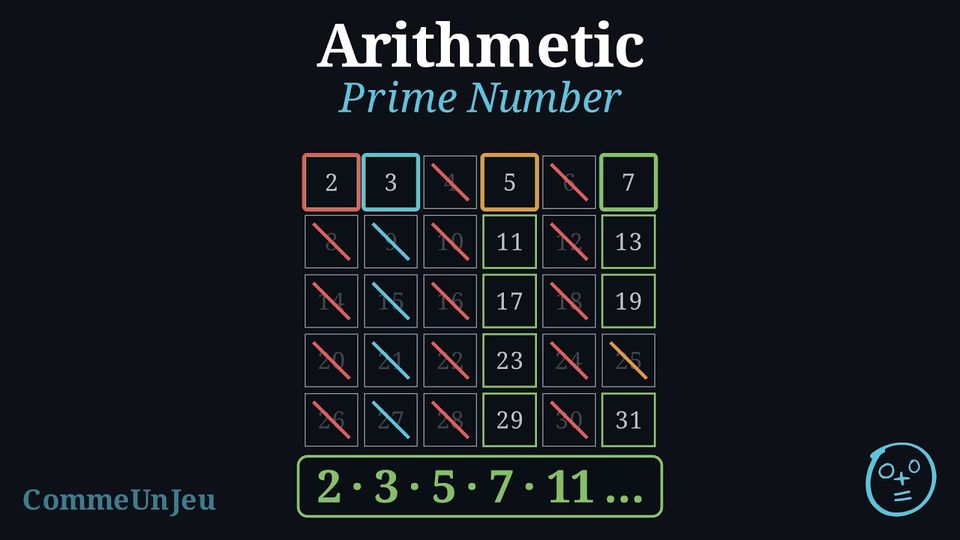
A prime number is a whole number greater than \(1\) that has exactly two different divisors: \(1\) and itself.A whole number greater than \(1\) that is not prime is called a composite number.
Method — Testing whether a Number is Prime
To decide whether a whole number \(n\) greater than \(1\) is prime: - Check the quick criteria: if \(n\) is even, or if its digit sum is a multiple of \(3\), or if it ends in \(0\) or \(5\), then \(n\) is composite (unless \(n\) is \(2\), \(3\) or \(5\) itself).
- Otherwise, test the next prime numbers one after the other (\(7\), \(11\), \(13\), …): divide \(n\) by each one.
- Stop as soon as the prime \(p\) to test satisfies \(p \times p > n\): if no prime before that point divides \(n\), then \(n\) is prime. Indeed, if \(n\) is composite it can be written \(n = a \times b\) with \(1 < a \leq b\), so \(a \times a \leq n\). And the smallest divisor of \(n\) above \(1\) is necessarily prime: were it not, it would itself have a smaller divisor, which would divide \(n\). So a composite number always has a prime factor \(p\) with \(p \times p \leq n\).
Example
Is \(101\) a prime number?
\(101\) is odd, its digit sum \(1 + 0 + 1 = 2\) is not a multiple of \(3\), and it does not end in \(0\) or \(5\): neither \(2\), \(3\) nor \(5\) divides it. Testing the next primes: \(101 = 7 \times 14 + 3\), so \(7\) does not divide it. The next prime is \(11\), and \(11 \times 11 = 121 > 101\): we stop. No prime up to the stopping point divides \(101\): the number \(101\) is prime.
Skills to practice
- Deciding Whether a Number Is Prime
V
The Highest Common Factor
Definition — Common Divisor
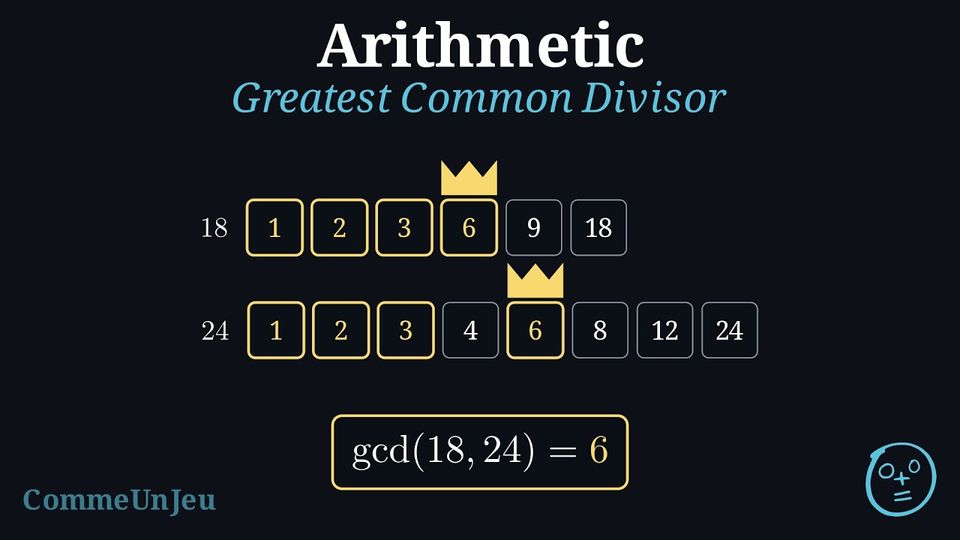
A number is a common divisor of two numbers when it divides both. To find them all: write the divisors of the first number, write those of the second, and keep the ones that appear in both lists. Definition — Highest Common Factor (HCF)
The highest common factor (HCF) of two (or more) whole numbers, not all zero, is the largest positive whole number that is a factor of each of them (it divides each of them exactly, with remainder \(0\)). It is also called the greatest common divisor (GCD). We usually write the HCF of \(a\) and \(b\) as \(\operatorname{HCF}(a, b)\).
Example
Find the HCF of \(18\) and \(24\). - The factors of \(18\) are: \(1, 2, 3, \textcolor{olive}{6}, 9, 18\).
- The factors of \(24\) are: \(1, 2, 3, 4, \textcolor{olive}{6}, 8, 12, 24\).
- The highest common factor is \(\textcolor{olive}{6}\), so \(\operatorname{HCF}(18, 24) = 6\).
Skills to practice
- Finding the Highest Common Factor by Listing
- Solving Real-Life Problems with the Highest Common Factor
VI
Going further
Skills to practice
- Investigating Patterns in Divisibility
- Solving Problems with Factors and Multiples
- Quiz
Jump to section