International Baccalaureate · MYP 1
Lines and Angles
I
Points and Lines
I.1
Naming Points and Lines; Collinear Points
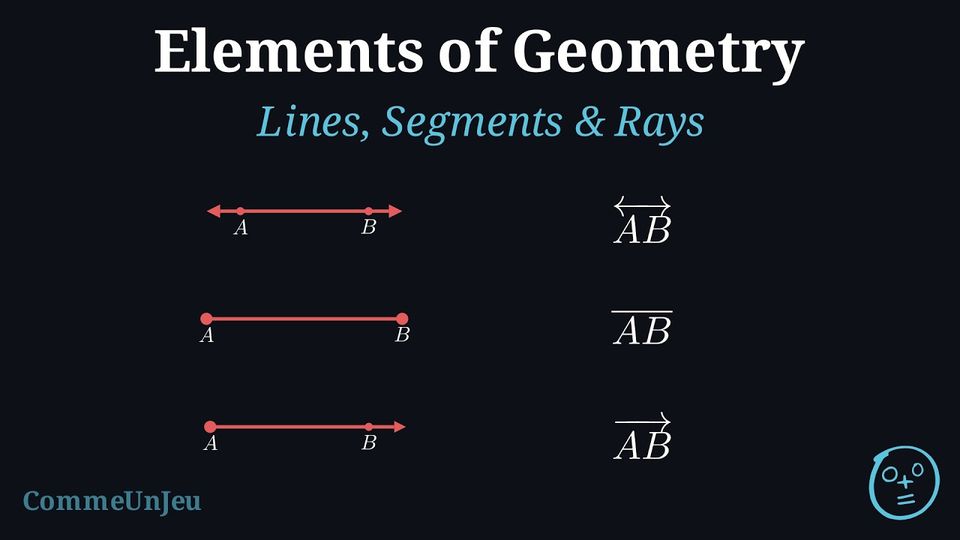
Geometry studies position and shape in space. It is built from a few primitive objects — first the point, then the line — that are so simple we can only draw and describe them, not build them from anything smaller. From these we form every figure, and we learn to name them, to mark how they relate, to construct them, and to reason about them: in geometry we describe positions and relations, more than we measure.
Every geometric figure is a set of points. A line is an endless set of points in a row; a segment is the set of all the points between its two ends. To study a figure is to study which points belong to it, and how figures relate to one another — whether two lines cross, run parallel, or (later) meet at a right angle. These relations are shown by marking and constructing the figure, and later by reasoning about it.
Definition — Point
A point shows an exact position in space. We draw a point as a small dot. 
Definition — Point Notation
We usually name a point with a capital letter, such as \(A\). 
Definition — Line Notation
- A line can be named with a lowercase letter, written as \(l\).
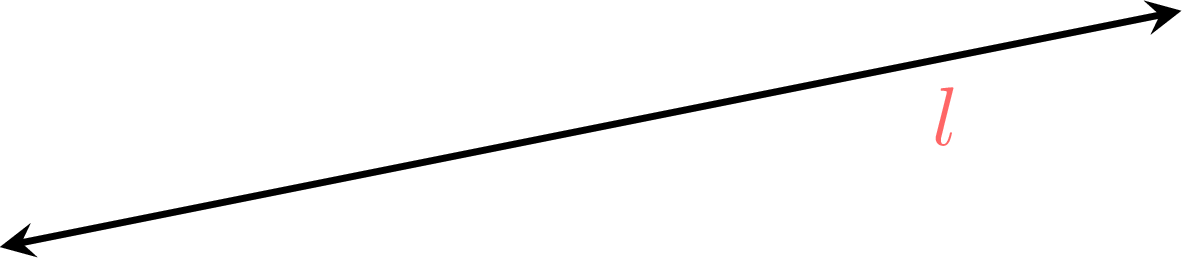
- A line is named using two points on it, written as \(\Line{AB}\).

Definition — Collinear Points
Collinear points are points that all lie on the same straight line. Skills to practice
- Recognising Collinear Points
- Placing Points on a Figure
I.2
Intersecting Lines
Definition — Intersection Point
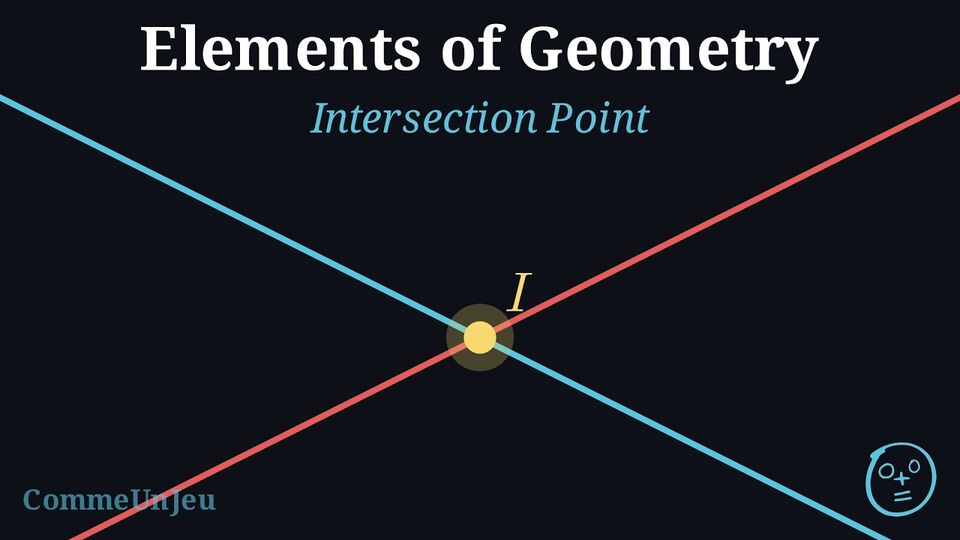
An intersection point is a point where two or more lines, segments, or rays cross each other. 
Example
Find the intersection point of the lines \(\Line{AB}\) and \(\Line{CD}\). 
The intersection point is \(I\).
Skills to practice
- Marking Intersection Points
I.3
Perpendicular Lines
Definition — Perpendicular Lines
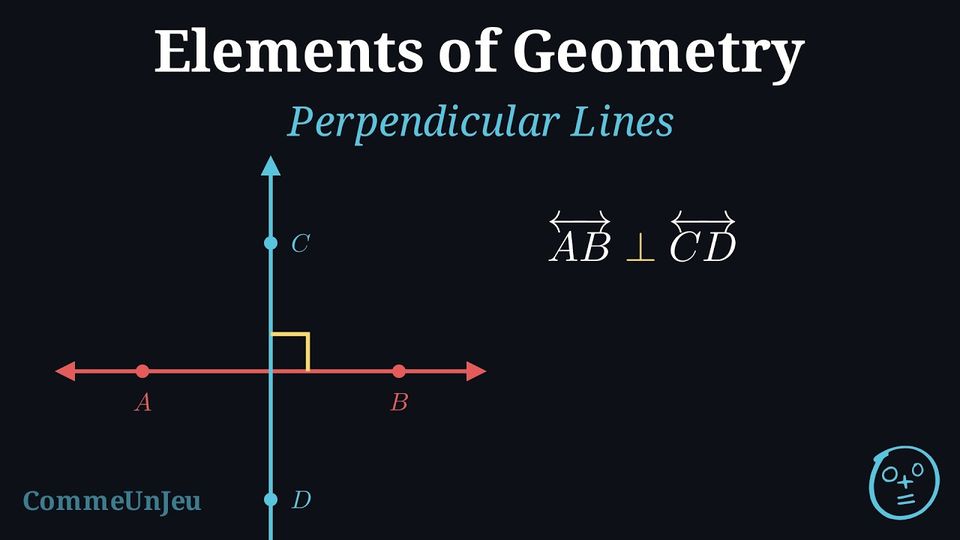
Two perpendicular lines are lines that intersect at a right angle (90 degrees). We write \(\Line{AB} \perp \Line{CD}\) to show that line \(\Line{AB}\) is perpendicular to line \(\Line{CD}\). 
Example
Identify the pair of perpendicular lines in the figure below. 
The lines \(\Line{AB}\) and \(\Line{CD}\) are perpendicular, as they intersect, forming a right angle, indicated by the right-angle mark.
Skills to practice
- Identifying Perpendicular Lines
II
Angles
II.1
Naming Angles with Three Points
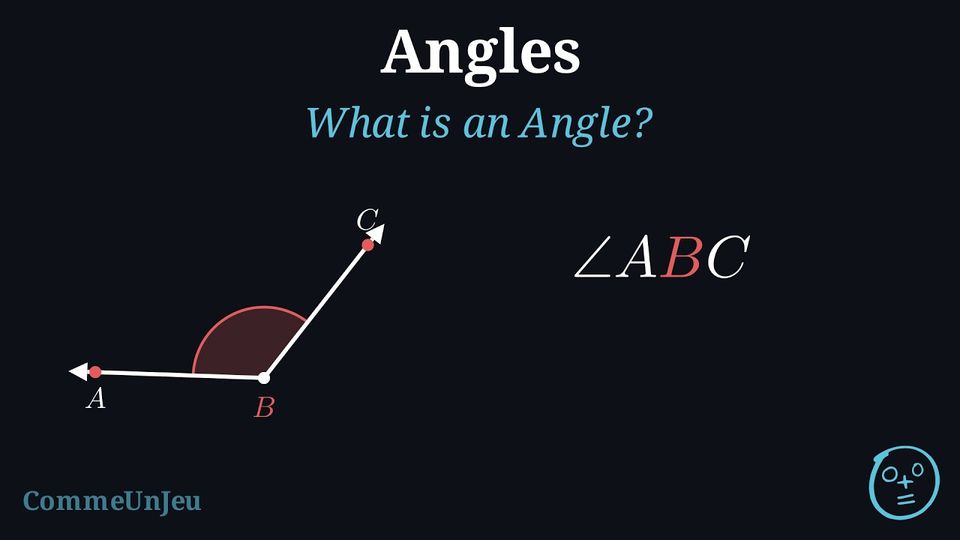
Definition — Angle
An angle is made of two rays that start from the same point, the vertex; they are its arms (or sides). Its size is its opening: the amount of turn that brings one arm onto the other. The length of the arms drawn makes no difference. 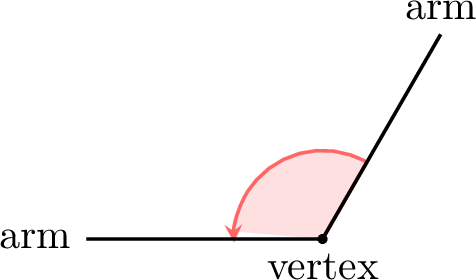
Definition — Naming Angles with Three Points
An angle is named using three points with the symbol \(\Angle{ABC}\), where \(B\) is the vertex of the angle, and \(A\) and \(C\) are points on the two sides of the angle. The vertex \(B\) is always written in the middle. The two sides form two angles: \(\Angle{ABC}\) names the angle less than \(180^\circ\) (or equal to it); a reflex angle is named “reflex \(\Angle{ABC}\)”. 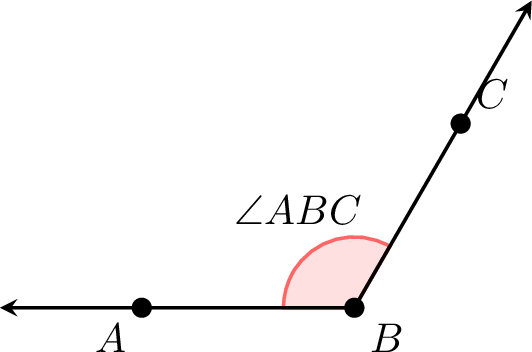
Skills to practice
- Naming Angles with Three Points
II.2
Adjacent Angles and Angle Addition
Definition — Adjacent Angles
Two angles are adjacent when they share their vertex and one arm, and lie on either side of that common arm. 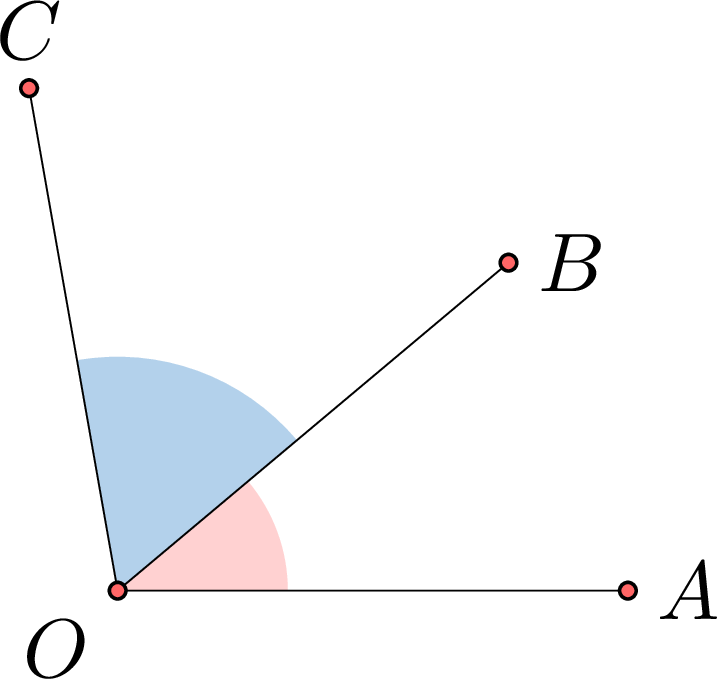
Example
In the figure above, \(\Angle{AOB} = 40^\circ\) and \(\Angle{BOC} = 60^\circ\). What is \(\Angle{AOC}\)? Are \(\Angle{AOB}\) and \(\Angle{AOC}\) adjacent?
\(\Angle{AOB}\) and \(\Angle{BOC}\) are adjacent, so they add up: $$\Angle{AOC} = 40^\circ + 60^\circ = 100^\circ.$$ \(\Angle{AOB}\) and \(\Angle{AOC}\) share the vertex \(O\) and the arm \(\Ray{OA}\), but they are not on either side of it: the first is inside the second. They are not adjacent.
Proposition — Angle Addition Postulate
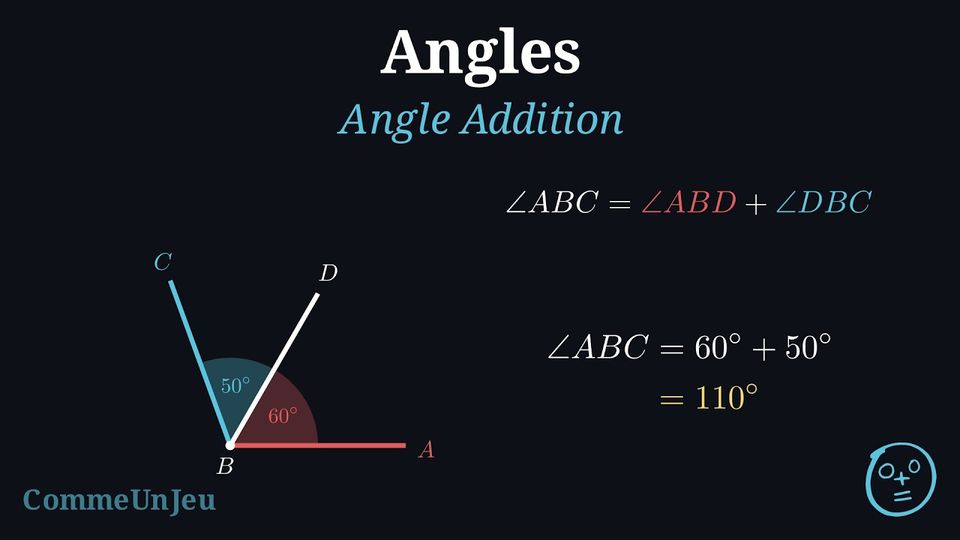
When two angles are adjacent (same vertex, one common arm, one angle on each side of it) and their sum does not exceed a straight angle, the measure of the angle formed by their other sides is equal to the sum of their measures. 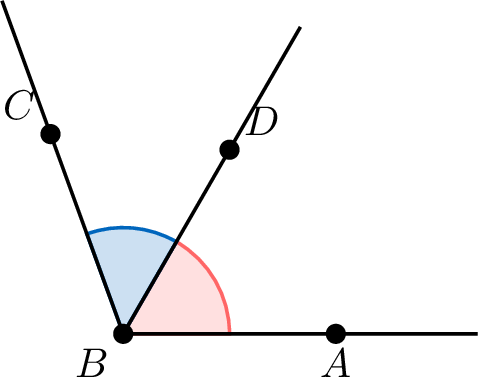
\(\Angle{ABC} = \textcolor{colordef}{\Angle{ABD}} + \textcolor{colorprop}{\Angle{DBC}}\)
Method — Calculating an Angle
To find the measure of an unknown angle, use the measures of related known angles. If the unknown angle is formed by two smaller adjacent angles that share a common vertex and a common side, add the measures of the smaller angles: adjacent angles add up. If the whole angle and one of the two parts are known, subtract: \(\Angle{ABD} = \Angle{ABC} - \Angle{DBC}\). Example
Calculate \(\Angle{ABC}\) without using a protractor. 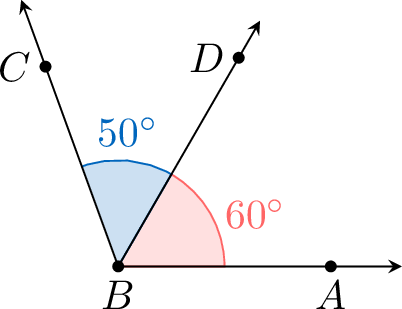
Angles \(\Angle{ABD}\) and \(\Angle{DBC}\) are adjacent and form \(\Angle{ABC}\). Adjacent angles add up: $$\begin{aligned} \Angle{ABC} &= \textcolor{colordef}{\Angle{ABD}} + \textcolor{colorprop}{\Angle{DBC}} \\
&= \textcolor{colordef}{60^\circ} + \textcolor{colorprop}{50^\circ} \\
&= 110^\circ \end{aligned}$$
Skills to practice
- Recognising Adjacent Angles
- Adding Angles
- Subtracting Angles
III
Calculating Angles
III.1
Angles in a Right Angle, on a Line and at a Point
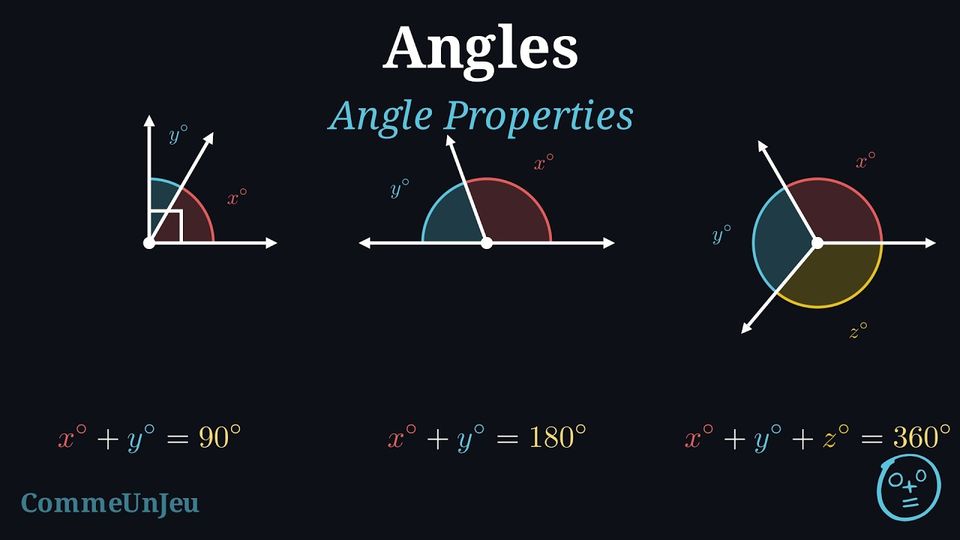
Proposition — Angle Properties
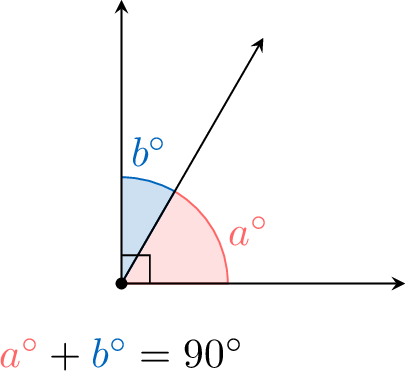
- Right Angle: If two adjacent angles form a right angle, the sum of their measures is \(90^\circ\) (two angles whose measures add up to \(90^\circ\) are called complementary, whether or not they are side by side).
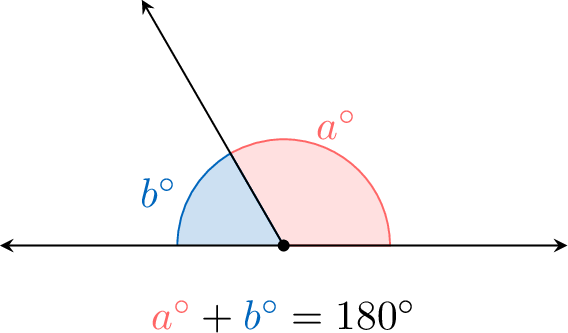
- Straight Angle: If two adjacent angles form a straight angle, the sum of their measures is \(180^\circ\) (two angles whose measures add up to \(180^\circ\) are called supplementary, whether or not they are side by side).
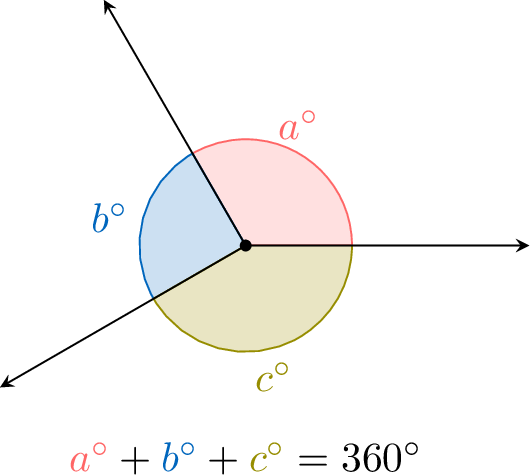
- Full Angle: If several angles meet at a point and form one full turn around that point, the sum of their measures is \(360^\circ\).
Example
Calculate \(x^{\circ}\). 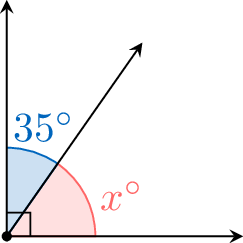
Since the two angles form a right angle, their measures add up to \(90^\circ\): $$\begin{aligned} x^\circ + 35^\circ &= 90^\circ \\
x^\circ &= 90^\circ - 35^\circ \\
x^\circ &= 55^\circ \end{aligned}$$
A geometry set contains two set squares, and the angles of each one are known once and for all. The first one has a right angle and two equal angles of \(45^\circ\). The second one has a right angle, an angle of \(60^\circ\) and an angle of \(30^\circ\). 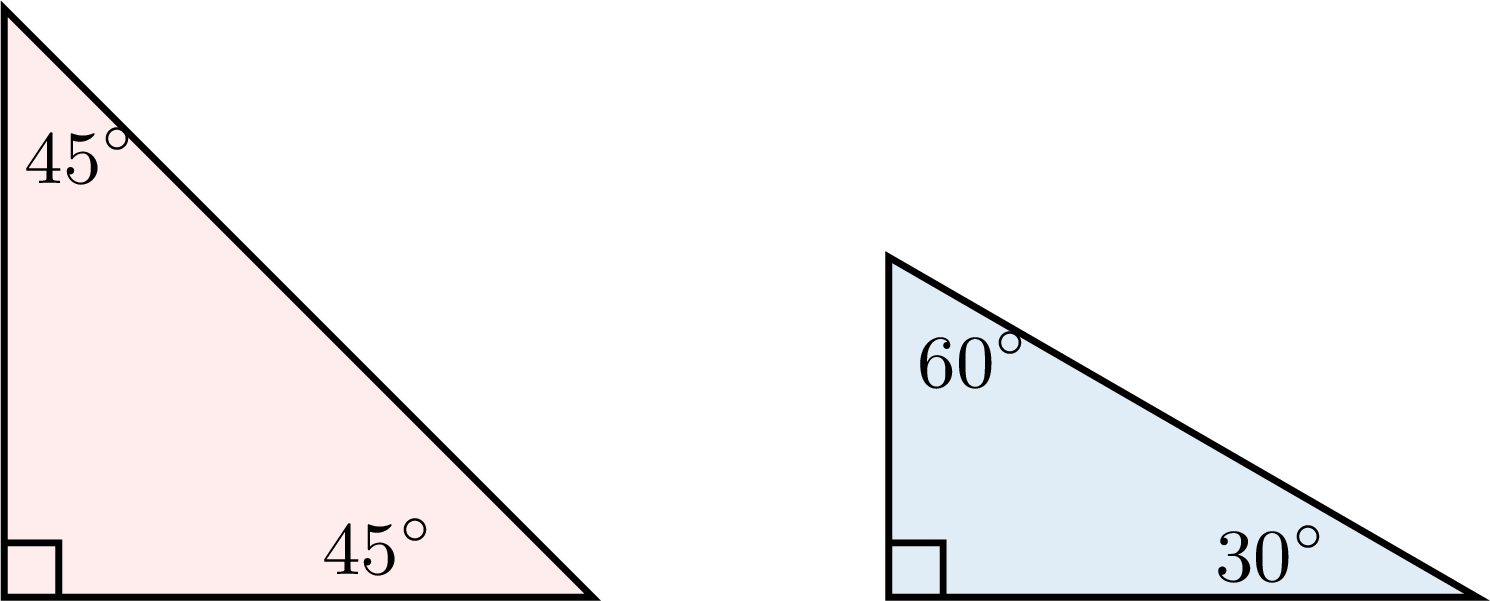
The four measures \(30^\circ\), \(45^\circ\), \(60^\circ\) and \(90^\circ\) can therefore be drawn or checked with a set square alone, without a protractor: it is enough to place on the vertex of the angle the corner that carries the wanted measure.
Skills to practice
- Calculating an Unknown Angle in a Right Angle
- Calculating an Unknown Angle in a Straight Angle
- Calculating an Unknown Angle in a Full Angle
- Using the Angles of the Set Square
III.2
Vertically Opposite Angles
Definition — Vertically Opposite Angles
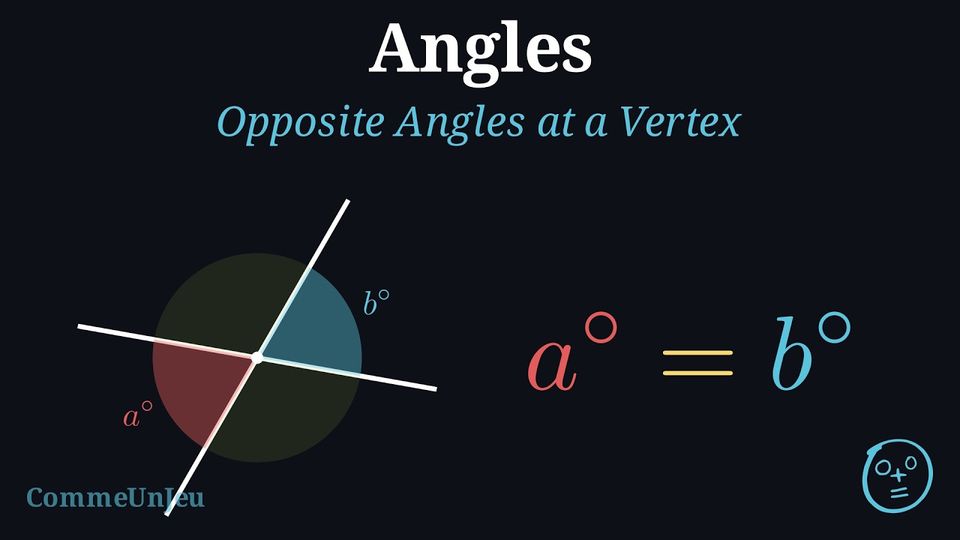
Vertically opposite angles (also called opposite angles at a vertex) are pairs of angles that lie opposite each other when two lines intersect. They share a common vertex. 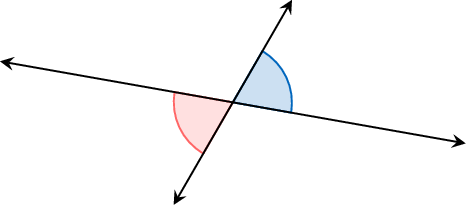
Proposition — Vertically Opposite Angles Are Equal
Vertically opposite angles are equal. 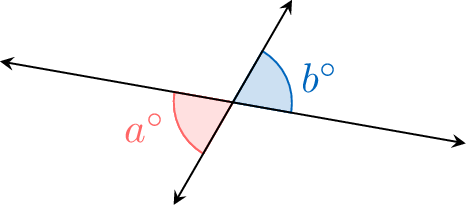
\(\textcolor{colordef}{a^\circ} = \textcolor{colorprop}{b^\circ}\)
Consider two lines intersecting at a point, forming opposite angles \(a^\circ\) and \(b^\circ\), and an adjacent angle \(c^\circ\). 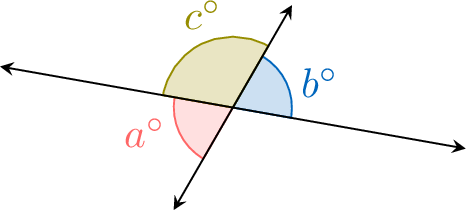
Since \(a^\circ\) and \(c^\circ\) form a straight angle: $$\textcolor{colordef}{a^\circ} + \textcolor{olive}{c^\circ} = 180^\circ \quad (\text{straight angle})$$ Similarly, \(b^\circ\) and \(c^\circ\) form a straight angle: $$\textcolor{colorprop}{b^\circ} + \textcolor{olive}{c^\circ} = 180^\circ \quad (\text{straight angle})$$ Thus, \(\textcolor{colordef}{a^\circ} + \textcolor{olive}{c^\circ} = \textcolor{colorprop}{b^\circ} + \textcolor{olive}{c^\circ}\). Subtracting \(\textcolor{olive}{c^\circ}\) from both sides gives: $$\textcolor{colordef}{a^\circ} = \textcolor{colorprop}{b^\circ}$$
Example
Calculate the measure of the unknown angle \(x^\circ\). 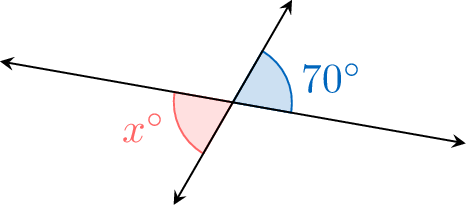
Vertically opposite angles are equal. $$\begin{aligned} x^\circ &= 70^\circ \quad (\text{vertically opposite angles are equal}) \end{aligned}$$
Skills to practice
- Identifying Vertically Opposite Angles
- Calculating Unknown Angles
IV
Going further
Skills to practice
- Solving Real-Life Angle Problems
- Investigating Patterns with Lines and Angles
- Quiz
Jump to section