International Baccalaureate · PYP 5
Temperature and Negative Numbers
I
Degrees Fahrenheit
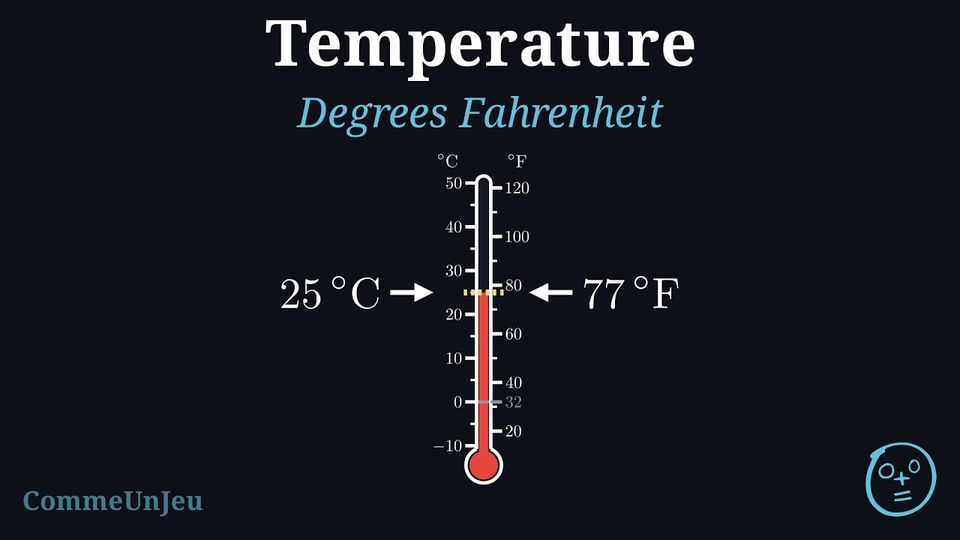
The weather website of a city in the United States gives tomorrow's temperature: \(77\,^\circ\)F. Is tomorrow a day for a T-shirt or for a warm coat?
In the United States, temperatures are usually given in degrees Fahrenheit (\(^\circ\)F), not in degrees Celsius: \(77\) is not a number of \(^\circ\)C. On a thermometer with the two scales side by side, \(77\,^\circ\)F is at the same height as \(25\,^\circ\)C: tomorrow is a warm day, a day for a T-shirt. 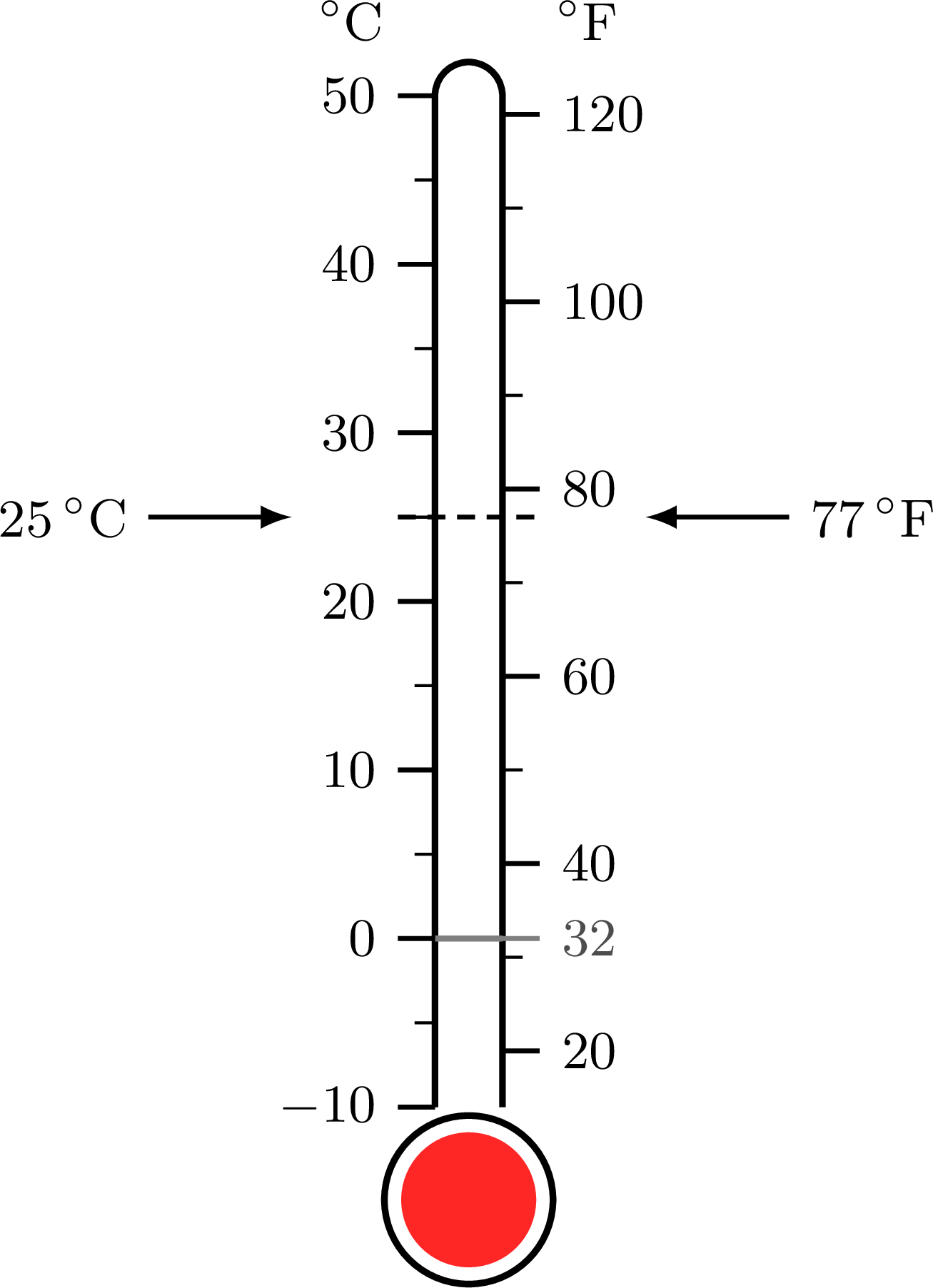
Definition — Degrees Fahrenheit
Most countries measure temperature in degrees Celsius (\(^\circ\)C). A few countries, such as the United States, use another unit: the degree Fahrenheit (\(^\circ\)F). The same temperature is usually written with a different number in each unit: water freezes at \(0\,^\circ\)C, which is \(32\,^\circ\)F.Some thermometers carry the two scales side by side: \(^\circ\)C on the left, \(^\circ\)F on the right. At the top of the liquid, we read the temperature in \(^\circ\)C on the left scale and in \(^\circ\)F on the right scale. On the thermometer below, the liquid shows \(60\,^\circ\)C on the left scale and \(140\,^\circ\)F on the right scale: the same temperature. The dashed lines show three temperatures to know.
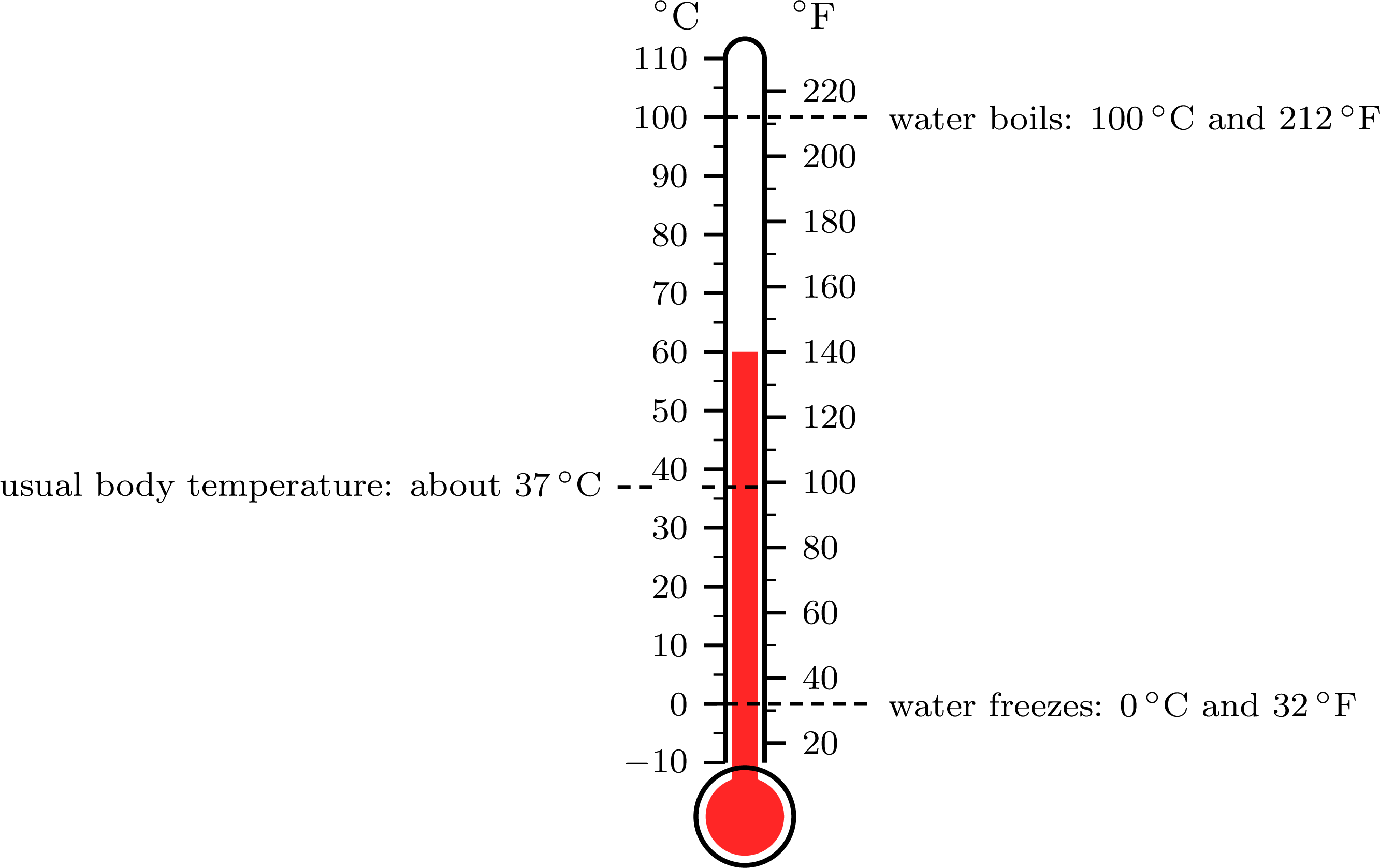
| in \(^\circ\)C | in \(^\circ\)F | |
| water freezes | \(0\,^\circ\)C | \(32\,^\circ\)F |
| usual body temperature | about \(37\,^\circ\)C | about \(98.6\,^\circ\)F |
| water boils | \(100\,^\circ\)C | \(212\,^\circ\)F |
Method — Comparing Temperatures in Two Units
- Same unit: compare the numbers, as on a thermometer with one scale. The higher temperature is the warmer one: \(41\,^\circ\)F is warmer than \(14\,^\circ\)F.
- Two different units: do not compare the numbers. Find each temperature on its own scale of the double thermometer and look across: the one higher up is the warmer.
Example
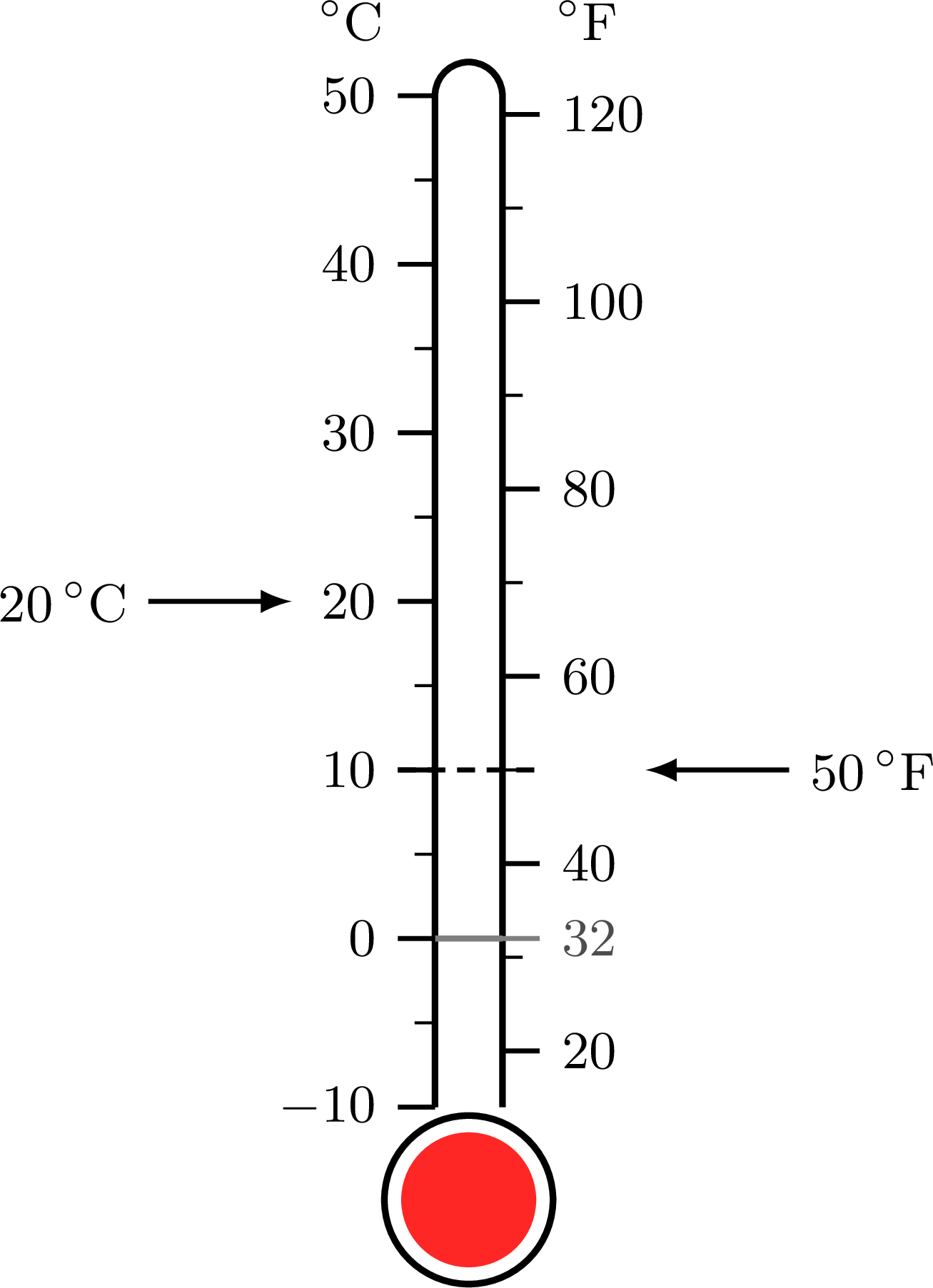
Read the temperature shown, in degrees Celsius and in degrees Fahrenheit. 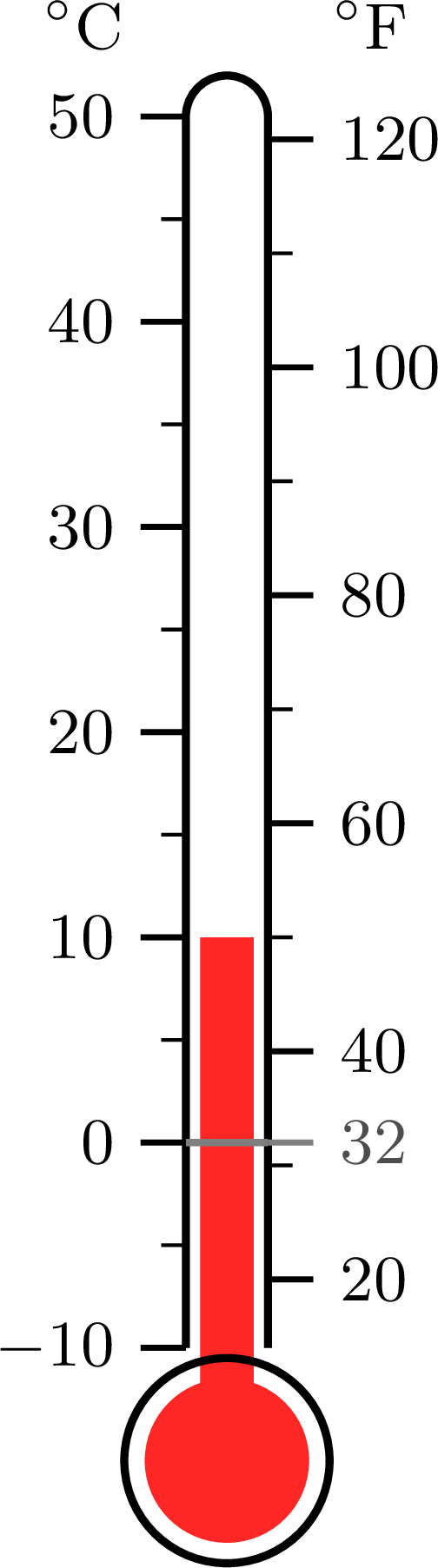
On the left scale, the top of the liquid is on the large mark \(10\): the temperature is \(\mathbf{10\,^\circ\text{C}}\).
On the right scale, the large marks go up by \(20\) degrees, so a small mark is \(10\) degrees further. The top of the liquid is on the small mark halfway between \(40\) and \(60\): the temperature is \(\mathbf{50\,^\circ\text{F}}\).
\(10\,^\circ\)C and \(50\,^\circ\)F are the same temperature: the two readings are at the same height. 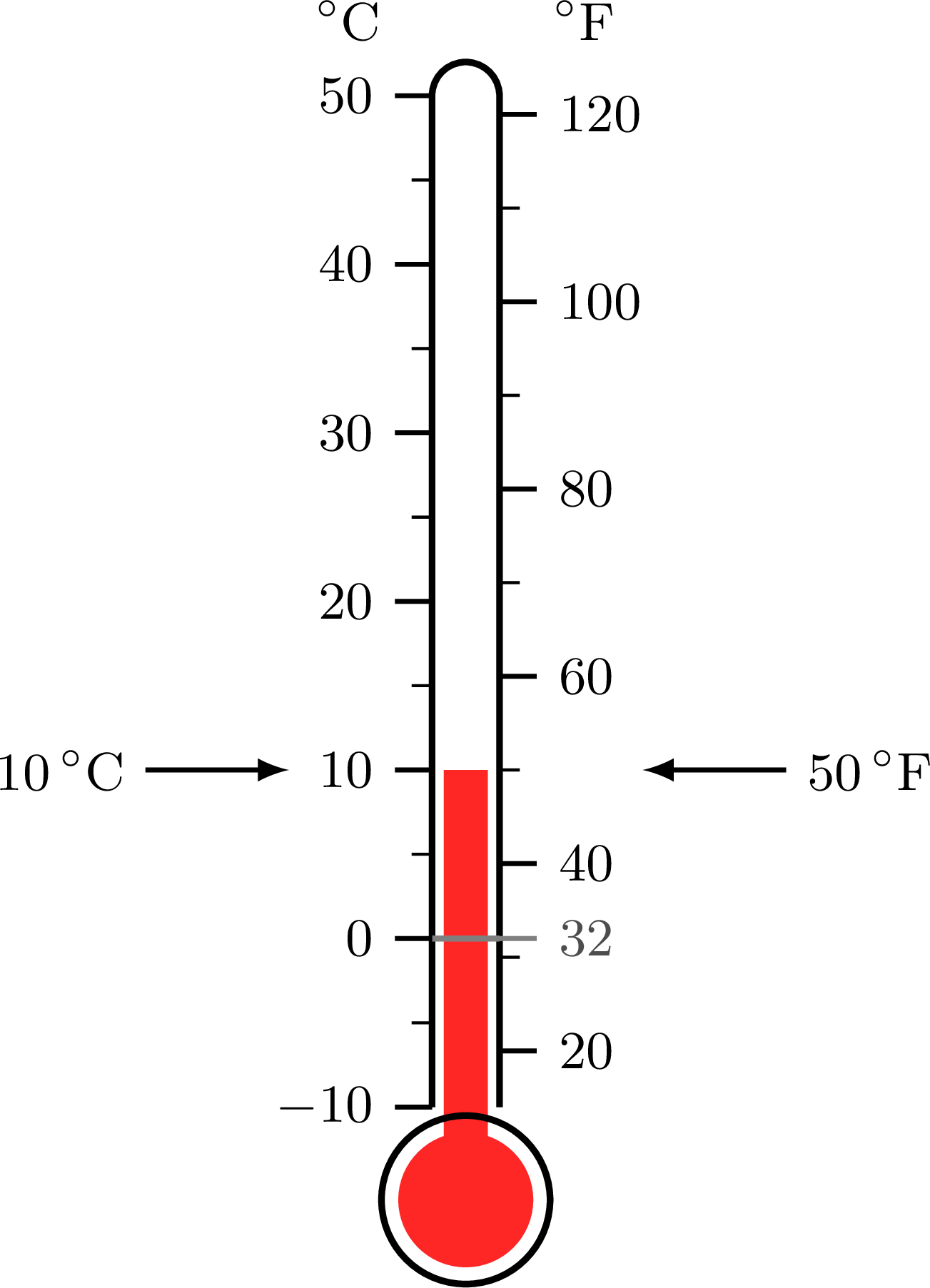
On the right scale, the large marks go up by \(20\) degrees, so a small mark is \(10\) degrees further. The top of the liquid is on the small mark halfway between \(40\) and \(60\): the temperature is \(\mathbf{50\,^\circ\text{F}}\).
\(10\,^\circ\)C and \(50\,^\circ\)F are the same temperature: the two readings are at the same height.
Example
At noon, it is \(80\,^\circ\)F in a city of the United States and \(20\,^\circ\)C in a city of France. Which city is warmer at noon? 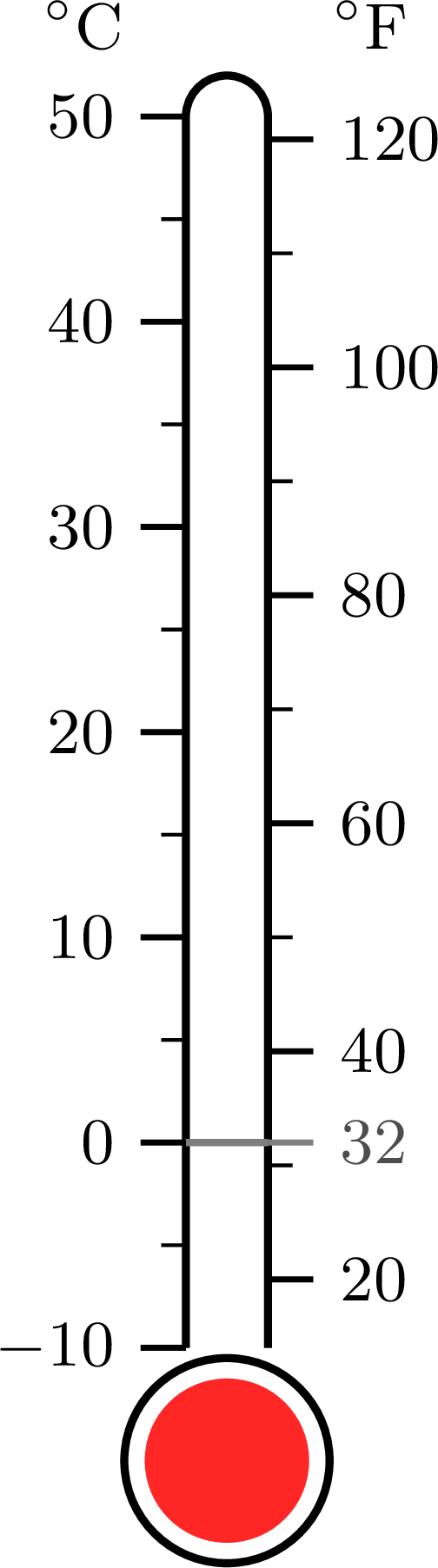
The two temperatures are in different units: do not compare the numbers \(80\) and \(20\). On the right scale, \(80\,^\circ\)F is on the large mark \(80\). Looking across to the left scale, it is between \(25\,^\circ\)C and \(30\,^\circ\)C, higher up than \(20\,^\circ\)C. 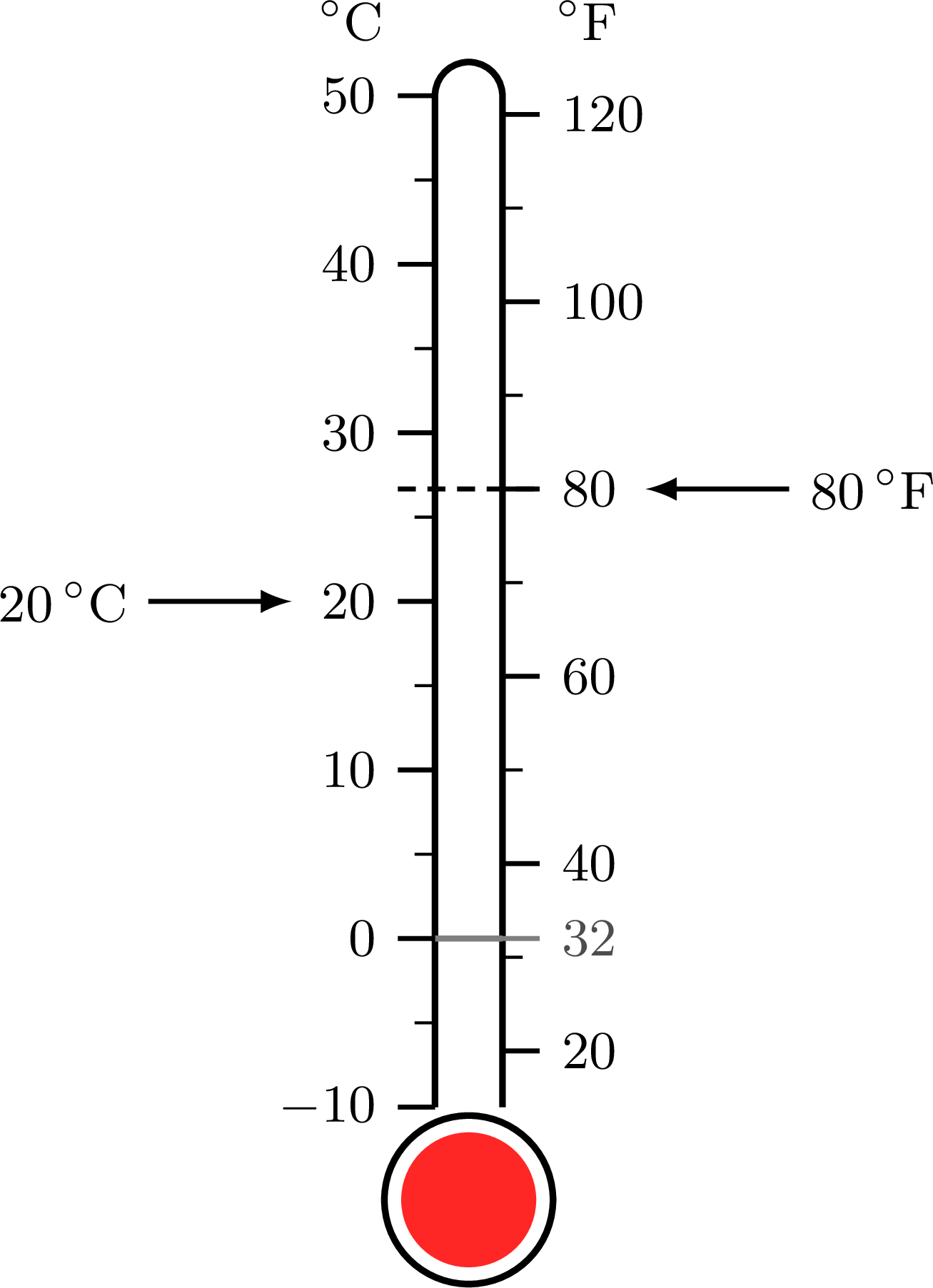
\(80\,^\circ\)F is warmer than \(20\,^\circ\)C: the city of the United States is warmer at noon.
Skills to practice
- Using Degrees Fahrenheit
- Reading Temperatures in Degrees Fahrenheit
- Comparing Temperatures in Two Units
II
Negative Numbers in Context
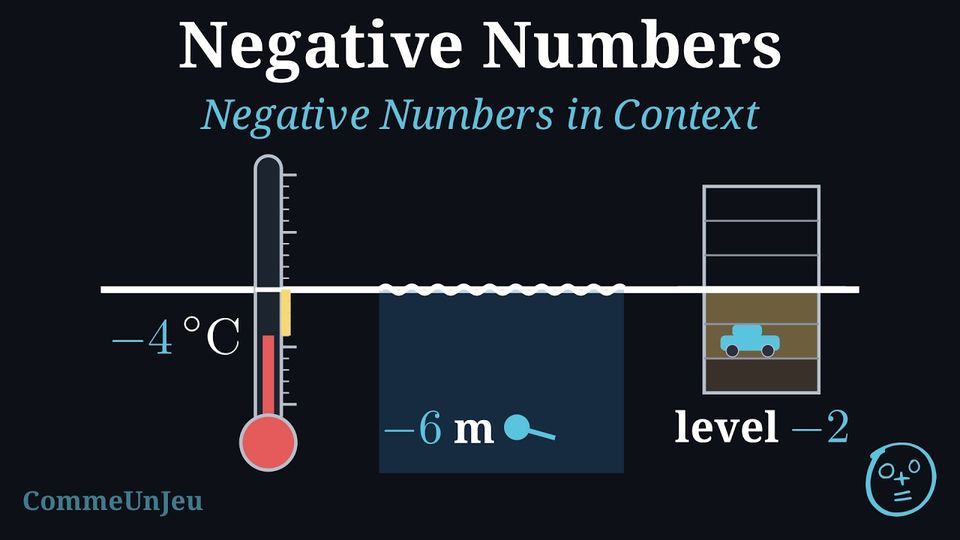
On the same winter morning: 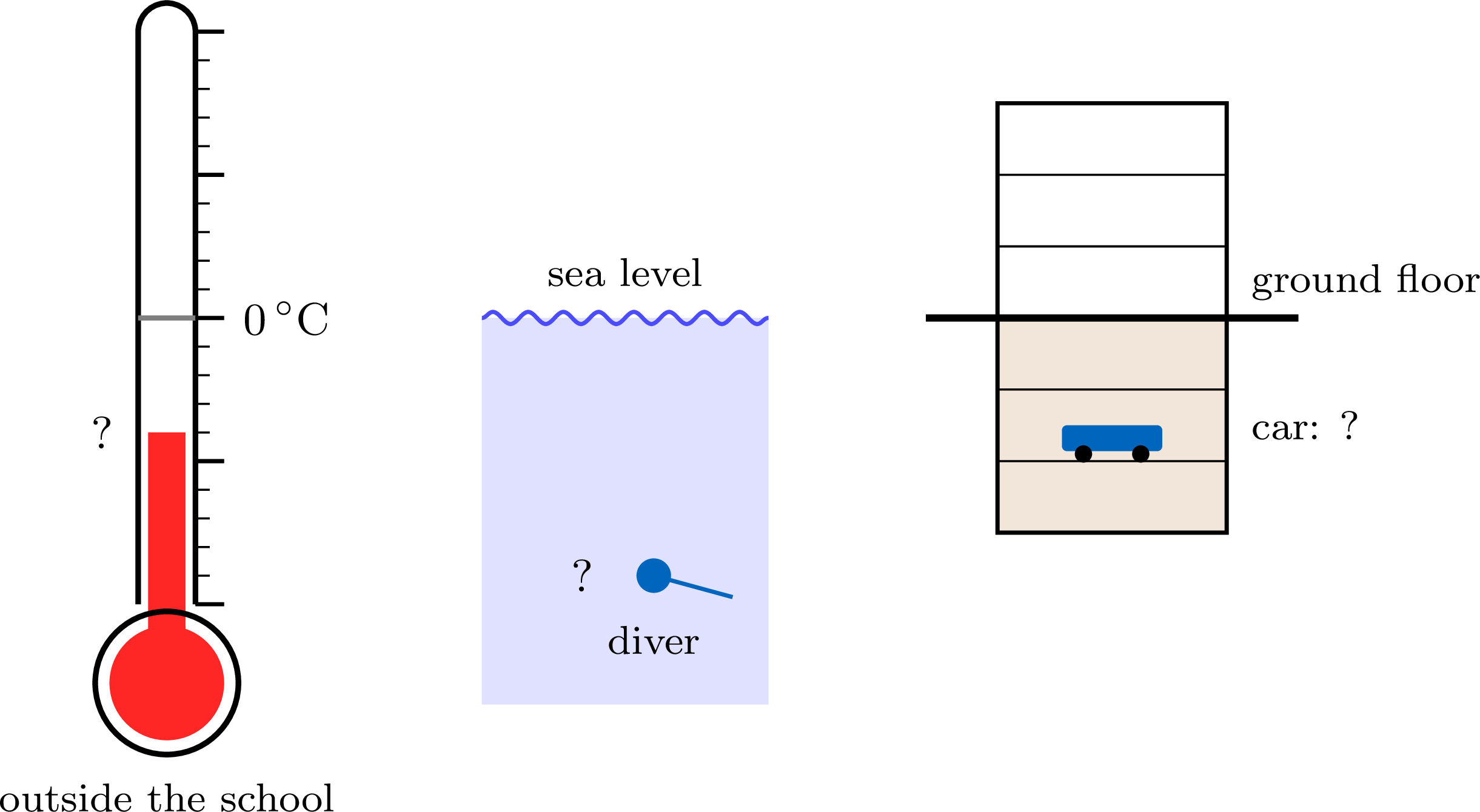
How can each of these three positions be written with a single number?
- the thermometer outside the school shows \(4\) degrees below zero;
- a diver swims \(6\) metres below the surface of the sea;
- a car is parked on the second level below the ground floor of a building.
On a thermometer, \(4\) degrees below zero is written with a minus sign: \(\textcolor{colorprop}{-4}\,^\circ\)C. The two other positions are written in the same way, with a minus sign because they are below their starting level: the diver is at \(\textcolor{colorprop}{-6}\) m (\(6\) metres below sea level), and the car is on level \(\textcolor{colorprop}{-2}\) (\(2\) levels below the ground floor). 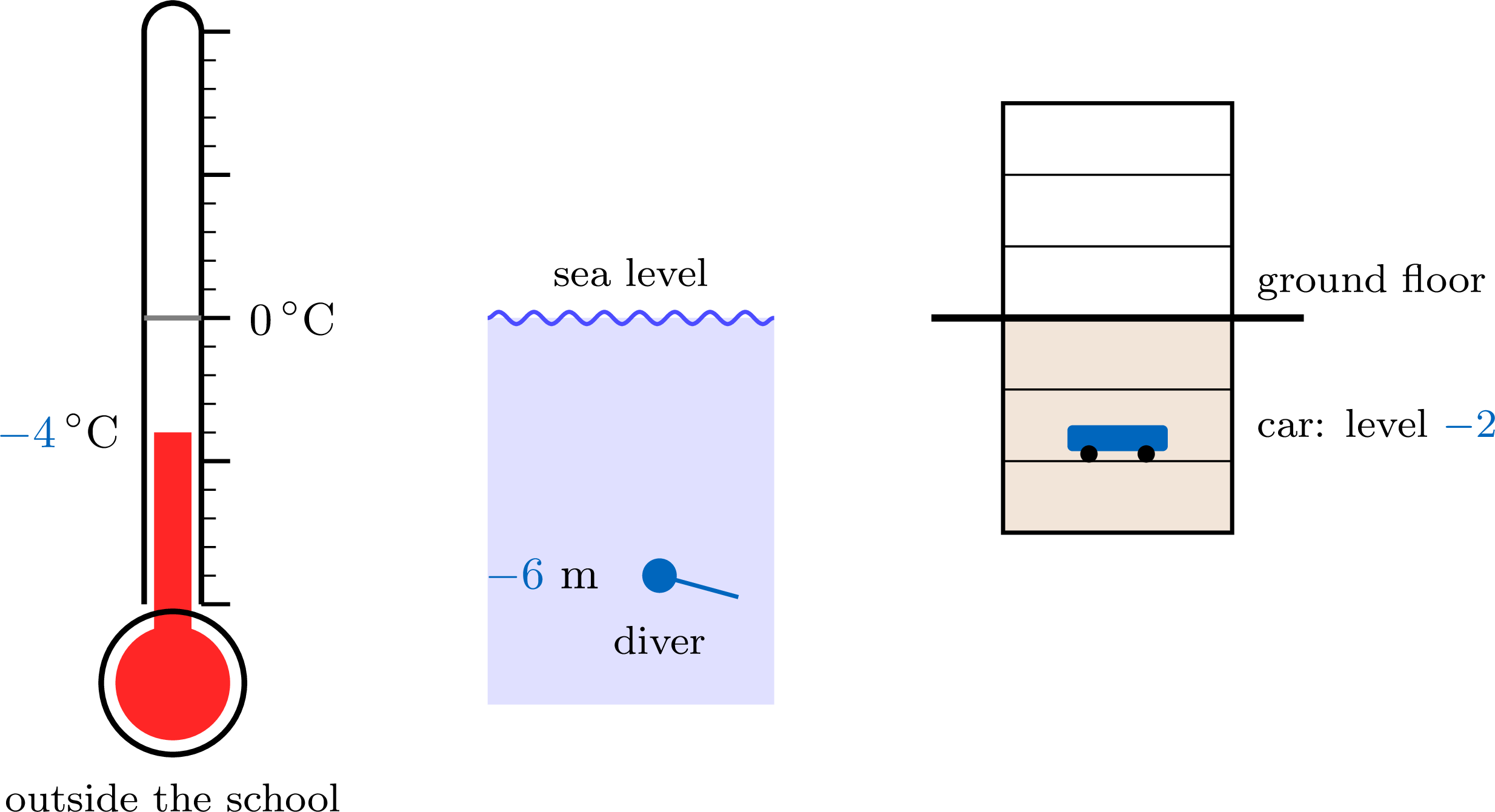
Definition — Positive and Negative Numbers
Many quantities are measured up or down from a zero, a starting level: \(0\,^\circ\)C on a thermometer, sea level for heights and depths, the ground floor in a building. - A number below zero is a negative number. It is written with a minus sign: \(\textcolor{colorprop}{-6}\) means \(6\) below zero. It is read “negative six” or “minus six”.
- A number above zero is a positive number: \(\textcolor{colordef}{6}\) means \(6\) above zero. A plus sign can be written in front of it, \(\textcolor{colordef}{+6}\), but it is usually left out.
- Zero is the starting level itself: it is neither positive nor negative.
| situation | zero | \(3\) above zero | \(3\) below zero |
| temperature | \(0\,^\circ\)C | \(\textcolor{colordef}{3}\,^\circ\)C | \(\textcolor{colorprop}{-3}\,^\circ\)C |
| height | sea level | \(\textcolor{colordef}{3}\) m | \(\textcolor{colorprop}{-3}\) m |
| building | ground floor | level \(\textcolor{colordef}{3}\) | level \(\textcolor{colorprop}{-3}\) |
Method — Reading and Placing Numbers Around Zero
A number line can go on below zero. It is drawn upright, like the scale of a thermometer, or across, like a ruler: then the negative numbers are on the left of zero. - Find zero on the line.
- Find the step from one mark to the next: \(1\), \(2\), \(5\), \(10\), …
- Count the steps from zero: upward (or to the right) for a positive number, downward (or to the left) for a negative number.
On the upright line, \(A\) is \(\textcolor{colordef}{3}\) and \(B\) is \(\textcolor{colorprop}{-4}\); on the line across, \(C\) is \(\textcolor{colorprop}{-2}\) and \(D\) is \(\textcolor{colordef}{5}\).
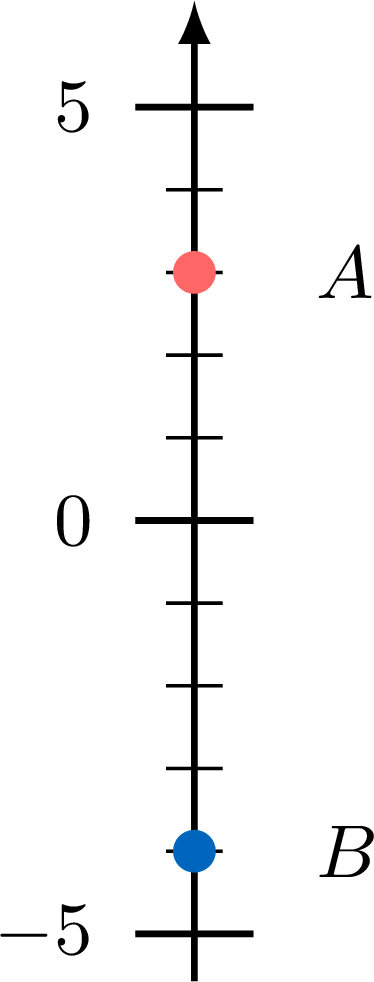

Example
Near a cliff, heights are measured from sea level, in metres. Read the height of the gull, of the diver and of the crab on the sea floor. 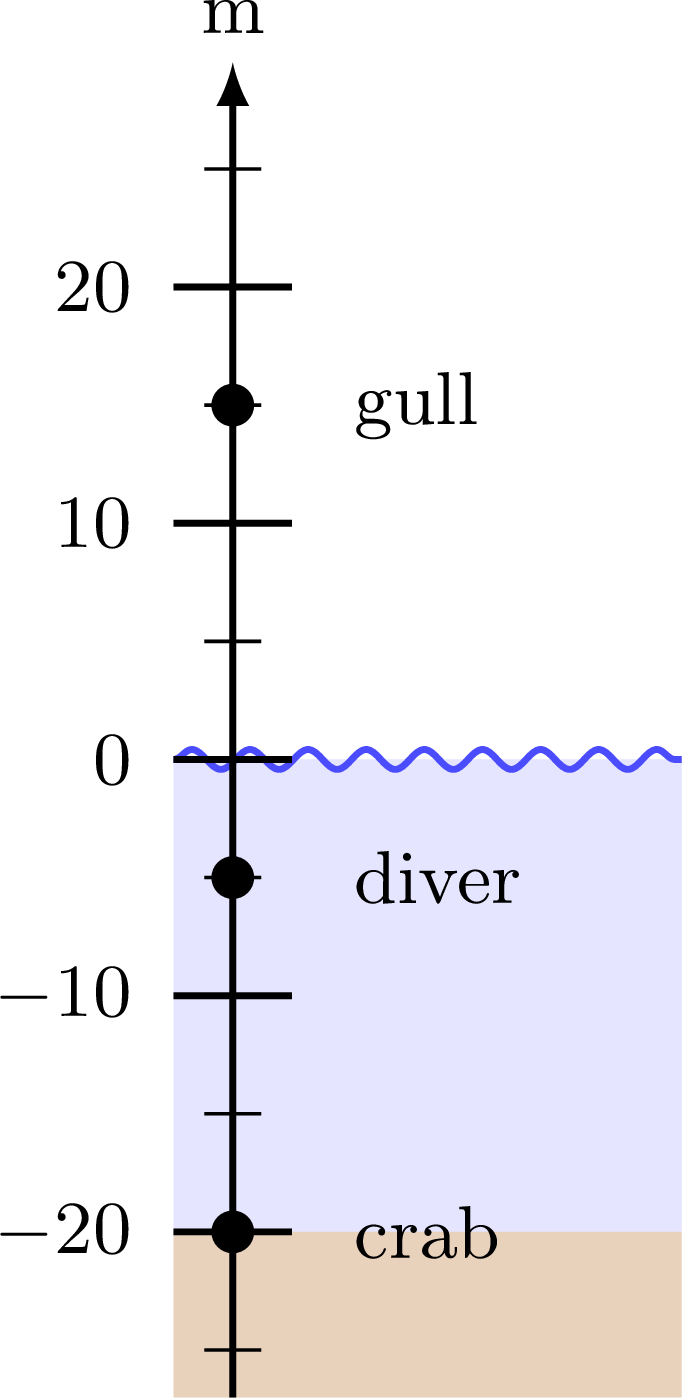
Zero is sea level. The numbers go up by \(10\) and there is one mark between two numbers, so the step is \(5\) m. 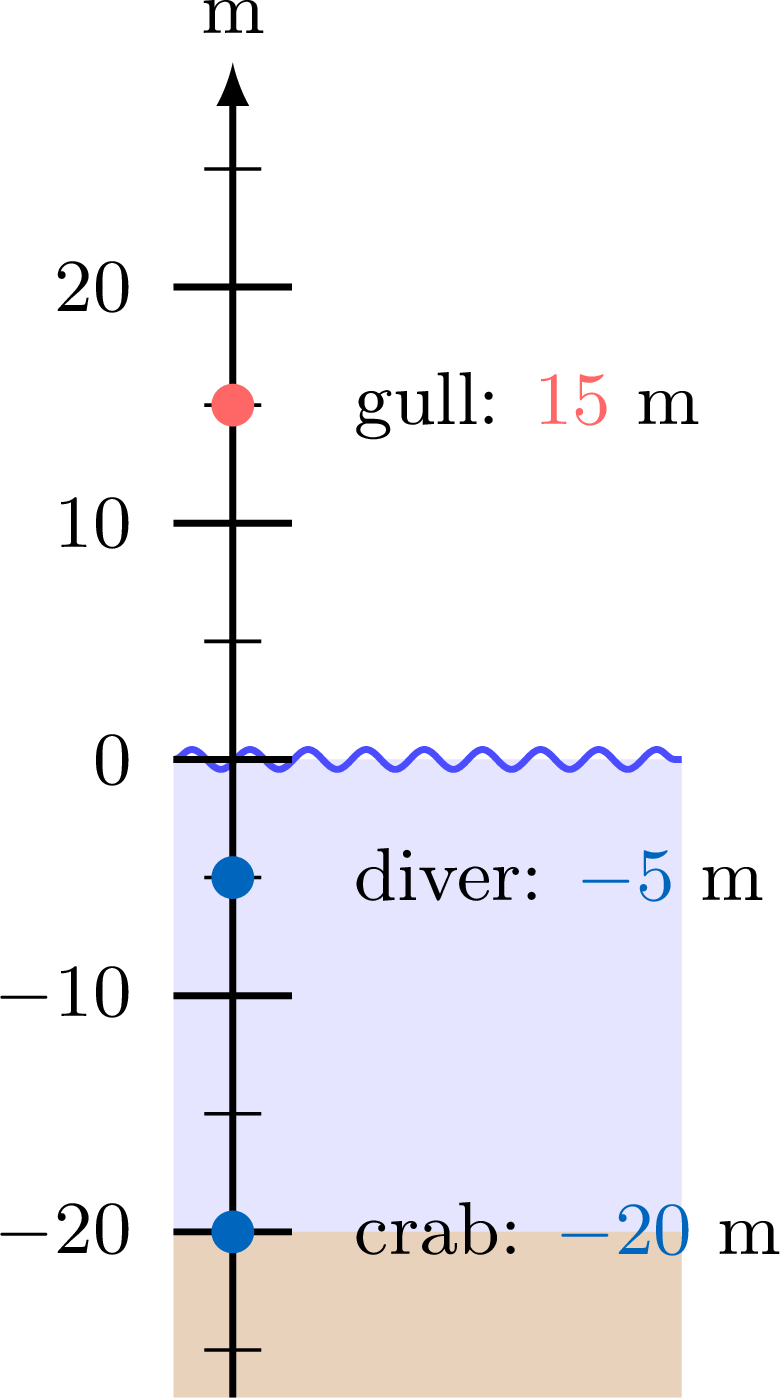
- The gull is \(3\) marks above zero: \(3 \times 5 = 15\), its height is \(\mathbf{\textcolor{colordef}{15}}\) m.
- The diver is \(1\) mark below zero: the diver's height is \(\mathbf{\textcolor{colorprop}{-5}}\) m, \(5\) m below sea level.
- The crab is on the mark numbered \(-20\): its height is \(\mathbf{\textcolor{colorprop}{-20}}\) m.
Example
In a quiz, every team starts at \(0\) points; a correct answer wins points and a wrong answer loses points, so a score can go below zero. At the end, the Lions have \(3\) points, the Tigers \(-2\), the Bears \(-4\) and the Eagles \(1\). Place the four scores on the number line. 
The step is \(1\). The positive scores go to the right of zero: the Lions \(3\) steps, the Eagles \(1\) step. The negative scores go to the left of zero: the Tigers \(2\) steps, the Bears \(4\) steps. 
\(L\): Lions, \(T\): Tigers, \(B\): Bears, \(E\): Eagles.
Method — Comparing and Ordering in Context
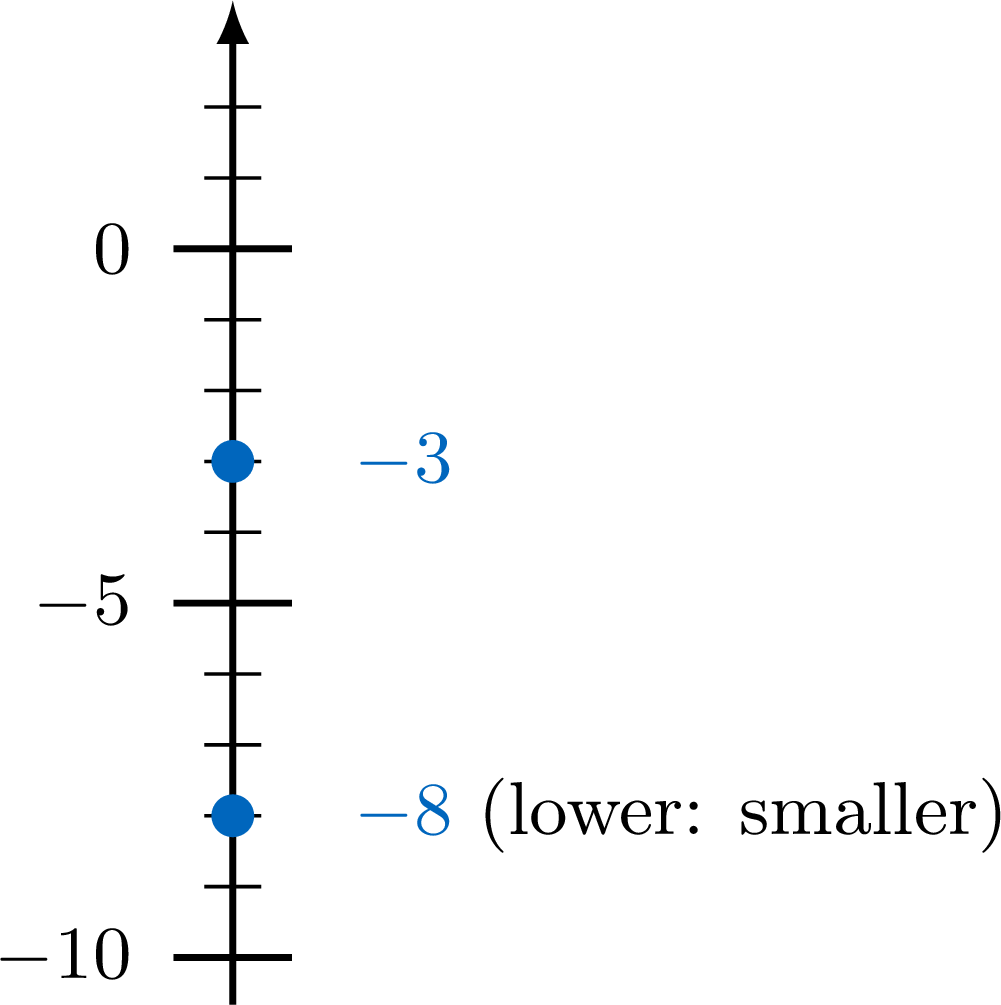
On an upright number line, the number lower down is the smaller; on a number line drawn across, the number further left is the smaller. In a situation, the smaller number is the colder temperature, the deeper point, the lower floor, the lower score.So \(\textcolor{colorprop}{-8} < \textcolor{colorprop}{-3}\), even though \(8\) is larger than \(3\): \(\textcolor{colorprop}{-8}\) is lower down, further below zero. \(\textcolor{colorprop}{-8}\,^\circ\)C is colder than \(\textcolor{colorprop}{-3}\,^\circ\)C.
Example
At \(7\) in the morning, it is \(-6\,^\circ\)C in a mountain village and \(-2\,^\circ\)C in a town by a lake. Which place is colder? Compare the two numbers with the sign \(<\).
On an upright number line, \(\textcolor{colorprop}{-6}\) is lower down than \(\textcolor{colorprop}{-2}\): 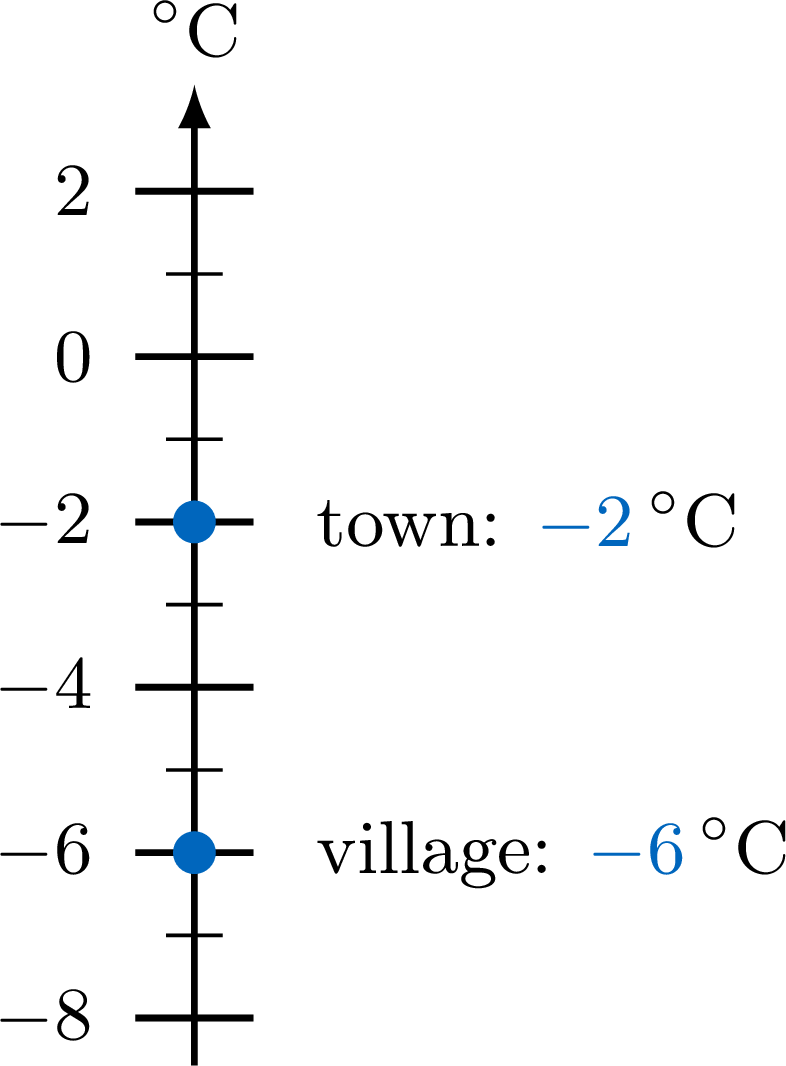
$$\textcolor{colorprop}{-6} < \textcolor{colorprop}{-2}$$ The mountain village is colder.
Example
Four divers are under water: Ana at \(-12\) m, Ben at \(-5\) m, Chloé at \(-20\) m and Dev at \(-8\) m. Their boat floats on the sea, at \(0\) m. Order the five heights from the lowest to the highest.
Place the five heights on an upright number line, then read them from the bottom up: 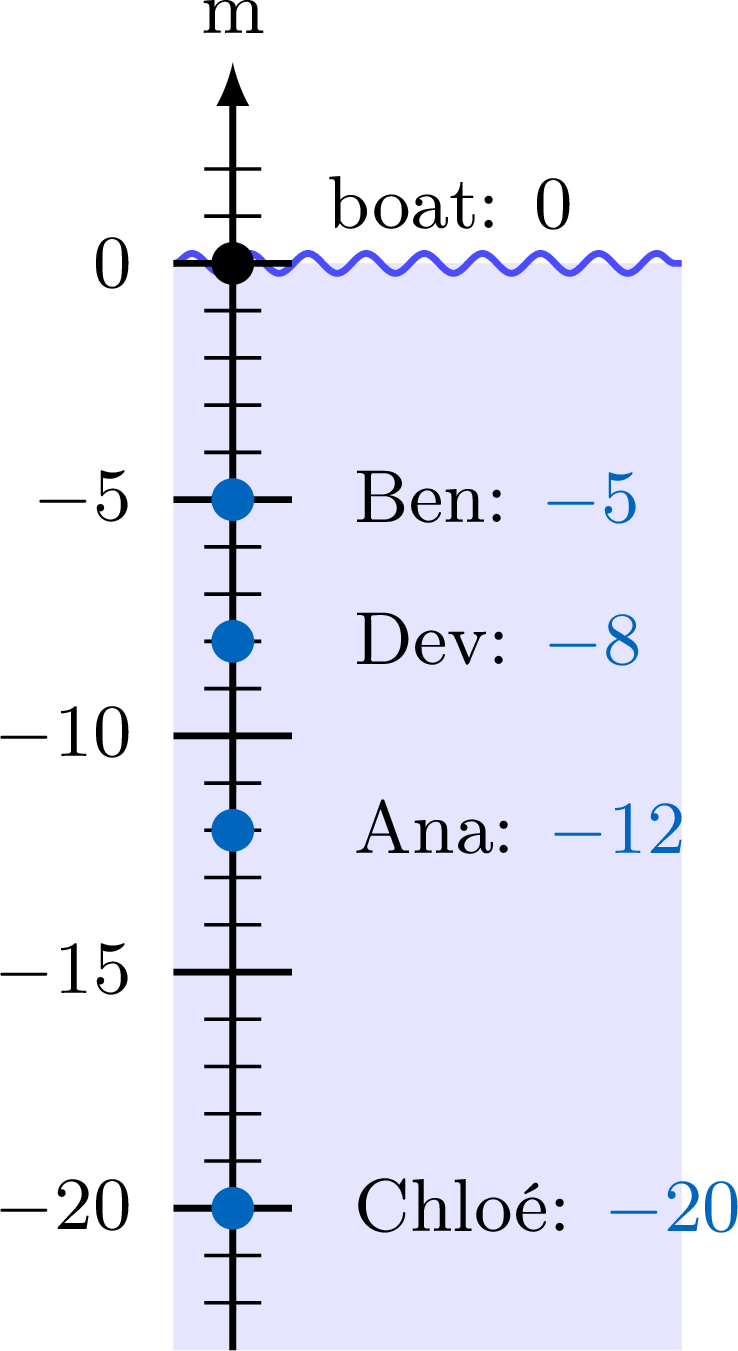
$$\textcolor{colorprop}{-20} < \textcolor{colorprop}{-12} < \textcolor{colorprop}{-8} < \textcolor{colorprop}{-5} < 0$$ Chloé is the deepest, then Ana, Dev and Ben; the boat is the highest.
Example
A gull flies \(12\) m above sea level and a diver swims \(8\) m below sea level, right under it. How far apart are they?
The gull is at \(\textcolor{colordef}{12}\) m and the diver at \(\textcolor{colorprop}{-8}\) m: sea level, \(0\), is between them. Count the metres down from \(12\) to \(0\), then from \(0\) down to \(-8\), and add, as for a fall in temperature across zero: 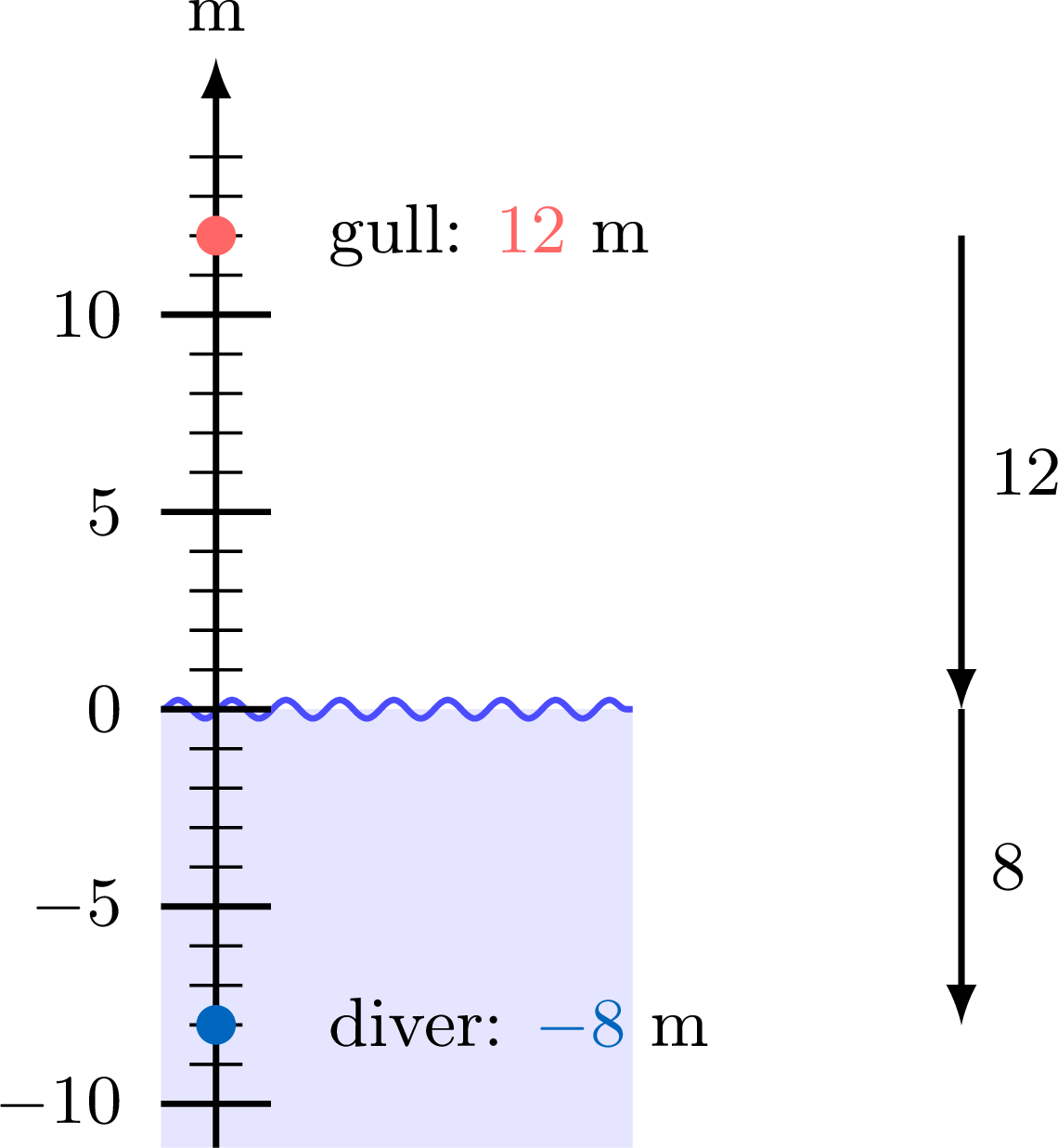
$$\begin{aligned} \text{distance} &= 12 + 8 &&\text{(from } 12 \text{ down to } 0\text{, then from } 0 \text{ down to } {-8}\text{)}\\
&= 20 \end{aligned}$$ They are \(\mathbf{20}\) m apart. When both are below sea level, \(0\) is not between them: from \(-8\) m up to \(-3\) m, count the steps between them, \(5\) m, without adding \(8\) and \(3\).
The whole numbers above zero, zero and the whole numbers below zero, such as \(\textcolor{colorprop}{-12}\), \(\textcolor{colorprop}{-3}\), \(0\), \(\textcolor{colordef}{5}\), \(\textcolor{colordef}{300}\), are called integers. The number line through zero and the rule “the lower (or further left), the smaller” work for every integer, in a situation or without one.
Definition — Opposite Numbers
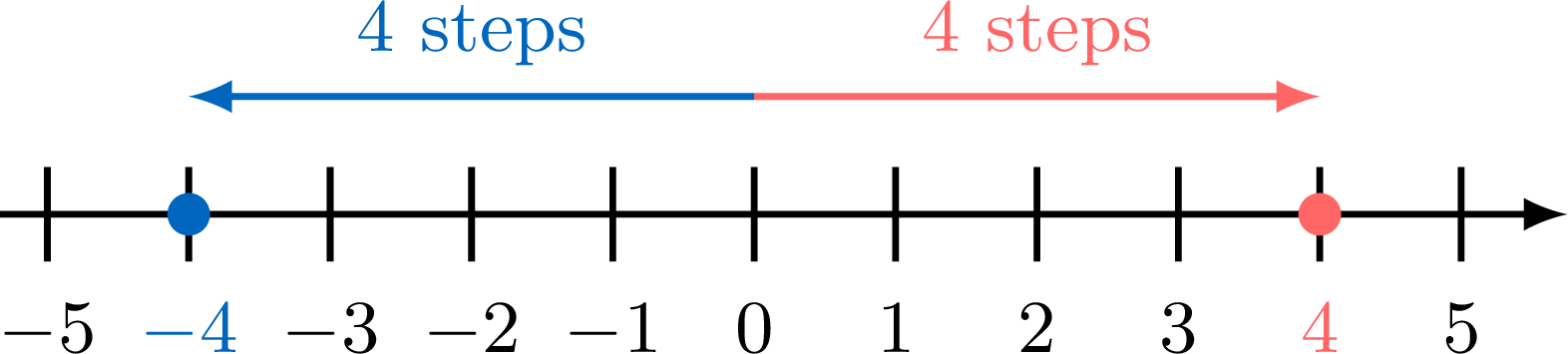
Two numbers are opposite numbers when they are at the same distance from zero, on either side of zero. \(\textcolor{colordef}{4}\) and \(\textcolor{colorprop}{-4}\) are opposite numbers: both are \(4\) steps from zero, \(\textcolor{colordef}{4}\) to the right and \(\textcolor{colorprop}{-4}\) to the left. So \(\textcolor{colorprop}{-4}\) is the opposite of \(\textcolor{colordef}{4}\), and \(\textcolor{colordef}{4}\) is the opposite of \(\textcolor{colorprop}{-4}\).\(0\) is its own opposite: it is on zero, neither to the right nor to the left.
Skills to practice
- Writing a Situation as a Number
- Reading a Number Line Through Zero
- Writing Integers from Words
- Finding the Opposite
- Ordering Values in Context
III
The Number Line and the Distance to Zero
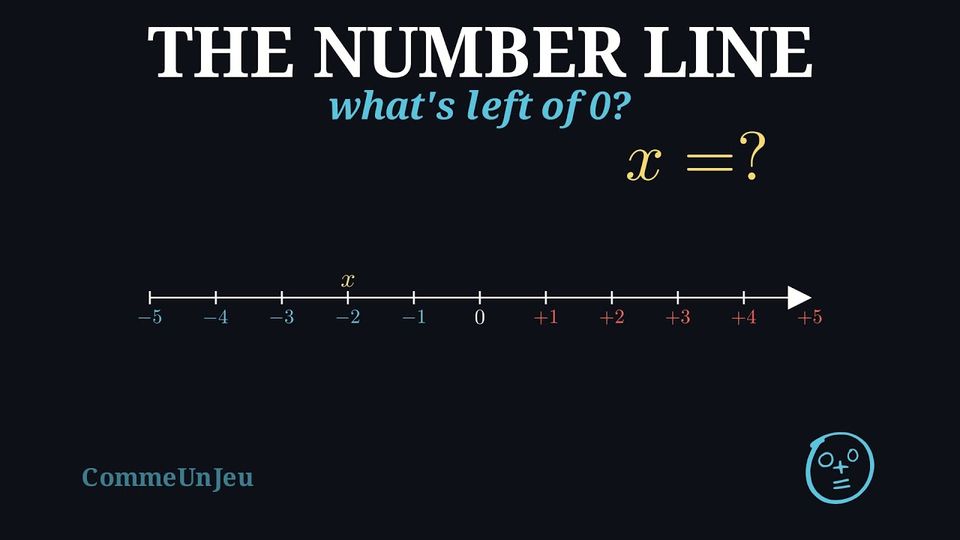
On a number line, \(0\) is on a mark, and the numbers \(\textcolor{colordef}{+1}\), \(\textcolor{colordef}{+2}\), \(\textcolor{colordef}{+3}\), …\ go to the right of \(0\), one step at each mark. The line is now drawn on the other side of \(0\) too. 
How does the line go on below \(0\), to the left? Which numbers go on the marks to the left of \(0\)?
Going to the right, each mark is one step more: \(0\), \(\textcolor{colordef}{+1}\), \(\textcolor{colordef}{+2}\), …\ Going to the left from \(0\), each mark is one step less: one step to the left of \(0\) is \(\textcolor{colorprop}{-1}\), two steps to the left is \(\textcolor{colorprop}{-2}\), three steps is \(\textcolor{colorprop}{-3}\), and so on.
Below \(0\), the line goes on to the left with the negative numbers \(\textcolor{colorprop}{-1}\), \(\textcolor{colorprop}{-2}\), \(\textcolor{colorprop}{-3}\), … 
Below \(0\), the line goes on to the left with the negative numbers \(\textcolor{colorprop}{-1}\), \(\textcolor{colorprop}{-2}\), \(\textcolor{colorprop}{-3}\), …
Definition — Number Line
A number line is a straight line with marks at equal steps: one mark is \(0\), the positive numbers are to the right of \(0\), the negative numbers to the left, and the step from one mark to the next is always the same. 


Definition — Distance to Zero
The distance to zero of a number is the distance between its point and the point \(0\) on the number line. It does not depend on the sign: \(\textcolor{colordef}{+3}\) and \(\textcolor{colorprop}{-3}\) have the same distance to zero, which is \(3\). This distance is also called the absolute value of the number: for a number \(n\), it is written \(|n|\), and we write \(|+3| = |-3| = 3\). Example
- \(\textcolor{colordef}{+2}\) is \(2\) units to the right of \(0\): its distance to zero is \(2\).
- \(\textcolor{colorprop}{-3}\) is \(3\) units to the left of \(0\): its distance to zero is \(3\).

Skills to practice
- Finding x on the Number Line
- Placing Numbers on the Number Line
- Finding the Distance to Zero
- Finding the Distance Between Two Points
IV
Comparing and Ordering Integers
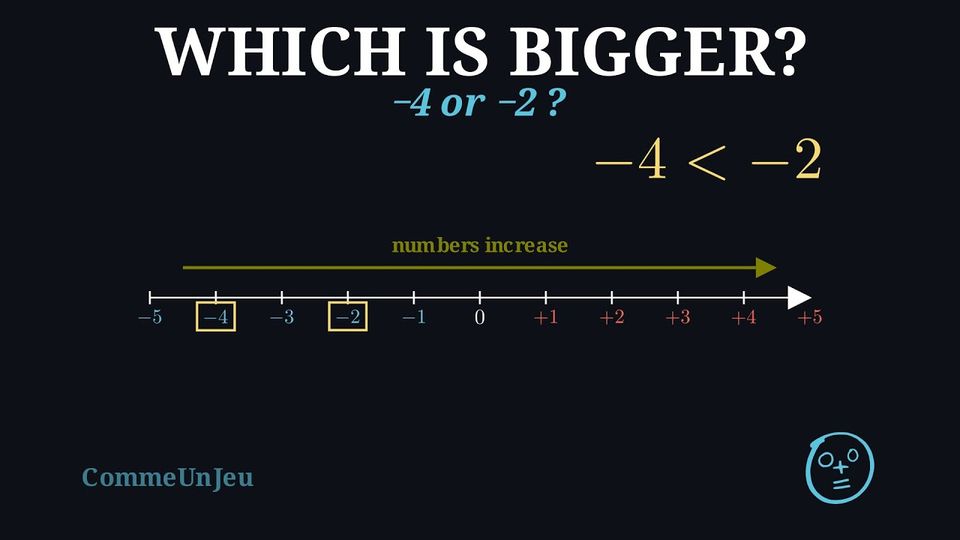
Which is larger, \(\textcolor{colorprop}{-4}\) or \(\textcolor{colorprop}{-2}\)? Tom says \(\textcolor{colorprop}{-4}\), because \(4\) is larger than \(2\). Use the number line to decide. 
Along the number line, from left to right, the numbers increase: $$\dots\lt\textcolor{colorprop}{-3}\lt\textcolor{colorprop}{-2}\lt\textcolor{colorprop}{-1}\lt 0 \lt \textcolor{colordef}{+1}\lt\textcolor{colordef}{+2}\lt\textcolor{colordef}{+3}\lt\dots $$ 
\(\textcolor{colorprop}{-2}\) is to the right of \(\textcolor{colorprop}{-4}\), so \(\textcolor{colorprop}{-2}\) is the larger: \(\textcolor{colorprop}{-4}\lt \textcolor{colorprop}{-2}\). Tom is wrong: of two negative numbers, the greater is the one closer to zero.
- In the same way, \(\textcolor{colordef}{+3}\) is to the right of \(\textcolor{colorprop}{-5}\), so \(\textcolor{colorprop}{-5} \lt \textcolor{colordef}{+3}\): a positive number is greater than a negative number.
- \(\textcolor{colordef}{+6}\) is to the right of \(\textcolor{colordef}{+4}\), so \(\textcolor{colordef}{+4}\lt \textcolor{colordef}{+6}\): of two positive numbers, the greater is the one further from zero.
Method — Comparing Two Numbers
- When one number is positive and the other is negative (both nonzero), the positive number is greater.
- When both numbers are negative, the number closer to zero is greater (the number with the smaller distance to zero is greater).
- When both numbers are positive, the number further from zero is greater (the number with the greater distance to zero is greater).
- \(0\) is greater than every negative number and less than every positive number.
- When the two numbers are equal, neither is greater: we write \(a = b\).

Example
Compare \(\textcolor{colorprop}{-4}\) and \(\textcolor{colordef}{+3}\). - As \(\textcolor{colordef}{+3}\) is positive and \(\textcolor{colorprop}{-4}\) is negative, the positive number is greater than the negative number: \(\textcolor{colorprop}{-4}\lt \textcolor{colordef}{+3}\).
-

Method — Ordering Several Integers
- Separate the negatives, zero, and the positives: every negative is smaller than \(0\), and \(0\) is smaller than every positive.
- Order the negatives between themselves with their distances to zero: the negative with the larger distance to zero is the smaller number.
- Order the positives as usual, like whole numbers.
- Write the chain in increasing order (increasing: from smallest to largest) or decreasing order.
Example
Order in increasing order: \(+3\), \(-5\), \(0\), \(-2\), \(+1\).
The negatives come first: \(-5\) is \(5\) from zero and \(-2\) is \(2\) from zero, so \(-5 < -2\). Then zero, then the positives \(+1 < +3\): $$-5 < -2 < 0 < +1 < +3.$$
Skills to practice
- Comparing Small Integers
- Comparing Integers
- Comparing Integers in Real-World Problems
- Ordering Integers: Level 1
- Ordering Integers: Level 2
V
Review & Quizz
Skills to practice
- Quiz
Jump to section