International Baccalaureate · PYP 5
Area
I
Area of a Triangle
Proposition — Area Formulas
To find the area of a rectangle, multiply its length by its width. To find the area of a square, multiply the side length by itself. | Shape | Diagram | Area Formula |
| Rectangle | 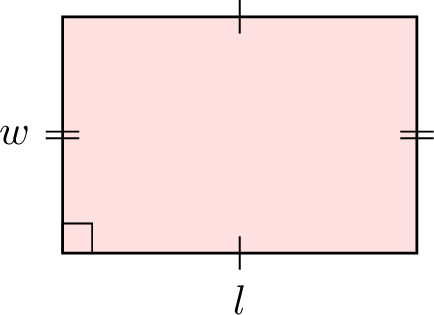 | \(A = l \times w\) |
| Square | 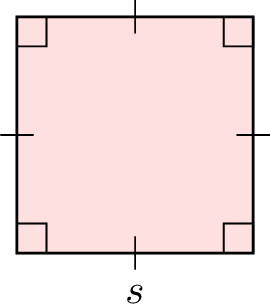 | \(A = s \times s\) |
To find the area of a triangle, we draw a copy of it and cut the copy along the dashed height: the two pieces fill the rest of the rectangle around the triangle, so this rectangle has twice the area of the triangle. Here is how it works, step by step, with the triangle below: 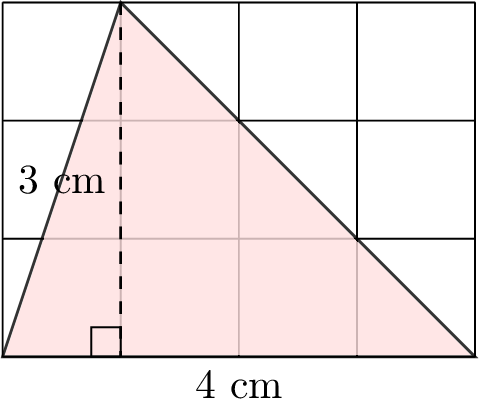
- Draw a copy of the triangle and cut it along the dashed height: the two pieces fill the rectangle around it.
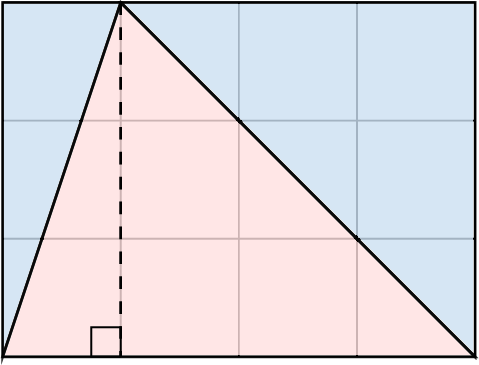
- The area of the rectangle is the length multiplied by the height: \(4 \times 3 = 12 \,\text{cm}^2\). Since the area of the rectangle is equal to twice the area of the original triangle, the area of the triangle is half the area of the rectangle: $$ \begin{aligned} A_\triangle &= \dfrac{\text{base} \times \text{height}}{2}\\ &= \dfrac{4 \times 3}{2}\\ &= 6 \,\text{cm}^2 . \end{aligned} $$
Proposition — Area of a Triangle
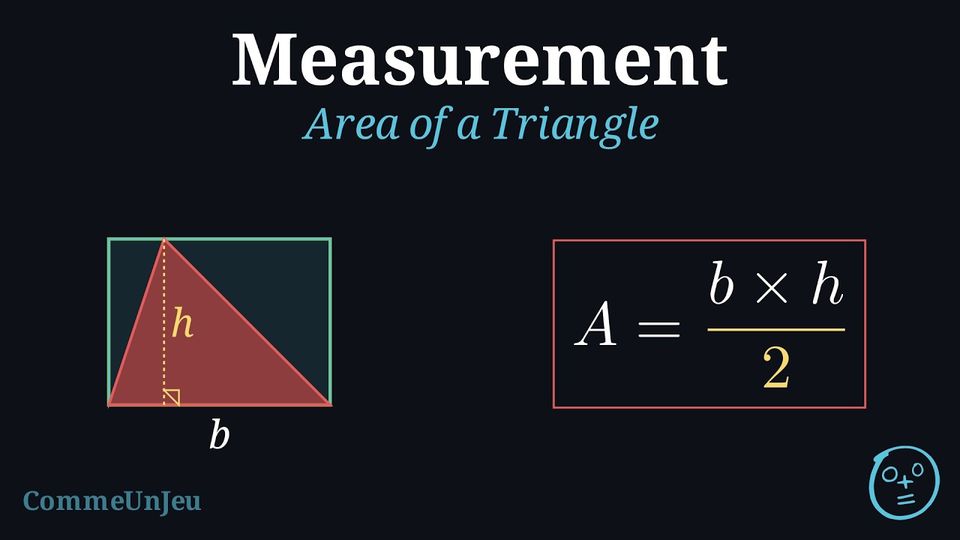
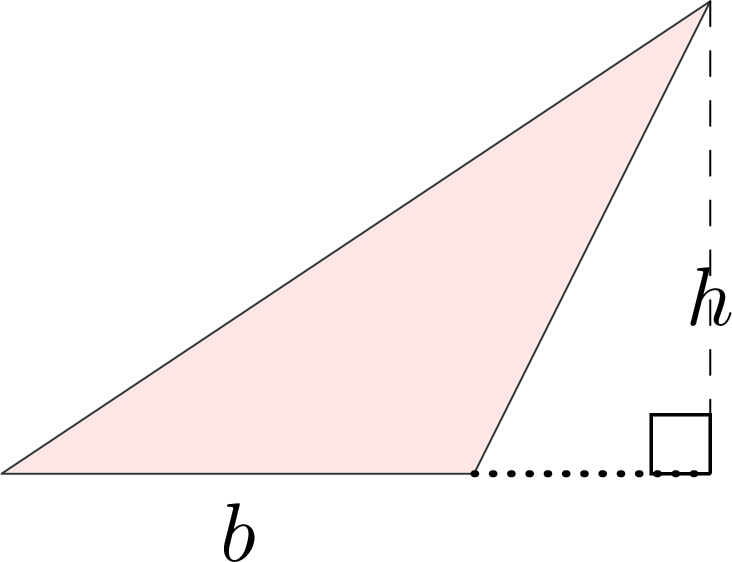
The area of a triangle is found by multiplying the base by the height and dividing by 2: $$\text{Area of a triangle} = \dfrac{\text{base} \times \text{height}}{2}$$ $$A = \dfrac{b \times h}{2}$$ where \(b\) is the length of the base and \(h\) is the corresponding height. The height can fall outside the triangle: the base is then extended with a dotted line, and the height meets this extension at a right angle (figure on the right). 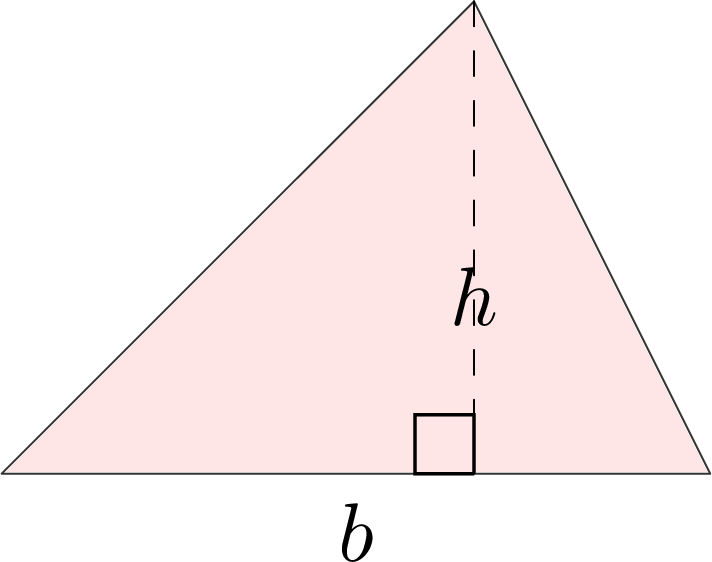
Example
Find the area of the triangle: 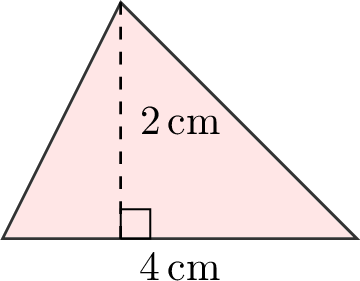
$$\begin{aligned}[t]A &= \dfrac{b \times h}{2} \\
&= \dfrac{4 \times 2}{2} \\
&= 4 \, \text{cm}^2\end{aligned}$$ So, the area of the triangle is \(4 \,\text{cm}^2\).
Skills to practice
- Finding Areas of Triangles
II
Area of Composite Figures
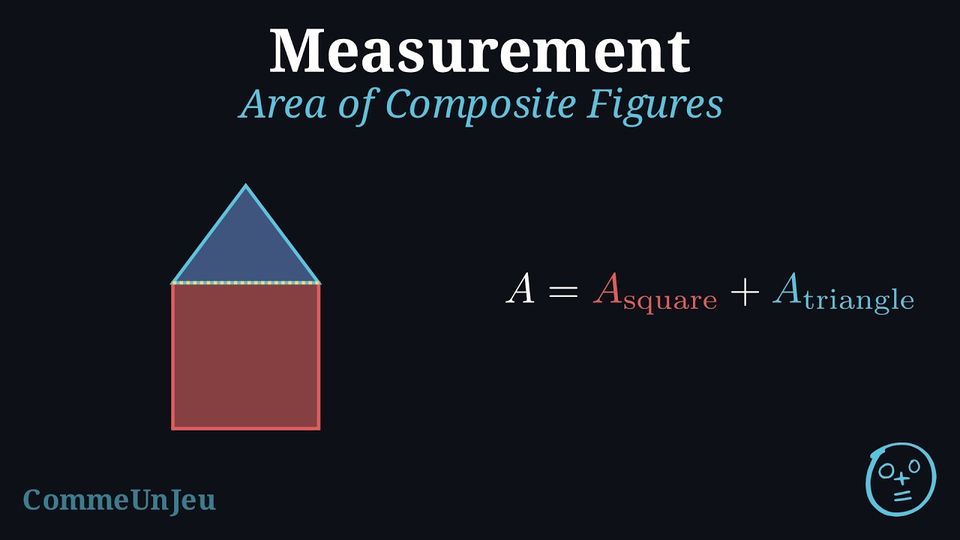
Method — Finding the Area of a Composite Figure
To find the area of a composite figure, follow these steps: - Divide the figure into simple, non-overlapping shapes whose area can be calculated with a formula (rectangles, squares, triangles, …).
- Find the area of each simpler shape using the appropriate formula.
- Add the areas together to find the total area of the composite figure, or, when a part is missing from a rectangle, subtract its area from the area of the rectangle.
Example
Find the area of the composite figure below, which is made up of a square and a triangle: 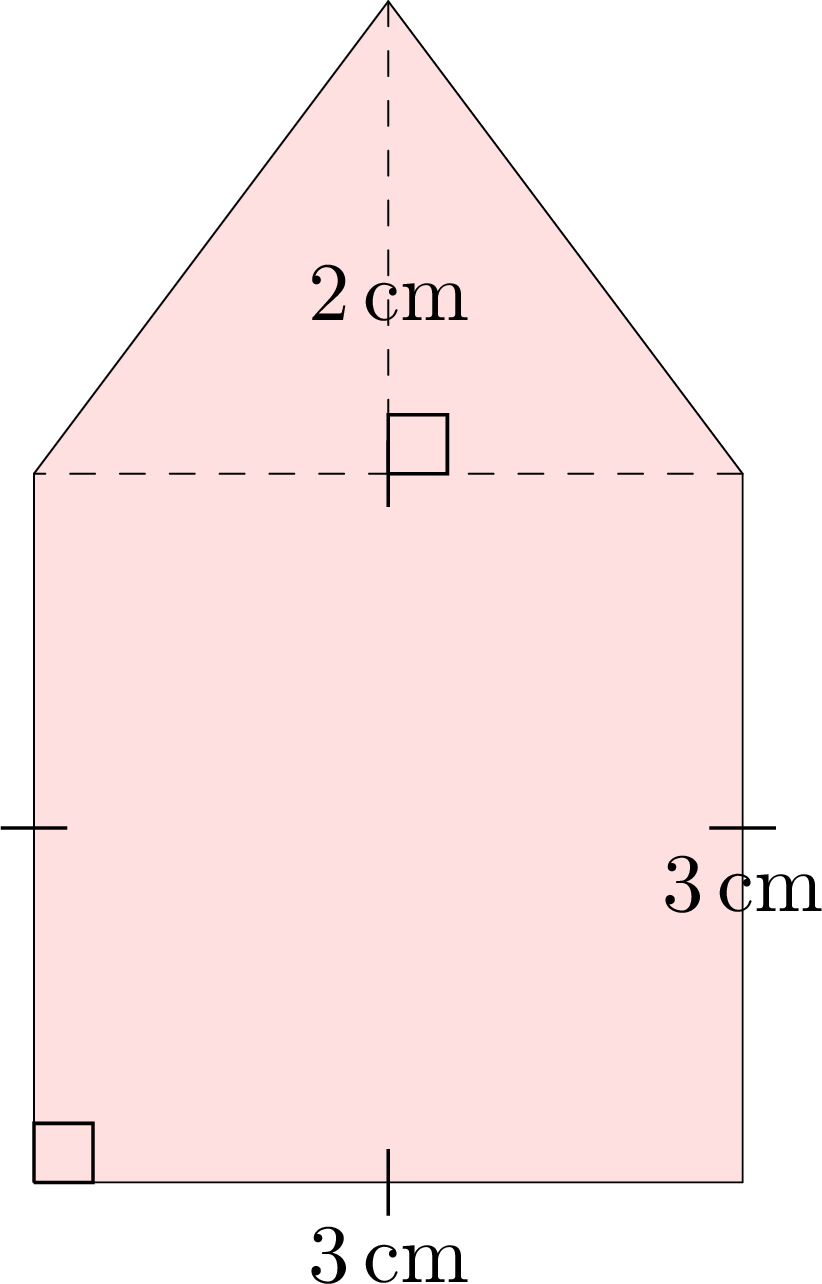
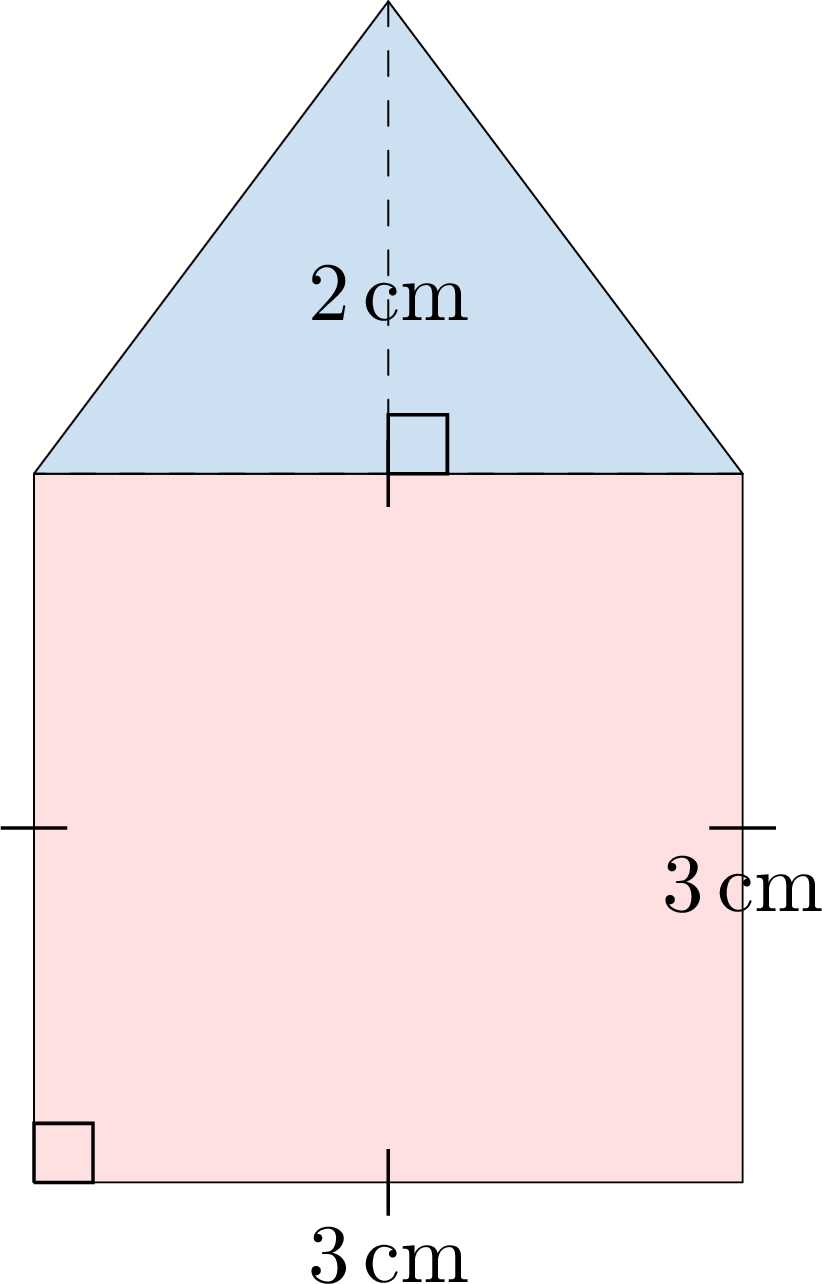
Skills to practice
- Finding Areas of Composite Figures
III
Units of Area from mm² to km²
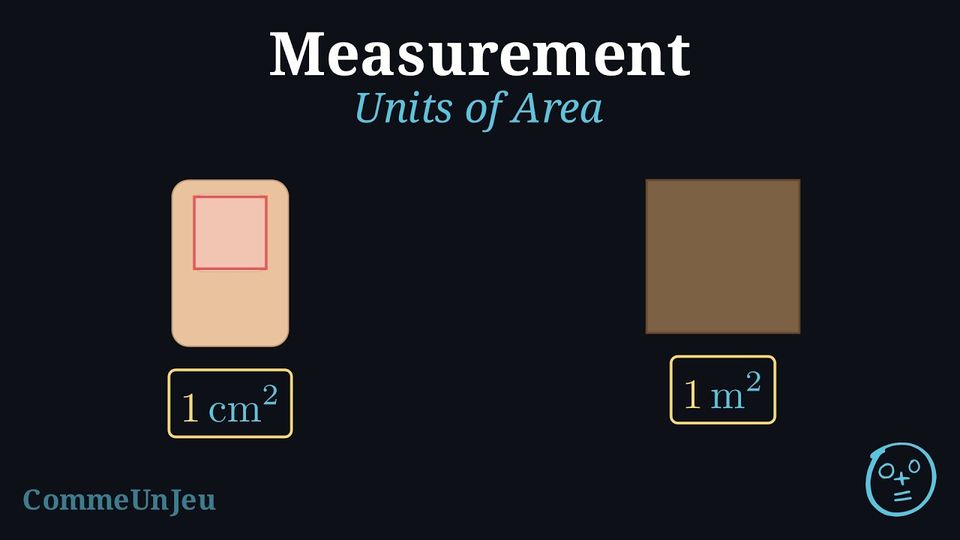
Definition — Units of Area
- Square centimetre \(\left(\mathrm{cm}^2\right)\): The area of a square that is 1 cm on each side. This is about the size of your thumbnail. We write this as \(1\;\text{cm}^2\).

- Square metre \(\left(\mathrm{m}^2\right)\): The area of a square that is 1 m on each side. This is about the size of the top of a small square table. We write this as \(1\;\text{m}^2\).
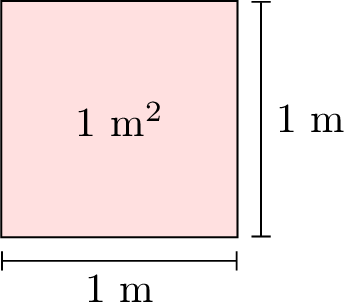
Definition — The Units of Area, from mm² to km²
Area is measured in square units. The standard units are based on the metric system. - Square Kilometre (\(\mathrm{km}^2\)): The area of a square with sides 1 km long. Used for very large areas like cities or national parks.
- Square Metre (\(\mathrm{m}^2\)): The area of a square with sides 1 m long. Used for areas like rooms, gardens, or classrooms.
- Square Centimetre (\(\mathrm{cm}^2\)): The area of a square with sides 1 cm long. Used for small surfaces like stamps, passport photos or the cover of a book.
- Square Millimetre (\(\mathrm{mm}^2\)): The area of a square with sides 1 mm long. Used for very tiny areas.
Skills to practice
- Choosing Units for Area
IV
Conversion of Area Units
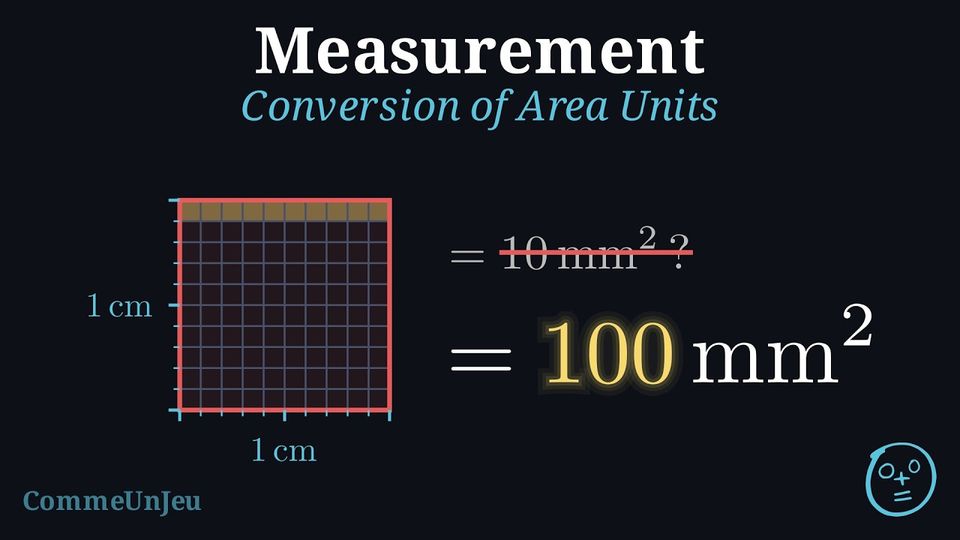
Here is how area units are related. Consider a square with an area of 1 cm\(^2\). Since 1 cm = 10 mm, each side of this square is 10 mm long. 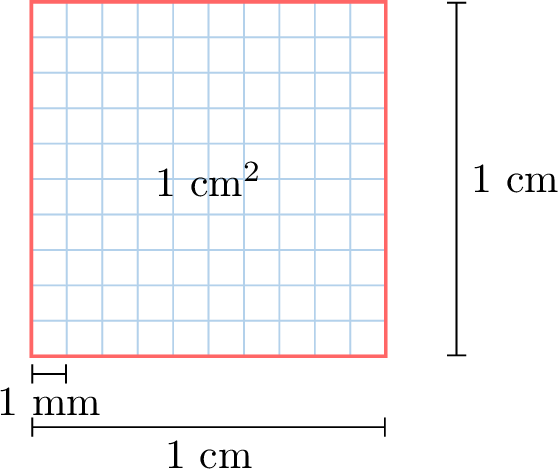
Each small square is 1 mm\(^2\). To find the area in mm\(^2\), we multiply its length in mm by its width in mm: $$ \begin{aligned} 1 \, \mathrm{cm}^2 &= 1 \, \mathrm{cm} \times 1 \, \mathrm{cm} \\
&= 10 \, \mathrm{mm} \times 10 \, \mathrm{mm} \\
&= 100 \, \mathrm{mm}^2 \end{aligned} $$ So, 1 cm\(^2\) is equal to 100 mm\(^2\). The conversion factor is squared: \(10 \times 10 = 100\).
Proposition — Conversion of Area Units
Because we multiply two lengths to get an area, the conversion factors are squared. - \(1 \, \text{cm} = 10 \, \text{mm}\), so \(1 \, \text{cm}^2 = (10 \times 10) \, \text{mm}^2 = \mathbf{100} \, \text{mm}^2\)
- \(1 \, \text{m} = 100 \, \text{cm}\), so \(1 \, \text{m}^2 = (100 \times 100) \, \text{cm}^2 = \mathbf{10\,000} \, \text{cm}^2\)
- \(1 \, \text{km} = 1\,000 \, \text{m}\), so \(1 \, \text{km}^2 = (1\,000 \times 1\,000) \, \text{m}^2 = \mathbf{1\,000\,000} \, \text{m}^2\)
Method — Converting Using Multiplication or Division
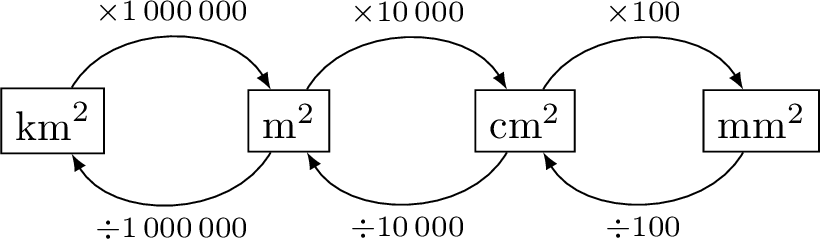
- Use multiplication to go from a larger unit to a smaller one (like square metres to square centimetres).
- Use division to go from a smaller unit to a larger one (like square centimetres to square metres).
Skills to practice
- Converting Area Units
- Converting Area Units with Decimal Numbers
V
Going further
Skills to practice
- Reasoning and Solving Problems about Area
- Quiz
Jump to section