International Baccalaureate · PYP 5
Transformations, Symmetry and Enlargement
I
Congruent Shapes
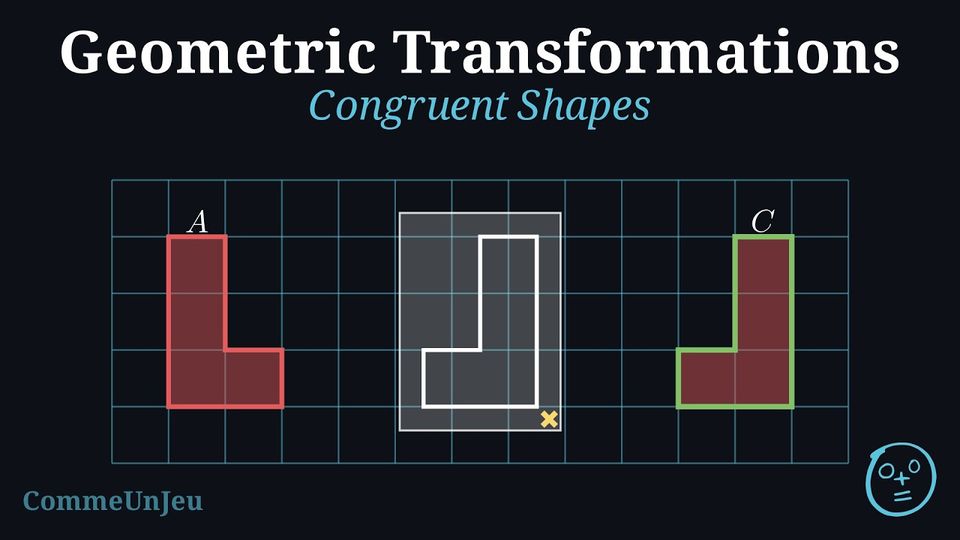
Every transformation follows a rule that sends each point of the figure to a point called its image. We sort transformations by what they keep the same: a translation, a rotation and a reflection keep the figure exactly the same size and shape. An enlargement or a reduction keeps the same shape but changes the size.
Definition — Congruent Shapes
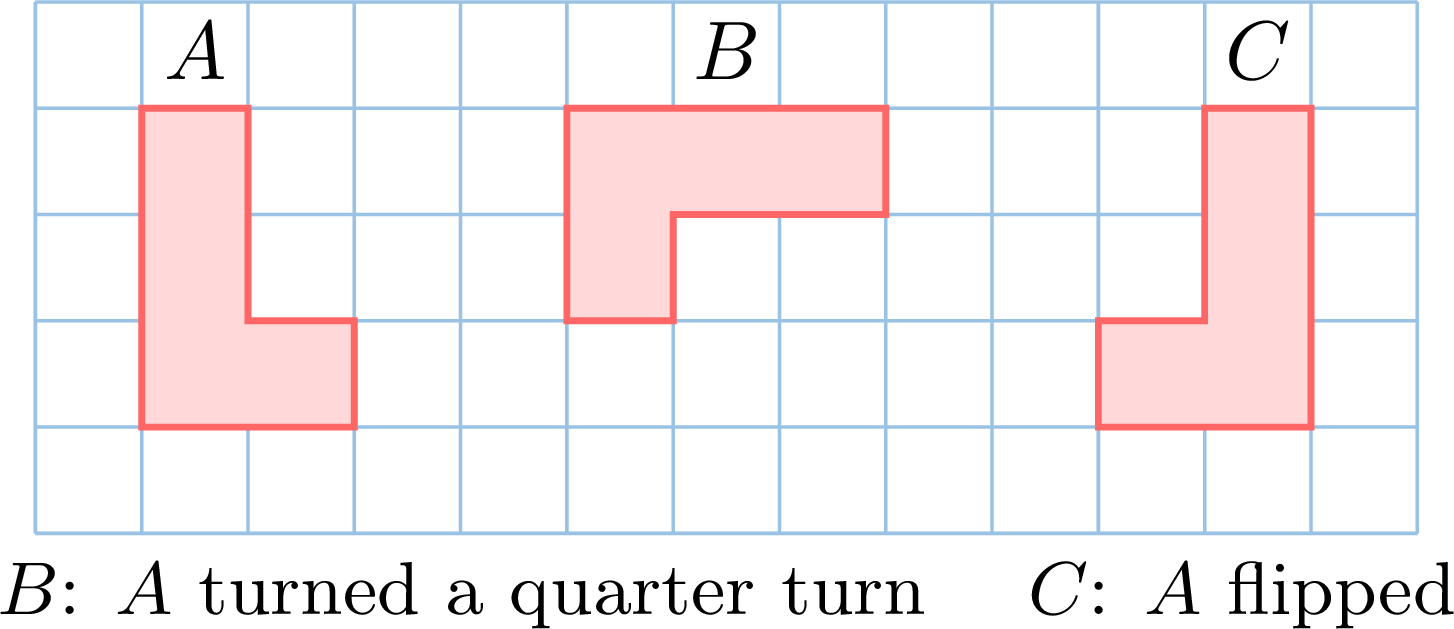
Two shapes are congruent when they have the same shape and the same size. One of them can then be moved exactly onto the other: it may be slid (a translation), turned (a rotation) or flipped (a reflection), as many times as needed, but it is never stretched and never shrunk.To check, trace one of the shapes on tracing paper, then move the tracing — slide it, turn it, turn it over — until it covers the other shape exactly.
Example
Which of the shapes \(P\), \(Q\), \(R\) and \(S\) are congruent to shape \(A\)? For each one, explain. 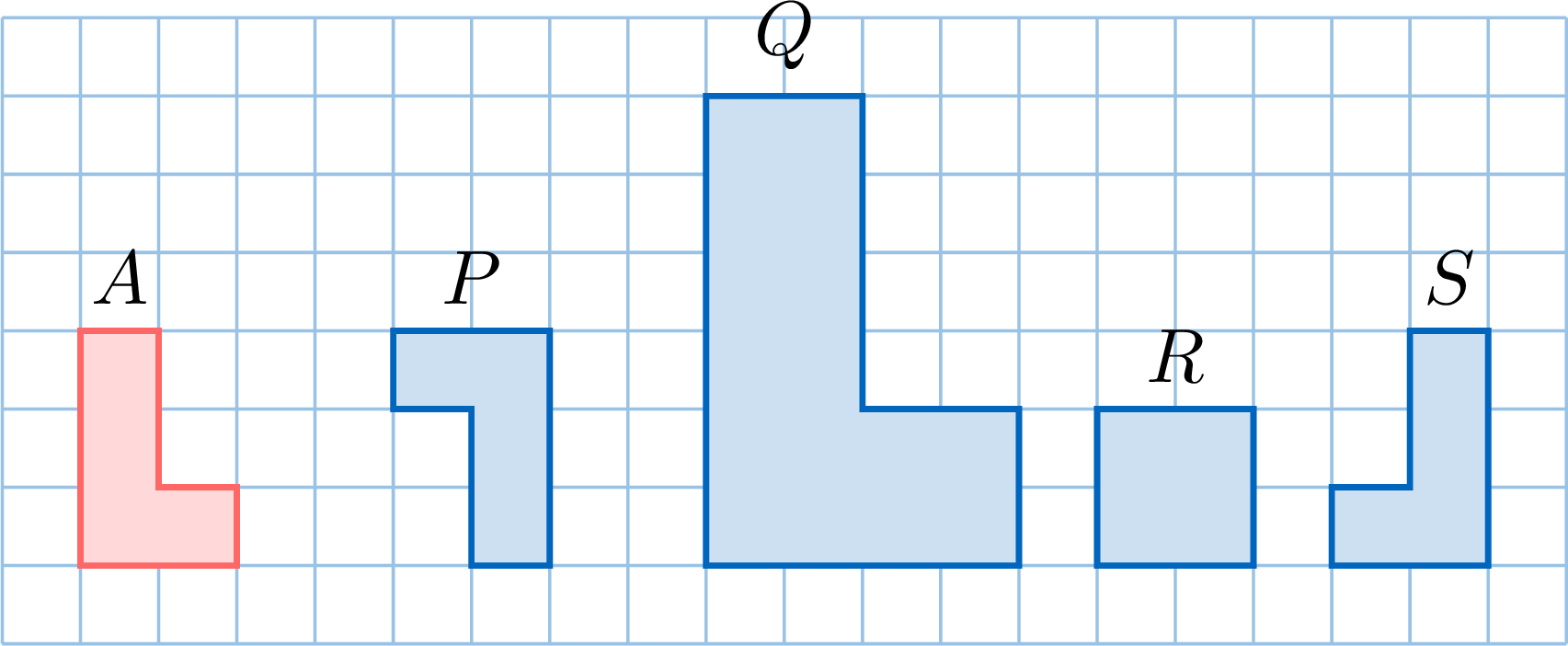
Shape \(A\) is made of \(4\) squares: a column of \(3\) squares with \(1\) more square at the bottom, on the right.
- \(P\) is congruent to \(A\): it is \(A\) turned a half turn (upside down). A tracing of \(A\), turned a half turn, covers \(P\) exactly.
- \(Q\) is not congruent to \(A\): it has the same shape, but every side is twice as long. It is an enlargement of \(A\): not the same size.
- \(R\) is not congruent to \(A\): it is also made of \(4\) squares, so it has the same area, but it is a square, not the shape of \(A\). No slide, turn or flip changes a square into \(A\).
- \(S\) is congruent to \(A\): it is \(A\) flipped, like its image in a mirror. The tracing of \(A\), turned over, covers \(S\) exactly.
Skills to practice
- Recognising Congruent Shapes
- Drawing and Justifying Congruent Shapes
II
Patterns
Definition — Pattern
A pattern is a design made by repeating the same move of a shape again and again: a slide, a flip or a turn (also called a translation, a reflection or a rotation). Skills to practice
- Drawing Patterns on Two Rows
III
Drawing the Mirror Image in a Diagonal Line
Method — Completing a Figure to Make it Symmetrical
The figure is drawn on squared paper, the axis is horizontal or vertical, and only half of the outline is there: it starts and stops on the axis. Completing it means adding the missing half so that the whole figure becomes symmetrical. - Look at the vertices already drawn. Those that sit on the axis do not move: they are their own mirror, and it is there that the two halves join.
- Mirror the others. For each one, count the squares to the axis, then place its mirror the same number of squares on the other side — without leaving its row if the axis is vertical, without leaving its column if it is horizontal.
- Join the new points in the same order as the ones already drawn, and close the figure on the vertices that sit on the axis.
Method — Drawing the Mirror Image in a Diagonal Line
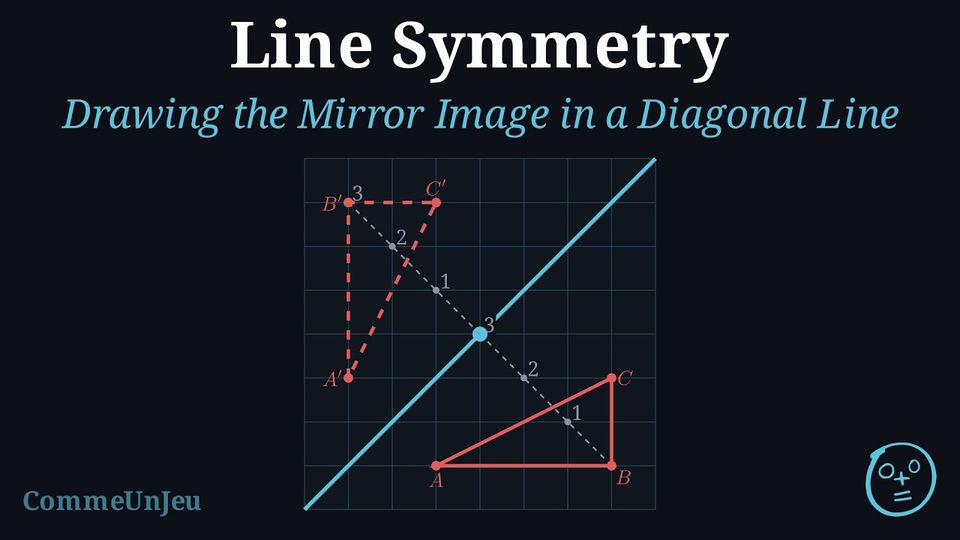
This time the line of symmetry (also called an axis of symmetry) is a diagonal of the squared paper: it runs from corner to corner of the squares. Counting squares along a row or a column no longer works, because the shortest path from a point to the line of symmetry is no longer sideways or straight up: it follows the other diagonal of the squares, the one that is perpendicular to the line of symmetry (the two diagonals of a square are perpendicular). So we count in diagonal steps: one step goes from a corner of a square to the opposite corner. 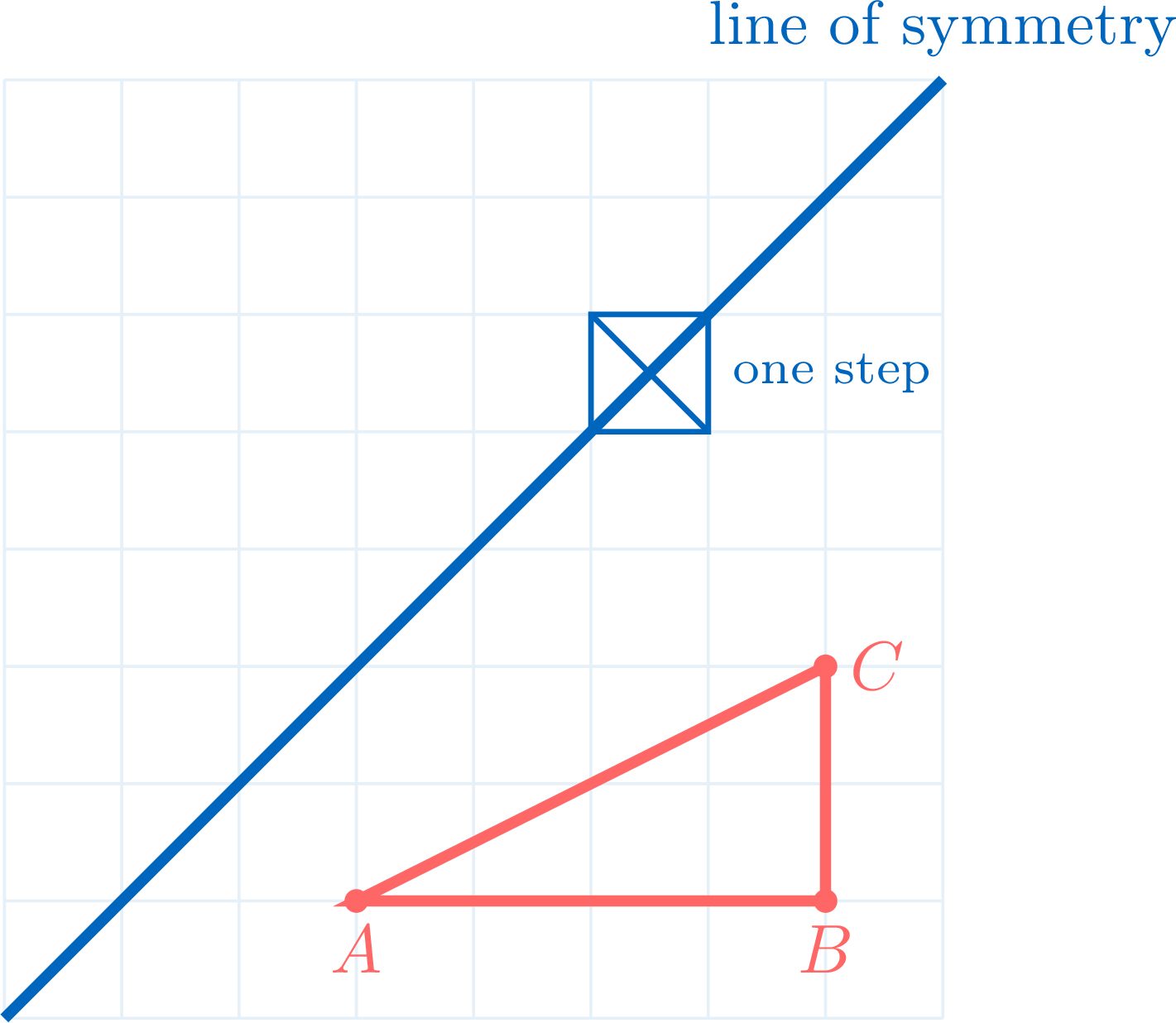
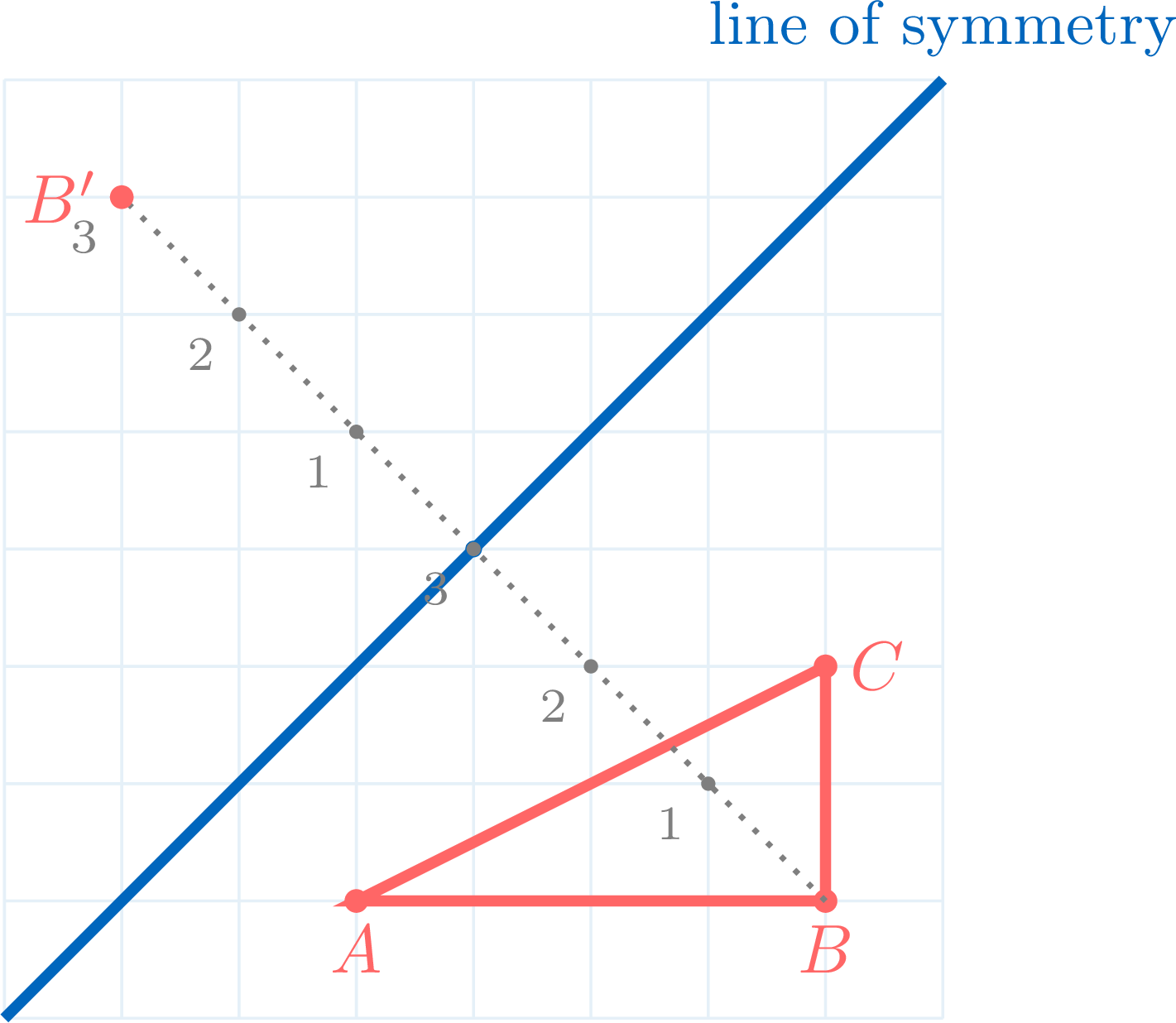
- Walk to the line of symmetry. From a vertex, go corner to corner along the diagonal that is perpendicular to the line of symmetry, and count the diagonal steps up to the line of symmetry. Here \(B\) reaches the line of symmetry in \(3\) steps. If the path meets the line of symmetry in the middle of a square, count half a step (one step and a half, for example).
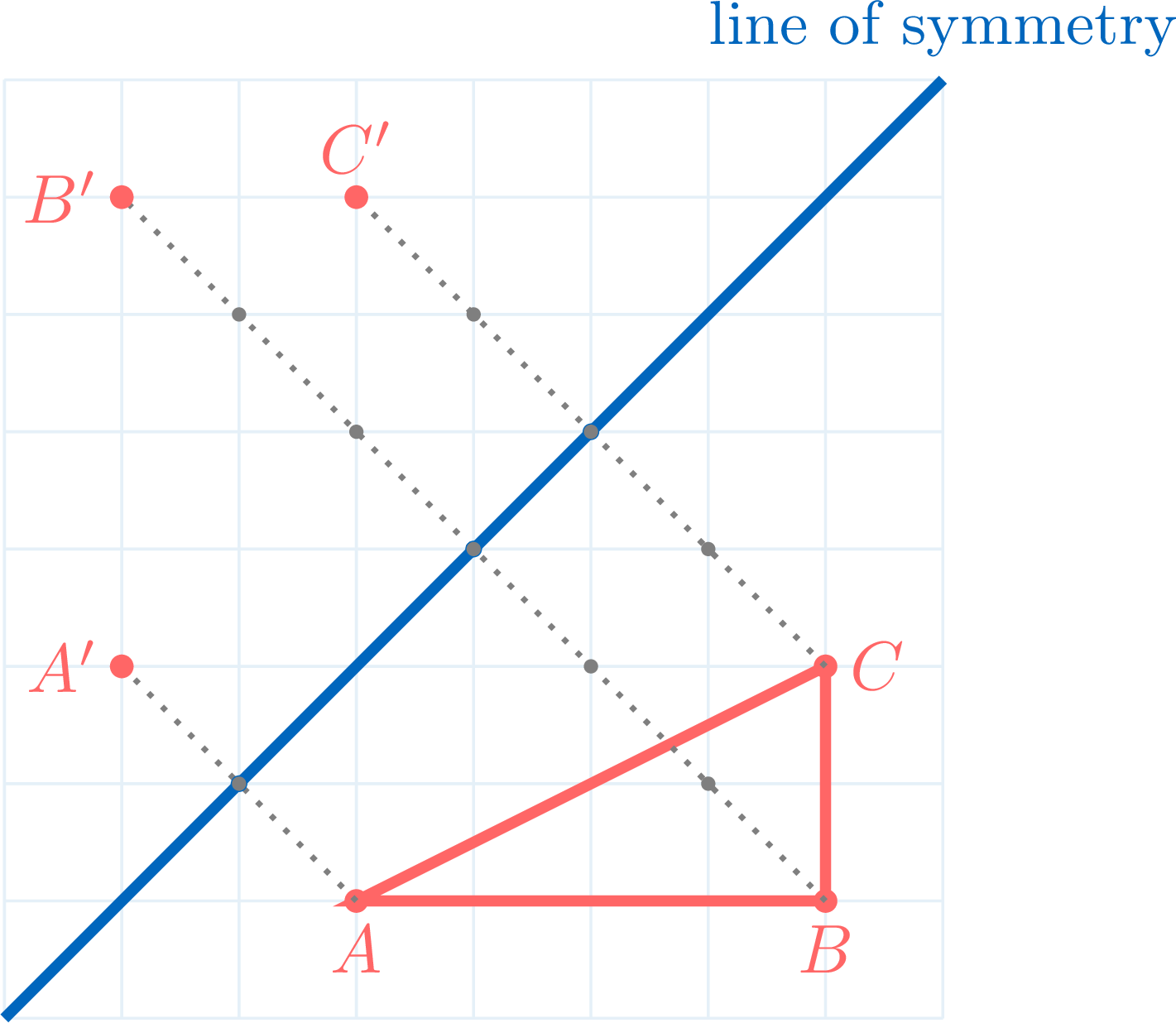
- Walk the same distance beyond. Keep going straight, the same number of diagonal steps on the other side: that is the mirror vertex \(B'\). Do the same for every vertex: \(A\) is \(1\) step from the line of symmetry, \(C\) is \(2\) steps.
- Join the mirror vertices in the same order as in the original figure.
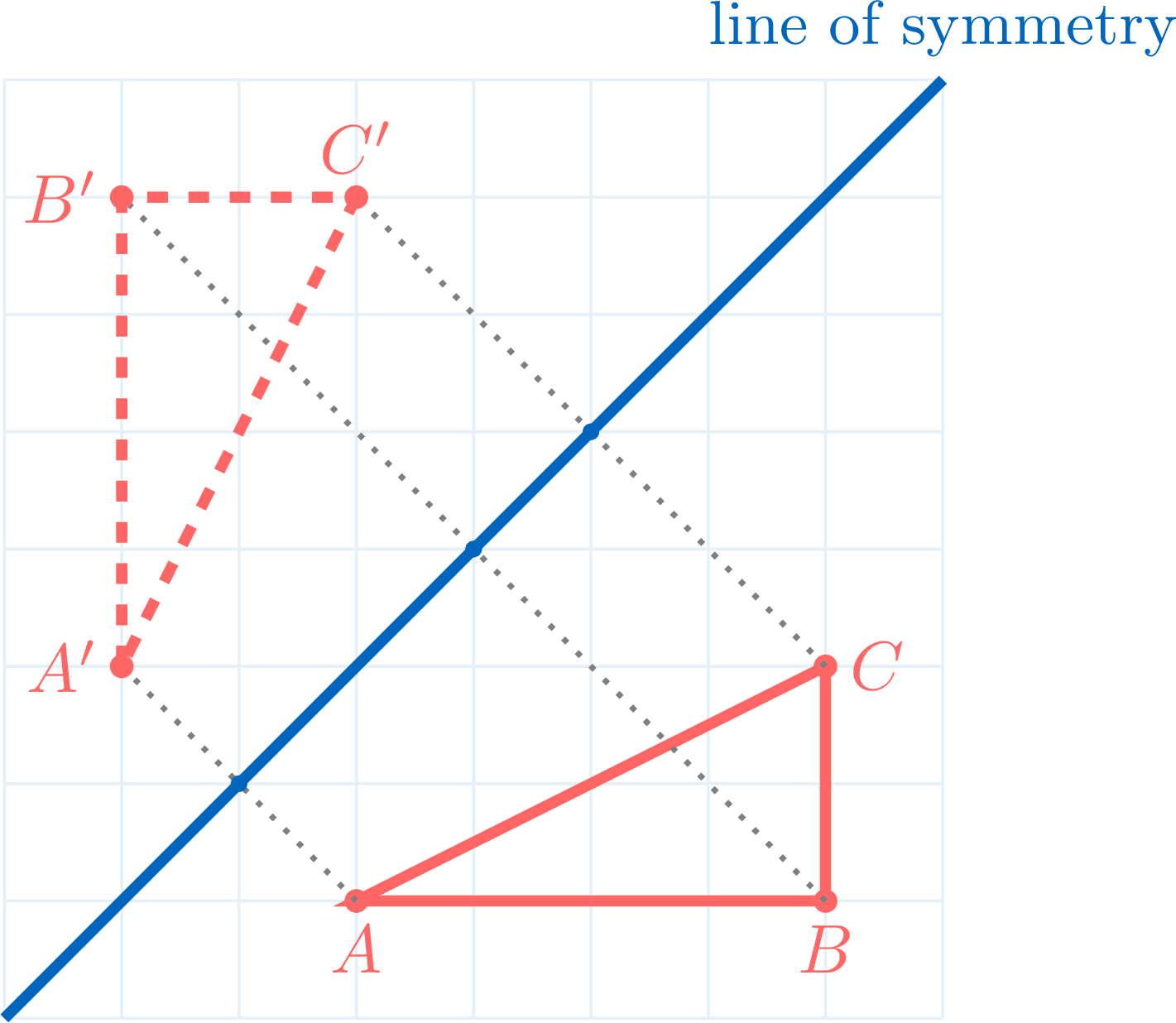
A mirror is not a slide. Inès copied the triangle on the other side of the line of symmetry without flipping it over (in grey): its horizontal side is still horizontal. That is a slid copy, not a mirror image. In the true mirror image (dashed), the horizontal side has become vertical, and each vertex sits on the diagonal path that goes through its original, at the same number of steps from the line of symmetry. 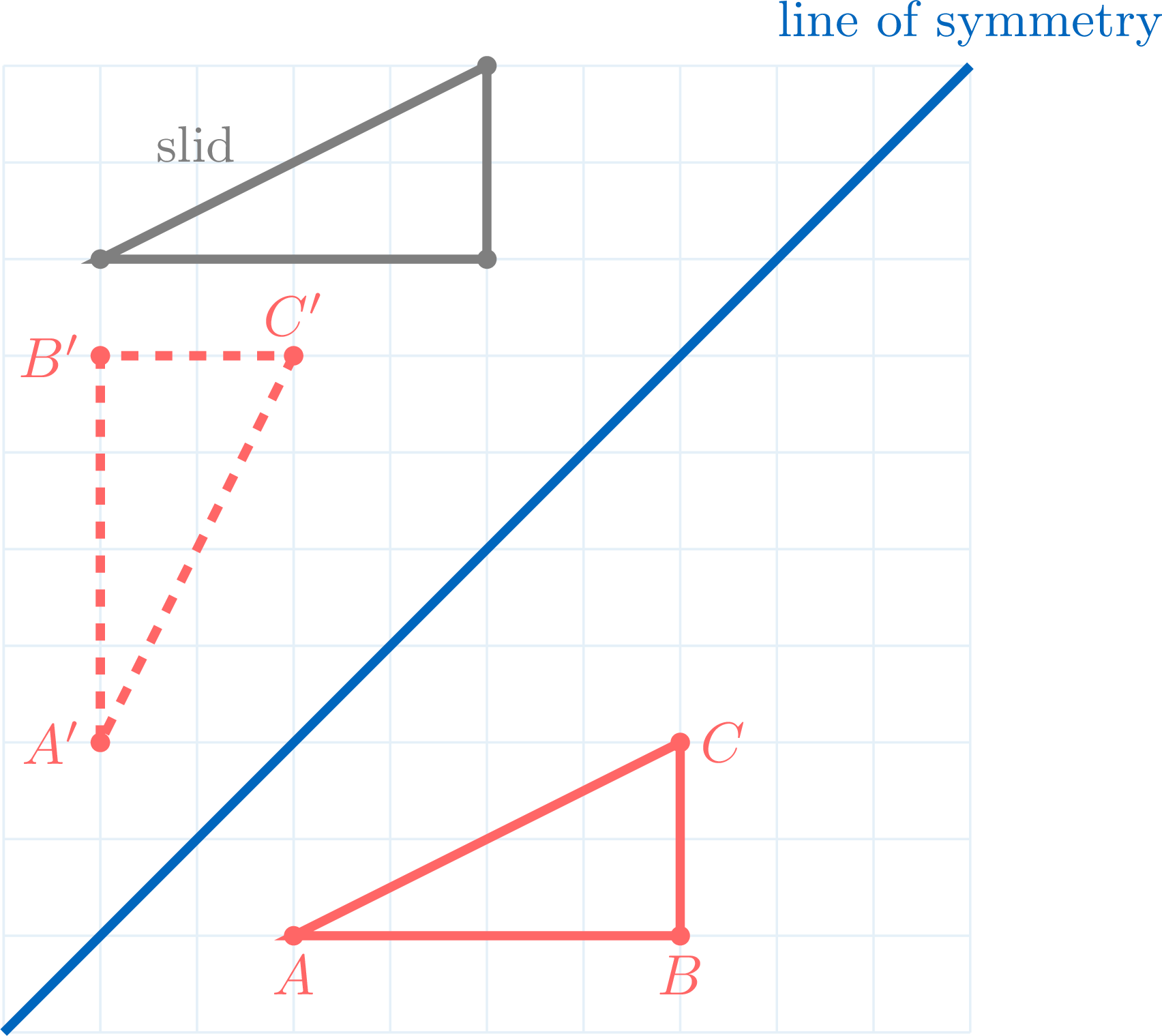
Example
Draw the mirror image of the quadrilateral \(ABCD\) in the diagonal line of symmetry. 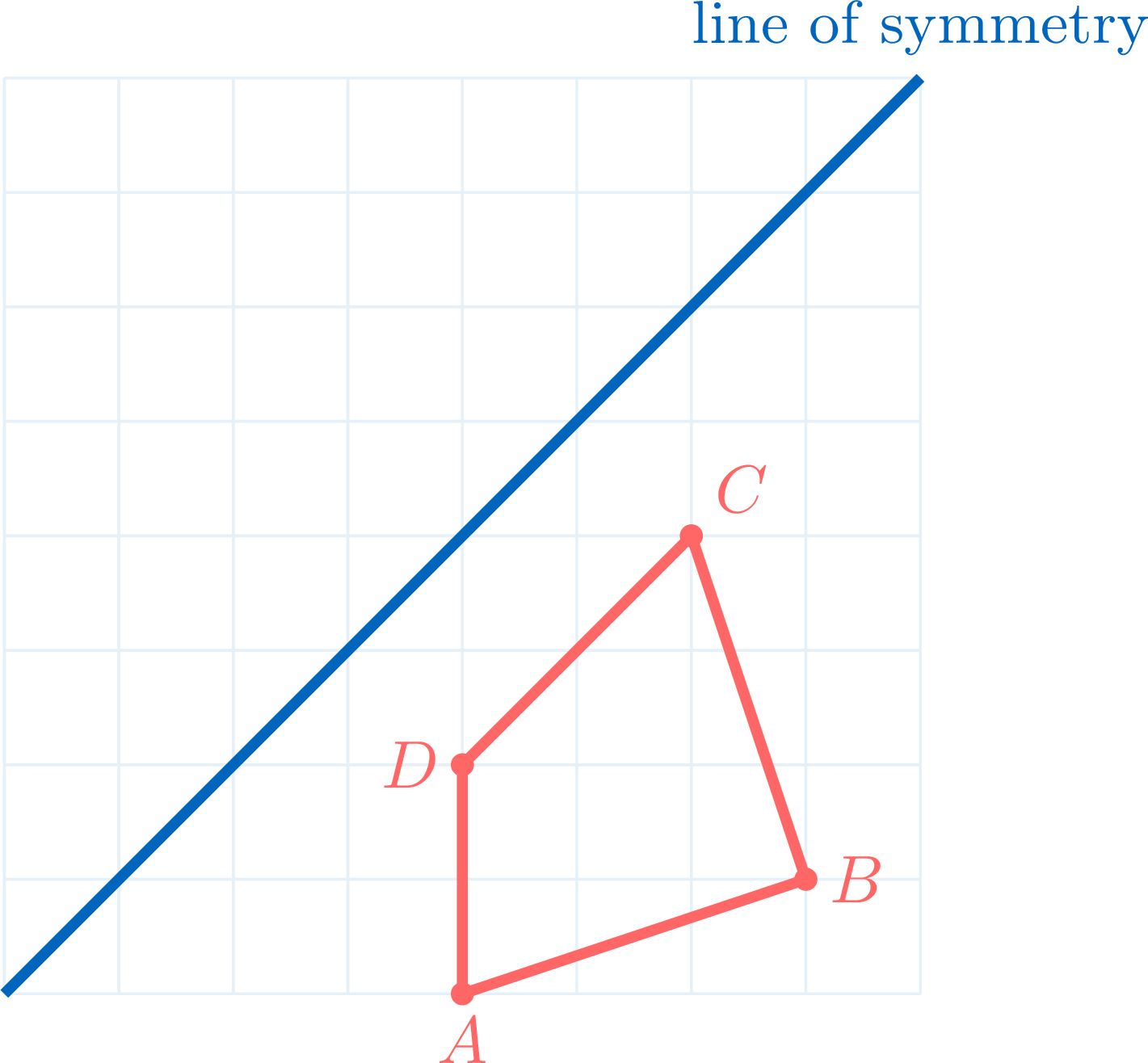
From each vertex we walk along the diagonal perpendicular to the line of symmetry: \(A\) reaches the line of symmetry in \(2\) steps, \(B\) in \(3\), \(C\) in \(1\), \(D\) in \(1\). Each mirror vertex is the same number of steps beyond the line of symmetry. Joining \(A'\), \(B'\), \(C'\), \(D'\) in the same order gives the mirror image. Check: the vertical side \(AD\) has become the horizontal side \(A'D'\). 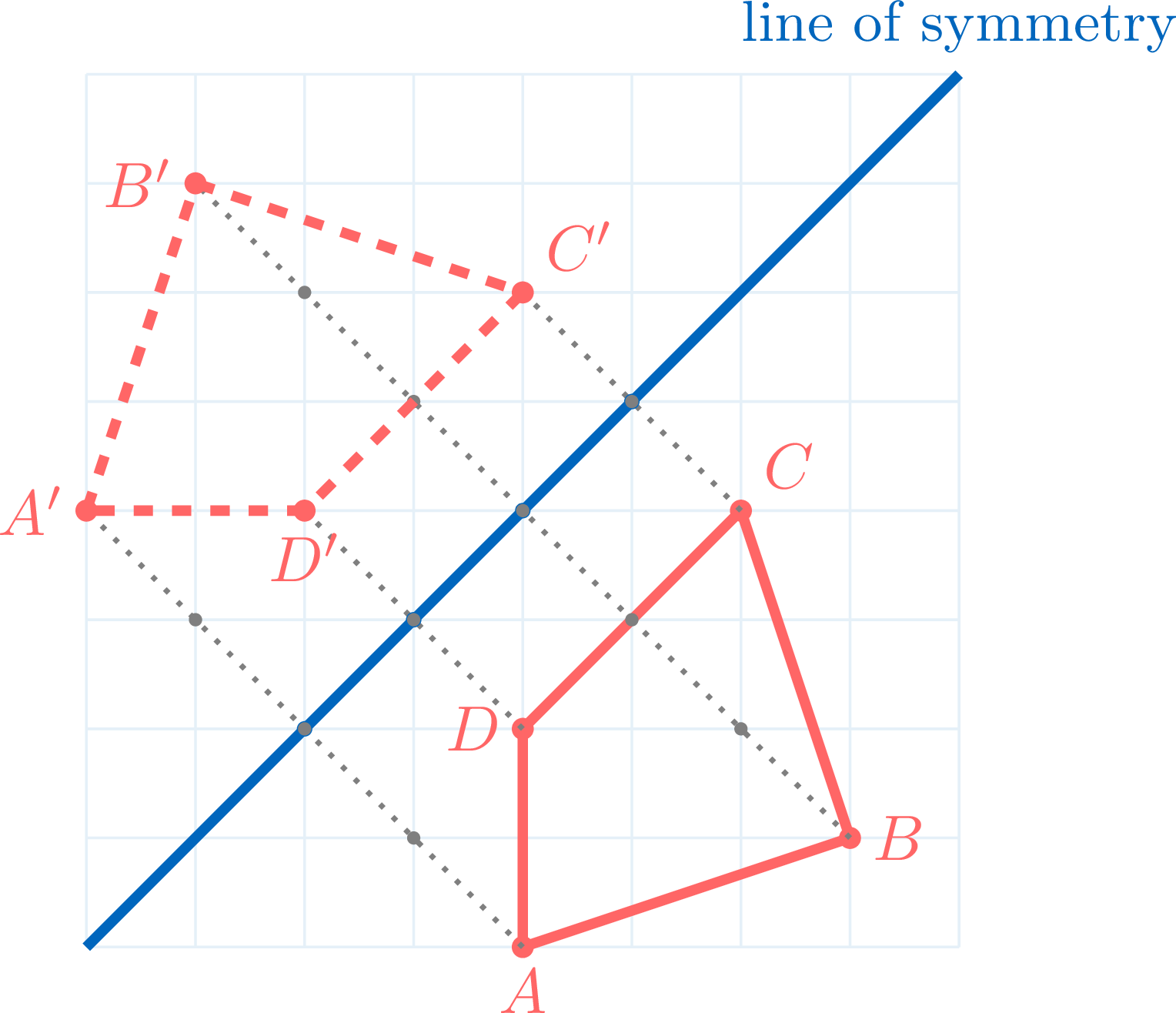
A quick check, when the line of symmetry climbs to the right. Choose a corner \(O\) on the line of symmetry. If a point \(M\) is \(3\) squares to the right and \(1\) square up from \(O\), its mirror \(M'\) is \(1\) square to the right and \(3\) squares up from the same corner: the two numbers swap. Useful to check a mirror vertex once it is drawn. 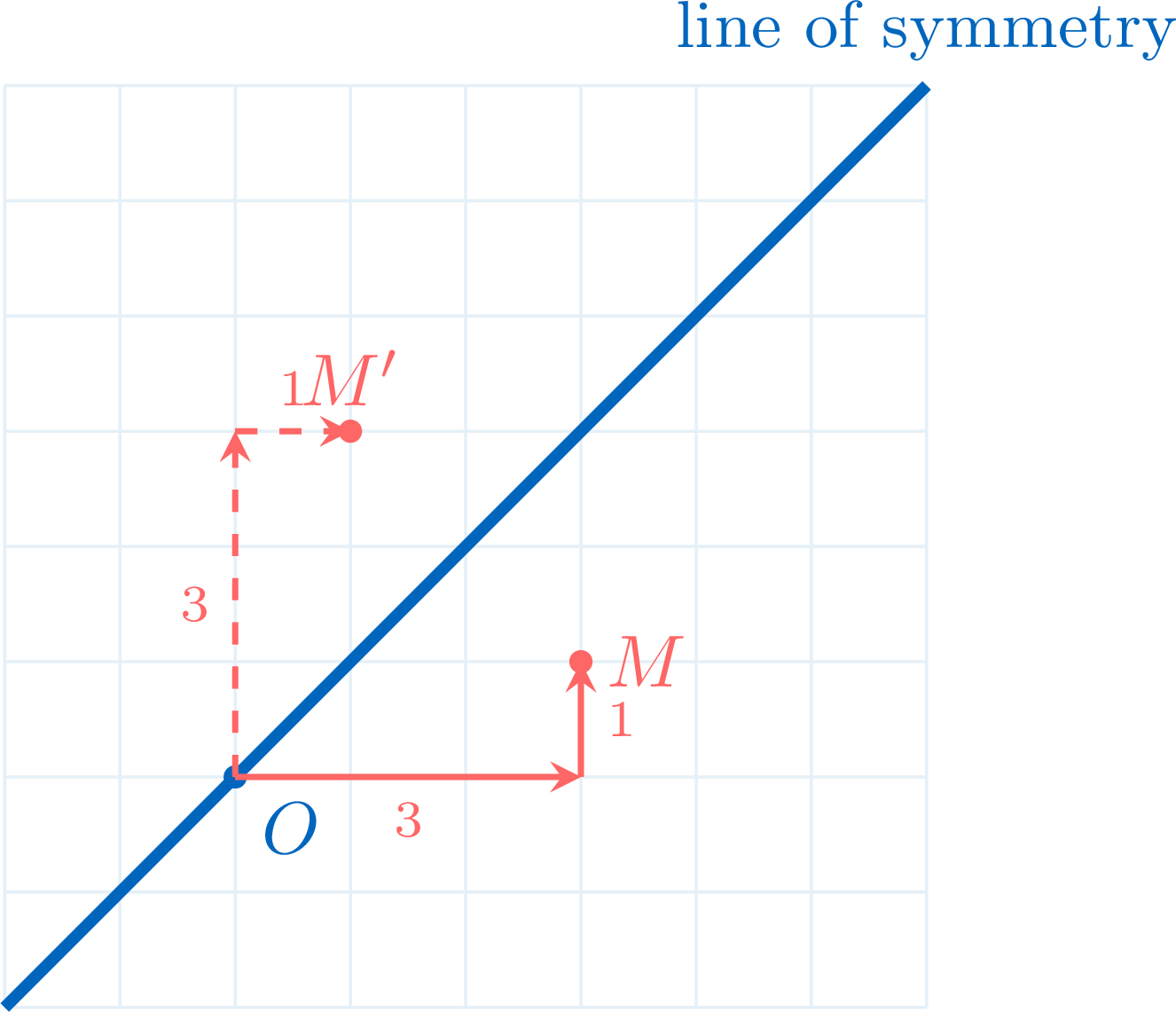
Example
Here the line of symmetry is the diagonal that goes down to the right. Draw the mirror image of the triangle \(PQR\). 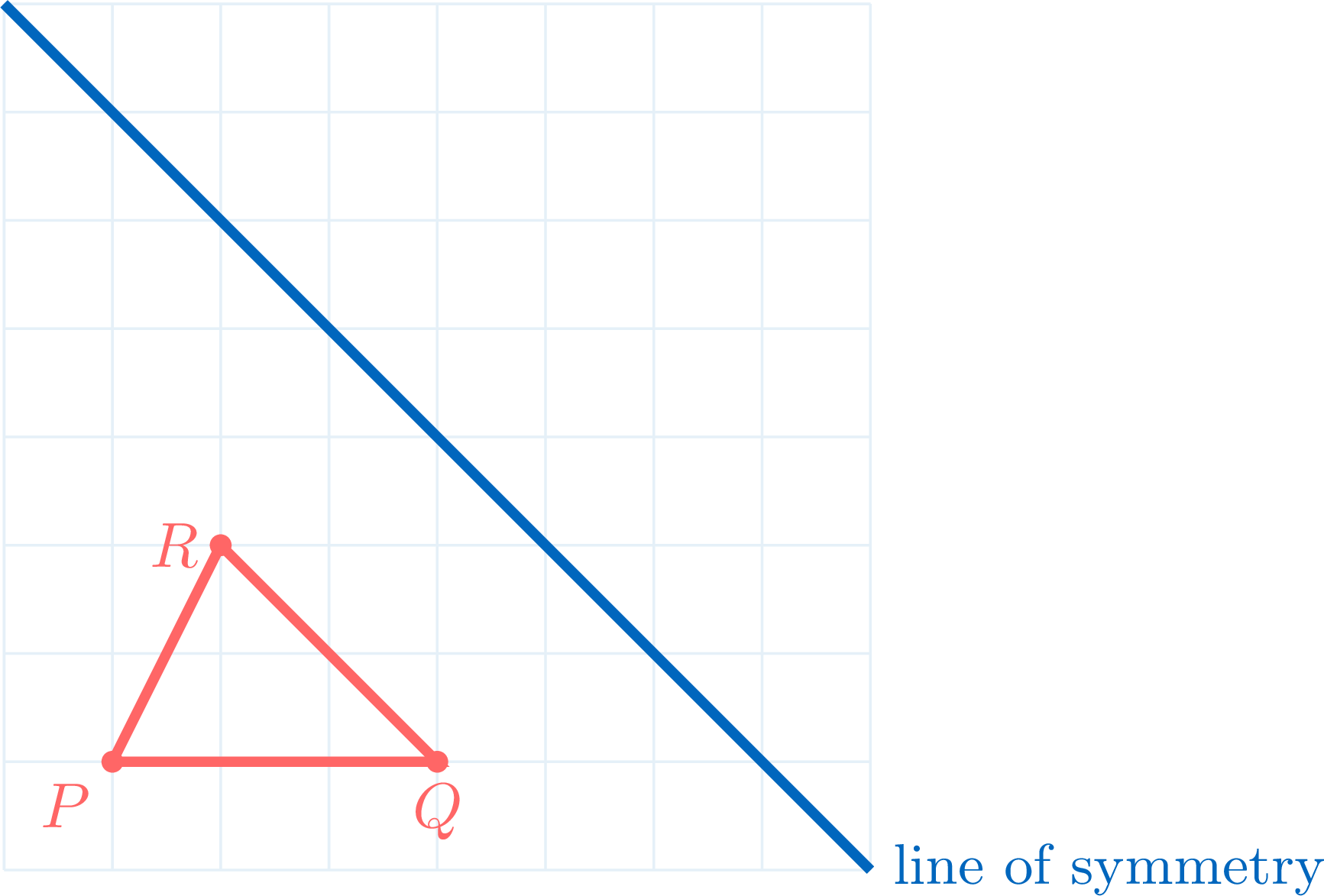
The path to the line of symmetry now follows the diagonal that climbs to the right. \(P\) reaches the line of symmetry in \(3\) steps, so \(P'\) is \(3\) steps beyond. From \(Q\), one step brings us to a corner, and the line of symmetry is crossed in the middle of the next square: \(Q\) is one step and a half from the line of symmetry. One step and a half beyond the line of symmetry lands on a corner again: that is \(Q'\). The same happens for \(R\). The horizontal side \(PQ\) has become the vertical side \(P'Q'\). 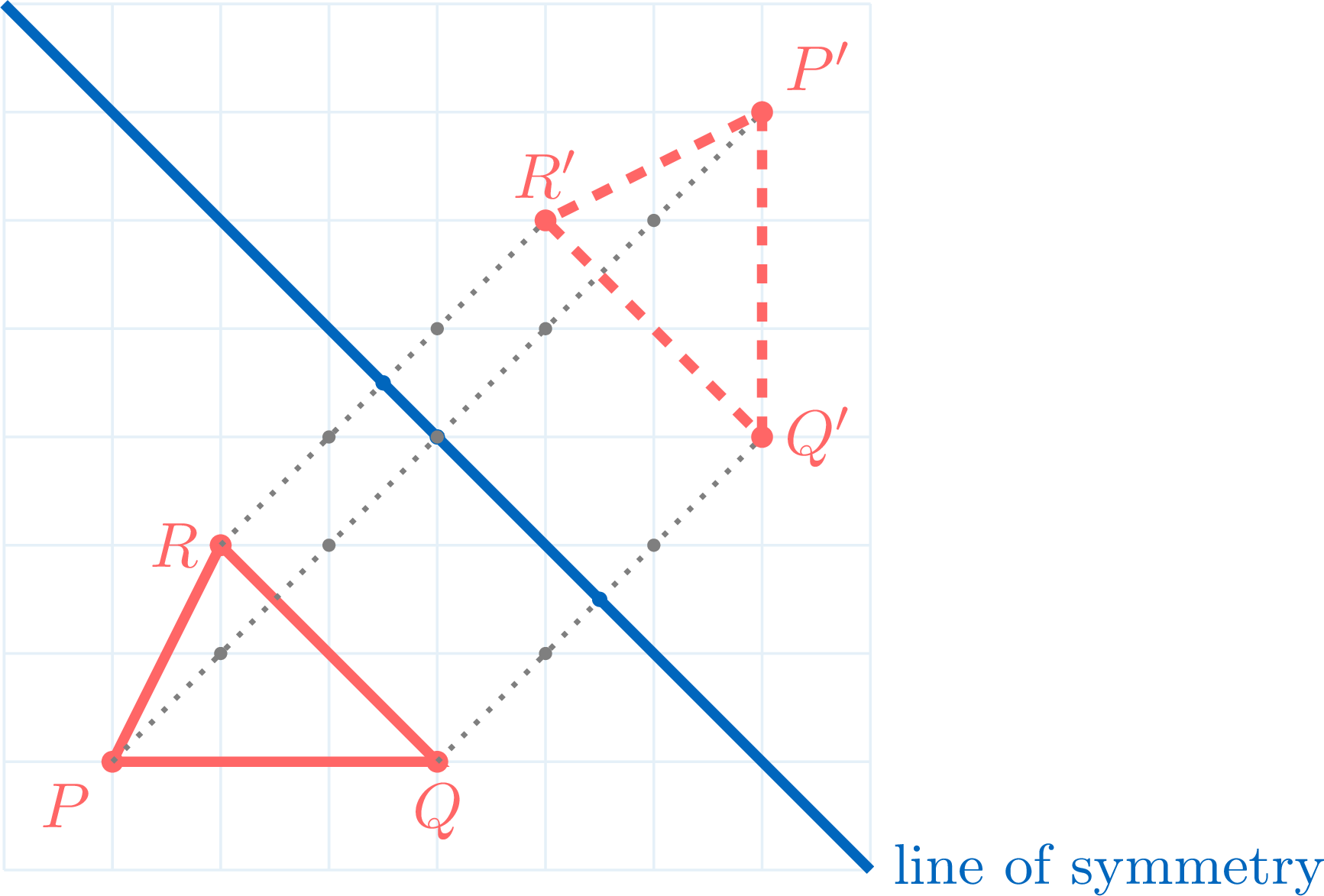
Skills to practice
- Counting Diagonal Steps to the Line of Symmetry
- Drawing the Mirror Image in a Diagonal Line
- Checking a Mirror Image in a Diagonal Line
IV
Rotational Symmetry
Definition — Rotational Symmetry
A shape has rotational symmetry when a turn about its centre, not zero and smaller than a full turn, maps it onto itself: after the turn, the shape fits exactly onto its own outline, and nobody could tell that it has been turned. 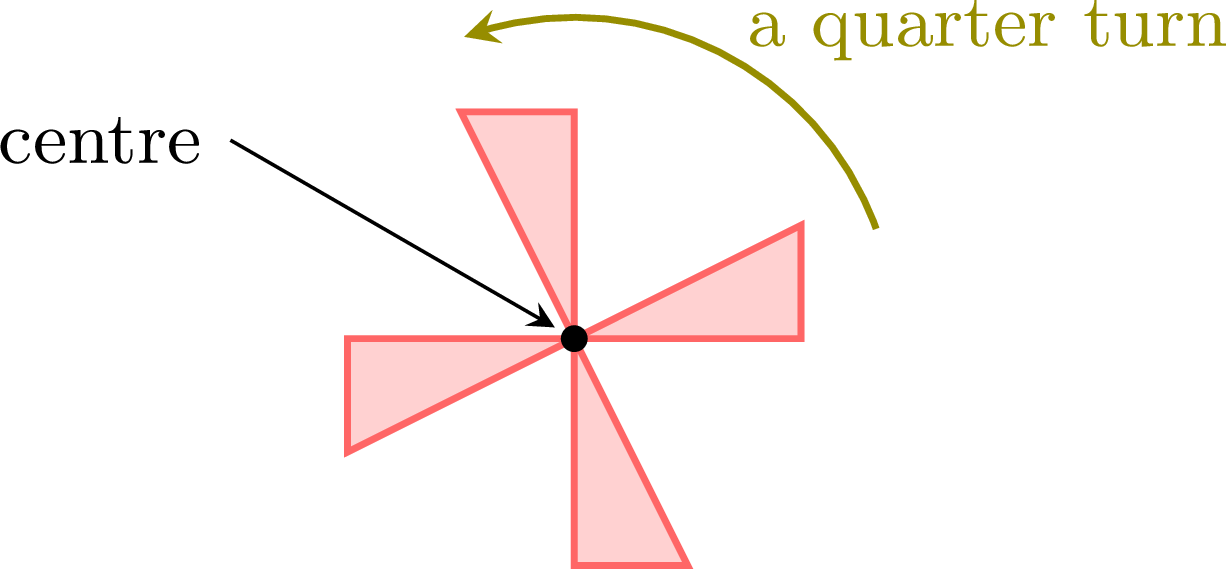
Definition — Order of Rotational Symmetry
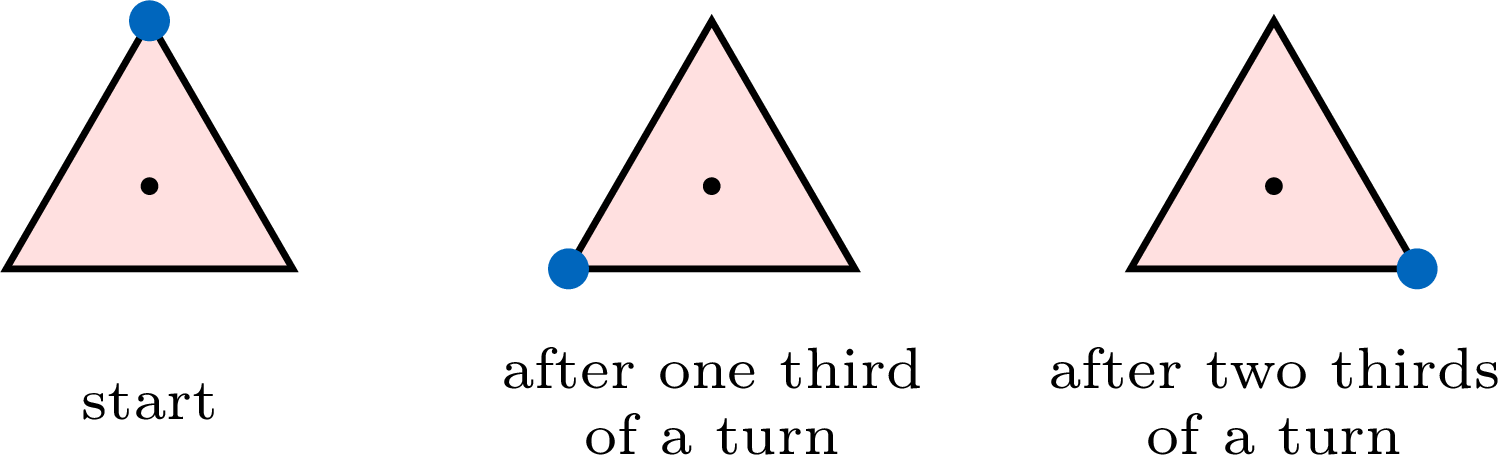
The order of rotational symmetry of a shape is the number of positions, during one full turn about its centre, in which the shape fits onto its outline. The starting position is counted once: it comes back at the end of the full turn.A shape that fits only in its starting position has order \(1\): it has no rotational symmetry.
Method — Finding the Order with Tracing Paper
- Trace the shape on tracing paper and mark one corner of the tracing with a small cross, to remember where it started.
- Hold the centre of the shape with the point of a pencil, through the tracing.
- Turn the tracing slowly, always in the same direction, and count each position in which it covers the shape exactly. Do not count the start: it is counted at the end, when the cross comes back.
- Stop when the cross is back in its starting place: the full turn is done, and this last position counts. The number counted is the order.
Example
Give the order of rotational symmetry of each shape: an equilateral triangle, a square, a regular pentagon, a regular hexagon, a rectangle and a parallelogram (the rectangle and the parallelogram drawn are not squares). 
Turning a tracing of each shape about its centre and counting the positions where it fits:
For a regular polygon (all sides equal and all angles equal), each corner can take the place of the next one, so the order is the number of sides. A rectangle that is not a square does not fit after a quarter turn: its long sides would stand upright. It only fits after a half turn and after the full turn: order \(2\). The parallelogram drawn also fits after a half turn only: order \(2\). A square is also a rectangle and a parallelogram, but its order is \(4\).
| shape | positions that fit in one full turn | order |
| equilateral triangle | every third of a turn | \(3\) |
| square | every quarter turn | \(4\) |
| regular pentagon | every fifth of a turn | \(5\) |
| regular hexagon | every sixth of a turn | \(6\) |
| rectangle (not a square) | the half turn and the full turn | \(2\) |
| parallelogram (not a square) | the half turn and the full turn | \(2\) |
Example
Which of these letters and this logo have rotational symmetry? Give the order of each one. 
- The letters Z, N, S and H fit onto their outline after a half turn about their centre, and again after the full turn: they have rotational symmetry of order \(2\). A quarter turn does not work: the letter would lie on its side.
- The letters A and T only fit after the full turn: order \(1\), no rotational symmetry. After a half turn, A and T are upside down.
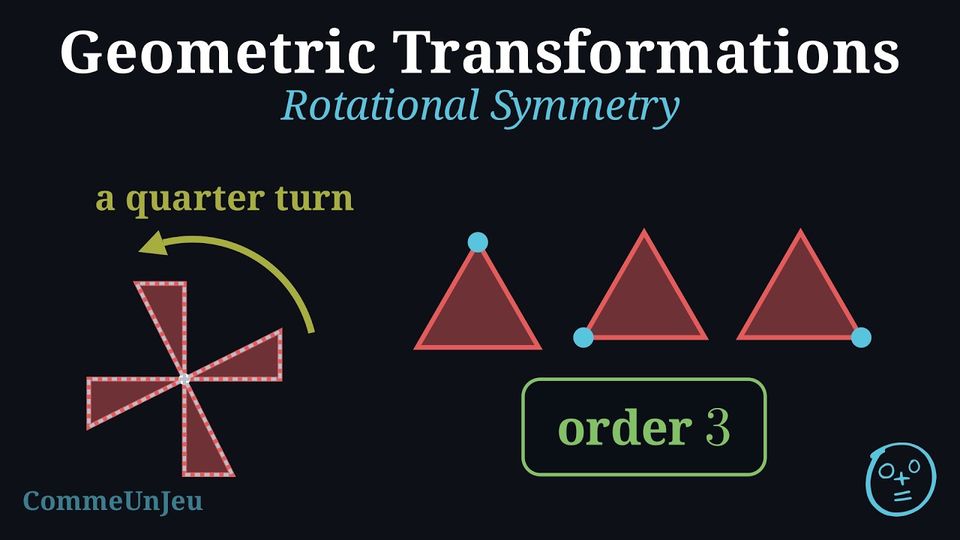
- The logo is made of three identical blades. A third of a turn sends each blade onto the next one: it fits in \(3\) positions, order \(3\).
Rotational symmetry and line symmetry are two different properties. The letter A has a line of symmetry (a vertical one) but no rotational symmetry. The logo above and the windmill have rotational symmetry but no line of symmetry: folding them never makes the two halves match. The letter H and the square have both.
Skills to practice
- Recognising Rotational Symmetry
- Finding the Order of Rotational Symmetry
- Completing Shapes with Rotational Symmetry
V
Enlargement and Reduction
Rectangle \(A\) is drawn on squared paper, with three other rectangles \(B\), \(C\) and \(D\). 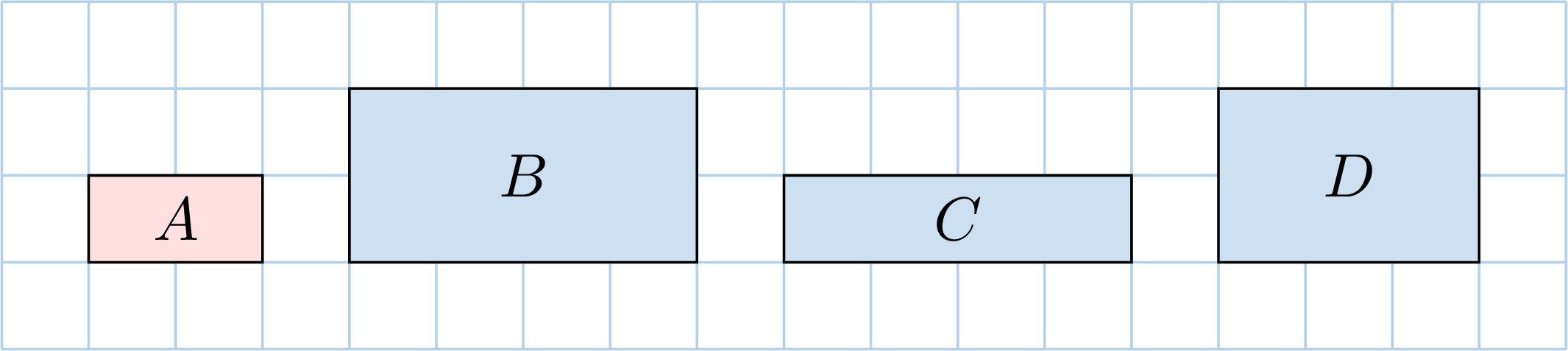
Which rectangle has the same shape as \(A\)? How do you know?
Rectangle \(A\) is \(2\) squares long and \(1\) square wide: it is twice as long as it is wide.
- \(B\) is \(4\) squares long and \(2\) squares wide: each side of \(A\) is multiplied by \(2\) (\(2 \times 2 = 4\) and \(1 \times 2 = 2\)). \(B\) is still twice as long as it is wide: \(B\) has the same shape as \(A\), it is \(A\) made larger.
- \(C\) is \(4\) squares long and \(1\) square wide: only the length is doubled. \(C\) is four times as long as it is wide: it is stretched, it does not have the same shape.
- \(D\) is \(3\) squares long and \(2\) squares wide: \(1\) square is added to each side. \(D\) is no longer twice as long as it is wide: it does not have the same shape.
Definition — Enlargement and Reduction
- An enlargement makes a shape larger by multiplying all side lengths by a number called the scale factor. In an enlargement, the scale factor is greater than 1.
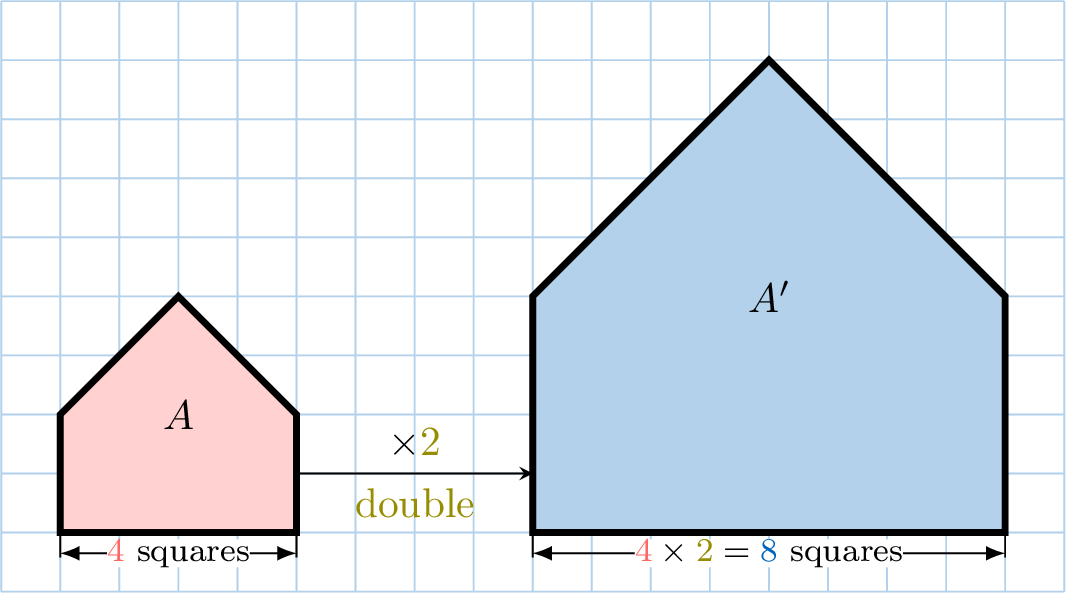
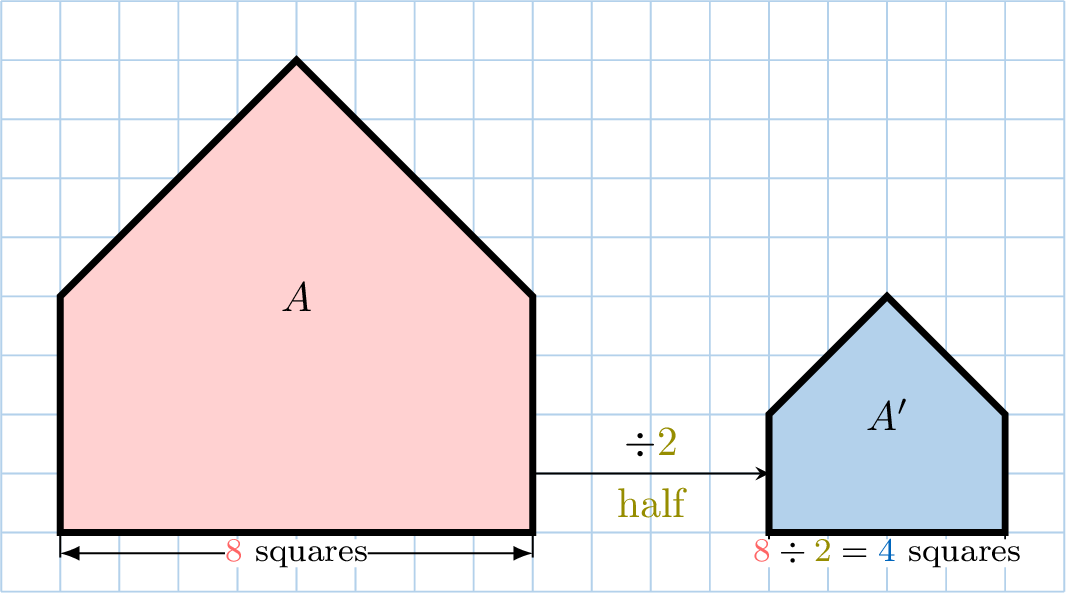
- A reduction makes a shape smaller. One way to do this is to divide all side lengths by the same number. This is the same as multiplying all side lengths by a scale factor between 0 and 1.
Method — Enlarging a Shape on Squared Paper
To enlarge a shape drawn on squared paper by a scale factor: - Count the length of each side of the shape, in squares.
- Multiply each length by the scale factor.
- Draw the new shape side after side, in the same order, keeping the angles: each side keeps its direction, and a right angle stays a right angle.
Example
Enlarge this L-shape by a scale factor of \(3\). 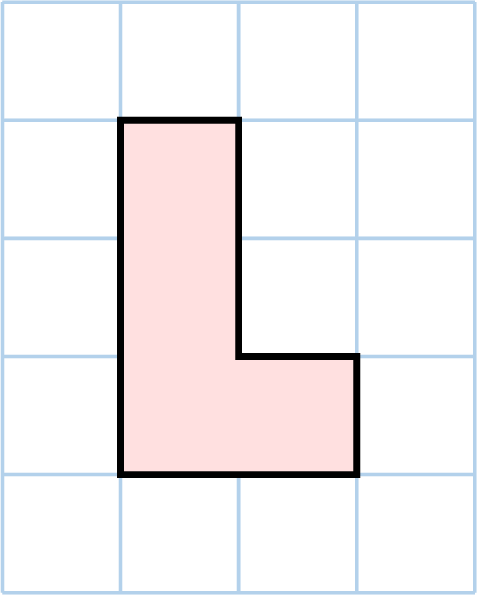
We count each side of the L-shape in squares, then multiply each length by \(3\): 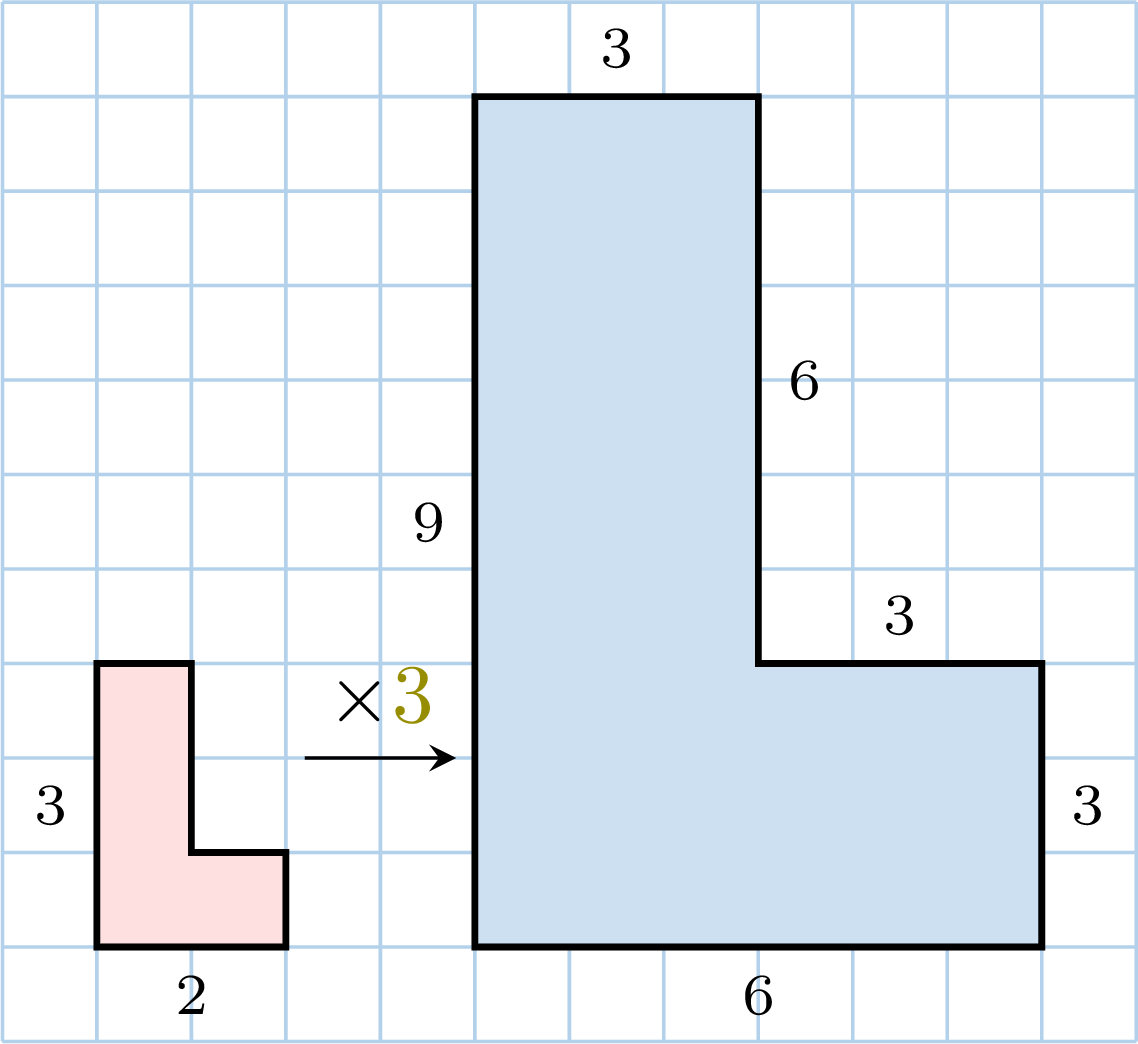
Check: \(9 \div 3 = 3\), \(6 \div 3 = 2\) and \(3 \div 3 = 1\): we find the sides of the L-shape again.
- the long side on the left: \(3 \times 3 = 9\) squares; the bottom: \(2 \times 3 = 6\) squares;
- the other side of the column: \(2 \times 3 = 6\) squares;
- each side of length \(1\) (the top of the column, the top and the end of the foot): \(1 \times 3 = 3\) squares.
Skills to practice
- Enlarging Shapes
- Reducing Shapes
VI
Going further
Skills to practice
- Diagonal Axes and Two Mirrors in a Row
- Reasoning about Enlargements and Scales
- Quiz
Jump to section