International Baccalaureate · PYP 5
3D Shapes and Nets
I
Nets and Solid Constructions
Definition — Net
A net of a solid is a flat figure that can be folded up, or rolled up, to make that solid. When the solid has only flat faces and no curved surface — a cube, a rectangular prism (a box), a pyramid, a prism — the net is folded along the edges: the folds are the lines inside the net. A cylinder and a cone have a net too, but their curved surface has to be rolled rather than folded. A ball has no net at all: no flat sheet can be wrapped around it without creasing. 
Method — Recognising a Net of a Cube
To tell whether a flat assembly of polygons is a net of a cube, three checks, in this order: - Count the faces: there must be exactly \(6\).
- Check their nature and their size: all \(6\) must be squares, and all of the same size — a cube has equal faces.
- Fold mentally: every square must land on a different face, with no two squares falling on the same one, and the \(6\) faces must all be covered.
Proposition — The Usual Solids and their Faces
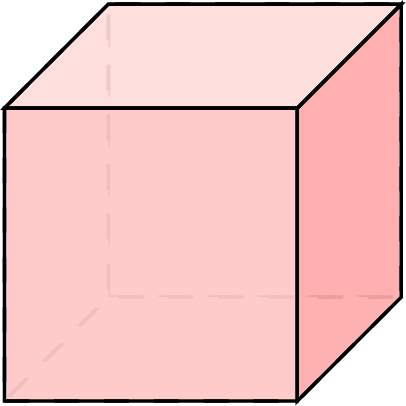
Counting the faces is not enough to tell two solids apart: a cube and a rectangular prism (a box) that is not a cube both have \(6\). What tells them apart is the shape of those faces. Each usual solid is described by how many flat faces it has, what shape they are, and whether it also has a curved surface (the round part). Here face always means a flat face: a curved surface, like the one that wraps a cylinder, is never counted among them. - A cube: 6 faces, all of them squares.
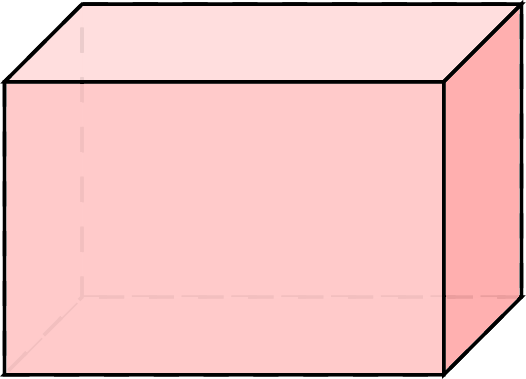
- A rectangular prism (a box): 6 faces, all of them rectangles. When those \(6\) rectangles are all squares, the prism is a cube — a cube is a special rectangular prism.
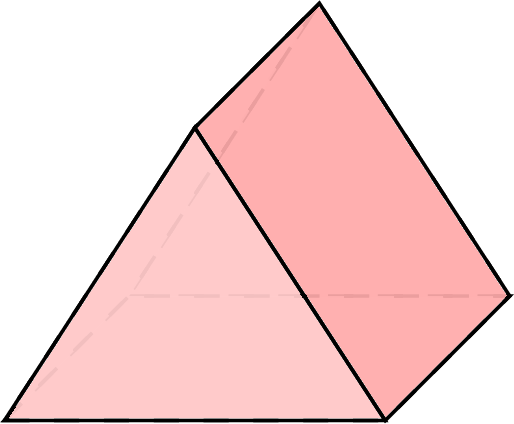
- A right prism: 2 identical polygon bases, one exactly facing the other, and rectangles all around — one rectangle for each side of the base. When the two bases are triangles it is called a triangular prism, and it has \(5\) flat faces: \(2\) triangles and \(3\) rectangles. On a perspective drawing those rectangles look slanted, but rectangles they are. A rectangular prism is itself a right prism, one whose bases are rectangles.
- A pyramid: one polygon base, and triangles that all meet at the same vertex, the apex — one triangle for each side of the base. The usual one is the square pyramid: \(5\) flat faces, \(1\) square and \(4\) triangles.
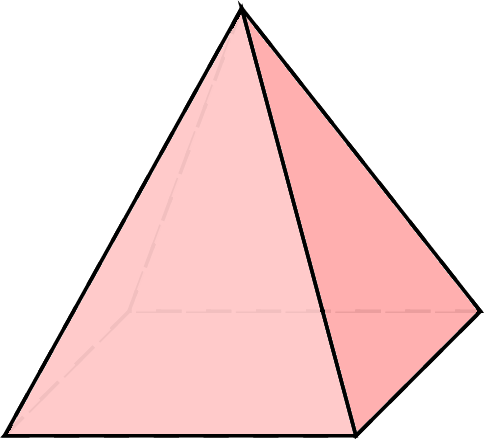
- A cylinder: 2 identical flat faces that are discs, joined by one curved surface. On a perspective drawing those discs are drawn as ellipses, but discs they are.
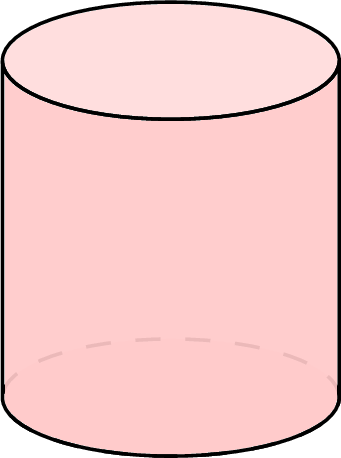
- A cone: one flat face that is a disc — drawn as an ellipse in perspective — and one curved surface that joins the whole rim of that disc to a single point, the apex.
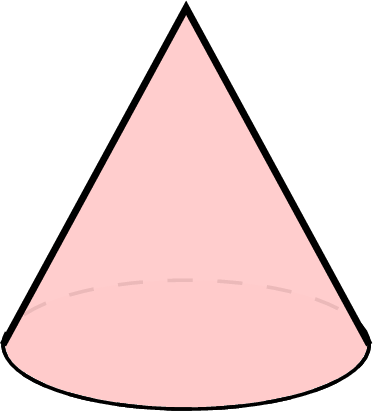
- A ball: no flat face at all, only a single curved surface.
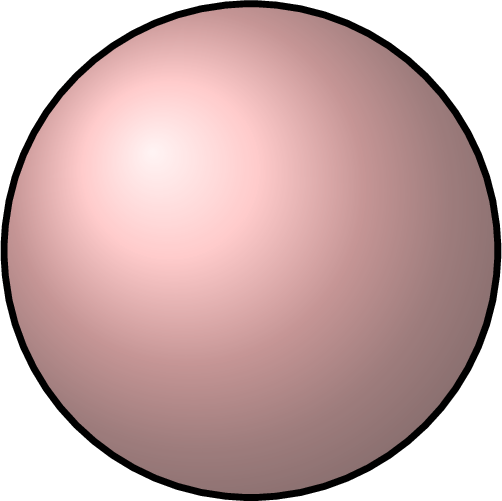
Proposition — The Eleven Nets of a Cube
A solid can have several different nets. A cube has exactly 11 different nets: a net that is only turned round or flipped over does not count as a new one. Folding any one of them makes a cube. 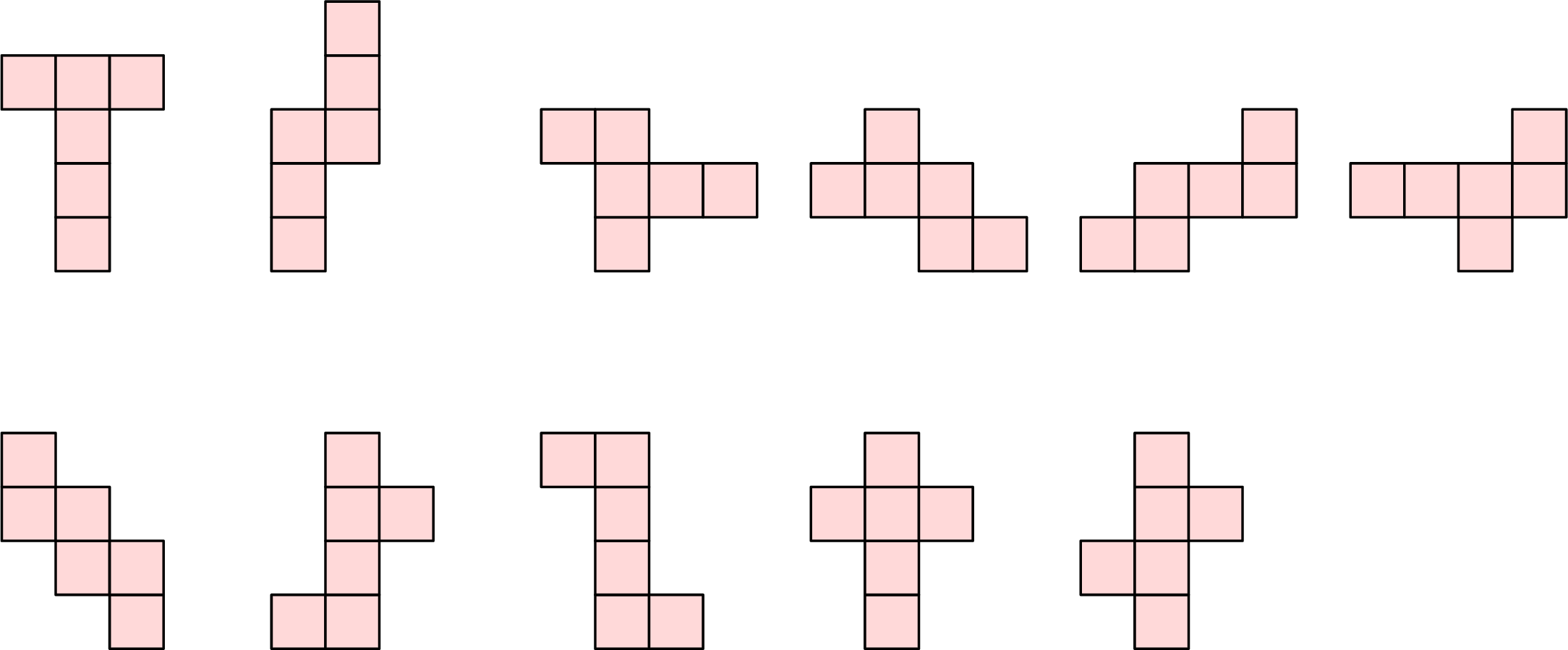
Example
Draw this net of a cube on card, cut it out, then fold it along the dashed lines to check that it really makes a cube. 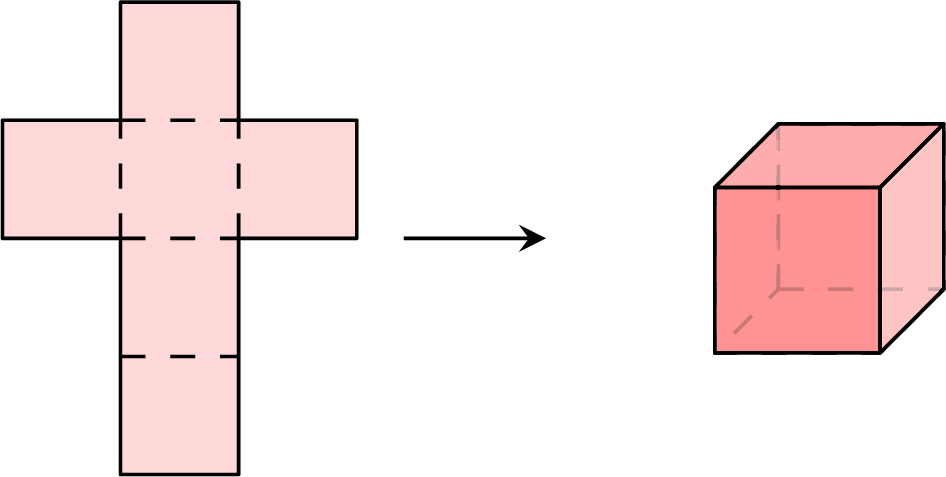
Skills to practice
- Identifying Nets
- Drawing Nets and Building Solids
II
The Net of a Rectangular Prism
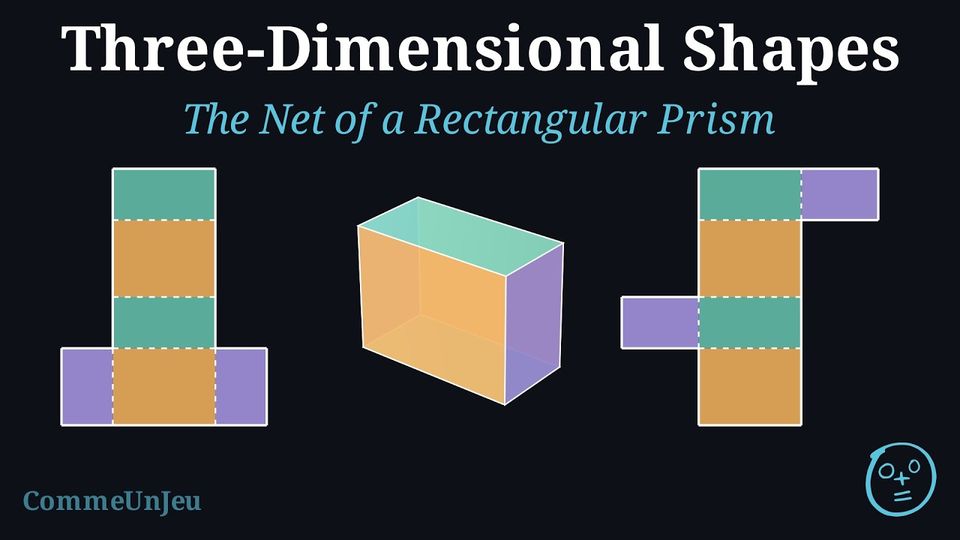
Sami and Inès each draw a figure for the same box, a rectangular prism \(4\) long, \(2\) wide and \(3\) high. Sami draws the first figure, Inès the second, and both say: “this is a net of our box”. Can two different figures both be nets of the same box? And how can a figure be checked without cutting it out and folding it? 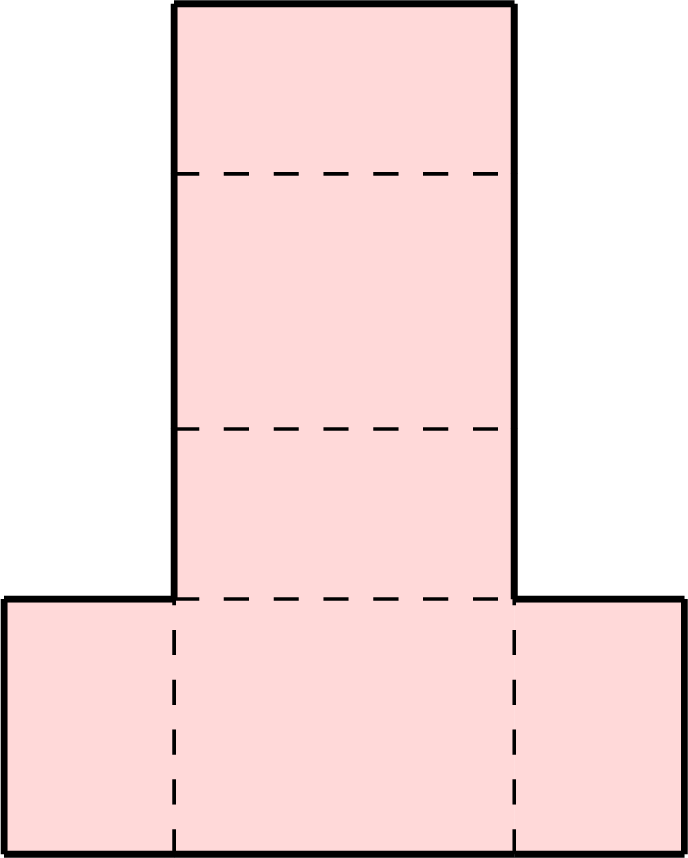
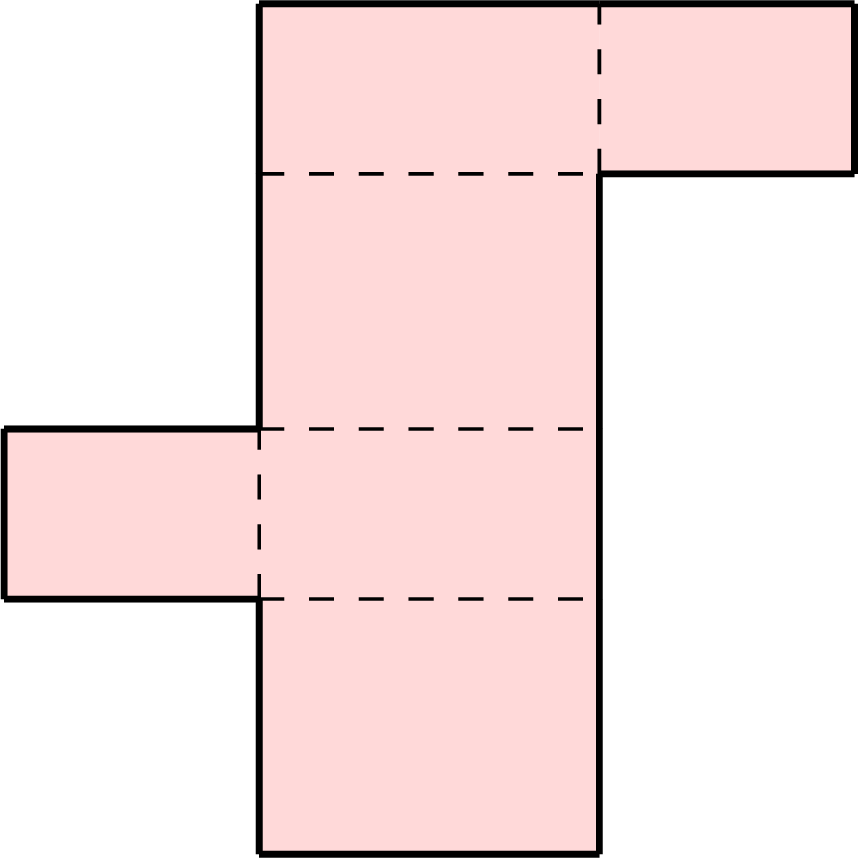
Yes. Both figures fold into the box: each has six rectangular faces of the correct sizes, two of each, joined along folds of the same length, and arranged so that they close the box. A rectangular prism has several different nets, just as a cube has eleven. The method below gives three checks to decide, without cutting anything, whether a figure is a net of a given box.
Method — Recognising a net of a rectangular prism
A rectangular prism (a box) has six faces, all rectangles, which go in three pairs: two identical faces facing each other. In a box \(4\) long, \(2\) wide and \(3\) high, the front and the back are \(4 \times 3\) rectangles, the top and the bottom are \(4 \times 2\), the two sides are \(2 \times 3\). A net of the box is a flat figure of six rectangles that folds up into it. To decide whether a figure is a net of a given box, check three things. 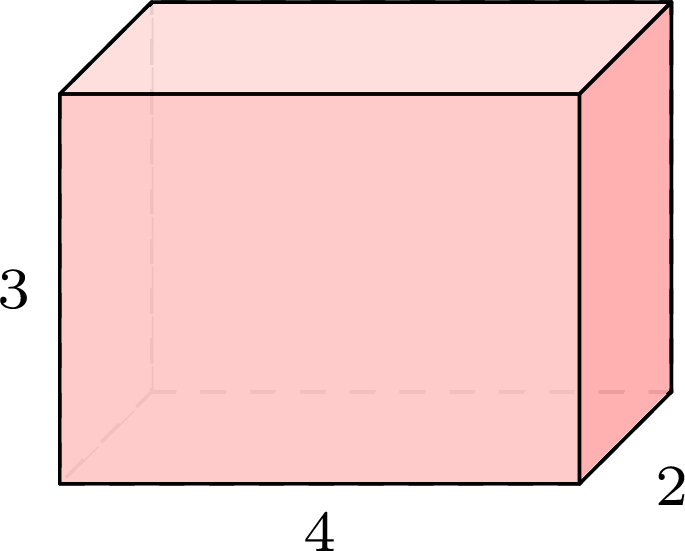
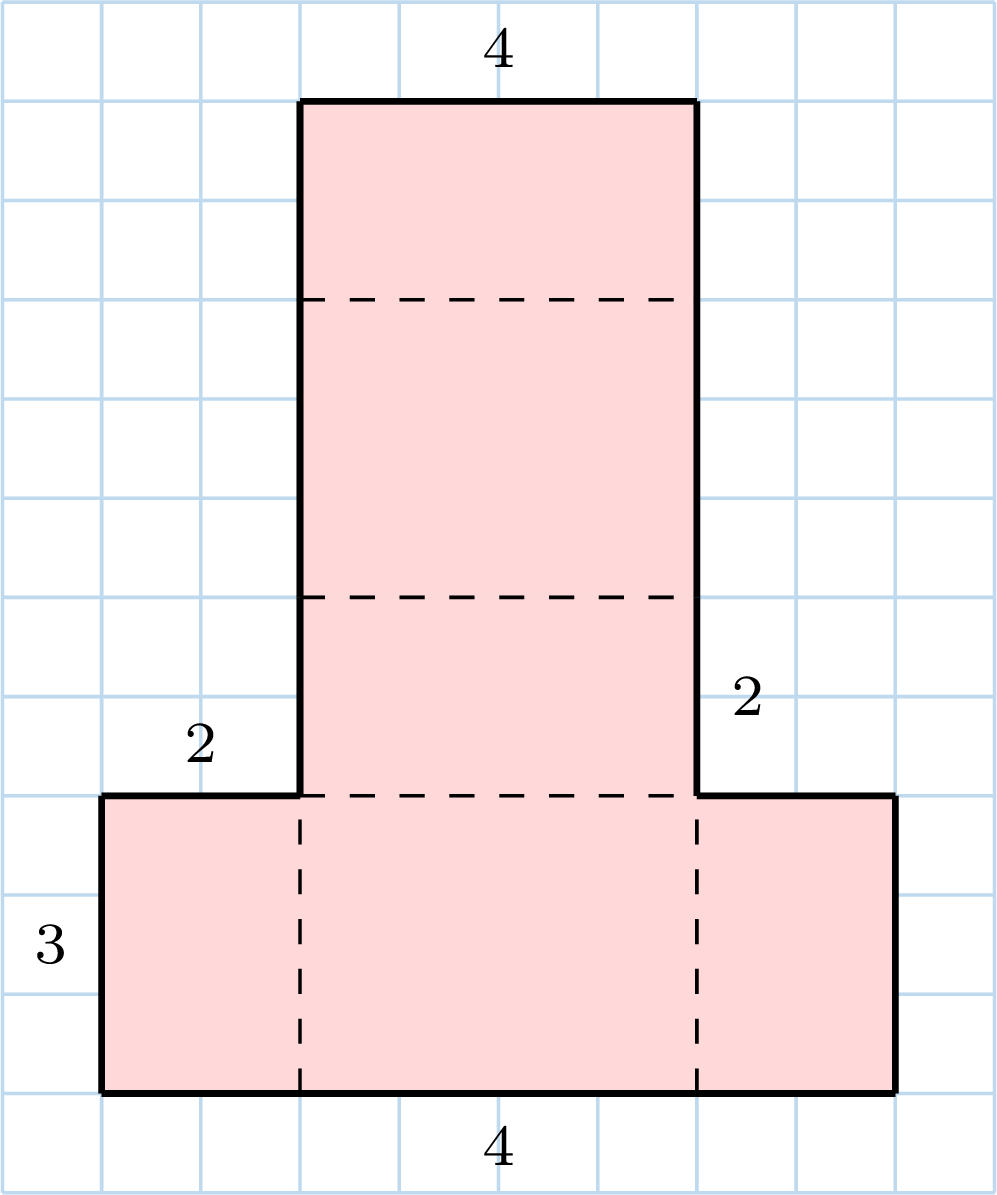
- Count and sort the faces. Six rectangles, no more, no fewer; and two of each size: two \(4 \times 3\), two \(4 \times 2\), two \(2 \times 3\). A face of the wrong size, or a size that appears once or three times, and the figure is not a net.
- Check every fold. Along a dashed fold, the two faces share one edge of the box: their sides along the fold must have the same length. If one face touches the fold with a side of \(2\) while the other touches it with a side of \(3\), the figure is not a net.
- Fold it mentally. The faces must close the box without two of them landing on the same face, and without leaving a hole. The six rectangles are arranged like one of the eleven nets of the cube: here, a band of four faces that wraps around the box, and the two remaining faces attached on either side of the band.
Example
Is this figure a net of the box \(4\) long, \(2\) wide and \(3\) high? 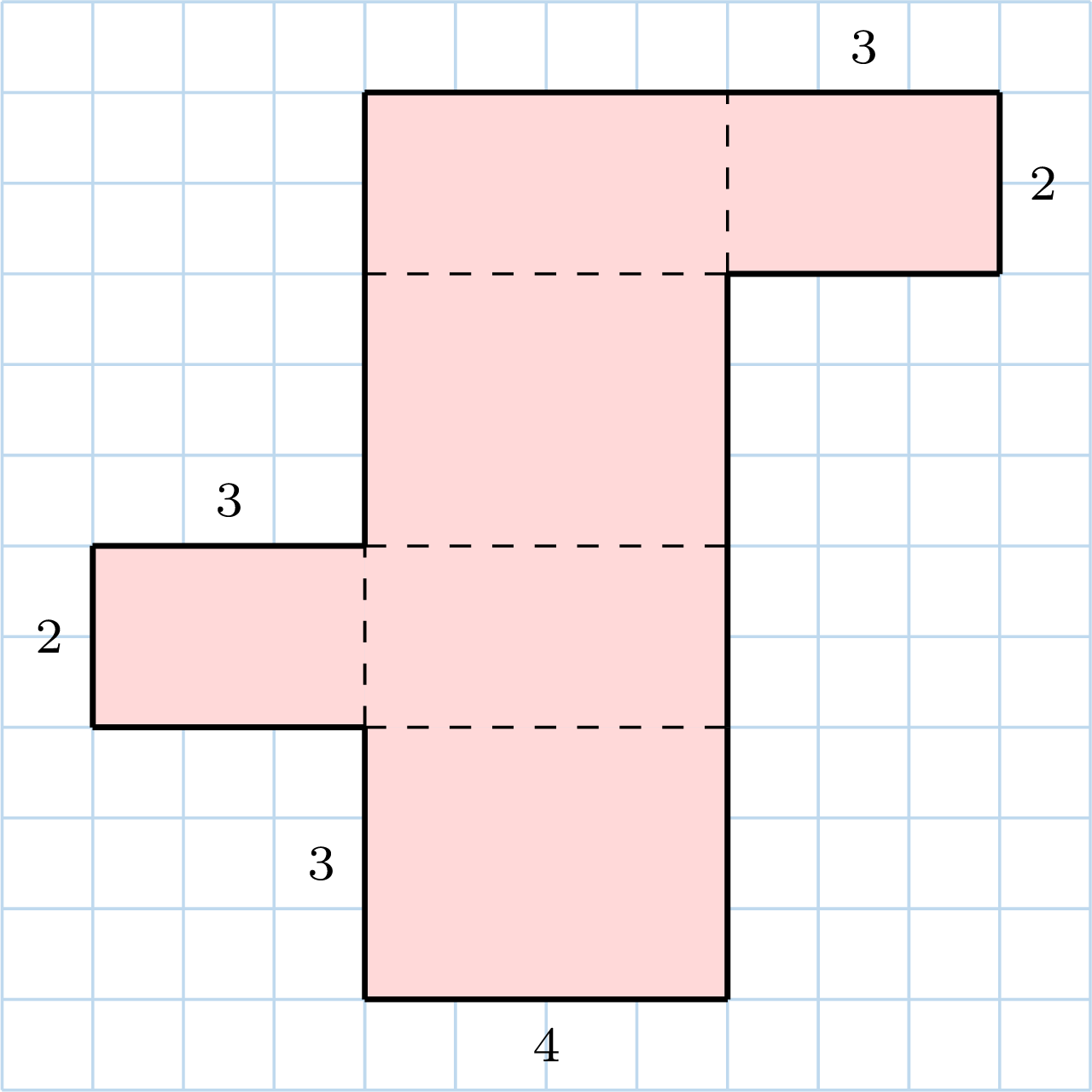
Yes. Six rectangles: two \(4 \times 3\) (front and back), two \(4 \times 2\) (bottom and top), two \(3 \times 2\) (the sides), so the sizes are correct. Every fold matches: each side face is attached by its side of \(2\) to the short side of a \(4 \times 2\) face, which is also \(2\). Folding in your head: the band of four faces wraps around the box, one side face closes the left, the other closes the right. It is a net of the box, just not the same one as in the method: a box has several different nets.
Example
Léo says that this figure is a net of the same box, \(4\) long, \(2\) wide and \(3\) high. Is he correct? 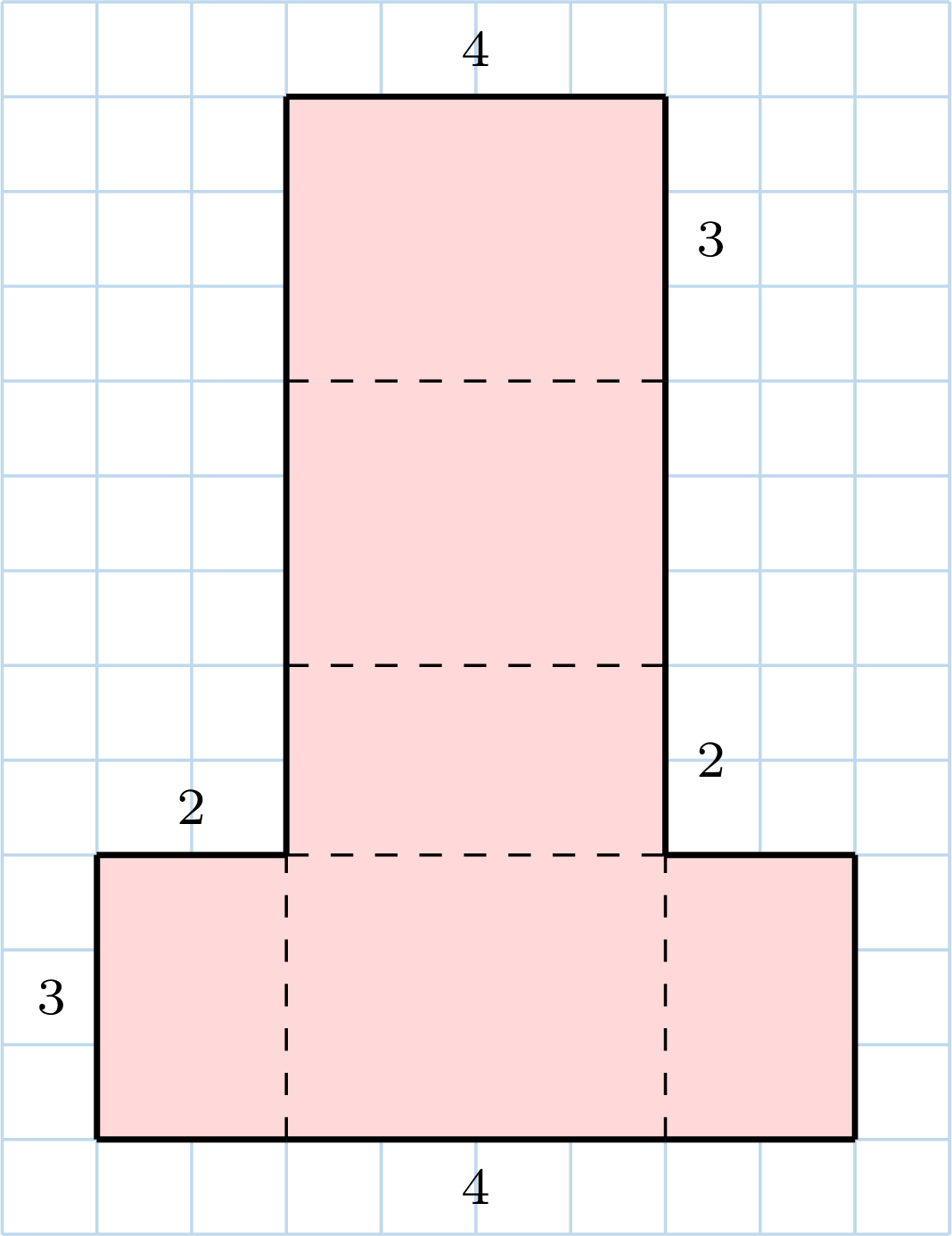
No. Count and sort the faces: the top face of the band is \(4 \times 3\) instead of \(4 \times 2\). So there are three faces \(4 \times 3\) and only one face \(4 \times 2\): the sizes do not go in pairs. When you fold the band, that face is too tall and sticks out of the box: the figure is not a net. Replacing it by a \(4 \times 2\) face gives back the net of the method.
The correct faces, but badly placed. This figure has the six correct faces and every fold matches. Yet it is not a net: fold it in your head. The band closes the front, bottom, back and top of the box; the side face attached to the front folds onto the left side, and the side face attached to the back folds onto the left side too. Two faces on the same place, and the right side of the box stays open. The two side faces must be attached on opposite sides of the band. 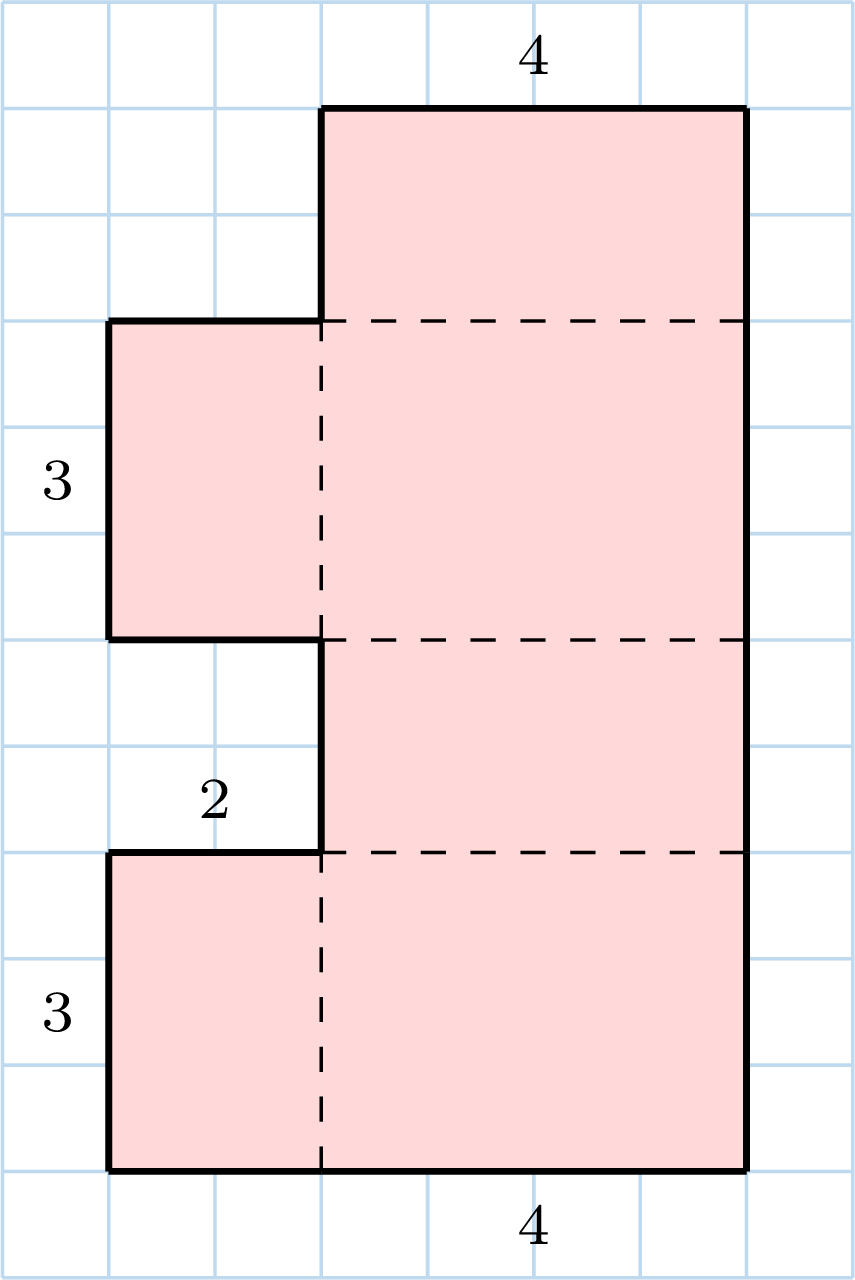
Skills to practice
- Recognising a Net of a Rectangular Prism
- Reading a Net
- Drawing a Net of a Rectangular Prism
III
Going further
Skills to practice
- Solving Harder Solid Problems
- Quiz
Jump to section