International Baccalaureate · PYP 2
3D Shapes
I
Building Solids
Definition — Classification
We can sort three-dimensional (3D) shapes by counting their faces, edges, and vertices. Some examples are shown in the table below. | Name | Shape | Faces | Edges | Vertices |
| Cube | 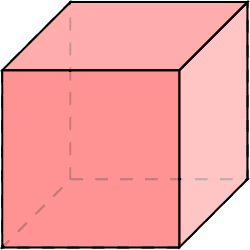 | 6 (flat faces) | 12 | 8 |
| Rectangular Prism (a box) | 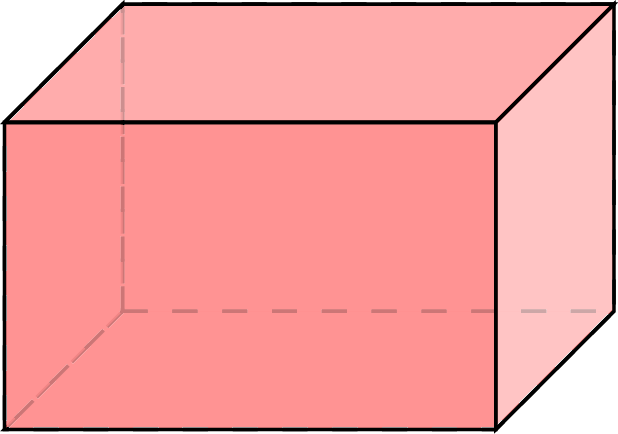 | 6 (flat faces) | 12 | 8 |
| Sphere (a ball) | 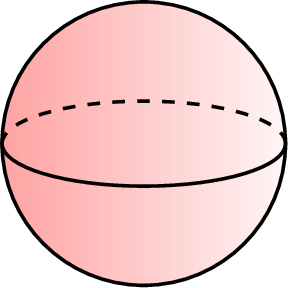 | 0 flat faces (1 curved surface) | 0 | 0 |
| Square Pyramid | 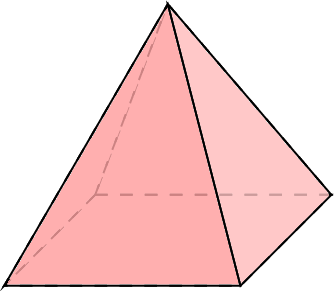 | 5 (flat faces) | 8 | 5 |
| Cylinder | 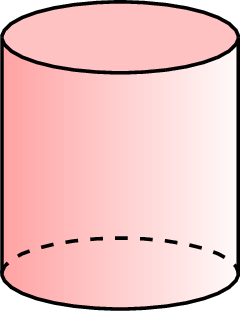 | 2 flat faces (1 curved surface) | 0 | 0 |
Definition — The Usual Solids and their Faces
Counting the faces is not enough: a cube and a box both have \(6\). What tells the solids apart is the shape of their faces. | Solid | Name | Its faces |
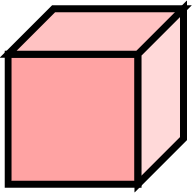 | the cube | \(6\) faces, all squares |
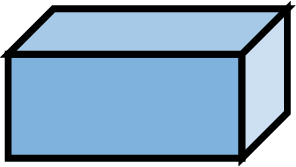 | the box (a rectangular prism) | \(6\) rectangles (sometimes two of them are squares) |
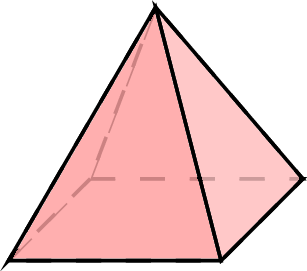 | the square pyramid | \(1\) square and \(4\) triangles up to the point at the top |
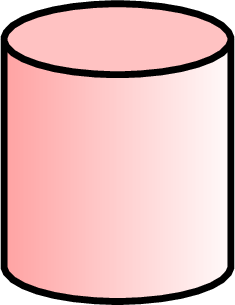 | the cylinder | \(2\) flat discs (round shapes) and \(1\) round part |
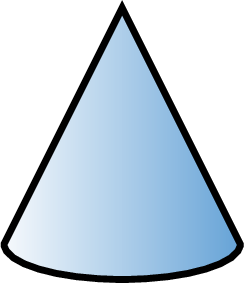 | the cone | \(1\) flat disc and \(1\) round part up to the point |
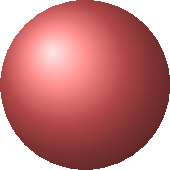 | the ball (a sphere) | no flat face: round all over |
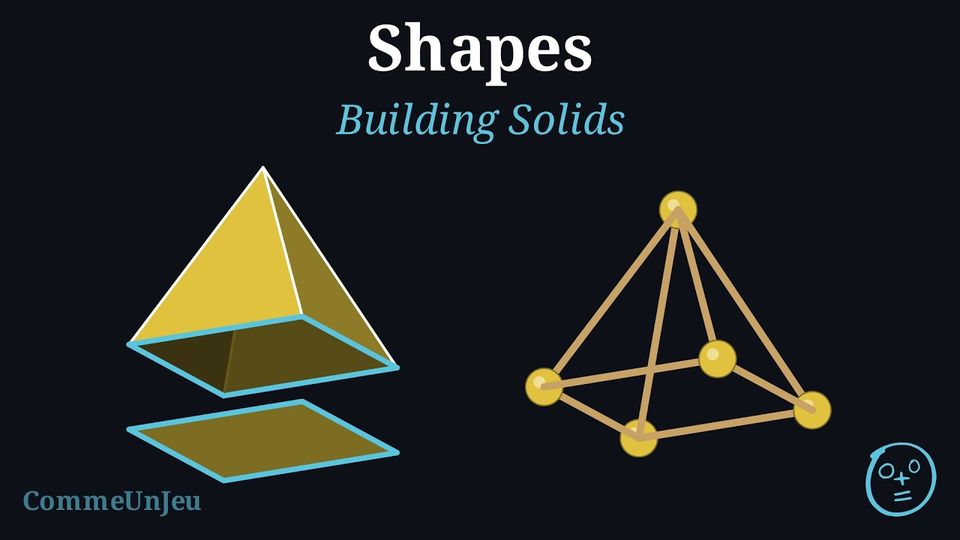
Léa wants to build a pyramid out of card. She cuts out \(4\) identical triangles and glues them together along their edges, up to a point. Her pyramid is not closed: it is open underneath. What is missing? 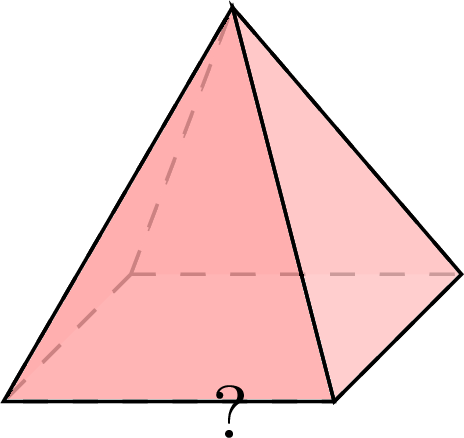
The base is missing: a square, glued under the \(4\) triangles. A square pyramid has \(5\) faces, \(1\) square and \(4\) triangles — with only the triangles, one face is missing and the solid is not closed.
Method — Building a Solid from a Model
- Look at the model: count its faces and say the shape of each one (square, rectangle, triangle).
- Cut out the faces: one piece of card for each face, of the right shape and the right size — for the cube and the box, faces that are opposite each other are alike.
- Put them together: glue the faces edge to edge. Every edge is shared by two faces, and the solid must be closed all around.
Example
Noah builds a cube with sticks and balls of modelling clay. Léa builds a box out of card. What does each of them need? - Noah's cube: a cube has \(12\) edges and \(8\) vertices, so Noah needs \(12\) sticks, all of the same length, and \(8\) balls of clay.
- Léa's box: a box has \(6\) faces, all rectangles, alike two by two: Léa cuts out \(6\) rectangles, alike two by two, and glues them edge to edge.
Skills to practice
- Finding What Is Needed to Build a Solid
II
Cube Assemblies
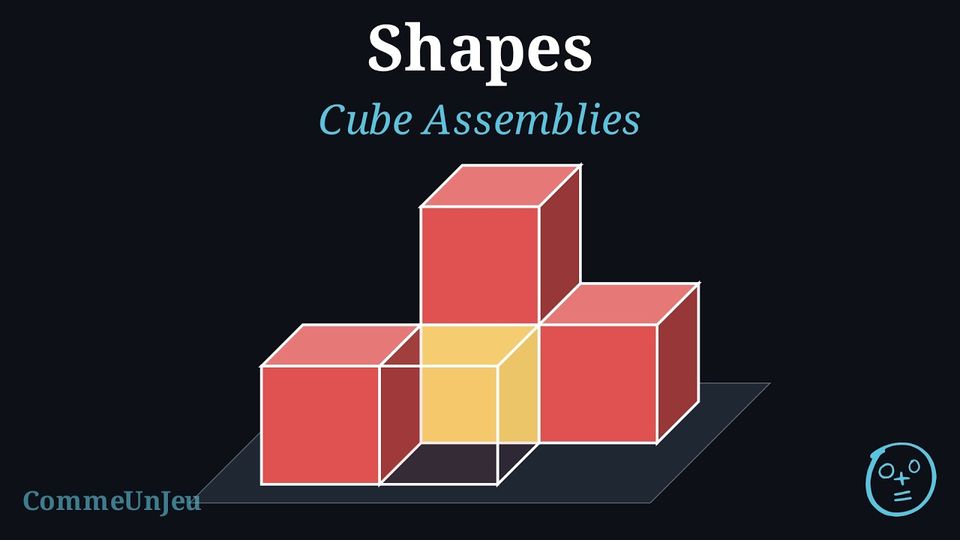
Léa built an assembly with cubes and took a picture of it. Noah wants to build the same one from the picture. He counts the cubes he sees — four — and builds it. But Léa says: “Mine has five.” Where is the cube Noah cannot see? 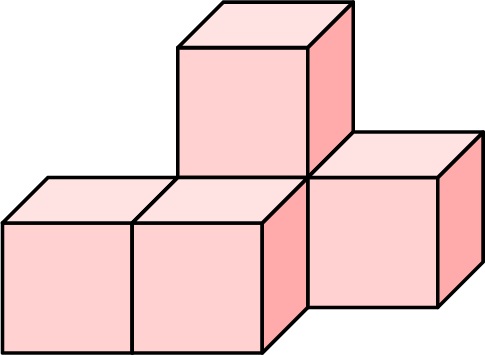
The top cube, at the back, is in the air: it cannot float, it rests on a cube. That cube is hidden: behind the front right cube, under the top one, and next to the back cube on the right. There are five cubes: four seen, one hidden.
Definition — Cube Assembly
A cube assembly is a construction made of cubes all of the same size, placed face against face, on a table. We can look at it for real — a model — or on a representation: a photo, or a drawing in perspective, which shows up to three faces of each visible cube: the front, the top and one side. On a representation, some cubes are hidden by those in front of them or above them. 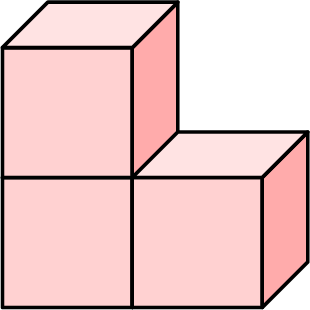
Method — Reproducing an Assembly
- Count by columns: a column is a stack of cubes standing on one square of the table. Count its height — how many cubes from the table to the top.
- Do not forget the hidden ones: a cube in the air always rests on a cube. Under every cube you see, count the cubes that hold it up, even if you cannot see them.
- Build the bottom layer first, the cubes that touch the table, then add the layers above.
- Check: count your cubes in another order — from the right instead of from the left — and compare with the model.
Hidden Cubes
On a drawing, a hidden cube cannot be seen, yet it is there when it carries a cube we can see: nothing floats. When in doubt, count column by column — each column has as many cubes as its height, from the table up. A hidden cube that carries nothing, the drawing alone cannot show.
Example
How many cubes are needed to build this assembly? 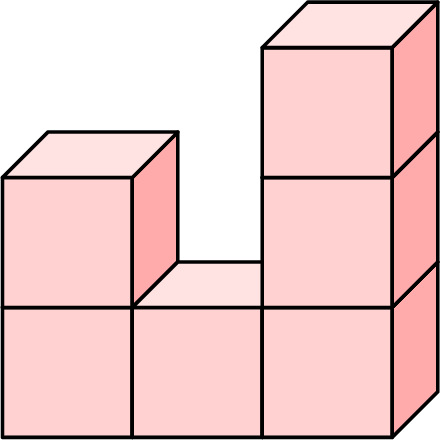
Three columns, from the left: \(2\) cubes, \(1\) cube, \(3\) cubes. \(2+1+3=6\) cubes. Check from the right: \(3+1+2=6\).
Cubes and Cuboids
An assembly can mix cubes and cuboids. A cuboid is a box (a rectangular prism) whose faces are rectangles: here a cuboid is as long as two cubes. To reproduce the assembly, count the cubes and the cuboids separately, then place them as on the model.
Example
How many cubes and how many cuboids are needed to build this assembly? The cuboids are drawn in blue. 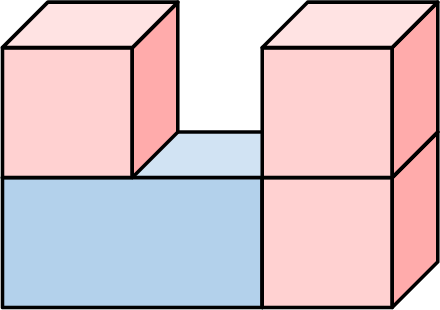
One cuboid (the long blue box at the bottom left) and three cubes: one on the bottom right, two on top.
Skills to practice
- Finding the Hidden Cubes
- Counting the Cubes and Cuboids
- Reproducing the Assembly
III
Going further
Skills to practice
- Counting and Comparing Faces, Edges and Vertices
- Quiz
Jump to section