International Baccalaureate · MYP 5
Circle Theorems and Geometric Proof
I
Angles in a Circle
I.1
Angle at the Centre
In an open-air theatre, the front of the stage is the segment \(\Segment{AB}\), and the seats are placed on the arc of a circle of centre \(O\) through \(A\) and \(B\) drawn in bold. Two spectators sit at \(C\) and at \(D\) on this arc. A surveyor measured the angles under which they see the stage, and the angle \(\Angle{AOB}\) at the centre: 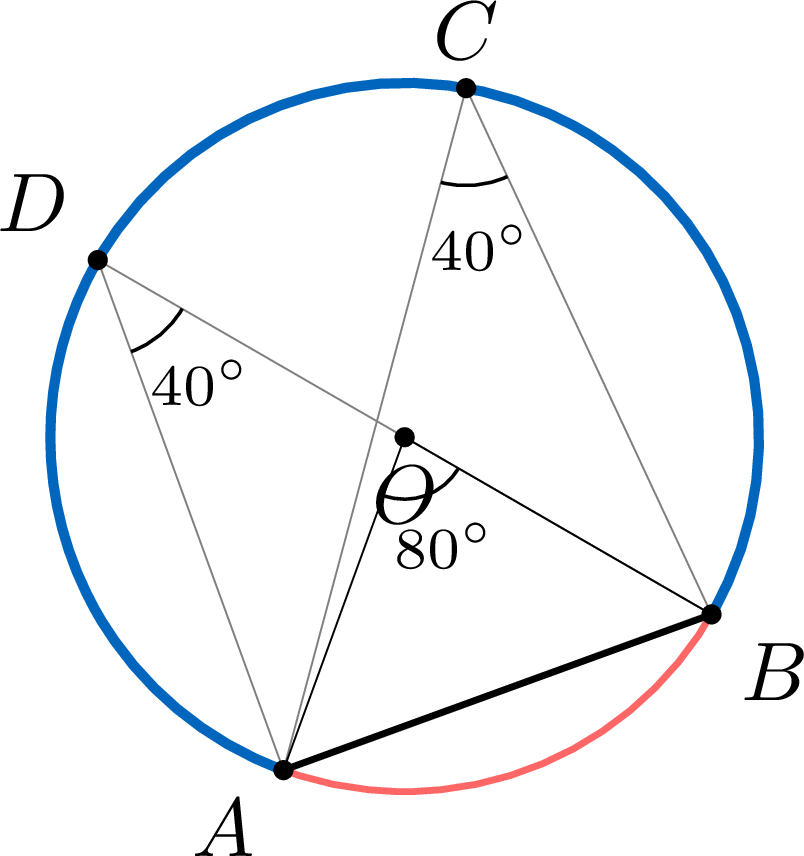
What do you notice? Would a third spectator on the same arc see the stage under the same angle?
Both spectators see the stage under the same angle, \(40^\circ\), which is half the angle \(\Angle{AOB} = 80^\circ\) at the centre. This is no coincidence: every point of the arc sees \(\Segment{AB}\) under half the angle at the centre (the theorems “Angle at the Centre” and “Angles on the Same Arc”), so a third spectator on the arc would also see the stage under \(40^\circ\). The seats are placed so that everyone has the same view of the stage.
Definition — Angle at the Centre and Angle at the Circumference
Let \(A\) and \(B\) be two points of a circle of centre \(O\), and consider one of the two arcs \(AB\). The angle at the centre subtended by this arc is the angle \(\Angle{AOB}\) whose inside contains the arc; it is a reflex angle when the arc is a major arc. For a point \(C\) of the circle that is not on this arc, the angle \(\Angle{ACB}\) is an angle at the circumference (or inscribed angle) subtended by the same arc. 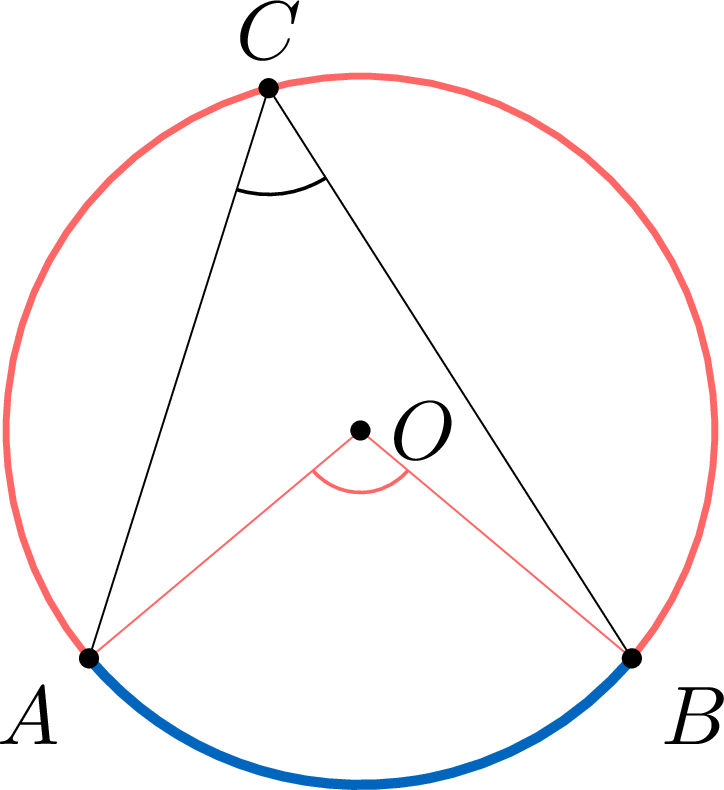
Proposition — Angle at the Centre
The angle at the centre is twice any angle at the circumference subtended by the same arc: if \(C\) is a point of the circle of centre \(O\) not on the arc \(AB\), then $$\Angle{AOB} = 2\Angle{ACB}.$$ This also holds when the arc is a major arc, the angle at the centre being then reflex. 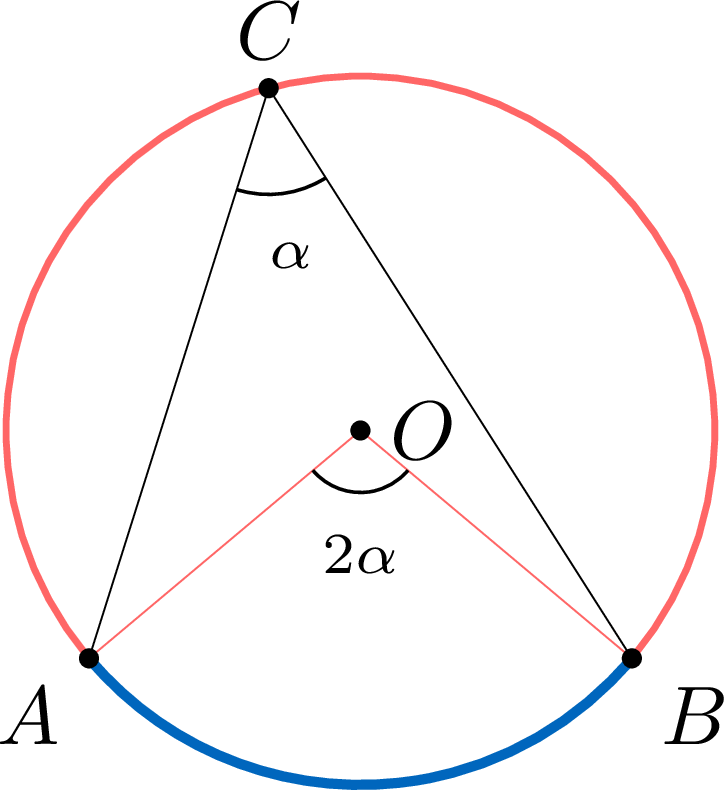
Let \(C\) be a point of the circle not on the arc \(AB\). The segments \(\Segment{OA}\), \(\Segment{OB}\) and \(\Segment{OC}\) are radii, so a triangle with two of them as sides is isosceles at \(O\). Three cases arise, according to the position of the centre \(O\) with respect to the angle \(\Angle{ACB}\) (figures 1, 2 and 3). 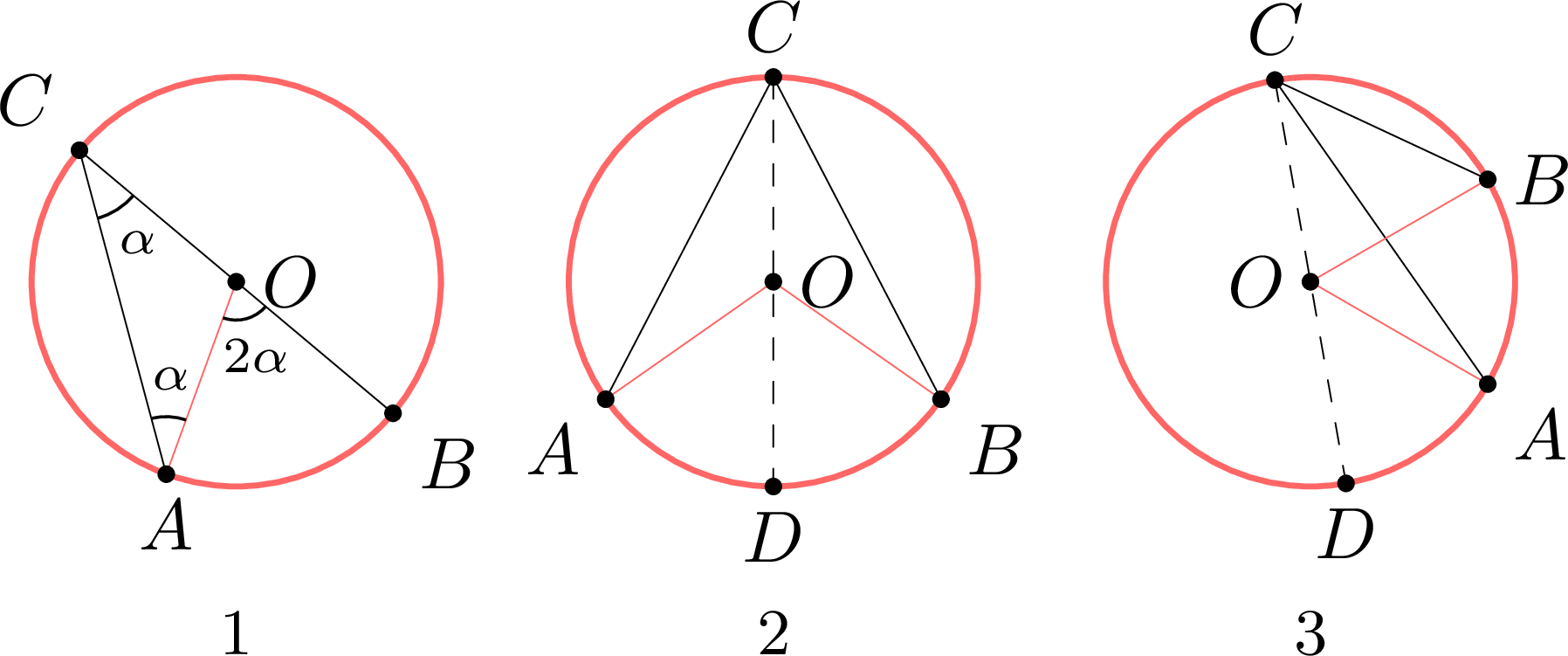
Case 1: \(O\) lies on a side of the angle, say on \(\Segment{CB}\), which is then a diameter. The triangle \(OCA\) is isosceles at \(O\) (\(OC = OA\)), and, \(C\), \(O\), \(B\) being collinear, \(\Angle{AOB}\) is an exterior angle of this triangle: $$\begin{aligned}[t] \Angle{AOB} &= \Angle{OCA} + \Angle{OAC} && \text{(exterior angle of the triangle } OCA\text{)}\\
&= 2\Angle{OCA} && \text{(base angles of the isosceles triangle } OCA\text{)}\\
&= 2\Angle{ACB}. \end{aligned}$$ Case 2: \(O\) lies inside the angle \(\Angle{ACB}\). Let \(\Segment{CD}\) be the diameter through \(C\). The ray \(\Ray{CD}\) cuts \(\Angle{ACB}\) into the angles \(\Angle{ACD}\) and \(\Angle{DCB}\), each of which has the diameter \(\Segment{CD}\) as a side. By case 1, \(\Angle{AOD} = 2\Angle{ACD}\) and \(\Angle{DOB} = 2\Angle{DCB}\), so $$\begin{aligned}[t] \Angle{AOB} &= \Angle{AOD} + \Angle{DOB}\\
&= 2\Angle{ACD} + 2\Angle{DCB}\\
&= 2\Angle{ACB}. \end{aligned}$$ When \(C\) lies on the minor arc, the arc \(AB\) not containing \(C\) is the major arc, \(O\) lies inside the angle \(\Angle{ACB}\), and the same computation gives the reflex angle \(\Angle{AOB}\). Case 3: \(O\) lies outside the angle \(\Angle{ACB}\). Let \(\Segment{CD}\) be the diameter through \(C\), and name the points so that the ray \(\Ray{CA}\) lies between the rays \(\Ray{CD}\) and \(\Ray{CB}\). By case 1, \(\Angle{DOB} = 2\Angle{DCB}\) and \(\Angle{DOA} = 2\Angle{DCA}\), so $$\begin{aligned}[t] \Angle{AOB} &= \Angle{DOB} - \Angle{DOA}\\
&= 2\Angle{DCB} - 2\Angle{DCA}\\
&= 2\Angle{ACB}. \end{aligned}$$ In every case, the angle at the centre is twice the angle at the circumference.
Method — Finding Angles in a Circle
- Mark the centre and the radii: a triangle with two radii as sides is isosceles, and its base angles are equal.
- For each angle at the circumference, name the arc it stands on: the angle at the centre on the same arc is twice as large.
- Write one fact per line, each followed by its reason: a circle theorem called by its name, a property of the triangle (angle sum, isosceles triangle, exterior angle), or angles on a straight line.
- Check: the angles of each triangle of the figure add up to \(180^\circ\).
Example
The points \(A\), \(B\), \(C\) and \(D\) lie on the circle of centre \(O\), with \(C\) on the major arc \(AB\) and \(D\) on the minor arc \(AB\), and \(\Angle{OAB} = 26^\circ\). 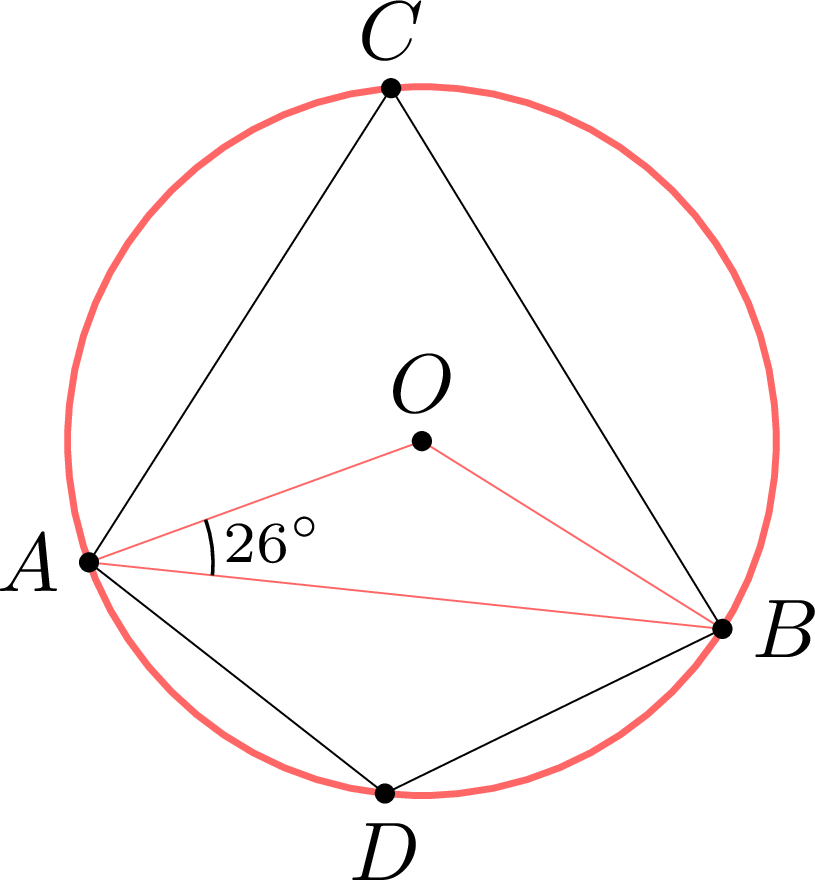
$$\begin{aligned}[t] \Angle{OBA} &= \Angle{OAB} = 26^\circ && \text{(}OA = OB\text{: the triangle } OAB \text{ is isosceles)}\\
\Angle{AOB} &= 180^\circ - 26^\circ - 26^\circ && \text{(angle sum of the triangle } OAB\text{)}\\
&= 128^\circ\\
\Angle{ACB} &= \frac{128^\circ}{2} = 64^\circ && \text{(angle at the centre: } C \text{ is on the major arc)}\\
\Angle{ADB} &= \frac{\text{reflex } \Angle{AOB}}{2} = \frac{360^\circ - 128^\circ}{2} && \text{(angle at the centre: } D \text{ is on the minor arc)}\\
&= 116^\circ. \end{aligned}$$ Check: the two angles at the centre fill the full turn, \(2 \times 64^\circ + 2 \times 116^\circ = 128^\circ + 232^\circ = 360^\circ\).
Example
The chord \(\Segment{AB}\) of a circle of centre \(O\) has the same length as the radius. 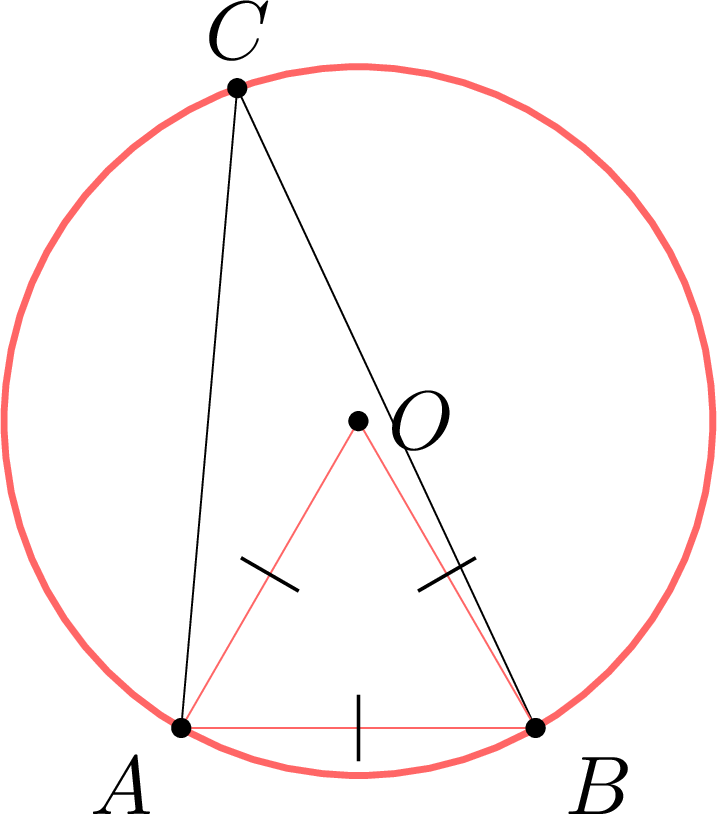
Given: \(AB = OA = OB\). To prove: \(\Angle{ACB} = 30^\circ\) for every point \(C\) of the major arc \(AB\). $$\begin{aligned}[t] OA &= OB = AB && \text{(radii, and the datum)}\\
\Angle{AOB} &= 60^\circ && \text{(the triangle } OAB \text{ is equilateral)}\\
\Angle{ACB} &= \frac{60^\circ}{2} = 30^\circ && \text{(angle at the centre)} \end{aligned}$$ Conclusion. Every angle at the circumference subtended by the minor arc \(AB\) measures \(30^\circ\).
Skills to practice
- Finding Angles at the Centre
- Proving with the Angle at the Centre
I.2
Angles on the Same Arc
Proposition — Angles on the Same Arc
Angles at the circumference subtended by the same arc are equal: if \(C\) and \(D\) are two points of a circle that are not on the arc \(AB\), then $$\Angle{ACB} = \Angle{ADB}.$$ 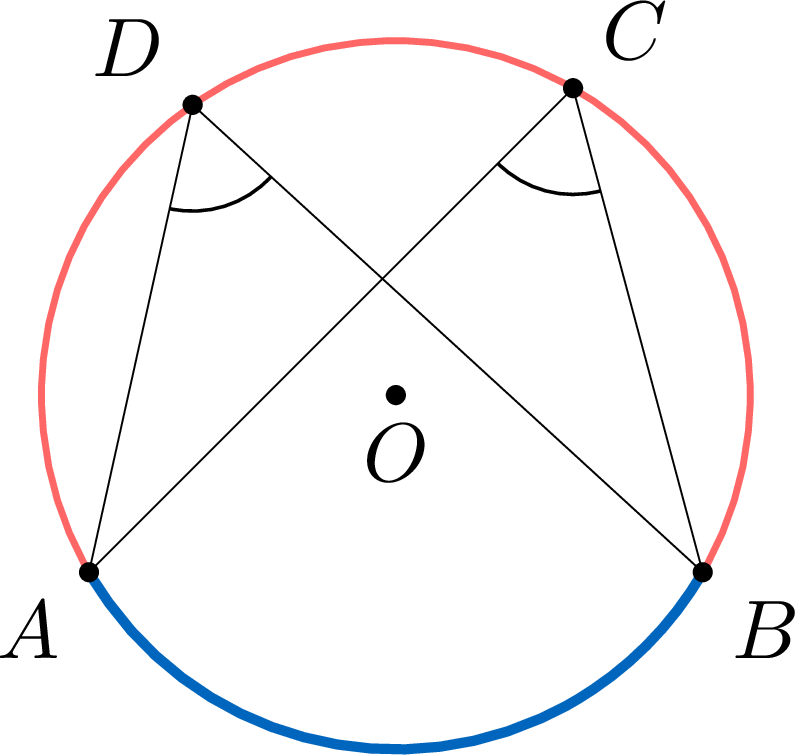
Let \(O\) be the centre of the circle. The angles \(\Angle{ACB}\) and \(\Angle{ADB}\) are subtended by the same arc \(AB\), so by the theorem “Angle at the Centre” each of them is half of the same angle at the centre \(\Angle{AOB}\): $$\Angle{ACB} = \frac{1}{2}\Angle{AOB} = \Angle{ADB}.$$
The Angle in a Semicircle Revisited
When the arc \(AB\) is a semicircle, the angle at the centre subtended by it is a straight angle, \(180^\circ\): every angle at the circumference subtended by a semicircle measures \(\dfrac{180^\circ}{2} = 90^\circ\). The theorem “Angle in a Semicircle” is the special case of the angle at the centre in which the chord is a diameter.
Example
The points \(A\), \(B\), \(C\) and \(D\) lie on a circle, and the chords \(\Segment{AC}\) and \(\Segment{BD}\) cut at \(X\). Moreover \(\Angle{ABD} = 32^\circ\) and \(\Angle{BDC} = 47^\circ\). 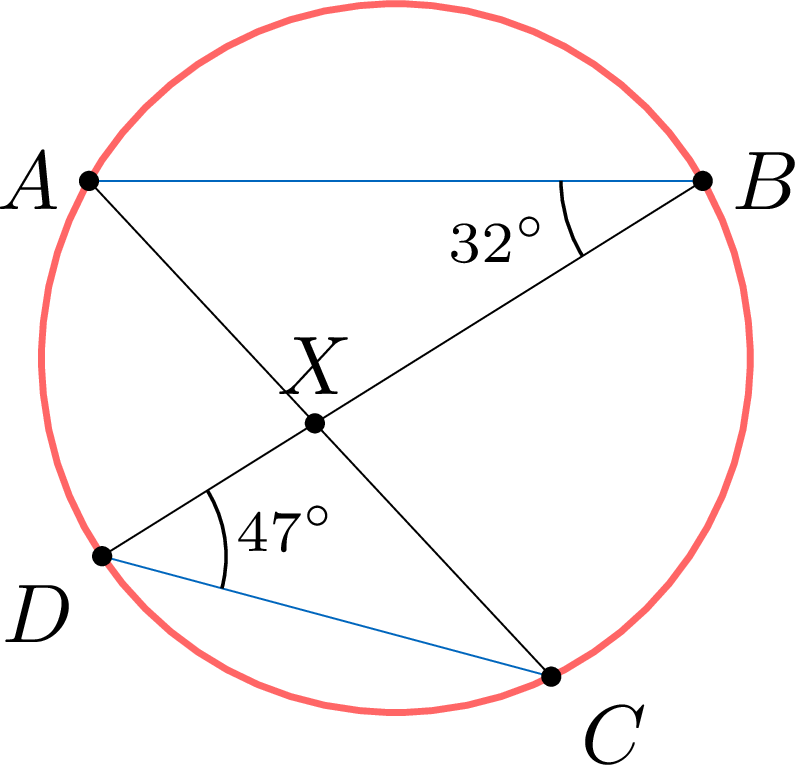
$$\begin{aligned}[t] \Angle{ACD} &= \Angle{ABD} = 32^\circ && \text{(angles on the same arc } AD\text{)}\\
\Angle{BAC} &= \Angle{BDC} = 47^\circ && \text{(angles on the same arc } BC\text{)}\\
\Angle{AXB} &= 180^\circ - 47^\circ - 32^\circ && \text{(angle sum of the triangle } ABX\text{)}\\
&= 101^\circ. \end{aligned}$$ Check in the triangle \(DXC\): \(\Angle{DXC} = \Angle{AXB} = 101^\circ\) (vertically opposite angles), and \(32^\circ + 47^\circ + 101^\circ = 180^\circ\).
Example
The chords \(\Segment{AC}\) and \(\Segment{BD}\) of a circle cut at \(X\). 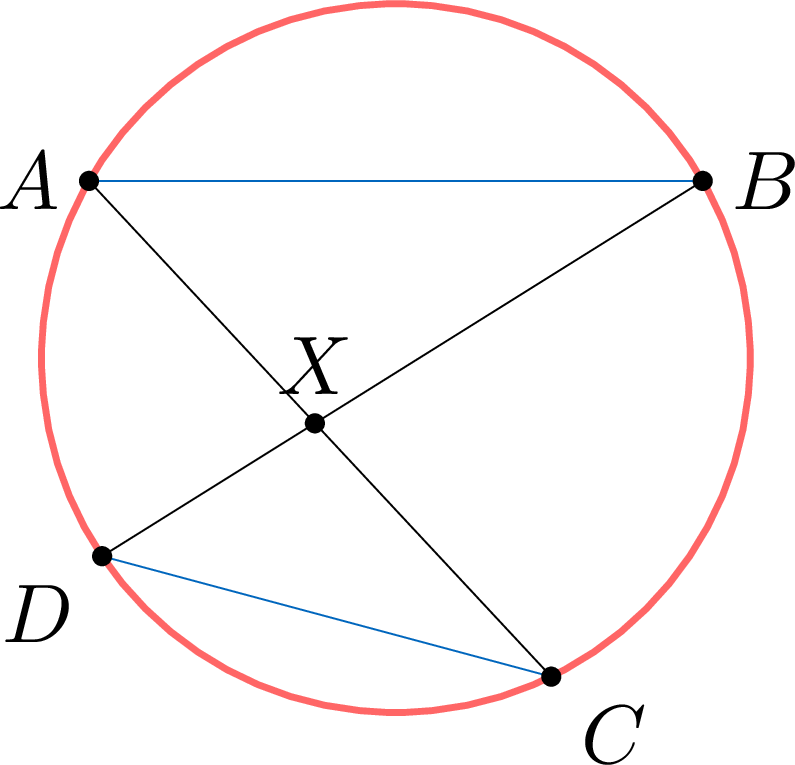
Similar triangles. $$\begin{aligned}[t] \Angle{XAB} = \Angle{CAB} &= \Angle{CDB} = \Angle{XDC} && \text{(angles on the same arc } BC\text{)}\\
\Angle{AXB} &= \Angle{DXC} && \text{(vertically opposite angles)} \end{aligned}$$ The triangles \(XAB\) and \(XDC\) have two pairs of equal angles: they are similar, with \(X\), \(A\), \(B\) corresponding to \(X\), \(D\), \(C\). The product. In similar triangles, corresponding sides are proportional: $$\begin{aligned}[t] \frac{XA}{XD} &= \frac{XB}{XC} && \text{(similar triangles } XAB \text{ and } XDC\text{)}\\
XA \times XC &= XB \times XD && \text{(cross-multiplying)}. \end{aligned}$$
Skills to practice
- Finding Angles on the Same Arc
- Proving with Angles on the Same Arc
II
Cyclic Quadrilaterals and Tangents
II.1
Cyclic Quadrilaterals
Four points \(A\), \(B\), \(C\) and \(D\) lie, in this order, on a circle. The angles of the quadrilateral \(ABCD\) were measured: 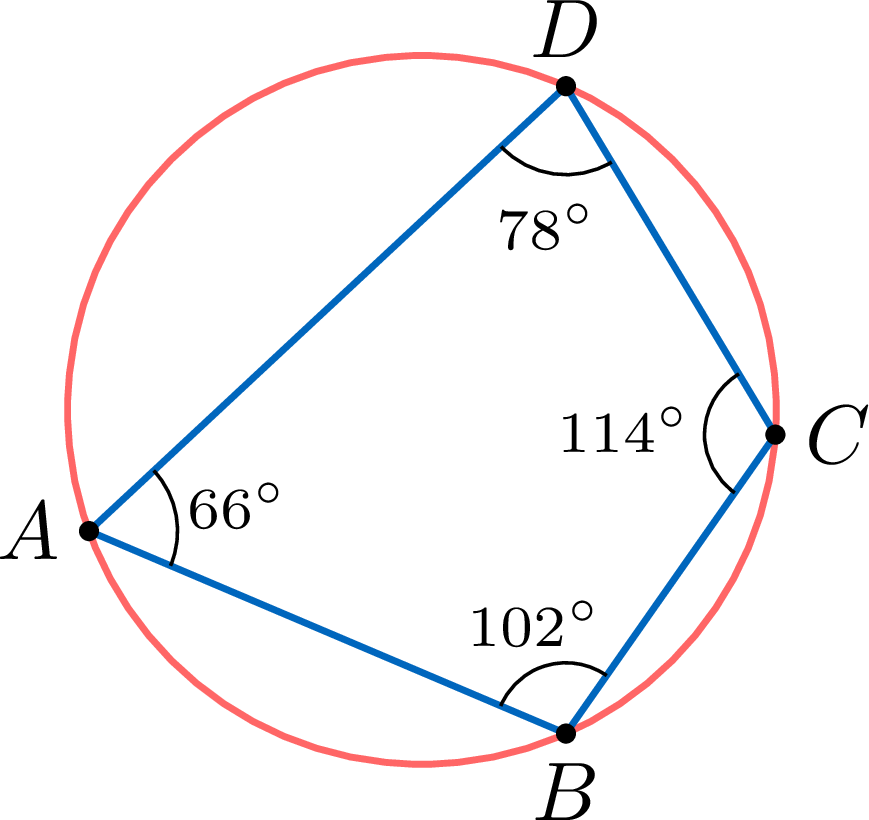
Calculate the sums of opposite angles \(\Angle{DAB} + \Angle{BCD}\) and \(\Angle{ABC} + \Angle{CDA}\). What do you notice? Would it be the same for any four points of a circle, taken in order?
\(\Angle{DAB} + \Angle{BCD} = 66^\circ + 114^\circ = 180^\circ\) and \(\Angle{ABC} + \Angle{CDA} = 102^\circ + 78^\circ = 180^\circ\): in each pair, the two opposite angles are supplementary. This is no coincidence: the angles \(\Angle{DAB}\) and \(\Angle{BCD}\) stand on the two arcs \(BD\), whose angles at the centre together make a full turn, \(360^\circ\); each of them is half of its angle at the centre, so together they make \(180^\circ\) (the theorem “Opposite Angles of a Cyclic Quadrilateral”). The same holds for any four points of a circle taken in order.
Definition — Cyclic Quadrilateral
A quadrilateral is cyclic when its four vertices lie on one circle; the quadrilateral is then said to be inscribed in the circle. 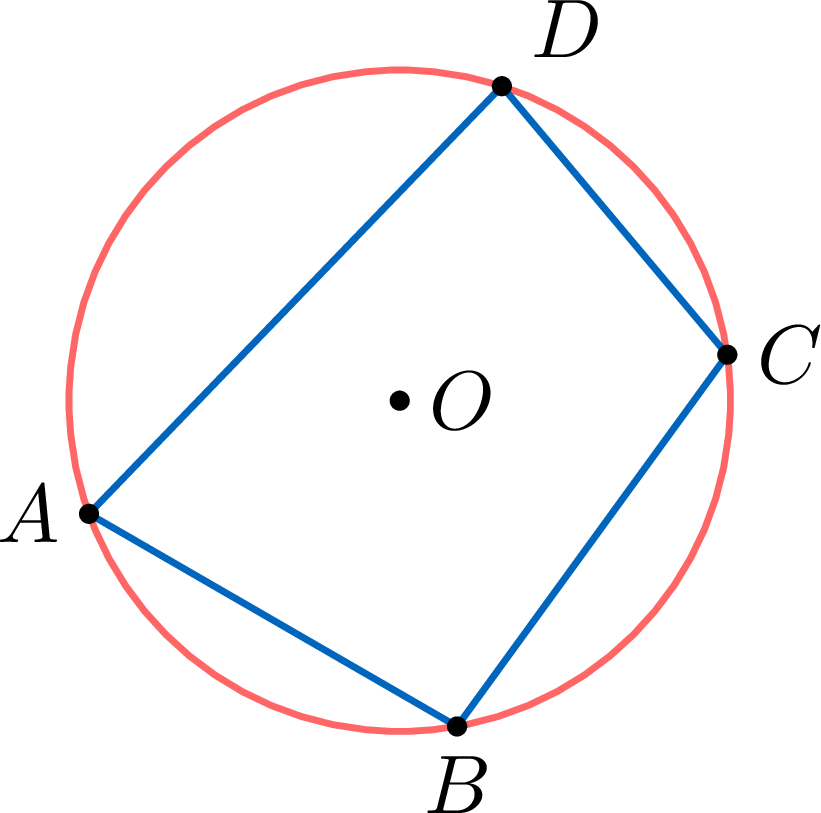
Proposition — Opposite Angles of a Cyclic Quadrilateral
In a cyclic quadrilateral \(ABCD\), the opposite angles are supplementary: $$\Angle{DAB} + \Angle{BCD} = 180^\circ \quad\text{and}\quad \Angle{ABC} + \Angle{CDA} = 180^\circ.$$ Consequently, an exterior angle of a cyclic quadrilateral is equal to the interior opposite angle: if \(E\) lies on the line \(\Line{DC}\) beyond \(C\), then \(\Angle{BCE} = \Angle{DAB}\). 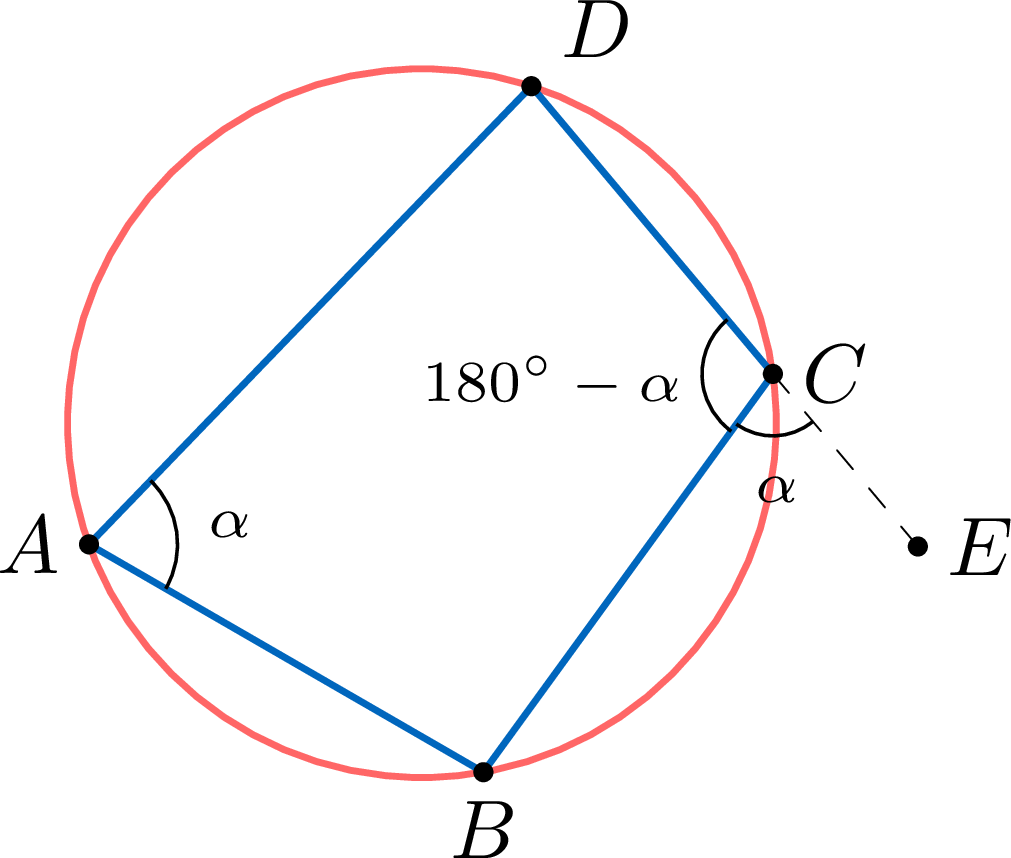
Let \(O\) be the centre of the circle. The vertices \(A\) and \(C\) lie on the two different arcs \(BD\). The angle \(\Angle{DAB}\) is subtended by the arc \(BD\) that contains \(C\), and \(\Angle{BCD}\) by the arc \(BD\) that contains \(A\); the angles at the centre subtended by these two arcs together make a full turn: 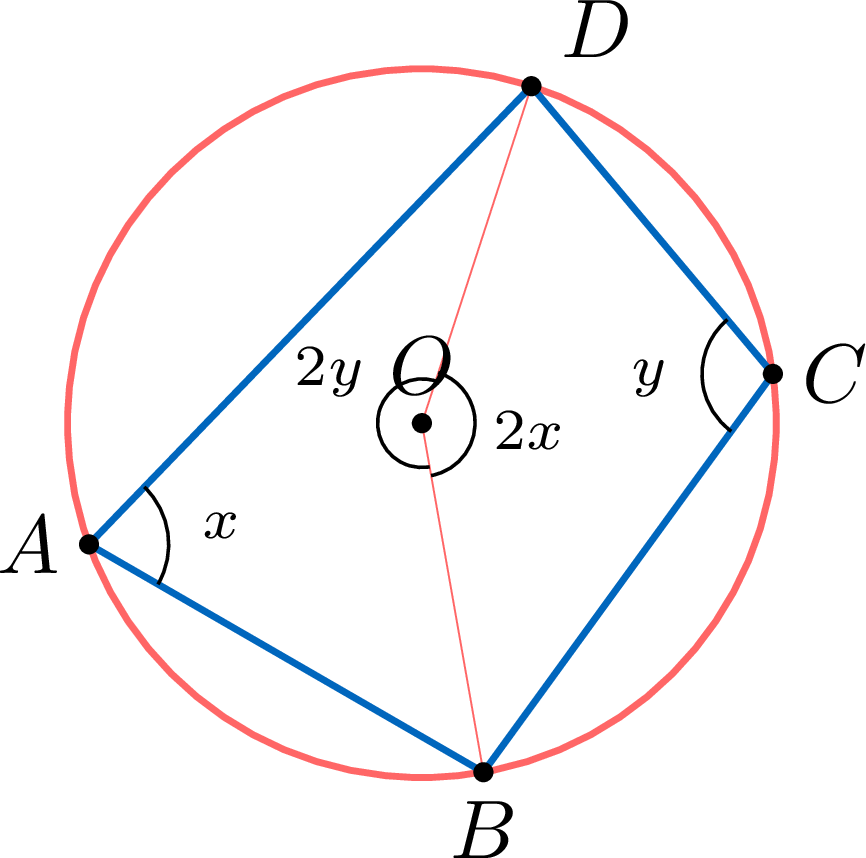
$$\begin{aligned}[t] 2\Angle{DAB} + 2\Angle{BCD} &= 360^\circ && \text{(angle at the centre, twice)}\\
\Angle{DAB} + \Angle{BCD} &= 180^\circ. \end{aligned}$$ The angles of the quadrilateral add up to \(360^\circ\), so \(\Angle{ABC} + \Angle{CDA} = 360^\circ - 180^\circ = 180^\circ\). Finally, \(D\), \(C\), \(E\) being collinear, \(\Angle{BCE} = 180^\circ - \Angle{BCD} = \Angle{DAB}\) (angles on a straight line).
Proposition — Circumscribed circle of a triangle
Let \(ABC\) be a triangle. The perpendicular bisectors of its three sides pass through a single point \(O\), which is at equal distance from the three vertices: \(OA = OB = OC\). The circle with centre \(O\) passing through \(A\), \(B\) and \(C\) is called the circumscribed circle of the triangle. 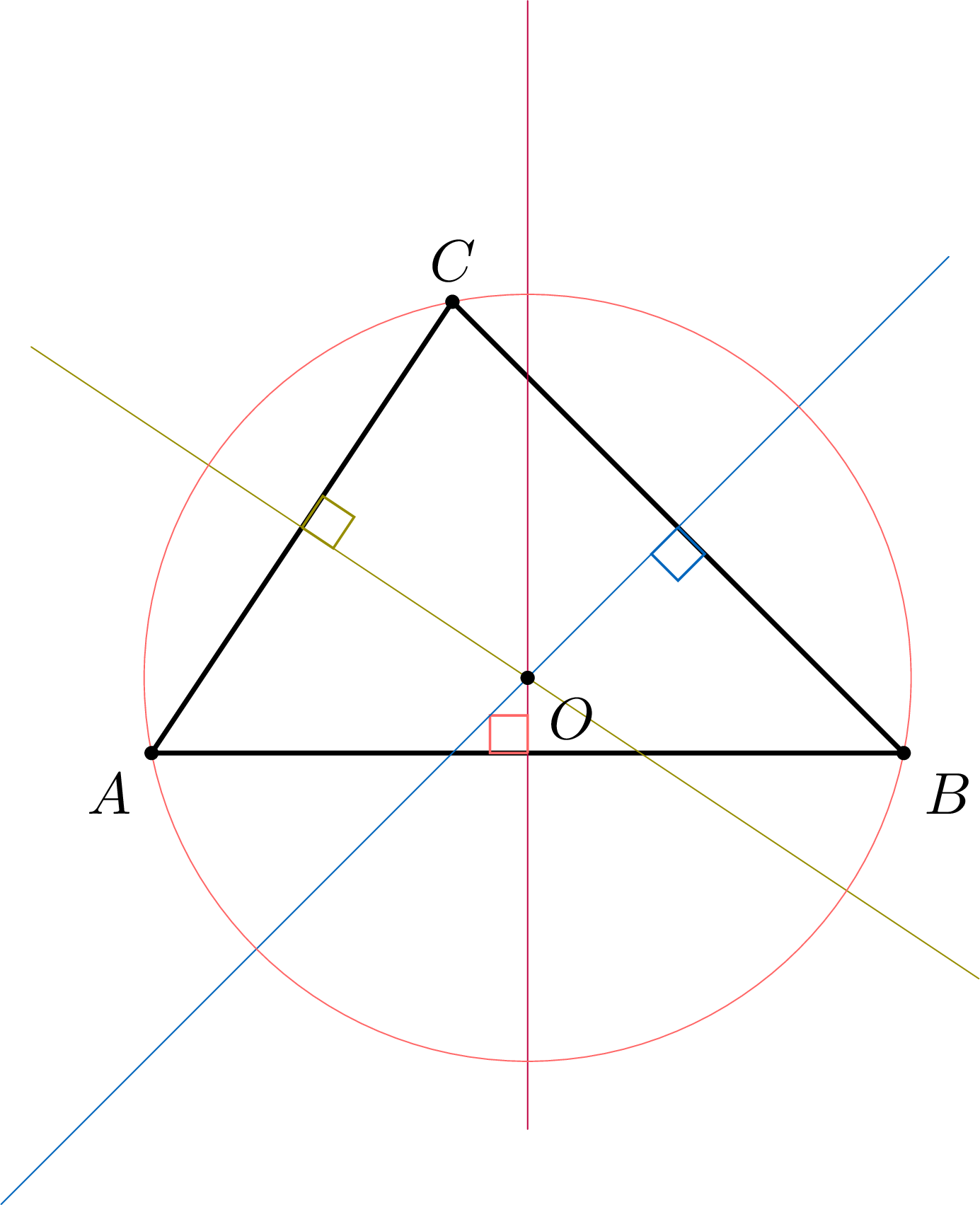
Proposition — A Test for a Cyclic Quadrilateral
If a convex quadrilateral has two opposite angles that are supplementary, then it is cyclic. Equivalently, a convex quadrilateral with an exterior angle equal to the interior opposite angle is cyclic.
Let \(ABCD\) be a convex quadrilateral with \(\Angle{ABC} + \Angle{CDA} = 180^\circ\), and \(\Gamma\) the circumscribed circle of the triangle \(ABC\), which passes through \(A\), \(B\) and \(C\) (circumscribed circle of a triangle). Suppose, for contradiction, that \(D\) is not on \(\Gamma\). The diagonals of the convex quadrilateral cut at a point \(X\) of the chord \(\Segment{AC}\), inside \(\Gamma\); so the ray \(\Ray{BD}\), which passes through \(X\), meets \(\Gamma\) again at a point \(D'\) beyond \(X\). The quadrilateral \(ABCD'\) is cyclic, so \(\Angle{ABC} + \Angle{CD'A} = 180^\circ\) (opposite angles), hence \(\Angle{CD'A} = \Angle{CDA}\). The points \(D\) and \(D'\) are distinct and both lie on the ray \(\Ray{XD}\). 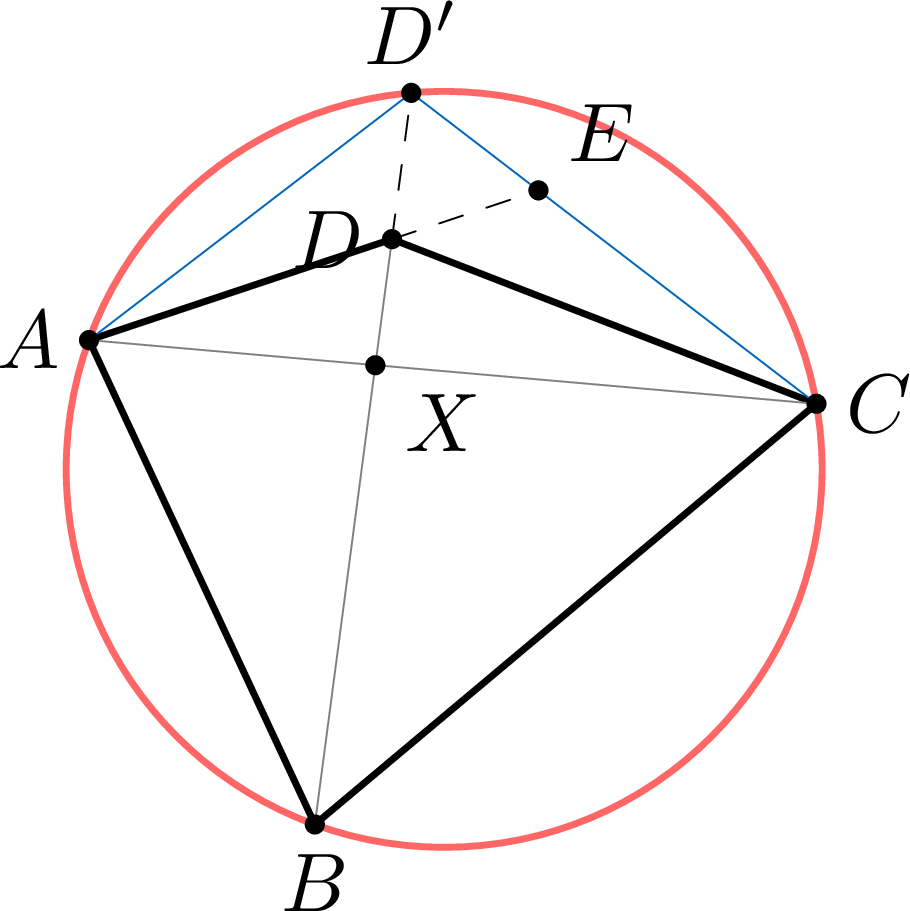
- If \(D\) lies between \(X\) and \(D'\) (\(D\) inside \(\Gamma\), as in the figure), \(D\) lies inside the triangle \(AD'C\), and the line \(\Line{AD}\) cuts \(\Segment{CD'}\) at a point \(E\). The angle \(\Angle{ADC}\) is an exterior angle of the triangle \(DEC\), so \(\Angle{ADC} \gt \Angle{DEC}\); and \(\Angle{AEC} = \Angle{DEC}\) is an exterior angle of the triangle \(AED'\), so \(\Angle{AEC} \gt \Angle{AD'E} = \Angle{AD'C}\). Hence \(\Angle{ADC} \gt \Angle{AD'C}\).
- If \(D'\) lies between \(X\) and \(D\) (\(D\) outside \(\Gamma\)), \(D'\) lies inside the triangle \(ADC\), and the line \(\Line{AD'}\) cuts \(\Segment{CD}\) at a point \(E'\). The angle \(\Angle{AD'C}\) is an exterior angle of the triangle \(D'E'C\), so \(\Angle{AD'C} \gt \Angle{D'E'C}\); and \(\Angle{AE'C} = \Angle{D'E'C}\) is an exterior angle of the triangle \(AE'D\), so \(\Angle{AE'C} \gt \Angle{ADE'} = \Angle{ADC}\). Hence \(\Angle{AD'C} \gt \Angle{ADC}\).
Method — Proving That Four Points Lie on a Circle
To prove that the points \(A\), \(B\), \(C\), \(D\) lie on one circle: - name the quadrilateral with its vertices in order around it, and check that it is convex;
- find two opposite angles, each with its reason, and show that they add up to \(180^\circ\) — or show that an exterior angle equals the interior opposite angle;
- conclude with the test for a cyclic quadrilateral.
Example
The quadrilateral \(ABCD\) is cyclic, with \(\Angle{DAB} = 76^\circ\), \(\Angle{ABC} = 3y\) and \(\Angle{CDA} = 2y + 20^\circ\). The side \(\Segment{BC}\) is extended beyond \(C\) to a point \(E\). 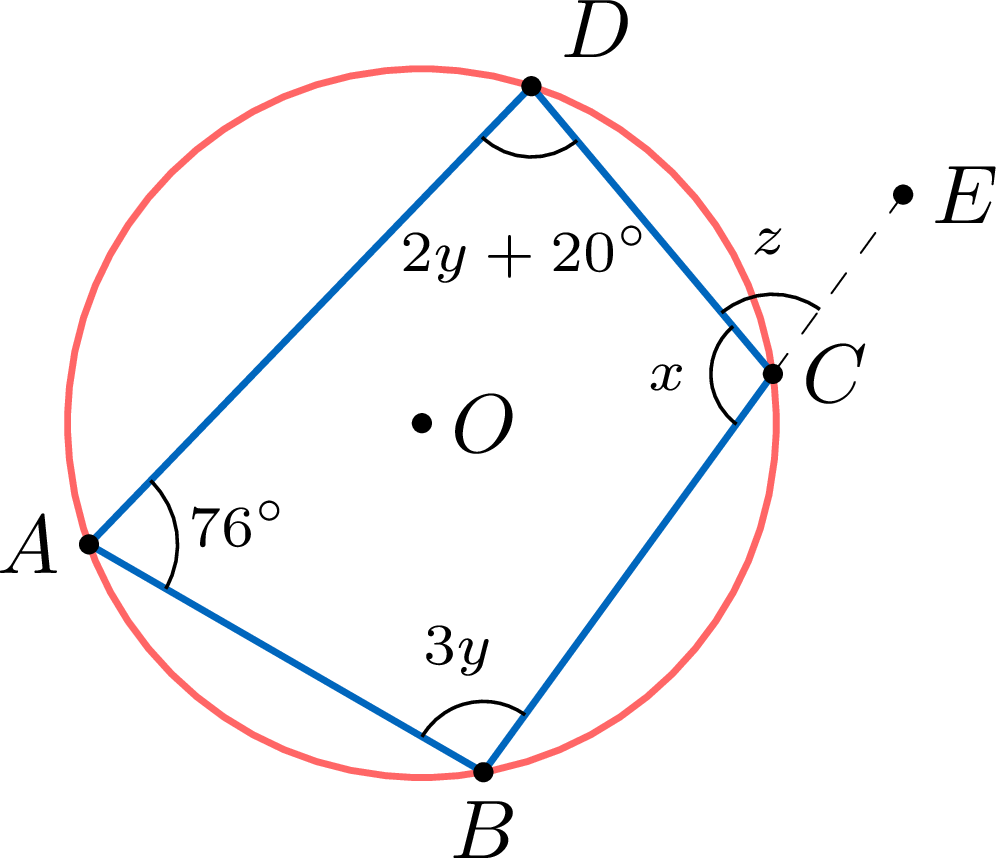
$$\begin{aligned}[t] x &= 180^\circ - 76^\circ = 104^\circ && \text{(opposite angles of a cyclic quadrilateral)}\\
3y + 2y + 20^\circ &= 180^\circ && \text{(opposite angles } \Angle{ABC} \text{ and } \Angle{CDA}\text{)}\\
5y &= 160^\circ\\
y &= 32^\circ\\
z &= 180^\circ - x = 76^\circ && \text{(angles on a straight line)} \end{aligned}$$ So \(\Angle{ABC} = 96^\circ\) and \(\Angle{CDA} = 84^\circ\), and the exterior angle \(z = 76^\circ\) equals the interior opposite angle \(\Angle{DAB}\). Check: \(76^\circ + 96^\circ + 104^\circ + 84^\circ = 360^\circ\).
Example
In the triangle \(ABC\), the point \(D\) lies on \(\Segment{AB}\) and the point \(E\) on \(\Segment{AC}\), both distinct from the vertices, with \(\Angle{ADE} = \Angle{ACB}\). 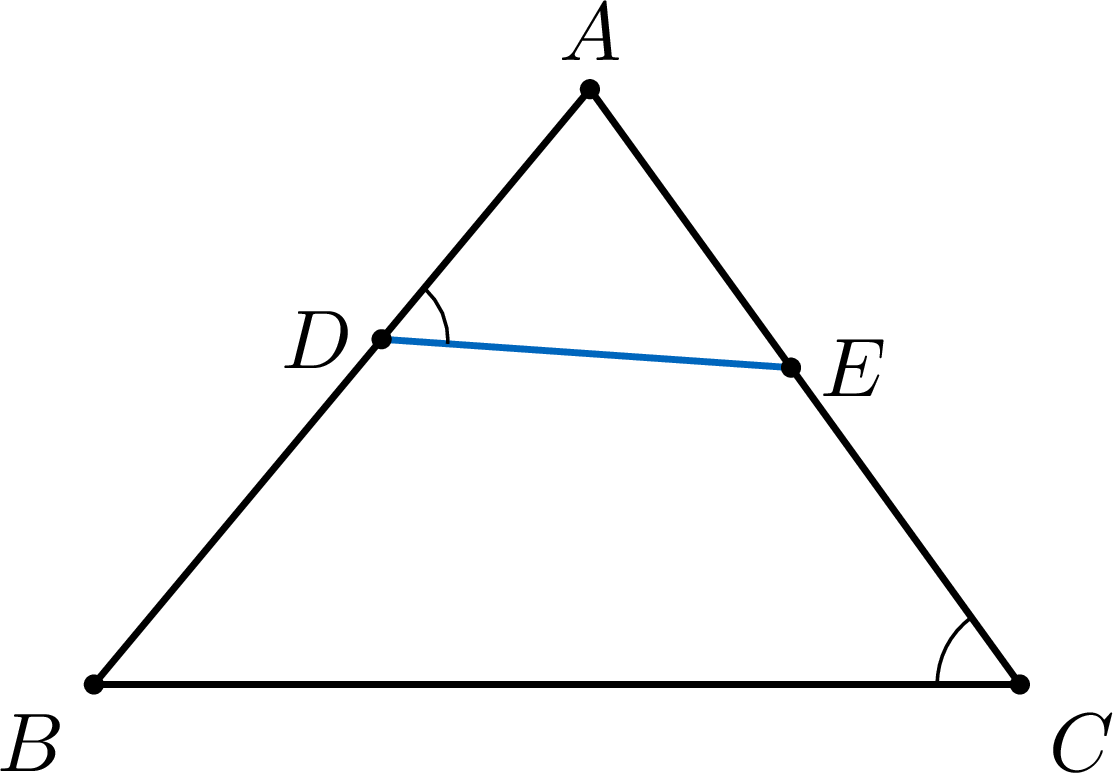
Consider the convex quadrilateral \(BCED\), with its vertices in this order.
- \(A\), \(D\), \(B\) are collinear, with \(D\) between \(A\) and \(B\): the angle \(\Angle{ADE}\) is the exterior angle of \(BCED\) at \(D\).
- The interior angle opposite \(D\) is the angle at \(C\): \(\Angle{BCE} = \Angle{ACB}\), since \(E\) lies on \(\Segment{AC}\).
- By hypothesis \(\Angle{ADE} = \Angle{ACB} = \Angle{BCE}\): the exterior angle at \(D\) equals the interior opposite angle.
Skills to practice
- Finding Angles in Cyclic Quadrilaterals
- Proving with Cyclic Quadrilaterals
II.2
Angle between a Tangent and a Chord
Proposition — Tangent and Radius
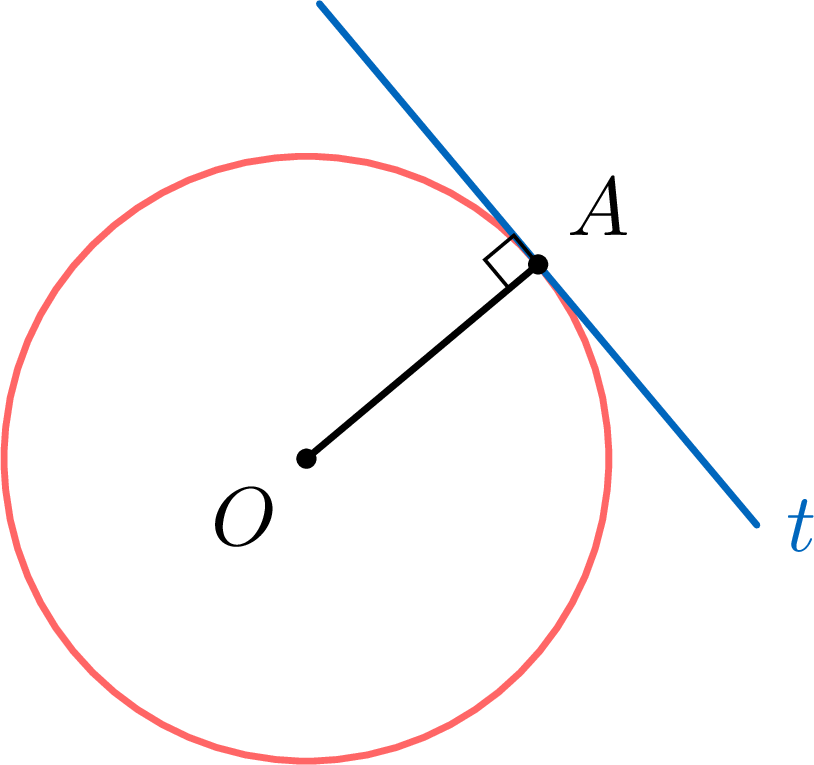
Let \(\mathcal{C}\) be the circle of centre \(O\) and radius \(r\), and \(A\) a point of \(\mathcal{C}\). Recall that a line is tangent to \(\mathcal{C}\) at \(A\) when \(A\) is its only common point with \(\mathcal{C}\). - If a line is tangent to \(\mathcal{C}\) at \(A\), then it is perpendicular to the radius \(\Segment{OA}\).
- Conversely, the line through \(A\) perpendicular to the radius \(\Segment{OA}\) is tangent to \(\mathcal{C}\) at \(A\).
Proposition — Tangent–Chord Angle
Let \(\Segment{AB}\) be a chord of a circle and \(T\) a point, other than \(A\), of the tangent line at \(A\). The angle \(\Angle{TAB}\) between the tangent and the chord is equal to any angle at the circumference \(\Angle{ACB}\), where \(C\) is a point of the circle on the other side of \(\Line{AB}\) from \(T\) (in the alternate segment): $$\Angle{TAB} = \Angle{ACB}.$$ 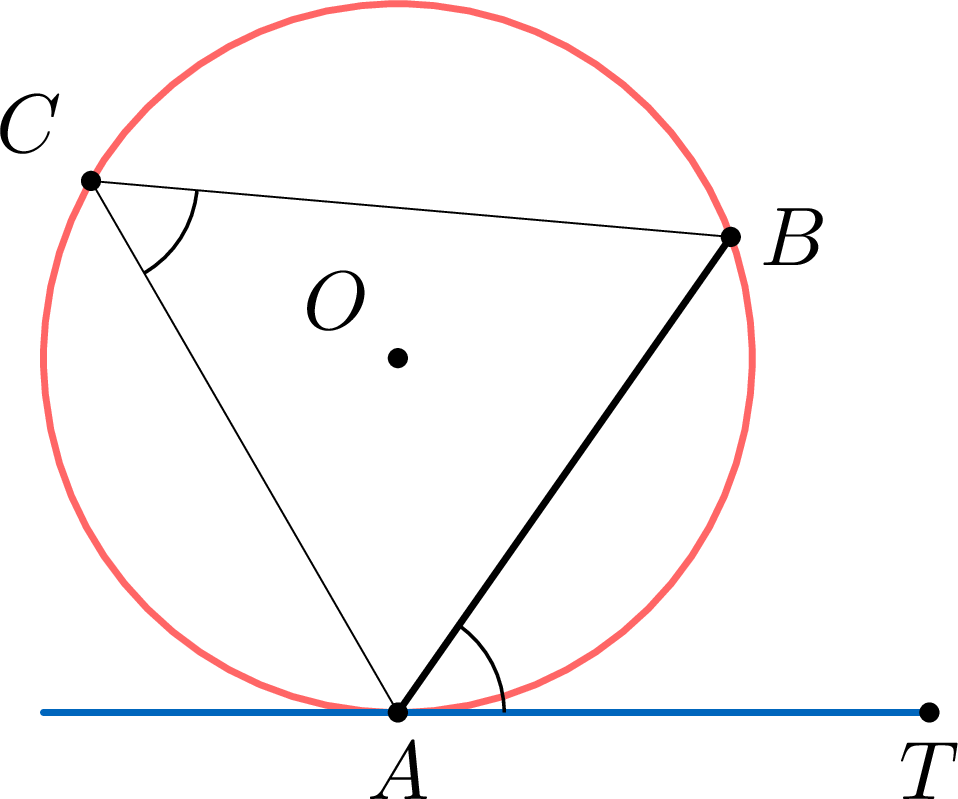
Let \(O\) be the centre of the circle. 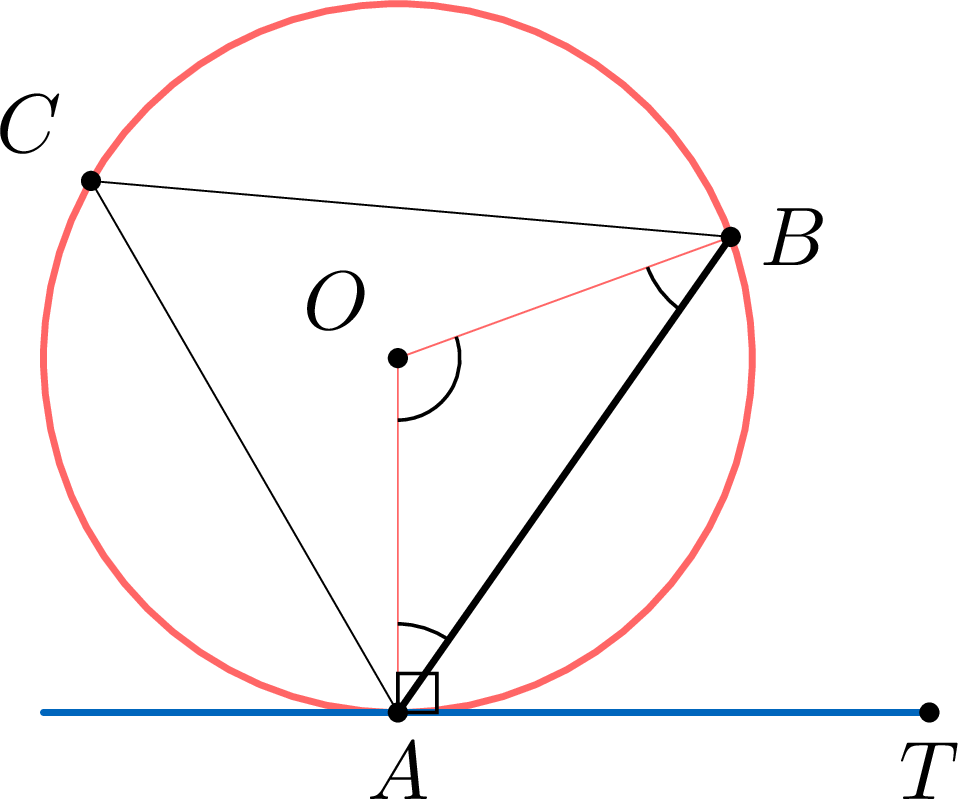
Case where \(\Angle{TAB}\) is acute. All the points of the circle lie on the same side of the tangent as \(O\) (if a point \(Q\) of the circle were on the other side, the segment \(\Segment{OQ}\) would cut the tangent at a point \(M \neq A\) with \(OM \lt OQ = r\), whereas every point of the tangent other than \(A\) is outside the circle: tangent and radius), and \(\Angle{TAO} = 90^\circ\) (tangent and radius), so the ray \(\Ray{AB}\) lies inside the right angle \(\Angle{TAO}\). The triangle \(OAB\) is isosceles at \(O\) (\(OA = OB\)), so \(\Angle{OAB} = \dfrac{180^\circ - \Angle{AOB}}{2}\). Hence $$\begin{aligned}[t] \Angle{TAB} &= \Angle{TAO} - \Angle{OAB}\\
&= 90^\circ - \frac{180^\circ - \Angle{AOB}}{2} && \text{(tangent and radius; isosceles triangle } OAB\text{)}\\
&= \frac{1}{2}\Angle{AOB}. \end{aligned}$$ The angle \(\Angle{AOB}\) is the angle at the centre subtended by the arc \(AB\) lying inside the angle \(\Angle{TAB}\), which does not contain \(C\); so \(\Angle{ACB} = \dfrac{1}{2}\Angle{AOB}\) (angle at the centre), and \(\Angle{TAB} = \Angle{ACB}\). Case where \(\Angle{TAB}\) is right. The line \(\Line{AB}\) is then the perpendicular to the tangent at \(A\), which is the line \(\Line{OA}\) (tangent and radius): \(\Segment{AB}\) is a diameter, and \(\Angle{ACB} = 90^\circ\) (angle in a semicircle). Case where \(\Angle{TAB}\) is obtuse. Let \(T'\) be a point of the tangent on the other side of \(A\), and \(D\) a point of the circle on the same side of \(\Line{AB}\) as \(T\). The angle \(\Angle{T'AB} = 180^\circ - \Angle{TAB}\) is acute, so by the first case \(\Angle{T'AB} = \Angle{ADB}\). The quadrilateral \(ADBC\) is cyclic, so \(\Angle{ACB} = 180^\circ - \Angle{ADB}\) (opposite angles), that is, \(\Angle{ACB} = 180^\circ - \Angle{T'AB} = \Angle{TAB}\).
Example
The triangle \(ABC\) is inscribed in a circle of centre \(O\), and \(T\) is a point of the tangent at \(A\), on the other side of \(\Line{AB}\) from \(C\). Moreover \(\Angle{TAB} = 68^\circ\) and \(\Angle{BAC} = 50^\circ\). 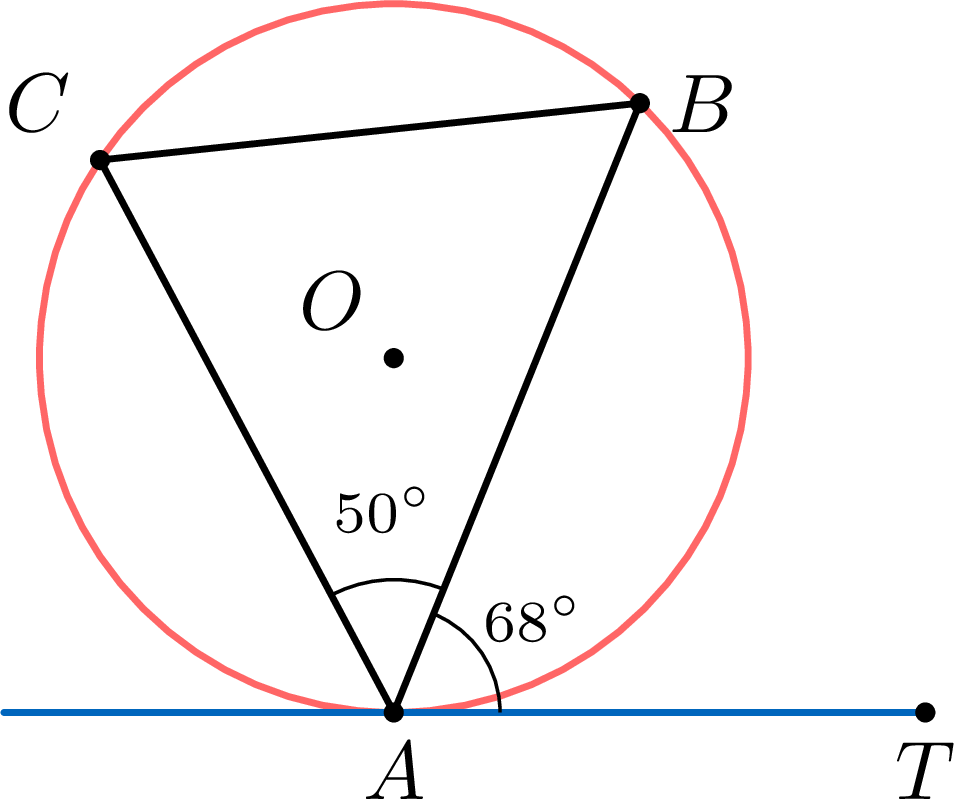
$$\begin{aligned}[t] \Angle{ACB} &= \Angle{TAB} = 68^\circ && \text{(tangent--chord angle)}\\
\Angle{ABC} &= 180^\circ - 68^\circ - 50^\circ && \text{(angle sum of the triangle } ABC\text{)}\\
&= 62^\circ\\
\Angle{AOB} &= 2 \times 68^\circ = 136^\circ && \text{(angle at the centre)} \end{aligned}$$ Check with the tangent on the other side of \(A\): the angle between it and the chord \(\Segment{AC}\) is \(180^\circ - 68^\circ - 50^\circ = 62^\circ\), equal to \(\Angle{ABC}\), as the tangent–chord angle predicts.
Example
The triangle \(ABC\) is inscribed in a circle, with \(AB = AC\). 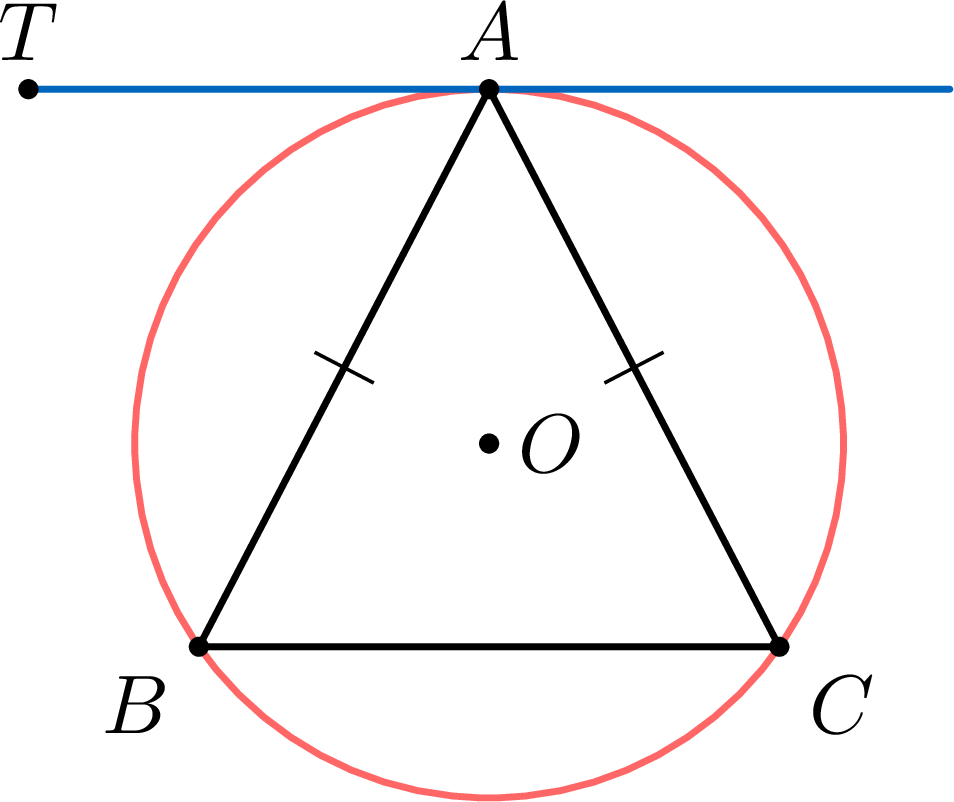
Let \(T\) be a point of the tangent at \(A\) on the other side of \(\Line{AB}\) from \(C\). $$\begin{aligned}[t] \Angle{TAB} &= \Angle{ACB} && \text{(tangent--chord angle)}\\
&= \Angle{ABC} && \text{(}AB = AC\text{: base angles of the isosceles triangle } ABC\text{)} \end{aligned}$$ The lines \(\Line{AT}\) and \(\Line{BC}\) are cut by the line \(\Line{AB}\), and the angles \(\Angle{TAB}\) and \(\Angle{ABC}\) are alternate angles (\(T\) and \(C\) lie on either side of \(\Line{AB}\)). They are equal, so \(\Line{AT} \parallel \Line{BC}\): the tangent at \(A\) is parallel to \(\Line{BC}\).
Skills to practice
- Finding Angles between a Tangent and a Chord
- Proving with the Tangent-Chord Angle
III
Going further
Skills to practice
- Solving Problems with Circle Theorems
- Investigating Patterns
- Solving Problems in Context
- Quiz
Jump to section