International Baccalaureate · MYP 4
Transformations
I
Reflecting in the Axes and in y \(\equal\) x
Proposition — Reflection in the \(x\)-axis
The image of the point \(M(x, y)\) under the reflection in the \(x\)-axis is \(M'(x, -y)\). This reflection keeps the \(x\)-coordinate and changes the sign of the \(y\)-coordinate.
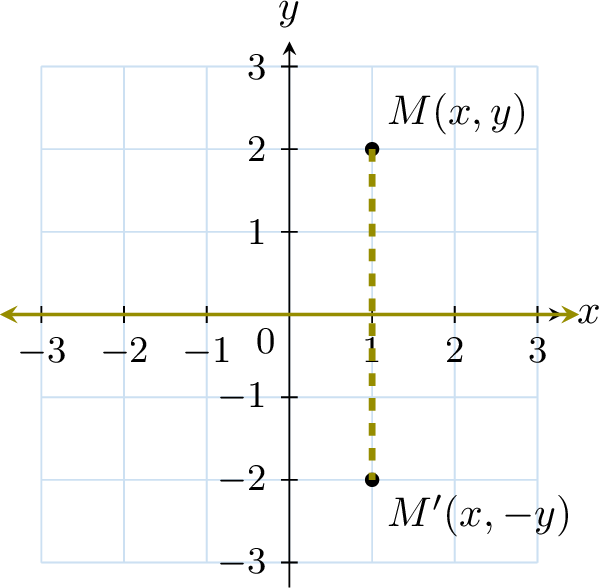
Let \(M(x, y)\) with \(y \neq 0\), and \(M'(x, -y)\). Take any point \(P(t, 0)\) of the \(x\)-axis and compare its distances to \(M\) and \(M'\): $$PM^2 = (t-x)^2 + y^2 \qquad PM'^2 = (t-x)^2 + (-y)^2 = (t-x)^2 + y^2.$$ Every point of the \(x\)-axis is equidistant from \(M\) and \(M'\): the axis is therefore the perpendicular bisector of the segment \(\Segment{MM'}\) — which is exactly what makes \(M'\) the reflection of \(M\) in the \(x\)-axis. (For \(y = 0\), the point is on the axis and is its own image.)
Proposition — Reflection in the \(y\)-axis
The image of the point \(M(x, y)\) under the reflection in the \(y\)-axis is \(M'(-x, y)\).This reflection keeps the \(y\)-coordinate and changes the sign of the \(x\)-coordinate.
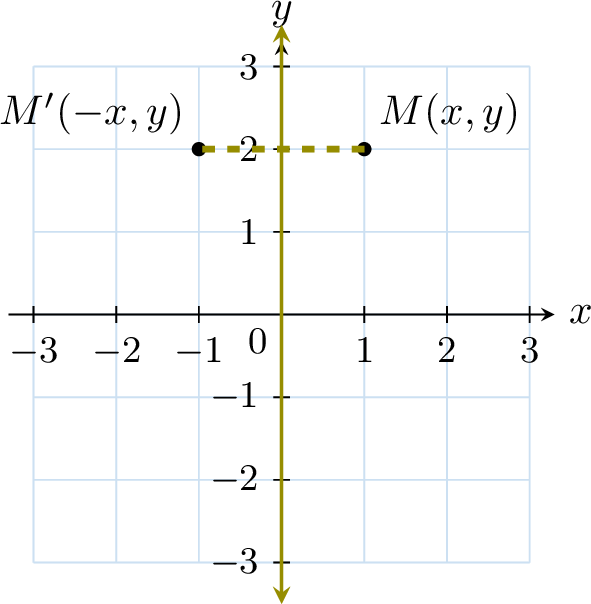
The same argument with the roles of the coordinates exchanged: for \(M(x, y)\) with \(x \neq 0\), \(M'(-x, y)\), and any point \(P(0, t)\) of the \(y\)-axis, $$PM^2 = x^2 + (t-y)^2 = PM'^2,$$ so the \(y\)-axis is the perpendicular bisector of \(\Segment{MM'}\).
Proposition — Reflection in the line \(y\equal x\)
The image of the point \(M(x, y)\) under the reflection in the line \(y=x\) is \(M'(y, x)\). The coordinates are swapped.
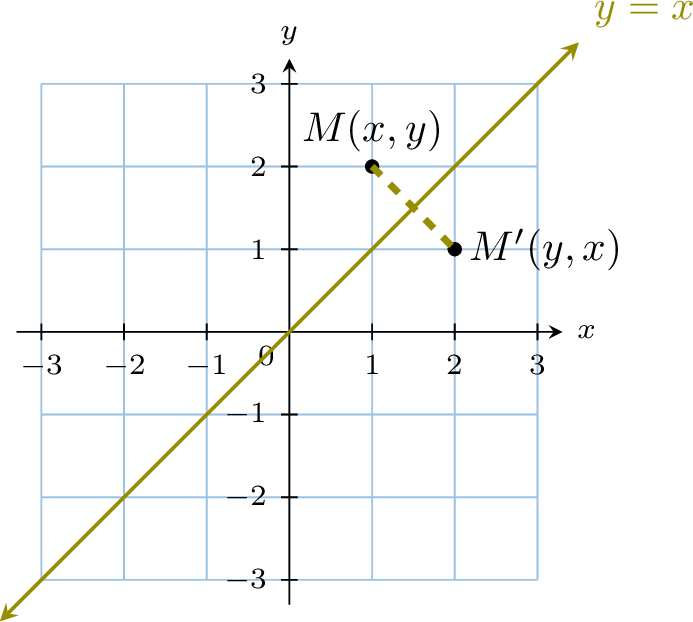
Let \(M(x, y)\) with \(y \neq x\), and \(M'(y, x)\). Take any point \(P(t, t)\) of the line \(y = x\): $$PM^2 = (t-x)^2 + (t-y)^2 \qquad PM'^2 = (t-y)^2 + (t-x)^2:$$ the same two squares, in the other order. Every point of the line is equidistant from \(M\) and \(M'\), so the line \(y = x\) is the perpendicular bisector of \(\Segment{MM'}\): swapping the coordinates is the reflection in it. (For \(y = x\), the point lies on the mirror line.)
Skills to practice
- Finding Images under a Reflection
II
Rotating about the Origin
Definition — Rotation of a Point
A rotation of point \(M\) through an angle \(a^{\circ}\) about centre \(O\), in a given direction, gives the point \(M'\) with \(OM'=OM\) such that turning the segment \(\Segment{OM}\) about \(O\) through \(a^{\circ}\) in that direction brings it onto the segment \(\Segment{OM'}\). The centre \(O\) is its own image.The direction is always given: clockwise \(\curvearrowright\) or anticlockwise \(\curvearrowleft\).

Proposition — Rotation of 90°
The image of the point \(M(x, y)\) under the rotation of \(90^\circ\) (anticlockwise) around the origin is \(M'(-y, x)\).In coordinates, a \(90^\circ\) anticlockwise rotation sends \((x,y)\) to \((-y,x)\).
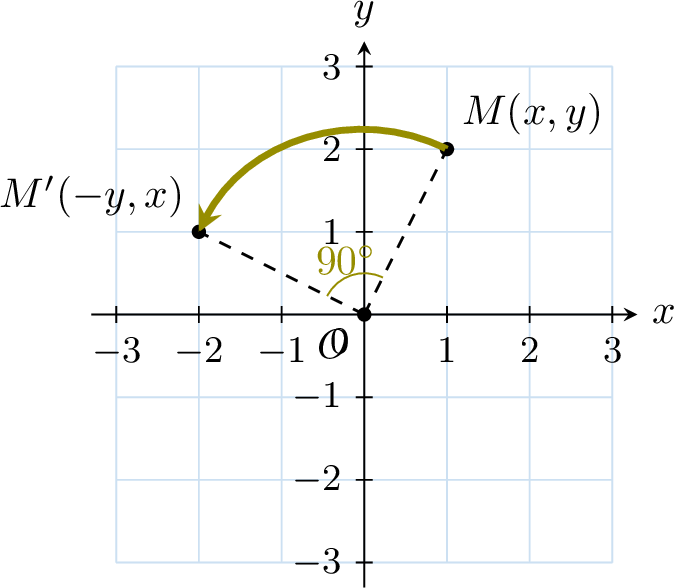
Let \(M(x, y)\) and \(M'(-y, x)\). First, the distances to the centre agree: $$OM'^2 = (-y)^2 + x^2 = x^2 + y^2 = OM^2.$$ Next, the quarter turn: let \(P(x, 0)\) and \(P'(0, x)\) be the feet of \(M\) and \(M'\) on the axes. The right-angled triangle \(OPM\) (legs \(|x|\) along the \(x\)-axis and \(|y|\) vertical) and the right-angled triangle \(OP'M'\) (legs \(|x|\) along the \(y\)-axis and \(|y|\) horizontal) are congruent, and the second is the first with each leg turned by \(90°\) (the \(x\)-axis onto the \(y\)-axis). So \(\Vect{OM'}\) is \(\Vect{OM}\) turned by \(90°\) anticlockwise, at the same distance from \(O\): \(M'\) is the image of \(M\) under the rotation of \(90°\) around the origin.
Proposition — Rotation of -90°
The image of the point \(M(x, y)\) under the rotation of \(-90^\circ\) (clockwise) around the origin is \(M'(y, -x)\).In coordinates, a \(90^\circ\) clockwise rotation sends \((x,y)\) to \((y,-x)\).
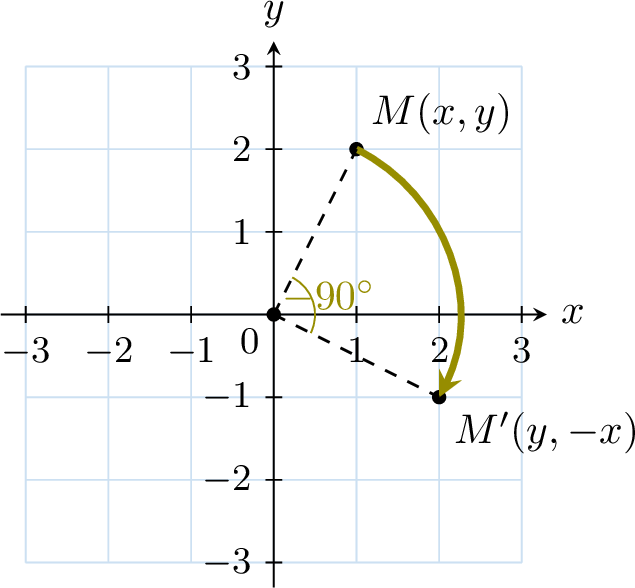
The rotation of \(-90°\) is the inverse of the rotation of \(+90°\): it must send \(M'\) back to \(M\). Check that the formula \((x, y) \mapsto (y, -x)\) does exactly that: applying the \(+90°\) formula to \((y, -x)\) gives $$\big(-(-x),\ y\big) = (x, y).$$ The two formulas undo each other, so \((y, -x)\) is the image of \((x, y)\) under the quarter turn in the clockwise sense.
Proposition — Rotation of 180°
The image of the point \(M(x, y)\) under the rotation of \(180^\circ\) around the origin is \(M'(-x, -y)\).In coordinates, a half-turn about the origin sends \((x,y)\) to \((-x,-y)\).
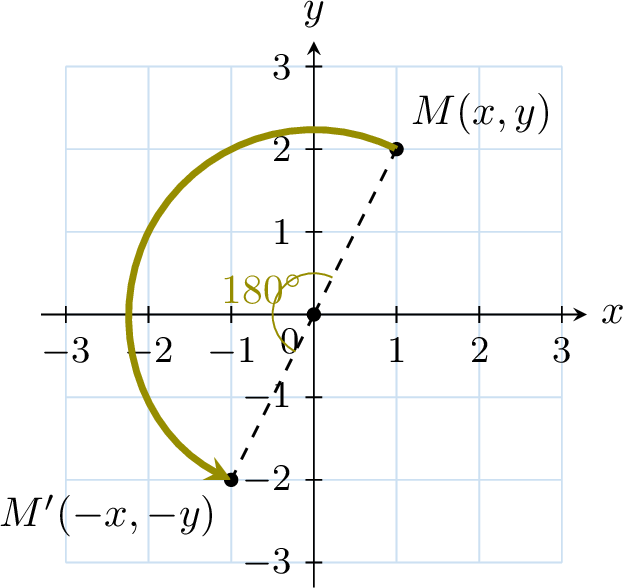
The half-turn about the origin sends \(M\) to the point \(M'\) such that \(O\) is the midpoint of \(\Segment{MM'}\). The midpoint of \(M(x, y)\) and \(M'(-x, -y)\) is $$\left(\frac{x + (-x)}{2},\ \frac{y + (-y)}{2}\right) = (0, 0) = O. \qquad \checkmark$$ Alternatively: turning by \(180°\) is turning by \(90°\) twice, and the formula agrees: $$(x, y) \xrightarrow{\ 90°\ } (-y, x) \xrightarrow{\ 90°\ } (-x, -y).$$
Skills to practice
- Recognising a Transformation from Its Rule
- Finding Images under a Rotation
III
Enlarging about a Centre
You have already met enlargement and reduction: multiplying every length of a figure by a positive scale factor. A homothety makes this idea precise in two ways. It fixes a centre \(O\) from which the figure is scaled, and it allows the scale factor \(\textcolor{olive}{k}\) to be negative — a negative \(k\) puts the image on the opposite side of \(O\). The enlargement or reduction you already know is the case where \(\textcolor{olive}{k}\) is positive, and its scale factor is then \(|\textcolor{olive}{k}|\).
Definition — Homothety of a Point
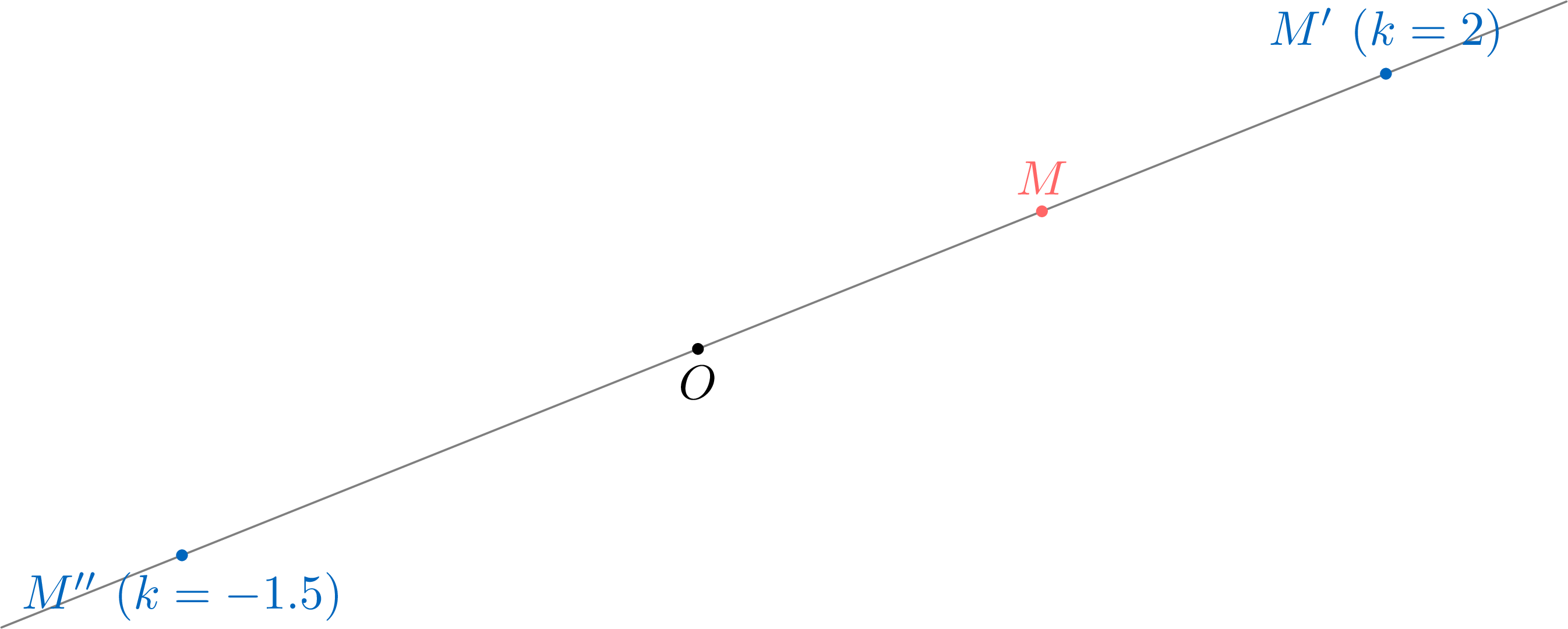
The enlargement with centre \(O\) and scale factor \(\textcolor{olive}{k}\) (a nonzero number), also called a homothety, sends a point \(M\) to the point \(M'\) such that: - \(M'\) lies on the line \(\Line{OM}\);
- \(OM' = |\textcolor{olive}{k}| \times OM\);
- \(M'\) is on the same side of \(O\) as \(M\) when \(\textcolor{olive}{k} > 0\), and on the opposite side when \(\textcolor{olive}{k} < 0\).
Example
Find the coordinates of the image \(M'\) of the point \(M\) under the homothety with centre \(O\) and scale factor \(k = 2\), then of its image \(M''\) under the homothety with centre \(O\) and scale factor \(k = -1\). 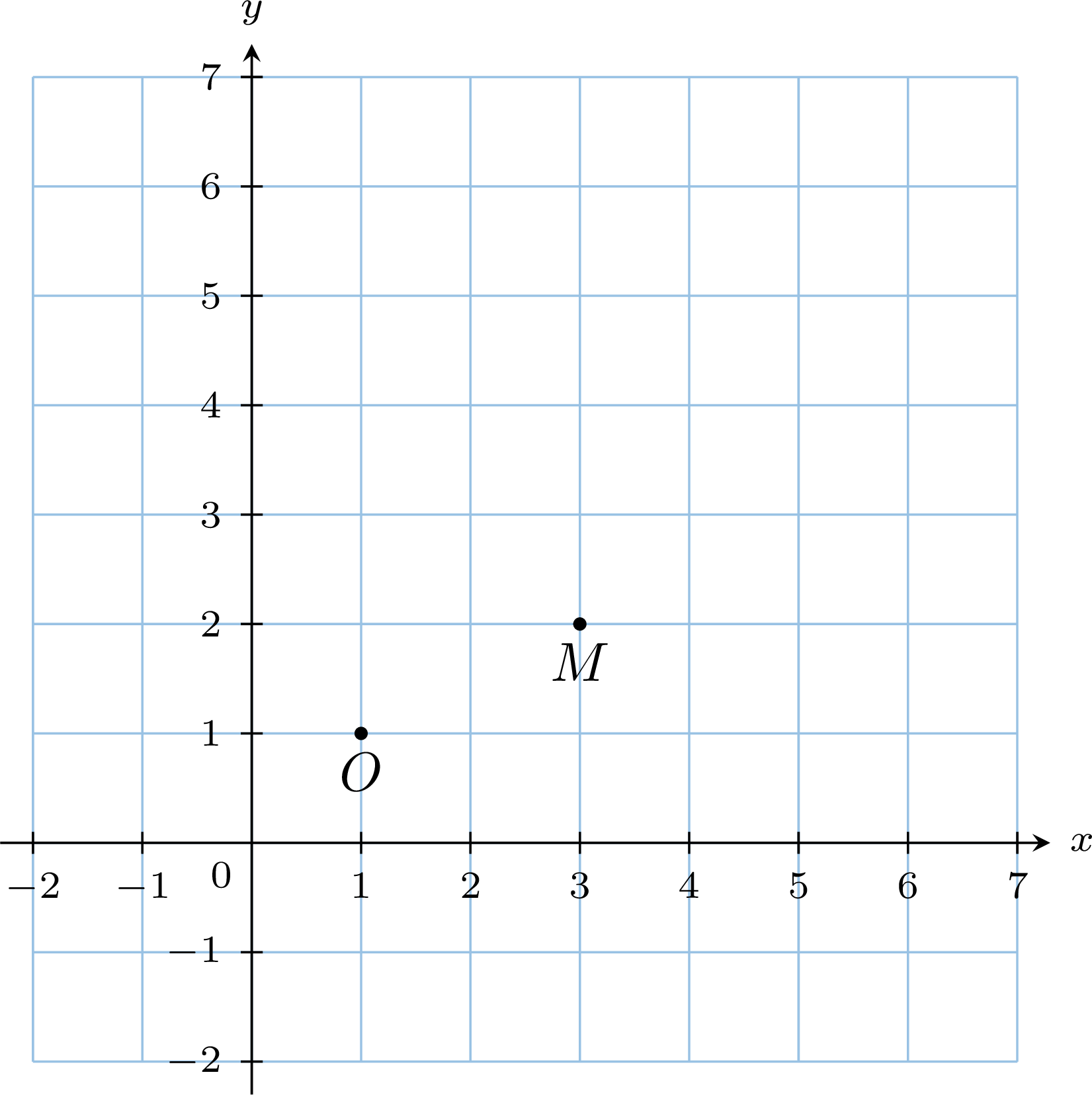
\(O(1, 1)\) and \(M(3, 2)\): from \(O\) to \(M\), the displacement is \(2\) to the right and \(1\) up. For \(k = 2\), the displacement from \(O\) to \(M'\) is twice as large, in the same direction: \(4\) to the right and \(2\) up, so \(M'(1 + 4, 1 + 2) = M'(5, 3)\). Check: \(O\), \(M\), \(M'\) are lined up and \(OM' = 2\,OM\).
For \(k = -1\), the displacement keeps its size but is reversed: \(2\) to the left and \(1\) down, so \(M''(1 - 2, 1 - 1) = M''(-1, 0)\): \(M''\) is on the other side of \(O\), at the same distance as \(M\).
For \(k = -1\), the displacement keeps its size but is reversed: \(2\) to the left and \(1\) down, so \(M''(1 - 2, 1 - 1) = M''(-1, 0)\): \(M''\) is on the other side of \(O\), at the same distance as \(M\).
Definition — Homothety
The homothety of a figure with centre \(O\) and scale factor \(k\) is the image obtained by applying the homothety with centre \(O\) and scale factor \(k\) to all its points. 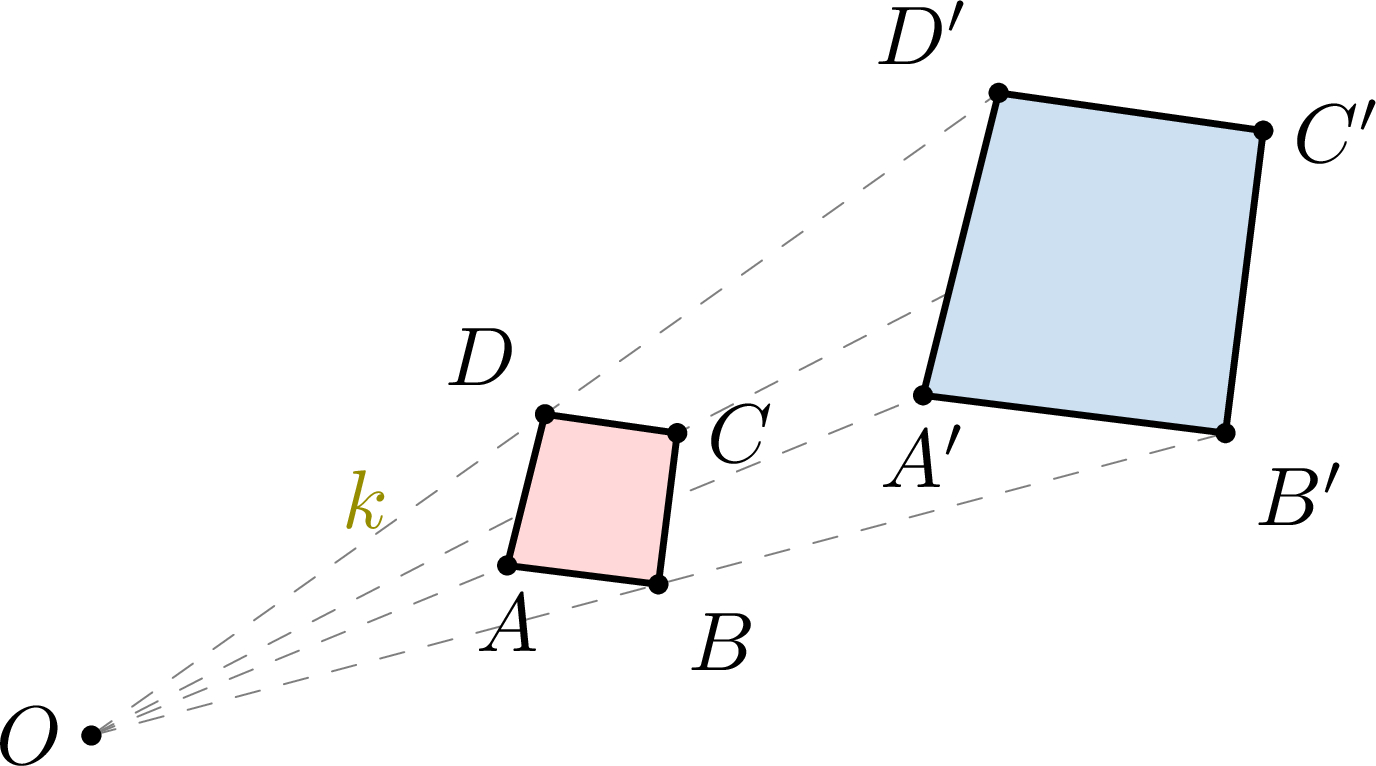
Example
The figure \(\textcolor{colorprop}{A'}\) is the image of figure \(\textcolor{colordef}{A}\) under a homothety with centre \(O\) and scale factor \(2\). 
Look at the special case \(\textcolor{olive}{k} = -1\): the image \(M'\) of \(M\) is on the other side of \(O\), at the same distance, so \(O\) is the midpoint of \(\Segment{MM'}\). The homothety with scale factor \(-1\) is therefore exactly the point reflection (central symmetry) about \(O\). For any negative scale factor, the image is on the other side of \(O\): it is turned by a half-turn, and enlarged or reduced by \(|\textcolor{olive}{k}|\).
Proposition — Effects of a Homothety
A homothety with centre \(O\) and scale factor \(k\): - multiplies every length by \(|k|\): if \(A'\) and \(B'\) are the images of \(A\) and \(B\), then \(A'B' = |k| \times AB\);
- preserves angles, and sends a line to a parallel line (the same line when it passes through \(O\)): a figure and its image have the same shape;
- multiplies areas by \(k^2\).
Example
A triangle has sides \(6\) cm, \(8\) cm and \(10\) cm and an area of \(24\) cm\(^2\). Give the side lengths and the area of its image under a homothety with scale factor \(k = -0.5\). Is the image an enlargement or a reduction?
The lengths are multiplied by \(|k| = 0.5\): the image has sides \(3\) cm, \(4\) cm and \(5\) cm. The area is multiplied by \(k^2 = 0.25\): it is \(24 \times 0.25 = 6\) cm\(^2\). As \(|k| < 1\), the image is a reduction; and as \(k < 0\), it is also turned by a half-turn about the centre.
Proposition — Properties of a Rotation
A rotation preserves lengths, angles and areas: a figure and its image are congruent (they have the same shape and the same size, only their position changes). The image of a segment is a segment of the same length, the image of a line is a line, the image of a circle is a circle of the same radius.A transformation that preserves lengths is called an isometry: rotations, reflections, half-turns (point reflections) and translations are isometries.
Proposition — Composing a Homothety with an Isometry
Following a homothety with scale factor \(k\neq0\) by an isometry produces a similarity with scale factor \(|k|\): the isometry keeps every length, the homothety multiplies them by \(|k|\). The homothety supplies the change of size, the isometry the rigid motion — and every similarity can be obtained in this way (accepted without proof). 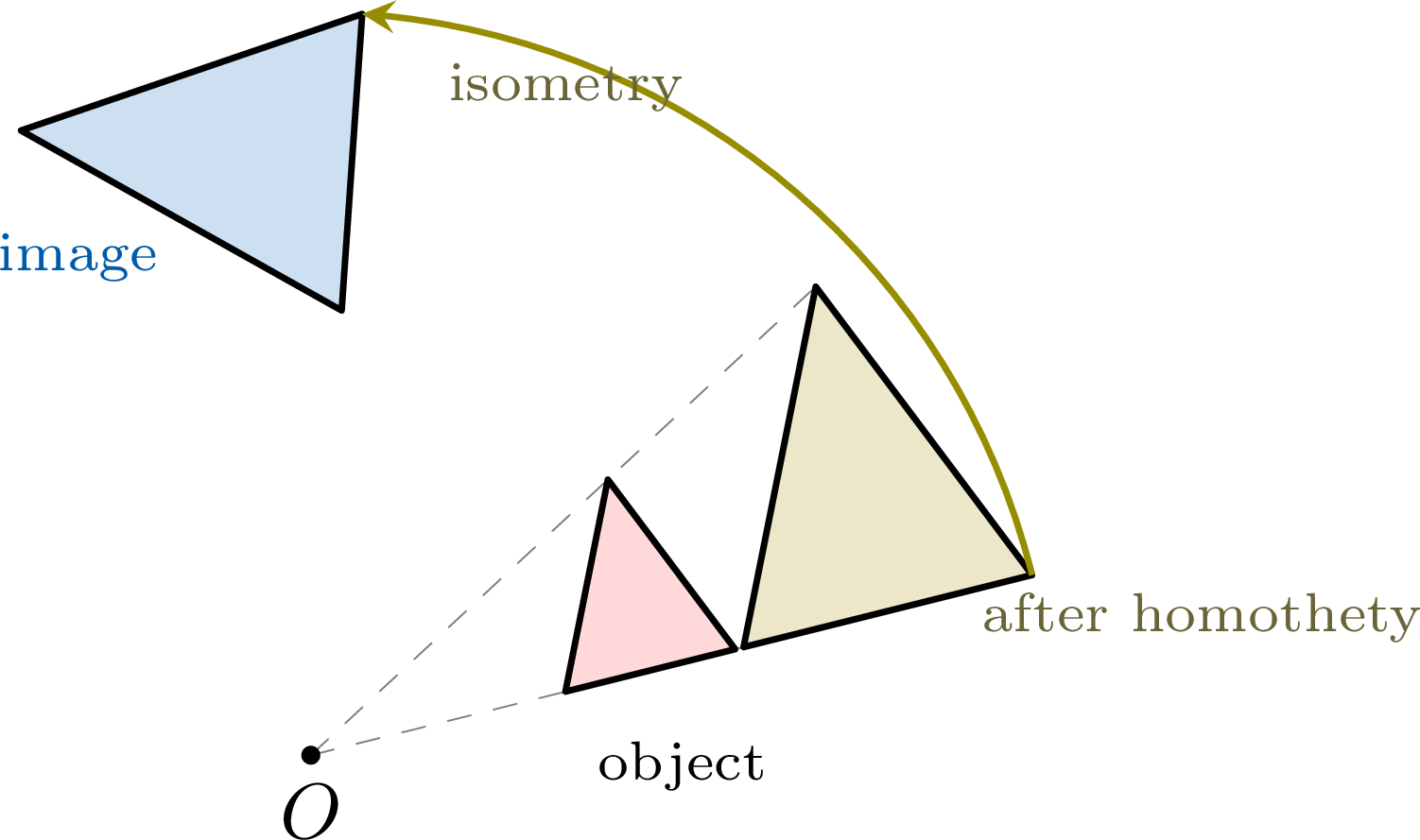
Example
The triangle \(A'B'C'\) is the image of the triangle \(ABC\) under the homothety with centre \(O\) and scale factor \(k = 2\), followed by a rotation about \(O\). In the triangle \(ABC\), \(AB = 3\) cm, \(BC = 4\) cm and the angle at \(B\) measures \(50^\circ\). Give \(A'B'\), \(B'C'\) and the angle at \(B'\), then state the scale factor of the similarity that maps \(ABC\) onto \(A'B'C'\). 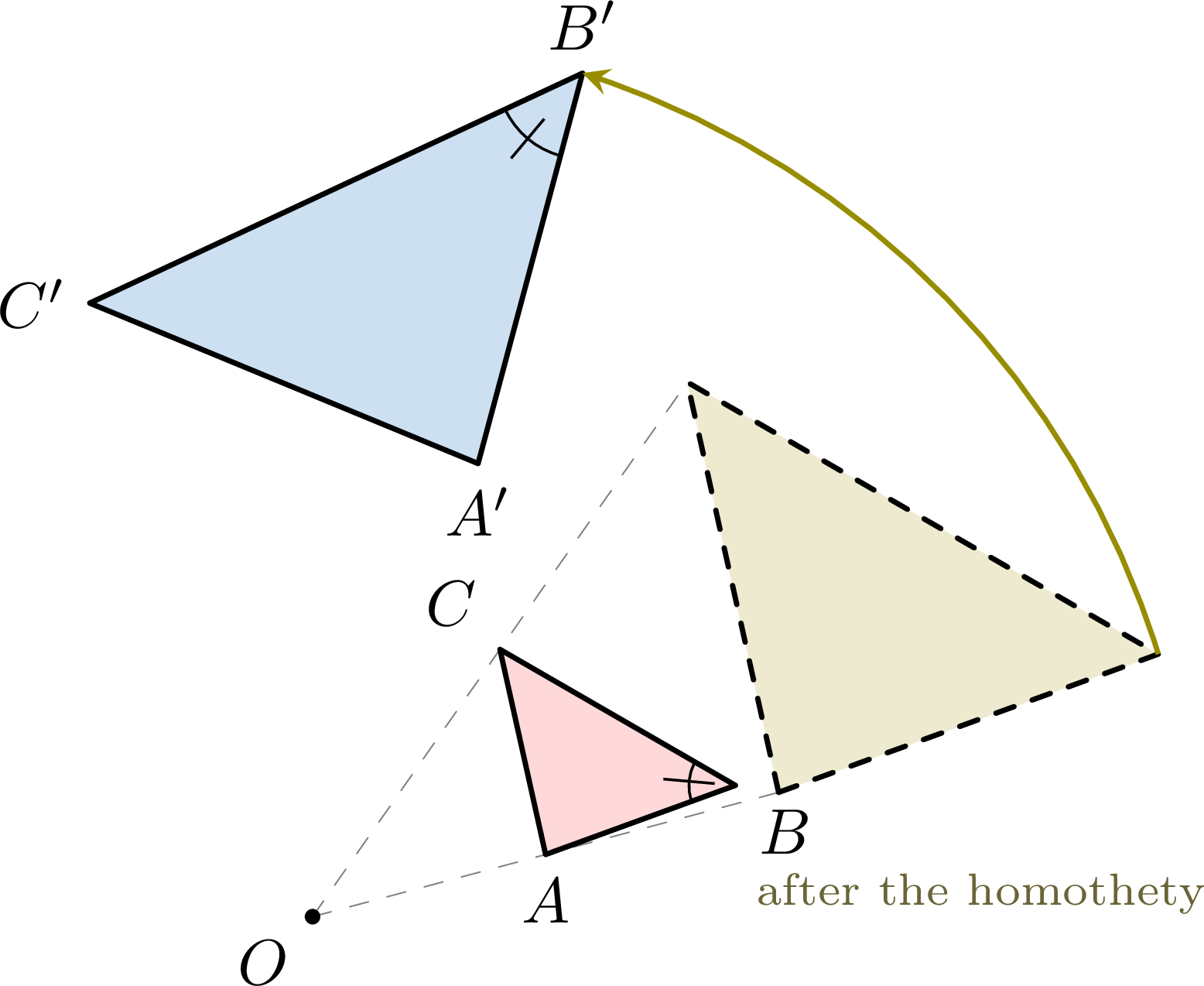
The homothety multiplies every length by \(|k|\) and the rotation, being an isometry, keeps every length: one after the other, every length is multiplied by \(|k| \times 1 = |k|\). $$\begin{aligned}[t] A'B' &= |k| \times AB = 2 \times 3 = 6 \text{ cm} && \text{(homothety } \times |k|\text{, rotation } \times 1) \\
B'C' &= |k| \times BC = 2 \times 4 = 8 \text{ cm.} \end{aligned}$$ Both transformations keep every angle, so the angle at \(B'\) still measures \(50^\circ\). Multiplying all lengths by \(2\) while keeping all angles is exactly a similarity with scale factor \(2\), that is \(|k|\). Check: \(\dfrac{A'B'}{AB} = \dfrac{6}{3} = 2\) and \(\dfrac{B'C'}{BC} = \dfrac{8}{4} = 2\) — the same ratio on both pairs of corresponding sides, as a similarity requires.
Skills to practice
- Finding the Images of Points and Figures
- Finding the Scale Factor
- Finding an Unknown Length
IV
Stretching a Figure
Example
The vertical stretch with scale factor \(2\) whose invariant line is the \(x\)-axis (the \(x\)-axis stays fixed) maps each point \((x, y)\) to the point \((x, 2y)\): the \(x\)-coordinate is kept, the distance to the \(x\)-axis is doubled. The triangle \(ABC\) has vertices \(A(1, 1)\), \(B(5, 1)\) and \(C(2, 3)\). - Give the coordinates of the images \(A'\), \(B'\) and \(C'\), and draw the triangle \(A'B'C'\).
- Compare the lengths \(AB\) and \(A'B'\), then the heights of the two triangles relative to these sides.
- Compare the areas of the two triangles.
- Is the triangle \(A'B'C'\) an enlargement of the triangle \(ABC\)?
- Each point \((x, y)\) goes to \((x, 2y)\): \(A'(1, 2)\), \(B'(5, 2)\) and \(C'(2, 6)\). Each vertex moves vertically, away from the \(x\)-axis.
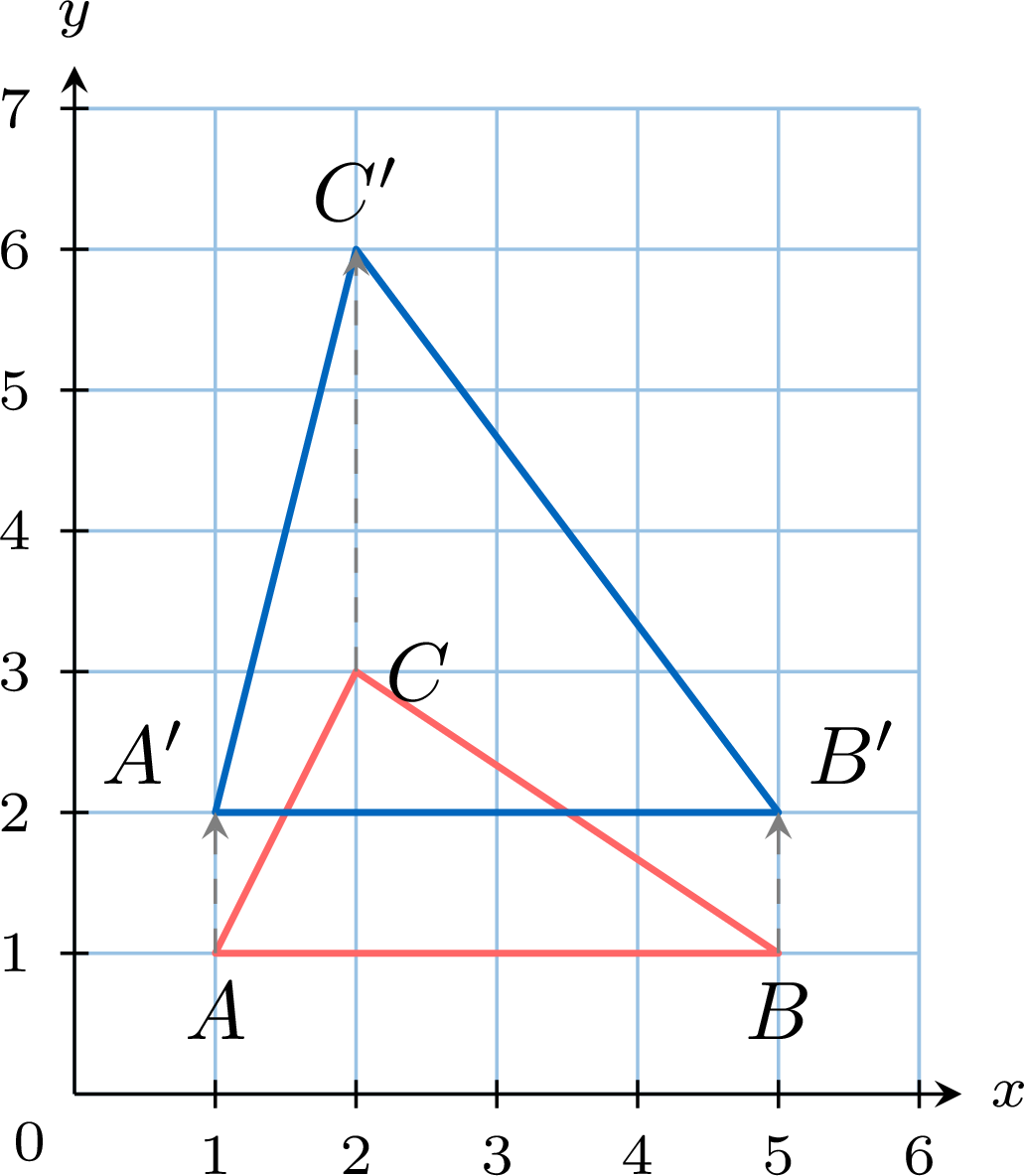
- \(\Segment{AB}\) and \(\Segment{A'B'}\) are horizontal: \(AB = 5 - 1 = 4\) and \(A'B' = 5 - 1 = 4\), the same length. The height from \(C\) is the vertical distance from \(C\) to the line \(\Line{AB}\): \(3 - 1 = 2\); the height from \(C'\) is \(6 - 2 = 4\). It is doubled.
- $$\begin{aligned}[t] \text{area of } ABC &= \frac{\text{base} \times \text{height}}{2} = \frac{4 \times 2}{2} = 4, \\ \text{area of } A'B'C' &= \frac{4 \times 4}{2} = 8 = 2 \times 4. \end{aligned}$$ The area is multiplied by \(2\), the scale factor of the stretch. This holds for every figure: a vertical stretch keeps the horizontal lengths and multiplies the vertical ones by its scale factor, so each square of the grid becomes a rectangle with the same width and a height multiplied by the scale factor; every area is multiplied by the scale factor.
- No. An enlargement (a homothety) multiplies every length by the same number. Here \(AB\) keeps its length while the height is doubled. The triangles do not even have the same shape: with the distance formula, the sides of \(ABC\) are, in increasing order, \(AC = \sqrt{5}\), \(BC = \sqrt{13}\) and \(AB = 4\), those of \(A'B'C'\) are \(A'B' = 4\), \(A'C' = \sqrt{17}\) and \(B'C' = 5\), and they are not proportional: \(\dfrac{4}{\sqrt{5}} \approx 1.79\) but \(\dfrac{5}{4} = 1.25\). A stretch keeps the lengths parallel to its invariant line and multiplies the distances to this line by its scale factor.
Example
The rectangle \(PQRS\) has vertices \(P(8, 1)\), \(Q(12, 1)\), \(R(12, 3)\) and \(S(8, 3)\). Its image under a stretch is the quadrilateral \(P'Q'R'S'\) with \(P'(4, 1)\), \(Q'(6, 1)\), \(R'(6, 3)\) and \(S'(4, 3)\). - Identify the stretch: which coordinate changes, which axis stays fixed, and what is the scale factor?
- What is the nature of the quadrilateral \(P'Q'R'S'\)? Compare the areas of \(PQRS\) and \(P'Q'R'S'\).
- Which stretch maps \(P'Q'R'S'\) back onto \(PQRS\)?
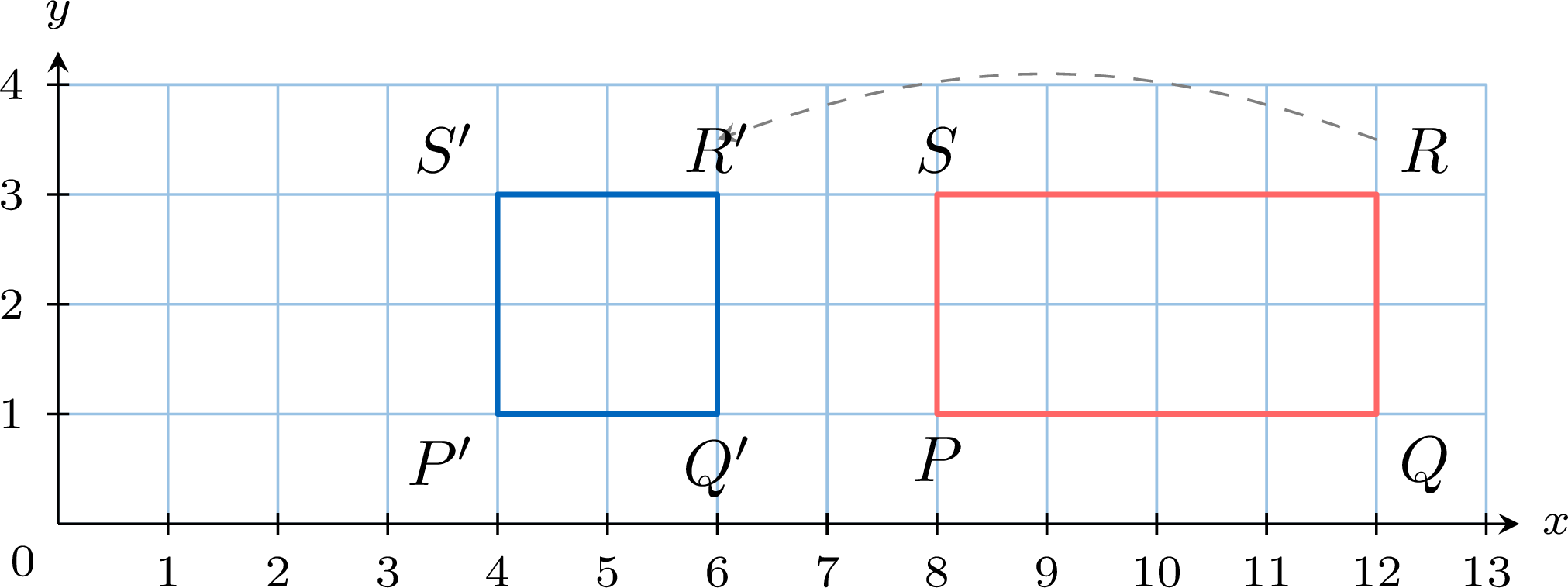
- Each \(y\)-coordinate is kept and each \(x\)-coordinate is halved: \(P(8, 1) \mapsto P'(4, 1)\), \(Q(12, 1) \mapsto Q'(6, 1)\), \(R(12, 3) \mapsto R'(6, 3)\), \(S(8, 3) \mapsto S'(4, 3)\). Each point \((x, y)\) goes to \(\left(\dfrac{1}{2}x, y\right)\): this is the horizontal stretch with scale factor \(\dfrac{1}{2}\) whose invariant line is the \(y\)-axis. A scale factor between \(0\) and \(1\) brings the points closer to the invariant line: the rectangle is compressed.
- The sides of \(P'Q'R'S'\) are horizontal or vertical, so its angles are right angles, and \(P'Q' = 6 - 4 = 2\), \(Q'R' = 3 - 1 = 2\): \(P'Q'R'S'\) is a square of side \(2\). The areas: $$\begin{aligned}[t] \text{area of } PQRS &= PQ \times QR = 4 \times 2 = 8, \\ \text{area of } P'Q'R'S' &= 2 \times 2 = 4 = \frac{1}{2} \times 8. \end{aligned}$$ The area is multiplied by \(\dfrac{1}{2}\), the scale factor.
- The horizontal stretch with scale factor \(2\) whose invariant line is the \(y\)-axis: \((x, y) \mapsto (2x, y)\) doubles the \(x\)-coordinates back, for example \(Q'(6, 1) \mapsto (12, 1) = Q\).
Skills to practice
- Recognising Stretches
- Drawing the Image under a Stretch
- Describing and Justifying Stretches
V
Tiling with Regular Polygons
A tiler wants to cover a floor with identical tiles shaped as a regular polygon, placed edge to edge. He has equilateral triangles, squares, regular pentagons and regular hexagons. Three pentagons placed around a point \(O\) give this: 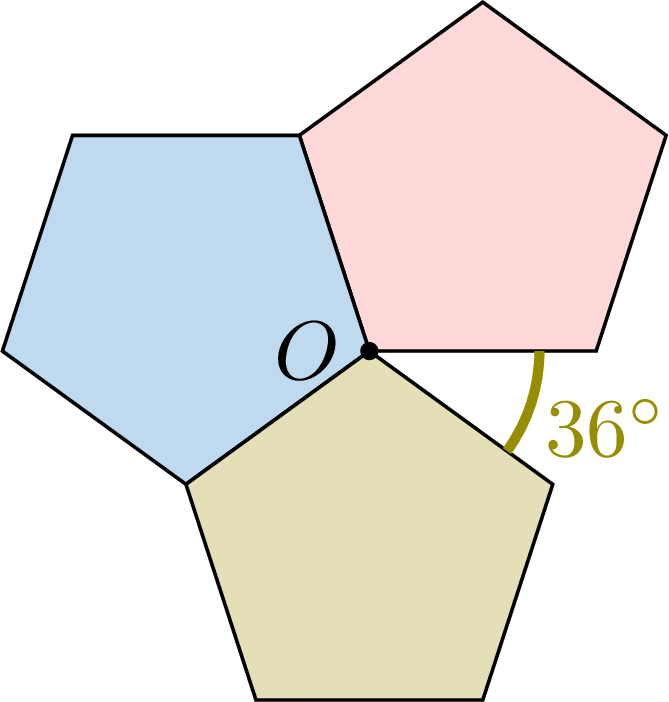
Which shapes can he use?
Around each corner, the tiles must fill the full turn, \(360^\circ\), with no gap and no overlap.
- Equilateral triangles: \(6 \times 60^\circ = 360^\circ\). Squares: \(4 \times 90^\circ = 360^\circ\). Regular hexagons: \(3 \times 120^\circ = 360^\circ\). These three shapes fit.
- Regular pentagons: each angle measures \(108^\circ\). Three pentagons give \(3 \times 108^\circ = 324^\circ\), leaving a gap of \(36^\circ\); four would give \(432^\circ\), more than a full turn. Pentagons do not fit.
Definition — Tiling
A tiling of the plane is a covering of the plane by figures, the tiles, with no gap and no overlap: two tiles may only share points of their edges. A tiling is edge-to-edge when two tiles that touch share either a whole side or a single vertex. It is periodic when two translations with non-collinear vectors leave it invariant; all the tilings studied here are periodic. 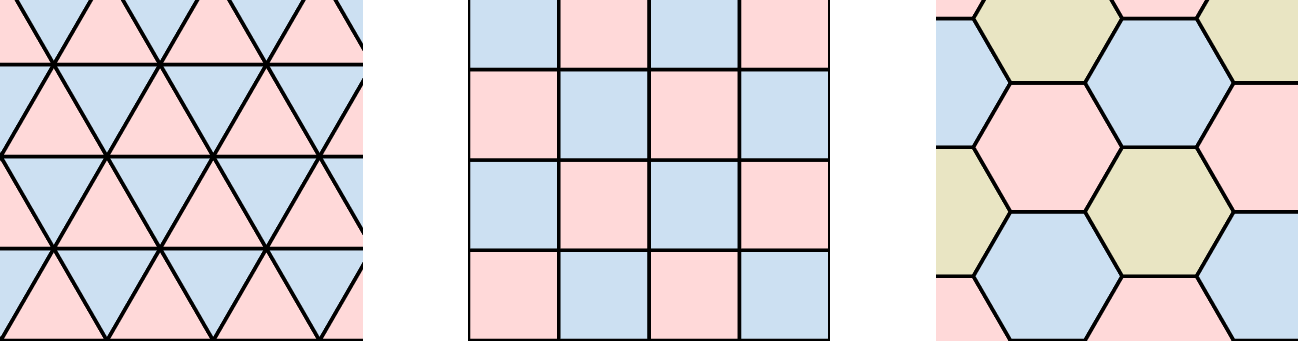
Proposition — Angles of a Regular Polygon
In a regular polygon with \(n\) sides, all the interior angles are equal and all the exterior angles are equal: - each exterior angle measures \(\dfrac{360^\circ}{n}\);
- each interior angle measures \(\dfrac{(n - 2) \times 180^\circ}{n} = 180^\circ - \dfrac{360^\circ}{n}\).
A regular polygon has all its angles equal (Definition “Regular Polygon”). Its \(n\) equal interior angles add up to \((n - 2) \times 180^\circ\), so each of them measures \(\dfrac{(n - 2) \times 180^\circ}{n}\); each is less than \(180^\circ\), so the polygon is convex. At each vertex, the exterior angle is \(180^\circ\) minus the interior angle, so the \(n\) exterior angles are equal too; they add up to \(360^\circ\) (Proposition “Sum of the Exterior Angles”), so each of them measures \(\dfrac{360^\circ}{n}\). Finally, the two forms of the interior angle agree: $$\begin{aligned}[t] \frac{(n - 2) \times 180^\circ}{n} &= \frac{n \times 180^\circ - 360^\circ}{n} && \text{(distributive law)}\\
&= 180^\circ - \frac{360^\circ}{n}. \end{aligned}$$
Proposition — Tilings by One Regular Polygon
Identical regular polygons with \(n\) sides tile the plane edge-to-edge if and only if \(n = 3\), \(4\) or \(6\): equilateral triangles, \(6\) around each vertex; squares, \(4\) around each vertex; regular hexagons, \(3\) around each vertex.
Each angle of a regular polygon with \(n\) sides measures \(\dfrac{(n-2)\times 180^\circ}{n}\). In an edge-to-edge tiling, the polygons that meet at a vertex each have one of their vertices there and fill the full turn. If \(k\) polygons meet at a vertex: $$\begin{aligned}[t] k \times \frac{(n-2)\times 180}{n} = 360 &\iff k = \frac{360\,n}{180\,(n-2)} && \text{(solving for } k\text{)}\\
&\iff k = \frac{2n}{n-2} && \text{(simplifying by } 180\text{)}\\
&\iff k = \frac{2(n-2)+4}{n-2} && \text{(}2n = 2(n-2)+4\text{)}\\
&\iff k = 2 + \frac{4}{n-2} && \text{(splitting the fraction)}. \end{aligned}$$ The number \(k\) is a whole number, so \(n - 2\) divides \(4\): \(n - 2 = 1\), \(2\) or \(4\), that is \(n = 3\) (\(k = 6\)), \(n = 4\) (\(k = 4\)) or \(n = 6\) (\(k = 3\)). Conversely, the three tilings drawn with the definition of a tiling exist.
Example
A floor is tiled edge-to-edge with regular octagons and squares, as below. Check that the tiles fill the full turn around each vertex, and explain why the side of a square equals the side of an octagon. 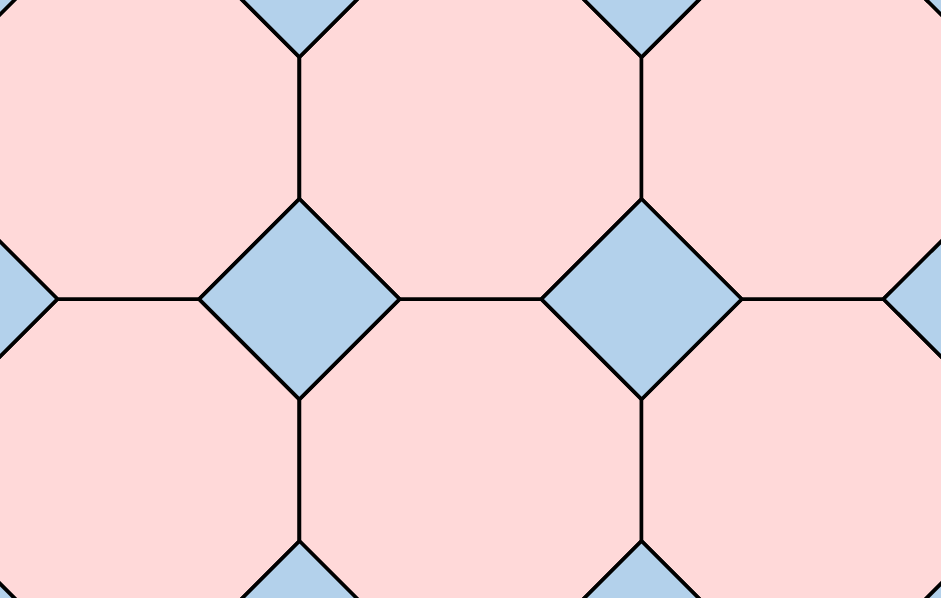
Each angle of a regular octagon measures $$\begin{aligned}[t] \frac{(8-2)\times 180^\circ}{8} &= \frac{1080^\circ}{8} && \text{(}6 \times 180 = 1080\text{)}\\
&= 135^\circ. \end{aligned}$$ At each vertex meet two octagons and one square: $$\begin{aligned}[t] 135^\circ + 135^\circ + 90^\circ &= 360^\circ. \end{aligned}$$ The tiles fill the full turn. The tiling is edge-to-edge, so each side of a square is also a whole side of an octagon: the two sides are equal.
Method — Deforming a Tile
Start from a tile that tiles the plane by translations, such as a square or a parallelogram. - Replace one side by a curve with the same endpoints, which crosses neither itself nor the other sides: a piece is nibbled out of the tile, or added to it.
- Replace the opposite side by the same curve, moved by the translation that maps the first side onto the opposite side: what was removed on one side is added on the other.
- Check that the outline of the new tile does not cross itself: the curve and its copy meet neither each other nor the other sides, except at the corners. Then the new tile has the same area and tiles the plane with the same translations.
Example
A designer starts from a square tile of side \(4\) cm. She cuts a half-disc out of the left side and glues it onto the right side, and cuts a triangle out of the bottom side and glues it onto the top side, as shown by the arrows. Explain why the new tile still tiles the plane, and give its area. 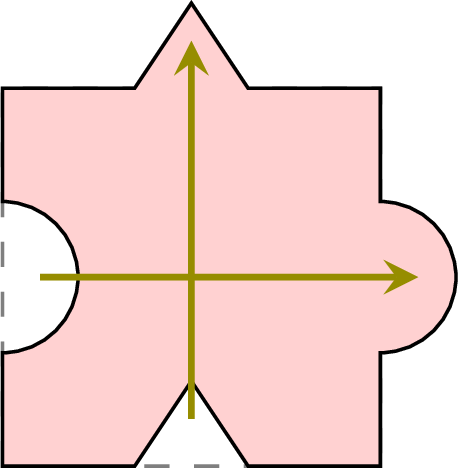
The half-disc cut on the left is glued on the right after the translation of \(4\) cm to the right, and the triangle cut at the bottom is glued at the top after the translation of \(4\) cm upwards. Each side of the tile is therefore the image of the opposite side by one of the two translations of the square tiling: the bump of one tile fills the notch of its neighbour. 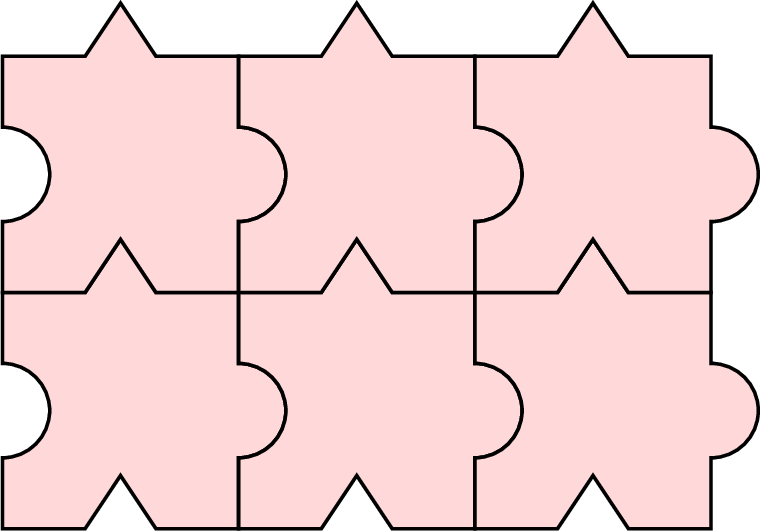
The new tile tiles the plane with the same translations as the square. Nothing was added or lost, so its area is that of the square: $$\begin{aligned}[t] 4 \times 4 &= 16\ \text{cm}^2. \end{aligned}$$
Skills to practice
- Deciding Whether Tiles Fit Around a Vertex
- Computing Angles and Numbers of Tiles
VI
Going further
Skills to practice
- Reasoning with Transformations
- Reasoning with Homotheties
- Investigating Patterns in Transformations
- Solving Real-Life Problems with Transformations
- Quiz
Jump to section