International Baccalaureate · MYP 5
Measurement Accuracy and Error
I
Rounding a Result to Three Significant Figures
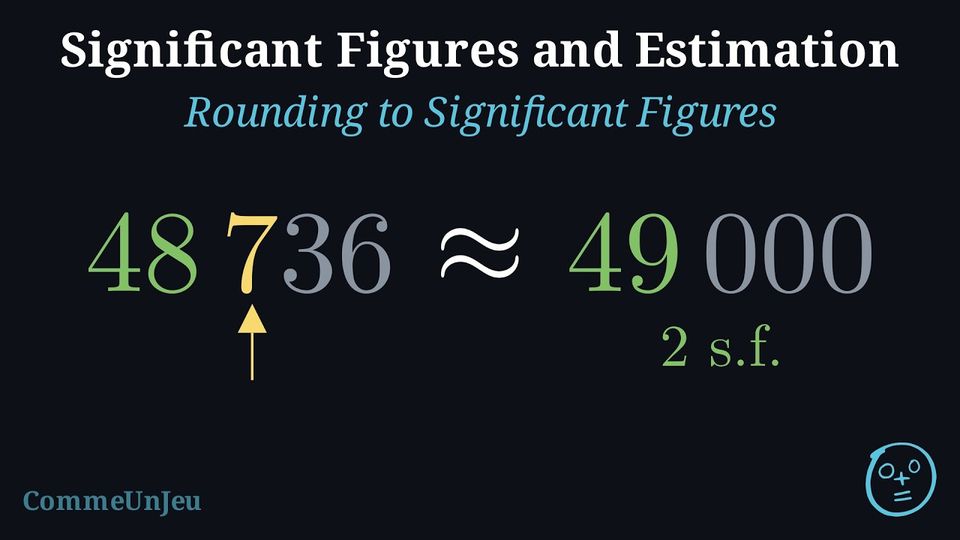
In science and mathematics, exact values are often impossible to obtain, either because of measurement limitations or because some numbers (like \(\pi\) or \(\sqrt{2}\)) cannot be written exactly as terminating decimals. Therefore, we often work with approximations.
Approximating well takes four skills: rounding numbers correctly, quantifying the error introduced by an approximation, linking measurement accuracy to the smallest division on a scale, and giving the interval in which the true value lies.
Approximating well takes four skills: rounding numbers correctly, quantifying the error introduced by an approximation, linking measurement accuracy to the smallest division on a scale, and giving the interval in which the true value lies.
When to Give an Answer to Three Significant Figures
When a calculation gives a short exact value, such as \(15\) or \(2.75\), the answer is written in full. When the result goes on — a division that does not end, such as \(20 \div 7 = 2.857142\ldots\) — and the question does not say how to round, a common convention is to give the answer to \(3\) significant figures: \(20 \div 7 \approx 2.86\). Three figures are enough for most uses; for a result computed from measurements, more figures would even claim a precision that the measurements do not have. Two rules go with this convention:
- keep the full calculator value during the calculation, and round only the final answer;
- give an amount of money to the cent, that is to \(2\) decimal places, rather than to \(3\) significant figures.
Example
Consider the number \(N = 1204.5678\). - Rounded to 2 decimal places (2 d.p.): \(1204.57\) (the 3rd decimal digit is \(7\), so we round up).
- Rounded to 3 significant figures (3 s.f.): \(1.20 \times 10^3\) (the next digit is \(4\), so we round down).
(Writing \(1200\) is acceptable here, but \(1.20\times 10^3\) makes the “3 s.f.” explicit.)
Skills to practice
- Rounding to Significant Figures and in Standard Form
II
Calculating Absolute, Relative and Percentage Errors
On 23 September 1999, NASA lost the Mars Climate Orbiter: the probe, part of a \(\dollar 327\) million mission with its twin lander, burned up in the Martian atmosphere instead of entering orbit. The investigation found the cause. One piece of software reported the thruster impulses in pound-force seconds, while the navigation system read those numbers as newton seconds — and \(1\) pound-force second \(\approx 4.45\) newton seconds. Every reported value was therefore \(4.45\) times too small.
- The navigation system used the value \(1\) where the true value was \(4.45\). Compute the percentage error \(\left|\frac{1 - 4.45}{4.45}\right| \times 100\pourcent\) committed on every single thruster firing.
- Tiny errors are often harmless. Was this one tiny? What simple habit — checking the order of magnitude of a result — could have caught the problem months before the loss of the probe?
Definition — Absolute, Relative and Percentage Error
Let \(V_{\text{exact}}\) be the true value and \(V_{\text{approx}}\) be the approximated value. - The signed error is \(e = V_{\text{approx}} - V_{\text{exact}}\).
- The absolute error is \(|e| = |V_{\text{approx}} - V_{\text{exact}}|\).
- The relative error (when \(V_{\text{exact}}\neq 0\)) is $$ r = \left|\frac{V_{\text{approx}} - V_{\text{exact}}}{V_{\text{exact}}}\right|. $$
- The percentage error is $$ \epsilon = r \times 100\pourcent = \left|\frac{V_{\text{approx}} - V_{\text{exact}}}{V_{\text{exact}}}\right|\times 100\pourcent. $$
Example
The estimated length of a table is \(150\) cm, while the actual length is \(145\) cm. Calculate the absolute error and the percentage error. - Absolute error: \(|150 - 145| = 5\) cm.
- Percentage error: $$\left|\frac{150 - 145}{145}\right|\times 100\pourcent \approx 3.45\pourcent.$$
Skills to practice
- Calculating Absolute and Percentage Errors
III
Determining the Accuracy of a Measurement
When we take measurements, we usually read a scale (a ruler, a thermometer, a balance, \(\dots\)). Often, the true value lies between two marks. We record the closest mark, so the recorded value is an approximation.
If the smallest division on the scale is \(u\), then the measurement can be wrong by up to half of this division, i.e. by \(\pm \dfrac{u}{2}\).
The same holds for any value displayed or rounded to a unit \(u\) (a digital display, a value rounded to the nearest multiple of \(u\)): the true value lies within \(\pm \dfrac{u}{2}\) of it. A digital scale shows \(2.48\) kg, to the nearest \(0.01\) kg: the true mass lies between \(2.475\) kg and \(2.485\) kg.
Definition — Accuracy Rule
If the smallest division on the scale is \(u\), then:$$ \text{accuracy} = \pm \frac{u}{2}. $$ This is sometimes called the reading error or the absolute uncertainty. It is the largest possible reading error: it assumes the reading is taken to the nearest mark, and it does not include other sources of error (instrument, method). Example
A ruler has markings every \(1\) cm (so \(u=1\) cm). A pencil is measured to be \(14\) cm. - Determine the accuracy of the measurement.
- State the interval within which the true length lies.
- The accuracy is \(\pm \dfrac{1}{2}\times 1\text{ cm}=\pm 0.5\text{ cm}\).
- The true length \(L\) is in the interval \([13.5,\;14.5)\) cm, i.e. \(13.5 \le L < 14.5\) cm.
Skills to practice
- Understanding Error and Accuracy
- Determining Accuracy and Ranges
IV
Going further
Skills to practice
- Solving Problems with Errors in Context
- Investigating Patterns in Rounding Errors
- Quiz
Jump to section