International Baccalaureate · MYP 1
Area
I
Units of Area, the Are and the Hectare
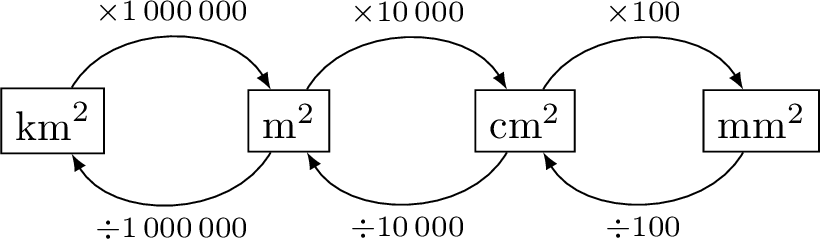
Method — Converting Using Multiplication or Division
- Use multiplication to go from a larger unit to a smaller one (like square metres to square centimetres).
- Use division to go from a smaller unit to a larger one (like square centimetres to square metres).
Definition — Units of Area
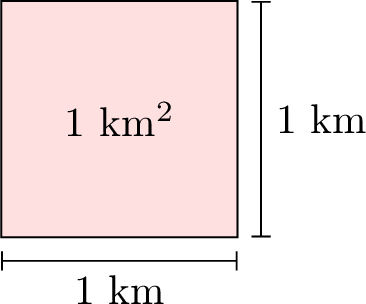
- Square kilometre \(\left(\mathrm{km}^2\right)\): A very large unit of area, the area of a square with sides of \(1\) km: about \(140\) football pitches.
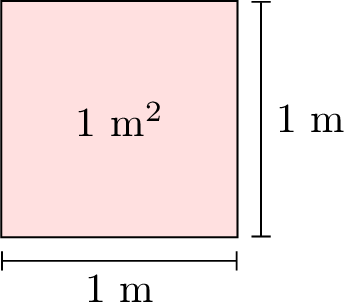
- Square metre \(\left(\mathrm{m}^2\right)\): An everyday unit of area, the area of a square with sides of \(1\) m: about the size of a small table top.
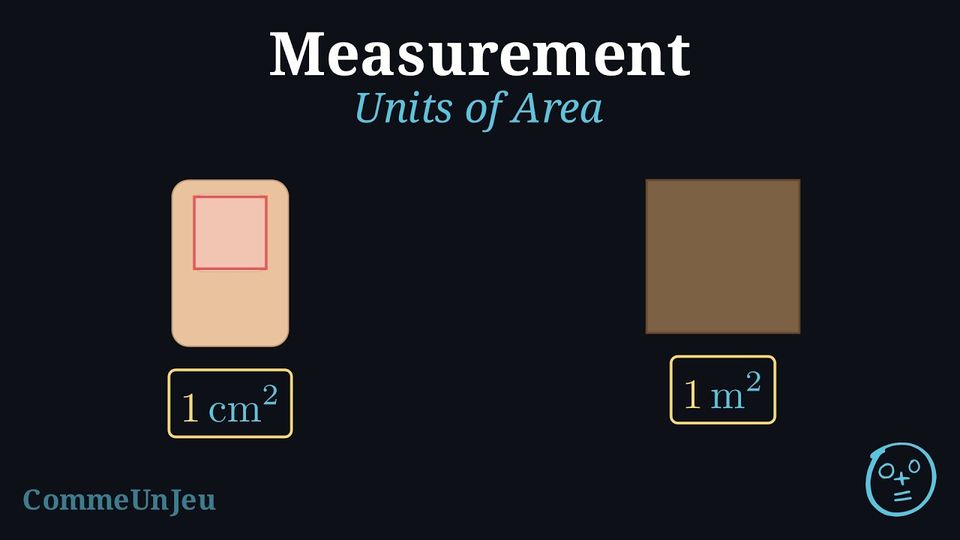
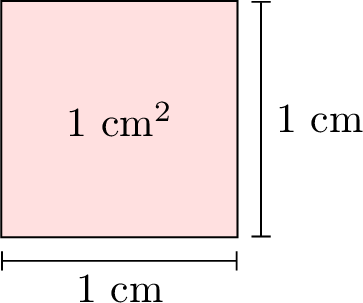
- Square centimetre \(\left(\mathrm{cm}^2\right)\): A small unit of area, about the size of a fingernail.
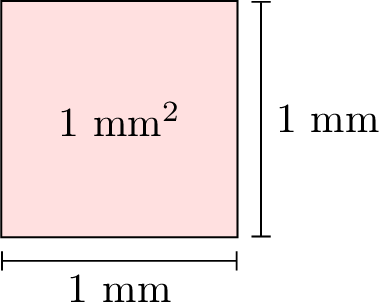
- Square millimetre \(\left(\mathrm{mm}^2\right)\): A very small unit of area, about the size of a tiny dot made by a pencil.
Skills to practice
- Converting with the Are and the Hectare
II
The Area Formulas of the Square and the Rectangle
Proposition — The Area Formulas of the Square and the Rectangle
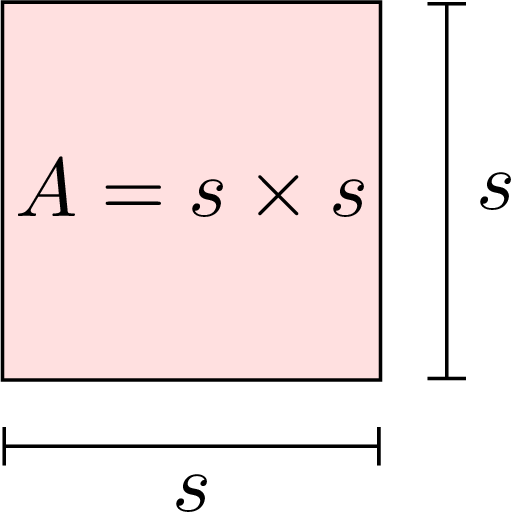
- Square: the area of a square is equal to its side multiplied by itself. In words: \(\text{area} = \text{side} \times \text{side}\). In letters, with \(s\) the side: $$A = s \times s.$$
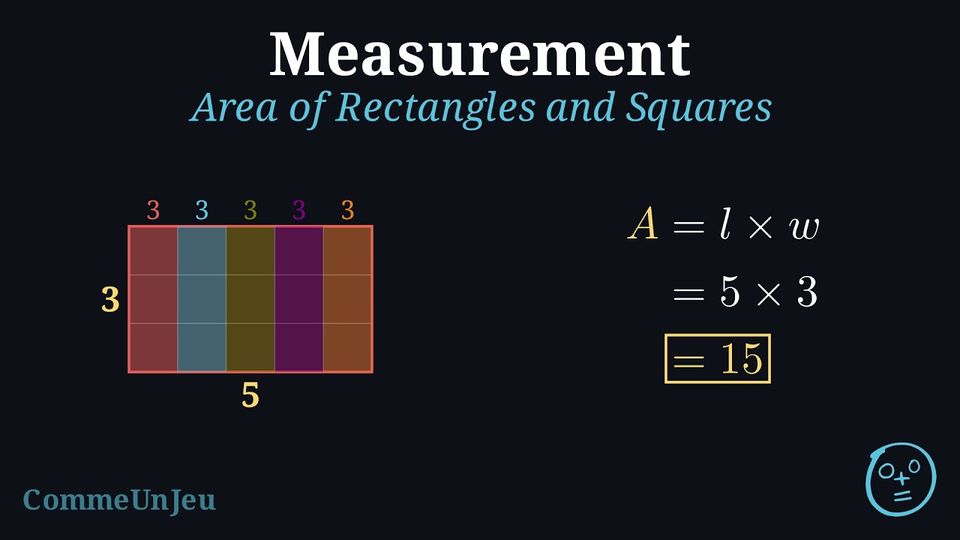
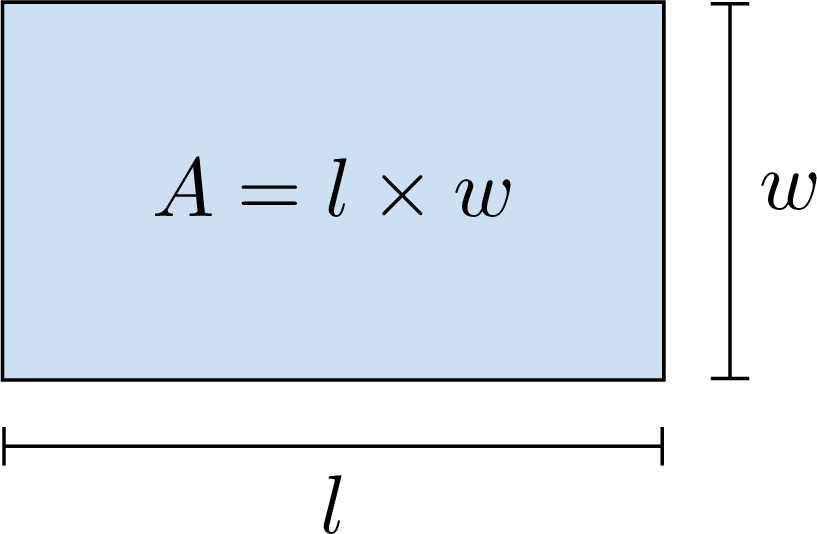
- Rectangle: the area of a rectangle is equal to the product of its length and its width. In words: \(\text{area} = \text{length} \times \text{width}\). In letters, with \(l\) the length and \(w\) the width: $$A = l \times w.$$
Method — Using a Formula: Replacing the Letters
For a rectangle of length \(l = 4.6\) m and width \(w = 2.5\) m: - Write the formula with its letters: \(A = l \times w\).
- Replace each letter by its value, all the lengths being in the same unit (convert first if needed): \(A = 4.6 \times 2.5\).
- Calculate: \(A = 11.5\).
- Write the unit, the unit of area that matches the lengths: \(A = 11.5 \, \text{m}^2\).
Example
- A rectangle is \(4.6\) m long and \(2.5\) m wide. Calculate its area and its perimeter.
- A square has a side of \(6.5\) cm. Calculate its area.
- A rectangle is \(7.5\) m long and \(120\) cm wide. Calculate its area in \(\text{m}^2\).
- A rectangle is \(5\) m long and \(\dfrac{3}{4}\) m wide. Calculate its area.
- \(A = l \times w = 4.6 \times 2.5 = 11.5 \, \text{m}^2\) and \(P = 2 \times (l + w) = 2 \times (4.6 + 2.5) = 2 \times 7.1 = 14.2\) m.
- \(A = s \times s = 6.5 \times 6.5 = 42.25 \, \text{cm}^2\).
- The two lengths must be in the same unit: \(120\) cm \(= 1.2\) m. Then \(A = 7.5 \times 1.2 = 9 \, \text{m}^2\) (check in cm: \(750 \times 120 = 90\,000 \, \text{cm}^2 = 9 \, \text{m}^2\)).
- \(A = 5 \times \dfrac{3}{4} = \dfrac{15}{4} \, \text{m}^2\), and \(\dfrac{15}{4} = 15 \div 4 = 3.75\): the area is \(3.75 \, \text{m}^2\).
Skills to practice
- Calculating with the Formula
- Finding Area and Perimeter with the Formulas
- Converting Before Calculating
III
Cutting and Completing
Method — Finding the Area of a Composite Figure
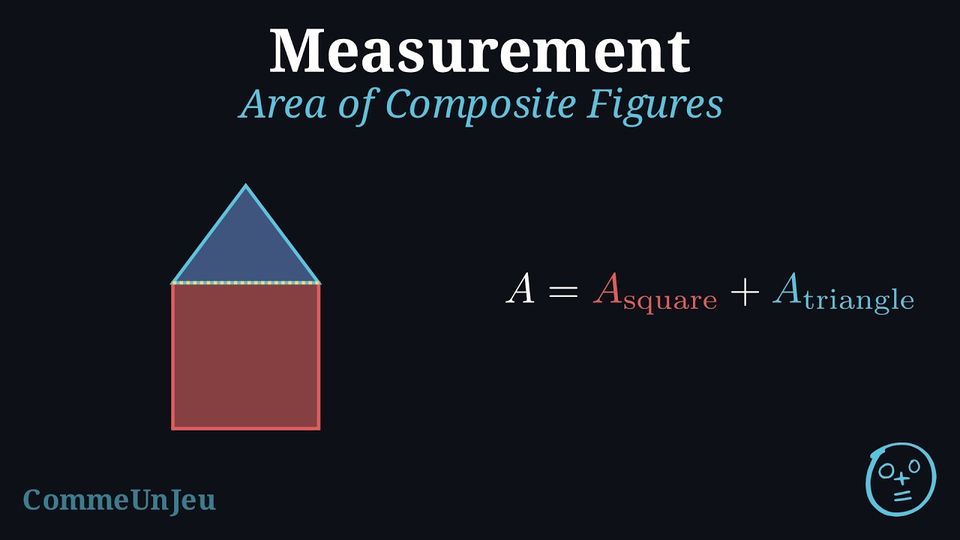
To find the area of a composite figure, follow these steps: - Divide the figure into simple, non-overlapping shapes whose area can be calculated with a formula (rectangles, squares, triangles, …).
- Find the area of each simpler shape using the appropriate formula.
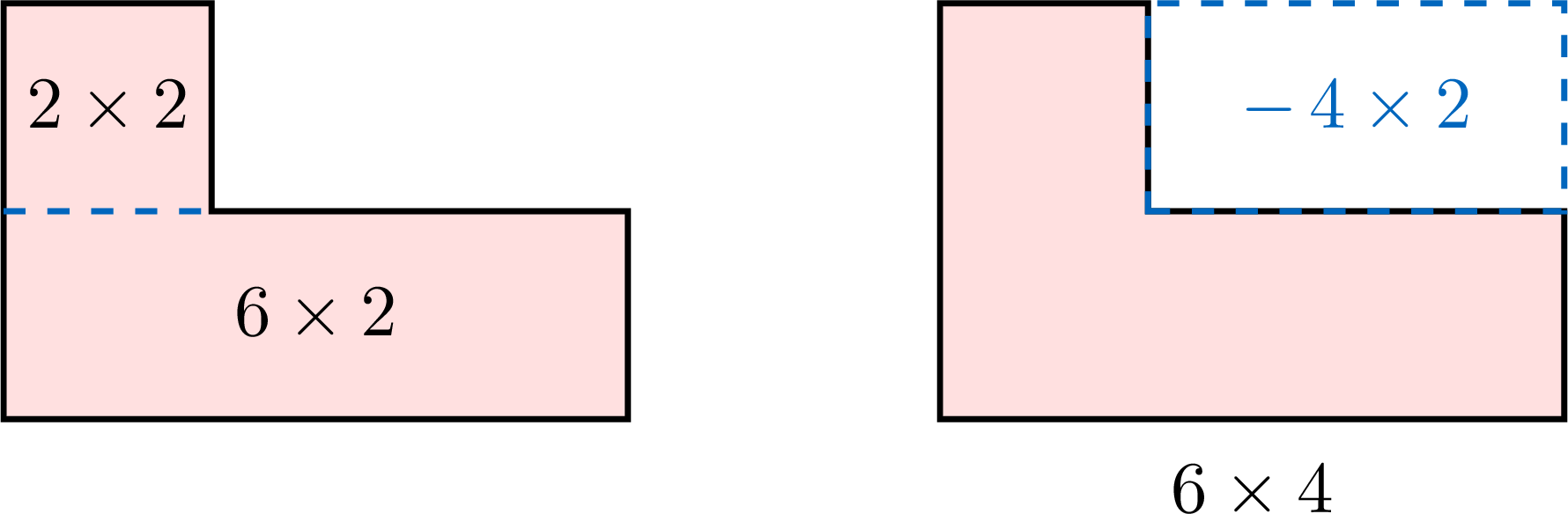
- Add the areas together to find the total area of the composite figure, or, when a part is missing from a rectangle, subtract its area from the area of the rectangle.
Proposition — Area of a Triangle
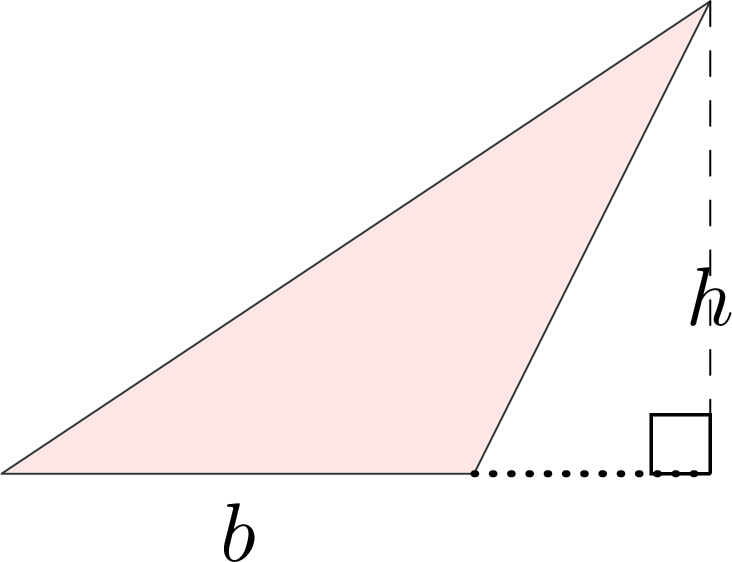
The area of a triangle is found by multiplying the base by the height and dividing by 2: $$\text{Area of a triangle} = \dfrac{\text{base} \times \text{height}}{2}$$ $$A = \dfrac{b \times h}{2}$$ where \(b\) is the length of the base and \(h\) is the corresponding height. The height can fall outside the triangle: the base is then extended with a dotted line, and the height meets this extension at a right angle (figure on the right). 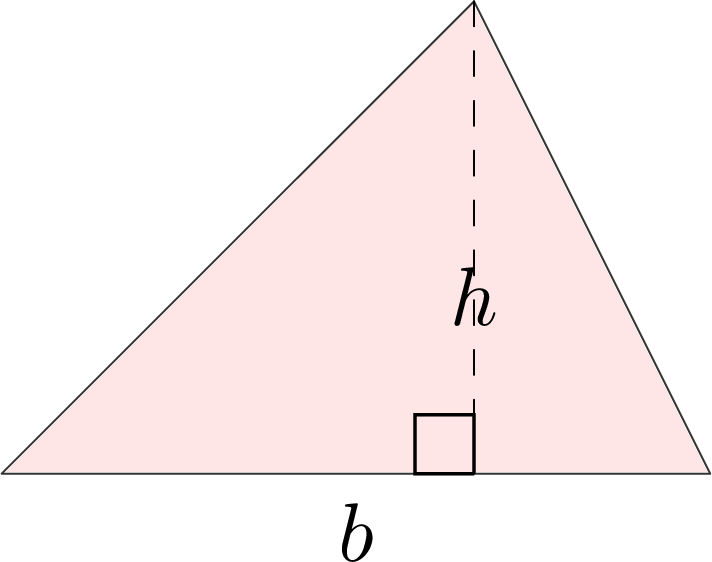
Example
This L-shaped figure is made of rectangles. Find its area in two different ways. 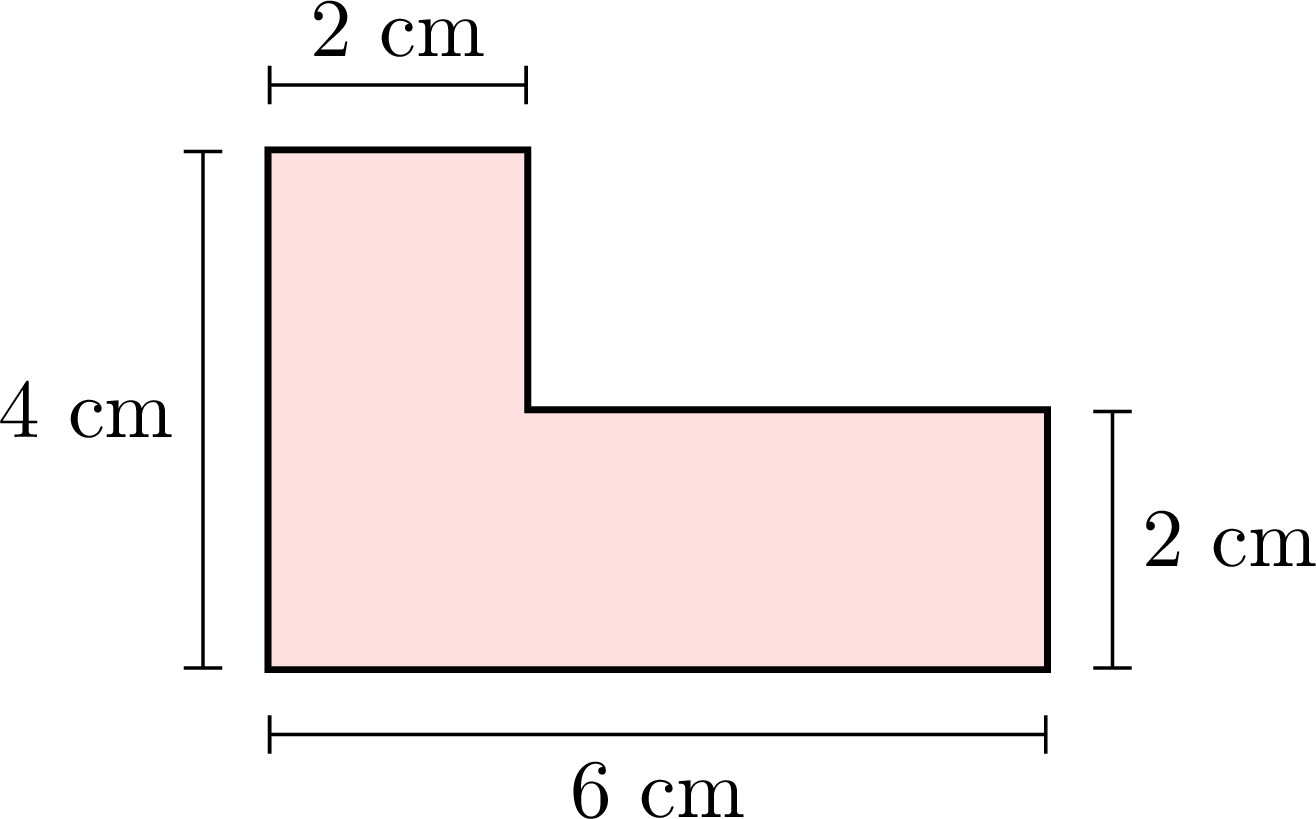
Skills to practice
- Finding Areas by Cutting or Completing
IV
Going further
Skills to practice
- Using the Formulas in New Ways
- Using the Formulas to Solve Problems
- Investigating Area Patterns
- Quiz
Jump to section